Author: admin

  • Tailor Made Ferrari Roma

    Tailor Made Ferrari Roma

    A ONE-OF-A-KIND FERRARI EXPLORES PARALLELS BETWEEN ITALIAN AND JAPANESE DESIGN, CULTURE AND CRAFTS IN A CONTEMPORARY CREATIVE COLLABORATION

    [source: Ferrari]

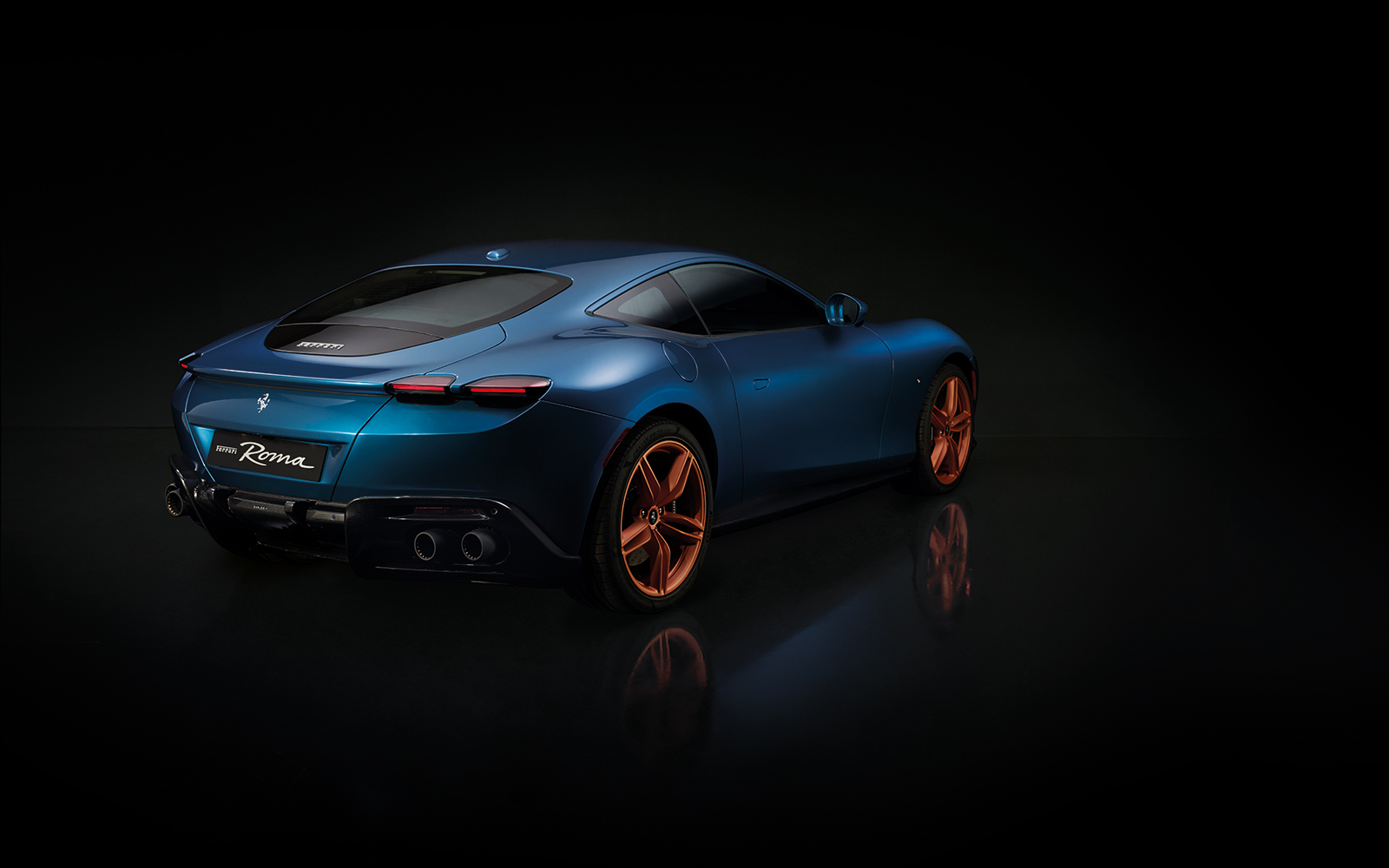
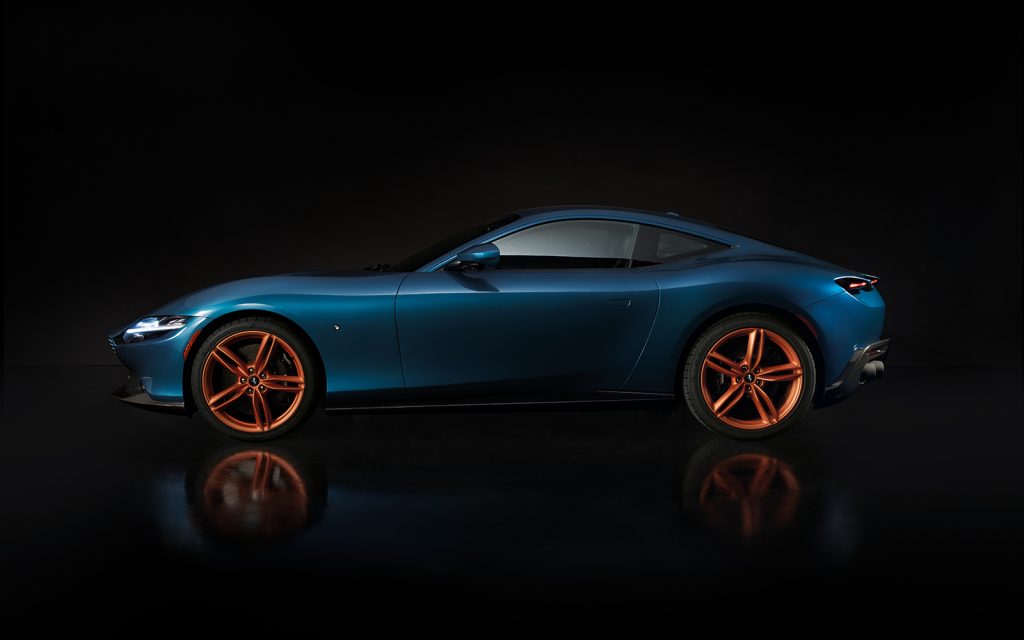
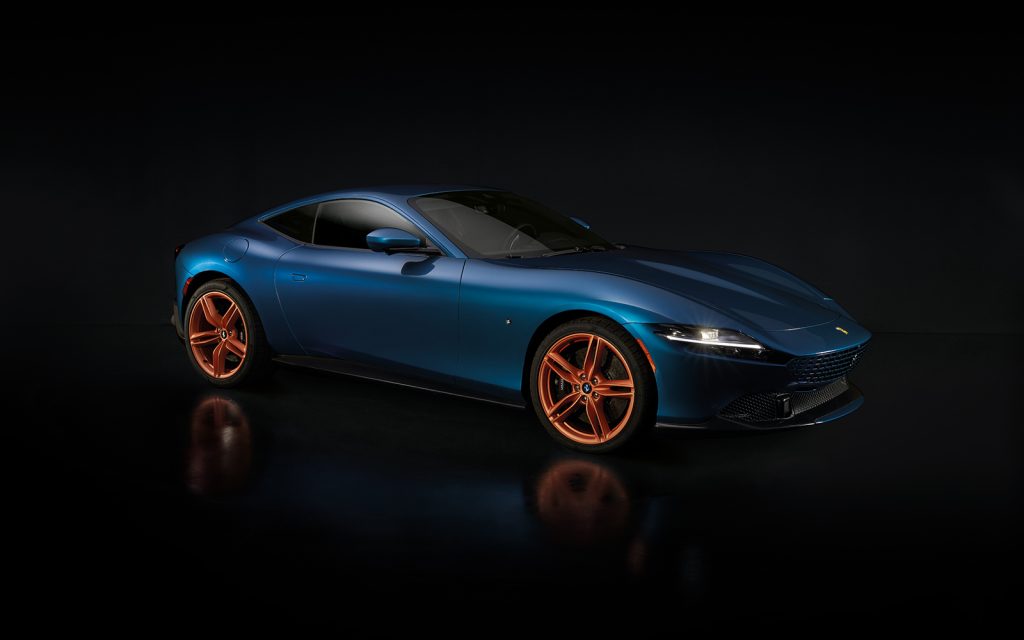
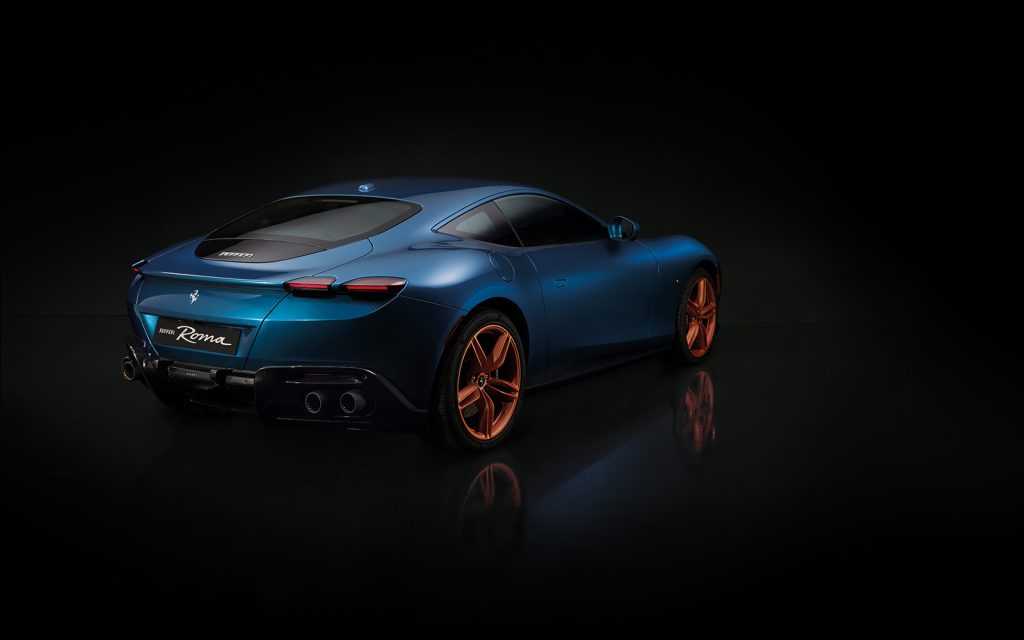
    Maranello, 17 May 2022 – Ferrari unveils a one-of-a-kind Ferrari Roma model, crafted by its bespoke Tailor Made department. The car features exquisite traditional Japanese-inspired detailing while retaining the clean, sophisticated elegance of the original car.

    Ferrari Tailor Made is an exclusive programme for those who wish to customise each element of their Ferrari to create a vehicle that truly reflects their personality and tastes. Customers who participate in the Tailor Made programme are assisted by a team of experts led by a personal designer that interprets their desires whilst upholding the aesthetic standards of the Ferrari brand.
    This particular car’s story began when Evan Orensten and Josh Rubin, the founders of the award-winning independent US publication dedicated to design, culture and technology COOL HUNTING, were offered, and accepted, the opportunity of customising a Ferrari Roma, to explore how far Ferrari’s bespoke personalisation programme could go and really push the boundaries.

    They met Flavio Manzoni, Ferrari Chief Design Officer, in the Ferrari Tailor Made showroom in New York. They had just returned from several research trips to Japan where they had immersed themselves in the country’s traditional crafts and artisanal methods, and proposed bringing some of those ideas and unique materials into the Tailor Made journey as envisioned by COOL HUNTING.

    Flavio Manzoni and his team were inspired by the parallels between Italian and Japanese culture and design philosophy: a single-minded devotion to quality, an emotional involvement with the client, and exquisite skills in craftsmanship that have been passed down from generation to generation.
    An idea formed – to create a Ferrari featuring some of the unique materials developed from traditional Japanese techniques while employing Ferrari’s customary innovation to modify them to accommodate the requirements of durability and functionality that a modern high-performance car demands.

    Traditional Japanese indigo dyes inspired the Ferrari Roma’s colour scheme, particularly the vivid blue exterior paint which was specially developed for this car and named Indigo Metal. This vivid colour perfectly enhances the purity of the Ferrari Roma’s shape – light appears to flow over its bodywork, accentuating its lines through highlights and shade.

    Indigo features prominently in Japanese design culture, and the traditional dye is produced naturally. COOL HUNTING had visited Toyama, one of only five remaining indigo farms in Tokushima, Japan’s traditional indigo-growing region. They learned that the dye comes from a green plant which, when harvested and fermented, becomes sukumo, traditional dried Japanese indigo that is mixed with lye, sake and limestone powder to create authentic Hon-Ai indigo dye. Because of its antimicrobial properties it was traditionally used for linens, bedding and clothing.
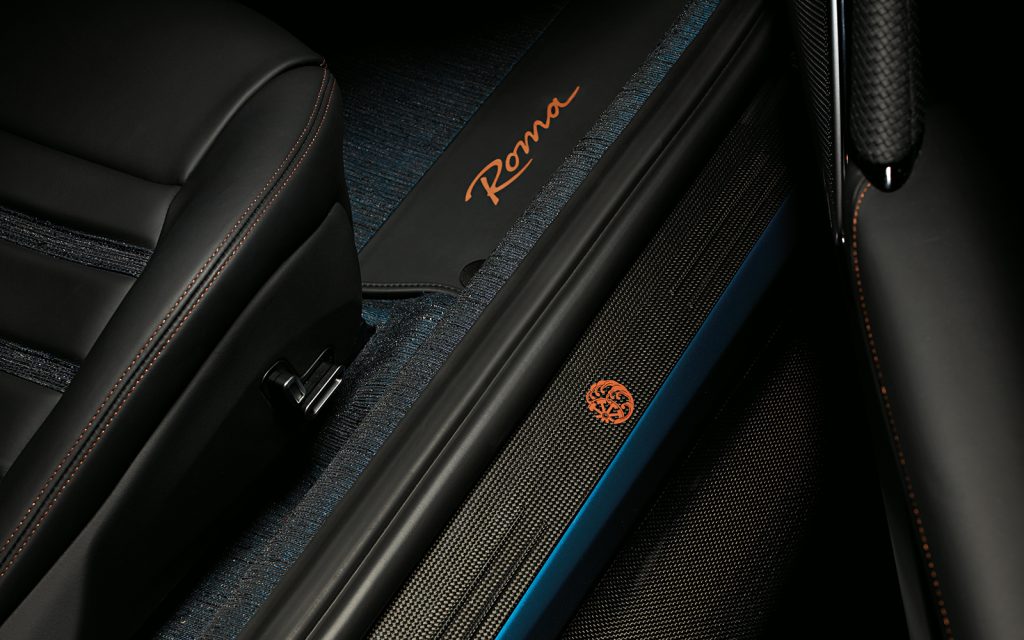
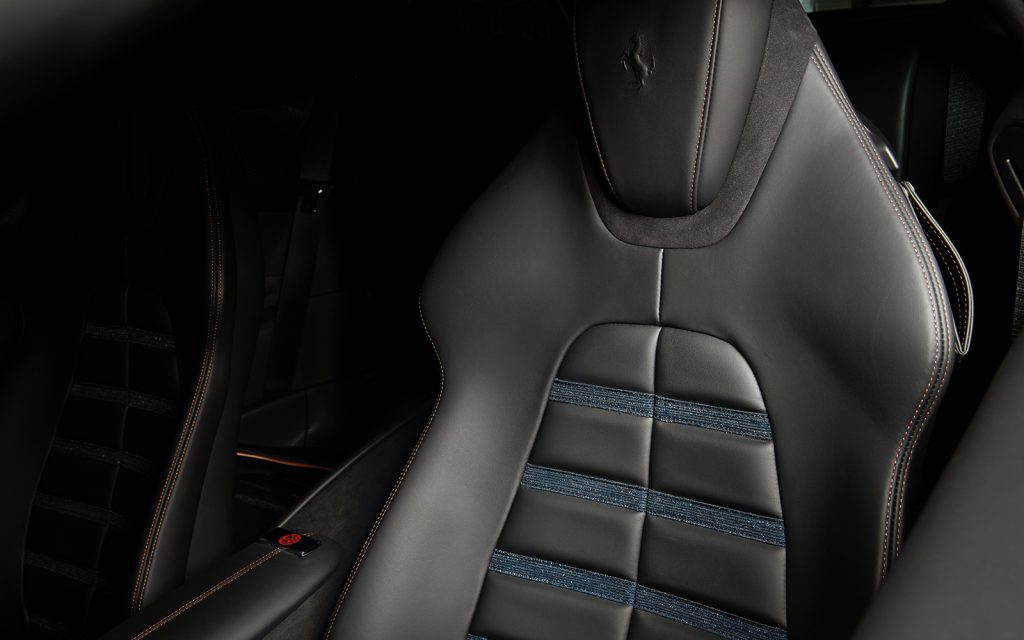
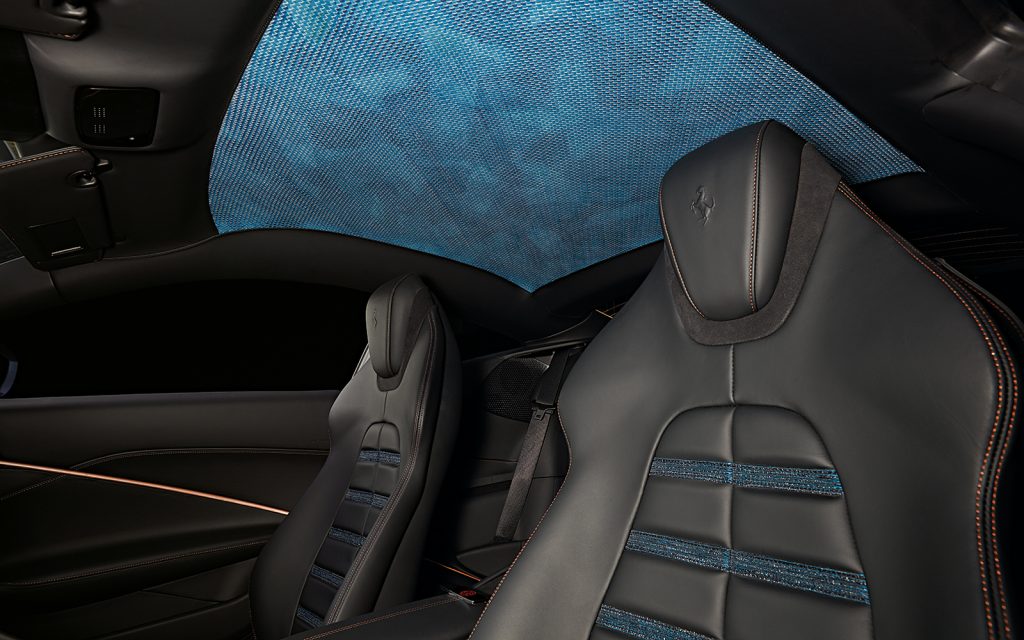
    The same colour palette is used to tie together the vehicle’s exterior and interior into one subtle, holistic statement. The indigo shade is also found in the sakiori fabric used for the seat trim inserts and the carpets.

    Sakiori is one of the world’s oldest examples of upcycling, dating from the 1700s when cotton and silk were available only to Japan’s nobility and the very wealthy. Worn-out kimonos were disassembled, their fabric cut into strands and rewoven with new fibres, creating a material that was both warm, comfortable and durable. The word comes from the Japanese saku (to rip up) and oru (to weave).

    An innovative solution was identified in making sakiori a viable material. Two vintage kimonos originally made in Amami Oshima, an island in Japan’s southern archipelago were used—an indigo-dyed kimono approximately 75 years old and one approximately 45 years old, dyed in both indigo and the island’s celebrated Amami Oshima Tsumugi mud-based dye. Instead of weaving the kimono strands with cotton or silk as is traditional, it was woven with high-tensile nylon, ensuring the durability required of this material in its application inside the vehicle. This new textile was created in the same place the original materials originated from by Hajime Shoji.
    The indigo theme is carried through to the Ferrari Roma’s headlining – a beautifully detailed piece of craftsmanship and design which is exclusively experienced by those sitting in the car. It is comprised of two indigo-dyed hides made with Asai Roektsu in Kyoto—one with a unique solid colour crafted to match the car’s colour scheme, and a hand-painted hide using the Roketsu method, which can be traced back to the 8th century. It is a wax resist-dyeing method that forms intricate repeated patterns around a single colour, and was commonly used to decorate the silk or cotton of kimonos and obis. The hides were then sent to Italy, where they were cut into strips and hand-woven by Italian artisans in a process called intreccio, forming an elegant one-of-a-kind work of art.

    The Ferrari Roma’s interior door handles also take their inspiration from Japan – they are enclosed in tightly hand-woven strips of black leather in an homage to tsukami, the ancient art of wrapping the grips of Katana swords.

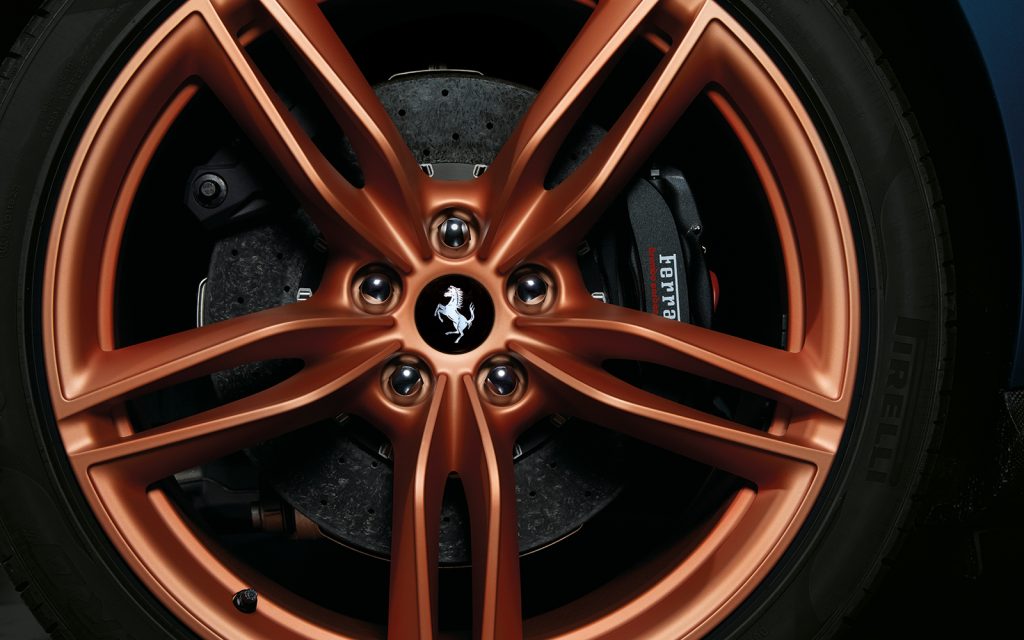
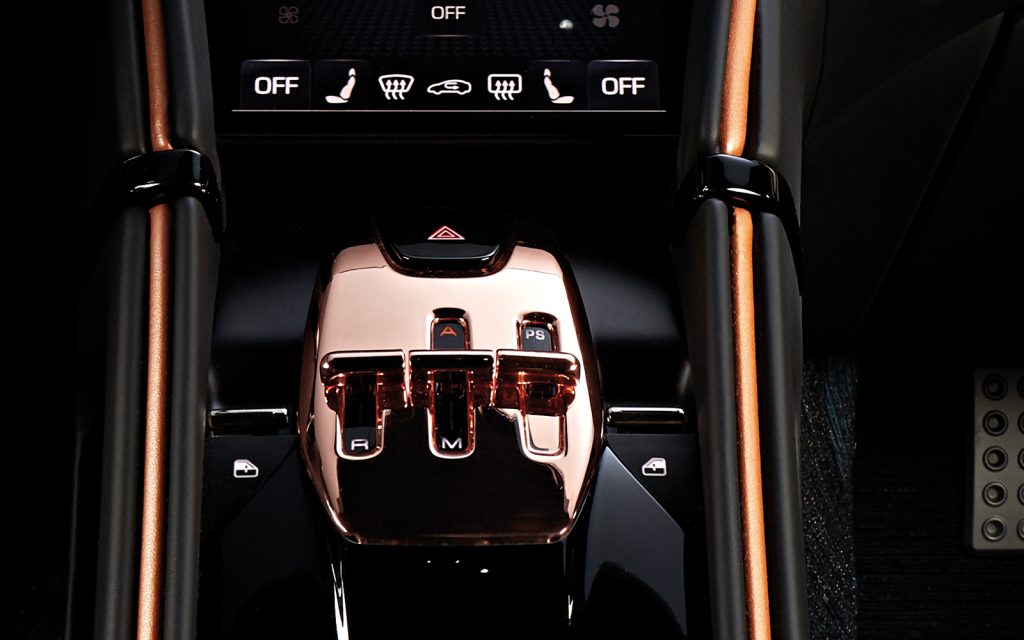
    The COOL HUNTING team were further inspired by a visit to Kaikado, a Kyoto-based family business known for its iconic copper tea canisters. Now made by the fifth and sixth generations of the family, the canisters are so skilfully crafted that they form a vacuum seal as the lid gently falls onto the body. The copper also adopts a unique natural patina with use. Inspired by this, Copper plating is found in details on the Ferrari Roma’s gear shift gate surround and levers, which were plated in Japan. The outline of the dual cockpits, the wheel rims and the kamon are also made in this colour.
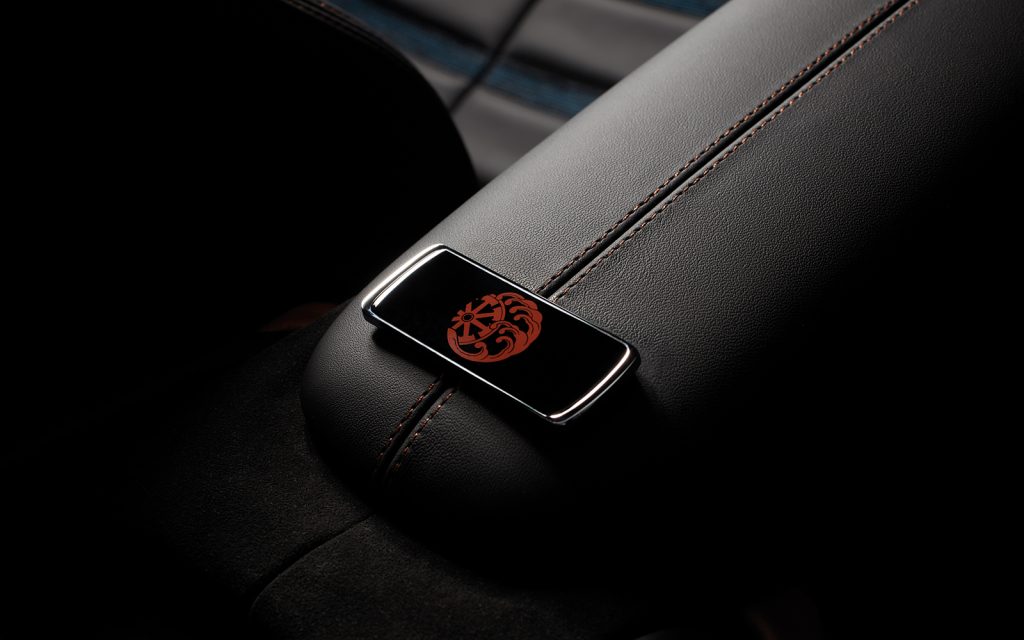
    The unique crest on the car’s dedication plate on the central armrest and door sills is a custom-made “kamon,” a symbol passed down from generation to generation in Japan. Designed by Kyogen, it represents a wheel from an ox-drawn carriage (popular transportation among aristocrats during the Heian period, 794-1185) combined with the eight pistons of the Ferrari Roma’s V8 engine forming its spokes. The numeric theme is continued in the eight wave crests that encircle the wheel – symbols of good luck, power and resilience.

    This subtle but exceptionally detailed Ferrari Roma brings together Italian and Japanese design culture in a harmonious form. It is a beautiful example of the unlimited wealth of combinations and possibilities that are available through the Ferrari Tailor Made programme.

    The Ferrari Roma features refined proportions and timeless design combined with unparalleled performance and handling. Not only is the Ferrari Roma an icon of Italian design, but it also represents the pinnacle of performance in this category, thanks to its 620-cv turbo-charged V8 from the family of engines that won the overall International Engine of the Year award four years running.

    The Tailor Made Ferrari Roma Specially Crafted for COOL HUNTING will be on display in the Ferrari Tailor Made Showroom during the New York Design Week (NYC X DESIGN), celebrating the space where this incredibly dynamic collaboration started, bringing together diverse cultural and creative forces from different parts of the world in a unique and special way.
  • Ferrari SP48 Unica: A New One-Off from Maranello

    Ferrari SP48 Unica: A New One-Off from Maranello

    • A unique new Ferrari designed to a client’s brief
    • The SP48 Unica is a two-seater sports berlinetta powered by the same twin-turbo V8 as the F8 Tributo
    • Bespoke design and aero modifications give the SP48 Unica a sporty and dynamic look

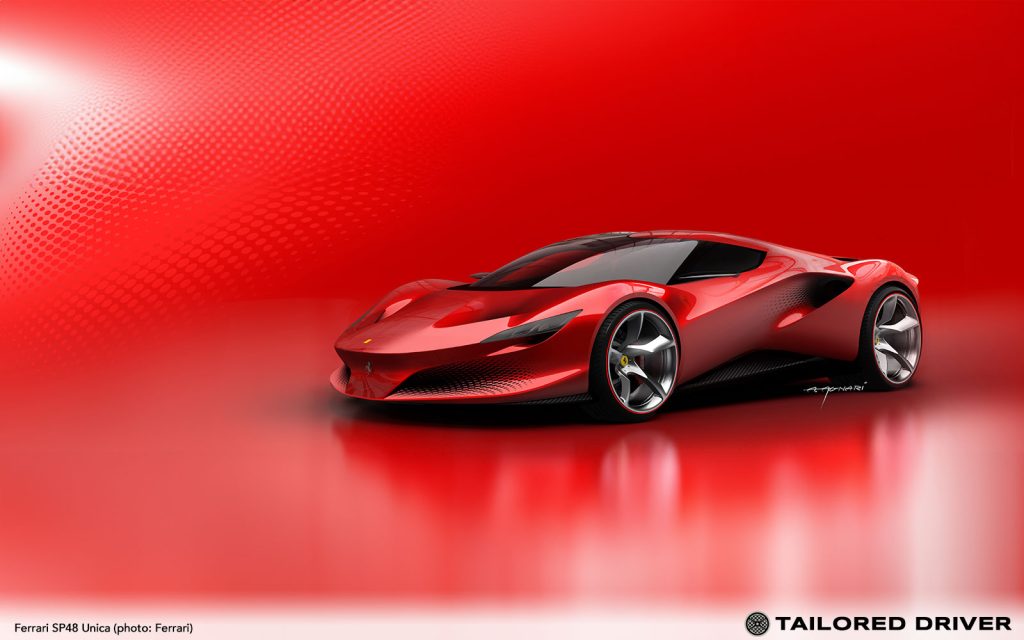
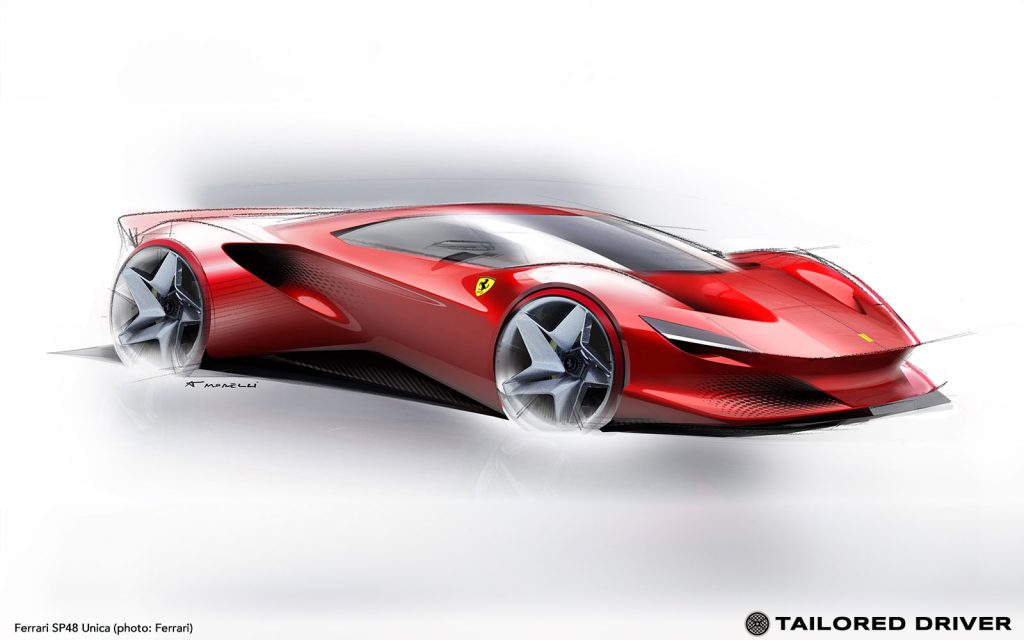
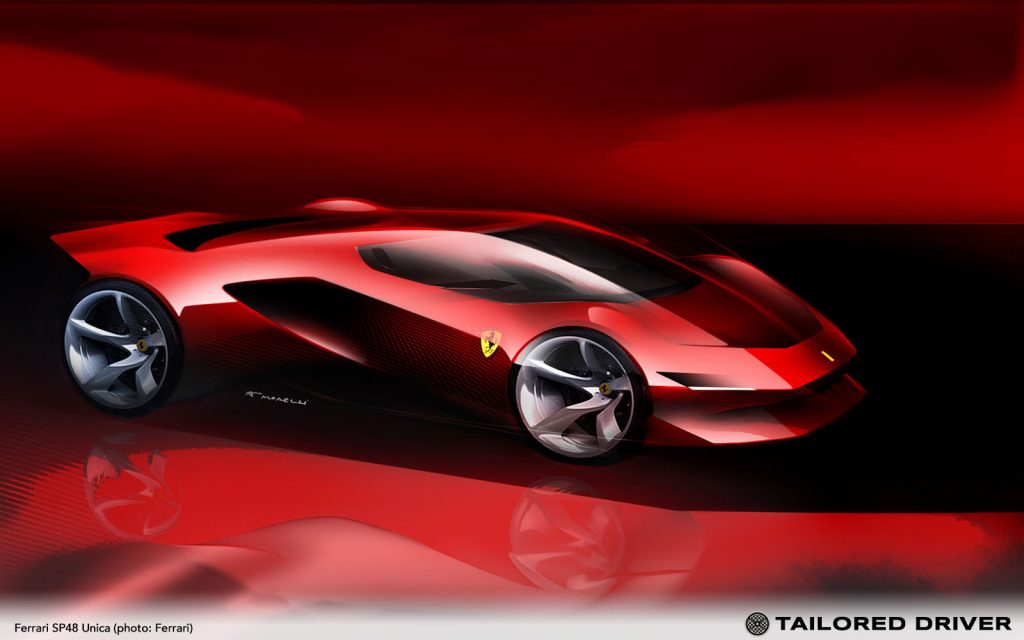
    Maranello, 5 May 2022 – The Ferrari SP48 Unica, the latest addition to the Prancing Horse’s One-Off series, was unveiled today and joins the most exclusive group in Maranello’s entire production: unique, absolutely bespoke cars crafted to the specifications of a single client and designed as a clear expression of their own individual requirements.

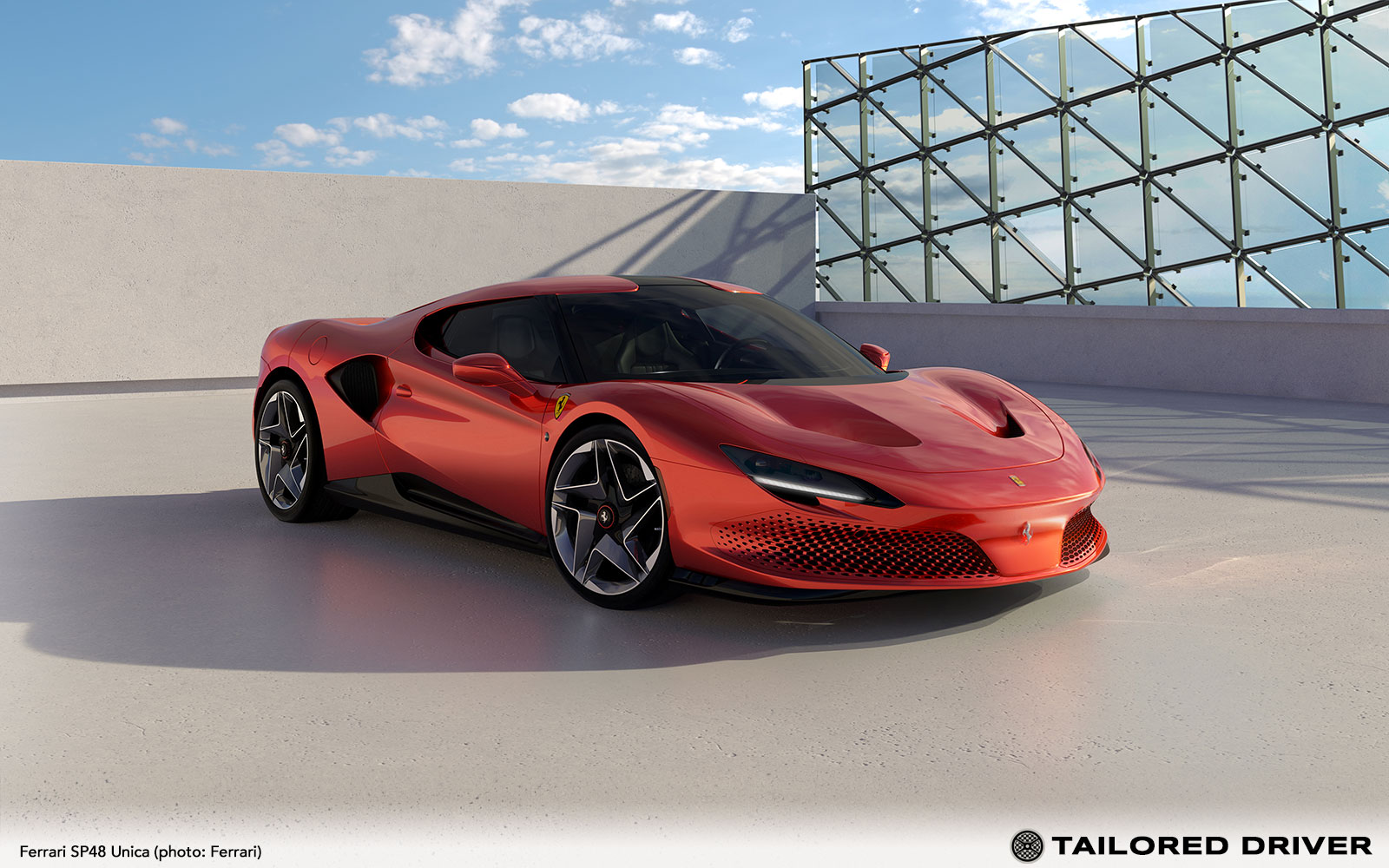
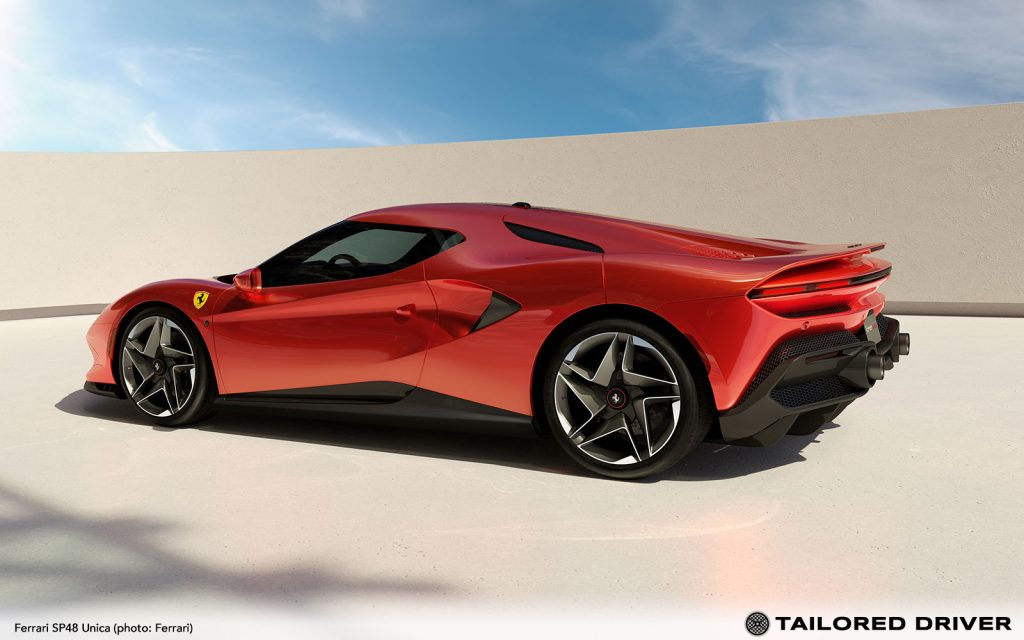
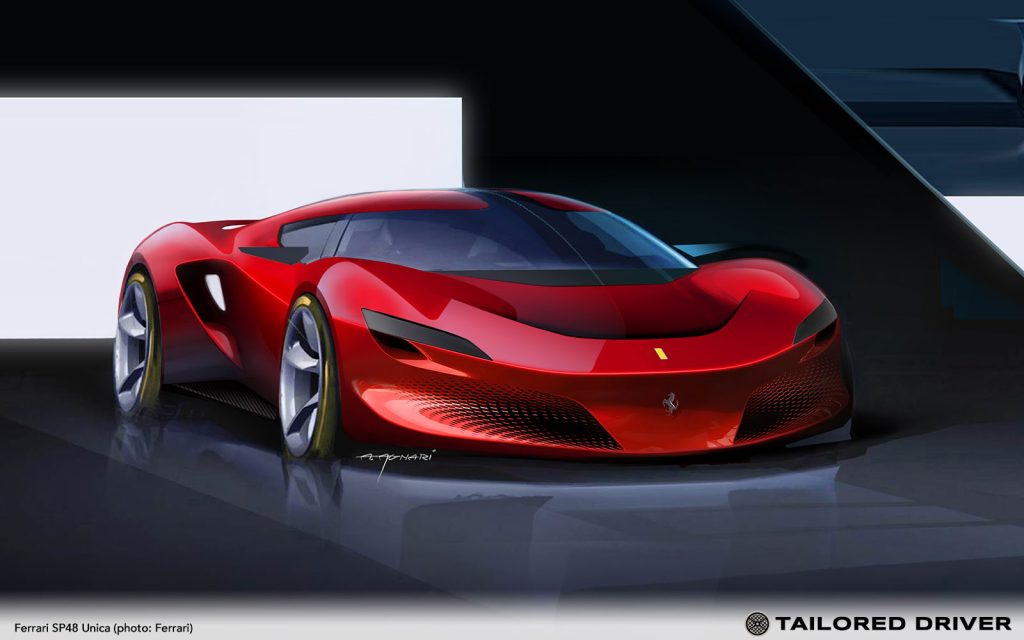
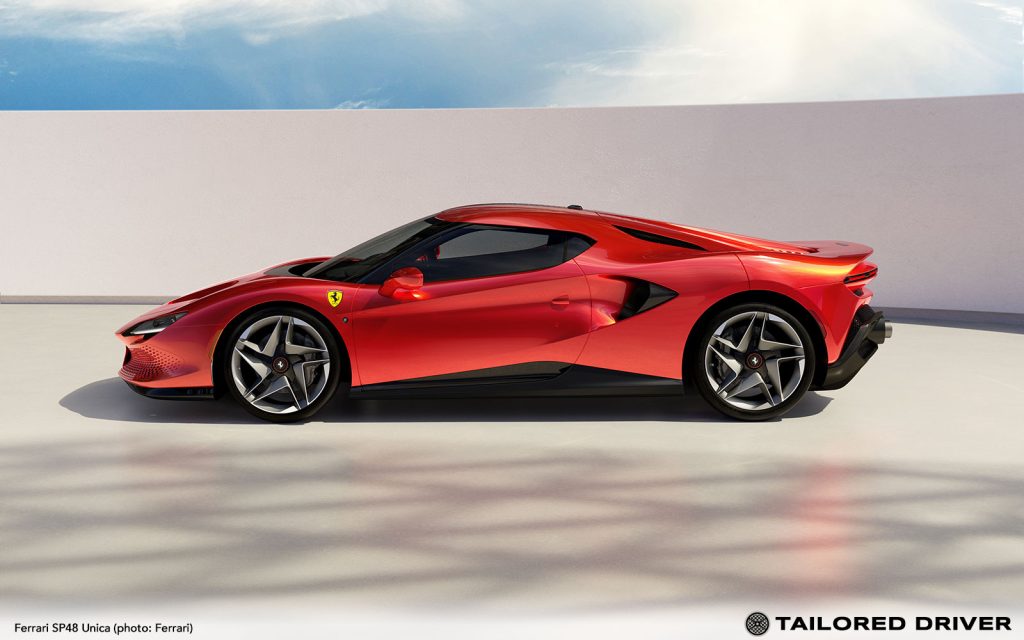
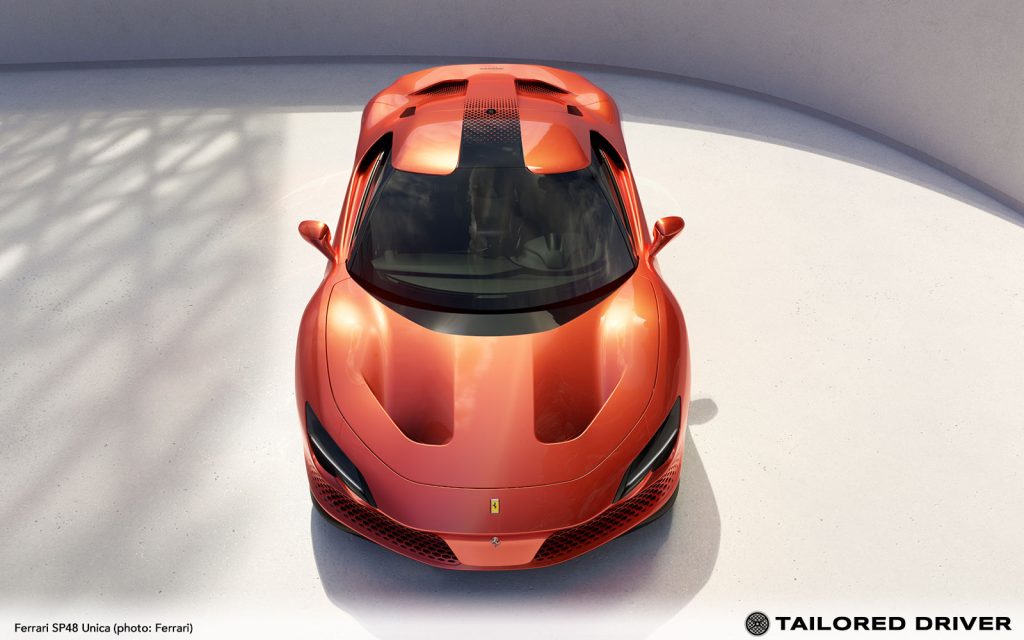
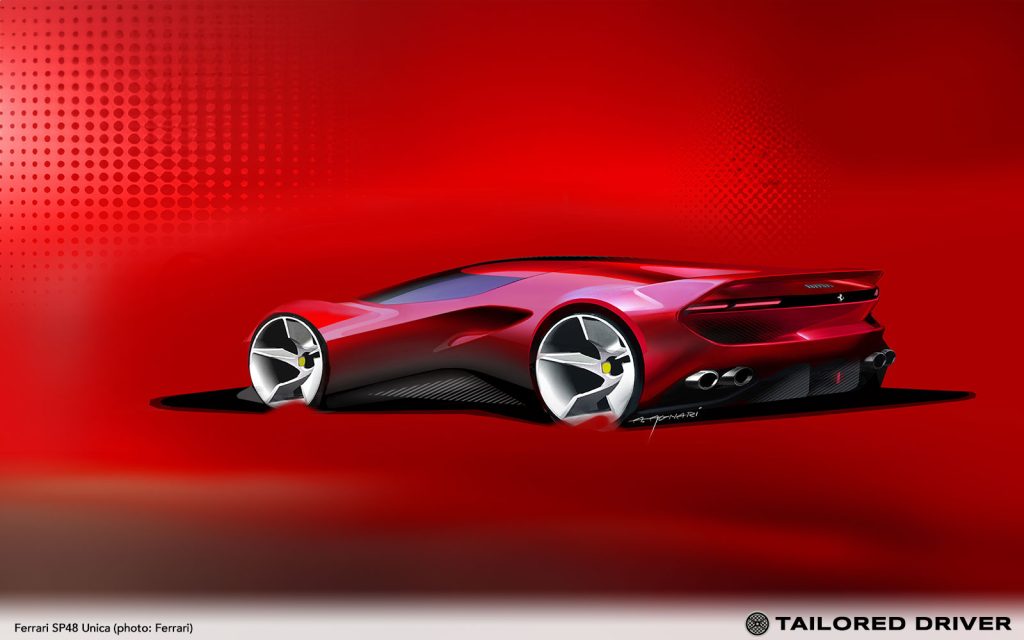
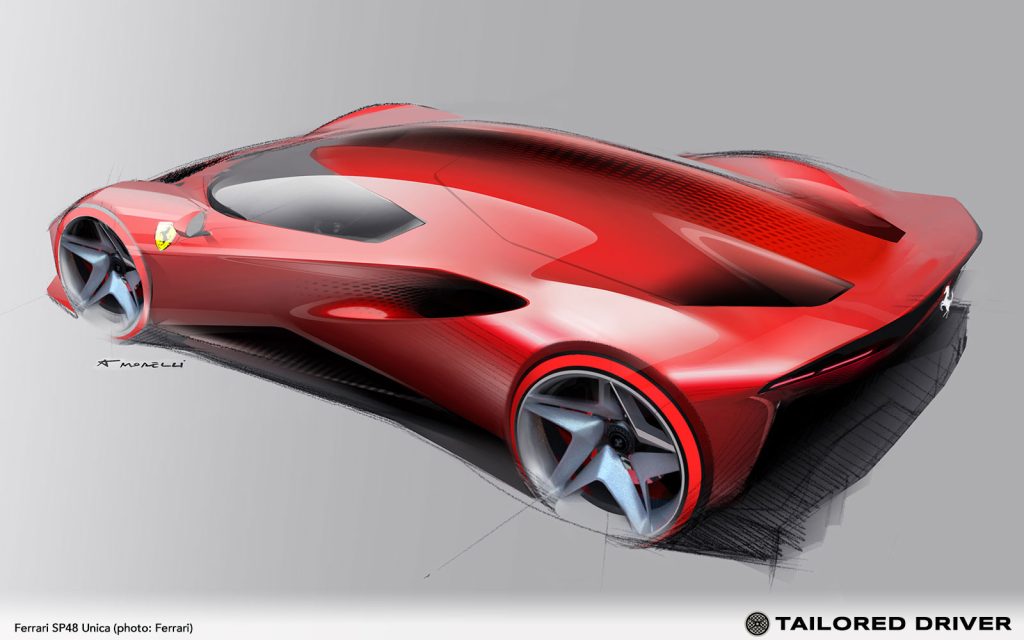
    The SP48 Unica, designed by the Ferrari Styling Centre under the direction of Flavio Manzoni, Chief Design Officer, is a two-seater sports berlinetta developed on the F8 Tributo platform. Its taut lines and aggressive stance make it instantly recognisable with respect to the original model, and it is unmistakable too, thanks to its arrow-shaped front profile. Central to achieving this effect was the redesign of the headlights and the subsequent relocation of the brake air intakes.

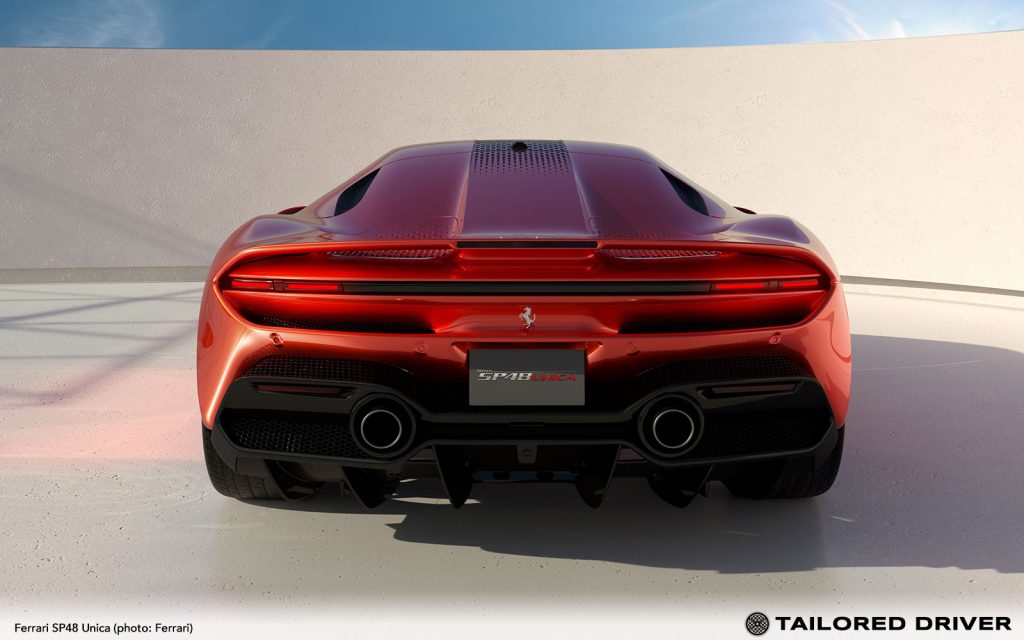
    A pivotal aspect of the design of this unique new car is the extensive use of procedural-parametric modelling techniques and 3D prototyping (additive manufacturing) which enabled the Ferrari Styling Centre designers and Maranello’s engineers to completely redesign the front grille and engine air intakes. This advanced production process resulted in perfect 3D grilles that seem carved from a solid volume creating a sense of seamless continuity and dynamic fluidity.

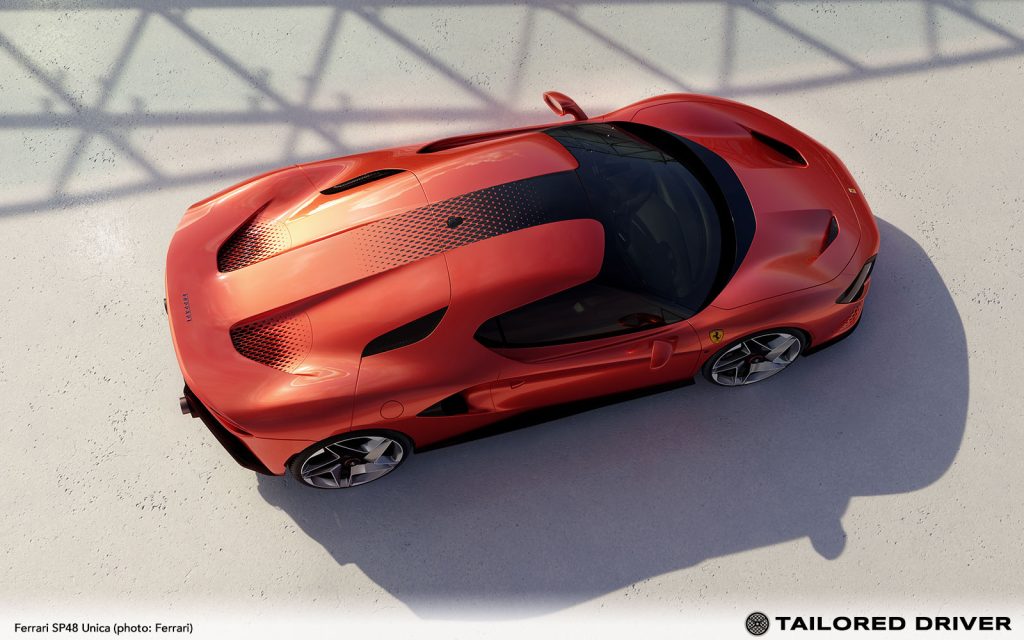
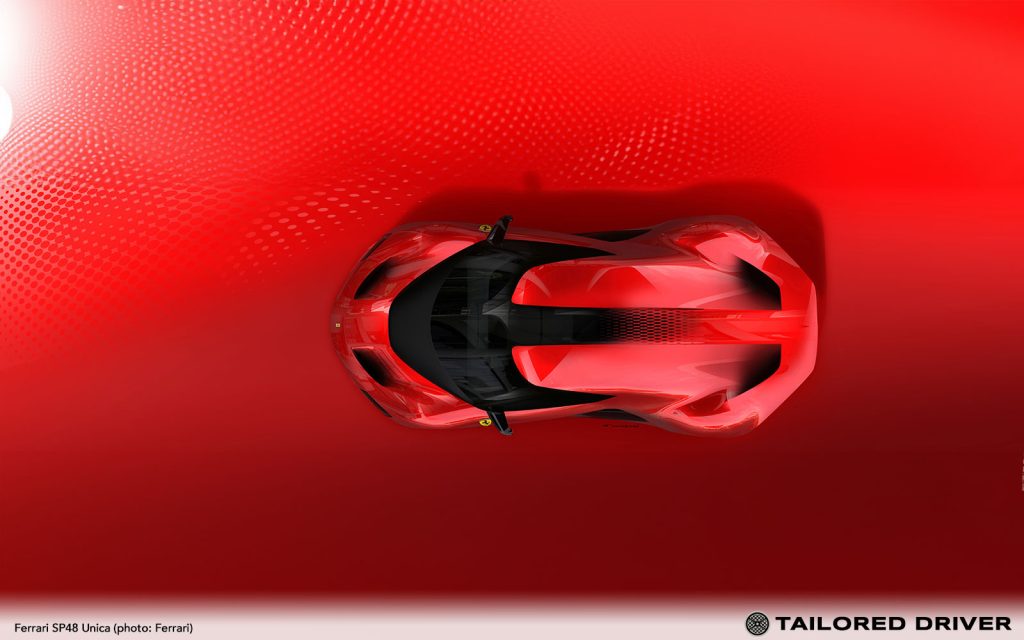
    The procedural graphic solutions adopted on the bodywork dialogue directly with the grilles and influence the SP48 Unica’s overall design:  the transition from black – which includes the windows, roof and engine cover – to the body colour is especially clear.  The striking visor effect of the front is further heightened by the reduction in the size of the side windows and the elimination of the rear screen, highlighting the powerful muscularity of the SP48 Unica which seems sculpted from a single block of metal.

    The plan view emphasises the central section of the roof which includes a graphic representation of the air intakes set into the rear part of the carbon-fibre engine cover before the rear wing. This angle allows the viewer to appreciate the styling research that went into the SP48 Unica and reveals the sophisticated interplay of symmetries and intersecting lines created by its forms.

    The SP48 Unica’s thermal-fluid-dynamic design has been honed and perfected to guarantee it satisfies all cooling requirements in addition to delivering a different aerodynamic balance. The biggest changes compared to the F8 Tributo’s styling include the air intakes for cooling flows for the engine on the front bumper and beneath the rear spoiler. Each has a deep procedural grille, every section of which is optimally angled to maximise the amount of air passing through. The car’s configuration also allowed the engineers to locate an intercooler intake immediately behind the side windows, which in turn enabled them to reduce the dimension of the intakes on the flanks. The longer rear overhang reduces suction from the roof area, boosting rear downforce.

    Although the cabin retains the F8 Tributo’s technical identity – excluding the rear screen – meticulous development work was lavished on achieving the perfect combination of colour and trim to reflect the SP48 Unica’s  sleek, sporty and aggressive personality.  A good example is the specially developed black laser-perforated Alcantara® used on the seats and most of the cabin trim, beneath which are glimpses of iridescent reddish-orange fabric that match the exterior colour. Its motif picks up the hexagonal motif of the grilles and the procedural livery on the roof, creating an appealing continuity between the car’s interior and exterior.  In the SP48 Unica cockpit, the eye is immediately drawn to the polished sill covers with the same laser-embossed hexagonal motif. Matte carbon-fibre imbues the cockpit with a sense of technicality and exclusivity, and is complemented by the Grigio Canna di Fucile accents.

    Designed for a long-standing client who was deeply involved in every step of its creation, the one-off Ferrari SP48 Unica is a bold interpretation of a sports car and cleverly enhances its racing soul and vocation for speed. The SP48 Unica achieves its goal of transforming an existing model to masterful effect, taking inspiration from and paying homage to the company’s core values of innovation and passion.

    SPECIAL PROJECTS

    The Special Projects programme creates unique Ferraris (so-called “One-Offs”) characterised by an exclusive design crafted around the requirements of each individual client to ensure each one becomes the owner of a genuinely one-of-a-kind model. Each project originates from an idea put forward by the client and then developed with a team of designers from Ferrari’s Styling Centre. Having defined the car’s proportion and forms, detailed design blueprints and a styling buck are produced before the construction of the new One-Off begins. The entire process lasts more than a year on average, during which time the client is closely involved in assessing the design and verification phases. The result? A unique Ferrari sporting the Prancing Horse logo and engineered to the same standard of excellence as every car that rolls off the Maranello assembly lines.

  • BMW and Kith Start Season 2 of Successful Collaboration with the BMW i4 M50.

    BMW and Kith Start Season 2 of Successful Collaboration with the BMW i4 M50.

    • Highly limited edition of the fully electric Performance BMW M vehicle with unique Kith features
    • Historic BMW 1602 from 1972 electrified and adorned with design details by Ronnie Fieg
    • Lifestyle collection available worldwide in Kith stores and online

    [source: BMW]

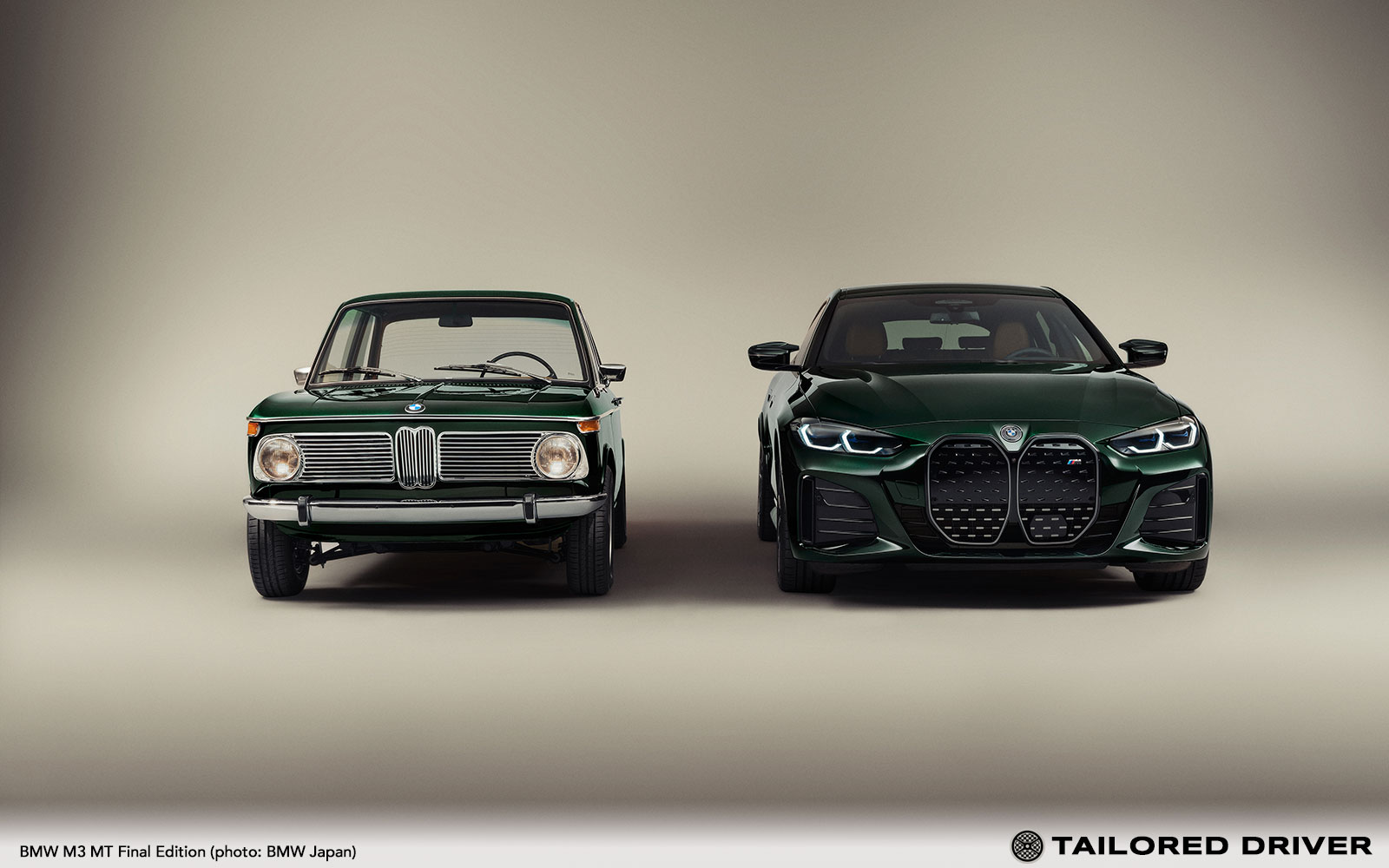
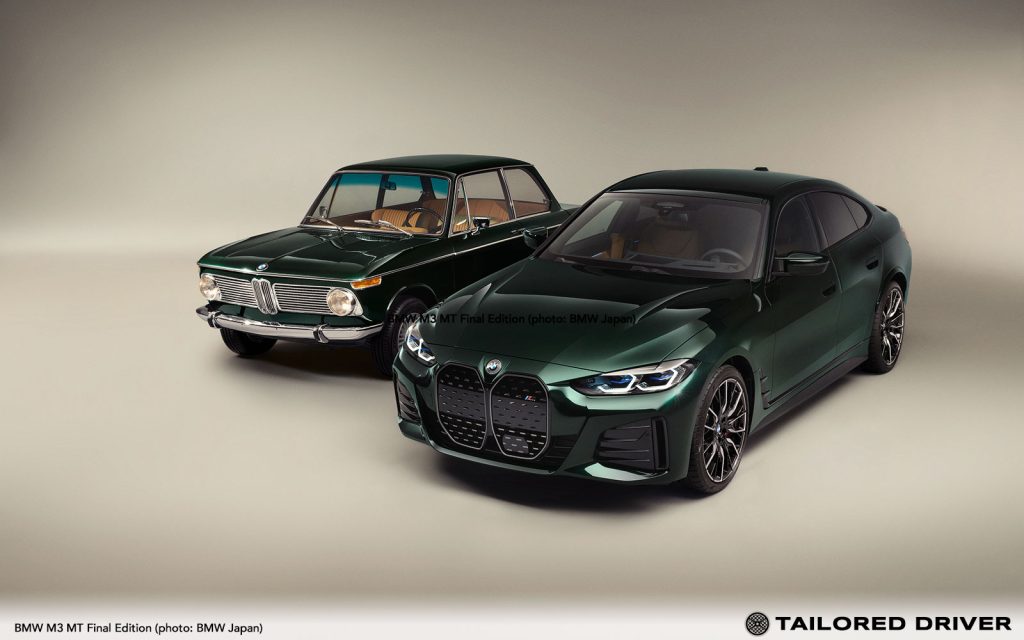
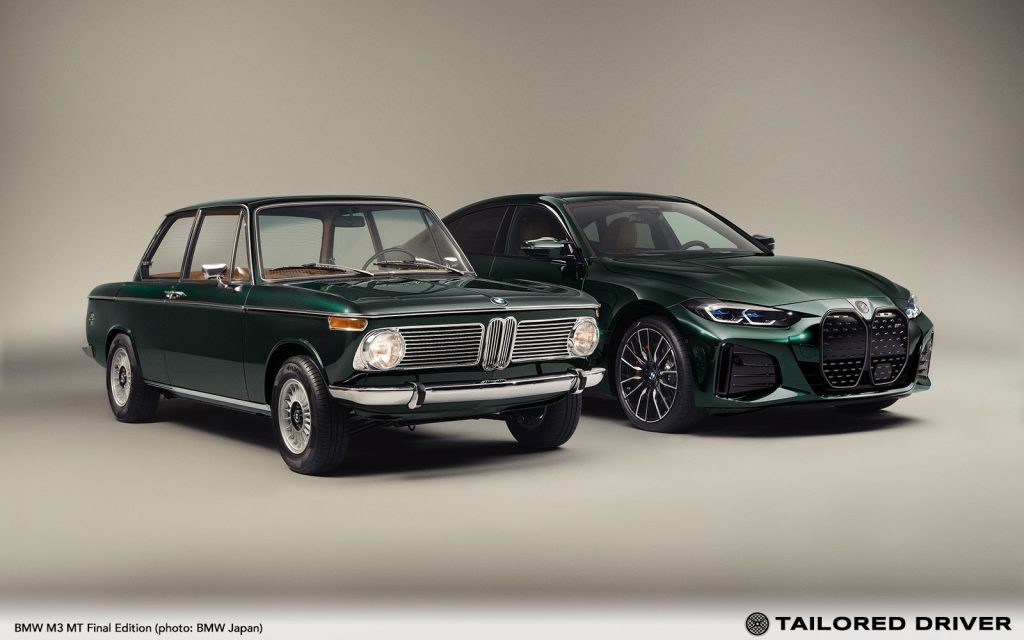
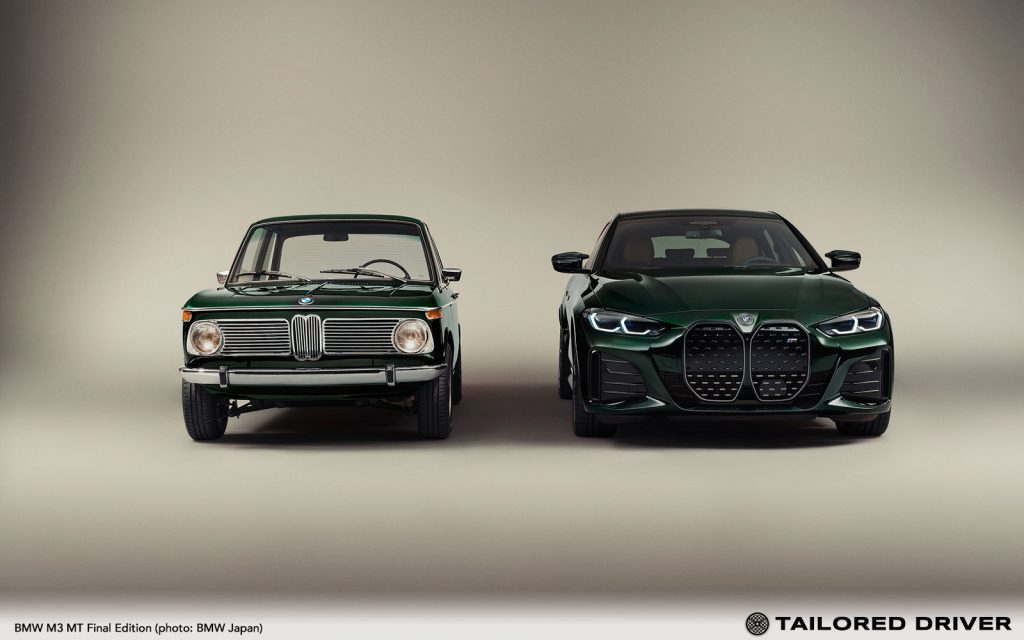
    Munich. More than just electrically charged: the BMW i4 M50 (electricity consumption in kWh/100 km: – (NEDC) / 22.5–18.0 (WLTP); electric range (WLTP) in km: 416–520) is not just the first fully electric M automobile, but also the second BMW M vehicle that New York designer Ronnie Fieg has exclusively designed as part of the collaboration between his brand, Kith, and BMW M GmbH – inside and out. Only seven BMW i4 M50 by Kith vehicles will be produced for the public. One of those is the only vehicle within this collaboration being auctioned to a global public audience. To mark the limited edition, Kith is selling a 51-piece collection comprising apparel and accessories, inspired by the colours of the Kith Vitality Green (kithvitalitygrün; metallic; P9H; BMW) vehicle paint and BMW Individual Caramel Merino vehicle leather in its stores all over the world and online

    A symbol of the transformation of BMW in the age of electric vehicles.

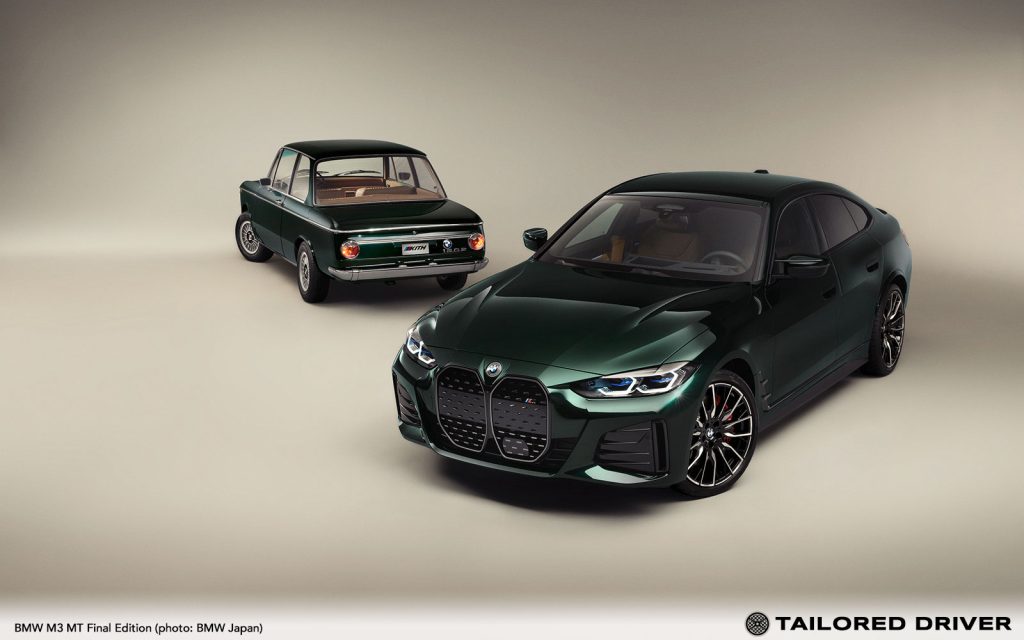
    In BMW M’s 50th anniversary year, a historic vehicle is bridging the gap between the past and the electrified present. Ronnie Fieg as an automotive enthusiast has transformed a 1972 BMW 1602 into a contemporary electric car. This is based on the 1972 Olympic Games in Munich, where two BMW 1602s, converted into electric cars, were used at various long-distance competitions as accompanying and camera cars by the organisation committee. This was the start of a pioneering, forward-looking evolution of electrified vehicles at BMW. To commemorate the debut of electrification at BMW, BMW and Kith Season 2 presents the 1972 BMW 1602 Elektro by Ronnie Fieg.

    The unique 1972 BMW 1602 Elektro by Ronnie Fieg will be handed over to the designer by the BMW Group. He already owns an impressive collection of BMW vehicles, including a legendary BMW E30 M3 by Kith stemming from Season 1 of the collaboration. His passion for BMW was sparked as a boy by his grandfather; the collaboration with BMW M means this comes full circle for him. Ronnie Fieg founded his Kith label in 2011. The collaboration between the BMW and Kith brands started in 2020 with the design of a BMW M4 Competition Coupé by Ronnie Fieg. The 150 editions of the exclusive BMW M4 Competition × Kith were sold out in less than 30 minutes.

    A combination of sportiness and aesthetics. 

    The success of the first brand collaboration with Kith led to this second edition, where electromobility is the focus. As the first fully electric M model, the BMW i4 M50 can be called the “Brand Shaper”. It has the well-regarded M DNA and as a BEV shows the responsible direction that BMW is going in. The 1972 BMW 1602 tells the story of the very first electrified BMW, which came onto the market 50 years ago and which is part of the brand’s high-performance segment. The sportiness of the lifestyle and streetwear label Kith is a perfect match for the BMW M. Ronnie Fieg gives both models a new aesthetic with his design.

    BMW goes Kith Vitality Green.

    For the first time ever, BMW is naming a new colour after a brand partner: Kith Vitality Green is a rich, dark green that is not available on a serial BMW, as it is limited to this exclusive collaboration. New logos merged with each other are a hallmark of the various Kith partnerships with globally famous companies. BMW changed its brand emblem for a collaboration partner for the first time two years ago. The well-known BMW emblem was again altered this time: an additional ring in the colour Kith Vitality Green was added around the brand logo that adorns the hood of the BMW i4 M50 by Kith. The green ring lists the partnership, model and year as well as the fact that it is an electric car. The logo on the hood of the 1972 BMW 1602 by Ronnie Fieg looks different again: the BMW letters have been swapped for Kith. A similar logo in black and white with the subline “Elektro-Auto” can be found as an engraving on the lid of the cup holder in the BMW i4 M50 by Kith.

    The interior goes Caramel.

    Kith Vitality Green is the colour in which all vehicles of the collaboration are painted. While the exterior is an exquisite green, the full-grain merino leather interior is in the colour Caramel. In the 1972 BMW 1602 Elektro by Ronnie Fieg, the leather of the seats is embossed with the Kith lettering, as are the leather inserts in the footwells for the driver and front passenger. The logo altered to feature the Kith lettering instead of BMW can also be found on the centre holes of the rims.

    The interior of the BMW i4 M50 by Kith is also particularly harmoniously coordinated in Caramel. The knee bolster, steering column, seat and side panelling, as well as the lower part of the A and B posts are all upholstered in merino leather. The front and rear floor mats are also trimmed in caramel-coloured leather and embroidered with the M logo, which has been changed to Kith, and the M stripes. Kith lettering in a box design is embossed on the headrests as well as the front centre armrest. “KITH Exclusive Edition” has been laser-engraved into the trim.

    Technology and luxury in the limited edition.

    The technology has been taken over from the BMW i4 M50, which combines the innovative power of the BMW M with that of the BMW i for the first time. The BMW i4 M50 with its fully electric powertrain fed by two BMW M eDrive motors achieves a powerful 400 kW (544 hp) in Sport Boost mode and offers a dynamism typical of a BMW M in an as-yet-unseen edition, which takes it from 0 to 100 km/h in 3.9 seconds. It is locally emission-free and has a reach of up to 520 kilometres according to WLTP. As the first purely electric Gran Coupé from BMW M, this extraordinary vehicle creates a class of its own and proves itself for everyday use too, thanks to its impressive reach, luxurious spaciousness and intelligent networking.

    In addition to the standard equipment in the BMW i4 M50 and specific scope of the Kith collaboration, the model is equipped with a few special additions as standard. Alongside the adaptive M chassis, these include the M sports brakes with red brake callipers, the M aerodynamic package and the BMW Individual Shadow Line lights. The Professional and Plus driving assistants also contribute to the luxurious driving feeling, as well as the electric sliding glass roof, the fine oak wood trim and the M high-gloss Shadow Line exterior trim. The features are rounded off by the Harman/Kardon surround sound audio system, which provides the perfect soundtrack to the joy and driving experience in the BMW i4 M50 by Kith.

  • Bell Sport & Classic Completes Concours-Level Restoration of Rare Ferrari Dino 246 GT L Series

    Bell Sport & Classic Completes Concours-Level Restoration of Rare Ferrari Dino 246 GT L Series

    • Originally appearing on Ferrari’s stand at the 1969 Frankfurt Motor Show, this remarkable Dino 246 GT L Series has been meticulously restored to concours condition
    • Four year strip down and rebuild to Ferrari Classiche standard by Bell Sport & Classic restoration team
    • Iconic model represents seminal period in Ferrari history
    • Arguably now the best Dino in the world, it is the latest demonstration of the  benchmark-setting levels of finish Bell Sport & Classic applies to every restoration

    [source: Bell Sport & Classic]

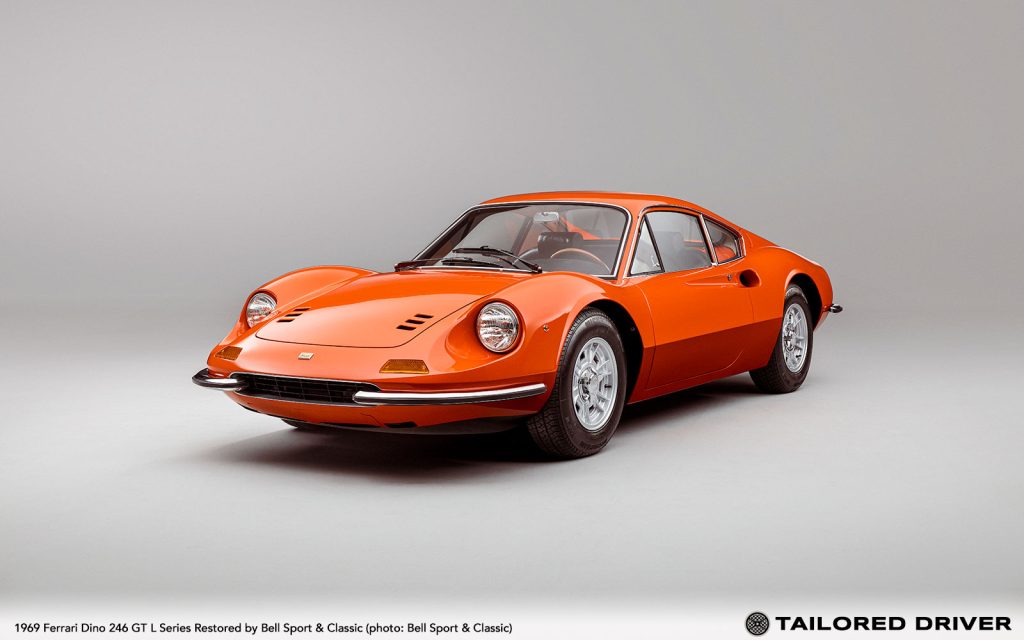
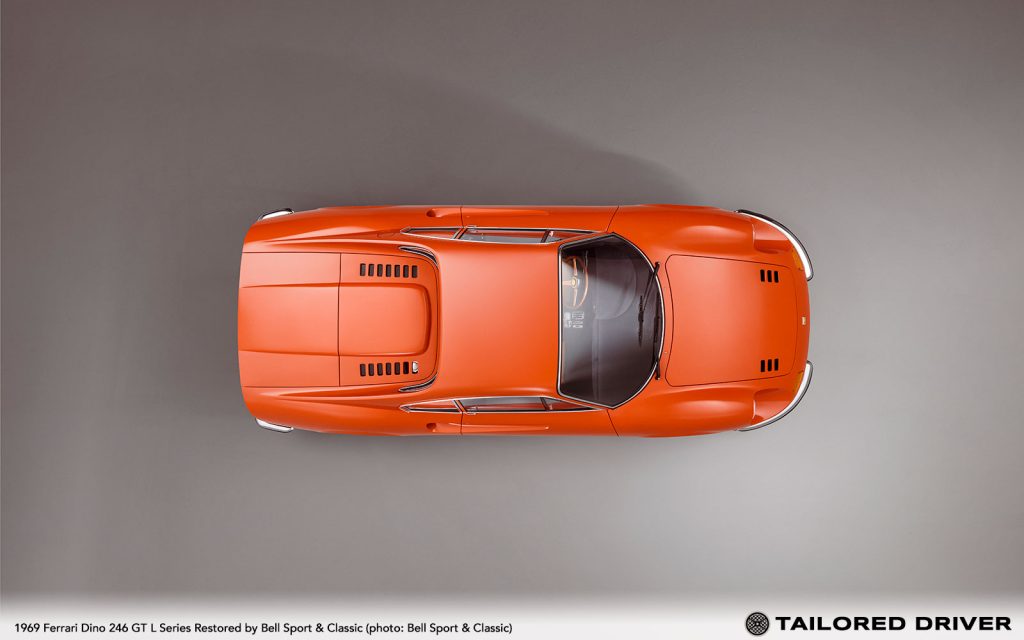
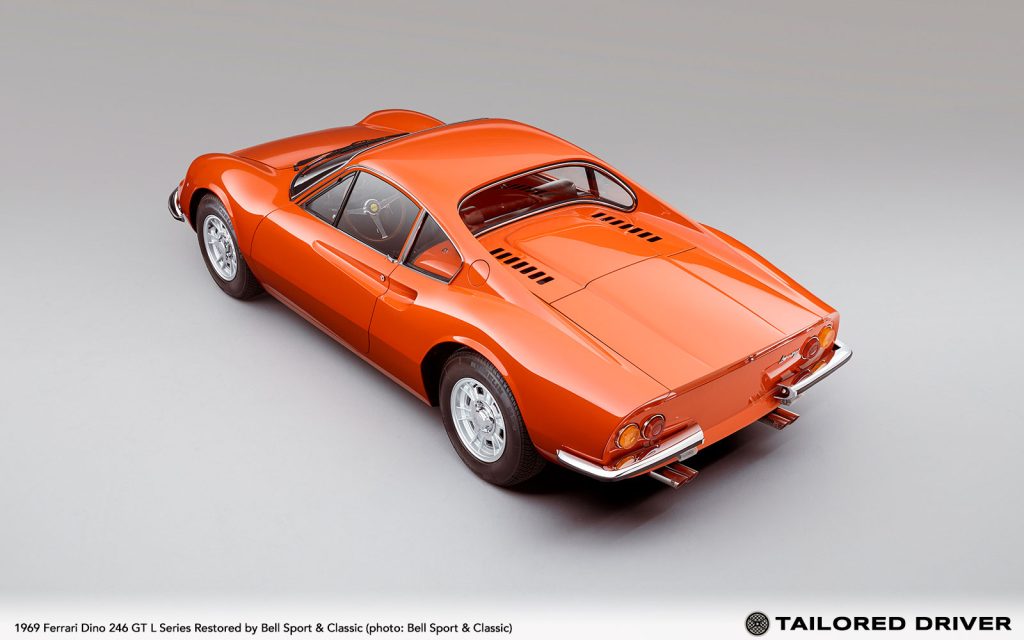
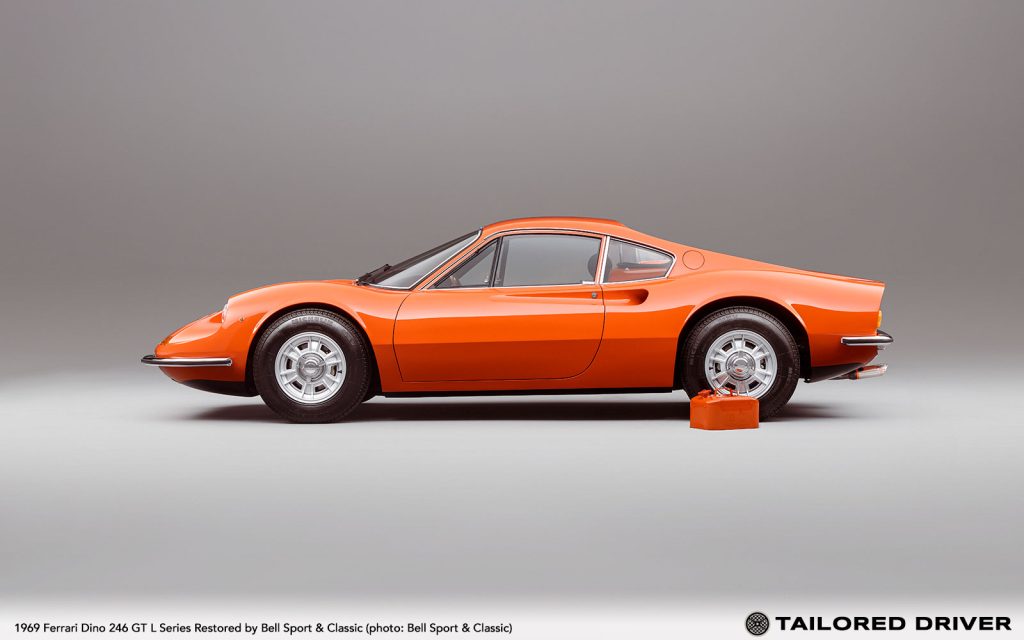
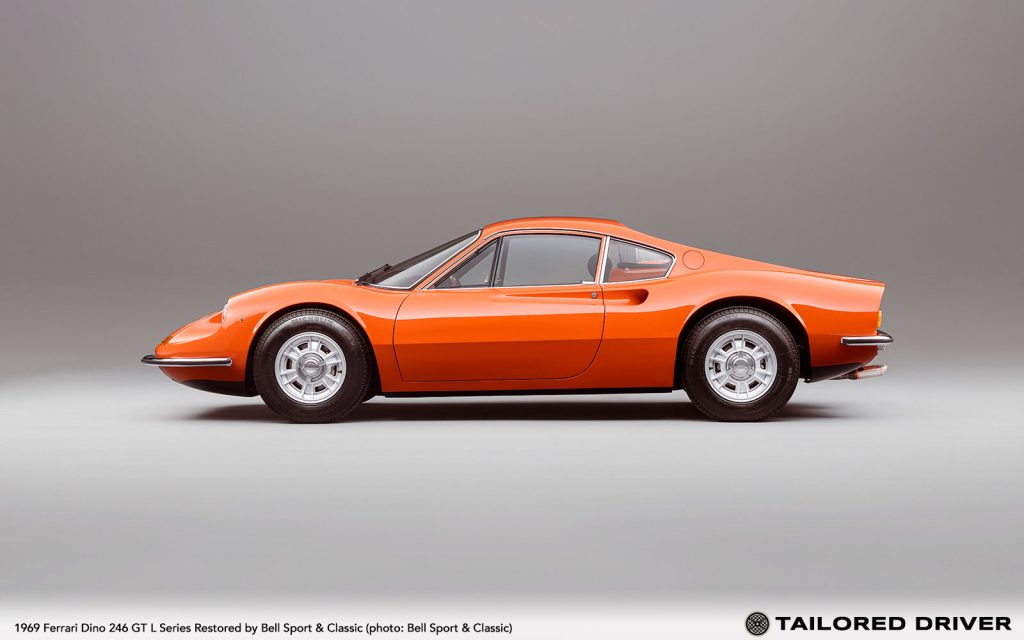
    Markyate, Hertfordshire, UK – Bell Sport & Classic is delighted to reveal the latest example of its exceptional in-house Ferrari restoration expertise: a complete, ground-up, concours-level restoration of the original 246 GT Dino L Series that debuted on Ferrari’s stand at the 1969 Frankfurt Motor Show.

    A seminal model from marque’s history, this significant car has been the subject of Bell Sport & Classic’s benchmark-setting standards, blending originality and the utmost attention to detail with the very latest restoration techniques to create arguably the best Dino on the planet.

    Leaving the Maranello factory in 1969 and exhibited at that year’s Frankfurt Motor Show before being delivered to a customer in West Germany, it was the first Dino to be sold in the country and the seventh L Series ever made by Ferrari. Today, this concours-condition, low-mileage, early left-hand drive car represents an exceptionally rare opportunity for an aficionado to add one of the most important models built by Ferrari to their collection.  

    Fitting tribute and lasting legacy
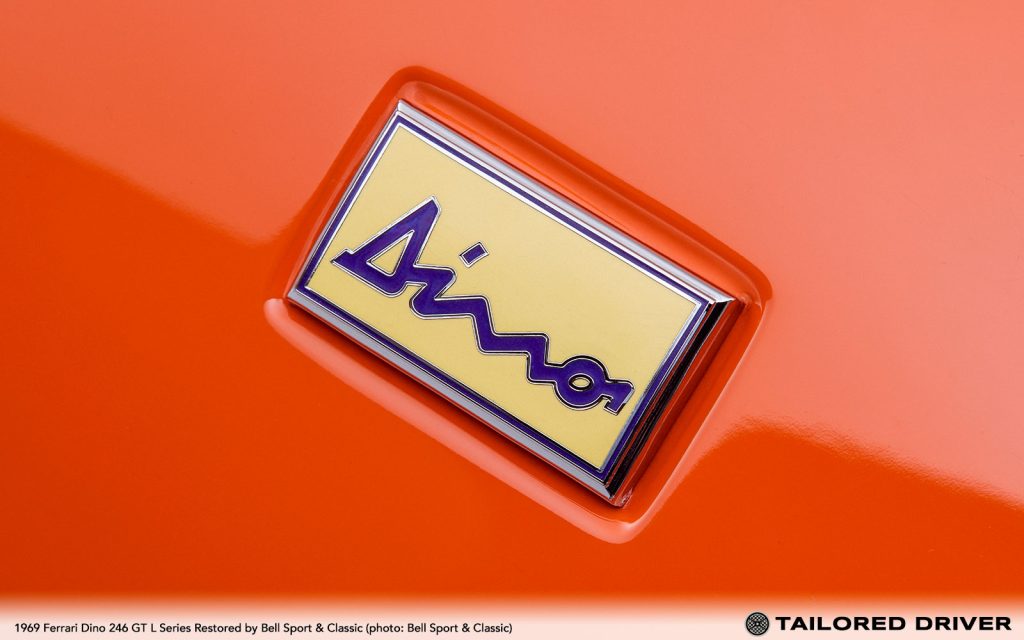
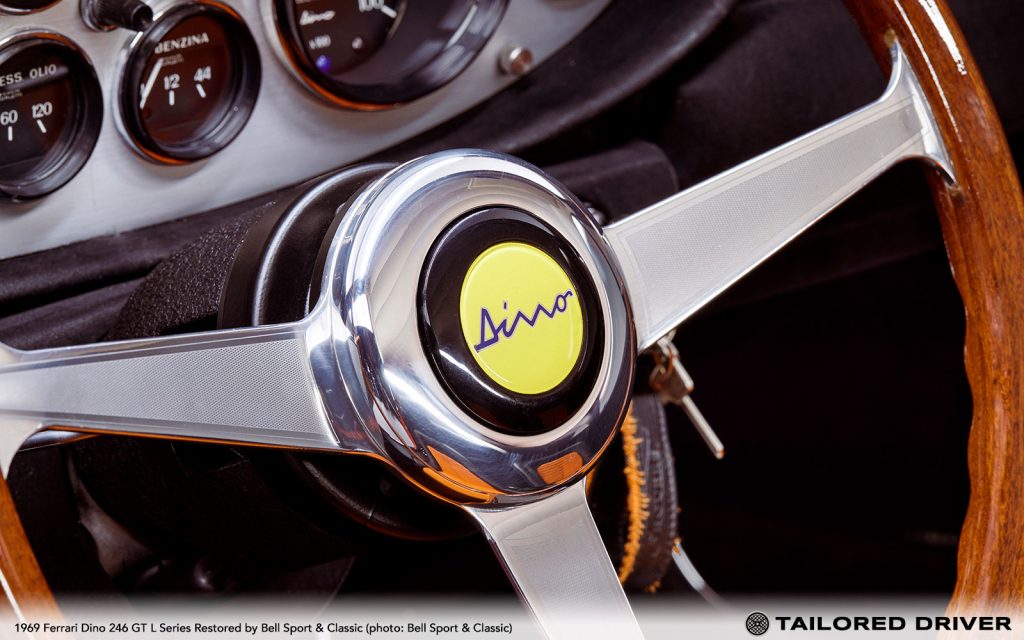
    “Enzo Ferrari first used the ‘Dino’ name to denote a range of V6 Formula 1 and Formula 2 racing engines as a tribute to his first son Alfredo ‘Dino’ Ferrari, helped develop the engines, but tragically succumbed to illness at the age of 24 in 1956,” recounts Tim Kearns, Managing Director of Bell Sport and Classic. “When Ferrari launched its first V6-powered, mid-engined road car in 1968, it did so under the ‘Dino’ brand. And instead of the traditional Cavallino Rampante or Prancing Horse Ferrari badge, the Pininfarina-designed cars carried the signature of Alfredo ‘Dino’ Ferrari.”

    The first Dino launched was the 206 GT variant, powered by a 2.0-litre V6 engine. A year later, this model was followed by the 246 GT L, which featured a 60mm longer wheelbase and boasted a more powerful 2.4-litre engine – as did the 246 GTS targa model. Maranello built just 357 examples of the L-series Dino, before following it up with the M and E-series variants, which were produced in greater numbers.

    In 1969, the highly respected motoring writer and racing driver Paul Frère summed up the Dino 246 GT L’s exceptional driving attributes: “The Dino is most fun to drive on roads with lots of bends and good visibility. I know of very few cars that offer as much driving enjoyment through this type of terrain as this one does.” 

    Frère was far from alone in his enthusiasm for the Dino. “Critics and customers alike loved the way the Dino looked, sounded and drove. The car soon became acknowledged as a ‘lifestyle’ icon, even achieving fame in the cult classic detective television series ‘The Persuaders’, in which Tony Curtis drove a 246 GT,” reveals Tim Kearns.

    “It’s remarkable to think that at the time the car made its debut, Enzo Ferrari was adamant that his road-going creations should only be fitted with V12 engines and launched the new V6-powered Dino as a sub-brand. Yet today, Ferrari has closed the circle and returned to the V6 engine format, albeit in turbocharged guise, with its new 296 GTB.”

    Improving standards, respecting authenticity
    Before arriving at Bell Sport & Classic’s extensive restoration facilities in 2017, the Dino 246 GT, which carries the chassis number 00436, confirming its status as the 7th of 357 examples built, had been moved around the globe, spending time with owners in Germany, France, Canada, and the US. Despite the car’s far-flung travels, it had accrued only 53,400 miles (86,000km) over a period of forty-eight years. But it was, however, in a very sorry state of disrepair.

    “To be honest, I doubt if many other proper restoration companies would have even considered taking this project on. The tired state the Dino was in, it just didn’t look economically viable to attempt to return it to its former glory,” recalls project leader Peter Ensor, who along with Marc Holden, Elliot East and technical director Attilio Romano formed the key team responsible for the Dino’s restoration.

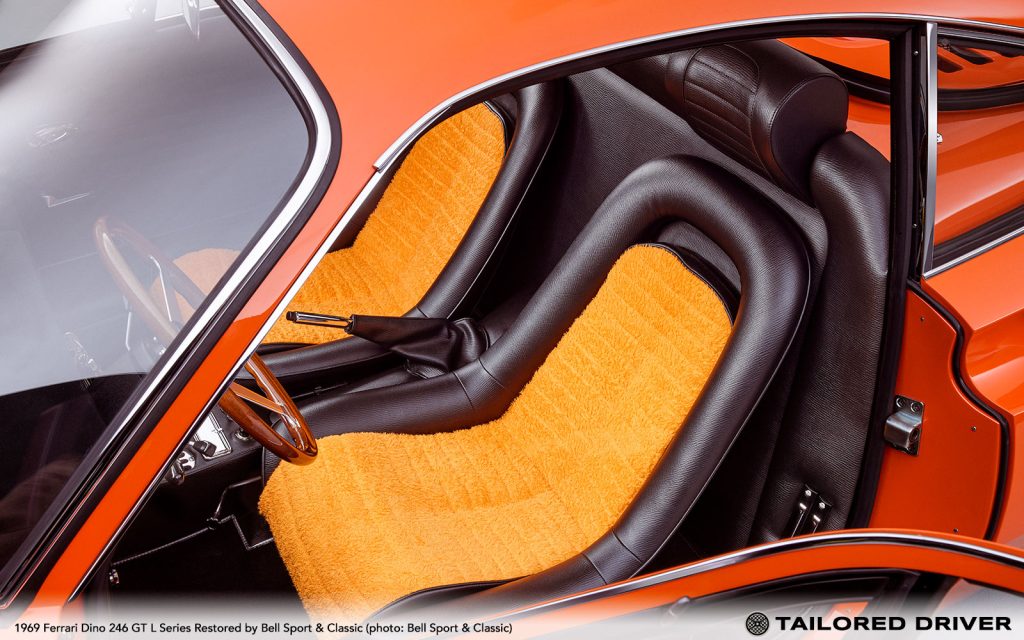
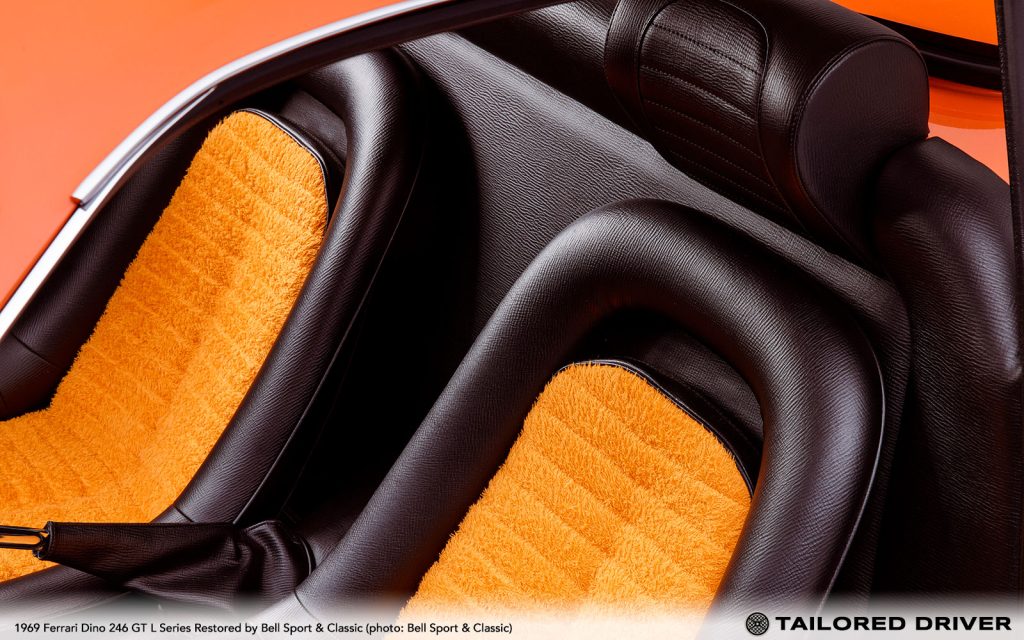
    “The car had been restored twice before in its life already, but lacked real care and precision. It was painted Rosso Corsa red instead of the original Rosso Dino, which has a more ‘orangey’ hue, the leather trim was incorrect too – it was black and red as opposed to the black with orange seat towelling interior fitted at the factory. And that was just for starters. When we delved deeper, we realised that there were plenty of other problems to address too.”

    Rust plagued the inner wings and the misshapen front and rear valances. The ‘scoops’ on the door panels did not align with those on the body, neither in terms of height nor angle, the wheel arch heights didn’t match from one side of the car to the other and the rear roofline was off-kilter. “And those were just the things we could see,” adds Elliot East wryly. “We also found that at some stage replacement front wing panels had been welded on top of the original items. The same ‘technique’ had been used on the sills and rocker panels, which meant the seam lines had been lost and rust had been locked in underneath.” 

    The full extent of the perilous state of the car was only revealed when Bell Sport & Classic completed a full strip-down to the steel monocoque. This process took several months, with the team carefully removing the aluminium panels, doors, glass and all mechanical components. Only then did it become apparent just how much effort, time, and skill – not to mention expense – would be required to restore the Dino. Yet, in some ways, the poor state of the car made it an ideal project for Bell Sport & Classic to exercise its renowned bodywork, mechanical and interior trim refurbishment expertise upon. The company prides itself in setting standards that are unmatched across the industry and deliver a level of finish significantly superior to that with which the vehicle would have left the factory in period, while fully respecting the car’s originality.

    Working to the very highest standards and having gained the coveted Ferrari Classiche certification for its impeccable work restoring previous Ferrari models, Bell Sport & Classic was eminently qualified to undertake the Dino project. But despite its exceptional knowledge and experience bank, the company left no stone unturned by seeking the expertise of Matthias Bartz, a highly respected author, and the world-leading authority on the Dino model. This enabled the vehicle’s authenticity to be determined beyond any doubt, and detailed information on the original factory specification to be obtained.

    Obsessive level of detail
    The team fully stripped the 2.4-litre V6 engine, triple Weber 40 DCF carburettors, five-speed gearbox, all-round disc brake system, front and rear coil spring, and double-wishbone suspension.

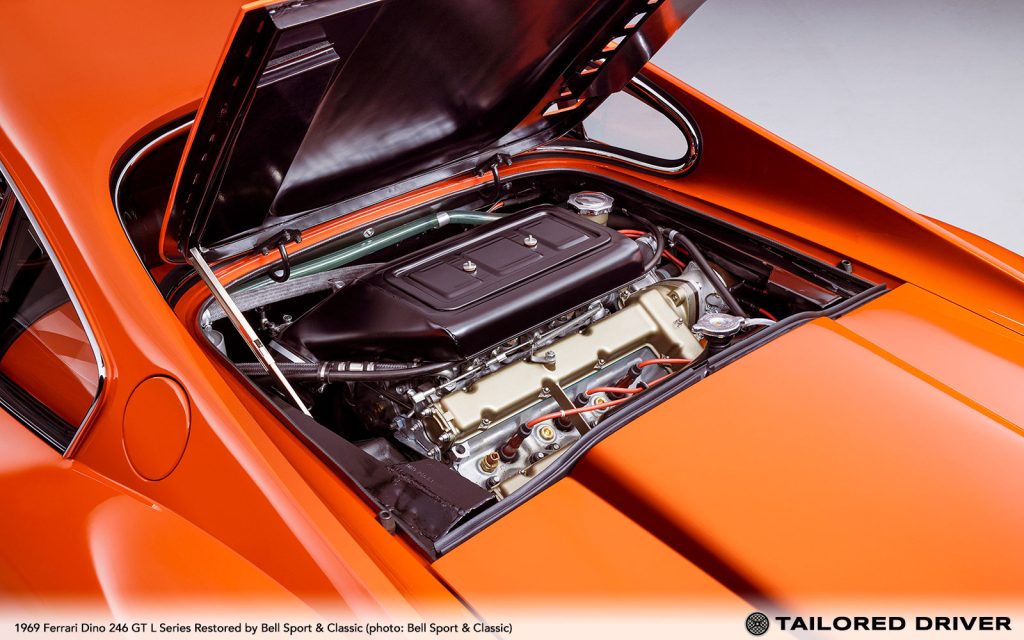
    Each component was painstakingly restored to original specification, with all worn parts refabricated or replaced as required. Once rebuilt at Bell Sport & Classic’s own specialist engine workshop, the V6 was tested on a dynamometer and bench-run for a day. After being reinstalled in the car, the engine was re-tested on a rolling road and fine-tuned to ensure it produced the precise 191bhp it left the factory with.
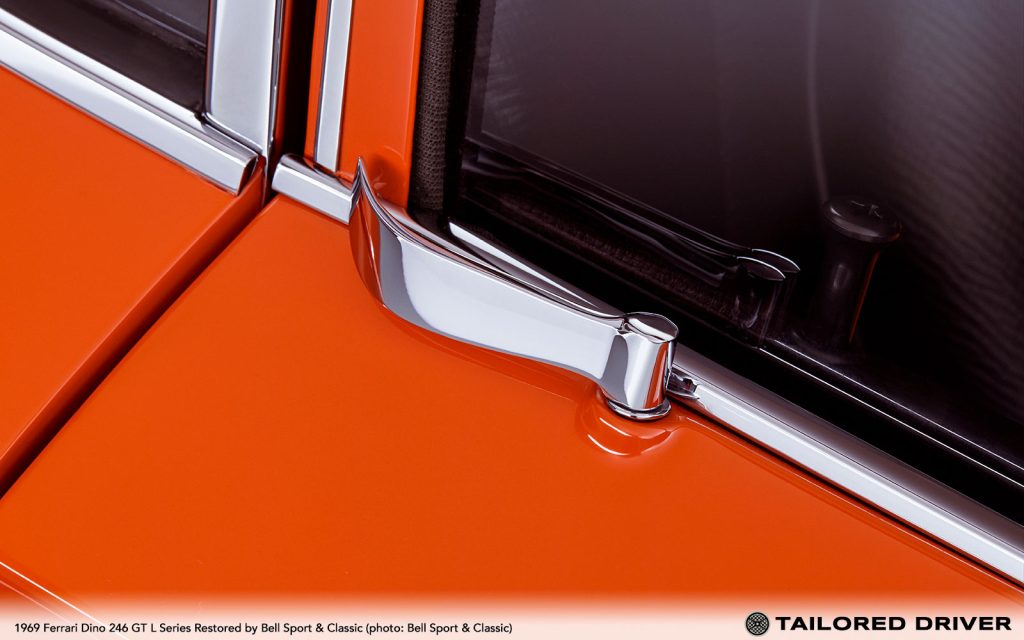
    Using the specialist information supplied by Bartz, the Bell Sport & Classic team went to extraordinary levels of meticulous detail to ensure they restored the Dino to the highest possible specification. “For example, there is a panel seal that runs along the sill underneath the doors. On sub-standard Dino restorations, it’s all too easy for this to fill up with paint, so the detail gets lost,” explains Ensor. “That might only be a minor thing to some people, but little things like that are everything to us. Call it obsession if you like, but on our Dino, there is not a single spec of paint on the panel seal, and the detailing is perfect.”

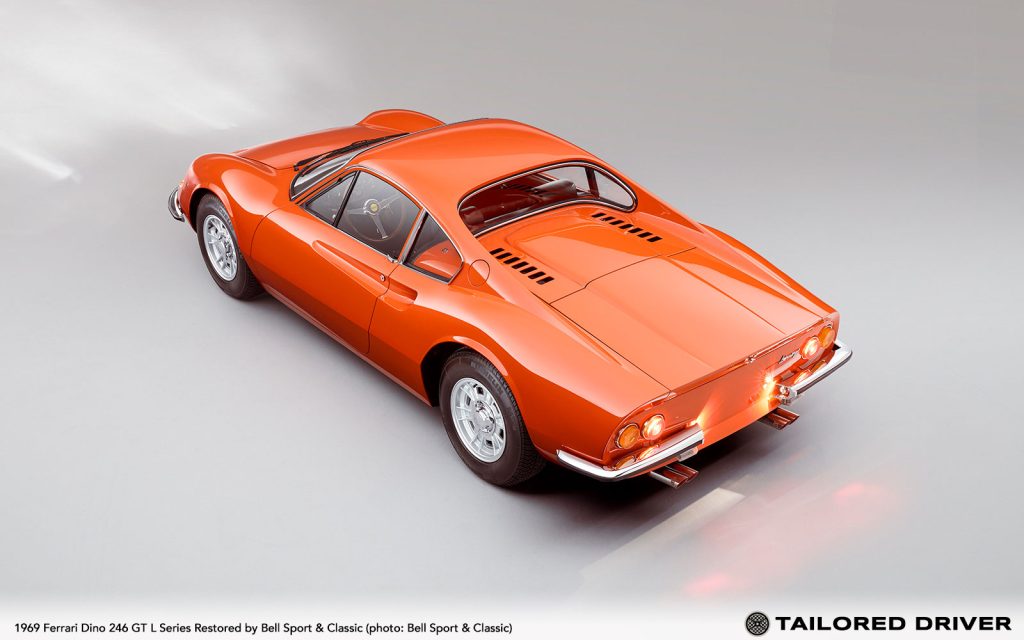
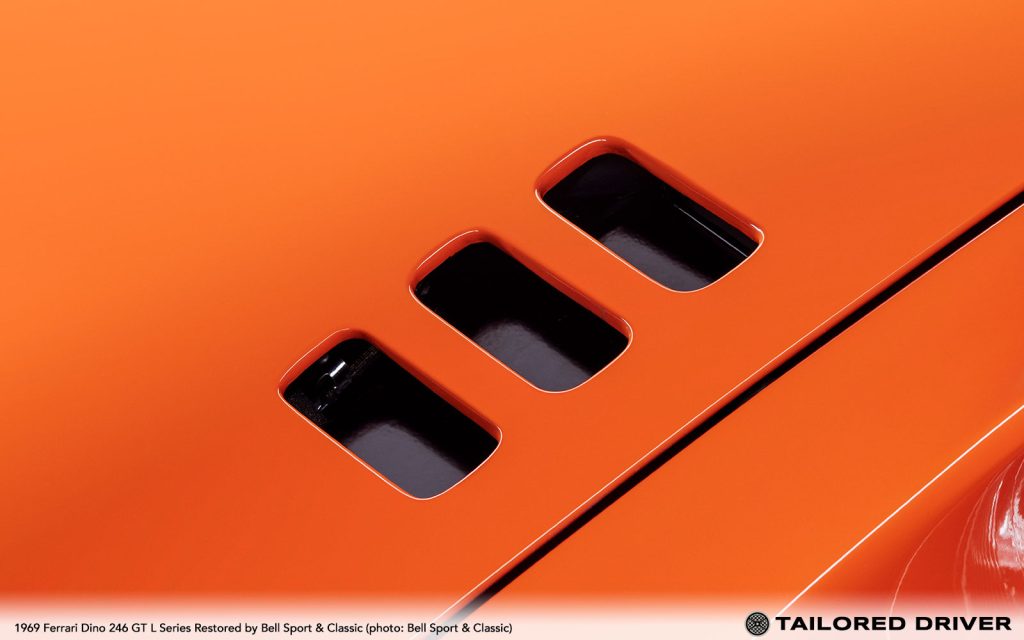
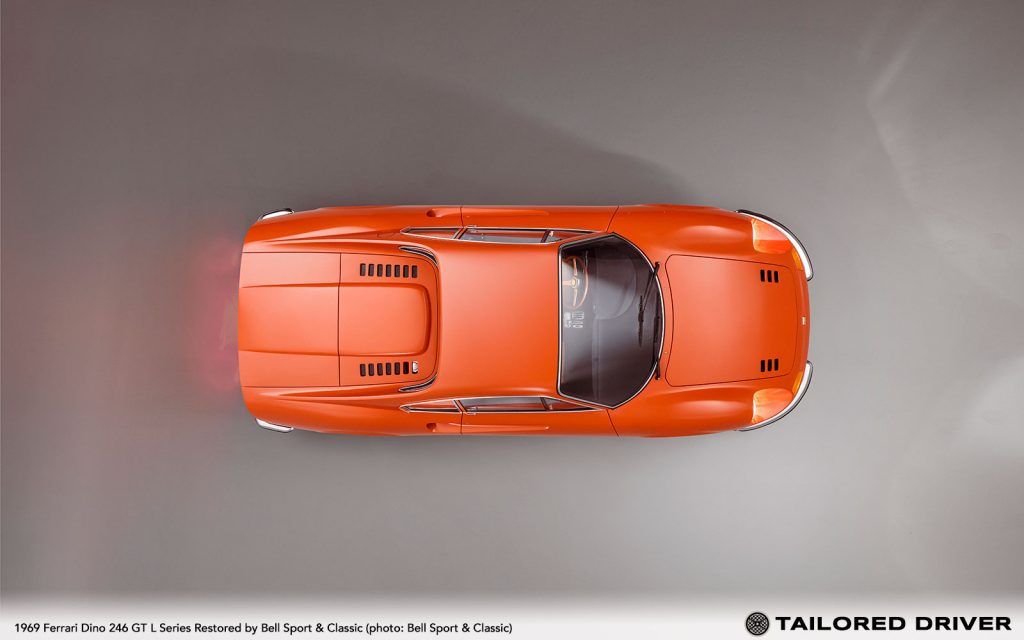
    The team took a similar fastidious approach to the Dino’s iconic air intake scoops, which cut elegantly into the doors and carry on along the rear panels to ensure the mid-mounted V6 engine has a plentiful supply of cool air. “Back in the 1960s, the people building these cars at Maranello did not have the technology at their disposal that we do today and so fit and finish were often not what they could have been,” continues Ensor. “When chassis number 00436 left Maranello in 1969, it did so with a slight mismatch on the position of the door scoops, a common enough problem at the time. We have spent hundreds of hours ensuring that the scoops are now correct.”

    Achieving symmetrical perfection required the wheel arches to be reformed and new sills to be fabricated and fitted. “Once we had the body panels perfect, we still had the issue of ensuring the scoops on the doors would align correctly with those on the body panels. That meant refabricating the doors and aluminium-welding the original scoops into the new skins,” reveals Ensor.

    Dry build for perfect finish
    Bell Sport and Classic is adamant that restoration is both a science and an art. It does not consider the process to be a matter of simply replacing damaged panels and worn-out parts. Even though doing this can save time and money, the team believes that the greater the number of new components fitted to a vehicle, the greater the risk its originality becomes depleted.

    Instead, the team uses its technical excellence, outstanding craftsmanship, and often its sheer patience in the passionate pursuit of perfection, carefully restoring and refurbishing every component to avoid needing new parts where possible. “Of course, lavishing attention to detail on every individual component makes the rebuild process even more challenging,” explains Ensor. “No car ever goes back together easily, and the more thorough the restoration, the more demanding the rebuild is because every single part of the car has been completely reengineered.” 

    The delicate and painstaking rebuild process is where the team’s skill and experience truly came to the fore, with near-constant minute adjustments of components such as body panels, window frames and sills required to ensure the perfect finish.

    “It took two weeks before we were completely satisfied that the doors opened and closed correctly and that the scoops on the doors aligned absolutely perfectly with those on the rear body panels. We spent a similar amount of time fitting the curved rear screen. That’s a very tricky job because the screen is actually bigger than the space it is going into. The only way to fit it is to put one side in first and then flex the screen ever so slightly to get the other end in,” recalls Ensor.

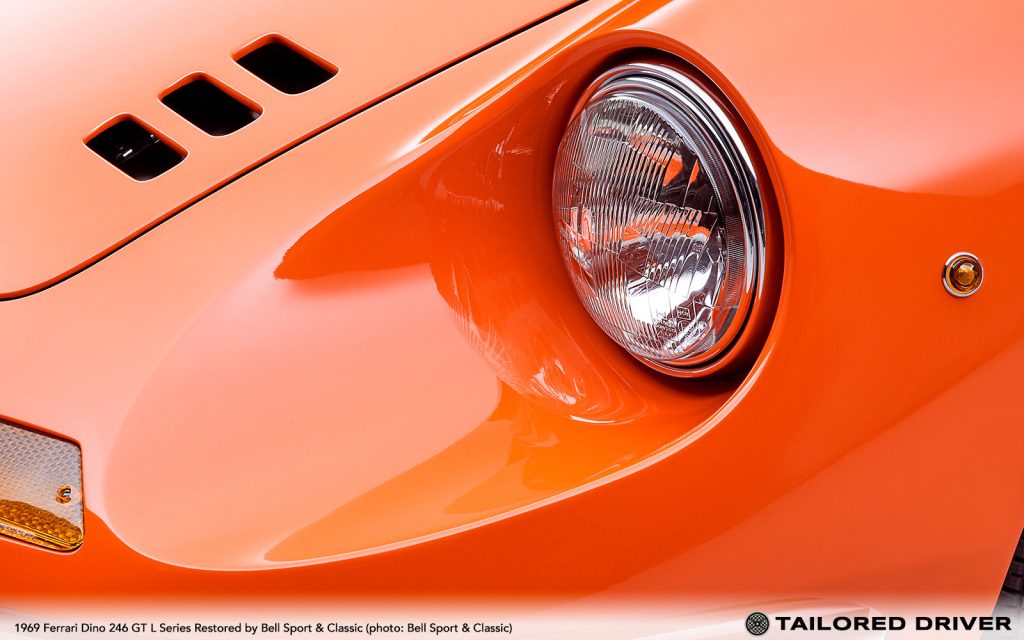
    More days and weeks ticked by with endless hours lavished on countless tasks such as repairing and polishing the front grille and ensuring the perfect positioning of the front sunken indicators. No component, no matter how small, escaped Bell Sport & Classic’s famous obsessive attention to detail. 

    Even the thin aluminium shell of the interior mirror had two days of polishing lavished upon it to attain perfection.

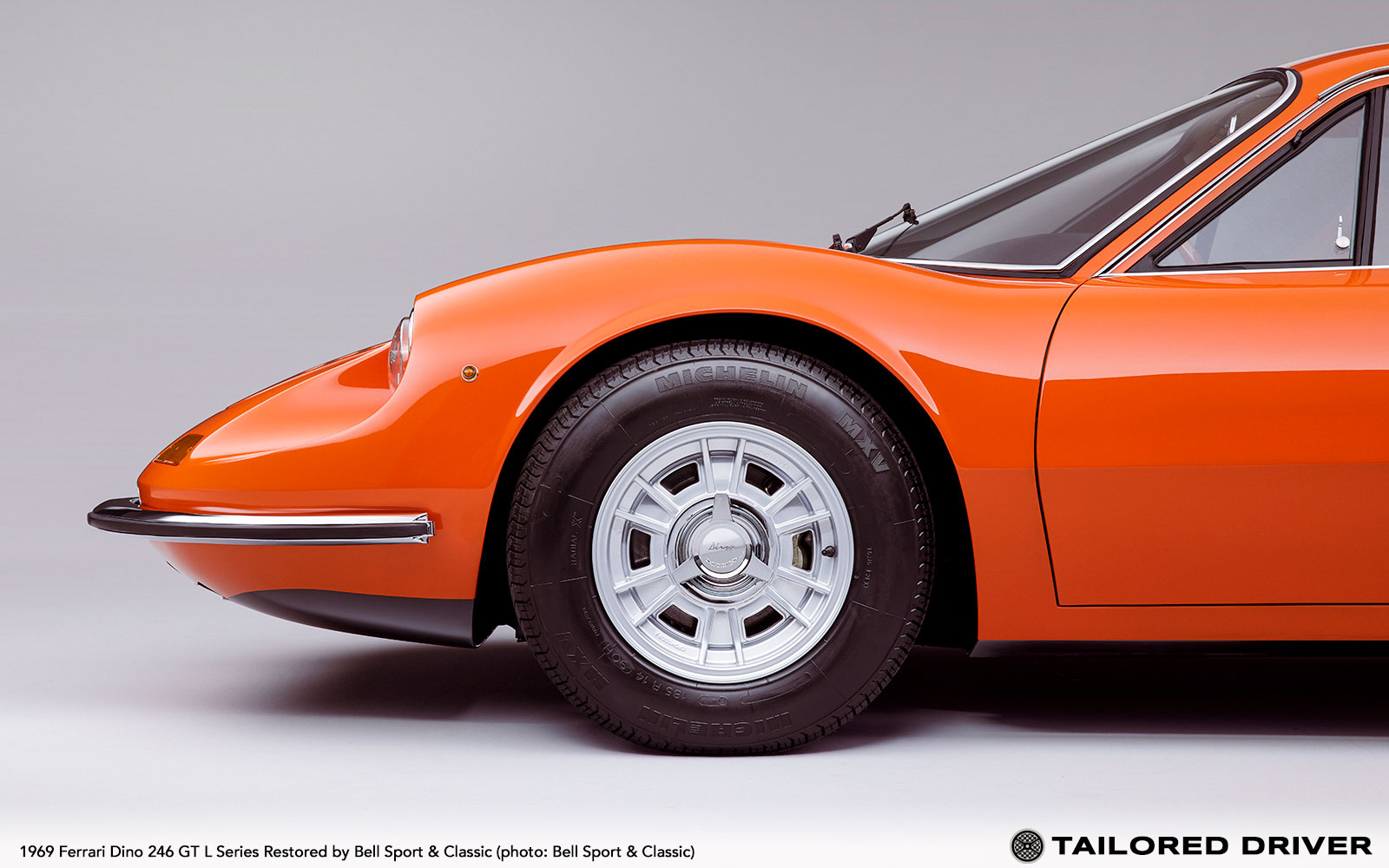
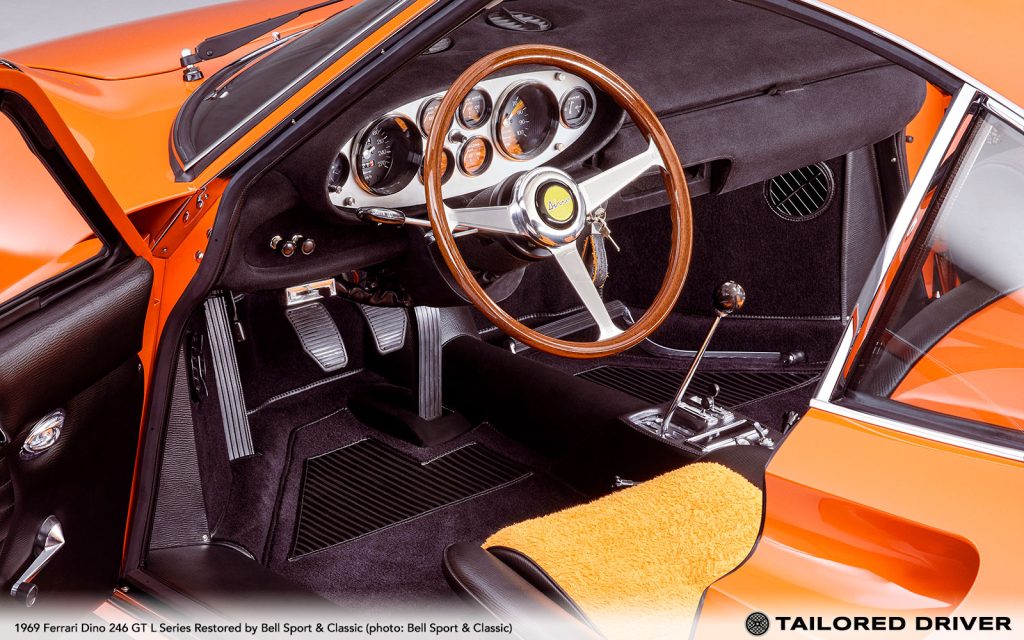
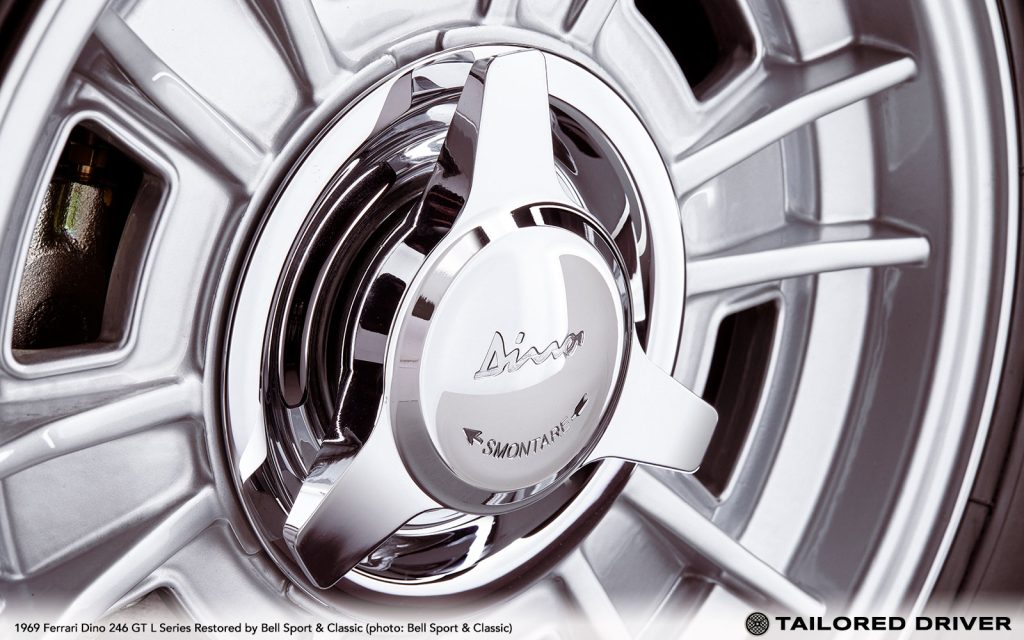
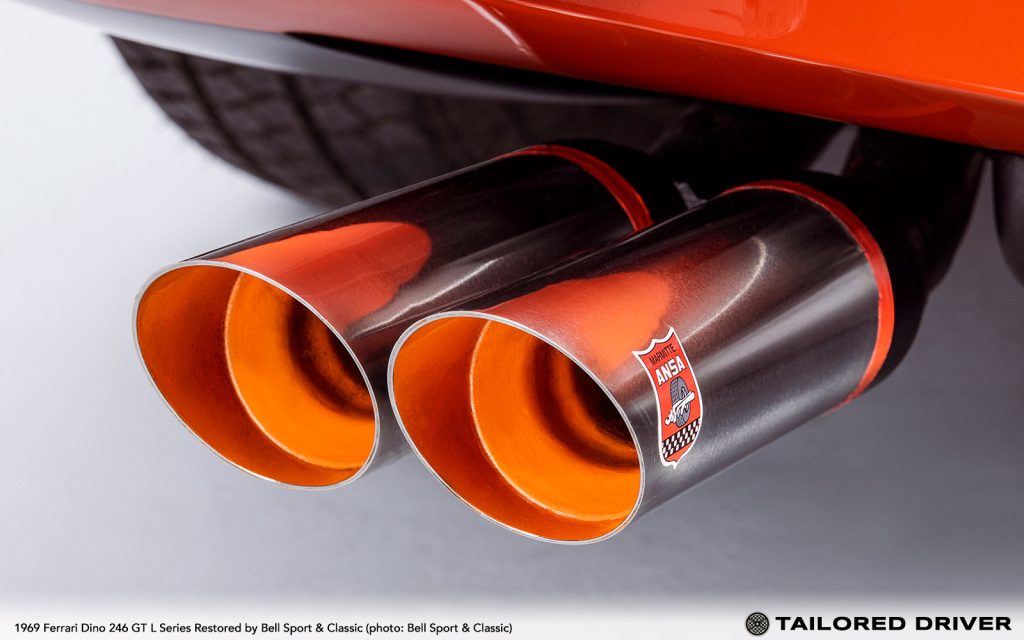
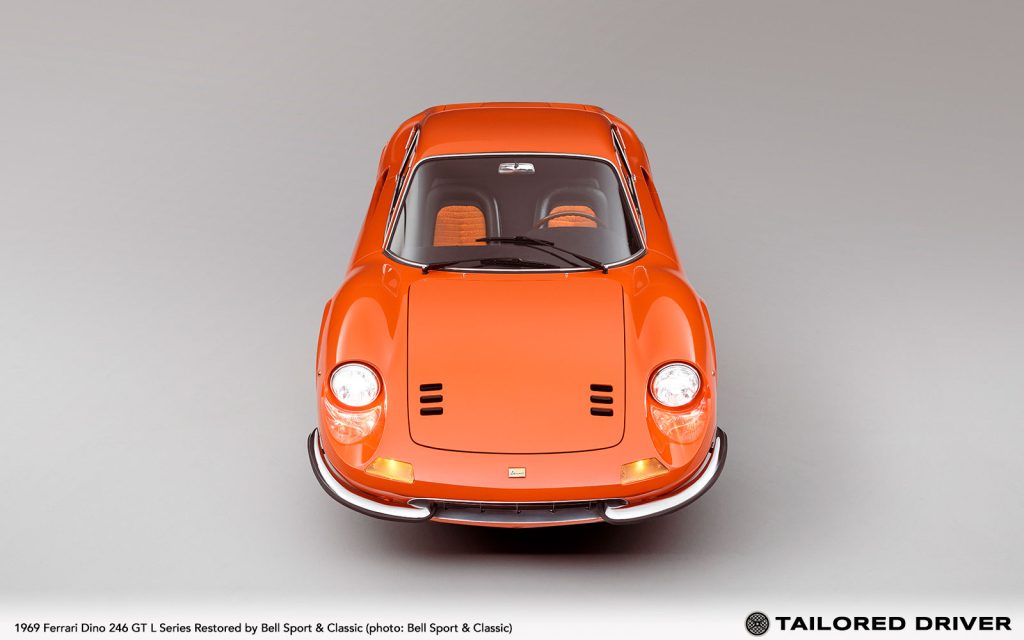
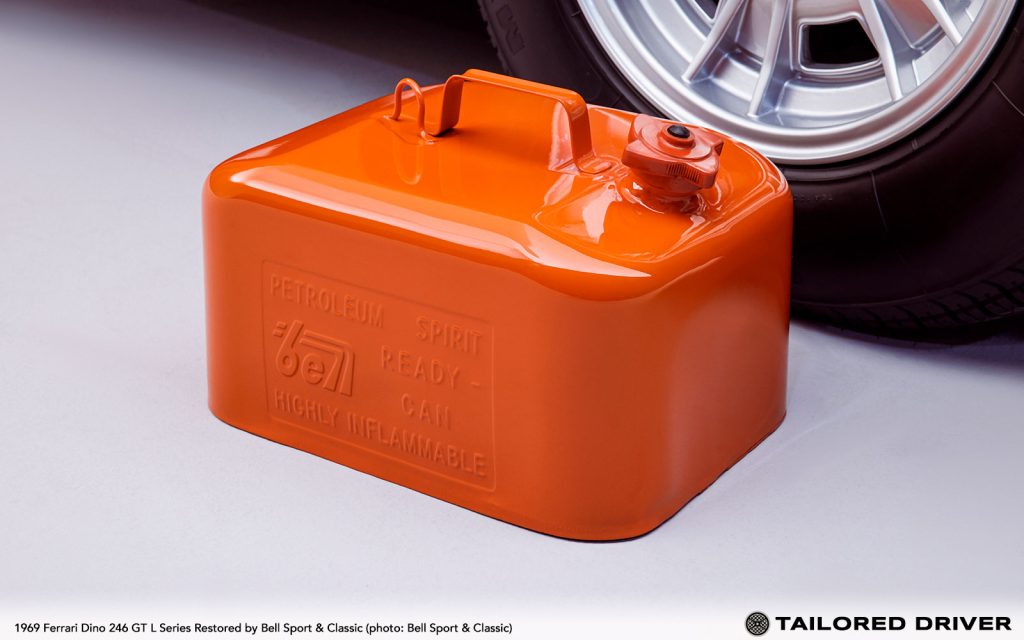
    The Dino 246 GT 00436 has been gloriously returned to its Rosso Dino (rosso dino; non-metallic Uni; 350; Ferrari) paint finish, which involved first applying the period-correct grey primer followed by a Rosso Corsa undercoat with Rosso Dino final coat. This painstaking, multi-tone process ensures the rare and desirable Rosso Dino is shown most effectively. The seats have been reupholstered in period-correct black leather complete with orange towelling inserts, and beautifully installed along with a newly built dashboard. Even the engine cam covers have been restored to their original bronze colour, ensuring the car is precisely as it left the factory in August 1969 – only better.
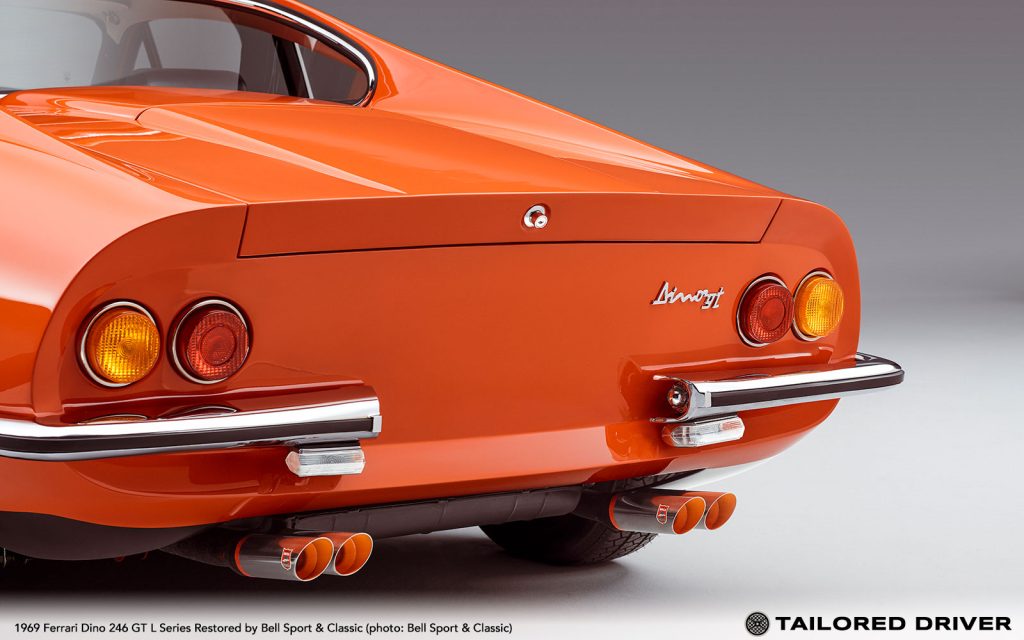
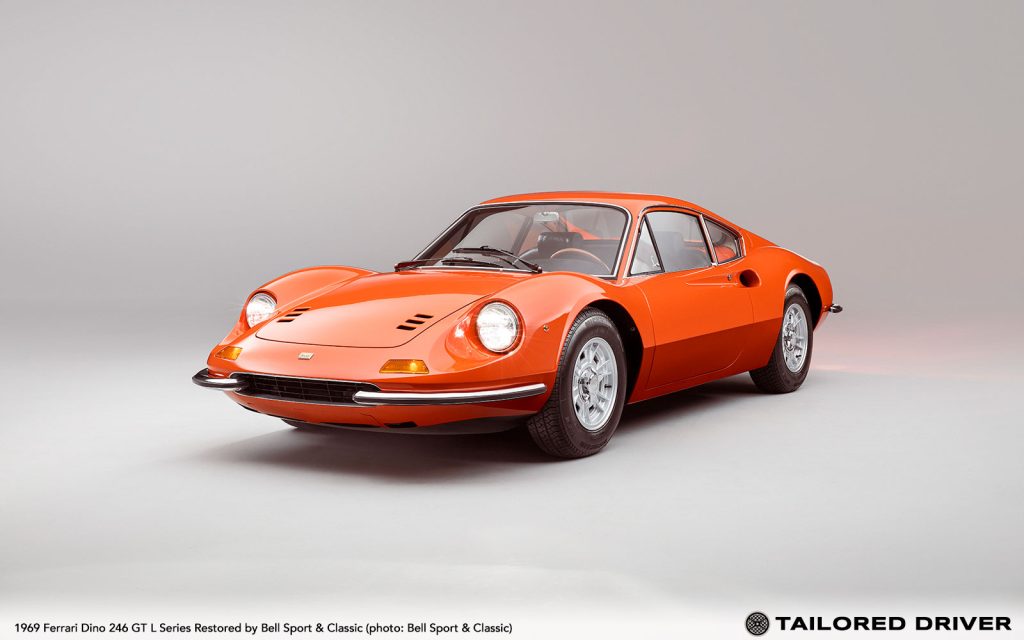
    Tim Kearns, Managing Director of Bell Sport and Classic, said: “Like every project we undertake, bringing the Dino 246 GT back to be life has been a true labour of love and most definitely not a clock-watching exercise. No amount of time, expense or attention to detail has been spared in ensuring the car is now in even better condition than when it left the factory. Along with its concours condition, the car’s low mileage adds to its considerable allure. With its mid-mounted V6 engine, the Dino differs from the Ferrari V12 GT models that preceded it. It represents a seminal point in the company’s history and stands as a fitting tribute to Alfredo ‘Dino’ Ferrari. There will always be an air of intrigue to this car too, as one cannot look at it without wondering what direction Ferrari may have taken if Alfredo had lived to take over the company’s reins from his father, Enzo. And that makes the Dino an exceptional car.”

    About Bell Sport & Classic 
    Bell Sport & Classic is a team of experts who have come together to provide customers unrivalled expertise across the sales, service and restoration of the world’s most revered classic and modern classic cars, specialising primarily in notable Ferraris but also Aston Martin and Lamborghini and other leading marques.

    Authenticity, originality and quality are the bedrocks of the business; Bell Sport & Classic prides itself on sourcing the ultimate in collector cars and bringing new standards to classic car restorations. Bell Sport & Classic stands apart in the classic car world as an innovator and leader in customer service.

  • Singer Presents Results of Turbo Study

    Singer Presents Results of Turbo Study

    Worldwide Introduction of Singer’s ‘Third Act’ Follows Classic Study and Dynamics and Lightweighting Study in Continued Celebration of the Porsche 911

    • A new chapter in Singer’s automotive services in collaboration with air-cooled 911 owners
    • The first road-going, turbocharged Porsche 911 reimagined by Singer
    • A wide range of high-performance capability – from luxury grand touring to sports focus

    [source: Singer Vehicle Design]

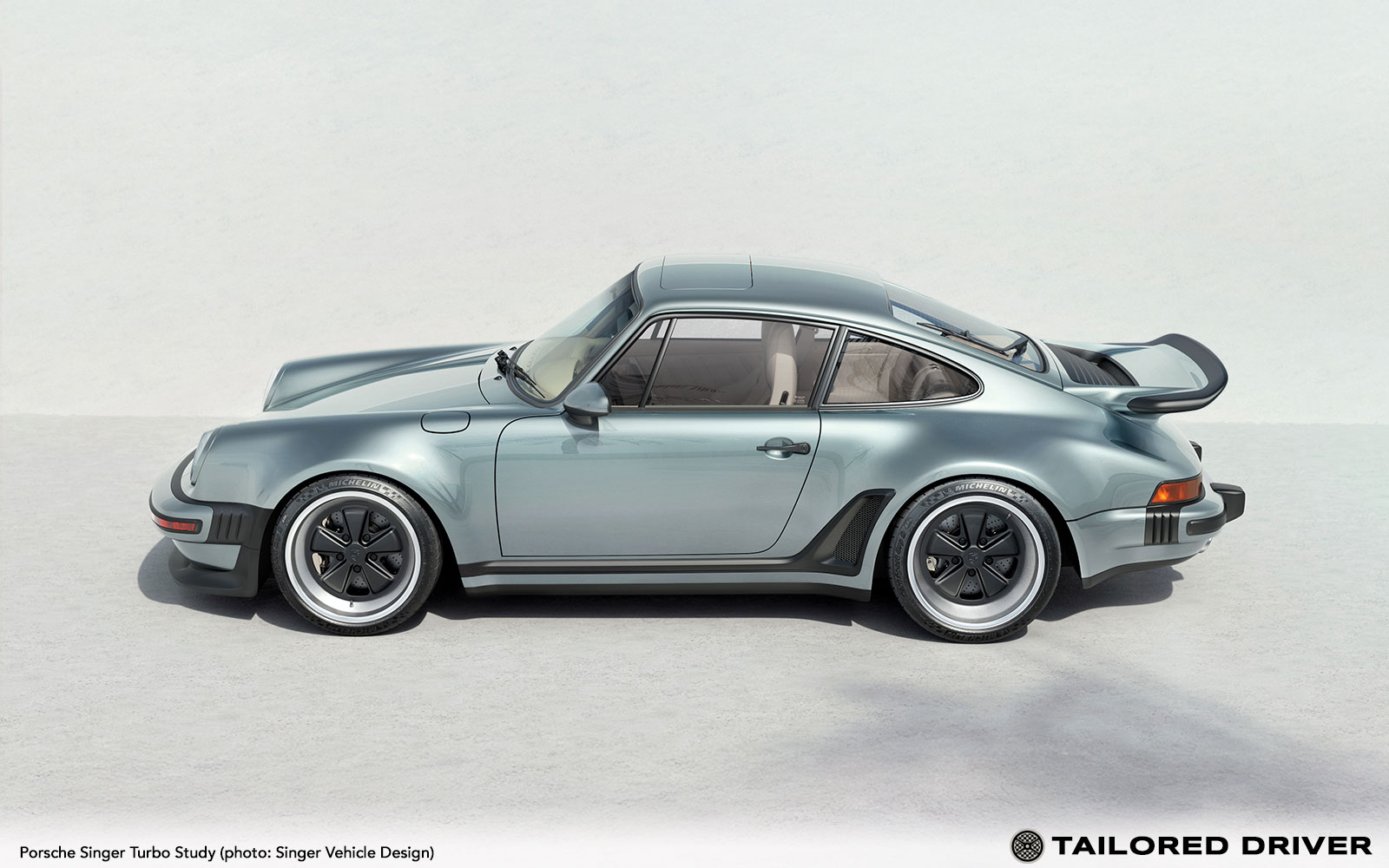
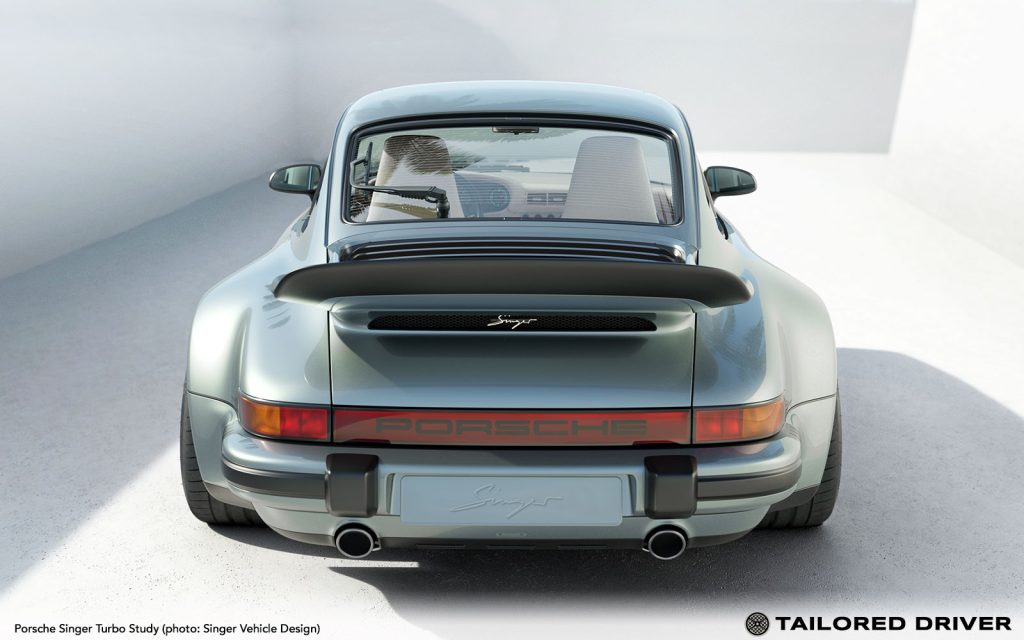
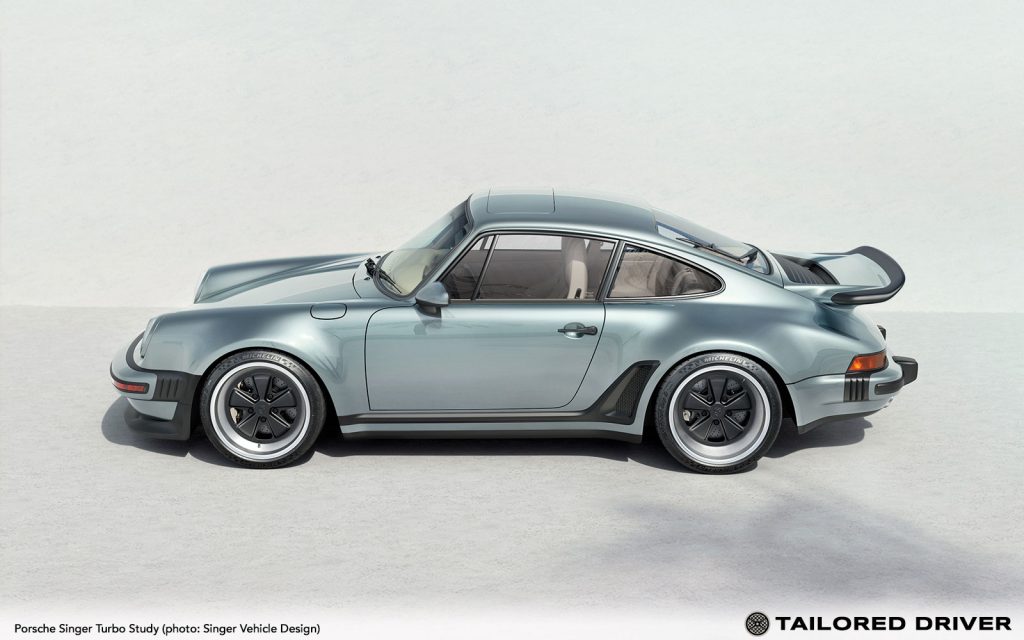
    Los Angeles, CA – Singer, the California-based, luxury specialist, presents the Porsche 911 reimagined by Singer – Turbo Study. The Turbo Study is a response to requests from owners for restoration services that incorporate turbocharging. More than 70 owners have reserved bespoke restorations enabled by the study.

    The next generation of services from Singer encompass:

    • Collaboration with owners on the first road-going restorations to feature forced-induction
    • Highly capable grand-touring, sports and everyday performance
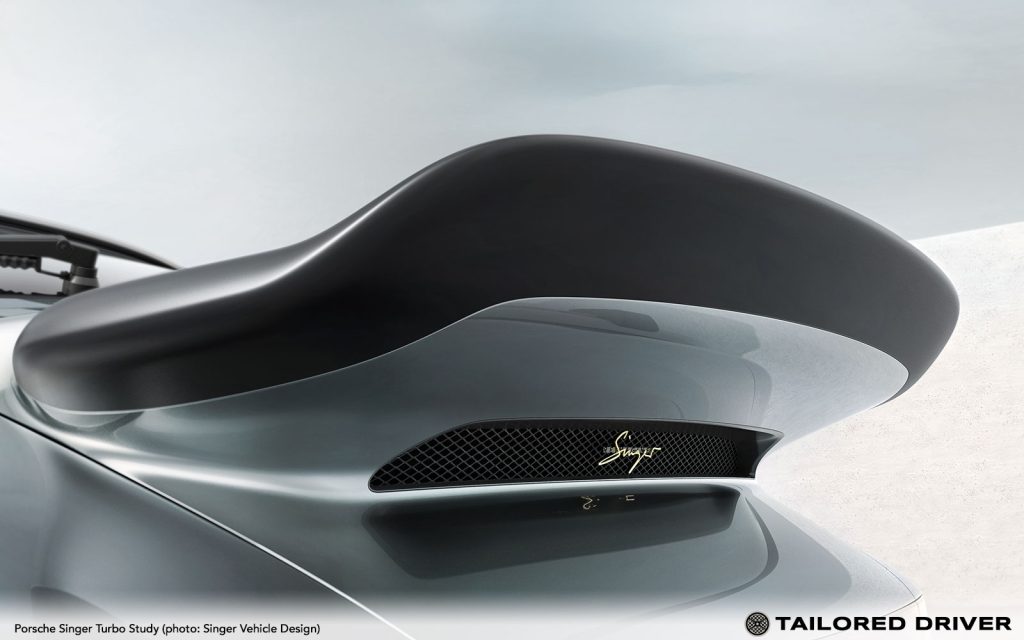
    • The iconic turbo body, whale tail spoiler and shark fin – reimagined
    • A balance of luxury and sporting character tailored by each owner for their car

    Rob Dickinson, Founder and Executive Chairman, Singer Group Inc. “My first ever ride in a Porsche 911 as an 11-year-old in 1976 left me dry-mouthed and speechless – it was a black 930 Turbo with red tartan seats. Forty-five years on from that life-changing moment I’m excited to present the results of our study that aims to capture the awesome thrill of Porsche’s first ‘supercar’ while reimagining its performance and refinement and collaborating with owners to take both to new heights. I believe it’s a fitting tribute to a car that changed my life and many others.”

    Summary Technical Specifications

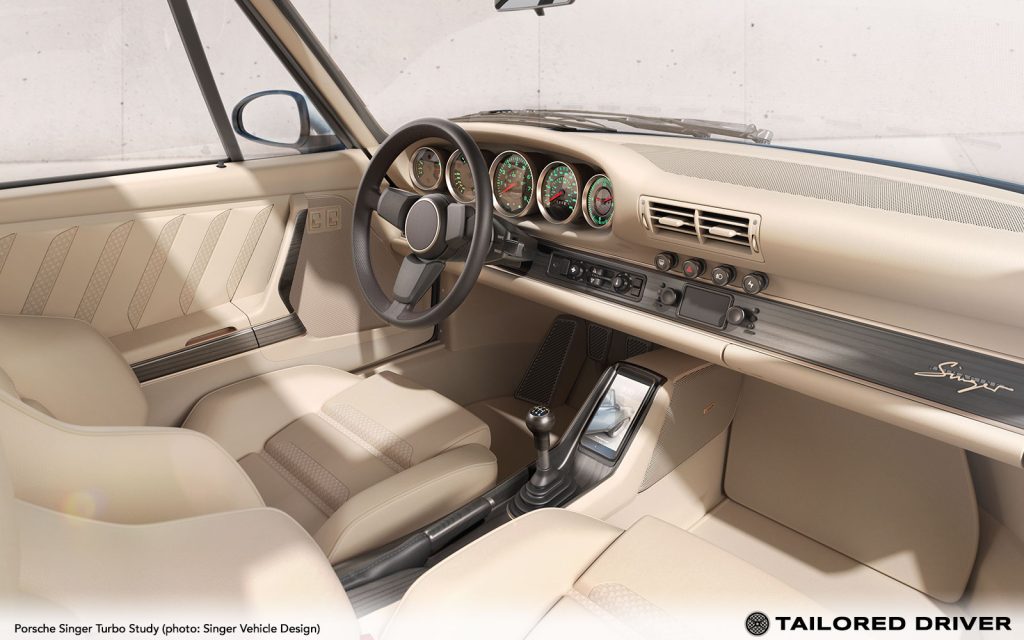
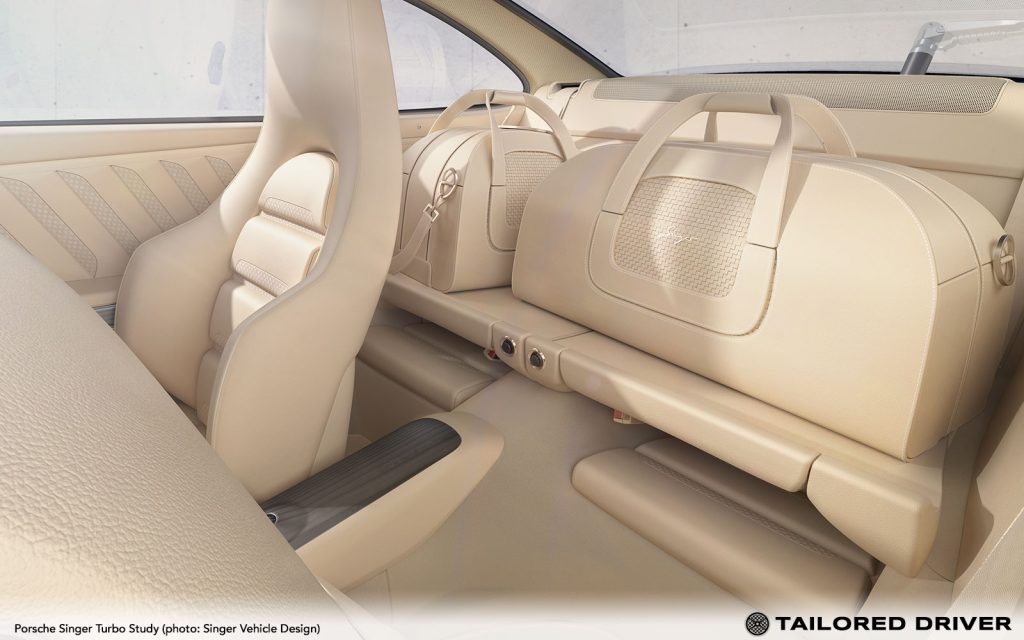
    The car in Wolf Blue presented here shows a Porsche 911 reimagined by Singer, specified by its owner using the results of the Turbo Study to reflect a personal vision. This owner has pursued a focus on high-performance, luxury grand touring capabilities, including:

    • Lightweight carbon fibre bodywork in Wolf Blue3.8L twin turbocharged, intercooled flat-six
    • Over 450 HP (power may be tailored to each owner’s specification)
    • 6-speed manual transmissionRear-wheel-drive and touring-focused suspension
    • Carbon-ceramic braking systemInterior presented in Malibu Sand with Black Forest wood accentsElectrically adjustable, heated seats
    • Air-conditioning

    Engine

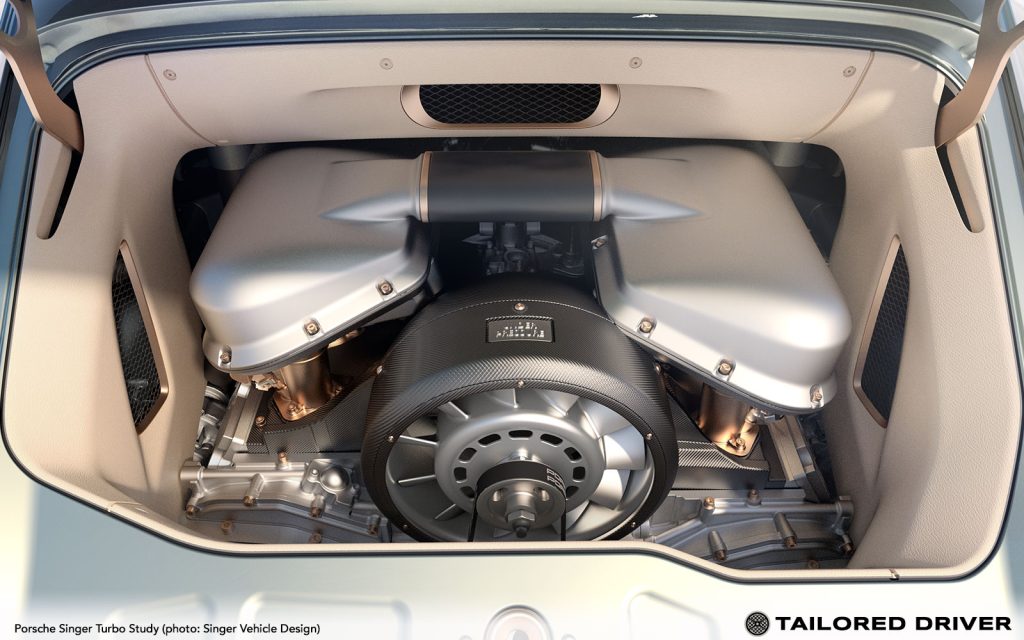
    As with all Singer’s restoration services in collaboration with owners of the Porsche 911, the Turbo Study takes the Type 964 generation of air-cooled cars as its starting point. The study features a new evolution of the “Mezger” air-cooled flat-six. Now in 3.8L form, the engine features twin turbochargers with electric wastegate. Bespoke air to water intercoolers are mounted inside the intake plenums. The ‘shark fin’ on the rear fender is reimagined as an intake and supplies cold air to the engine bay to optimize combustion and cooling performance.  In response to owners’ preferences, the study enables power outputs starting at 450 HP.

    Advanced materials

    A bespoke carbon fibre body maintains the careful balancing of iconic DNA with cutting-edge engineering and material science. While inspired by the turbo cars of the mid-70s, the bodywork is reimagined to optimize aesthetic and functional performance. As always, the use of carbon fibre allows reduced mass and enhanced stiffness, further sharpening dynamic responses in the manner that Singer’s clients have come to expect and enjoy.

    Drive

    The results of the Turbo Study also reflect Singer’s habitual focus on constant optimization and technical development. The study draws on all-wheel-drive experience that has been developed in-house since the first AWD Classic Study restoration, undertaken in 2014. In recent years this experience has been brought together with research into turbocharging and high-performance ride and damping expertise.

    Accordingly, in response to owners’ requests, both rear-wheel-drive and all-wheel-drive restorations may be enabled by the Turbo Study. An owner may decide to specify the AWD configuration to enhance sure-footed deployment of power and torque in all seasons and surface conditions. The RWD configuration allows owners to pursue an alternative sporting focus, if preferred. In both cases, an optimized six-speed manual transmission underlines the driver engagement that Singer is renowned for.

    Performance

    The use of forced induction enables power outputs starting at 450 HP. Refinement is enhanced, with reduced noise levels and the ability to opt for more compliant damping and suspension performance. This allows owners to focus on long-range, high-speed touring capability if desired. The availability of turbocharged torque allows for effortless speed-matching from alpine pass to autobahn, together with deep reserves of overtaking ability.

    A higher power output may also be specified by the owner. If a more overtly sporting focus is preferred, a sports exhaust system and suitable damping characteristics can be tailored as required.

    The collaboration between Singer and owner enables all points in between, from refined grand touring to sports focus, to be accommodated. Immensely powerful, turbo-specific, brakes, ABS, and traction control sit in reserve for the moment they are needed. Carbon-ceramic discs are available if desired by the owner.

    Inside, the results of the Turbo Study enable owners to respond to the demands of all-season touring if they wish. Heated, electrically adjustable seats and cruise control are available for comfort during cold-climate driving and for convenience on high-speed road networks.

    Price

    Prices for restorations enabled by the Turbo Study are dependent on the specification requested by the car’s owner. As always, clients are able to engage the special wishes department to discuss their personal requirements for further bespoke engineering, in collaboration with Singer.

    Mazen Fawaz, Chief Executive Officer, Singer Group Inc.

    “We’ve more than doubled sales of our services between 2020 and 2021. Our new, much larger, consolidated facility in Torrance, California enables us to expand the team, respond to demand and welcome owners in comfort. Meanwhile, in the UK, our team is carefully executing each of the restorations enabled by the Dynamics and Lightweighting Study. The response to the Turbo Study from owners has been incredible and we look forward to working with each of them as their restorations progress.”

    In public

    For those keen to see and hear the results of the Turbo Study in person, the car will be running at Goodwood Festival of Speed in the UK from 23-26 June, 2022. It will then travel to the Monterey Peninsula in Northern California for Car Week in August 2022.

    Singer’s automotive services now encompass both normally aspirated and turbocharged sports cars for the road. The results of the Classic Study allow owners to pursue their personal vision for optimized, air-cooled 911 coupes and Targas.

    The results of the Dynamics and Lightweighting Study, allow owners to explore the ultra-high-performance capabilities of their air-cooled 911, incorporating technology born from the world of Formula 1.

    The results of the Turbo Study extend Singer’s services on behalf of owners into the world of turbocharging. Over the coming years, the definitive collection of iconic design will continue to grow.

    Singer Summary

    Founded in California in 2009, Singer represents a philosophy simply expressed as A Relentless Pursuit of Excellence.

    The company has become renowned for its collaboration with owners of the air-cooled Porsche 911 to reimagine bespoke restorations. Singer’s philosophy embodies:

    • A highly personalized approach and exquisite execution, guided by the Singer mantra Everything is Important.
    • A passionate focus on iconic design and a homage to the world’s most iconic sportscars.
    • Modern engineering and material science combined with jewel-like details.
    • A deep connection with California and its automotive zeitgeist.

    Over the past decade Singer has become a luxury brand with a global clientèle and is now synonymous with the concept of Reimagining – bringing together heritage with twenty-first century engineering and material science. The brand has been growing beyond car culture, with an award-winning Swiss watchmaking division, Singer Reimagined, launched in 2017.

    Singer Quick Timeline:

    2009 – Company founded; first restoration presented at Monterey Car Week
    2014 – First all-wheel-drive and Targa restorations completed
    2017 – Singer Reimagined watch company launched
    2018 – Results of the Dynamics and Lightweighting Study presented at Goodwood and Monterey
    2021 – Results of the All-terrain Competition Study presented
    2022 – Results of the Turbo Study presented

    About Singer

    Singer Group, Inc. (Singer) restores and reimagines 1989 to 1994 Porsche 911s, based on the 964 chassis at the direction of its clients.  Singer does not manufacture or sell automobiles.  Singer’s Global Partner Network supports owners across North America, Europe, the Middle East, Asia and Australasia.

    Singer is not sponsored, associated, approved, endorsed nor, in any way, affiliated with Porsche Cars North America, Inc., or Dr. Ing. h.c.F. Porsche, AG. The Porsche® name and crest, 911® and TARGA® are trademarks of Dr. Ing. h.c.F. Porsche AG, and any other products mentioned are the trademarks of their respective holders. Any mention of trademarked names or other marks is for purpose of reference only. 

    The product of Singer’s painstaking effort is a Porsche 911 restored and reimagined by Singer.  Out of respect for Porsche, and to respect Porsche’s trademark rights, this incredible machine should never under any circumstances be referred to or described as a “Singer,” “Singer 911,” “Singer Porsche 911” or a “Porsche Singer 911,” or in any other manner that suggests that it is anything but a Porsche 911 that has been restored and reimagined by Singer.

  • Audi USA Celebrates Final Model Year of TT RS with Limited “Heritage Edition”

    Audi USA Celebrates Final Model Year of TT RS with Limited “Heritage Edition”

    • Audi TT RS no longer offered after the 2022 model year in the U.S.
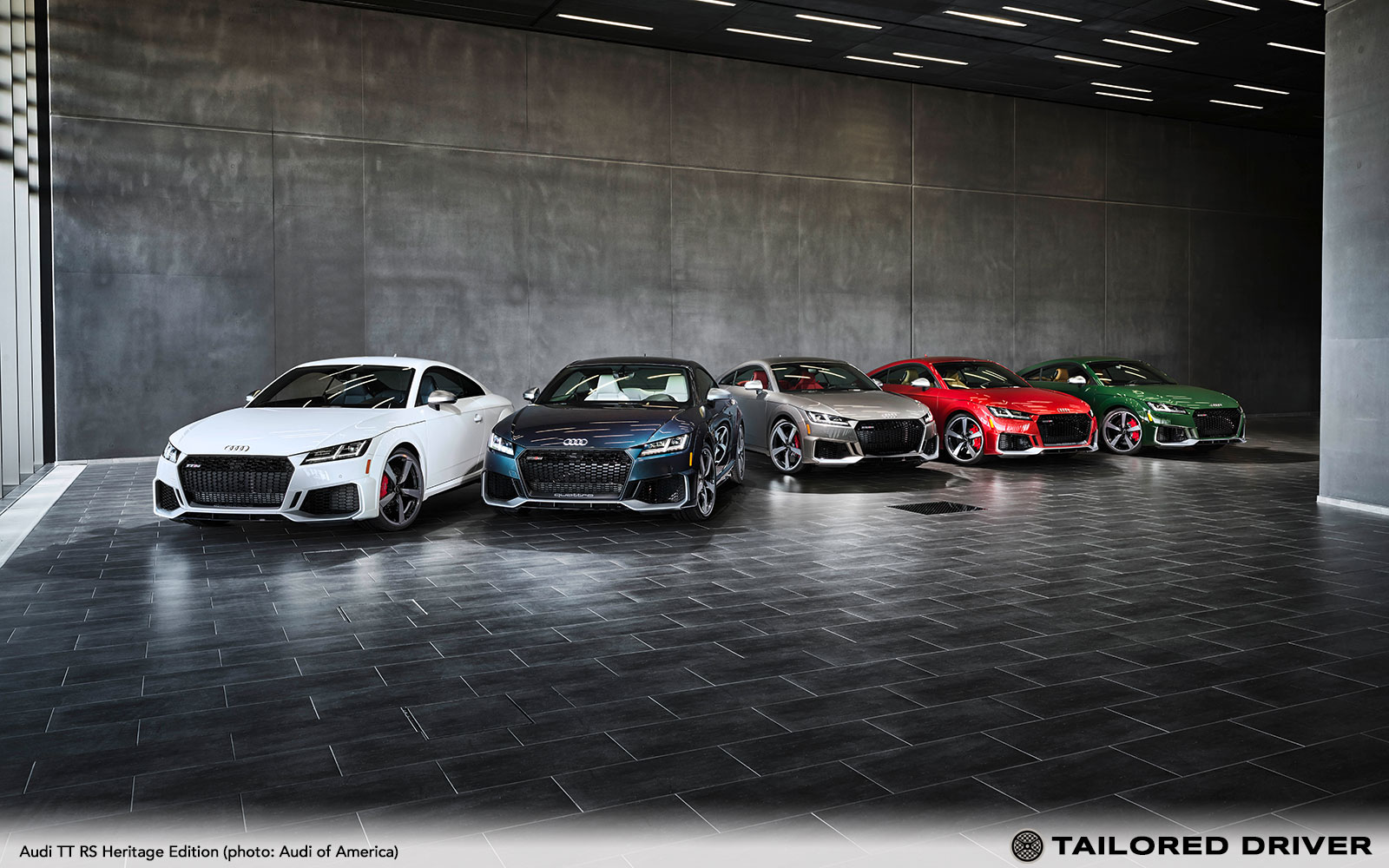
    • Five Audi heritage colors celebrate legendary five-cylinder engine and bids farewell to pinnacle performance of a design icon in the U.S. 
    • Limited number of just 50 (10 of each) color combinations available

    [source: Audi of America, Color Code Information Researched and Provided by Tailored Driver]

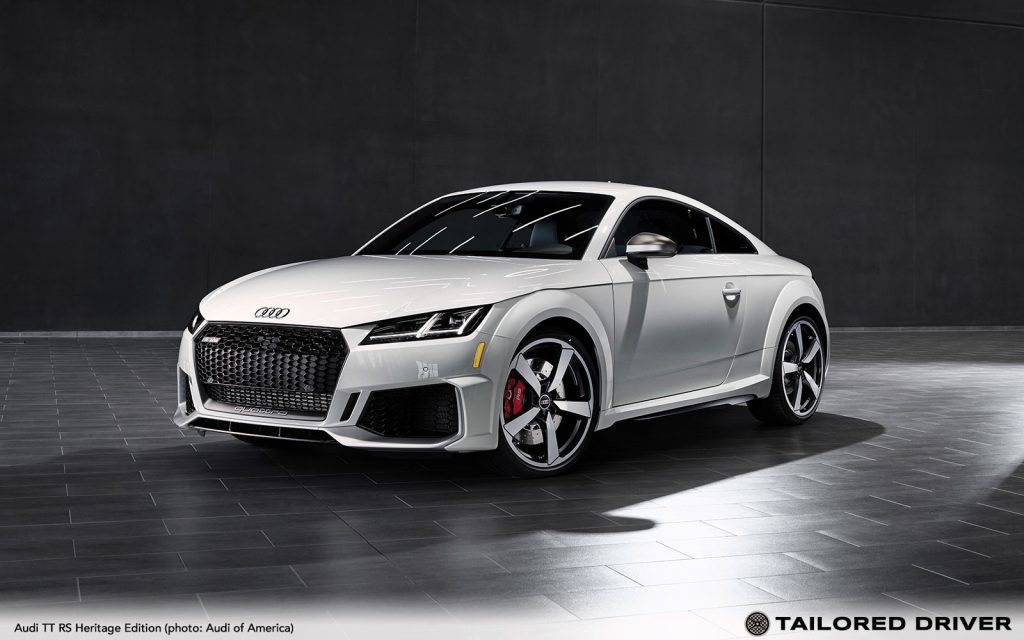
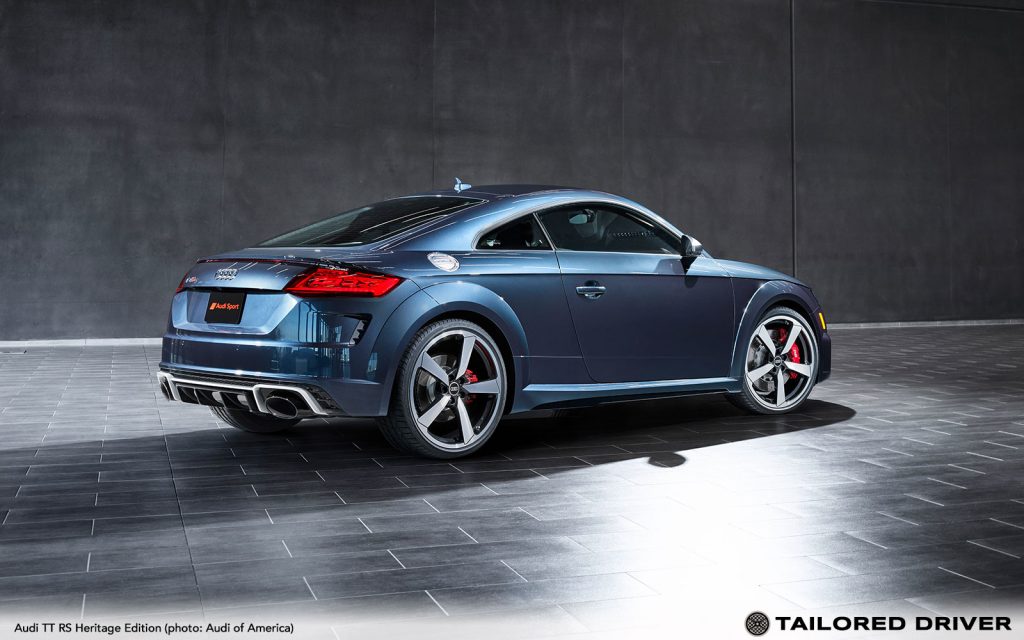
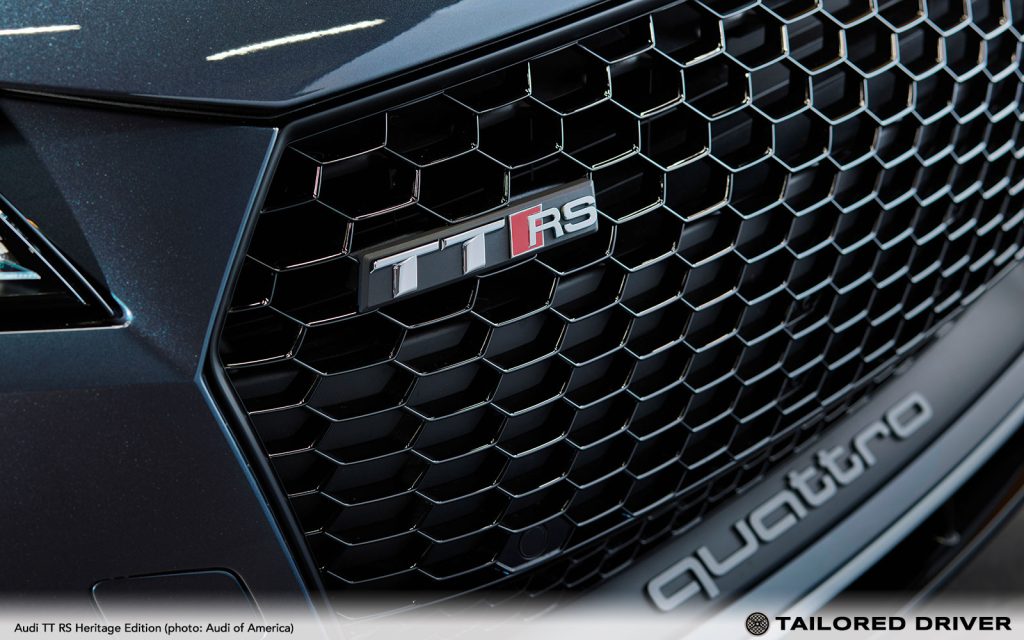
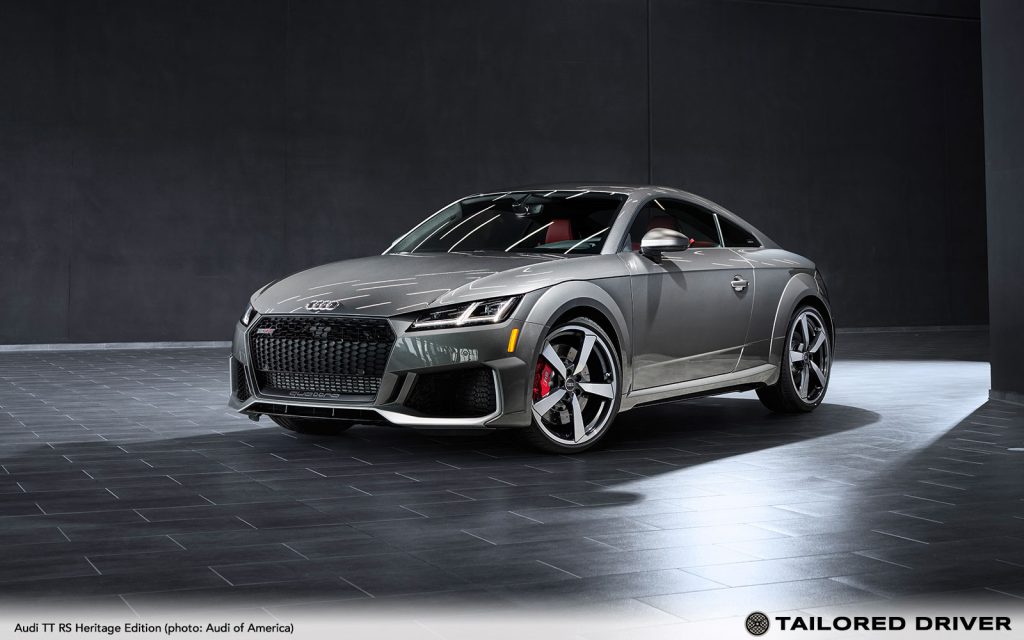
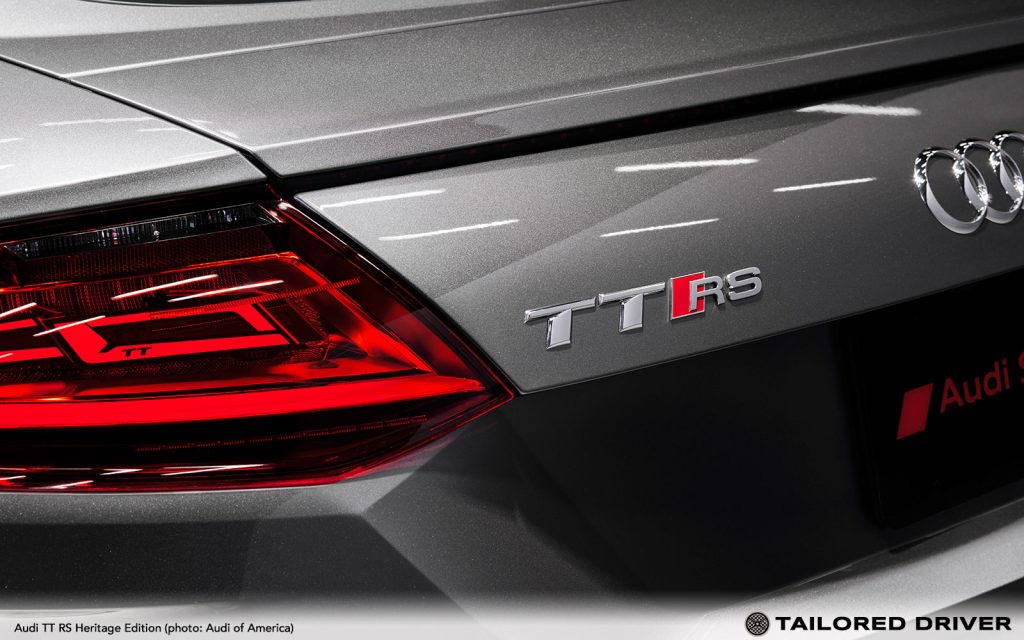
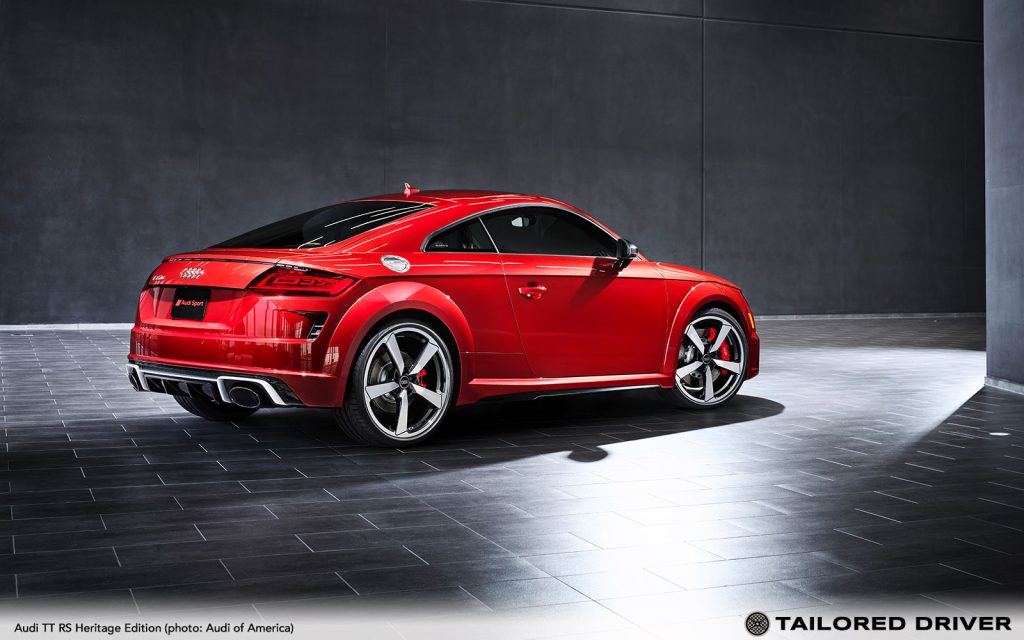
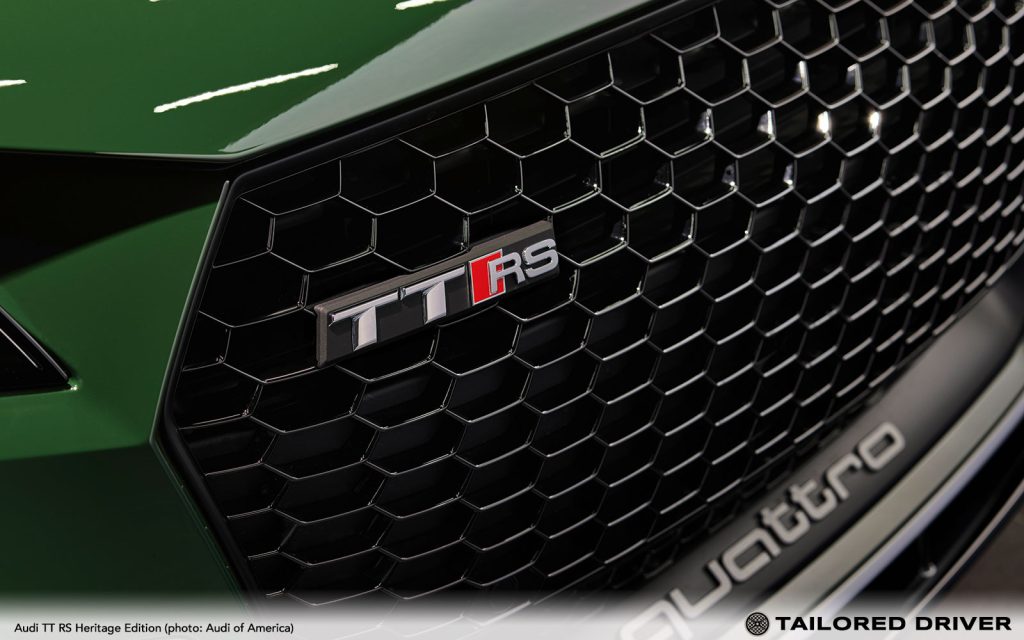
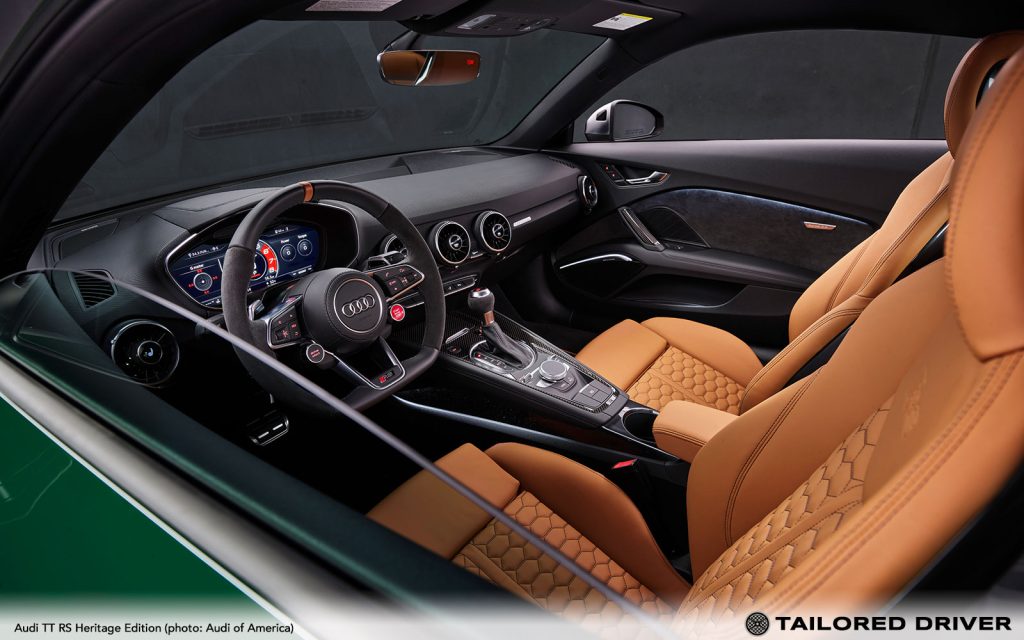
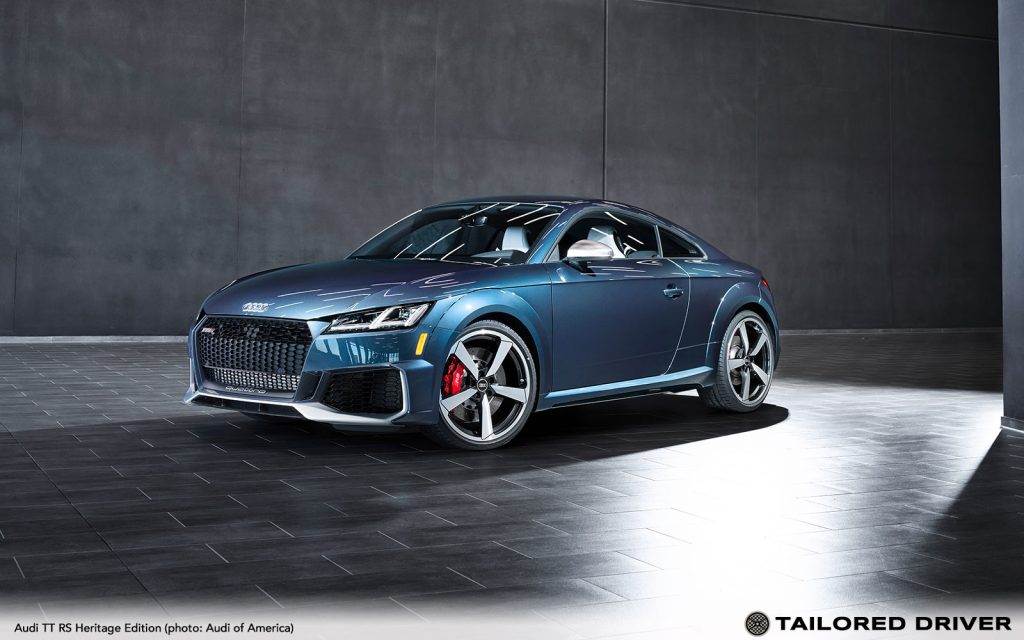
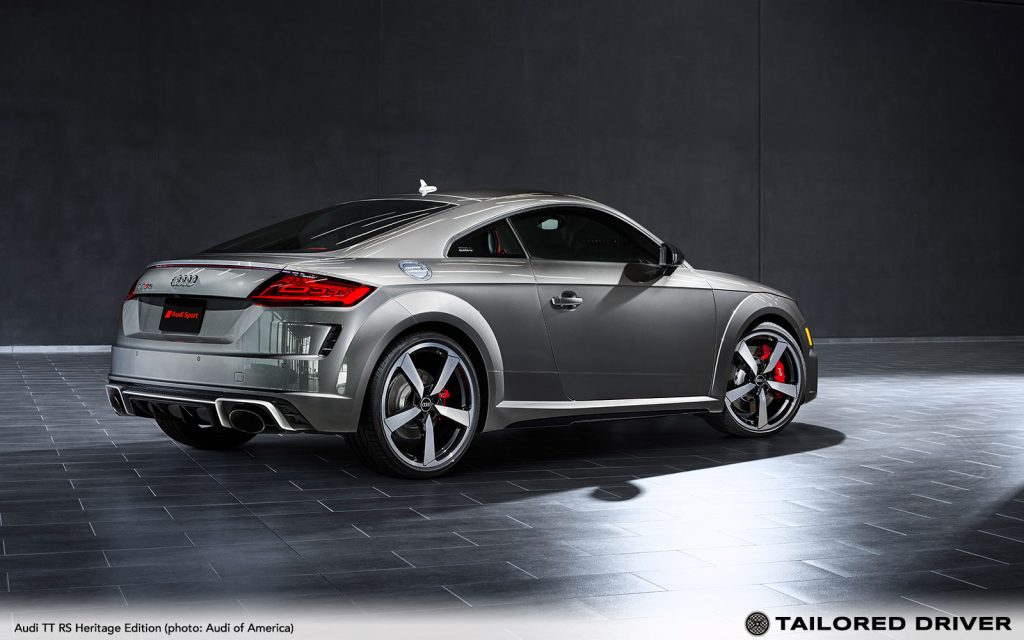
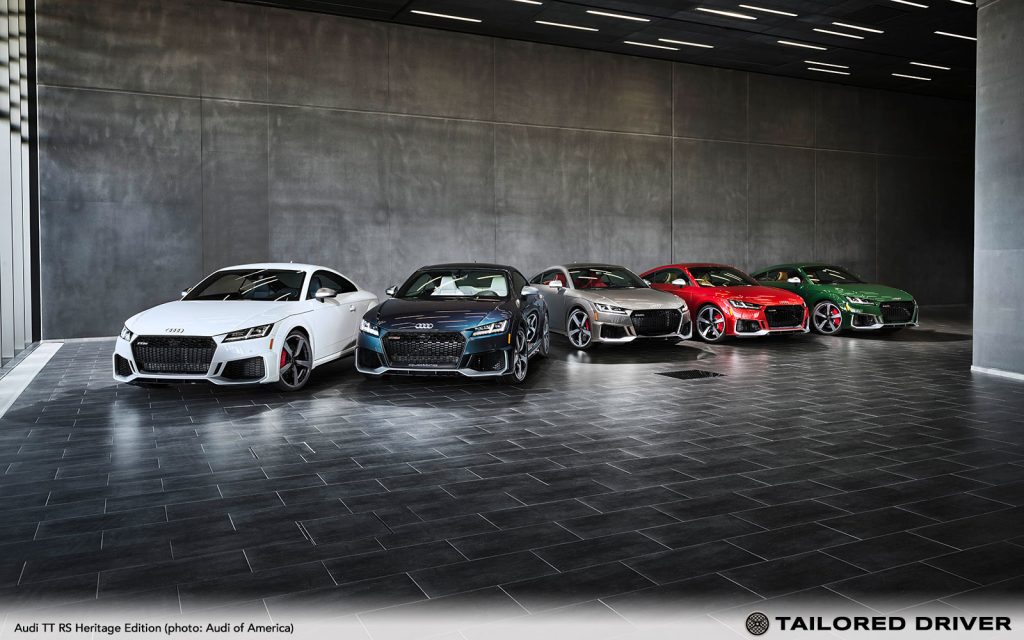
    HERNDON, VA – Today, Audi of America announces a limited offering of 50 special units of the 2022 Audi TT RS Heritage Edition that combines the power of the emotive Audi five-cylinder engine heritage along with the storied paint colors that once adorned the Audi Ur-quattro. While still available outside of the U.S., the 2022 Audi TT RS Heritage Edition signals the appropriate farewell to the remarkable high-performance coupe following the 2022 model year. The TT and TTS models will continue to be available in international markets and in the U.S. market.

    Five heritage color combinations celebrate the legendary five-cylinder engine
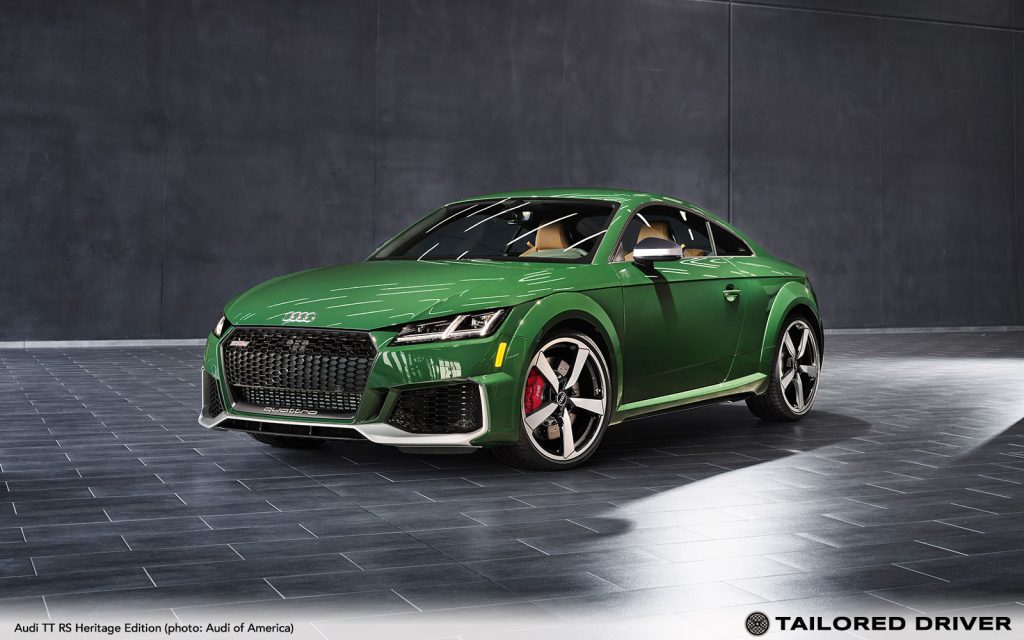
    For the 2022 model year, a limited number of just 50 highly collectible TT RS models will be available with the Heritage Edition nomenclature that blends five different exterior paints of the past that celebrate the heritage of the Audi Ur-quattro. The legendary Ur-quattro was powered by the storied Audi five-cylinder engine of its time with the modern version supporting the high performance Audi TT RS today. The limited TT RS Heritage Edition is available in five different color combinations, listed below in the five-cylinder firing order, and is limited to only 10 units of each.
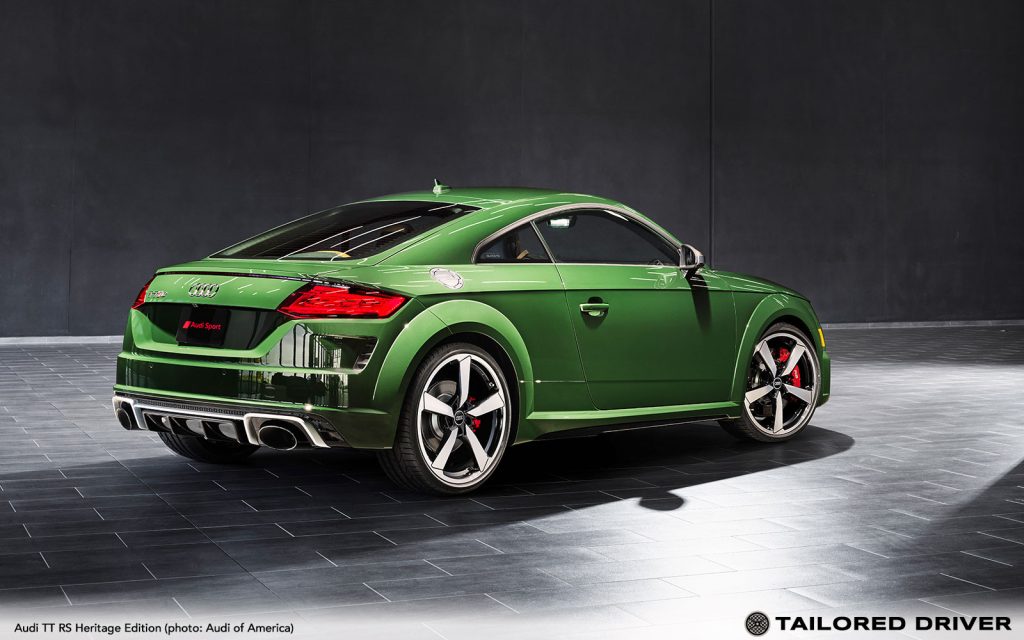
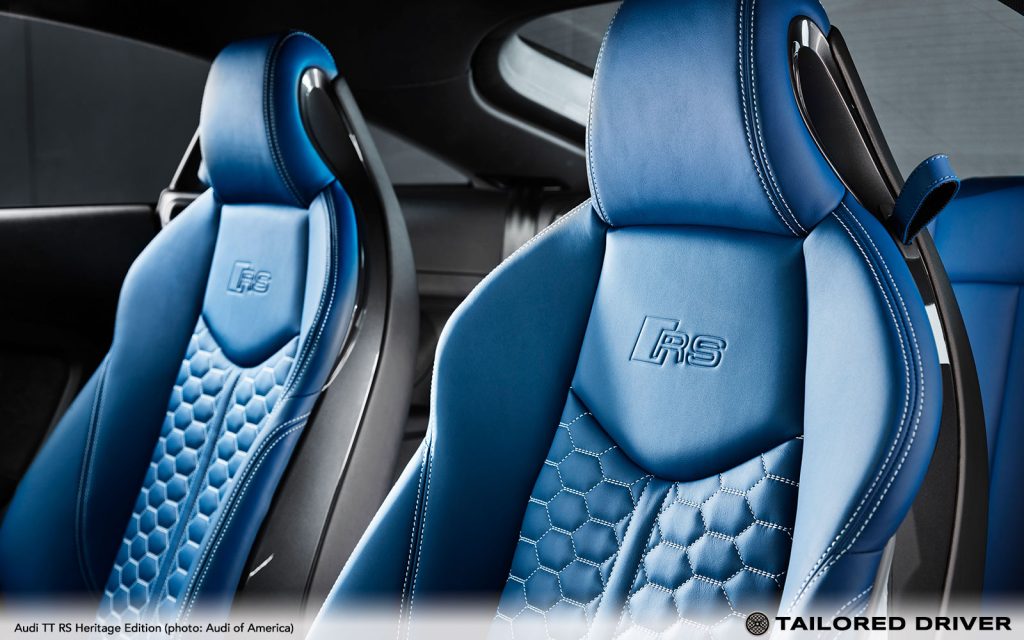
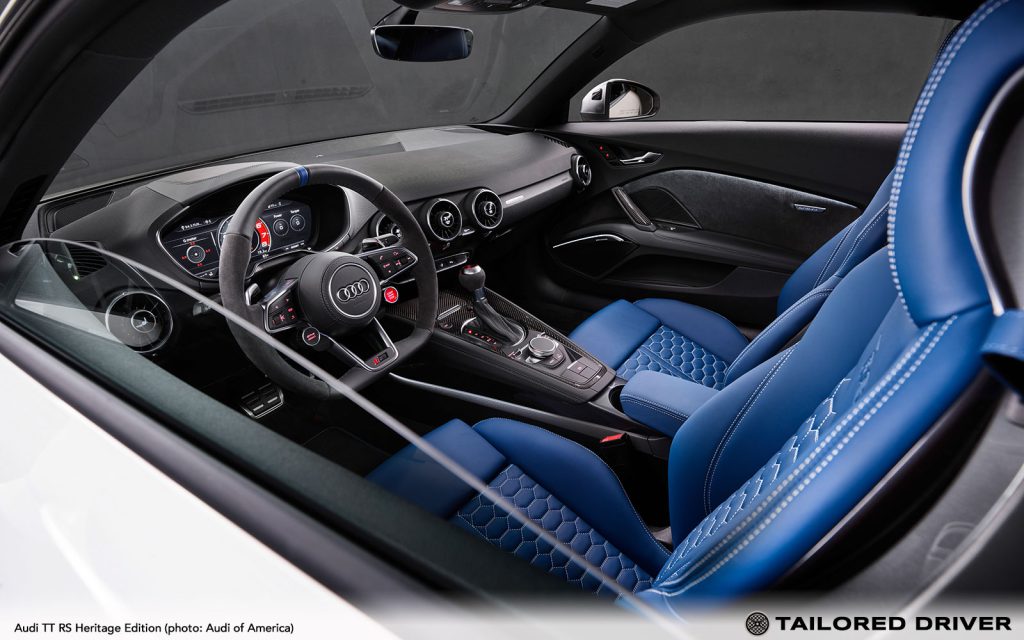
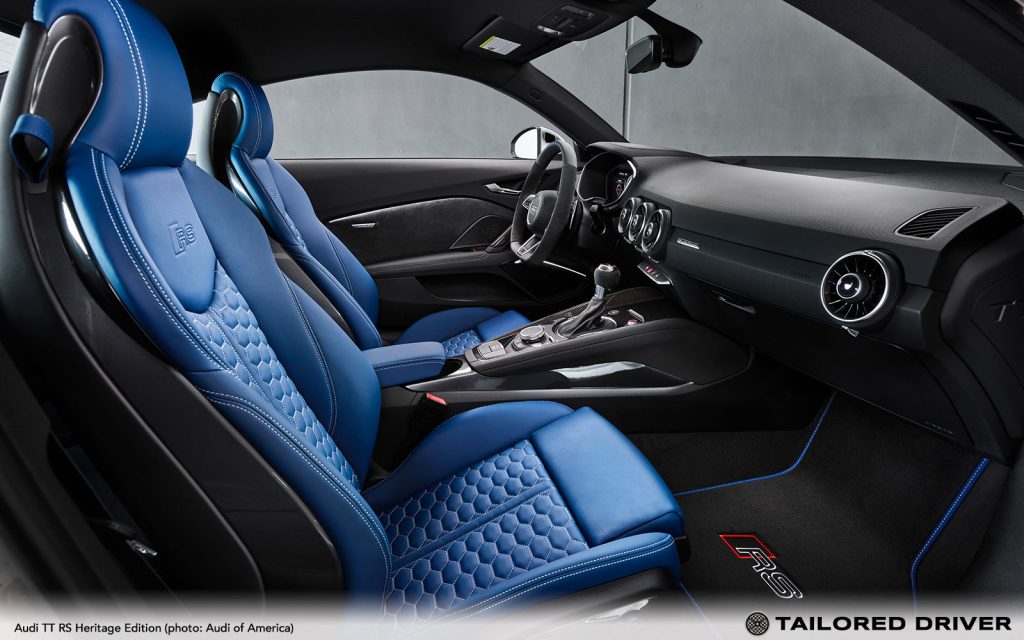
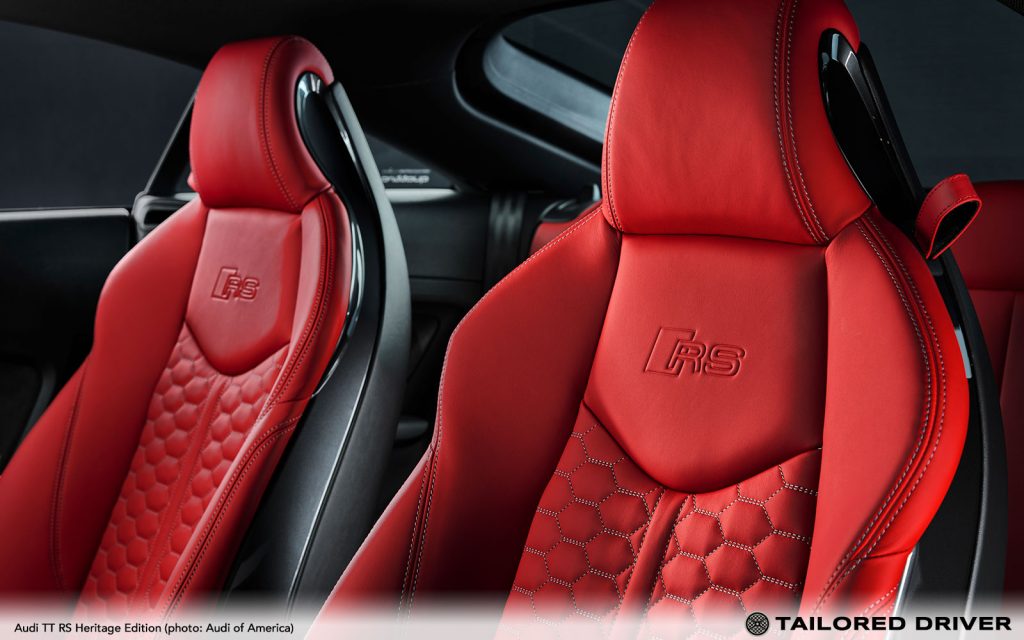
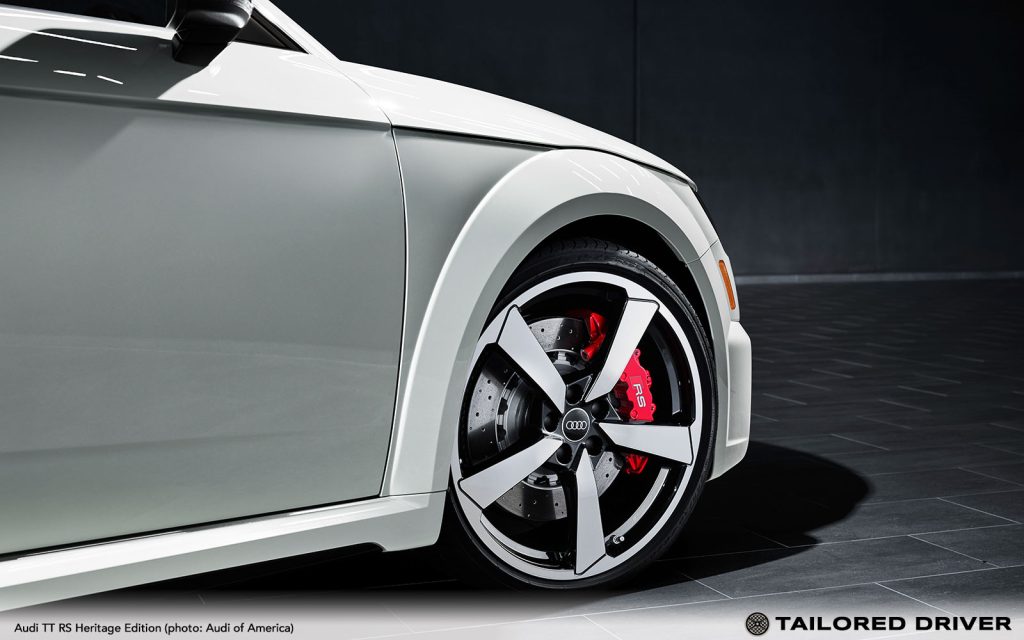
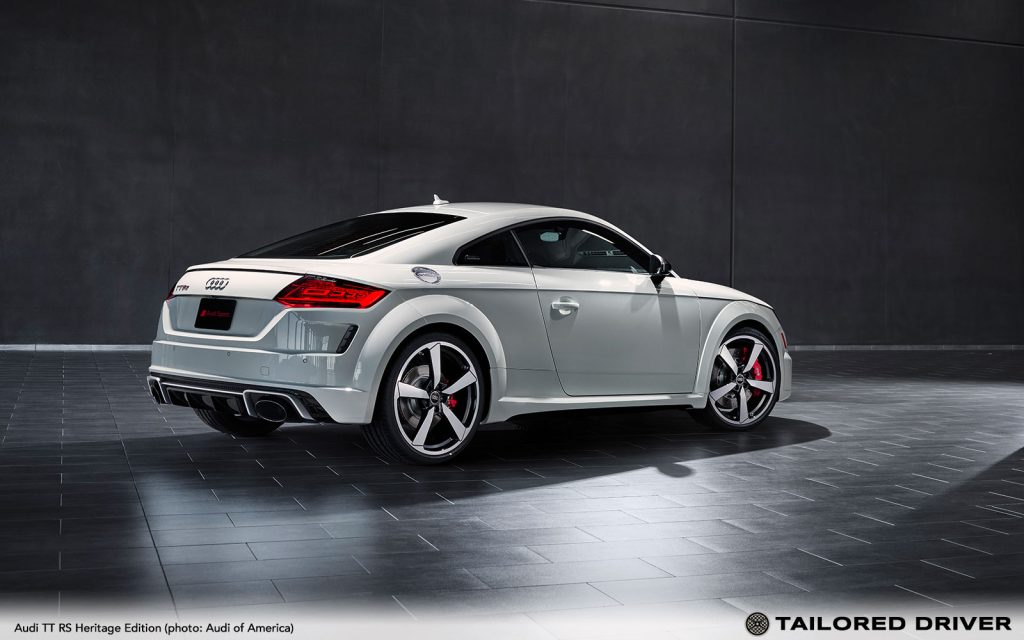
    1. Alpine White (alpinweiß; non-metallic UNI; L90E; Audi) with Ocean Blue leather and Diamond Silver stitch
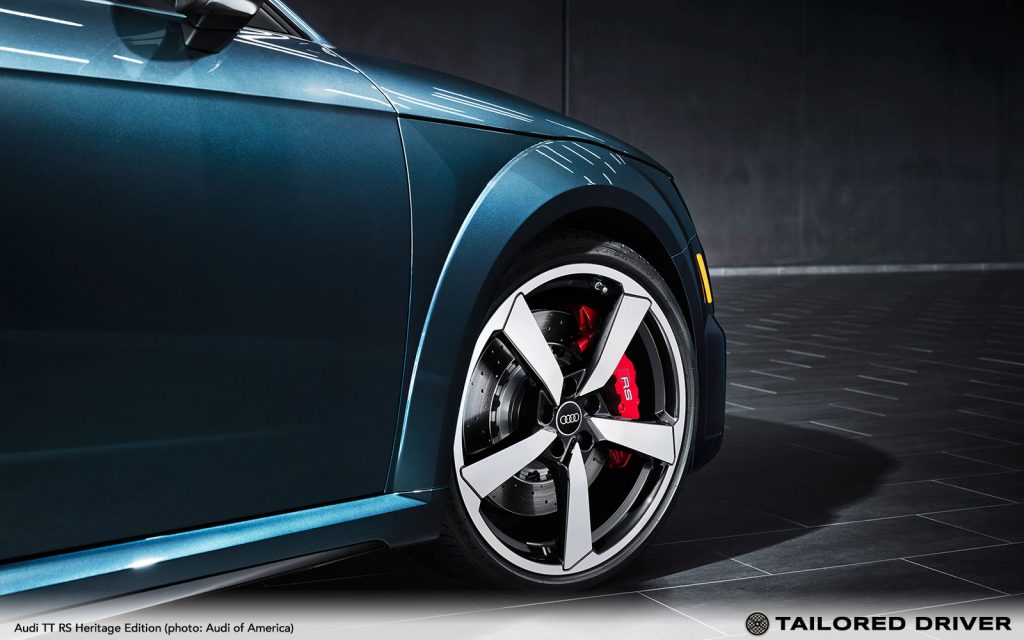
    2. Helios Blue metallic (heliosblaumetallic; metallic UNI; LA5Y; Audi) Diamond Silver leather and Ocean Blue stitch
    4. Stone Gray metallic (steingraumetallic; metallic UNI; LY7U; Audi) with Crimson Red leather and Jet Gray stitch
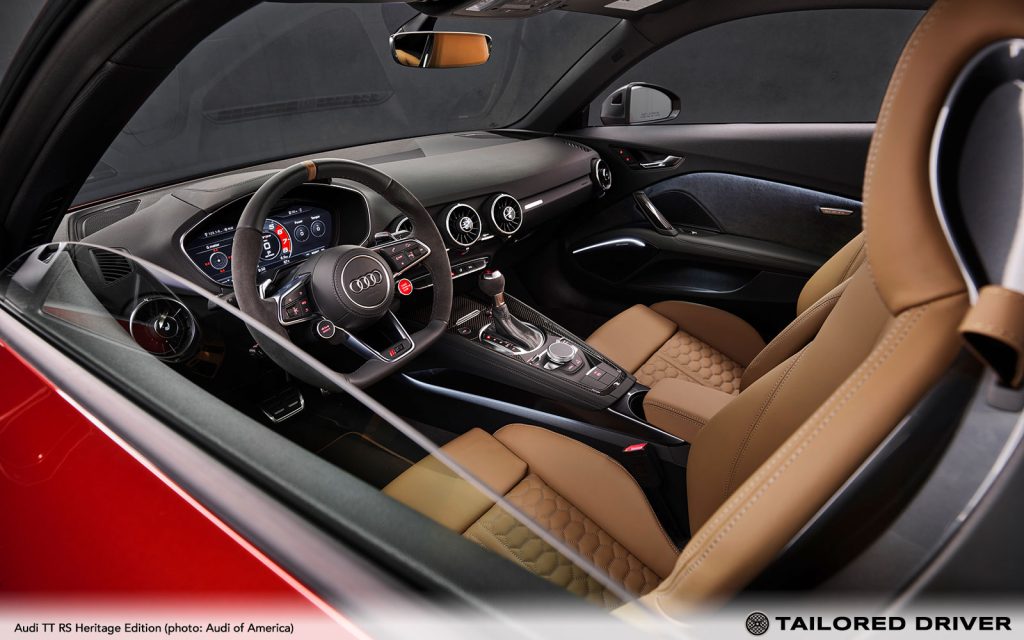
    5. Tizian Red metallic (tizianrotmetallic; metallic UNI; LB3V; Audi) with Havanna Brown leather and Jet Gray stitch
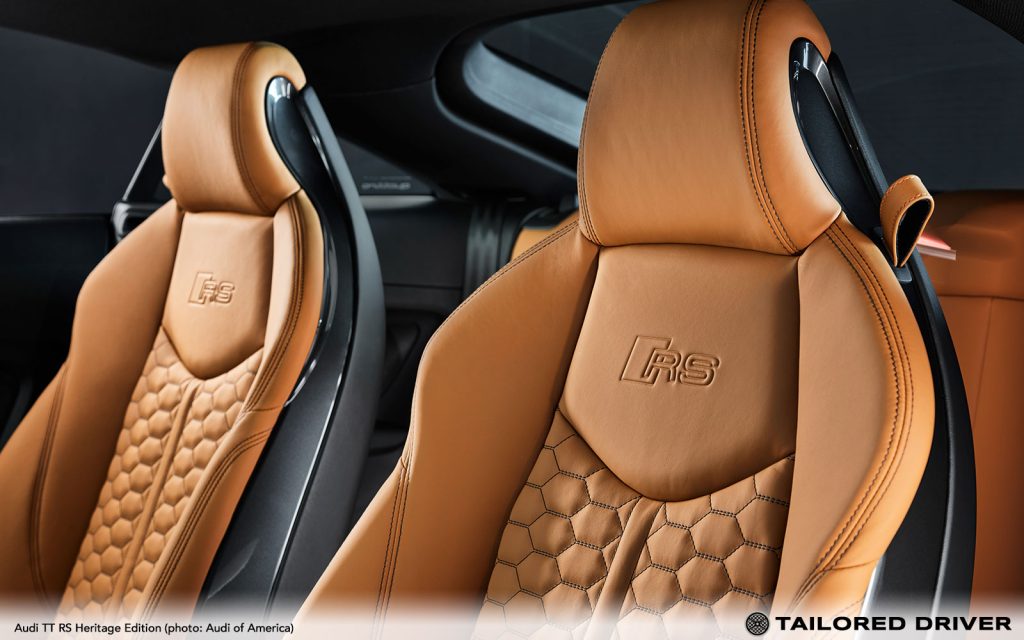
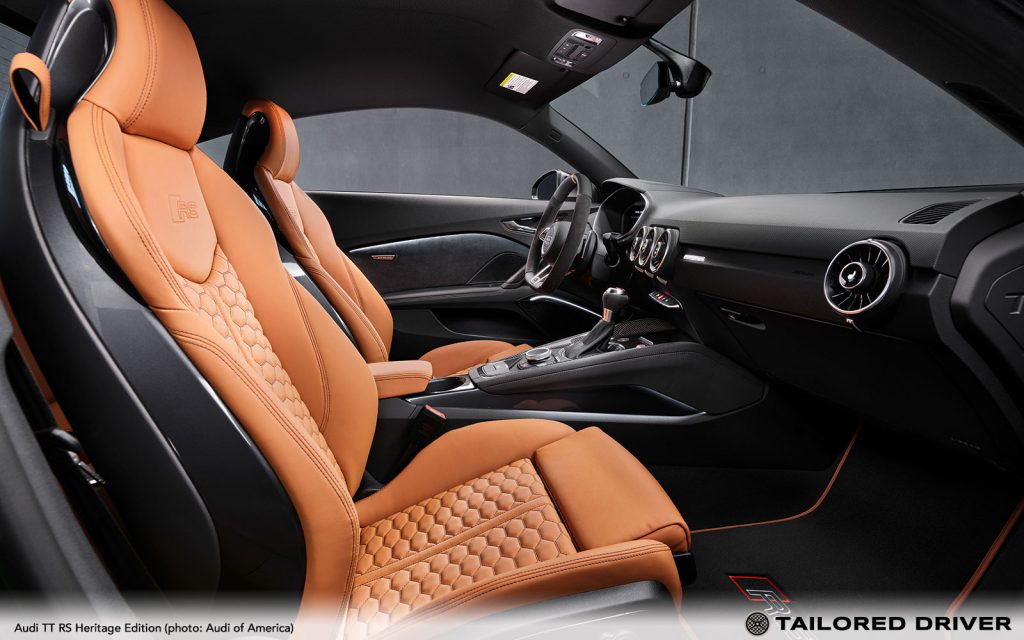
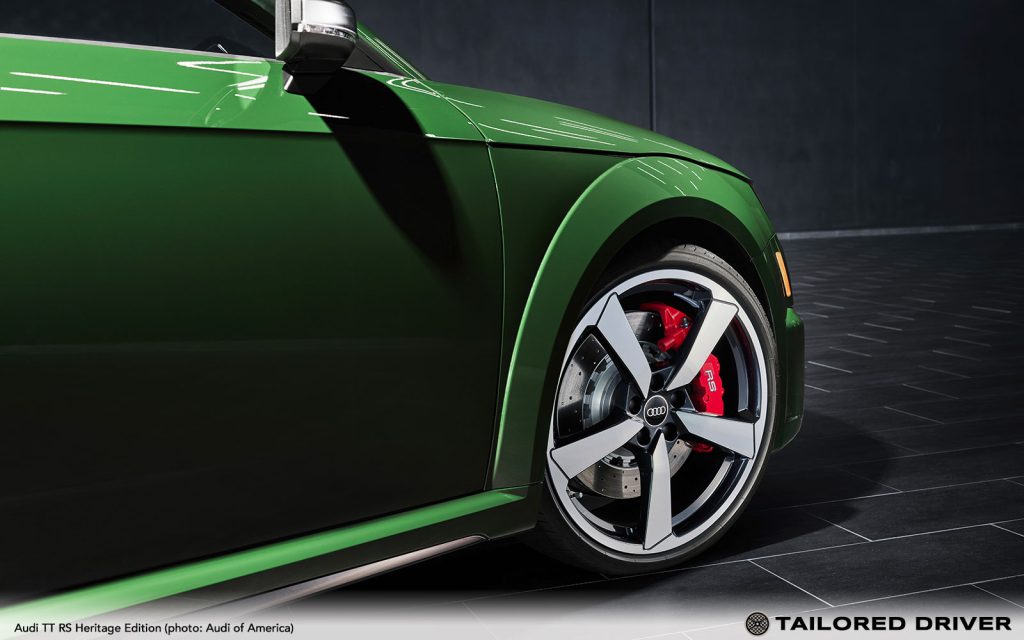
    3. Malachite Green metallic (malachitgrünmetallic; metallic UNI; LY6A; Audi) with Cognac Brown leather and Black stitch

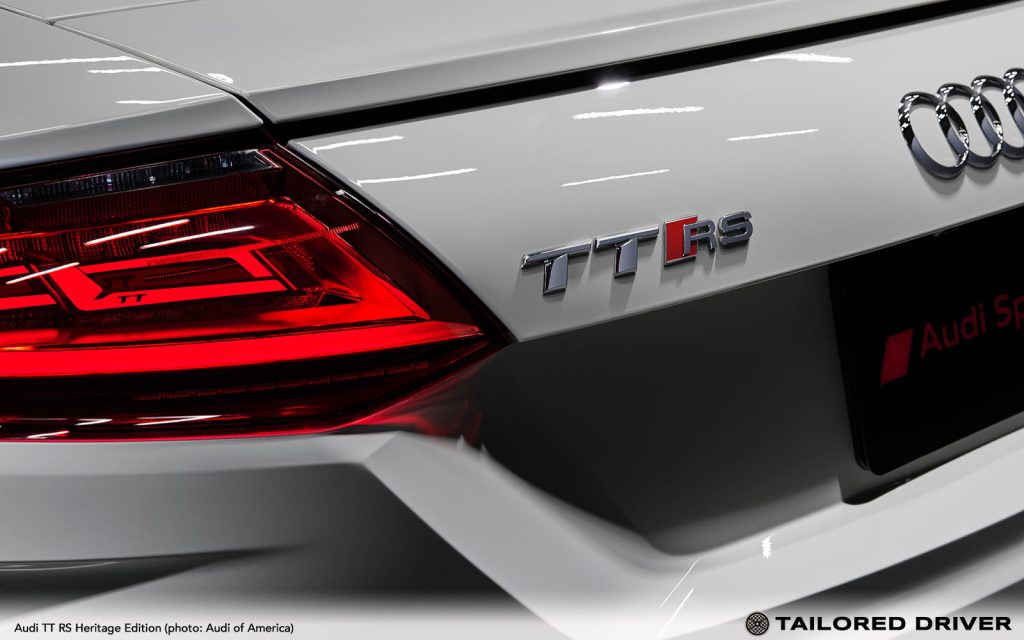
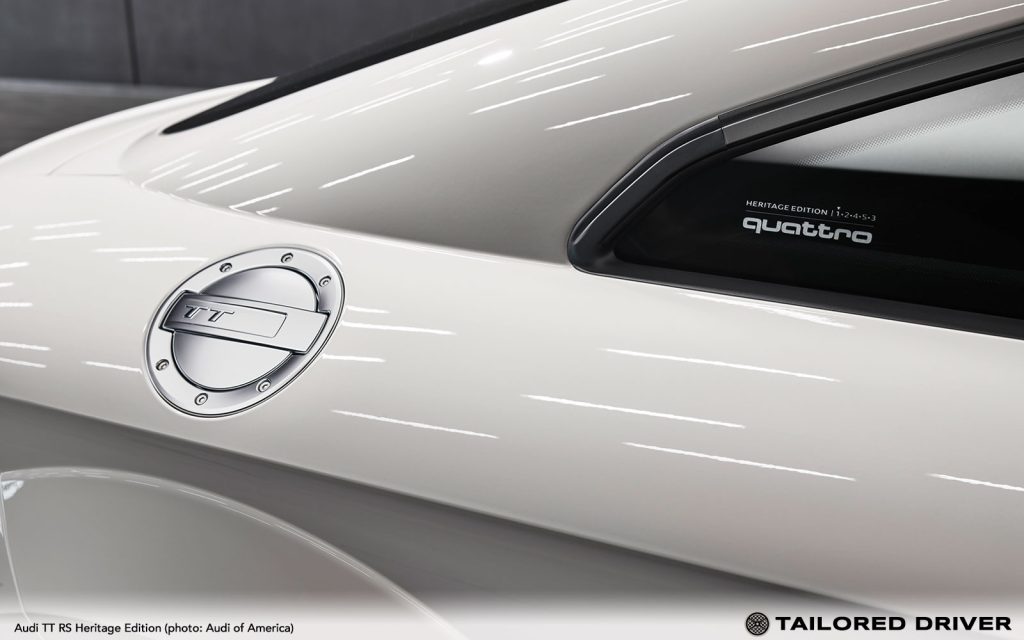
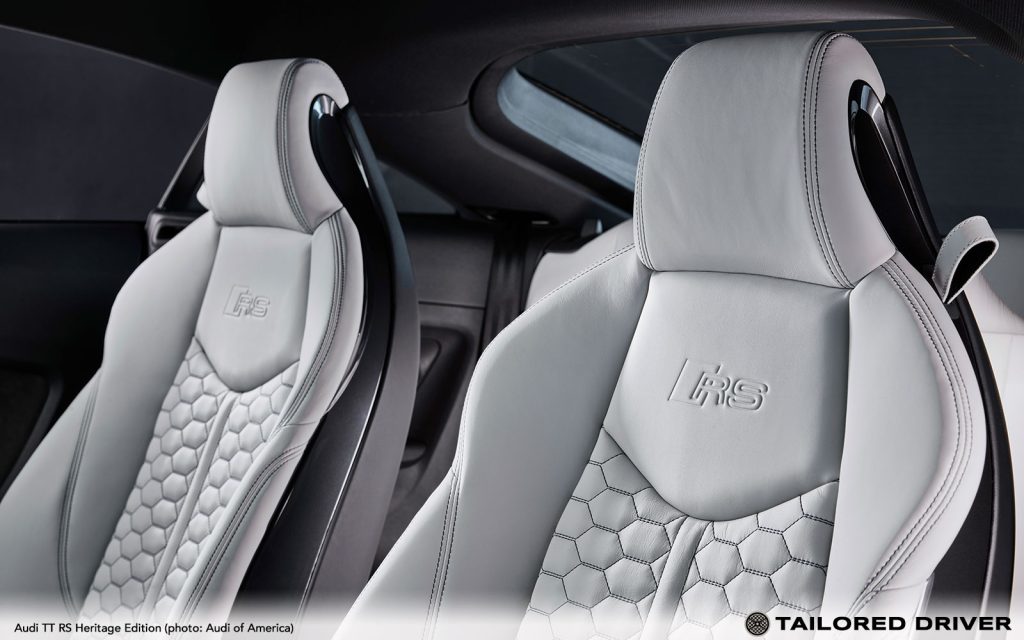
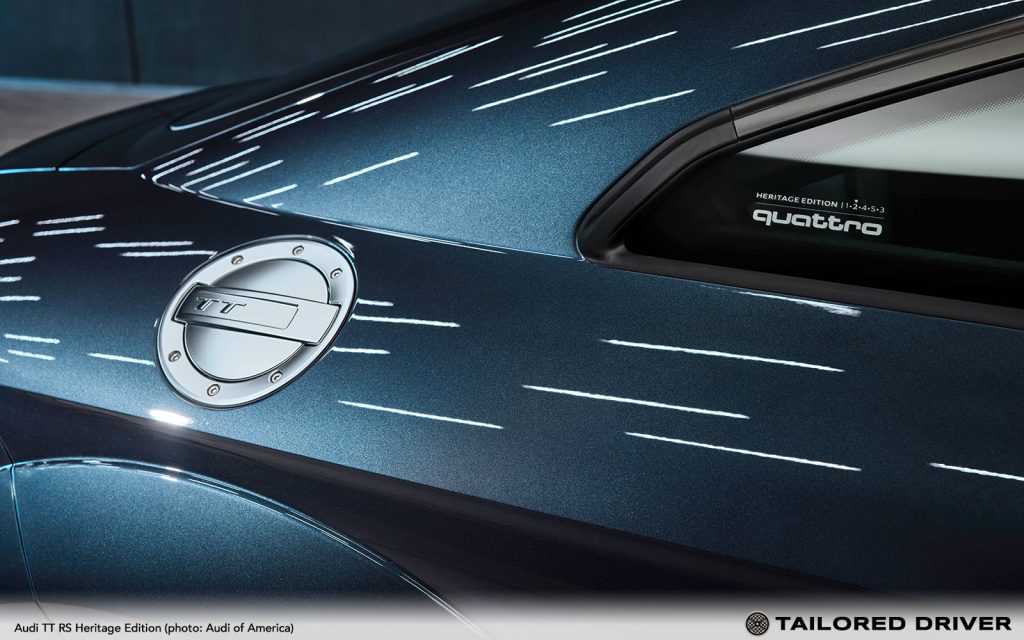
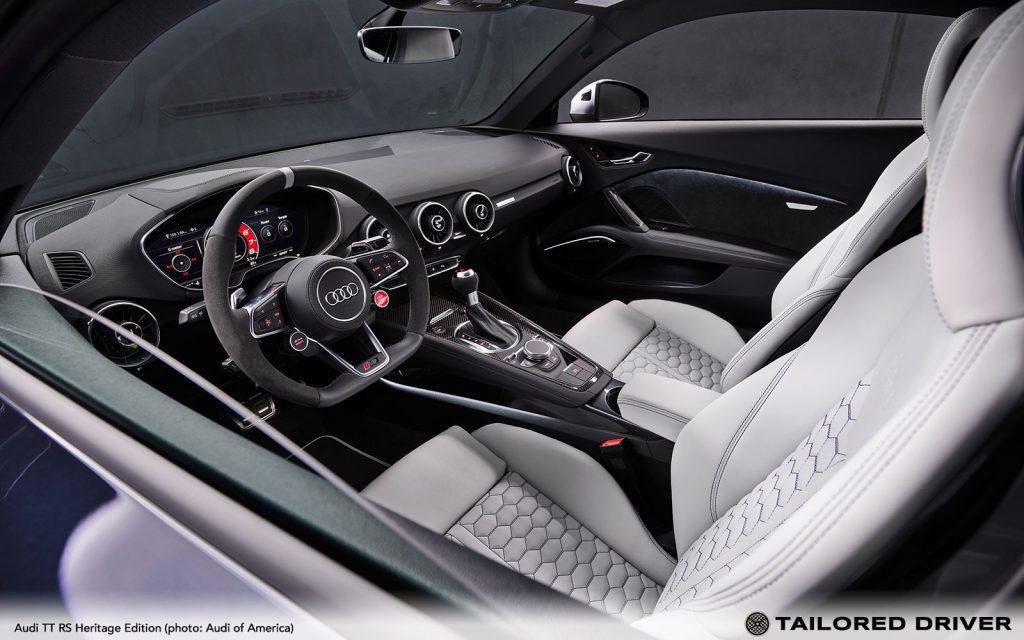
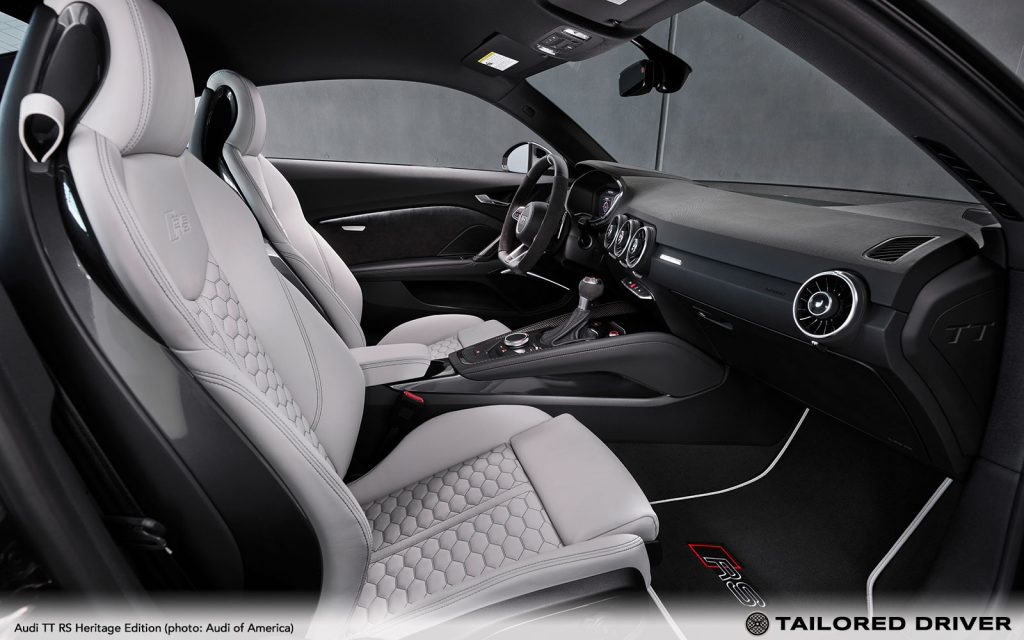
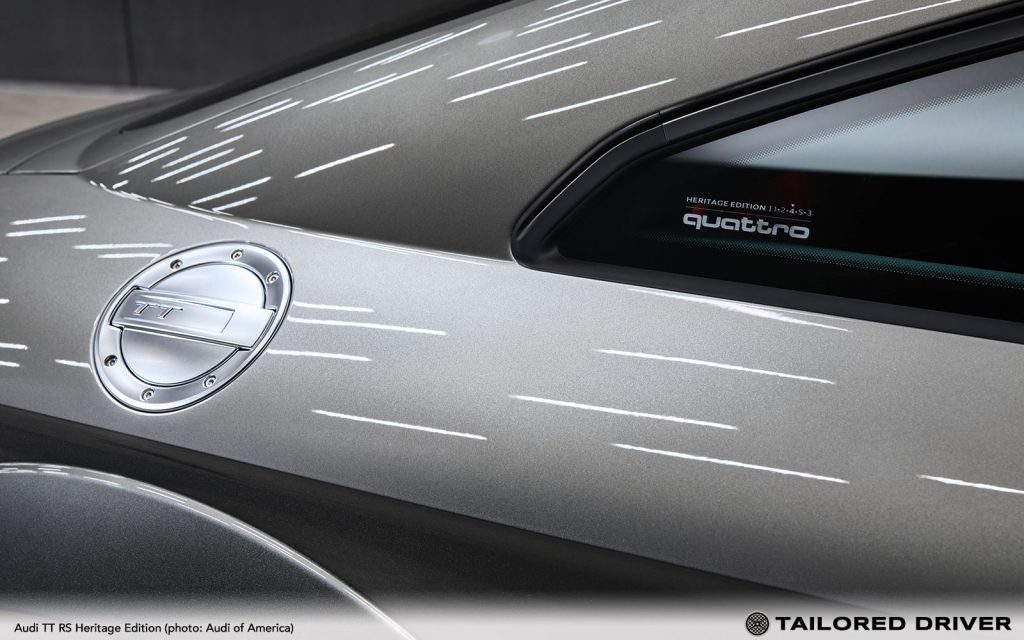
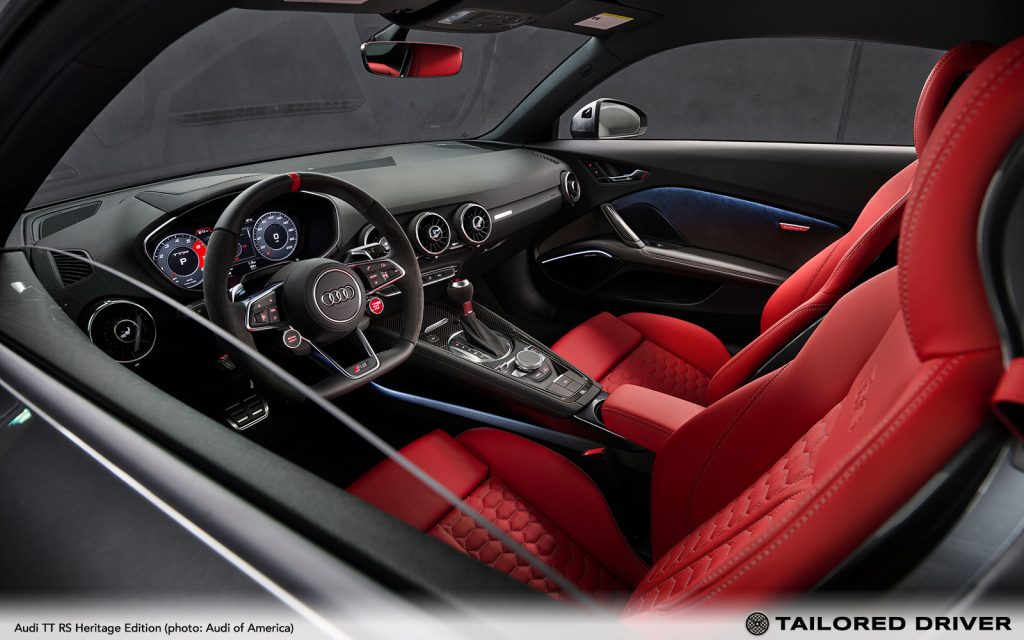
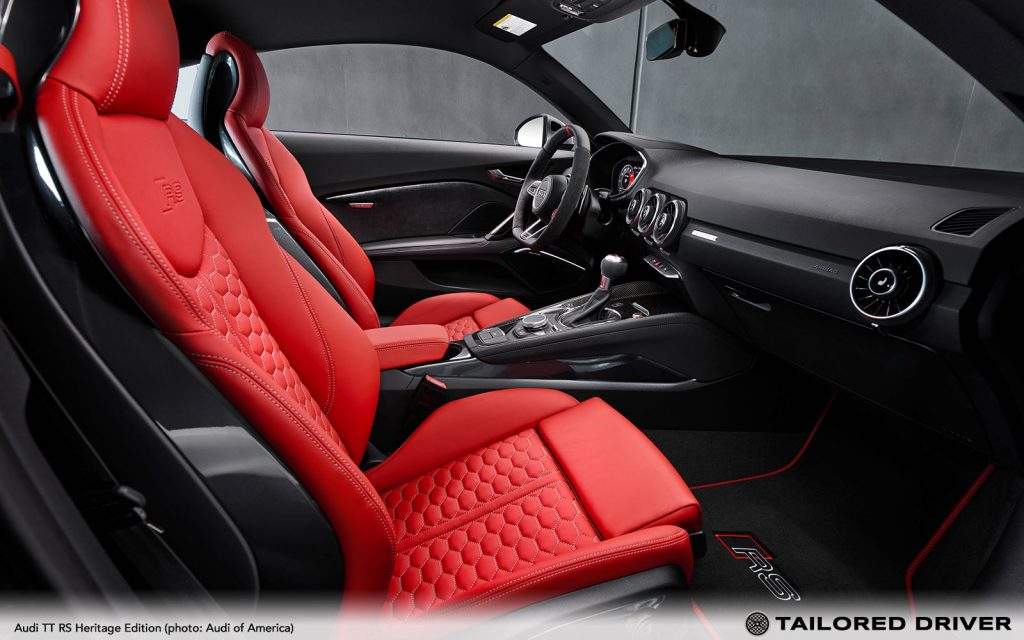
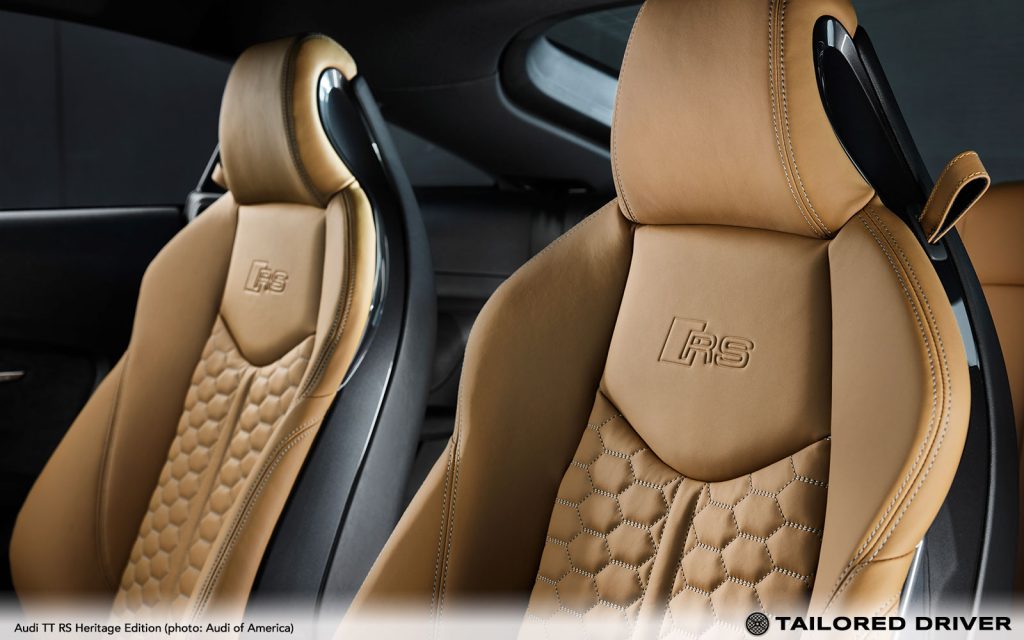
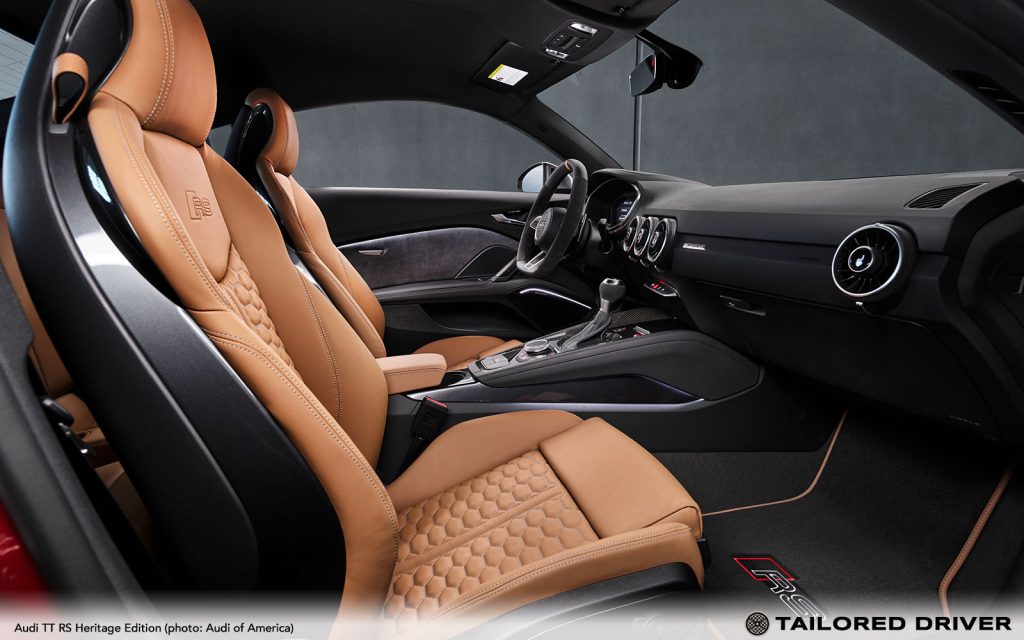
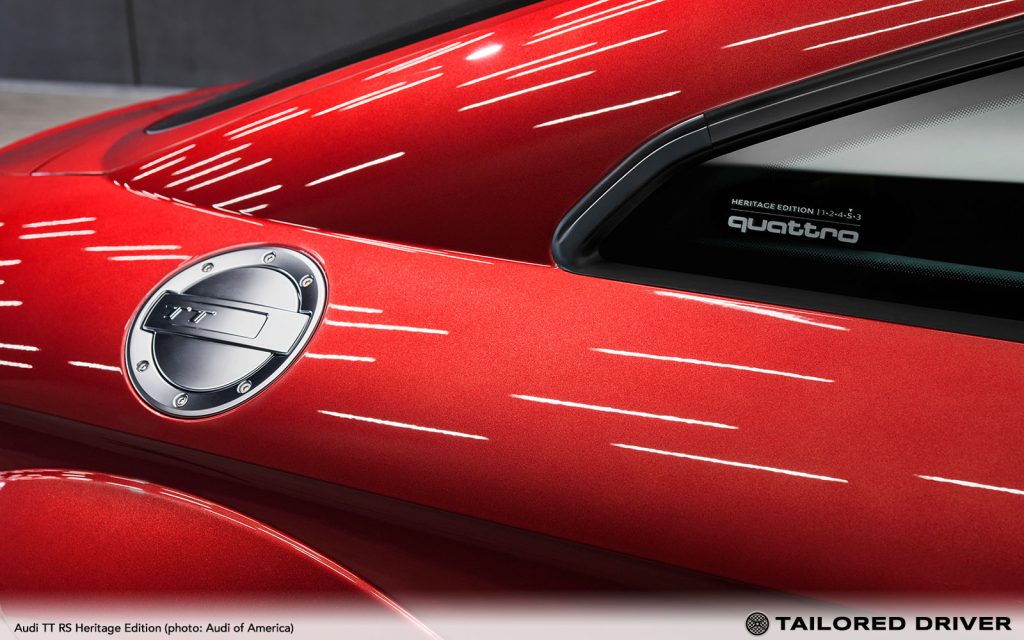
    The interior leather and contrast stitching combinations are leveraged from the current Audi exclusive portfolio of upholstery selections, and include several first-time color combinations for the U.S. market. To further underline the exclusivity of the limited edition model, the TT RS Heritage Edition exhibits an understated, yet distinctive etch of “HERITAGE EDITION” script followed by the firing order of the five-cylinder engine “1-2-4-5-3”, underlined by a “quattro” script in the rear quarter glass on the right side of each car.

    Additionally, the TT RS Heritage Edition presents an exclusive list of standard equipment:

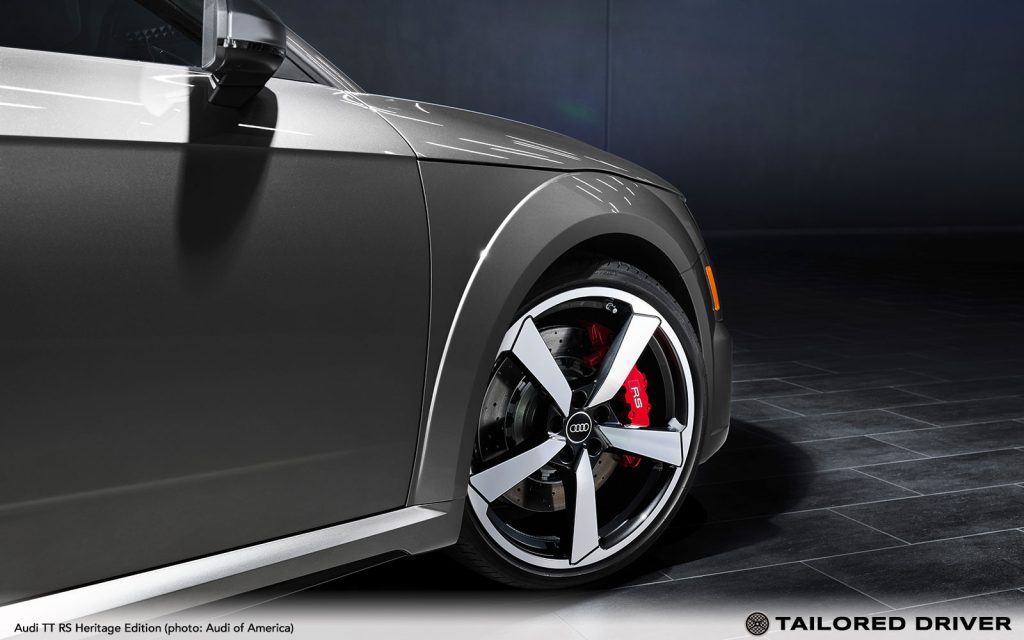
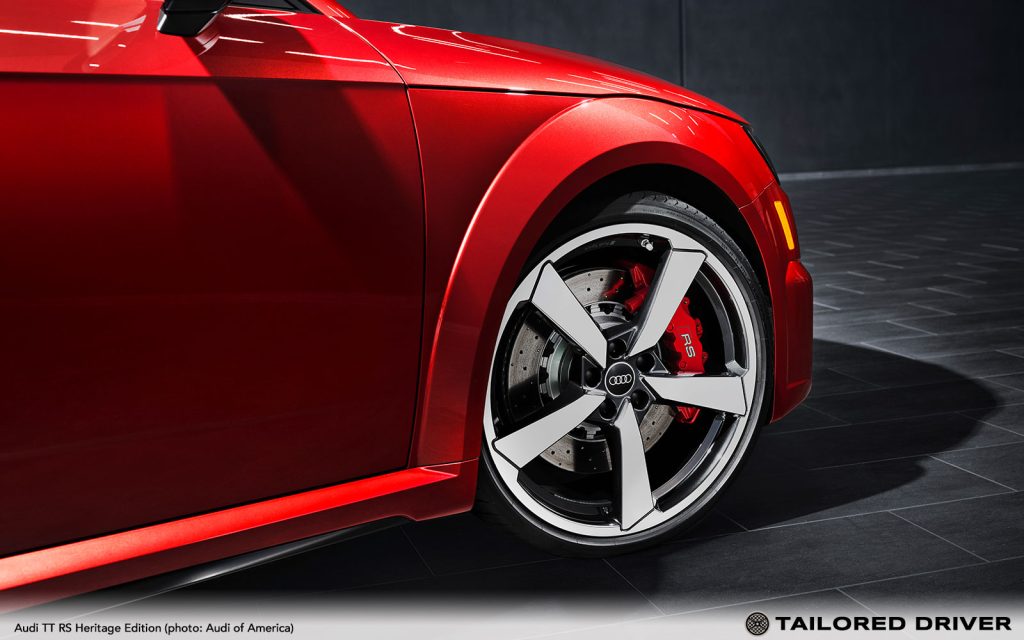
    • 20” 5-arm cutter design wheels in bi-color anthracite finish
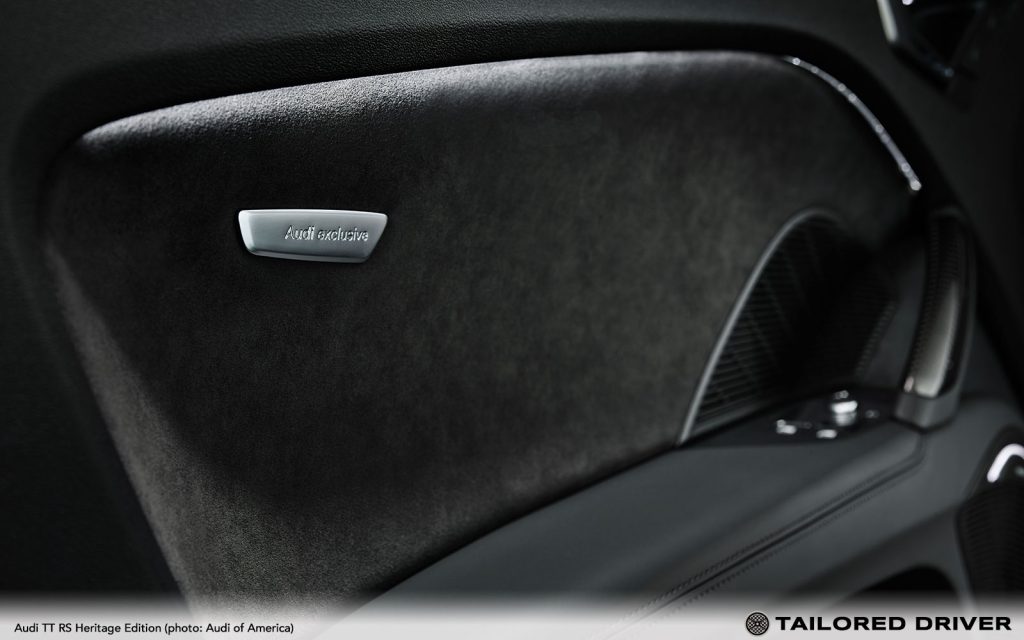
    • Audi exclusive etching in rear quarter glass
    • 174 mph top speed limiter
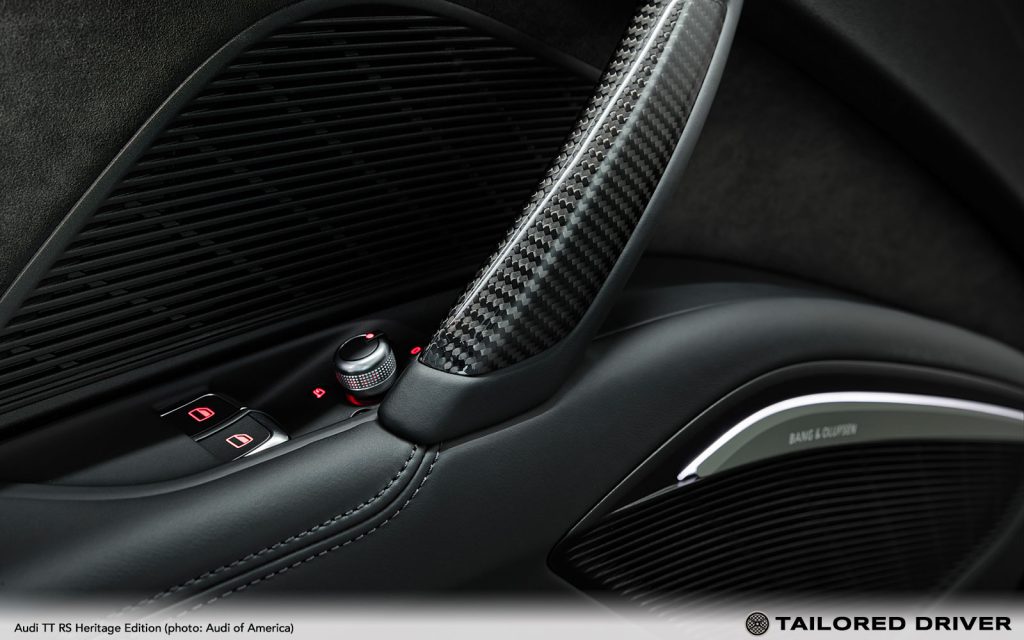
    • Alcantara covered steering wheel with 12 o’clock marker in leather color
    • Alcantara covered shift lever
    • Alu-optic exterior elements including mirror housings
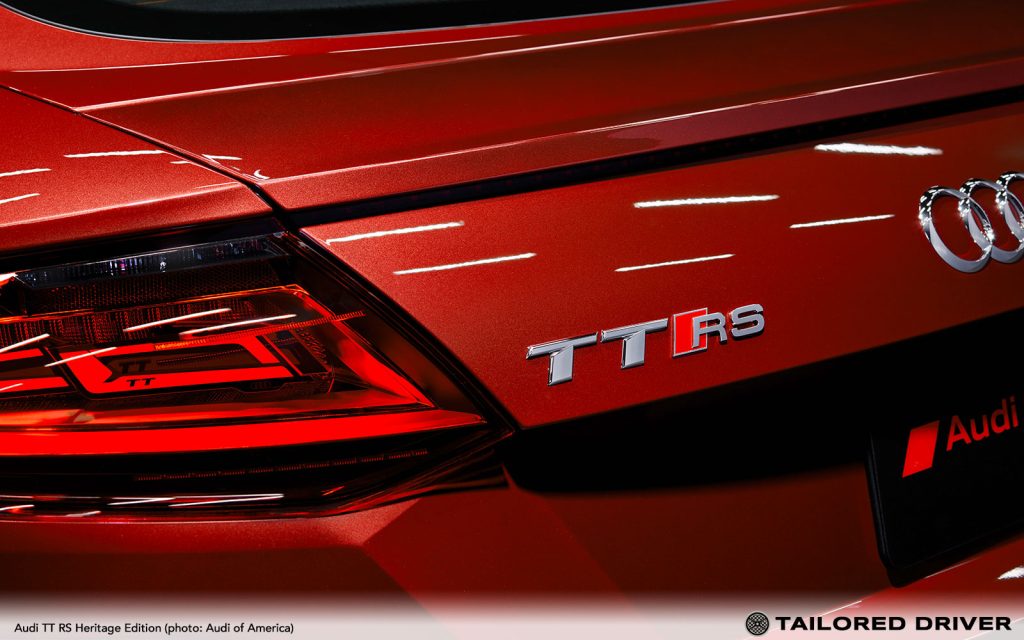
    • OLED taillights
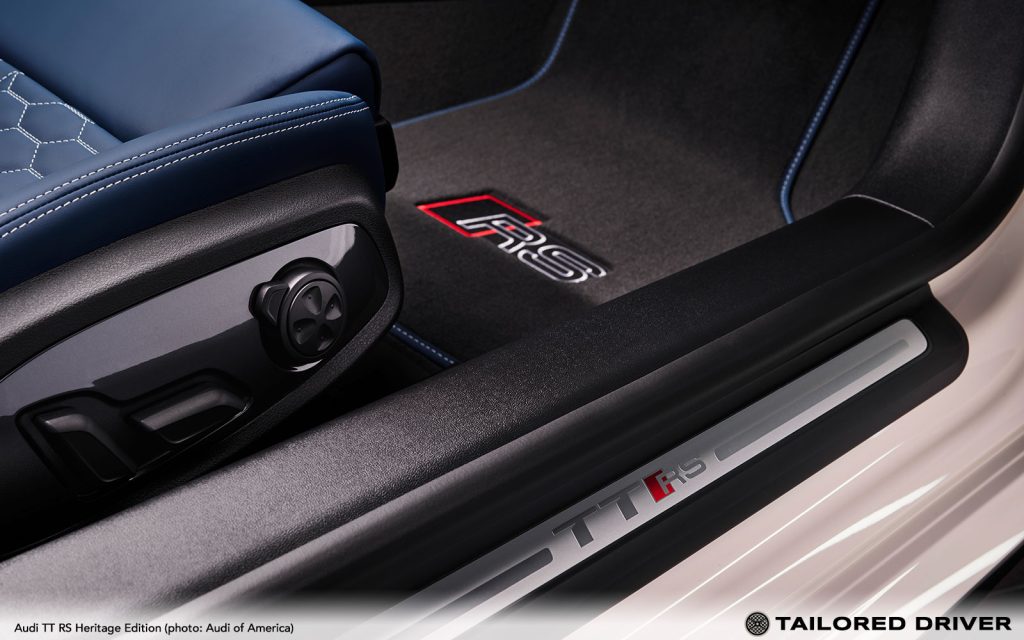
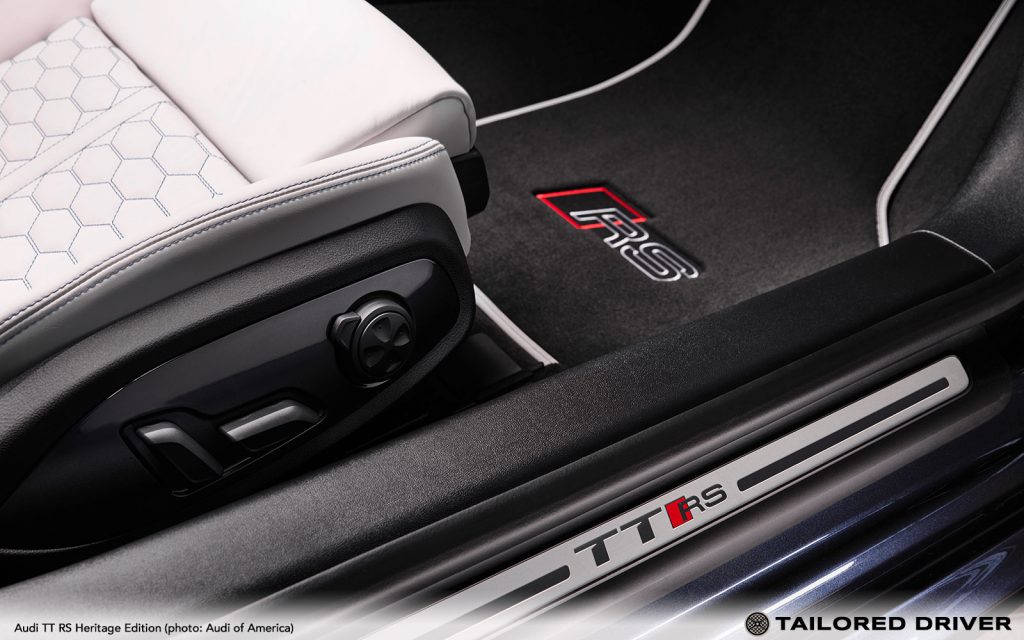
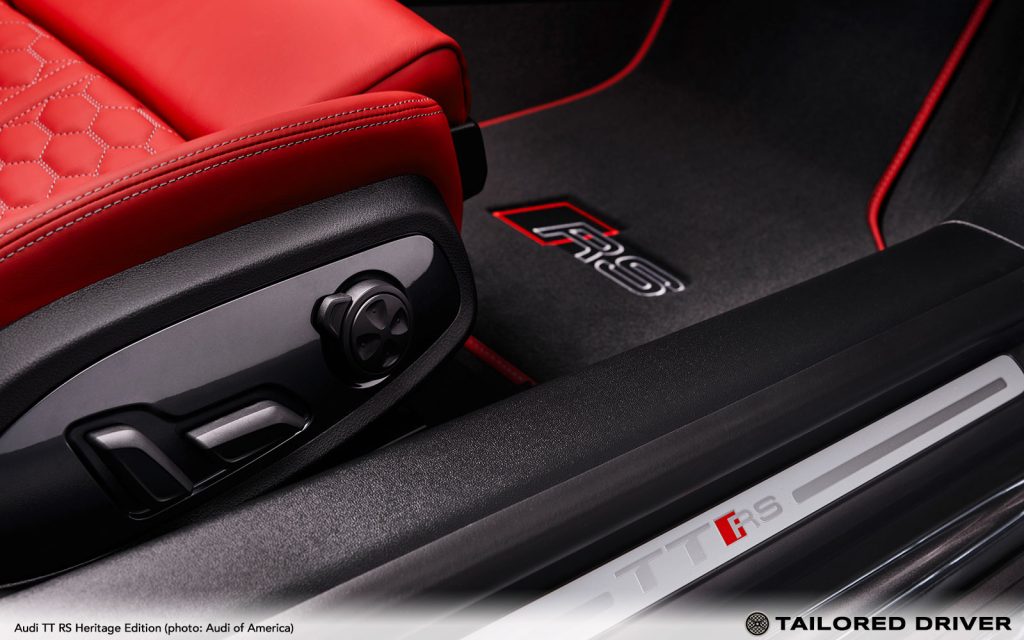
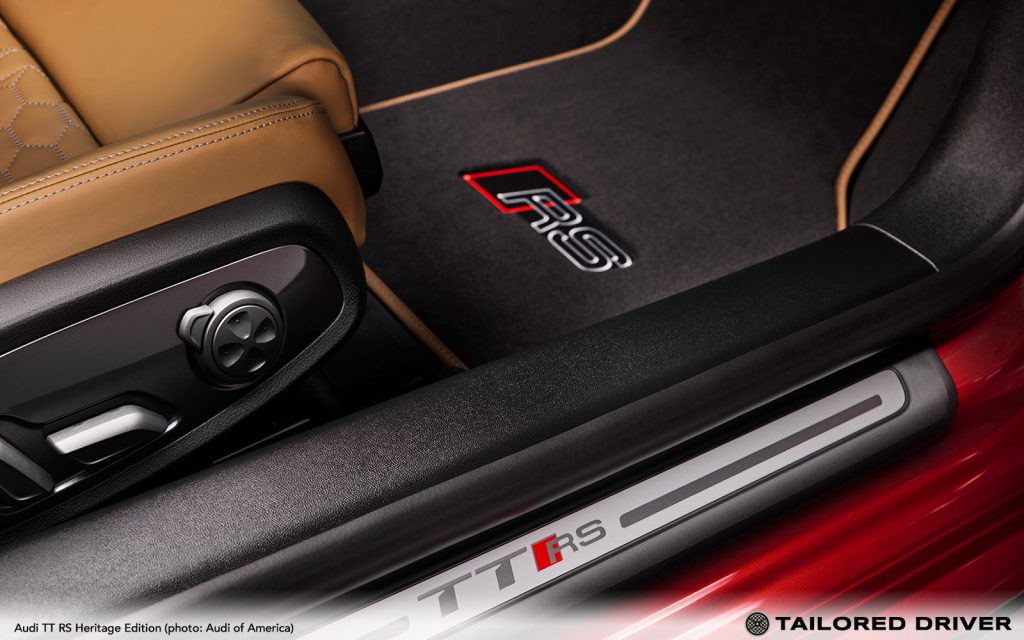
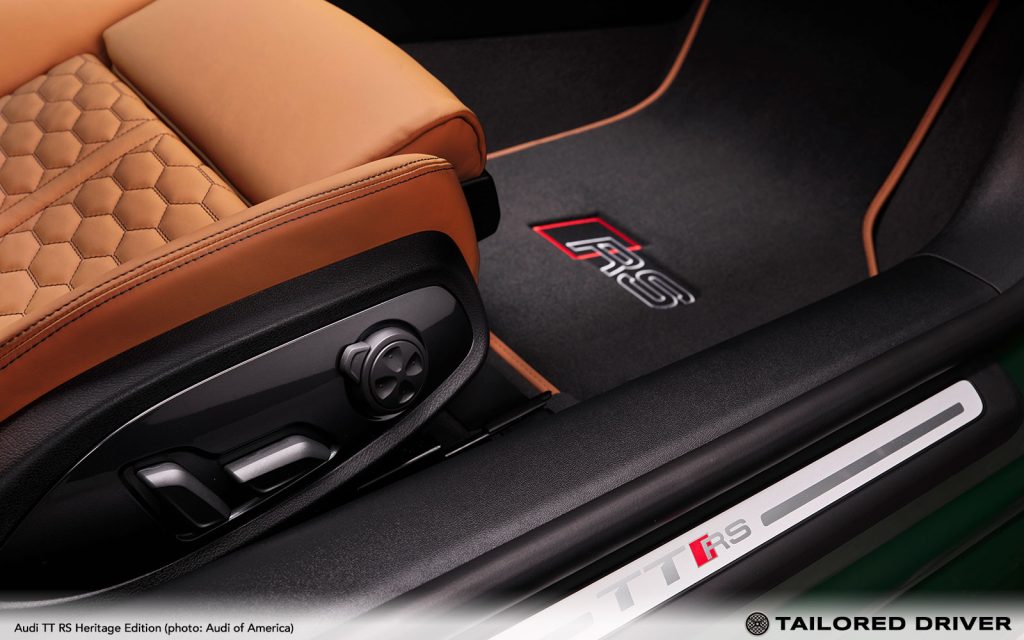
    • RS logo floor mats with contrast stitching
    • Sport exhaust with black tips
    • Electric spoiler / rear wing delete

    Hear that heritage sound? It’s legendary performance.
    The five-cylinder engine has deep historical roots in Audi’s DNA, and is a fundmental pillar of the emotional connection to the Audi Sport brand. The engine has achieved countless victories in motorsports from courses in rally around the world to the tarmac in the IMSA GTO and at the Nuerburgring in the legendary 24-hour race, the 5 cylinder has prevailed. It even earned the  “International Engine of the Year Award” nine times in a row since 2010. Yet – it is the unique and distinctive sound of the five-cylinder engine that has captured the emotion of enthusiasts. Due to the odd number of cylinders, and more specifically, the 1-2-4-5-3 firing order, the Audi five-cylinder engine’s sound is unmistakable and presents a symphonic rhythm that is accompanied by deep tone characteristics. 

    Besides its visibility in motorsports, the legendary engine harkens back to the Ur-quattro coupe from the 1980s, and has been a part of just two U.S. market Audi products over the last few years – the Audi TT RS Coupe and RS 3 Sedan. The engine remains one of brand’s more powerful engines with 394 horsepower and 354 lb-ft of torque that brings the TT RS Coupe from 0-60 mph in just 3.6 seconds.

    The return of the five-cylinder. A social network comeback
    Until 2012, the five-cylinder engine remained absent from the Audi portfolio for nearly 30 years. In 2009, the first Audi TT RS made its global debut in the world markets, and was only a dream to drive on the roads stateside, until Audi of America took a stance to get the car to the U.S. In 2011, Audi of America would exhibit a signed petition on Facebook to bring the first generation TT RS to the U.S. market – the petition resulted in an astounding 12,000 signatures in just one month.

    After the success of the social media campaign, Audi of America brought the product in limited production run for just two model years, 2012-2013. In both years, Audi of America offered a total of approximately 1,200 highly collectible TT RS models properly outfitted exclusively with a six-speed manual transmission, which became the final manual transmission offer in any Audi RS- model, globally.
    Fond farewell
    While 2022 is the last model year for the TT RS in the U.S., the model will live on in other international markets for some time. The 2022 Audi TT RS Heritage Edition and the 2022 Audi TT RS model are expected to go on sale in the U.S. toward the beginning of 2022. The TT RS celebrated its 10 year anniversary since its introduction as a 2012 model year in the US market. 
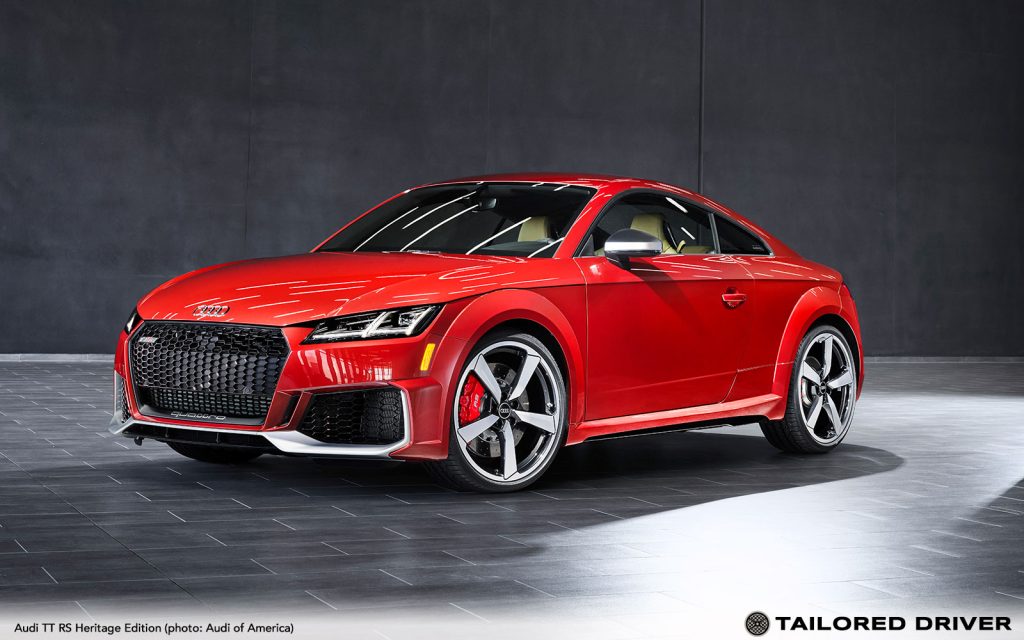
    The limited edition model, no doubt to become a sought after model for enthusiasts and collectors alike, celebrates the victory, performance, and expansive history of the legendary five-cylinder engine for the Audi brand which will continue to be available once the all-new RS 3 goes on sale next summer in the U.S.

    MSRP pricing detail

    Model 
    2022 Audi TT RS Heritage Edition$85,350
    2022 Audi TT RS$73,200

    Prices exclude $1,045 destination charge, sales taxes, title, options, and dealer charges. Dealer sets actual price.


    At Audi of America, we believe the Future is Electric. Our U.S. model lineup will be 30 percent electrified, including fully electric vehicles and plug-in hybrids, by 2025, and globally we are committed to net CO2 neutrality by 2050. In 2020, Audi sold 186,620 vehicles in the U.S., and this year, we look forward to the next chapter in our journey to reinvent premium mobility with the arrivals of the fully electric Audi e-tron GT and Audi Q4 e-tron. Learn more about who we are and how we’re working to create a more electric, innovative, and inclusive future at audiusa.com or media.audiusa.com.


    This information and any vehicle specifications are preliminary and subject to change.

  • Porsche Paint to Sample Program Expands

    Porsche Paint to Sample Program Expands

    [source: Porsche USA]

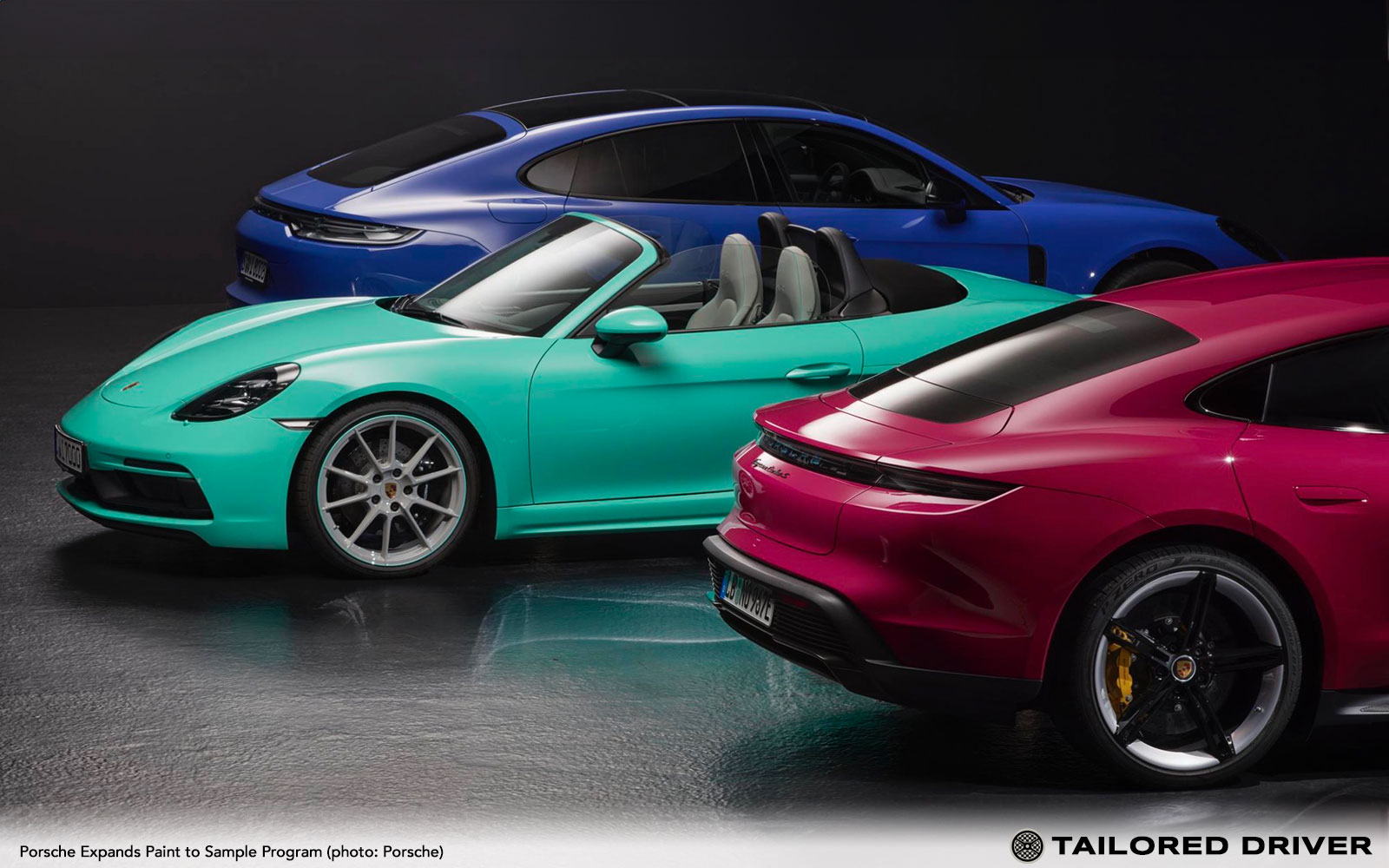
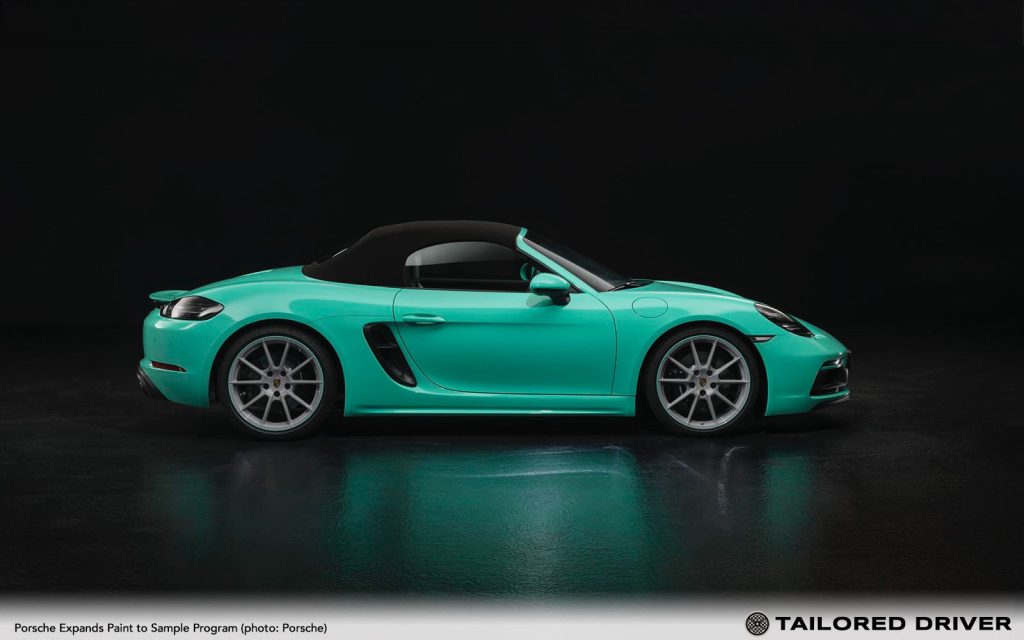
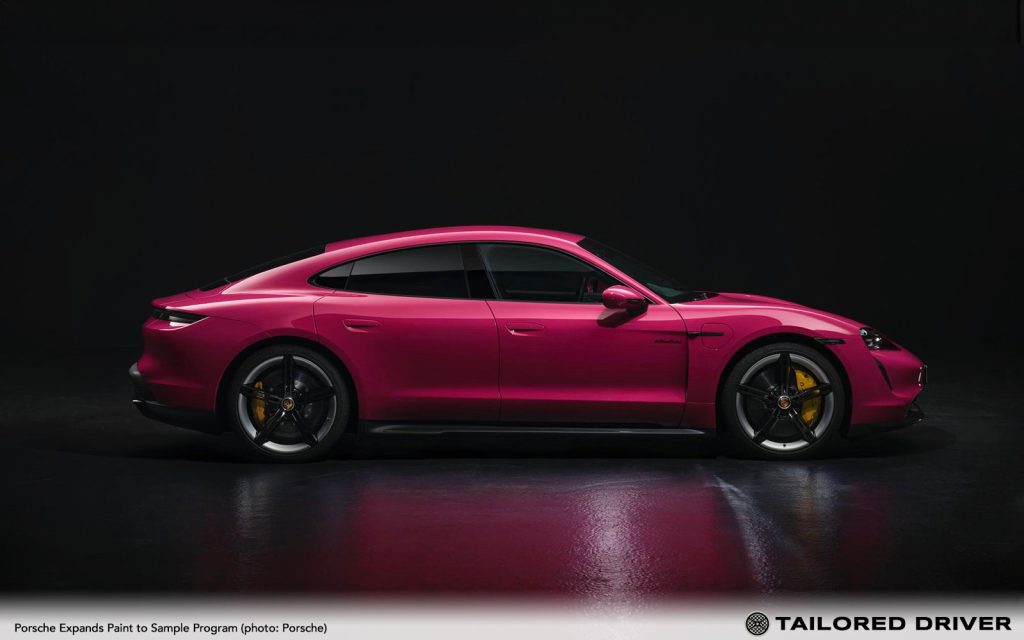
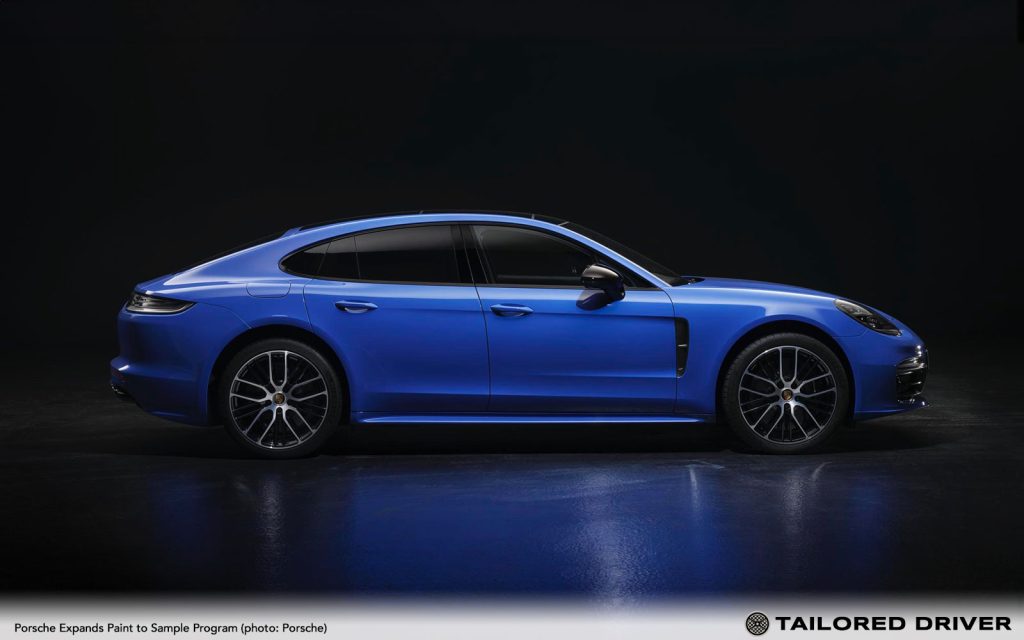
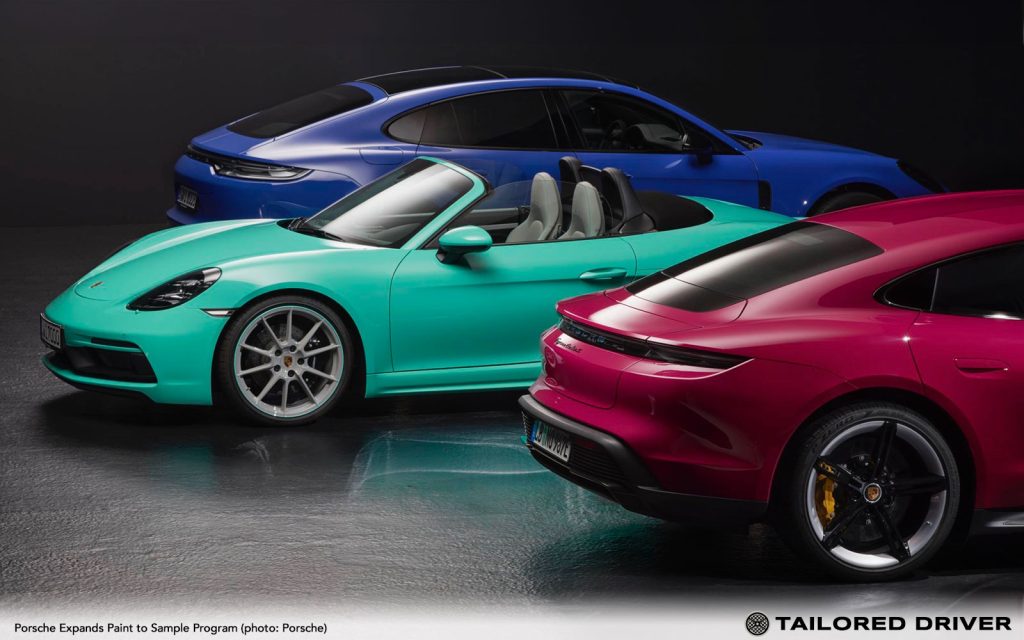
    Porsche is expanding capacity for its popular “Paint to Sample” program to meet increasing demand and improve ease of access for customers. With the newly revamped “Paint to Sample,” more than 160 pre-approved colors will be available with the option to specify a totally bespoke color through “Paint to Sample Plus,” which requires extensive feasibility testing. These colors are in addition to the wide selection of paint choices Porsche already offers, including several no-cost, non-metallic colors, and additional-cost metallic colors ranging from $650 to $840 depending on the model.  Special color options are also available for between $2,580 and $3,270 depending on the model.

    Porsche Paint shop in Zuffenhausen: batch comparison plates are painted and serve as color reference samples during the final inspection of the vehicle.

    “Individualization is at the core of Porsche. Customers have been making special requests to personalize their cars since our earliest model, the 356,” said Kjell Gruner, President and CEO of Porsche Cars North America. “Paint to Sample is integral in satisfying that demand. With this offering, we bring many historic colors back to life and expand the catalog to a total of more than 160 choices.”

    The array of colors on offer is extensive and varies depending on the model and production facility. More than 100 additional colors beyond the standard offerings are available for the 911 and 718 variants. Panamera, Macan and Cayenne, have access to more than 50 Paint to Sample color choices. The Taycan has 65 color choices.

    Paint to Sample Plus: extensive feasibility check

    The expansion is possible thanks in large part to a new color mixing bank that went online this year in the Zuffenhausen plant where the 911, 718 and Taycan model lines are assembled. For example, Paint to Sample capacity for 911 models will increase from roughly five cars per day to about 20 cars per day. The Paint to Sample process does not increase the time required for overall production.

    Customers can specify Paint to Sample through their local Porsche dealer. In the future, it will also be possible to visualize the extensive Paint to Sample color palette on the Porsche Car Configurator. Pricing depends on the model and variant. Paint to Sample costs $11,430 for most 911 and 718 models. For 718 GT and 911 Turbo, Turbo S as well as the 911 GT3 models, the price is $12,830.

    For unique color requests, Porsche Exclusive Manufaktur offers Paint to Sample Plus on all models except Cayenne. In these cases, the customer provides a color sample to their dealer that is sent to Porsche AG and subjected to extensive quality and feasibility testing. The customer car is not finished in the bespoke color until feasibility testing – up to 11 months in certain cases – is complete. If the paint color is not feasible, Porsche covers the cost of the feasibility study. Pricing example for Paint to Sample Plus: $22,860 for most models, and $25,660 for 911 Turbo and GT models as well as 718 GT models.

    About Porsche Exclusive Manufaktur

    A sports car as individual as your own fingerprint, as unmistakable as your own lifestyle: in an interplay of craftsmanship and attention to detail, Porsche Exclusive Manufaktur creates extremely personal customer vehicles. Highly qualified employees with decades of expertise devote their full attention to every detail and enhance it through hand craftsmanship. The experts can draw on a wide range of visual and technical customization options for the exterior and interior. The highest standards are fulfilled with respect to material and finishing.

    Alongside the individual customer vehicles, Porsche Exclusive Manufaktur also produces limited small series and editions. Here, high-quality materials are combined with modern production technologies to create a harmonious overall concept. Porsche dealers provide advice on the range and possibilities offered by Porsche Exclusive Manufaktur as the first point of contact alongside the online Car Configurator. Around 100 Exclusive Manufaktur partners are available to customers all over the world to help fulfill particularly individual wishes. These are Porsche dealers that are specially equipped and trained to provide advice on the Exclusive Manufaktur product range. In addition, advice is available for all models at the heart of the brand in Stuttgart-Zuffenhausen, in cooperation with the Porsche dealer and on the basis of a commission number. The main plant specializes in individual paint finishes: Werk 1 has the largest collection of Porsche color samples and sample vehicles painted in Paint to Sample.


  • Ferrari BR20: Maranello’s Latest One-Off Revealed

    Ferrari BR20: Maranello’s Latest One-Off Revealed

    • A unique new car designed by Ferrari designers to a client’s brief
    • The BR20 is a two-seater V12 coupé based on the GTC4Lusso platform
    • A sublime marriage of dynamic, modern good looks and styling flair inspired by Ferraris of the 1950s and 60s

    [source: Ferrari]

    Maranello, Italy – The Ferrari BR20, the latest addition to the Prancing Horse’s One-Off series, was unveiled today and joins the most exclusive group in Maranello’s range: unique, absolutely bespoke cars crafted to the specifications of a client and designed as a clear expression of their own unique requirements.

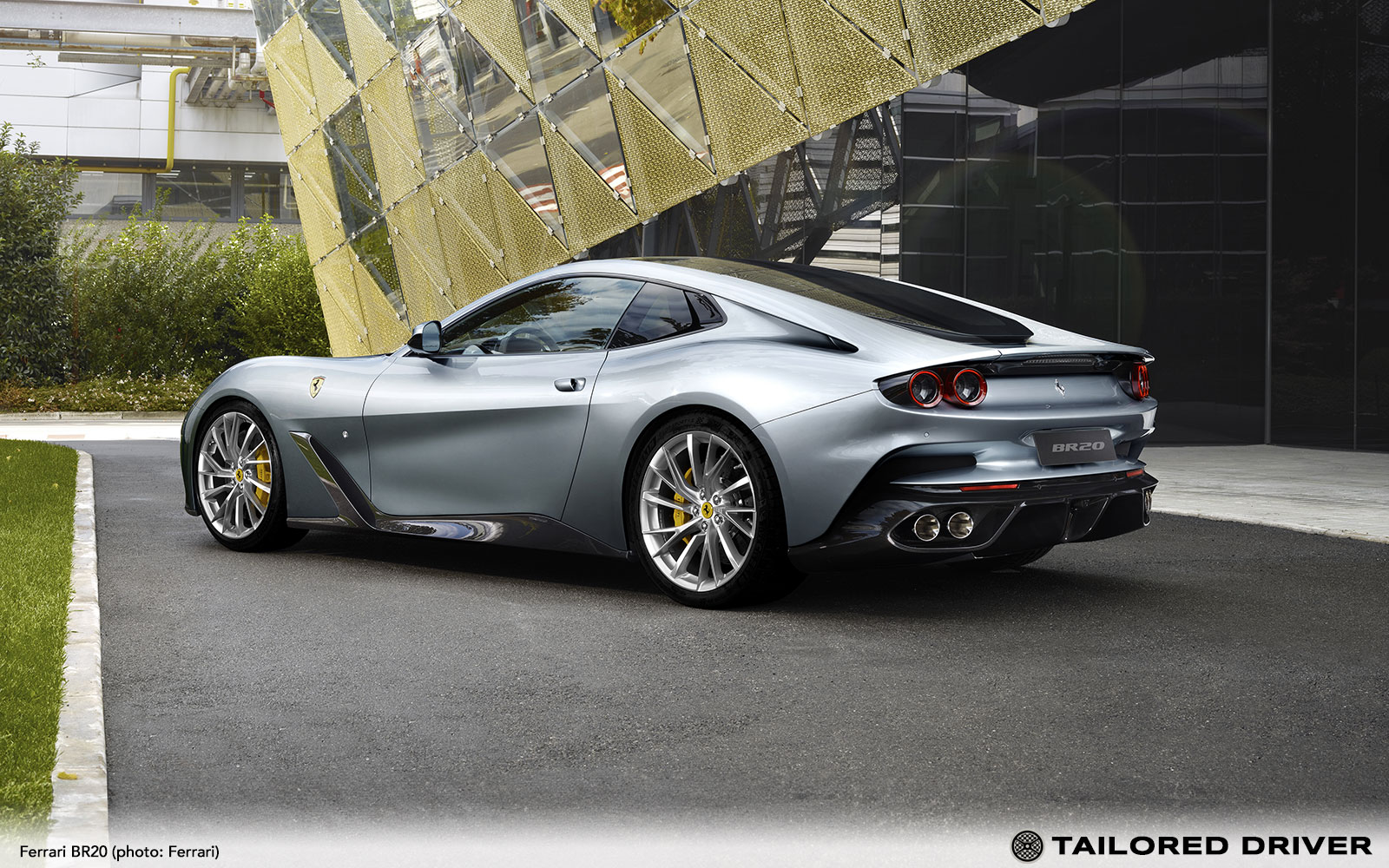
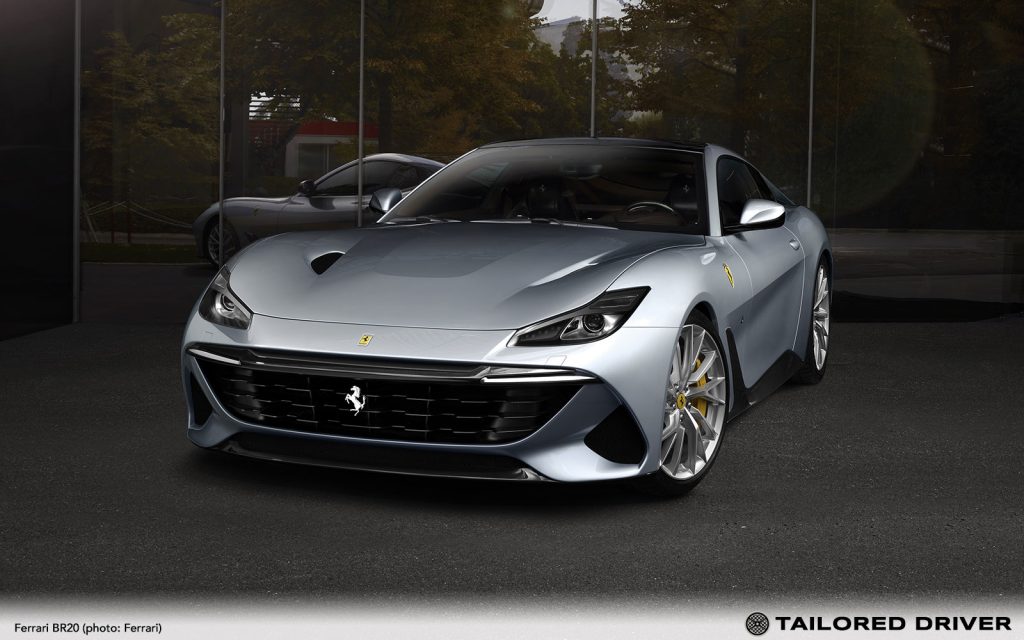
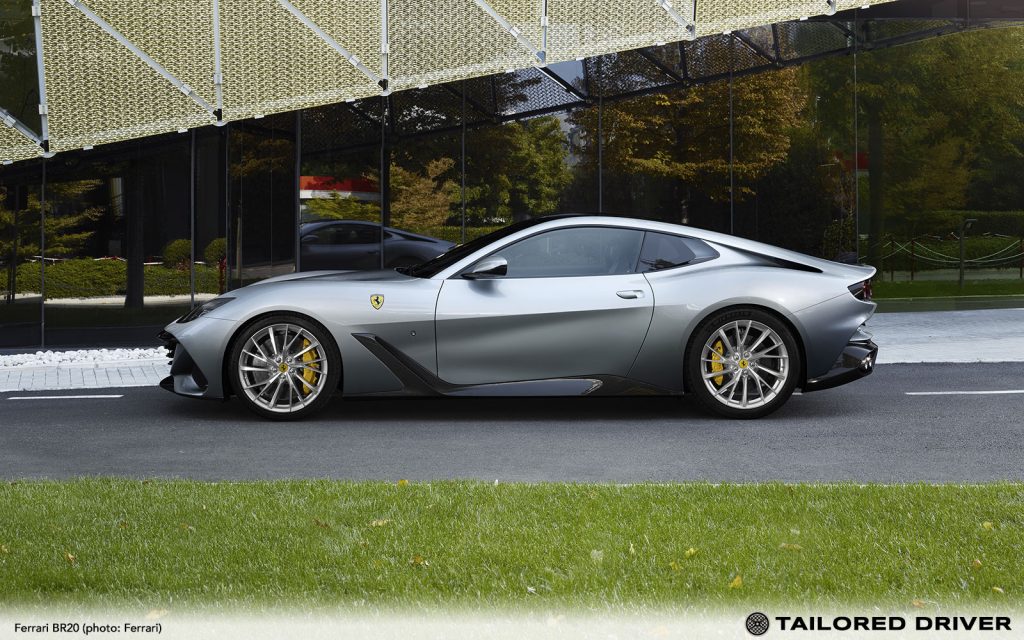
    The BR20 is a two-seater V12 coupé developed on the GTC4Lusso platform, which in terms of its philosophy and styling approach, cleverly references the magnificent Ferrari coupés of the 1950s and 60s, without the slightest hint of nostalgia. Instead, it pulls off the challenging feat of marrying timeless elegance with muscular sportiness, effortlessly incorporating styling themes typical of some of the most iconic 12-cylinders in Ferrari history, including the 410 SA and 500 Superfast.

    The GTC4Lusso’s two rear seats have been removed to add extra dynamism to the BR20’s ultra-sleek fastback line. The new car is three inches longer than the original, thanks to a specific rear overhang treatment designed to create a silhouette that beautifully emphasises its proportions. One of the cornerstones of the design process for this one-off was the radical modification made to the cabin volume. This in turn gave the design team, led by Flavio Manzoni, the freedom to conceive the innovative proportions that ultimately produced a powerful yet stylistically coherent exterior design theme.

    The new cabin design solution creates the impression of a pair of arches running lengthwise from A-pillar to rear spoiler. The rear volume of the arch has been hollowed out to create an aerodynamic channel with the air outlet concealed by the black rear fascia under the spoiler. This modern take on Ferrari’s “flying buttress” theme firmly connects the car to signature Prancing Horse styling cues not just from Ferrari’s GT tradition, but also sports cars such as the 599 GTB Fiorano. To visually lighten the cabin, the black paint of the roof visually connects the windscreen to the rear screen, which stands above the surface of the rear tailgate as if to channel the air flow.

    A muscular rear bumper melds beautifully with the aggressive look of the rest of the car: twin taillights create a visual dialogue with the tailpipes, which are lower and set into a prominent aerodynamic diffuser with active flaps on the underbody. Even the BR20’s twin round exhaust tips were designed especially for this bespoke model.

    The BR20’s many carbon-fibre details highlight the edgy dynamic characteristics and powerful performance of this extraordinary four-wheel drive car. High, sinuous sills add an extra hint of dynamism to the lower section of the flanks as well as emphasising the front air vents on the wheel arches. The wide front grille sports an upper carbon-fibre element, a note of stylistic consistency with other recent Ferrari one-offs, whileunusual chrome side inserts help underline the car’s dynamic front stance.

    The BR20’s unique identity is further underscored by the front grille’s striking new horizontal slats that lend a powerful sense of three-dimensionality. A virtually endless list of elements was designed specifically for the BR20, not least its modified headlights. They are lower in height compared to those of the GTC4Lusso with slimmer DRLs, which makes the bonnet seem even longer and sleeker. The 20” tone-on-tone diamond-finish wheels were also created especially for this unique car.

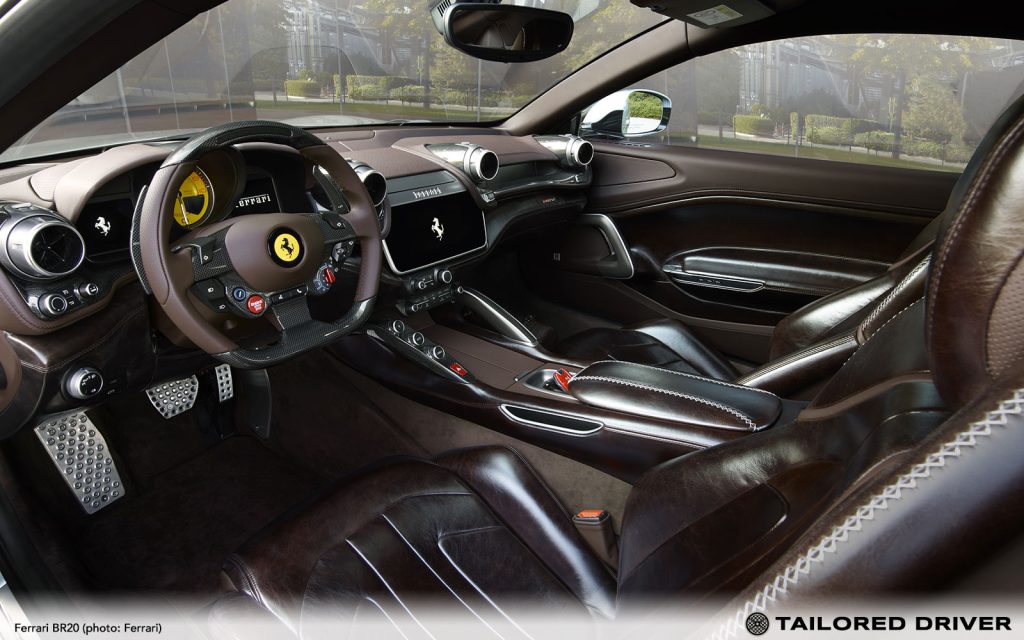
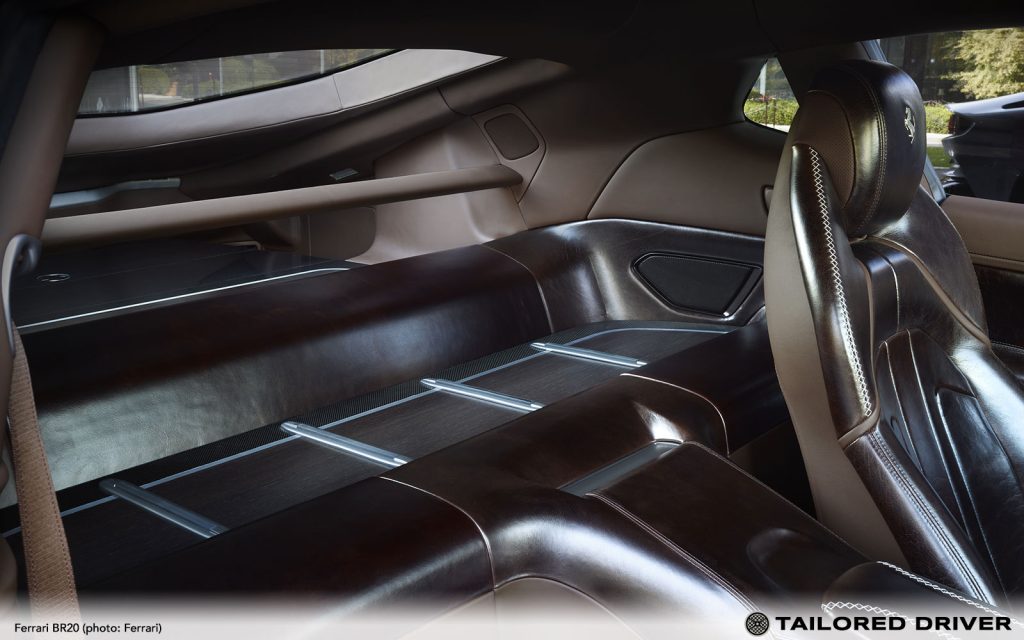
    The BR20’s interior is no less impressive, trimmed in two shades of brown leather and carbon-fibre, an exquisite combination developed according to the client’s indications. The seats are trimmed in dark brown Heritage Testa di Moro leather and sport an exclusive pattern at the front as well as silver cross-stitching. The cabin volume runs uninterrupted from the windscreen to the luggage compartment at the rear, creating a sense of unique lightness and airiness for occupants. Oak trim with carbon-fibre inserts adorns the rear bench and luggage deck, which conceals a deeper loading area when folded flat, as well as the door handles.

    Designed for a longstanding client who was deeply involved in every step of its creation, the Ferrari BR20 represents a true interpretation of the traditional coachbuilder’s art, successfully transforming an existing model in a masterful and unique way taking inspiration from and paying homage to the company’s core values of innovation and passion.

    SPECIAL PROJECTS

    The Special Projects programme is aimed at creating unique Ferraris (the so-called “One-Offs”) characterised by an exclusive design crafted according to the requirements of the client, who thus becomes the owner of a one-of-a-kind model. Each project originates from an idea put forward by the client and developed with a team of designers from Ferrari’s Styling Centre; after having defined the car’s proportion and forms, detailed design blueprints and a styling buck are produced before starting the manufacturing process of the new One-Off. The entire process lasts on average more than one year, during which the client is closely involved in assessing the design and verification phases. The result? A unique Ferrari, which sports the Prancing Horse logo and is engineered to the same levels of excellence which characterise every other Maranello production car.

  • Porsche 911 GT3: Based on 956 That Won Le Mans 1985

    Porsche 911 GT3: Based on 956 That Won Le Mans 1985

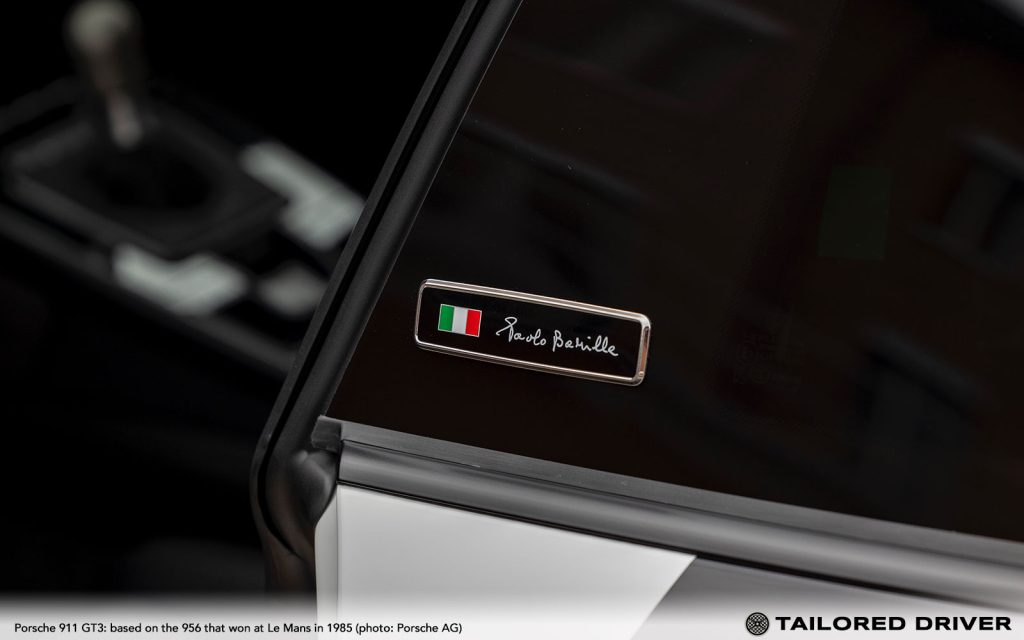
    Stuttgart, Germany – Pictures, cups and racing suits – the typical mementos of a motor sport career. Paolo Barilla, overall winner of Le Mans in 1985 in a private Porsche 956, has chosen a different, far more dynamic reminder of his greatest sporting success.

    [source: Porsche AG]

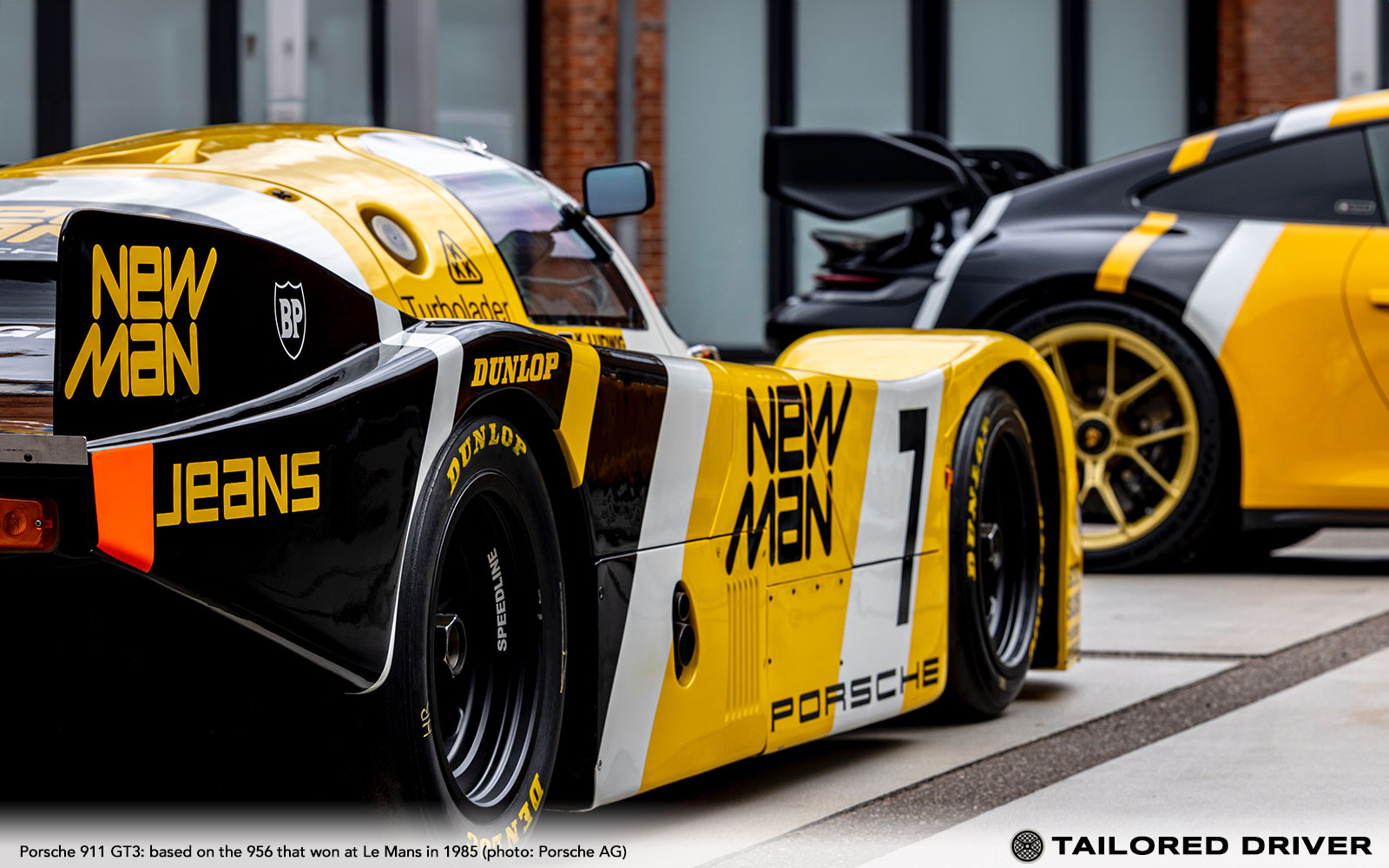
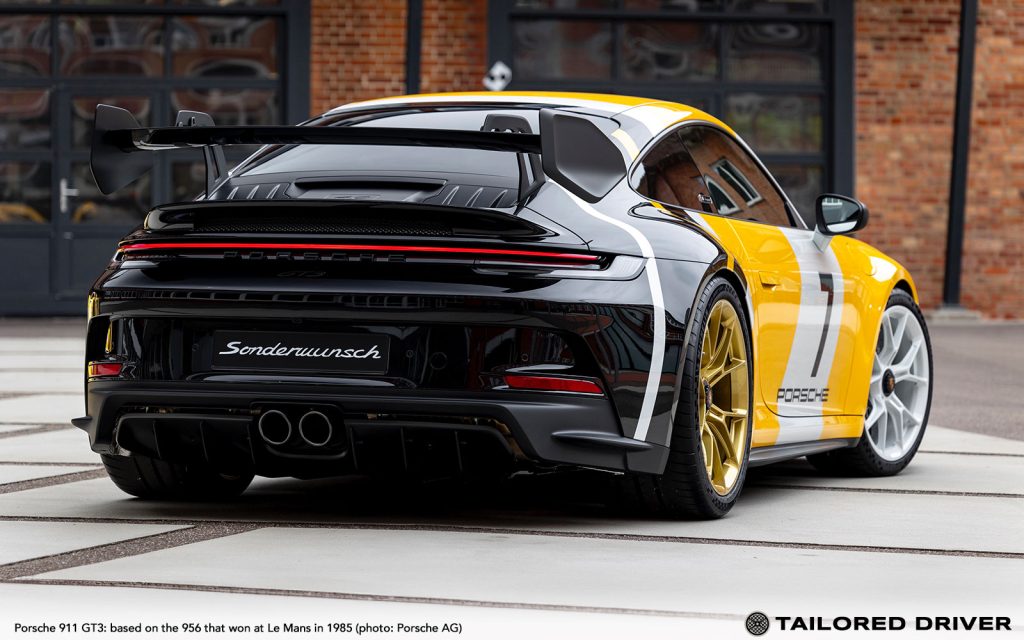
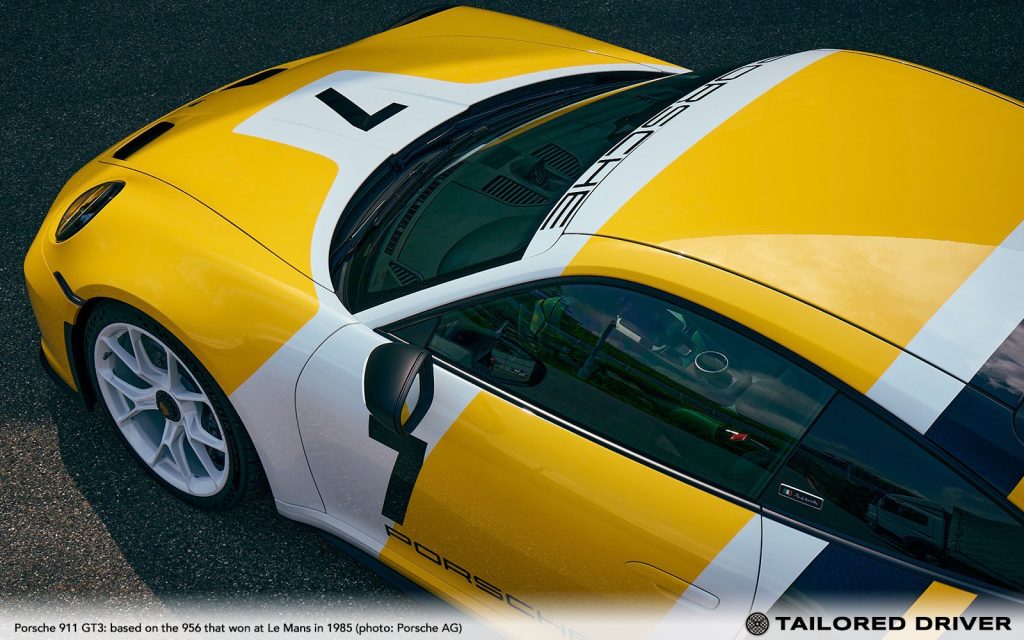
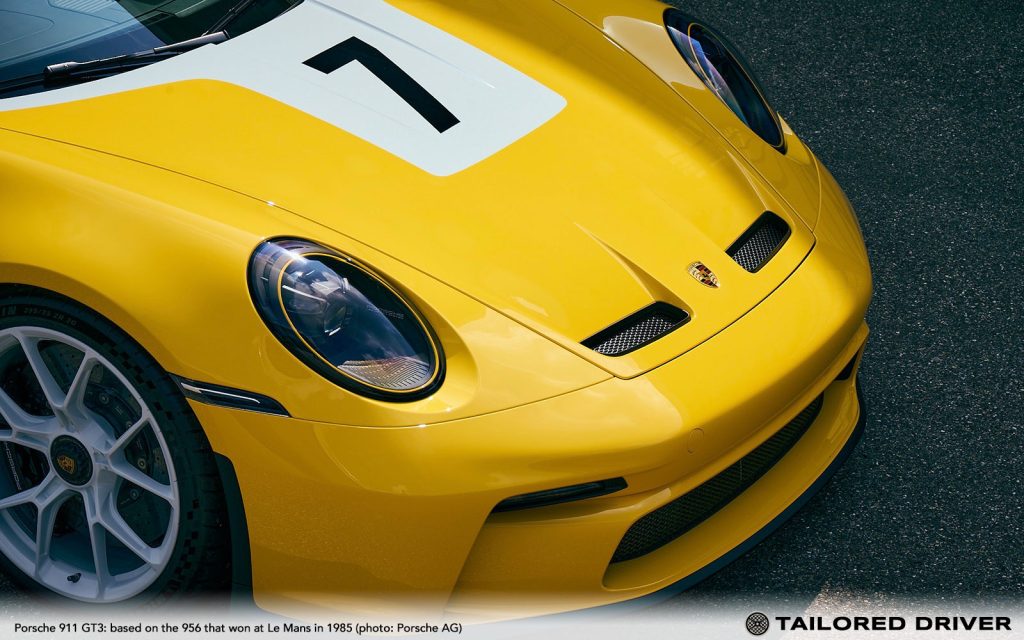
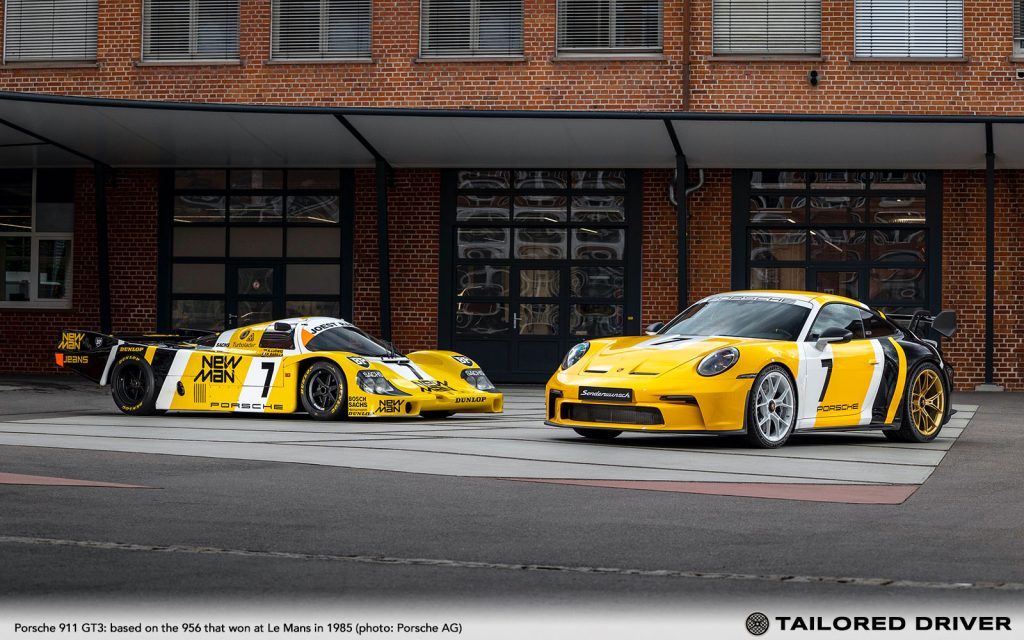
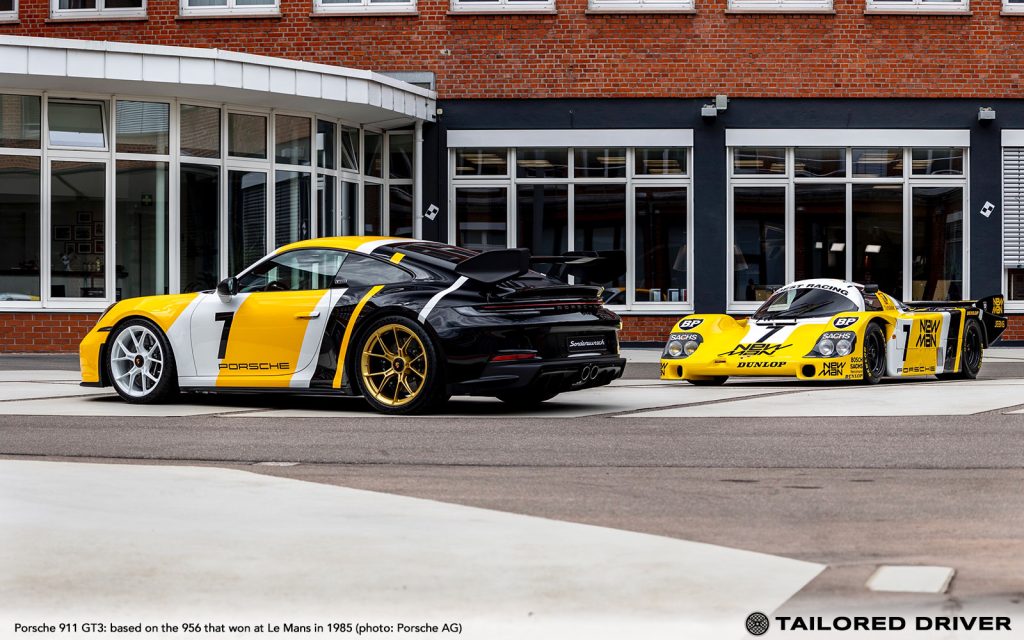
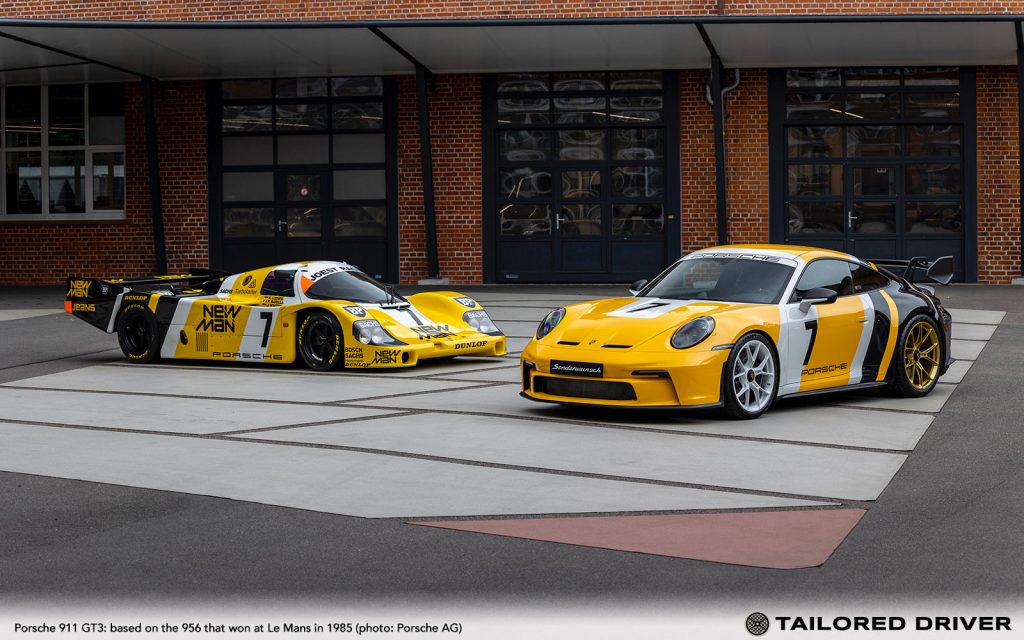
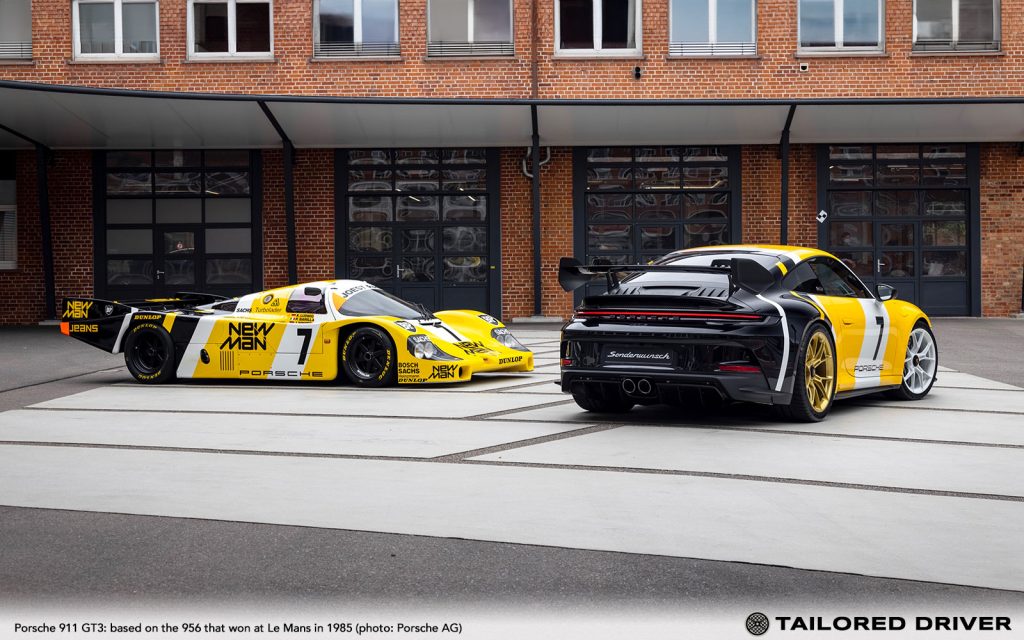
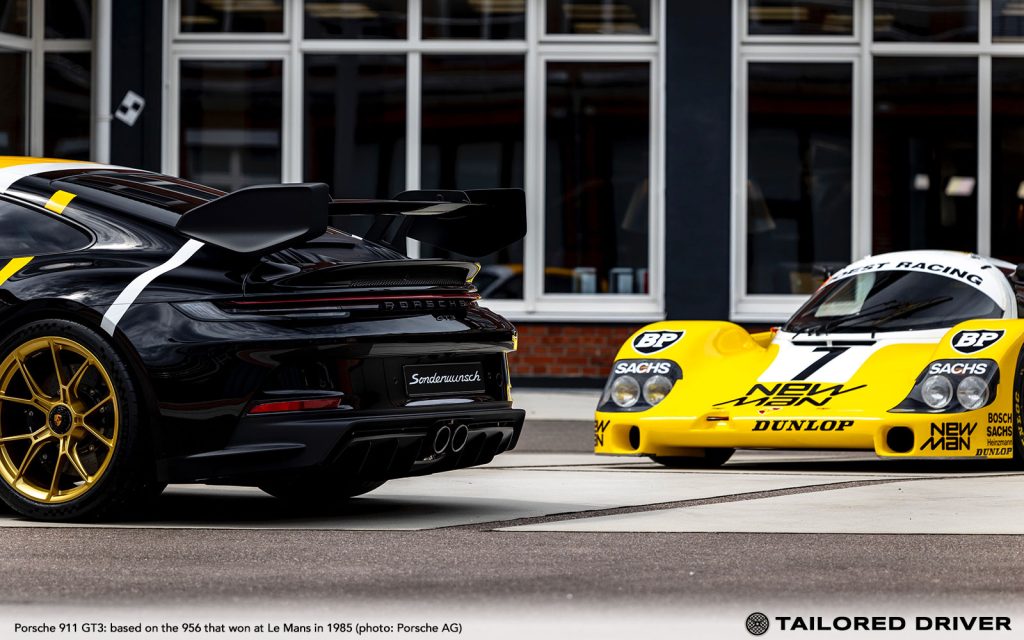
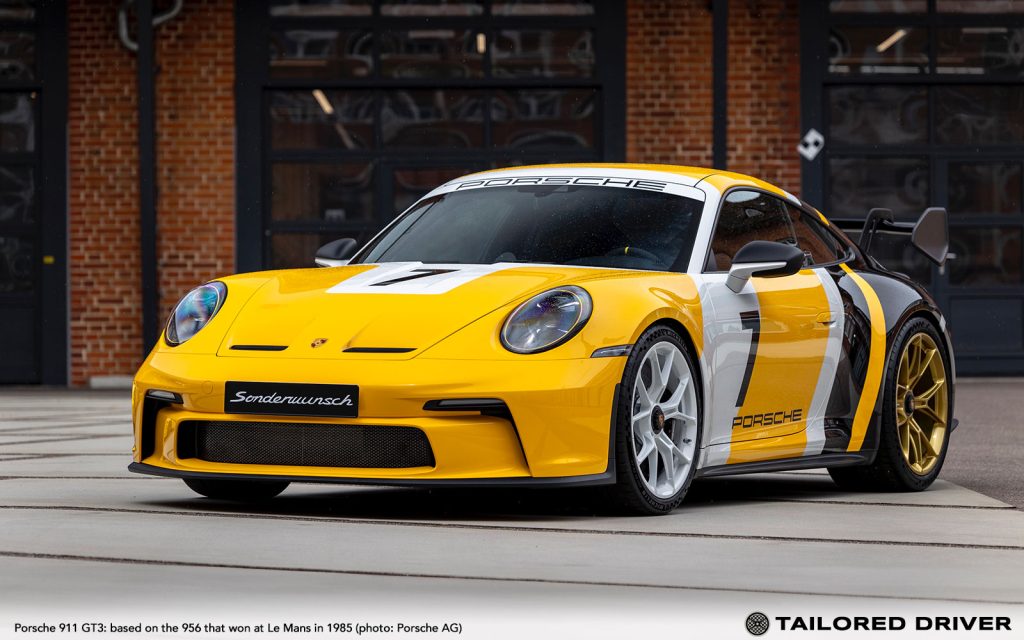
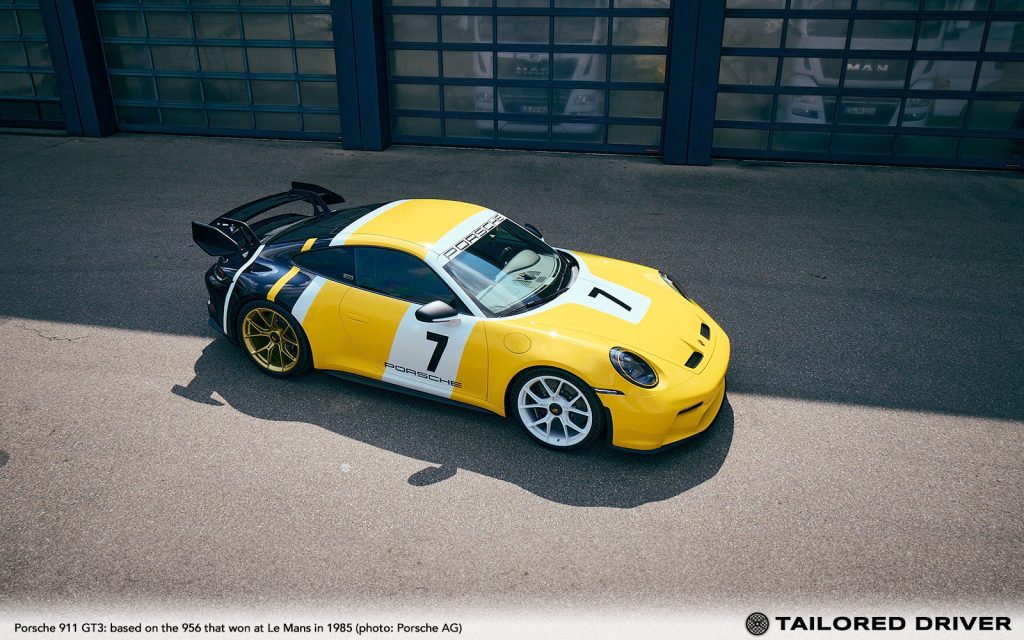
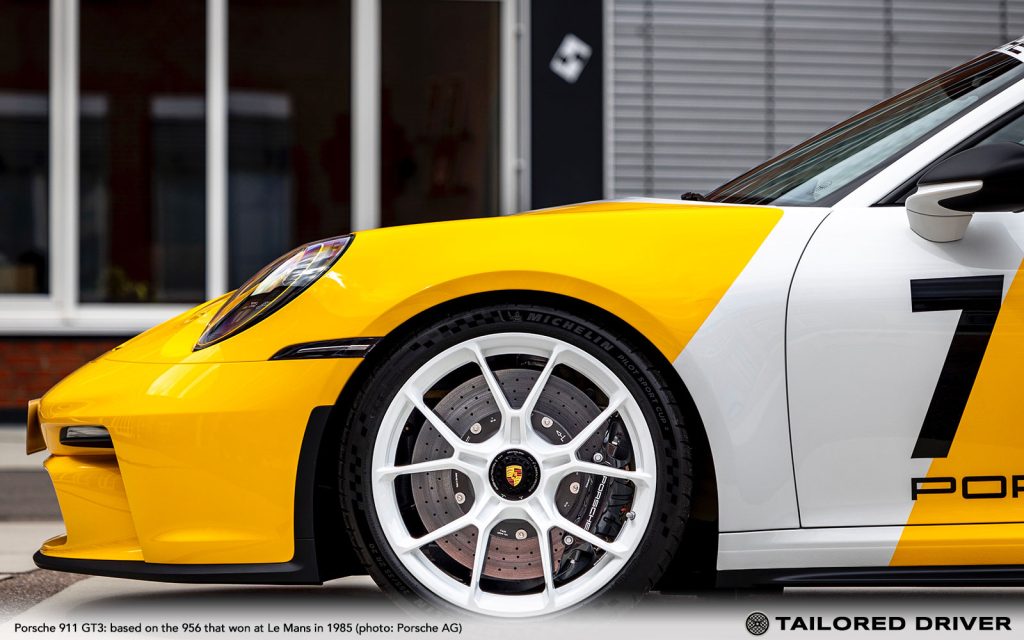
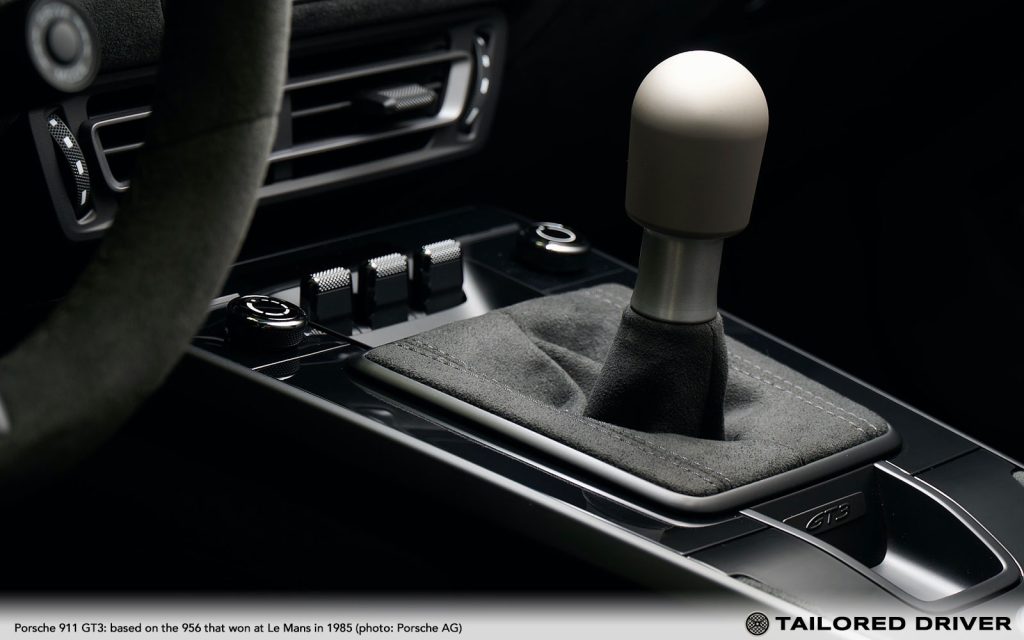
    On his 60th birthday, he was the first customer to complete a car project together with Porsche Exclusive Manufaktur as part of the new Sonderwunsch programme. It became known as the “dream car”. The Italian entrepreneur wanted to design a unique Porsche 911 GT3 (992) based on his Le Mans winning car and to be fully involved in its creation. In addition to the characteristic racing look in Summer Yellow, white and black, this special car has the winning race number 7 on its bonnet and doors. Other features such as the rear wing and the gear lever were also reinterpreted and in part developed independently.

    “The unique customer experience is at the heart of the Porsche brand,” according to Alexander Fabig, Vice President Individualisation and Classic at Porsche AG. “That’s why the significantly expanded Sonderwunsch programme is another milestone in terms of customer enthusiasm worldwide. And this car project is the jewel in the crown of customisation by Porsche Exclusive Manufaktur.”

    “In the Eighties, I had the chance to drive the wonderful Porsche 956, an iconic car in terms of performance and beauty,” says Paolo Barilla, ex-racing driver and Deputy Chairman of the Italian food company. “The interpretation of some elements in a modern GT3 makes that memory exciting and vital – for me and for people who are close to me.”

    As Alexander Fabig, Vice President Individualisation and Classic at Porsche AG explains, “the cooperation with Paolo Barilla was a very special project for Porsche too. Because not only is the handcrafted 911 GT3 itself highly individual, but its design process is also unique.”

    Unique from every angle

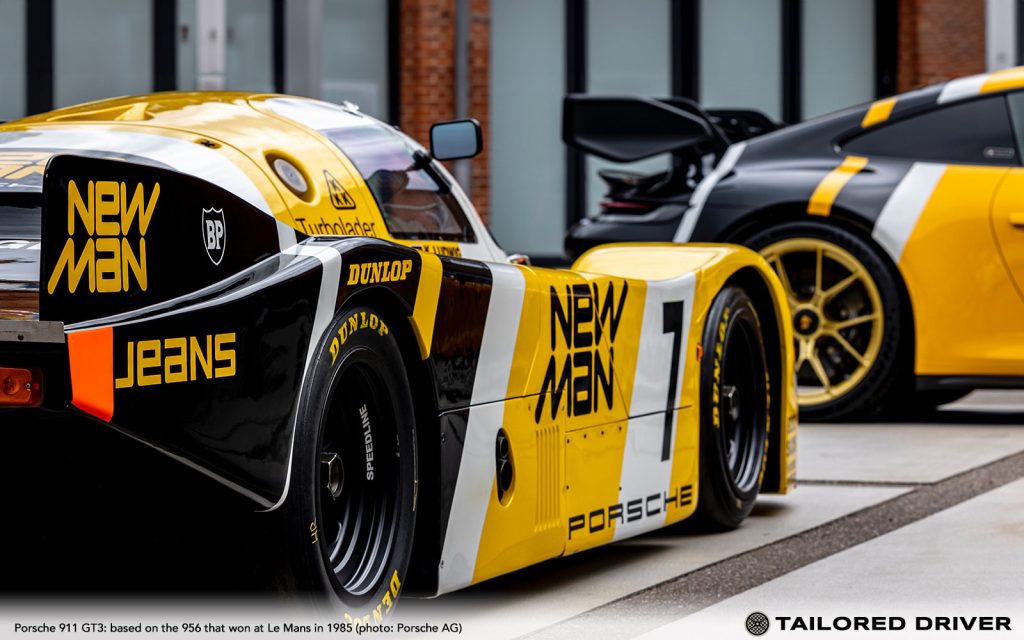
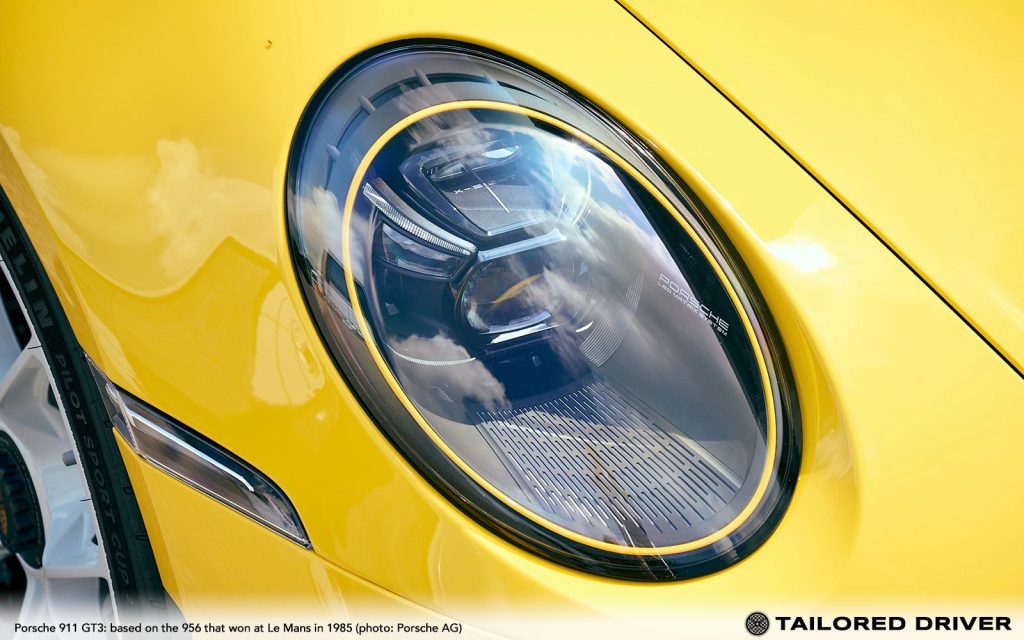
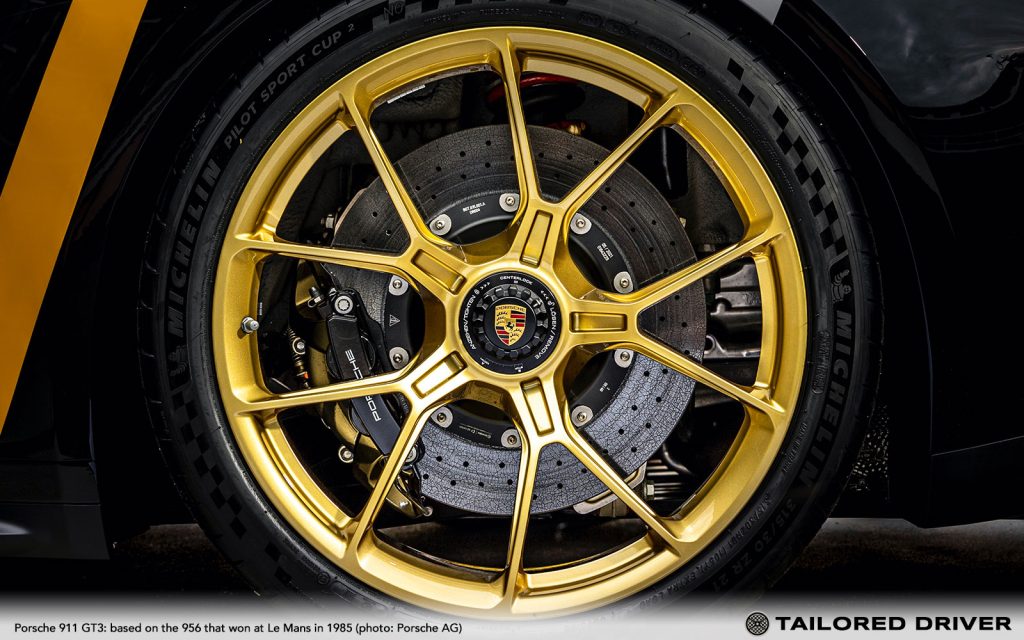
    One of the special features of this 911 GT3 is its striking exterior paintwork in Summer Yellow, white and black. It reinterprets the striped design of the historic racing car. The front apron and the trim rings on the headlights are also painted in Summer Yellow. The design of the centre-lock wheels is inspired by the rims of the Porsche 956. When used in racing, these had White aeroblades. The 911 GT3 rims are also white at the front, while the rear axle is painted in a modern gold colour.

    The side plates on the rear spoiler are also influenced by the design and geometry of their historic predecessor. Sample components were initially developed using rapid prototyping. Naturally, aerodynamic performance and, in particular, the balance between the front and rear axles needed to be retained, so the aerodynamic engineers from the series-produced 911 GT3 were included in the project at a very early stage. The modified rear wing had to prove its flow characteristics in the wind tunnel. “PB 60” is blazoned across the flanks, representing Paolo Barilla’s initials and age. The style of this logo is inspired by the graphic of the then main sponsor of the Le Mans winning car.

    Unique Interior

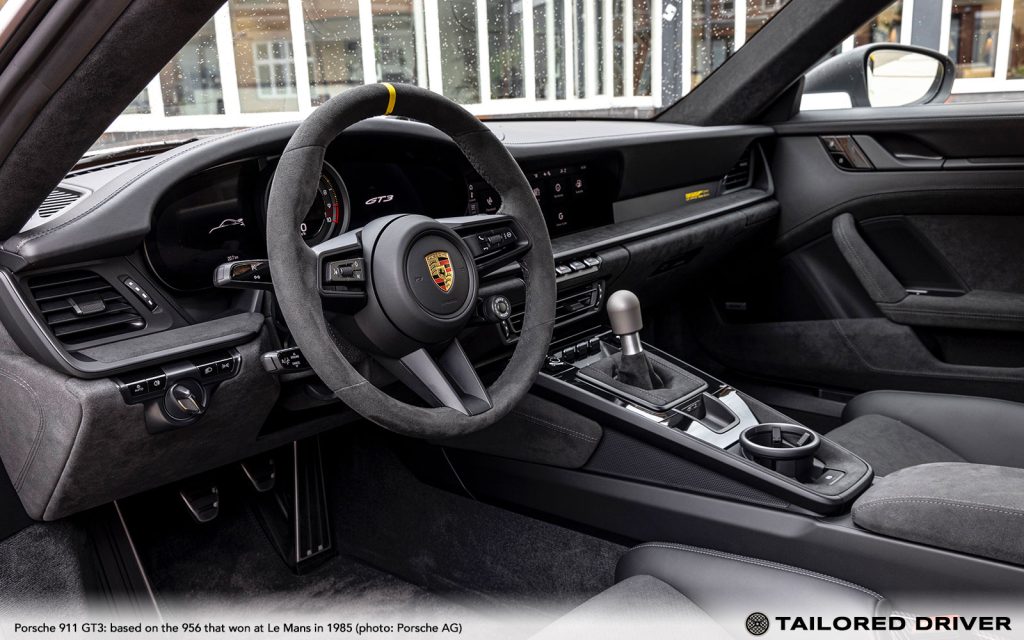
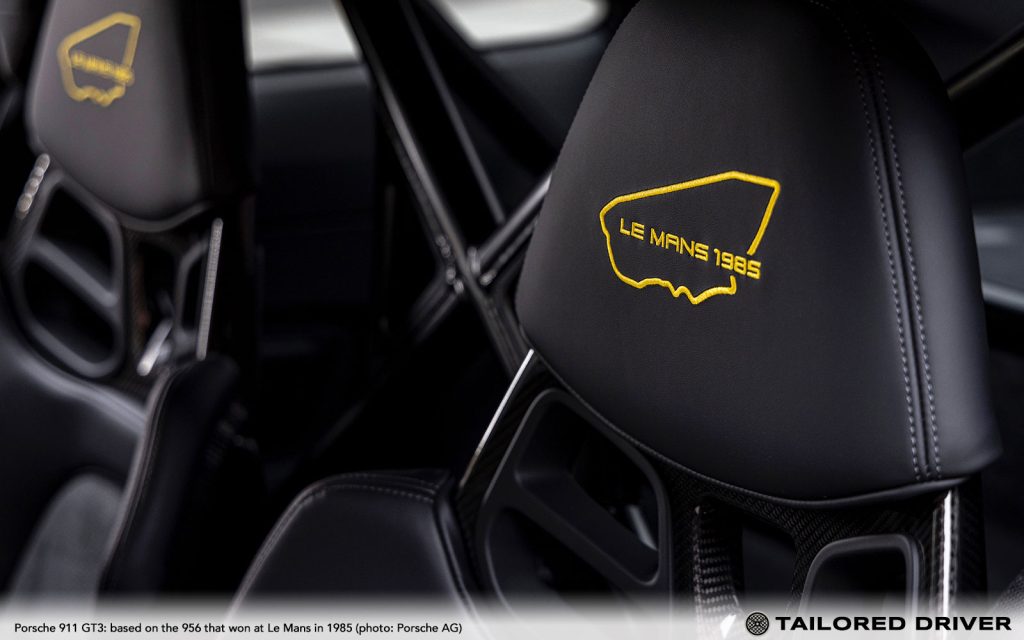
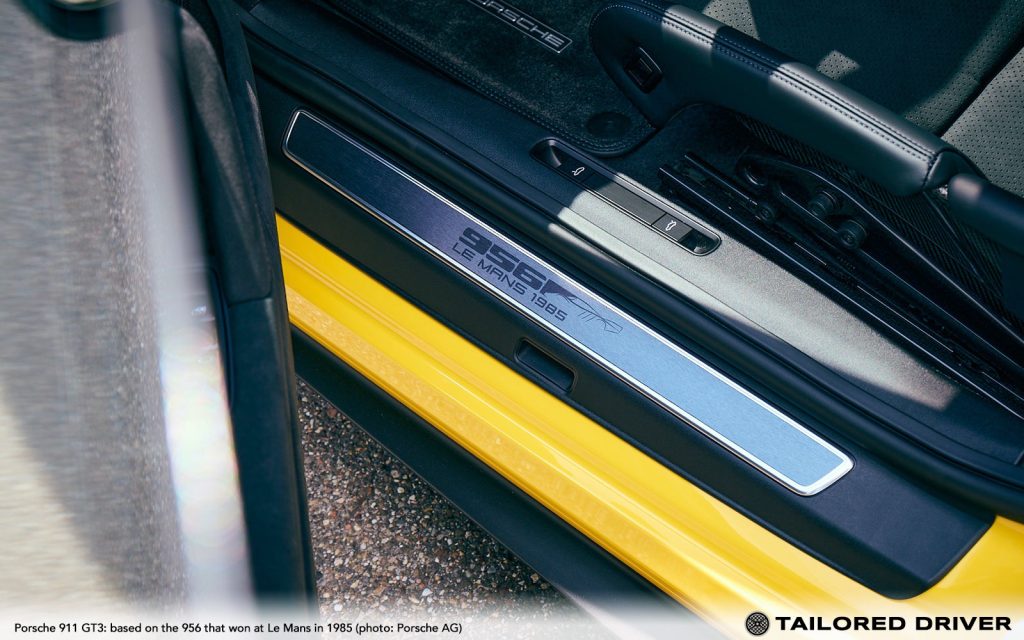
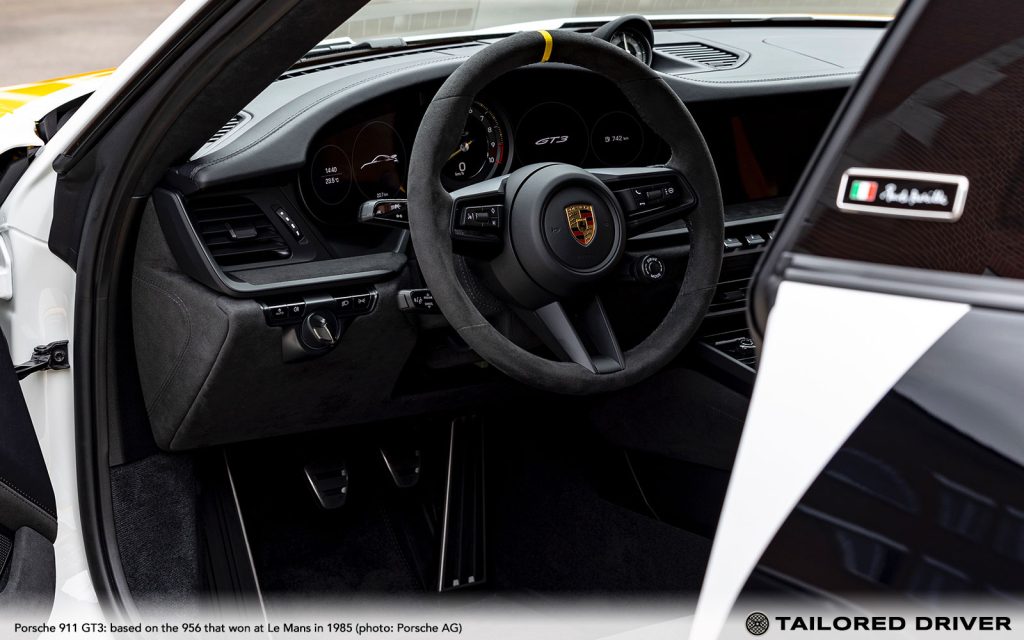
    Black dominates the interior, as you would expect in a racing car. The door entry guards and the decorative trim in yellow on the passenger side dashboard are decorated with a logo specially designed with the customer in mind. It combines the type code 956, the “Le Mans 1985” logo and the stylised silhouette of the racing car. This logo and the 1985 circuit are embroidered in the headrests. The gear lever is reminiscent of the magnesium ball in the 956 racing car and is an elaborate custom-made product: the top part was milled from an aluminium block and the surface was sanded.

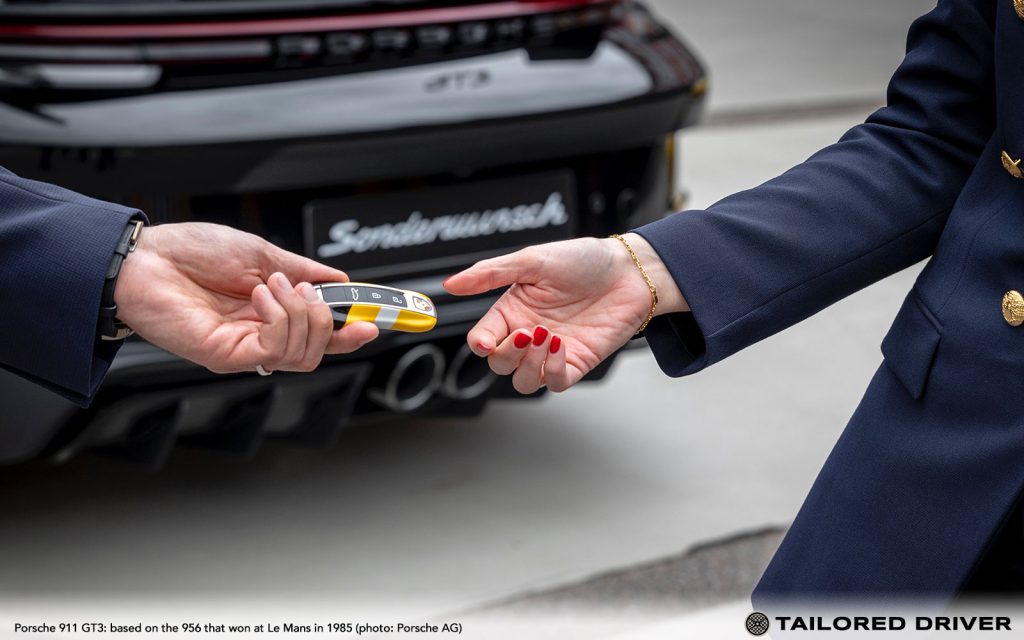
    Within the new Sonderwunsch programme, the client assumed the role of project manager. As part of the project team, made up of experts from Porsche Exclusive Manufaktur and the Style Porsche design department, Barilla collaborated directly in the creation of his dream car. The process took a total of three years, from the first design sketch to the technical feasibility check and construction. Development started on the basis of the predecessor GT3 car, as the type 992 was still in series development.

    “Many times in this project we would have had good reason to say ‘It’s not going to work’ or ‘It’s too complicated,’” said Philipp Setter, Head of Sonderwunsch Customer Consultation at Porsche Exclusive Manufaktur. “Once we decided to take on the challenge, we pushed the boundaries and were able to achieve a lot. With his clear vision and grasp of tight schedules and decision-making, Paolo Barilla was the right client and project manager for this ambitious project.”

    Summer Yellow from the “Colour of Choice Plus” programme

    “Direct contact with the customer is the best thing that you can have as a designer,” according to Grant Larson. Together with Harm Lagaay, Grant Larson designed the first Boxster and is currently the Director of Special Projects at Style Porsche. “I work for Porsche because that is where I can design dream cars. But the Sonderwunsch projects are in another dimension: The personal exchange with the client is extremely satisfying and helps us to better understand our customers’ wishes in our daily work.”

    The biggest challenge for Larson was to transfer the graphic design from the extremely flat and square racing car to the more rounded shapes of the current 911. “Geometrically these are very different cars,” said Larson. “The layout couldn’t be transferred 1:1.” First, he worked digitally on the computer, then the lines were projected onto a test body with a laser device and these were painted accordingly. The trial paint was applied three times before designer Larson and project manager Barilla were satisfied. The warm, yellow shade also had to be carefully chosen to closely match the historical model and to work in both artificial and daylight. The team finally opted for summer yellow from the extensive “Colour of Choice Plus” programme at Porsche Exclusive Manufaktur.

    “I originally wanted to move the race numbers on the doors further towards the centre of the white strip, but Paolo Barilla insisted that the “7” should be very close to the edge, like on his racing car,” Larson recalls. During the project phase, he placed a 1:43 model of the racing car on his desk for inspiration.

    Integrated into the Porsche family

    Barilla visited Porsche three times during the concept phase to actively take part in the project from specification to completion. During the implementation phase, frequent consultations took place via telephone, email and video conference, followed by further visits – with his very own works ID. “Paolo Barilla was very pleased about this detail,” says Setter. “When the Porsche works ID was handed over in person, he officially became part of the team and our Porsche family.”

    He also became an official production employee because Barilla himself flanged the gearbox to the engine in his unique car using a torque-controlled screw device. “Authentic experiences like these are ultimately what makes Porsche Porsche,” according to Setter. “Our customers have generally seen and experienced a lot, but for projects of this size, we always try to open a few more doors that would otherwise be closed, for very good reason.”

    About the Porsche Sonderwunsch programme

    Porsche Exclusive Manufaktur and Porsche Classic enhance and restore unique sports cars with a combination of skilled craftsmanship and attention to detail. As part of its Co-Creation strategy, the sports car manufacturer is now offering a new interpretation of its legendary Sonderwunsch programme from the late 70s, which will make it possible to design individualised, one-off cars in future – co-created by the customer and professionally produced by Porsche. The expansion of this offering is divided into the areas of Factory Commissioning for individual customer colour and material requests directly in production as well as subsequent Factory Re-Commissioning and Factory One-Off after vehicle delivery to the customer. Whereas Factory Re-Commissioning is also aimed at the implementation of individual colours and materials, the Factory One-Off is a systematic technical new development. Depending on the vehicle age, the technical experts of Porsche Exclusive Manufaktur or Porsche Classic take care of implementation.

    About Porsche Exclusive Manufaktur

    A sports car as individual as your own fingerprint, as unmistakable as your own lifestyle: Porsche Exclusive Manufaktur in Zuffenhausen creates very personal customer vehicles through a combination of perfect craftsmanship and high-tech. Highly qualified employees with decades of expertise devote their full attention to every detail and enhance it through hand craftsmanship.

    The experts can draw on a wide range of visual and technical customisation options for the exterior and interior. Visible examples include Sport Design packages, custom rim designs and interior trims, as well as the comprehensive “Colour of Choice Plus” range for all Porsche models. Porsche Exclusive Manufaktur fulfils the highest demands with regard to materials and craftsmanship. Alongside individual customer vehicles, Porsche Exclusive Manufaktur also produces limited small series and editions. Here, high-quality materials are combined with modern production technologies to create a harmonious overall concept.

  • New MANUFAKTUR Label – Exclusive Equipment for Individual Customer Wishes

    New MANUFAKTUR Label – Exclusive Equipment for Individual Customer Wishes

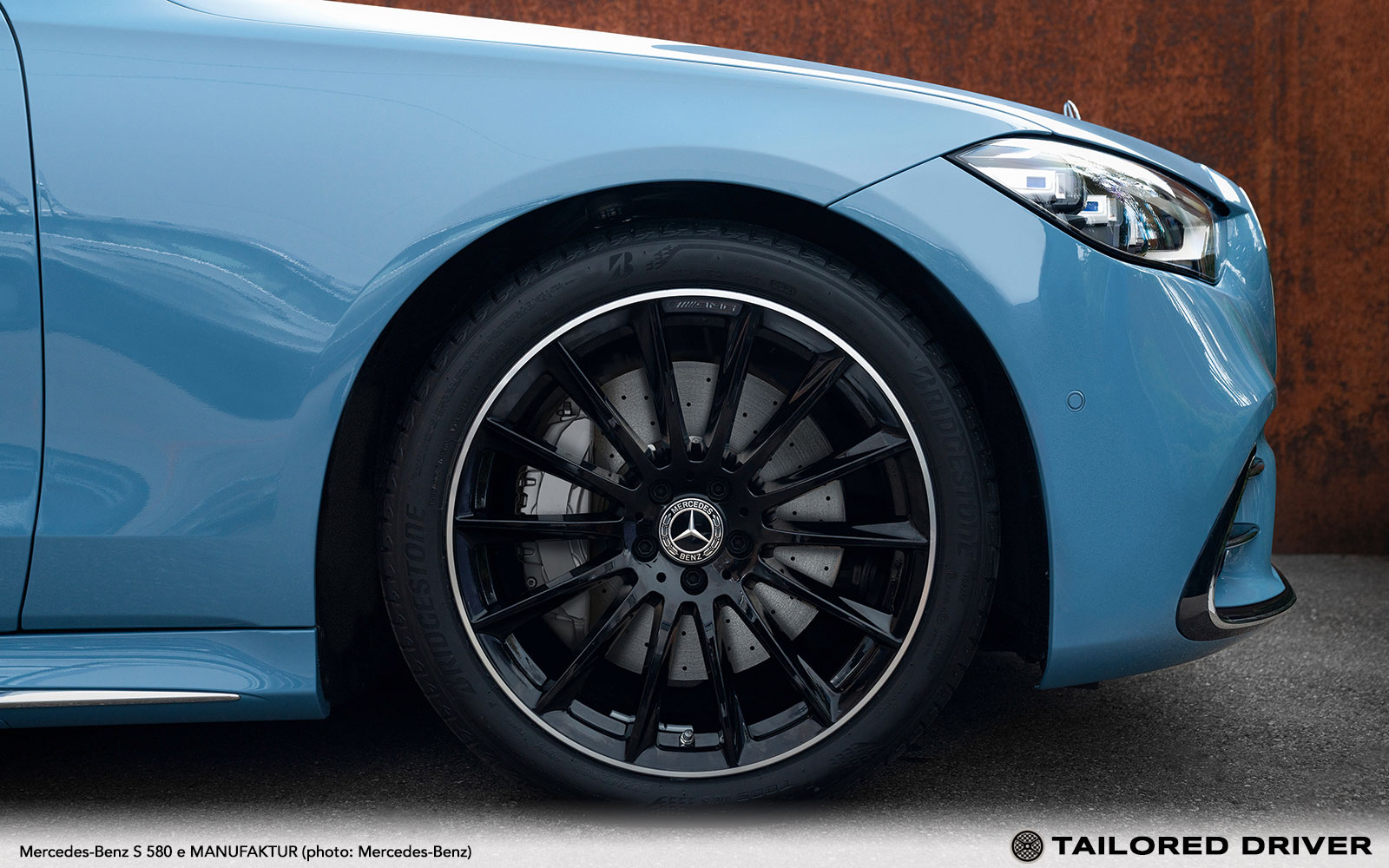
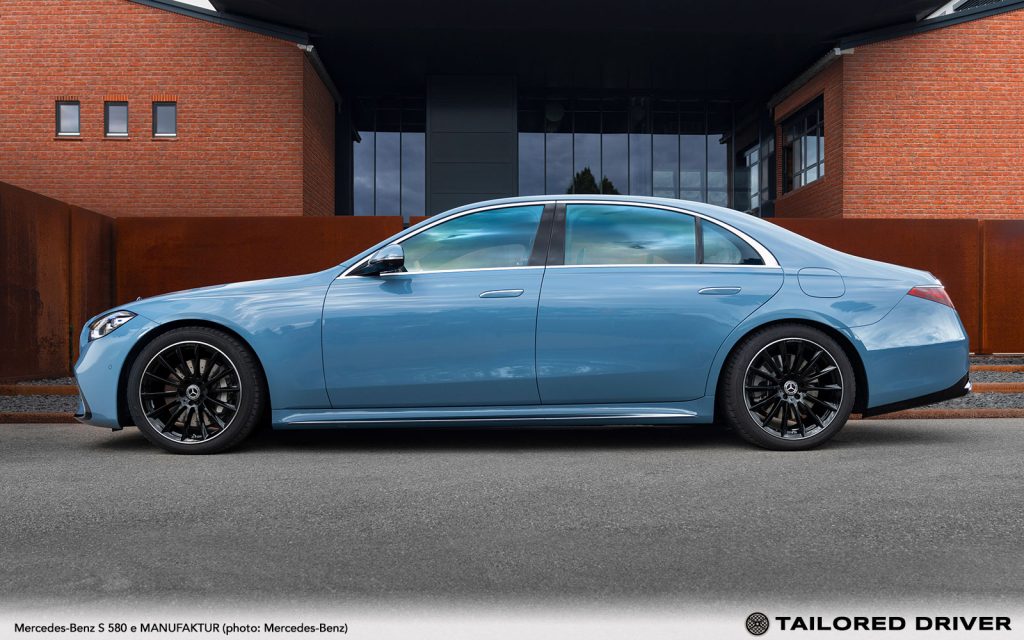
    Stuttgart. The Mercedes-Benz brand stands for luxury and fascination like hardly any other. The design, styling and different equipment lines express the personal lifestyles of customers. With the new “MANUFAKTUR” label, Mercedes-Benz is doing even more justice to customers’ growing desire for more individuality, and is enhancing the existing product portfolio with additional exclusivity and luxury: selected materials which are predominantly processed by hand, exclusive paint finishes and high-quality embellishments in the interior offer a wide range of options for an individual appearance. A corresponding programme has already been available for the G-Class for several years: the “G manufaktur” presents its own selection of materials and colours specially adapted to the vehicle architecture. With the introduction of the new MANUFAKTUR label, Mercedes-Benz now also offers a corresponding customisation programme for other model series such as the CLS, the Mercedes-AMG GT 4-door coupé and the S-Class long-wheelbase, as well as the Mercedes-Maybach S-Class.

    [source: Mercedes-Benz]

    Buying a new vehicle means making numerous decisions at the same time. After all, your own car is always part of your personal everyday life, and an expression of your own lifestyle. In addition to a choice of engine, colour, interior equipment and comfort features, Mercedes-Benz customers are offered many options with which they can tailor their dream vehicle to their needs. For those who are also looking for something special in terms of paintwork, leather upholstery and interior design, Mercedes-Benz now offers further, exclusive customisation options for selected model series with the new MANUFAKTUR label. These combine luxurious craftsmanship, the highest quality materials and fascinating design.

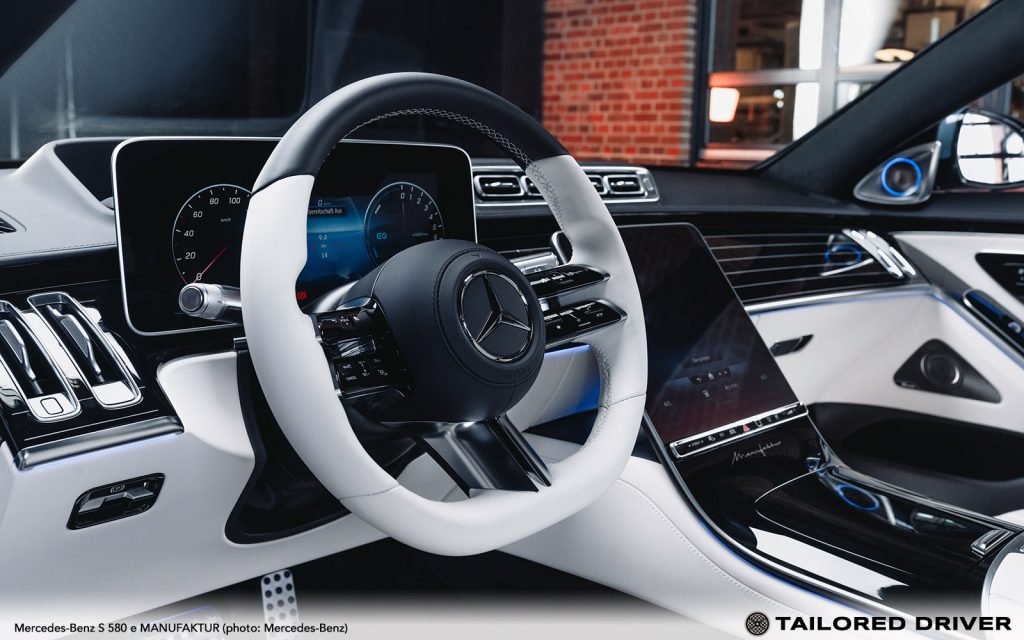
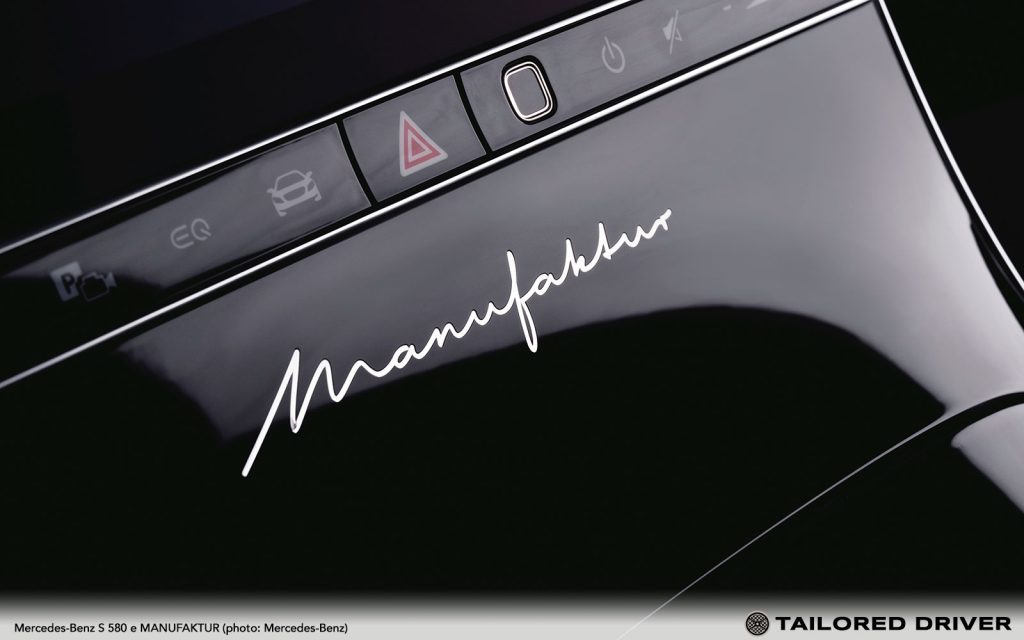
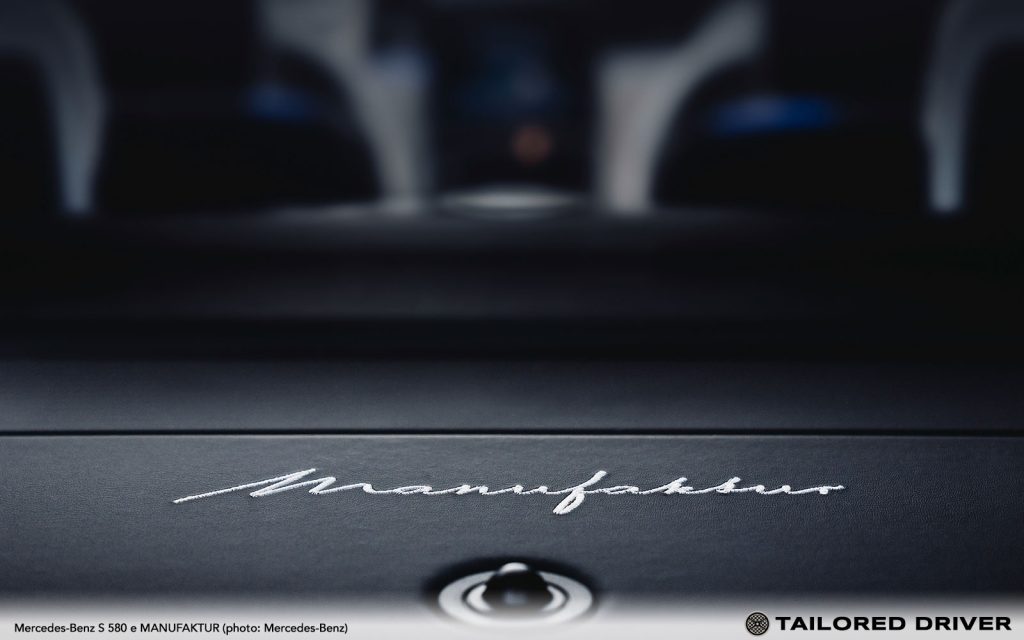
    Mercedes-Benz customers can expect an ambience characterised by an equally aesthetic and extraordinary colour concept, the finest materials, sensual comfort and exclusive trim elements in piano lacquer or wood. The excellence of the craftsmanship is visible and tangible in the embroidery, the leatherwork and the carefully applied trim elements. The attention to detail is particularly highlighted in the Mercedes-Benz S-Class long-wheelbase and the Mercedes-Maybach S-Class, by the MANUFAKTUR lettering in chrome look on the centre console and as discreet embroidery on the parcel shelf, as it is a result of a high-quality manufacturing process with selected, first-class materials.

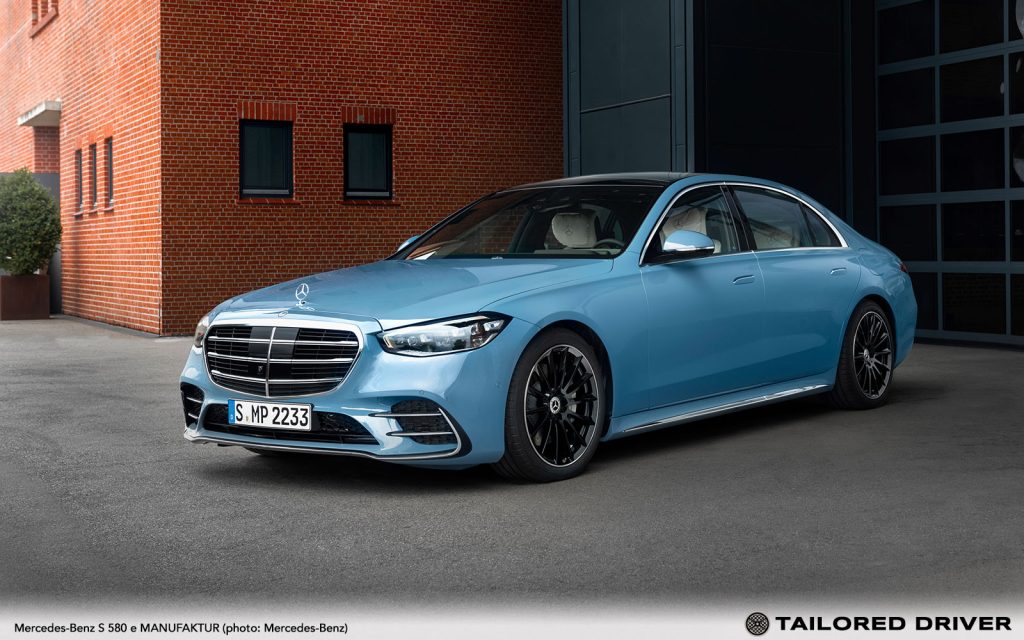
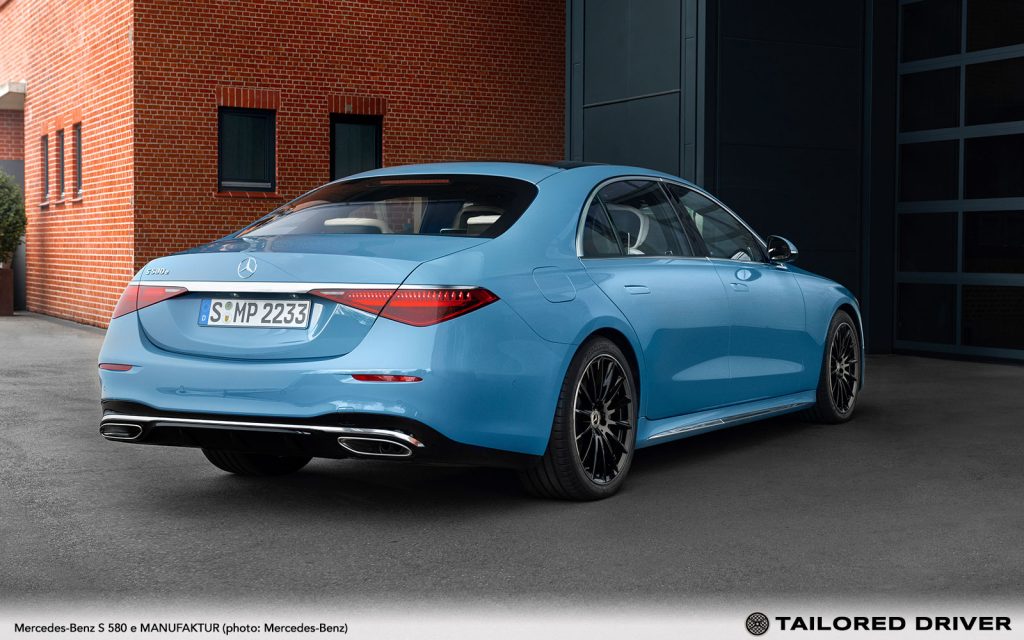
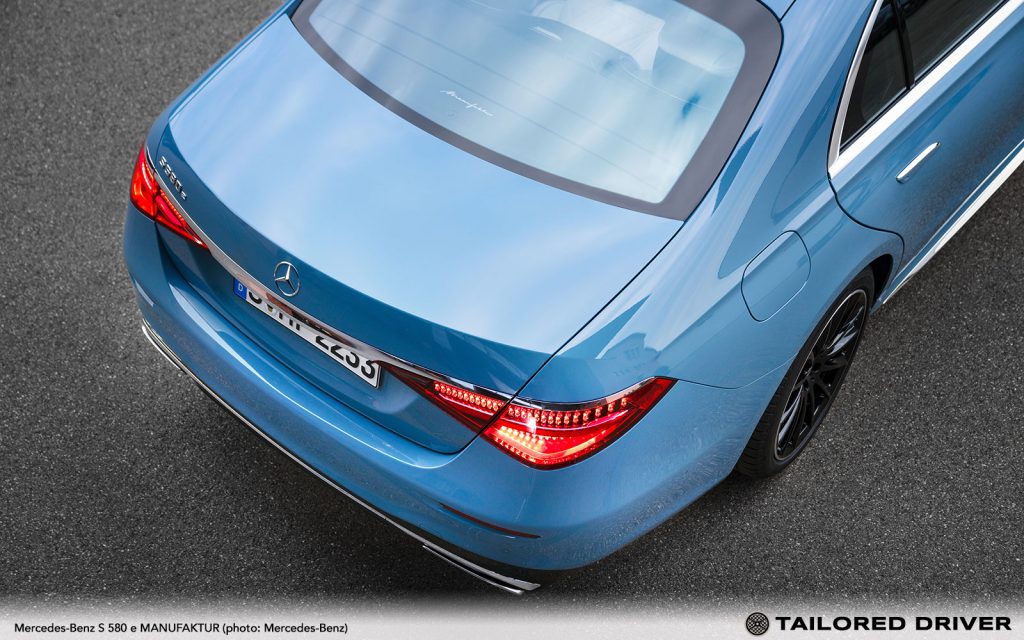
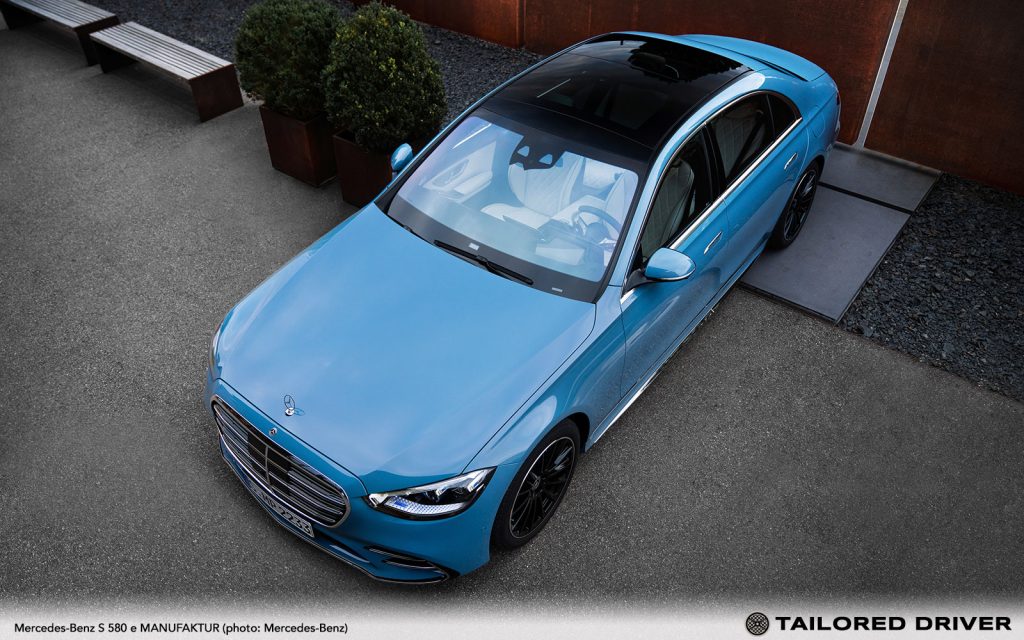
    One of the most expressive features of a vehicle is its colour. The MANUFAKTUR range offers an exclusive selection of special paint finishes – both silky matt and high-gloss metallic, or rich non-metallic colours. Some of these colours are reminiscent of Mercedes-Benz history. MANUFAKTUR silicon grey uni was already part of the colour range until the early 1960s, and e.g. adorned the legendary 300 SL “Gullwing” as a special colour. MANUFAKTUR graphite metallic and MANUFAKTUR olive metallic were among the exclusive exterior options in the 1980s, while MANUFAKTUR vintage blue uni was a popular choice for the E-Class (W123) and the S-Class (W126) in the 1980s. The trend towards a satin finish is reflected in fine, elegant finishes such as MANUFAKTUR cashmere white magno and MANUFAKTUR kalahari gold magno, or the sporty MANUFAKTUR night black magno. All MANUFAKTUR paint finishes exude high quality, and underline the fascination of Mercedes-Benz vehicles and their dynamic lines.

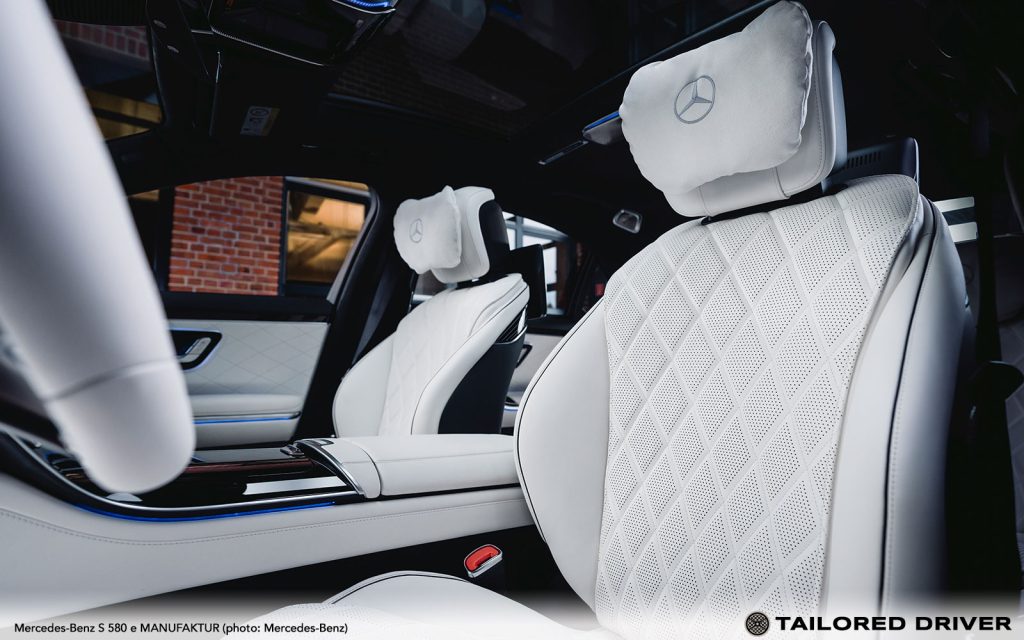
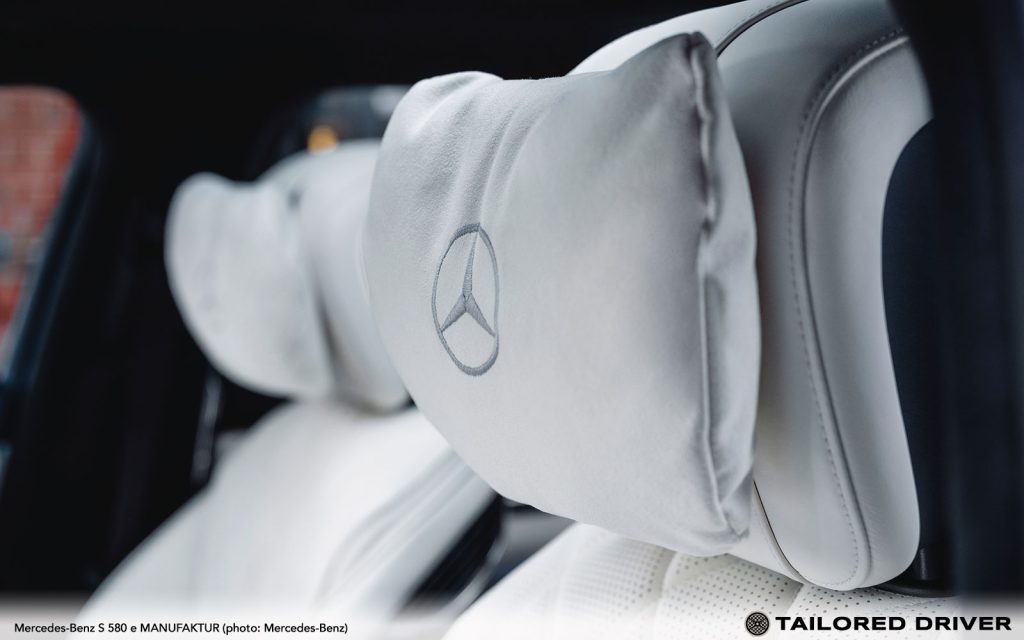
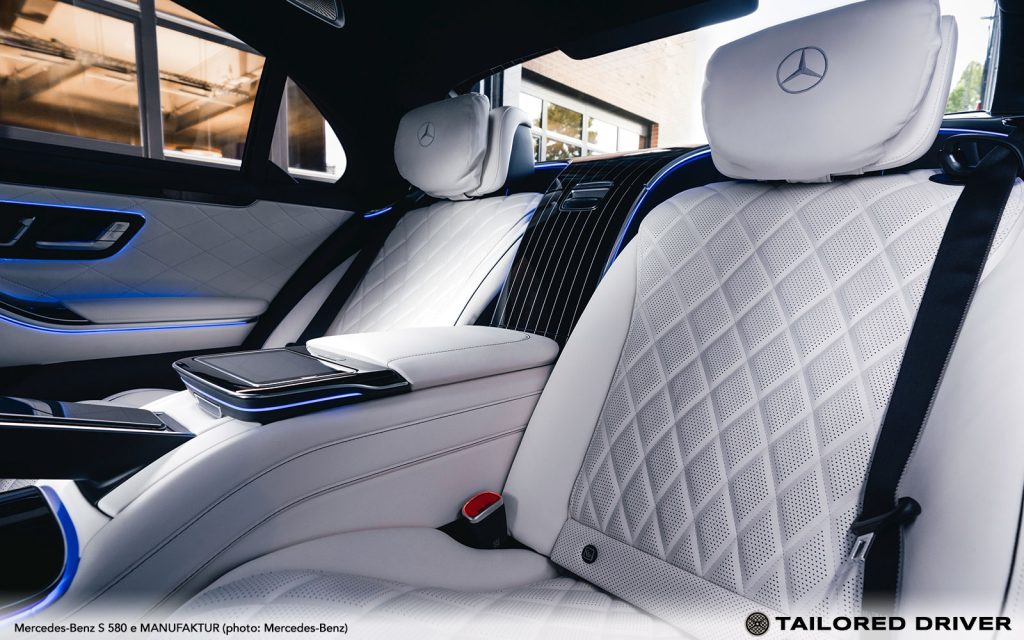
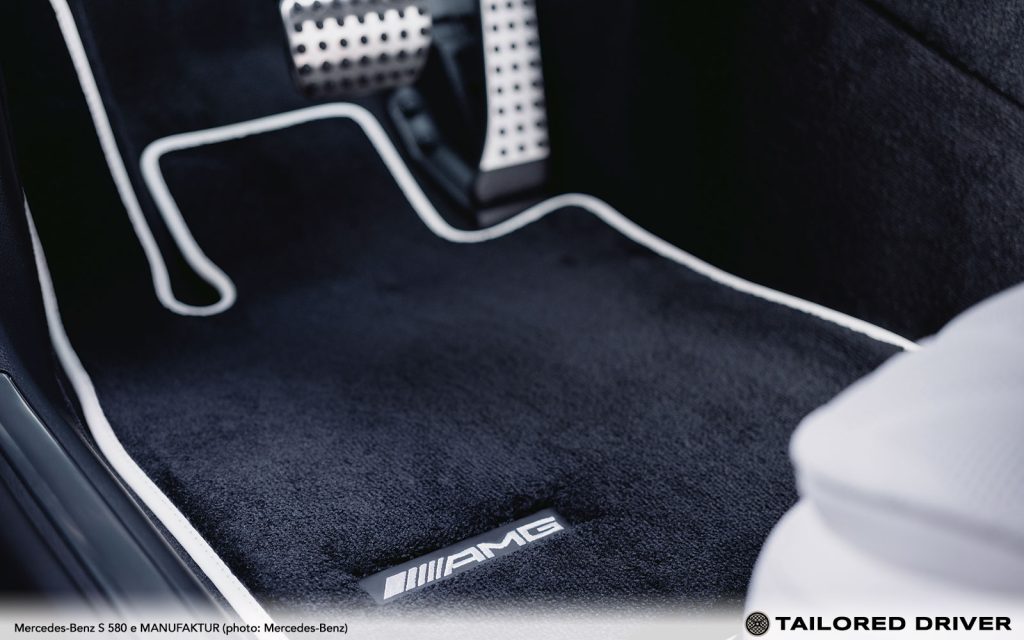
    Fine, high-quality nappa leather with unusual contrasting colour concepts characterises the ambience in the interior. This is where the classic MANUFAKTUR deep white/black comes back to life, as does the iconic special upholstery colour MANUFAKTUR pastel yellow/black, which was available for the S-Class until 2012. Also in combination with black, other leather colours such as MANUFAKTUR nut brown/black, MANUFAKTUR truffle brown/black or maritime MANUFAKTUR yacht blue/black stand for the highest individual elegance. The intricate diamond-pattern stitching further enhances the exclusive look, and ensures particularly pleasant seating comfort. The package also includes tone-on-tone additional cushions with an embroidered logo – depending on the model and equipment requirements, either the Mercedes-Benz star, the double-M rhombus of Mercedes-Maybach or Mercedes-AMG lettering in the floor mats, for example. If the customer chooses one of the optional Emblem packages available for the long-wheelbase version of the S-Class and the Mercedes-Maybach S-Class, the trademarks can also be embroidered in gold or platinum to further enhance the luxurious ambience.

    In combination with the selected upholstery, customers receive further refined components for a coherent and consistently high-quality overall impression. For example, the handcrafted, two-tone MANUFAKTUR leather steering wheel as well as the door centre panels, the armrest and the lower section of the instrument panel are also lined with fine nappa leather. The precise stitching and excellent fit are testament to the high level of craftsmanship of the saddlers who fashion all leather components from the finest materials.

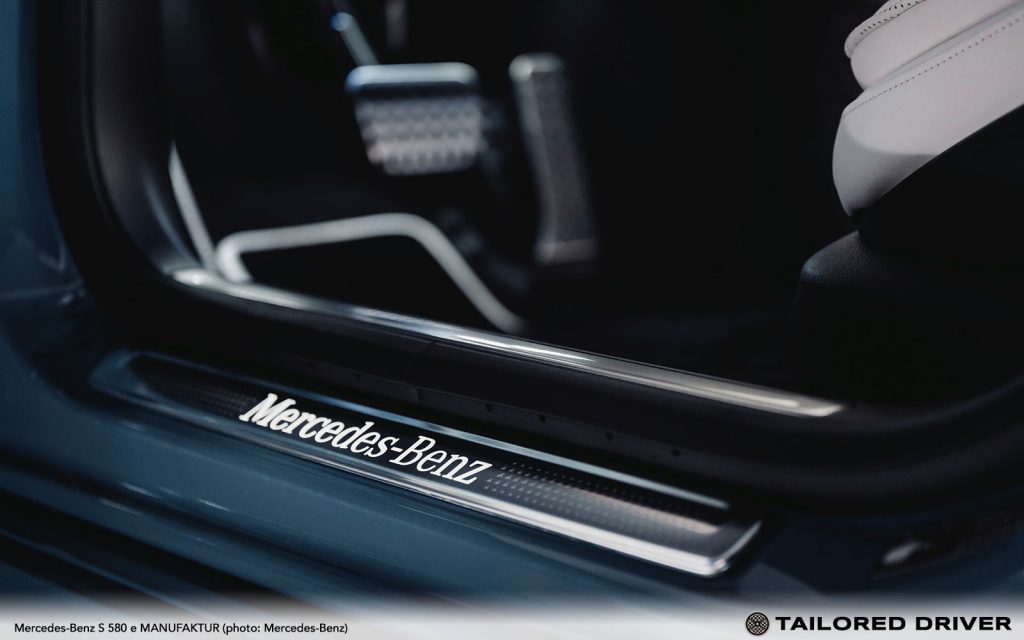
    Another noble highlight that can be additionally selected is the MANUFAKTUR headliner made entirely of nappa leather with double-stitched Maybach rhombus. It consists of a rear central panel in a contrasting colour with diamond quilting and a middle central panel in a contrasting colour without diamond quilting. The harmonious interior is complemented by high-quality thick-pile floor mats edged with the chosen nappa leather in a contrasting colour. Depending on the line and the choice of Emblem package, they are embroidered with the Mercedes-Benz star, the Maybach logo or Mercedes-AMG lettering. The brand logos are also repeated on the door sill panels, where they are additionally illuminated and bordered by the current Mercedes Star pattern or, in the case of the Mercedes-Maybach, by the current Maybach pattern.

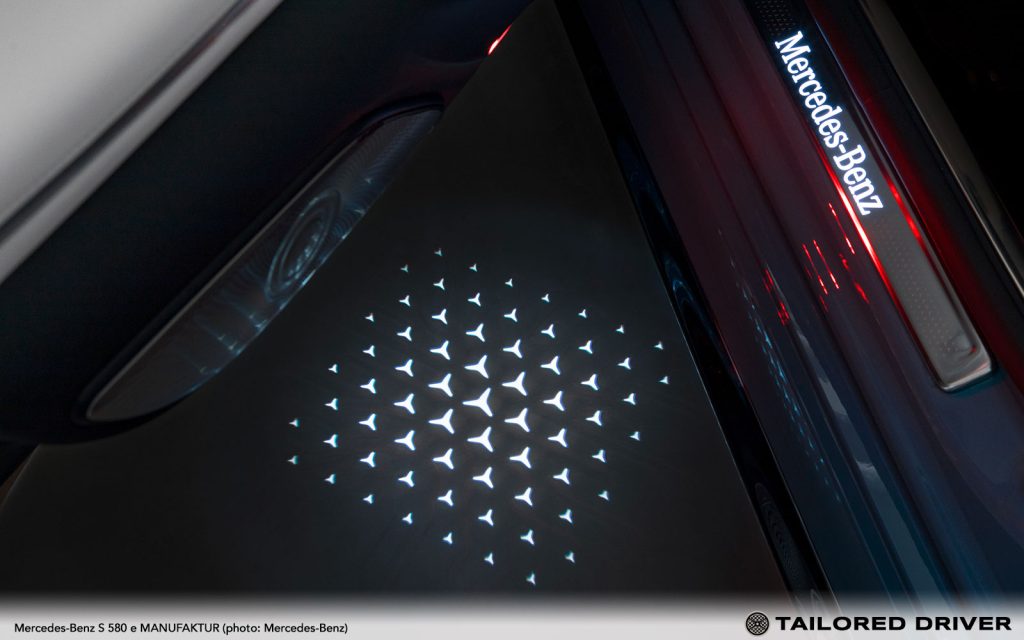
    A real eye-catcher that underlines the brand presence is the MANUFAKTUR surround lighting with animated projection. When the doors are opened, animated Mercedes-Benz or Mercedes-Maybach patterns using sophisticated LCD technology light up and elegantly illuminate both the front and rear entry areas. This special lightshow is made possible by four LCD projectors embedded in the front and rear doors, which deactivate themselves after ten minutes.