Category: Marques

  • Ferrari Reveals New F80 Supercar

    Ferrari Reveals New F80 Supercar

    • The F80 is Ferrari’s new supercar, a car destined to join iconic models from the 1984 GTO to the 2016 LaFerrari Aperta
    • The F80 is a showcase for the ultimate in technology and performance from the marque, and represents an extreme development of the internal combustion engine
    • With a combined maximum power of 1200 hp, the V6-hybrid powertrain of the F80 makes it the most powerful road car ever to come out of the gates of the Ferrari factory
    • A host of advanced technological solutions makes the F80 the new benchmark for innovation and engineering excellence

    [source: Ferrari]

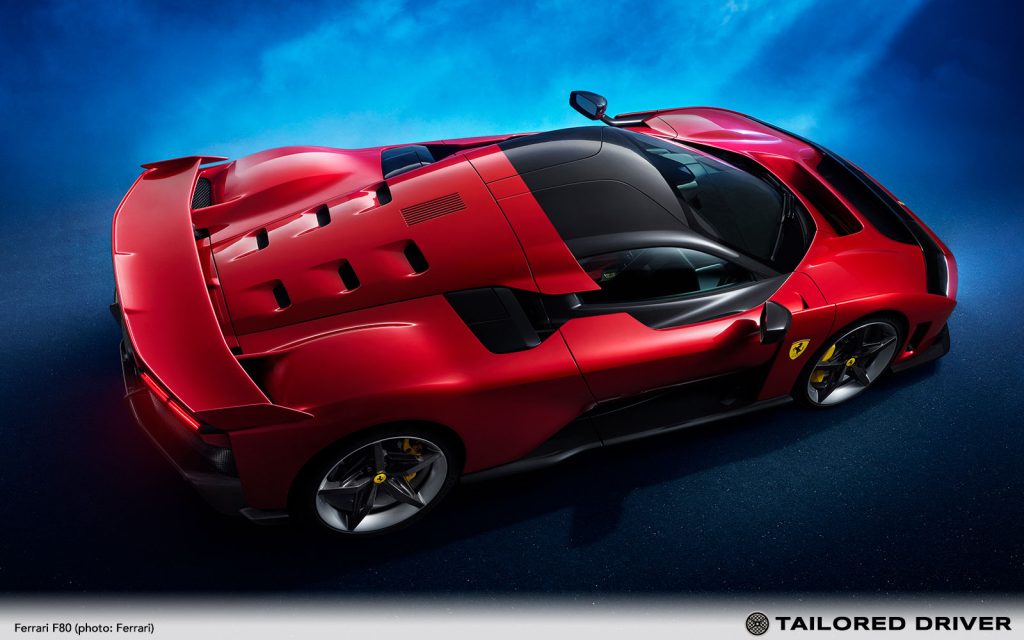
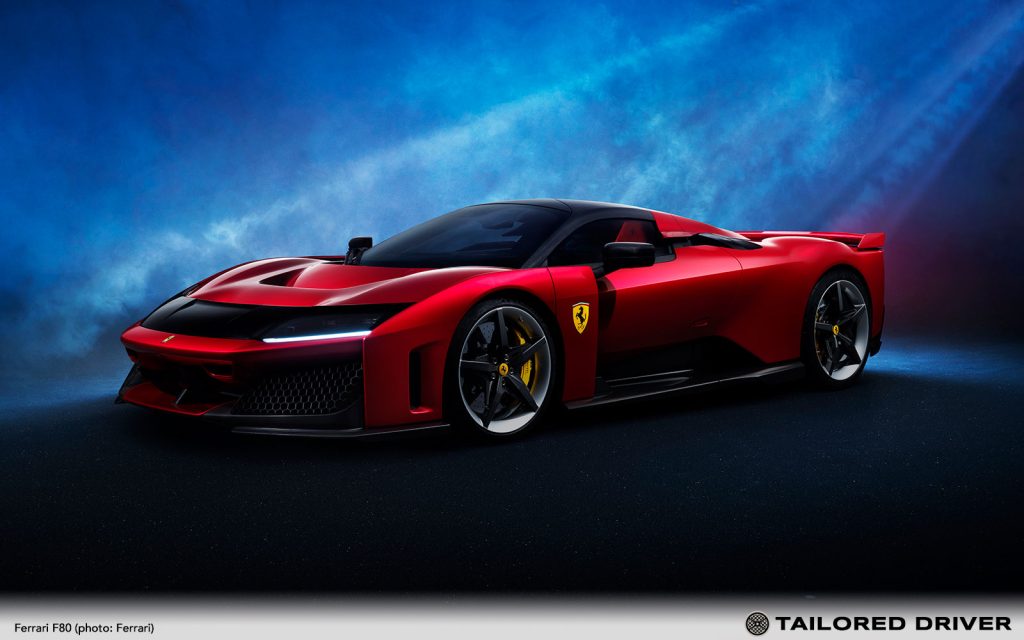
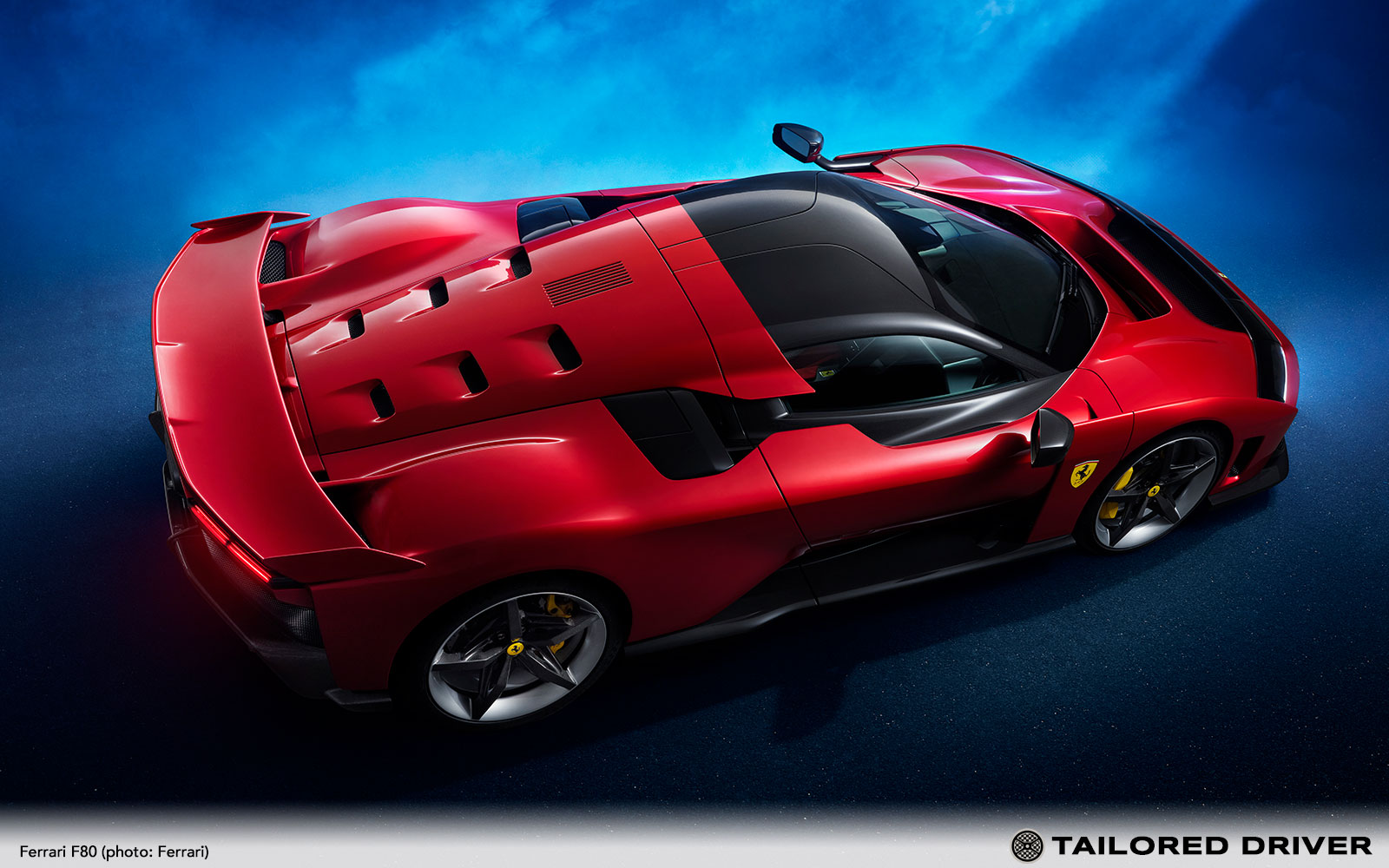
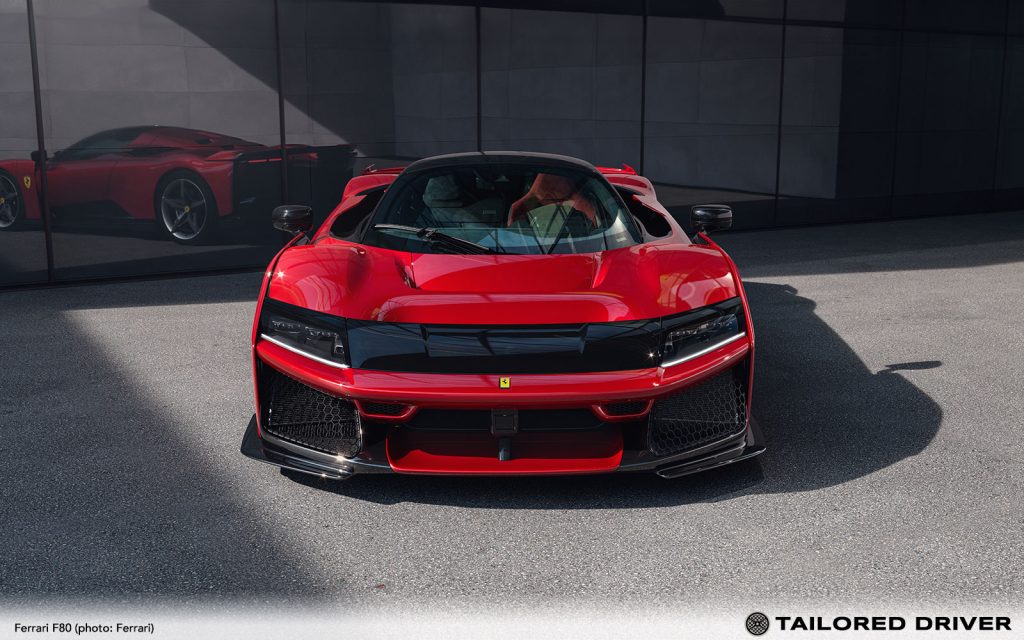
    Maranello, 17 October 2024 – Ferrari today unveiled the F80 and wrote a new chapter in the history of legendary supercars bearing the Prancing Horse badge. The F80 will be produced in a limited run of just 799 examples and joins the pantheon of icons such as the GTO, F40 and LaFerrari by showcasing the best that the Maranello-based marque has achieved in terms of technology and performance.

    Ever since 1984, Ferrari has periodically released a new supercar that represented the pinnacle of cutting-edge technology and innovation of its era and that was destined to become enshrined in popular culture. Intended for the most discerning clients of the brand, these cars immediately became legends in their own lifetime, making an indelible mark not only on the history of Ferrari, but on the history of the automobile itself.

    The latest addition to this family, the F80, is tasked with embodying the ultimate in engineering for an internal-combustion-engined vehicle and employs all the most advanced technological solutions, including latest-generation hybrid technology for the powertrain, to achieve unparalleled levels of power and torque. Every aspect of the architecture is conceived to maximise performance, from the carbon-fibre chassis and extreme aerodynamic solutions far beyond anything seen before in a road-legal car, to the new active suspension optimised to let the driver wring every ounce of performance from the car on the track.

    Unlike anything else in the current supercar world, the F80 combines all these attributes with uncompromising levels of usability on the road, where it can be driven with ease. This ability shaped every choice made in terms of technology and architecture to achieve the goal, which at first sight seems impossible, of creating a track-oriented supercar that’s just as driveable as a production range model.

    All this means that the driver will spend even more time in the car and can truly get to know and revel in its performance and the thrilling driving experience it offers. The architecture of the F80 is so extreme that the layout chosen results in a narrower cabin with a driver-centric layout, which nonetheless still offers excellent space and comfort for a passenger. This choice had crucial benefits in terms of minimising drag and weight.

    The cockpit area therefore has a distinct single-seater feel, despite the fact that the car is homologated for two occupants, resulting in a architecture that we could call “1+”. The primary reason for this choice was to minimise width, to the benefit of aerodynamics (with less drag) and weight saving. This concept is completely in keeping with the motorsport world from which this car not only draws inspiration but also inherits technological solutions.

    As has always been the case with the Ferrari supercars preceding the F80, the powertrain is based on the finest expression of technology in motorsport. The GTO and F40 were powered by a turbo V8, because Formula 1 cars used turbocharged engines in the 1980s. Today in both Formula 1 and the World Endurance Championship (WEC), powertrains consist of turbo V6 ICE engines mated with an 800 V hybrid system. It was only natural then that this architecture – the same architecture used by the 499P, which has taken two consecutive victories at the 24 Hours of Le Mans – would be transferred into the new F80.

    Here though the powertrain is further complemented by the introduction, for the first time ever on a Ferrari, of electric turbo technology (e-turbo), which, with an electric motor installed between the turbine and compressor of each turbo, allows for an extraordinary specific power output and instantaneous response from low down in the rev range.

    Aerodynamics play a key role on the F80, with solutions such as the active rear wing, rear diffuser, flat underbody, front triplane wing and S-Duct working in concert to generate 1000 kg of downforce at 250 km/h. This result is further enhanced thanks to the active suspension, which contributes directly to generating ground effect. Performance is boosted by the electric front axle, which brings four-wheel drive capability to make even more effective use of the torque and power on tap, and the new brakes with motorsports-derived CCM-R Plus technology.

    As with all the supercars preceding it, the F80 marks the start of a new design era for Ferrari, with a more tense, extreme design language accentuating its race-bred soul. There are clear references to cues borrowed from aerospace, which underscore the cutting-edge technology and elegant engineering of each and every technical solution. But there are also nods to its hallowed progenitors which clearly declare the illustrious lineage of the F80.

    POWERTRAIN

    INTERNAL COMBUSTION ENGINE

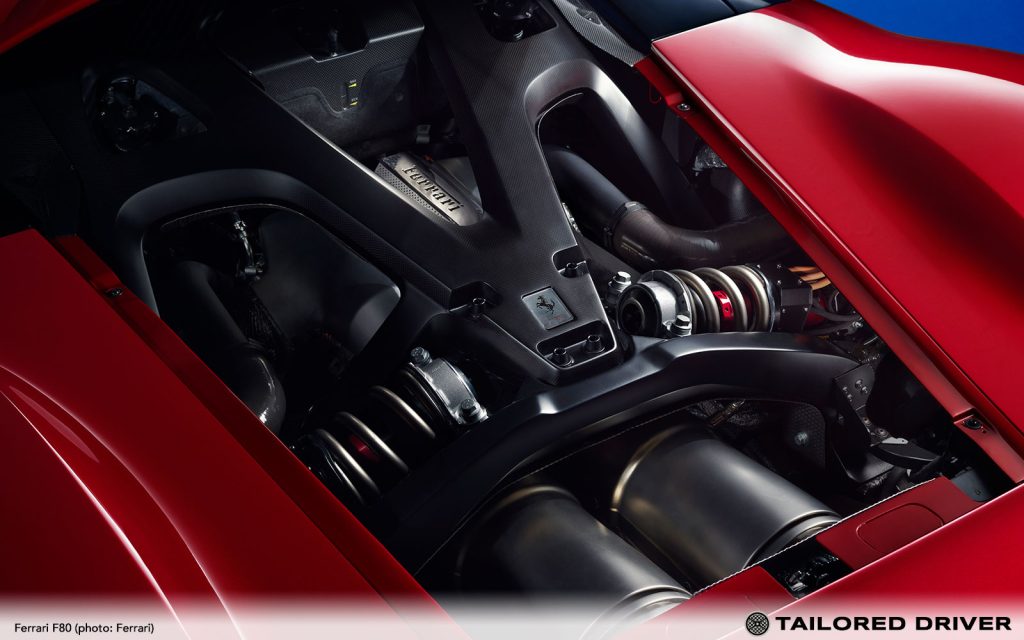
    The three-litre 120° V6 F163CF of the F80 is the ultimate expression of the Ferrari six cylinder engine: this unit produces an astonishing peak power of 900 hp, making it the Ferrari engine with the highest specific power of all time (300 cv/l), to which the electric front axle (e-4WD) and rear motor (MGU-K) of the hybrid system add another 300 cv.

    The link with motorsports, and endurance racing in particular, is strong: the architecture of this engine and many of its components are closely derived from the powerplant of the 499P which won the last two editions of the 24 Hours of Le Mans. Commonalities with the car competing in the World Endurance Championship (WEC) include the architecture, crankcase, layout and drive chains of the timing system, oil pump recovery circuit, bearings, injectors and GDI pumps.

    Naturally, there is also technology carried over from Formula 1, from which the F80 inherits both the concept of the MGU-K (with the development of an industrially manufacturable electric motor similar to the unit used in Ferrari F1 cars) and the MGU-Hs (which generate power from the excess kinetic energy from the rotation of the turbines created by the heat energy from the exhaust gases) with a bespoke e-turbo application.

    For maximum performance in all possible conditions, every aspect of the calibration of the engine has been taken to the extreme, focusing in particular on the ignition and injection timing, the number of injection events per stroke and the management of the variable-phase valve timing. The F80 is equipped with the first Ferrari road car engine to benefit from a new approach for statistical knock control, which lets the engine operate even closer to the knock limit, allowing the use of higher combustion chamber pressures than ever (+20% compared with the 296 GTB) to unleash even more of the engine’s potential.

    Another crucial aspect has been the work dedicated to the dynamic calibration of the torque curve in every gear, an all-time first for a Ferrari road car. This part of the project focused on real road-driving conditions and the management of the e-turbo system, because knock and compressor surge limits vary depending on whether they are measured in dynamic or stationary conditions. As a result of this research, a dedicated calibration was developed for each gear, allowing the engine to attain levels of responsiveness comparable to a naturally-aspirated engine in all operating conditions.

    The e-turbos, with an electric motor installed axially between the turbine and the compressor housing, let the engineers optimise the fluid dynamics of the engine for maximum power at mid to high engine speeds without the usual compromise this entails in terms of turbo lag at low engine speeds. Bringing electric power into the equation makes it possible to define e-turbo management strategies which negate turbo lag and ensure lightning-quick response times.

    The 350 bar injectors of the GDI system are situated at the centre of the combustion chamber for optimal fuel/air mixing and, together with the multiple injection strategies adopted, ensure efficiency for outstanding performance with lower emissions. The intake and exhaust cam profiles have been revised to optimise fluid dynamic efficiency and increase maximum engine speed to 9000 rpm, with a dynamic limiter at 9200 rpm.

    Both the intake and exhaust runners are polished for better performance; the intake runners have been shortened to reduce resistance and cool the air/fuel mixture through fluid dynamic detuning, and are specifically designed to increase turbulence in the combustion chamber. The three-brick (matrices) exhaust line complies with current emissions standards (Euro 6E-bis), but already takes future evolutions in emissions regulations on a global level into account.

    The Inconel© exhaust manifolds are designed to minimise pressure losses and are tuned to emphasise the distinctive sound of a Ferrari V6. The steel crankshaft is machined from a die-cast element and features hot-forged crankpins with an offset angle of 120°. The 1-6-3-4-2-5 firing order lends the F80 a typical Ferrari timbre. To reduce weight, the crankshaft webs and counterweights have been lightened.

    The connecting rods and pistons have also been revised: the titanium connecting rods feature a toothed interface at the mating surface between the shank and the big end cap to ensure perfect alignment between the two parts and absolute assembly precision with the bearings. The aluminium pistons have been optimised to reduce weight and withstand the higher pressure and thermal loads in the combustion chamber due to the incredibly high torque and power. Specifically, high strength DLC (diamond-like carbon) coated steel has been used for the piston pin. Additionally, a dedicated oil passage hole has been added to the zone between the piston pin and the connecting rod to improve lubrication.

    To lower the centre of gravity of the car, the engine has been installed as close as physically possible to the flat undertray. As a result, none of the components situated at the bottom of the sump are more than 100 mm below the centreline of the crankshaft. It was also decided to tilt the engine-transmission unit by 1.3° in the Z axis, raising the gearbox so that it does not compromise the efficacy of the aerodynamic undertray.

    To lighten the engine, the cylinder block, crankcase, timing cover and other components have been revised, while titanium screws have also been adopted. As a result of these measures, the engine weighs no more than the V6 of the 296 GTB despite a power increase of 237 hp.

    The lowered installation position of the engine-transmission unit was permitted by the new smaller diameter flywheel, conceived and designed from scratch for this application. This innovative solution was made possible by the use of two sets of springs, which also contributed to reducing the overall stiffness of the system and filtering vibrations transferred to the transmission more effectively. The damper was also developed specifically for this application to attenuate the higher torsional vibration forces in the driveline and dissipate the higher thermal loads due to the increased performance.
    HYBRID POWERTRAIN

    The electric motors used for the F80 are the first units developed, tested and manufactured entirely by Ferrari at Maranello, all with the specific goal of maximising performance and reducing weight. Their design (with two on the front axle and one at the rear of the car) draws directly from Ferrari’s experience in racing; specifically, the stator and rotor in a Halbach array configuration (which uses a special layout of the magnets to maximise magnetic field strength) and magnet sleeve in carbon fibre are all solutions derived from the design of the MGU-K unit used in Formula 1.

    The rotor adopts Halbach array technology to maximise magnetic flux density and minimise weight and inertia. The carbon fibre magnet sleeve, on the other hand, has been used to raise maximum motor speed to 30,000 rpm. The concentrated winding stator reduces the weight of copper used for the end windings, while the Litz wire minimises high-frequency losses. The Litz consists of multiple insulated strands instead of a single wire, reducing the ‘skin effect’ and allowing the current to flow uniformly through the entire cross section of the wire to minimise losses. The resin coating for all the active parts of the stator improves heat dissipation.

    A DC/DC converter transforms DC current at one voltage to DC current at a different voltage. This innovative technology makes it possible to use a single component to handle three different voltages simultaneously: 800 V, 48 V and 12 V.

    Using the direct current produced by the high-voltage battery at 800 V, the Ferrari converter generates direct current at 48 V to power the active suspension and e-turbo systems, and 12 V direct current to power the electronic control units and all other electric ancillaries on the vehicle. Innovative resonant technology allows this component to convert current with no latency with a conversion efficiency in excess of 98%, so that it behaves to all intents and purposes as an accumulator. This component eliminated the need for a 48 V battery, saving weight and simplifying the layout of the electrical system. 

    Also developed and manufactured entirely in-house by Ferrari, the front axle includes two electric motors, an inverter and an integrated cooling system. This component makes it possible to use torque vectoring for the front axle. Integrating different functions in a single component and the new mechanical layout have offered a weight saving of around 14 kg over previous applications, and the entire component weighs just 61.5 kg. Optimising mechanical efficiency was a primary goal: low viscosity oil (Shell E6+) and a dry sump active lubrication system with an oil tank integrated directly into the axle reduced mechanical power losses by 20%. The use of high coverage ratio (HCR) gears contributed to reducing noise emissions by 10 dB.

    The direct current received from the high-voltage battery is transformed into the alternating current necessary to power the electric motor by the inverter. The inverter integrated in the front axle is bidirectional, meaning that it also transforms alternating current produced by the axle under regenerative braking into direct current for recharging the battery. The inverter used to convert power and control the two front motors is capable of delivering a total of 210 kW of power to the axle. On the F80, the inverter is integrated directly into the axle and weighs just 9 kg, contributing to the lower mass of this component compared to its counterpart on the SF90 Stradale.

    Another inverter is used for the rear electric motor (MGU-K). This performs three functions: starting the internal combustion engine, recovering energy to recharge the high voltage battery and supplementing the torque of the engine in certain dynamic conditions. It can generate up to 70 kW in regeneration mode and assist the internal combustion engine with up to 60 kW of power. Integrated into both of these inverters is the Ferrari Power Pack (FPP) system, a power module with all the elements necessary for power conversion combined in the most compact unit possible. This unit consists of six modules in silicon carbide (SiC), gate driver boards and a dedicated cooling system.

    The core of the energy accumulation system – the high-voltage battery – is conceived for very high power density. The innovative design of the battery is based on three principles: lithium-cell chemistry derived from Formula 1, an extensive use of carbon fibre for the construction of the monocoque casing, and a patented design and assembly method (cell-to-pack) which minimises the weight and volume of the unit. Situated low down in the engine bay, the pack contributes to even better dynamic vehicle behaviour by lowering the car’s centre of gravity. All electrical and hydraulic circuit connectors are built into the component to reduce cable and hose length, while the pack is configured with 204 cells connected in series and subdivided equally into 3 modules, for a total energy capacity of 2.3 kWh and a maximum power output of 242 kW.

    Last but not least, to improve integration between the electric and electronic internal components, Ferrari developed the CSC (Cell Sensing Circuit) wireless sensor suite, which monitors cell voltage with spring contacts and measures cell temperatures with infrared sensors.
    AERODYNAMICS

    The F80 pushes aerodynamic performance to levels never seen before on a Ferrari road car, as testified by the 1000 kg of downforce produced at 250 km/h. This astonishing achievement was made possible by perfect symbiosis between all the internal Ferrari departments working on the definition of the car’s architecture; for each department, the perfect balance between downforce and top speed was the basis for every design choice, giving shape to a suite of extreme solutions befitting a true supercar.

    The front end of the F80, which develops 460 kg of total downforce at 250 km/h, was inspired by the aerodynamic concepts employed in Formula 1 and the World Endurance Championship (WEC), innovatively reinterpreted for this application to become cornerstones of the entire design. On the one hand, the recumbent racing driving position allowed for a chassis with a high centre keel, while on the other, the cooling system layout has freed up the entire central portion of the vehicle, maximising the space usable for other functions.

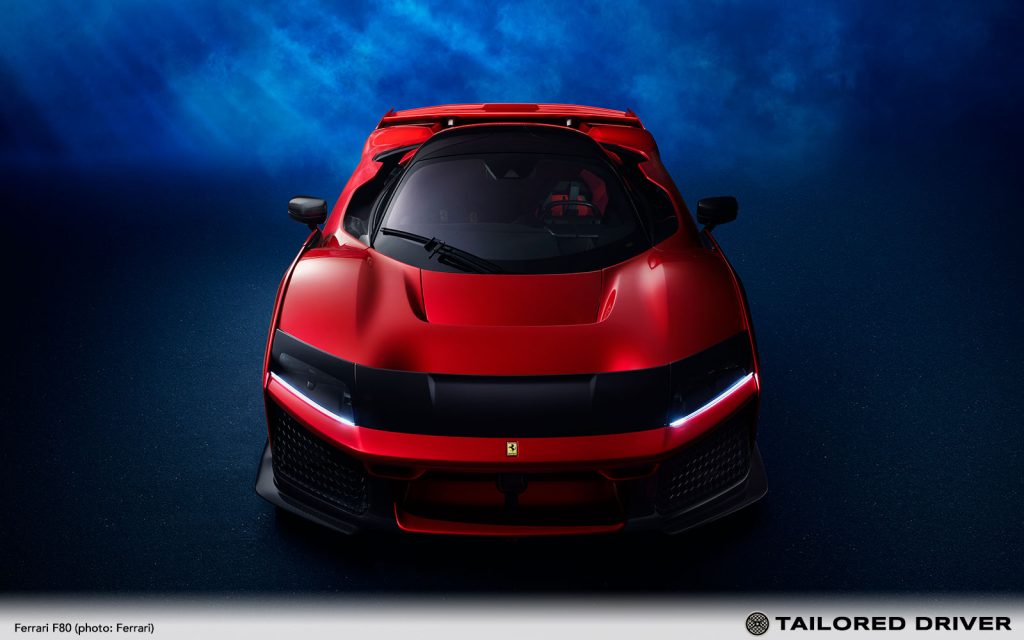
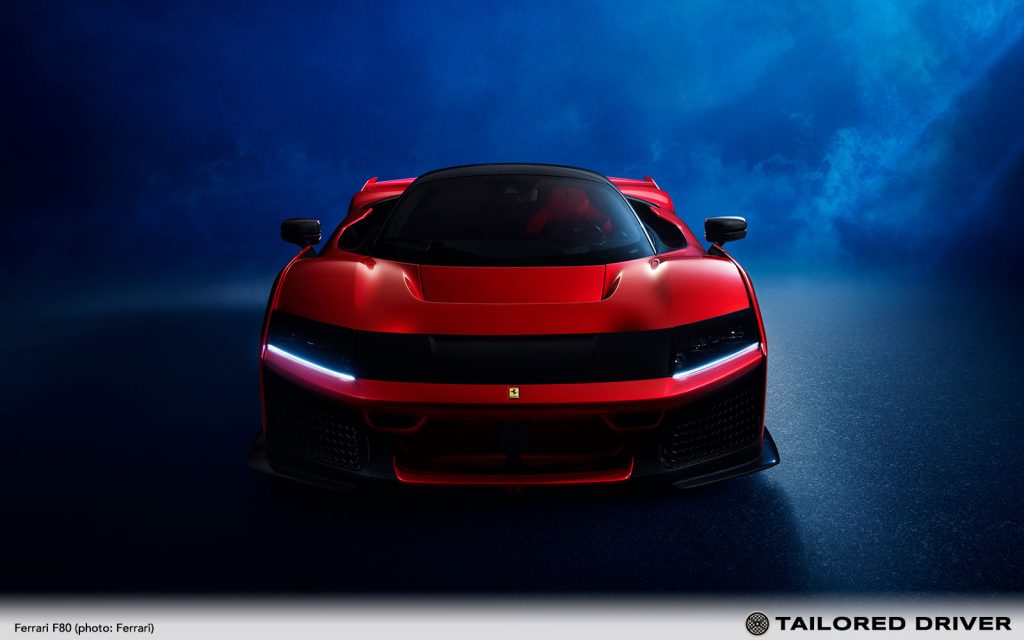
    The body-coloured central volume of the nose acts as the generously-sized main plane of the front wing. Inside the S-Duct are two flaps following the main profile to complete the triplane wing configuration with curvatures and blower slots clearly inspired by the 499P. Crucial for the aerodynamic efficacy of the front of the vehicle is the way the triplane works in perfect concert with the S-Duct and the high central keel, minimising blockage of the air flow towards the wing and maximising performance.

    As a result, the air flow from the underbody and bumper undergoes violent vertical expansion and is redirected within the duct towards the front bonnet, generating a potent upwash which translates into a powerful low-pressure zone under the underbody. This accounts for 150 of the 460 kg of the maximum downforce generated at the front of the car which, however, is very sensitive to changes in ground clearance. The aerodynamic balance of the car is therefore ensured by the active suspension, which controls the attitude of the vehicle in real time and adjusts the distance between the underbody and the road in response to driving conditions.

    The volume freed up under the feet of the driver also made room for three pairs of bargeboards. These devices generate powerful, concentrated vortices which introduce a velocity component to the airflow field in the outwash direction. In addition to improving the underbody’s suction, the outwash also reduces blockage and improves the performance of the front triplane. The bargeboards also help mitigate the detrimental effects of the wake of the front wheel by confining it and keeping it away from the undertbody, preventing contamination of the air flow directed to the rear of the car.

    The aerodynamic performance of the rear zone of the car, which generates the remaining 590 kg of downforce at 250 km/h, is a result of the combined action of the rear wing-diffuser system. The efficiency of this system is highly dependent on the quantity of downforce produced by the underbody, as this has very little impact on drag.

    To take the performance of the diffuser of the F80 to extreme levels, the expansion volume of the diffuser itself has been maximised by inclining the engine-gearbox unit by 1.3° in the Z axis, and by the configuration of the rear chassis and suspension components. The starting point of the upward curvature of the diffuser has been brought forward, resulting in a diffuser measuring a record-breaking 1800 mm in length, which generates a huge low-pressure zone underneath the vehicle, which in turn draws a massive flow of air into the underbody area.

    The geometry of the chassis, with narrow, curved sills, contributes to creating an aerodynamic seal effect around the underbody by forming a duct that captures the flow adhering to the flank and blows air into the interior of the rear wheelarch housing under the lower suspension arm. The interaction between this air flow and the outer strake of the diffuser interferes with the vortices generated in the wheel-road contact zone, preventing air from entering the diffuser too far forwards. These solutions work in such perfect harmony that the downforce generated by the diffuser alone is 285 kg, or more than 50% of the total downforce on the rear axle.

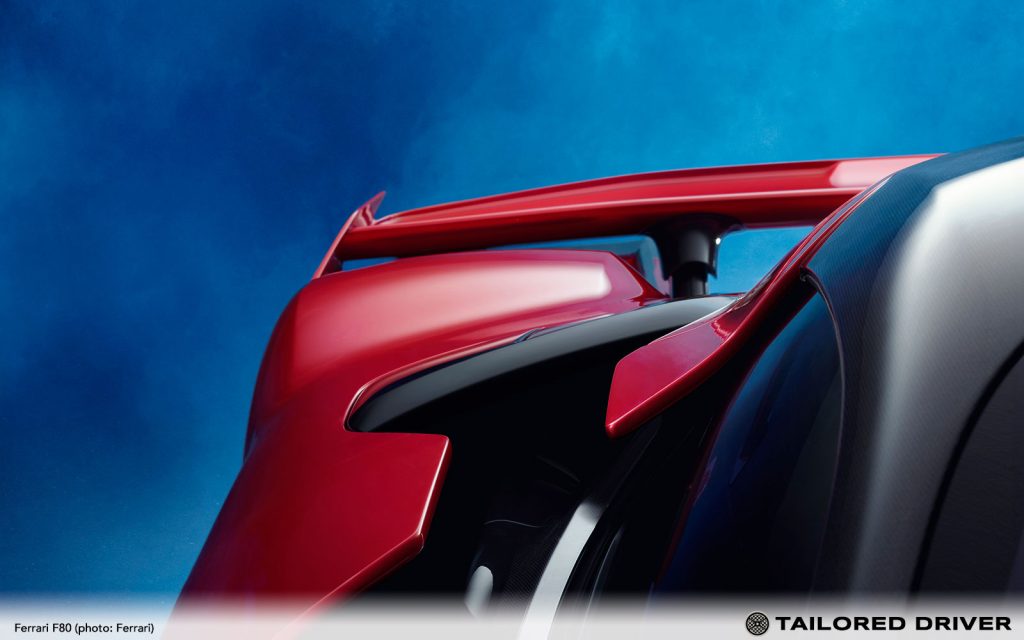
    The active wing is the most visually distinctive aero feature of the F80, which completes the entire aerodynamic concept of the vehicle. The actuator system of the rear wing adjusts not only its height but also controls angle of attack continuously and dynamically, for precisely modulable downforce and drag. In the High Downforce (HD) configuration, which is used during braking, turn-in and cornering, the wing assumes an angle of 11° relative to the direction of the air flow to generate over 180 kg of downforce at 250 km/h.

    At the extreme opposite of its range of rotation, the wing is in Low Drag (LD) configuration, with the leading edge pitched upwards. Drag is much lower in this configuration, not only because of the reduction in lift, but also due to the tractive effect generated by the residual low-pressure zone impinging on the underside of the wing itself.

    The rear wing is the keystone of the entire adaptive aero system, allowing the F80 to adapt to any possible dynamic conditions, which are monitored and evaluated in real time by the vehicle control systems. In response to the requests of the driver in terms of acceleration, speed and steering angle, the system determines the optimal blend of downforce, aerodynamic balance and drag, and tells the active suspension and active aero systems to implement the ideal attitude accordingly. In the case of the aero system, this means controlling the angle of attack of the rear wing and the activation state of the Active Reverse Gurney flap under the front triplane.

    With its two different configurations, the flap also allows control over downforce and drag at the front of the car: the closed position generates maximum downforce, while in the open position the device is at right angles to the air flow and, similarly to how DRS systems work in Formula 1, stalls the underbody to reduce drag and let the car reach a higher top speed.
    HEAT MANAGEMENT

    Defining the layout of the cooling system demanded in-depth studies and painstaking development to reconcile the thermal needs of the engine (which has to dissipate over 200 kW of thermal power during performance usage) and the new hybrid system with aerodynamic requisites. The aim was to design a cooling system with the least possible impact on the overall packaging, to attain a functionally and aerodynamically valid configuration that perfectly accommodates both the aerodynamic and thermal demands of the F80.

    The radiators are positioned optimally to maximise the flow of cold air and minimise interference with the hot air flow, for better thermal exchange efficiency. A number of other innovative solutions were also adopted to improve the overall thermal balance of the car, such as the transparent film embedded in the windscreen which uses power from the 48V circuit to demist the screen and reduce the power demand on the HVAC system. Additionally, the climate control circuit is controlled by electrically actuated valves which modulate the flow of refrigerant in relation to the needs of the HVB circuit, improving energy management.

    At the front are two condensers serving the climate control, battery and active suspension circuit, plus three high temperature radiators for cooling the V6. Two of these are situated laterally, in outboard positions, to make the most effective use possible of the space between the underfloor and the headlights, while the third is situated at the centre and takes advantage of the upwash generated by the triplane to ensure adequate air flow.

    The venting of the hot air flows has been optimised to not interfere with the front aerodynamics and the flows of cooling air directed towards the rear. The main vent of the lateral radiators opens inside the wheelarch housing, a solution offering the least possible blockage to ensure excellent permeability for the radiating masses. Another aperture in the flank of the front wing ahead of the wheel contributes to containing the wheel wake while also directing hot air around the exterior of the wheel. The centre radiator vents heat into the zone between the bumper and the front bonnet without interfering with the flow exiting the S-Duct.

    A number of different functions are integrated into the flank of the F80 in a single formal solution described by the upper volume of the door, where the surface drops away gradually to give shape to a channel incorporated in the bodywork itself. The shape of this channel protects the air flow along the wing from thermal contamination by the hot wake of the front wheel and guides it along the surface of the door to the inlet at the leading edge of the flank. This air intake is topped by a winglet that reinterprets the distinctive form of NACA aeronautical inlets: a solution that exploits the vorticity of the air to capture part of the air stream flowing in the region above the duct. Inside the duct, the incoming air is split into two flows, with one feeding the induction system of the engine, which benefits from up to 5 hp of extra power as a result of ram effect, and the other feeding the intercooler, which cools the intake air, and the rear brakes.

    Here too, the engineers opted for innovative solutions to keep the braking system – developed around state-of-the-art CCM-R Plus discs – working in optimal thermal conditions. These include a front duct that uses the hollow inner cavities of the front impact-absorbing chassis longerons to channel the high-energy cold air flow from the bumper to the discs, pads and callipers, which are the most sensitive elements of the system. For the first time ever, this solution, patented by Ferrari, turns what was a packaging constraint into a means to maximise cooling performance, and offers a 20% increase in cooling air flow compared the LaFerrari with no penalty in terms of front aerodynamics. 
    VEHICLE DYNAMICS

    The F80 is equipped with the most advanced suite of technological solutions currently available for managing vehicle dynamics in all possible conditions on the road or track. The Ferrari active suspension system is undoubtedly one of the showpieces of these and has been re-engineered from the ground up compared with the version used on the Ferrari Purosangue to tailor it to the F80’s supercar soul.

    The system features completely independent suspension all round actuated by four 48V electric motors, a double wishbone layout, active inboard dampers and upper wishbones created with 3D printing and additive manufacturing technology, which is used here for the first time on a Ferrari road car. This solution offers a number of advantages, such as an optimised layout, more precise wheel control, reduced unsprung mass, no requirement for an anti-roll bar and the introduction of a dedicated camber angle correction function.

    This system fulfils two apparently irreconcilable requirements – the need for a very flat ride on the track, where variations in ride height must be minimised as much as possible, and the need for the compliance to effectively soak up bumps in road surfaces during normal driving. This means that the car boasts outstanding driveability on the road and can also manage downforce optimally in all possible conditions.

    At low speeds, the system prioritises mechanical balance and centre of gravity control, while with increasing speed, the ride height control system works to optimise aerodynamic balance in each different cornering state in concert with the active aero system. When under hard braking, such as when entering a bend, ride height control minimises variations to prevent instability caused by the weight transfer towards the front that would usually occur in this scenario. While cornering, the system contributes to increasing downforce to maintain the optimal balance. As the car exits the bend, the system contrasts the tendency for the balance to shift towards the rear, maintaining the best possible conditions for traction for all four wheels and stability.

    Another major evolution introduced by the F80 is the new SSC 9.0 (Side Slip Control) system, which now benefits from the integrated FIVE (Ferrari Integrated Vehicle Estimator) function. The new estimator is based on the concept of the digital twin, a mathematical model that uses the parameters acquired by sensors installed on the car to replicate its behaviour virtually.

    As well as estimating yaw angle in real time, which was already possible with the previous generation, the new system also estimates the velocity of the centre of mass of the car, calculating each with a precision of under 1° and 1 km/h respectively. The new estimator improves the performance of all the dynamic control systems on board the vehicle, including traction control, for example.

    Featuring the eManettino like all PHEV Ferrari models, the hybrid powertrain of the F80 offers three different driving modes: ‘Hybrid’, ‘Performance’ and ‘Qualify’. There is no eDrive mode, which is available on the SF90 Stradale and 296 GTB, because the F80 cannot be driven in full-electric mode, considered not be in keeping with the car’s mission.

    ‘Hybrid’ mode is selected by default when the vehicle is switched on and enables all the functions intended to make the vehicle more efficient and useable in all real-world conditions. This mode prioritises energy recovery and battery charge maintenance to prolong the ability of the MGU-K motor to deliver boost when needed. ‘Performance’ mode is geared towards delivering continuous levels of performance during extended stints on the track, optimising energy flows towards the battery to always keep a battery state of charge of around 70%. The most extreme performance mode, ‘Qualify’, lets the driver unleash all the power that the F80 has at its disposal, using electronic torque shaping during upshifts at the rev limiter to use the torque curves of the electric motor and ICE engine in the best combination possible for maximum performance.

    ‘Performance’ and ‘Qualify’ eManettino modes also offer the driver access to an all-new function marking a first not only for Ferrari but for the automotive industry as a whole: Boost Optimization, a technology that records the track where the vehicle is driving and delivers an extra power boost in the sections of the circuit where it is most needed. After selecting this function, the driver first drives around the track in a reconnaissance lap, during which the system identifies the curves and straights of the circuit, acquiring the data it needs to optimise power delivery. Once this lap is complete, the vehicle is ready to deliver the extra power needed automatically with no further action from the driver. How Boost Optimization is implemented depends on whether it is used in ‘Performance’ mode – where it maintains constantly available performance for as long as possible – or ‘Qualify’ mode, where it maximises the boost zones, even at the cost of a drop in high-voltage battery charge.

    The braking system of the F80 introduces another important innovation: CCM-R Plus technology, developed in collaboration with Brembo. The adoption of materials and technologies derived directly from Ferrari’s experience in motorsports has given shape to a product with distinctly superior performance to any other road-going carbon ceramic system.

    CCM-R Plus uses longer carbon fibres to significantly improve mechanical strength (+100%) and thermal conductivity (+300%) over the previous-generation solution. The braking surfaces are coated with layer of silicon carbide (SiC), which offers incredible wear resistance while also reducing bedding-in times. These discs work in conjunction with brake pads with a specific new compound that ensures an extraordinarily constant coefficient of friction even during prolonged extreme usage on the circuit. The larger heat exchange area of the two rows of ventilation channels of the disc and their geometry, derived from F1 applications and optimised with advanced computational fluid dynamic (CFD) methods, ensure superior cooling.

    Two tyre choices, with Pilot Sport Cup2 and Pilot Sport Cup2R variants, both offered in the sizes 285/30 R20 and 345/30 R21 (front/rear), were co-developed with Michelin for the F80. Pilot Sport Cup2 tyres feature a casing and tread designed specifically to offer a thrilling driving experience and maximise the usability of the car, while the Pilot Sport Cup2R uses specific compounds derived from motorsports applications to allow the car to reach previously unimaginable levels of performance on the track for a Ferrari road car in terms of both maximum grip and consistency over time.

    And to maximise day to day usability, even when not driven at the limit, the F80 is equipped as standard with all the main ADAS driver assist functions currently available: Adaptive Cruise Control with Stop&Go function; Automatic Emergency Brake; Lane Departure Warning; Lane Keeping Assist; Automatic High Beam; Traffic Sign Recognition; and Driver Drowsiness and Attention Warning.
    CHASSIS AND BODYSHELL

    CHASSIS

    The tub and other elements of the chassis of the F80 were developed using a multi-material approach, where the best suited material for the task is used for each individual zone. The cell and roof are made of carbon fibre and other composites, while the front and rear subframes are made of aluminium and are fastened to the tub with titanium screws. At the rear there is an additional aluminium subframe, fastened to the main rear subframe with screws, for carrying the battery.

    The subframes are made up of closed-end extrusions connected to each other by cast elements. The tub features hollow sills in carbon fibre serving as the main load-bearing elements. The roof is made of carbon fibre, fabricated and then cured in a single session in the autoclave. Both areas use dual tubular bladders, an innovative production method derived from Formula 1. The tub and roof both use internal carbon-fibre and Rohacell/Nomex sandwich panels as load-bearing structures.

    As on the LaFerrari, the sills act as side impact absorbers. The asymmetric layout of the cabin allowed each side of the tub to be optimised separately: the driver side has an adjustable seat, with a generous range of positions ensuring driving comfort and safety in the event of a side-on impact. This necessitated a larger number of structural panels in the floor and longer impact absorbers on the driver side than the passenger side, where a fixed seat is used to save weight while still ensuring uncompromised safety for both occupants.

    The front aluminium impact-absorbing longerons also contribute to heat management, as their hollow interiors are used as cooling air ducts for the brake system. Ferrari co-developed a new casting solution that has reduced the minimum wall thickness limit previously applicable for these castings (2.0 mm) by 23%. Together, these solutions have brought a weight saving of 5% while increasing torsional and beam stiffness by 50% with respect to the LaFerrari. NVH has also been significantly improved to offer the most comfortable driving experience possible.
    BODYSHELL

    The bodyshell of the F80 is completely new and is fabricated from pre-preg carbon fibre and cured in the autoclave using technology derived from Formula 1 and other motorsports. The front bonnet features an S-Duct consisting of a fixed element connecting the two front wings.

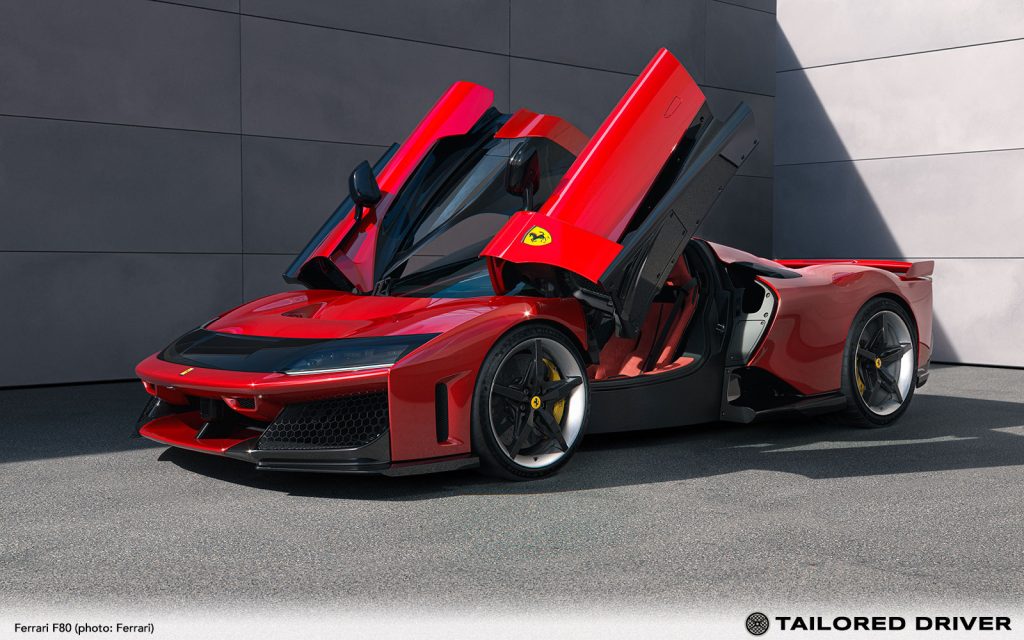
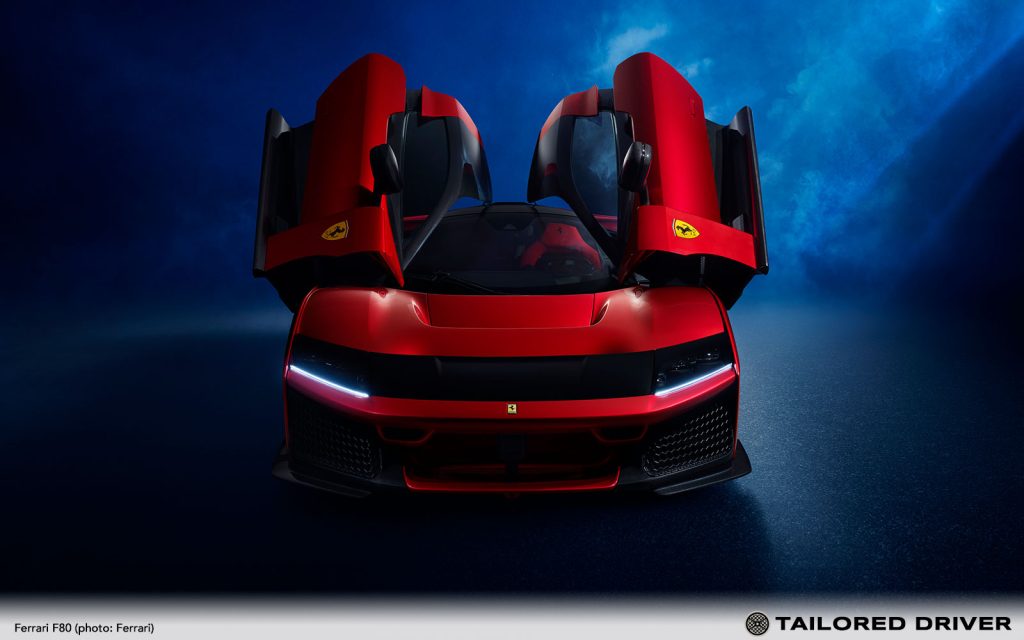
    Butterfly doors are used, as on the LaFerrari, with a dual axis of rotation hinge mechanism allowing them to open vertically to an angle of almost 90°. The substructure of the doors, a structural element also tasked with absorbing dynamic loads in the event of lateral impact, is constructed from special high-performance carbon fibre.

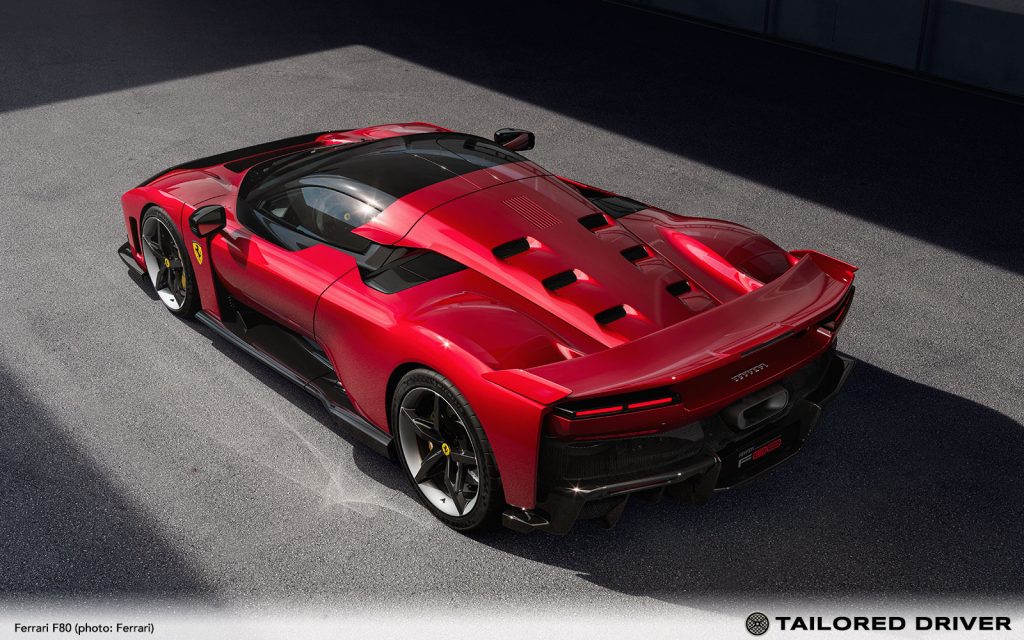
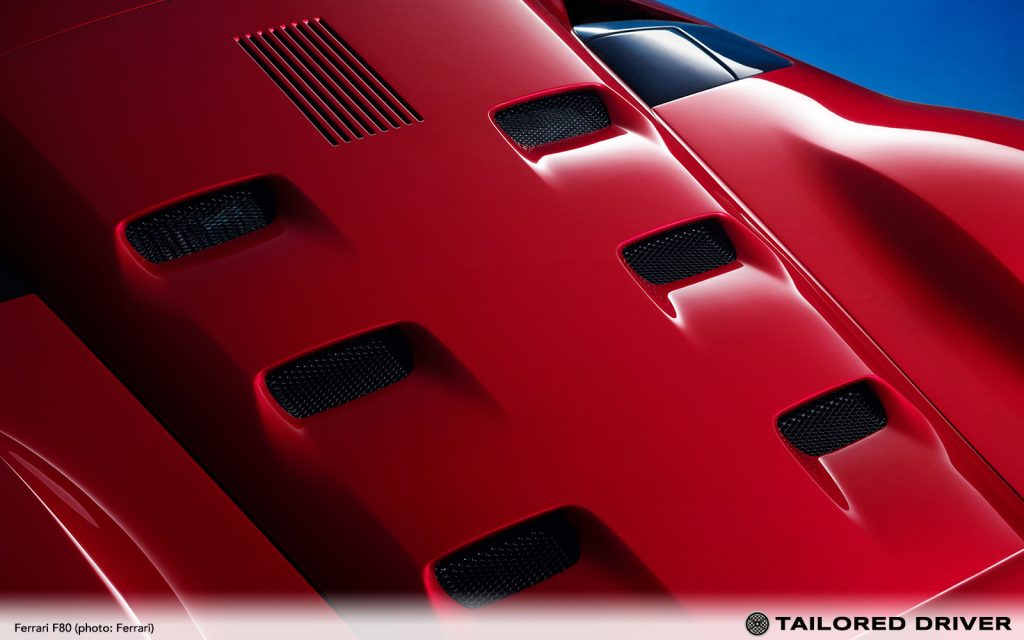
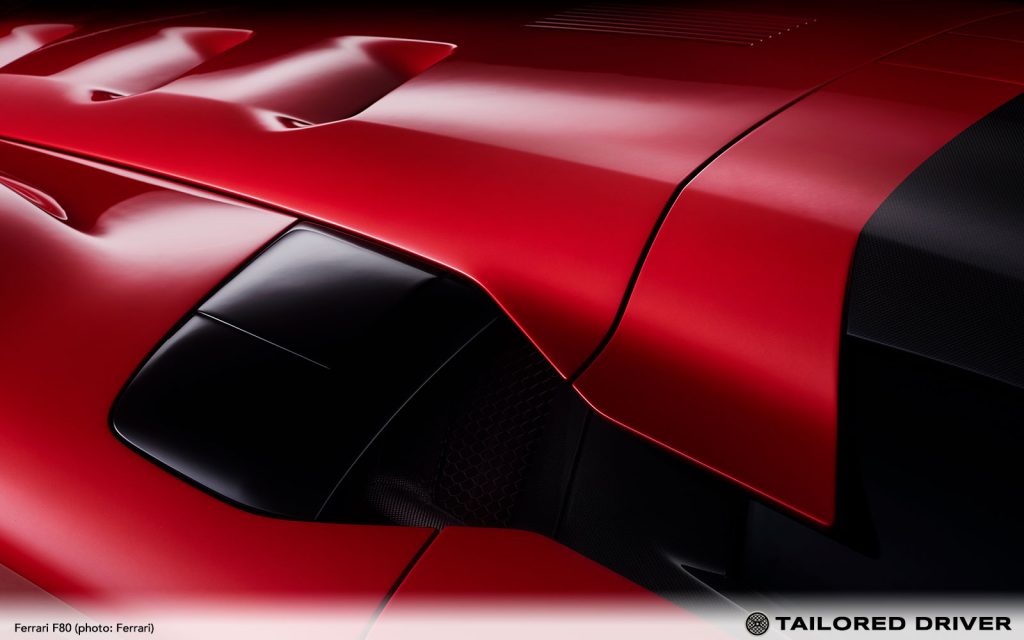
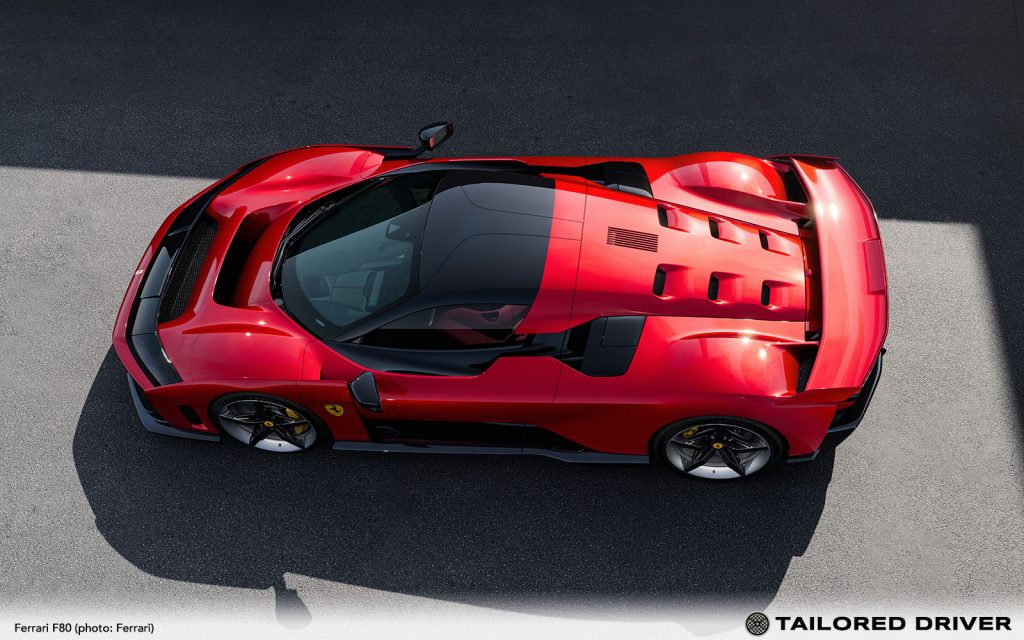
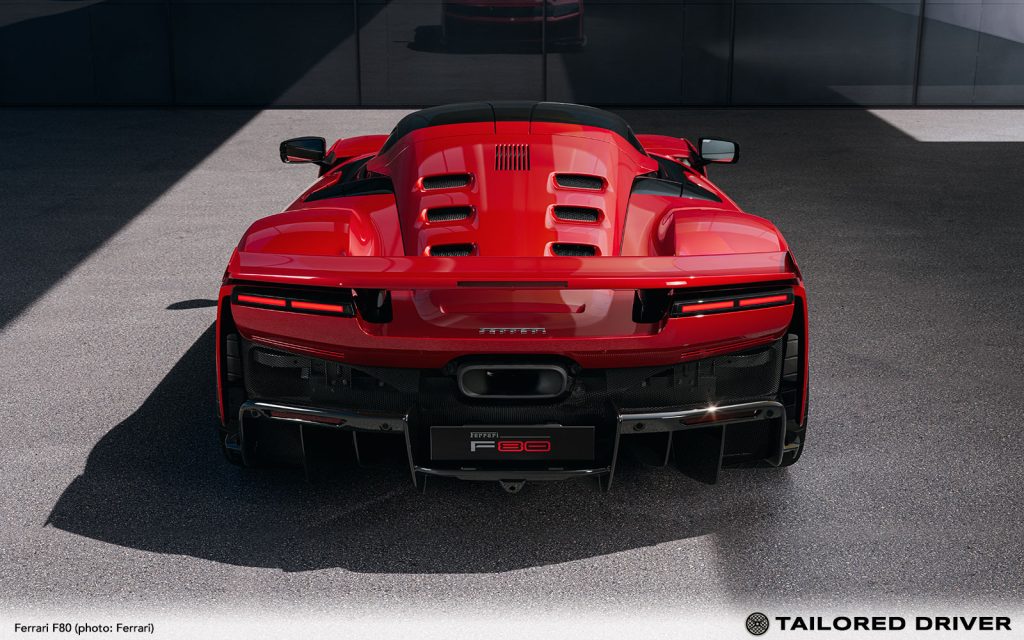
    The rear engine cover, which echoes the styling cues of the door from the side view, includes six slots venting hot air from the V6 engine and a grille which also vents air.

    DESIGN

    EXTERIOR

    The F80 is the product of a creative design study that has led the team of the Ferrari Styling Centre headed by Flavio Manzoni to make a radical change in the visual language of the marque, forging a link between the past and future of Ferrari design. With the intent of assimilating a host of different elements of the design language and DNA of the brand, this study first turned its attention to the aesthetics of the marque’s F1 racing cars to identify the direction for creating a car with a modern and innovative visual identity that can accommodate a driver and a passenger despite offering the uncompromised experience of a single-seater.

    With this logic as the foundation, the design of the F80 was then developed with technological input, lending the car its boldly high-tech character. The ambitious performance goals necessitated a holistic approach to the project; as a result, the formal design project for the F80 progressed from start to definitive completion with the Styling Centre working in constant synergy with the engineering, aerodynamics and ergonomics departments. From the very first sketches and the more abstract initial studies in form, the project evolved in a process of natural convergence to strike a perfect balance between form and volume that visually expresses the uncompromised performance of the car to perfection.

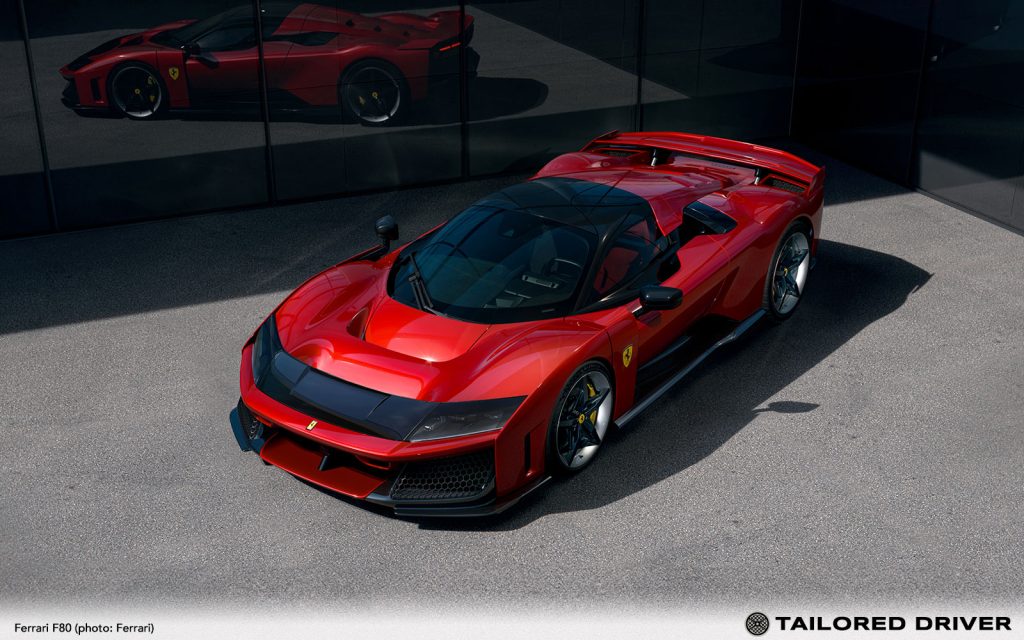
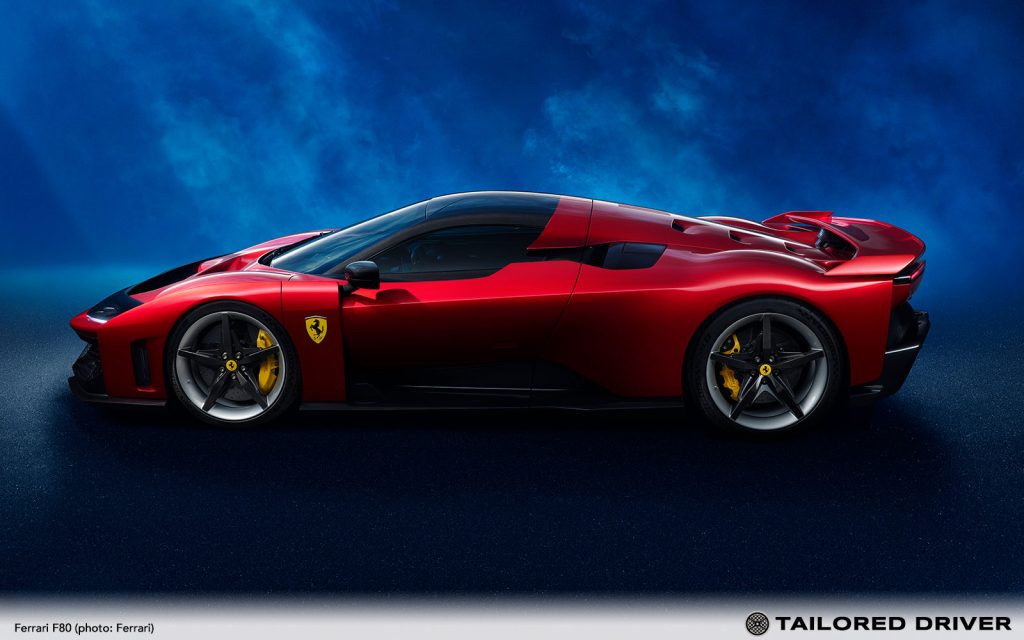
    The F80 has a strongly futuristic visual impact with unmistakeable references to aerospace. The architecture is defined by a dihedral cross section with its two bottom corners firmly planted on the wheels. From the side view, the rear section has a sculpted flow that emphasises the muscularity of the entire rear wing. The front section of the car is defined by more architectural elements: the wheelarch ends with a vertical panel that stands proud of the door paying homage to the visual language of the F40.

    Rising out from the volumes of the lower body is the cabin, a floating bubble structure of unexpected volumes, and the product of an exacting study in architecture and proportion. A whole 50 mm lower than greenhouse of the LaFerrari, the cab has a significant effect on the perception of volume, broadening the shoulders of the car to give the cockpit an even more compact look.

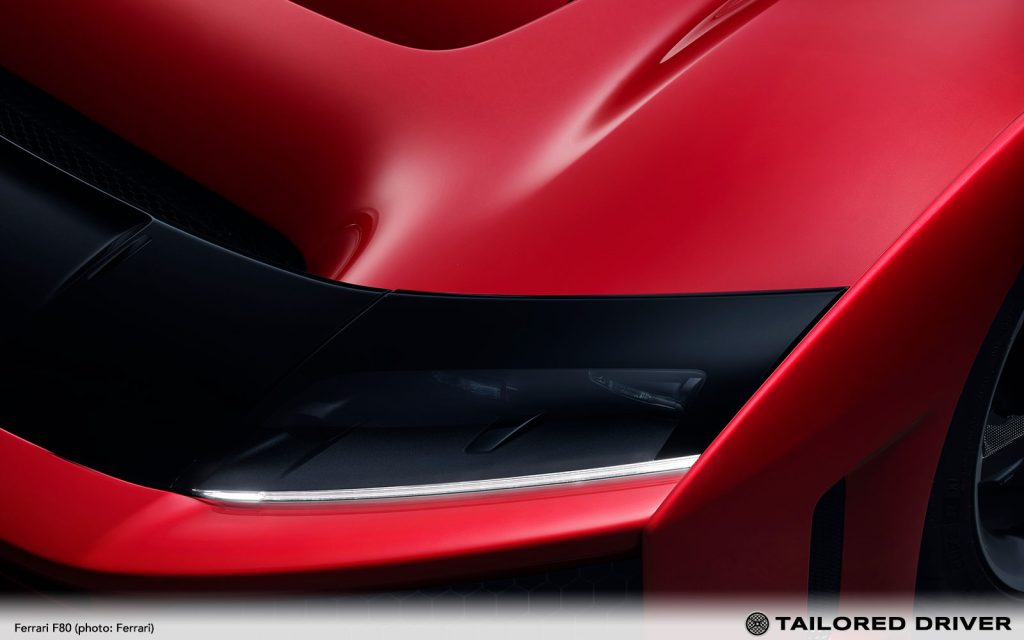
    As on all latest-generation Ferraris, the contrast between the upper zone in bodywork colour and the lower zone in clear-coat finished carbon fibre accentuates the design of the car, revealing more of its technical side with each new glance. The designers wanted to avoid an anthropomorphic effect at the front of the F80; the headlamps are concealed in a visor element, a black screen serving both aerodynamic and lighting functions that gives the F80 a particularly original appearance.

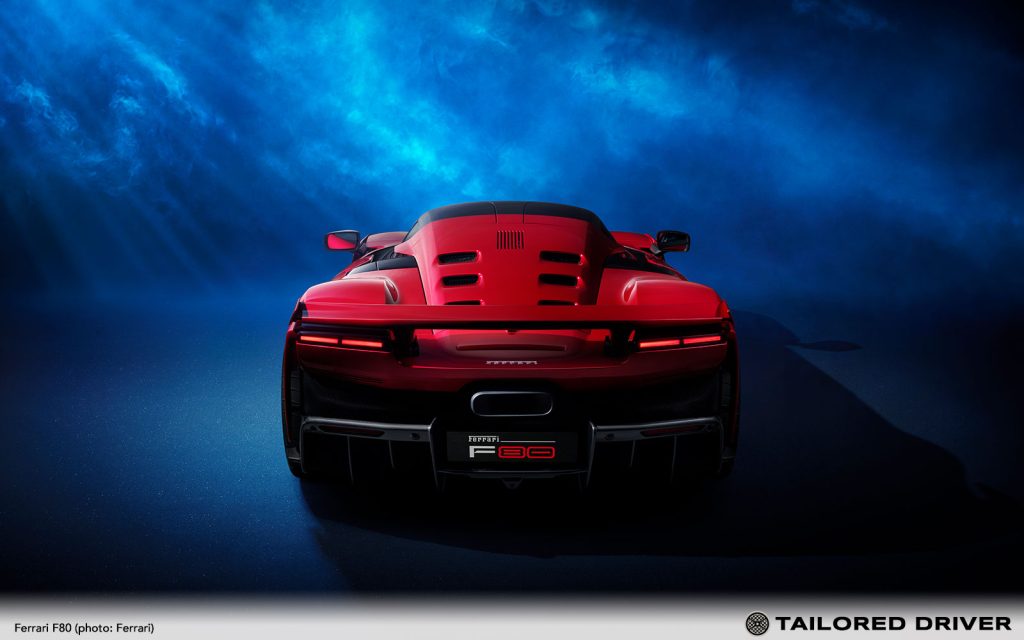
    The short-tail rear of the car has two different configurations during use: with the mobile wing stowed or deployed. The tail lights are set into a two-layer structure consisting of the tail fascia and the spoiler, creating a sandwich effect that gives the rear an extremely sporty character in both configurations.

    With the rear spoiler raised, the car expresses even more power and dynamism as the difference in visual balance between the two configurations reveals the other side of its character. The functional needs of the car have been resolved visually in the design to create the perfect dialogue between performance and form. Some of these functional features play a very strong role in defining the visual character: the NACA duct channelling air towards the engine intake and lateral radiators, for example, is as iconic as it is functional, and constitutes one of the most original styling cues of the flank.

    Another functional but highly symbolic element is the louvred engine compartment spine, where six slots, one for each cylinder of the internal combustion engine, create an unexpected relationship between the geometric lines and sculptural surfaces of the car.
    INTERIOR

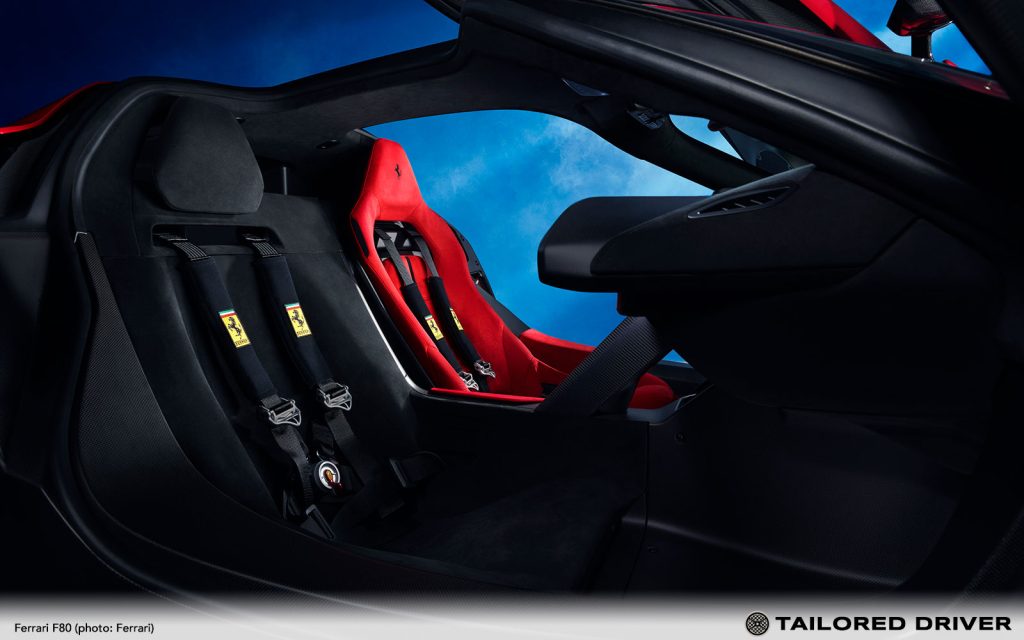
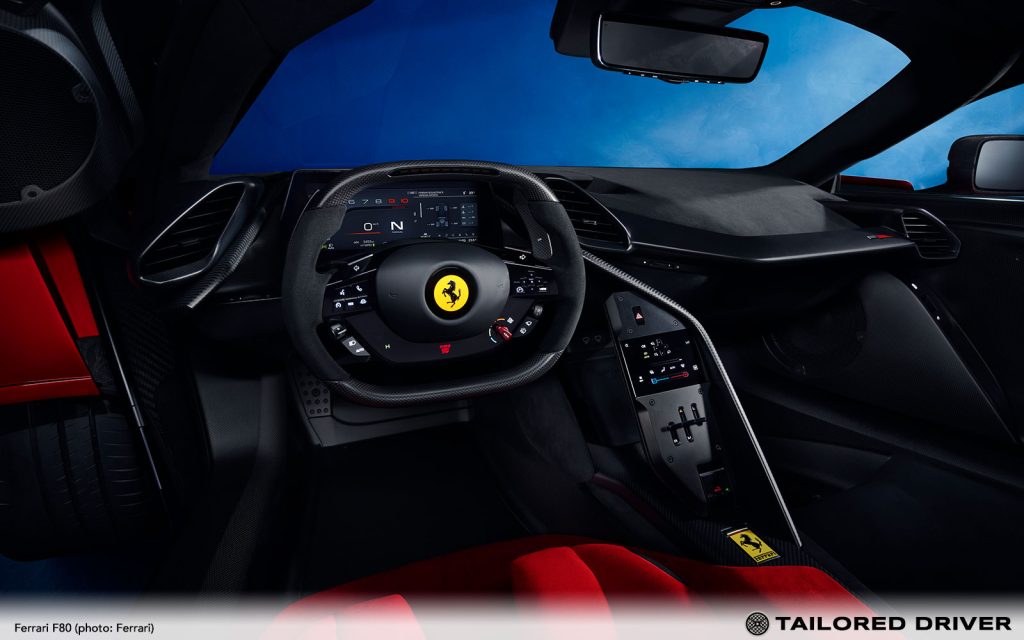
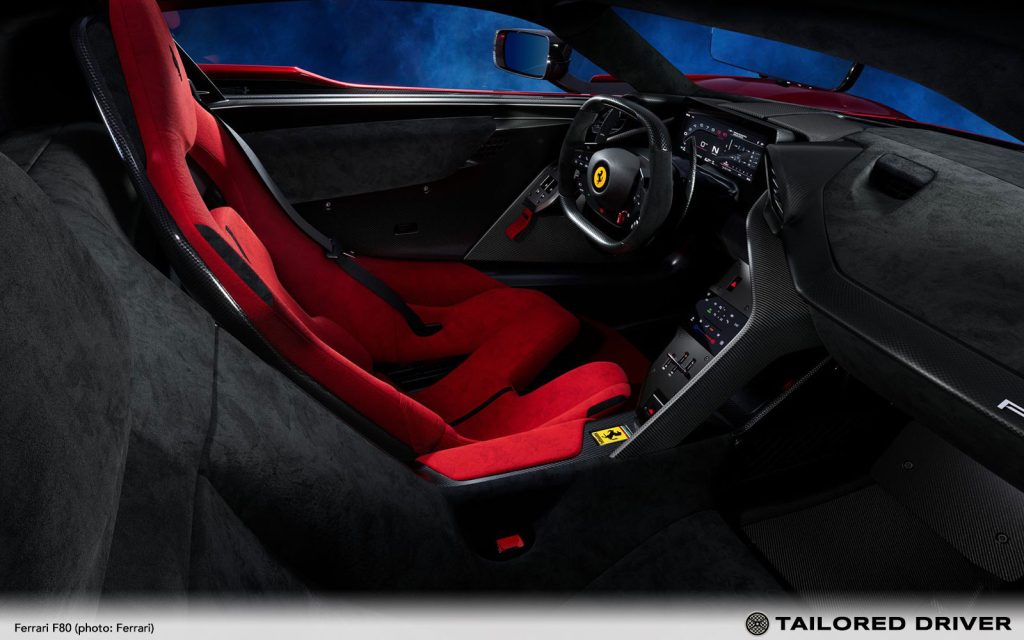
    The compact proportions of the cabin were made possible by opting for a cockpit inspired by a single-seat racer, creating a visual perception akin to an enclosed Formula 1 car. A lengthy process involving designers, engineers, ergonomics specialists and Colour & Trim experts culminated in an original new solution that sets the driver unequivocally as the protagonist in the cabin and transforms the car into a “1+”.

    The decidedly enveloping cockpit is centred entirely around the driver, with its forms converging towards the controls and instrument panel. The control panel is also oriented ergonomically towards the driver, creating a sort of cocoon effect around them.

    While ergonomically complete and comfortable, the passenger seat is so well integrated into the trim of the cabin that it almost disappears from view, a result also made possible by the masterful differentiation between the colours and materials used for the driver seat and for the rest of the trim.

    A longitudinal offset in the positions of the seats of the two occupants made it possible to set the passenger seat farther back than the driver seat, allowing for a narrower interior space with no penalty in terms of ergonomics and perceived comfort. This solution let the designers give the car a smaller cabin and reduce the frontal cross section of the car.

    The F80 also boasts a new steering wheel developed specifically for this car, which will make an appearance in the future road-going models of the Prancing Horse. Slightly smaller than its predecessor and with flattened top and bottom rims, the steering wheel also has a smaller boss, improving visibility and accentuating the sense of sportiness when driving. The lateral zones of the rim are optimised to ensure a better grip with or without gloves. The physical buttons on the right and left hand spokes of the steering wheel make a return here, replacing the full-digital layout used by Ferrari in recent years with a solution with easier to use buttons that can be instantly identified by touch.

    7-YEAR MAINTENANCE

    Ferrari’s unparalleled quality standards and increasing focus on client service underpin the extended seven-year maintenance programme offered with the F80. Available across the entire Ferrari range, this is the first time this programme has been offered on a supercar and covers all regular maintenance for the first seven years of the car’s life. This scheduled maintenance programme for Ferraris is an exclusive service that allows clients the certainty that their car is being kept at peak performance and safety over the years. This very special service is also available to owners of pre-owned Ferraris.

    Regular maintenance (at intervals of either 20,000 km or once a year with no mileage restrictions), original spares and meticulous checks by staff trained directly at the Ferrari Training Centre in Maranello using the most modern diagnostic tools are just some of the advantages of the Genuine Maintenance Programme. The service is available on all markets worldwide and from all Dealerships on the Official Dealership Network.

    The Genuine Maintenance programme further extends the wide range of after-sales services offered by Ferrari to meet the needs of clients wishing to preserve the performance and excellence that are the signatures of all cars built in Maranello.
    FERRARI F80 – TECHNICAL DATA SHEET

    ENGINE

    INTERNAL COMBUSTION ENGINE (ICE)

    Type V6 – 120° – dry sump

    Total displacement 2992 cc

    Bore and stroke 88 mm × 82 mm

    Maximum power 900 cv at 8750 rpm

    Maximum torque 850 Nm at 5550 rpm

    Maximum engine speed 9000 rpm (dynamic limiter at 9200 rpm)

    Compression ratio 9.5:1

    Specific power output 300 cv/l

    HYBRID POWERTRAIN

    Type Concentrated winding stator, Litz wire and stator and rotor in a Halbach array configuration

    REAR ELECTRIC MOTOR (MGU-K)

    Operating voltage 650 – 860 V

    Peak power Regenerative braking: 70 kW (95 cv); ICE assist: 60 kW (81 cv)

    Peak torque 45 Nm

    Maximum engine speed 30,000 rpm

    Weight 8.8 kg

    FRONT AXLE ELECTRIC MOTOR

    Operating voltage 650 – 860 V

    Peak power 105 kW (142 cv) for each of the two electric motors

    Peak torque 121 Nm

    Maximum engine speed 30,000 rpm

    Weight 12.9 kg

    HIGH-VOLTAGE BATTERY

    Maximum voltage 860 V

    Maximum power (charge/discharge) 242 kW

    Energy 2.28 kWh

    Maximum current 350 A

    Power density 6.16 kW/kg

    Weight 39.3 kg

    WEIGHTS AND DIMENSIONS

    Length 4840 mm

    Width 2060 mm

    Height (in kerb weight conditions) 1138 mm

    Wheelbase 2665 mm

    Front track 1701 mm

    Rear track 1660 mm

    Dry weight* 1525 kg

    Dry weight/power ratio 1.27 kg/cv

    Weight distribution 42.2% front / 57.8% rear

    Fuel tank capacity 63.5 litres

    Luggage compartment capacity 35 litres

    TYRES AND WHEELS

    Front 285/30 R20

    Rear 345/30 R21

    BRAKES

    Front 408 x 220 x 38 mm (6 pistons per calliper)

    Rear 390 x 263 x 32 mm (4 pistons per calliper)

    TRANSMISSION AND GEARBOX

    8-speed dual-clutch F1 DCT

    ELECTRONIC CONTROLS

    SSC 8.0: TC, eDiff, SCM, PCV 3.0, FDE 2.0, EPS, ABS-Evo in all Manettino modes, 6D sensor

    performance ABS/ABD

    PERFORMANCE

    Maximum speed 350 km/h

    0–100 km/h 2.15 s

    0–200 km/h 5.75 s

    100-0 km/h 28 m

    200-0 km/h 98 m

    FUEL CONSUMPTION

    Under homologation

    CO2 EMISSIONS

    Under homologation

    * With optional content
  • Porsche Teases First 992.2 GT Car (Likely GT3 and GT3 Touring) Confirms 10/18 Debut

    Porsche Teases First 992.2 GT Car (Likely GT3 and GT3 Touring) Confirms 10/18 Debut

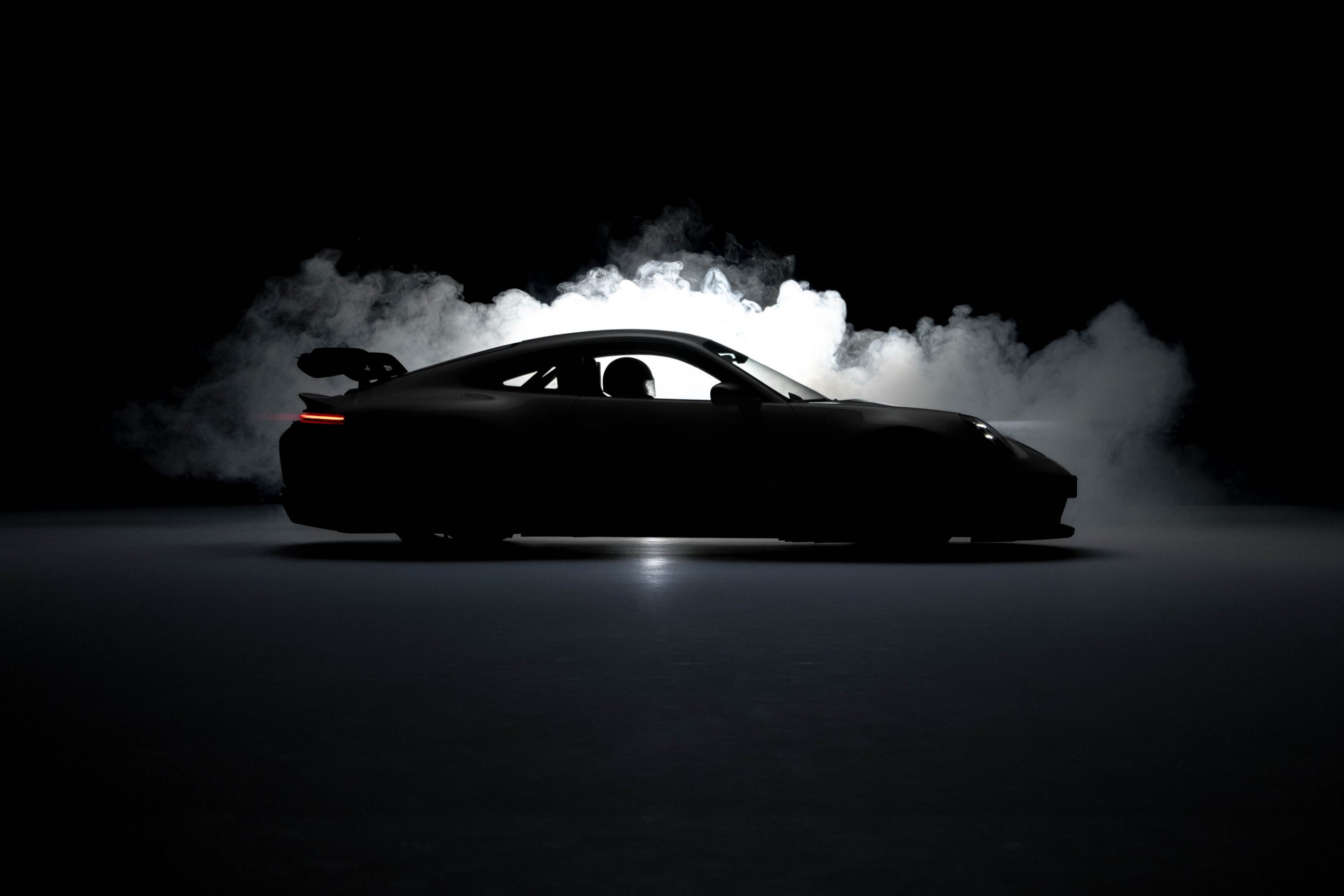
    Porsche is about to launch its first 992.2-based GT car, and it’s likely the updated freshening of the GT3 and GT3 Touring. To message that, they dropped this teaser image along with confirmation of a digital world premiere on October 18 at 18:30 CEST (12:30 EST).

    How do we know it’s the GT3? Call it an educated guess. The image shows a car with no vented front fenders and a fixed rear wing. The statement by Porsche also confirms two versions of its first 992.2 “GT Car”… like say a GT3 and a GT3 Touring.

    Of course, this being Tailored Driver, it’s also worth mentioning that Porsche stated, “Both (versions) have become even more emotional, offer customers even more individuality and come up with innovative detailed solutions.”

    We’ll post the full text below.

    First GT model of the new 911 generation

    • New model debuts in two variants
    • Even more emotional, more individual and innovative than its predecessor
    • First driving impressions of professional pilots Walter Röhrl and Jörg Bergmeister
    • Digital world premiere on 18. October 2024 at 18:30 CEST

    [source: Porsche AG]

    Stuttgart The first GT model of the new 911 generation is in the starting blocks. In a digital world premiere, Andreas Preuninger, Head of GT Vehicles, will present the further developed vehicle together with the brand ambassadors Walter Röhrl and Jörg Bergmeister. The new 911 from the GT forge in Flacht will be presented in two variants at the same time. Both have become even more emotional, offer customers even more individuality and come up with innovative detailed solutions.

    Broadcast in the Porsche Newsroom
    The world premiere of the new 911 GT model will be on 18. October at 18:30 CEST in the Porsche Newsroom at newsroom.porsche.de as well as on the Porsche channels on Youtube and LinkedIn and can then be accessed on demand.

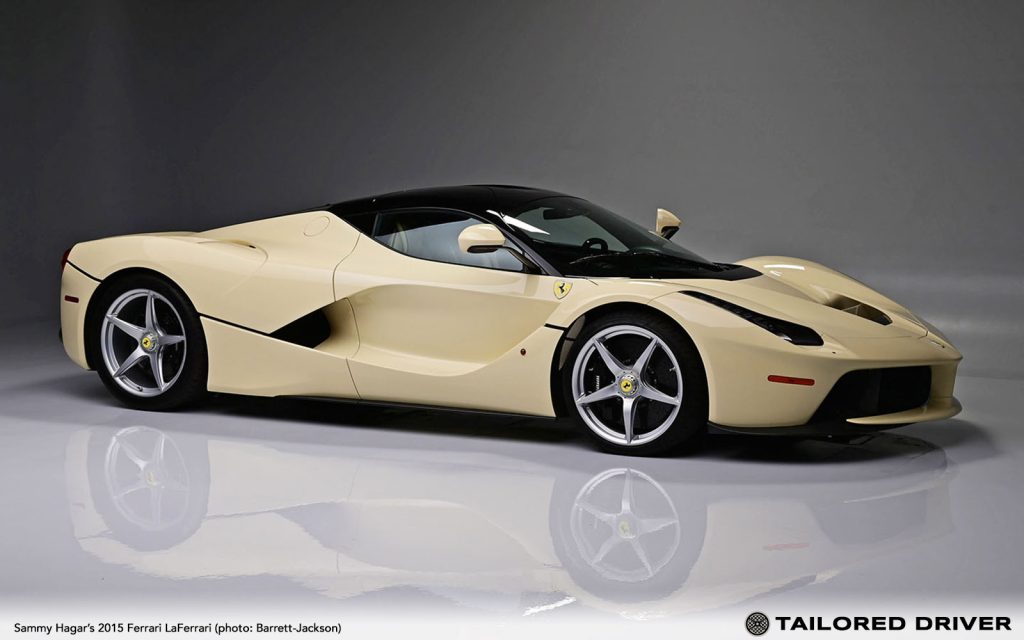
  • Sammy Hagar’s Cream LaFerrari Just Sells for $4.65M, Setting World Record

    Sammy Hagar’s Cream LaFerrari Just Sells for $4.65M, Setting World Record

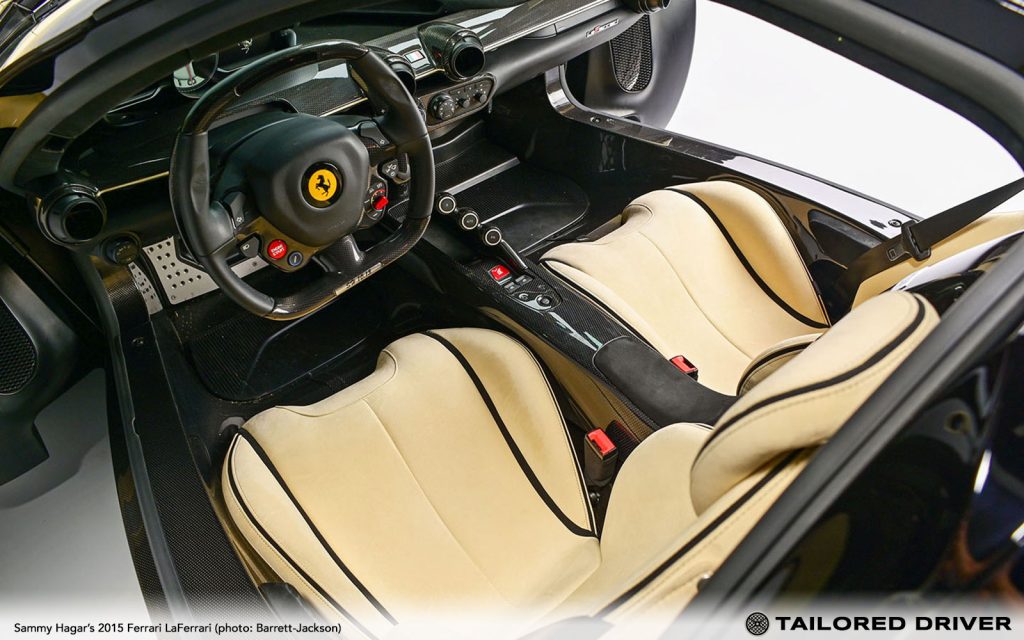
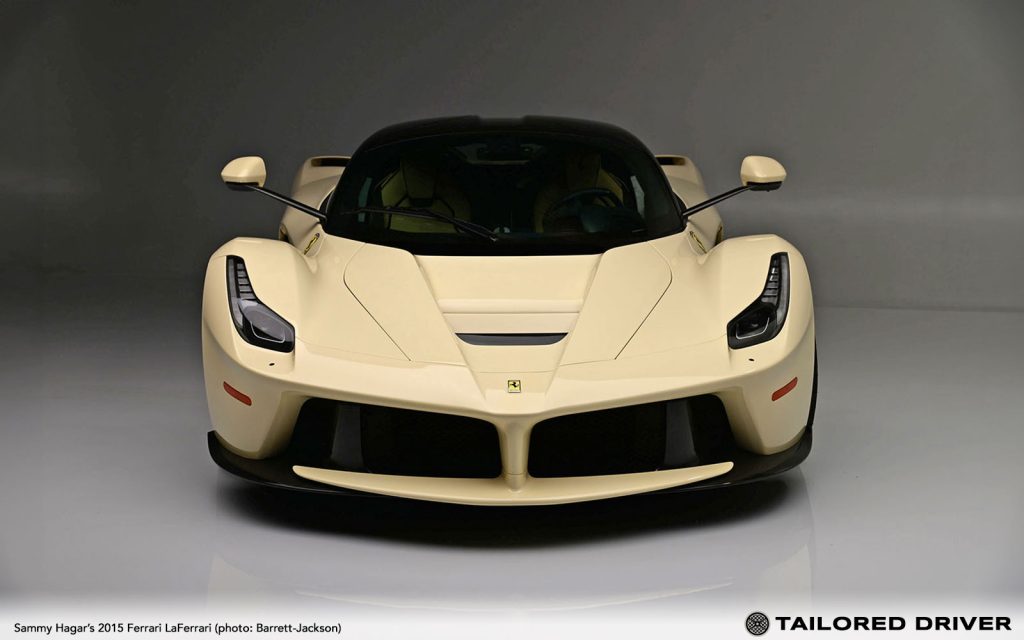
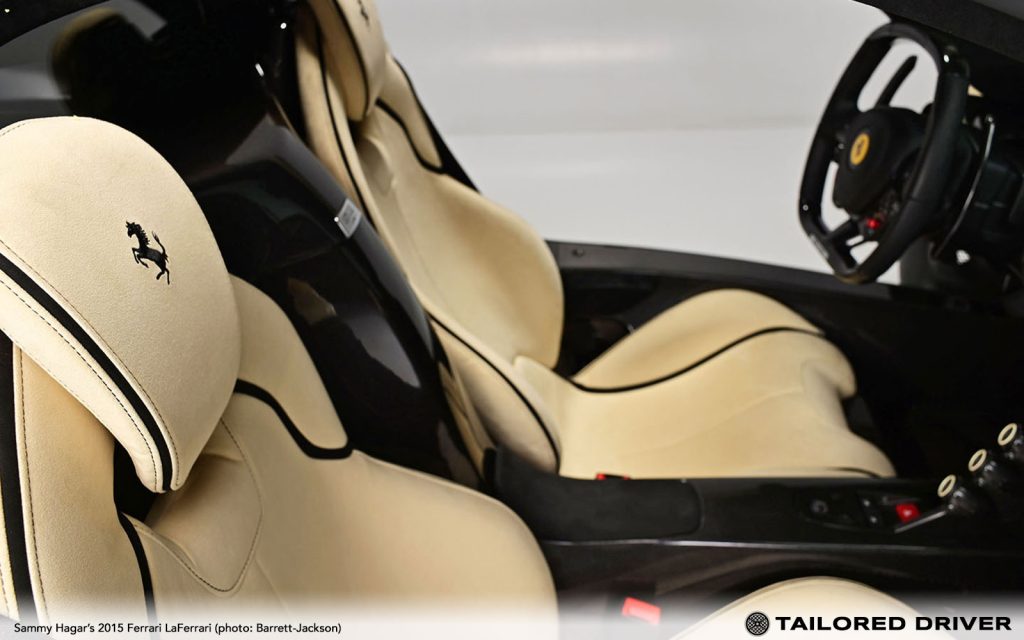
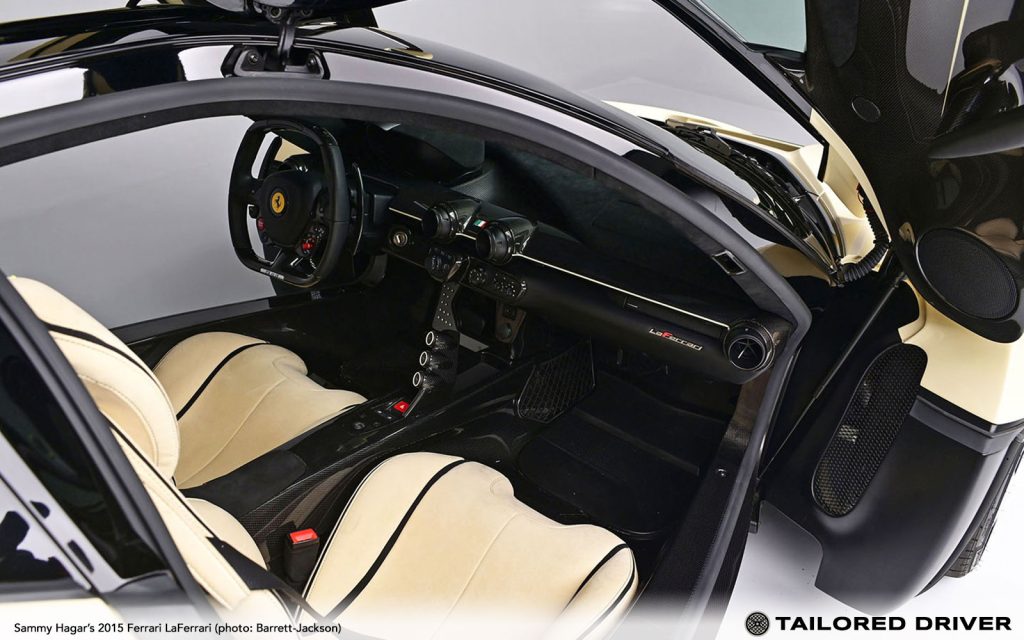
    Former Van Halen front man and rocker in his own right Sammy Hagar just sold his unique Ferrari LaFerrari (VIN: ZFF76ZFA2F0212166) via Barrett Jackson’s Fall 2024 sale, setting a new world record price for this particular model of Ferrari. Notably, the car was custom built to Sammy’s specification in Cream over Cream.

    Looking over the Hagar LaFerrari, we’re guessing he built it via the Ferrari Tailor-Made program where discerning clients get a wide spectrum of freedom as they specify exterior color(s), interior color(s) and other details within the specification.

    We’re a little confused on the final price. The Barrett-Jackson social media post (below) lists it as $4.25 million, though the Barrett-Jackson Fall Sale results on their website (HERE) list the price as $4.675M.

    In this case, the colors of the Hagar LaFerrari listed by Barrett Jackson are simply Cream exterior and Cream interior. Sammy reportedly chose the combination to match the color of a 1960s Ferrari he saw pictured on the wall at Ferrari’s Maranello factory during his visit in 2014 presumably to order this car. The color combination also contrasts beautifully with carbon fiber and black accents.

    Also included with the car is a special replica model that was given to Hagar as a gift by Ferrari, a book of the build process and plaque signed by Hagar from when the car was displayed at The Quail during the 2016 Monterey Car Week.

    “I’m so excited that my LaFerrari, the most beautiful one on the planet, is headed back to Scottsdale this fall,” said Hagar in a Barrett-Jackson Press Release. “This car has a new high-voltage battery straight from the factory, so it’s even better than the original. It’s going to be an extra-rocking time because it’s crossing the block on Oct. 12, the day before my birthday. In fact, the winning bidder had better bring a passport, because I’m taking you to Cabo to help celebrate my birthday on October 13. This is going to be a wild ride and I can’t wait to see everyone there.”

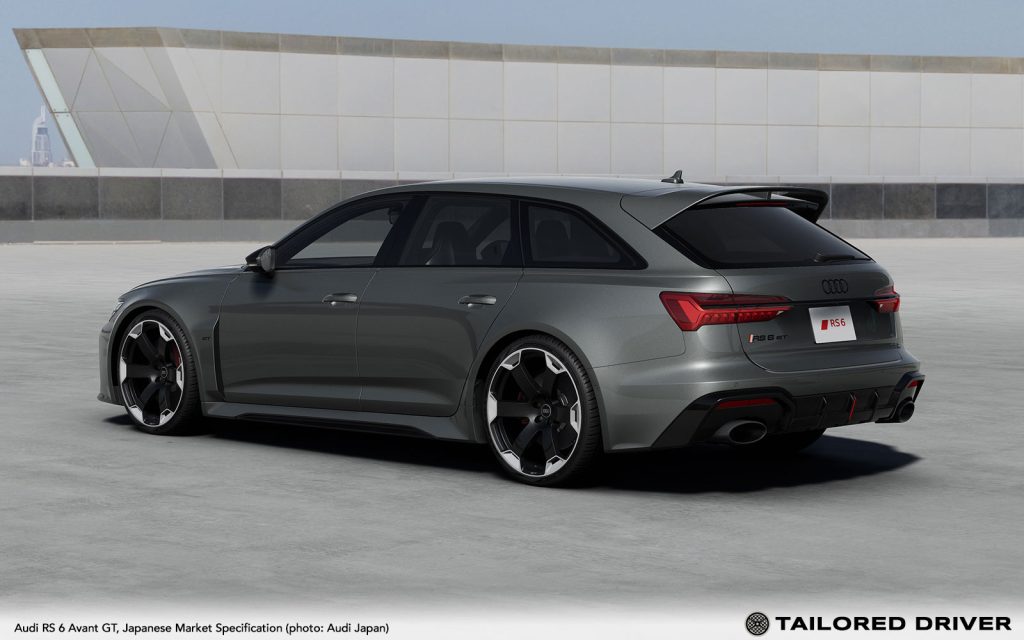
  • Audi RS 6 Avant GT in Daytona Grey and Mythos Black, Colors You Can’t Have

    Audi RS 6 Avant GT in Daytona Grey and Mythos Black, Colors You Can’t Have

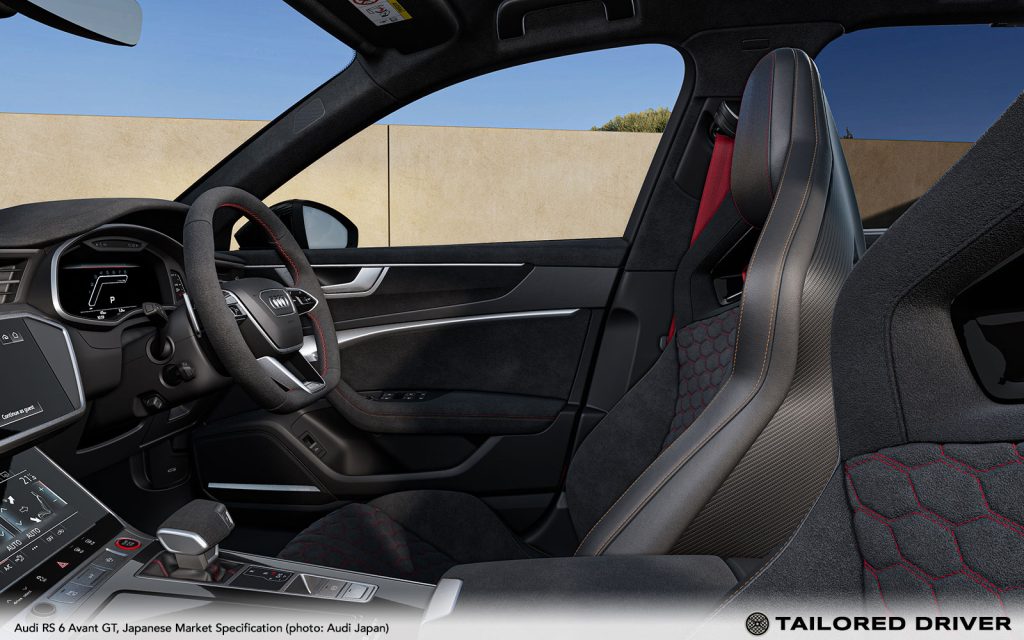
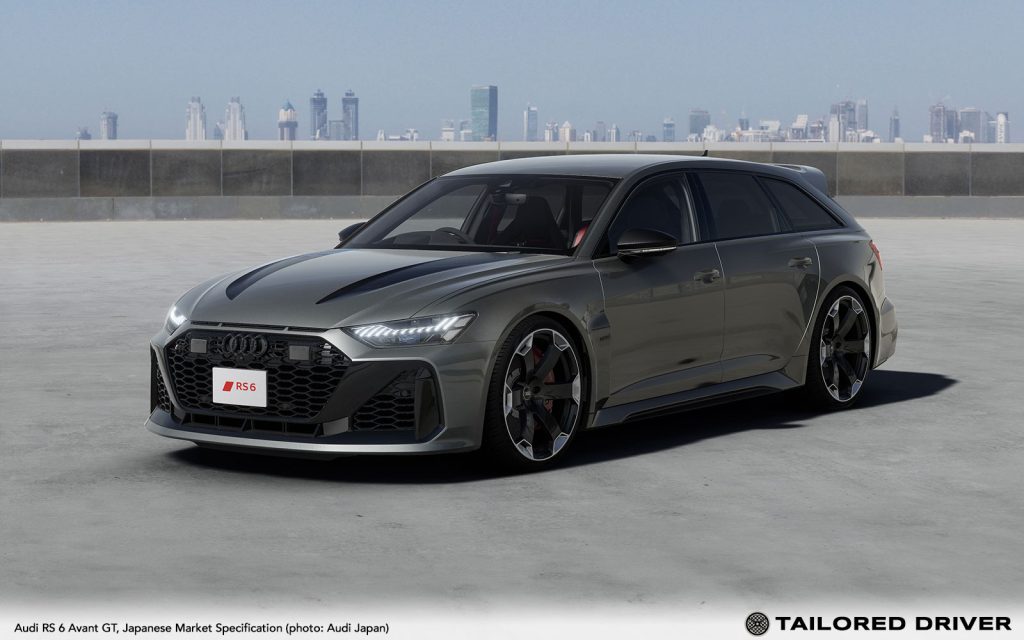
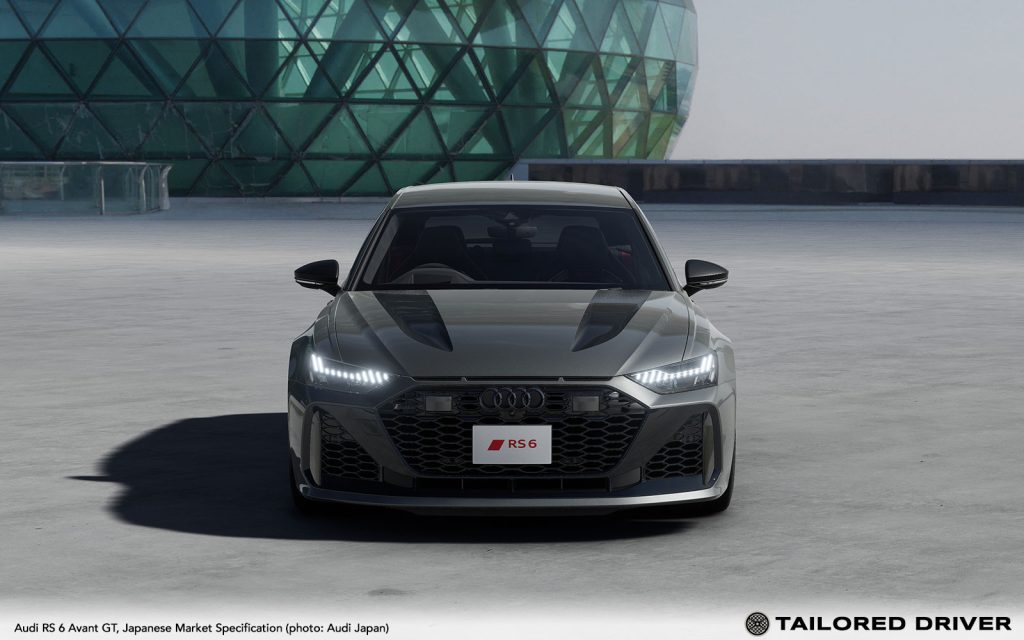
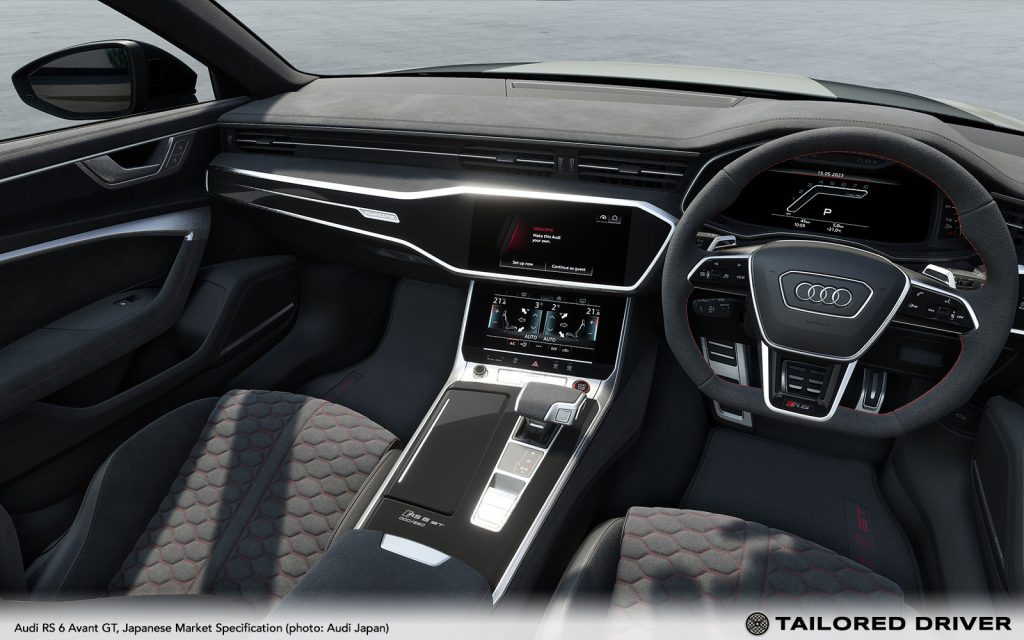
    From the Grass is Always Greener department come these photos of the Audi RS 6 Avant GT released by Audi Japan. While they’re CGI renderings likely from the Audi exclusive configurator, they show the RS 6 Avant GT in Chronos Grey and Mythos Black, colors you can’t get here in America given all of ours will be built in Arkona White with heritage stripe livery in vinyl.

    According to the German market configurator, it appears that Europe will have choices between the Arkona White heritage specification, Nardo Grey or Mythos Black. According to Audi Japan, they’ll be getting just ten units with five in Mythos Black and five in Chronos Grey (although these renderings make it look more like Daytona Grey).

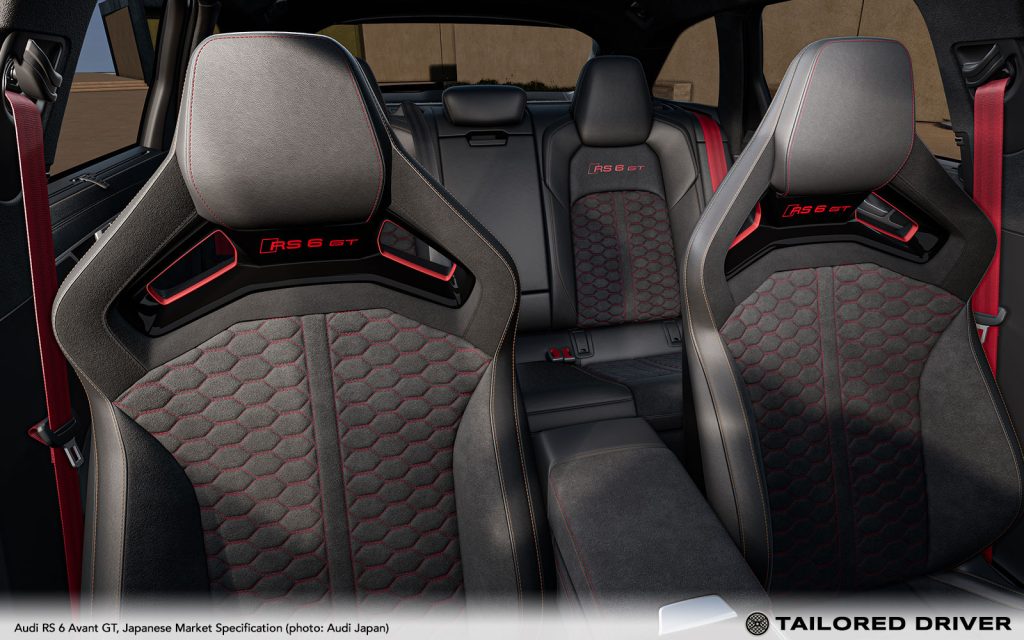
    For the RS 6 Avant super fans, there are a few other pieces of kit the Japanese (and Europeans) will have access to that won’t be coming to America officially. These include the optional sport shell seats and the 6-arm Avus wheels in either black matte or gloss black metallic with partial polished segmentation. The latter appears on all renderings released from Japan and may be their only wheel option.

  • Bentley Batur Convertible W12 Begins Sign-off Journey

    Bentley Batur Convertible W12 Begins Sign-off Journey

    • Pair of Batur Convertible development cars begin final development trails across Europe
    • 16 Batur Convertible examples among the last W12-powered Bentleys, after the retirement of the engine in July
    • Extensive whole vehicle development program includes 120 individual tests over more than a year
    • Testing opens with 3,000 km drive from Germany to Spain, ahead of high-speed assessment at Idiada proving ground
    • Both development cars reflect the choices available to Mulliner customers, with bespoke colours and finishes to every single surface of both the cabin and the exterior

    [source: Bentley]

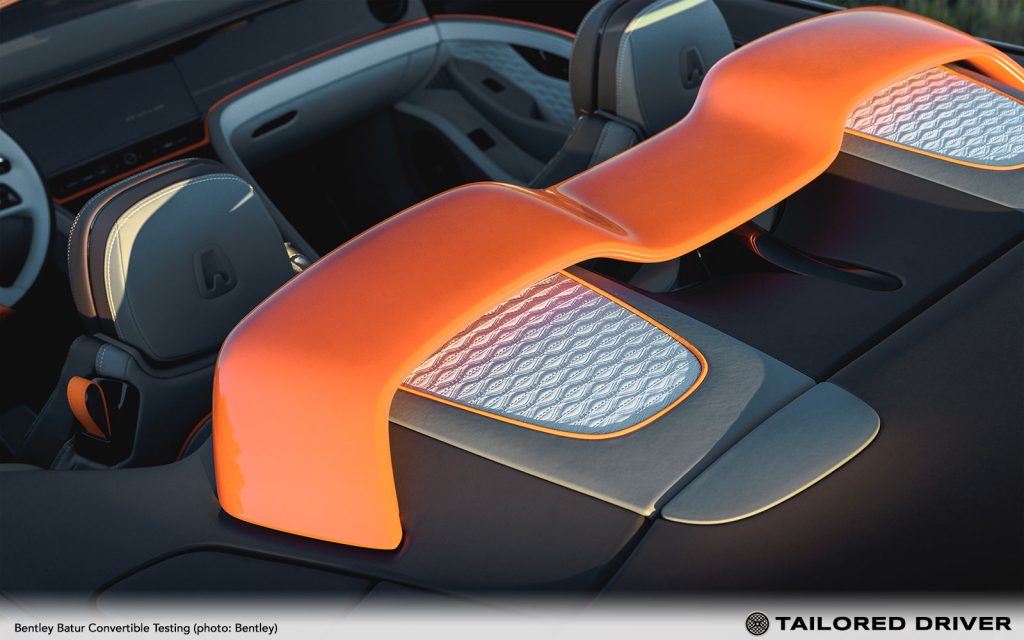
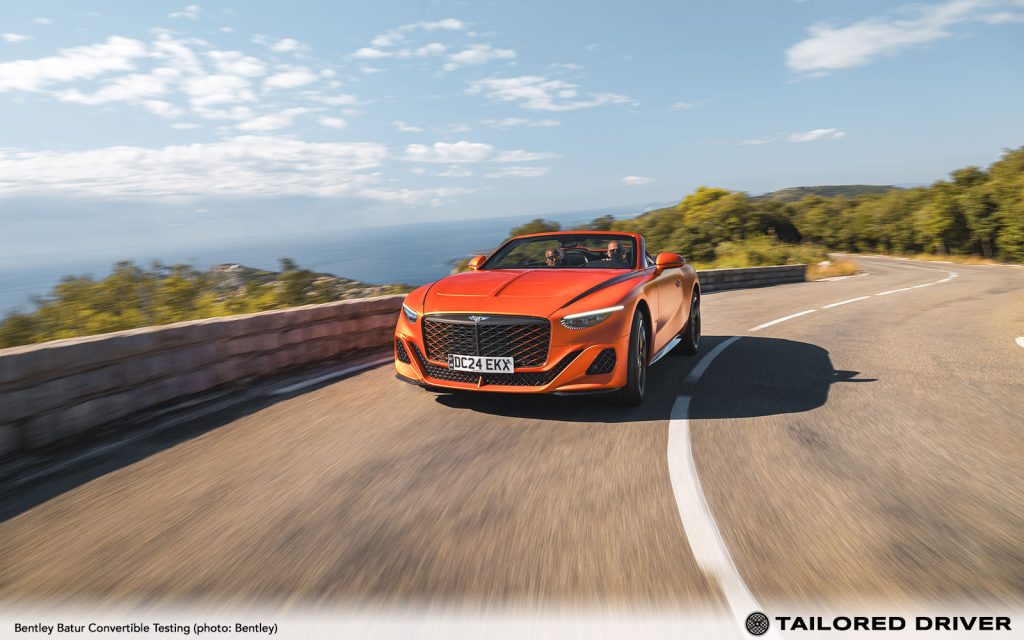
    Crewe, UK – The most powerful W12-engined Bentley – the highly exclusive Batur Convertible – has begun its final suite of sign-off testing. Created by Mulliner, Bentley’s in house bespoke division and the longest standing coachbuilder in the world, the Batur Convertible is the third car in Mulliner’s Coachbuilt family, following the Bacalar barchetta and the Batur coupe. Strictly limited to just 16 units, the Batur Convertible is the most powerful W12-powered drop-top Grand Tourer in Bentley’s history.

    Bentley announced the retirement of the W12 engine earlier this year, with the last engine leaving the production line in July. The 16 customer examples of the Batur Convertible will be among the recipients of the final W12 engines, each producing 750 PS as the most powerful iteration of the engine ever developed.

    The validation activities include durability for both the engine and whole vehicle, environmental compatibility and sunlight simulation, high speed stability, aerodynamics, noise and vibration, and driving dynamics. More than 120 individual tests in all cover everything from the quality of the surface finish of the gold “organ stop” ventilation controls to the new W12 engine hardware and software.  Over 58 weeks of vehicle validation have been scheduled across  a pair of pre-series cars – Batur Convertible Car Zero and the Batur Convertible Engineering Car.

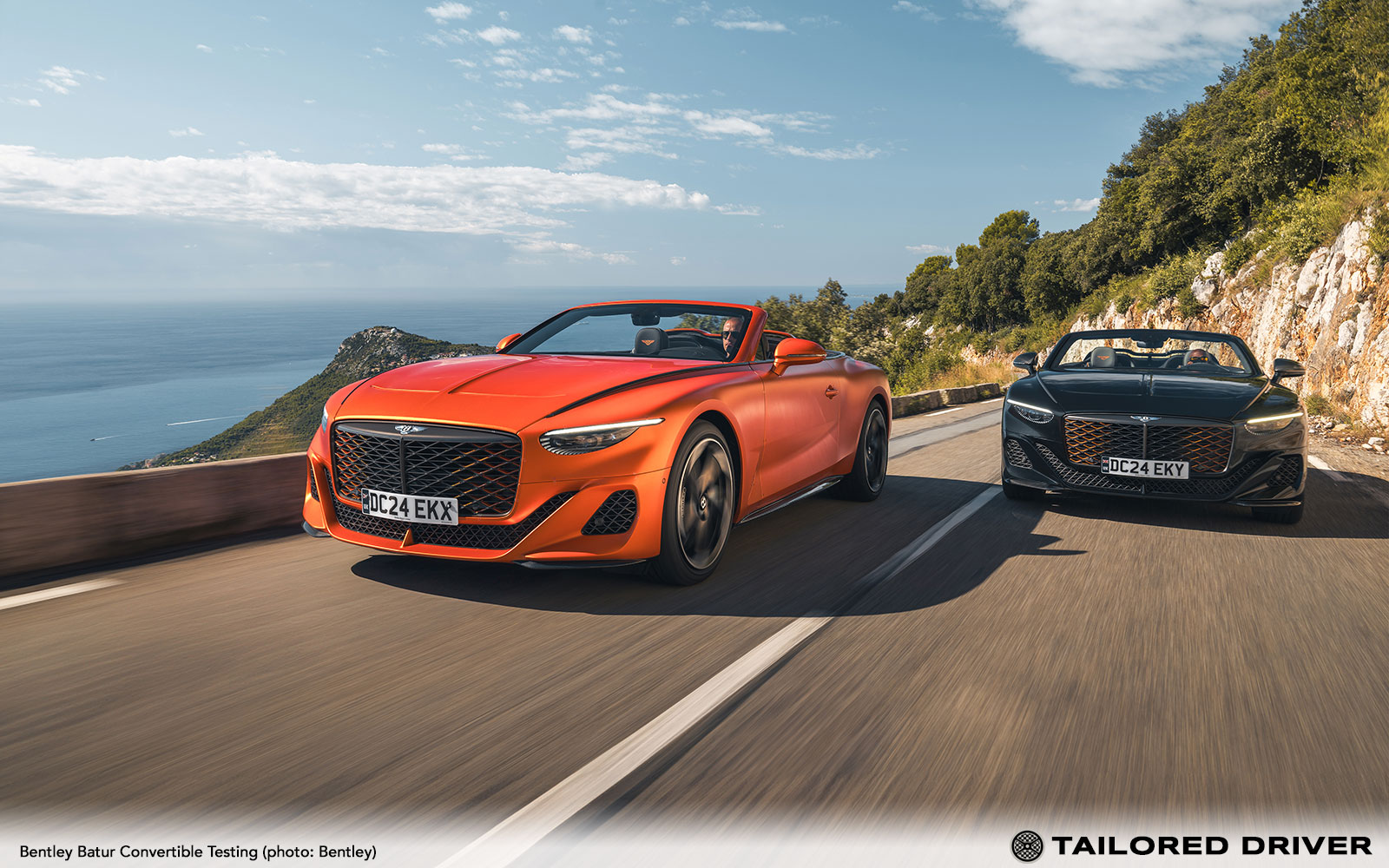
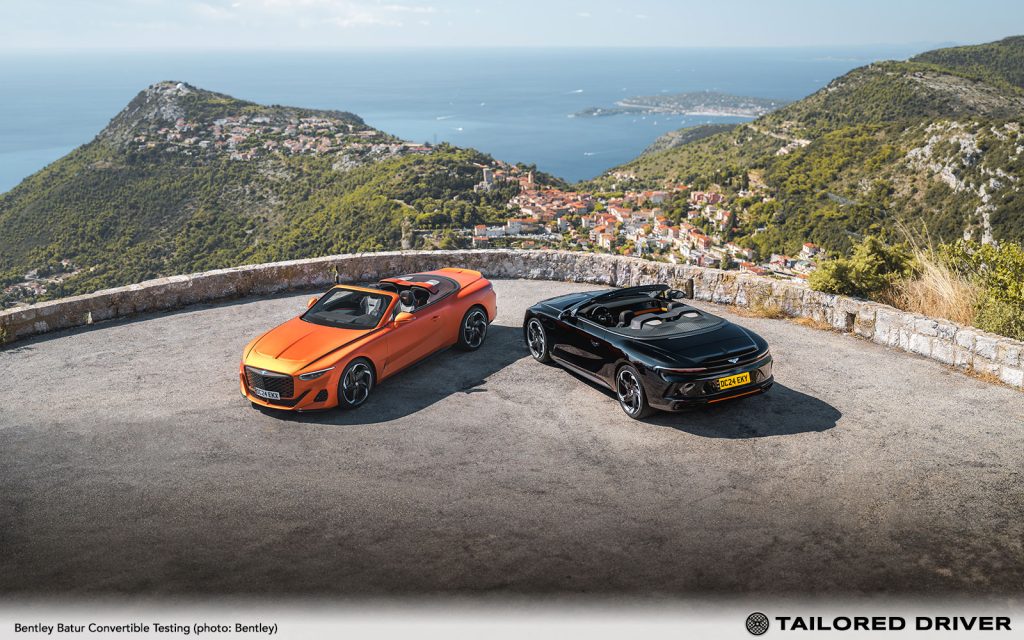
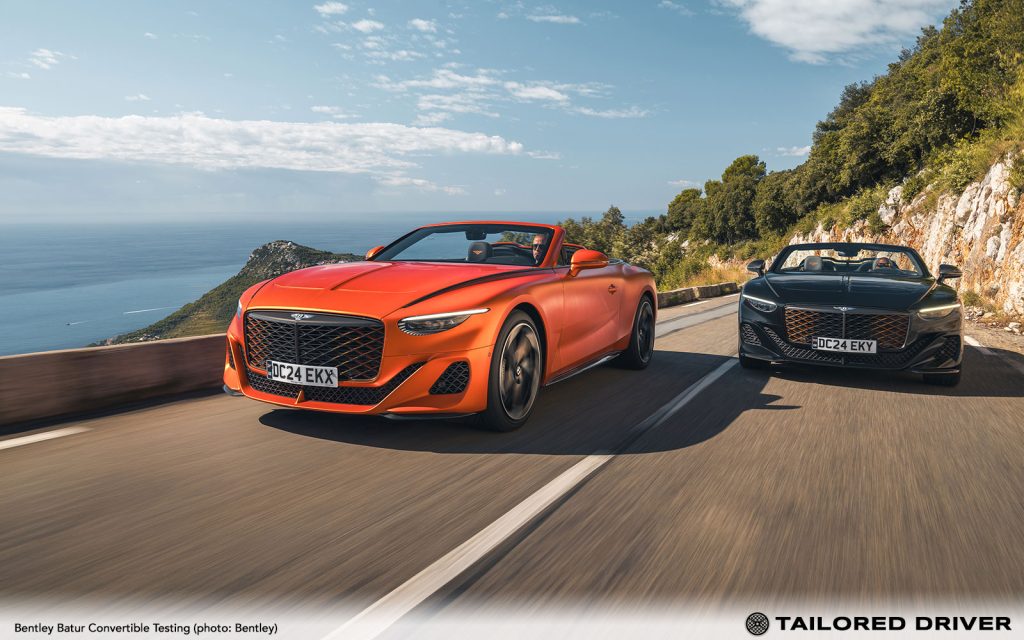
    The real-world testing campaign started with an extensive 3,000 kilometre , five-country drive across Europe to simulate real world conditions. The route left Germany and travelled through Italy, France and Spain, across mountains, highways and cities, with the cars pausing briefly for an afternoon in Monaco for photography before continuing their journey to Idiada in Spain, where high speed testing will begin on private test tracks.

    Paul Williams, Chief Technical Officer for Mulliner, comments:
    “The purpose of an engineering validation public road drive is to test a vehicle’s performance, safety, and reliability under real-world conditions. It allows our engineers to assess how the vehicle operates in a variety of environments, traffic scenarios, and weather conditions that cannot be fully replicated in controlled testing environments. This stage is critical for identifying potential issues, validating system integration, and ensuring the vehicle meets regulatory standards and customer expectations as part of the engineering development test program. At the start of the project it was clear that this car had to be the ultimate open-air Grand Tourer and so every element from the exterior design, engine power and hand-crafted interior has been created without compromise.”

    At the proving grounds, the Batur Convertibles will begin seven weeks of durability work on handling tracks, mixed road conditions, high speed testing and abusive surface conditions. During all of these activities data and feedback are collated ensuring the technical targets are being met.

    The Final W12 Grand Tourer
    The Batur Convertible furthers the innovative design DNA introduced by its coupe sibling that will ultimately guide the design of Bentley’s future cars.

    Created by Mulliner, the Batur Convertible follows the exquisitely hand-crafted Bacalar barchetta and Batur coupe. With the Batur Convertible, Mulliner continues its long tradition of crafting truly individual cars, tailored to the wishes of each of its extraordinary clients.

    The Batur Convertible retains the most powerful version of Bentley’s iconic W12, with a 750 PS, hand-assembled 6.0-litre twin-turbocharged engine that has metaphorically and literally powered Bentley’s success for the last two decades. The Batur Convertible will be the last ever Bentley to use this incredible powertrain.

    The convertible roof delivers an aesthetic of beauty as a modern, tactile alternative to a hardtop roof. A combination of insulation material, sealing system refinements and acoustic treatments create a cossetting environment in a system which can be deployed or stowed in just 19 seconds, with the car travelling at speeds of up to 30 mph (50 km/h), transforming the car from a luxurious coupe into an open-top Grand Tourer at the touch of a button.

    Mulliner’s in-house design team will help co-create every Batur Convertible with its customer, working together through a specially created Mulliner visualiser that allows any part of the car to be customised in colour and surface finish. Endless samples of unique materials bring texture to the process, and the resulting designs will be truly individual and created by the customer – limited only by their imagination.

    Batur Convertible Car Zero
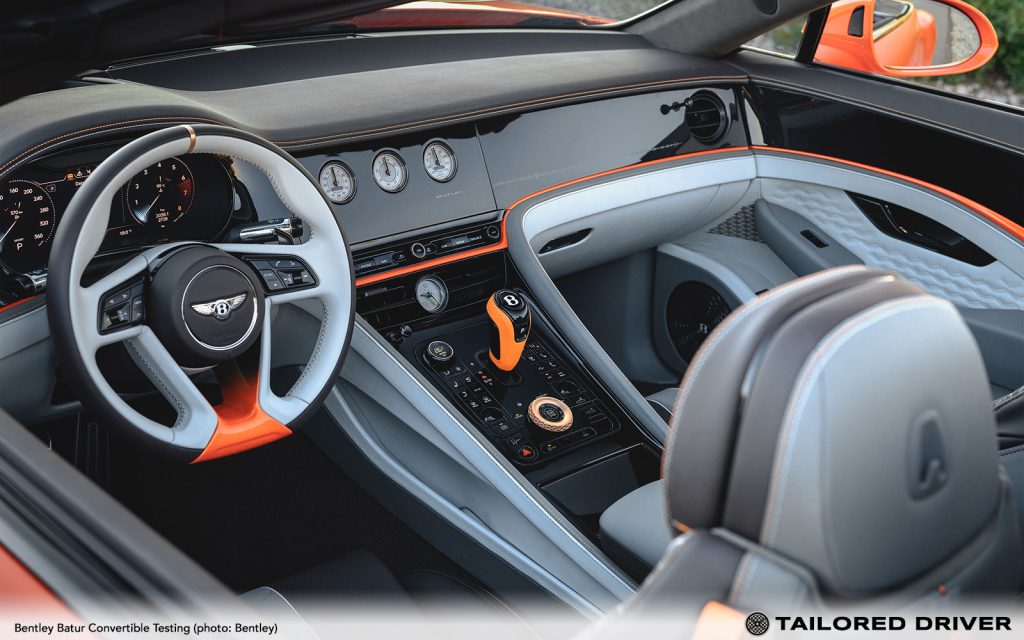
    Like all Mulliner Coachbuilt vehicles, the Batur Convertible is infinitely customisable – with each customer able to specify the colour and finish of literally every single surface of both the exterior and cabin of the car.

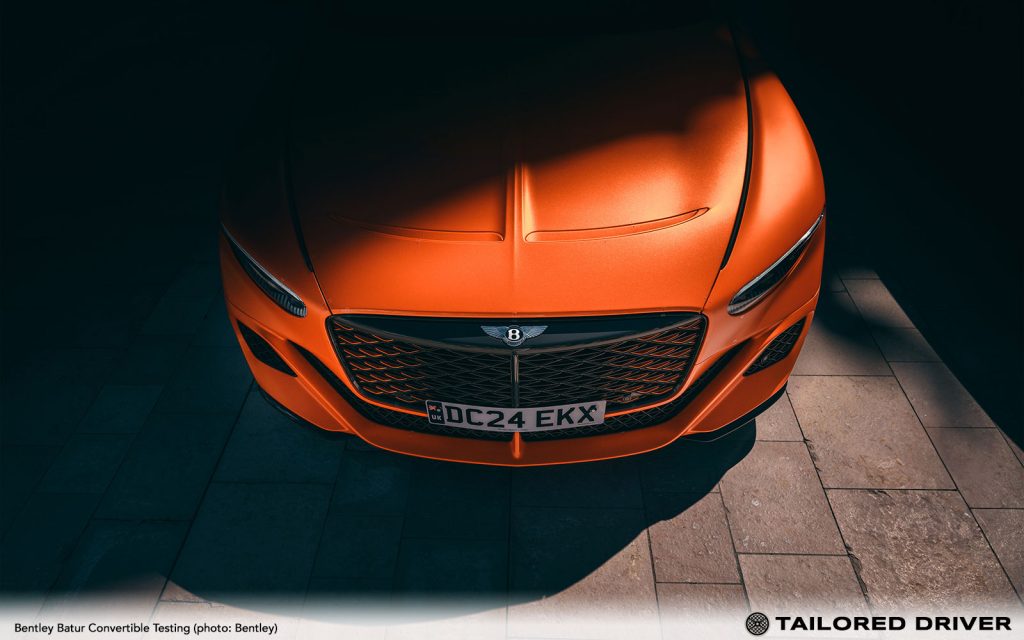
    The engineering development car – Batur Convertible Car Zero – has had the same level of attention to detail as a customer’s own specification. The exterior paintwork is a bespoke colour – Vermillion Gloss over Vermillion Satin Duo tone – that provides a vibrant colour across the contemporary surfaces. The bodywork is underscored by front splitters, side skirts and rear diffuser in high gloss carbon fibre.

    The front of the car features a grille of exceptional art – with the main matrix finished in Gloss Dark Titanium, accented with contrast chevrons in a horizontal ombré pattern that flows from Beluga in the centre and lighten to the vibrant sides in Vermillion Gloss. The “endless bonnet” line is finished in Gloss Dark Titanium paint, as are the 22” wheels – with the spokes in Gloss and Satin Black Titanium with Vermillion Gloss accents.

    The second development car – known simply as the ‘Engineering Car’, features an entirely different specification. Midnight Emerald exterior paintwork is finished with a high gloss carbon fibre body kit and Satin Dark Titanium finished bonnet brightware and lower bumper meshes The wheels are tri-tone – with a Satin Dark Titanium body, gloss Porpoise accent faces and gloss Mandarin pinstripe. The same combination of Satin Dark Titanium and Mandarin is joined by gloss Beluga for the three-colour ombré fade to the front grille. The cabin echoes the exterior, with Cumbrian Green and Porpoises leather being accented with Mandarin stitching and piping, complemented with machined titanium Organ Stops and Bullseye vents. The veneer is Mulliner’s exquisite “guitar fade”, where the colour across the width of the cabin changes gradually from gloss Beluga, to high gloss carbon fibre, and back to gloss Beluga, and finished with a laser-etched audio signature of the W12 engine.

  • Aston Martin Enhances Tailored Ultra-Luxury Experience with New UK Dealerships

    Aston Martin Enhances Tailored Ultra-Luxury Experience with New UK Dealerships

    • British brand celebrates first UK dealerships embracing ultra-luxury vision and new corporate identity 
    • Aston Martin Birmingham official opened following £10m investment in new landmark location
    • New dealership in Leeds also follows successful opening of Aston Martin Edinburgh and global expansions in Europe and Asia

    [source: Aston Martin]

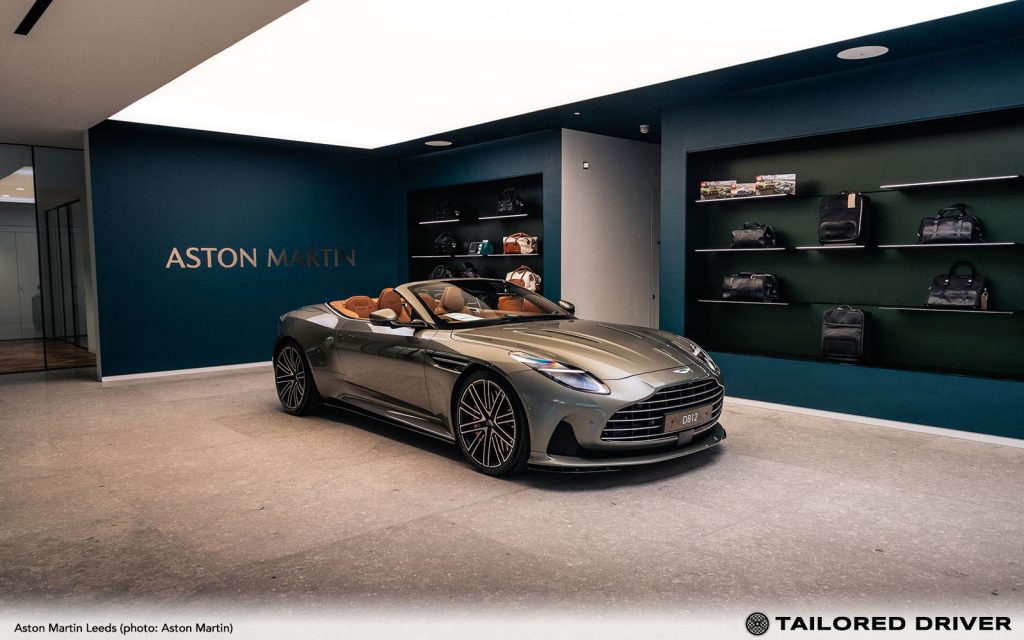
    3 October 2024, Gaydon, UK: Aston Martin is enhancing its retail presence in the UK with the opening of a series of landmark new dealerships, building on the brand’s commitment to providing the most tailored ultra-luxury automotive customer experience.

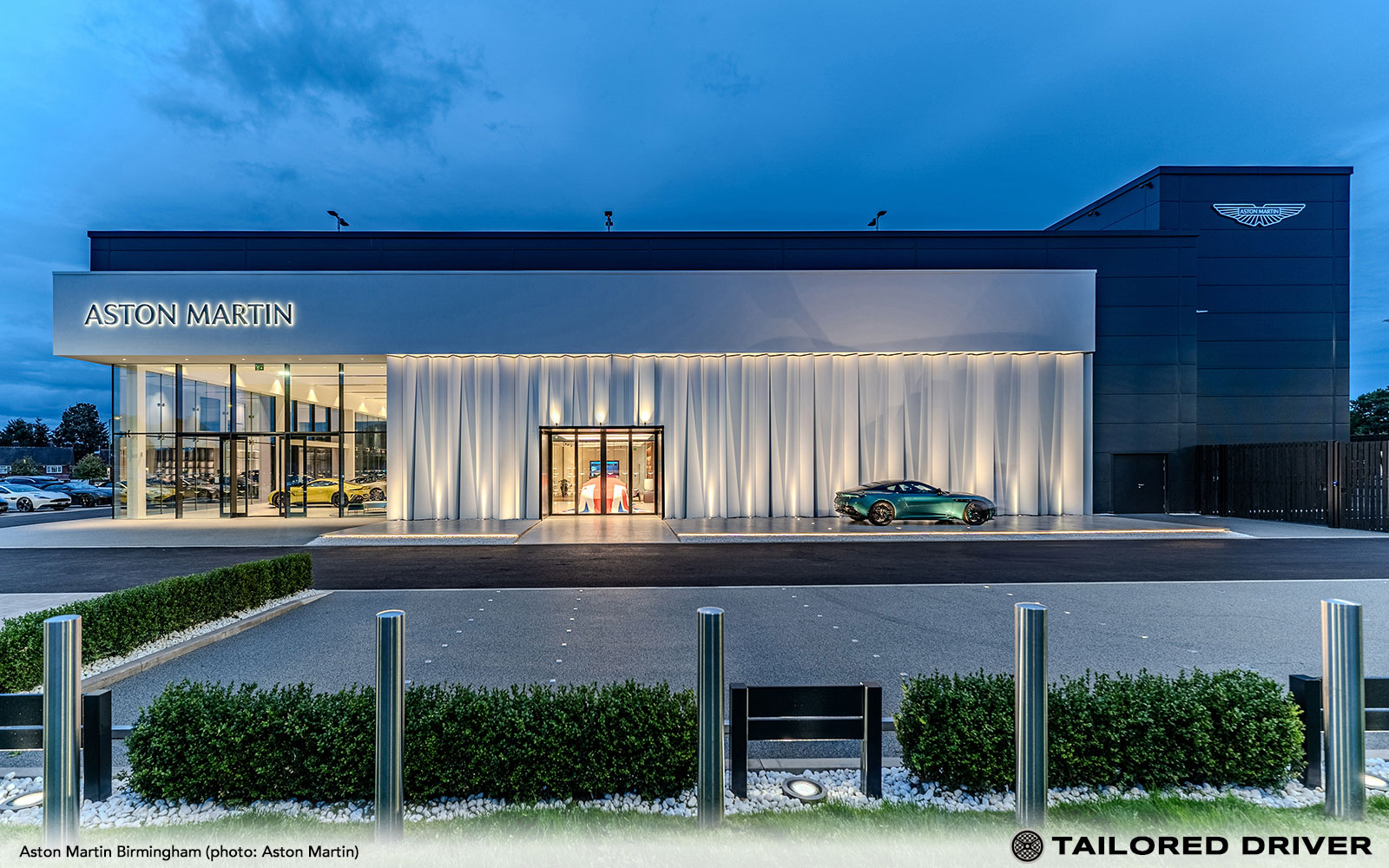
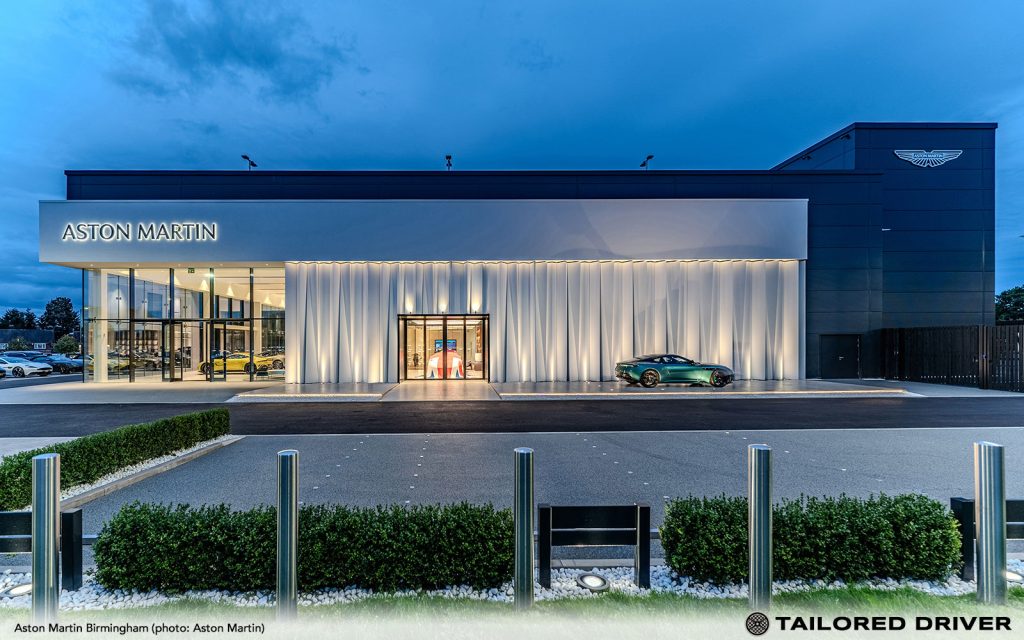
    The closest dealership to the marque’s global headquarters in Warwickshire, Aston Martin Birmingham is now officially open at a state-of-the-art new location in Solihull, following a £10m investment from dealer partner Grange, part of the Cambria Automobiles group.

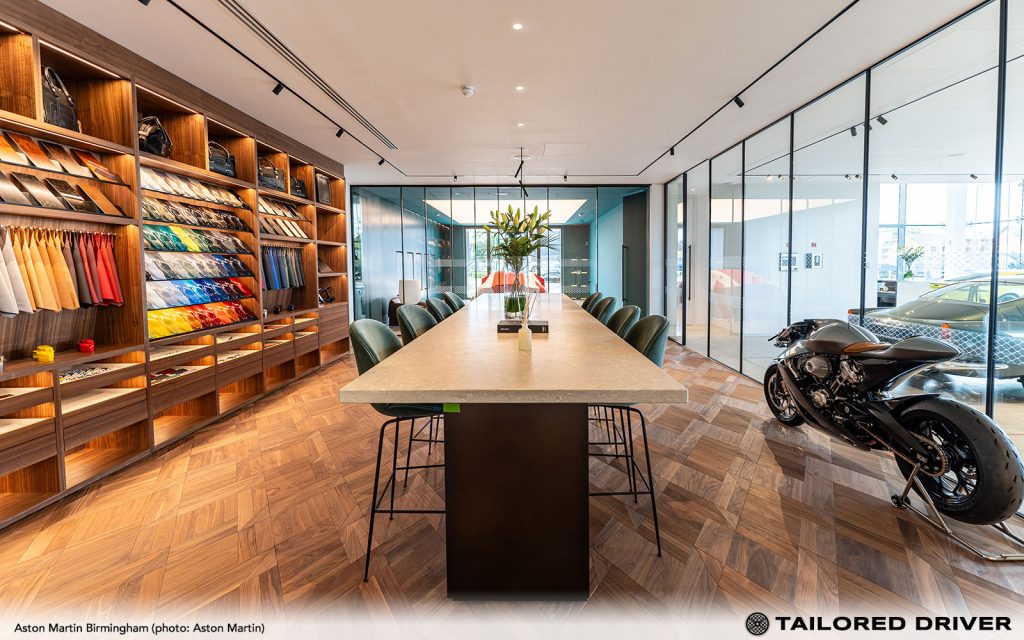
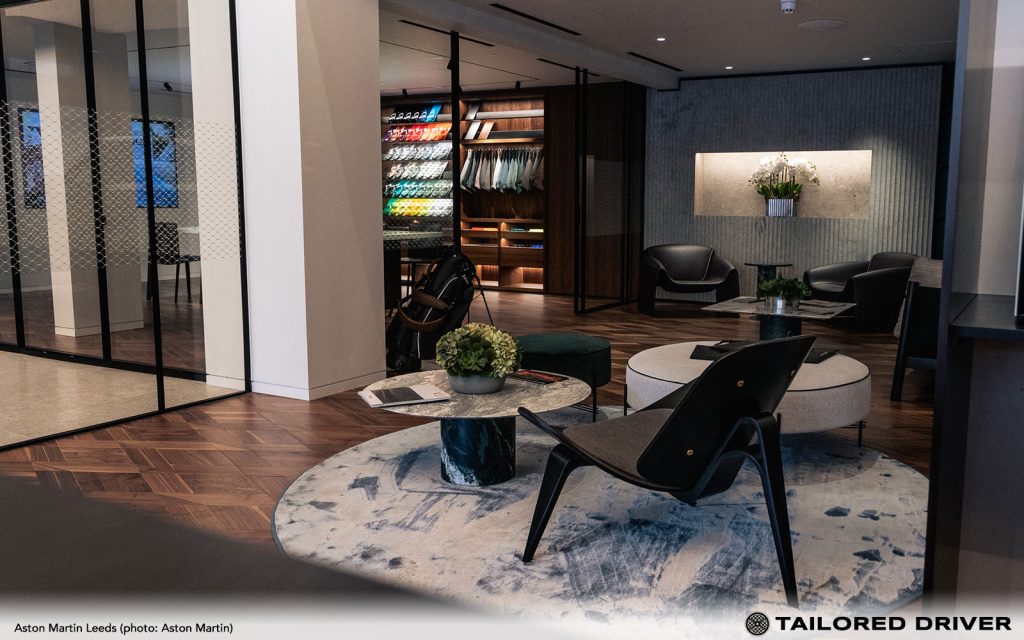
    The striking new location, with a unique exterior feature wall, covers a total footprint of 1204m2, and has created 30 jobs. Featuring a bespoke Q by Aston Martin customer specification lounge, it offers the very highest levels of luxury personalisation and the opportunity for clients to engage with the latest cutting-edge technology to digitally configure their own intimately personal Aston Martin alongside an extensive range of physical samples. The showroom presents eight curated Aston Martin models, provides an exquisite bespoke handover experience, and supports ongoing maintenance of vehicles with a seven-bay class-leading aftersales facility, providing the very latest equipment and technology. The new location builds on Grange’s successful opening of new premises for Aston Martin Edinburgh earlier this year.

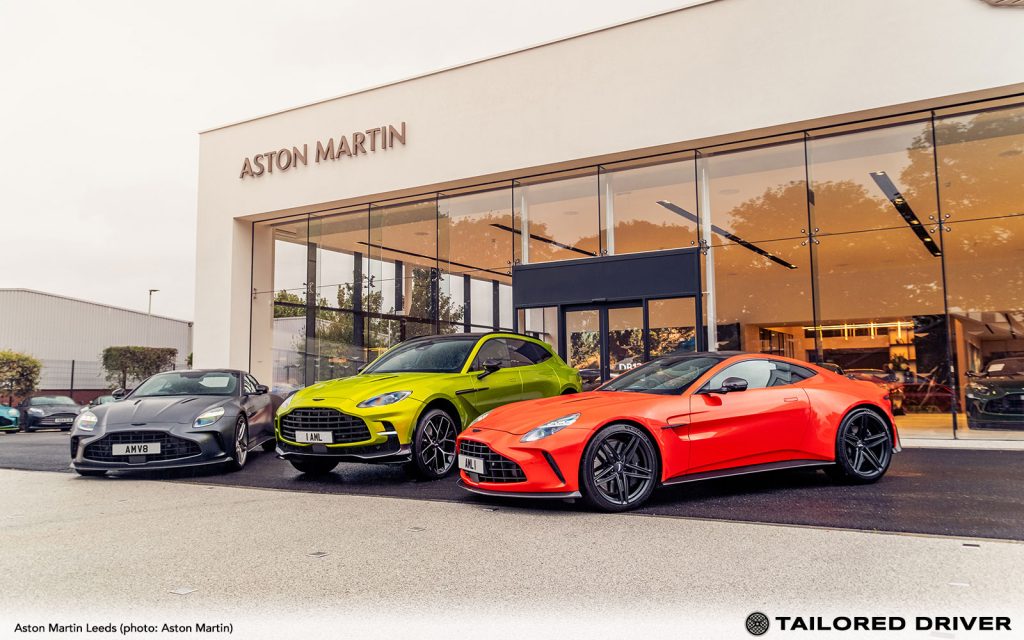
    Aston Martin’s footprint in the north of England is also boosted by the launch of a new state of the art 1468mdealership in Leeds, to be operated by Yorkshire-based automotive retailer JCT600. Located at its Brooklands location, the dealership offers customers an expansive ultra-luxury lounge and specification space, in addition to a display of 10 Aston Martin models at any one-time. Providing exceptional customer service across sales and aftersales, it also boasts a nine-bay dedicated aftersales facility and curated parts and accessories area, further heightening customer engagement and personalisation opportunities.

    The new locations are the first Aston Martin dealerships in the UK to embrace the marque’s new ultra-luxury vision and stand-out corporate identity and draw design inspiration from Aston Martin’s first global flagship location, Q New York, located on the high-profile corner of Park Avenue and West 57th Street.

    In addition to the new dealerships, Aston Martin is pleased to introduce Marshall Motor Group to the UK dealer network. Marshall will operate from Sevenoaks, representing the South East of England. The UK dealer network will continue to build a portfolio of new developments across the remainder of 2024 and 2025.

    Marco Mattiacci, Global Chief Brand & Commercial Officer at Aston Martin said: “The investment in these landmark new UK retail locations comes at the perfect time, as we bring to market the most diverse, dynamic and desirable portfolio within the ultra-luxury and high-performance automotive segments. The thrilling new Vantage, upgraded DBX707 and class-leading DB12 are now joined by our recently unveiled V12 flagship model, Vanquish, completing the strongest line-up of products in our history. It is brilliant to have this breathtaking portfolio available at world-class dealerships, providing the very highest standards in luxury customer experience.

    “The significant long-term investment being made from our UK dealer network represents the positive trajectory of the Aston Martin brand along with a strong confidence in the new portfolio of models we have brought to market. Alongside our partners, we will continue to invest in the retail strategy for our home market and internationally, through development of our network including high-profile flagship locations including a Central London location now identified and set to be revealed in 2025.”

    The new UK dealerships build on Aston Martin’s expansion in Europe with new showrooms and boutique locations in Baden-Baden, Nürnberg, Hamburg and Prague all to open before the end of 2024. Following the opening of a new landmark showroom inside the Peninsular Tokyo Hotel earlier this year, the brand’s presence in Asia will also be boosted by the official reopening of Aston Martin Seoul later this month, adding to the opening earlier this year of Aston Martin Suwon with new importer Britannia Auto, marking a new era for Aston Martin in South Korea.

    About Aston Martin Lagonda:
    Aston Martin’s vision is to be the world’s most desirable, ultra-luxury British brand, creating the most exquisitely addictive performance cars.

    Founded in 1913 by Lionel Martin and Robert Bamford, Aston Martin is acknowledged as an iconic global brand synonymous with style, luxury, performance, and exclusivity. Aston Martin fuses the latest technology, time honoured craftsmanship and beautiful styling to produce a range of critically acclaimed luxury models including the Vanquish, Vantage, DB12, DBX707 and its first hypercar, the Aston Martin Valkyrie. Aligned with its Racing. Green. sustainability strategy, Aston Martin is developing alternatives to the Internal Combustion Engine with a blended drivetrain approach between 2025 and 2030, including PHEV and BEV, with a clear plan to have a line-up of electric sports cars and SUVs.

    Based in Gaydon, England, Aston Martin Lagonda designs, creates, and exports cars which are sold in more than 50 countries around the world. Its sports cars are manufactured in Gaydon with its luxury DBX SUV range proudly manufactured in St Athan, Wales. The company is on track to deliver net-zero manufacturing facilities by 2030.

    Lagonda was founded in 1899 and came together with Aston Martin in 1947 when both were purchased by the late Sir David Brown, and the company is now listed on the London Stock Exchange as Aston Martin Lagonda Global Holdings plc.

    2020 saw Lawrence Stroll become the company’s Executive Chairman, alongside significant new investment. This coincided with Aston Martin’s return to the pinnacle of motorsport with the Aston Martin Aramco Formula One® Team and commenced a new era for the iconic British marque.

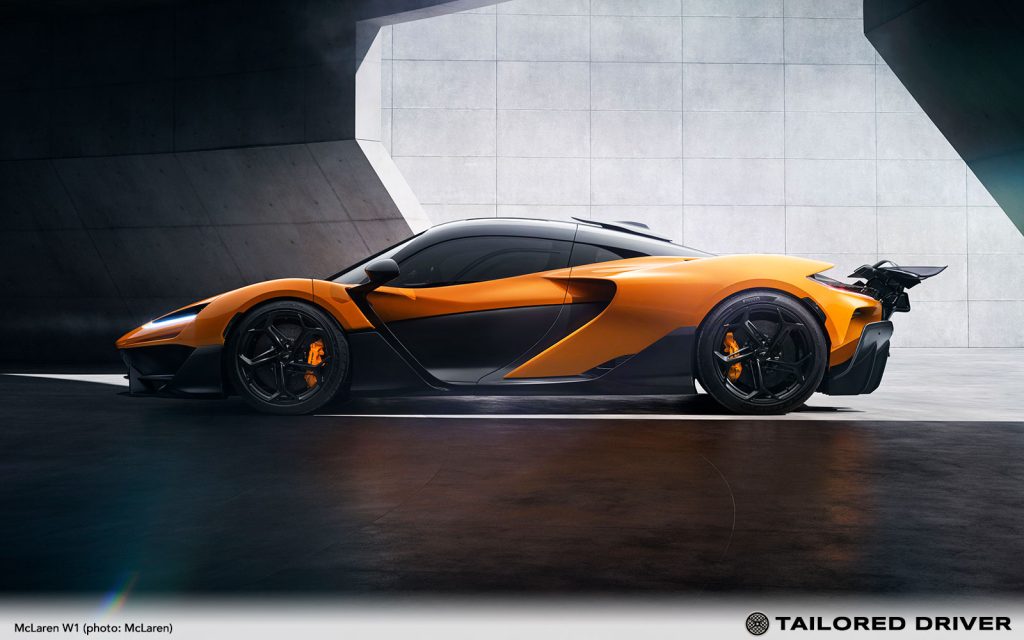
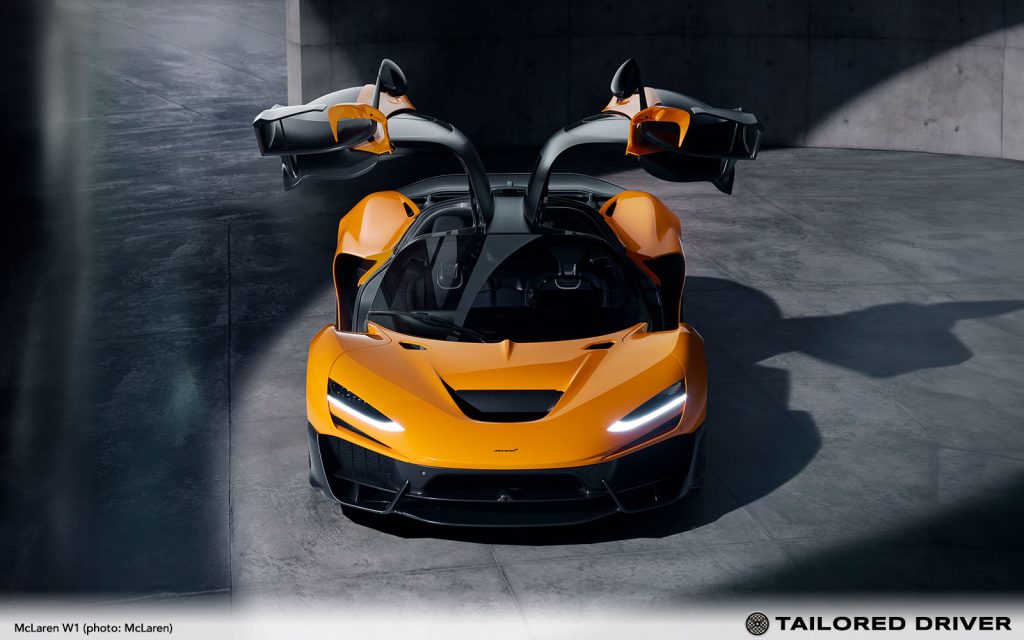
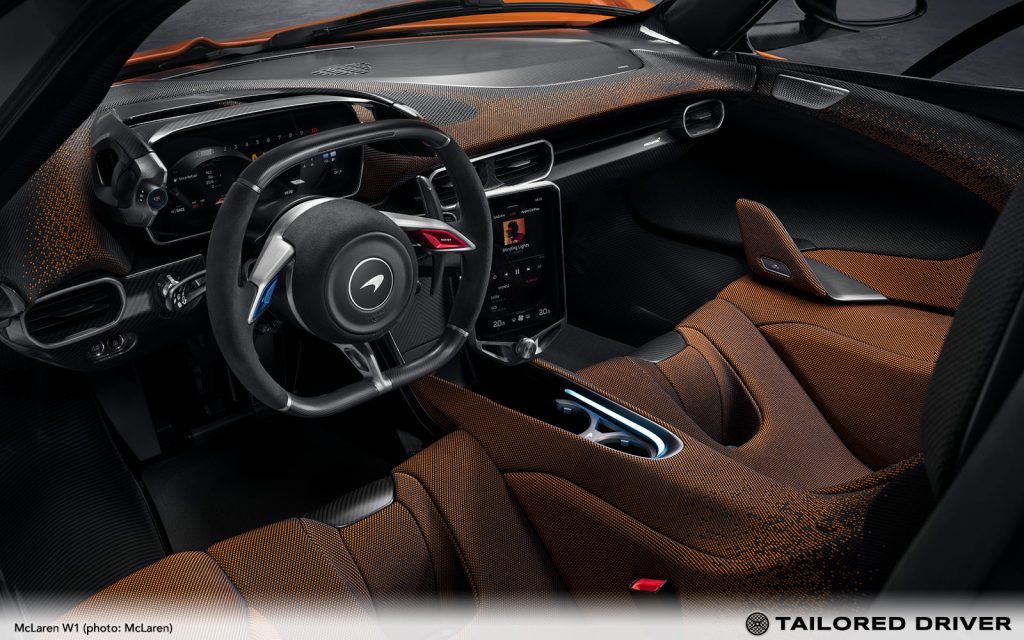
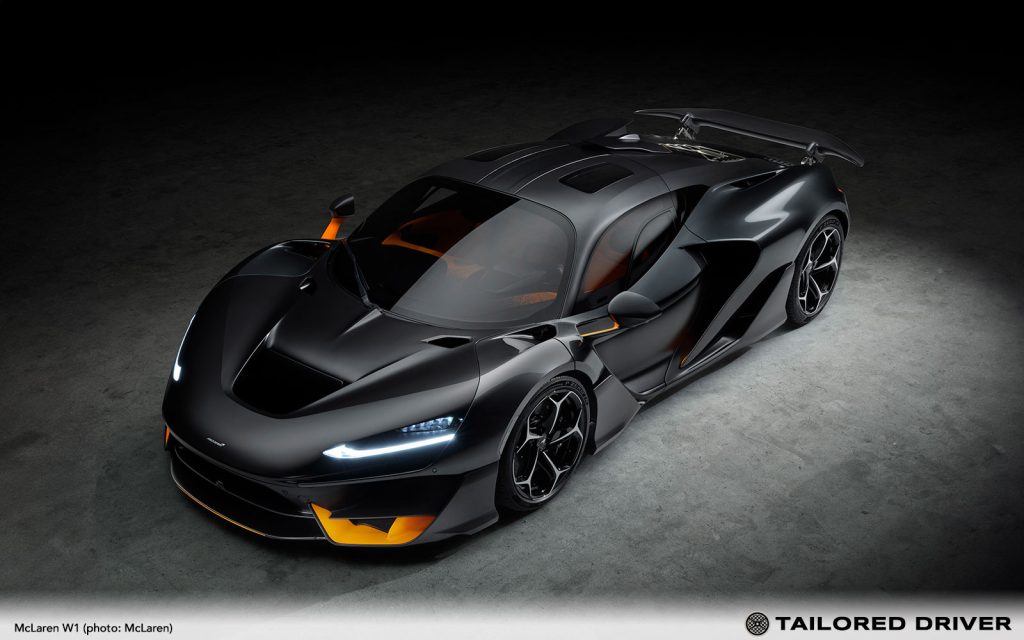
  • New McLaren W1 Supercar

    New McLaren W1 Supercar

    • Ground-breaking successor to two of the greatest supercars of all time – the McLaren F1 and McLaren P1TM – opens new chapter in McLaren’s famous ‘1’ car lineage
    • Created with McLaren’s World Championship mindset; underpinned by the principles that define a real supercar
    • Epic all-new V8 hybrid powertrain with 1275PS – the highest power output of any McLaren ever and greater than all core competitors
    • All-new MHP-8 V8 combustion engine develops 928PS – at 233PS per litre the highest-ever output from a McLaren engine – and revs to 9,200rpm
    • Power-dense E-module develops 347PS; integrates electric motor and control unit for reduced weight and optimised packaging
    • World-beating McLaren lightweight engineering delivers vehicle weight of 1,399kg, enabling best-in-class power-to-weight ratio of 911PS/tonne – the highest ever for any McLaren supercar
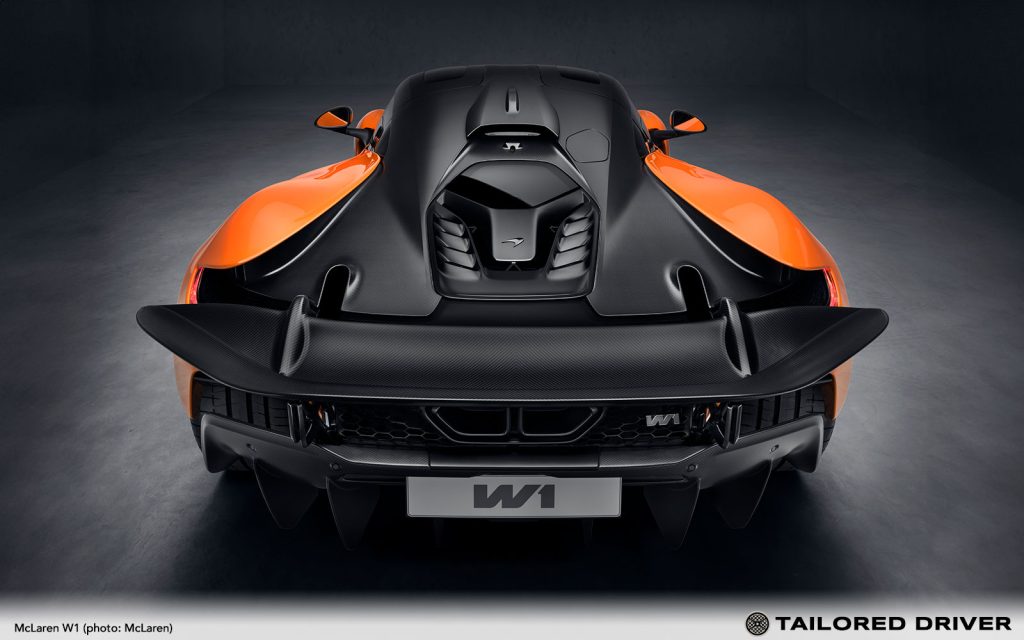
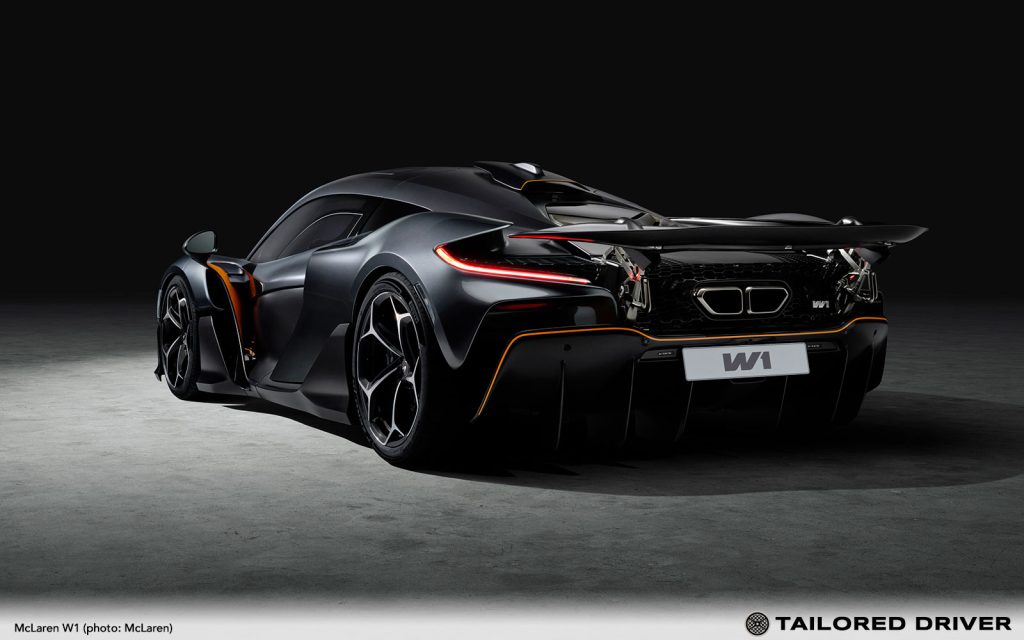
    • Formula 1-inspired ground effect aerodynamics and McLaren race mode combine to deliver world-first, radical ‘road to track’ character transformation, lowering ride height by 37mm at the front and 17mm at the rear and engaging up to 1,000kg of downforce
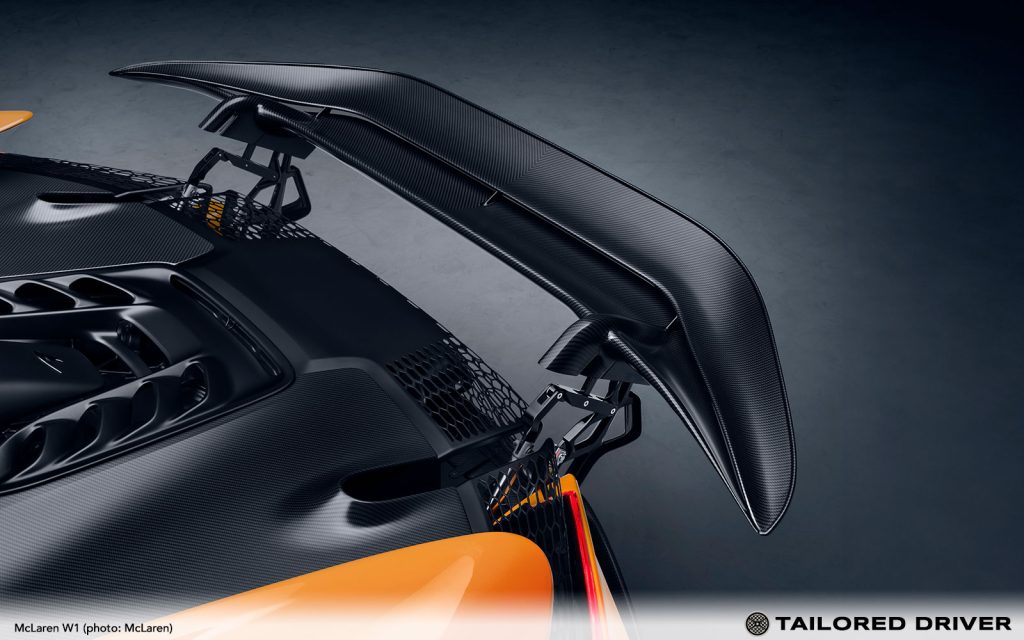
    • The most advanced active aero features ever in a road-legal McLaren, with revolutionary McLaren Active Long Tail rear wing that extends rearwards by 300mm just one of multiple patents filed for aerodynamic innovations
    • New W1 is fastest-accelerating and fastest-lapping road-legal McLaren ever, achieving the astonishing combination of being quicker than a Speedtail to 300km/h (186mph) in a straight-line and 3 seconds a lap ahead of a McLaren Senna on McLaren’s reference track
    • Incredible acceleration of 0-200km/h (0-124mph) in 5.8 seconds and 0-300km/h (0-186mph) in less than 12.7 seconds; maximum speed electronically limited to 350km/h
    • Pure driver control and engagement from McLaren trademark rear-wheel drive with 1275PS and 1340Nm made possible by extraordinary Formula 1 know-how that only McLaren as a racing company can deliver
    • New McLaren Race Active Chassis Control III suspension with Race mode ensures unparalleled breadth of capability across both road and track
    • Supreme feel and feedback from McLaren Hydraulic Performance Steering and hydraulic braking to create real supercar sensation
    • New 8-speed transmission with E-reverse, coupled with new hydraulic electronic differential
    • Bespoke McLaren Aerocell carbon fibre monocoque and McLaren Anhedral Doors optimised for aerodynamic performance; constructed using motorsport techniques
    • Formula 1-inspired front suspension is mounted directly into the Aerocell with externally visible front arms and key components 3D-printed for weight optimisation, including the use of titanium components
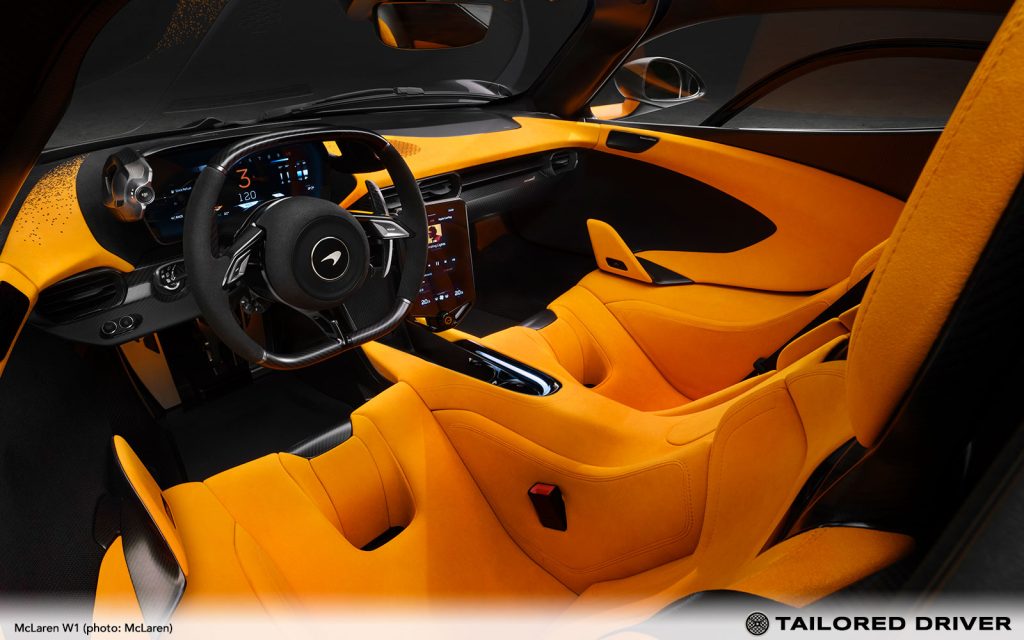
    • Unmatched supercar driver ergonomics and best-in-class visibility on road and track
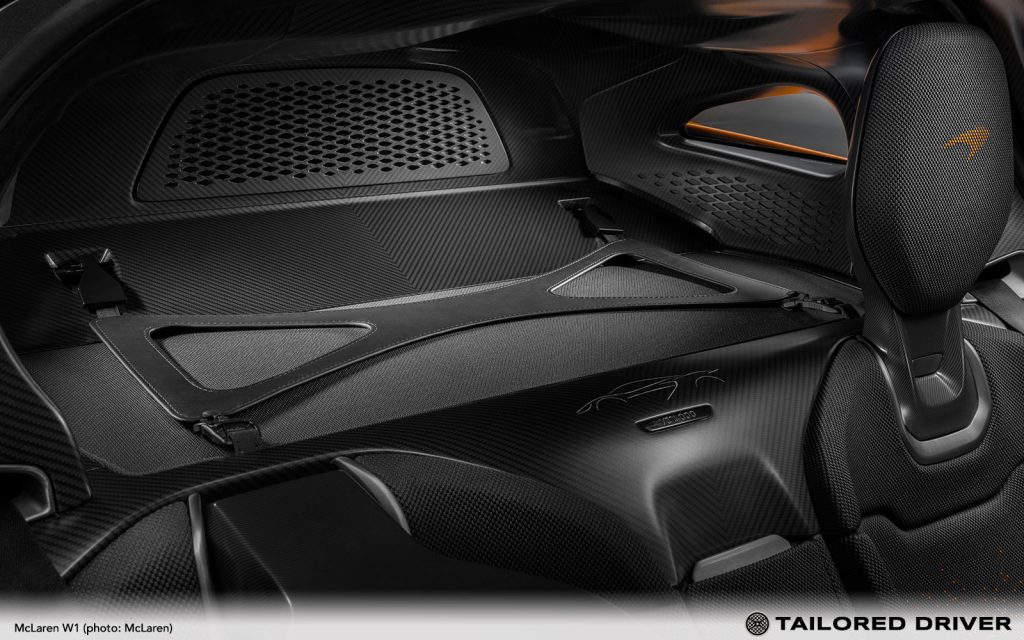
    • Unique seating design integrated into the Aerocell monocoque for the purest driver connection to the car
    • Pedals, steering wheel and primary controls move to fully embrace driver within the cockpit environment
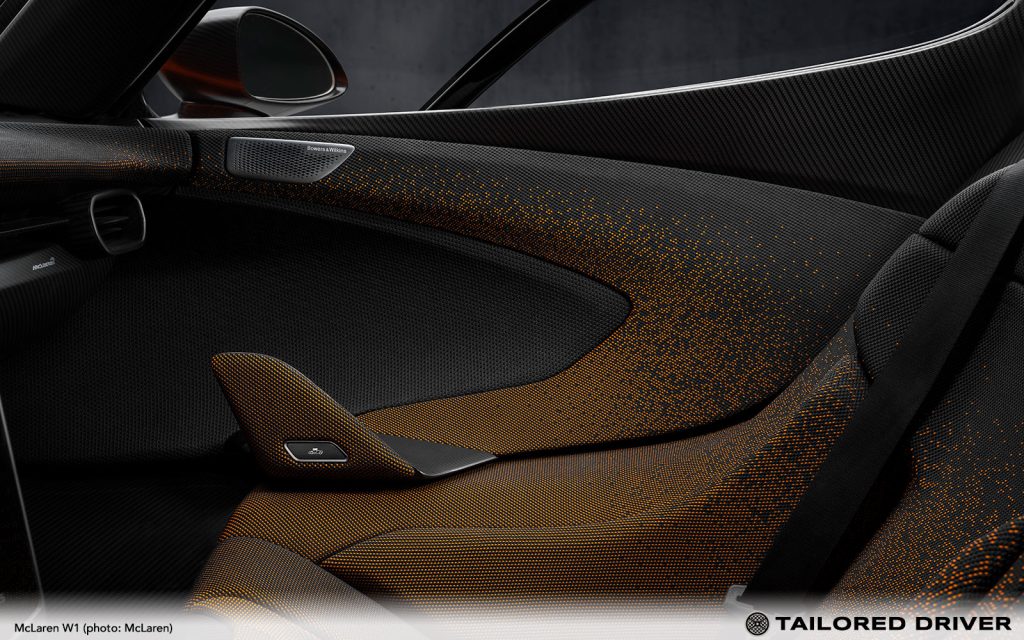
    • Virtually unlimited bespoke options available via MSO, including new McLaren InnoKnit tailored interior material
    • Comprehensive warranty (4-year vehicle; 6-year HV battery) and 4-year service plan complement unique ownership experience
    • Pricing from circa £2.0 million including taxes in the UK, with the final cost dependent on the level of MSO personalisation
    • Just 399 customer cars will be produced – and all are already customer allocated

    [source: McLaren]

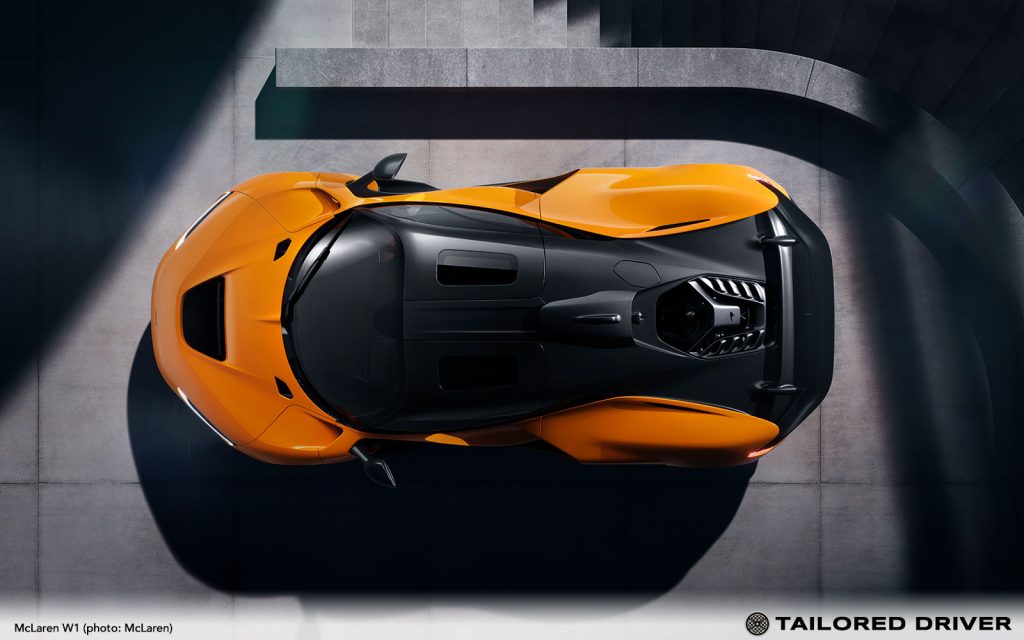
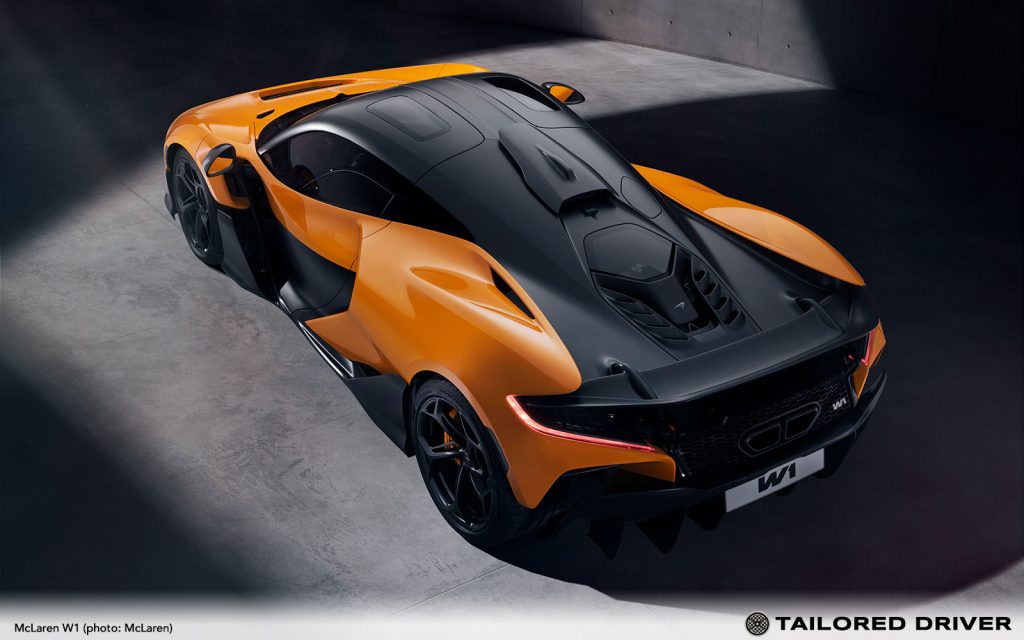
    The new McLaren W1 is the ground-breaking successor to two of the greatest supercars ever – the McLaren F1 and McLaren P1TM – and elevates the McLaren ‘1’ car lineage to new heights in every aspect of performance.

    The Ultimate expression of a real supercar, the new W1 has been created according to the McLaren ethos of class-leading performance, informed by the core principles that underpin every McLaren supercar: epic power applied through cutting-edge aerodynamics and lightweight chassis technologies; the highest levels of dynamic excellence and the purest driver connection; the perfect driver environment, for all driving situations; and awe-inspiring visual and aural drama.

    All of McLaren’s significant and renowned expertise in lightweight engineering and aerodynamic performance, inspired by years of racing innovation and the company’s World Championship mindset, was applied to W1. The engineering team behind the new McLaren Ultimate model have between them contributed to 16 McLaren Formula 1 World Championship titles across driver and constructor categories. This expertise as part of a bigger team has resulted in the most focused supercar that McLaren has ever built, but also one with a huge breadth of capability.

    “The McLaren W1 is a celebration of both the excellence of the iconic McLaren F1 and McLaren P1TM and the manifestation of McLaren’s World Championship mindset. With our new Ultimate supercar, we are again pushing the boundaries of real supercar performance with an epic hybrid powertrain featuring our all-new MHP-8 V8 engine, the most advanced aerodynamic platform of any McLaren road car and extensive use of advanced lightweight materials. This allows us to engineer a supreme track driving experience from the same car that gives unparalleled driving enjoyment on the road.

    “Formula 1-derived aerodynamics, pure rear-wheel drive and McLaren hydraulic performance steering showcase McLaren’s approach to purposeful innovation as a racing company that always delivers the best possible performance. It is therefore no surprise that the new W1 is our fastest-lapping and fastest accelerating road-legal car ever. It also provides the purest driver connection by remaining true to the principles that underpin the ultimate supercar driving experience. This really is a car that only McLaren could create.”
    Michael Leiters, Chief Executive Officer, McLaren Automotive

    W1 is a supercar for all occasions; more than any other McLaren, it is equally at home on road and track and as the fastest-lapping and fastest accelerating McLaren road-legal supercar yet, is exhilarating to drive whatever the circumstances.

    The spine-tingling driver enjoyment ensured by the W1’s revolutionary new high-downforce, low-drag, ground-effect aerodynamics design is further enhanced by the unique transformation process from Road mode to Race mode for track driving: W1’s ride height lowers (by 37mm at the front and 17mm at the rear) and a heave system stiffens the suspension. Front and rear active wings are deployed, with the McLaren Active Long Tail extending rearwards by up to 300mm to assist in generating the 1,000kg of downforce available in W1.

    The all-new MHP-8 4.0-litre twin-turbo V8 engine that debuts in W1 is coupled with a power-dense E-module to deliver scintillating speed. The epic power of this all-new 1275PS High-Performance Hybrid powertrain and McLaren’s relentless dedication to lightweight engineering has resulted in levels of performance previously only attainable by track-only supercars and race cars.

    Just as the W1 name celebrates McLaren’s World Championship mindset, the date of the public reveal of the car was also chosen with this in mind: October 6th 2024 is the 50th anniversary of Emerson Fittipaldi sealing McLaren’s first Formula 1 Drivers and Constructors World Championships.

    Epic performance from V8 High-Performance Hybrid powertrain with pure RWD
    At the heart of W1 is an all-new High-Performance Hybrid powertrain, comprising McLaren’s all-new MHP-8 V8 combustion engine, an all-new E-module (integrating a radial flux electric motor and motor control unit), and an 8-speed transmission with E-reverse. Power and torque are to the rear wheels only, through an E-differential.

    The 928PS of the new V8 and 347PS of the E-module combine to produce 1275PS, giving W1 the highest-ever power output of any McLaren and putting it above all core competitors. Engineered for epic power delivery and breathtaking performance, the powertrain combines with a vehicle weight of 1,399kg to deliver an astonishing power-to-weight ratio of 911PS/tonne for W1 – the highest-ever for any road-legal McLaren and more importantly, best-in-class.

    This huge amount of power, together with total torque of 1340Nm and instant throttle response from the E-module, gives W1 astonishing acceleration figures: 0-100km/h takes 2.7 seconds, 0–200km/h (124mph) is possible in just 5.8 seconds and 0-300km/h (186mph) can be achieved in under 12.7 seconds.

    McLaren has challenged convention by choosing to retain the purity of a rear-wheel-drive chassis in a car with this much power and torque, at a time when competitors are turning to front-wheel-drive assistance. Only McLaren could successfully achieve acceleration of this magnitude with dynamic performance to match in a rear-wheel-drive supercar, thanks to its extensive heritage in Formula 1 which exclusively deploys power through the rear wheels to reach the pinnacle of performance and ultimate steering precision.

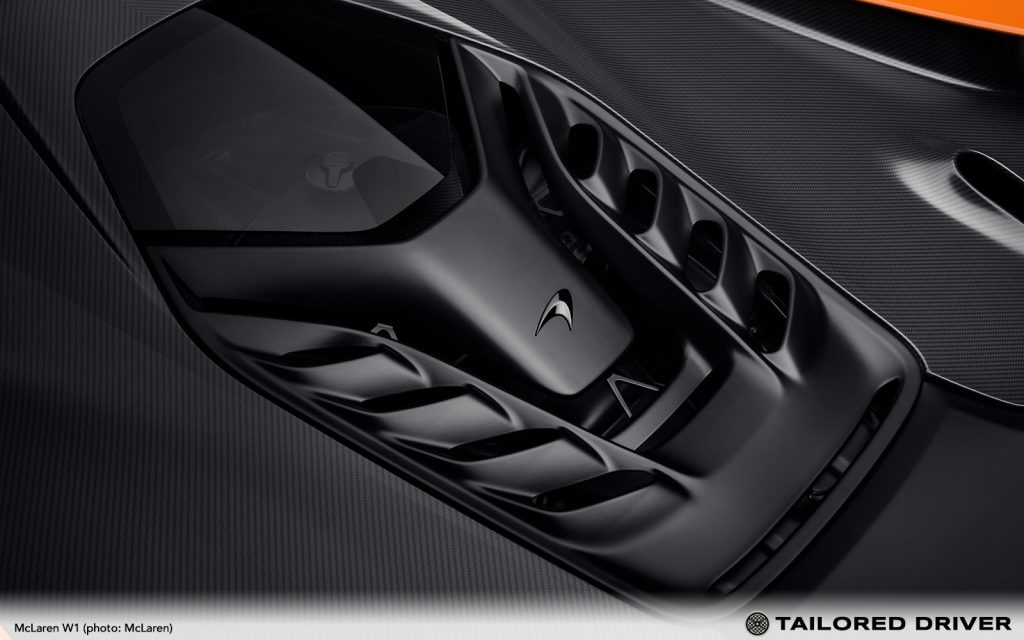
    McLaren’s all-new MHP-8 flat plane crank 90-degree V8 engine is central to the delivery of the W1’s epic power. Designed from the outset to be at the centre of the very best electrified powertrains, the twin-turbocharged 3,988cc unit has a lightweight block, cylinder heads and pistons in aluminium and showcases McLaren’s expertise in engineering combustion engines that set new standards – for example, plasma spray coated cylinder bores are employed to allow engine speeds of up to 9,200rpm.

    A 350bar Gasoline Direct Injection (GDI) system and port fuel injection extend the performance scope of the MHP-8 engine without adversely affecting emissions, enabling the highest-ever specific power output in a McLaren – a massive 233PS per litre.

    The twin-scroll turbochargers in W1 are optimised to deliver higher peak power and torque than previous components, available throughout the rev range and improved response from as low as 2500rpm.

    The exhaust features tubular manifolds that are engineered to maximise driver engagement as well as performance​, with long, equal-length runners tuned to build sound to a crescendo as the engine speed approaches its 9,200rpm electronic rpm limit.

    The motorsport-derived E-module that works in combination with the combustion engine is mounted to the side of the transmission and contributes up to 347PS. Comprising a radial flux E-motor and integrated Motor Control Unit – an engineering approach similar that taken in IndyCar racing – the E-module is a masterclass in maximising efficiency while minimising package volume and weight, The whole unit weighs just 20kg and further advantages include reducing coolant volume, low-voltage and high-voltage connections and seals. The sealed unit improves serviceability with a dry interface outside of the transmission unit.

    The E-motor element is capable of spinning up to 24,000rpm has a specific output of 23PS/kg, which is directly comparable to Formula 1 E-motors.

    The E-module is powered by a 1.384kWh battery, which together with the management unit and power distribution unit is enclosed on a structural carbon fibre floor housed within a cavity in the carbon fibre monocoque, located as low as possible to benefit vehicle centre of gravity.

    The motorsport-derived battery cells are designed to prioritise high power outputs to the E-module, increasing throttle response and boosting overall power to the levels needed to deliver the eye-watering levels of performance that W1 reaches. Even with this focus on maximising power, the W1 can be driven in zero-emission, electric-only mode for up to 2km (1.6 miles).

    The battery state of charge is managed to maintain a minimum level of charge to crank the engine on vehicle start-up, power for the reversing function and a reserve for when the car remains parked for extended periods.

    In line with McLaren’s commitment to minimising weight, the total weight of hybrid components has been reduced by 40kg compared to the McLaren P1TM while delivering almost double the electric power. Further weight is saved by the absence of engine ancillaries including the alternator, starter motor and additional pipework required for a conventional HVAC system.

    Born from Formula 1-inspired ground-effect aerodynamics
    McLaren has been synonymous with aerodynamic innovation and excellence since its very beginnings, with Bruce McLaren himself always determined to push for any advantage offered by new ways of managing airflow to balance lift and drag in the most efficient way possible. The 1967 championship-winning McLaren M6A Can-Am racecar employed ground effect aerodynamics with great success and while it was another decade before the technology came to Formula 1 – and the 1990s before the McLaren F1 showed how effective it could be in a road car – ground effect remains a significant advantage as part of an overall aerodynamic package for those car makers who can master it.

    It is no surprise then that the new McLaren W1’s striking design is defined by aerodynamic requirements, with McLaren’s engineers focusing on combining the high downforce and low drag that ground-effect innovations provide to the foundations for the new Ultimate McLaren’s extraordinary abilities.

    The aerodynamic platform of W1 is the most advanced ever in a McLaren road car, the result of 350 hours of wind tunnel sessions with 5000 points tested. The concept begins with the Aerocell monocoque, which is shaped to facilitate full ground effect aerodynamics. Featuring integrated seating – which saves almost 70mm in wheelbase requirement – and raised footwells with an adjustable pedal box and steering to ensure the optimum driving position, the Aerocell is unique to W1, which also features the highest number of aerodynamic and active surface areas of any McLaren.

    The Aerocell also incorporates fixings for McLaren’s first-ever Anhedral doors. The decision to adopt this door concept was dictated by aerodynamic requirements demanding a door design that is hinged only from the roof. In conjunction with the reduced-size side window drop glass, the McLaren Anhedral Door allows optimisation of airflow from the front wheel arches into the high temperature radiators, providing extra cooling space that allows the size of the radiators required to cool the powertrain to be reduced, optimising packaging and saving weight. The fact that the door shape is reminiscent of the bodyside of the McLaren MCL38 Formula 1 car is also a neat visual signature.

    The W1 builds on the Formula 1-inspired aerodynamic innovation that first distinguished the McLaren P1TM from its competition and has been honed in subsequent McLaren cars. The attention to aerodynamic requirements in W1 even extends to the powertrain, which is inclined by 3 degrees to accommodate the car’s high-downforce rear diffuser.

    The key to W1’s duality of dynamic character – offering a sublime driving experience on road and track alike – is McLaren Race mode. When deployed, this engages shape-shifting aerodynamic technologies to enable world-best, radical ‘road to track’ character transformation. Uniquely in W1, much of the downforce is achieved using all of the underbody for ground effect, with this maximised when Race mode is selected.

    The lowering of ride height – by 37mm at the front and 17mm at the rear – and deployment of active front and rear wings is not just theatre: in Race mode W1 is capable of generating up to 350kg of downforce at the front and 650kg at the rear, giving total downforce of up to 1000kg in high-speed corners.

    The active front and rear wings and a roof-mounted air flow diverter W1 are among the most advanced aerodynamic features ever in a road-legal McLaren. The revolutionary McLaren Active Long Tail rear wing – arguably visually the single most dramatic element of the new W1 – is absolutely integral to the aerodynamic performance of the car. McLaren’s first association with a ‘longtail’ name dates back to the 1997 F1 GTR, but in the case of this new Active Long Tail wing it is an essential part of the strategy for management of drag, lift and downforce.

    Actuated by four E-motors and moving up, down, and – depending on whether the W1 is in Road mode or Race mode – also 300mm rearwards and adjusting in pitch, the McLaren Active Long Tail extends the working area of the rear diffuser in Race mode and is key to the generation of downforce. It also operates in DRS and airbrake configurations as required to help optimise aerodynamic balance.

    The front wing is actuated by two E-motors and swings through an arc to create a full-width lower frontal area, feeding air under the car in Race mode via a Formula 1-style T-tray and keel. The two wings work in conjunction with each other and other elements of the design to allow fast and accurate management of aerodynamic requirements.

    For road driving the Active Long Tail wing sits over the rear bodywork and front and rear wing deployment is optimised for this environment, with the front wing sitting higher at low speeds to avoid damage from speed bumps. W1’s vehicle lift system further reduces this risk.

    The design of the front suspension also contributes to aerodynamic efficiency, with the lower wishbones of the pushrod and inboard damper system raised significantly to keep the channel of air flowing cleanly towards the rear of the car. Other components have an optimised aerodynamic profile to further assist. Conditioning airflow at the rear of the car is less of a priority since the diffuser manages this function, meaning outboard springs and dampers are the optimum solution.

    Dynamic genius without compromise, driven by McLaren DNA
    McLaren’s philosophy of Lightweight Engineering and the use of bespoke carbon fibre structures deliver a vehicle lightest dry weight of just 1,399kg for W1, which is key to the requirement for outstanding performance, everywhere – whether on road or on track.

    The all-new McLaren Race Active Chassis Control III suspension with McLaren Race mode ensures huge breadth of capability, from road-legal compliance to fastest lap performance and pure driver connection.

    The Comfort handling setting gives the occupants a smooth ride quality with increased body control at medium and high speeds, while Sport provides a more engaging, connected setup with focus on body control and agility at all speeds. When Race mode is selected a stable aerodynamic platform is prioritised, with an active heave element deployed for superior track dynamics and consistent downforce.
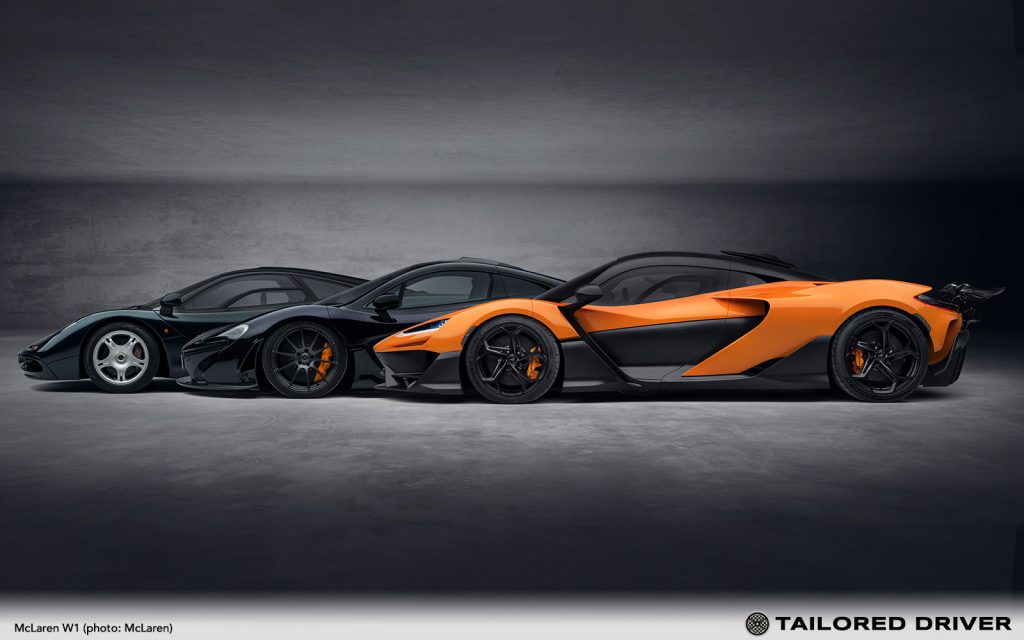
    W1’s suspension system works in combination with the front and rear active aero features integrated into a unique underfloor design delivering ground affect aerodynamics. This allows the required levels of load and grip to deploy the torque through the driven axle, mitigating the need for all-wheel-drive and therefore the additional weight required on the front axle. The ability to manage such a high level of torque on rear axle only is a key enabler to preserve McLaren’s best-in-class McLaren Hydraulic Performance Steering feedback and feel on the front axle.

    Continuing the Formula 1 influence, the front suspension setup also includes titanium torsion bars and an active heave element crosslink, while the rear has a Z-bar with active droplinks to control heave. In the relentless pursuit of light weight, 3D printing was used for the front uprights and wishbones of the advanced suspension system.
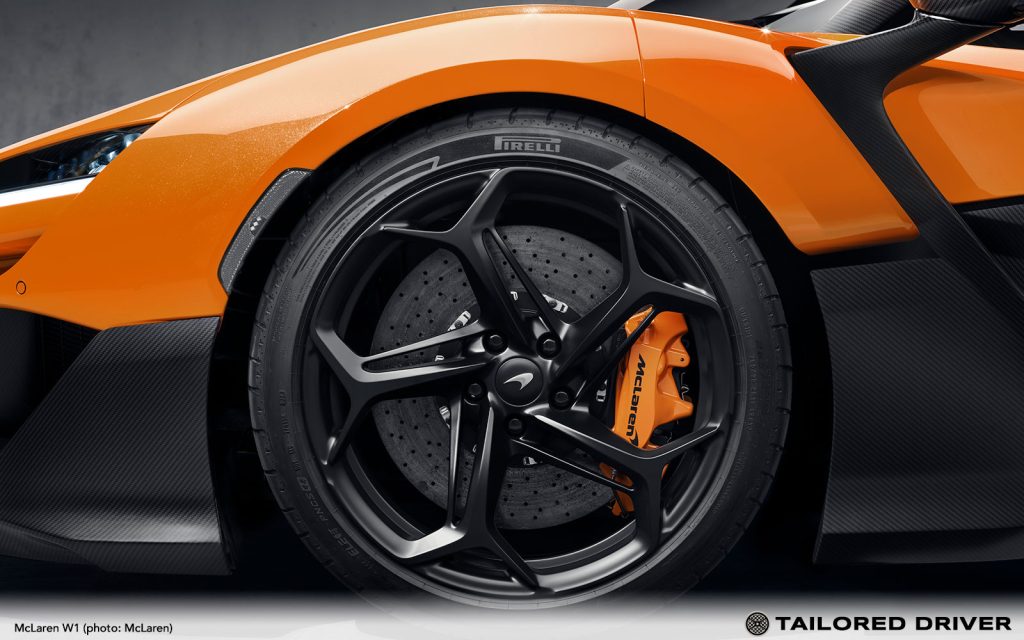
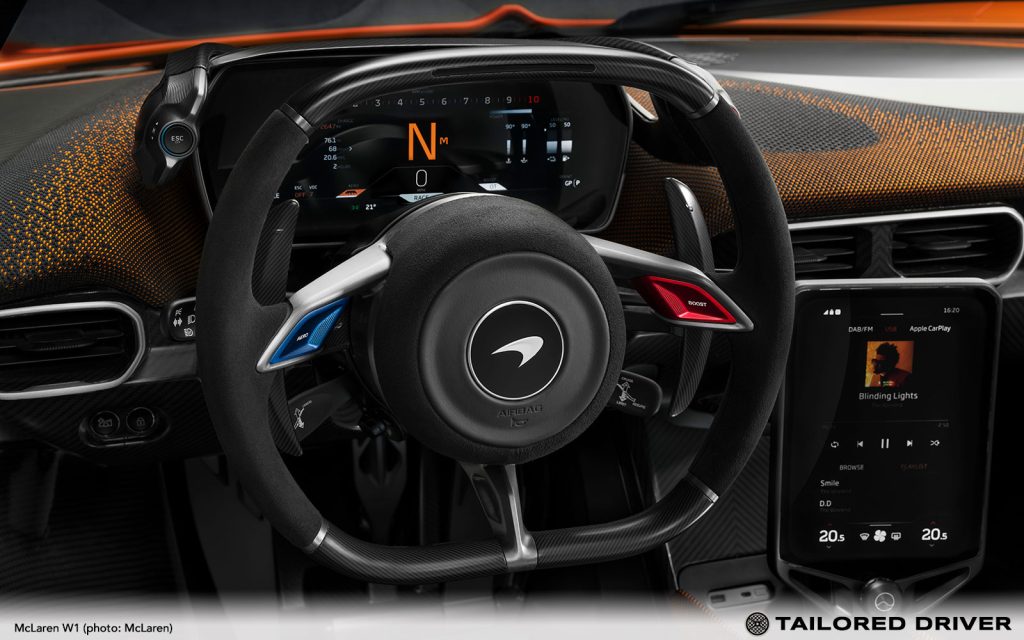
    Braking on W1 is a further advance on McLaren’s renowned high-performance hydraulic system, enhanced to meet the differing demands of flawless road and track response and feel while delivering Ultimate stopping power. W1 will come to a standstill from 100km/h in 29 metres and from 200km/h in just 100 metres.
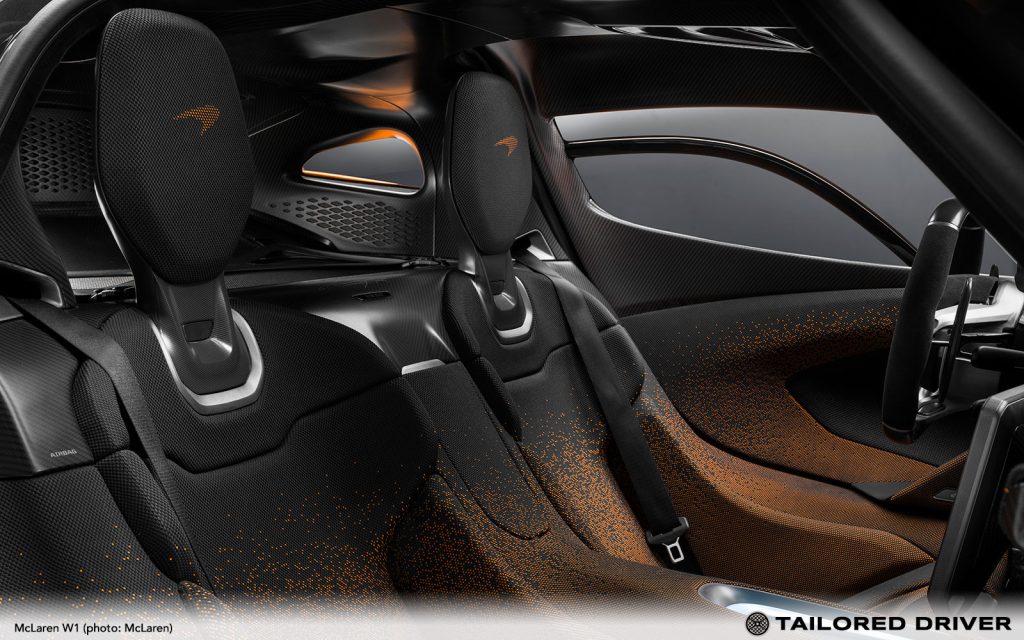
    The front brakes are activated with 6-piston calipers and the rear by 4-piston calipers, both of a forged monobloc design. The 390mm discs in the McLaren Carbon Ceramic Racing+ (MCCR+) system are unique to W1, featuring an additional ceramic layer compared to previous carbon ceramic discs. This provides greater durability while allowing for a more aggressive brake pad and higher friction levels to further increase braking efficiency.

    Brake performance is further optimised with aerodynamic features to keep the system cool. Directly inspired by Formula 1-style ducts, these have been designed to also increase downforce and radiator cooling by managing the wake of the tyres, while the brake lines have been routed to minimise airflow disruption under the car.

    The electronic parking brake is integrated on the rear calipers, saving weight while at the same time improving component stiffness.

    The fastest lapping and fastest accelerating road-legal McLaren ever
    Bettering even the super-lightweight and track-focused McLaren Senna – by an astonishing 3 seconds a lap at McLaren’s Nardo reference circuit – W1 is also the fastest accelerating road-legal McLaren ever. Hugely impressive in isolation, these two parameters are even more incredible when you consider that you need both high downforce and very low drag to achieve them.

    Inspired by the work of generations of Formula 1 Race Engineers, McLaren’s Race mode gives a choice of two suspension settings – Race and Race+, with the latter being the firmest available. This allows drivers to select settings according to whether they are on undulating, bumpy tracks where consistent aerodynamic downforce is needed, or flat, smooth surfaces on which the ground effect platform is optimised.
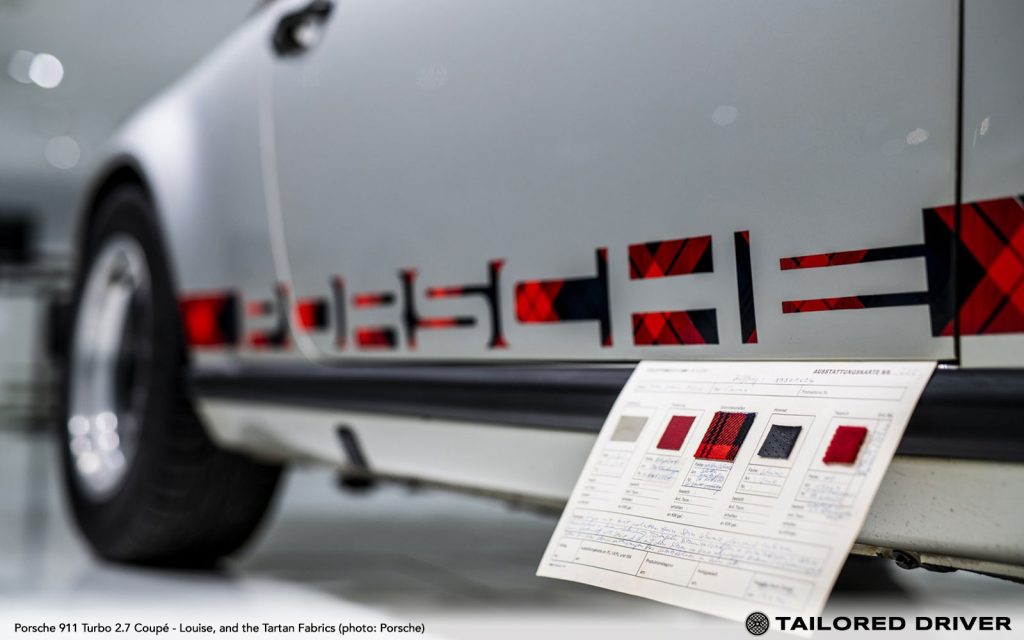
    Powertrain options in Race mode are a ‘GP’ setting for consistency over a longer track session, or ‘Sprint’ for maximum performance and E-module deployment over one lap. Two buttons on the steering wheel, ergonomically positioned within easy reach of the driver’s thumbs, give the driver further options: ‘Boost’ instantly deploys full E-module power available – the same principle as employed in Formula 1 – to give the driver everything for overtaking on track or additional speed out of corners as desired. This can be combined with the Aero button for an on-demand Drag Reduction System (DRS) effect from the rear McLaren Active Long Tail wing.
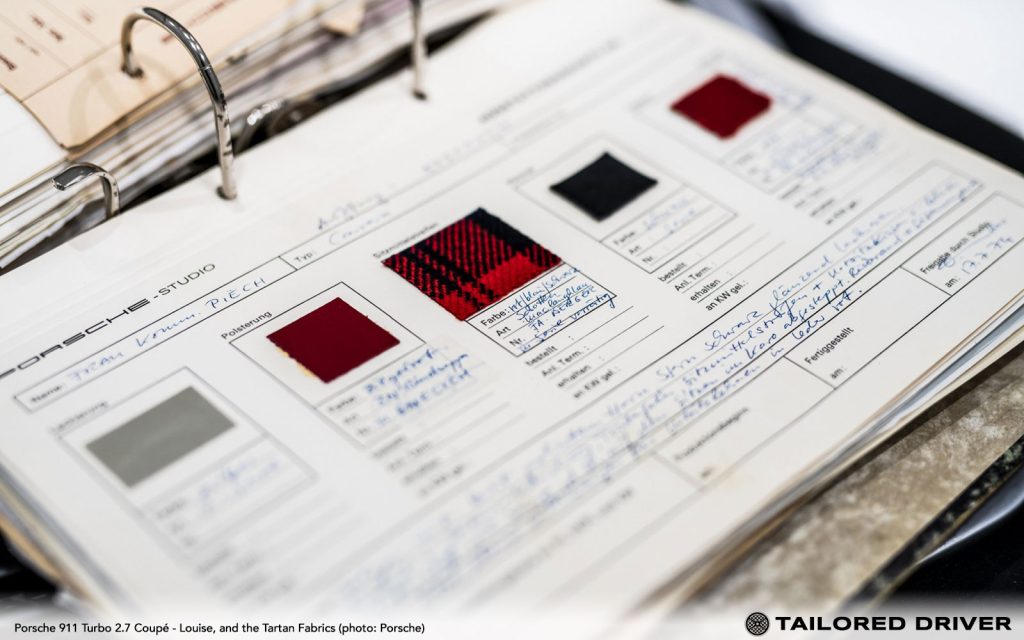
    Tyre performance is intrinsic to mechanical and aerodynamic grip and W1 features three 265/35 front and 335/30 rear tyre options from McLaren’s technical partner, Pirelli. To fit the car’s extreme requirements, the Pirelli P ZEROTM Trofeo RS road legal track tyre is the standard fitment. The tyre has a compound specially developed to maintain the highest performance and consistent grip over a track session. Pirelli P ZEROTM R and Pirelli P ZEROTM Winter 2 tyres – again both bespoke to W1 – are also available, the former being a road-focused solution and the latter delivering outstanding cold weather performance.
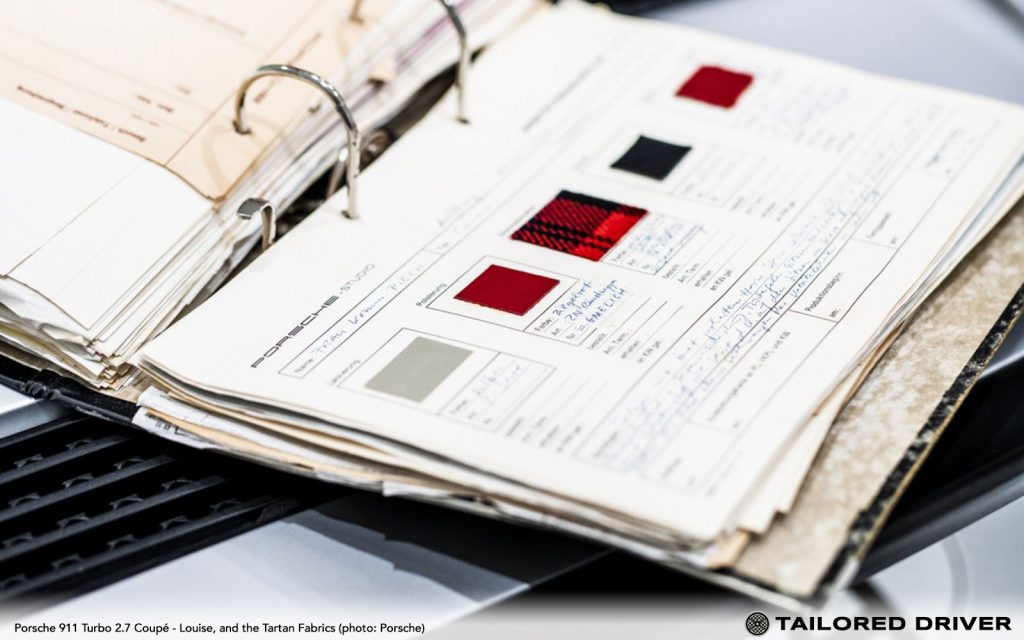
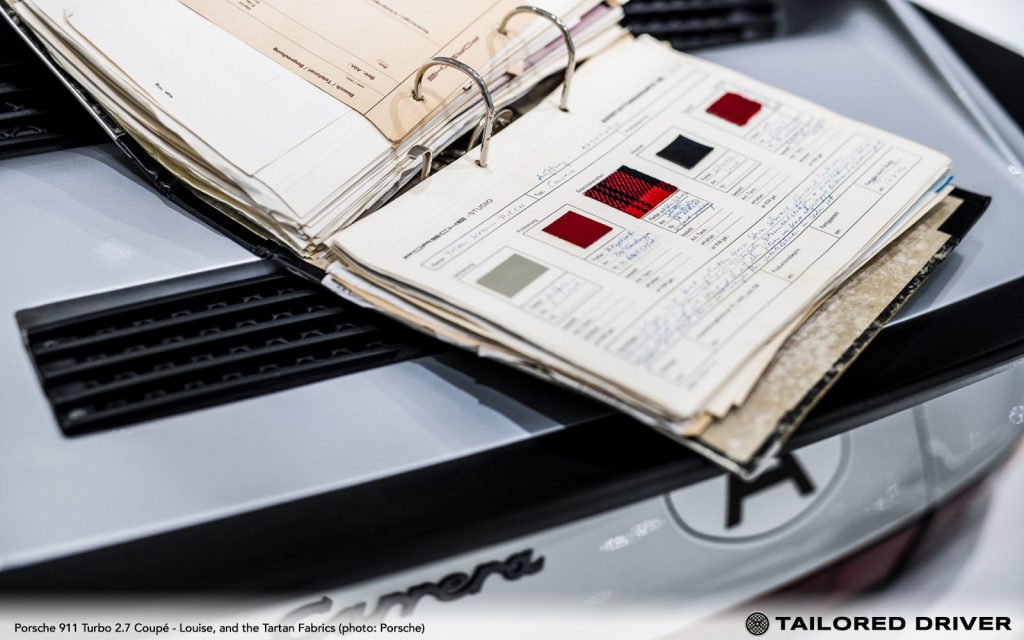
    The perfect supercar driving environment
    The excitement of driving W1 begins with the McLaren Anhedral Doors opening upwards to reveal recesses in the roof and the front lower opening that help to provide access to the innovative and comfortable cabin. The doors also feature a sculpted concave section on the inside to maximise occupant space.

    As is core to the McLaren DNA, W1 has unmatched supercar ergonomics and best-in-class visibility, with remarkably spacious cockpit room for both driver and passenger. Glazed sections in the rear three-quarter view and optionally in the upper doors provide an airy feel to the interior. Forward vision is exceptional, with the W1 incorporating McLaren’s narrowest A-pillars yet. Even the sun visors are designed with lightweighting in mind; made from carbon fibre, they are just 3mm thick.

    Seating is uniquely integrated into the McLaren Aerocell carbon fibre monocoque, directly connecting the driver – and passenger – to the chassis. Both seats are fully upholstered for optimal support and comfort and provide a driving position that is more reclined than usual, with a high level of thigh support.

    The pedals, steering wheel and primary controls move to fully embrace the driver within the cockpit environment, with a perfect driving position easily found by adjusting the floor-mounted aluminium pedals, which have a unique adjustment action. The unique-to-W1 wheel is smaller and flatter than previous McLaren steering wheel designs. Integral shift lights that prompt the driver to select the next gear as the 9,200rpm redline approaches, are optionally available.

    True to the McLaren supercar principle of a pure driver-focused interface, the only two buttons on the steering wheel are Boost and McLaren Aero Deployment controls. Inspired by Formula 1, these have been ergonomically designed to be easy to reach and activate by the driver moving their thumbs and not their hands from the wheel.

    Chassis and powertrain modes are adjusted via rocker controls on the instrument binnacle, which moves with the steering column to allow mode adjustments within easy reach of the wheel. The W1’s driver display has been engineered to ensure the full screen remains visible to the driver despite the smaller steering wheel and even doubles as an aerodynamic flow diverter for air from the compact HVAC system – which efficiently provides cool or warm air as desired in all driving modes, including EV-only operation.

    Further theatre is provided by overhead start/stop, gear selection and Race mode switchgear together with the window controls. These are housed by the digital rear-view display; designed to resemble a conventional rear-view mirror for driver familiarity, the camera position and angle is deliberately placed to discreetly display a small section of the Active Long Tail wing in order to give context and perspective to the driver’s rear view to ease vehicle positioning in traffic and low-speed manoeuvring including parking.

    Further information and adjustments can be found on the high resolution 8” touch screen McLaren Infotainment System (MIS II) located between the driver and passenger. This has Apple CarPlay with USB C connectivity, with USB A also provided for device charging and storage access.

    Between the fixed seats there is a storage area with a sliding cupholder, while there is a second area for small items behind the armrest. The W1 also has a luggage stowage shelf behind the seats, accessible by moving the headrests, which fold flat forwards to provide a loading platform. With up to 117 litres of storage space, two weekend bags or two crash helmets can be accommodated.

    Visually arresting engineering
    McLaren’s Performance by Design strategic approach centres on the five key principles of McLaren’s design DNA – Epic, Athletic, Functional, Focused and Intelligent – and the new W1 clearly meets this brief. The heavily sculpted form – with almost every panel made from carbon fibre – is immediately recognisable as a McLaren supercar and a bold visual demonstration of the W1’s duality of character, the smooth, flowing upper surface contrasting with the extreme and uncompromising ground effect underbody.

    The front aspect of W1 showcases its aerodynamic brilliance, with a large amount of lower bodywork layering designed to condition the flow of air towards aerodynamic surfaces heading towards the rear of the car. The upper nose section features intakes around the lights and upper wheelarches, with a large single nostril in the centre of the bonnet. At the rear of this is an aerodynamic blade that lifts to reveal the EVSE charging port, brake and washer fluid reservoirs. Visible carbon fibre aerodynamic structures and exposed suspension components are also a theme that echoes throughout the car.

    The side aspect of W1 is influenced by Formula 1 sidepod design, with a wide cut-out for the convex-shaped door that creates space for air to exit the front wheel arch via two outlets – through which the front suspension arms can be seen – and two large intakes ahead of the rear section. The most prominent of these, which feeds the high temperature radiators, is triangular in shape and provides an undercut in which the second intake is located ahead of the rear wheel and features a channel that feeds the rear diffuser and brake ducts. Even the side mirrors have been designed with aerodynamics in mind; they are placed as far outboard as possible on a support blade and are shaped to direct their wake away from the rear of the car so as not to disrupt efficiency of the radiators or the Active Long Tail wing.

    The heavily-haunched rear bodywork includes an intricately detailed engine cover that sits below the flow diverter, which also houses the shark fin audio and navigation antennae and sits above and forward of the central stop light and rear-view camera. This directs clean air towards the twin-element Active Long Tail wing, which sits above the large twin centre-exit exhaust. Completing the muscular rear section is the prominent multi-fenced rear diffuser.

    Seen from above, W1’s form is remarkably clean for an aerodynamically-led design, with a pronounced hammerhead-shaped nose and tight teardrop cabin form, which then opens up to the McLaren Active Long Tail wing. This is contrast to the strikingly complex lower bodywork, which is intentionally detailed to fully optimise ground effect.

    Exceptionally individual and uniquely desirable 
    Virtually unlimited bespoke personalisation is available through McLaren Special Operations, giving owners freedom to create their very own unique supercar. A range of luxury and innovative interior materials are available, including the world-first use of McLaren InnoKnit, an infinitely flexible and super-lightweight material tailored to seamlessly integrate interior surfaces and components. This material is knitted to fit, removing any wasteful cutting or sewing requirements.

    InnoKnit can be tailored to many and multiple colours, textures and shapes with precision patterns and has also been integrated into audio and visual elements, with the use of graphic elements to diffuse and project ambient cabin lighting. The material can also be incorporated into the speaker grilles of the W1’s high-specification Bowers & Wilkins bespoke audio system.

    The W1’s exterior details, including the use light and dark body surfaces partly inspired by its aerodynamic styling but also current Formula 1 livery design, also creates limitless opportunities for customers to personalise their own car with McLaren Special Operations (MSO) using visualisation tools including virtual reality and augmented reality to create their own unique W1.

    Ultimate warranty provision with servicing and maintenance to match
    Every W1 comes as standard with a comprehensive warranty [4-year/unlimited mileage vehicle; 6-year/75,000km HV battery] and a 4-year inclusive service plan that complements a unique ownership experience.

    The new hybrid powertrain has been developed to a maintenance cycle similar to the V6 hybrid powertrain and the service schedule for W1 will follow a 12-month cycle. This is in line with McLaren series production supercars rather than schedules of many track-focused cars which have reduced service intervals based on the number of hours of running.

    With the 399 examples of W1 that will be built all allocated. Further information about the W1 can be found at: https://cars.mclaren.com/en/W1

    The new McLaren W1 in detail
    W1 is a supercar that embodies all of the fundamentals of performance, honed through decades of motorsport and supercar innovation. Underpinned by epic power and a light vehicle weight of just 1,399kg – which combine to give a best-in-class ratio of 911PS-per-tonne – W1 not only eclipses all other road-legal McLarens on both acceleration and lap times, it redefines supercar acceleration and performance full-stop. In delivering ground-breaking low drag for straight-line performance and high downforce for awesome cornering ability, especially with the unique new McLaren Race mode engaged, we have elevated the standards for real supercar credentials to an entirely new level”. 
    Marcus Waite, Head of Attributes and Performance, McLaren Automotive and former Formula 1 Race Engineer.

    Epic performance from V8 High-performance Hybrid powertrain with pure RWD

    • All-new 4-litre twin-turbo 90-degree V8 engine with highest specific output of any McLaren – at 233PS/litre
    • Motorsport-derived E-module and battery provides up to 347PS for perfect throttle response and epic combined power
    • All-new 8-speed gearbox and E-differential deploys up to 1275PS and 1340Nm to the rear wheels for maximum driver engagement
    • Powertrain inclined within chassis by 3 degrees to accommodate high-downforce rear diffuser

    “To build the most authentic next-generation supercar requires an all-new powertrain and at the heart of this is our new V8 twin-turbo internal combustion engine. We’ve designed it to be much more power-dense than our previous V8 – generating 233PS per litre and capable of revving higher – at 9200rpm in W1 – with greater outputs as well as supreme driver engagement. Coupled with a motorsport-derived E-module and battery and driven through an all-new gearbox and E-differential, it is our most extreme – and exciting – powertrain yet.”
    Richard Jackson, Chief Engineer, Powertrain, McLaren Automotive – 30 years of Powertrain expertise, 10 of these at McLaren, including the M630 V6

    The W1 features the McLaren High-performance powertrain with an all-new V8 engine, E-module unit and transmission designed for epic performance. McLaren’s relentless approach to light weight engineering has produced a system that is power-dense, contributing to W1’s astonishing output and power-to-weight ratio.

    The combined output of the HPH powertrain is 1275PS and 1340Nm, with instant throttle response from the torque of the E-module. This translates to 0–200km/h (186mph) in 5.8 seconds and 0-300km/h in under 12.7 seconds. W1 is also capable of zero-emissions driving on electric power alone.

    The attention to aerodynamic requirements in W1 extends to the powertrain, which is inclined by 3 degrees to accommodate the rear diffuser. A key focus of the powertrain development programme has been optimising cooling requirements with the aerodynamic concept of the vehicle to deliver sustained, high-performance in track conditions. The car runs three separate water glycol circuits running at different temperatures: a high temperature circuit cools the engine with four radiators, two at the front and two in the middle of the car. A low temperature circuit is used for charge cooling for maximum performance with the front centrally-mounted radiator. A dedicated hybrid cooling circuit is used to cool the E-module, high voltage battery, charger and DC/DC converter.  The transmission is cooled by a thermostatically-controlled oil-to-air radiator for maximum cooling on track. Including HVAC, engine oil cooling and battery dielectric cooling a total of 10 heat exchangers are used in the cooling system.

    W1’s Powertrain modes have been set up to optimise driving in all environments. In addition to an Electric mode for near-silent EV running, Comfort mode – default on startup – provides relaxed cruising for town and motorway driving using the E-module for torque infill only. In Sport mode, the E-module is fully deployed for full hybrid power with ignition cut gear shifts and a more engaging throttle response. Race mode offers a Sprint setting for maximum power from the E-module and combustion engine, while Grand Prix focuses on consistent performance over a whole track session, balancing E-module deployment and harvesting.

    The fact that the new McLaren W1 is rear-wheel drive-only when such astonishing levels of power and torque are available is tribute to McLaren’s incredible heritage in racing, where successfully developing vehicle platforms able to deploy large amounts of torque to the rear axle is essential. At a time when competitors are turning to front-wheel-drive assistance, McLaren’s Formula 1 knowledge and expertise – in combination with meticulous engineering attention to lightweighting, weight distribution and finely tuned vehicle dimensions and kinematics – provided the competitive advantage to deliver the rear-wheel drive solution that is true to supercar principles and only McLaren could deliver.

    All-new, next generation V8 engine
    The W1 debuts the all-new 4.0-litre twin-turbo flat plane crank V8 engine that will, alongside the M630 V6, power the next generation of McLaren hybrid supercars. Like the V6, it has been designed to be extremely power-dense and is capable of much higher outputs than the previous generation M840T.

    The McLaren designed MPH-8 90-degree V8 has a lightweight aluminium engine block, cylinder heads and pistons. It features direct injection with fuel port injection and spray plasma coated bores, which at 92mm, allow higher engine speeds, with a stroke of 75mm for a total capacity of 3,988cc.

    In extending the engine speed range, valve actuation uses sliding finger followers with a Diamond-Like-Carbon (DLC) coating. To reduce the loads in the system the new engine also uses hollow intake valves enabling the use of a lighter, single valve spring per valve arrangement in addition to sodium cooled hollow exhaust valves.

    Due to the higher speeds and loads of the all-new engine, a novel approach has been taken for the crankshaft torsional damper. Unlike conventional road car engines that use external dampers, the new V8 has an internal viscous damper where the viscous fluid is actively oil cooled through a labyrinth cooling channel.

    Lubrication is through an electronically controlled variable displacement vane oil pump. The dry sump is scavenged by a four-stage pump that uses gerotors rather than gear pumps for improved mechanical refinement. The scavenge pump feeds an oil tank which has been specifically developed for the extreme G-loads that W1 can generate. 

    As a result the engine is capable of revving to 9,200 RPM – more than any previous road-legal McLaren – generating 928PS, a specific output of more than 233PS per litre. Total combustion output alone is an astonishing 103PS more than the McLaren Senna GTR, which is the most powerful application for the previous-generation M840T V8. A wide band of torque peaks at 900Nm as the power builds to a crescendo approaching the 9,200 RPM redline. Despite the higher output, the MPH-8 is also marginally lighter than the M840T series and 55mm shorter.

    The exhaust manifold feeds large capacity twin-scroll turbochargers. The turbine and compressor have been optimised to deliver higher peak power and a significant increase in torque throughout the speed range compared to the M840T. Up to 30% greater torque is available giving instant response from as low as 2500rpm. The compressors feed the engine through charge coolers, with low-volume intake manifolds connected directly to the intake ports to maximise performance and transient response.

    The exhaust features tubular manifolds that are engineered to maximise driver engagement as well as performance​, with long, equal-length runners tuned to build sound to a crescendo as the engine speed approaches its 9,200rpm electronic rpm limit.

    E-module and battery
    The all-new V8 engine has also been designed from the outset to be centre of the very best electrified powertrains and W1’s E-module has been designed to boost power and torque and provide acceleration and response times appropriate to the V8’s extremely high output.

    W1 uses a motorsport-derived E-module mounted to the side of the transmission that contributes up to 347PS. The E-module consists of a radial flux E-Motor capable of spinning up to 24,000rpm with a specific output of 23PS/kg, which is directly comparable to Formula 1 E-motors. This is combined with an integrated Silicon Carbide Motor Control Unit (MCU), which converts the high-voltage DC current of the battery to AC current. Combining the two units maximises efficiency and minimises package volume and weight; the whole unit weighs just 20kg. Further advantages include reducing coolant volume, low-voltage and high-voltage connections and seals. The sealed unit improves serviceability with a dry interface outside of the transmission unit.

    The E-module is powered by a 1.384kWh battery, which is conditioned using second-generation dielectric immersion cooling, transferring heat into the dedicated electric drive cooling circuit through a heat exchanger for increased cooling during sustained track running. The battery, management unit and power distribution unit is enclosed within a fireproof cover and mounted on a structural carbon fibre floor. It is housed within a cavity built into the carbon fibre monocoque – located as low as possible to benefit centre of gravity – and is further shielded from impact by the engine, transmission and rear structure.

    The battery cells are also motorsport-derived and specifically designed to prioritise high power outputs to the E-module to increase throttle response and boost overall power.

    The battery state of charge is managed to maintain a minimum level of charge to crank the engine on vehicle start-up, power for the reversing function and a reserve for when the car remains parked for extended periods. W1 has an onboard charger that supports EVSE connection, allowing the battery to be replenished to 80% in just 22 minutes.

    The total weight of hybrid components has been reduced by 40kg compared to the McLaren P1TM while delivering almost double the electric power. Further weight is also saved by the reduction of engine ancillaries including the alternator, starter motor and additional pipework required for a conventional HVAC system.

    All-new eight-speed transmission
    The W1’s transmission is an all-new 8-speed DCT with a much higher torque capacity than previous McLaren transmission systems. The E-module torque is fed into the transmission downstream of the clutches allowing the W1 to deliver combined torque from the V8 engine and E-module of 1340Nm at the input shaft.

    The hybrid power is transmitted via an all-new hydraulic E-differential to the rear wheels for heightened driver involvement. The purity of driver connection from rear-wheel drive has long been recognised as one of the principles of supercar engineering, the benefits to vehicle balance under power which the driver can adjust to influence lateral movement. In conjunction with McLaren Hydraulic Performance Steering uncorrupted by driven wheels, this allows drivers to fully engage with their car to bring maximum enjoyment, on track or on road. 

    With W1’s powertrain delivering 1275PS, the level of sophistication in the transmission, the suspension system, the steering, the brakes and the tyres needed to be equal to this epic power delivery. And while drivers have the option to disengage electronic controls, the levels of precision and freedom these simultaneously offer is testament to the expertise McLaren has brought to W1. Acceleration from standstill to 200km/h in just 5.8 seconds in a rear-wheel drive only supercar – the most powerful in its class against core competitors – is simply astonishing.

    Born from Formula 1-inspired ground-effect aerodynamics

    • W1’s entire underbody designed to deploy full ground effect aerodynamics
    • McLaren active front and Long Tail rear wings deploy dramatically to condition air under the car and extend diffuser area in Race mode
    • Total downforce limited to 1,000kg with low aerodynamic drag
    • At least 350 hours of wind tunnel sessions with 5,000 points tested and over 3,000 CFD simulation runs carried out in development followed by multiple patent applications

    “The McLaren W1 is the perfect execution of a bold and ambitious aerodynamic philosophy that delivers impressive lap times through not only high downforce but optimal aerodynamic behaviour and active control. The all-integral aerodynamic platform with the Aerocell as the centrepiece enables fully underbody ground effect in Race mode. Inherently efficient, W1 deploys staggering level of downforce for relatively little drag. Thanks to numerous innovations, we have succeeded in incorporating elegantly F1-inspired vortical flow field to an uncompromised road car.”
    Robin Algoo, Principal Aerodynamics Engineer, McLaren Automotive and former Formula 1 aerodynamicist

    The W1 builds on the Formula 1-inspired aerodynamic innovation that first distinguished the McLaren P1TM from its competition and continued with subsequent Ultimate models and supercars. While the McLaren P1 TM race mode was designed to maximise downforce, the W1 takes this to the next level, using the most active surface areas of any McLaren and full ground effect to transform into a track-only supercar at the touch of a button.

    The W1’s Race mode allows the vehicle to be more capable on track than any other road-legal performance car but without the compromises associated with track-capable supercars.

    The W1 is capable of running a stiffer spring and damping setup in Race mode, with ride height also lowered substantially – by 37mm at the front and 17mm at the rear – to take full advantage of the chassis’ inbuilt ground effect aerodynamics. But the most dramatic – and effective – feature is the active aerodynamics. The centre portion of the front wing feeds air downstream of the car up to the keel, whilst the outboard sections of the front wing generate front downforce.

    Under braking, the front wing deploys to reduce front downforce by backing off the outboard sections while protecting brake cooling. The centre line sees a reduction of air further reducing front downforce to shift the aero balance rearward providing braking stability. At the rear, the McLaren Active Long Tail wing is capable of moving 300mm rearward to extend the working area of the diffuser, generating up to five times more downforce than in road configuration.

    The W1’s front wing has a level of performance comparable to rear wing on most supercars and activates through an arc to trim downforce to balance the car, reduce the stall effect in order to optimise powertrain cooling or simply working with the vehicle lift to aid ground clearance. At its most extreme in Race mode, it works as a full width wing to maximise front downforce.

    The frontal area of the car also contains a variety of air intakes designed to condition the flow of air for cooling and aerodynamic effect to the rear of the vehicle. The front of the chassis is raised to optimise this airflow with the inboard front suspension – which includes a high-mounted aerodynamically-shaped lower suspension wishbone – helping to guide air. The monocoque features a narrow waist and in combination with a Formula 1-inspired underfloor T-Tray and keel, air is directed to the rear surfaces. The latter also generates vortices that are conditioned to control the wake from the front wheels, pushing this out from the underfloor airflow.

    The structural rear diffuser is the most extreme to be incorporated in a McLaren road car and begins to curve upward – expanding the air to create downforce – from behind the cabin section and ahead of the rear axle line. In order to accommodate this large element, the powertrain has been inclined by 3 degrees and the high temperature radiators and rear lower suspension wishbones have been raised to accommodate the underfloor space. The diffuser itself is shrink-wrapped to the powertrain and intricately detailed with prominent fences, working with the Active Long Tail wing to maximise downforce.

    The Active Long Tail wing is aided by a roof-mounted flow diverter device that controls air to the rear of the car, keeping it connected to the rear deck and wing. This allows the Active Long Tail wing to work at a lower height, reducing aerodynamic drag and, in Race mode, to extend the diffuser effect. In this mode it moves 300mm rearwards through a 180-degree arc; in this position the wing leading edge sits behind the diffuser trailing edge effectively becoming an extension of the underbody. The added benefit relative to a conventional high mounted wing is that instead of the rear bodywork being lifted by the wing’s suction effect, it is now being pushed down due to stagnation of the air on the upper surface of the wing. Another first for a McLaren car is the use of E-motors on the active front and rear wings, with six actuators allowing a greater degree of accuracy and speed of movement.

    Comprised of two elements to maximise overall curvature, the Active Long Tail wing’s supports have been aerodynamically profiled and each features a slot gap to improve performance in crosswinds.

    The front wing and Active Long Tail rear wing are tuned to constantly adjust according to the driver’s steering, accelerating and braking inputs and the vehicle’s speed. Under straight line acceleration the Active Long Tail wing will tilt to reduce drag, while the front wing will trim accordingly to optimise vehicle balance without compromising on steering feel or the flow of air for brake and powertrain cooling. Under braking, the Active Long Tail acts as an airbrake while the front wing swings up to significantly reduce pitch sensitivity. In cornering situations both wings will set to their optimal position to balance downforce according to the vehicle speed.

    The W1 is heavily influenced by Formula 1 aerodynamic advances. This includes heavily undercut side intakes that echo sidepods and aerodynamic appendages that carefully manage the wake with the front wheels at the straight ahead or under steering lock, the latter yielding the highest gains. Even the side mirrors are placed as far outboard as possible and shaped to flow air away from the rear of the car so as not to disrupt efficiency of the Active Long Tail wing.

    Given this level of detail, it is no surprise that the engineers spent a lot of time in half-scale and full-size wind tunnels, with at least 350 hours and 5,000 points tested across many iterations and conditions carried out during the research process in addition to over 3,000 CFD simulation runs. This is comparable with Formula 1 and sports-prototype race car development and has resulted in several patent applications in areas relating to the McLaren Active Long Tail rear wing, front active wing, monocoque, flow diverter, underbody aerodynamics, tyre wake-deflecting systems and the heave damping system.

    The result is a car that can generate up to 1000kg of downforce, but without the aerodynamic drag penalty associated from conventional upper body aerodynamic devices. W1 generates 20% less drag than a McLaren Senna with its rear wing in DRS configuration.

    Dynamic genius without compromise, driven by McLaren DNA

    • Unique McLaren Aerocell aerodynamically-optimised chassis design
    • Built using motorsport pre-preg carbon fibre techniques – stronger, lighter and with a 3K gloss finish
    • First use of Anhedral doors on a McLaren car
    • Formula 1-inspired inboard damping and heave dampers with McLaren Race Active Chassis Control III for superior high-speed grip on track and comfort on the road
    • McLaren Carbon Ceramic Racing+ (MCCR+) brake system with 390mm discs and extreme brake ducts for supreme stopping power on track

    At the heart of every McLaren road car is a carbon fibre structure, but the W1’s McLaren Aerocell central structure differs in two attributes. Firstly, it is constructed using pre-preg carbon fibre. This method, also used in the Solus GT track-only car, is more commonly used in low-volume motorsport applications. The carbon fibre is pre-impregnated with a resin system that simplifies the curing process and pressure treatment is then applied in the mould, which gives the Aerocell higher structural strength. This allows for a lighter structure – the Aerocell is pound-for-pound McLaren’s lightest monocoque yet – and the high uniformity of finish from the process negates the need for additional bodywork in some areas. The chassis has a 3K gloss finish with surfaces visible from the exterior and interior of the car.

    Secondly, the Aerocell has been designed to integrate W1’s extreme aerodynamic focus. With sections of the chassis finished to a high standard, the shape has been designed to save further weight with integrated exterior and interior surfaces. The exterior also contains aerodynamic surfaces that have been achieved by raising the floor of the monocoque by 65mm, which has lifted the footwell position and rising to 80mm towards the front of the Aerocell. At the same time, to reduce the length of the Aerocell – and of the overall vehicle – the decision was taken to fix the seat position and incorporate seating into the monocoque. Reducing the wheelbase by almost 70mm, this also has the added benefit of saving further weight – the seats are the lightest yet in a McLaren.

    With the front of the Aerocell being positioned higher than the monocoques in other McLarens, the lower-front suspension mountings are integrated into the central structure. This higher positioning optimises high-energy air flow under the car and also means no subframe is needed, contributing further weight-saving.

    One challenge arising from there being no front subframe was the mounting of the steering rack – which is higher than is usually the case – requiring a bespoke solution. This is resolved with a cut-out on each side of the monocoque, enabled by designing the structure to efficiently transfer the loads around it, made possible by McLaren’s mastery of carbon fibre engineering. The resulting position of the steering rack, closer to the centre of the road wheels, enables W1 to run in either of the two ride height settings linked to the Road or Race modes, with optimal steering geometry maintained in both positions.

    The Aerocell also incorporates fixings for McLaren’s first Anhedral doors. The decision to eschew the traditional Dihedral door design that began with the McLaren F1 three decades ago has brought aerodynamic benefits. This allows optimisation of airflow extracted from the front wheel arches into the high temperature radiators, providing an extra 100mm of cooling space, enough to reduce the size of the radiators required to cool the powertrain.

    The Anhedral door design also aids ingress and egress from the vehicle, in conjunction with offsetting the A-pillar as it meets the chassis. This creates more space at the lower front of the opening for stepping into the raised footwell.

    The aerodynamic focus of the chassis relies heavily on ground effect, an area that is maximised in Race mode, when the car is dramatically lowered. Airflow conditioned by the lower body interfaces with the structural diffuser – which is shrink-wrapped to the powertrain – that has been constructed using Intermediate Modulus Carbon Fibre (IMCF). Another first for McLaren, this method produces a material with a higher strength for this type of application and is more heat resistant as well as being lighter than conventional carbon fibre structures. Further weight is saved since the diffuser’s strength and stiffness removes the need for a cross car structure linking the suspension pick-up points and this solution also allows significant diffuser volume.

    The rear diffuser also forms part of the crash structure, acting as a rear bumper. W1 also incorporates a new rear frame that adds significant stiffness by tying into the upper part of the Aerocell. It is made from a box-section aluminium hollow casting, which is lighter than a more conventional ‘I’-shaped section.

    The W1 is the first McLaren road car to employ pushrods; these link to inboard dampers which, in conjunction with the use of wishbones, torsion bars and heave dampers is directly inspired by Formula 1. The front of the car utilises this concept to optimise aerodynamic efficiency, with an optimised aerodynamic profile of some components helping to keep the channel of air flowing cleanly towards the rear of the car. At the rear, where conditioning airflow is less of a priority, traditional outboard springs and dampers are employed.

    Continuing the Formula 1 influence, the front suspension setup also includes torsion bars and an active heave element, while the rear has a Z-bar with active droplinks to control heave. In the relentless pursuit of light weight, 3D printing was used for the titanium front uprights and wishbones of the advanced suspension system.

    The all-new McLaren Race Active Chassis Control III suspension with McLaren Race mode ensures huge breadth of capability, from road-legal compliance to fastest lap performance and pure driver connection.

    The Comfort handling setting gives the occupants a smooth ride quality with increased body control at medium and high speeds, while Sport provides a more engaging, connected setup with focus on body control and agility at all speeds. When Race mode is selected a stable aerodynamic platform is prioritised, with an active heave element deployed for superior track dynamics and consistent downforce.

    This is achieved by dramatically lowering the ride height, increasing ride stiffness and engaging the heave springs, which are designed to control vertical movement. This creates a more aerodynamically stable platform and more predictable dynamic behaviour at speed, optimising overall downforce and increasing driver confidence on high-speed tracks.

    The default Race mode is set up with a degree of compliance for undulating or uneven track surfaces. The additional Race+ setting for flat, smooth surfaces gives tighter control of the chassis to optimise aerodynamics.

    Braking uses the McLaren Carbon Ceramic Racing+ (MCCR+) system. With an additional ceramic layer the 390mm brake discs have superior durability, while allowing for a more aggressive brake pad and higher friction levels. The front brakes are activated with 6-piston calipers and the rear by 4-piston calipers, both of a forged monobloc design. Further weight is also saved by integrating the electronic parking brake on the rear calipers, which also improves stiffness of the system.

    Brake performance is further optimised with wheel aerodynamic appendages to keep the system cool. The most extreme design yet in a McLaren and directly inspired by Formula 1-style ducts, these have been designed to also increase downforce and radiator cooling by managing the wake of the tyres, while the brake lines have been re-routed to improve airflow under the car.

    Overall stopping performance is sensational; W1 will stop from 200-0km/h in just 100 metres and 100-0km/h in 29 metres.

    The fastest lapping and fastest accelerating road-legal McLaren ever
    Bettering even the super-lightweight and track-focused McLaren Senna – by an astonishing 3 seconds a lap at McLaren’s Nardo reference circuit – W1 is also the fastest accelerating road-legal McLaren ever. Hugely impressive in isolation, these two parameters are even more incredible when you consider that you need both high downforce and very low drag to achieve them.

    With a history of performance benchmarks that includes the P1TM and various LT models as well as the track-focused McLaren Senna, W1 has been designed to be the most engaging McLaren yet but also a supercar capable of the fastest lap time of any road-legal McLaren car.

    Areas of intense dynamic focus includes the Formula 1-inspired inboard front suspension concept and its aerodynamic placement, which is new to a McLaren road car. The ground effect aerodynamics have also been fine-tuned to work on both smooth and bumpy circuits to ensure a stable platform for the driver.

    This process has meant an expansion in the range of driver-adjustable chassis and powertrain modes. Powertrain defaults to Comfort, which deploys the E-module for torque infill at low revs only and an Electric mode for near-silent EV driving can be selected, while Sport gives full hybrid power, adding theatre to gear shifts and a more engaging throttle response. The Comfort Handling setting gives the occupants a smooth ride quality with increased body control at medium and high speeds, while Sport provides a more engaging, connected setup with focus on body control and agility at all speeds.

    Powertrain options in Race mode are a ‘GP’ setting for consistency over a longer track session, or ‘Sprint’ for maximum performance and E-module deployment over one lap. Two buttons on the steering wheel, ergonomically positioned within easy reach of the driver’s thumbs, give the driver further options: ‘Boost’ instantly deploys full E-module power available – the same principle as employed in Formula 1 – to give the driver everything for overtaking on track or additional speed out of corners as desired. This can be combined with the Aero button for an on-demand Drag Reduction System (DRS) effect from the rear McLaren Active Long Tail wing.

    Tyre performance is intrinsic to mechanical and aerodynamic grip and W1 features three 265/35 front and 335/30 rear tyre options from McLaren’s technical partner, Pirelli. To fit the car’s extreme requirements, the Pirelli P ZEROTM Trofeo RS road legal track tyre is the standard fitment. The tyre has a compound specially developed to maintain the highest performance and consistent grip over a track session. Pirelli P ZEROTM R and Pirelli P ZEROTM Winter 2 tyres – again both bespoke to W1 – are also available, the former being a road-focused solution and the latter delivering outstanding cold weather performance.

    The perfect supercar driving environment

    • McLaren Anhedral Door design provides ease of ingress and egress to cabin
    • Driver and passenger seating is integral to W1 Aerocell monocoque
    • Driver-focused cockpit most intelligent use of space of any McLaren
    • Unique steering wheel and moving pedal box

    With its fixed seats and raised footwells, W1’s driving position would appear more akin to a sports prototype racing car – but in practice is tailored towards superior occupant comfort. The anhedral doors feature with a sculpted concave section on the inside to maximise occupant space, with a cantilevered door fin blade that appears to float away from the occupants – minimalist yet beautiful and functional.

    As is core to the McLaren DNA, W1 has unmatched supercar ergonomics and best-in-class visibility, with remarkably spacious cockpit room for both driver and passenger. Glazed sections in the rear three-quarter view and optionally in the upper doors provide an airy feel to the interior. Forward vision is exceptional, with the W1 incorporating McLaren’s narrowest A-pillars yet. Even the sun visors are designed with lightweighting in mind; made from carbon fibre, they are just 3mm thick.

    Seating is uniquely integrated into the McLaren Aerocell carbon fibre monocoque, directly connecting the driver – and passenger – to the chassis. Both seats are fully upholstered for optimal support and comfort and provide a driving position that is more reclined than usual, with a high level of thigh support.

    The pedals, steering wheel and primary controls move to fully embrace driver within the cockpit environment, with a perfect driving position easily found by adjusting the floor-mounted aluminium pedals, which have a unique adjustment action. Smaller than the previous design, the flattened wheel gives the driver the best view of the road ahead of any McLaren as the steering wheel rim and binnacle both sit low. The flatter bottom of the wheel also aids leg clearance. The steering rack has been repositioned closer to the centre of the wheel to better maintain geometry in road and Race modes and has the distinctive McLaren Hydraulic Performance Steering feel. Integral shift lights that prompt the driver to select the next gear as the 9,200rpm redline approaches, are optionally available.

    True to the McLaren supercar principle of a pure driver-focused interface, the only two buttons on the steering wheel are Boost and McLaren Aero Deployment controls. Inspired by Formula 1, these have been ergonomically designed to be easy to reach and activate by the driver moving their thumbs and not their hands from the wheel.

    Chassis and powertrain modes can be adjusted via rocker switches on top of the instrument binnacle. Designed to move with the steering column to allow mode adjustments to be made within reach of the wheel. The W1’s driver display has been engineered to ensure the full screen remains visible to the driver despite the smaller steering wheel.

    The binnacle is also designed to be aerodynamically efficient – it doubles as a flow diverter providing the driver with a cool or warm stream of air as desired from the cabin-wide diffuse air vent. This works with four adjustable fascia vents to optimise the compact HVAC system – which efficiently provides cool or warm air as desired in all driving modes, including EV-only operation.

    Further information and adjustments can be found on the high resolution 8” touch screen McLaren Infotainment System (MIS II) located between the driver and passenger. This has Apple CarPlay with USB C connectivity, with USB A also provided for device charging and storage access.

    Between the fixed seats there is a storage area with a sliding cupholder, while there is a second area for small items behind the armrest. The W1 also has a luggage stowage shelf behind the seats, accessible by moving the headrests, which fold flat forwards to provide a loading platform. With up to 117 litres of storage space, two weekend bags or two crash helmets can be accommodated.

    Visually arresting engineering

    • Design inspired by racing but purposed for all environments
    • Contrast between elegant upper body and sculpted lower section echoes duality of W1
    • Limitless degree of personalisation available from MSO with lightweight luxury materials and innovative use of audio-visual elements

    “The McLaren designers who brought W1 to life were aware from the moment they began to work on the project that they would be making history, creating a new Ultimate McLaren inspired by decades of Formula 1 racing heritage and two of the greatest supercars ever – the McLaren F1 and McLaren P1™.

    “The W1 is immediately and unmistakeably a McLaren. The shoulder-line leaping forward, the pronounced wheelarches, the sunken cabin and the short overhang and open structure at the rear of the car are all pure McLaren design characteristics, defining an extraordinary new supercar that will have its own chapter in McLaren history.”

    Tobias Sühlmann, Chief Design Officer, McLaren Automotive, with several years’ experience heading luxury automotive design departments

    McLaren’s design DNA is expressed in compact dimensions and an athletic body form, by visible functional features and respect for aerodynamic principles.

    The W1’s heavily sculpted form epitomises McLaren’s performance-led design yet displays its aerodynamic excellence with elegance and flair. It is also a clear visual demonstration of its duality of character, with a smooth, flowing upper surface that contrasts with the extreme, sculpted ground effect lower body.

    Almost every panel is made from carbon fibre, the exception being the composite roof centre panel and flow diverter. Construction of these elements differ simply to allow the audio and navigation antennae – which is mounted in the flow diverter – to operate efficiently, a prime example of McLaren’s desire to create an extreme car for all occasions.

    “The McLaren W1 required the highest level of interaction between design and aerodynamics. With a holistic approach to maximising airflow throughout the car, including the interior, both teams collaborated from day one. This required a new approach to solving challenges, from meeting aerodynamic and performance targets with elegant supercar proportions to incorporating cabin architecture within a compact space while preserving a clean, decluttered and ergonomic area with sculpture and theatre. A car that is extreme, yet still usable day-to-day. The process of transforming an extreme concept into a compelling and intricate design has been tremendously satisfying.”
    Alex Alexiev – Principal Designer, McLaren Automotive, with 13 vehicle programs at McLaren over 11 years

    The front aspect of W1 showcases its aerodynamic brilliance, featuring a wide front active plane wing, which moves in a swing arc and a large amount of bodywork layering designed to condition the flow of air towards aerodynamic surfaces heading towards the rear of the car. The upper nose section is cleaner in design, but features intakes around the lights and upper wheelarches, with a large single nostril in the centre of the bonnet where hot air can escape from the front radiators. At the rear of this is an aerodynamic blade that lifts to reveal the EVSE charging port, brake and washer fluid reservoirs.

    The side aspect of W1 is dominated by a wide cut-out for the convex-shaped door which creates space for air to exit the front wheel arch via two outlets – through which the front suspension arms can be seen – and two large intakes ahead of the rear section. The most prominent of these, which feeds the high temperature radiators, is influenced by Formula 1 sidepod design. Its triangular shape provides an undercut in which the second intake is located ahead of the rear wheel and features a channel that feeds the rear diffuser. Even the side mirrors have been designed with aerodynamics in mind; they are placed as far outboard as possible on a support blade and are shaped to direct their wake away from the rear of the car so as not to disrupt efficiency of the radiators or the Active Long Tail wing.

    The heavily-haunched rear bodywork includes an intricately detailed engine cover that sits below the flow diverter, which also houses the shark fin audio and navigation antennae and sits above and forward of the central stop light and rear-view camera. The flow diverter directs clean air towards the twin-element Active Long Tail wing, which sits above the large twin centre-exit exhaust. Completing the muscular rear section is the prominent multi-fenced rear diffuser.

    Seen from above, W1’s form is remarkably clean for an aerodynamically-led design, with a pronounced hammerhead-shaped nose and tight teardrop cabin form, which then opens up to the McLaren Active Long Tail wing. This is contrast to the strikingly complex lower bodywork, which is intentionally detailed to fully optimise ground effect.

    The sense of drama to W1’s design is heightened by the anhedral doors, a departure from McLaren’s traditional dihedral operation. Highly intricate, these open upwards with recesses in the roof and at the lower front opening helping to provide access to the compact, yet spacious cabin, which is designed to make the most intelligent use of space in a McLaren yet.

    Exceptionally individual and uniquely desirable
    Virtually unlimited bespoke personalisation is available through McLaren Special Operations, giving owners freedom to create their very own unique supercar. A range of luxury and innovative interior materials are available, including the world-first use of McLaren InnoKnit, an infinitely flexible and super-lightweight material tailored to seamlessly integrate interior surfaces and components. This material is knitted to fit, removing any wasteful cutting or sewing requirements.

    InnoKnit can be tailored to many and multiple colours, textures and shapes with precision patterns and has also been integrated into audio and visual elements, with the use of graphic elements to diffuse and project ambient cabin lighting. The material can also be incorporated into the speaker grilles of the W1’s high-specification Bowers & Wilkins bespoke audio system.

    Leather and Alcantara® can also be specified, which can incorporate perforated sections for audio and visual elements. Other luxury materials can also be integrated into the cabin, including 1K carbon fibre interior jewellery for switchgear.

    The W1’s exterior details, including the use light and dark body surfaces partly inspired by its aerodynamic styling but also current Formula 1 livery design, also creates limitless opportunities for customers to personalise their own car with McLaren Special Operations (MSO) using visualisation tools including virtual reality and augmented reality to create their own unique W1.

    Ultimate warranty provision with servicing and maintenance to match
    Every W1 comes as standard with a comprehensive warranty [4-year/unlimited mileage vehicle; 6-year/75,000km HV battery] and a 4-year inclusive service plan that complements a unique ownership experience.

    The new hybrid powertrain has been developed to a maintenance cycle similar to the V6 hybrid powertrain and the service schedule for W1 will follow a 12-month cycle. This is in line with McLaren series production supercars rather than schedules of many track-focused cars which have reduced service intervals based on the number of hours of running.


    McLaren W1

    Technical Specification

    Engine configurationMHP-8 90° 4.0L (3988cc) twin-turbocharged V8 – hybrid drivetrain with radial flux electric module
    Drivetrain layoutLongitudinal, mid-engined, RWD
    Power PS (bhp/kW) @ rpm1275 (1258/938):
    928 (916/683) from petrol engine,
    347 (342/255) from electric module
    Torque Nm (lb ft) @ rpm1340 (988) @ 4500-5000rpm:
    900 (664) from petrol engine,
    440 (324) from electric module
    Transmission8-speed DCT with E-reverse
    SteeringMcLaren Hydraulic Performance Steering Electro-Hydraulic Power Assisted
    ChassisMcLaren Aerocell with high footbox, integrated seating, integrated front subframe, integrated single piece upper structure
    SuspensionMcLaren Race Active Chassis Control III with visible inboard active heave suspension, 3D printed and titanium suspension components, rear active drop links and adaptive damping. Front and rear double wishbone
    BrakesMcLaren Carbon Ceramic Racing+ (MCCR+) system withFront: 390mm brake discs with 6 piston Forged Monobloc Front Calipers.Rear: 390mm brake discs with 4 piston Forged Monobloc Rear Calipers and Integrated EPB
    Wheels (inches)F19 x 9.5J / R20 x 12.0J
    TyresPirelli P ZERO™ R Tyres & Pirelli P ZERO™ Trofeo RS TyresF 265/35/R19R 335/30/R20
    Length, mm (inches)4635 (182)
    Wheelbase, mm (inches)2680 (106)
    Height, mm (inches)1182 (47)
    Width, with mirrors, mm (inches)2191 (86)
    Width, mirrors folded, mm (inches)2074 (82)
    Track (to contact patch centre), mm (inches)Front: 1676 (66); Rear 1624 (64)
    Lightest dry weight, kg (lbs)1399 (3084)
    Power-to-weight (PS/tonne)911
    Fuel tank capacity, litres (UK/USA gallons)62 (16/19)
    Battery capacity (KWh)1.384
    Battery charge time (minutes)22 (via EVSE cable) to 80%
    Electric-only range (km/miles)2/1.6
    Luggage capacity, litres (wet/DIN)118/87


    Performance data

    0-97km/h (0-60mph)2.7 seconds
    0-100km/h (0-62mph)2.7 seconds
    0-200km/h (0-124mph)5.8 seconds
    0-300km/h (0-186mph)<12.7 seconds
    Maximum speed km/h (mph)350 (217) (electronically limited)
    200-0km/h (124mph-0) braking, metres (ft)100 (328)
    100-0km/h (62mph-0) braking, metres (ft)29 (95)
    Downforce kg (lbs)Limited to 1000 (2205) @280km/h (174mph):Front: 350 (772) maxRear: 650 (1433) max

     
    Efficiency

    CO2 emissions, g/km WLTP EU (combined)<310


    Warranty

    Vehicle (years/miles)4 unlimited
    HV battery (years/km/miles)6 75,000/45,000
    Roadside assistance (years)4
    Service plan (years)4


    Notes to editors:

    A selection of high-resolution images accompanying this release is available to download from the McLaren Automotive media site – cars.mclaren.press

    About McLaren Automotive:
    McLaren Automotive is a producer of ultra high-performance, lightweight supercars. Launched in 2010, the company is now the largest part of the McLaren Group.

    Headquartered at the McLaren Technology Centre (MTC) in Woking, Surrey, England, McLaren Automotive is driven by the challenge of creating the world’s most exhilarating, engaging and benchmark setting vehicles. Leveraging over 60 years of history in authentic, racing performance, McLaren has delivered some of the most spectacular supercars ever made.

    The company’s product portfolio of GTS, supercar, Motorsport and Ultimate models are retailed in over 40 markets around the world. Its cars are assembled by hand at the McLaren Production Centre (MPC), based on the same campus as MTC in Woking.

    McLaren is a pioneer that continuously pushes the boundaries. In 1981, it introduced lightweight and strong carbon fibre chassis technology into Formula 1 with the McLaren MP4/1.

    Then in 1993 it designed and built the legendary McLaren F1 road car. Built around a carbon fibre chassis, it established McLaren’s supercar DNA, realised for the 21st century in 2011 with the introduction of the McLaren 12C – McLaren Automotive’s first production car.

    McLaren was the first to deliver a hybrid hypercar, the McLaren P1™, in 2013. Launching the Ultimate Series of vehicles, P1™ was followed by the McLaren Senna in 2018 and its track-only GTR derivative followed a year later. 2019 also saw the introduction of the Speedtail hybrid hyper-GT. Its most recent Ultimate model, Elva, is the lightest McLaren road car ever.

    McLaren’s LT models represent the ultimate expression of track performance in series production supercars. The name stems from the ‘Longtail’ version of the F1 GTR, introduced in 1997, and was incorporated into McLaren Automotive nomenclature in 2015 with the arrival of the McLaren 650S-based 675LT coupe and Spider. In 2018, the LT legend continued with the McLaren 570S-based 600LT. The latest chapter in the LT story was written in 2020 and 2021, with the introduction of the 765LT coupe and Spider.

    Also in 2021, the company unveiled its all-new high-performance hybrid supercar, the McLaren Artura. The Artura is the first McLaren to benefit from the McLaren Carbon Lightweight Architecture (MCLA). The MCLA is designed, developed and manufactured at the McLaren Composites Technology Centre in the Sheffield region of England using world-first processes and will spearhead the brand’s electrified future.

    2022 saw McLaren announce the Solus GT, a single-seat, closed-cockpit track car which brought to life a futuristic concept that was originally created for virtual gaming.

    In 2023, McLaren unveiled its lightest and most powerful series-production supercar, the 750S – a thorough development of the award-winning 720S supercar. McLaren also introduced the new GTS, replacing the McLaren GT.

    The McLaren Artura Spider was revealed in early 2024 as the brand’s first high-performance hybrid convertible. Its introduction was part of a major model year uplift for the Artura nameplate, and meant McLaren’s series-production line-up of GTS, new Artura and 750S had been introduced within 12 months of each other.

    McLaren Automotive also chooses to partner with like-minded, world-leading companies and organisations who push the boundaries in their respective fields. These include Ashurst, Bowers & Wilkins, Dynisma, Gulf, Pirelli, Richard Mille and Tumi.

    About McLaren Group: 
    The McLaren Group is a global leader in high-performance supercar production and elite motorsports.

    Founded in 1963 by racer, engineer and entrepreneur Bruce McLaren, the Group is formed of McLaren Automotive, which hand-builds lightweight supercars and races them in global series, including the World Endurance Championship; and a majority stake in McLaren Racing which competes in the Formula 1 World Championship, INDYCAR series, Formula E, Extreme E and F1 Academy.

    The Group is globally headquartered at the iconic McLaren Technology Centre in Woking, Surrey, England.

    With a reputation for innovation and technological excellence, McLaren is one of the UK’s largest independent companies.

  • New Audi exclusive Configuration Tool Goes Live on Audi.de

    New Audi exclusive Configuration Tool Goes Live on Audi.de

    Many of the manufacturers operating factory tailor programs stepping up their game online has been a boon for those who watch the space. One point of improvement are configuration tools, where Audi has just taken live a new Audi exclusive specific site with expanded capability configurator.

    That site can be found HERE.

    While this new tool doesn’t include all colors, specifications or models, it is a step in an improved direction. Audi’s previous exclusive configurator offered just one or two models mainly with paint and interior color options. Here’ they’ve added a few more models – RS Q8, RS e-tron GT performance, SQ8 Sportback, RS 7 Sportback, SQ6 e-tron (minus paint options) and RS 3 Sportback. They’ve also allowed you to dig into leather segmentation and stitch colors.

    Also on the site are callout sections, focusing on paint colors, interiors, floor mat specifications, and even a bit about the brand’s Audi exclusive studio in Neckarsulm. We’re going to go ahead and embed them here for posterity as these sorts of things disappear from brand sites when specifications change.

    No doubt you can find a way to burn up time perfecting your own specifications. We definitely enjoyed spending a bit more time on the tool, though to be honest we wish they’d implement it into the main configurator.

    Why? Well, here you can’t even change the exterior color of the SQ6 e-tron at all, and being able to change more mundane details like wheels or body style (say RS 6 Avant versus RS 7) still helps you build a car closer to that of your dream. For us, that’s the end goal. When the average customer can readily enter an expanded in-house tailor tool and pick from colors or even upload their own, that’s when we’ll be satisfied with online configuration tools. No one has achieved that yet, so until they do we’ll keep playing with sites like this and passing the time with the options we have at hand.

    In case you missed that link above, the new Audi exclusive German market micro site with configuration tool can be found HERE.

  • Maserati Debuts at Monaco Yacht Show 2024

    Maserati Debuts at Monaco Yacht Show 2024

    GranCabrio Folgore and the TRIDENTE powerboat are the 100% electric leading lights
    from the Modena-based company at the event dedicated to maritime luxury.

    [source: Maserati]

    Monaco – From 25 to 28 September, Maserati will be in the Principality of Monaco for the first time it is taking part in the Monaco Yacht Show (MYS), one of the most eagerly awaited events of the year for boating and luxury yacht enthusiasts. 

    Now in its 33rd edition, and organised under the High Patronage of His Serene Highness Prince Albert II of Monaco, the MYS is dedicated to those who love to experience the sea in style, without sacrificing luxury, comfort, elegance and innovation, in search of the latest trends in the maritime market – for rent and for sale – and enriched by the presence of the elite of builders, brokers and global specialists in the sector.

    In the picturesque bay of Port Hercule, an audience of over 560 exhibitors have made room to welcome the international public of experts and enthusiasts for pleasure boating, surrounded by the truly unique atmosphere of the most glamorous resort on the Côte d’Azur.  

    In this exclusive setting alongside a fleet of over 120 superyachts and the best of the most luxurious tenders, Maserati has chosen to stand out with two of its most recent and innovative creations. The TRIDENTE powerboat is the result of the collaboration between the Modena-based company and Vita Power, a sophisticated marine technology outfit engaged in the development and production of high-performance all-electric powertrains and yachts; GranCabrio Folgore is the first 100% electric convertible on the market in the luxury segment, based on 800-V technology and developed with cutting-edge technical solutions that combine outstanding performance with the design and elegance typical of the Trident.

    With TRIDENTE, Maserati is writing a new chapter in its history on the water. The 10.5-metre powerboat – with a maximum output of 600 hp and a battery capacity of 252 kWh – boasts a cruising speed of 25 knots, a top speed of 40 knots and charges up on direct current in under an hour.
    The day boat, which can accommodate up to 10 passengers, is made of carbon fibre, finished to the highest creative standards by the nautical artisans at Hodgdon Yachts, a US boatbuilder from Maine with a history of over 200 years of passion and excellence, and a specialist in superyacht tenders.

    At the Maserati stand at MYS 2024, TRIDENTE is flanked by a GranCabrio Folgore with Rose Gold bodywork, Titan Grey canvas soft top and ECONYL® Denim and Ice interior.

    The new model, presented in April 2024, has already become a style icon and the perfect interpreter of the purest performance thanks to refined details such as the retractable soft top, to enjoy the best open-air experience, space for four true seats with the comfort required even for long journeys, and 800-V technology for outstanding performance, provided by the three powerful 300-kW permanent magnet motors.

    In this creation that symbolises Italian elegance on four wheels, luxury and performance come together in a car that can reach 290 km/h, with acceleration from 0 to 100 km/h in just 2.8″, ensuring refined power, comfort without sacrificing the sportiest driving fun, and the latest generation technology. Everything in the GranCabrio Folgore is also designed to optimise the maximum range that can be achieved – from drive modes to specific parameters and energy-saving strategies – and improve the efficiency of the vehicle, which can boast a range of 447 km (WLTP cycle).

    Maserati S.p.A.
    Maserati produces a complete range of unique cars, immediately recognizable for their extraordinary personality. Thanks to their style, technology, and innately exclusive character, they delight the most discerning, demanding tastes and have always been a benchmark for the global automotive industry. A tradition of successful cars, each of them redefining what makes an Italian sports car in terms of design, performance, comfort, elegance, and safety, currently available in more than 70 markets internationally. Maserati line-up includes the Grecale, the “everyday exceptional” SUV, the GranTurismo, the iconic Italian grand tourer, and the GranCabrio, the new convertible of the Trident; all models characterized by the use of the highest quality materials and excellent technical solutions. A range equipped with 4-cylinder hybrid powertrains – available for Grecale – and V6 petrol, with rear-wheel and four-wheel drive, embodying the performance DNA of the Trident brand. The top of the range is made up of the MC20 super sports car and the MC20 Cielo spyder, powered by the ground-breaking 100% Maserati Nettuno V6 engine, which incorporates F1-derived technologies into the power unit of a standard production car for the first time. The GranTurismo is available with both the high-performance V6 petrol engine, derived from the Nettuno, and a 100% electric version: the GranTurismo Folgore, the first car in the Modena-based brand’s history to adopt this solution. Today the full-electric range includes also the Grecale Folgore, Maserati’s first full-electric SUV, and the latest addition, GranCabrio Folgore. By 2025, all Maserati models will also be available in a full-electric version, and the entire Maserati range will run on electricity alone by 2028.

  • Tartan: A Pattern with a History at Porsche

    Tartan: A Pattern with a History at Porsche

    Tartan fabrics symbolise tradition and craftsmanship, belonging and confidence. Exactly 50 years ago, three tartans could be found on the options list exclusively for the Porsche 911 Turbo. It wasn’t until the 1976 model year that they appeared in the 911. To this day, this check pattern classic remains timeless and stylish – on the catwalk and in the sports car.

    [source: Porsche]

    The day that Anatole Lapine woke up and decided to wear a pair of tartan trousers would be the day on which the chief designer and his team would decide to include tartan fabrics in the interior programme. Dorothea Müller-Goodwyn worked as a stylist at Porsche from 1970 to 1975, and again from 1978 to 2003. “We had a Scottish colleague in our team who recommended two traditional tartan fabric makers from his homeland to me,” recalls Müller-Goodwyn, who then contacted them both. “Unfortunately, they were unable to supply us with fabrics with the qualities that we required for the interior of the sports cars: [they had to be] lightfast and abrasion-resistant.” She finally found a supplier 50 kilometres from Weissach, in Dettingen unter Teck, on the border of the Swabian Mountains. The town is home to the Berger company, which capable of weaving series-production-quality fabrics for the Porsche Style team.

    Historical background: tartan as a symbol of identity

    Tartans typically have a crisscross pattern that is created when threads of different colours are woven together. Traditional natives of Scotland, home of the iconic fabric, wear only the tartans of their clan, thereby identifying the family line to which they belong. However, according to the Scottish law of heraldic arms, it is not forbidden to wear the tartans of other clans.

    Three Scottish patterns for the options list

    Lapine’s trousers had a blue, green and black pattern inspired by the colours of Black Watch tartan. At the 1973 International Motor Show (IAA) in Frankfurt, Porsche presented the 911 RSR Turbo concept with seat centres and side bolsters in Black Watch tartan. A year later, Louise Piëch was given the 911 Turbo ‘No. 1’ (Vin: 9115600042), with silver bodywork and an interior upholstered in brick-red cowhide leather, the seat centre in McLaughlin tartan and the Porsche logo on a background of the same tartan pattern. The name of the clan with this red and blue Scottish tartan can also be written ‘MacLachlan’. In 1974, chief designer Lapine and his team added Mackenzie – featuring beige, red, blue, white and olive green – to the trio of tartans. “Following the success of the exclusive tartans in the Turbo, in the next model year we also used them in the 911,” explains Müller-Goodwyn. To this day, it is a tradition at Porsche to reinterpret classic design elements and deploy them in cars with state-of-the-art sports car technology. This is a joint endeavour of Porsche Exclusive Manufaktur and the Style Porsche design department. As part of the Heritage Design strategy, special models are created in the Lifestyle area, which are equipped with iconographic elements. These models stem from the product strategy for highly emotive concepts with a historical connection. These concepts are often based on style-defining textiles that evoke long-forgotten times while also carrying the values of the brand into the future.