Category: One-Offs

  • Ferrari SP-8: F8 Spider-Derived Roadster Is Latest On-Off from Maranello

    Ferrari SP-8: F8 Spider-Derived Roadster Is Latest On-Off from Maranello

    • The wraps are off the new Ferrari One-Off designed to a client’s specifications
    • The SP-8 is an uncompromising thoroughbred roadster crafted on the F8 Spider architecture
    • It will be possible to admire the SP-8 at the Ferrari Finali Mondiali and later at the Ferrari Museum in Maranello

    [source: Ferrari]

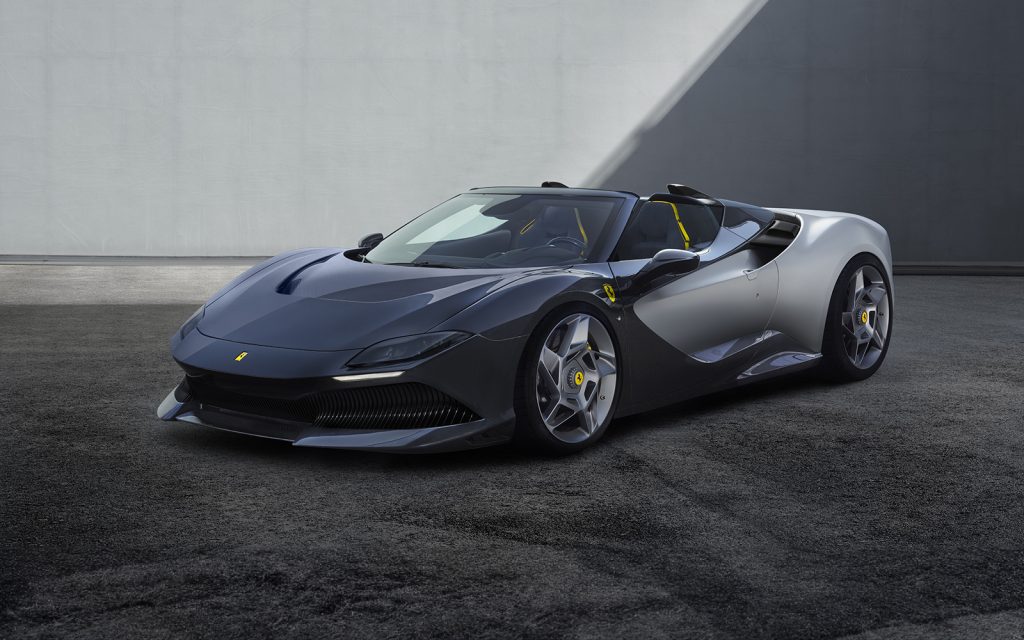
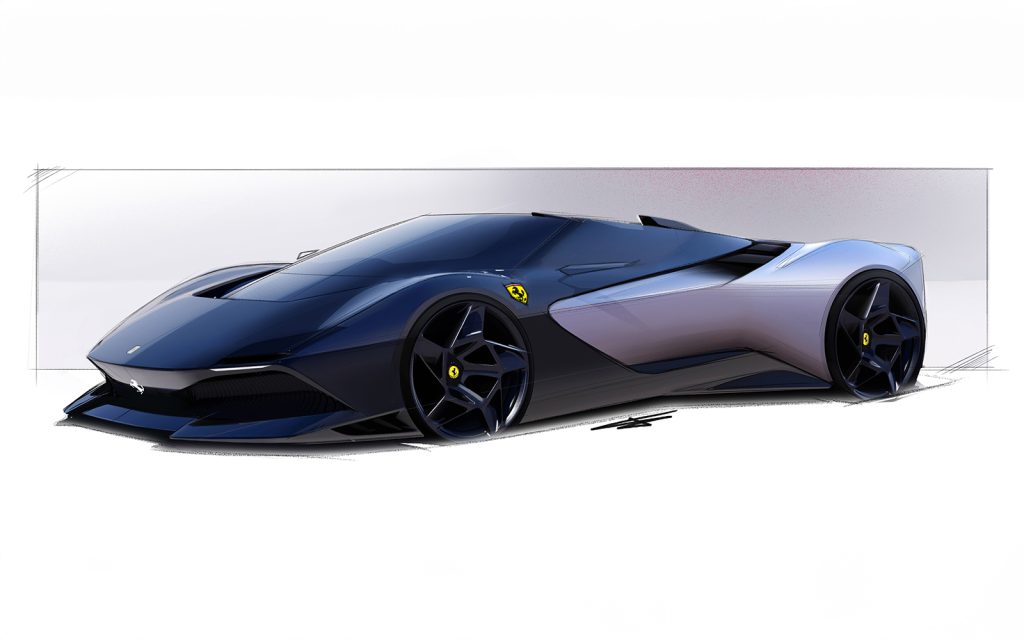
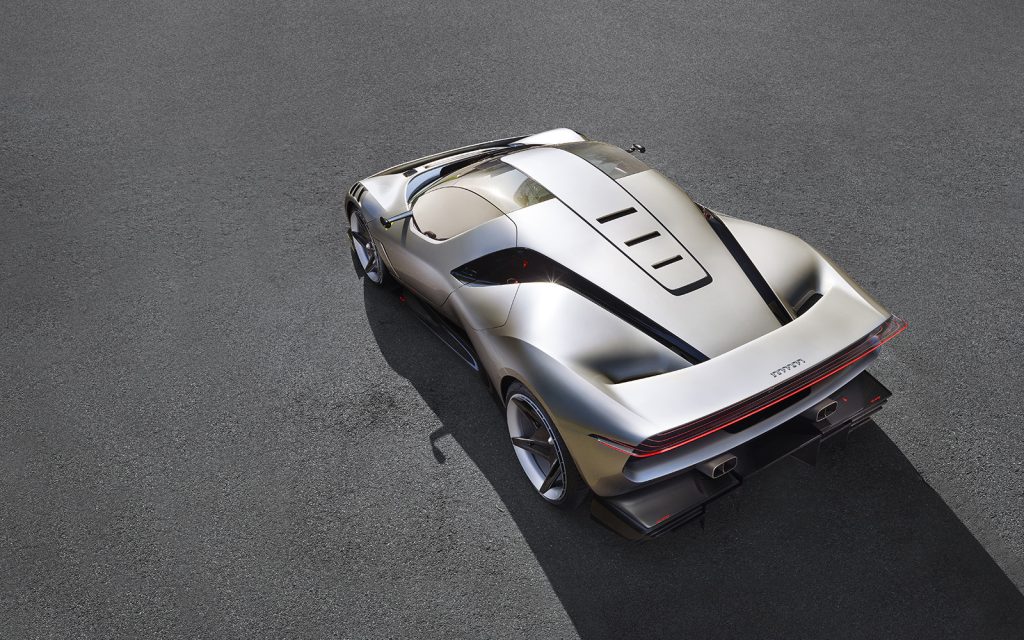
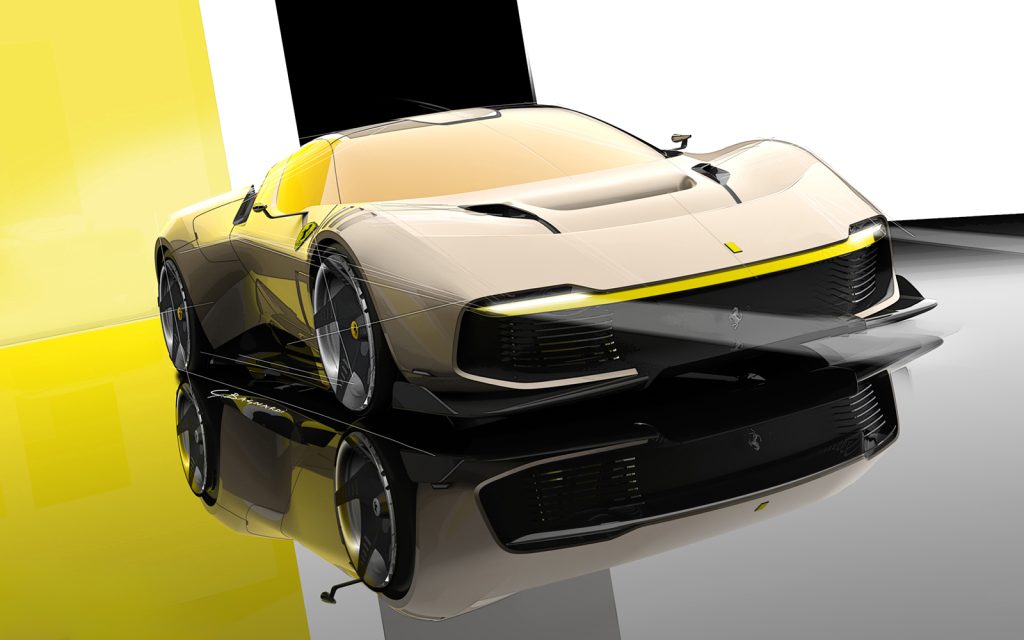
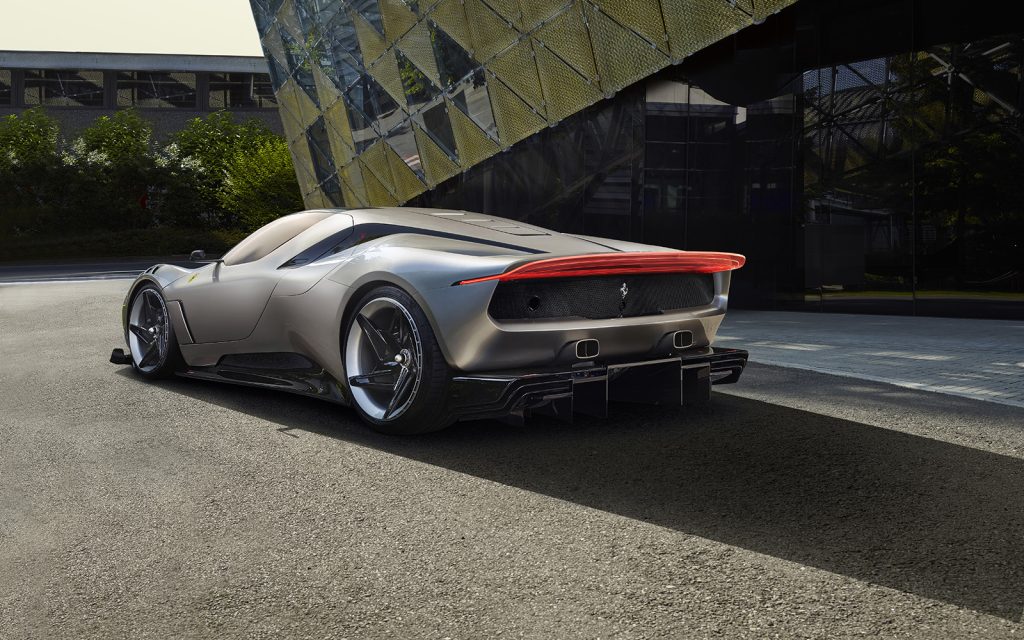
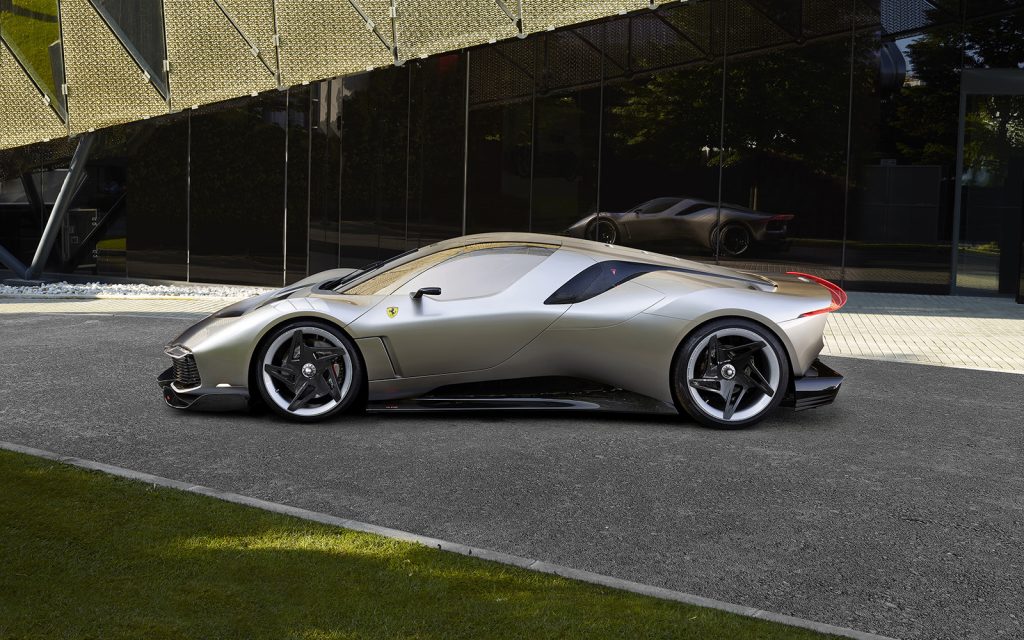
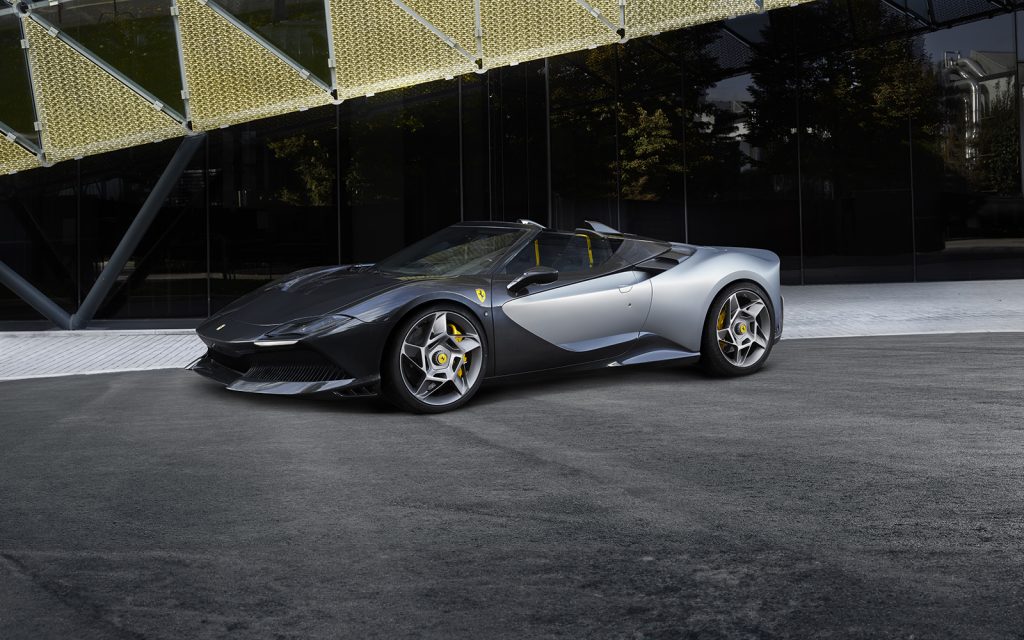
    Maranello, 24 October 2023 – Ferrari today unveiled the latest addition to its One-Off series, theFerrari SP-8. Part of the marque’s Special Projects programme and designed by the Flavio Manzoni-headed Ferrari Styling Centre, it is a mid-rear-engined V8 based on the F8 Spider from which it inherits its layout, chassis and engine. The SP-8 one-off joins the hallowed ranks of the most exclusive segment in the Ferrari range, unique cars crafted around individual clients’ specifications, with the result that they embody the very pinnacle of Prancing Horse customisation. 

    The car’s name celebrates its 3.9-litre V8 twin-turbo engine, one of the most critically-acclaimed power units in history and the winner of the prestigious Engine of the Year (IEOTY) award on four consecutive occasions. As the client that commissioned the SP-8 hails from Taiwan, the number 8 is also significant as it considered extremely lucky in Chinese culture, traditionally auguring success, good fortune and personal achievement. 
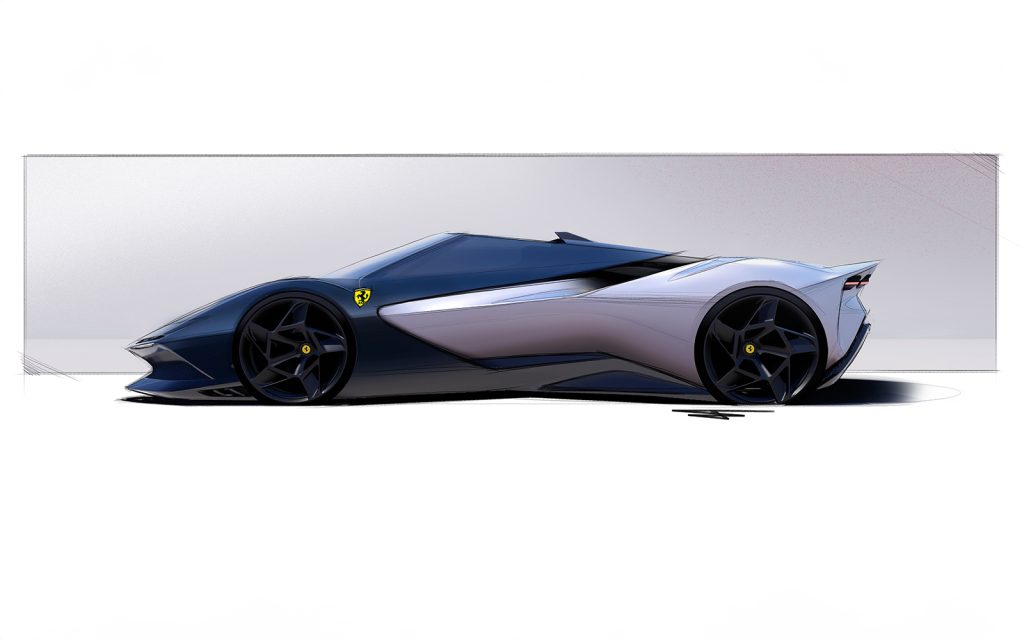
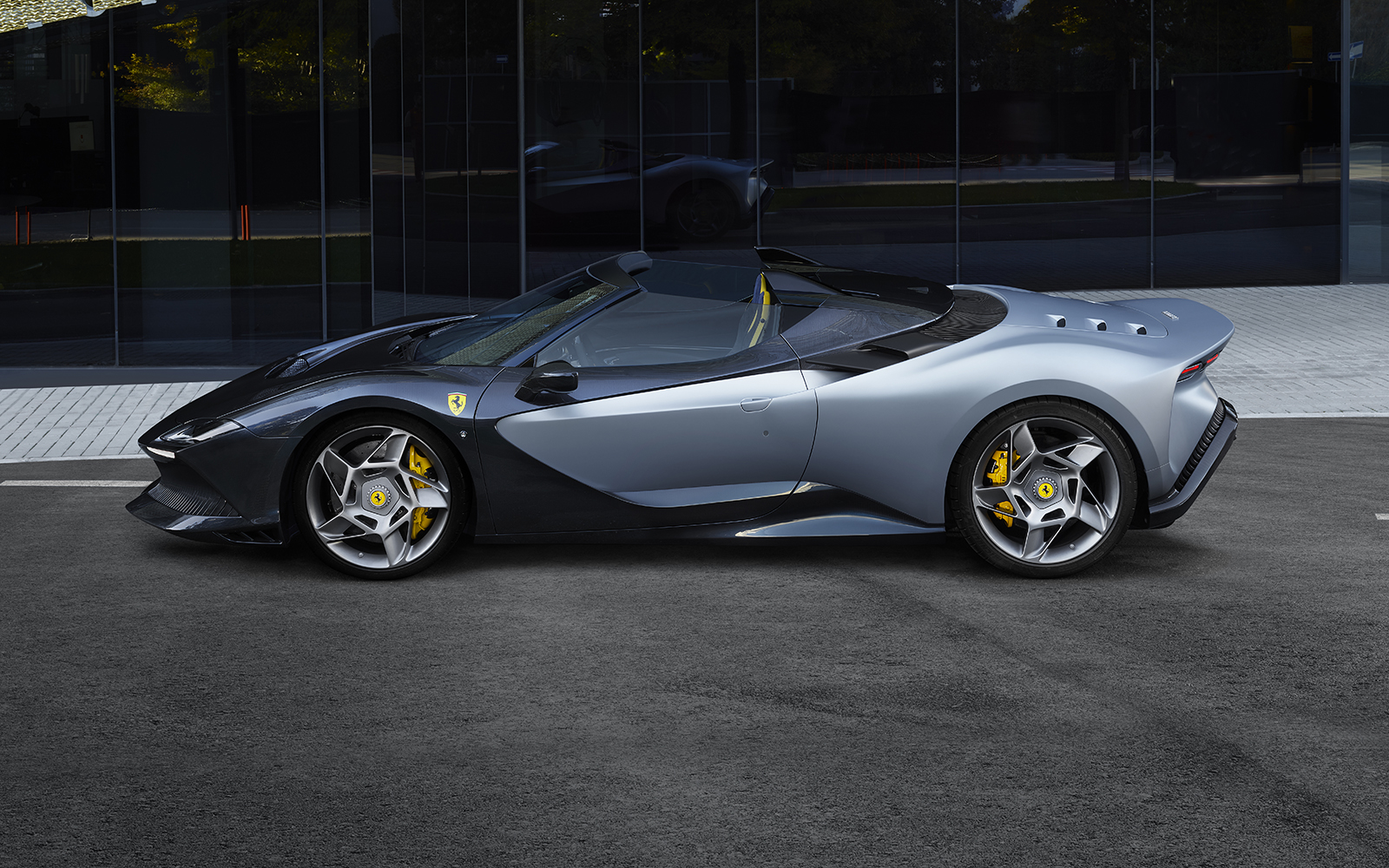
    The SP-8’s most unique feature is the fact that it has no roof, making it a thoroughbred two-seater roadster in every respect, underscoring its sporty character and the instantly exhilarating visual and en plein air driving experience it delivers. This solution demanded extensive refining of its aerodynamics through a combination of CFD simulations, wind tunnel testing and track testing to guarantee a standard of acoustic comfort and wind feeling comparable to the car that inspired it. 

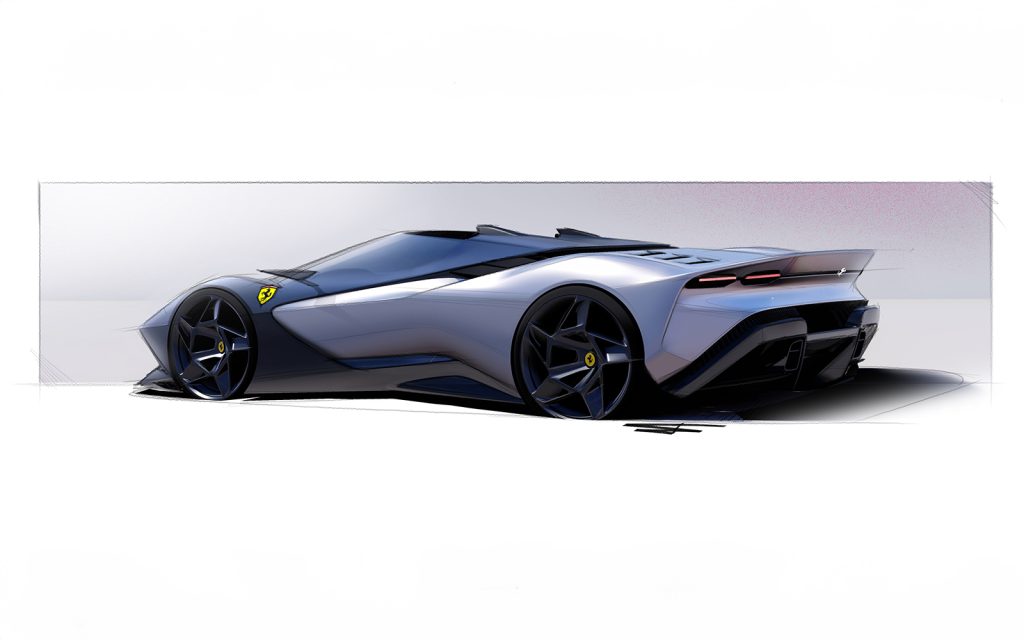
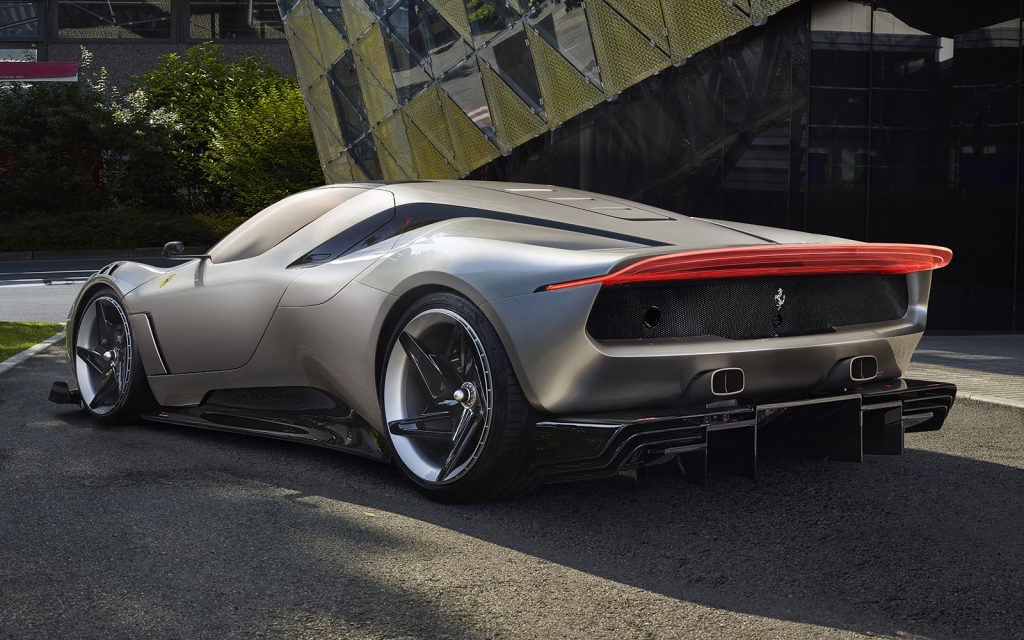
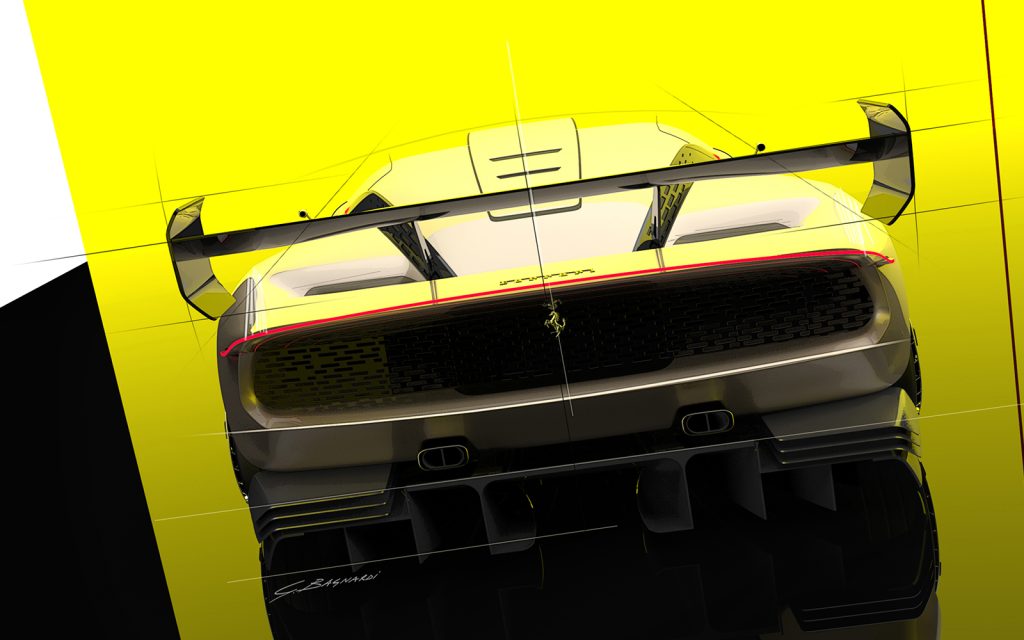
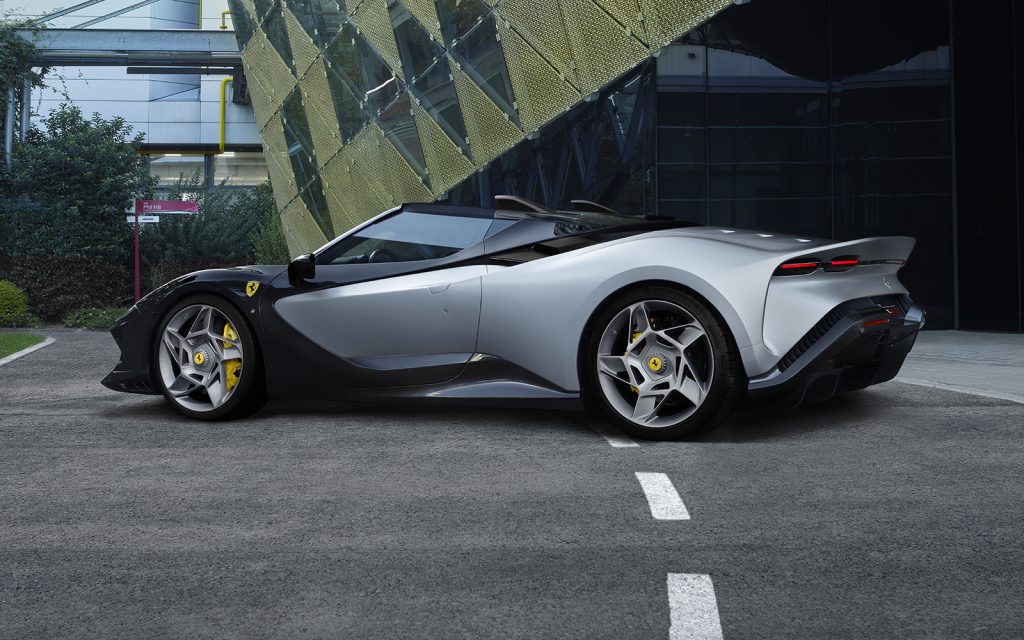
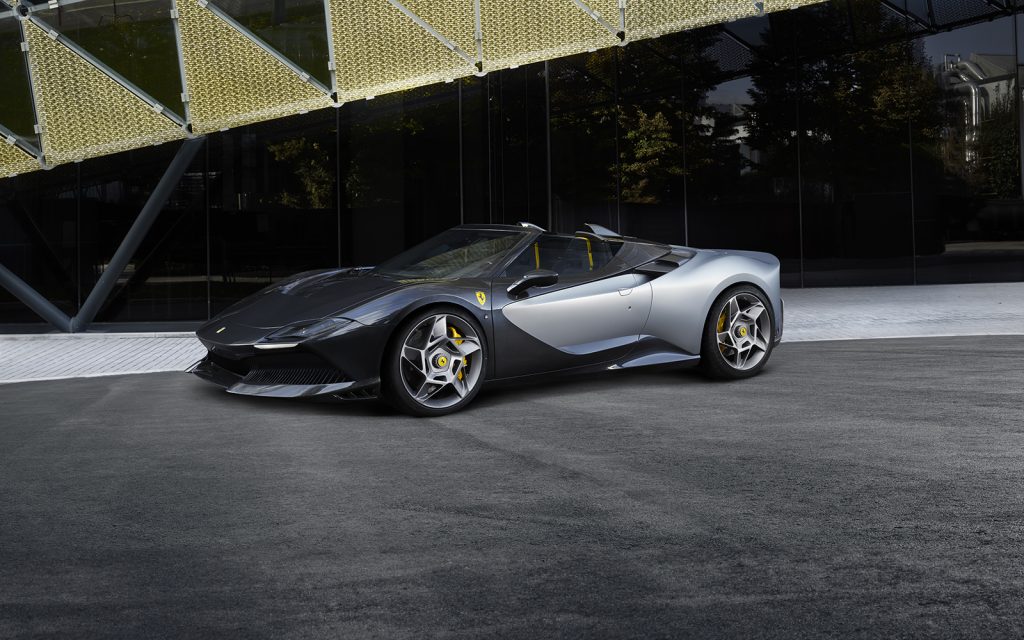
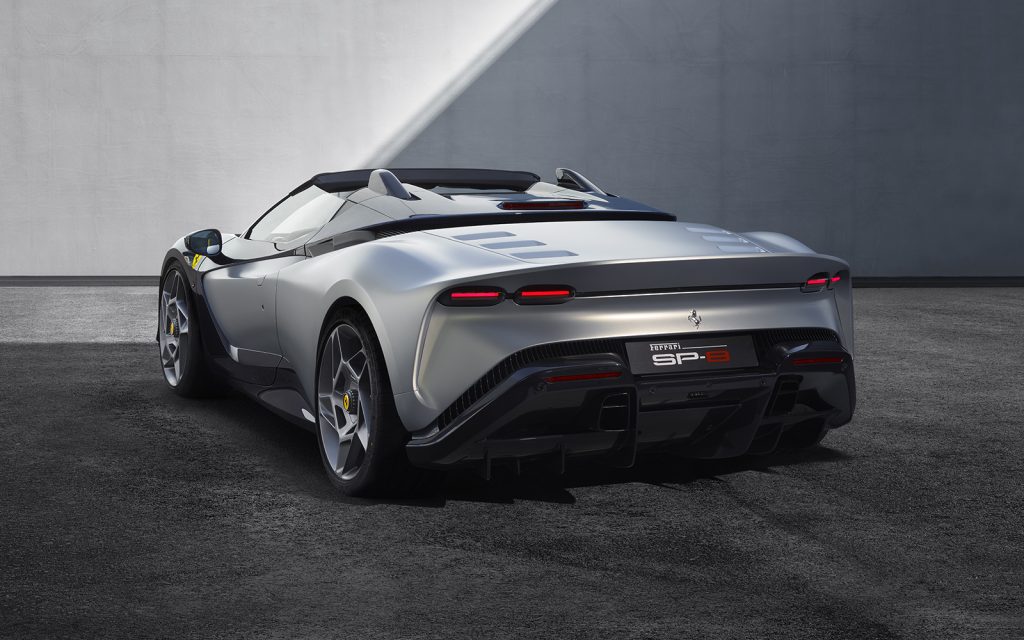
    The car’s main styling theme centres around the way in which its volumes crossover and fuse into one another: the unpainted carbon-fibre front wraps around to the tail, creating a two-tone effect that creates a powerful contrast in terms of both colour and materials. The elimination of the retractable hard top allowed the designers to radically restyle the entire tail section, giving it a full volume with a taut belt line. The car’s volume is divided into two parts which are connected by a functional central area in matte black that includes the side air intakes with separate ducts for the intercoolers and engine. The upper section of this band incorporates a vent for the engine compartment with longitudinal elements that reference the lateral strakes typical of Ferraris of the past. 

    Dominating the front of the car is an imposing full-width, cast aluminium grille made from a single, 3D-printed mould. The grille features the same strake theme, this time in a vertical movement, with the spacing in plan view gradually widening towards the flanks to better channel air flow to the two front radiators. The angling of these elements was optimised by the close collaboration between the Ferrari Styling Centre and the aerodynamics team that spent months honing the car using CFD. 
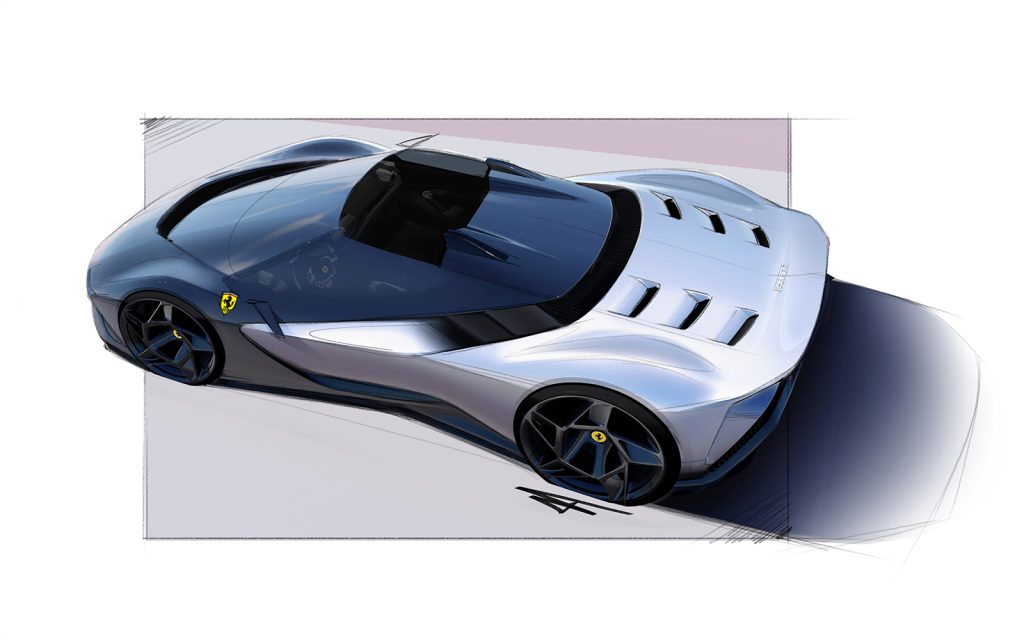
    Other areas of the SP-8 that were redesigned from the donor car include the headlights, which have special masks and lenses, the rear lights derived from those of the Roma with specific lenses, the windscreen, the tailpipes, which were given the same treatment as the 296 GTB’s, and the specially-designed wheel rims in a dedicated colour (matte Grigio NART). 

    These directional five-spoke wheels are exclusive to this particular car and offer a modern take on the classic rims used on Ferrari Sports Prototypes as well as the legendary F40. A clever and inextricable part of their overall aesthetic are their heavily sculpted sections and large apertures designed to make them lighter. 

    Inside the car, an important modification has been made to the central console to house the F1 gearbox commands that have featured in the Ferrari range since the debut of the SF90 Stradale. This meant modifying the now iconic shift-gate for this specific application. The interior finish is completed with seats featuring details in laser-etched Navy Blue Alcantara® coupled with gradient effect cloth, and carpets in specific twill fabric with an iridescent effect.
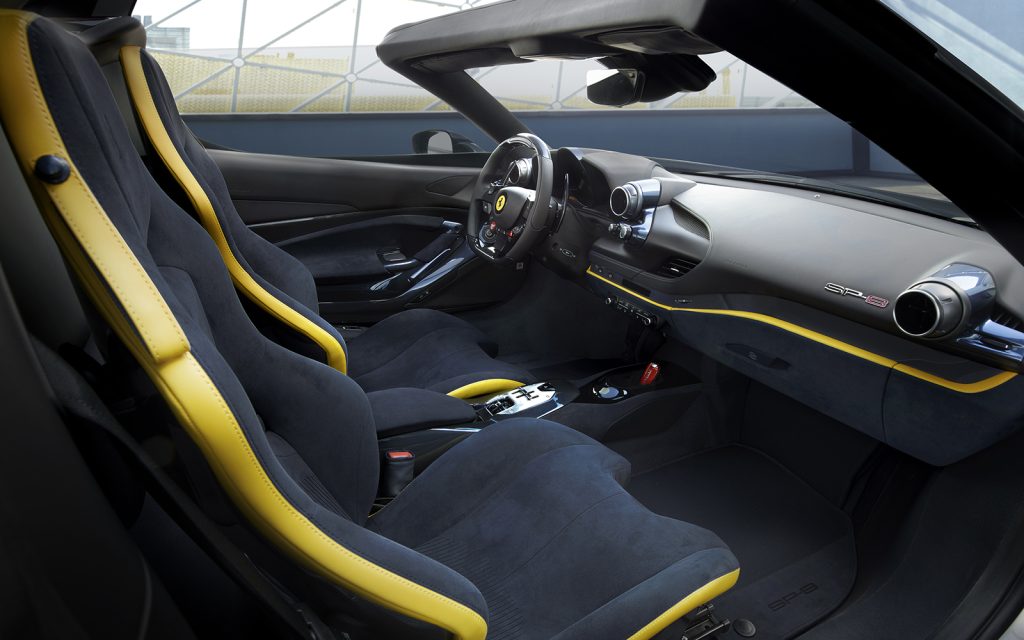
    The matte Argento Micalizzato colour created specifically for the SP-8 pairs brilliantly with the car’s carbon-fibre section, which has an equally specific colour and finish (glossy iridescent Blue Sandstone). Even the Blu Scuro Stellato colour used to link the two bodywork sections was specifically developed. 

    The SP-8 will be on display from the morning of the 24th of October at the Mugello Circuit until the end of the Finali Mondiali Ferrari 2023. Thereafter, it will be displayed at the Ferrari Museum in Maranello from November 16, 2023 until March 2024. 

    SPECIAL PROJECTS

    The Special Projects programme is aimed at creating unique Ferraris (so-called “One-Offs”) characterised by an exclusive design crafted to the requirements of the client, who thus becomes the owner of a one-of-a-kind model. Each project originates from an idea put forward by the client and is developed hand-in-glove with a team of designers from Ferrari’s Styling Centre. Once the car’s proportion and forms have been defined, detailed design blueprints and a styling buck are produced before the manufacturing process for the new One-Off begins. The entire process takes around two years on average, during which time the client is closely involved in assessing the design and verification phases. The result? A unique Ferrari sporting the Prancing Horse logo and engineered to the same standards of excellence that characterise all of Maranello’s cars.

  • Ferrari Tailor Made 812 Competizione

    Ferrari Tailor Made 812 Competizione

    A Ferrari with a unique perspective to be auctioned for charity.

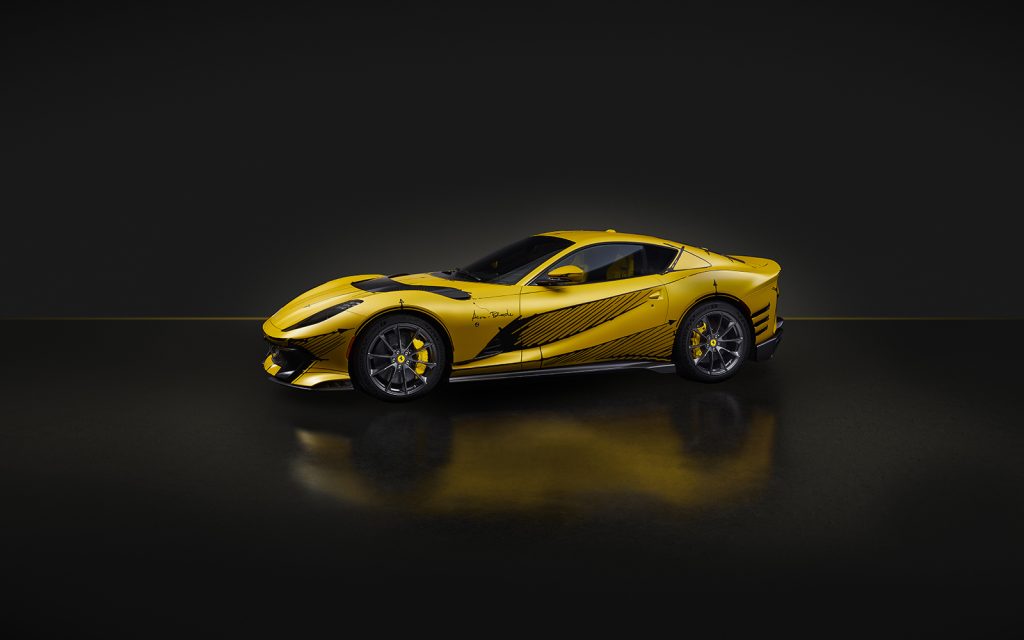
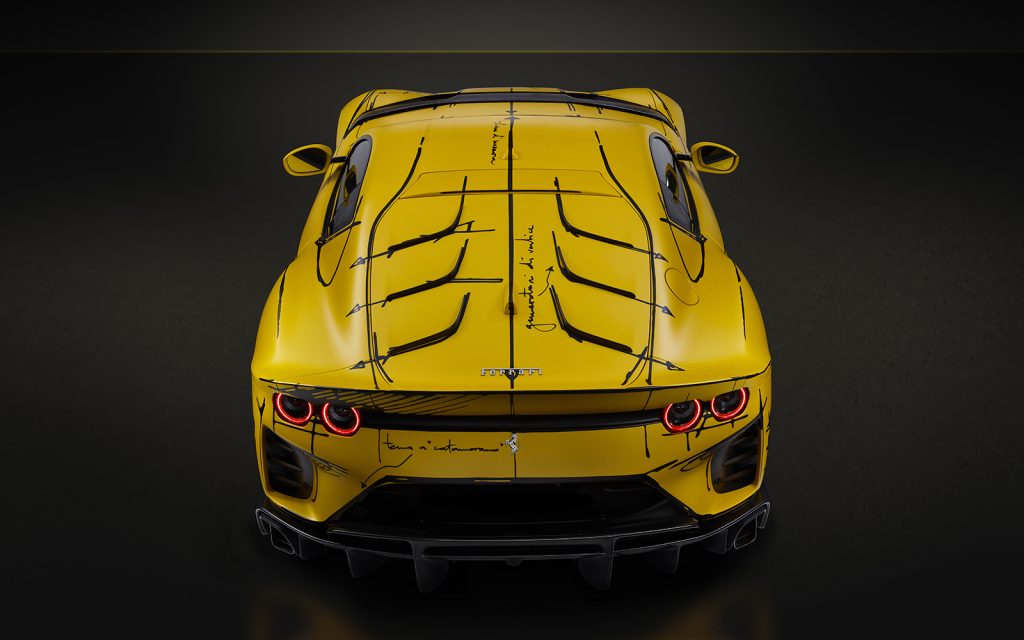
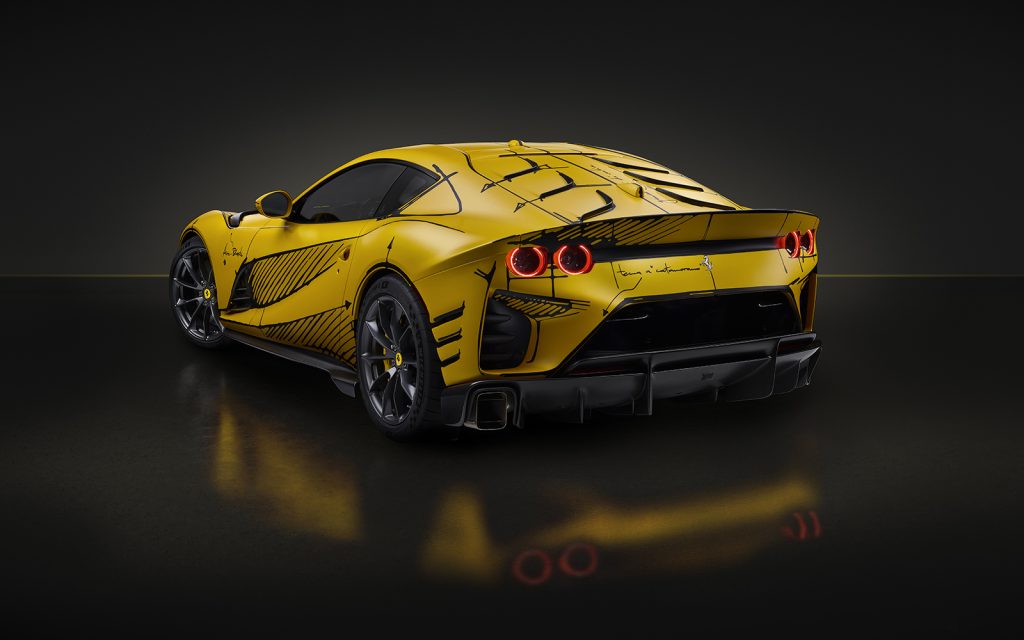
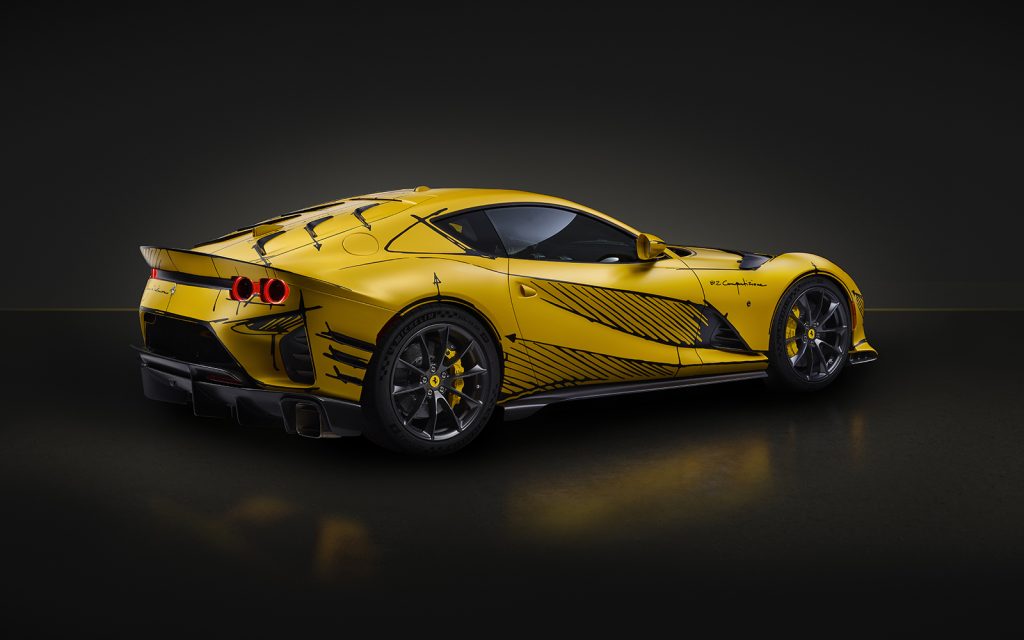
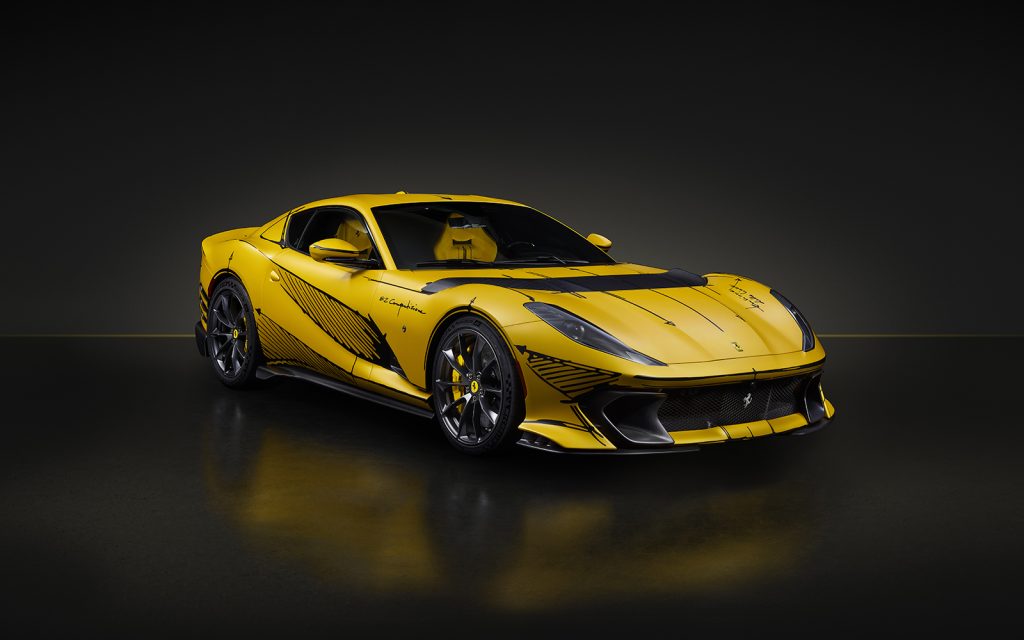
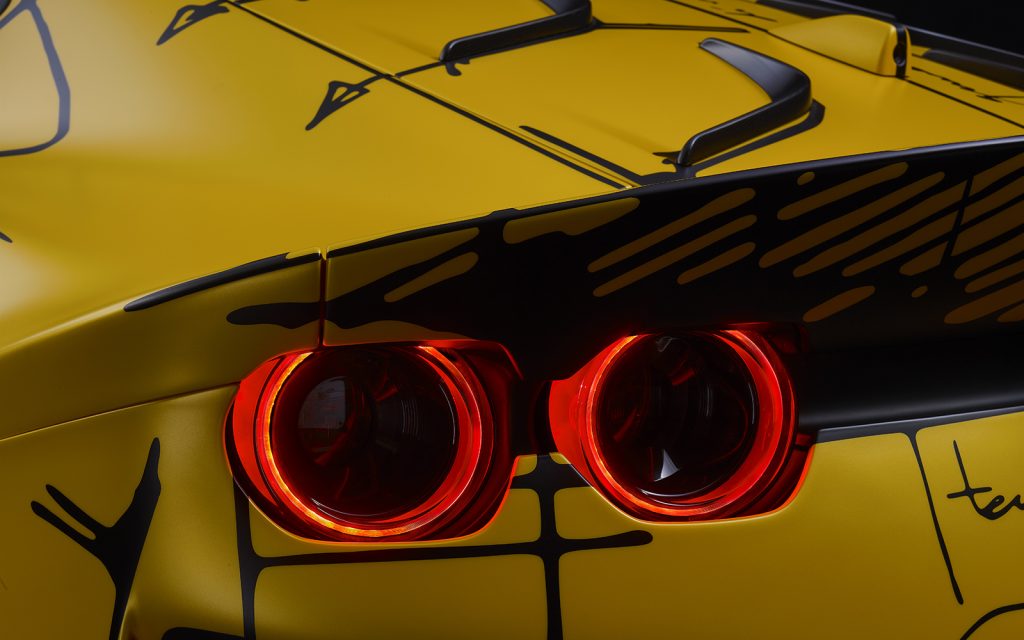
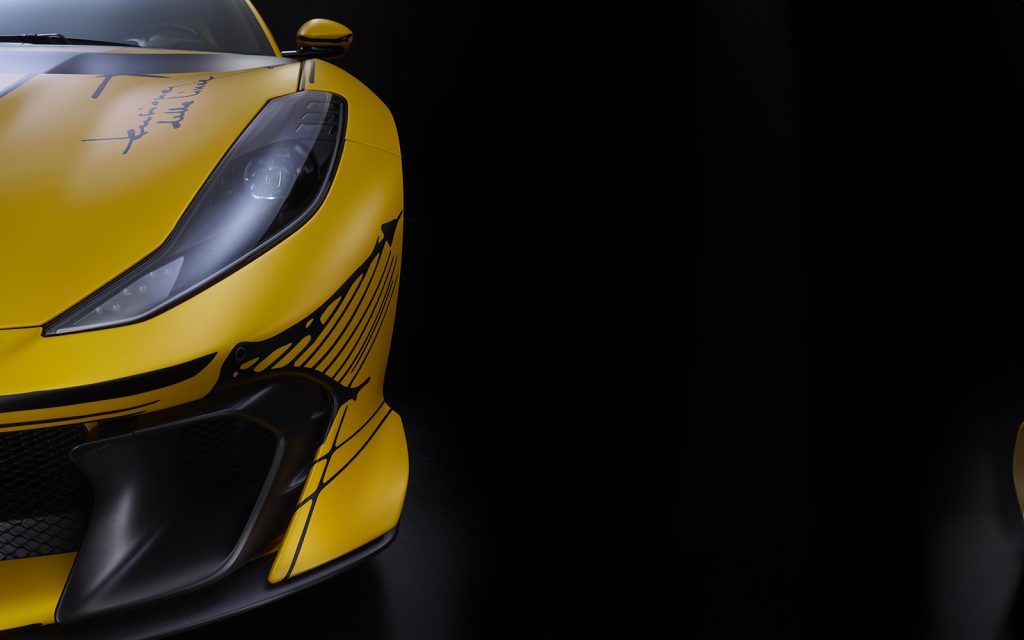
    Monterey (California, USA), Aug. 19, 2023 – At an exclusive event held at Casa Ferrari during Monterey Car Week and broadcast via live streaming, the Maranello-based company unveiled a one-of-a-kind Ferrari 812 Competizione. Without precedent, this Tailor Made car was inspired by the concept of a blank sheet, which is how the Ferrari Styling Centre starts its creative research for every new model.

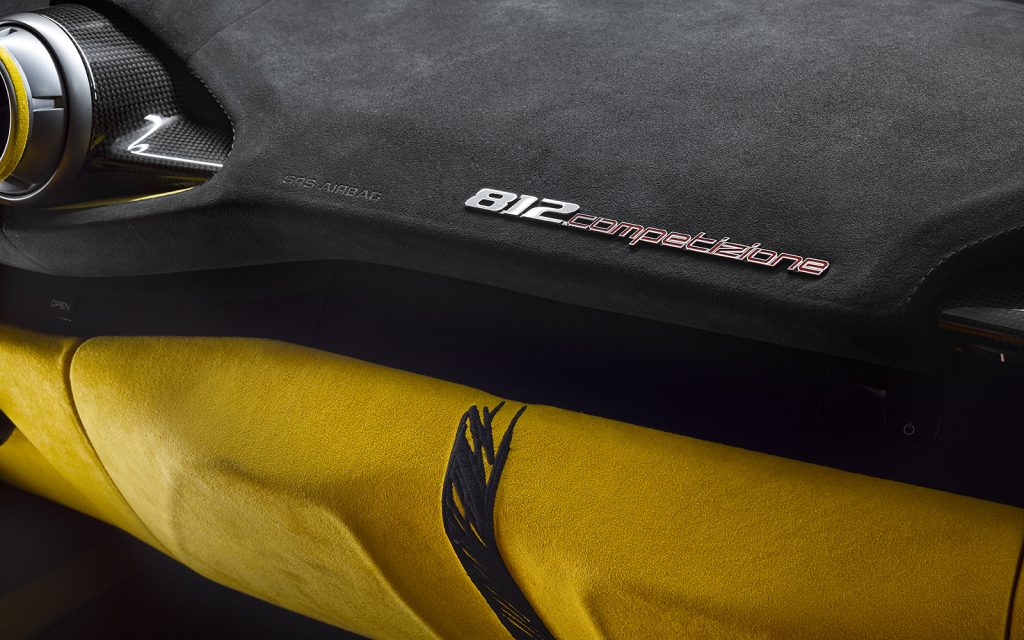
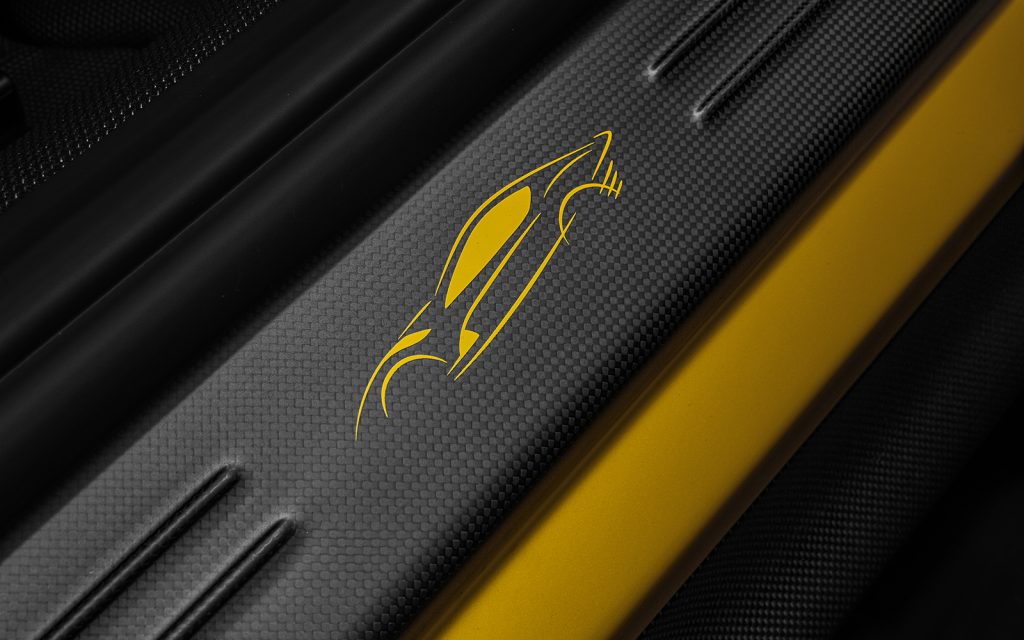
    The car the Tailor Made concept is applied to is one of just 999 Ferrari 812 Competiziones, a limited and extremely exclusive series intended for collectors and enthusiasts of the world’s most exciting twelve-cylinder. It is distinguished by a commemorative plaque affixed to the interior as a testament to its original inspiration.

    The Tailor Made 812 Competizione presented today was commissioned by Ferrari North America and will be auctioned at the Ferrari Gala to be held in New York City on October 17 at the culmination of an exclusive event aimed at celebrating the Maranello-based company’s unique community and passion for the brand. All proceeds will be donated to charity as part of the education support projects that have been the focal point of the Prancing Horse’s charitable activities.

    The process of developing the craftsmanship techniques used to create such original and creative patterns took over a year of close collaboration between the Styling Centre and the Tailor Made team, which handles the most innovative personalisation projects at Ferrari. The main challenge was to seek the perfect balance between flawless technical realization and maintaining the creative spark and artistic craftsmanship that flow from Ferrari Chief Design Officer, Flavio Manzoni’s drawings, which provided the inspiration for this model with its unique details.

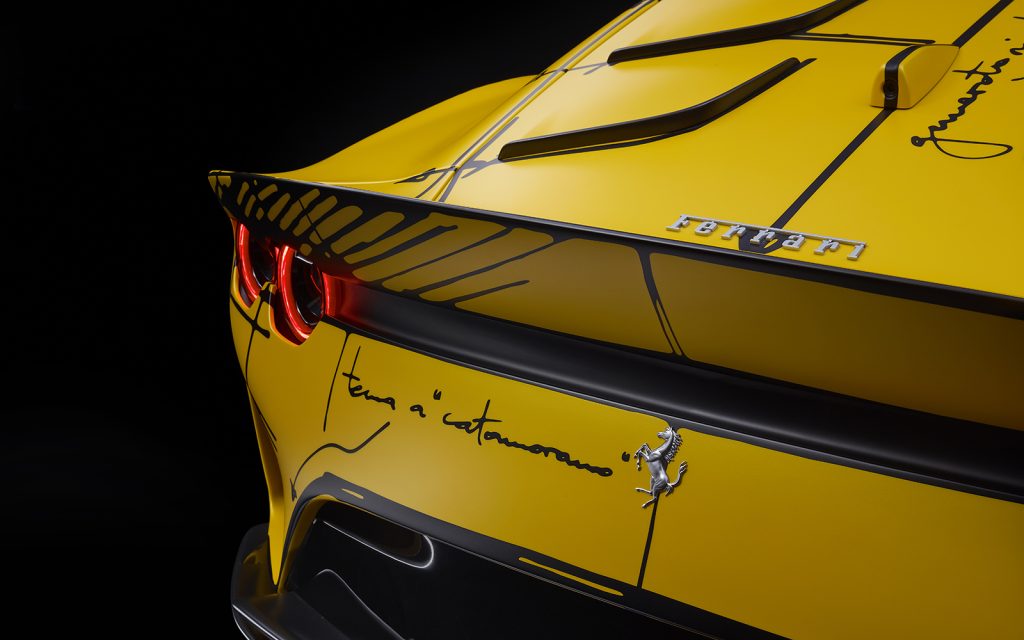
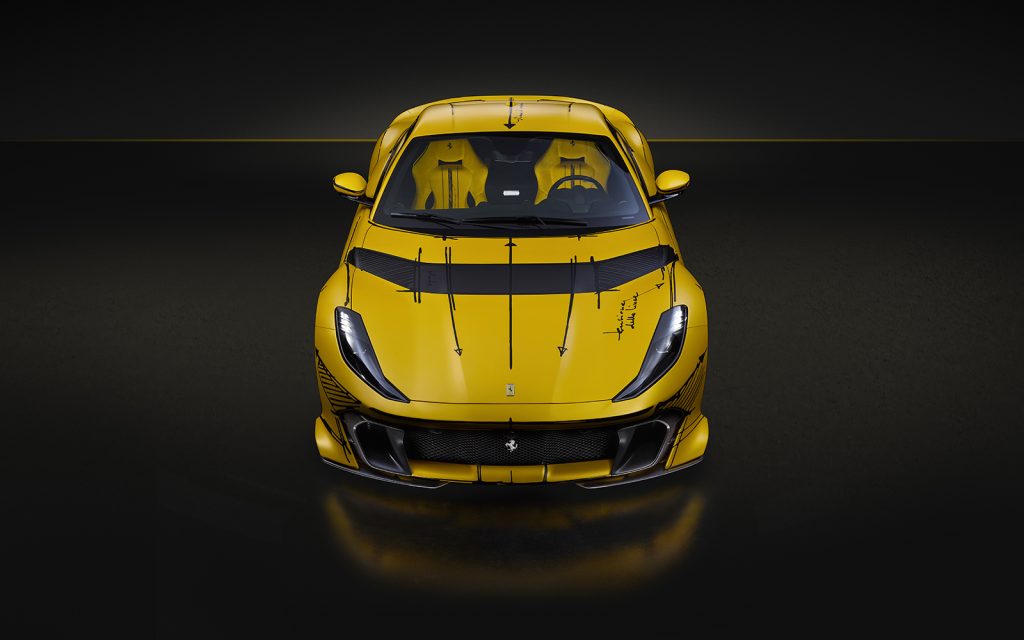
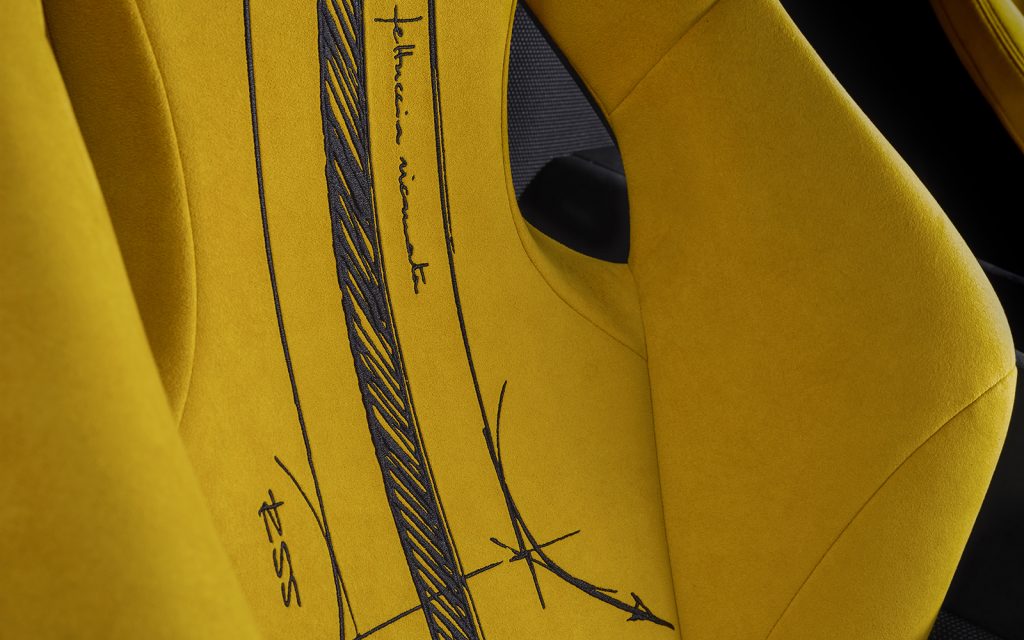
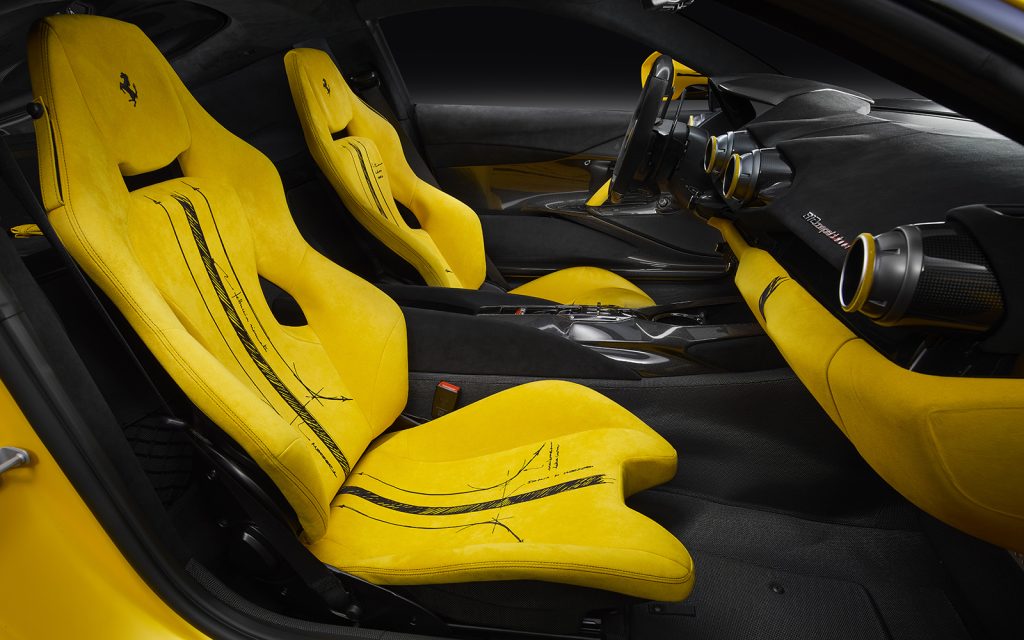
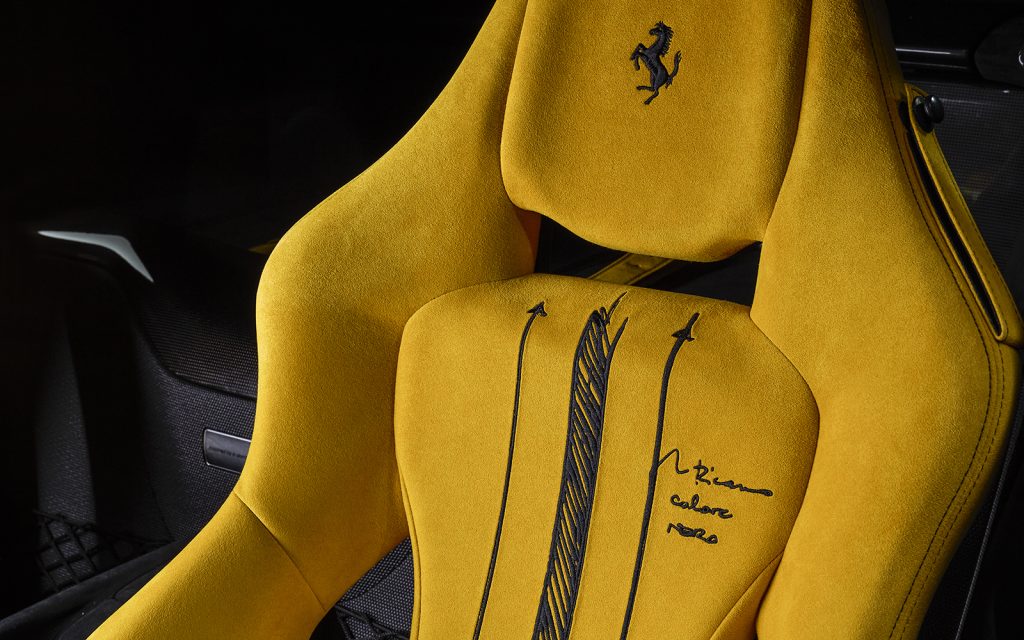
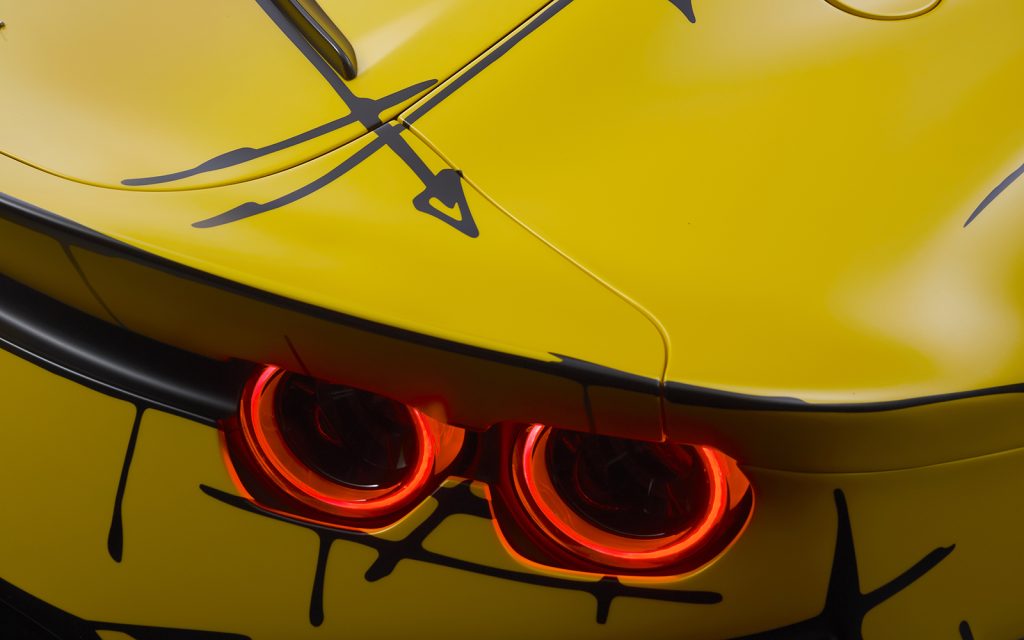
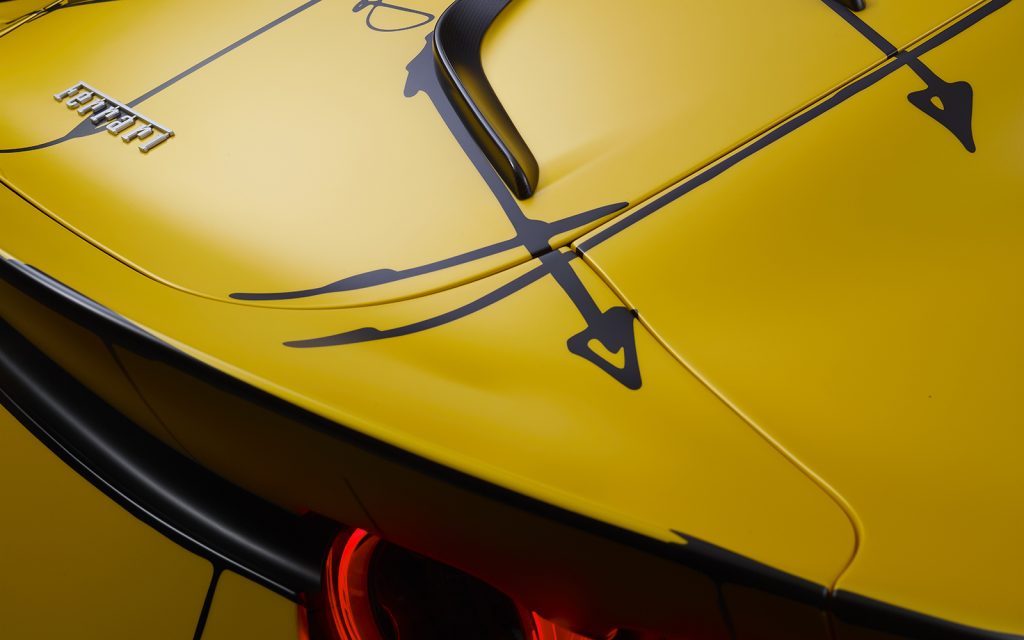
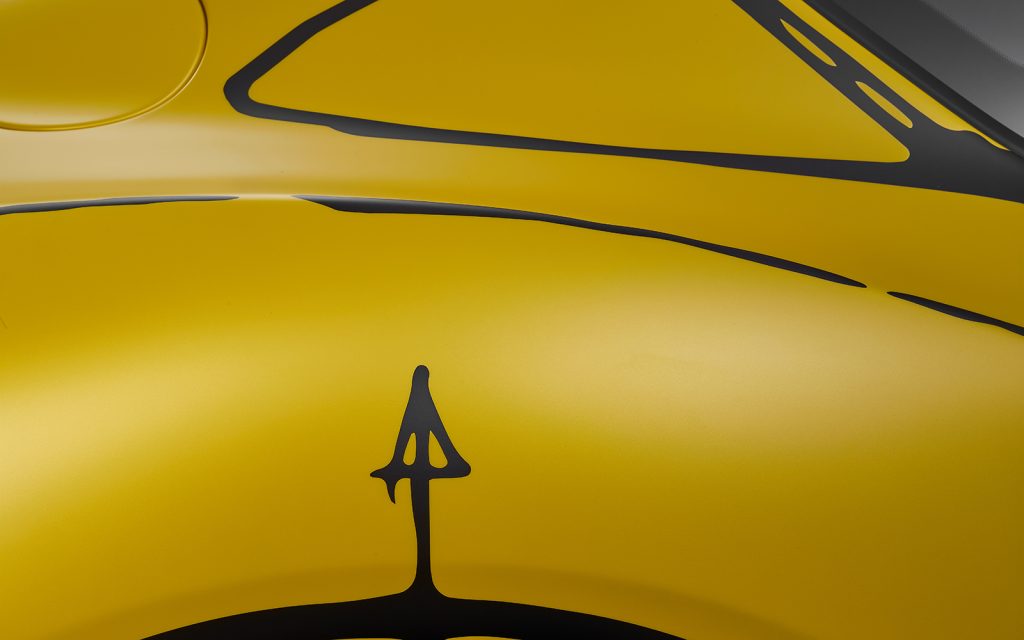
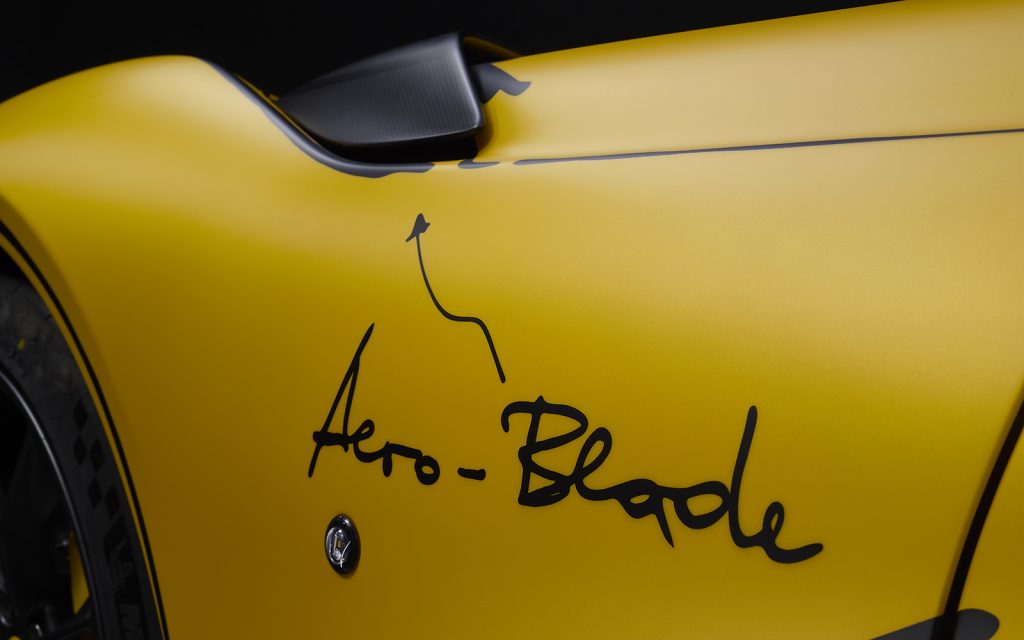
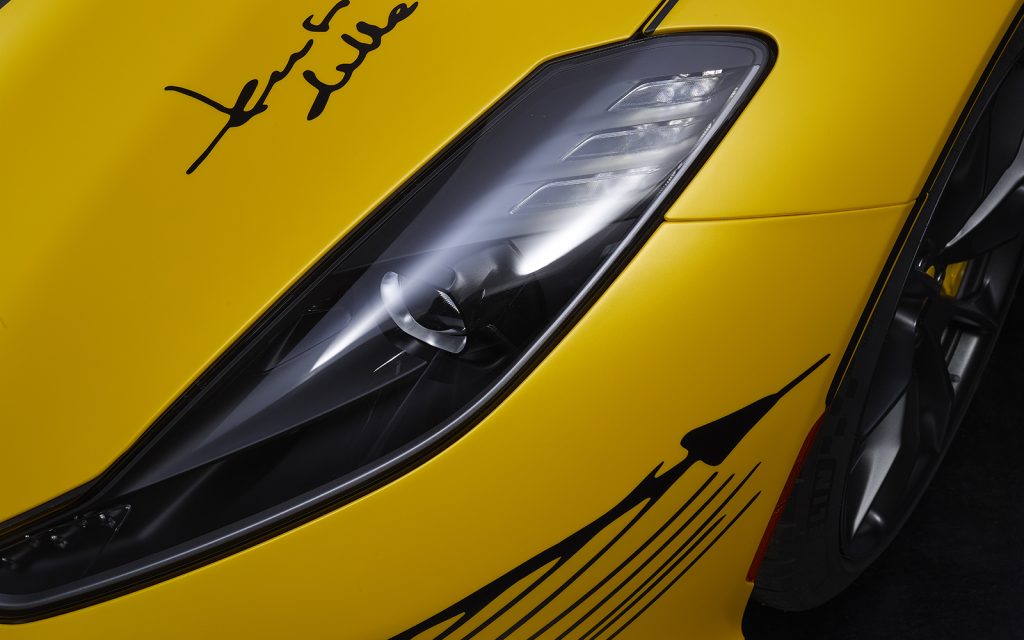
    The car, in fact, has been imagined as one of the now iconic yellow cards on which Maranello designers transfer their first ideas, insights and notes from mind to paper and on which – iteration after iteration, detail after detail, idea after idea – new concepts, unique stylistic features and shapes are composed that will become part of the history of Italian automotive design.

    On the car, in matte Giallo Tristrato, the lines composed by the designer who imagined the elegant and sporty forms of the 812 Competizione and its most iconic details have been traced in matte Nero DS Sketch. Notable among them are the carbon fibre blade that cuts across the horizontal plane of the front bonnet acting as an air intake for the engine, the characteristic louvres on the side – a tribute to the best twelve-cylinder Ferrari tradition – as well as the vortex generators on the rear screen devoid of glass, replaced by a concealed rear-view camera.

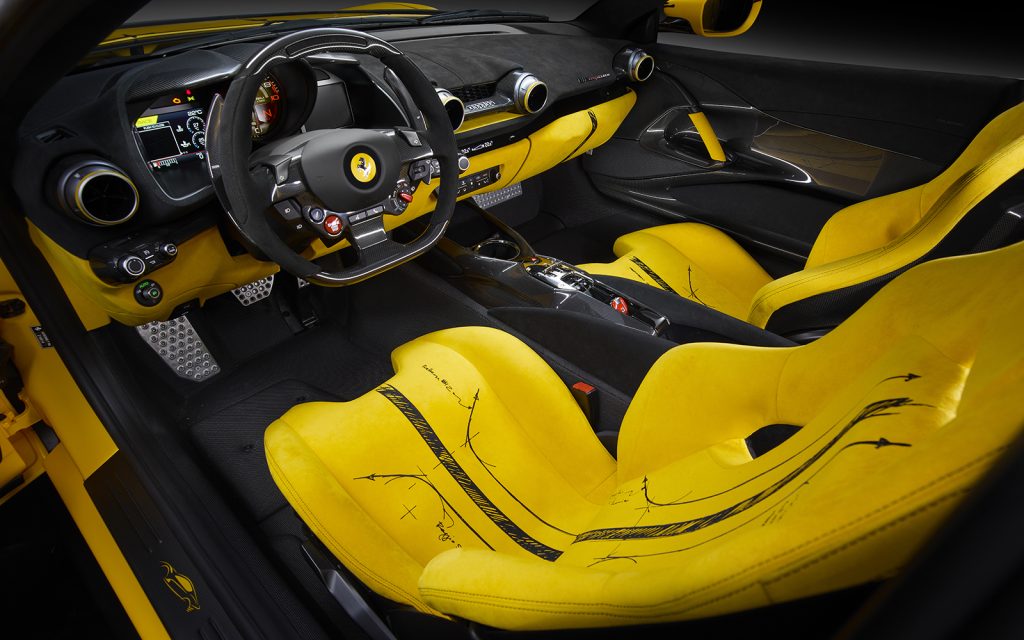
    The same concept is echoed in the interior. The new-generation Alcantara® that covers the cockpit of this 812 Competizione, composed of 65 percent recycled polyester and presented as a world premiere on Ferrari Purosangue, is embellished with design sketches that have been embroidered directly onto it using a highly innovative technique. This is a truly unique solution, as Ferrari usually employs leather for this kind of custom motif. Completing the elegant interior trim is the black trilobal Superfabric® used for the carpet and rear wall of the passenger compartment. 

    The 812 Competizione, dedicated to a small group of collectors and purists of the noblest Ferrari tradition, aims for maximum performance without leaving room for compromise. Innovative technological concepts have enabled it to reach new performance heights, making the model ideal for the unlimited wealth of combinations and possibilities offered by the Ferrari Tailor Made program.

    On the 812 Competizione, the driver, both on the road and on the track, becomes one with the car, which guarantees immediate responsiveness to the controls and total control even in the most complex manoeuvres. Driving thrills are always at the highest level thanks to the contribution of the independent four-wheel steering system, which gives it agility and cornering precision, and the most exciting 830-hp V12 on the world automotive scene. The engine pairs impressive power with exhilarating delivery and the sound that Maranello’s 12-cylinder purists know so well.

    FERRARI TAILOR MADE

    Ferrari Tailor Made is Ferrari’s exclusive programme dedicated to those who wish to personalise every area of their Ferrari to create a car that thoroughly reflects their character and personal tastes. Customers who join the programme are assisted by a team of experts and guided by a personal designer who interprets their wishes while respecting the brand’s aesthetic standards.

  • One-of-One Bentley GT Speed Celebrates 20 Years of Continental Success at Monterey Car Week

    One-of-One Bentley GT Speed Celebrates 20 Years of Continental Success at Monterey Car Week

    • Mulliner creates a modern interpretation of the original Continental GT
    • Unique car brings 20th birthday celebrations to a close
    • 2023 Continental GT Speed inspired by the specification of the very first production Continental GT from 2003
    • One-of-one car sold to American collector
    • Both cars displayed at The Quail, A Motorsports Gathering as part of Monterey Car Week
    • Celebratory ‘baton’ starts 20-stop global tour, connecting 20 individual Continental GT reviews

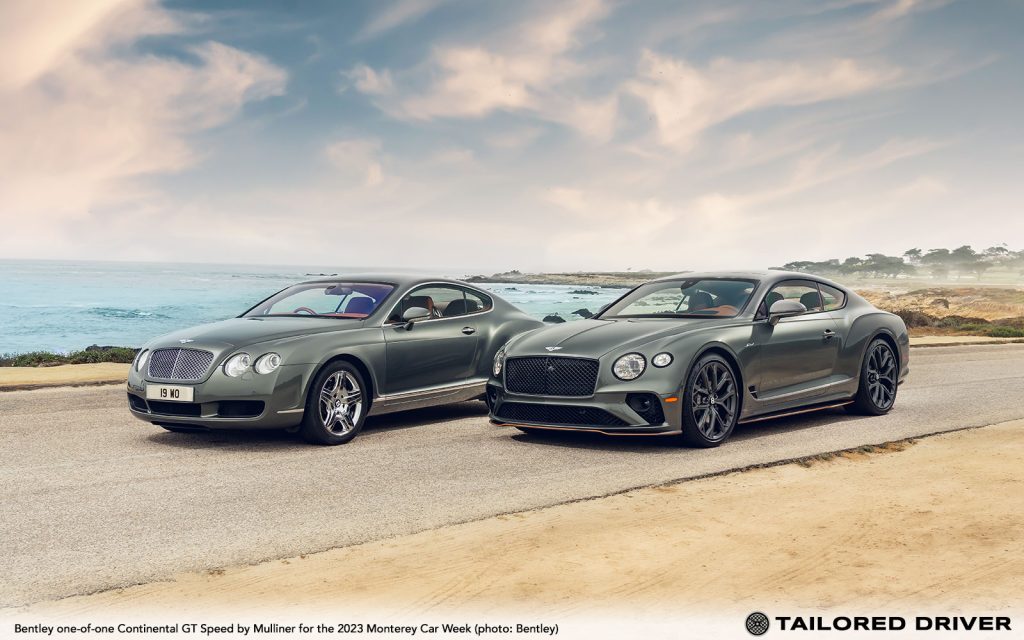
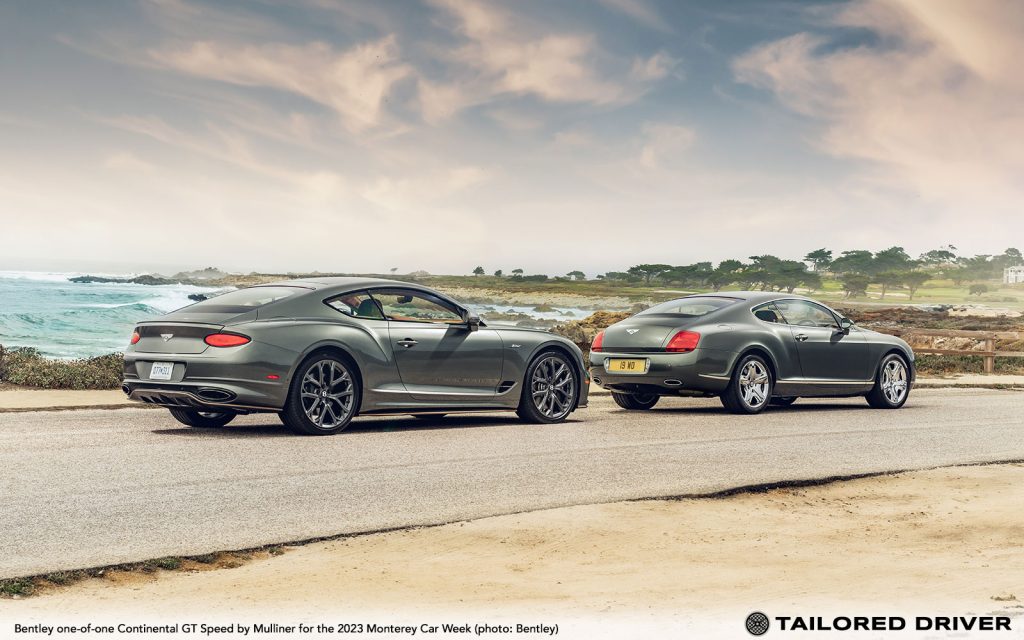
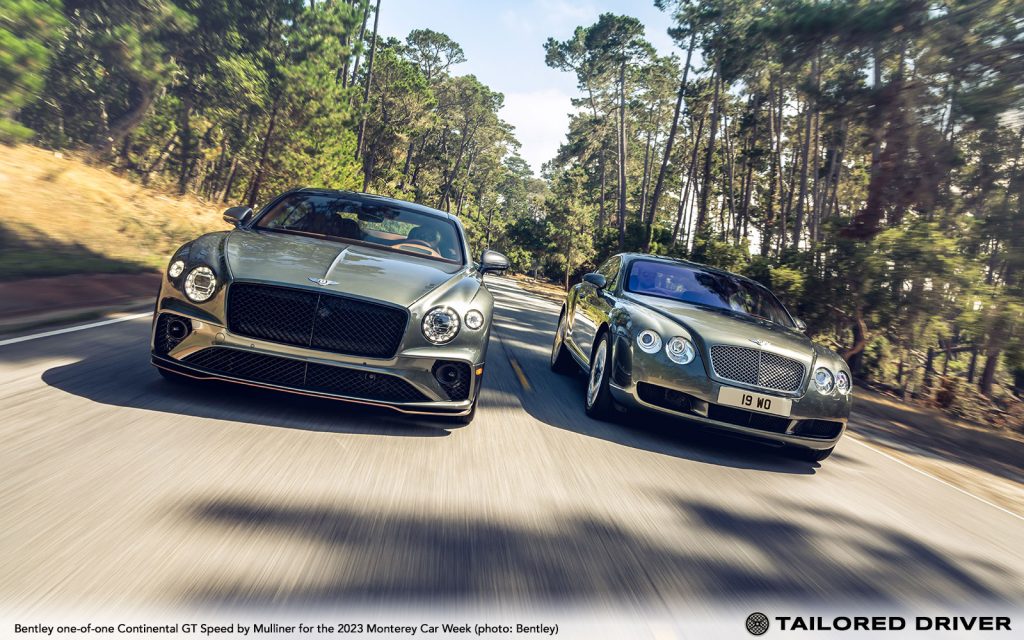
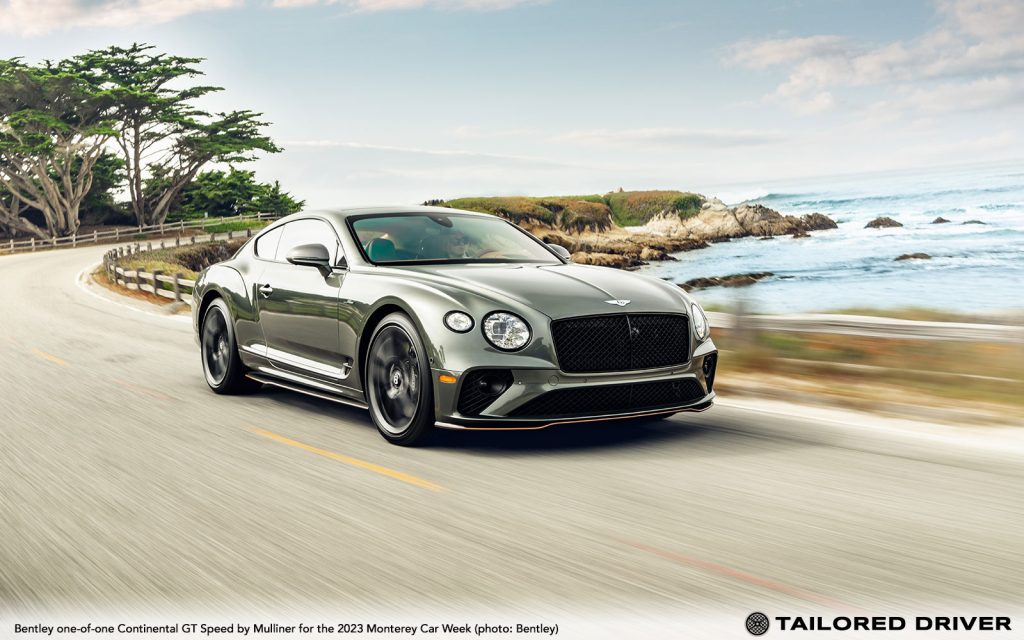
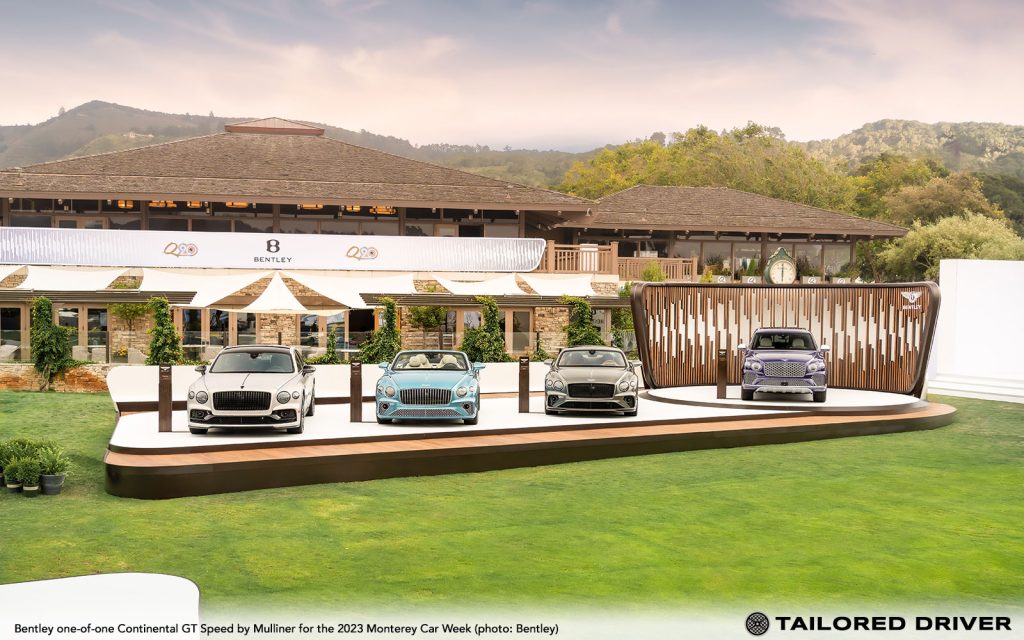
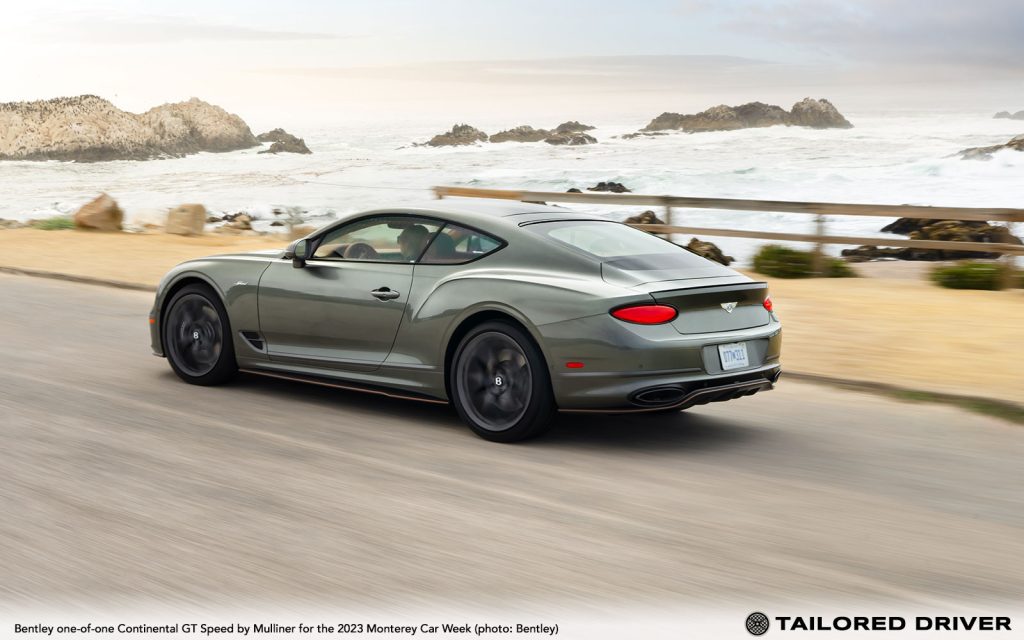
    Crewe, England – Bentley Motors brought the 20th birthday celebrations of its now-iconic Continental GT to a close with the reveal and immediate sale of a one-of-one Continental GT Speed, with a specification inspired by that of the very first production Continental GT from 2003. The muse for the project – VIN20001, the first GT off the Crewe production line – was displayed alongside the 2023 version at The Quail, A Motorsports Gathering, also celebrating its 20th birthday and an ongoing part of Monterey Car Week.

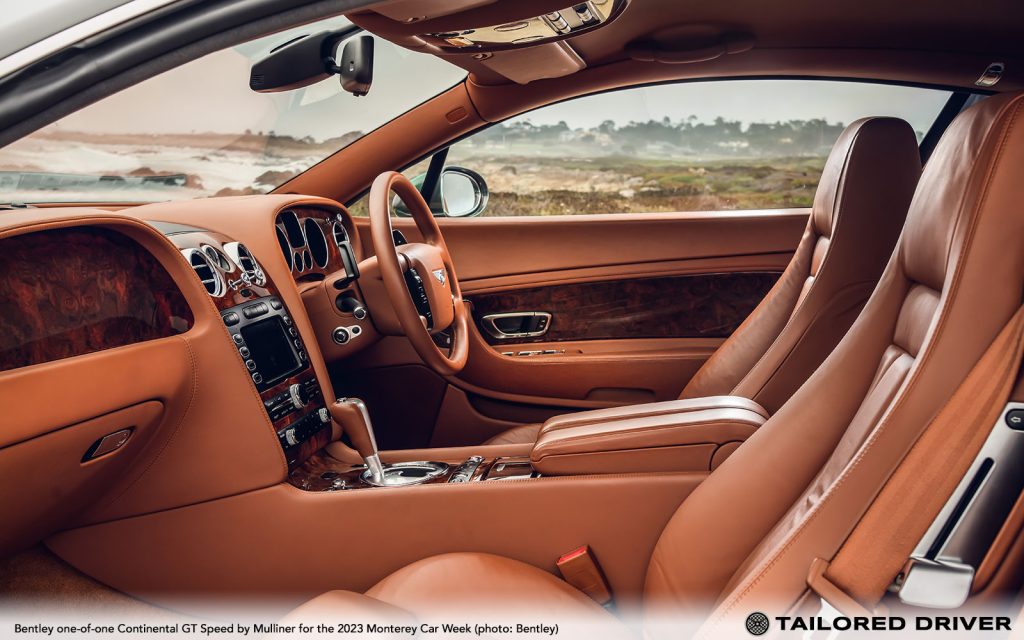
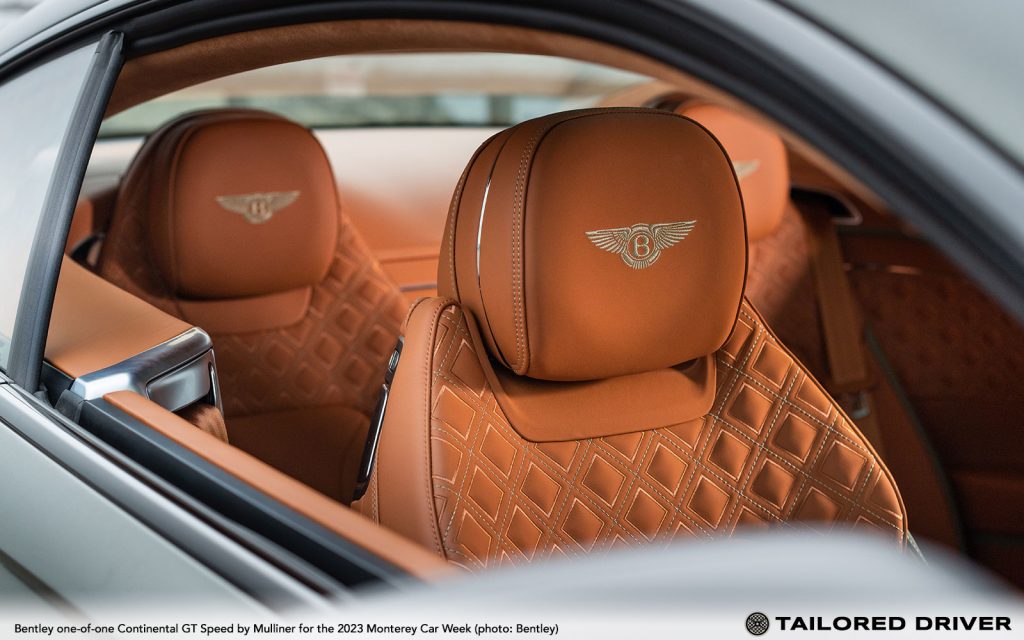
    Having redefined the Bentley brand for the 21st century when it was launched in 2003, catalysing a ten-fold increase in sales, the Continental GT continues to be the benchmark for modern, luxury grand tourers. The first production car – the most important modern car in Bentley’s rejuvenated Heritage Collection – was finished in Cypress Green (cypressgreen; metallic UNI; 6604 / 9560119; Bentley) paint, with an interior of Saddle leather upholstery and Burr Walnut veneer. The bespoke 2023 Continental GT Speed displays a specially commissioned interior inspired by that of its illustrious forbear.

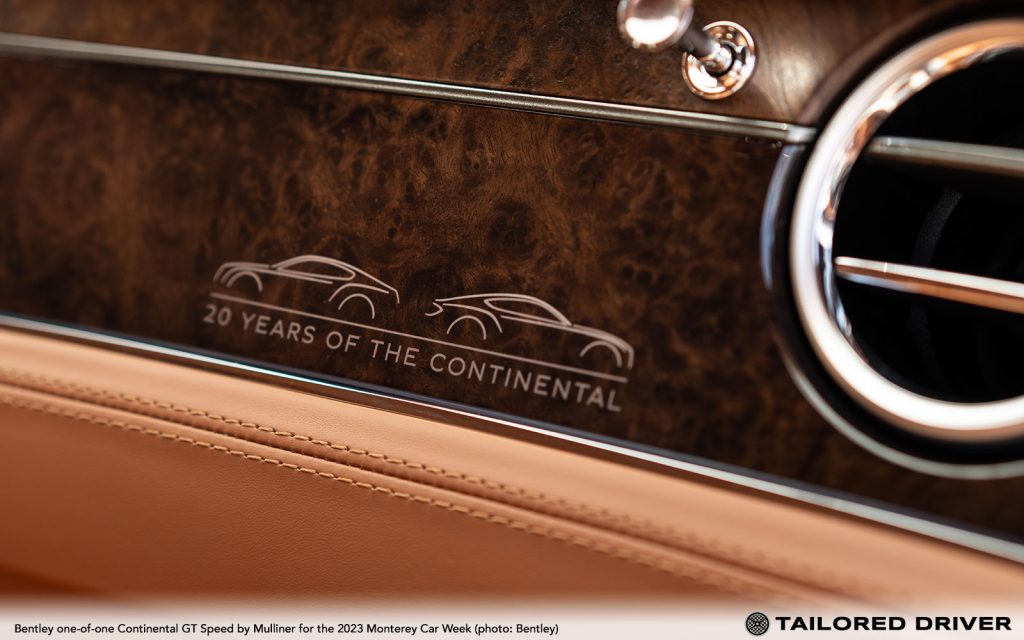
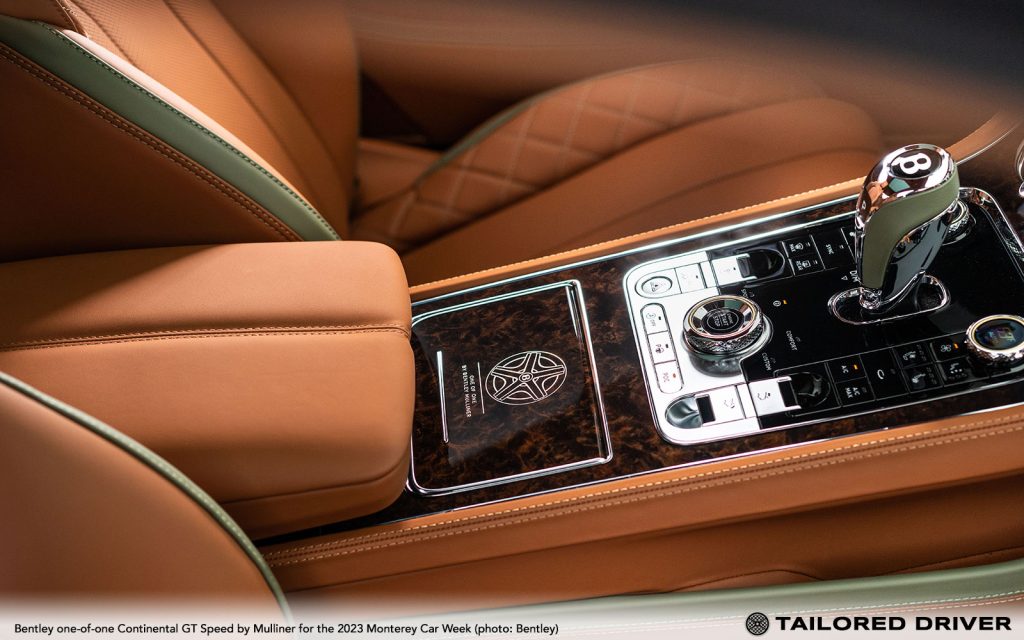
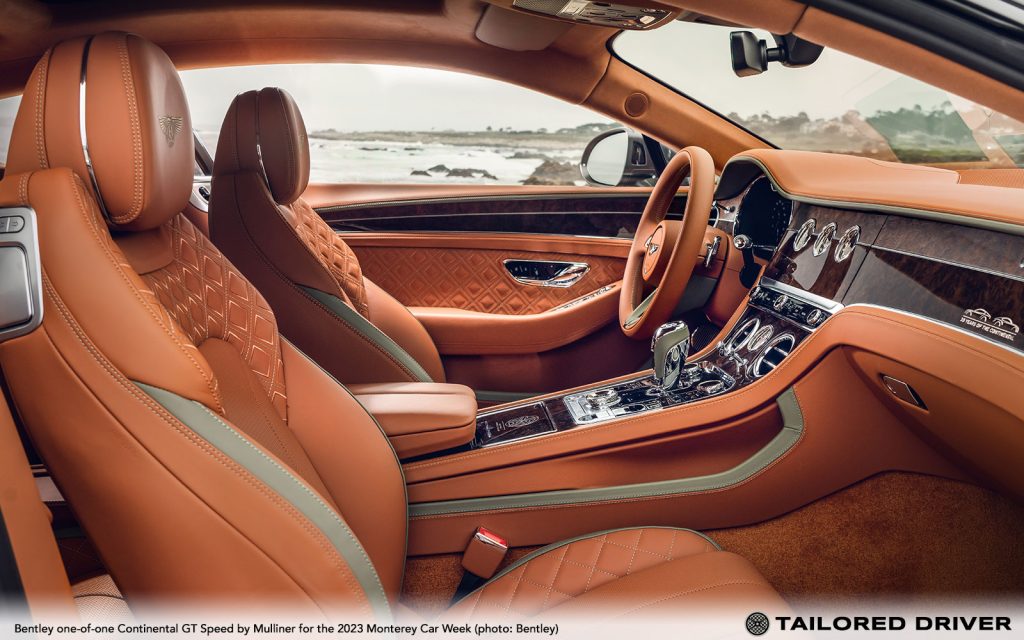
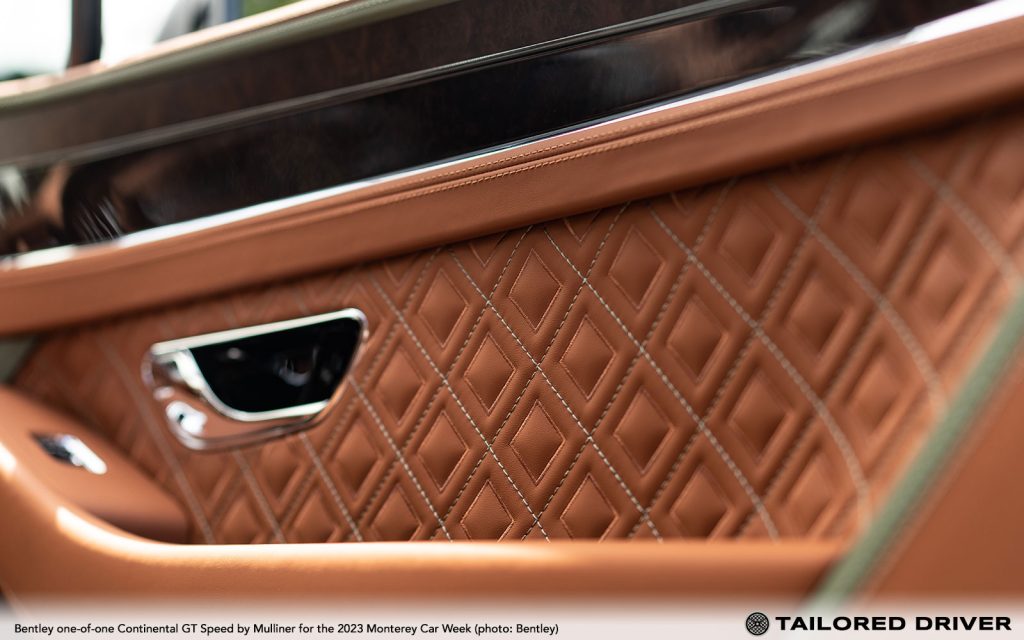
    While Saddle leather and Burr Walnut veneer feature in both cabins, the third-generation model features subtle enhancements of the original model’s theme. The rich Saddle colour is complemented by an accent hide in ‘Special Green’, with contrast stitching in the same shade throughout. The fascia and waist rails feature two different veneer finishes – open pore Dark Burr Walnut over high gloss Dark Burr Walnut – separated by a painted pinstripe in Cypress, connecting the interior with the exterior.

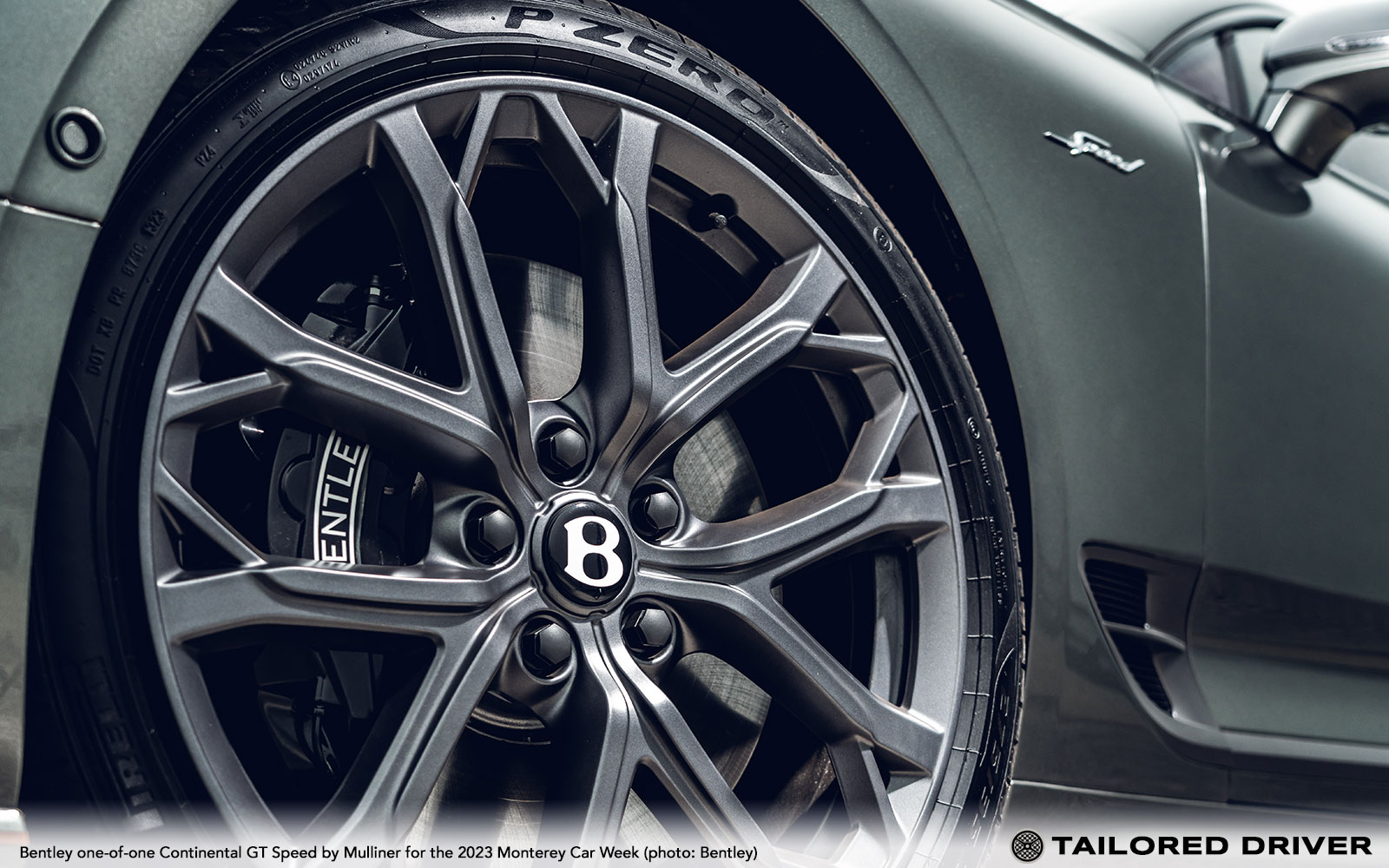
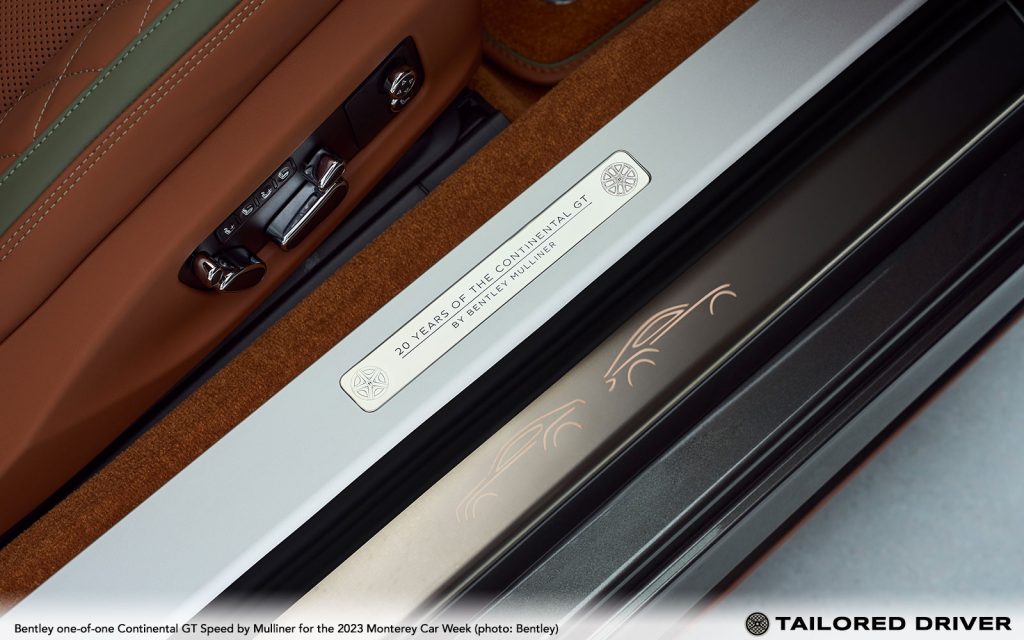
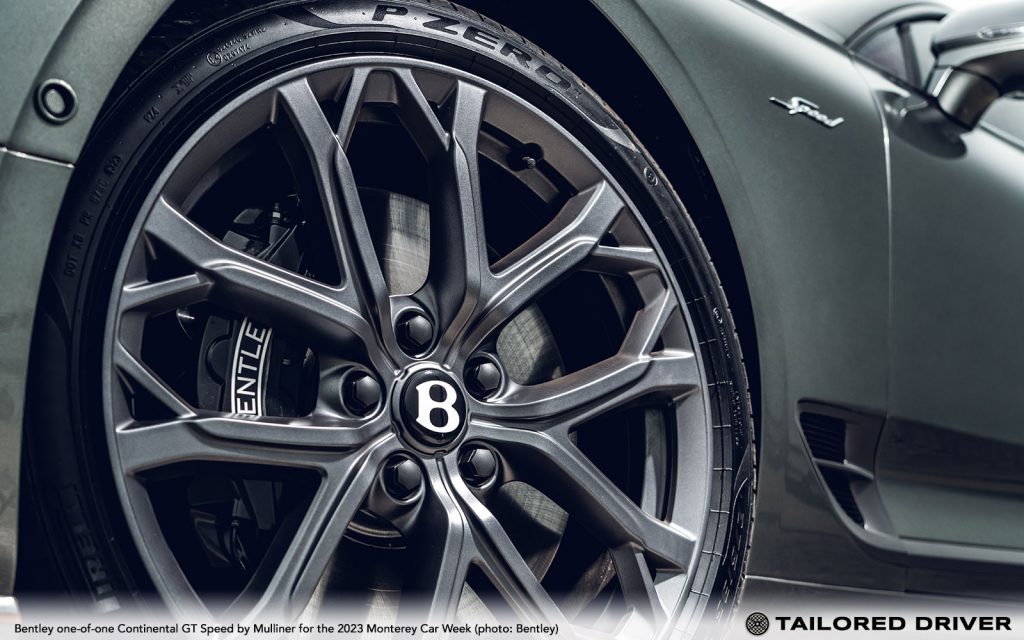
    An extensive list of features includes the Blackline, Touring and Styling Specifications – together bringing polished black exterior brightware, a suite of technical enhancements and a carbon fibre front splitter, side skirts, diffuser and subtle boot lip spoiler respectively. Self-levelling Mulliner wheel badges finished the 22” Sports Wheels in unique Dark Grey Satin. The interior features Naim for Bentley audio and the Bentley Rotating Display, while the personalised treadplates read, ’20 years of the Continental GT by Bentley Mulliner’. Outline representations of the 2003 and 2023 Continental GTs feature on the fascia, centre console and outer sill. This celebratory one-of-one car has already been sold, was handed to its new owner at The Quail, and represents the highlight of four months of activities and events to celebrate this milestone in Bentley’s history.

    20 Years and three generations

    The impact of the first-generation Continental GT was seismic, not only redefining Bentley as a modern luxury brand but also creating a new market sector. The first all-new Bentley with no carried-over components since the original 3 Litre of 2019, the Continental GT was designed at the Crewe studio under then Design Director Dirk van Braeckel and Head of Exterior Design Raul Pires. The sleek lines of Bentley’s new grand tourer were inspired by those of the 1952 R Type Continental, with a Bentley ‘powerline’ that starts low at the front and follows the shoulder line of the bonnet and door before meeting a muscular rear haunch. Twin round headlamps and a Bentley mesh grille gave a subtle nod to the company’s thunderous Le Mans-winning racers of the 1920s.

    Under the bonnet was an all-new 6.0-litre twin-turbo 48-valve W12 engine. This compact, smooth and powerful design developed 550 bhp and 650 Nm, powering all four wheels via a ZF six-speed automatic transmission. Acceleration from 0-62 mph took 4.8 seconds and top speed was a shade under 200 mph.

    During the seven years the first-generation Continental GT remained in production it sired a family of models including the Continental GT Convertible, Continental Flying Spur, Continental GT Speed and Supersports.

    Arrival of the V8

    The second-generation Continental GT, launched in 6.0-litre W12 form at the Paris Motor Show in 2010, also saw the arrival of a second all-new Bentley engine. The efficient and charismatic 4.0-litre V8, which made its debut in 2012, endowed the Continental GT with an eager, agile and responsive character, accompanied by a characterful V8 exhaust backbeat. In 2017 the line-up was joined by the limited edition 710PS Supersports, its conception inspired by the Team Bentley racing GT3.

    2018: the third generation

    Bentley’s third generation Continental GT was launched in 2018. An entirely new design, its sharper, sleeker lines took full advantage of a new, purpose-designed platform. Even its W12 engine was all-new, paired with a new dual-clutch transmission. Highlights of the new model’s specification included three-chamber air springs and 48V electric active anti-roll control, while the on-board technology took a major leap forward thanks to all-new electrical architecture. It was simultaneously faster, more comfortable, more efficient and more luxurious than its predecessors – yet unmistakably still a Continental GT.

    Around the world in 20 reviews

    A Bentley ‘baton’, designed and created in house to represent the key lines of the Continental GT, visited Monterey to start a global journey – travelling in a variety of Continental GT models across Europe, the Middle East, China, Asia Pacific and the US before returning to Crewe. At journey’s end at Bentley’s Dream Factory in Crewe, the baton – which will contain 20 mementoes of the tour – will become a time capsule as a permanent reminder of a unique journey.

  • Ferrari KC23: Maranello’s New One-Off Based on 488 EVO 2020

    Ferrari KC23: Maranello’s New One-Off Based on 488 EVO 2020

    • The wraps are off the KC23, Ferrari’s latest One-Off, bespoke-designed around a brief from one of the marque’s most passionate collectors
    • A futuristic track car based on the architecture of the 488 GT3 Evo 2020 which has triumphed on the world’s leading circuits
    • Two different configurations underscore its elegance and formal purity on the one hand, and its signature Ferrari sporty racing character on the other

    [source: Ferrari]

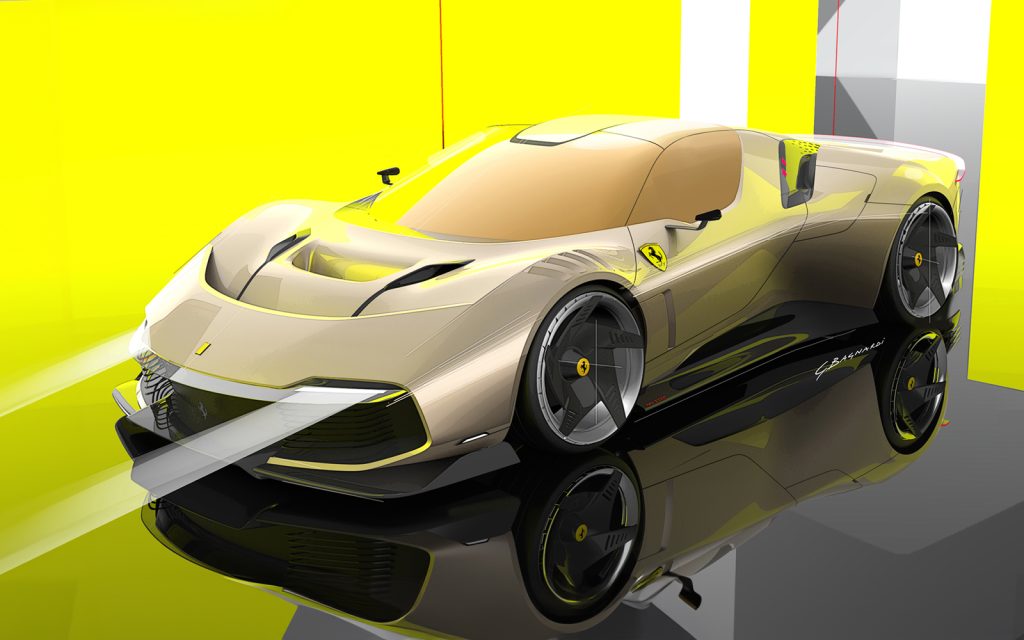
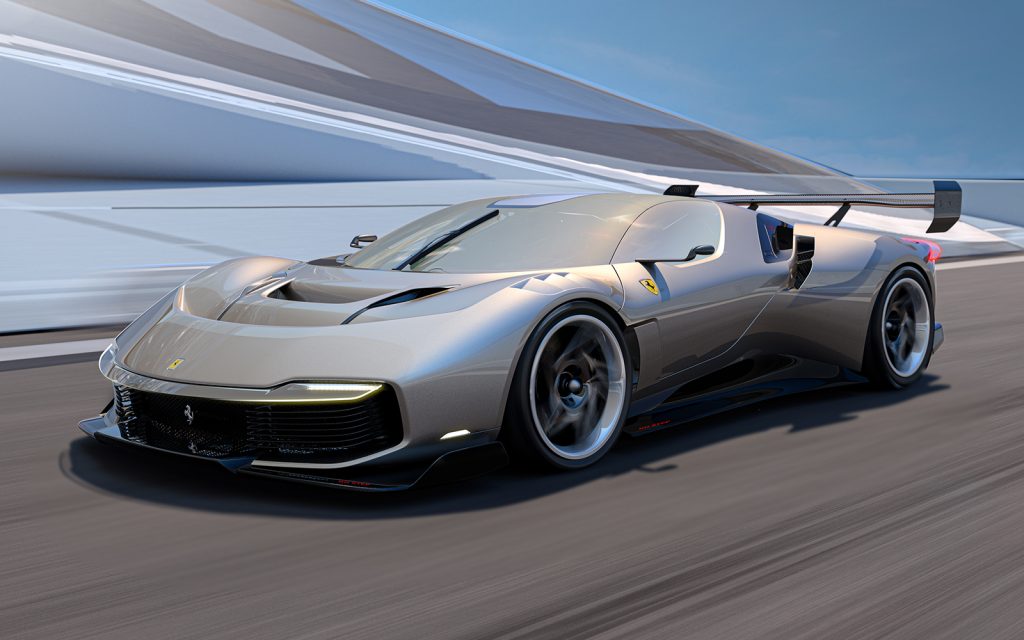
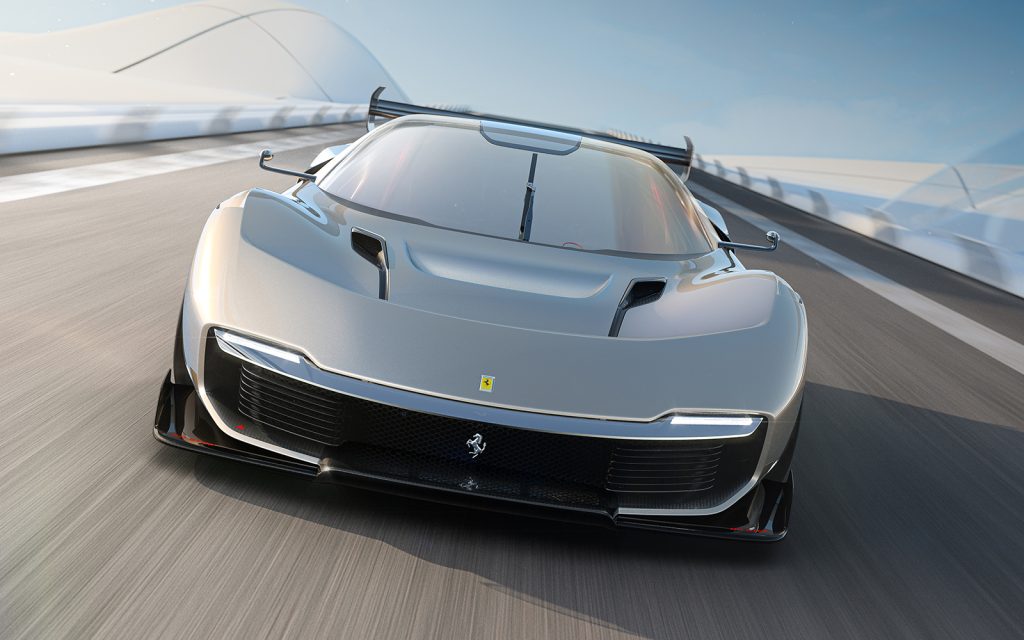
    Maranello, Italy – Ferrari today unveiled the latest addition to its One-Off series, the Ferrari KC23. The latest in the marque’s Special Projects programme, it was commissioned by one of the Prancing Horse’s leading collectors. The KC23 one-off is a bold and extreme vision of what the closed wheel racing of the future may look like. A superlative new take on the most successful track car in Maranello’s 76-year history, the 488 GT3 in its ‘Evo 2020’ version, it pulls off the incredible feat of exuding elegance when at a standstill and thrilling the viewer once on the move, thanks to ground-breaking aerodynamic solutions, such as motorised air intake vents and an imposing rear wing.

    Designed by the Ferrari Styling Centre led by Flavio Manzoni, the KC23 is based on the 488 GT3 Evo 2020 platform from which it inherits its layout, chassis and engine. The base for the project was very special indeed: the 488 GT3 has been racing since 2016 and to date, it has triumphed in the world’s most prestigious endurance races, racking up over 530 victories and winning more than 119 championships, making it the most successful racing Ferrari in history.

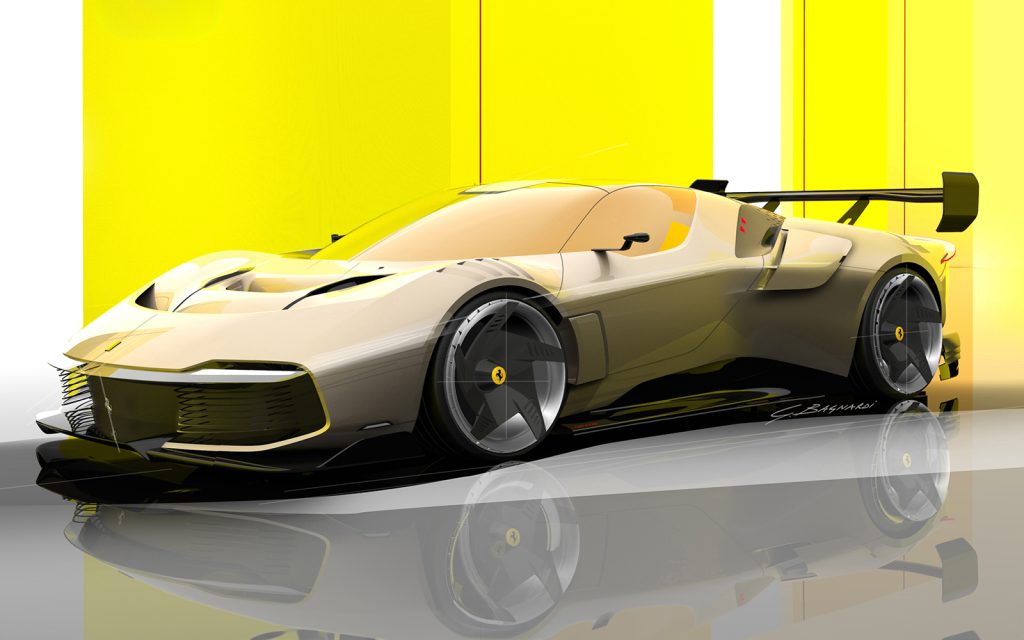
    Given the extreme nature of its engine, chassis and suspension set-up, the KC23 was designed exclusively for non-competitive track use. Its most unusual feature is its dual configuration. At a standstill, the car’s layout showcases its clean, sleek, sinuous forms, but once it hits the track its visual stance is dominated by its impressive air intakes, which open automatically, and its imposing rear wing.

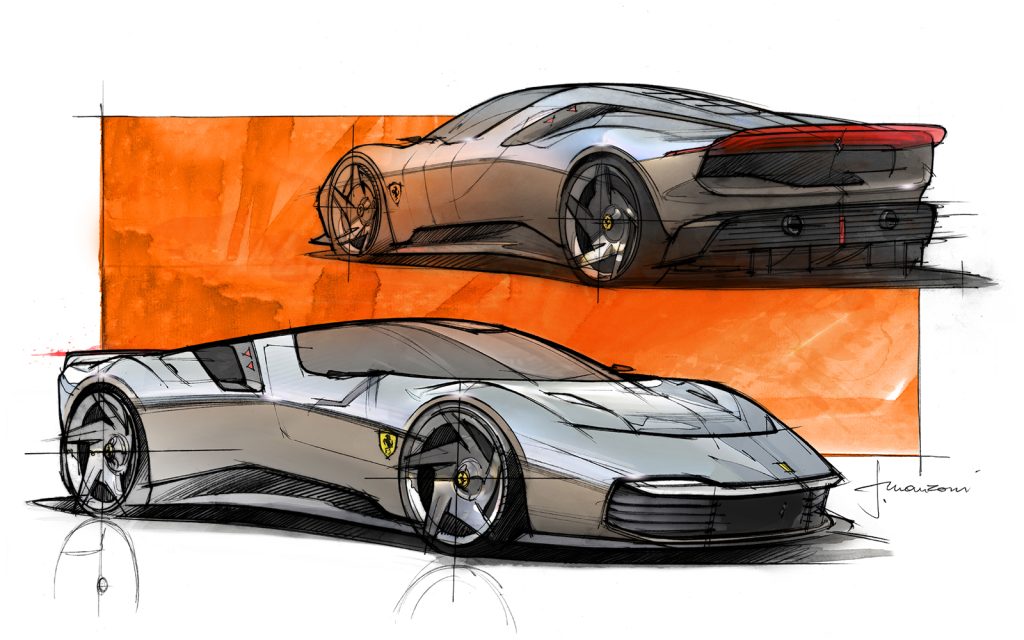
    From the very earliest days of the project and in agreement with the client, the Ferrari Styling Centre focused on creating a radical one-off car completely free of homologation constraints and clothed in the kind of timeless lines that would make an instant classic whilst also providing a tantalising glimpse of the future of supercars. That challenging goal demanded that every single one of the 488 GT3 Evo 2020’s lines being redesigned, glass surfaces and light clusters included.

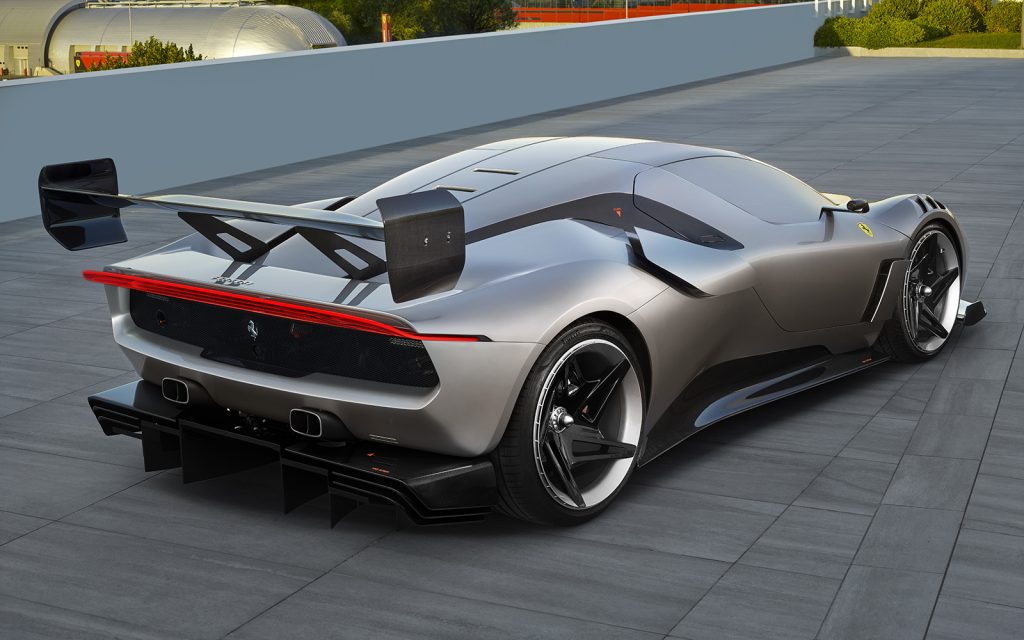
    The result is that the car has a monolithic beauty, as if it were sculpted from a single block of metal. The design also hides several of the car’s technical functions, particularly the side air intakes, which open automatically when the mid-rear V8 twin turbo is turned on. This gives the KC23 an almost lifelike look, as its shape changes depending on what it is being used for. The rear wing is also removable to underline its clean, formal lines when not on the track.

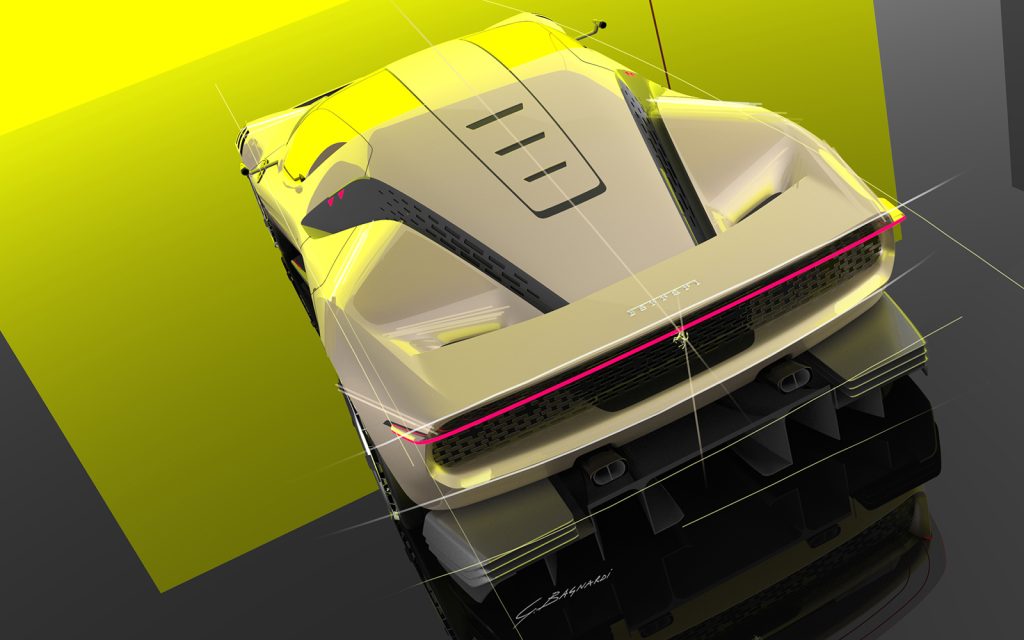
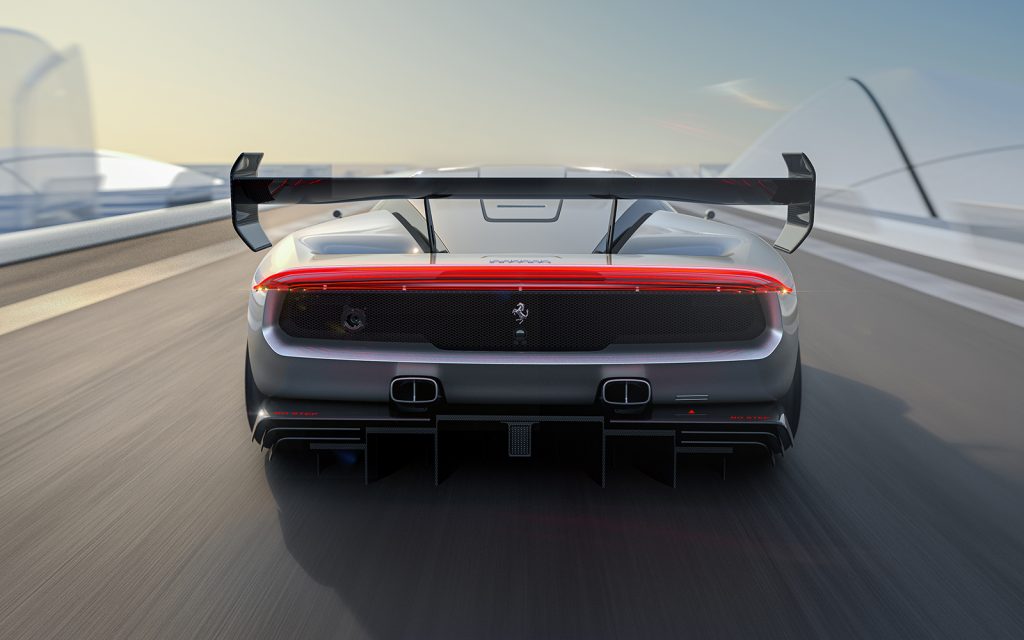
    The surface treatment is smooth and seamless, with sharp angles reduced to an absolute minimum to underscore the KC23’s spare, sinuous purity in the pursuit of an iconic, futuristic design that will stand the test of time. When the driver turns on the engine before taking it out on the track, the KC23 undergoes a radical transformation, its racing stance and aggression suddenly very much to the fore. It is impossible to ignore its imposing rear wing, which marks it out as a racing car designed to scythe through the corners and unleash every single horsepower the V8 can generate.

    In terms of downforce and cooling, the designers worked hard to retain the performance of the donor car despite the fact that the KC23 has a completely different silhouette. Panels were developed with custom kinematics that activate automatically when the engine is turned on: the one behind the front wheel reveals a fence, which boosts front downforce to balance the car aerodynamically. The panel at the rear provides the correct amount of intake air to the intercoolers and auxiliary components, as well as to the engine.

    The KC23’s butterfly doors open vertically on single front hinges, an architectural solution it shares with another iconic supercar, the LaFerrari. No changes were required to the greenhouse or the car structurally to incorporate this feature. The clam-shell bonnet has a simple opening system – just two pins need to be removed to allow the front to be inspected and maintenance work to be done. Both headlights and rear lights have been redesigned, with the most radical change to the rear lights where striking methacrylate light blades, inspired by the Ferrari Vision Gran Turismo, spring to dazzling life when the engine is turned on.

    Even the car’s glass surfaces were influenced by the design philosophy underpinning the KC23: they are seamlessly integrated with the bodywork, with no visible pillars, frames or seals, creating a clearly aeronautics-derived dome effect. Their metallic finish melds seamlessly for maximum styling continuity, creating a strikingly futuristic result.

    Another distinctive feature is the KC23’s Gold Mercury livery, courtesy of a specially-developed, four-layer aluminium paint. The liquid metal in the paint gives it an astonishingly luminous gleam in sunlight and the colour itself seems to change constantly depending on the type and angle of the light striking it, giving an extraordinarily captivating effect.

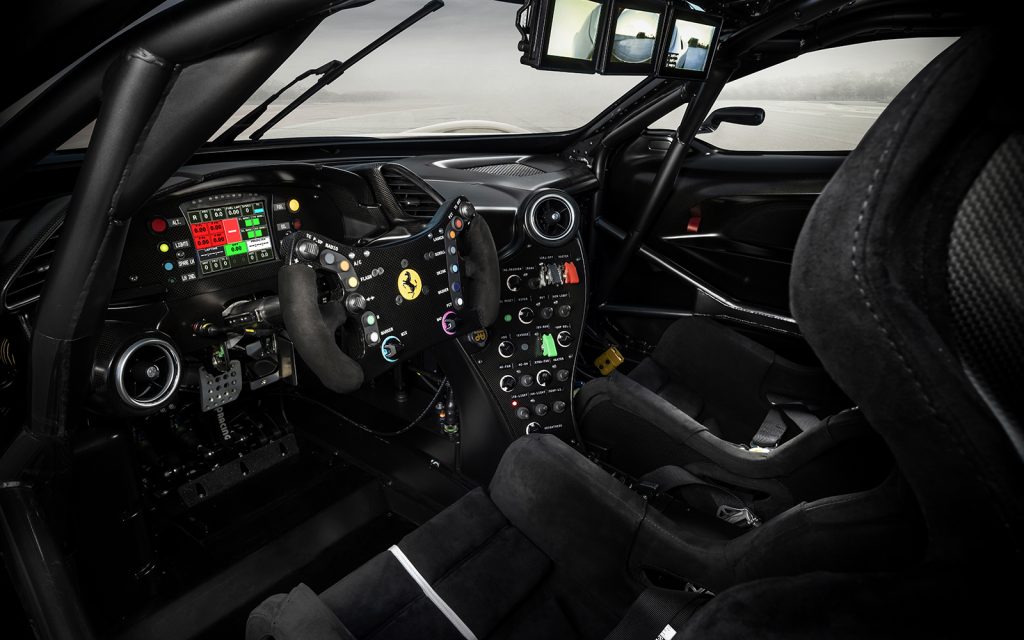
    The cabin has been kept as pared-back and similar to the 488 GT3 Evo 2020 as possible, with the exception of the door panels and dashboard finish on the passenger side. The KC23’s specific seats, trimmed in Alcantara® with an electro-welded logo, lend the cabin an elegance that is perfectly in tune with the exterior. Rearward visibility is ensured by a video camera system that also had a beneficial impact on the car’s aerodynamics, as the traditional wing mirrors could be removed and the line of the flanks left unsullied.

    The car has two sets of specifically designed wheels: 18” wheels will allow the KC23 to dazzle on the world’s circuits while 21” wheels at the front and 22” wheels at the rear will captivate the public when it is displayed in its static configuration.

    The new arrival took over three years to develop and now joins the most exclusive group in the Prancing Horse’s range: bespoke cars crafted to the specifications of a client, making them the very pinnacle of Ferrari’s personalisation strategy. It will be making its first public appearance between July 13th and 16th at the Goodwood Festival of Speed, one of the UK’s most important motorsports events. From August 1st to October 2nd, it will be on display at the Ferrari Museum in Maranello, much to the delight of all of the enthusiasts eager to admire its extraordinary formal and engineering solutions at first hand.

    SPECIAL PROJECTS

    The Special Projects programme is aimed at creating unique Ferraris (the so-called “One-Offs”) characterised by an exclusive design crafted to the requirements of the client, who thus becomes the owner of a one-of-a-kind model. Each project originates from an idea put forward by the client and is developed hand-in-glove with a team of designers from Ferrari’s Styling Centre. Once the car’s proportion and forms have been defined, detailed design blueprints and a styling buck are produced before the manufacturing process for the new One-Off begins. The entire process takes around two years on average, during which time the client is closely involved in assessing the design and verification phases. The result? A unique Ferrari sporting the Prancing Horse logo and engineered to the same standards of excellence that characterise all of Maranello’s cars.
  • Long-Standing Porsche Lover Has Colour Named after Him

    Long-Standing Porsche Lover Has Colour Named after Him

    For the first time, Porsche has implemented a customer-specific Paint to Sample Plus colour in a new process.

    [source: Porsche AG]

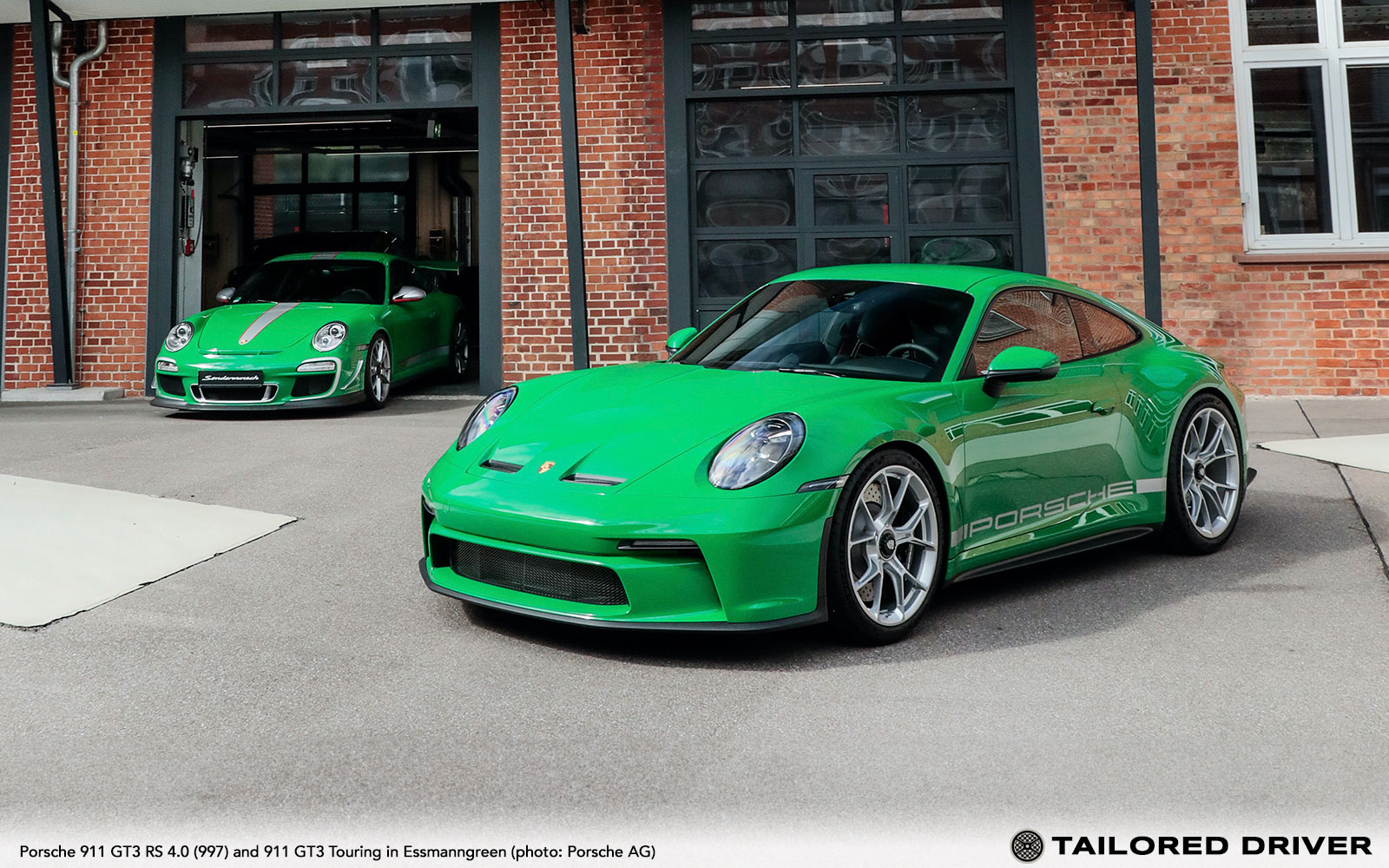
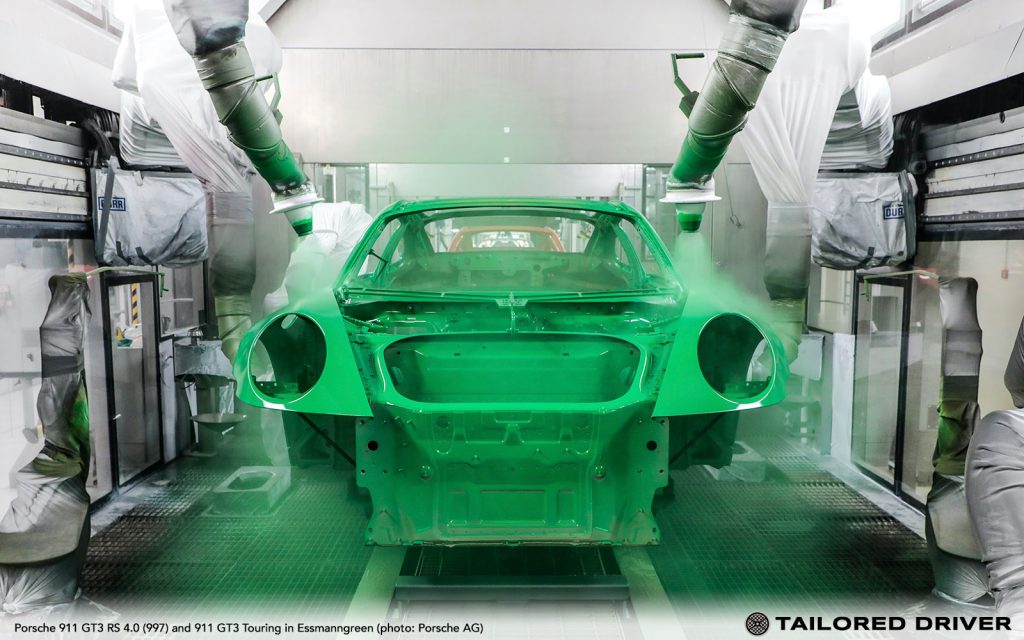
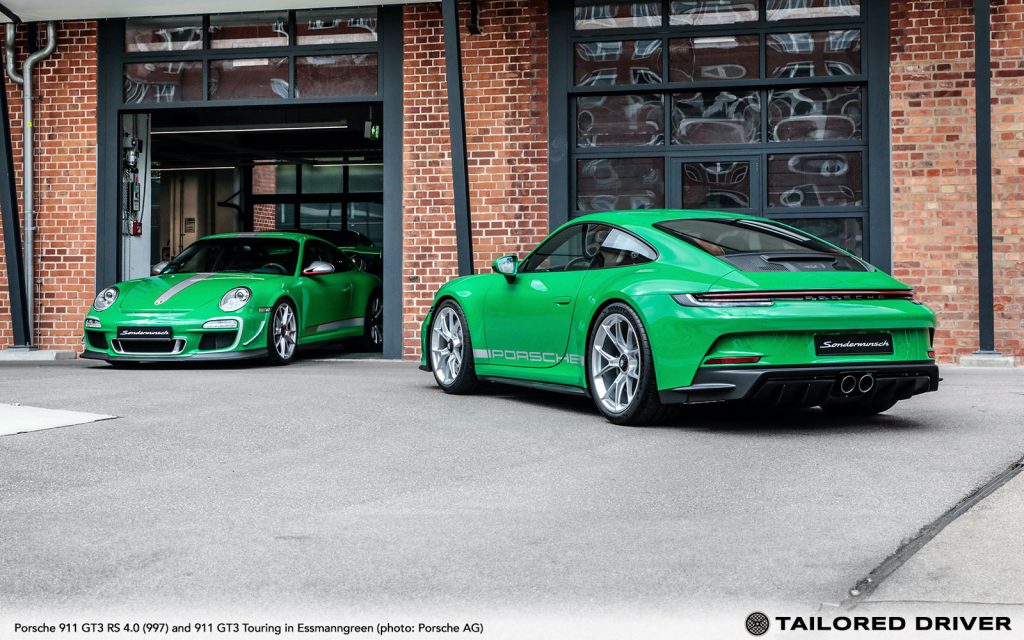
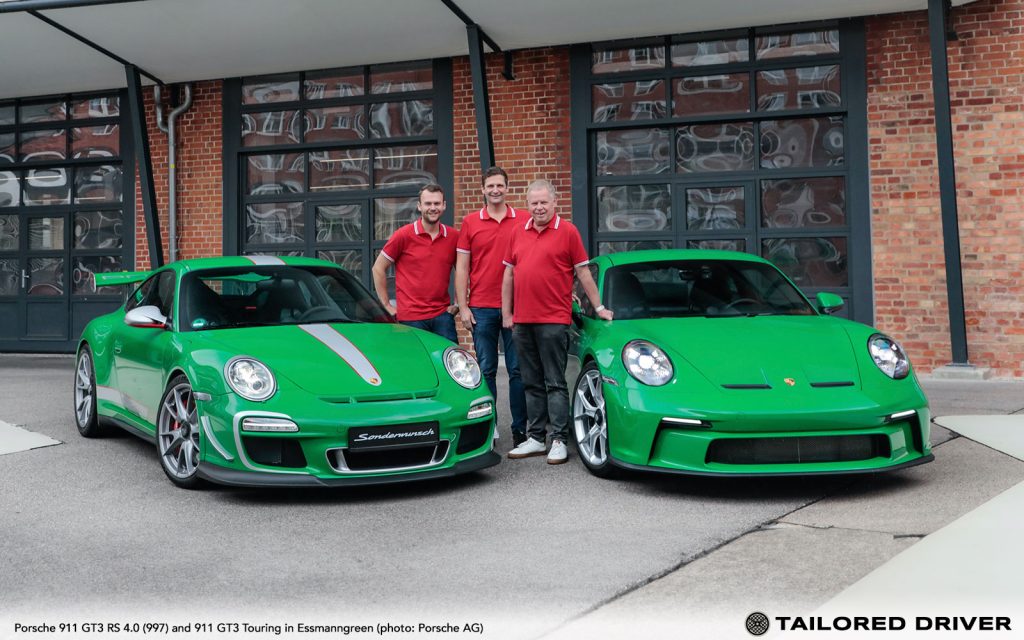
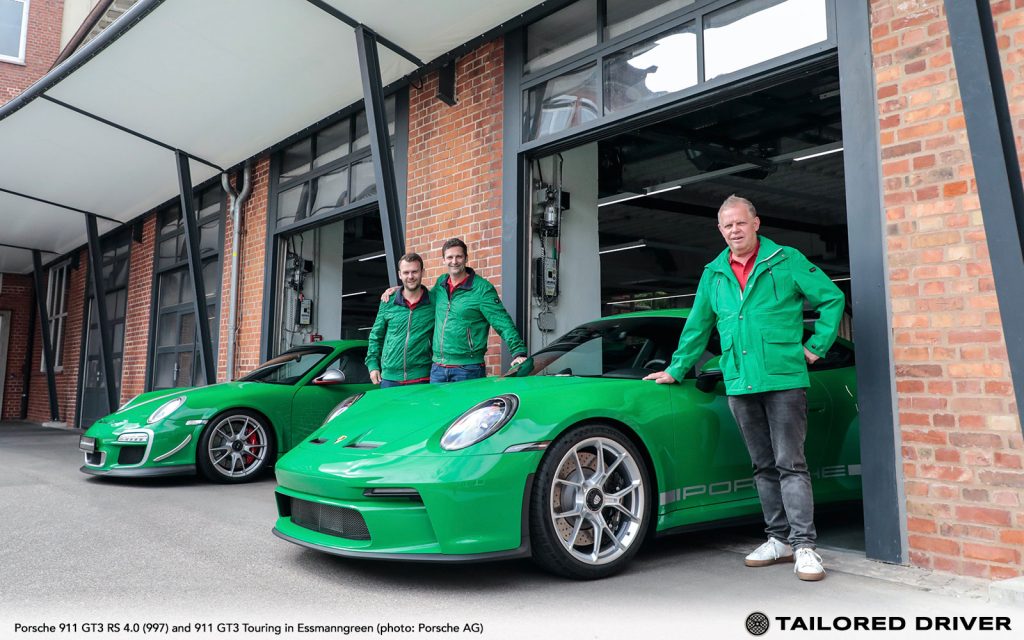
    Guards Red, Racing Yellow, Carrara White Metallic – just a few of the familiar names for colours from the Porsche Car Configurator. Now a brilliantly rich green will join the palette. Michael Essmann, a long-standing Porsche lover and Managing Director of family business Elektro Essmann, has had his very own individual colour made within the scope of the Paint to Sample Plus range. As part of the model year R Paint to Sample range, starting in March 2023 the exterior colour Essmanngreen, colour code 24C, will also be available through the Car Configurator for customers of the 911, 718 and Taycan model lines.

    As far back as 1992, Michael Essmann had a 911 Carrera RS 3.6 (964) painted in the company colour of the master workshop for electrical installations and photovoltaic systems – the first Porsche model in Essmanngreen. Other cars followed, including a 911 GT3 RS 4.0 (997) and most recently a 911 GT3 Touring (992). Sons Mike and Stefan Essmann compete successfully in the Porsche Sports Cup, with racing cars naturally, these also displaying Essmanngreen accents on the bodies.

    “My very first Porsche was a 911 SC in 1978 with which I also graduated from the Sport Driving School,” recalls Michael Essmann. “It was painted Opal Metallic. It was only later that I had the idea of using the colour of our family business for my private cars too. But every time I pick up a new Porsche in this very special colour it’s a great feeling. And to know that I’m the originator of this colour named after me.”

    Highest quality and perfect colour matching

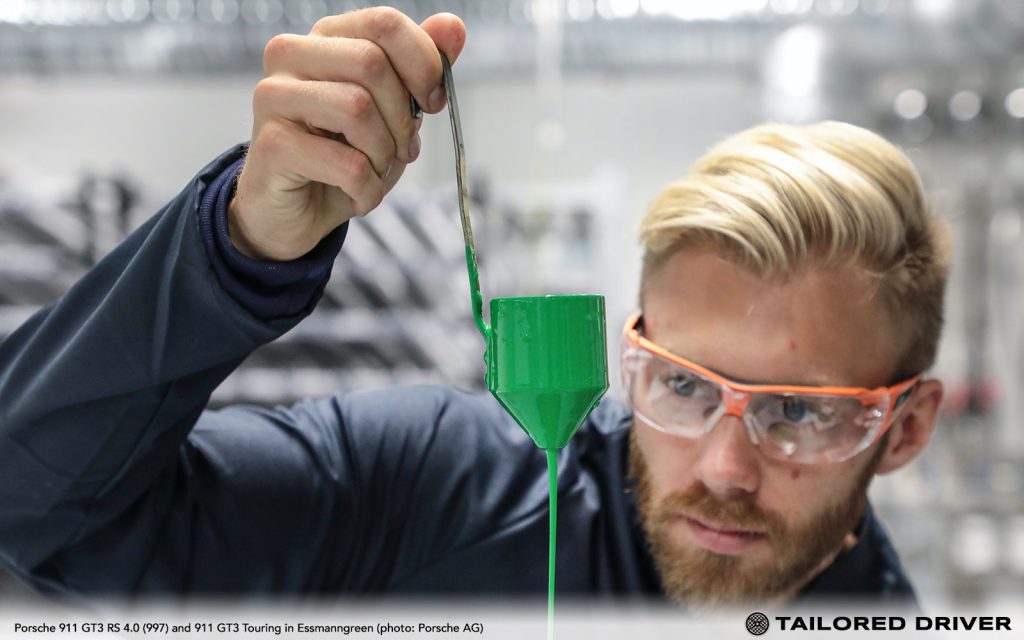
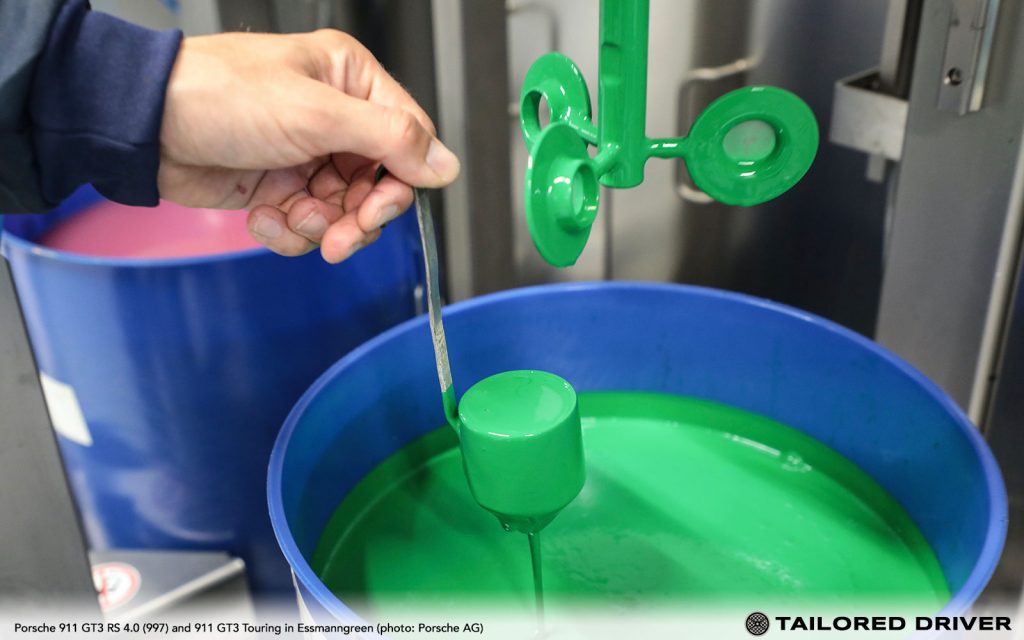
    While the Custom Colour of the 964 was blended in the After Sales painting process that was standard at the time 30 years ago, the current Essmann Porsche benefits from Porsche professionalising the range of special exterior colours in 2021 and significantly expanding its capacity. A new colour-mixing bench has been put into operation at the main plant in Zuffenhausen, where paint specialists blend several dozen ingredients down to the last milligram to achieve the desired shade. When the binding agents and additives are included, the recipe for Essmanngreen contains over 100 ingredients.

    Each batch is divided into two paint pots for bodywork and add-on parts. The areas to be painted on the vehicle consist largely of aluminium, plastics and carbon/fibreglass composites. This mix of materials and the different application methods and drying temperatures require slightly different paint compositions, depending on the component. A test body and so-called batch comparison plates are painted and used as a colour reference for the final acceptance of the car.

    These completely new processes designed for high quality with the combination of craftsmanship and industrialisation required the re-development, testing and approval of all colours, some of which had already been used successfully in the past in the old paint shop. This is why it was necessary to develop a paint recipe for Essmanngreen on Type 992 because it was last used successfully in the old paint shop for Type 997.

    “Unusual paint finishes are part of the history of our brand and are an important differentiating feature,” says Alexander Fabig, Head of Individualisation and Classic. “The intelligent combination of the production process and its industrialisation is unique. Our customers thus enjoy a very wide range of available colours and many custom paint finishes that meet the highest standards. Every colour must be deemed suitable for many different surfaces and materials – perfect colour matching is what is wanted.”

    170 additional colours across all model series

    Porsche has extended its colour range while simultaneously restructuring it. “Paint to Sample” used to be known as “Custom Colour”. This category includes predefined colours that have already been technically approved by the paint specialists at Porsche.

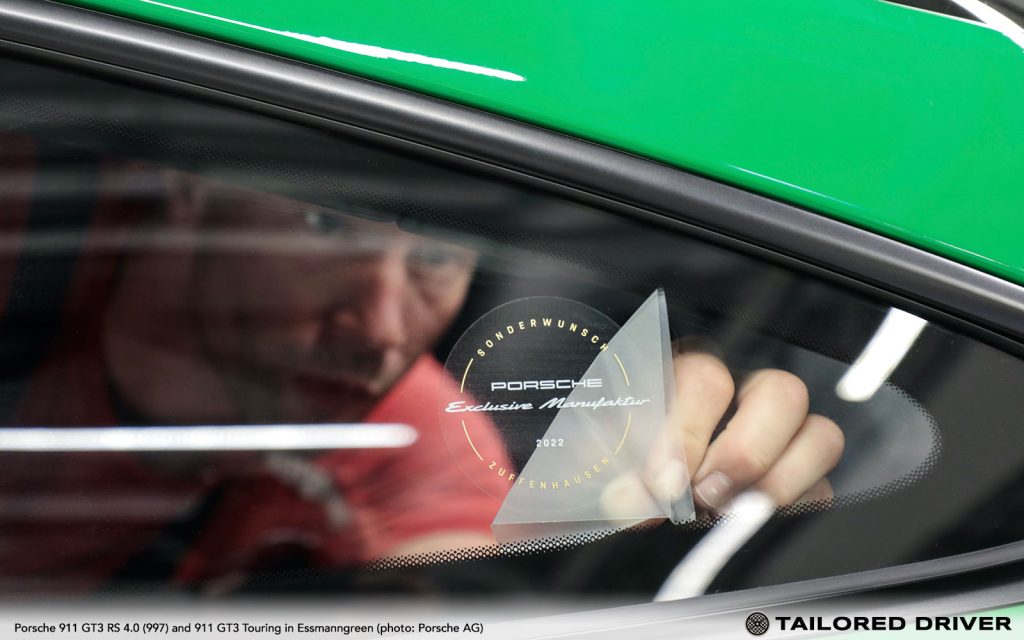
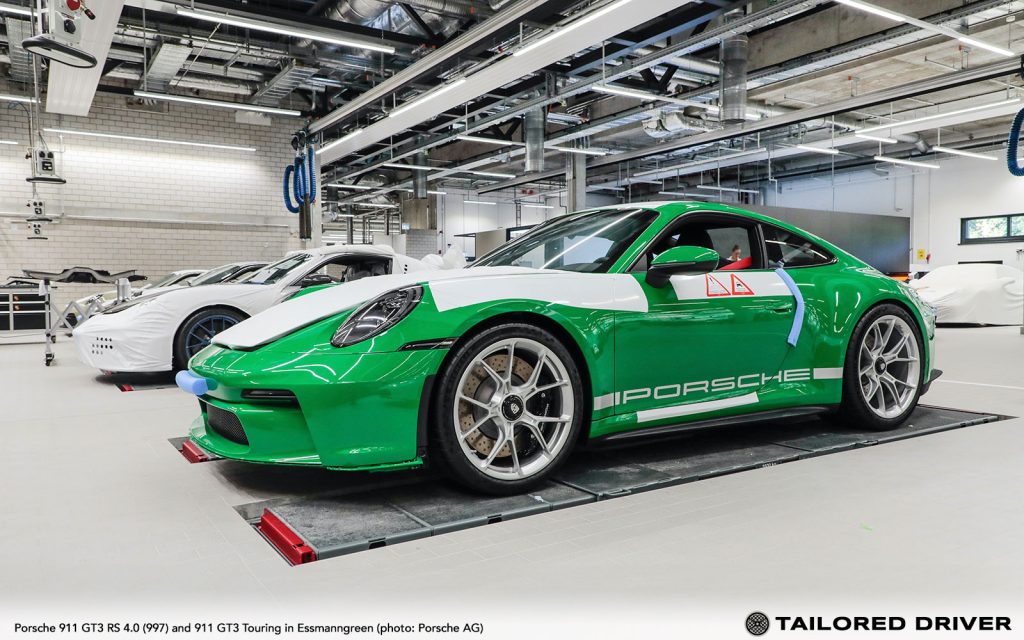
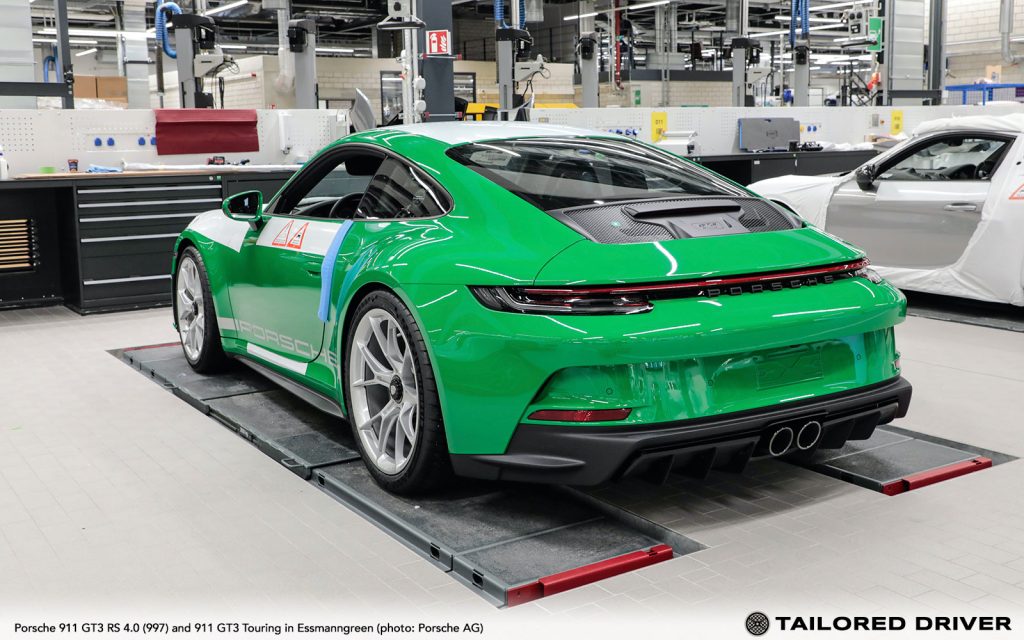
    For especially individual colour requests, Porsche Exclusive Manufaktur goes a step further: “Paint to Sample Plus” allows almost complete freedom in selecting the paintwork based on a sample submitted by the customer. Thus, the Essmanngreen colour on Michael Essmann’s 911 GT3 Touring was first created as a “Paint to Sample Plus”. After technical approval, the Porsche paint specialists then added the colour to the “Paint to Sample” programme. There, Essmanngreen can now be selected from anyone who is interested via the Porsche Car Configurator. The process was started by Porsche Exclusive Manufaktur, who painted a brand-new 911 GT3 RS (992) in the this colour for exhibition purposes.

    The overall range of “Colours of Choice” is very big. For the 911 and 718 model series, there are currently 115 additional paint colours to choose from, For the Taycan there are currently 108 such options, while for the Panamera and the Macan the number is 59, with the Cayenne offering a choice of 52 different colours. Taking into account a number of overlaps, there are 170 additional colours for all model series combined.

    Personal design even in the interior

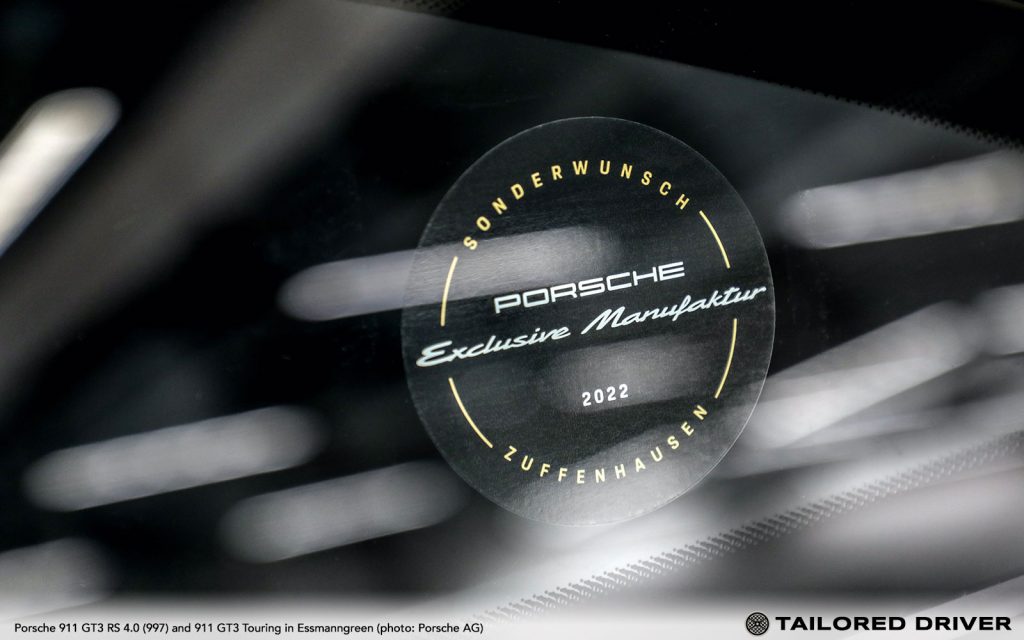
    Michael Essmann selected not only “Paint to Sample Plus” but also further custom options from the Sonderwunsch programme of Porsche Exclusive Manufaktur. For example, his very personal 911 GT3 Touring (992) has a Porsche logo on the side whose look is based on the Porsche Heritage Design models.

    In the interior, the seats were customised. Based on the 964 RS, the seat centres have a graduated colour design in Slate Grey and Crayon. Trim made of carbon enhances the dashboards. The “touring” logo is stitched into the headrests of the full bucket seats in red thread. This fits in with the overall concept as Elektro Essmann also uses red as a contrasting colour.

    About Porsche Exclusive Manufaktur

    A sports car as individual as your own fingerprint, as unmistakable as your own lifestyle: Porsche Exclusive Manufaktur in Zuffenhausen creates very personal customer vehicles through a combination of perfect craftsmanship and a high-tech approach. Highly qualified employees with decades of expertise devote their full attention to every detail and enhance it through hand craftsmanship.

    The experts can draw on a wide range of visual and technical customisation options for the exterior and interior of Porsche cars. Visible examples include Sport Design packages, custom rim designs and interior trims, as well as the comprehensive “Paint to Sample” range for all Porsche models. Porsche Exclusive Manufaktur fulfils the highest demands with regard to materials and craftsmanship. Alongside individual customer vehicles, Porsche Exclusive Manufaktur also produces limited small series and editions. High-quality materials are combined with modern production technologies to create a harmonious overall concept.

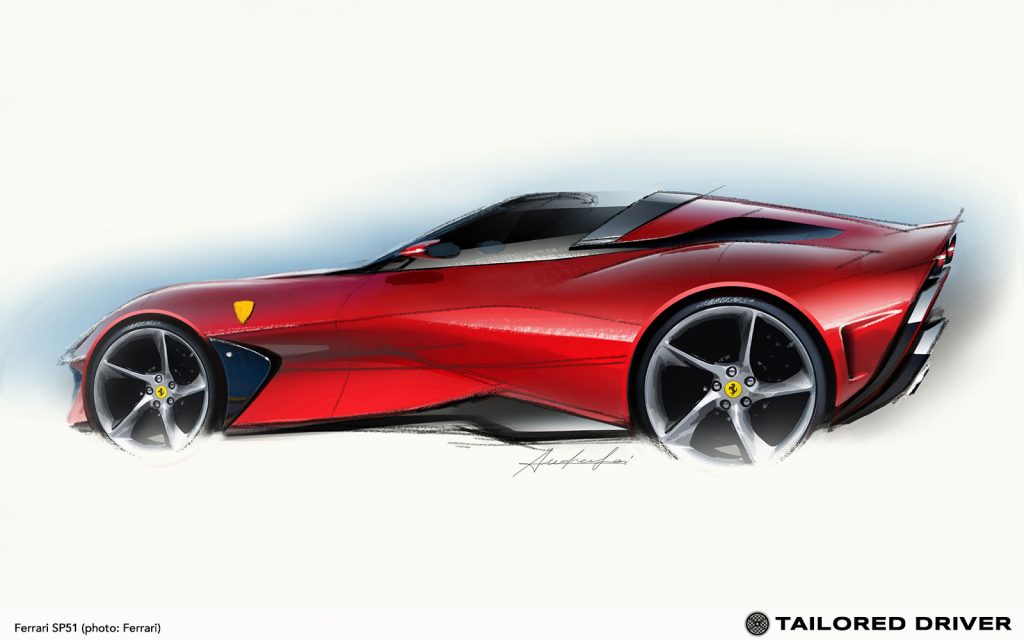
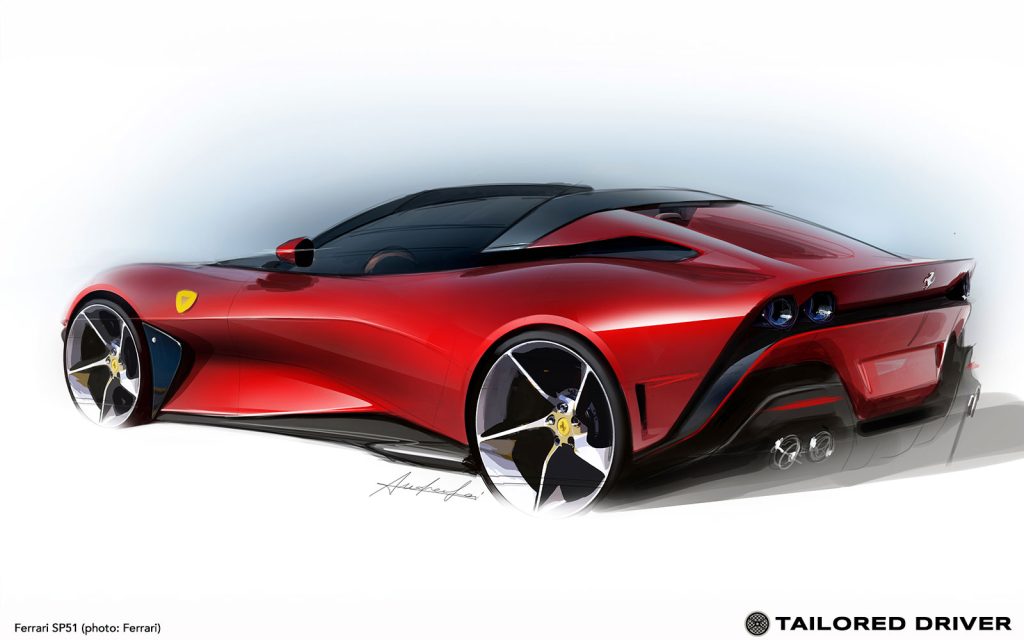
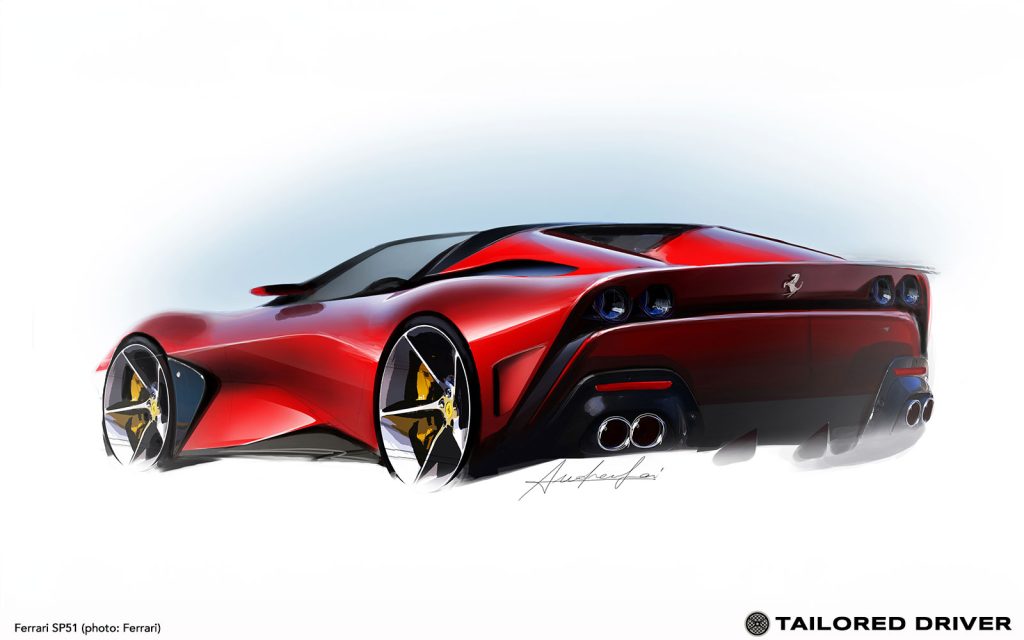
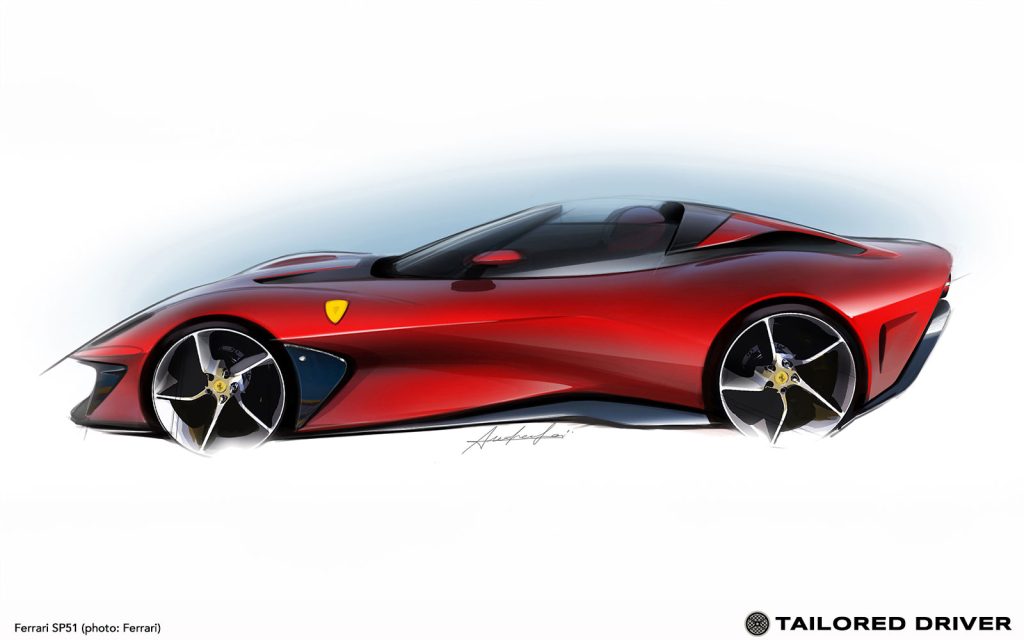
  • Ferrari SP51: The 812 GTS-Inspired Roadster is Maranello’s Latest One-Off

    Ferrari SP51: The 812 GTS-Inspired Roadster is Maranello’s Latest One-Off

    • A new Ferrari One-Off designed around its owner’s requirement
    • The SP51 is a thoroughbred roadster based on 812 GTS architecture 

    [source: Ferrari]

    Maranello, Italy – The latest addition to the Prancing Horse’s One-Off series, the Ferrari SP51, was unveiled today and joins the most exclusive group in Maranello’s range: unique, absolutely bespoke cars crafted to the specifications of a client, making them the very pinnacle of Ferrari’s customisation scope and range.

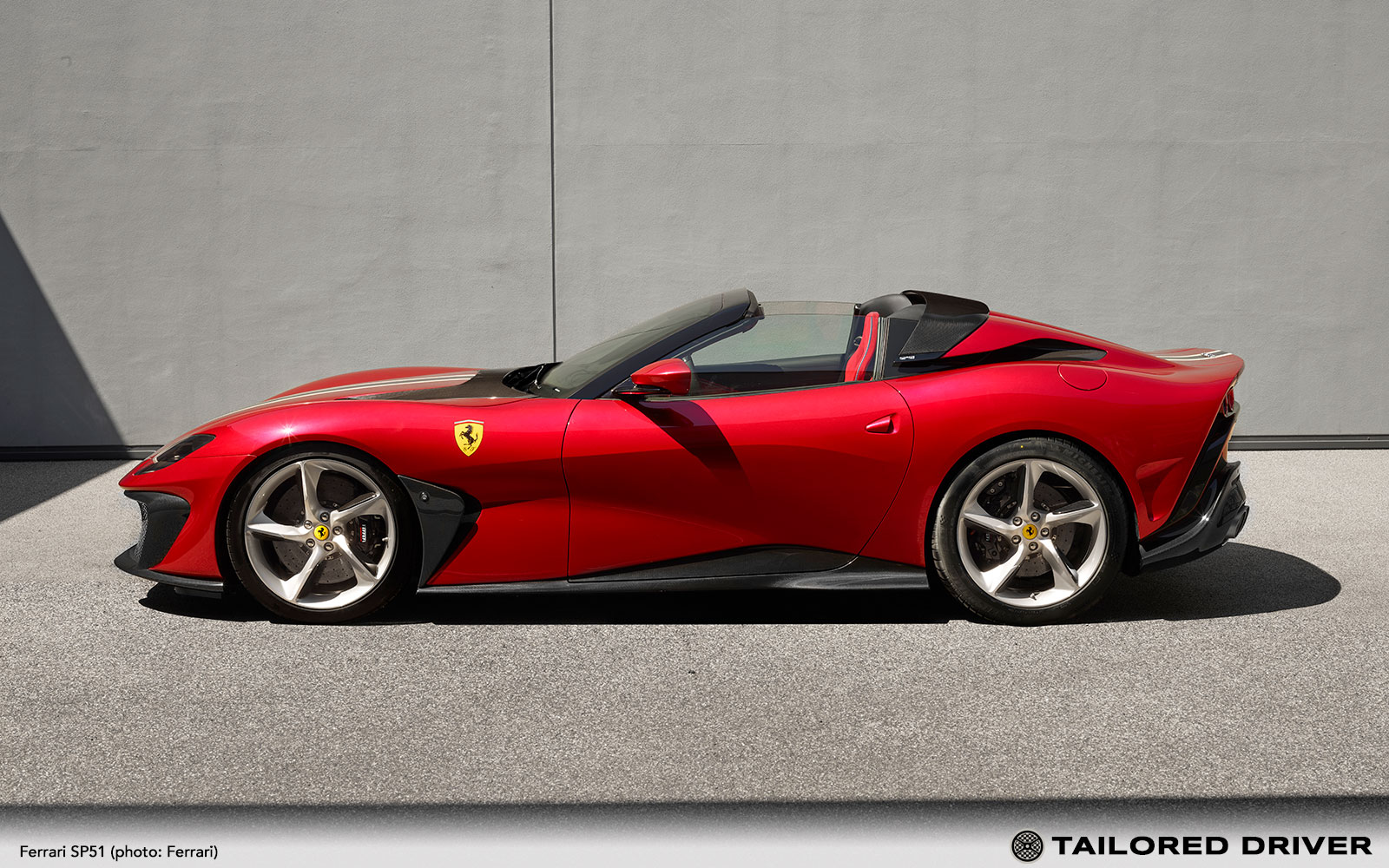
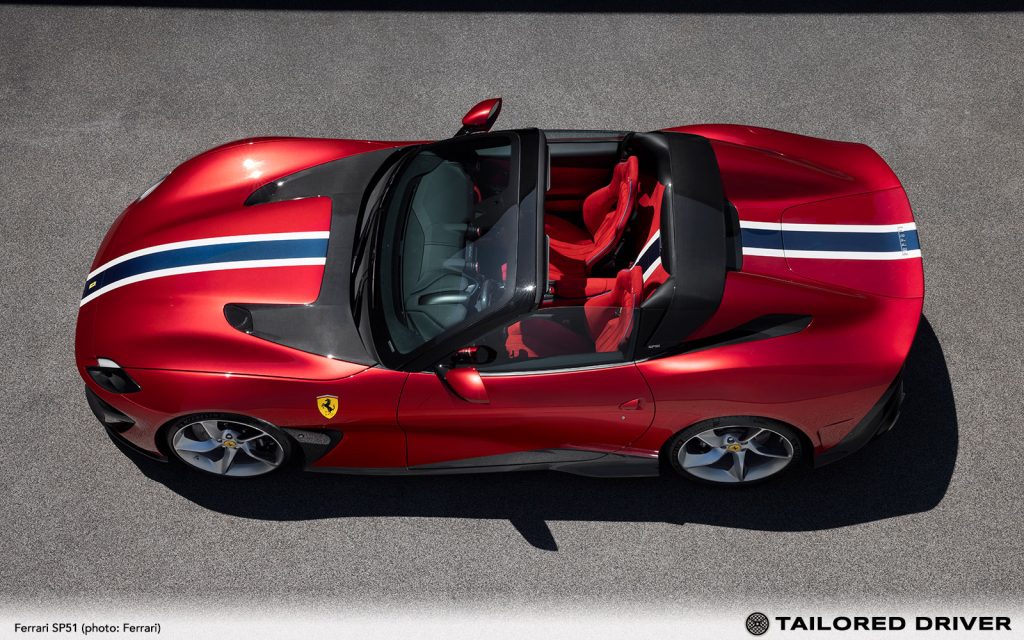
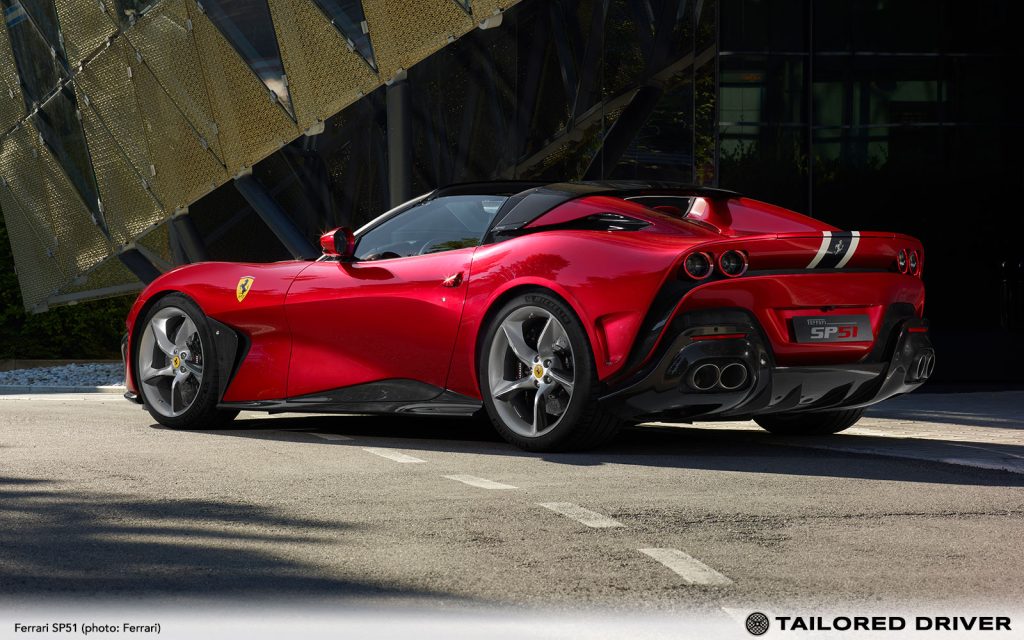
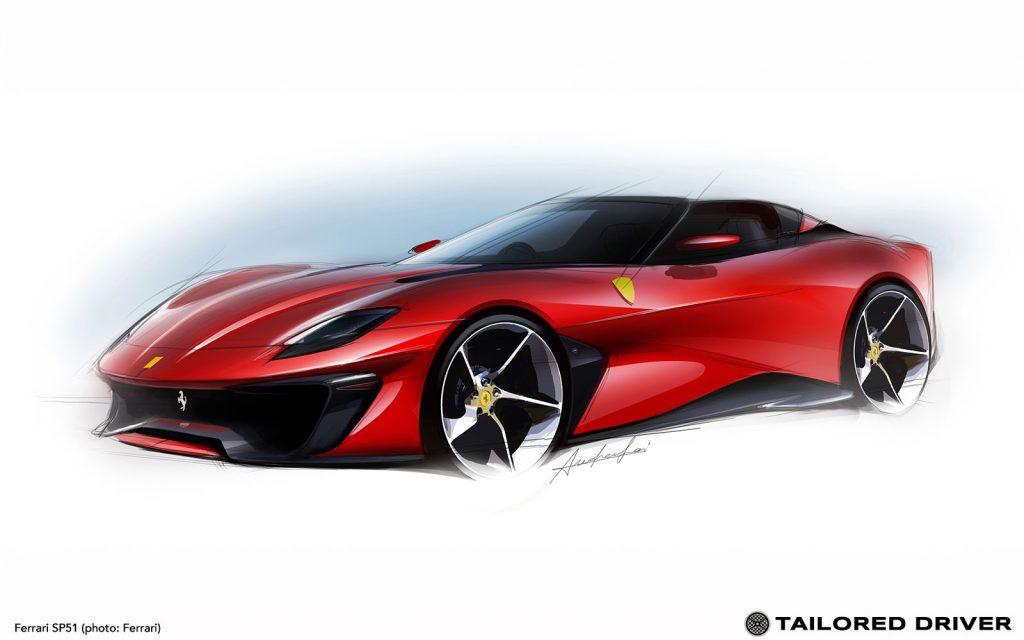
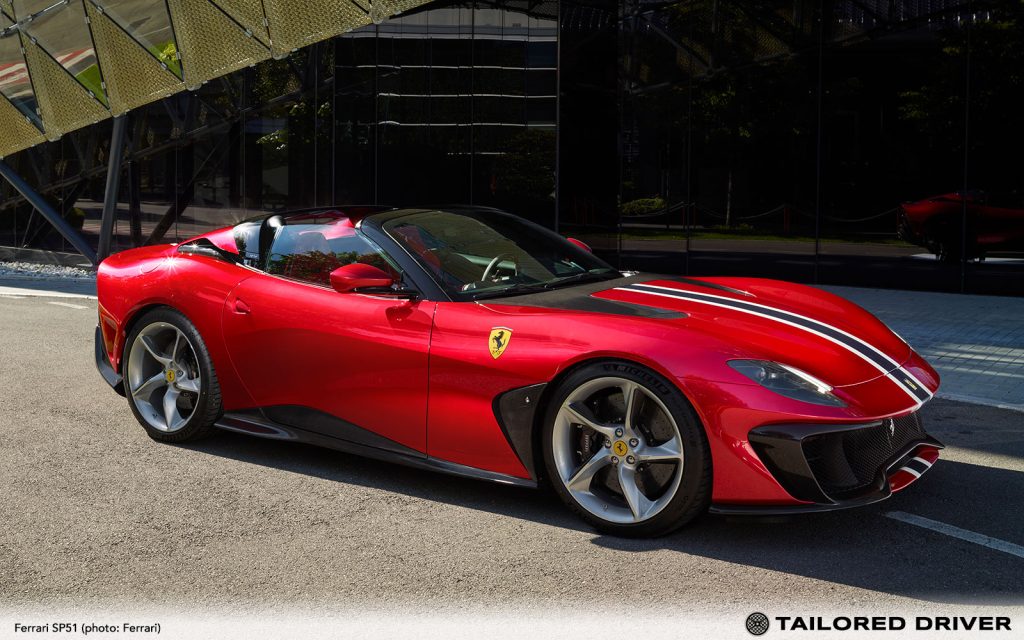
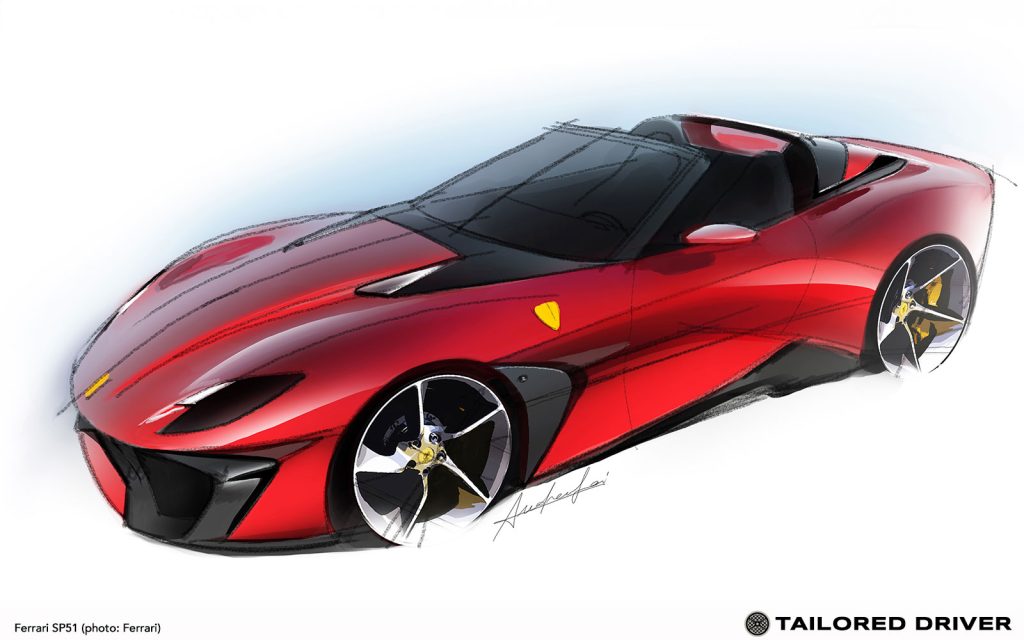
    Designed by the Flavio Manzoni-headed Ferrari Styling Centre, the SP51 is a front-engined V12 spider based on the 812 GTS platform from which it inherits its layout, chassis and engine. At first sight, the stunning new car’s most striking characteristic is its total absence of a roof, making it an authentic roadster in every respect, accentuating both its sporty character and ability to captivate both visually and in terms of en plein air driving exhilaration.

    Unsurprisingly, the SP51’s aerodynamics required meticulous honing in a process involving CFD simulations, wind tunnel and dynamic testing to guarantee not just the ultimate in comfort in the cabin, but also the same standard of acoustic comfort and wind feel as the car that inspired it.

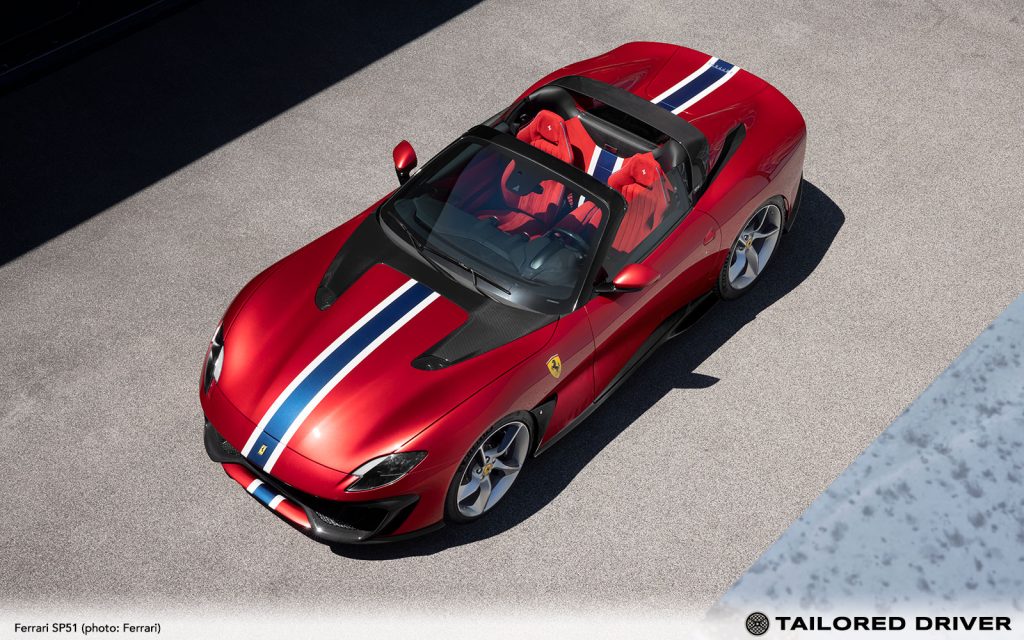
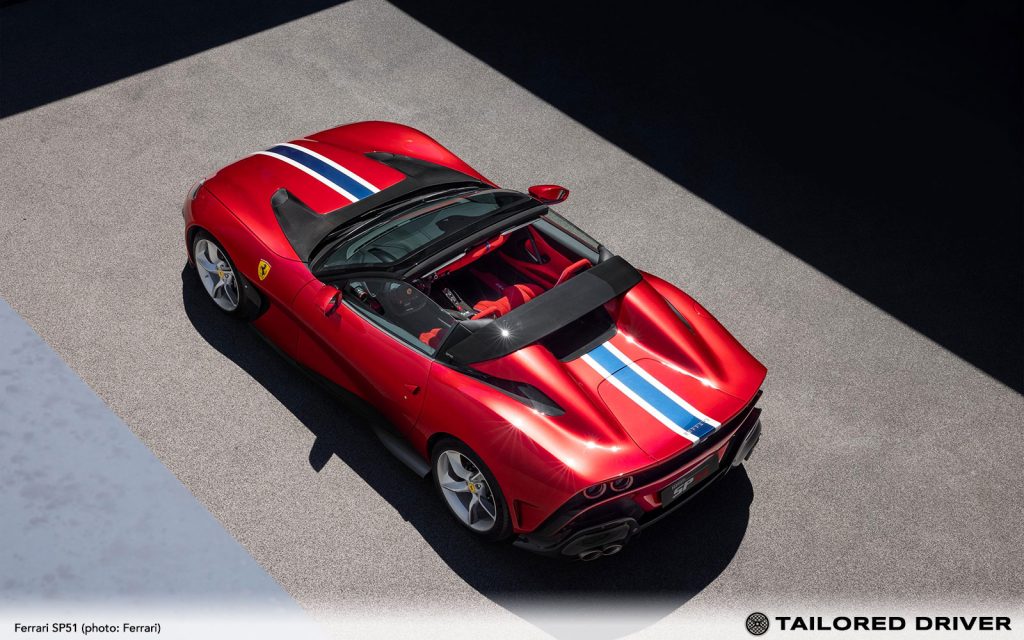
    The SP51’s styling is both powerful and harmonious, thanks to its seamlessly muscular, undulating surfaces. Its forms are modern, sinuous and sensual at once, in great part as a result of the extensive use of bare carbon-fibre both on the exterior and in the cabin. The trim on the bonnet is particularly striking as it dynamically frames the two air vents.

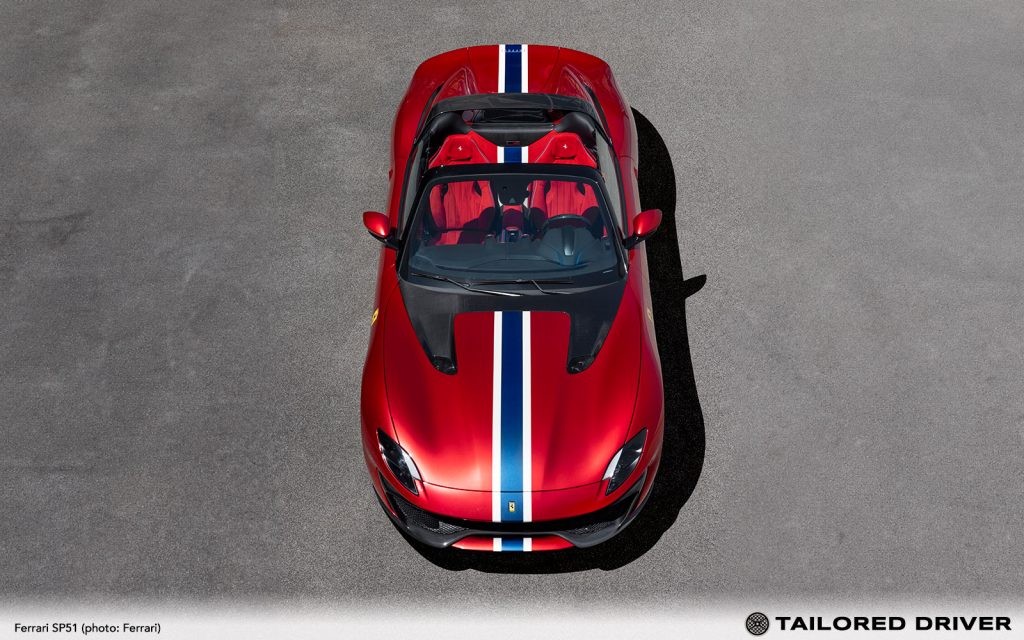
    Another of the SP51’s most captivating features is its new Rosso Passionale three-layer paintwork – the colour was developed specifically for the car and gives it an elegant yet imposing character that also exudes authority. This impression is further enhanced by the blue and white livery inspired by a legendary 1955 Ferrari 410 S which not only runs the length of the car, but is also referenced in the interior.

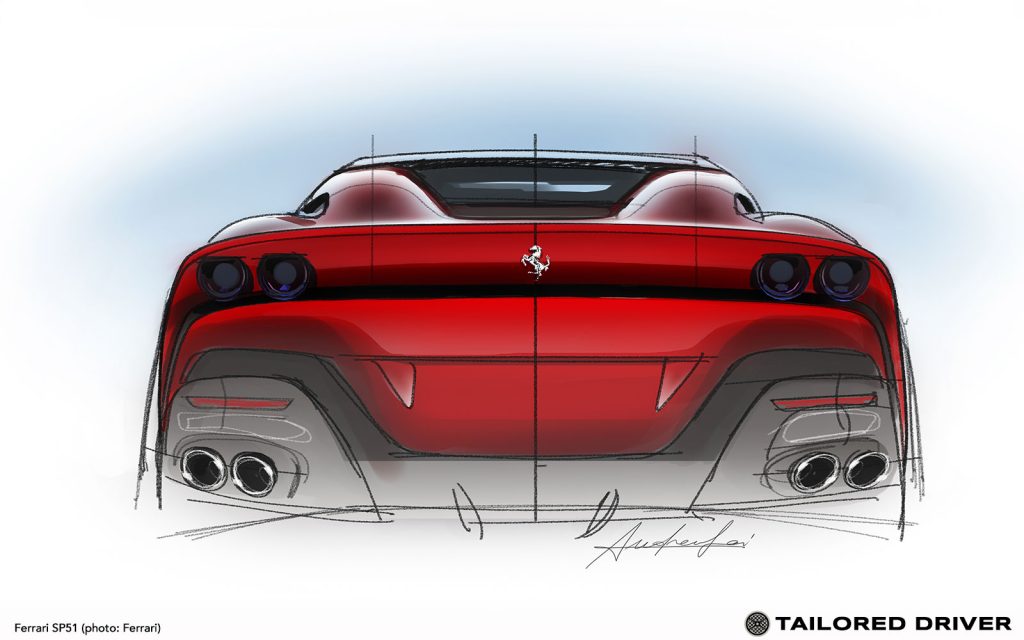
    At the front, specially-designed headlights give the SP51 an instantly recognisable and forceful identity all of its own. Also noteworthy are the wheels, which are specific to the car and have carbon-fibre wing profiles on each of the spokes which also feature a sophisticated tone-on-tone diamond-cut finish on the forward-facing section.

    The rear of the car is dominated by an arched theme with the taillights inset below the spoiler. Immediately behind the cabin are two flying buttresses that are visually softened by two deep carbon-fibre scoops. Between these two elements stretches a transverse, carbon-fibre wing, the profile of which folds over the buttresses. The resulting effect is vaguely reminiscent of a Targa-type car in which the flying bridge elegantly conceals the anti-roll hoop, a nod to the solution adopted on Ferrari’s early-1960s Sports Prototypes.

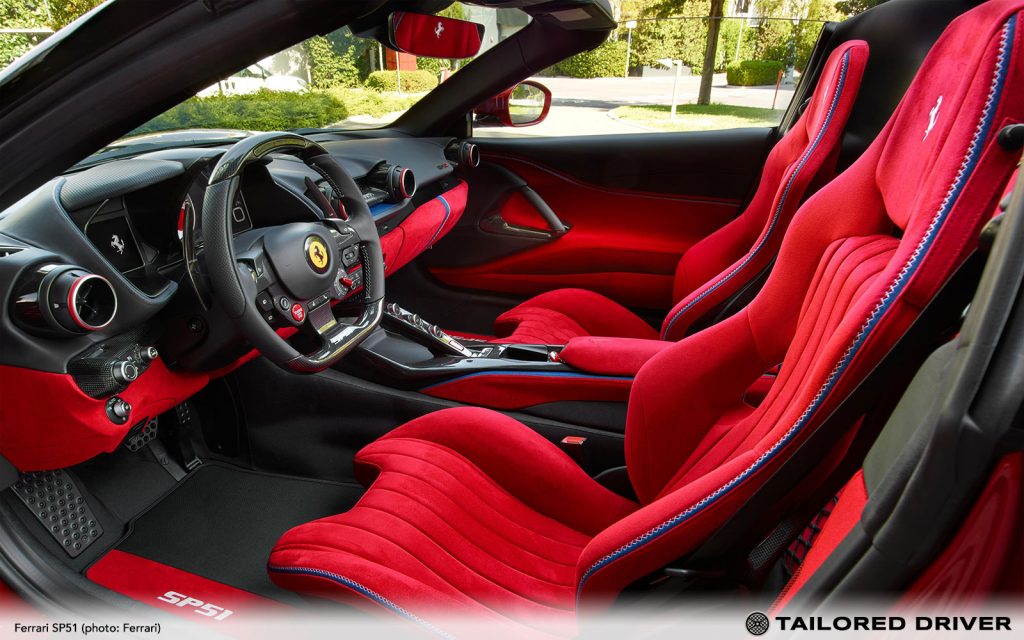
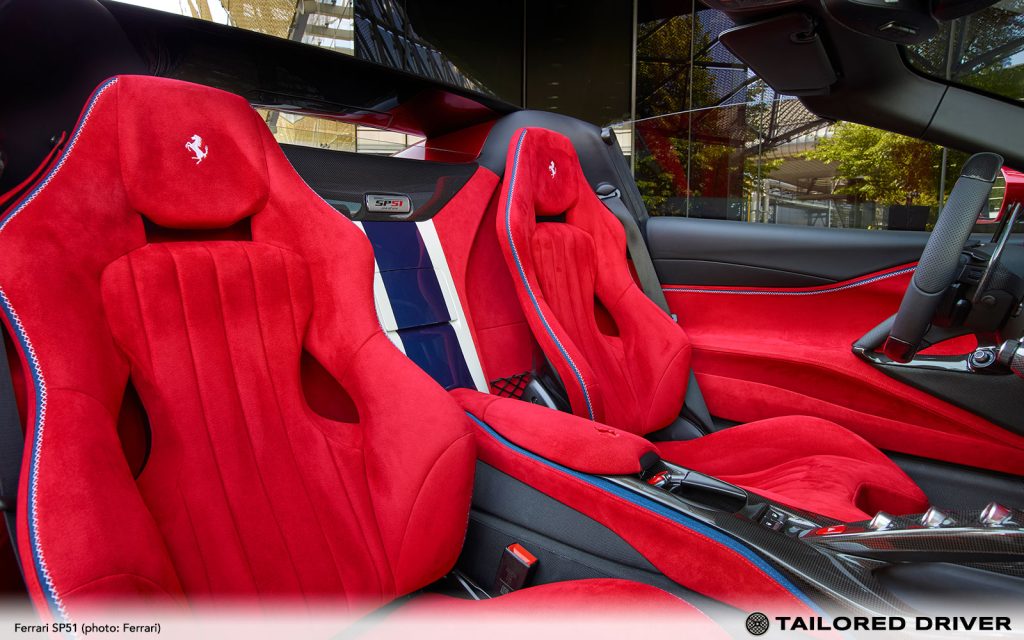
    That said, the very pinnacle of the meticulous honing process, in which the client was involved every step of the way, has to be the cabin where dizzying new heights of craftsmanship and creativity have been reached.  Its personalisation pivoted around two clever ideas: the decision to use the same Rosso Passionale colour custom-created for the exterior as the main colour for the Alcantara® trim, and the effective idea of extending the lengthwise exterior livery into the cabin. Its white and blue stripe, in fact, both appear on the central tunnel and the fascia between the two seats on the firewall, as well as on the steering wheel stitching, creating a sense of seamless continuity between exterior and interior in which the car’s roadster architecture played a vital role.

    The special finish for the door panels, the lower section of the dashboard and the sides of the seats, comprising a blue Kvadrat® insert with white cross-stitching, also picks up the livery. Glossy carbon-fibre trim has been extensively used throughout the interior where it pairs very harmoniously with the Nero Momo Opaco elements. This stylishly elegant and authoritative look is further enhanced by several white embroidered details (including the Prancing Horse and car logo, also found on the lower rim of the steering wheel).

    The Ferrari One-Off, SP51, was designed for a longstanding Taiwan-based client who is also one of our leading collectors. It is a successful roadster take on Maranello’s first front-engined V12 spider in 50 years. Its bold styling captivates at first sight. However, it brilliantly retains the signature elegance of its inspiration, the 812 GTS, whilst pushing the boundaries by offering a whole new way of enjoying en plein air driving.

    SPECIAL PROJECTS

    The Special Projects programme is aimed at creating unique Ferraris (the so-called “One-Offs”) characterised by an exclusive design crafted according to the requirements of the client, who thus becomes the owner of a one-of-a-kind model. Each project originates from an idea put forward by the client and is developed with a team of designers from Ferrari’s Styling Centre; having defined the car’s proportion and forms, detailed design blueprints and a styling buck are produced before starting the manufacturing process of the new One-Off. The entire process takes around two years on average, during which time the client is closely involved in assessing the design and verification phases. The result? A unique Ferrari sporting the Prancing Horse logo and engineered to the same levels of excellence that characterise all of Maranello’s cars.
  • Porsche 911 GT3 RS Celebrates 50 Years of Carrera RS 2.7

    Porsche 911 GT3 RS Celebrates 50 Years of Carrera RS 2.7

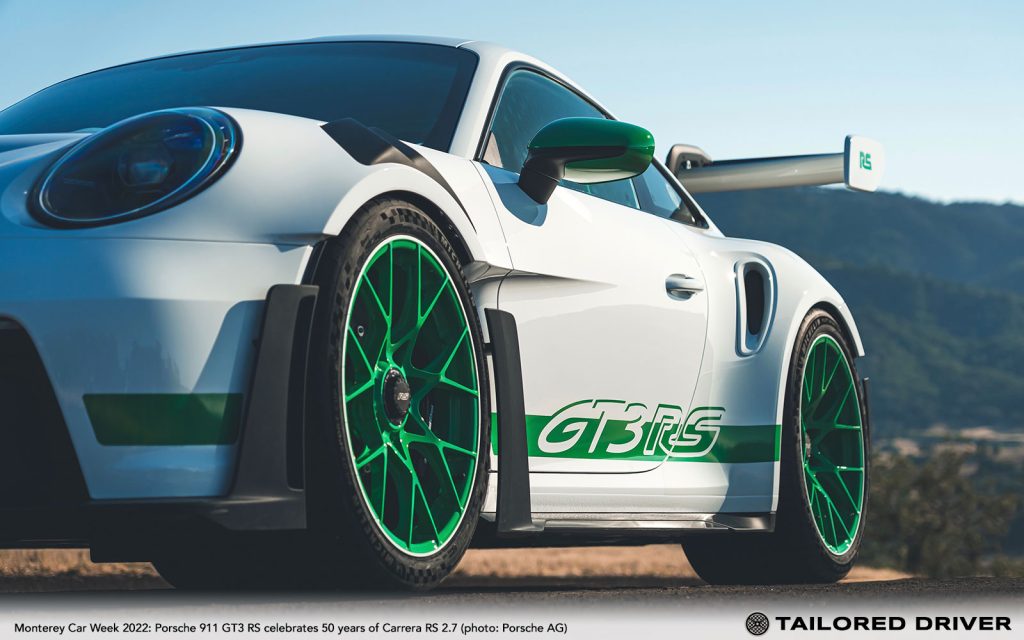
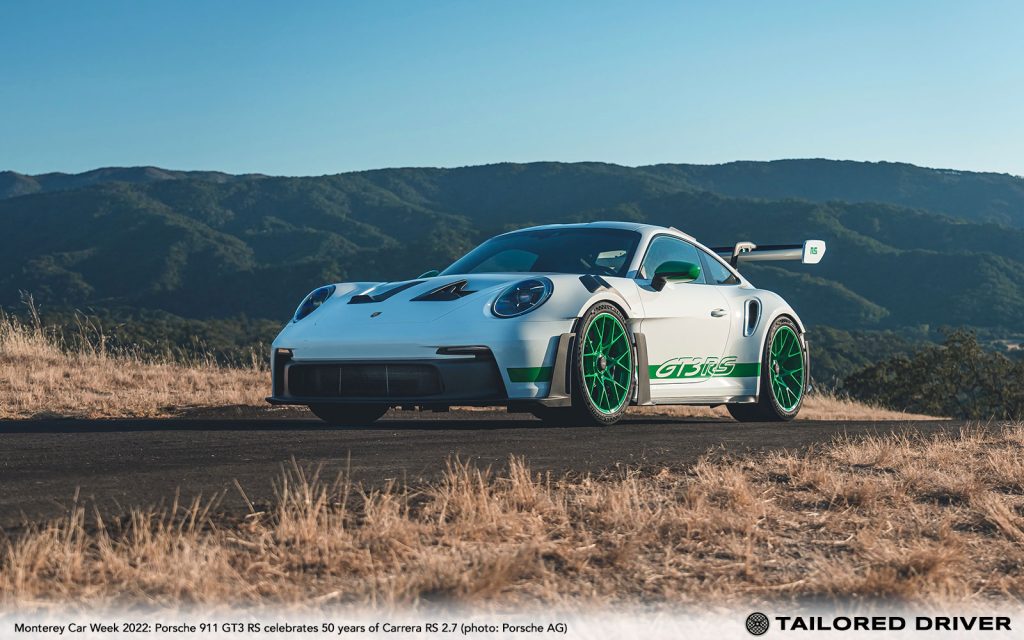
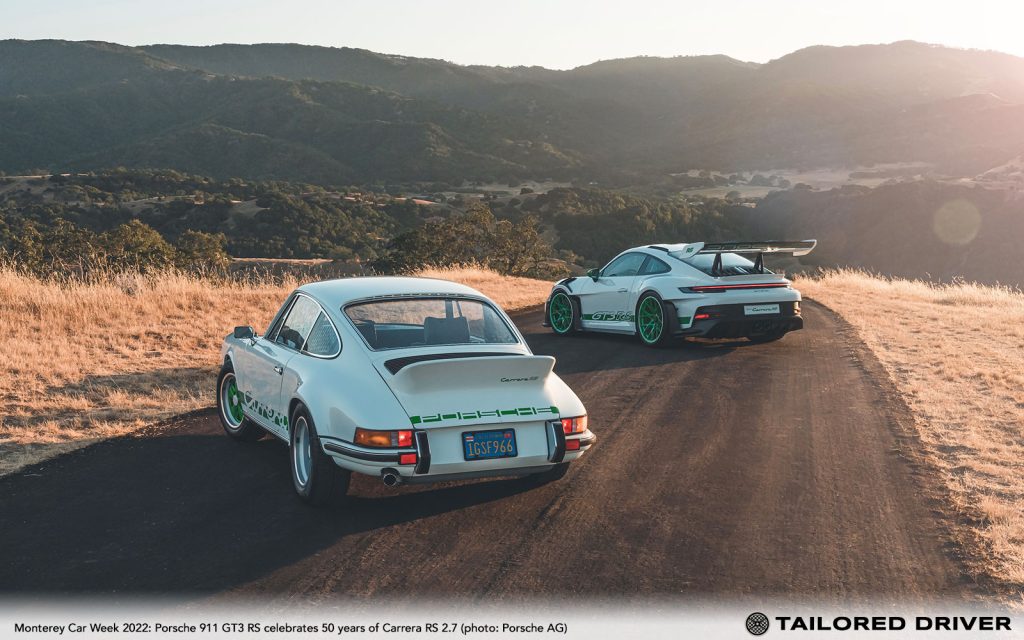
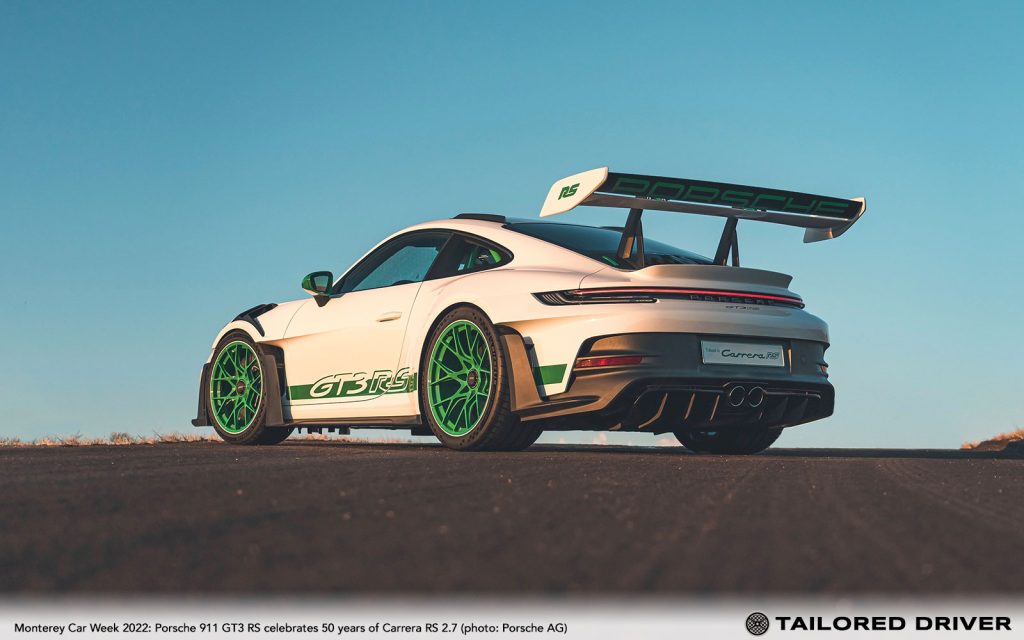
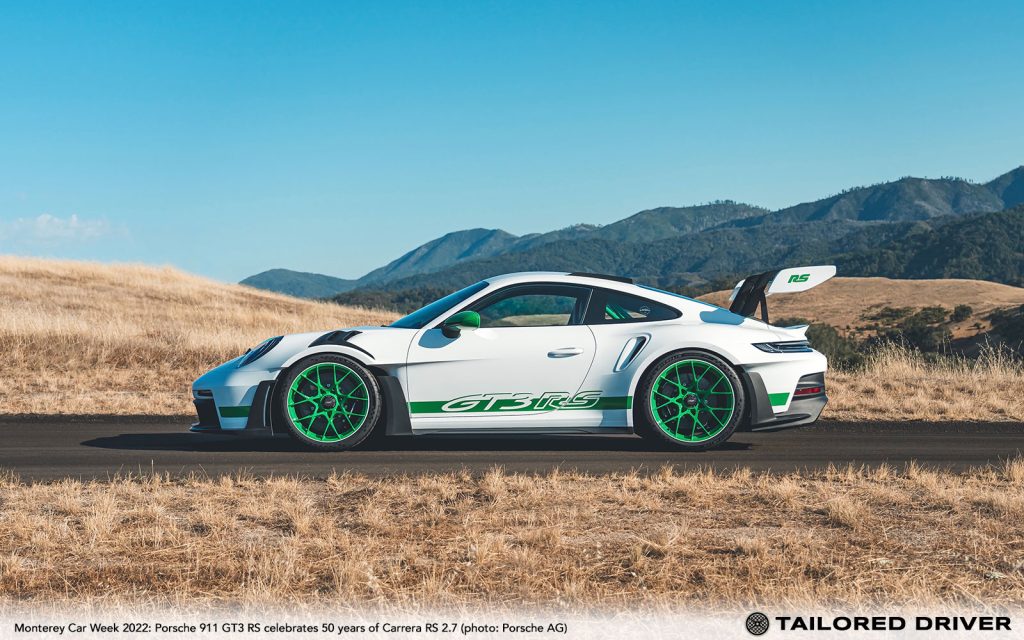
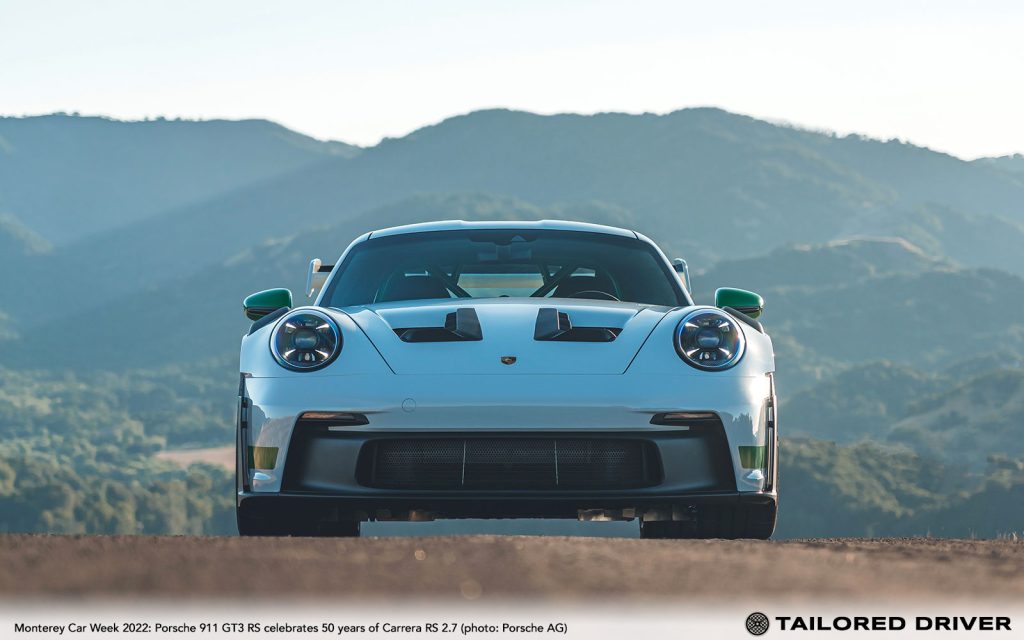
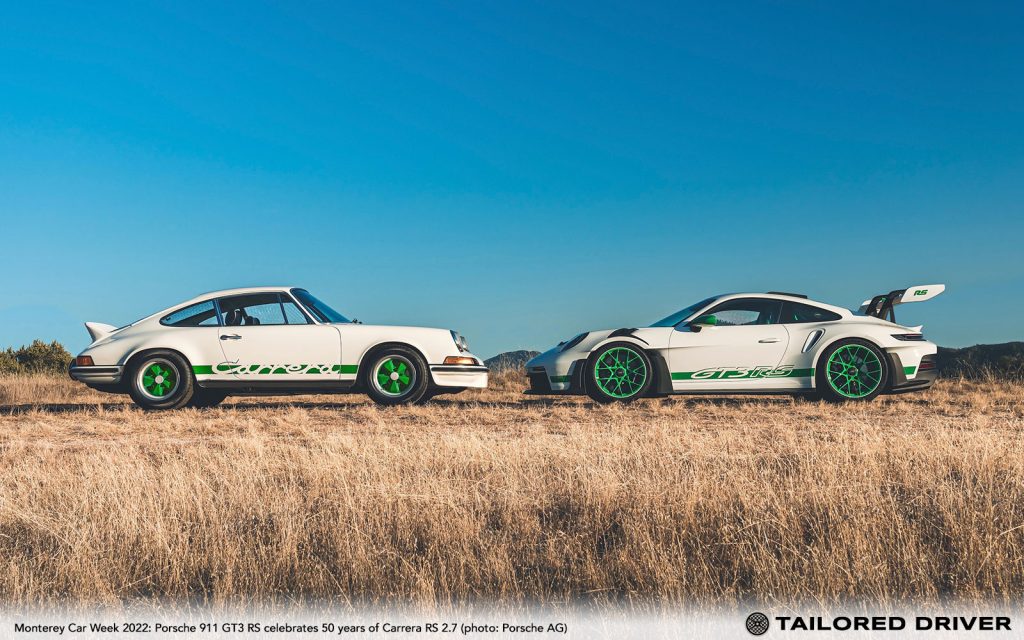
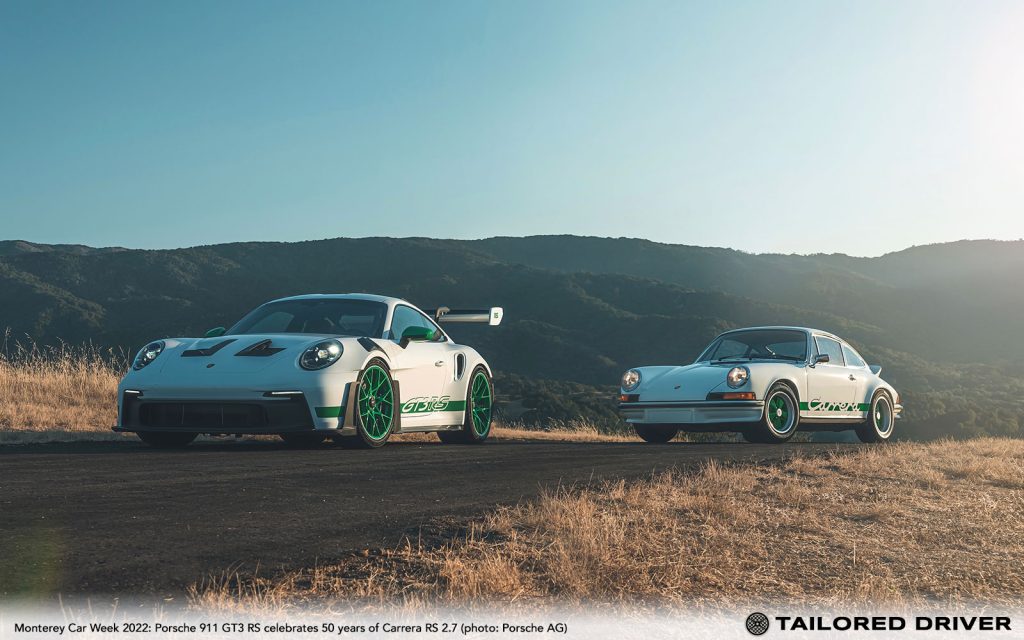
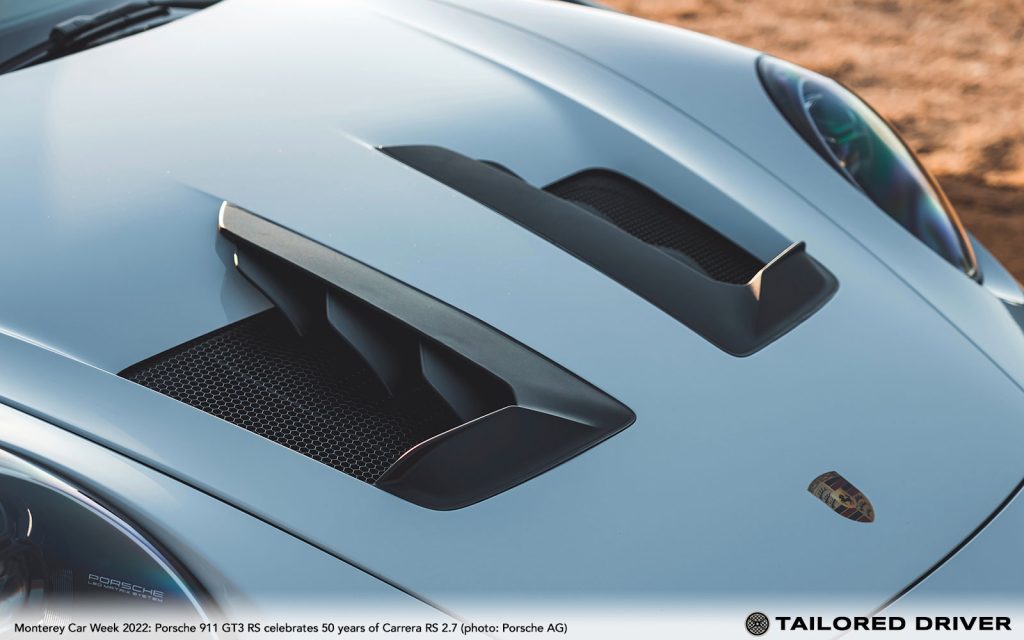
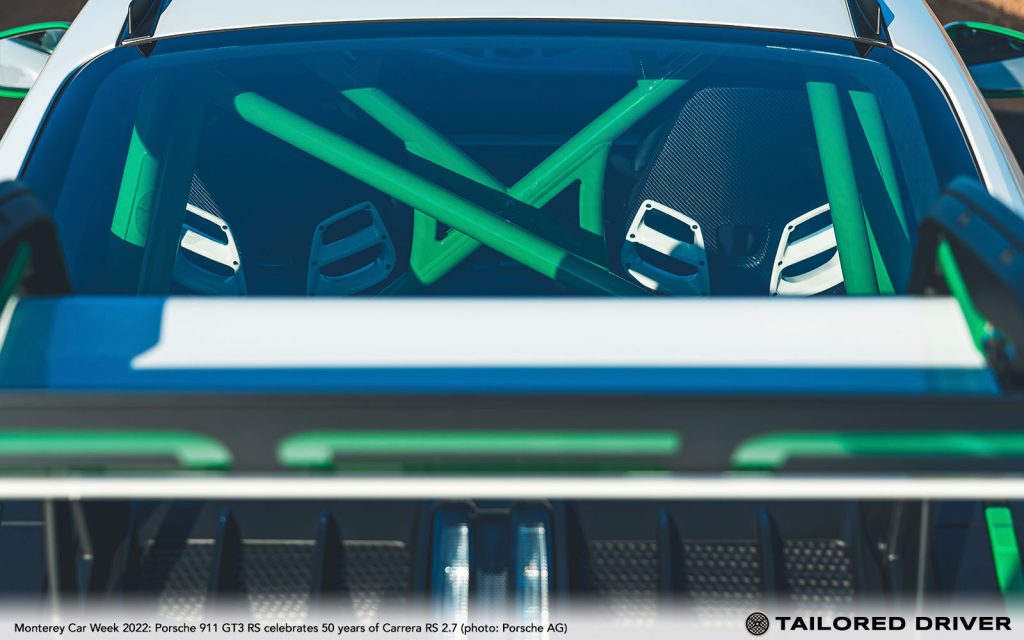
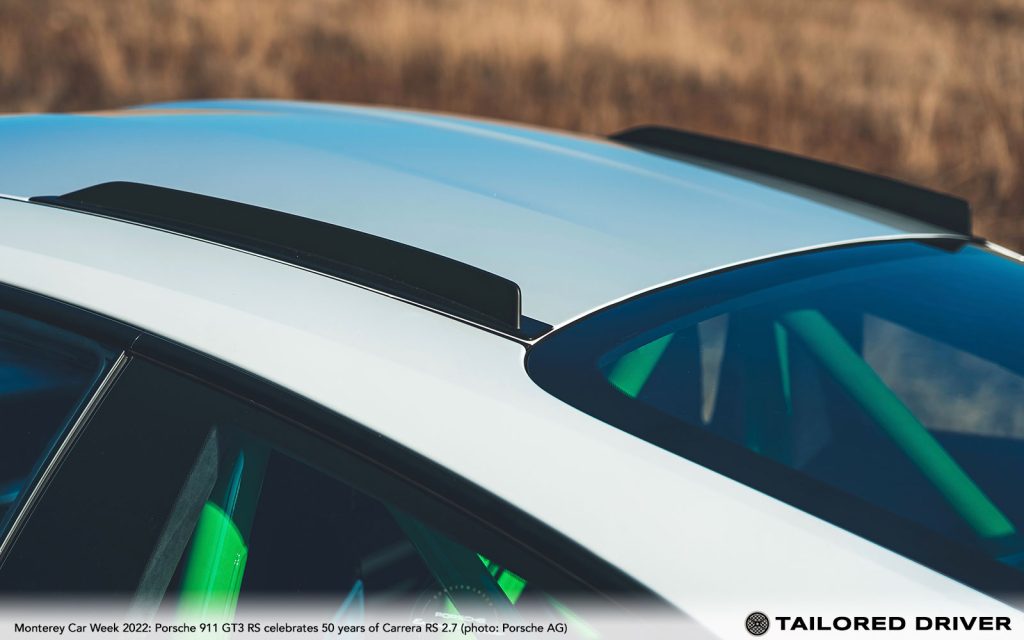
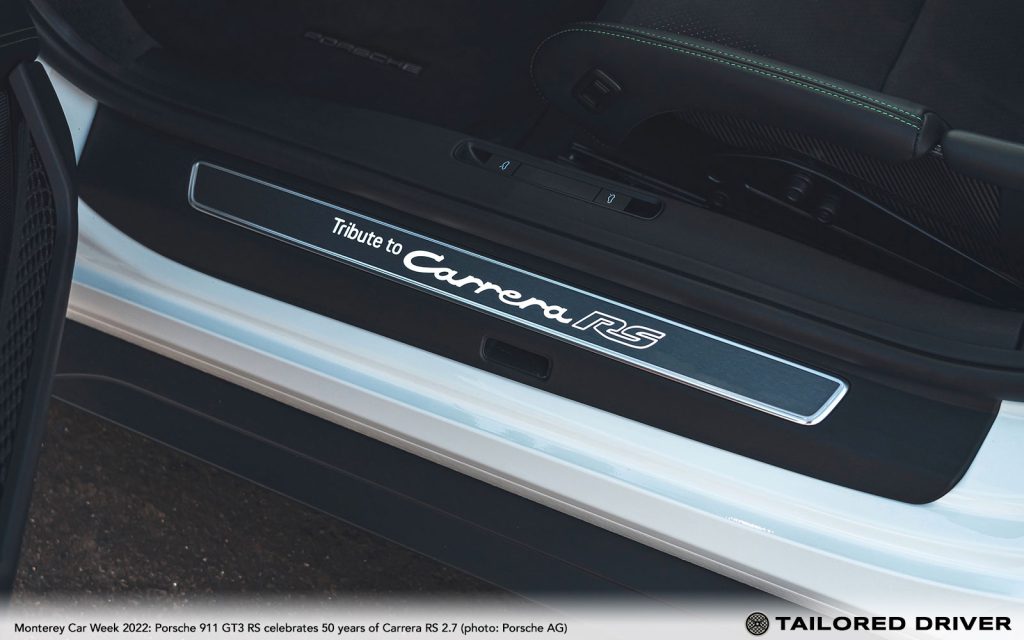
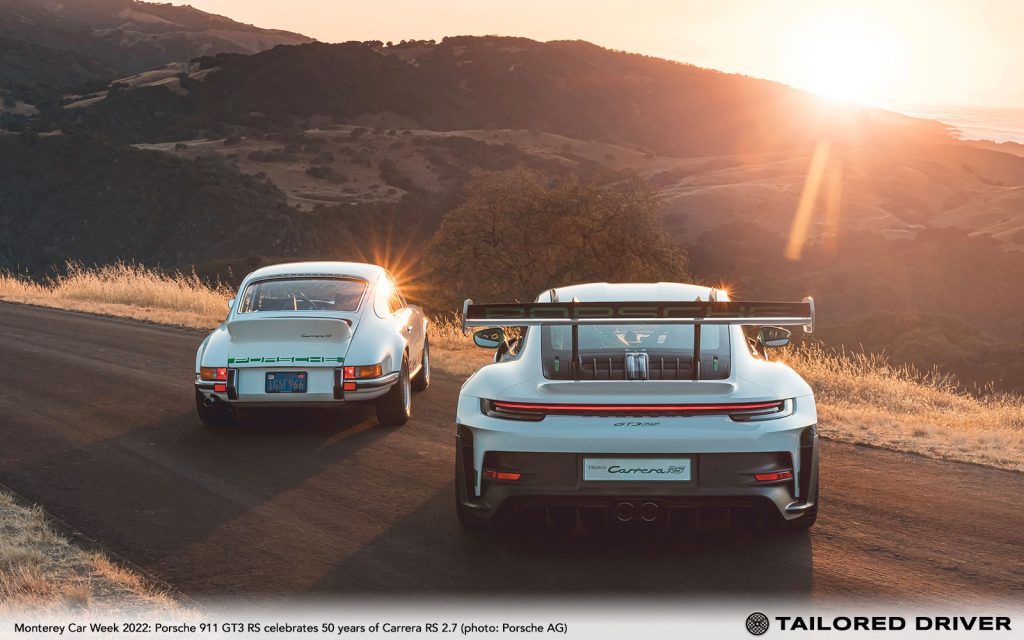
    Monterey, CA – The 2023 Porsche 911 GT3 RS made its first in-person appearance today at The Quail, A Motorsports Gathering, only two days after its digital world premiere. The show car – customized by the GT Model Line and Style Porsche – is a tribute to the 1972 911 Carrera RS 2.7.

    Additionally, as announced by Kjell Gruner, President and CEO of Porsche Cars North America Inc. (PCNA), the car will serve as inspiration for a limited-availability Porsche Exclusive Manufaktur offering exclusive to U.S. customers:  a Tribute to Carrera RS Package.

    “America is the second home of the 911 and a special tribute exclusive to the U.S. is the perfect way to celebrate the 50th anniversary of the 911 Carrera RS 2.7,” said Gruner. “So many of us idolized the original 1972 car. We want to create a special experience that combines exclusive options on the new GT3 RS with a one-of-a-kind list of accompanying items. Together, it will be an exciting and individual tribute to the RS lineage. This is a live project in its early stages, and is being created by enthusiasts, for enthusiasts as a joint effort between our colleagues in Zuffenhausen, Flacht and our team in America. The ideas and concepts are really exciting and we’re having a lot of fun developing it – all of us are looking forward to sharing more details with you soon.”

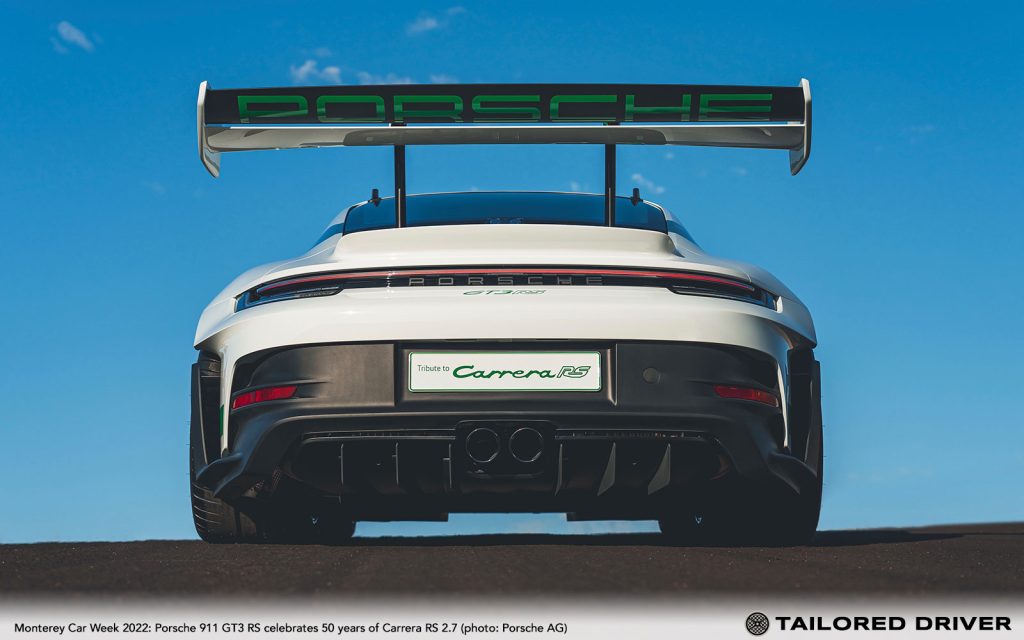
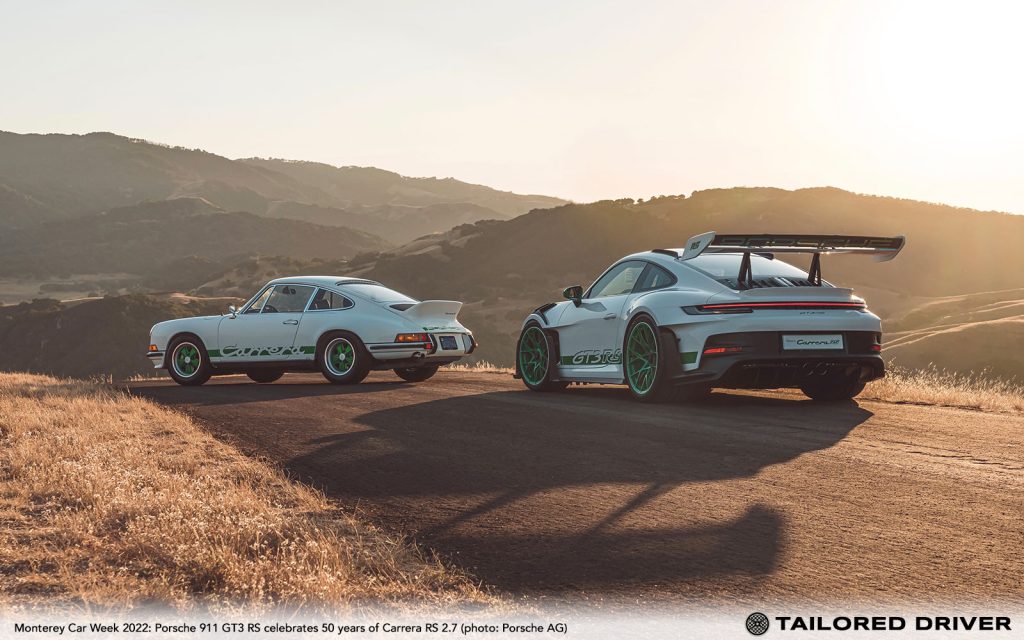
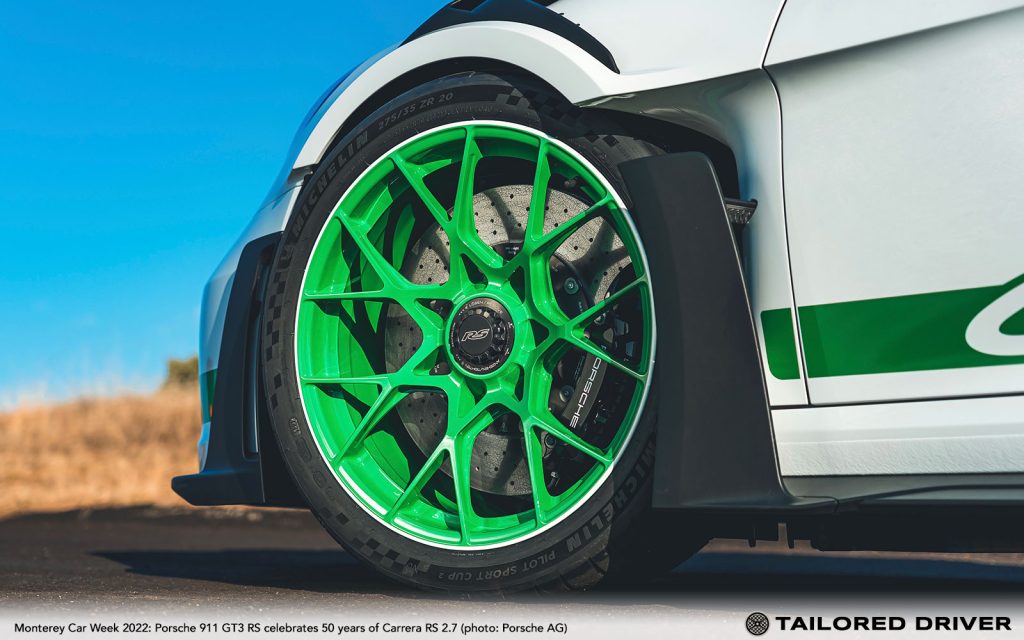
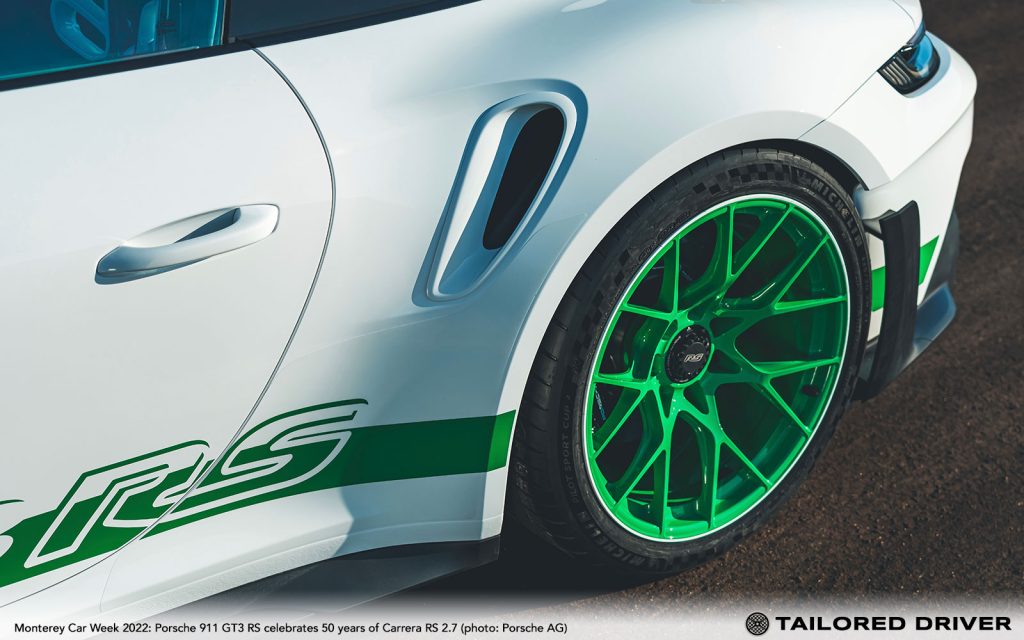
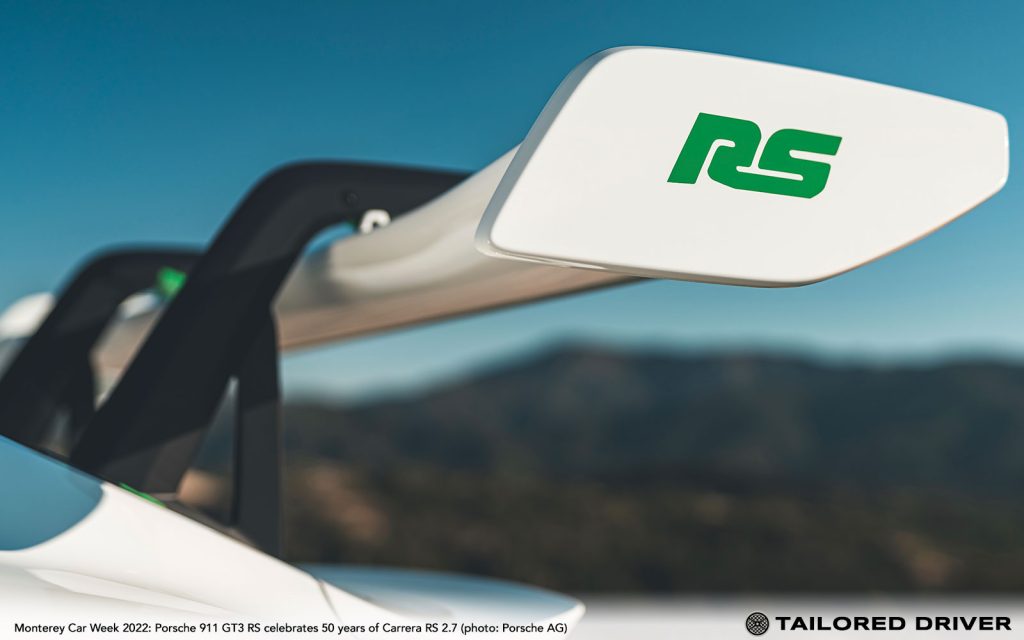
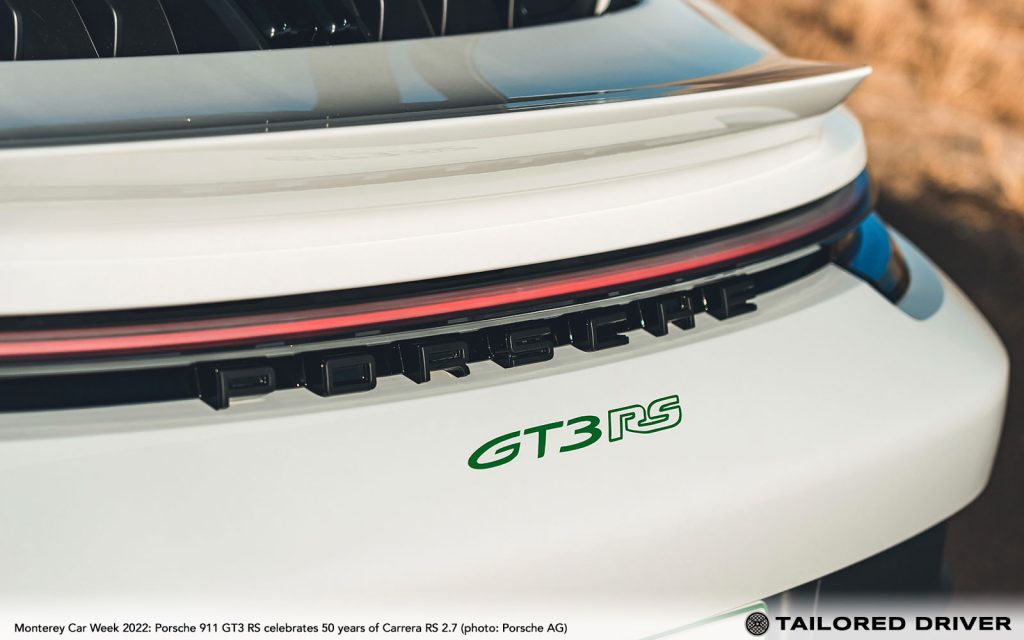
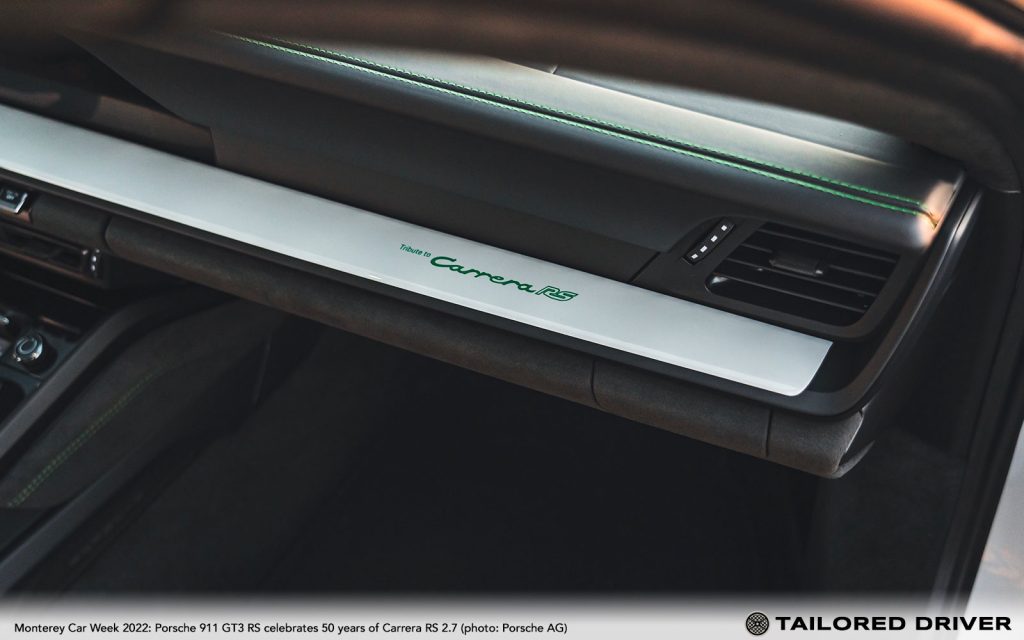
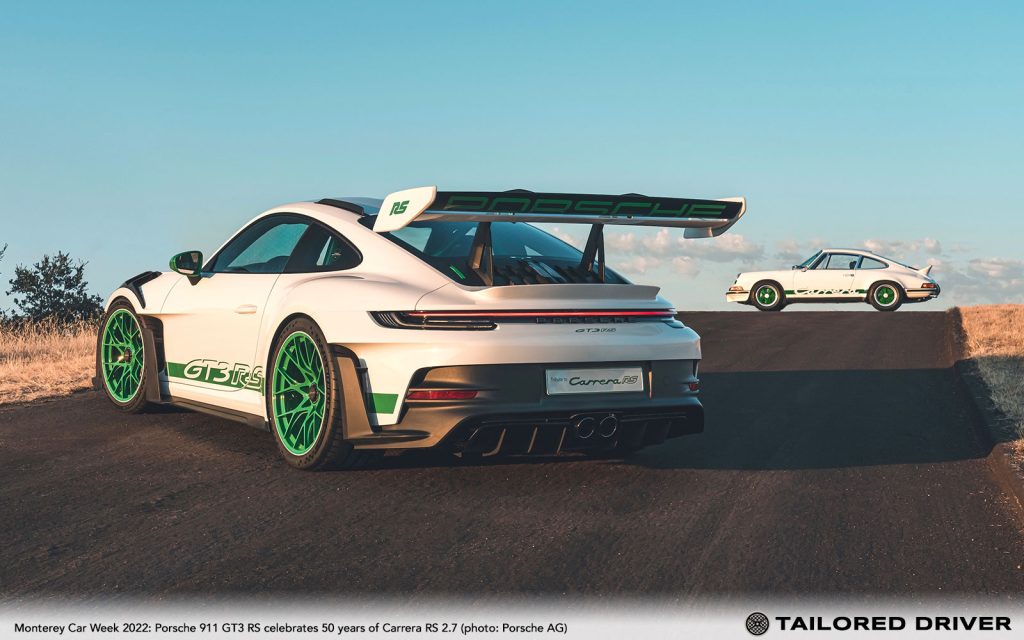
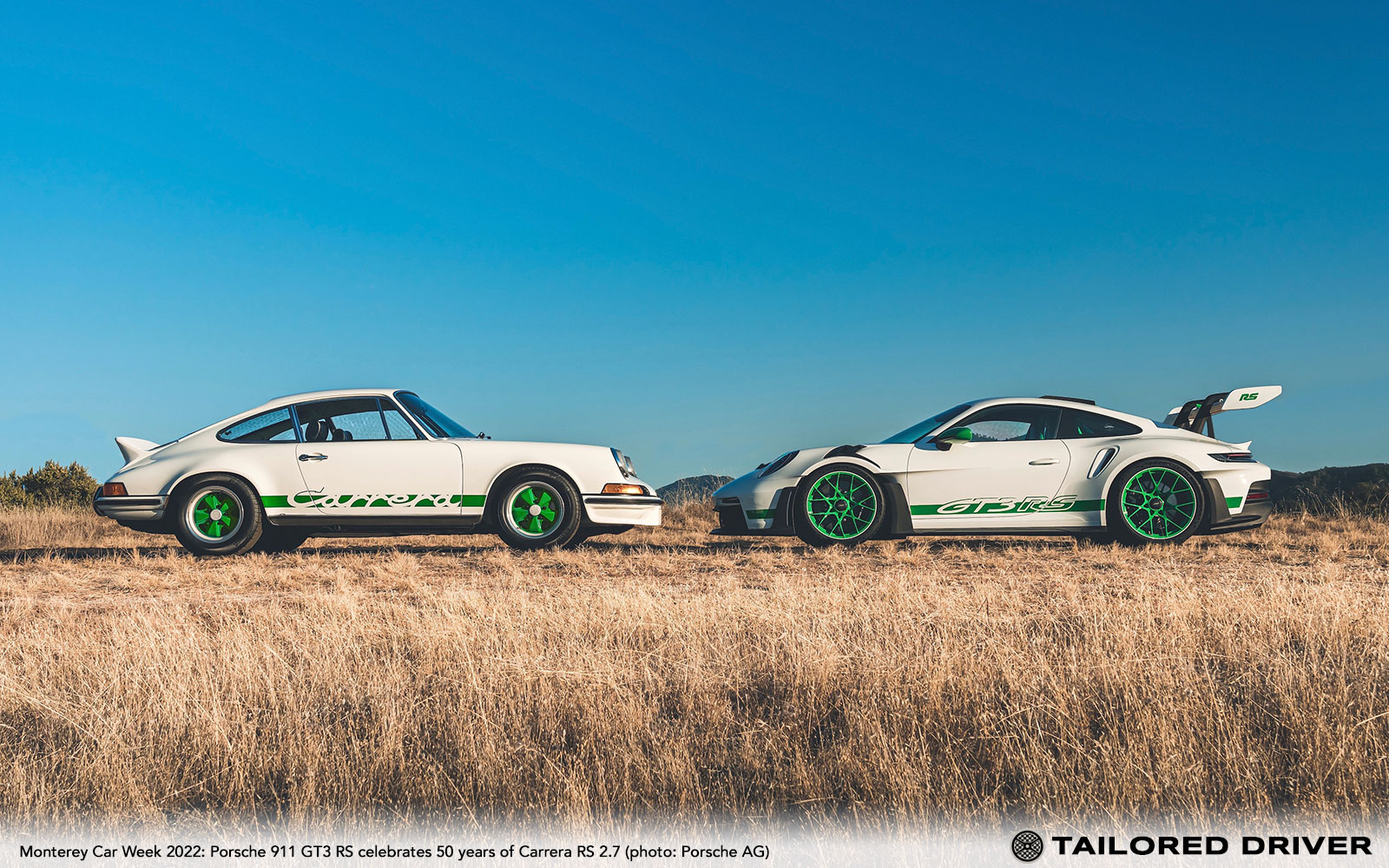
    Appropriately for Monterey Car Week, the model on display is extensively personalized. Finished in white with key areas in Python Green, the car is a direct reference to the iconic white and green color configuration offered in 1972 on the first 911 “RS” model as well as a new interpretation of it. In this instance, the body is finished in non-metallic white including side air intakes painted to match with model designation graphics on the sides and rear in Python Green, forged aluminum wheels in Python Green with white pinstripes. Exclusive Design taillights emphasize the green-on-white theme by eliminating the red color from the rear taillights and third brake light. Finally, the side plates on the left and right ends of the large rear wing are painted white with RS logos in Python Green.

    “Porsche Exclusive Manufaktur allows customers to personalize their car to a point where the vehicle is as much a reflection of them as it is of Porsche,” said Karl-Heinz Volz, Director of Exclusive Manufaktur Options. “Personalization is a Porsche tradition dating back to our first production model, the 356, when a customer requested a wiper be added to the rear window of their car. Today it is an incredibly extensive personalization program, offering options ranging from small changes to true one-off creations.”

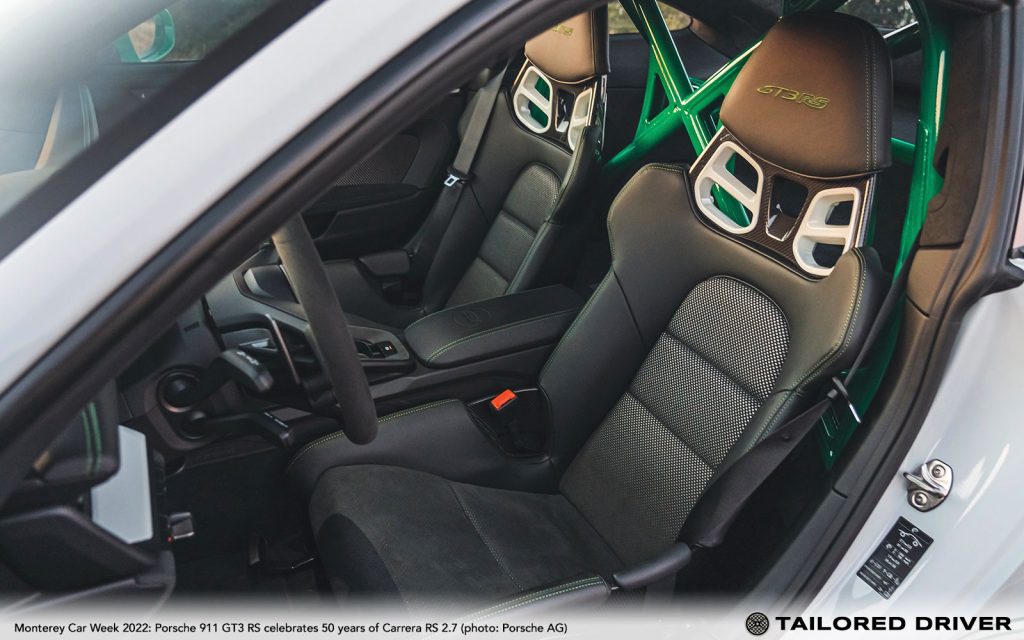
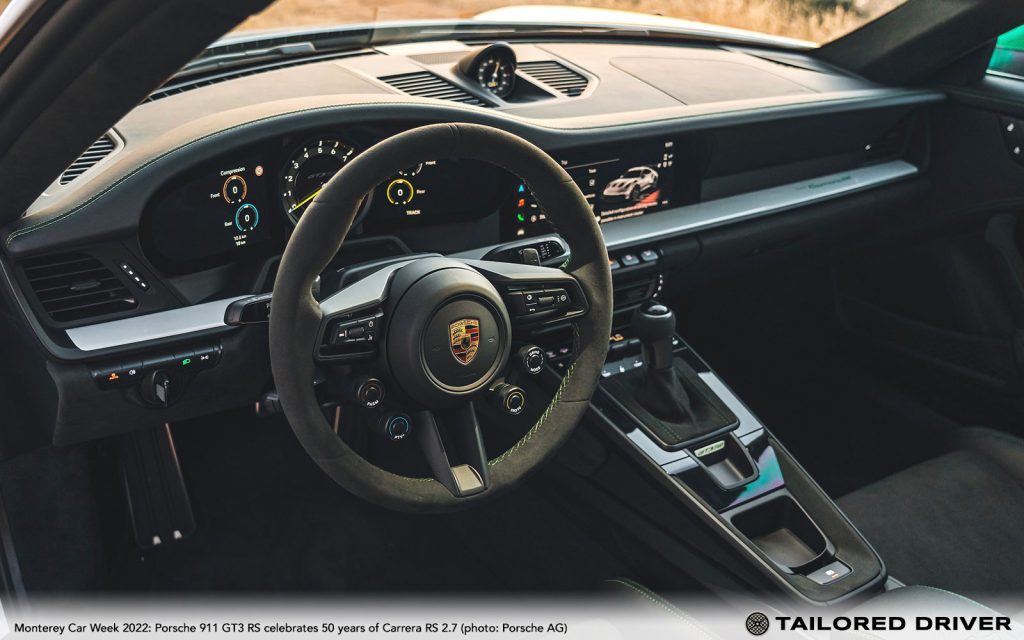
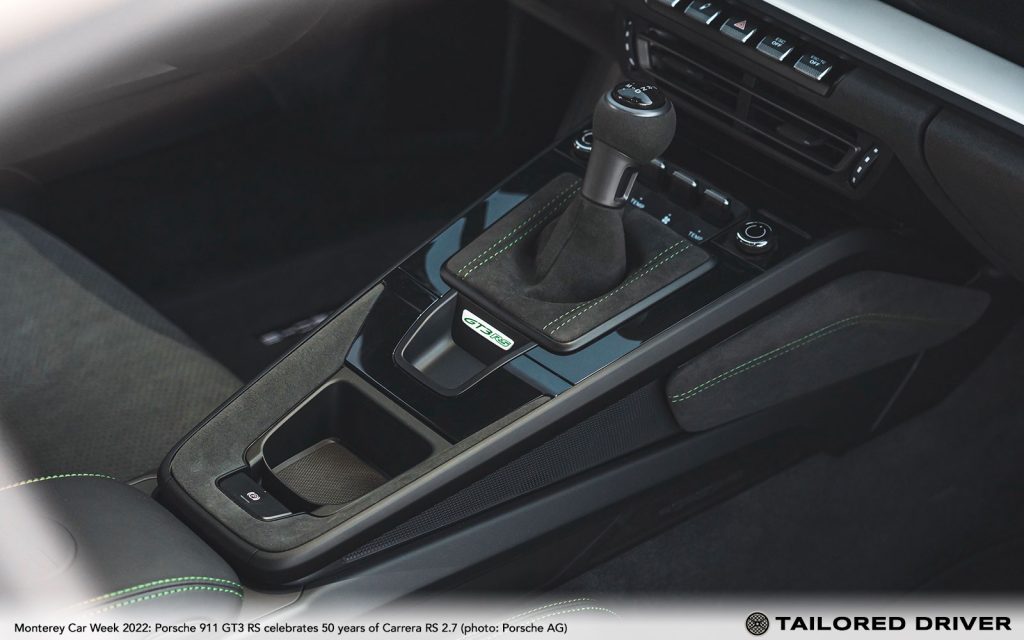
    The headlights also feature a pinstripe ring in white, something that is not available via the normal list of factory-available options. The color combination continues inside the car with matching stitching, trim panels in white to match the exterior.

    “As a car enthusiast growing up, my walls were plastered with models that I was particularly fond of. One of the most influential was the 911 Carrera RS 2.7. As a young kid it captured me imagination and even today it puts a smile on my face,” Andreas Preuninger, Director GT Model Lines, said. “That’s where the styling inspiration of the 996 GT3 RS came from, which was one of my first projects at Porsche. At the time, that car felt totally extreme so colors nodding to the forefather made sense. Today, it’s a very emotional moment for me to pay tribute to the first 911 RS model with our most extreme and capable 911 GT3 RS yet.”

    About the 2023 911 GT3 RS

    The 2023 Porsche 911 GT3 RS is the most extreme street-legal 911 model yet. Its 4.0-liter naturally aspirated boxer six-cylinder engine generates 518 hp, and revs to 9,000 rpm (911 GT3 RS: Fuel consumption* combined (WLTP) 13.2 l/100 km, CO₂ emissions* combined (WLTP) 299 g/km, CO2 class G ). That power is routed exclusively to the rear wheels via a seven-speed PDK dual-clutch automatic transmission. Making extensive use of motorsport-derived aerodynamics, it generates more than 900 lbs. of downforce at 124 mph and 1,895 lbs of downforce at 177 mph.

    This is also the first example of a 911 GT3 RS with active aerodynamics, a feature that is used to offer incredible levels of downforce, provide deceleration assistance by creating an air brake, and by offering a Drag Reduction System (DRS) that can reposition aerodynamic elements to cut drag at the driver’s command in certain conditions.

    About the 1972 / 1973 911 Carrera RS 2.7

    Fifty years ago, the world knew the 911 Carrera RS 2.7 as Germany’s fastest sports car. It began as a homologation special and featured many technological innovations. It was the most powerful version of the first-generation 911, generating 210 PS at 6,300 rpm and 188 lb.-ft. of torque at 5,100 rpm from its air-cooled flat-six developed by Hans Mezger and Valentin Schäffer.

    A more potent engine was only part of the success story. Much like the new 911 GT3 RS, wind tunnel testing and aerodynamic science introduced never-before-seen technology to the 911. The ducktail, now as much an icon of style as an element of function, was critical in achieving stability at high speeds. Not only did it unlock the ability to drive faster, but it did so without incurring additional drag. In fact, it reduced the drag coefficient

  • Sonderwunsch Factory Re-Commissioning: 911 GT3 – 30 Years of Porsche Supercup

    Sonderwunsch Factory Re-Commissioning: 911 GT3 – 30 Years of Porsche Supercup

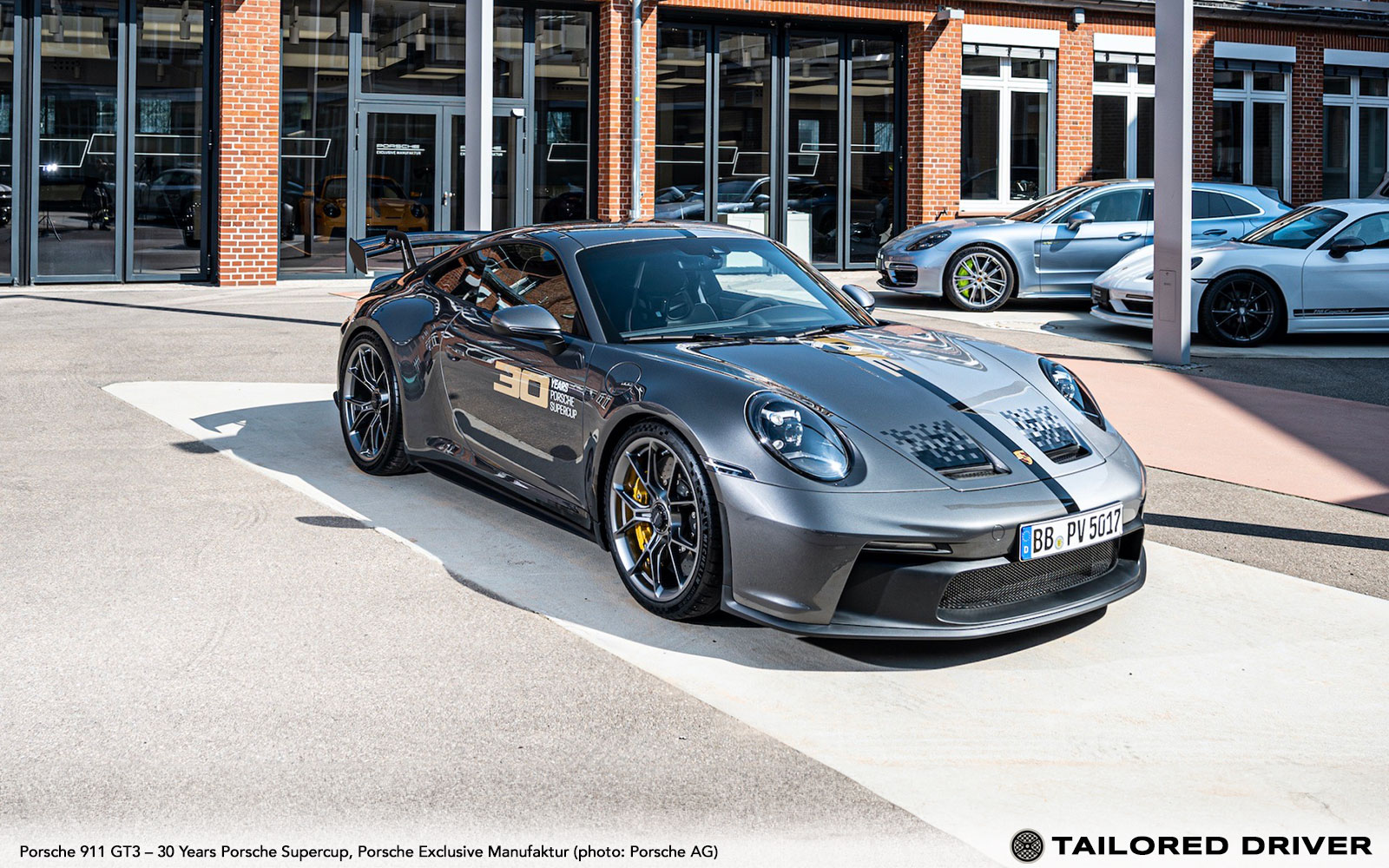
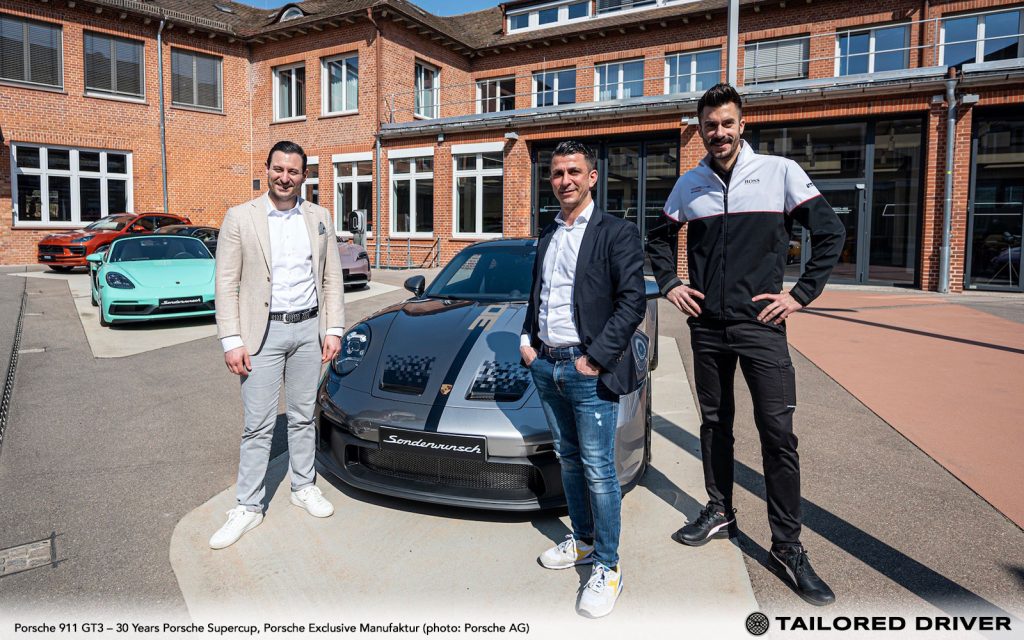
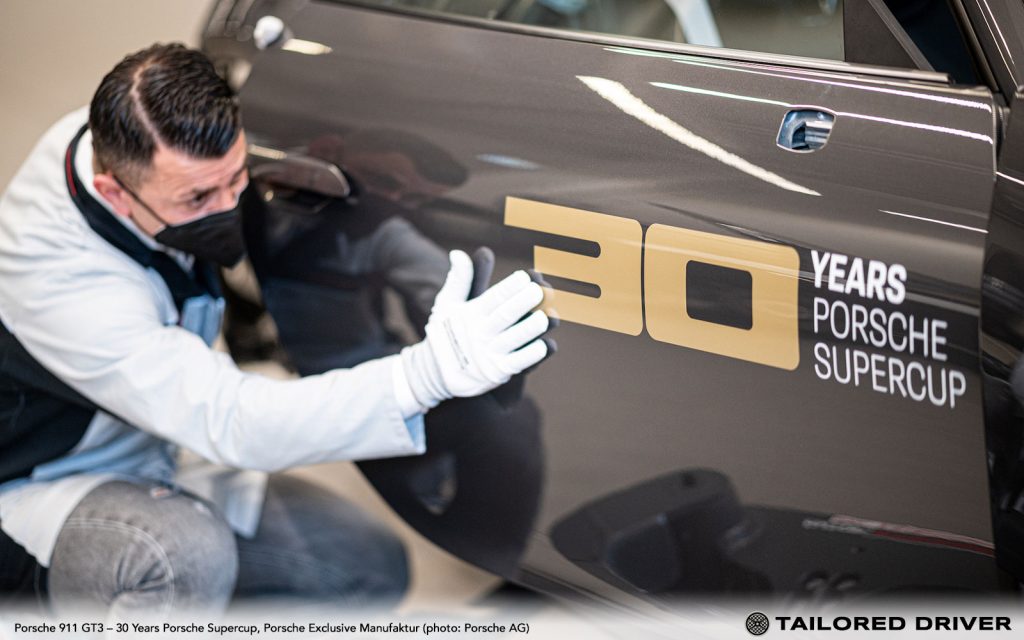
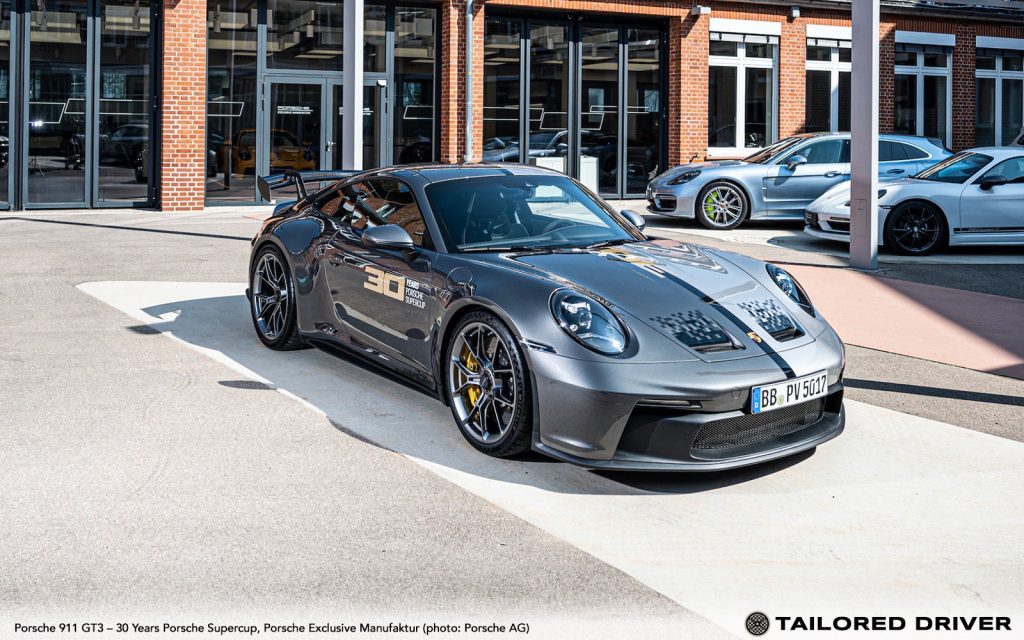
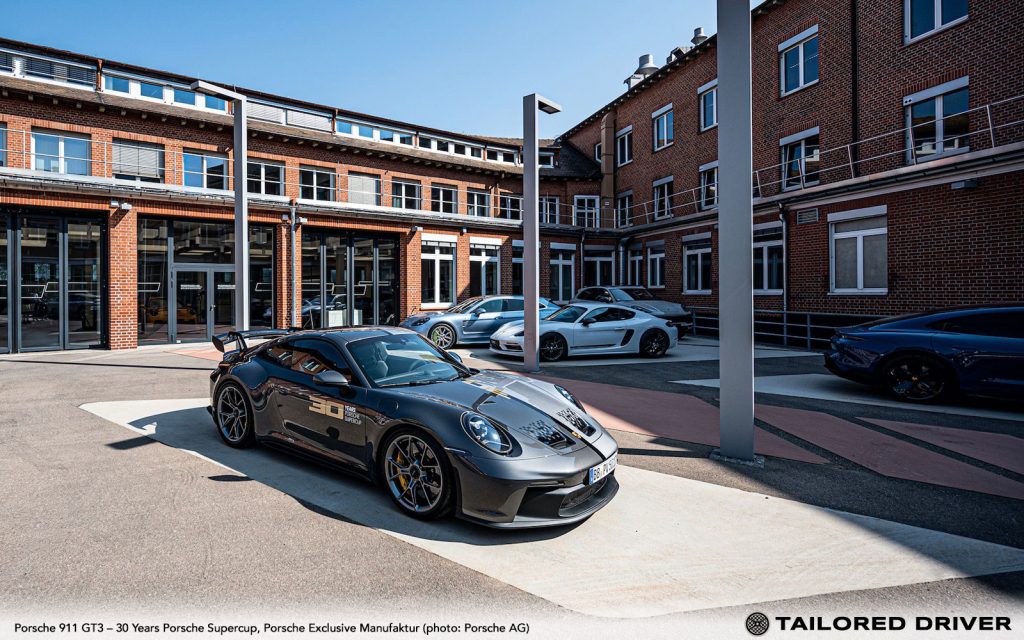
    The organisers of this one-make series have decided to mark this special anniversary with a treat for themselves: the project managers at Porsche Motorsport asked the specialists at Porsche Exclusive Manufaktur to carry out a complex Factory Re-Commissioning of a roadgoing 911 GT3 based on the 911 GT3 Cup in the 30th anniversary livery.

    [source: Porsche AG]

    The Porsche Supercup has been one of the best-known and toughest customer racing series in the world for 30 years. To drive the new 911 GT3 Cup on legendary circuits such as Monte Carlo or Silverstone in the run-up to Formula One races is a dream-come-true for many racers. The organisers of this one-make series have decided to mark this special anniversary with a treat for themselves.

    911 GT3 road version in anniversary design

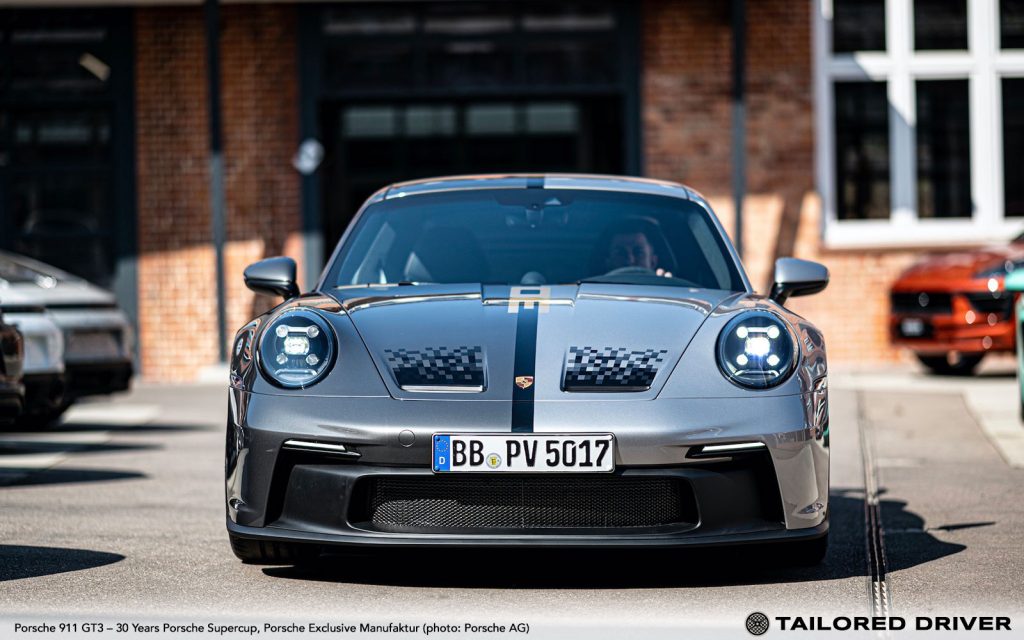
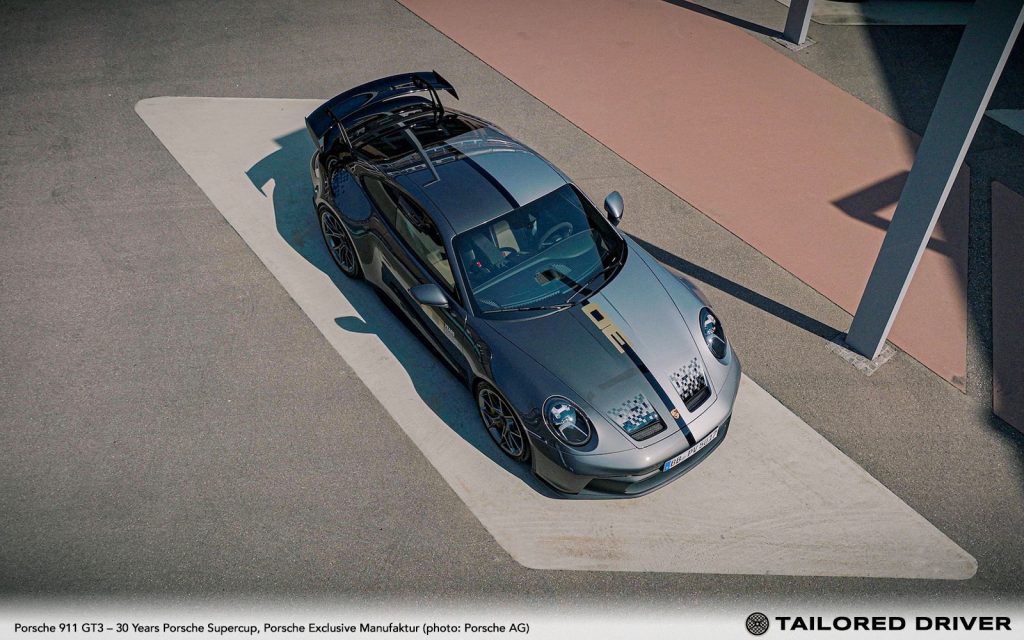
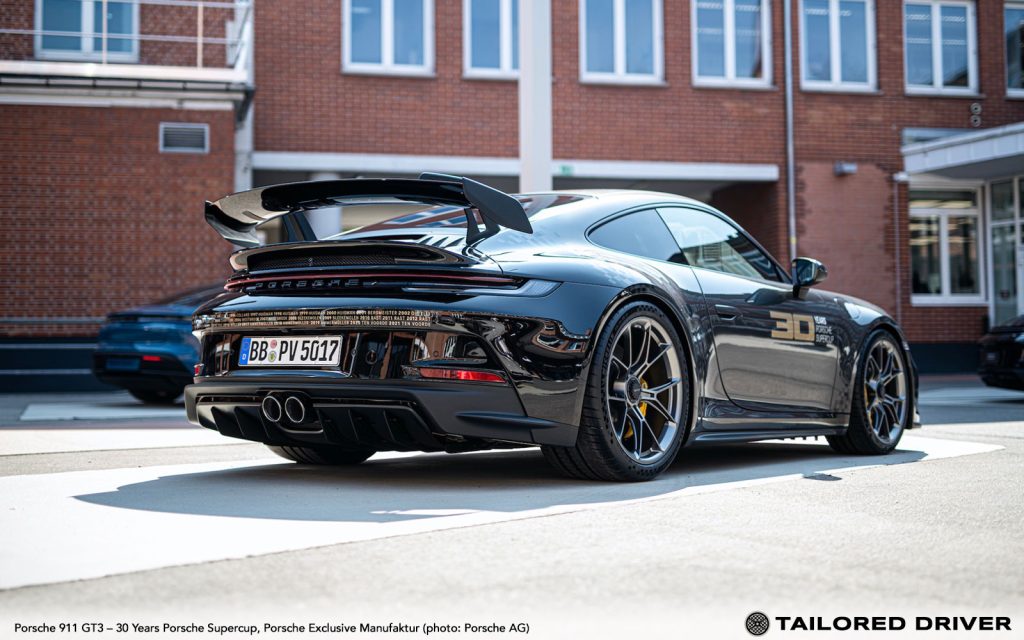
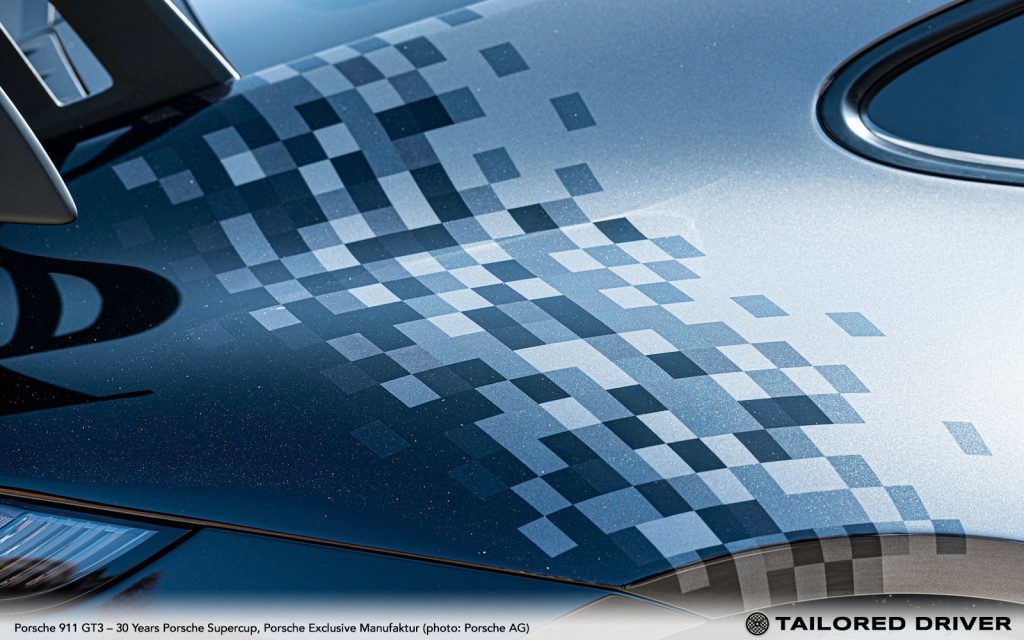
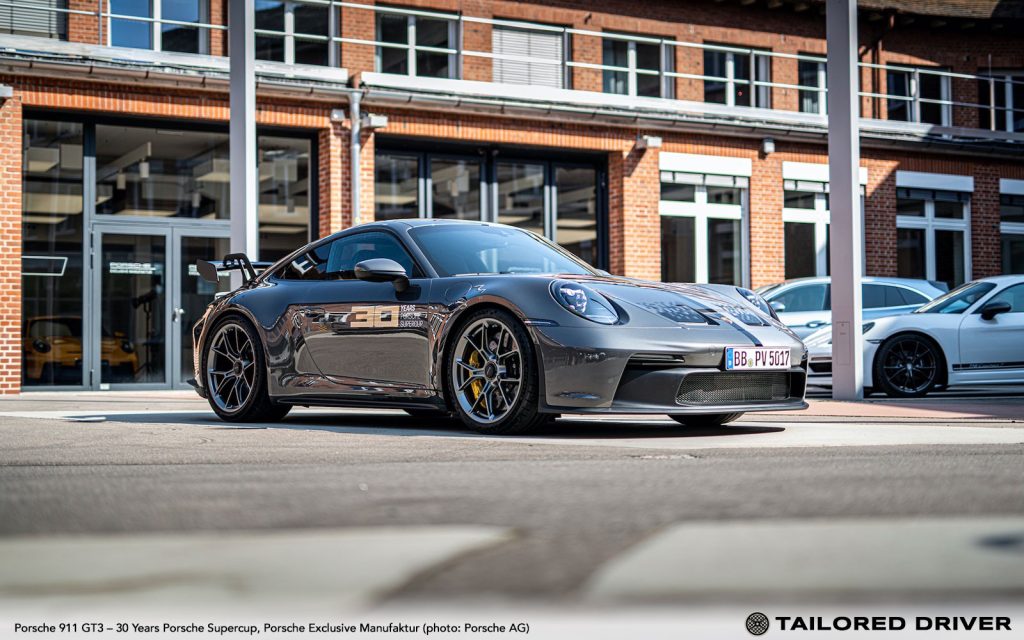
    As part of the new Sonderwunsch programme, the unique model was completed in less than six months. At Porsche, a ‘Sonderwunsch Factory Re-Commissioning’ is both a recommissioning project and a customisation one – in other words the technical restoration of a Porsche road car along with a redesign of the exterior and interior colour concept to a new-vehicle standard. Highlights include the spectacular eight-colour paintwork design with the anniversary logo and a multicolour pixel mesh around the rear wheel arches, among other elements. The names of all 29 previous Porsche Supercup champions are also immortalised in gold on the rear bumper.

    “Every Sonderwunsch project is something very special – not only for the customers, but also for us,” says Alexander Fabig, Vice President Individualization and Classic at Porsche. “New projects means new challenges, and we learn something every time. That applies to this 911 GT3 – 30 Years of Porsche Supercup as well.”

    “A tight schedule, high technical standards and a great team spirit that ultimately takes you to the finish line – this is something that I’ve otherwise only seen in the world of motorsport,” says Oliver Schwab, Project Manager of the Porsche Mobil 1 Supercup. “Working with Porsche Exclusive Manufaktur on this Factory Re-Commissioning was a great experience.  And the 911 GT3 – 30 Years of Porsche Supercup is a worthy ambassador in our anniversary year. The Porsche Supercup made racing history and continues to do so today. We say ‘Happy Birthday’ and look forward to many more years of racing on the most famous race tracks in the world.”

    To begin with, the special model will be seen at the Porsche Mobil 1 Supercup races. From late summer, appearances at the Porsche Museum and the CityLife Showroom in Milan are in the works, together with the 911 GT3 Cup VIP racing car. This model is a key element in communications for the Porsche Supercup. Every season, a well-known celebrity races the car as a guest driver. Past Supercup champions will also take the Sonderwunsch 911 GT3 on excursions and talk about their triumphs and highlights.

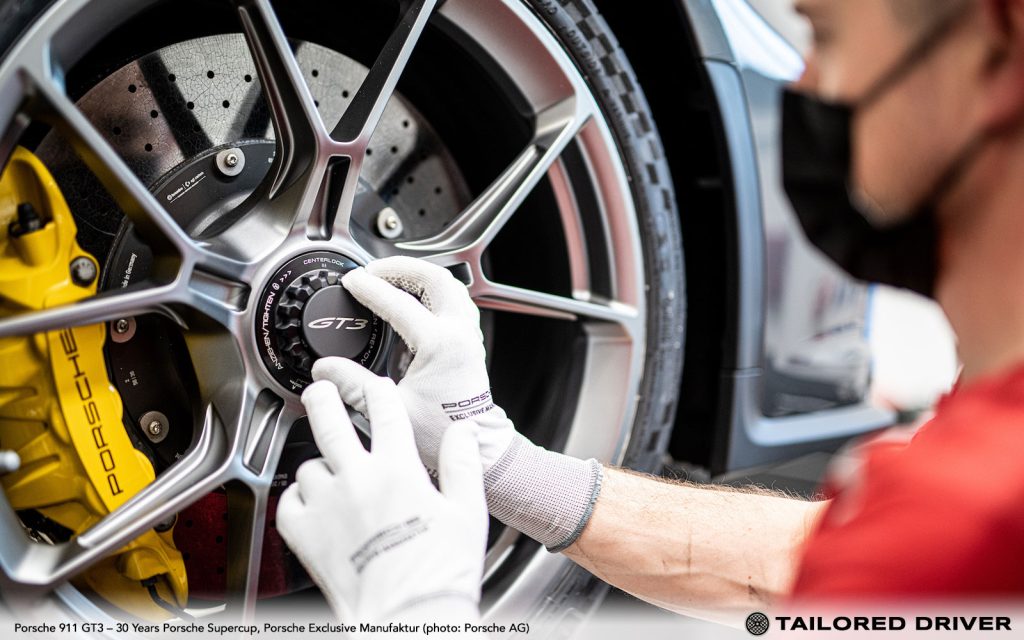
    The basis for the Sonderwunsch Factory Re-Commissioning was an already finished, road-ready Porsche 911 GT3 – the roadgoing version of the racing car used in the Porsche Supercup. In a process lasting several weeks, the vehicle was first disassembled and then rebuilt with its special design.

    Custom modifications to the exterior and interior

    The 911 GT3 – 30 Years of Porsche Supercup features multicolour paintwork. Not a single detail on the vehicle is a wrap or sticker. The eight colours in total – GT Silver Metallic, Agate Grey Metallic, high-gloss Black, Meteorgreymetallic, Parliamentgreymetallic, Volcanogreymetallic, Grigiogranitometallic and Diamondblackmetallic – are all painted, as are the gold-coloured names of the Supercup winners.

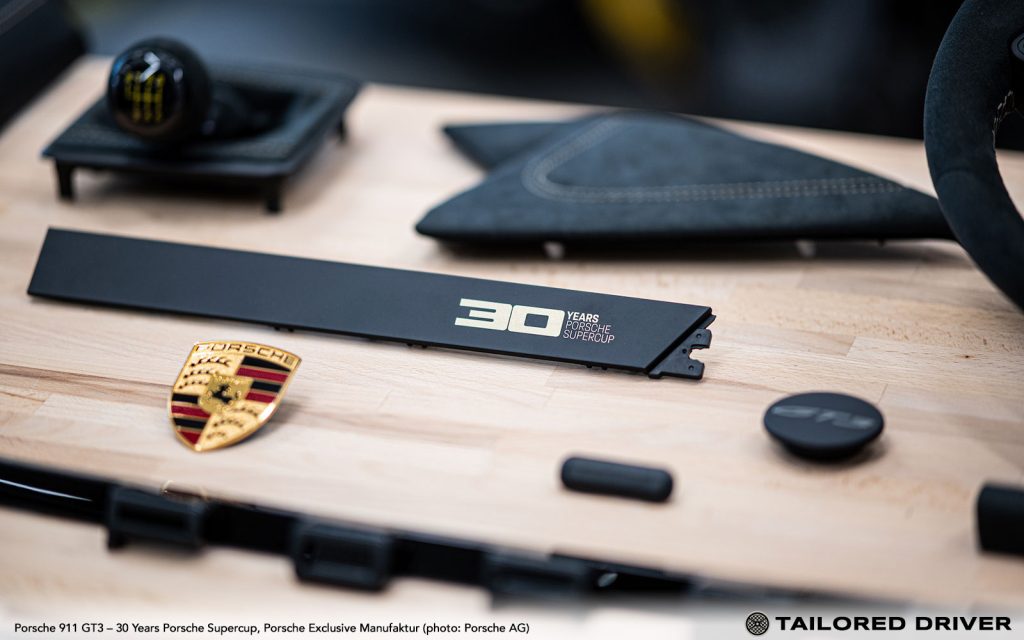
    The greatest challenge in the painting process was to precisely apply the multicoloured pixel mesh to several points on the dynamically shaped body. Inspired by the VIP racing car, the pattern can be found behind the air outlets in the front bonnet, behind the front wheels and on the rear wheel arches. The anniversary logo, a large golden ‘30’, is displayed on the doors and front bonnet. In addition, the names of all 29 past Porsche Supercup champions have been painted in gold and sealed with a high-gloss clear lacquer. After the paintwork, the vehicle was reassembled by hand at Porsche Exclusive Manufaktur and customised with additional Sonderwunsch features.

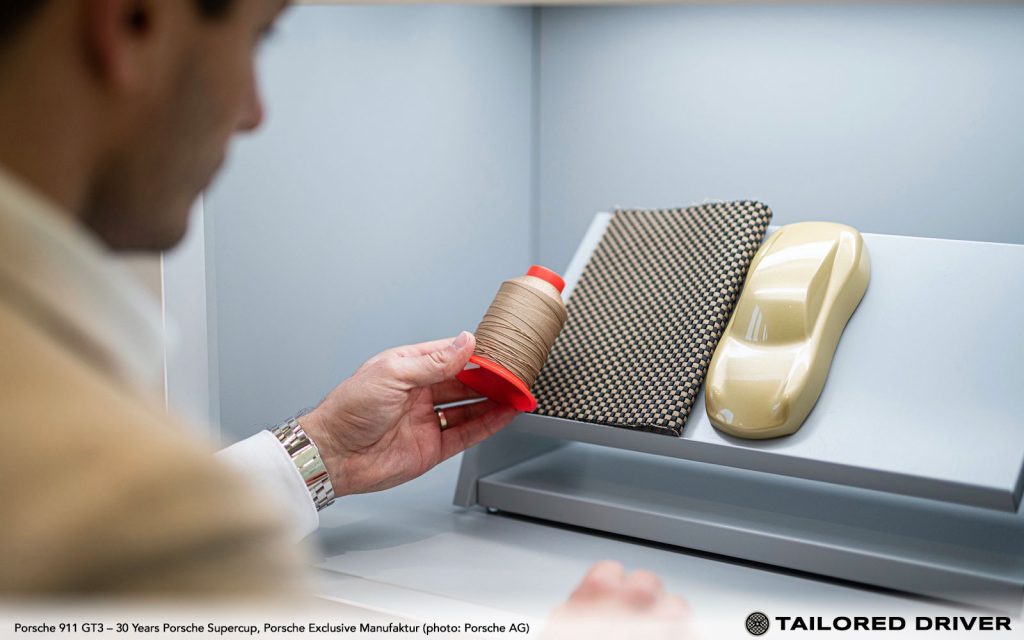
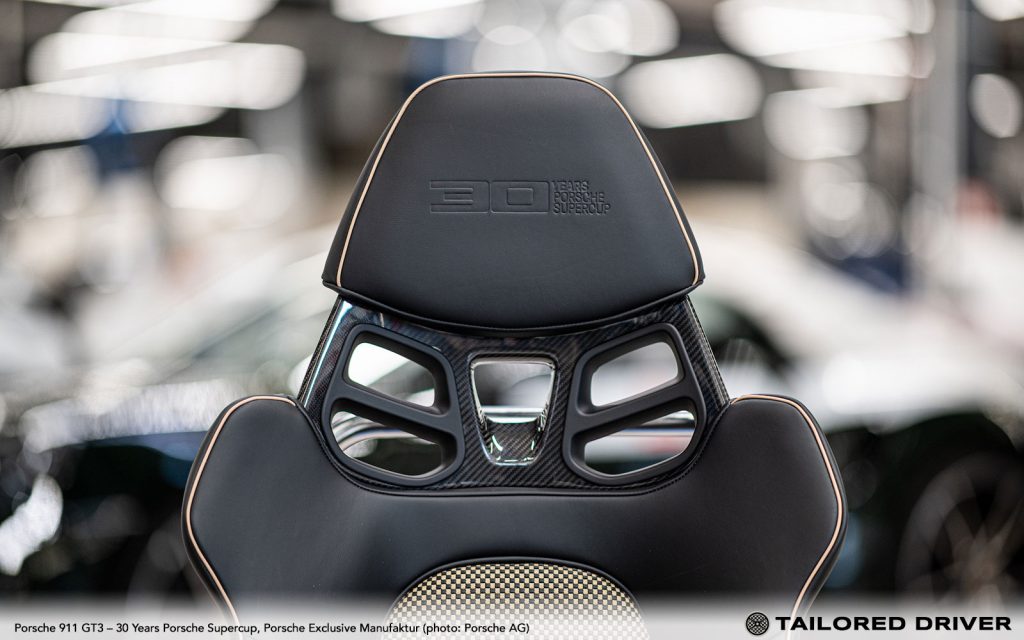
    Inside, the seats are particularly stunning. The embossed anniversary logo in the headrests, an independent Sport Tex colour variant in Black/Aurum for the centre panels and colour-coordinated piping in Mojave Beige lend the leather seats a very special character.

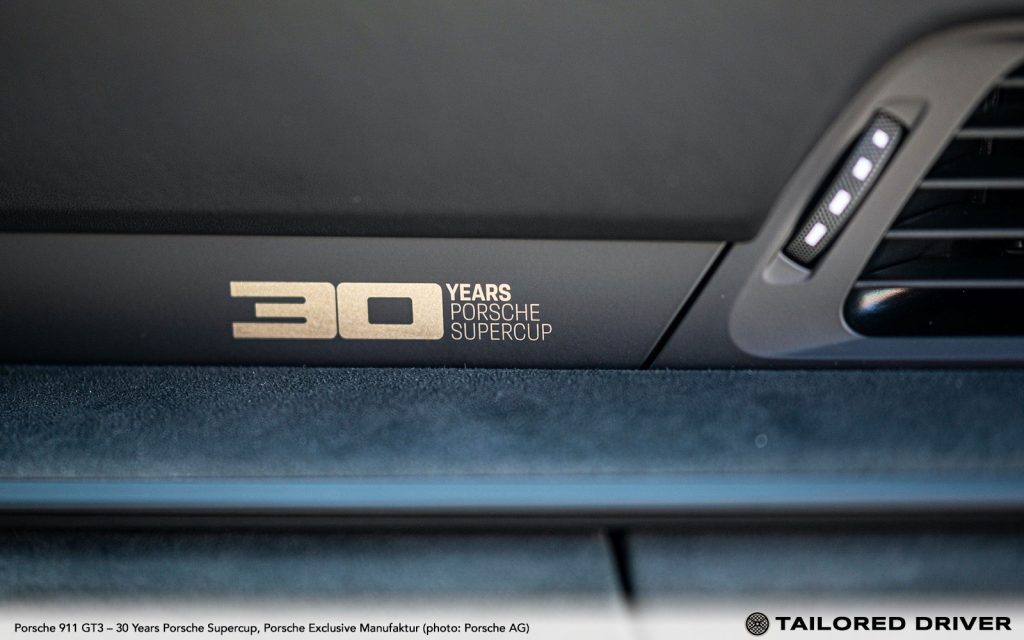
    The cuboid pattern in Black/Aurum is also used on the armrests in the doors. The dashboard trim also bears the anniversary logo while the top part of the dashboard, the door panels and the side panels have been customised with Mojave Beige cross-stitching.

    About Porsche Mobil 1 Supercup

    The Porsche Mobil 1 Supercup is regarded as one of the toughest one-make series in the world. Races are held at the European events of the FIA Formula One World Championship. In addition to the opening event in Imola, Italy on 24 April, there are seven further races on the calendar this year. A total of 28 racing drivers from eight teams are competing for the title in this anniversary season. In addition to the overall and ProAm driver classification, there is also a team and a rookie classification.

    Since the 2021 season, the Porsche 911 GT3 Cup racing car has been based on the current 992 generation 911. With an output of around 375 kW (510 PS), the spectacularly designed Cup car outmuscles its direct predecessor by 25 PS. The 911 GT3 Cup will be fuelled with Esso Renewable Racing Fuel.

    The highly successful Porsche junior programme has served as a springboard for professional careers in racing for 25 years and has produced numerous works drivers, world champions and Le Mans winners. Examples include the careers of Timo Bernhard (Porsche Junior from 2000 to 2001), Marc Lieb (2000 to 2002) and Earl Bamber (2014): all three won the legendary 24 Hours of Le Mans and the FIA World Endurance Championship title at least once with the Porsche 919 Hybrid.

    About Porsche Exclusive Manufaktur

    A sports car as individual as your own fingerprint, as unmistakable as your own lifestyle: Porsche Exclusive Manufaktur in Zuffenhausen creates very personal customer vehicles through a combination of perfect craftsmanship and a high-tech approach. Highly qualified employees with decades of expertise devote their full attention to every detail and enhance it through hand craftsmanship. The experts can draw on a wide range of visual and technical customisation options for the exterior and interior of Porsche cars.
    As part of its Co-Creation strategy, the sports car manufacturer is reinterpreting its legendary Sonderwunsch programme from the late 1970s, which will enable it to design individualised, one-off cars – co-created by the customer and professionally produced by Porsche. The expansion of this offering is divided into the areas of Factory Commissioning for individual customer colour and material requests directly in production as well as subsequent Factory Re-Commissioning and Factory One-Off after vehicle delivery to the customer. Whereas Factory Re-Commissioning is all about individual colours and materials, the Factory One-Off service is a systematic new technical development.

  • Tailor Made Ferrari Roma

    Tailor Made Ferrari Roma

    A ONE-OF-A-KIND FERRARI EXPLORES PARALLELS BETWEEN ITALIAN AND JAPANESE DESIGN, CULTURE AND CRAFTS IN A CONTEMPORARY CREATIVE COLLABORATION

    [source: Ferrari]

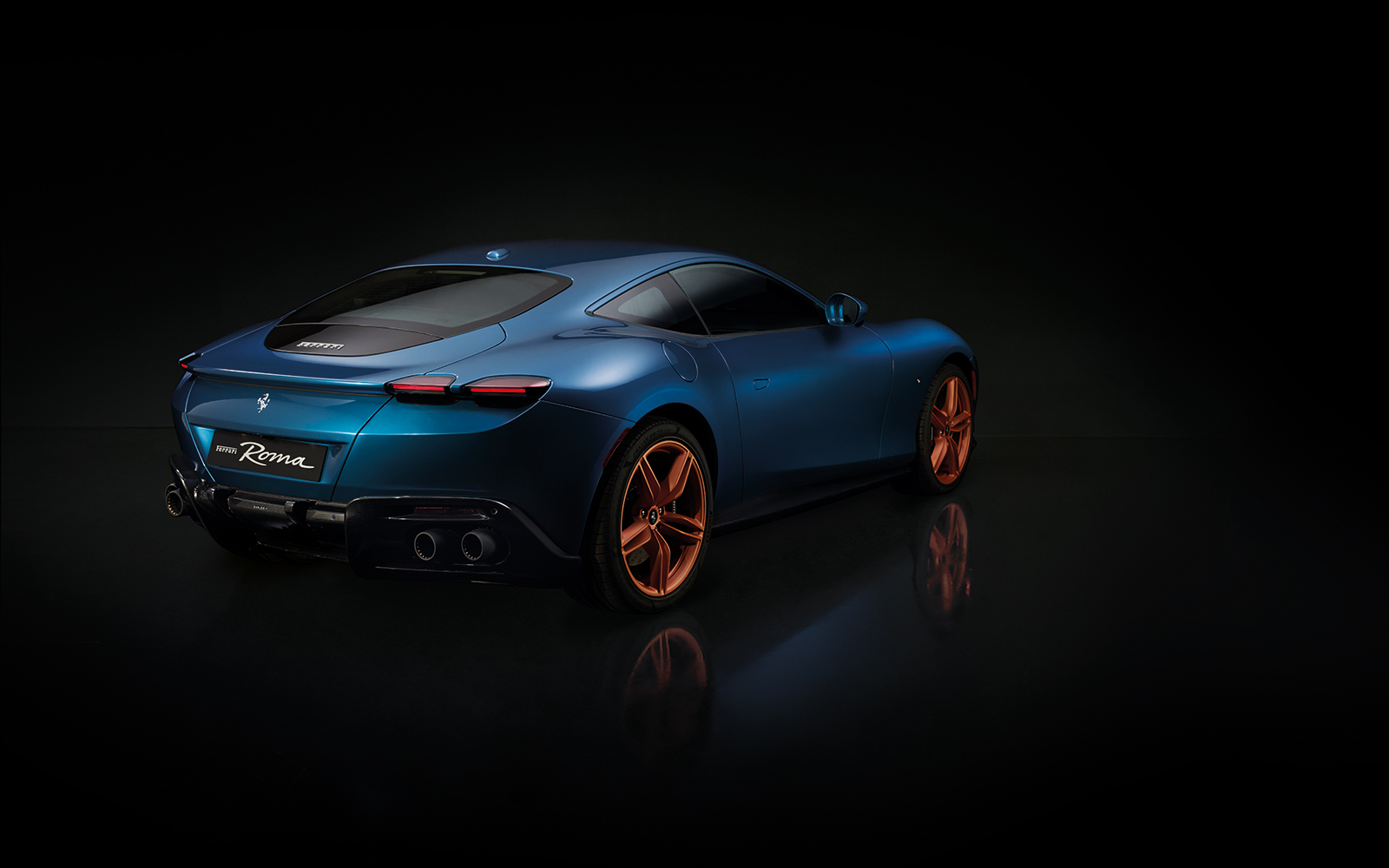
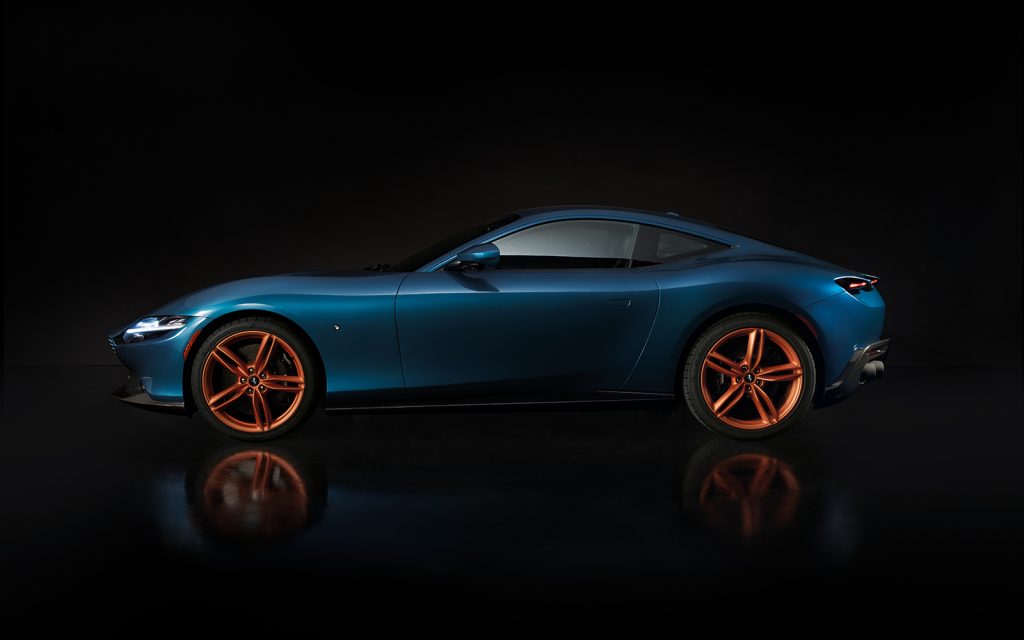
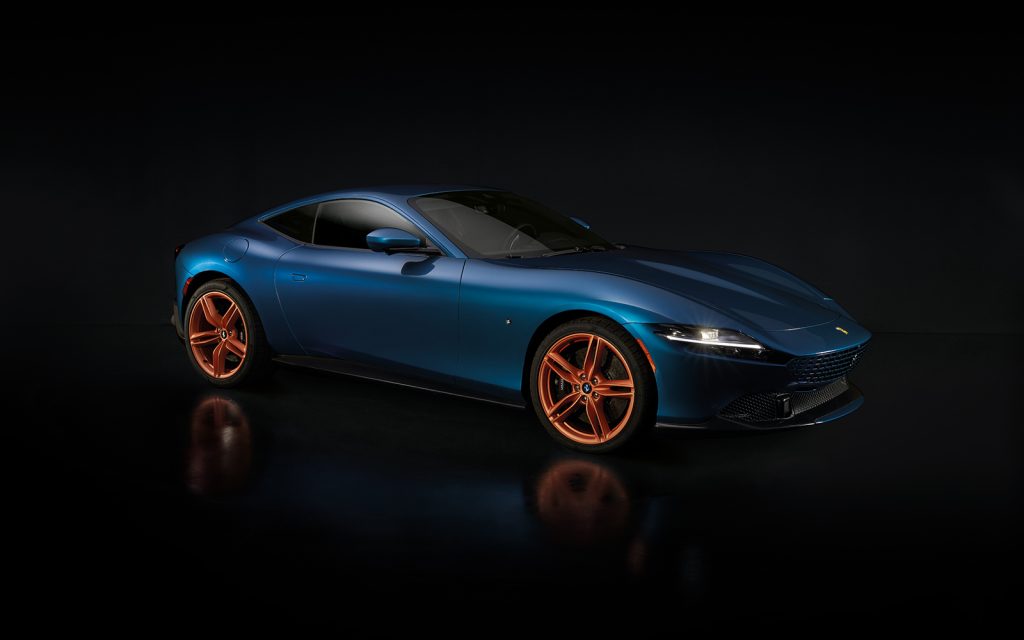
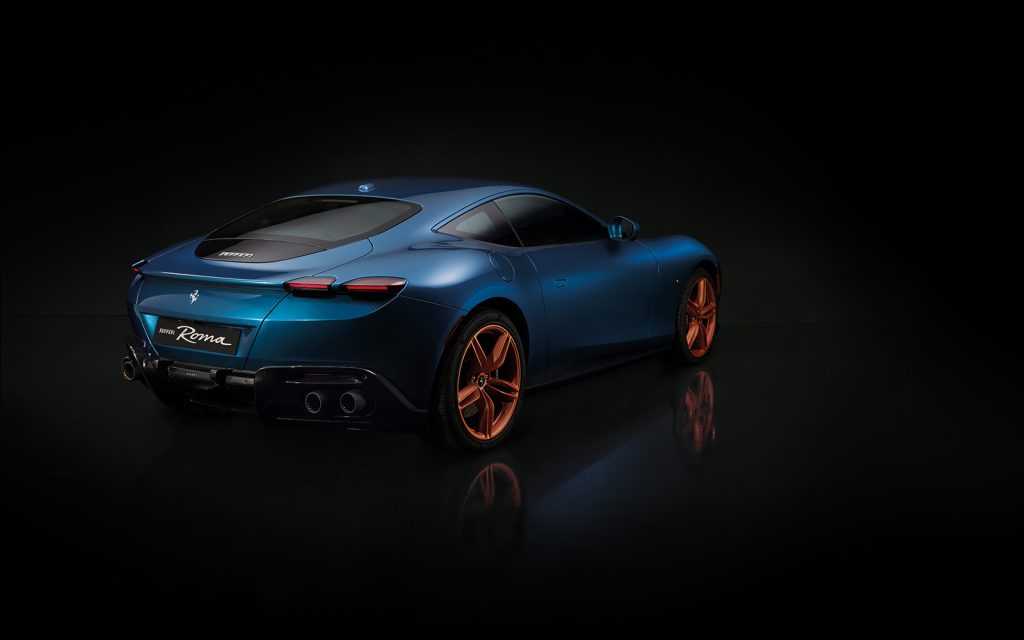
    Maranello, 17 May 2022 – Ferrari unveils a one-of-a-kind Ferrari Roma model, crafted by its bespoke Tailor Made department. The car features exquisite traditional Japanese-inspired detailing while retaining the clean, sophisticated elegance of the original car.

    Ferrari Tailor Made is an exclusive programme for those who wish to customise each element of their Ferrari to create a vehicle that truly reflects their personality and tastes. Customers who participate in the Tailor Made programme are assisted by a team of experts led by a personal designer that interprets their desires whilst upholding the aesthetic standards of the Ferrari brand.

    This particular car’s story began when Evan Orensten and Josh Rubin, the founders of the award-winning independent US publication dedicated to design, culture and technology COOL HUNTING, were offered, and accepted, the opportunity of customising a Ferrari Roma, to explore how far Ferrari’s bespoke personalisation programme could go and really push the boundaries.

    They met Flavio Manzoni, Ferrari Chief Design Officer, in the Ferrari Tailor Made showroom in New York. They had just returned from several research trips to Japan where they had immersed themselves in the country’s traditional crafts and artisanal methods, and proposed bringing some of those ideas and unique materials into the Tailor Made journey as envisioned by COOL HUNTING.

    Flavio Manzoni and his team were inspired by the parallels between Italian and Japanese culture and design philosophy: a single-minded devotion to quality, an emotional involvement with the client, and exquisite skills in craftsmanship that have been passed down from generation to generation.

    An idea formed – to create a Ferrari featuring some of the unique materials developed from traditional Japanese techniques while employing Ferrari’s customary innovation to modify them to accommodate the requirements of durability and functionality that a modern high-performance car demands.

    Traditional Japanese indigo dyes inspired the Ferrari Roma’s colour scheme, particularly the vivid blue exterior paint which was specially developed for this car and named Indigo Metal. This vivid colour perfectly enhances the purity of the Ferrari Roma’s shape – light appears to flow over its bodywork, accentuating its lines through highlights and shade.

    Indigo features prominently in Japanese design culture, and the traditional dye is produced naturally. COOL HUNTING had visited Toyama, one of only five remaining indigo farms in Tokushima, Japan’s traditional indigo-growing region. They learned that the dye comes from a green plant which, when harvested and fermented, becomes sukumo, traditional dried Japanese indigo that is mixed with lye, sake and limestone powder to create authentic Hon-Ai indigo dye. Because of its antimicrobial properties it was traditionally used for linens, bedding and clothing.

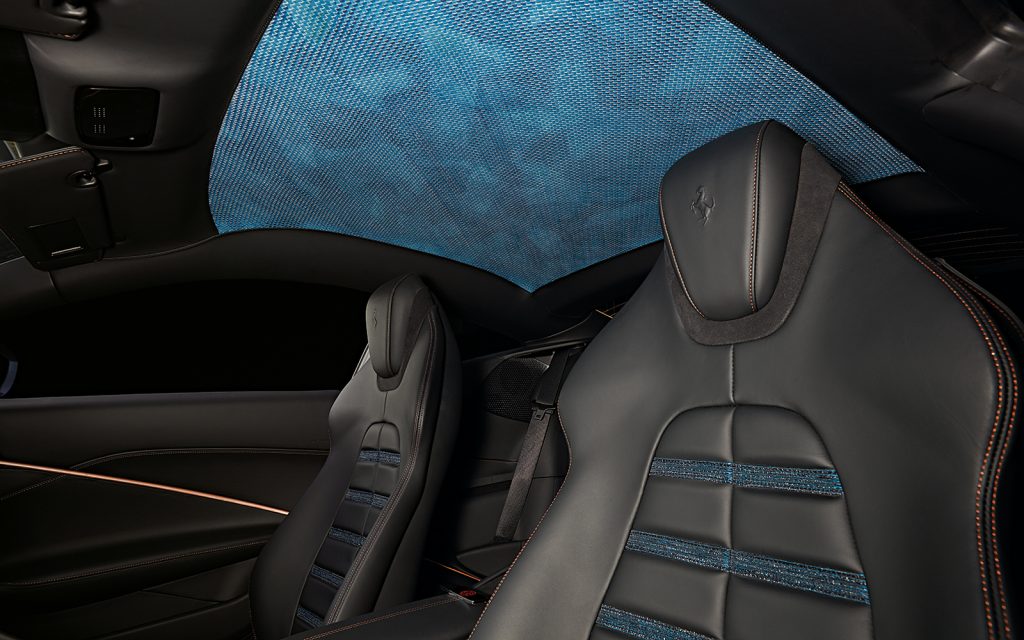
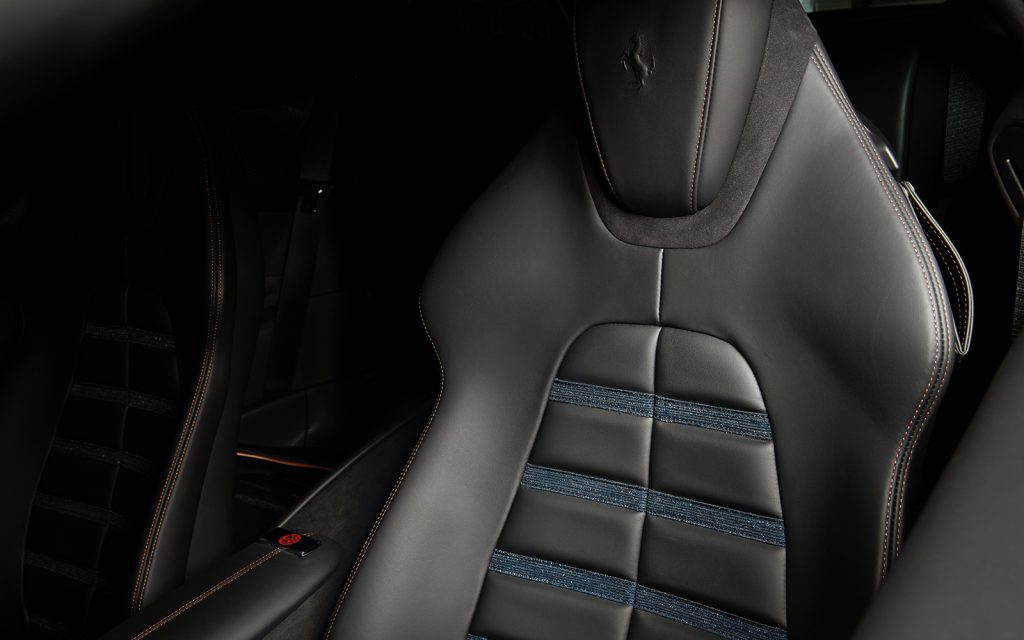
    The same colour palette is used to tie together the vehicle’s exterior and interior into one subtle, holistic statement. The indigo shade is also found in the sakiori fabric used for the seat trim inserts and the carpets.

    Sakiori is one of the world’s oldest examples of upcycling, dating from the 1700s when cotton and silk were available only to Japan’s nobility and the very wealthy. Worn-out kimonos were disassembled, their fabric cut into strands and rewoven with new fibres, creating a material that was both warm, comfortable and durable. The word comes from the Japanese saku (to rip up) and oru (to weave).

    An innovative solution was identified in making sakiori a viable material. Two vintage kimonos originally made in Amami Oshima, an island in Japan’s southern archipelago were used—an indigo-dyed kimono approximately 75 years old and one approximately 45 years old, dyed in both indigo and the island’s celebrated Amami Oshima Tsumugi mud-based dye. Instead of weaving the kimono strands with cotton or silk as is traditional, it was woven with high-tensile nylon, ensuring the durability required of this material in its application inside the vehicle. This new textile was created in the same place the original materials originated from by Hajime Shoji.

    The indigo theme is carried through to the Ferrari Roma’s headlining – a beautifully detailed piece of craftsmanship and design which is exclusively experienced by those sitting in the car. It is comprised of two indigo-dyed hides made with Asai Roektsu in Kyoto—one with a unique solid colour crafted to match the car’s colour scheme, and a hand-painted hide using the Roketsu method, which can be traced back to the 8th century. It is a wax resist-dyeing method that forms intricate repeated patterns around a single colour, and was commonly used to decorate the silk or cotton of kimonos and obis. The hides were then sent to Italy, where they were cut into strips and hand-woven by Italian artisans in a process called intreccio, forming an elegant one-of-a-kind work of art.

    The Ferrari Roma’s interior door handles also take their inspiration from Japan – they are enclosed in tightly hand-woven strips of black leather in an homage to tsukami, the ancient art of wrapping the grips of Katana swords.

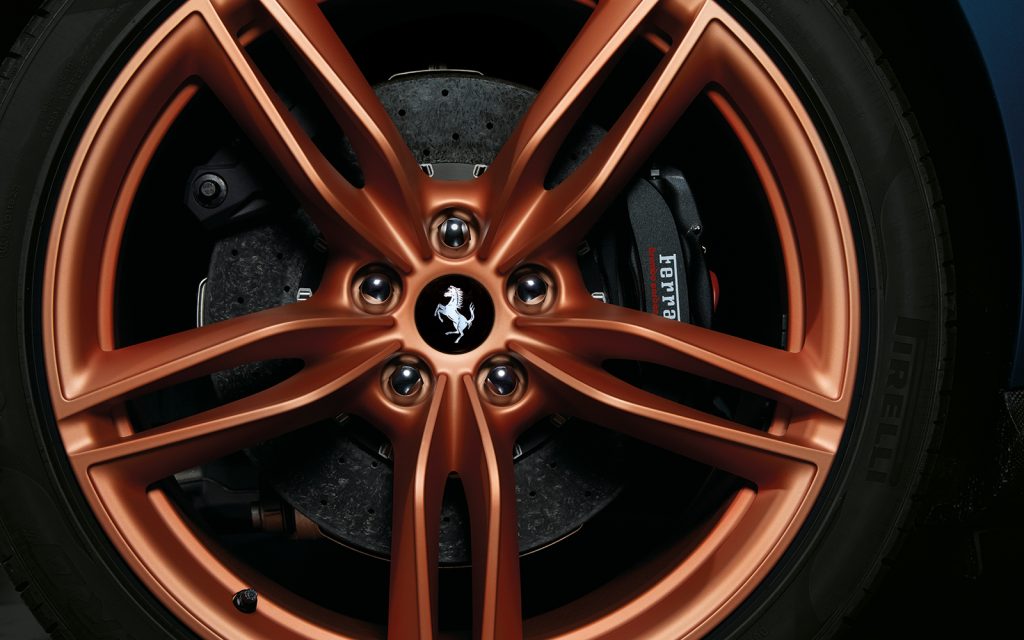
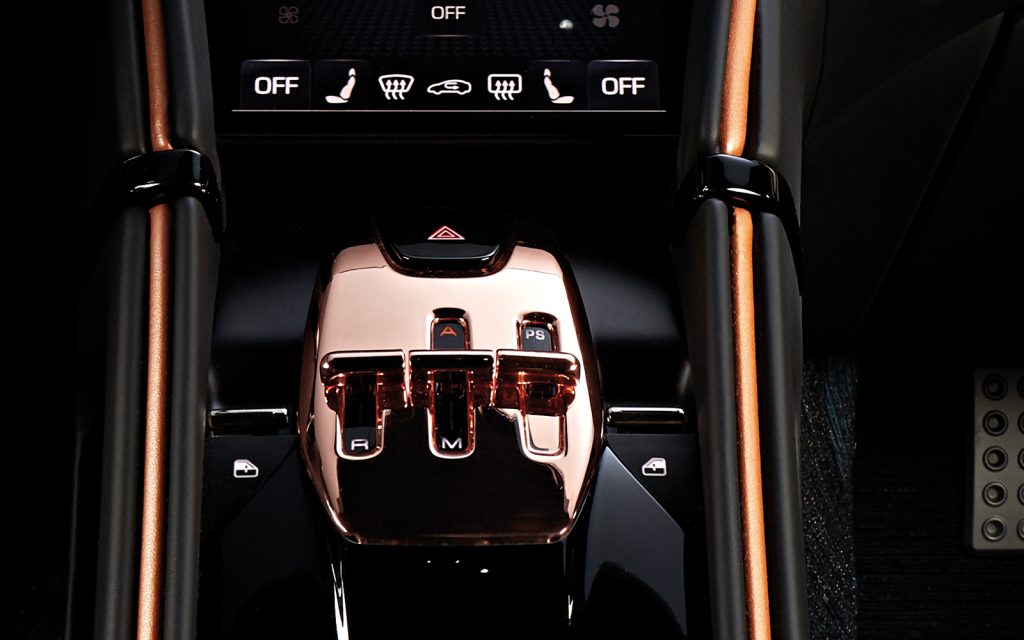
    The COOL HUNTING team were further inspired by a visit to Kaikado, a Kyoto-based family business known for its iconic copper tea canisters. Now made by the fifth and sixth generations of the family, the canisters are so skilfully crafted that they form a vacuum seal as the lid gently falls onto the body. The copper also adopts a unique natural patina with use. Inspired by this, Copper plating is found in details on the Ferrari Roma’s gear shift gate surround and levers, which were plated in Japan. The outline of the dual cockpits, the wheel rims and the kamon are also made in this colour.
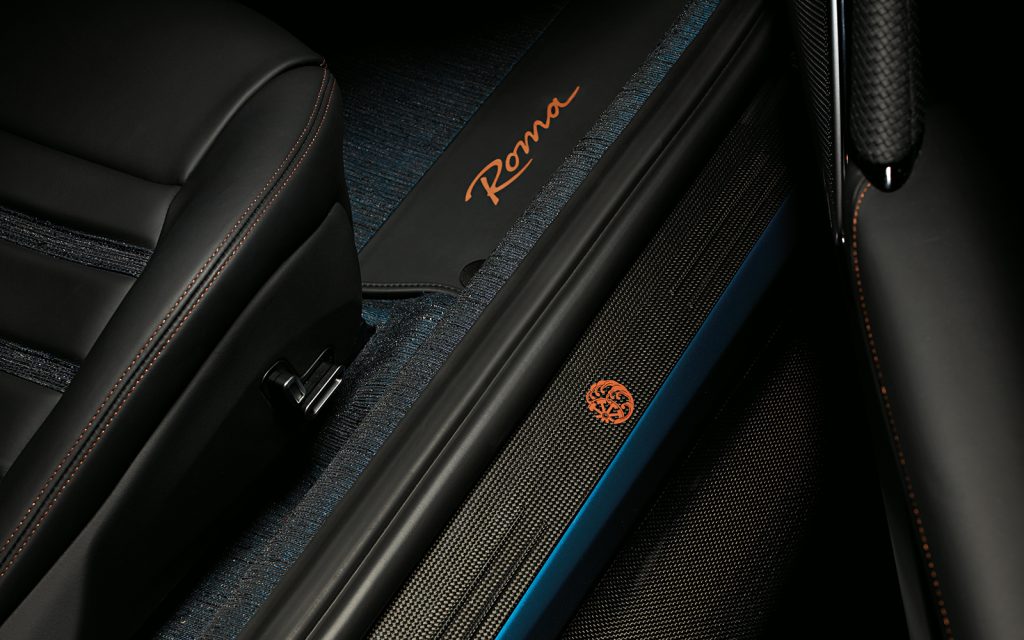
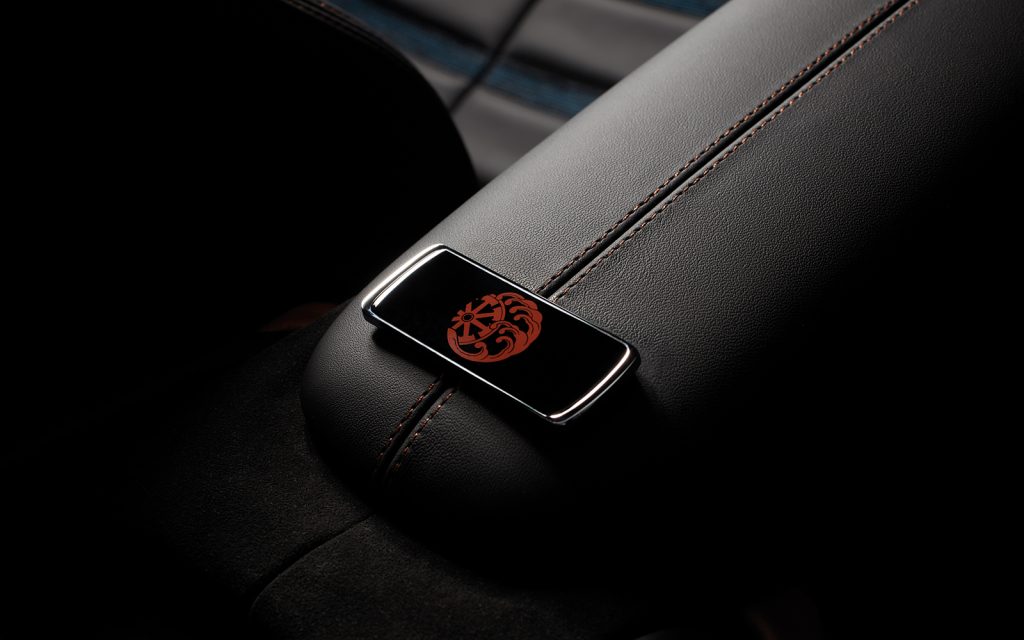
    The unique crest on the car’s dedication plate on the central armrest and door sills is a custom-made “kamon,” a symbol passed down from generation to generation in Japan. Designed by Kyogen, it represents a wheel from an ox-drawn carriage (popular transportation among aristocrats during the Heian period, 794-1185) combined with the eight pistons of the Ferrari Roma’s V8 engine forming its spokes. The numeric theme is continued in the eight wave crests that encircle the wheel – symbols of good luck, power and resilience.
    This subtle but exceptionally detailed Ferrari Roma brings together Italian and Japanese design culture in a harmonious form. It is a beautiful example of the unlimited wealth of combinations and possibilities that are available through the Ferrari Tailor Made programme.

    The Ferrari Roma features refined proportions and timeless design combined with unparalleled performance and handling. Not only is the Ferrari Roma an icon of Italian design, but it also represents the pinnacle of performance in this category, thanks to its 620-cv turbo-charged V8 from the family of engines that won the overall International Engine of the Year award four years running.

    The Tailor Made Ferrari Roma Specially Crafted for COOL HUNTING will be on display in the Ferrari Tailor Made Showroom during the New York Design Week (NYC X DESIGN), celebrating the space where this incredibly dynamic collaboration started, bringing together diverse cultural and creative forces from different parts of the world in a unique and special way.

  • Ferrari SP48 Unica: A New One-Off from Maranello

    Ferrari SP48 Unica: A New One-Off from Maranello

    • A unique new Ferrari designed to a client’s brief
    • The SP48 Unica is a two-seater sports berlinetta powered by the same twin-turbo V8 as the F8 Tributo
    • Bespoke design and aero modifications give the SP48 Unica a sporty and dynamic look

    Maranello, 5 May 2022 – The Ferrari SP48 Unica, the latest addition to the Prancing Horse’s One-Off series, was unveiled today and joins the most exclusive group in Maranello’s entire production: unique, absolutely bespoke cars crafted to the specifications of a single client and designed as a clear expression of their own individual requirements.
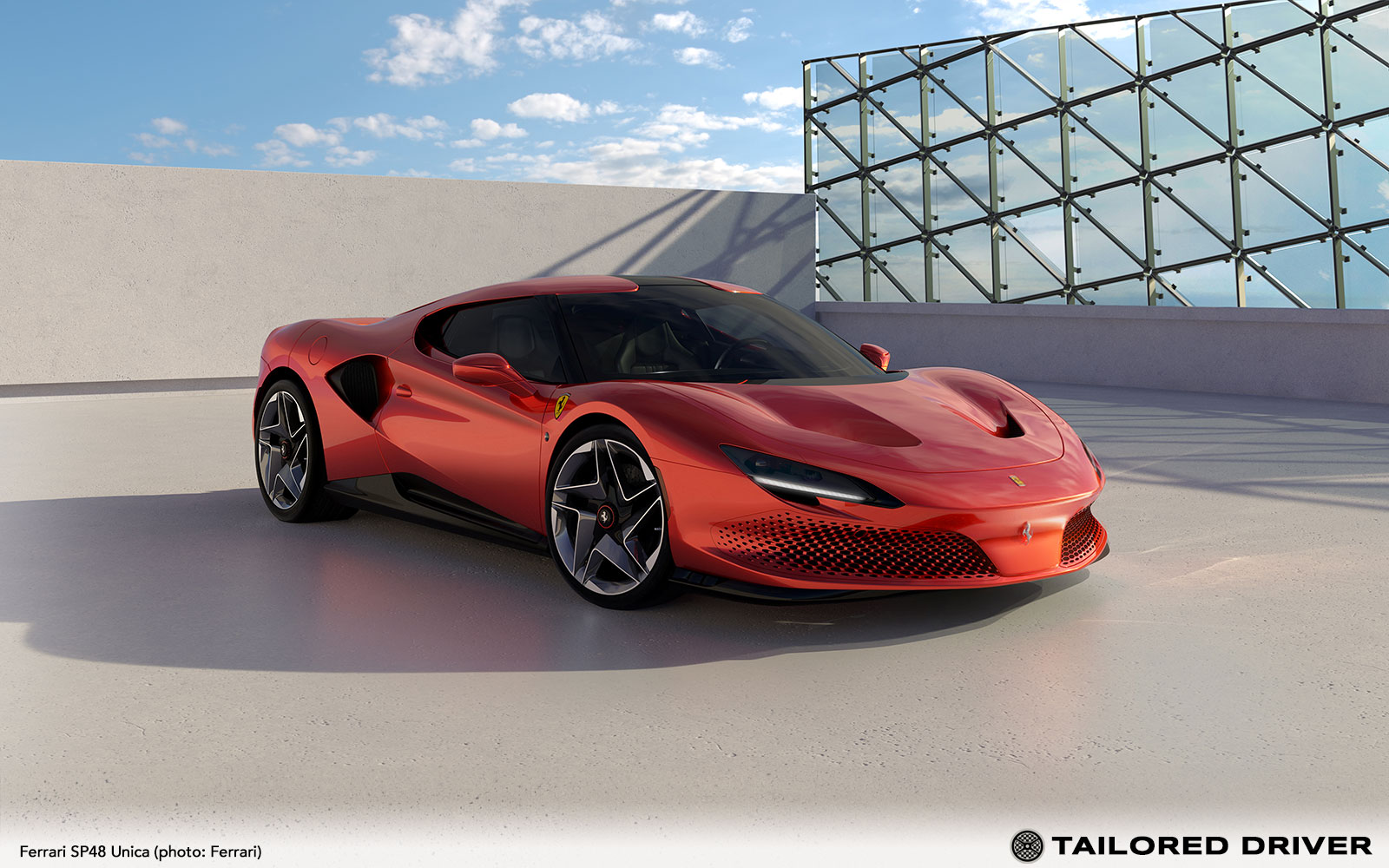
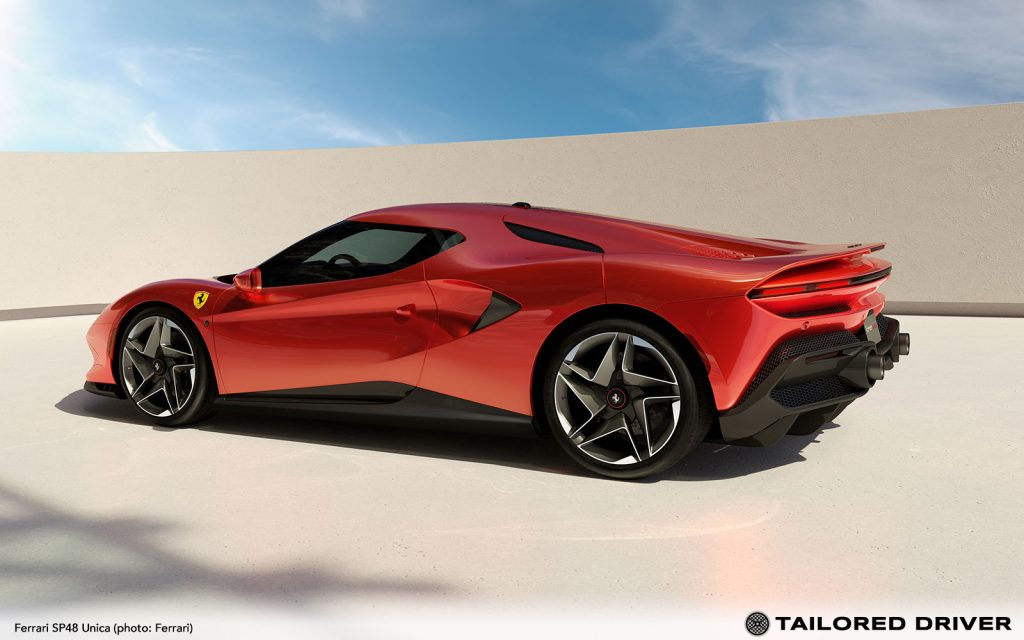
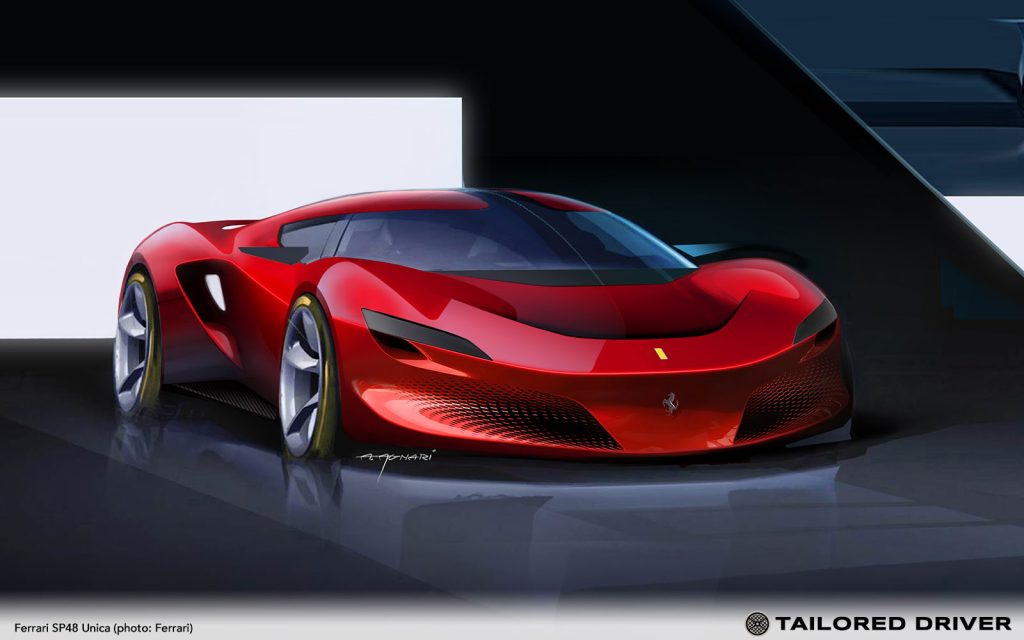
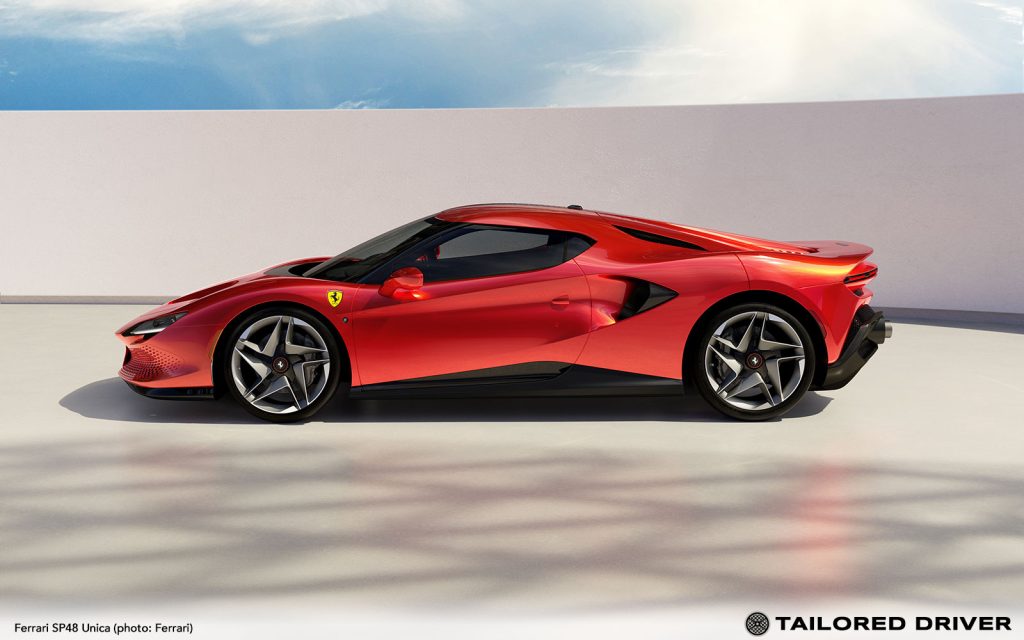
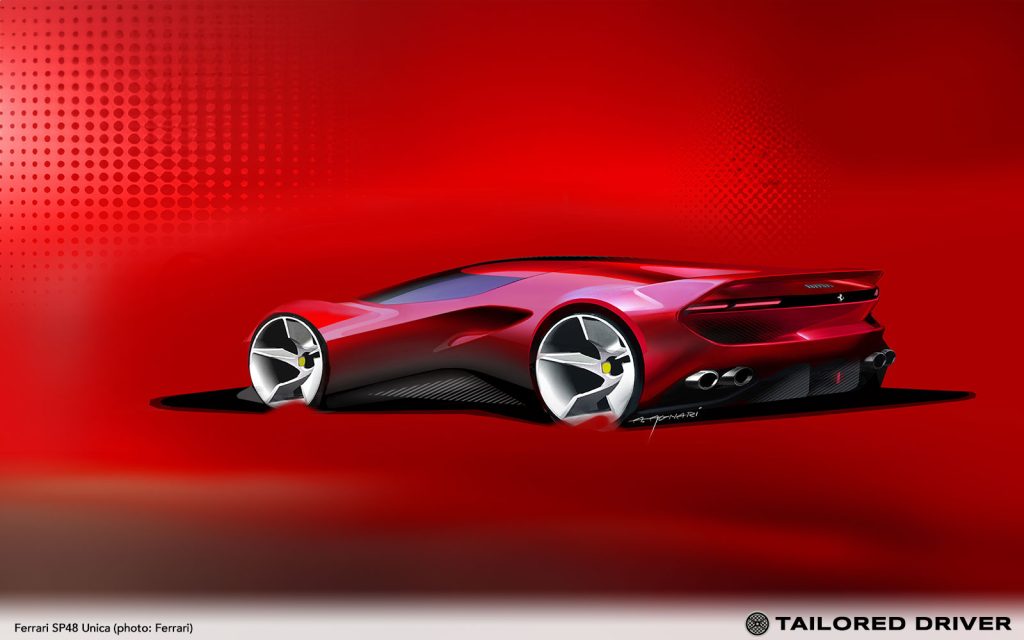
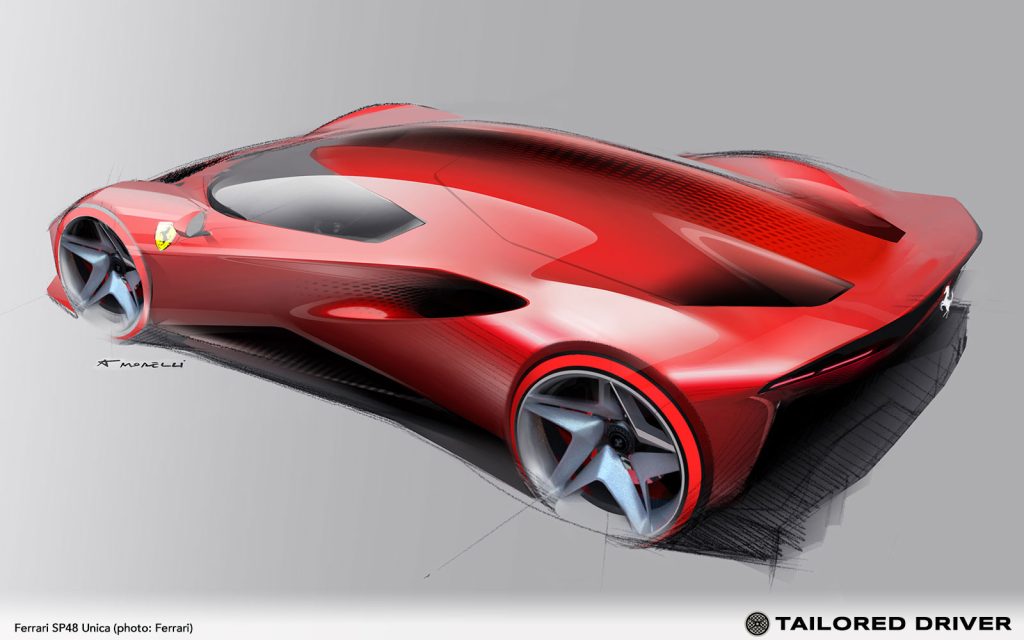
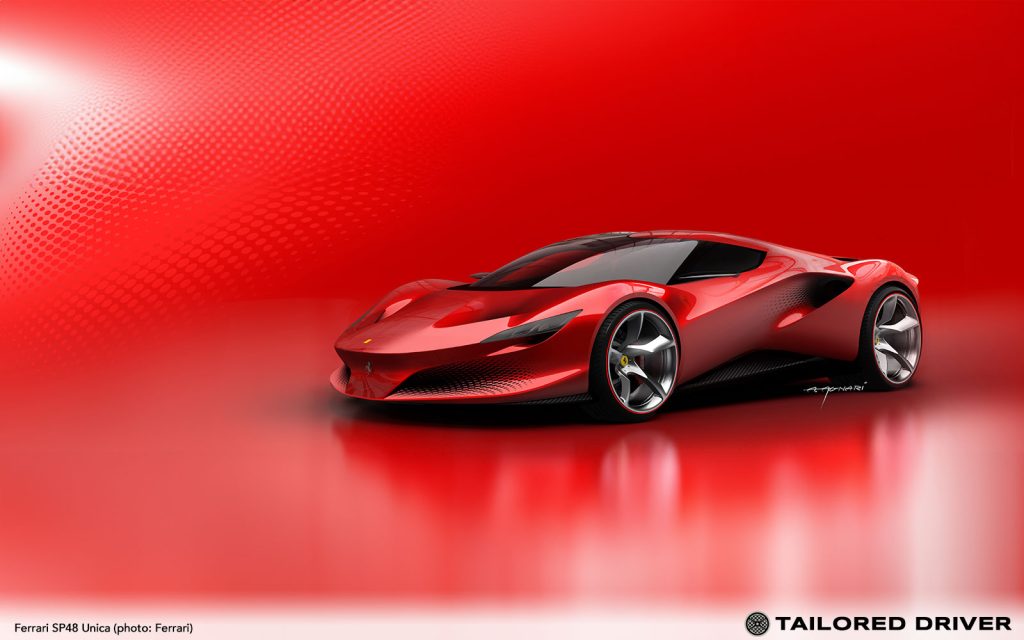
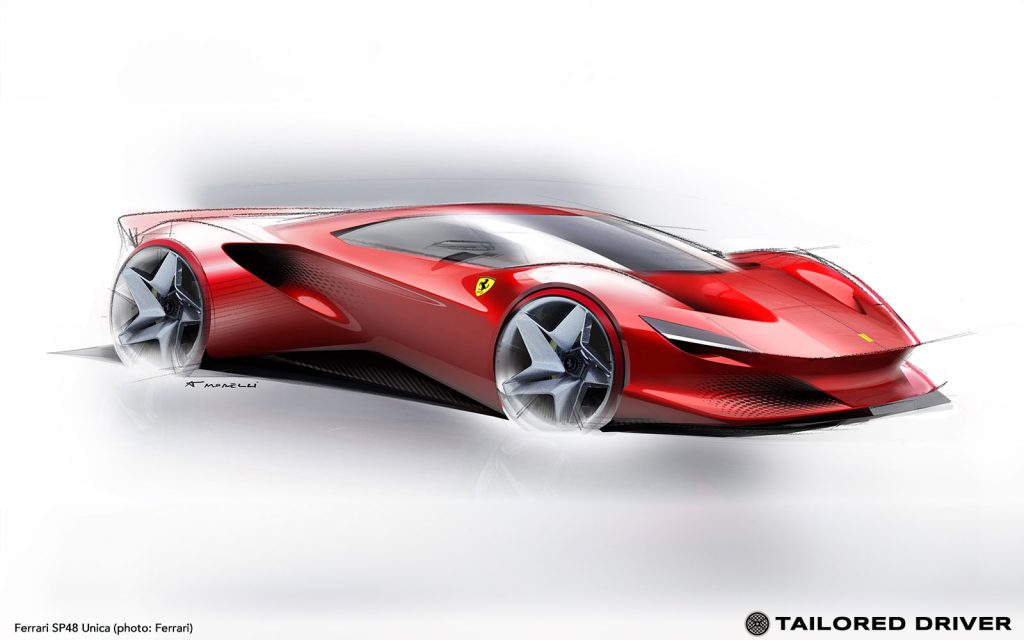
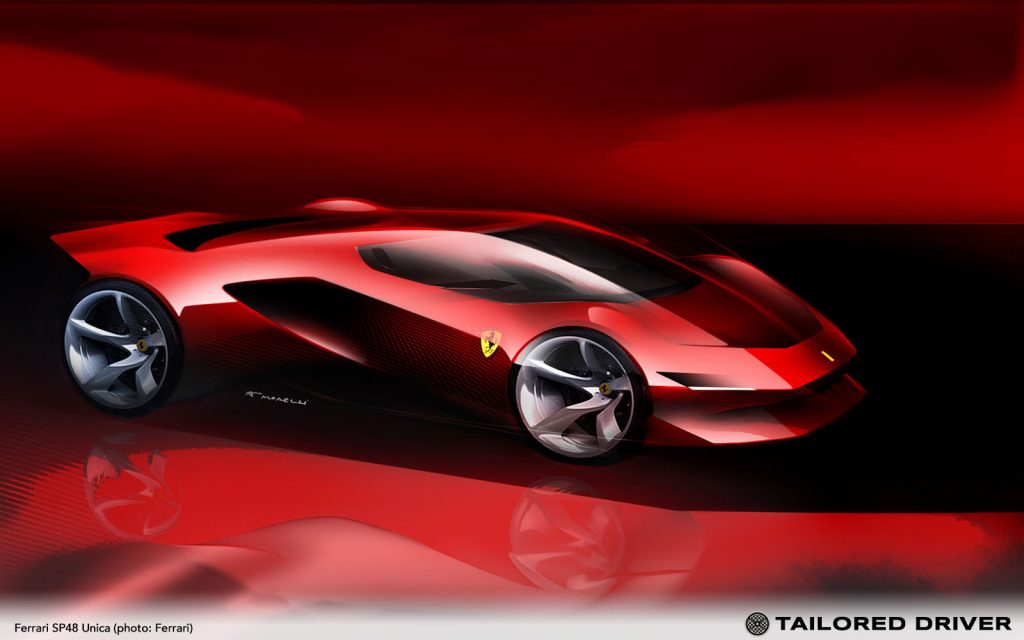
    The SP48 Unica, designed by the Ferrari Styling Centre under the direction of Flavio Manzoni, Chief Design Officer, is a two-seater sports berlinetta developed on the F8 Tributo platform. Its taut lines and aggressive stance make it instantly recognisable with respect to the original model, and it is unmistakable too, thanks to its arrow-shaped front profile. Central to achieving this effect was the redesign of the headlights and the subsequent relocation of the brake air intakes.
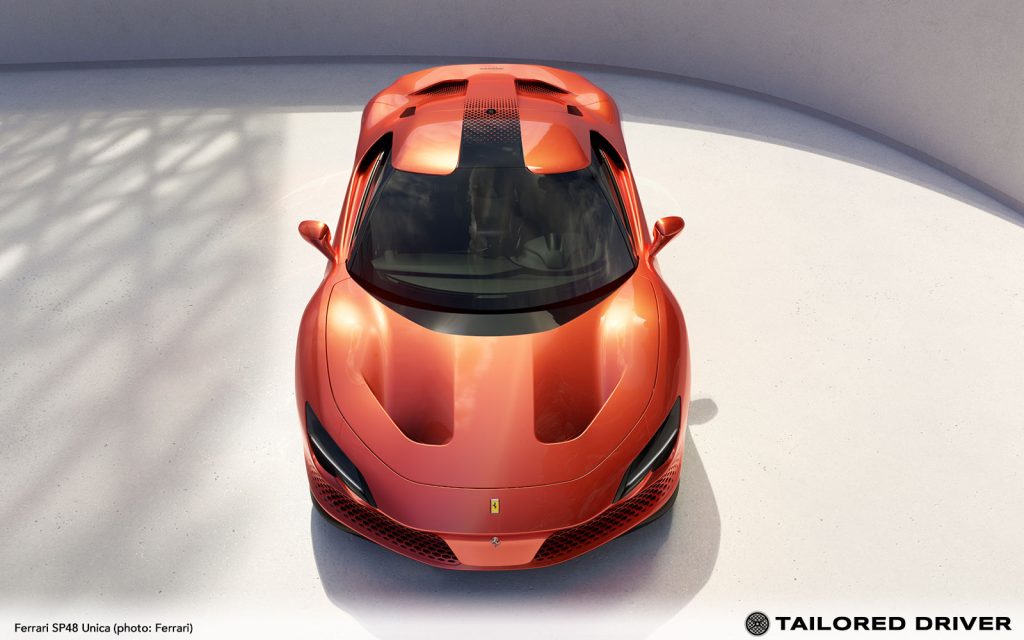
    A pivotal aspect of the design of this unique new car is the extensive use of procedural-parametric modelling techniques and 3D prototyping (additive manufacturing) which enabled the Ferrari Styling Centre designers and Maranello’s engineers to completely redesign the front grille and engine air intakes. This advanced production process resulted in perfect 3D grilles that seem carved from a solid volume creating a sense of seamless continuity and dynamic fluidity.

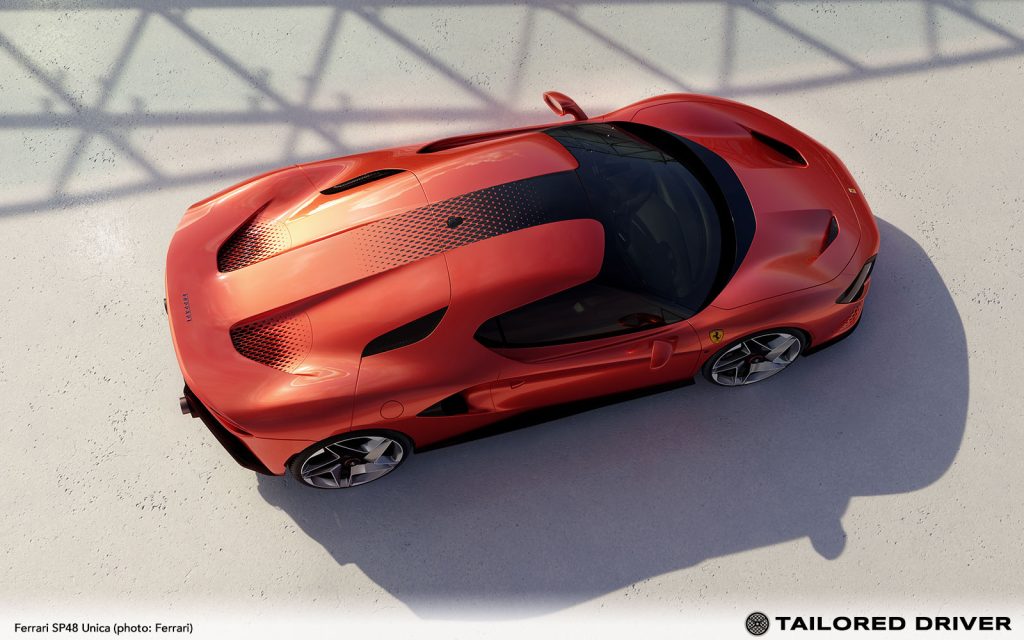
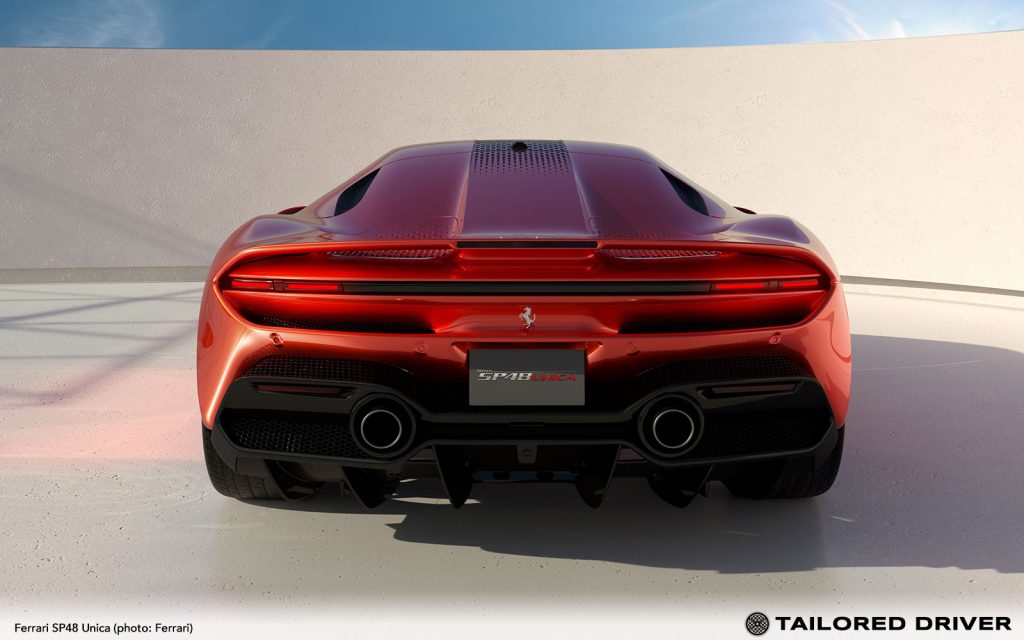
    The procedural graphic solutions adopted on the bodywork dialogue directly with the grilles and influence the SP48 Unica’s overall design:  the transition from black – which includes the windows, roof and engine cover – to the body colour is especially clear.  The striking visor effect of the front is further heightened by the reduction in the size of the side windows and the elimination of the rear screen, highlighting the powerful muscularity of the SP48 Unica which seems sculpted from a single block of metal.

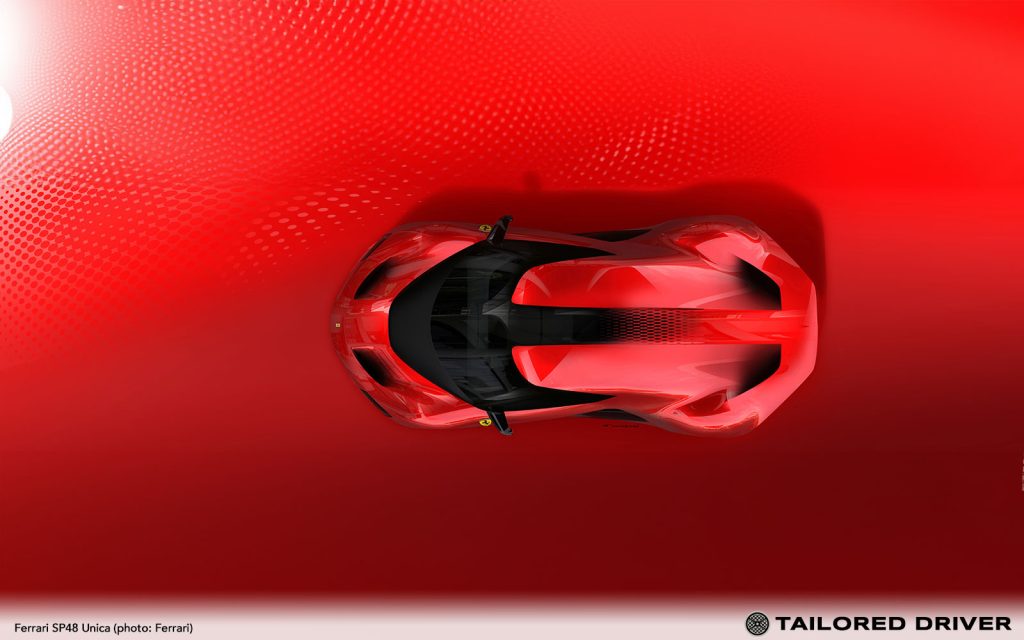
    The plan view emphasises the central section of the roof which includes a graphic representation of the air intakes set into the rear part of the carbon-fibre engine cover before the rear wing. This angle allows the viewer to appreciate the styling research that went into the SP48 Unica and reveals the sophisticated interplay of symmetries and intersecting lines created by its forms.

    The SP48 Unica’s thermal-fluid-dynamic design has been honed and perfected to guarantee it satisfies all cooling requirements in addition to delivering a different aerodynamic balance. The biggest changes compared to the F8 Tributo’s styling include the air intakes for cooling flows for the engine on the front bumper and beneath the rear spoiler. Each has a deep procedural grille, every section of which is optimally angled to maximise the amount of air passing through. The car’s configuration also allowed the engineers to locate an intercooler intake immediately behind the side windows, which in turn enabled them to reduce the dimension of the intakes on the flanks. The longer rear overhang reduces suction from the roof area, boosting rear downforce.

    Although the cabin retains the F8 Tributo’s technical identity – excluding the rear screen – meticulous development work was lavished on achieving the perfect combination of colour and trim to reflect the SP48 Unica’s  sleek, sporty and aggressive personality.  A good example is the specially developed black laser-perforated Alcantara® used on the seats and most of the cabin trim, beneath which are glimpses of iridescent reddish-orange fabric that match the exterior colour. Its motif picks up the hexagonal motif of the grilles and the procedural livery on the roof, creating an appealing continuity between the car’s interior and exterior.  In the SP48 Unica cockpit, the eye is immediately drawn to the polished sill covers with the same laser-embossed hexagonal motif. Matte carbon-fibre imbues the cockpit with a sense of technicality and exclusivity, and is complemented by the Grigio Canna di Fucile accents.

    Designed for a long-standing client who was deeply involved in every step of its creation, the one-off Ferrari SP48 Unica is a bold interpretation of a sports car and cleverly enhances its racing soul and vocation for speed. The SP48 Unica achieves its goal of transforming an existing model to masterful effect, taking inspiration from and paying homage to the company’s core values of innovation and passion.

    SPECIAL PROJECTS

    The Special Projects programme creates unique Ferraris (so-called “One-Offs”) characterised by an exclusive design crafted around the requirements of each individual client to ensure each one becomes the owner of a genuinely one-of-a-kind model. Each project originates from an idea put forward by the client and then developed with a team of designers from Ferrari’s Styling Centre. Having defined the car’s proportion and forms, detailed design blueprints and a styling buck are produced before the construction of the new One-Off begins. The entire process lasts more than a year on average, during which time the client is closely involved in assessing the design and verification phases. The result? A unique Ferrari sporting the Prancing Horse logo and engineered to the same standard of excellence as every car that rolls off the Maranello assembly lines.