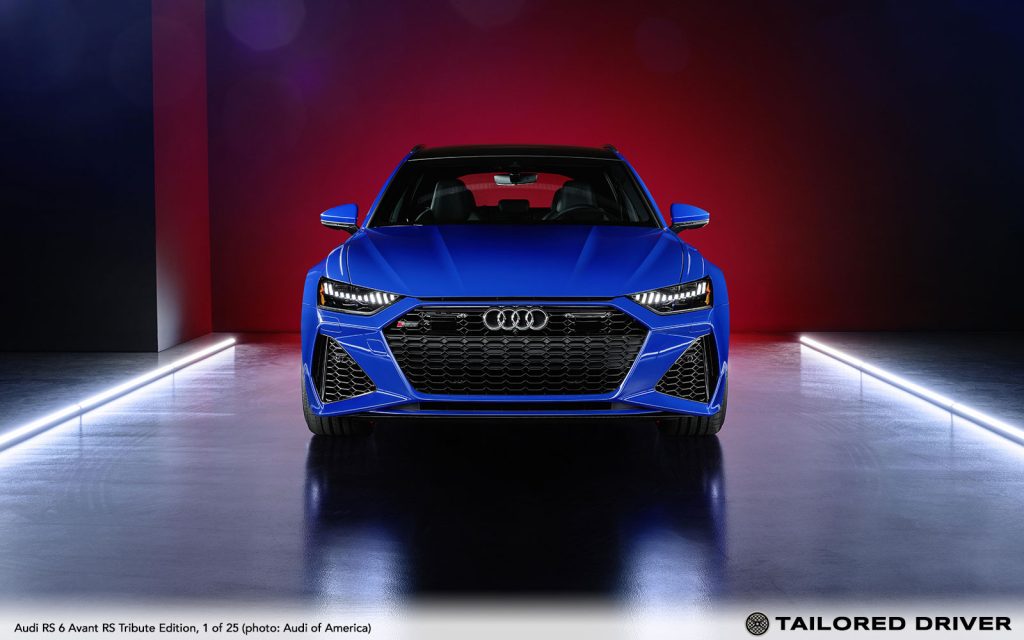
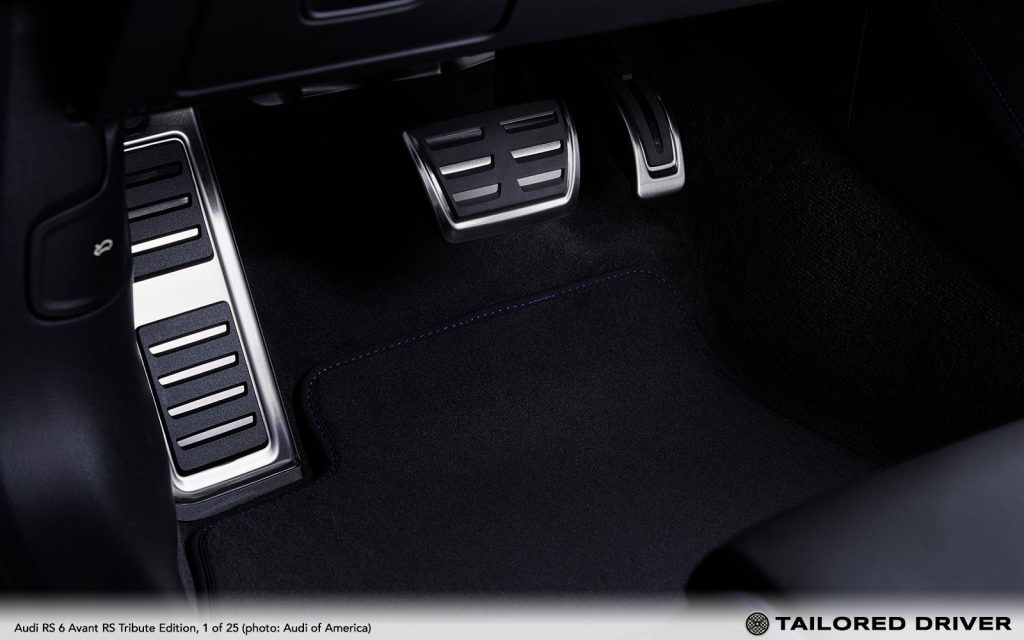
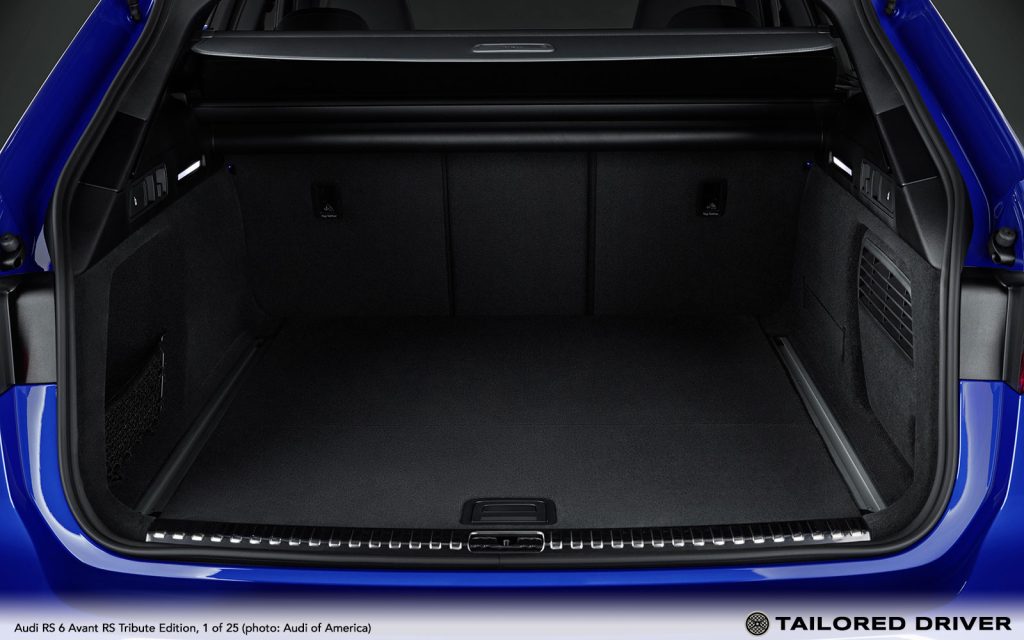
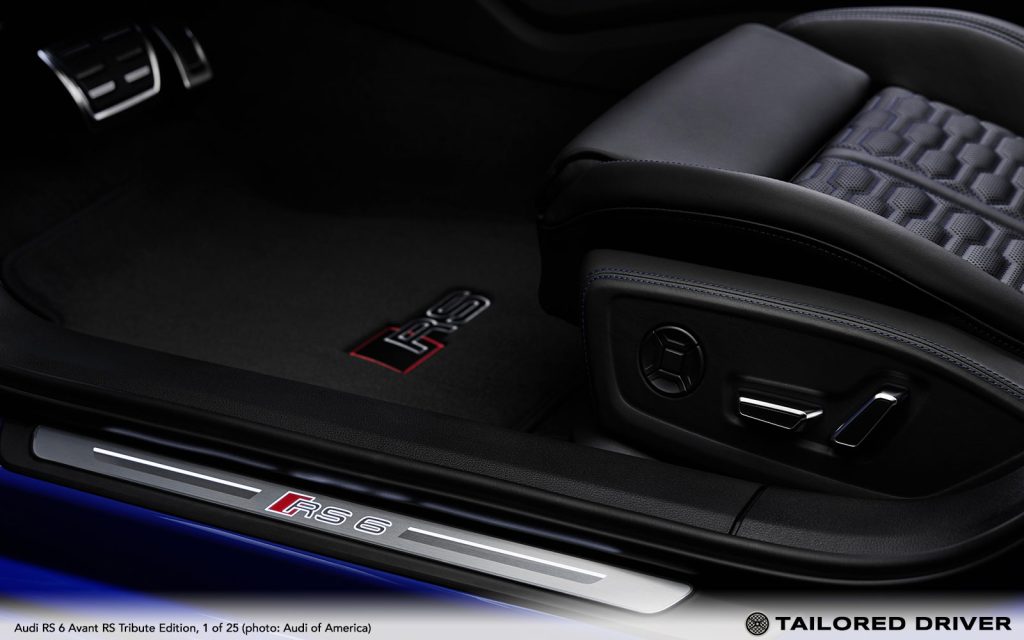
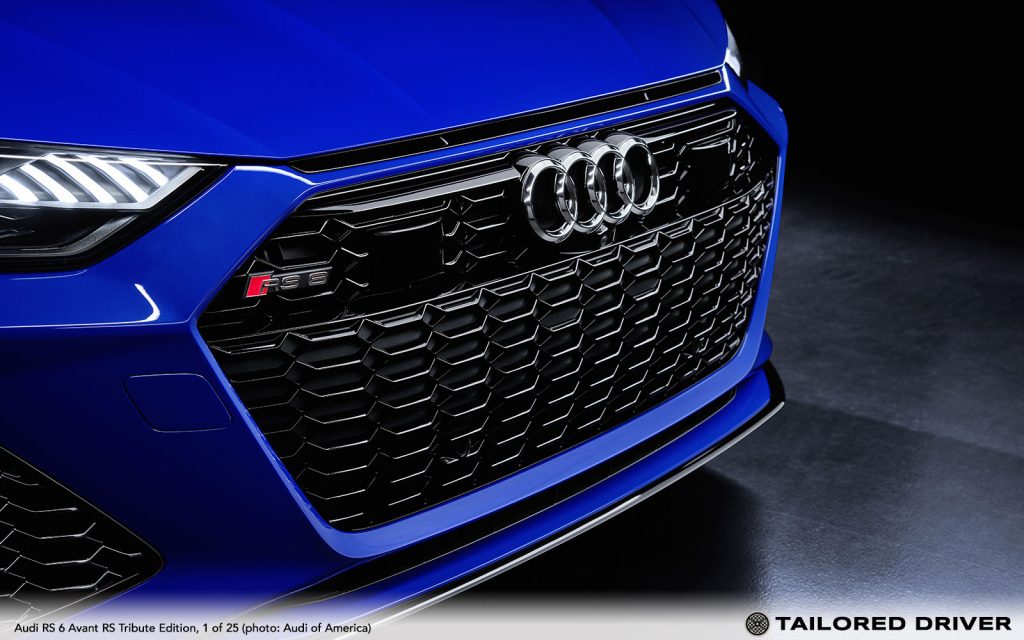
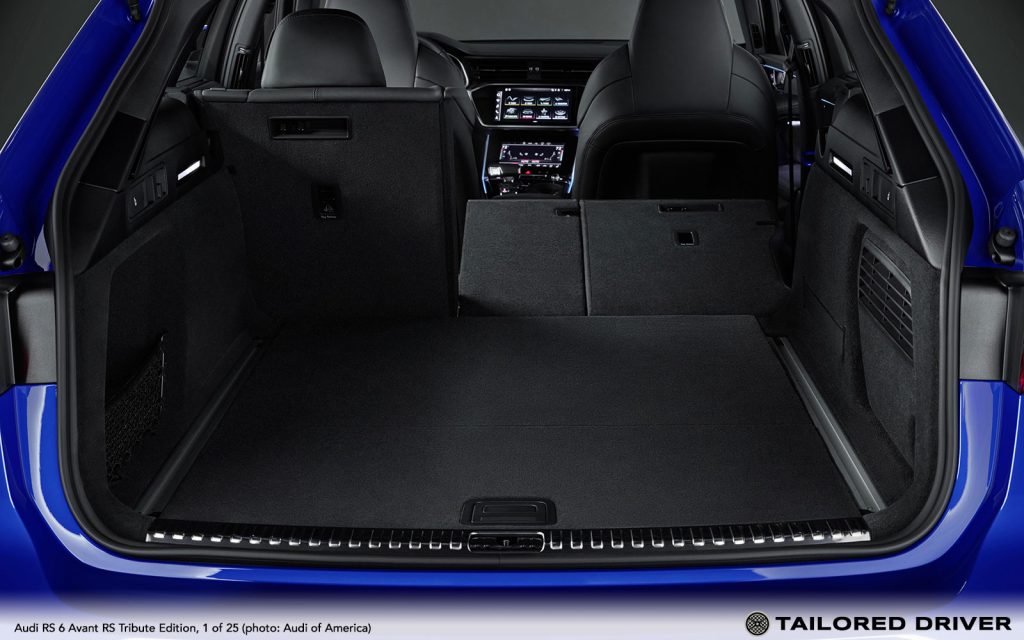
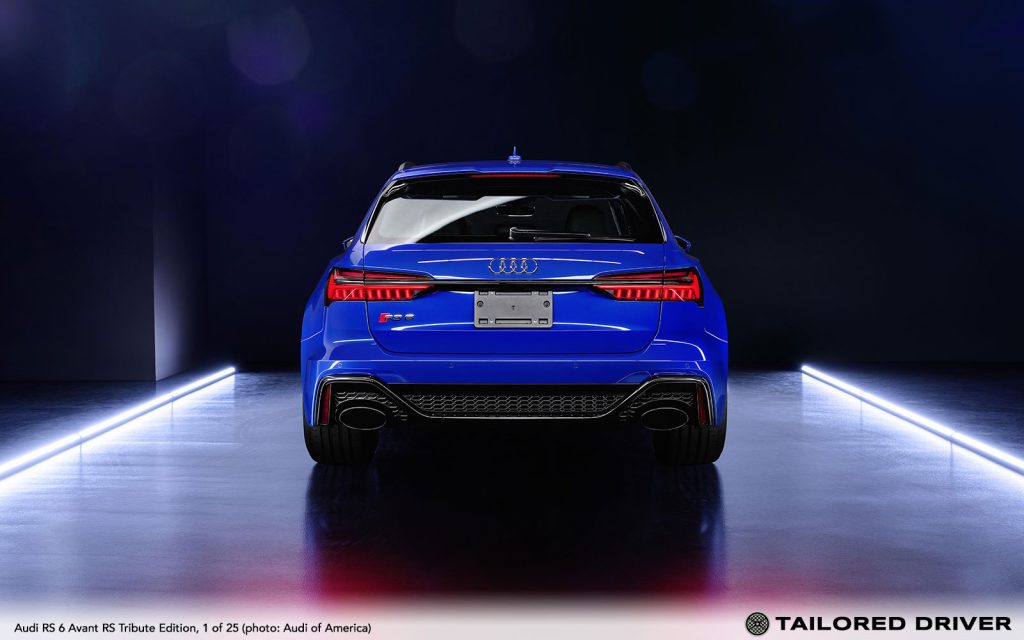
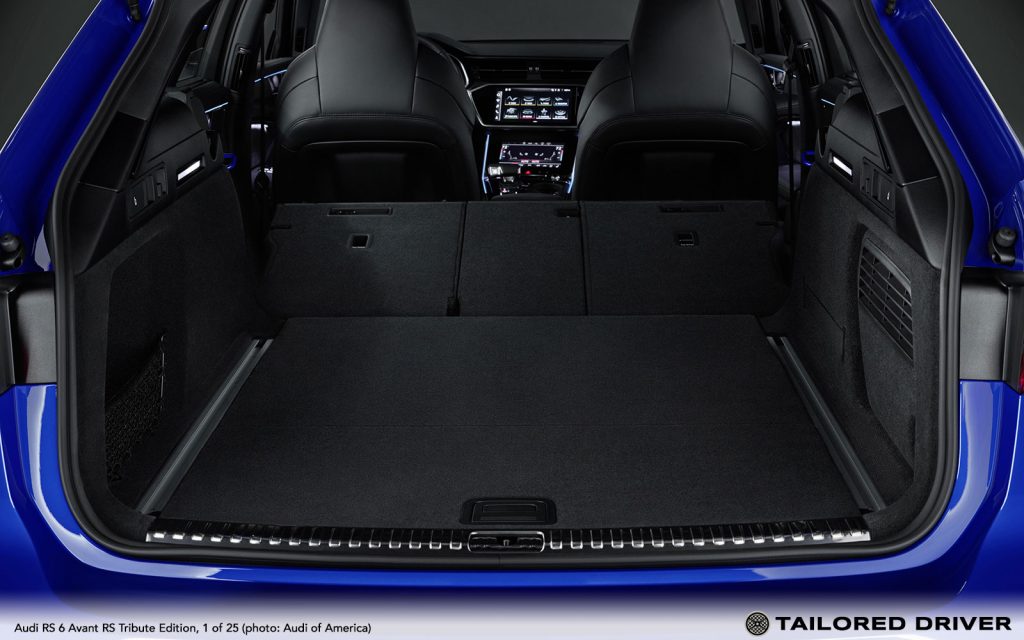
Limited to 25 units, the Tribute edition features unique trim details paying homage to original 1994 RS2 Avant
Powerful RS 6 Avant – Tribute edition is capable of 591 horsepower and 590 lb-ft of torque
2021 Audi RS 6 Avant and RS Tribute edition both on sale now
HERNDON, VA – The highly-anticipated RS 6 Avant is now on sale, and to celebrate the arrival of the high-performance wagon on U.S. shores, Audi of America announces the “RS Tribute edition.”
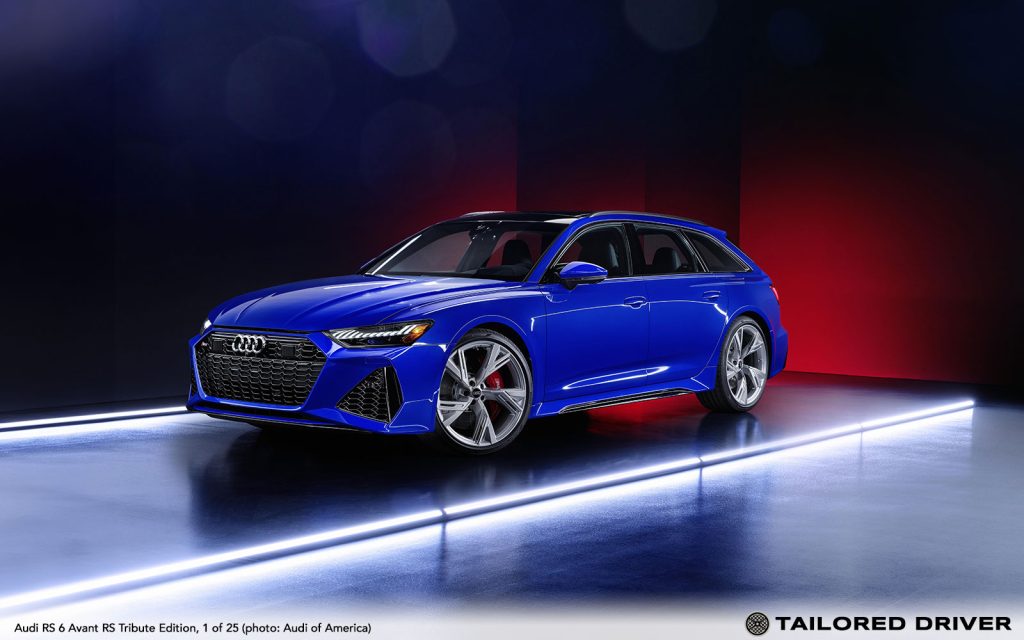
A quarter of a century ago, the RS2 Avant kicked off the success story of Audi high performance models. As a tribute to the first high-performance wagon from Audi, the RS 6 Avant “RS Tribute edition” with a limited production of 25 units, features unique design elements that harken back to the iconic RS2 Avant.
The RS2 Avant from 1994 established a completely new segment as the first Audi high-performance wagon. With its 315 PS five-cylinder engine, its extravagant interior design, and the vibrant paint finish in Nogaro blue (nogaroblau; pearl effect UNI; Z5M; Audi) , it made a strong statement that is still considered iconic today.
Unique design elements
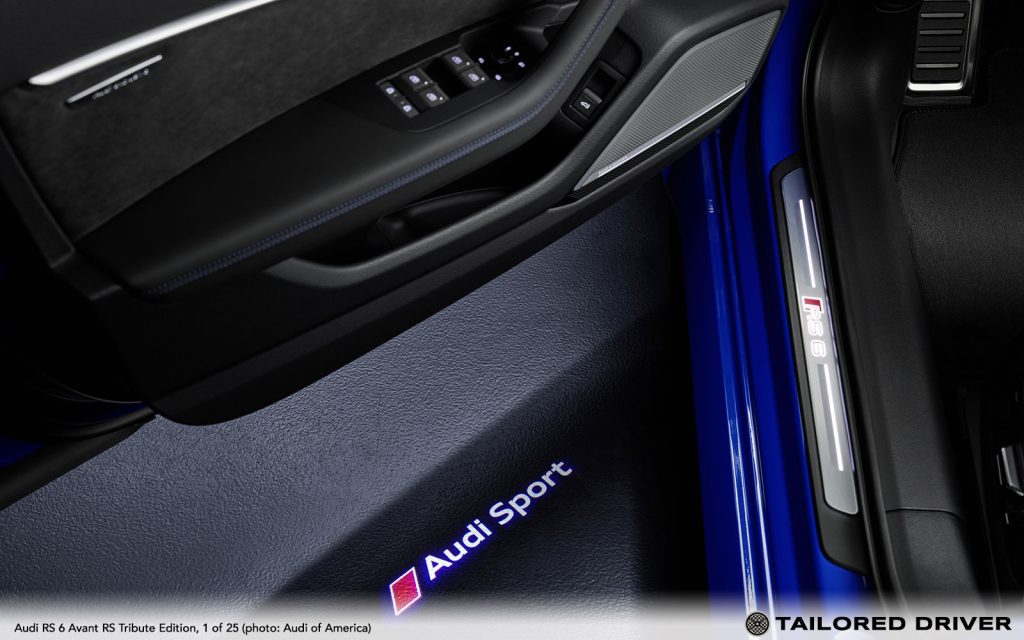
The 2021 RS 6 Avant “RS Tribute edition” pays homage to the ’94 RS2 Avant with unique interior and exterior design elements including:
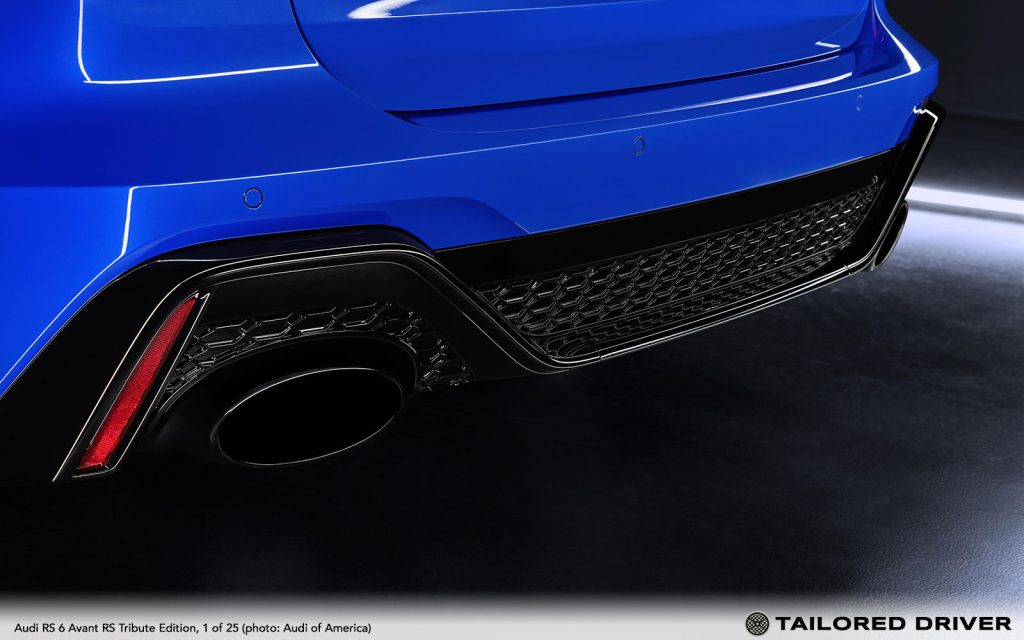
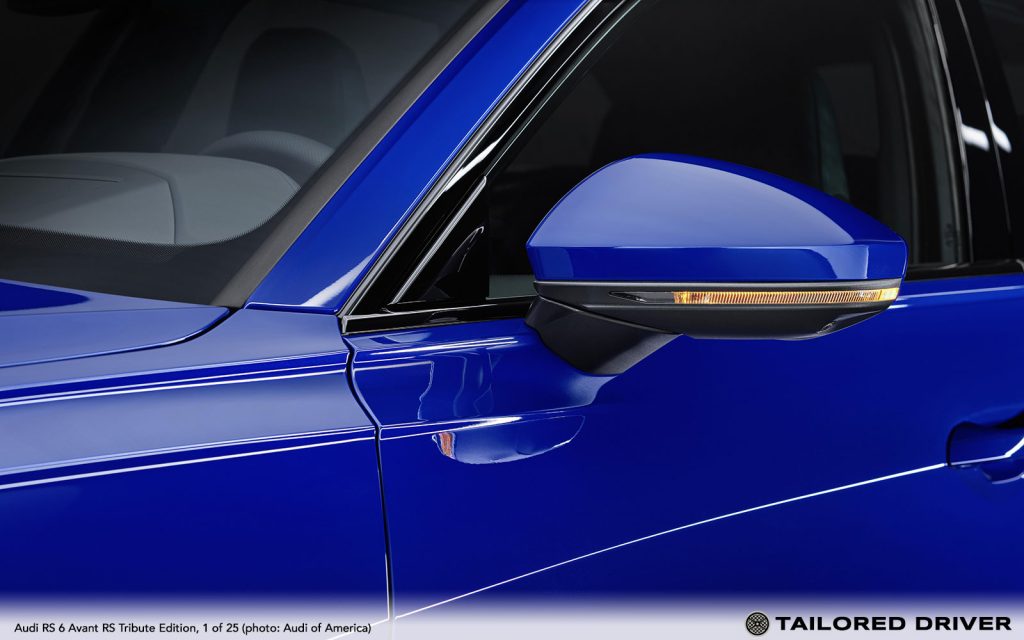
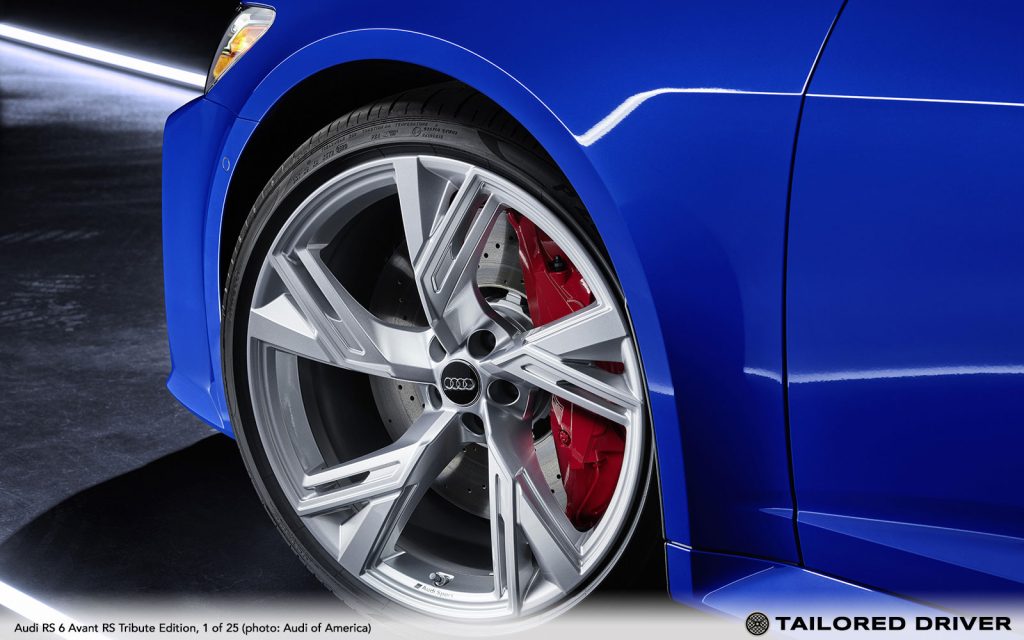
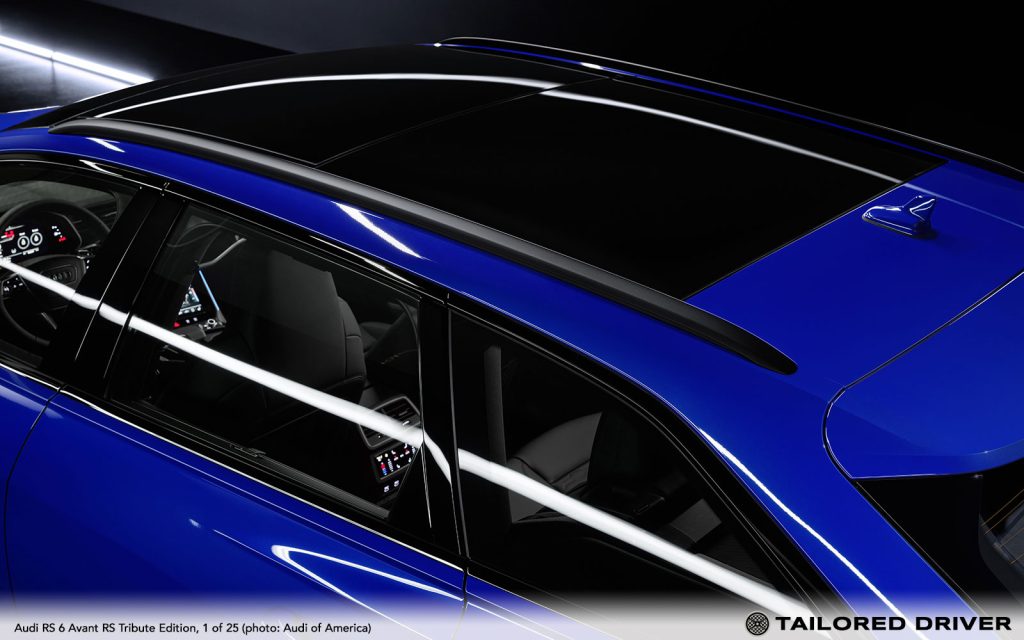
Nogaro Blue pearl effect exterior paint color with black optic accents on the grille, side blades, rear diffuser and black roof rails. The side mirrors are body color.
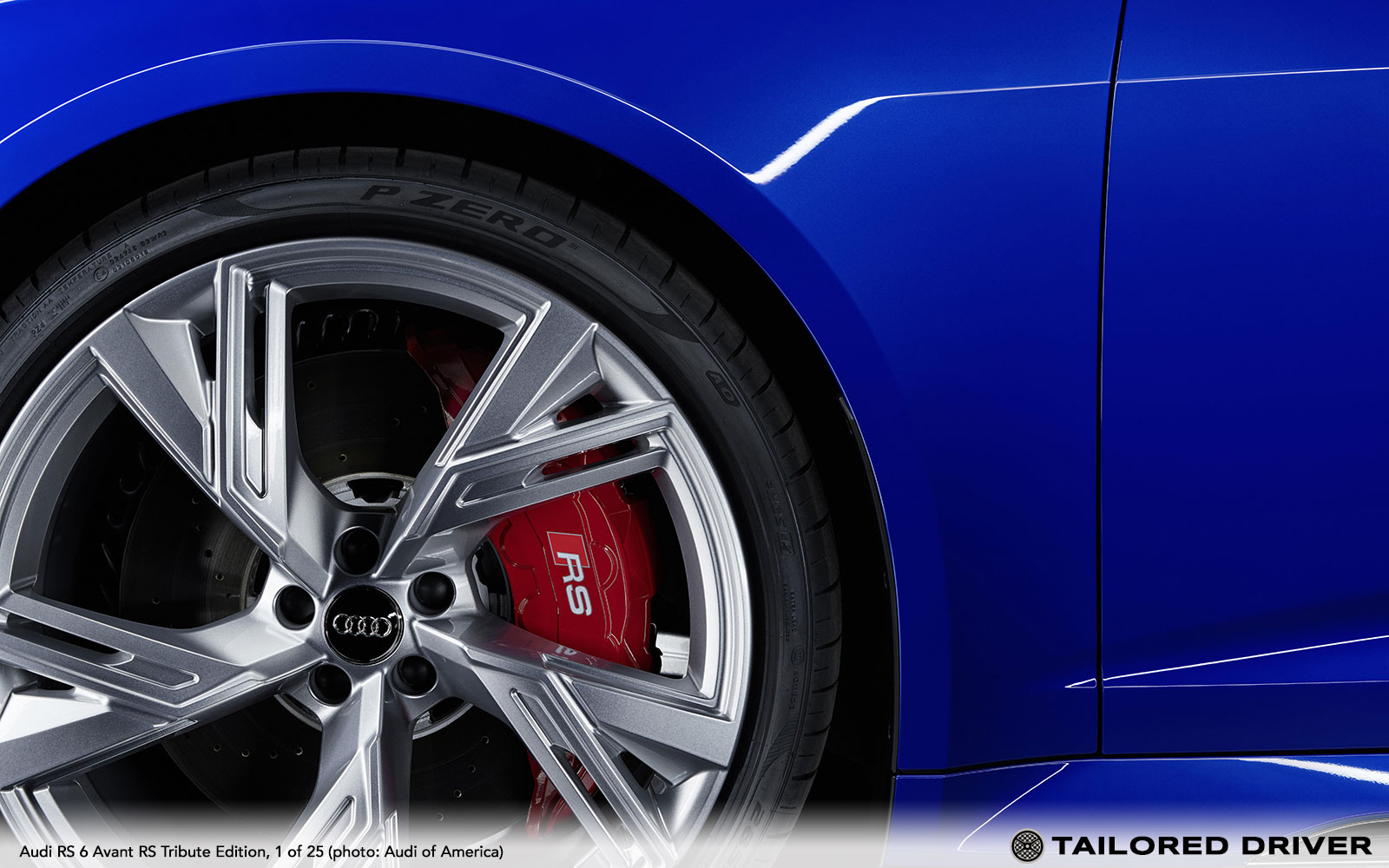
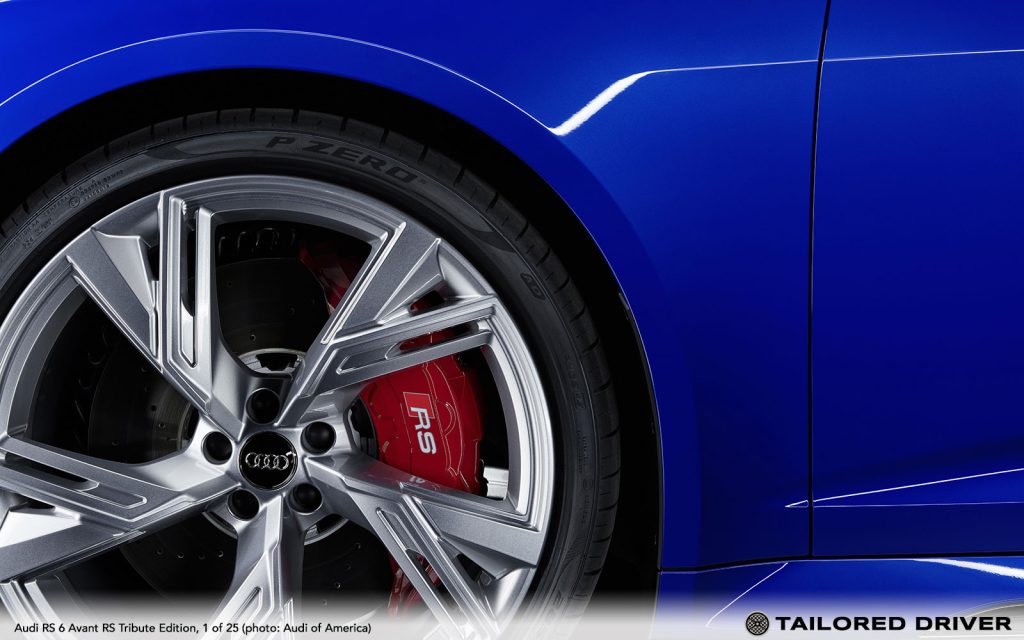
Standard 22-inch 5-V-spoke trapezoid design cast aluminum wheels in silver with summer tires.
The steel brake calipers are painted red.
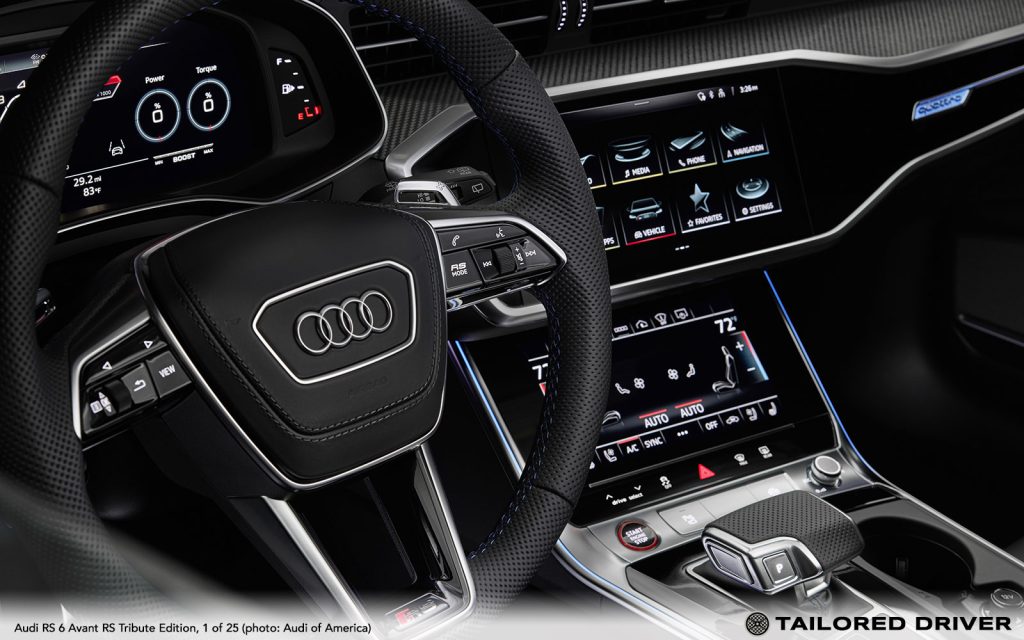
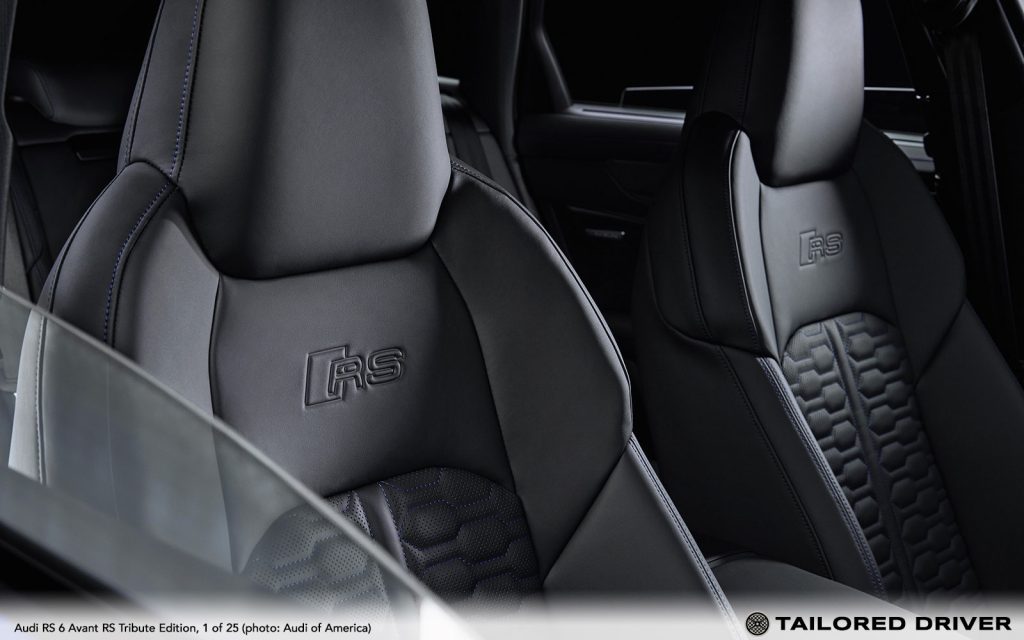
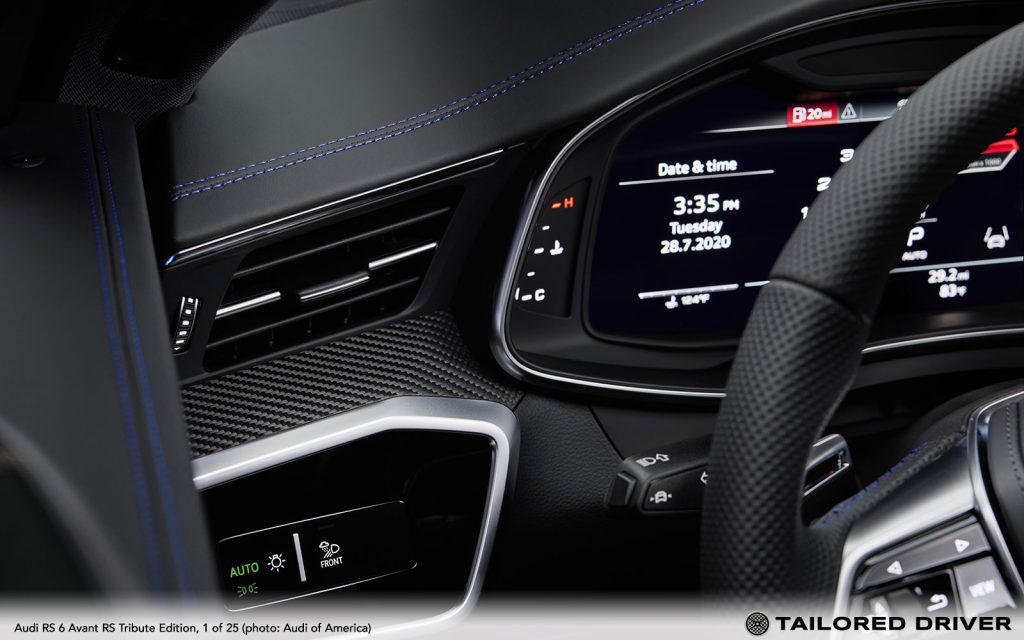
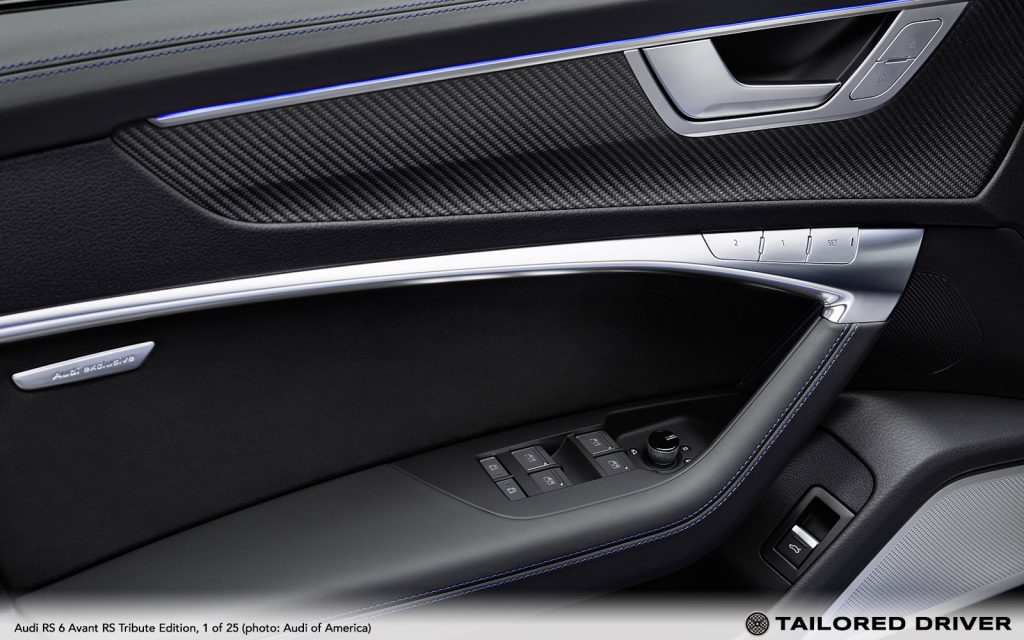
The interior features carbon twill structure inlays and Denim blue contrast stitching to accentuate the Audi exclusive Valcona S Sport seats, perforated steering wheel, RS floor mats and the leather elements along the upper and lower dashboard.
The front seats also include lower seat panels in leather with Denim blue contrast stitch.
Classic RS 6 Avant high-performance
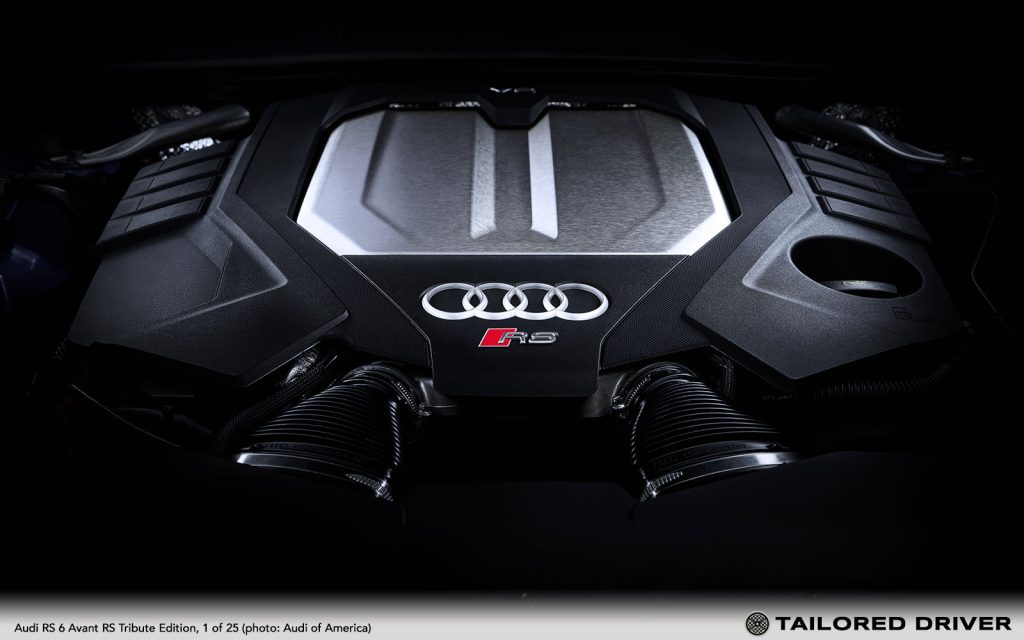
From design icon to driving machine, the RS 6 Avant features a 4.0-liter twin-turbo V8 engine capable of 591 horsepower and 590 lb-ft of torque that can send the Avant from 0-60 mph in just 3.5 seconds.
The 4.0-liter engine produces a full bodied and robust V8 sound, which the driver can adjust using the Audi drive select system. Each Tribute edition is standard equipped with a sport exhaust to further enhance the appearance, and emotion of the high-performance vehicle.
The RS Tribute edition also comes standard equipped with the Driver Assistance Package, which includes Audi adaptive cruise assist and Audi side assist, the Executive package, which includes heated rear seats, head-up display and power soft-closing doors and the Bang & Olufsen® 3D Advanced Sound System.
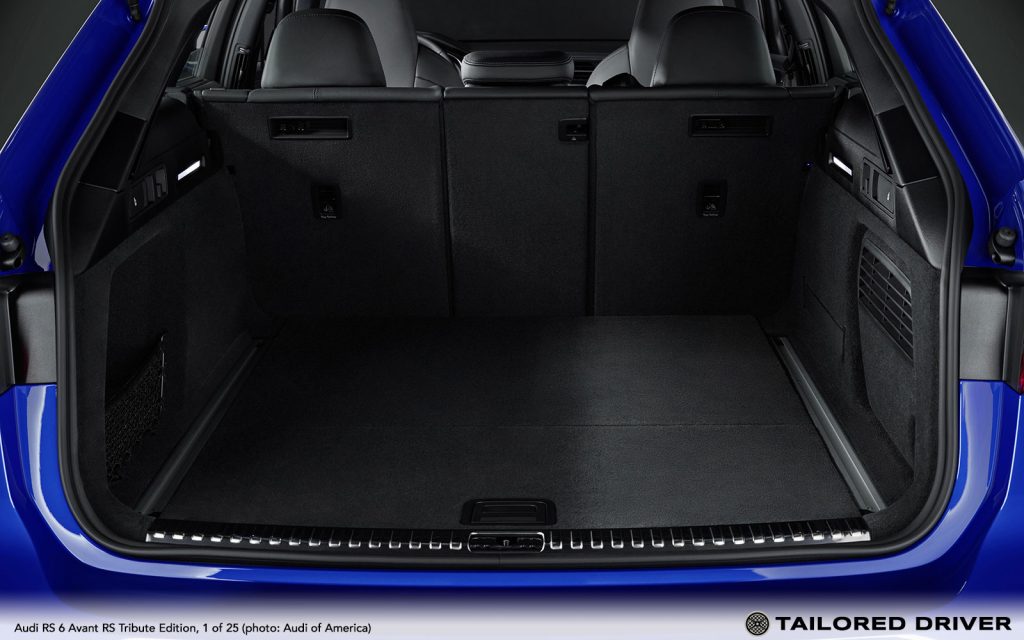
Once unobtainable in the U.S. market, the RS 6 Avant is now a reality for U.S. customers. The RS 6 Avant defies all expectations of what performance can be, while representing the next chapter in the successful history of Audi Sport. The high-performance wagon offers visceral design, exhilarating driving dynamics and everyday functionality for the driving enthusiast.
The 2021 RS 6 Avant “RS Tribute edition” is on sale now with an MSRP of $136,800.
ABOUT AUDI OF AMERICA
Audi of America, Inc. and its U.S. dealers offer a full line of German-engineered luxury vehicles. AUDI AG is among the most successful luxury automotive brands, delivering about 1.845 million vehicles globally in 2019. In the U.S., Audi of America sold just over 224,000 vehicles in 2019 and launched the brand’s first fully electric vehicle, the Audi e-tron – one of four fully electric models coming to the U.S. market in the next two years. Globally, the brand aims to be CO2 neutral by 2050. Visit audiusa.com or media.audiusa.com for more information regarding Audi vehicles and business topics.
This information and any vehicle specifications are preliminary and subject to change.
Features and technical data apply to models offered in the USA. They may differ in other countries.
Prices above exclude $1,045 destination charge, sales taxes, title, options, and dealer charges. Dealer sets actual price.
Always pay careful attention to the road, and do not drive while distracted.
Always obey local speed and traffic laws
Top track speed electronically limited in U.S. Always obey all speed and traffic laws.
Summer Performance tires may ride less comfortably, make more noise, and wear more quickly than other choices. To avoid tire, rim, or vehicle damage, it is important that inflation pressure is regularly checked and maintained at optimum levels. High-performance tires are designed for optimum performance and handling in warm climates and are not suitable for cold, snowy, or icy weather conditions. When driving during cold, snowy, or icy weather conditions, ensure that your vehicle is equipped with appropriate all-season or winter weather tires. Tires are supplied and warranted by their manufacturer.
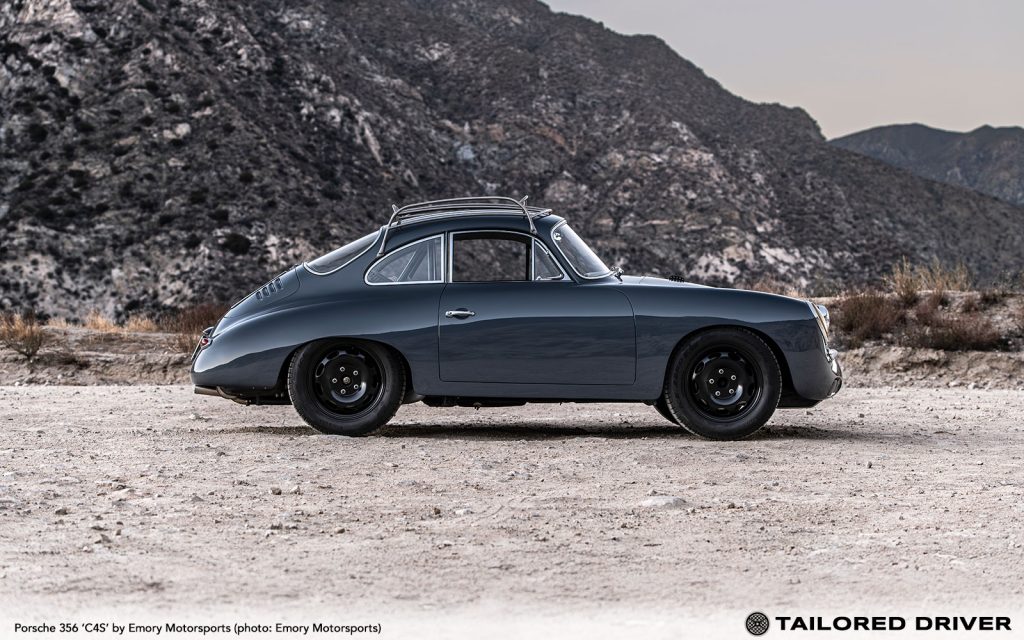
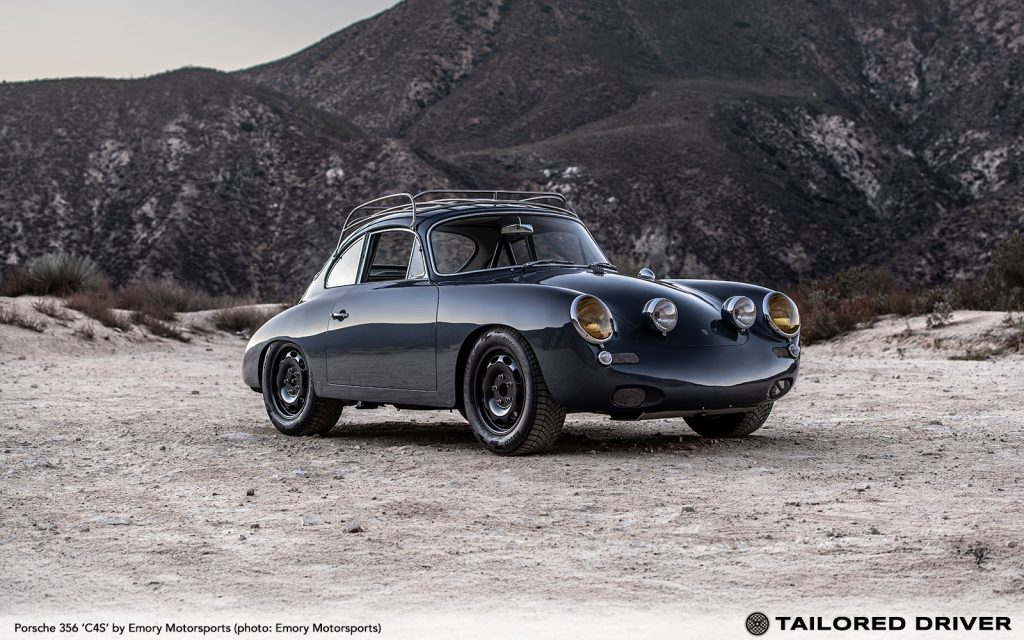
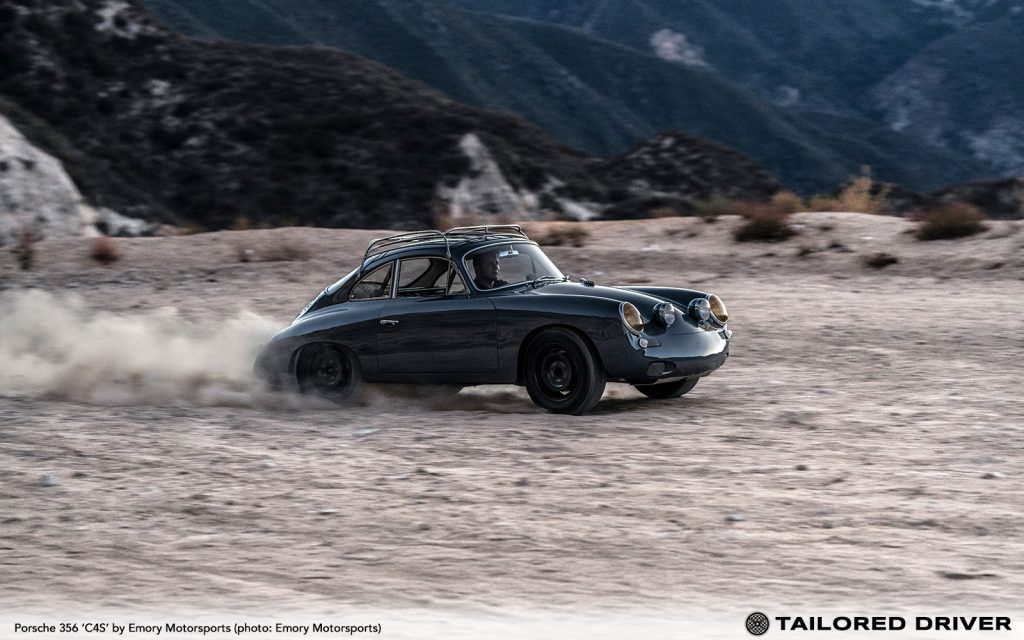
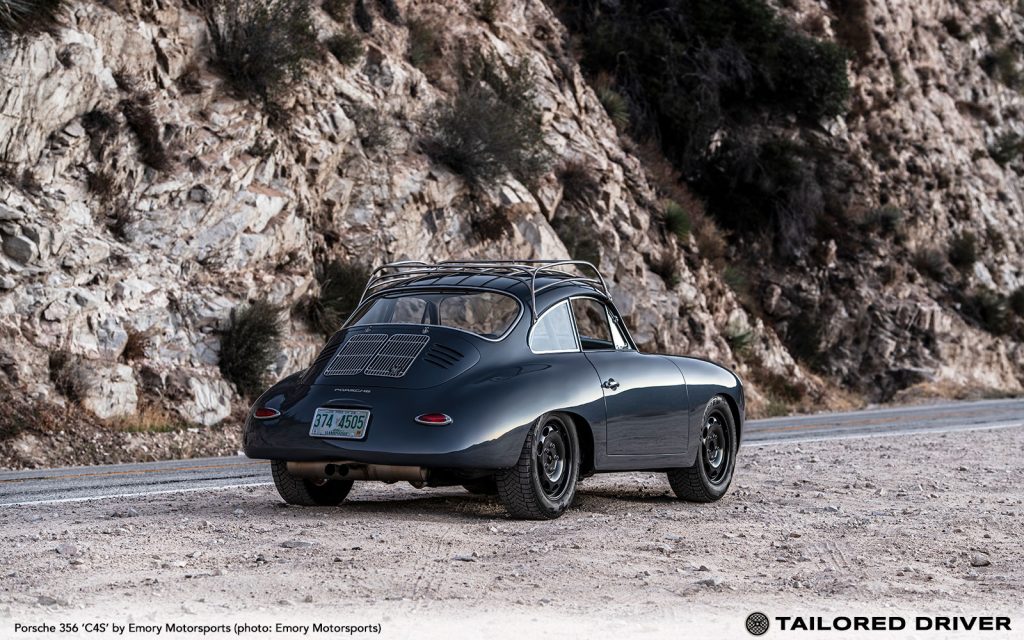
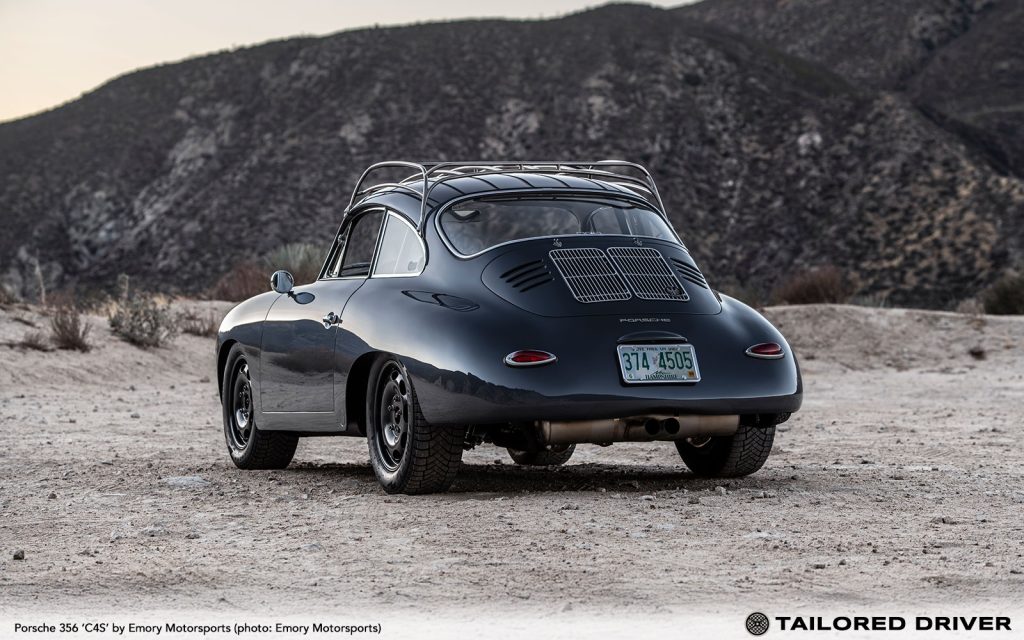
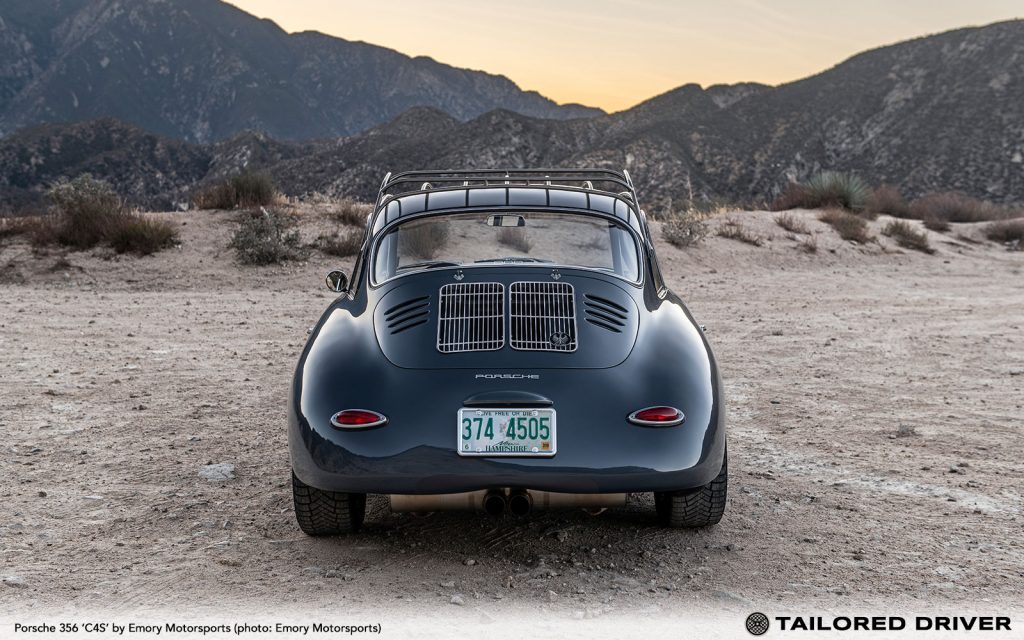
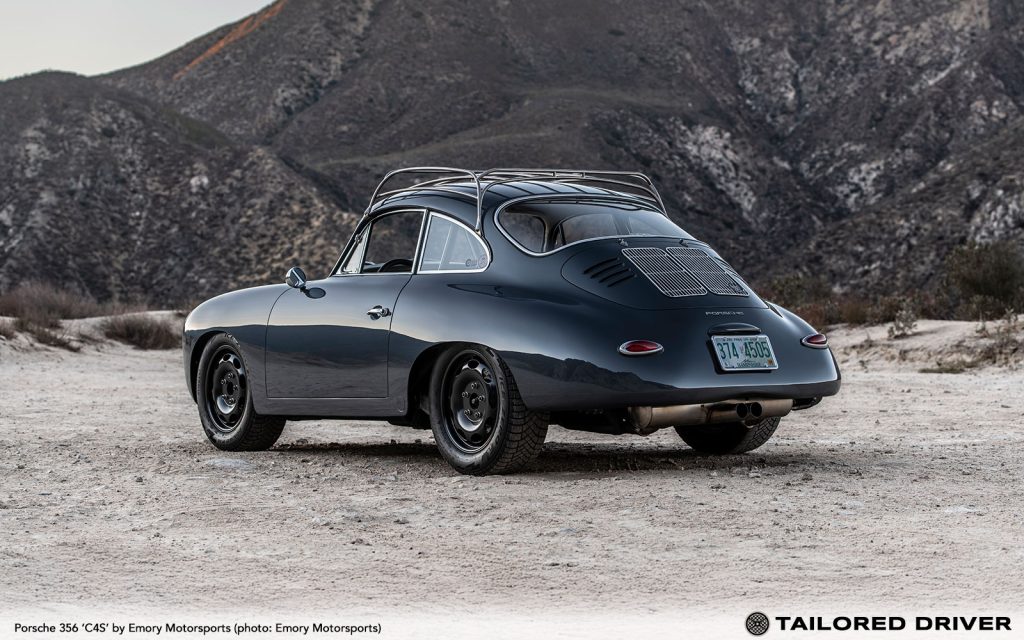
Dubbed the ‘AllRad,’ the Newest Emory Outlaw Pairs a 356 Coupe Body with a 911 All-Wheel Drivetrain to Create Most Capable 356 Ever Made
[source: Emory Motorsports]
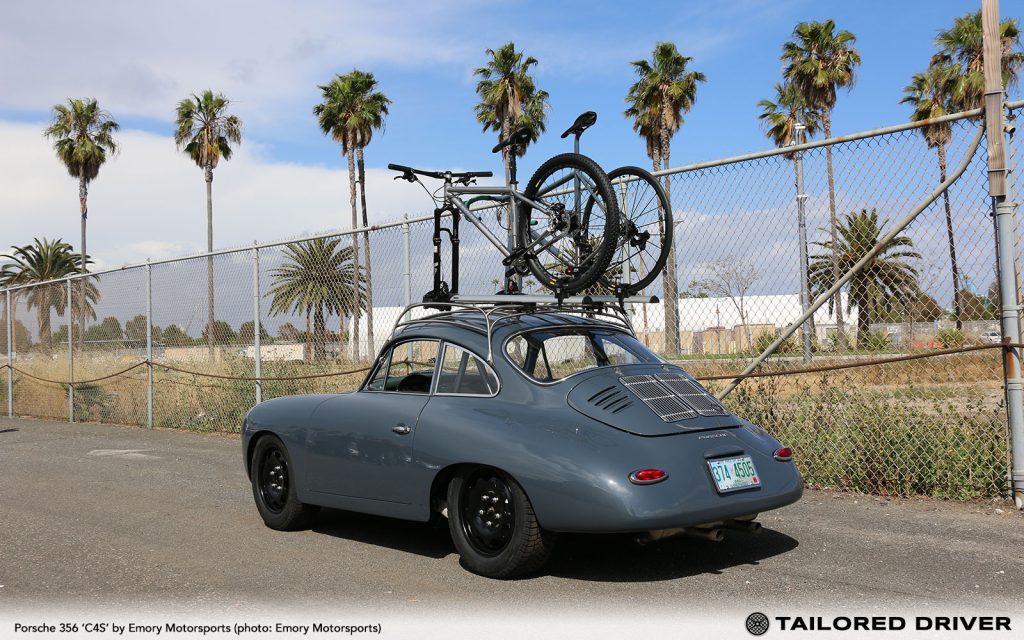
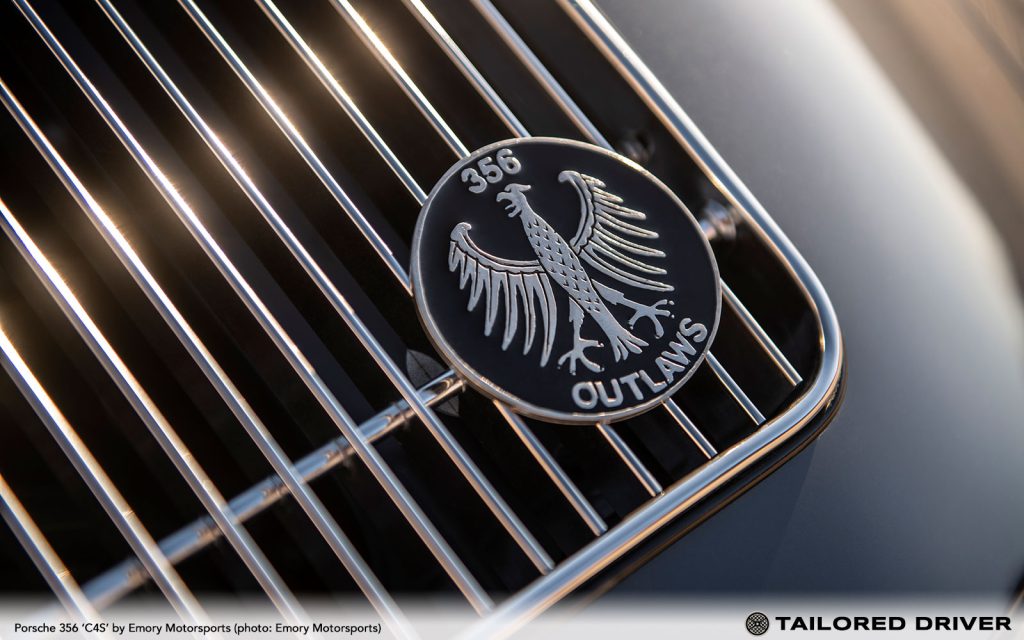
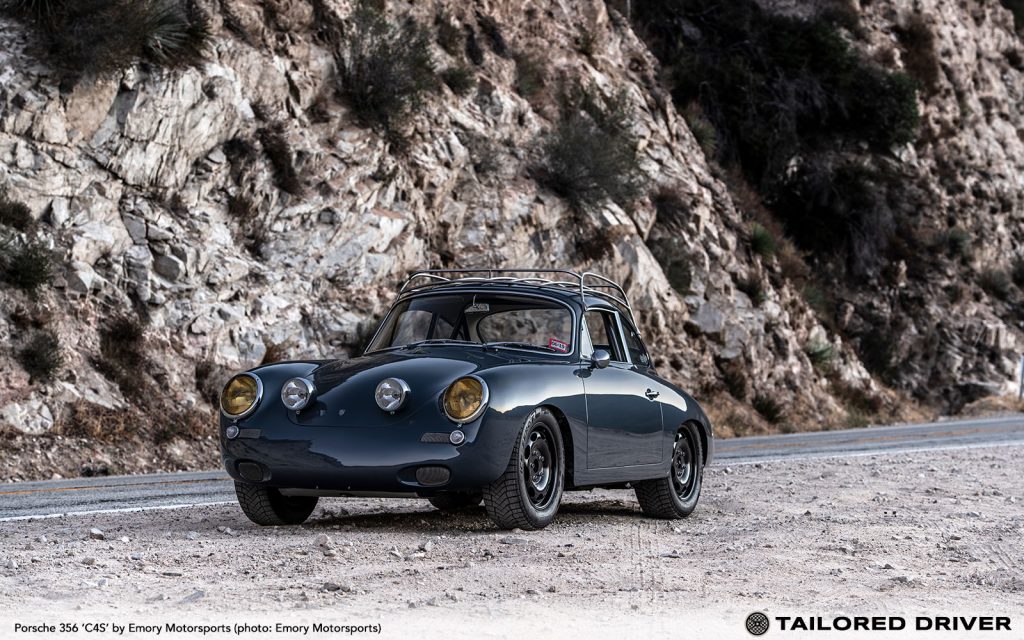
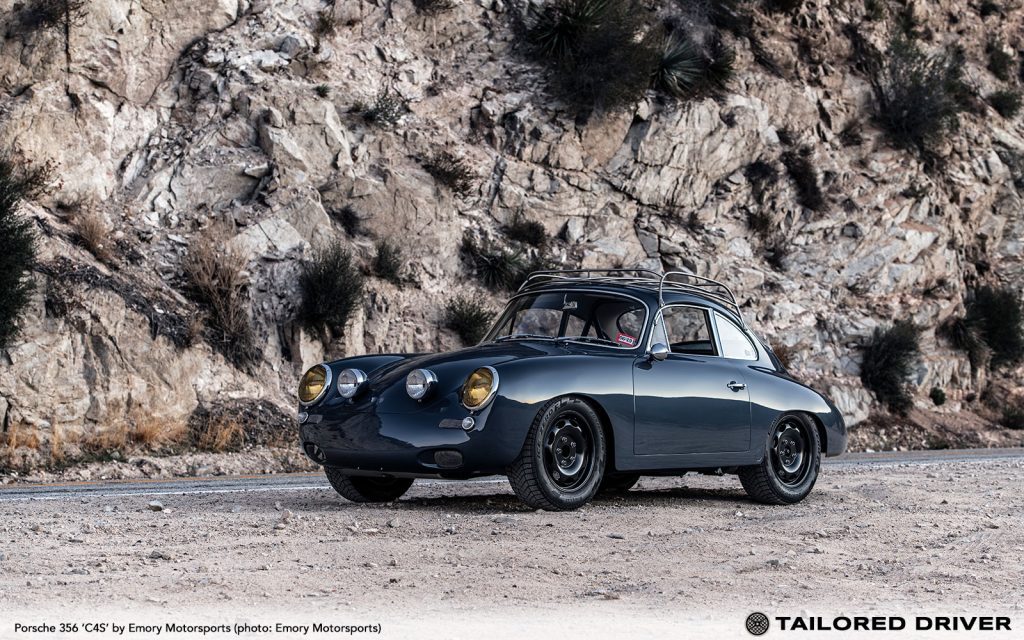
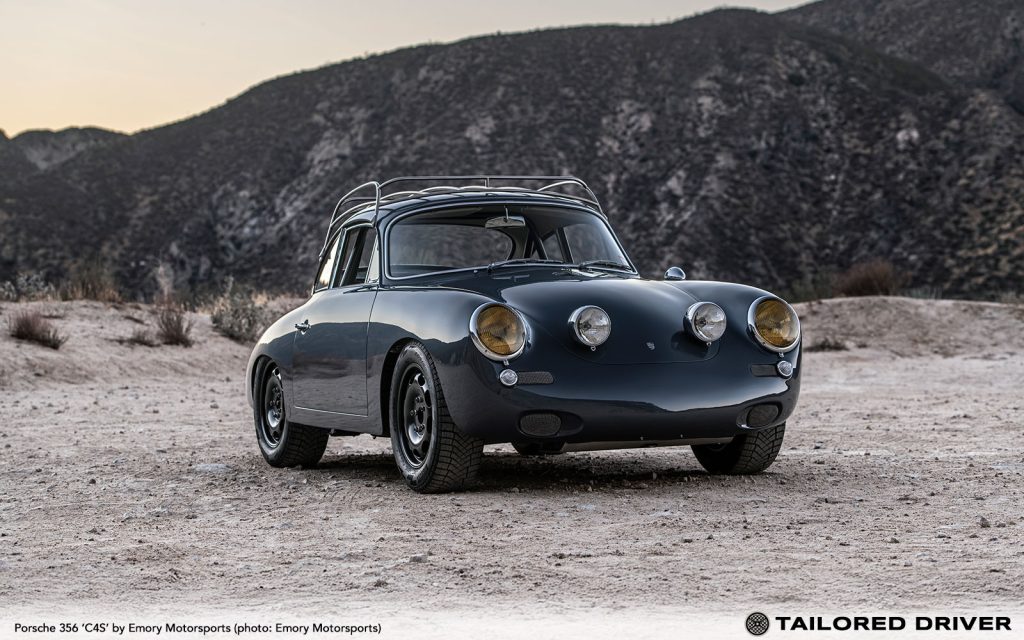
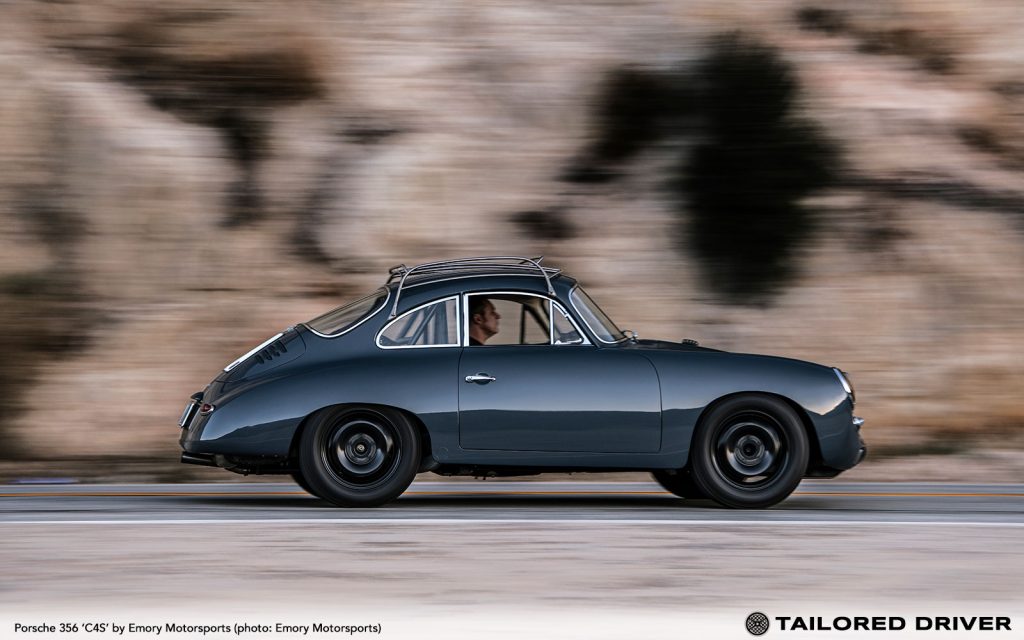
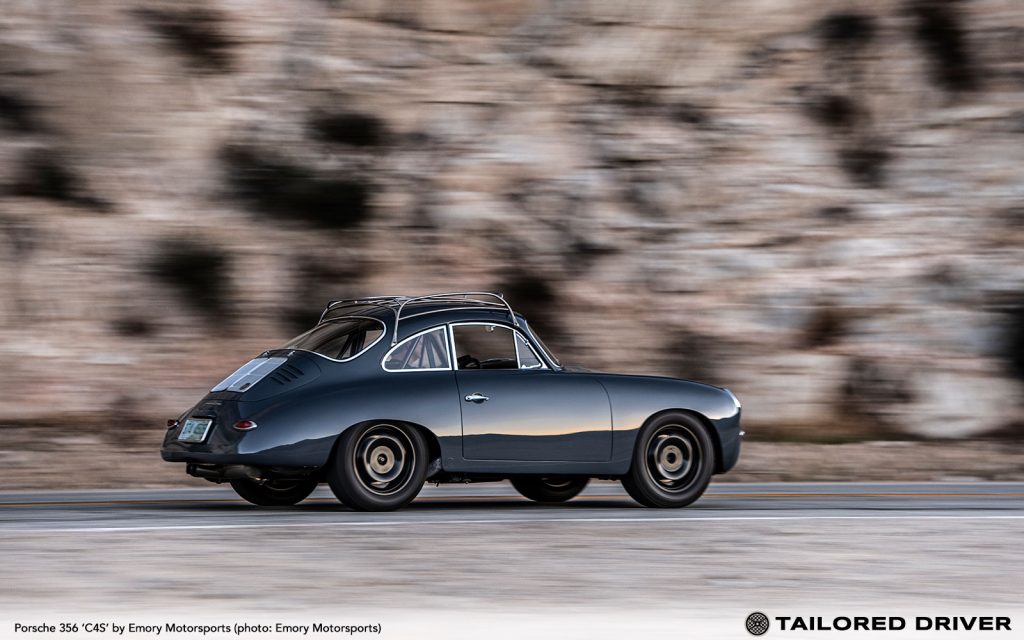
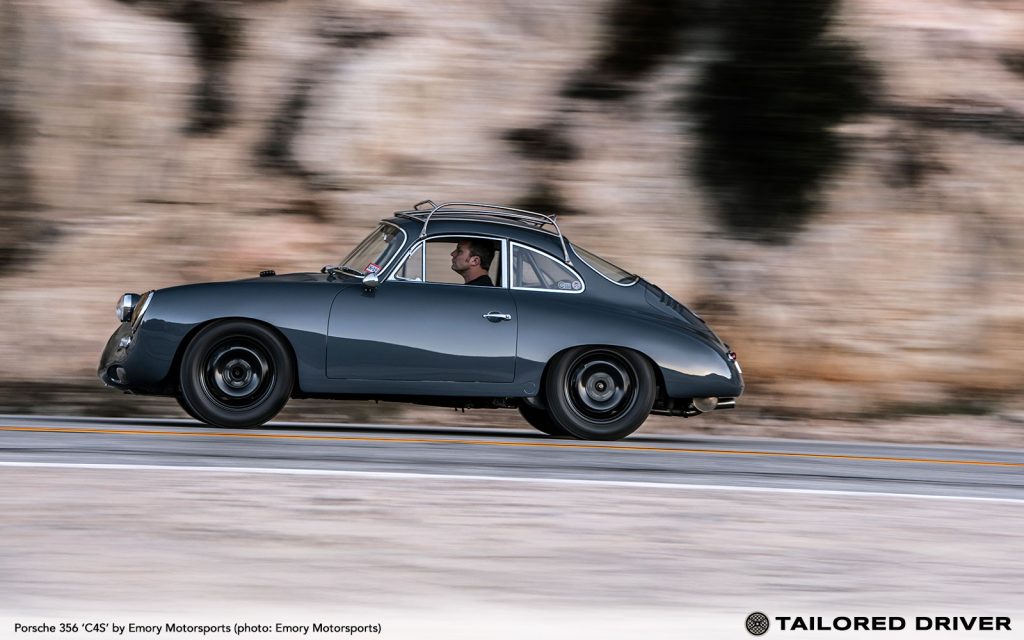
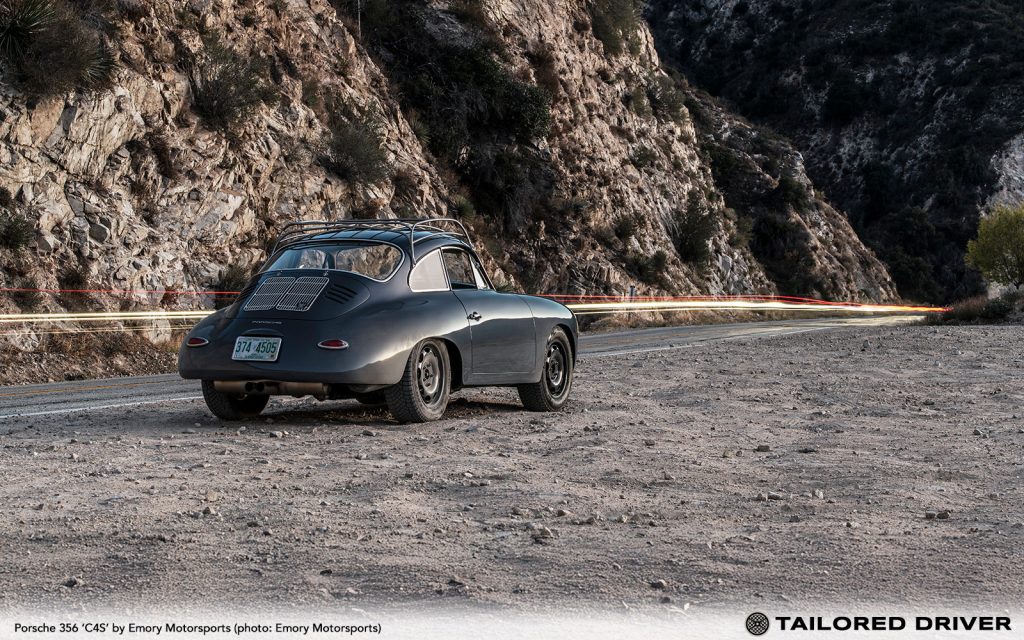
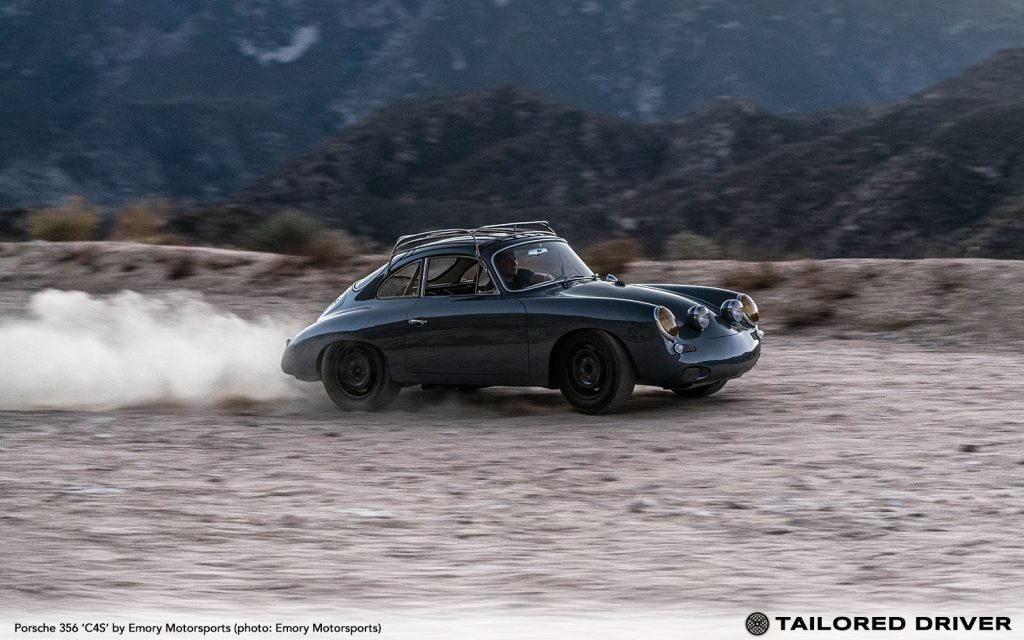
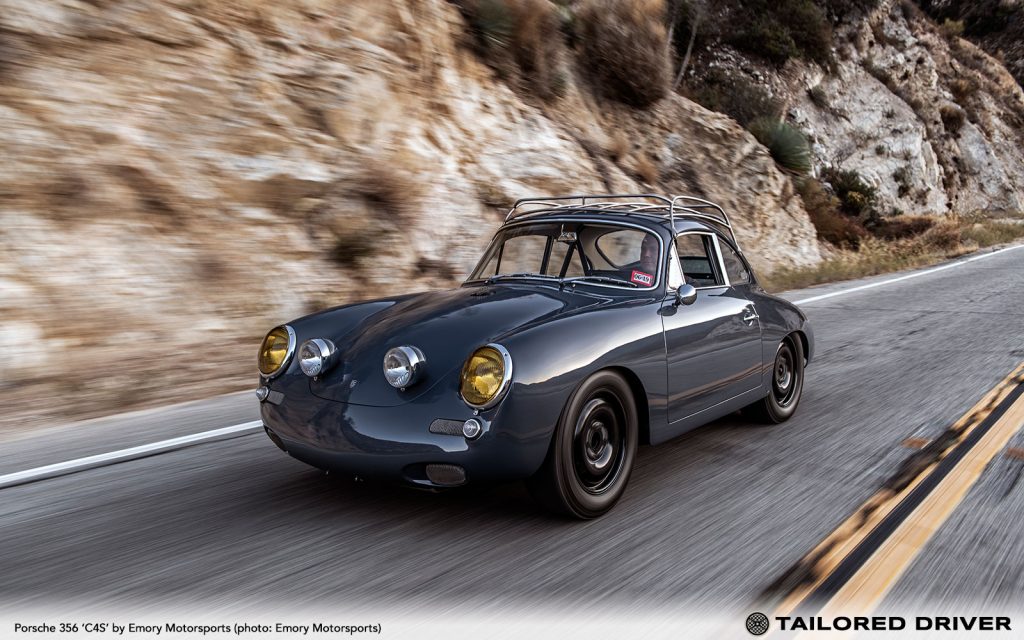
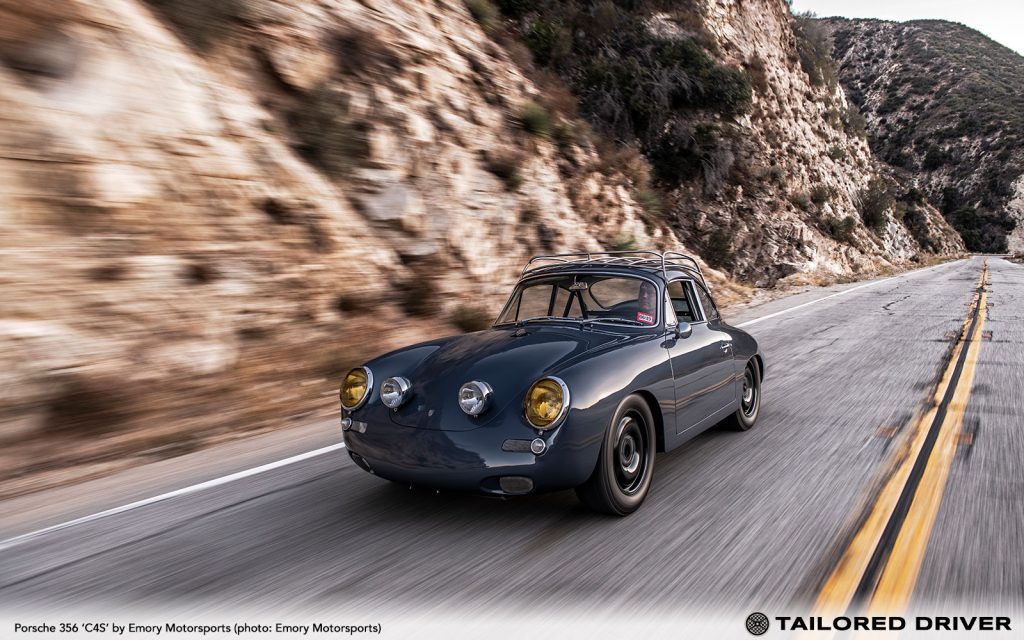
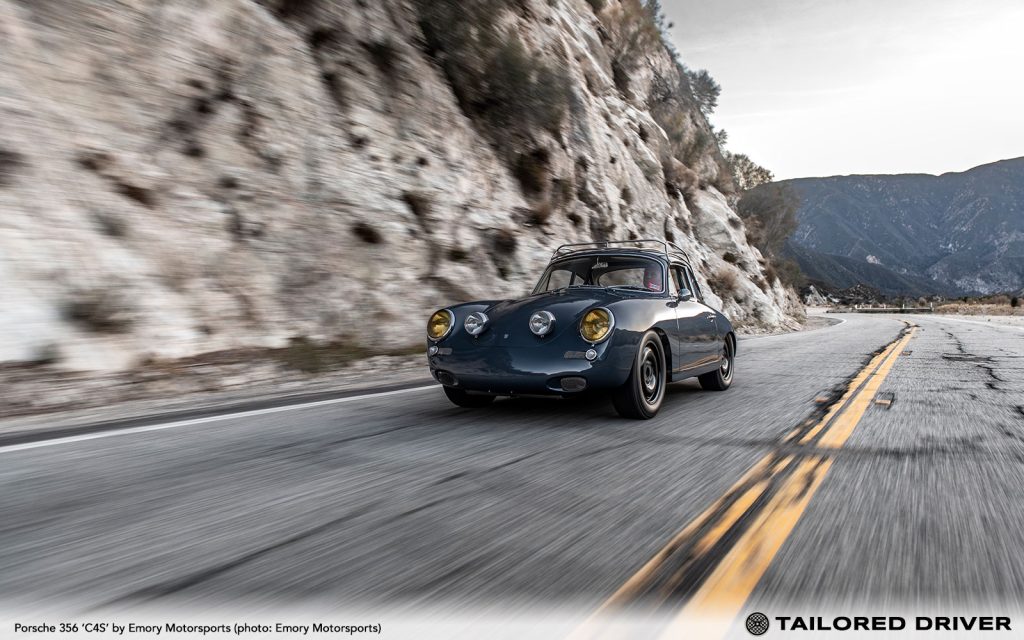
NORTH HOLLYWOOD, CA — Recognized for building iconic 356 Outlaws® for the last three decades, the Emory family’s automotive legacy began in 1948 when Rod Emory’s grandfather, Neil Emory, founded Valley Custom Shop in Burbank, CA. Located just a few miles from where Emory Motorsports currently creates its stunning Porsche creations, Neil earned a reputation for sleek, stately, European-esque channeled and sectioned coachwork on the American cars of the day. It’s in that same refined spirit that Emory Motorsports presents the effortlessly cool 356 C4S, a stout AWD build with a novel mix of 356 and 911 technology. The result is a truly one-of-a-kind ride, pairing 911 performance with the quintessential 356 Emory Motorsports aesthetic.
“Our build philosophy has always been to bring the best of certain eras together in our cars,” comments Emory Motorsports Co-Founder Rod Emory. “The Emory 356 C4S is really the first ‘RS’ that we’ve built, while being the world’s first AWD 356. Our goal was to create a special Porsche that never existed, but should have. The end result is that the 356 C4S really presents the highest performance level possible in a 356. The car’s owner was so pleased with the car he calls it his ‘AllRad 356.’”
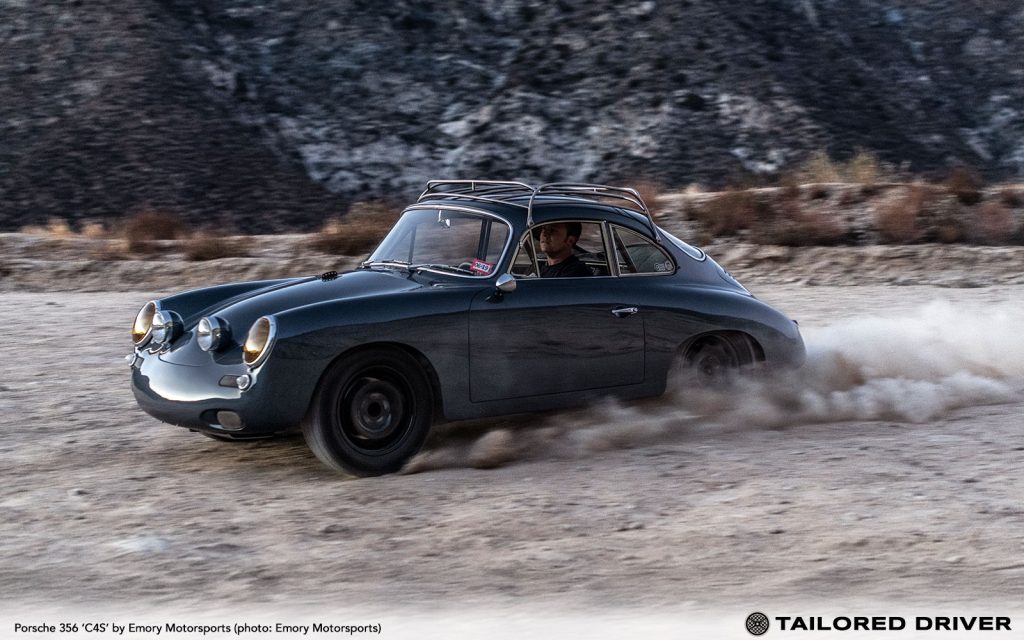
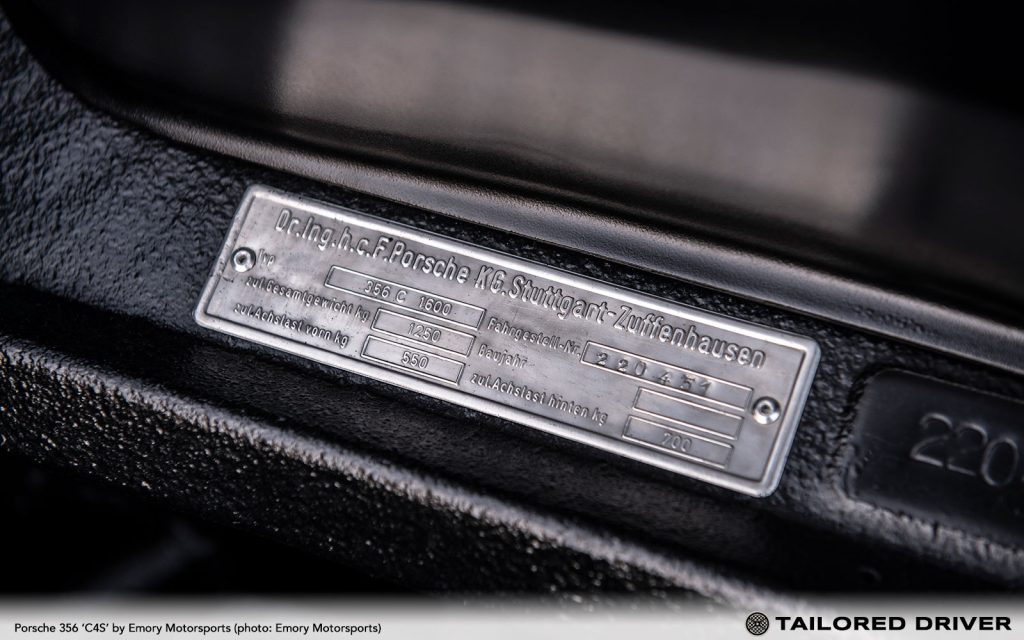
Commissioned by a discerning client who wanted to drive the Emory 356 C4S to East Coast ski areas in the winter, the decision was made to artfully combine a 1964 Porsche 356C body with an all-wheel-drive 1990 911 (964) C4 chassis. The meticulous four-year build began by laser-scanning the 1964 body and the 1990 chassis. Points of intersection were analyzed in the CAD environment with decisions about how to marry the two made in the virtual and real-world spaces.
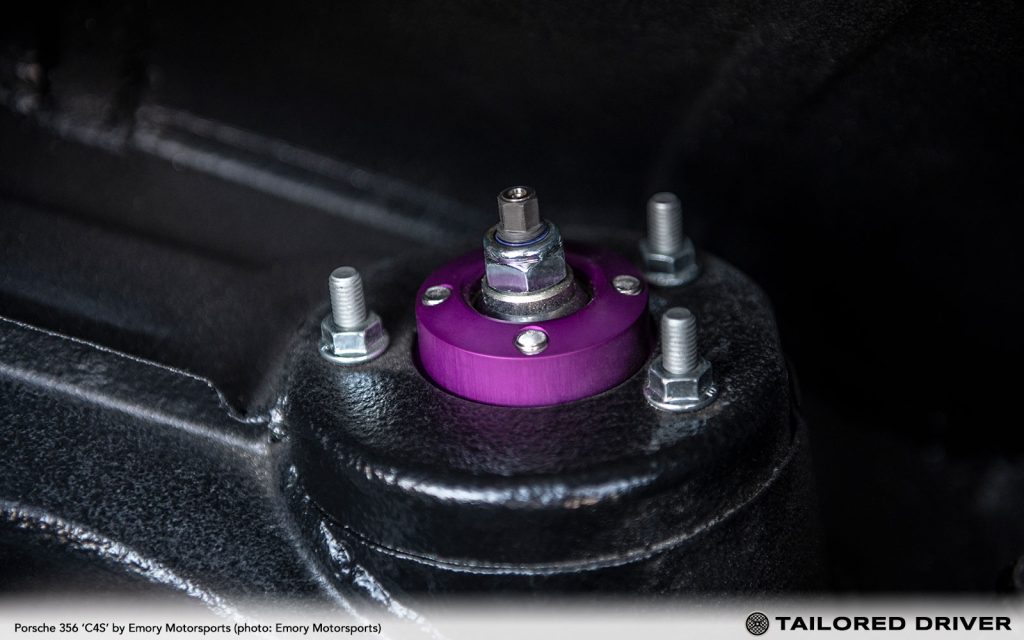
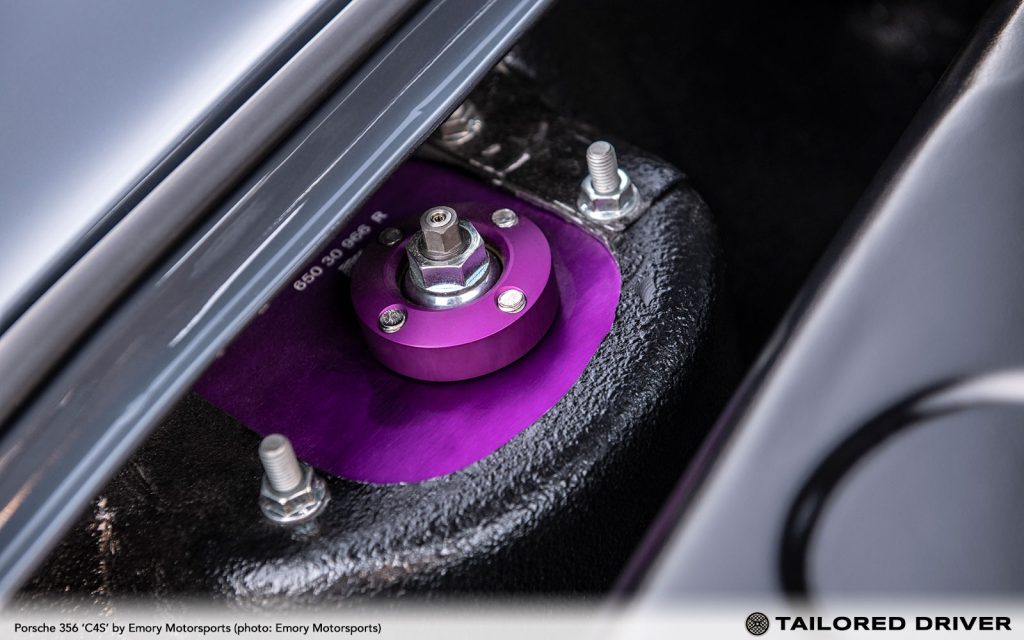
Emory Motorsports’ goal was to retain all of the original suspension pick-up points from the 911, but two challenges existed: the differences in wheelbase and rear track from the two Porsche platforms separated by 26 years. The decision was made to retain the 356’s wheelbase, which required shortening the 911’s center tunnel. The 356’s steel body was then subtly widened to match the 911’s rear track. Adjustable KW coil-over shocks mate perfectly to the 911’s architecture and provide optimal ride quality and control.
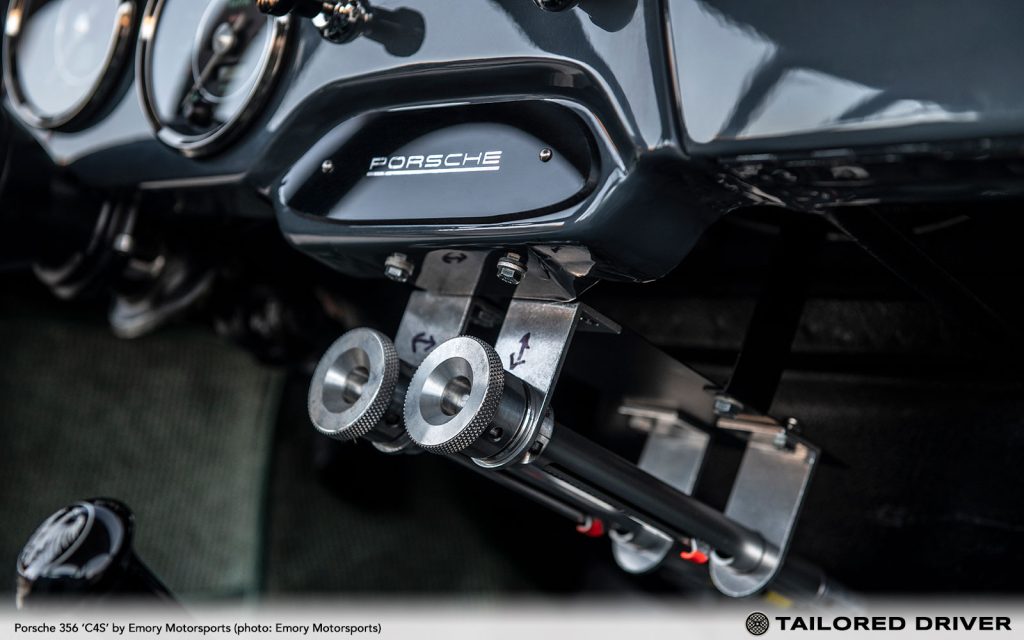
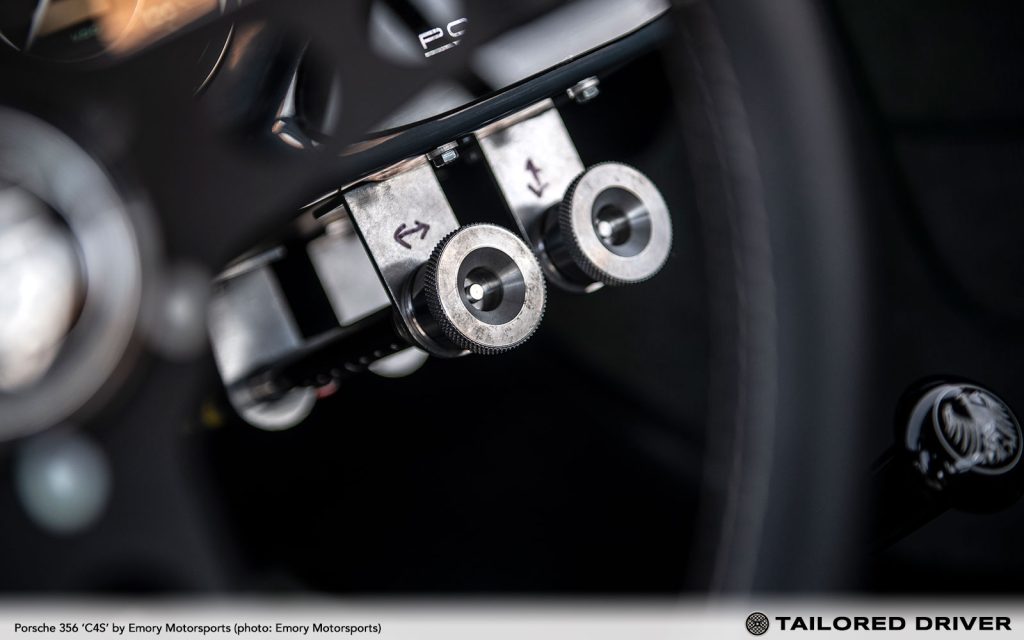
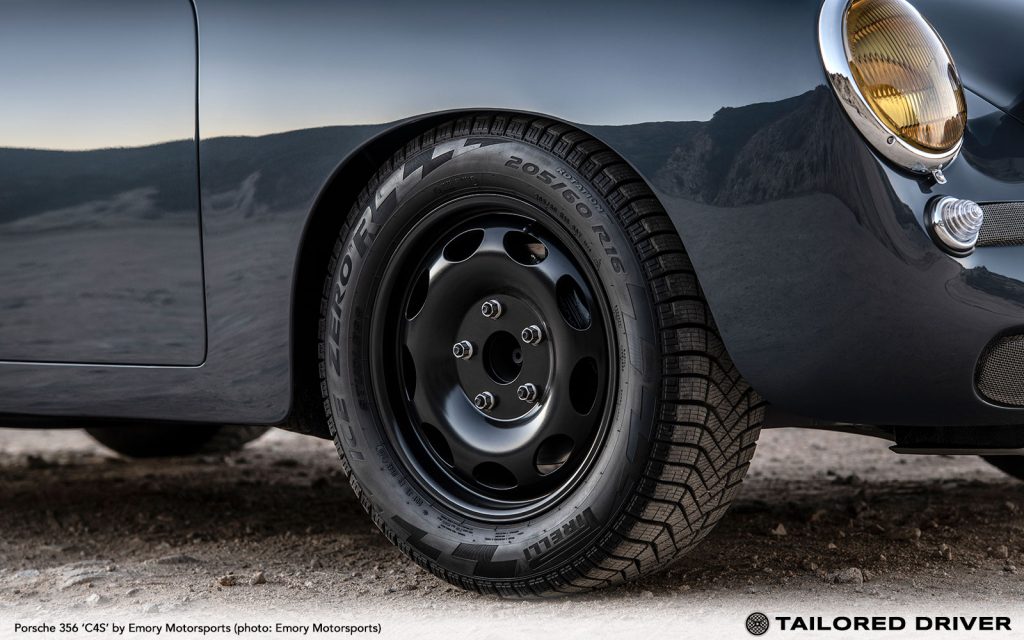
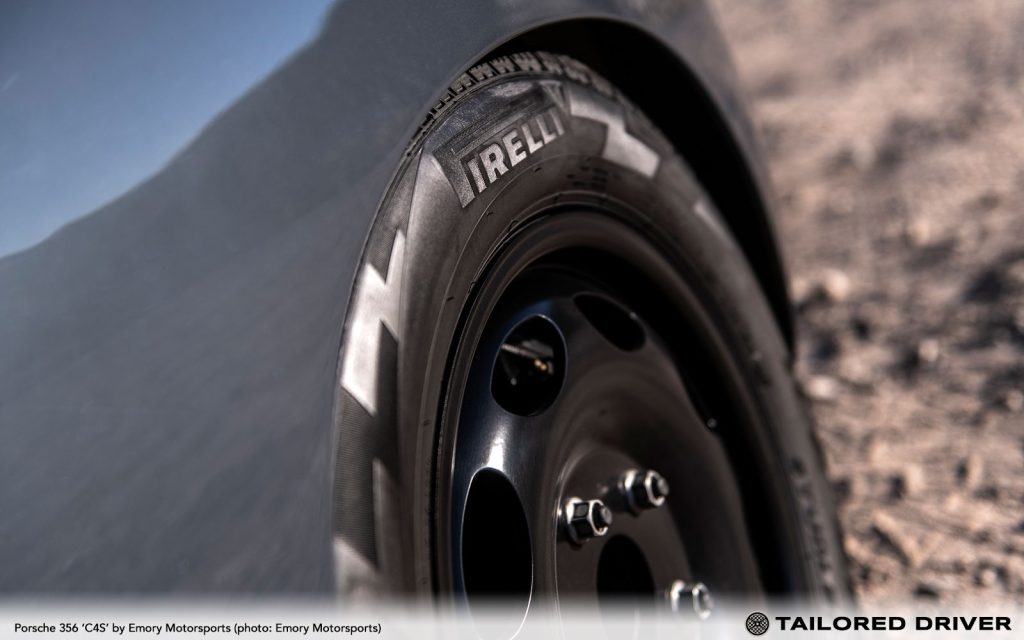
For the powertrain, Emory Motorsports retained the C4’s G64 5-speed AWD manual gear box. The driveline now incorporates a rally-style differential bias with independent front-to-rear and side-to-side manual torque control. The disc brakes are standard 964-issue with plenty of stopping power. The custom 16×7 black powder-coated wheels are pure Emory Motorsports ingenuity, inspired by wheel designs from different eras.205/60R16 Pirelli Ice Zeros give superior all-weather grip.
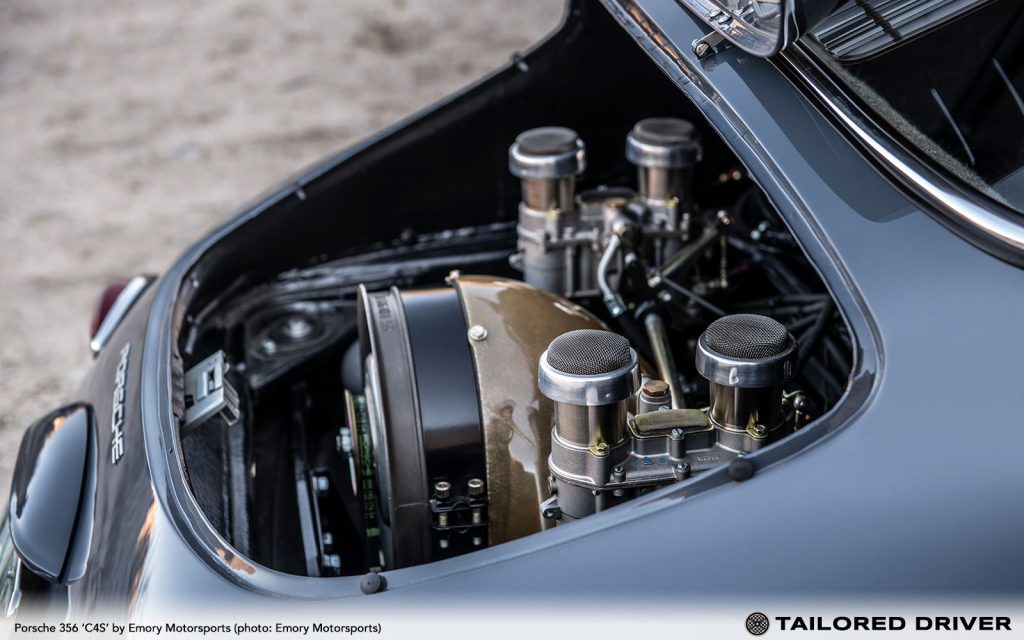
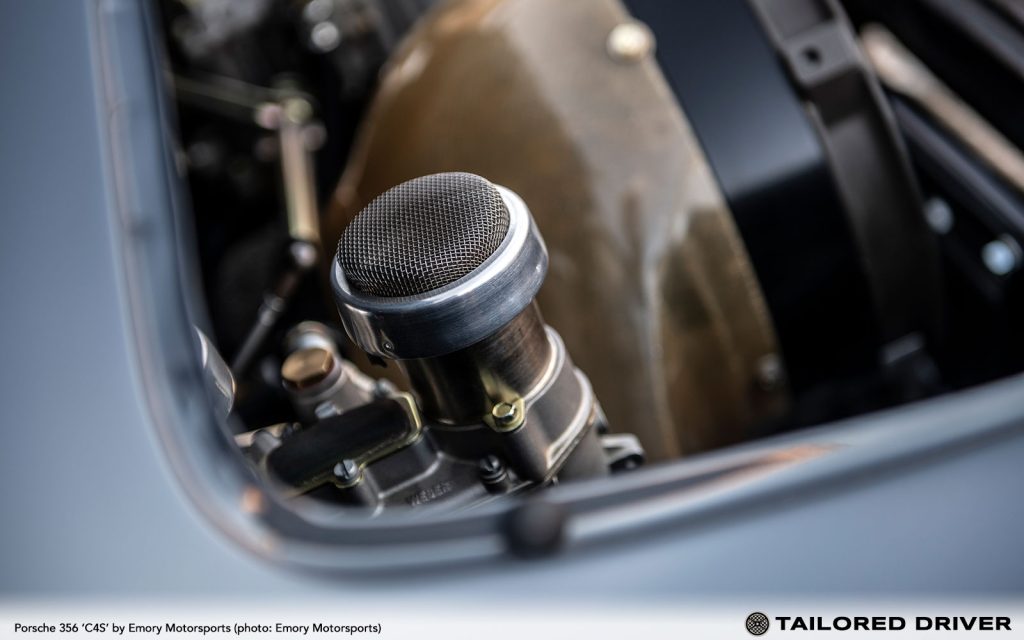
The 356 C4S is powered by the proprietary Emory-Rothsport “Outlaw-4” engine. Rod Emory and renowned engine builder Jeff Gamroth of Rothsport Racing collaborated over the better part of a decade to create an original four-cylinder cast-aluminum block, based on a dry-sump engine design. The new engine incorporates the best features of three distinct iterations of the 911 powerplant. Custom billet cam housings, camshafts, and crankshafts are designed to work with OE Porsche engine components.
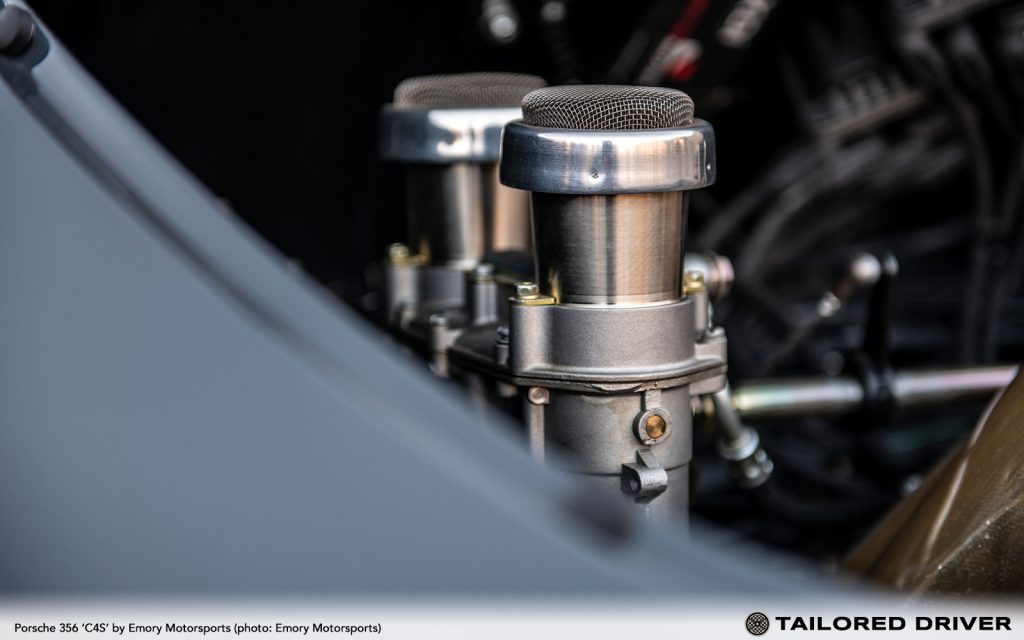
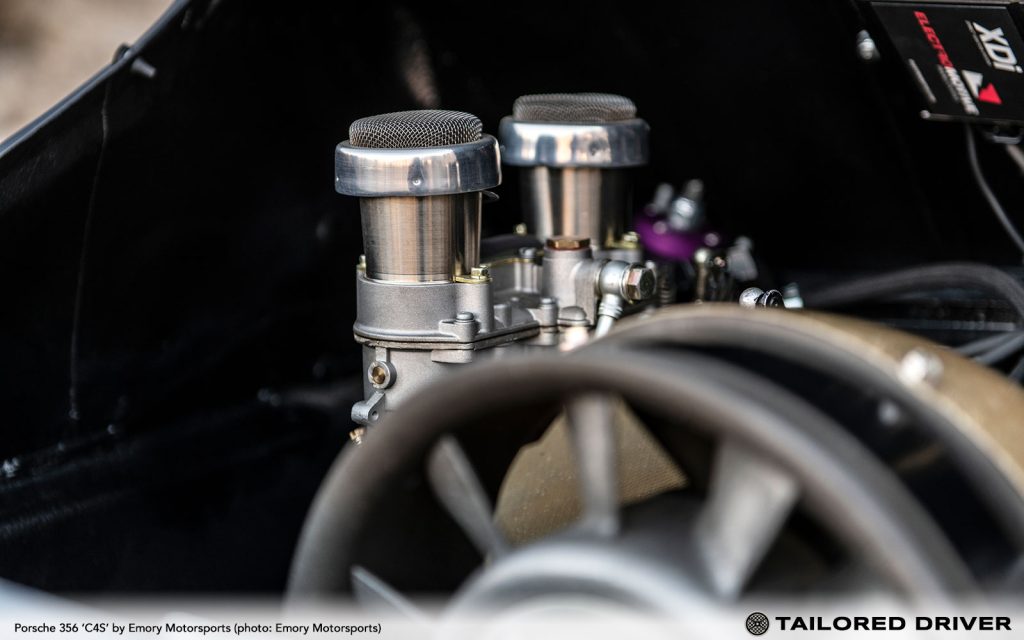
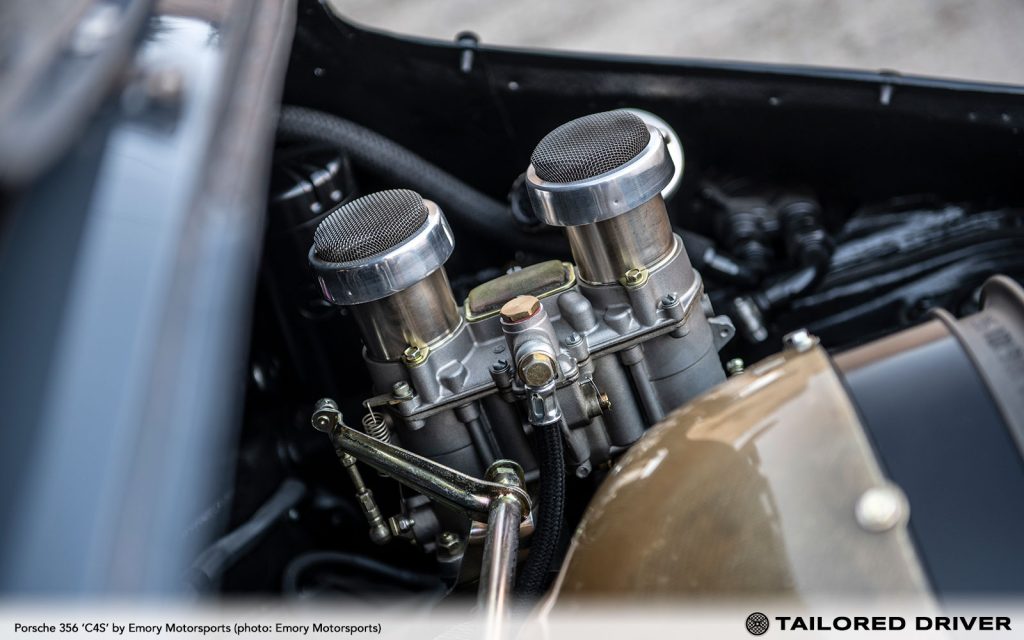
Dual Weber 48 IDA carburetors feed this twin-plug engine, rated at 200 horsepower. This 2.4-liter Outlaw-4 employs a crank-fire ignition, and full-flow lubrication with remote filter and cooler. Exhaust flows through custom headers and a stainless-steel muffler.
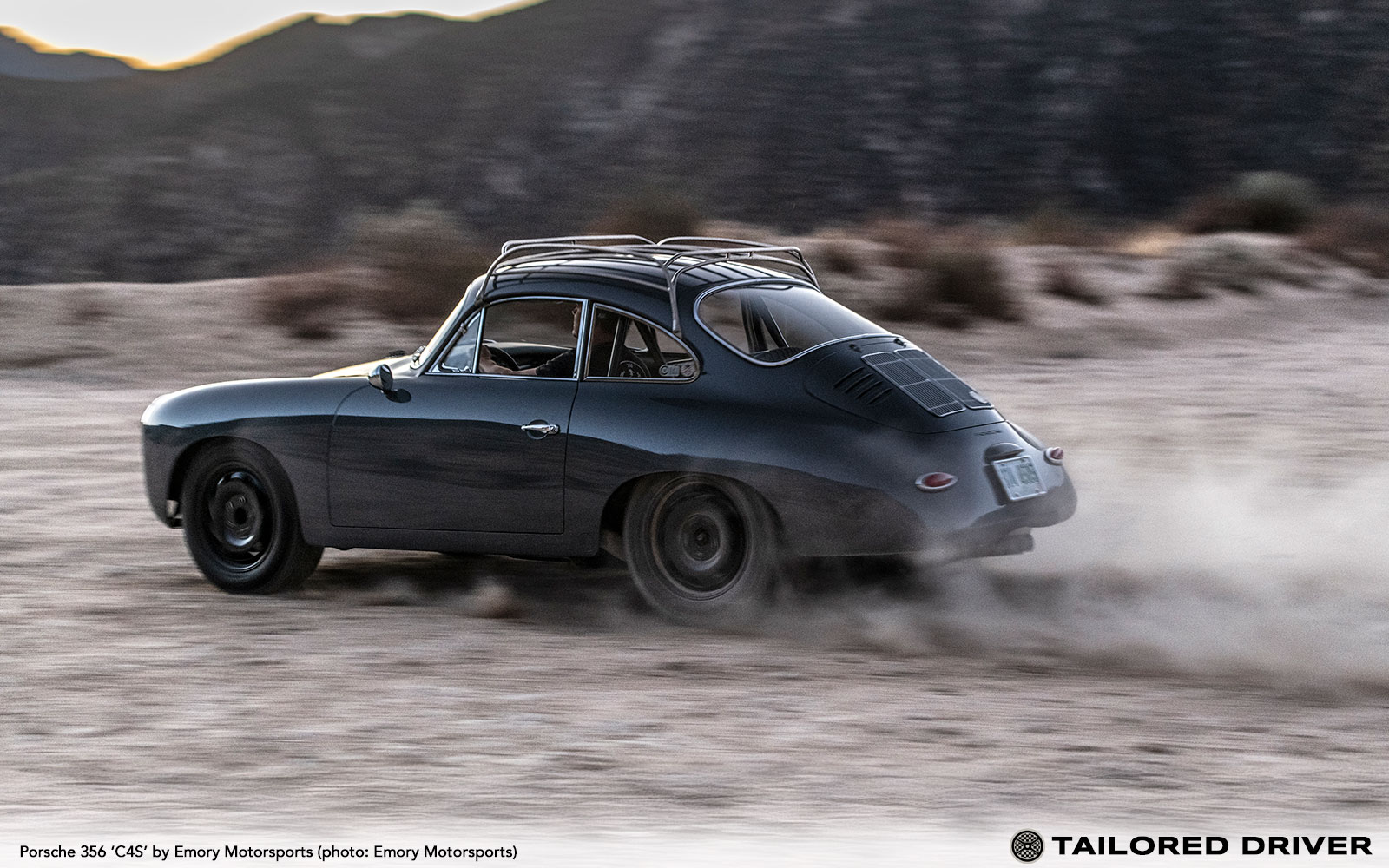
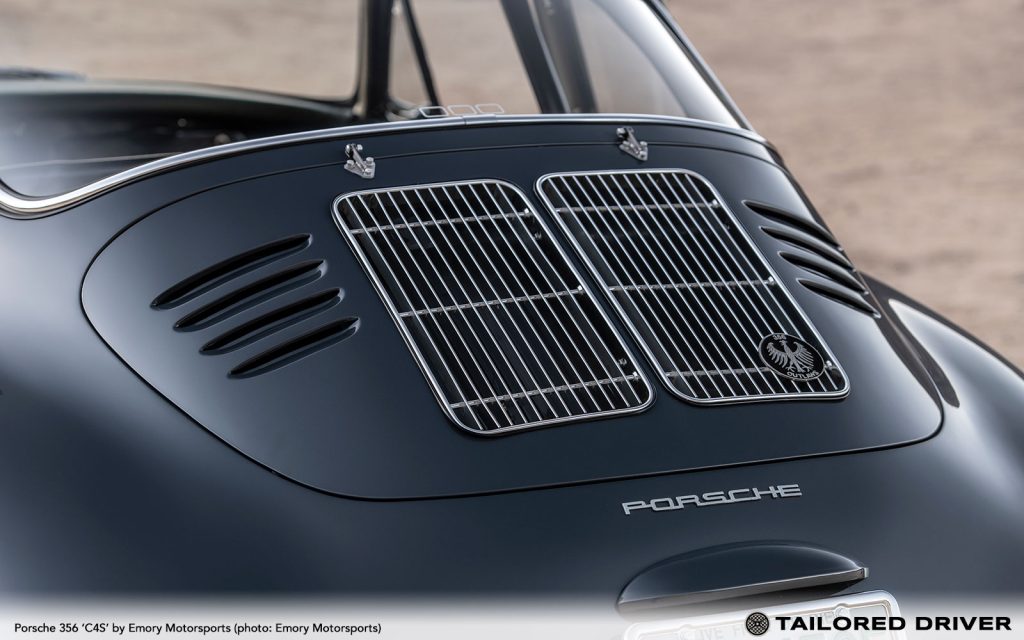
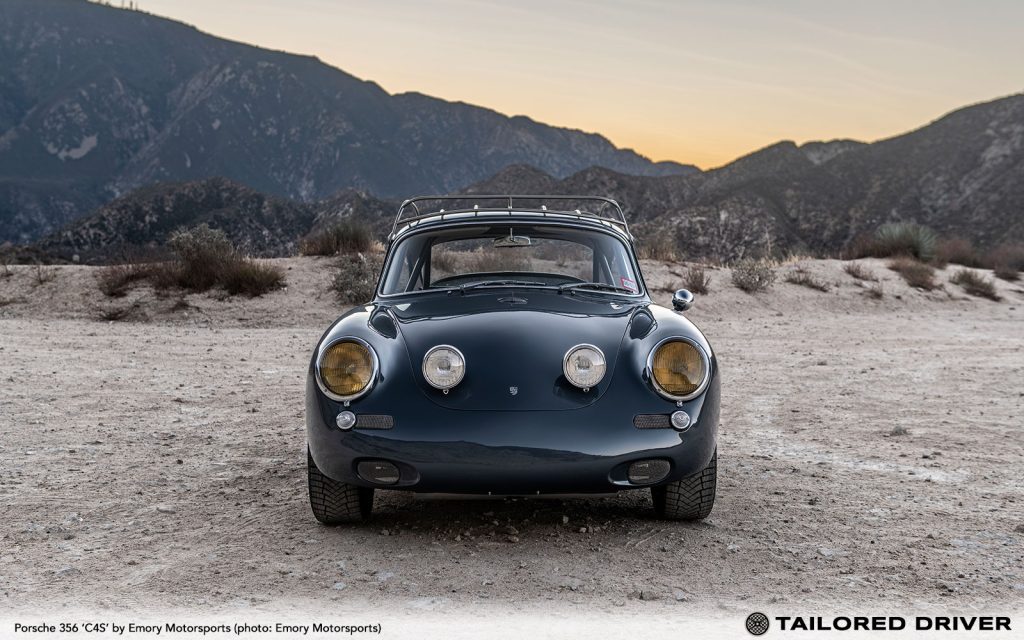
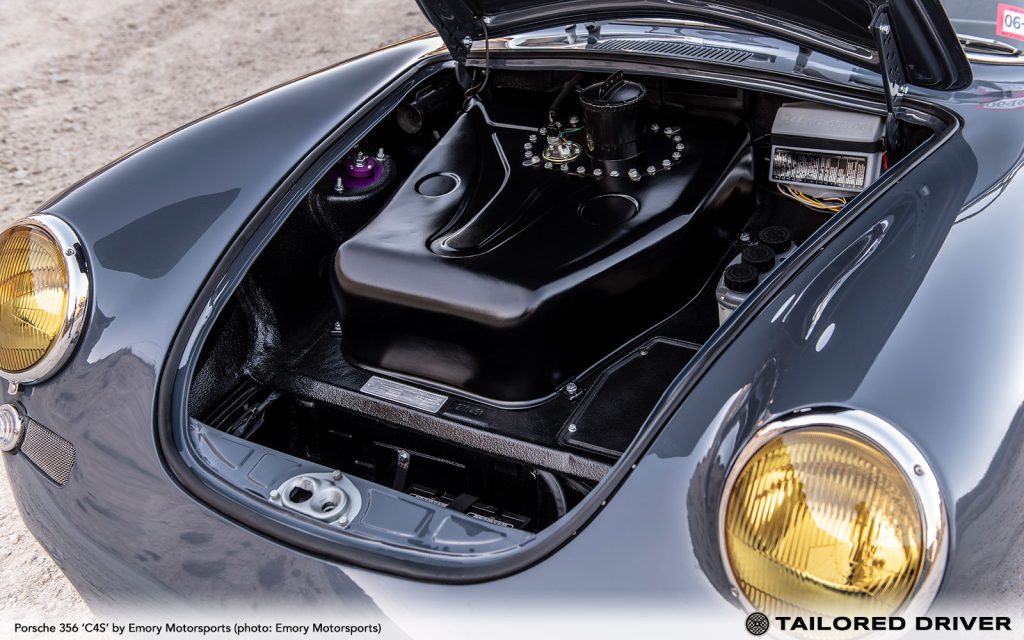
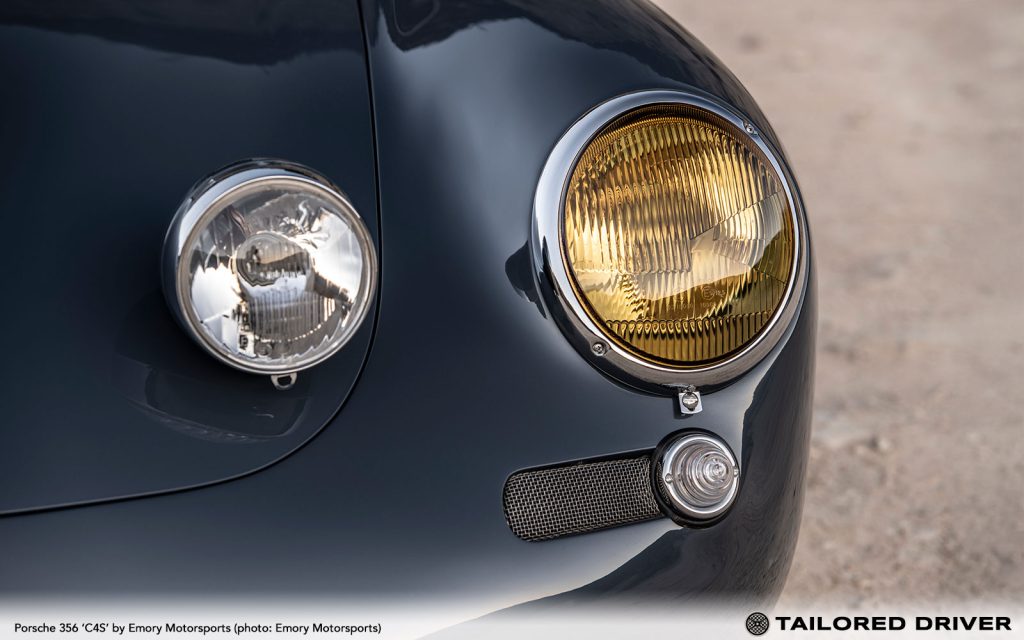
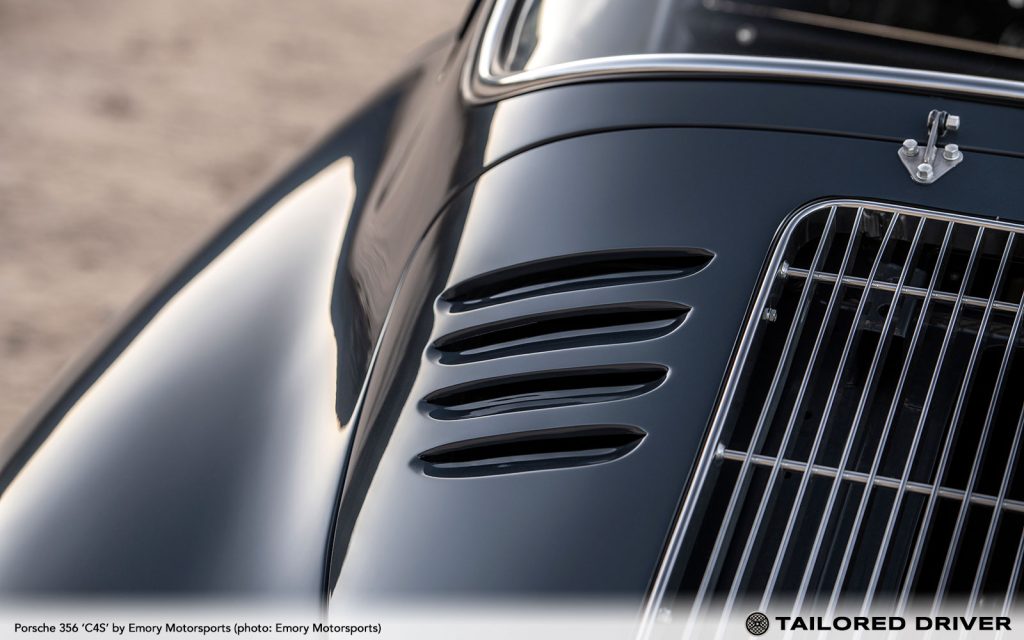
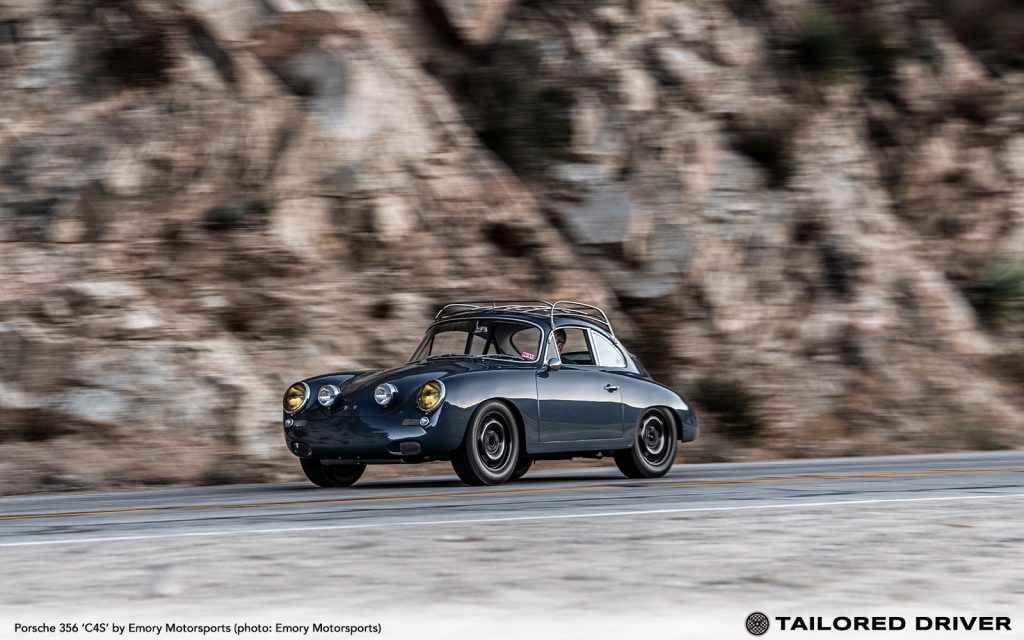
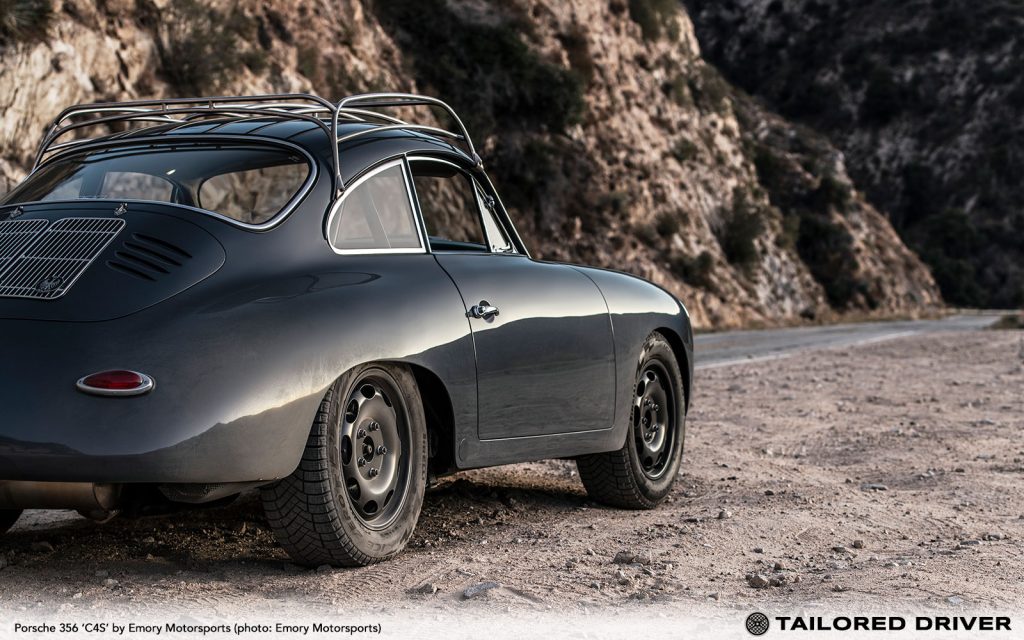
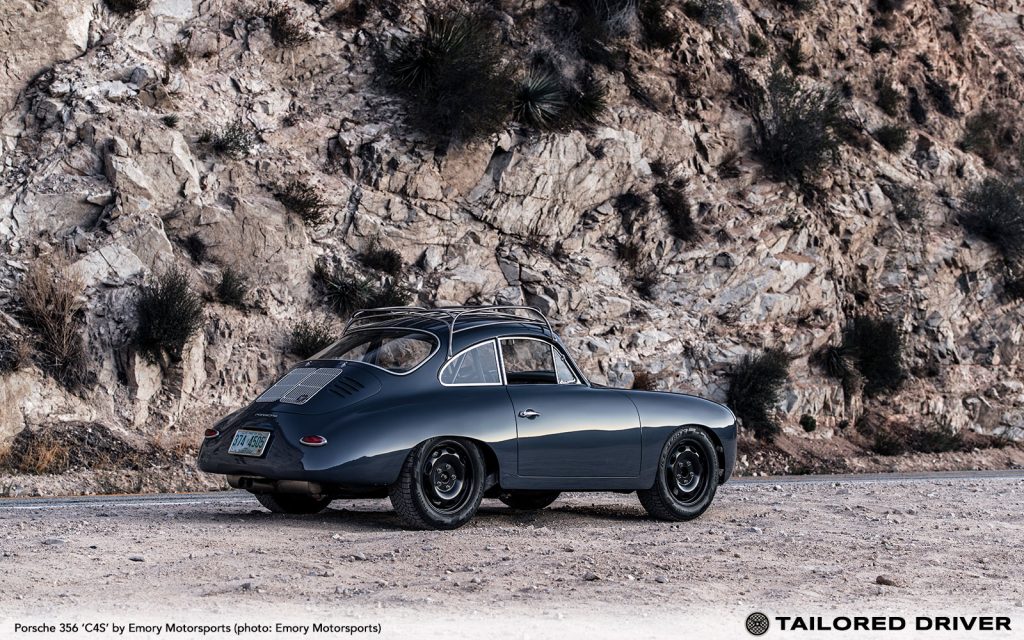
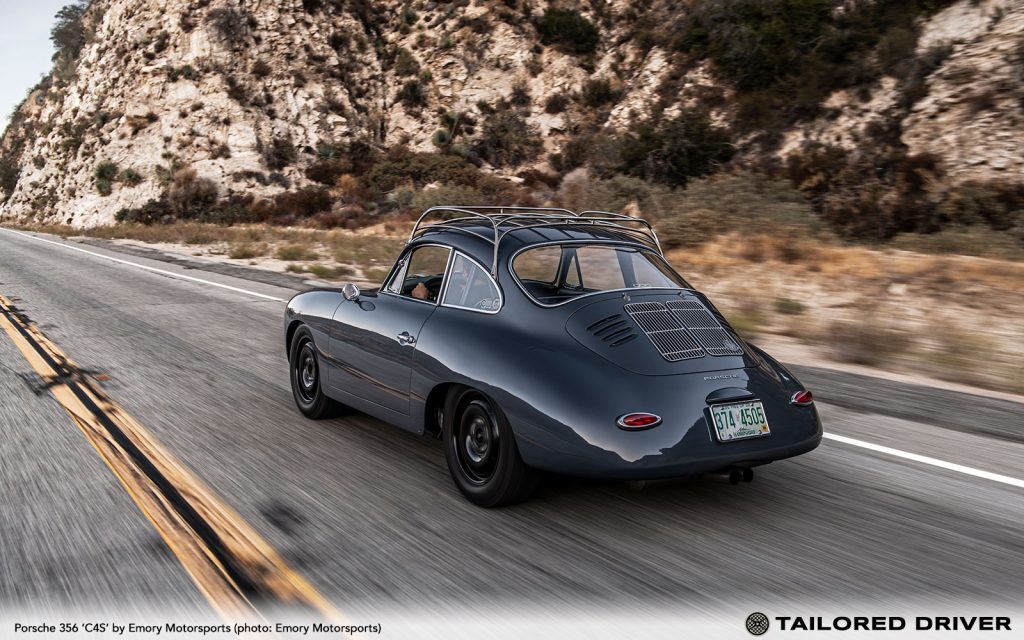
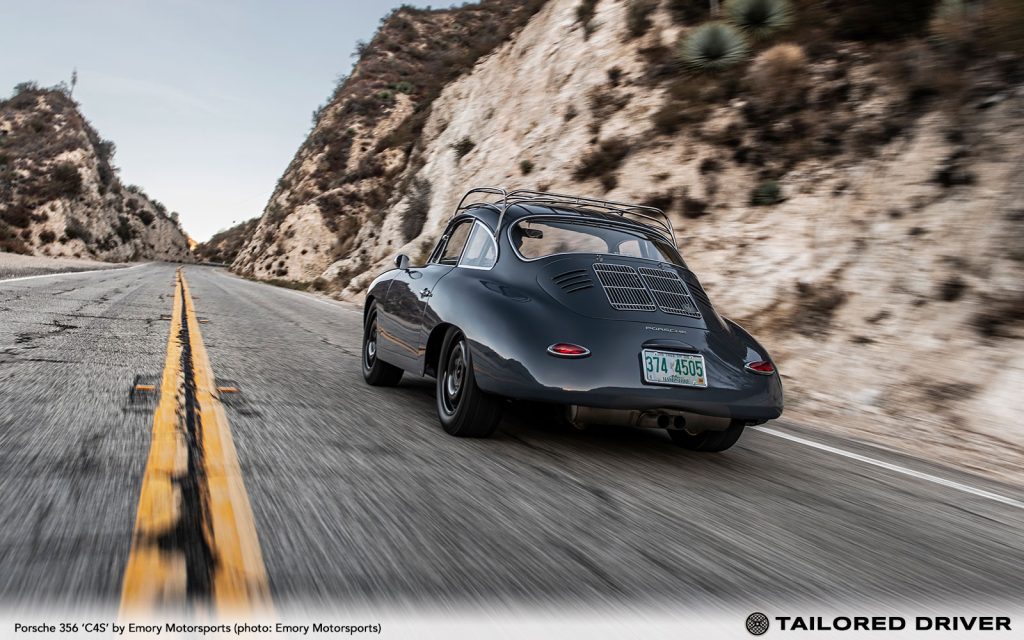
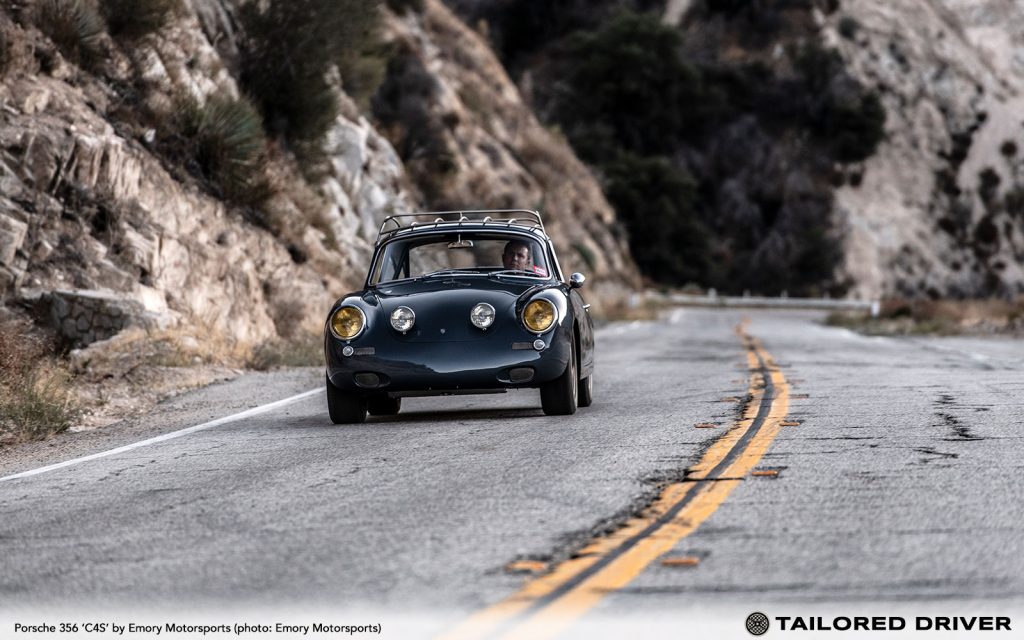
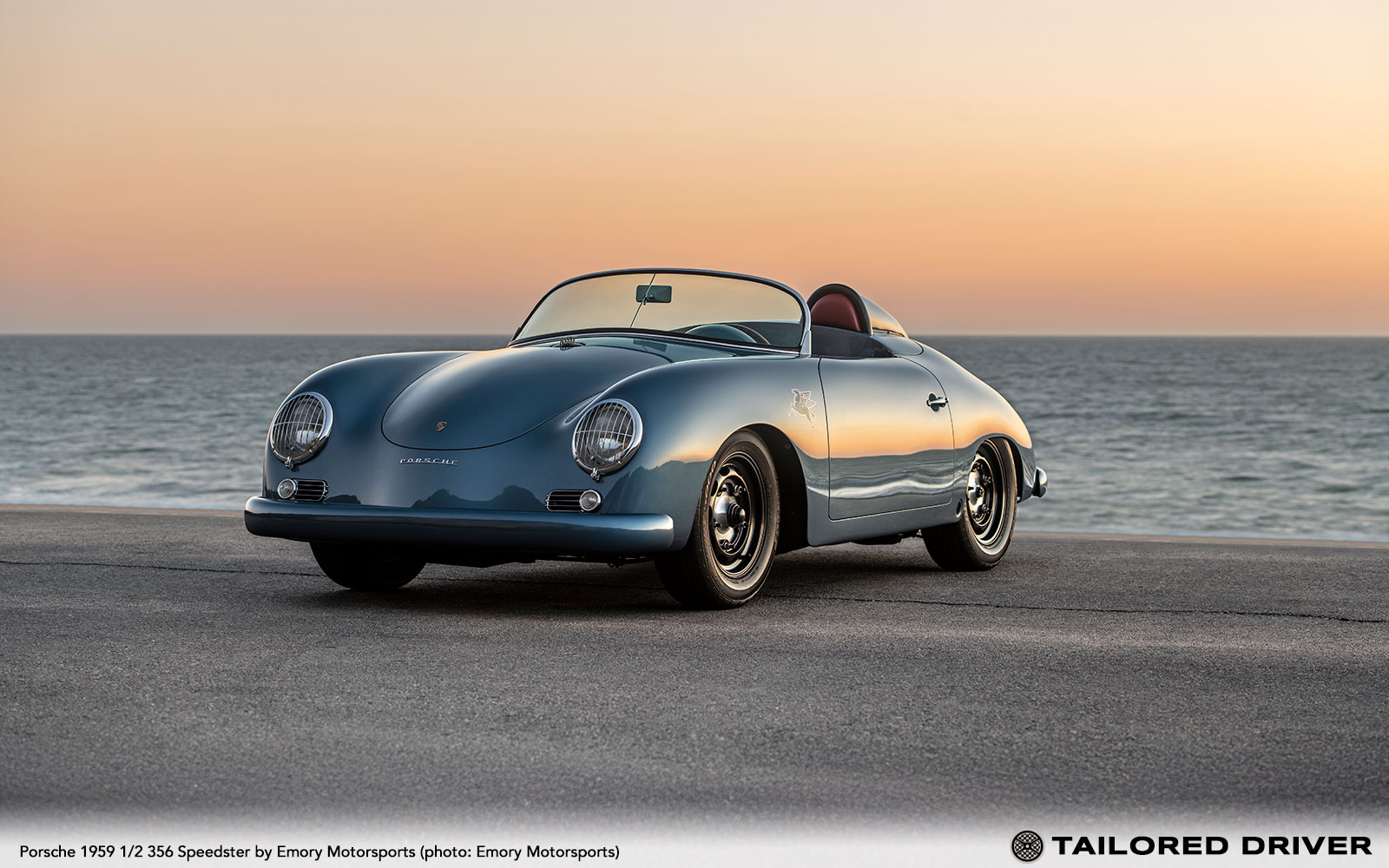
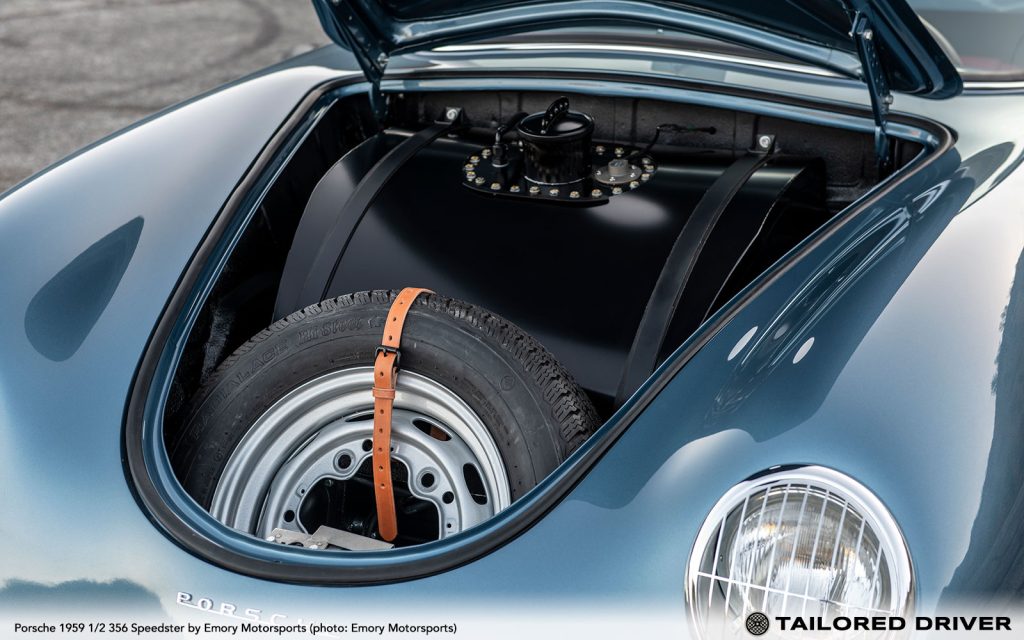
The carefully tailored bodywork includes a widened rear section, a flattened hood with its handle deleted, a louvered deck lid, and body-colored rally lights. A competition fuel filler leads to an 18-gallon GT FuelSafe fuel cell. Yellow headlight lenses and a Ray Dot mirror round out the distinctive exterior features of this build. Body color is Graphite Blue Metallic (graphitblaumetallic; metallic uni; M5G / A7; Porsche) an OE 2016 Porsche color.
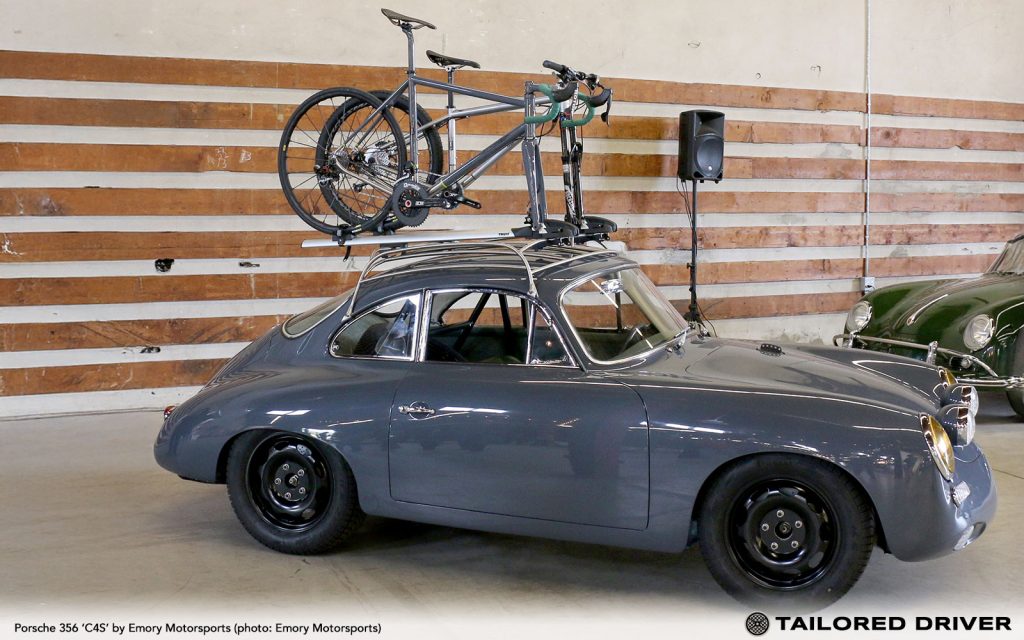
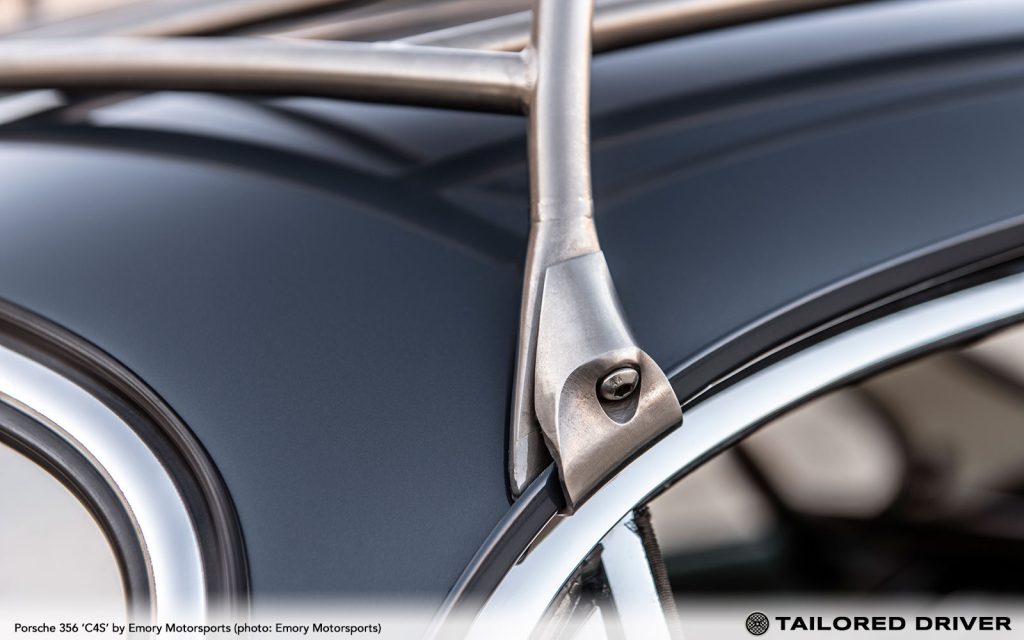
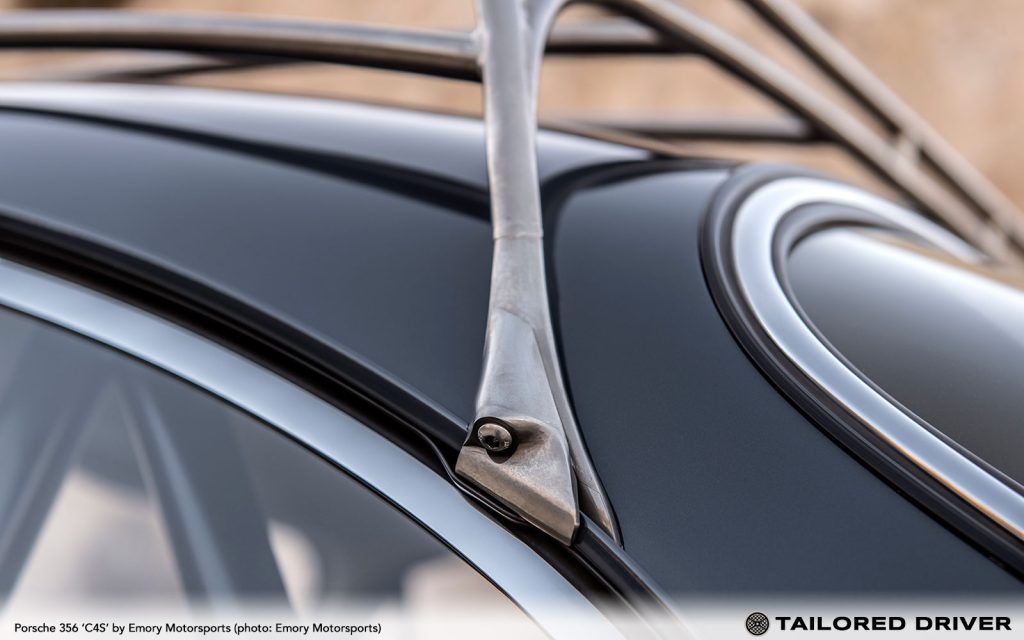
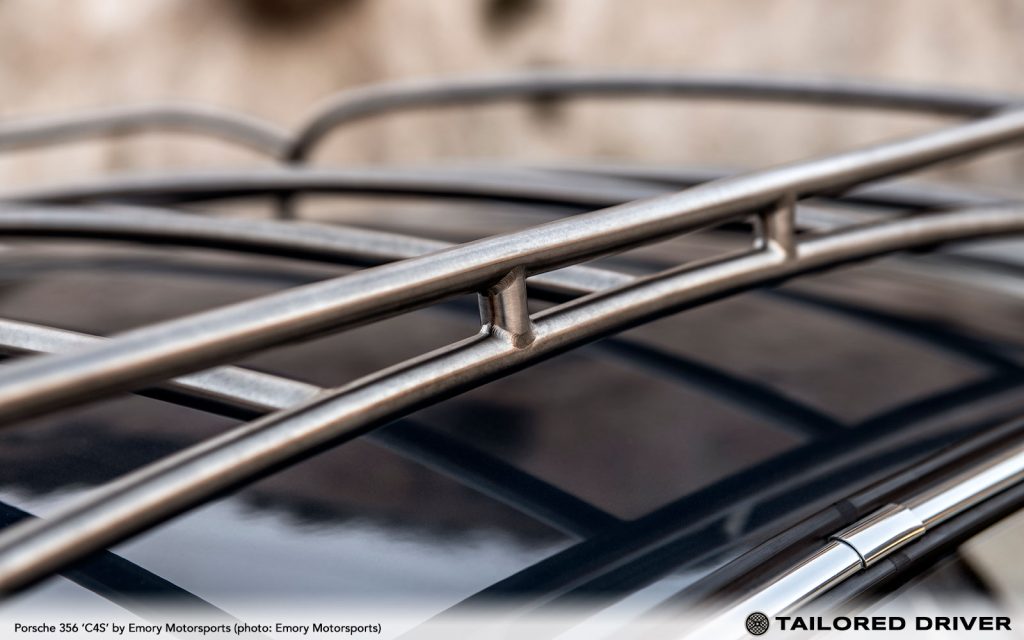
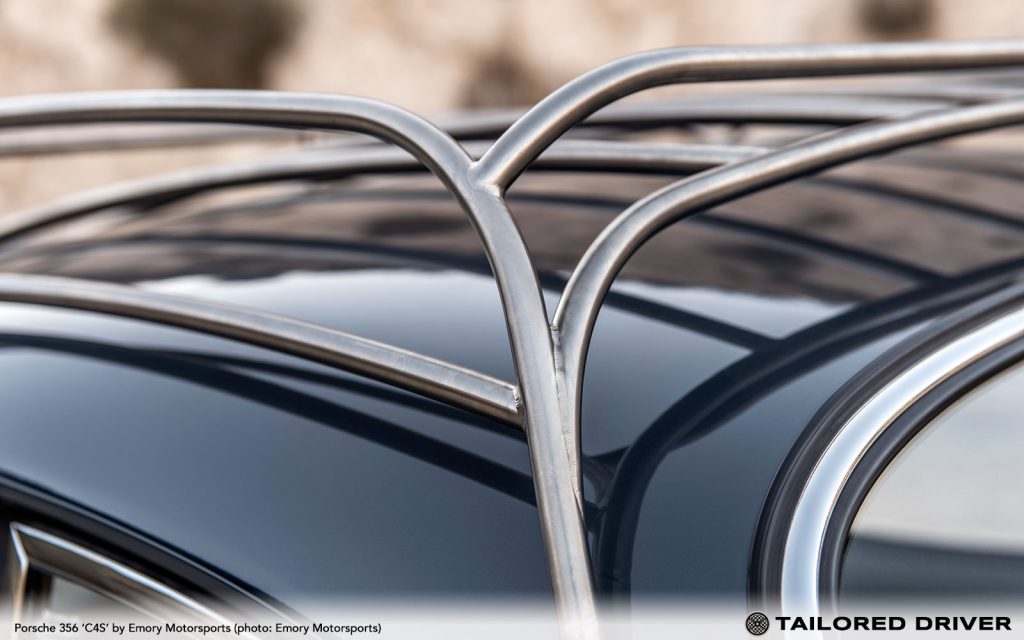
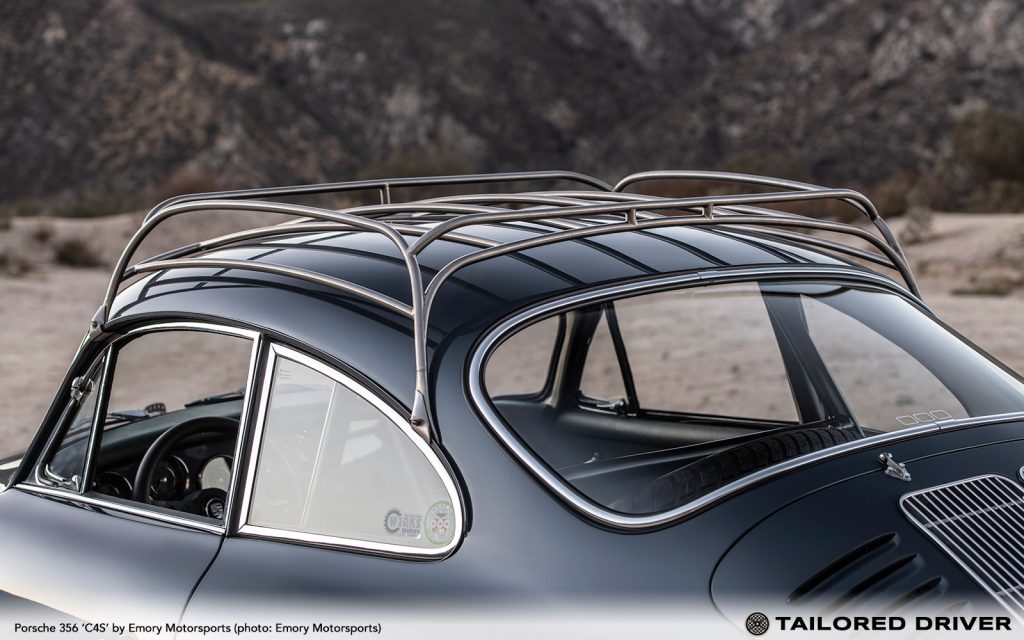
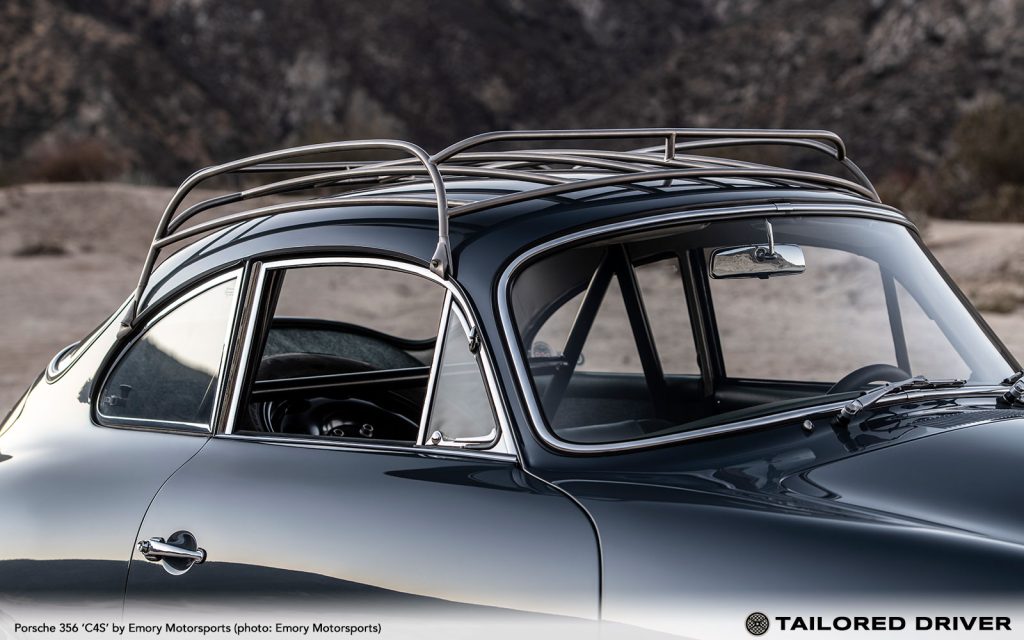
Careful observers will note the car’s titanium roof rack. Per the client’s request, the rack was conceived in CADto accommodate carrying bikes, skis, or other gear on road trips. The one-off drip-rail clamps were 3-D printed in chemically pure titanium, then welded to the custom-fabricated rack by the car’s owner. His fabrication skills extend from his titanium bicycle manufacturing (Independent Fabrication, https://ifbikes.com).
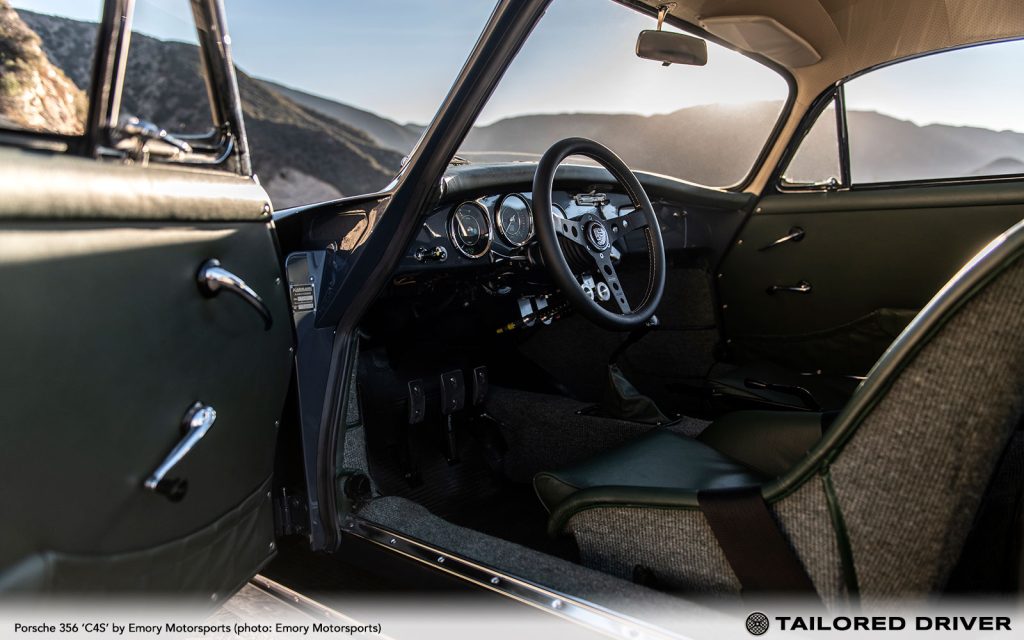
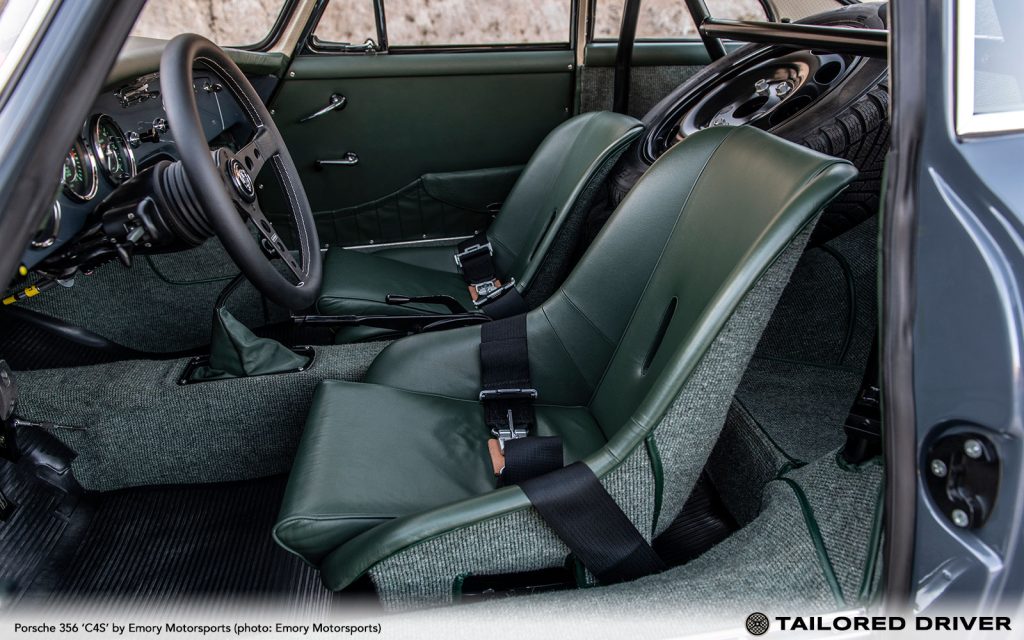
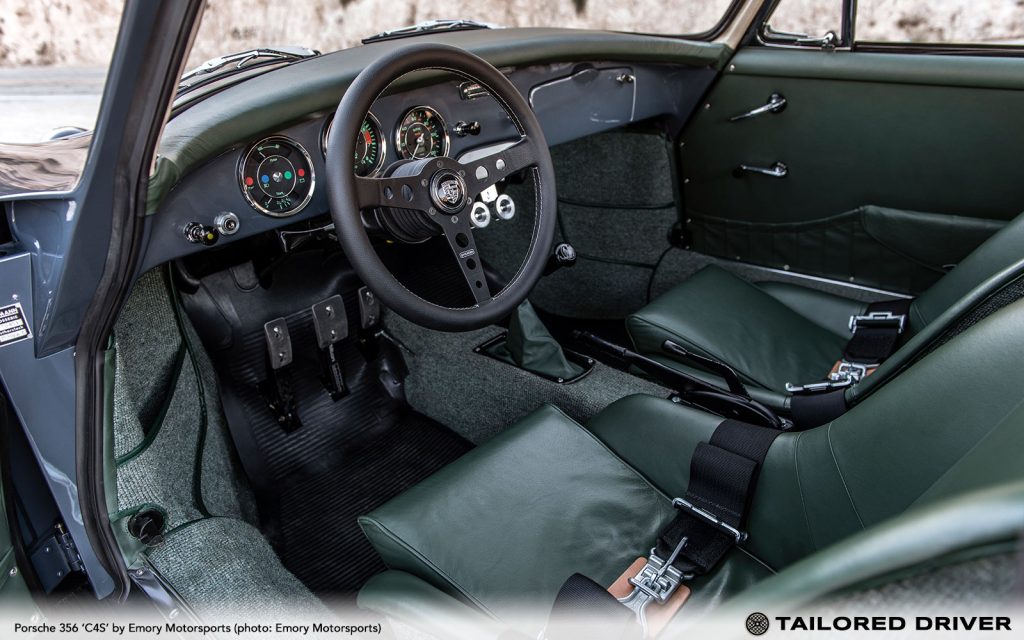
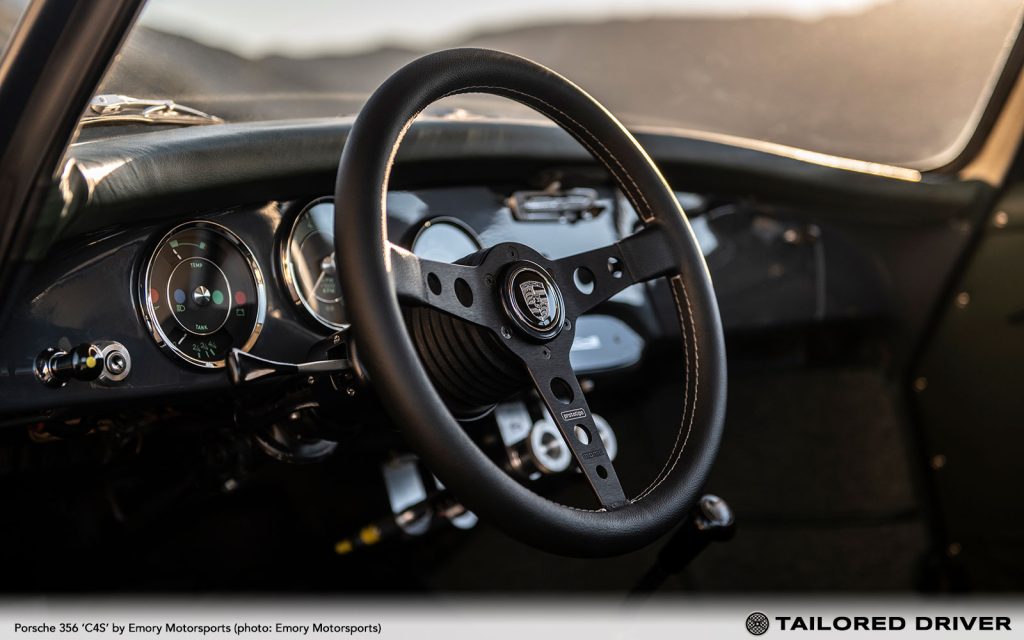
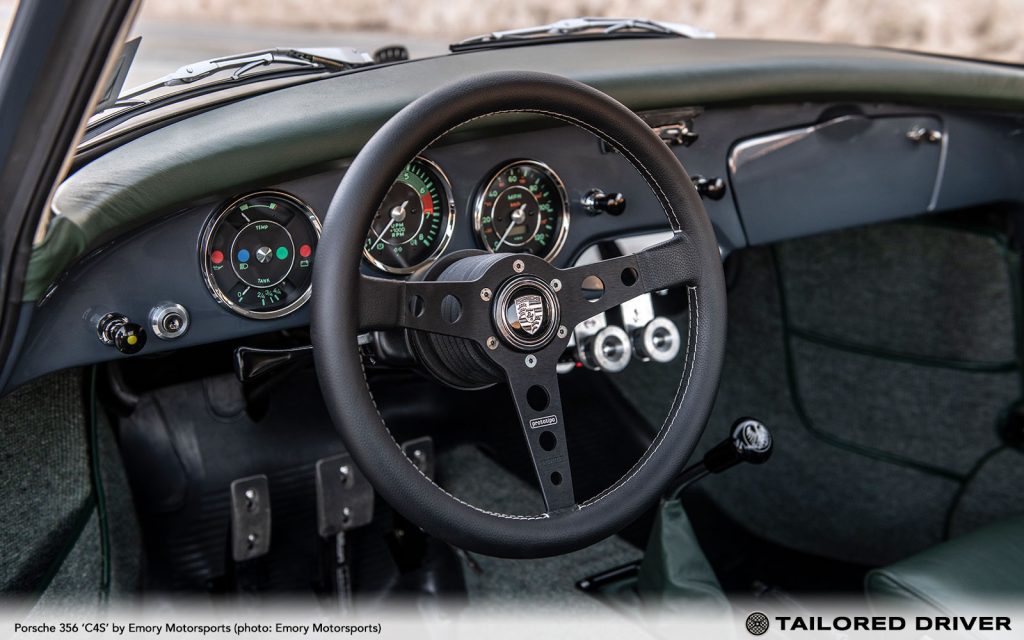
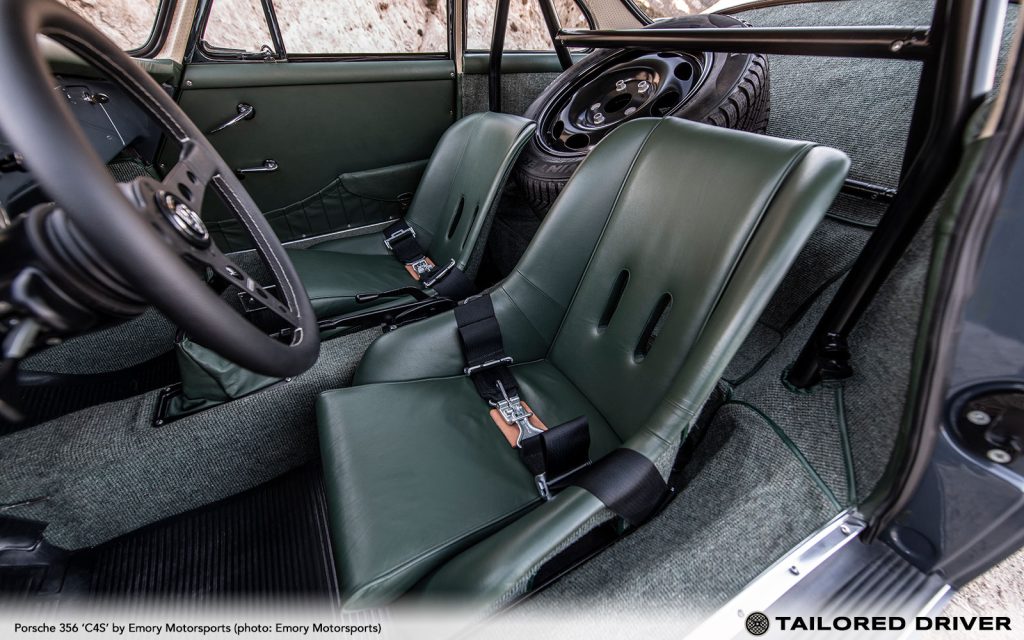
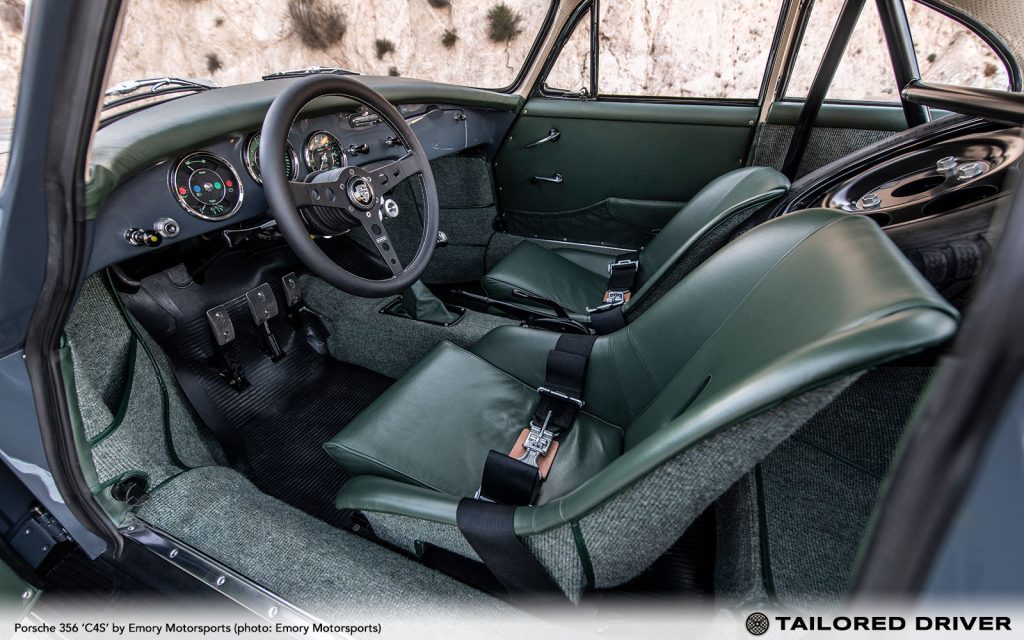
On the inside, Emory Motorsports injected Porsche racing inspiration. The RS-style driver’s seat provides functional contrast to the Speedster-style passenger seat. The interior is elegantly rendered in green leather, and occupants are held fast by 4-point competition harnesses. A removable roll cage provides additional safety for spirited driving conditions.
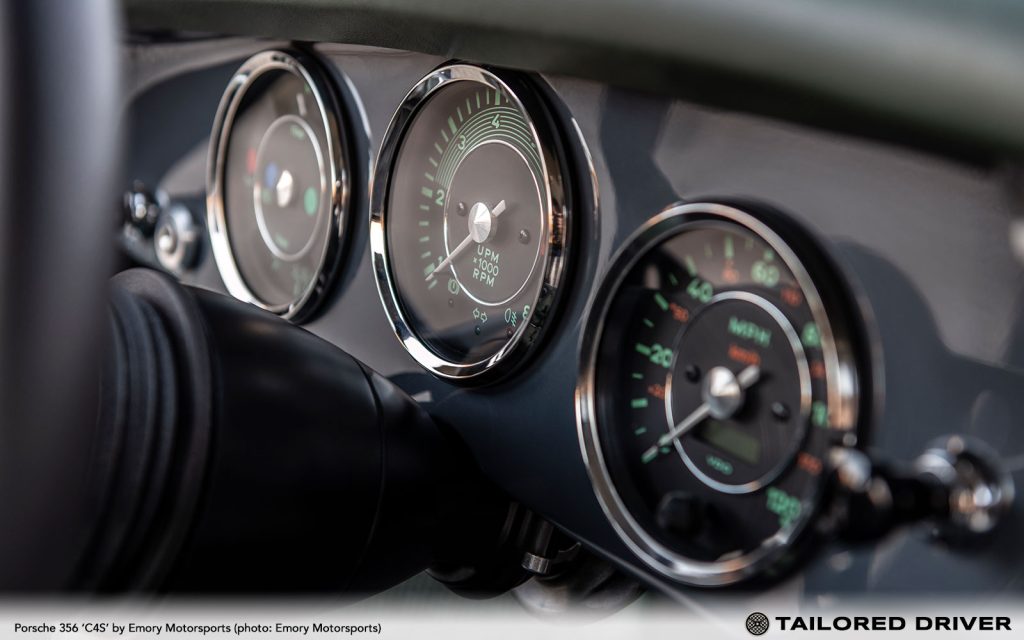
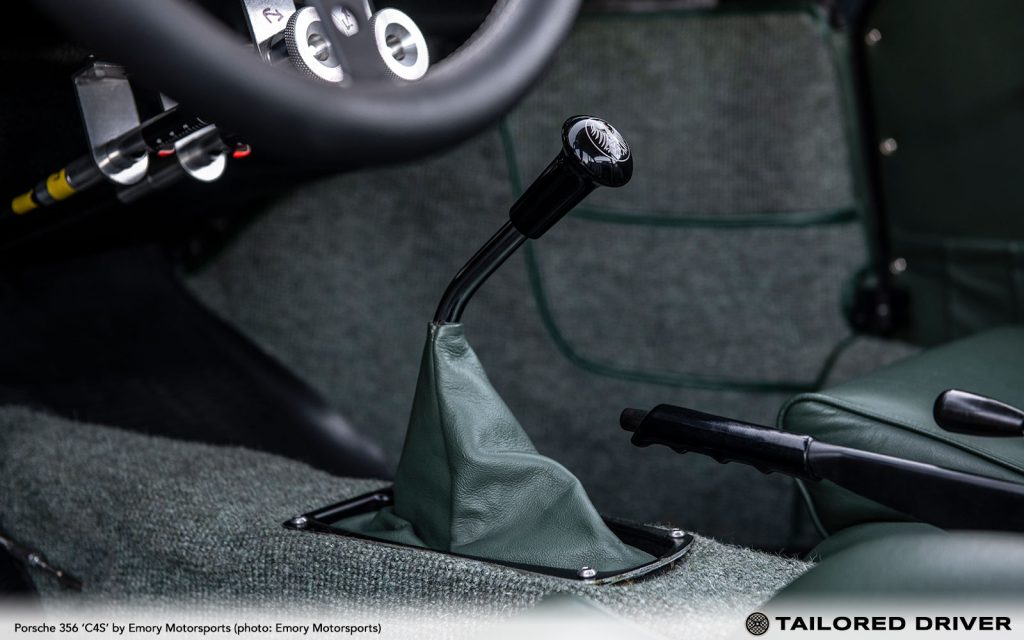
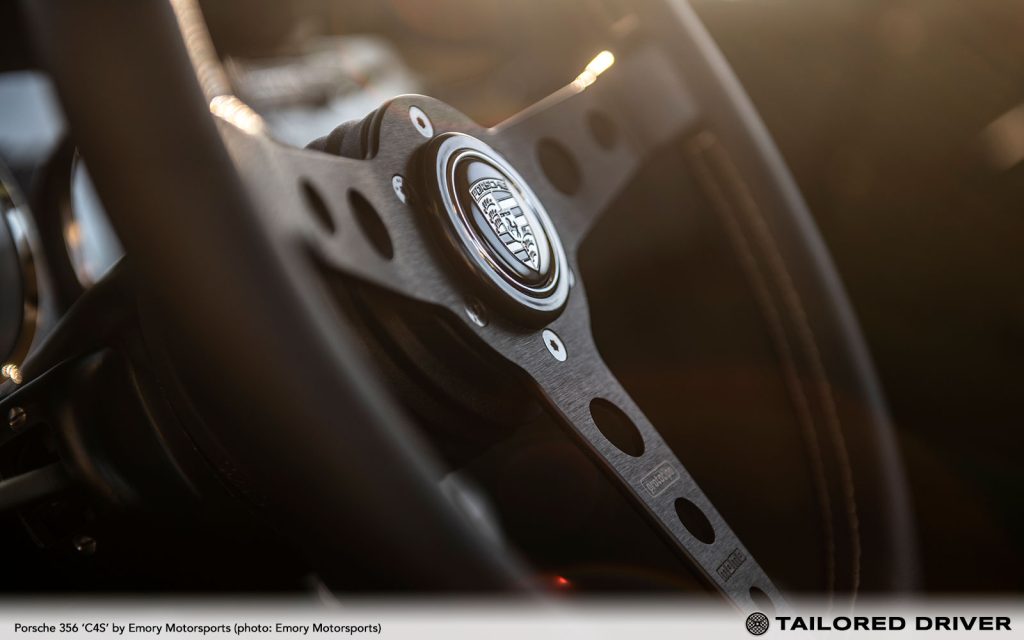
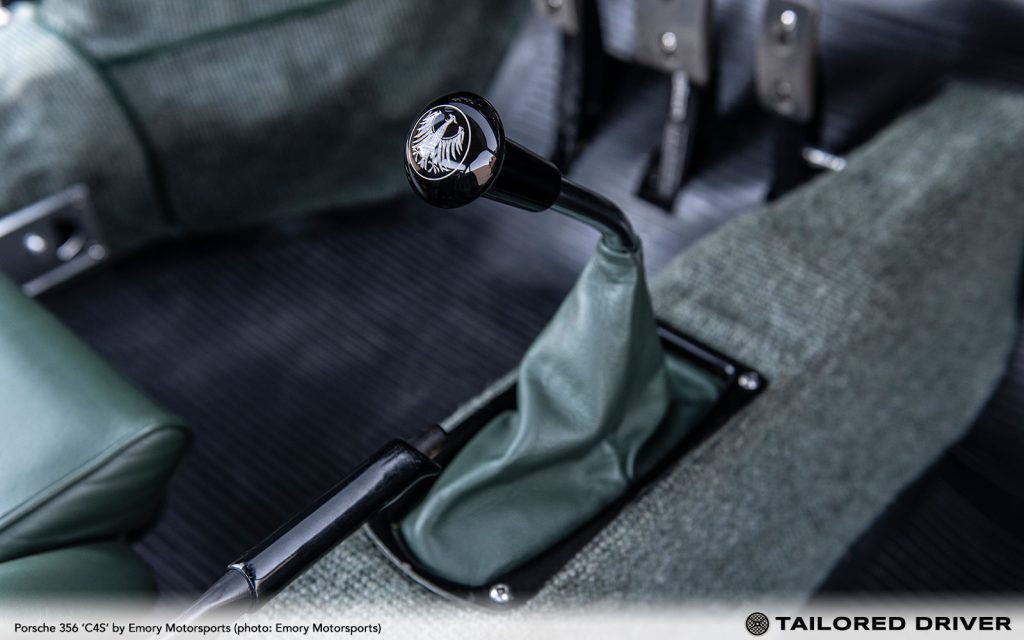
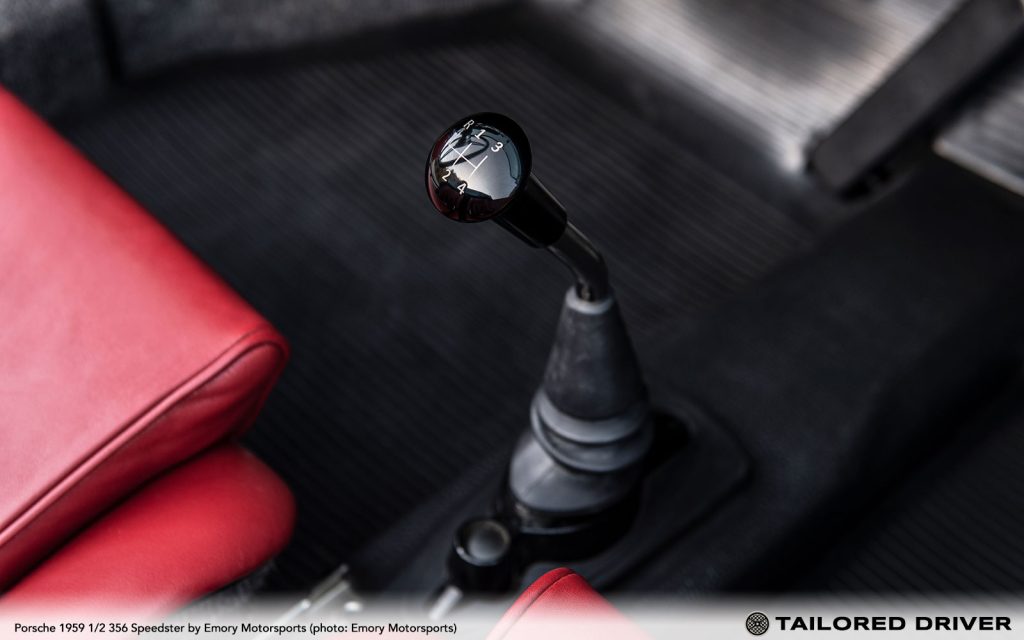
Other interior details include green square-weave carpet with rubber floor mats. Tactile interfaces include a MOMO Heritage steering wheel, a 911 shifter with Outlaw shift knob, and a Tilton pedal assembly. Total curb weight for this rally-inspired package is 2,150 pounds. For more information on custom Porsche 356 Emory Outlaws and Emory Specials, please visit EmoryMotorsports.com.
About Emory Motorsports
Founded in 1996 by Amy and Rod Emory, Emory Motorsports initially provided turnkey prep, repair and logistics for vintage Porsche racers. Simultaneously doing custom street-car builds, the company quicklybecame recognized as one of the world’s leading Porsche 356 customization and works car restoration resources.
Rod Emory’s automotive roots date to 1948, when his grandfather Neil Emory founded Valley Custom Shop. An innovator in body sectioning and channeling, Neil Emory created the bodywork for the infamous land-speed record-holding SoCal Streamliner. Rod’s dad, Gary, created the first Baja Bug while working as parts manager at Chick Iverson Porsche in the 1960s. He later founded Parts Obsolete and became the go-to source for hard-to-find OEM Porsche parts.
Rod acquired his grandfather’s sheet metal skills and echoed his dad’s enthusiasm for design, applying his unique skill set to the Porsche 356 and early 911 models. Purists initially labeled the Emorys as ‘outlaws’ when they attempted to enter shows in the 1990s with subtly customized cars that retained their Porsche DNA, but combined OE parts in unique ways. The Emorys happily championed the Porsche ‘outlaw’ movement, going so far as to create and protect the widely recognized “356 Outlaws®” brand. Since then, Emory Motorsports has created some of the most stunning Porsche 356s ever built. The company also meticulously restored what is now regarded as the most historically significant Porsche ever, the 356/2 SL “Gmund” that took a class victory at the 1951 24 Hours of Le Mans – Porsche’s first victory in international competition.
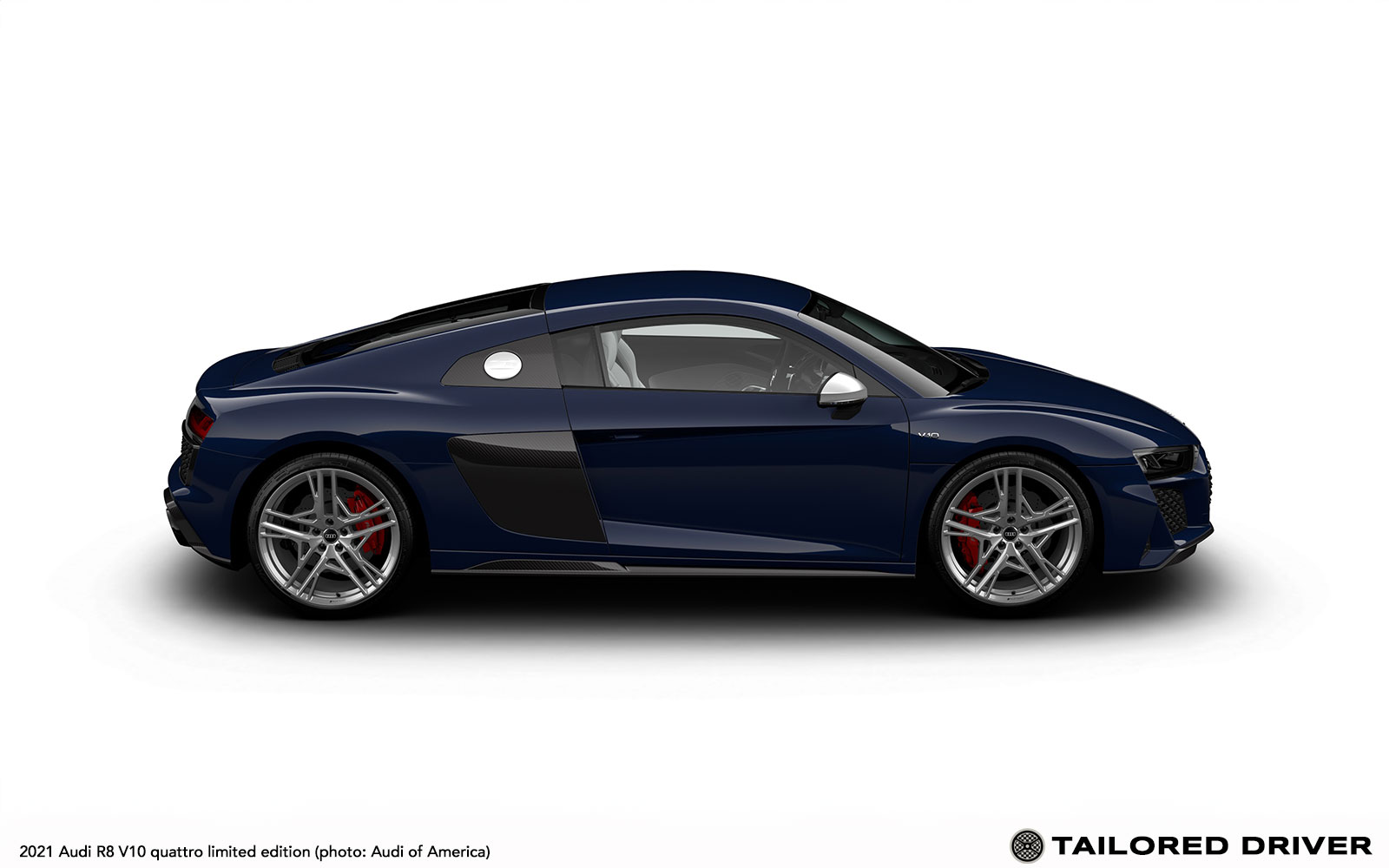
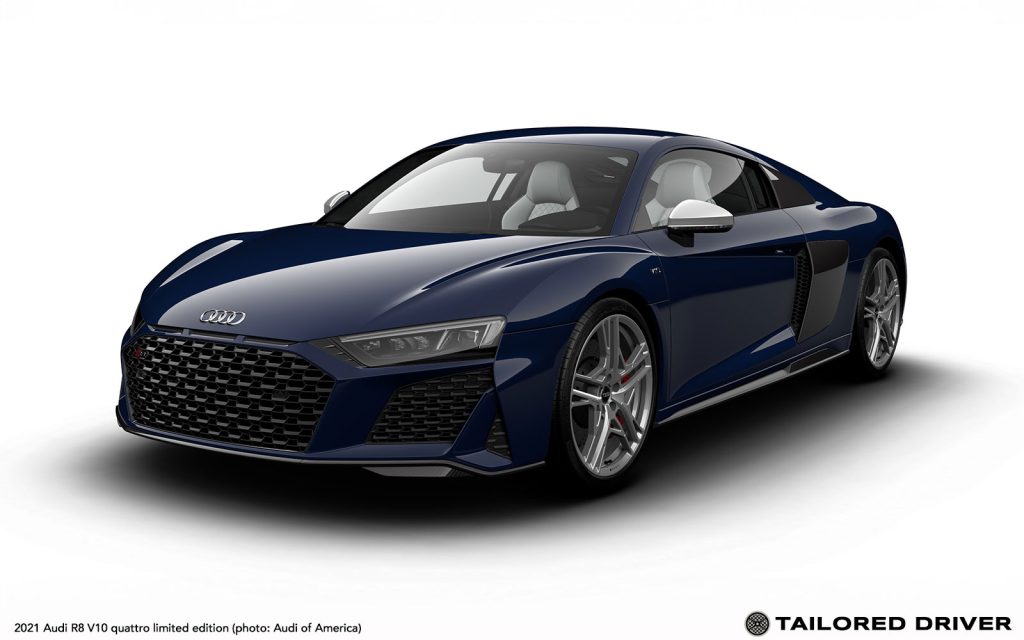
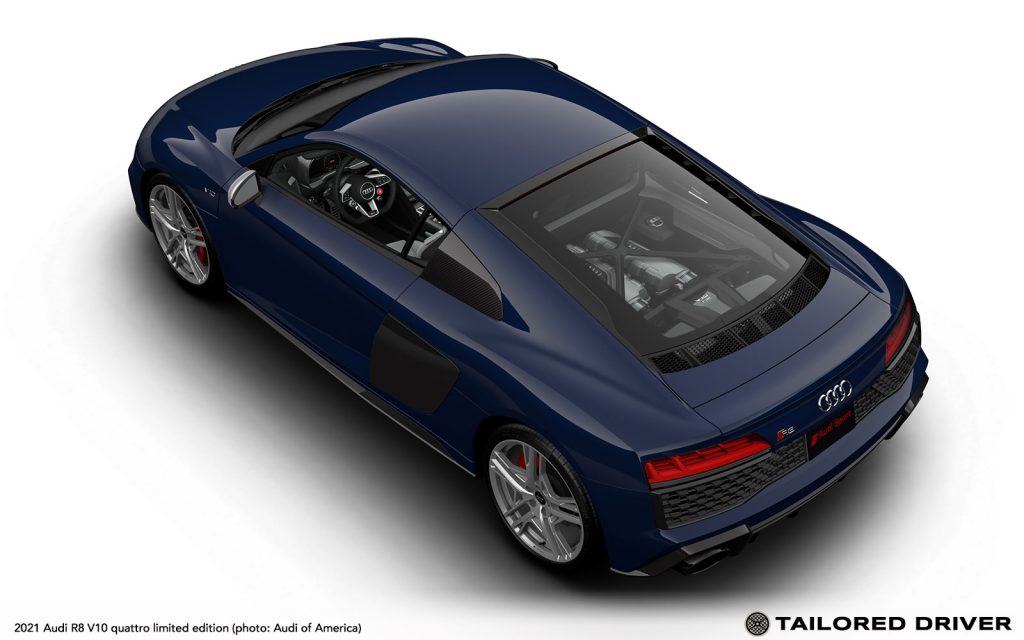
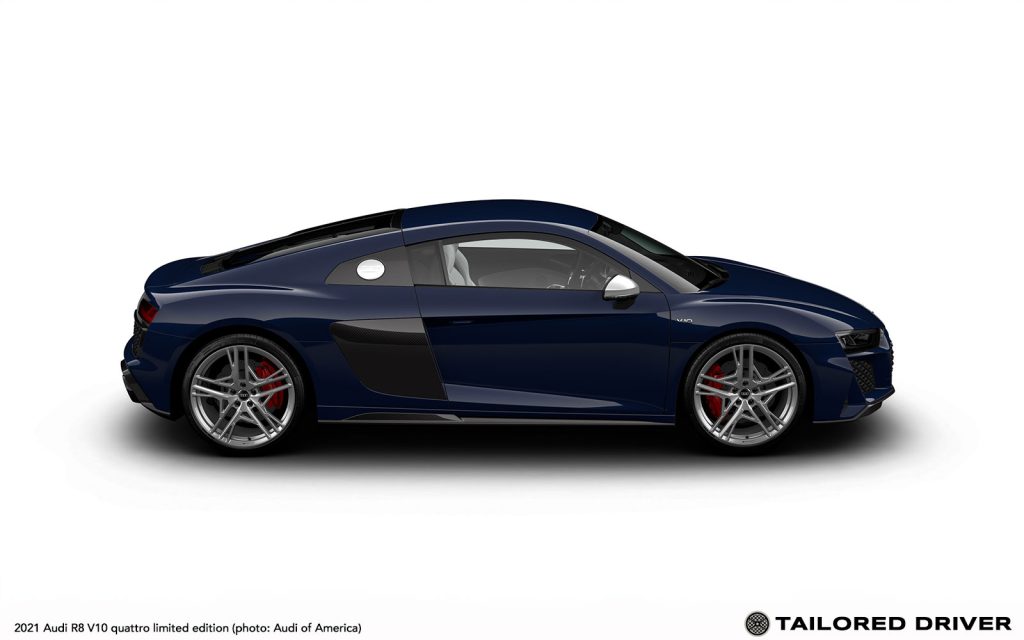
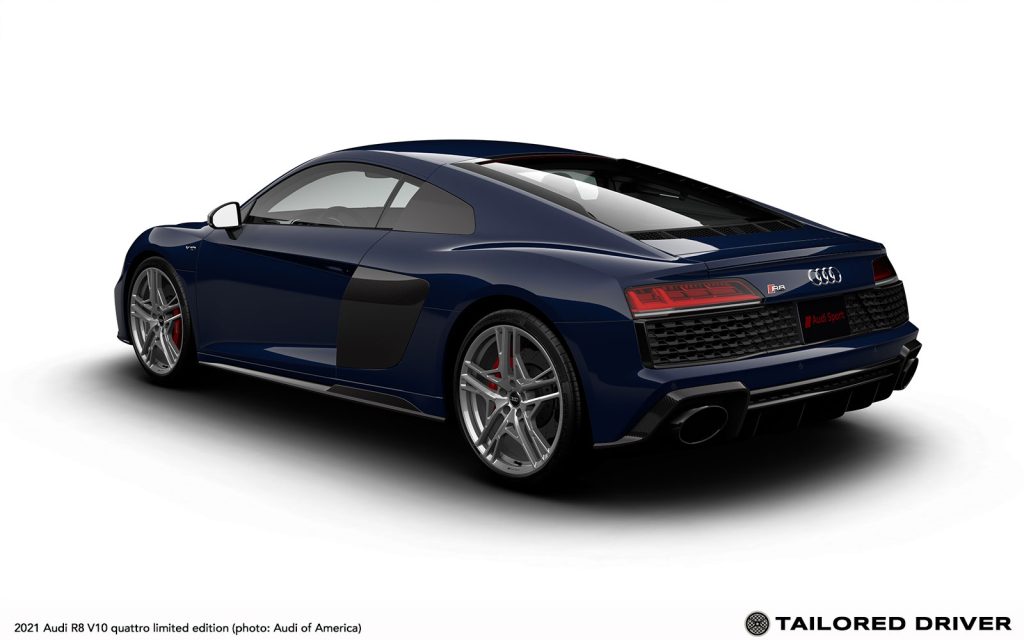
Limited to 30 units, the R8 V10 quattro features unique trim details including 20-inch milled wheels in silver, carbon exterior lower trim, and alu-optic mirror caps
Available as a Coupe painted in either Mugello Blue, Avus Silver, or Sonoma Green, and as a Spyder painted in Mugello Blue
R8 V10 performance quattro model continues on for 2021
[source: Audi of America]
HERNDON, VA – To celebrate a decade of success with the storied V10 engine, Audi of America announces the limited edition R8 V10 quattro models in Mugello Blue, Avus Silver, and Sonoma Green. Bidding farewell to the R8 V10 quattro, these 30 units bring technologies and features previously reserved for the performance model, and add unique interior and exterior design elements. The R8 V10 performance quattro model will continue on for the 2021 model year.
Powertrain and performance
Featuring the same naturally aspirated V10 engine found in the R8 LMS racecar, quattro® all-wheel drive, and a functional yet technologically advanced cabin, the R8 is the pinnacle of performance for Audi, with no other model bearing a closer tie to racing. With a seven-speed S tronic® dual-clutch transmission, which can shift gears in as little as 120 ms, the R8 V10 quattro achieves 562 horsepower and 406 lb-ft of torque, and reaches 60 mph in 3.4 seconds with a top track speed of 201 mph for the Coupe, or 0-60 mph in 3.5 seconds with a top track speed of 200 mph for the Spyder.
Previously only available for the R8 performance variants, the limited editions features a carbon fiber front sway bar, which saves 2 kg (4.4 lb) of weight. Audi magnetic ride adjusts the firmness of the dampers and included Audi dynamic steering offers a variable steering ratio that adjusts based on vehicle speed and the Audi drive select setting. At higher driving speeds, a less direct steering ratio helps to facilitate a more stable drive, and at lower driving speeds, a more direct steering ratio is utilized to help increase steering response for easier maneuvering.
The sport exhaust system, also previously only available on the R8 performance variants, amplifies the full bodied sound of the V10 engine, which the driver can adjust using the dedicated satellite button on the steering wheel or via the Audi drive select setting.
Unique design cues
With the Audi exclusive paint options and alu-optic mirror caps, the R8 makes its distinctive character clear. The lower trim, engine compartment, and side blades are all finished in carbon fiber and the brake calipers are painted red for an even sharper look.
Coupe variants will be offered in the following Audi exclusive paint colors: 15 Mugello Blue with pastel silver interior, five Avus Silver with black interior and red stitching, and five Sonoma Green with black interior and gray stitching. Five Spyders will be offered solely in Mugello Blue with pastel silver interior. All variants include Audi exclusive floor mats, with piping and stitching color-matched to the interior. The 20-inch milled wheels are finished in silver for the first time on an R8 in the U.S.
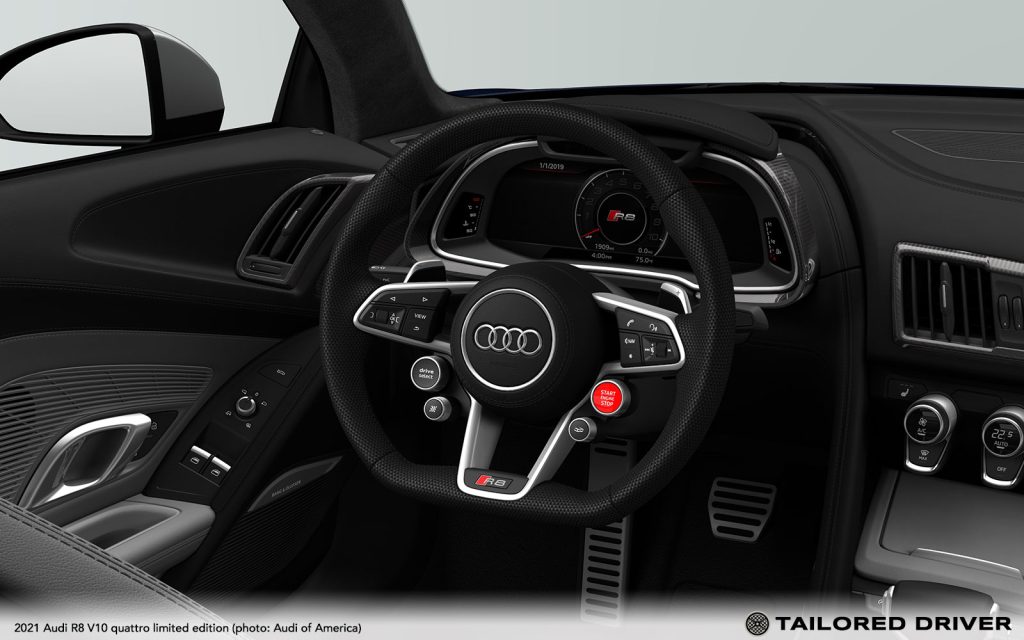
Sporty race features continue inside, where the driver-oriented interior features a three-spoke multifunction flat-bottom steering wheel with shift paddles and four steering wheel-mounted satellite buttons – engine Start/Stop, Audi drive select, Performance Mode selector and Sport exhaust. As with all R8 variants, the Audi virtual cockpit and the MMI navigation plus come standard. For even further definition, the included carbon interior adds carbon fiber high-gloss surrounds for both the virtual cockpit and the air vents and carbon sigma high-gloss inlays. Coupe models also feature a diamond stitched Alcantara® headliner.
With uncompromised performance and unmistakable design, the R8 model line has represented the pinnacle of Audi performance since its introduction in 2008, and the R8 V10 quattro is no exception.
The limited edition R8 V10 quattro is scheduled go on sale this summer with an MSRP of $186,000 for the Coupe and $195,900 for the Spyder.
ABOUT AUDI OF AMERICA
Audi of America, Inc. and its U.S. dealers offer a full line of German-engineered luxury vehicles. AUDI AG is among the most successful luxury automotive brands, delivering about 1.845 million vehicles globally in 2019. In the U.S., Audi of America sold just over 224,000 vehicles in 2019 and launched the brand’s first fully electric vehicle, the Audi e-tron – one of four fully electric models coming to the U.S. market in the next two years. Globally, the brand aims to be CO2 neutral by 2050. Visit audiusa.com or media.audiusa.com for more information regarding Audi vehicles and business topics.
This information and any vehicle specifications are preliminary and subject to change.
Prices above exclude $1,250 destination charge, $1,700 gas guzzler tax, sales taxes, title, options, and dealer charges. Dealer sets actual price.
Always obey local speed and traffic laws.
Top track speed electronically limited in U.S. Obey all speed and traffic laws.
MMI Navigation plus depends on signals from the worldwide Global Positioning Satellite network. The vehicle’s electrical system, and existing wireless and satellite technologies, must be available and operating properly for the system to function. The system is designed to provide you with suggested routes in locating addresses, destination and other points of interest. Changes in street names, construction zones, traffic flow, points of interest and other road system changes are beyond the control of Audi of America, Inc. Complete detailed mapping of lanes, roads, streets, toll roads, highways, etc., is not possible, therefore you may encounter discrepancies between the mapping and your actual location. Please rely on your individual judgment in determining whether or not to follow a suggested MMI Navigation plus route.
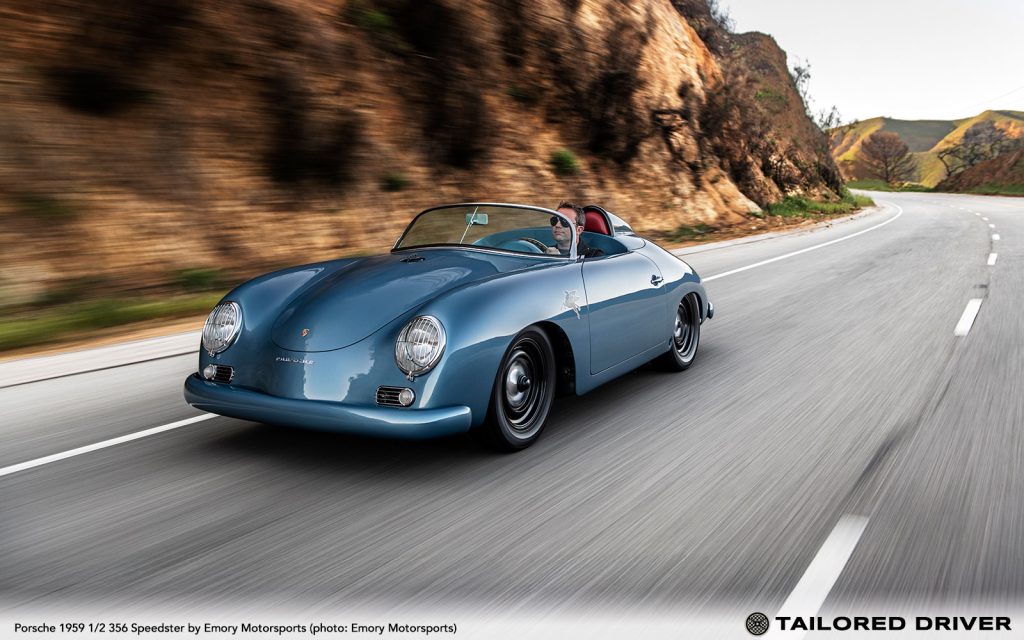
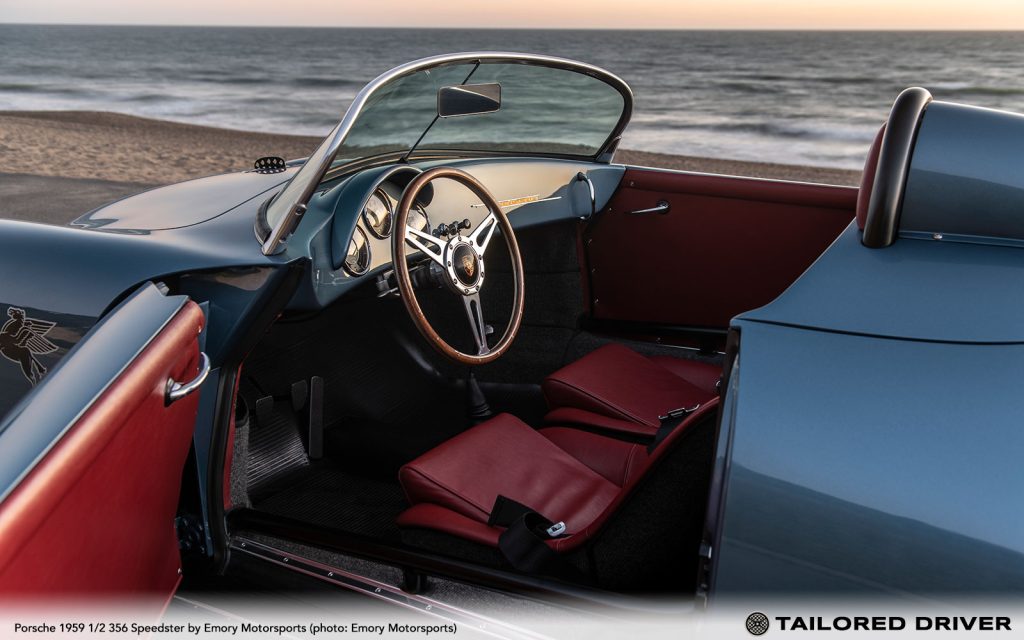
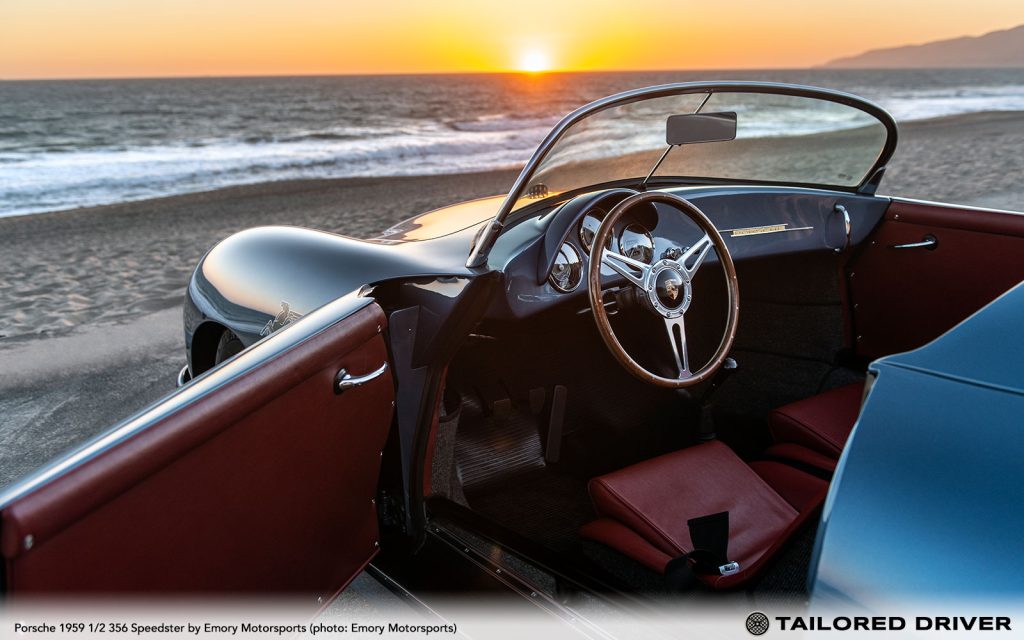
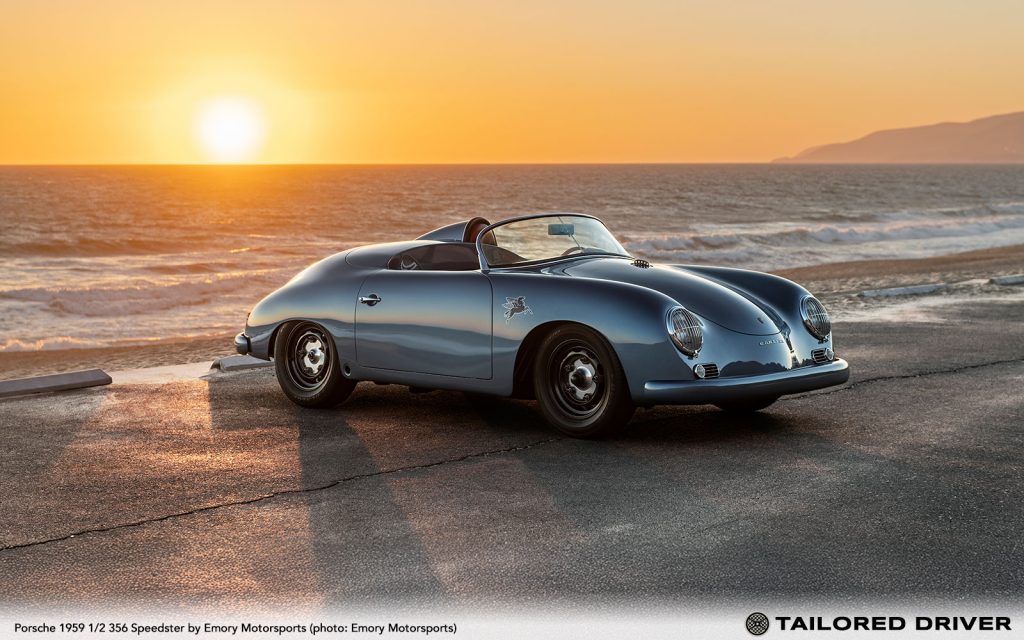
“Transitional” Speedster Brilliantly Illustrates The Why and The How of Rod Emory’s Porsche 356 Philosophy
[source: Emory Motorsports]
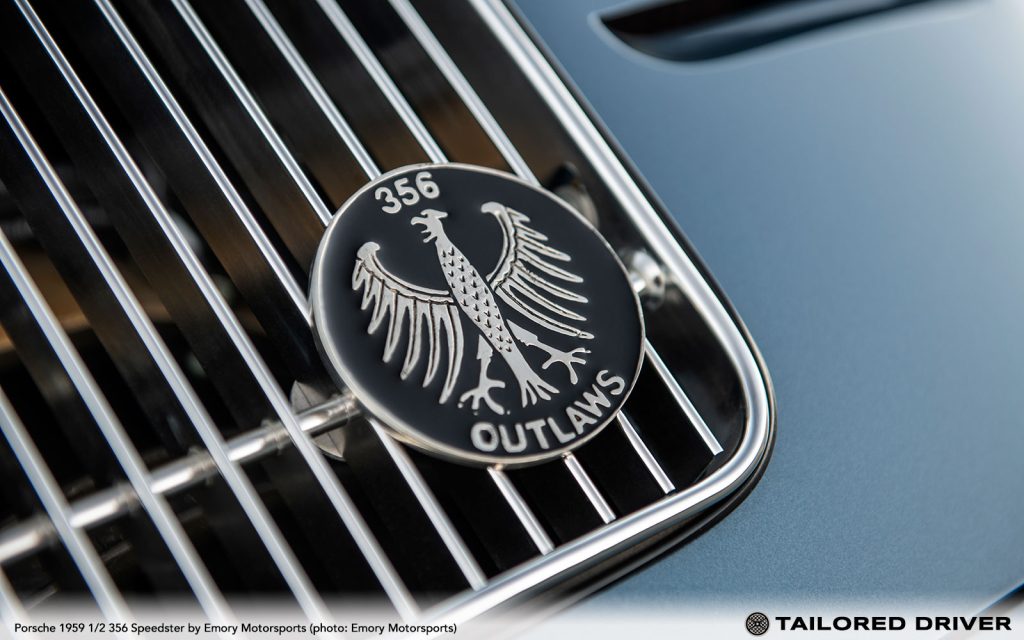
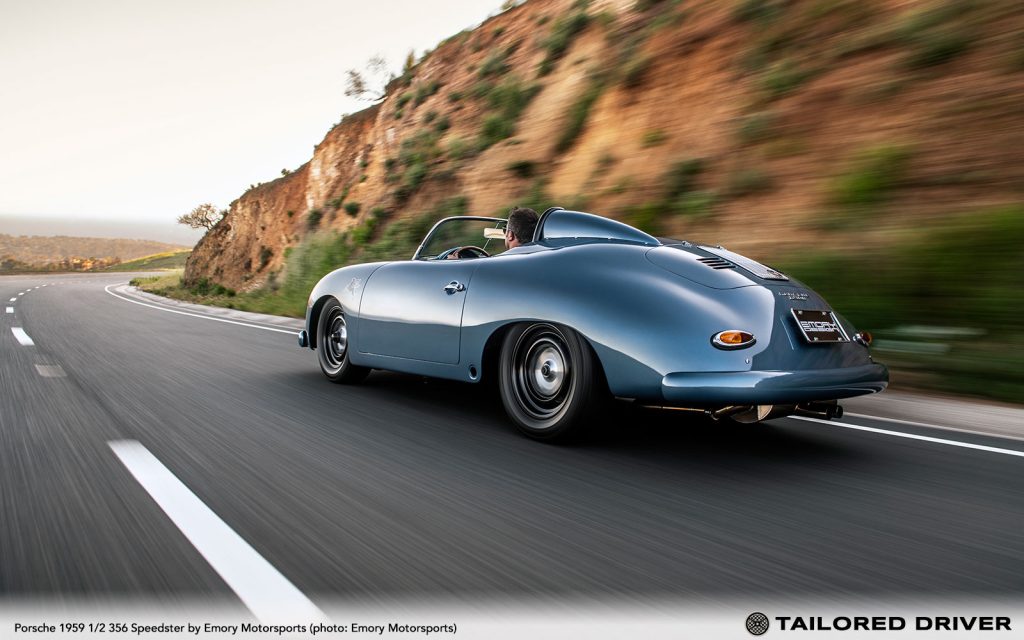
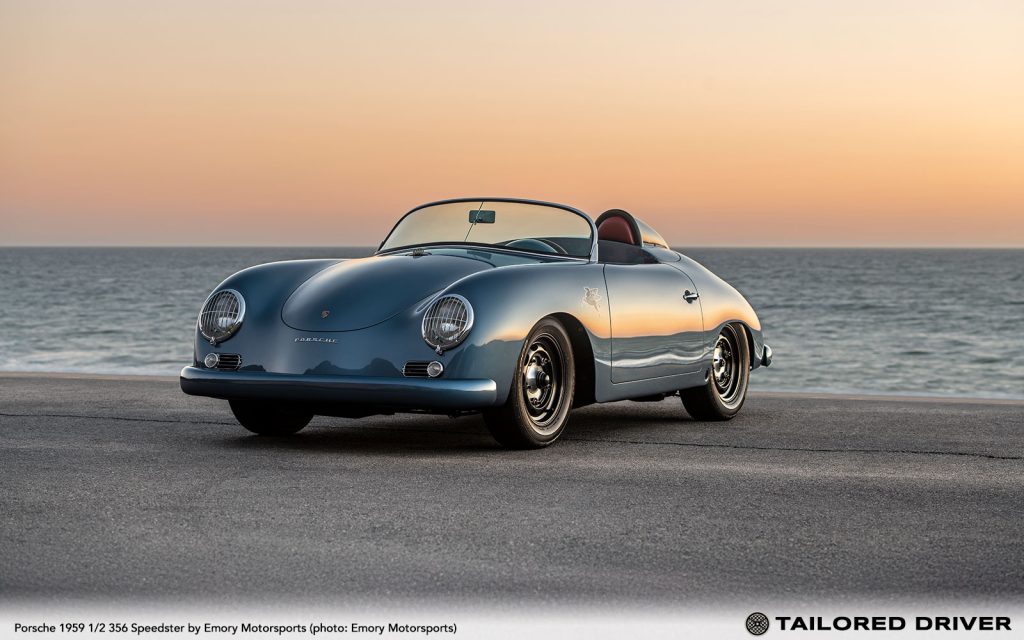
NORTH HOLLYWOOD, CA – Rod Emory has refined Emory Motorsports’ ‘Outlaw 356’ recipe by paying close attention to detail and by staying true to the principles of form and function. The secret ingredient (and their de facto mission statement) is the preservation of Porsche DNA, whatever the cost. All of the company’s four distinct “product lines” utilize this mandate, but differ according to the desired user experience. This unique 356 Speedster was built to experience the sun in the grandest Outlaw tradition.
“Each 356 that we put back on the road is a piece of Porsche history, and we work very hard to preserve that creative spark,” comments Rod Emory of Emory Motorsports. “The best part of my work is bringing new life to cars that might otherwise be destined for the junkyard.” The donor car for this particular project is a case in point: a 356 coupe whose roof was seriously compromised in an accident. Because the roof was not repairable, It provided Emory Motorsports a superb canvas for developing a truly one-of-a-kind 356 Outlaw that echoes everything enthusiasts have come to adore about the classic Speedsters of the era.”
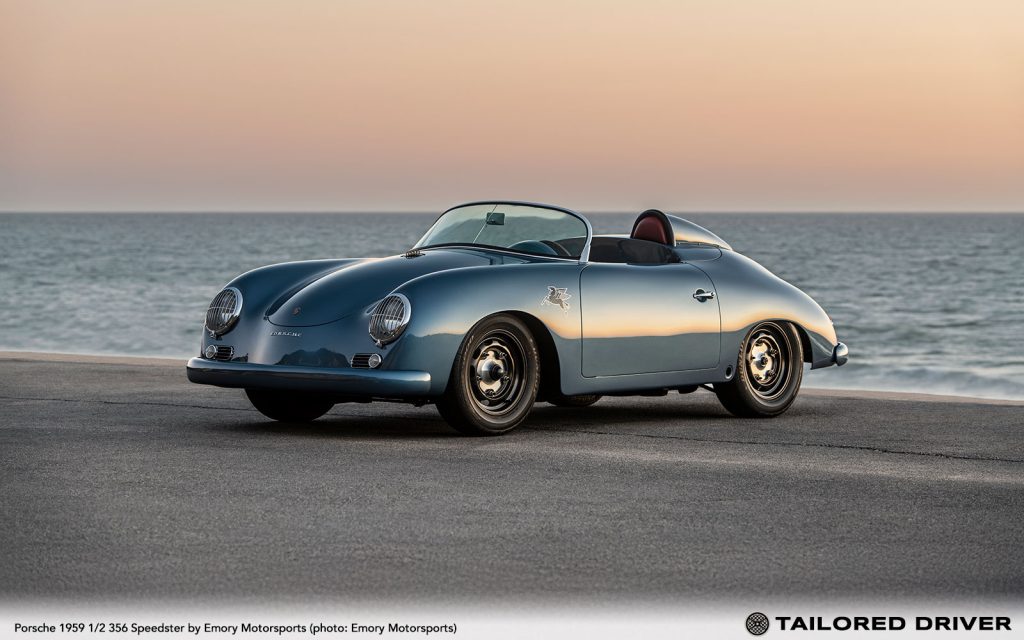
While Emory Motorsports encourages the preservation of ‘survivor’ Porsches, ones that have been carefully looked after, Rod also enjoys bringing a variety of deserving 356 basketcases back to life in brilliant fashion. This 1959½ “Transitional” Speedster succinctly illustrates this concept.
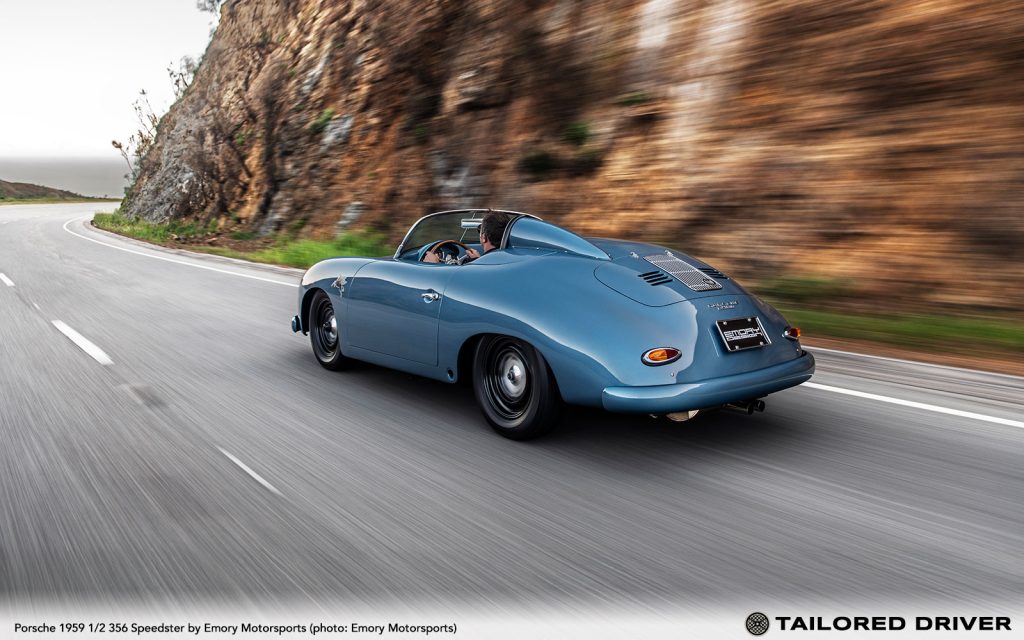
Porsche enthusiasts know that the ‘Speedster’ model was made between the years of 1954-1958, being replaced by the Convertible D in 1959. When Rod Emory gained a client looking for an open car concept, he knew that making a Speedster-like car from a coupe was entirely feasible. The perfect donor car came along and Emory Motorsports’ skilled team of artisans and fabricators set about fusing the ‘Outlaw’ and ‘Special’ design categories that Emory has championed for its clients through the years.
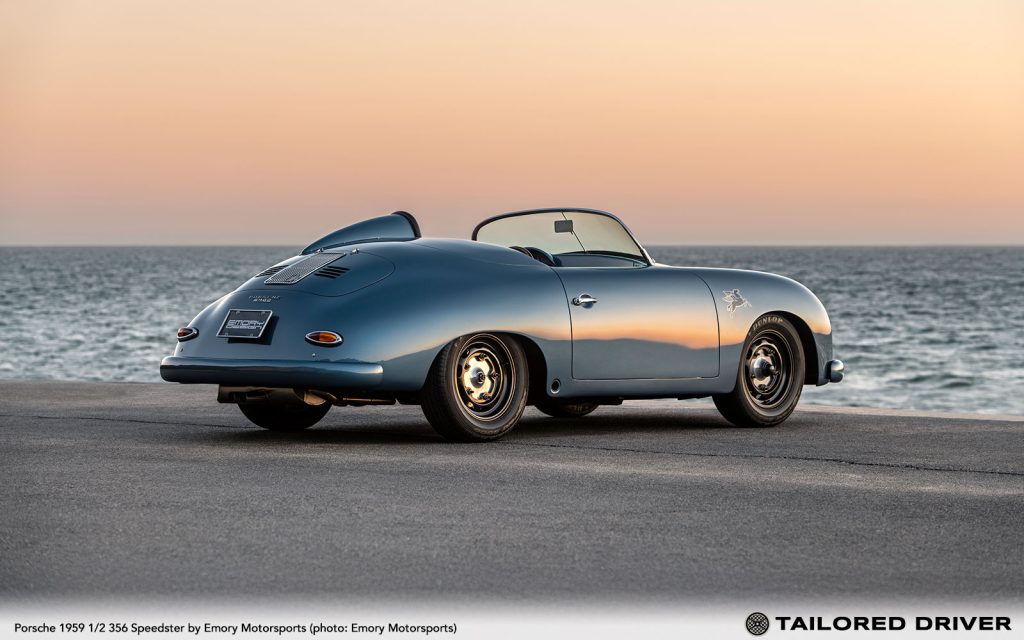
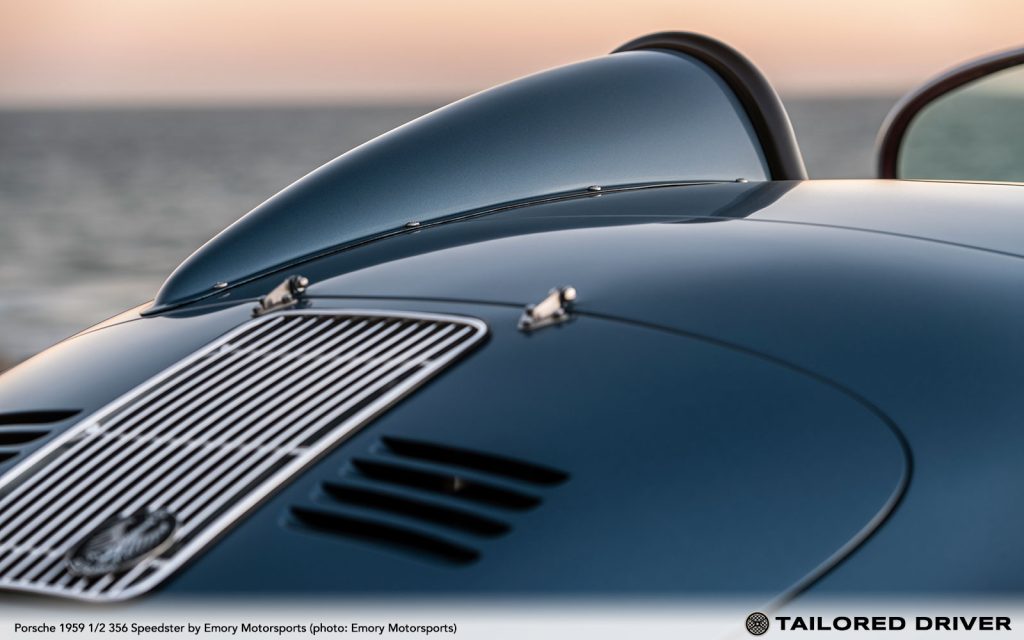
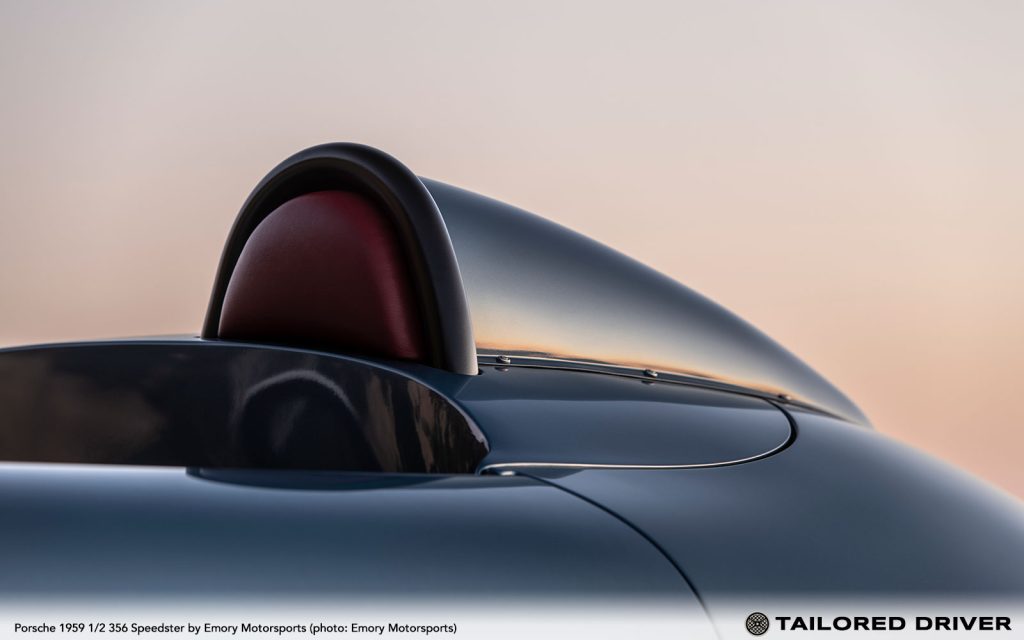
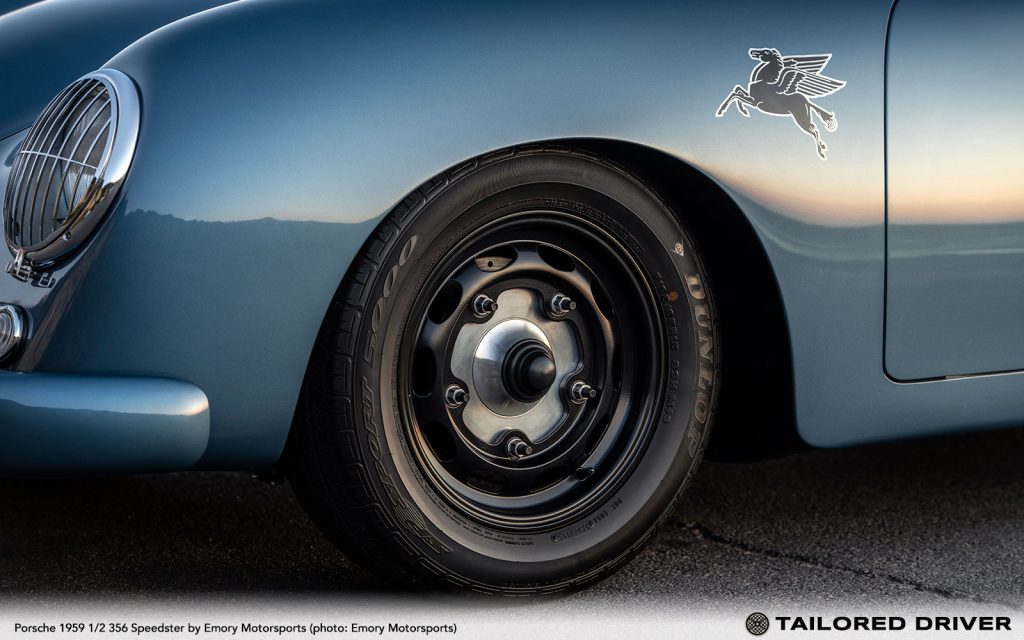
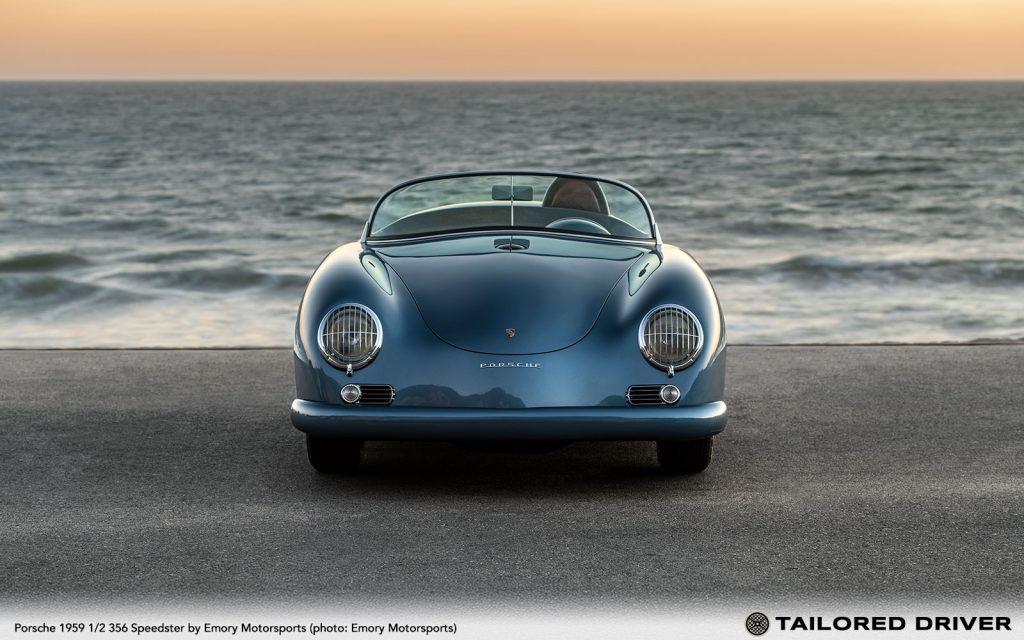
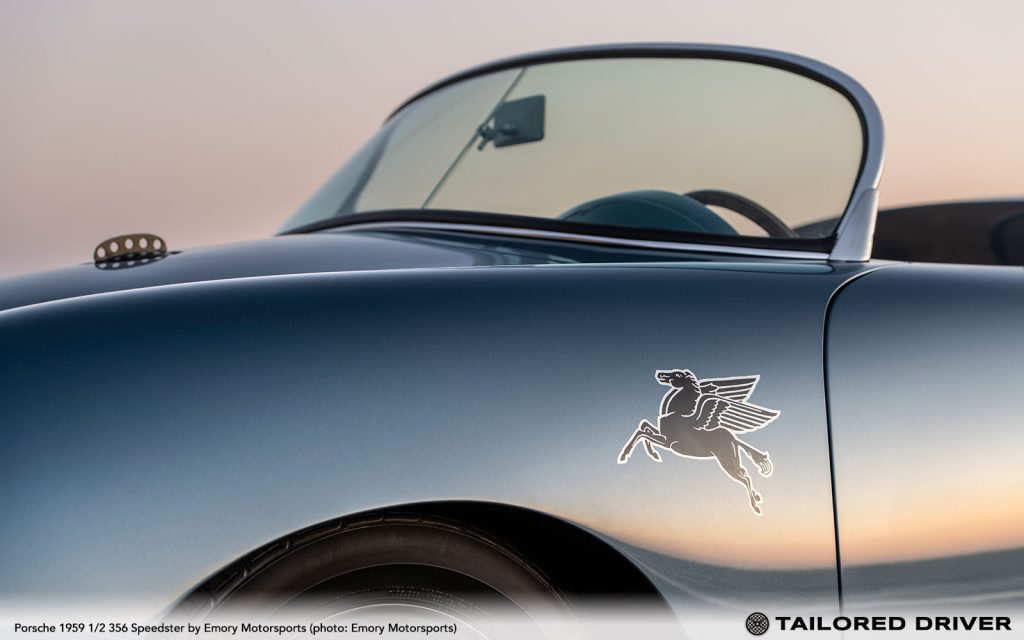
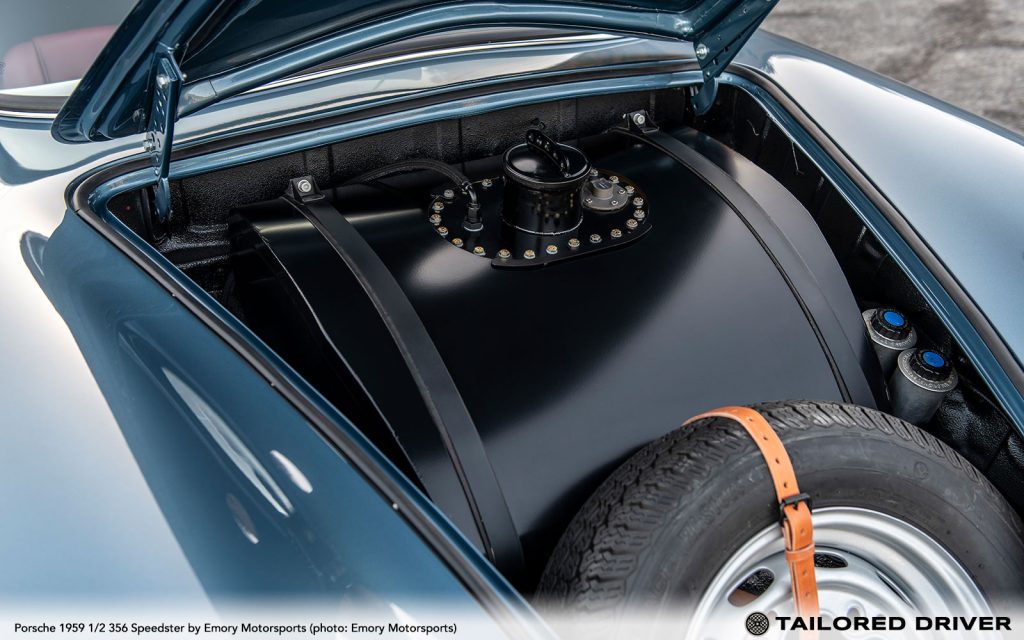
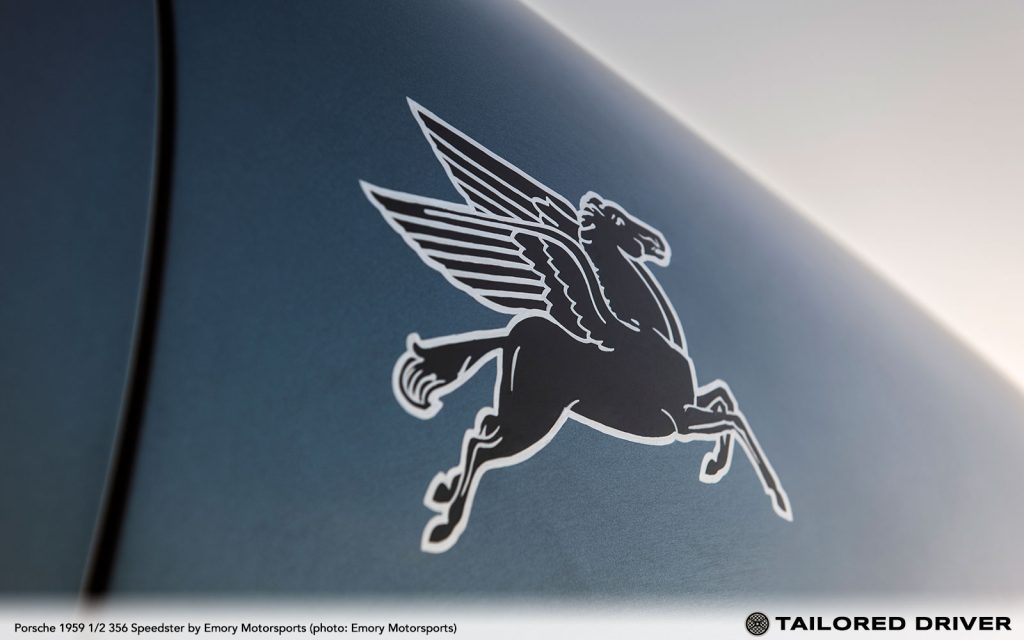
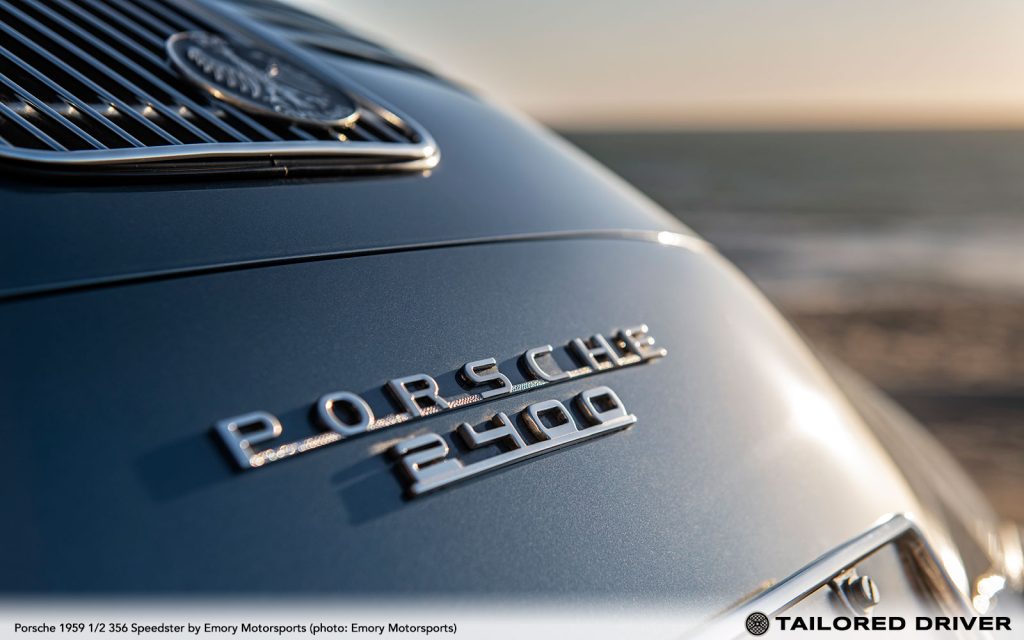
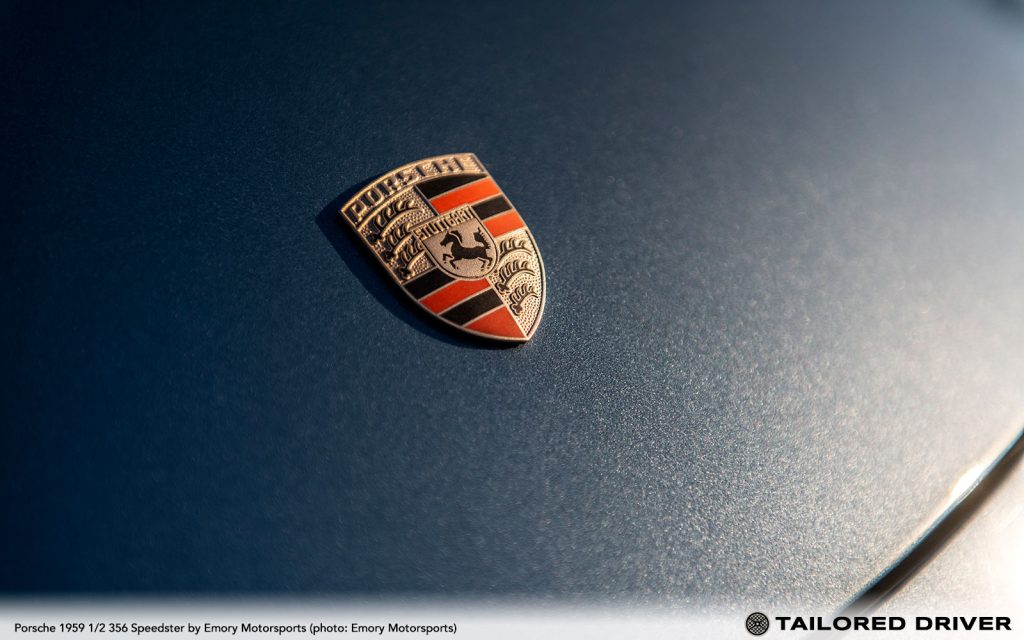
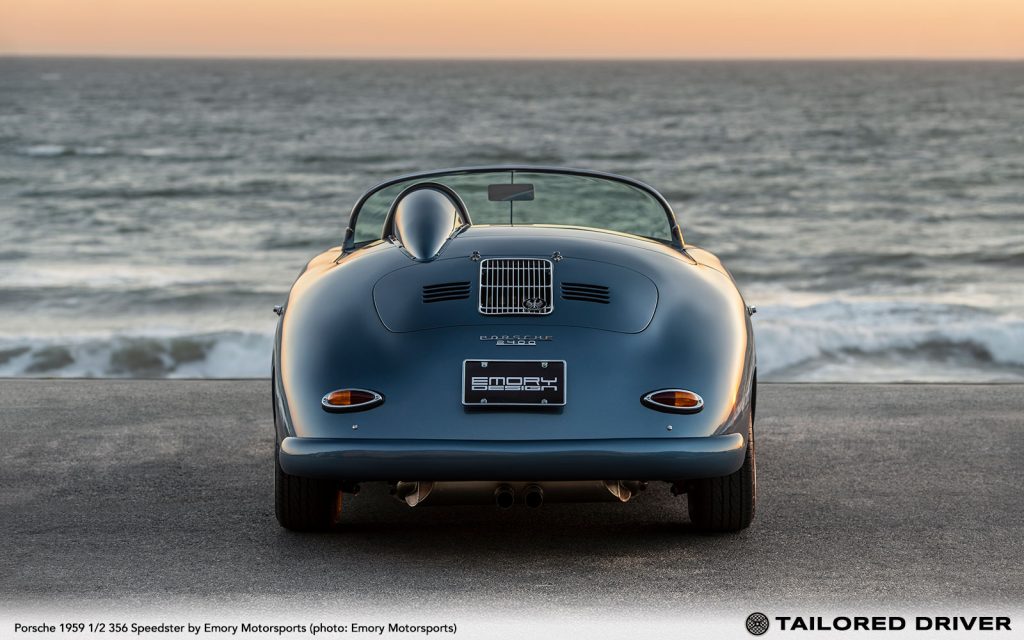
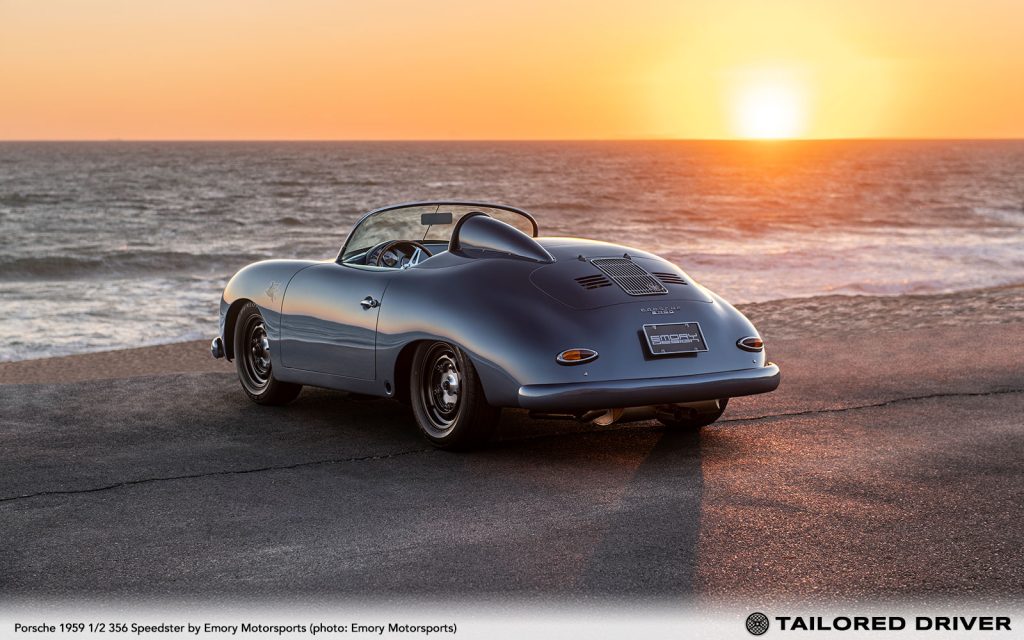
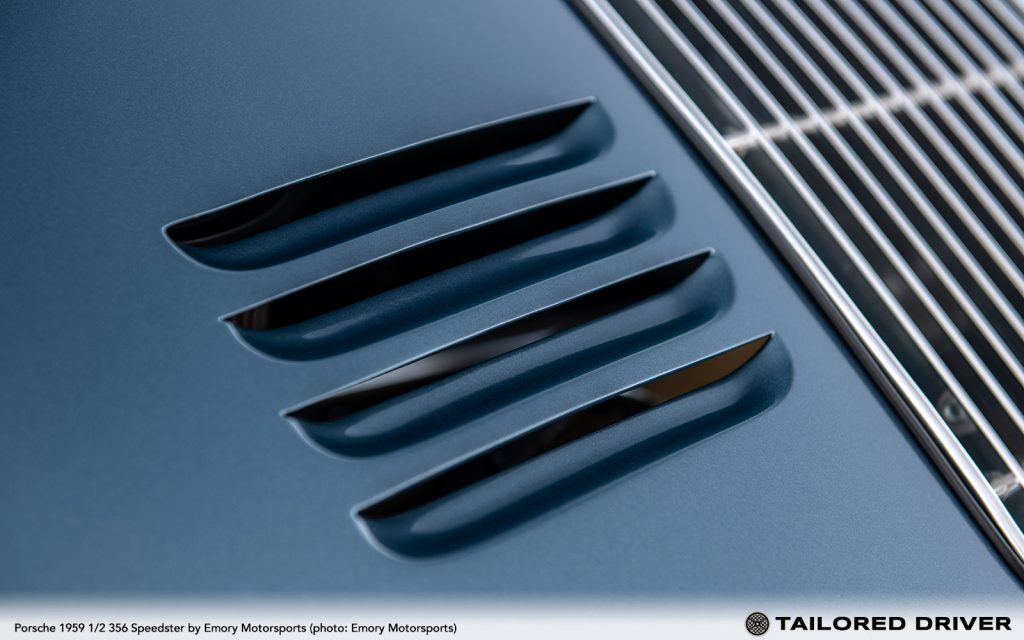
Because the 1956-61 A and B coupe sans roof lends itself nicely to a “Speedster treatment,” Emory Motorsports hand formed a racing-inspired aluminum tonneau cover and headrest fairing, perfectly mated to the integral headrest hoop and cage. Other exterior touches include body-hugging bumpers and an unusual reverse-louvered deck lid. Typical bonnet modifications include deleting the handle and adding fuel-filler access for the custom 18-gallon tank. The period-correct Aquamarine Metallic paint (aquamarinmetallic; metallic UNI; 5607; Porsche)was applied by Little Shop of Kustoms in Desert Hot Springs, California. This Outlaw enjoys a race-bred finishing touch, the iconic hand-painted Mobil Pegasus on the front fenders.
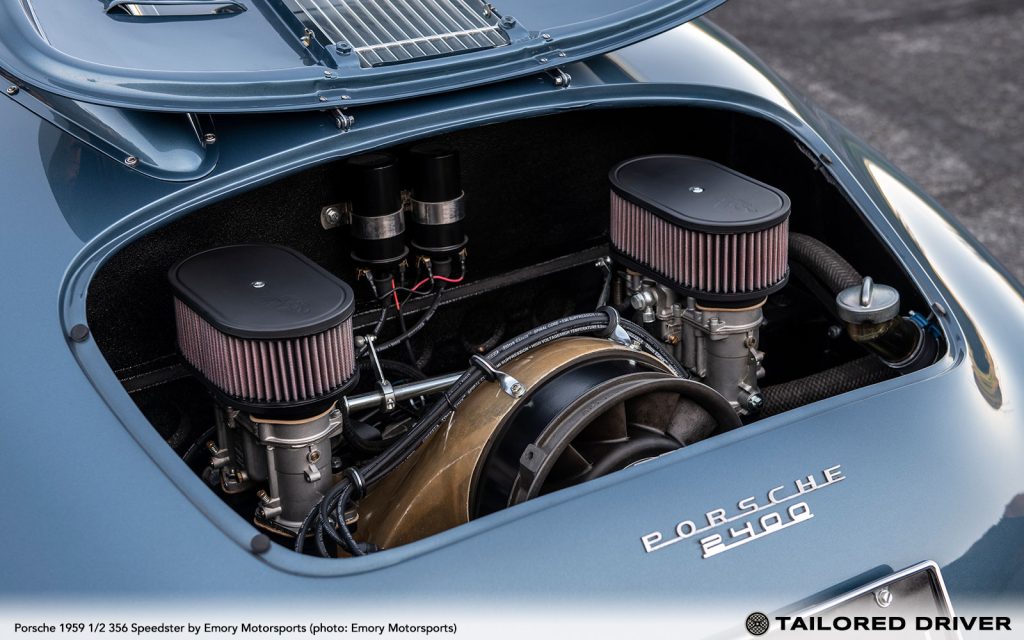
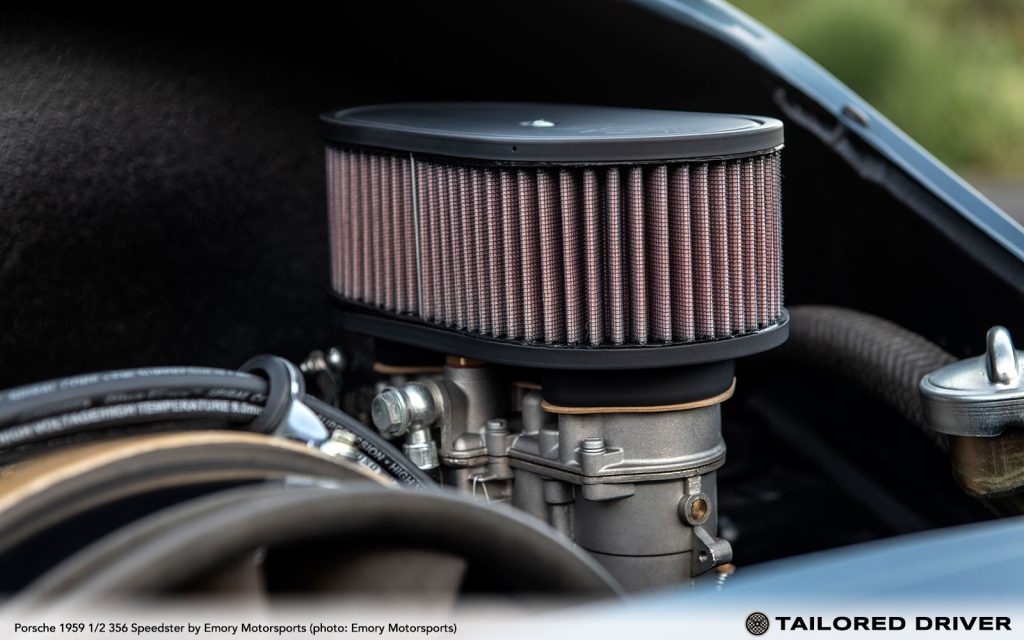
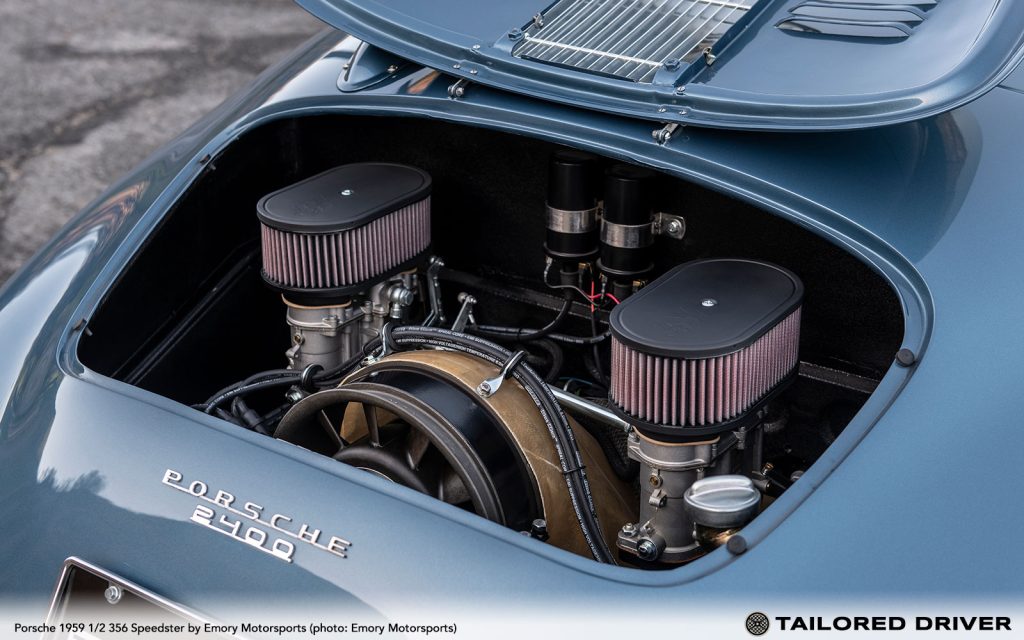
The Emory 1959½ “Transitional” Speedster is also significantly more powerful than its original 1600cc forbears. The proprietary Emory-Rothsport Outlaw-4 engine, co-developed with former Porsche GT racing crew chief Jeff Gamroth of Rothsport Racing, is standard equipment. This 4-cylinder, 2.4-liter displacement engine, fed by Weber 48 IDA carbs, delivers 205 horsepower. Spark is issued via an MSD ignition box through a bespoke twin-plug distributor, while the dry-sump engine is cooled in part by 14 quarts of oil in a 911-style full-flow arrangement. An aluminum-case 901 4-speed transmission delivers exhilarating speed for this lightweight platform.
The Outlaw Speedster’s chassis (and every Emory 356 Outlaw) was specially prepared to make maximum use of more than triple the standard power. Rear suspension was updated with modified 901-style IRS. Adjustable Koni dampers control the unsprung weight, and a pair of sway bars limit body roll during spirited cornering. The brakes were also upgraded to custom rotors and calipers that have 911-level stopping power. Power gets to the ground via 195/65R15 Dunlop SP 5000 tires on 15×5 Tecnomagnesio wheels, which are tastefully finished in satin-black powdercoat with brushed wheel hubs.
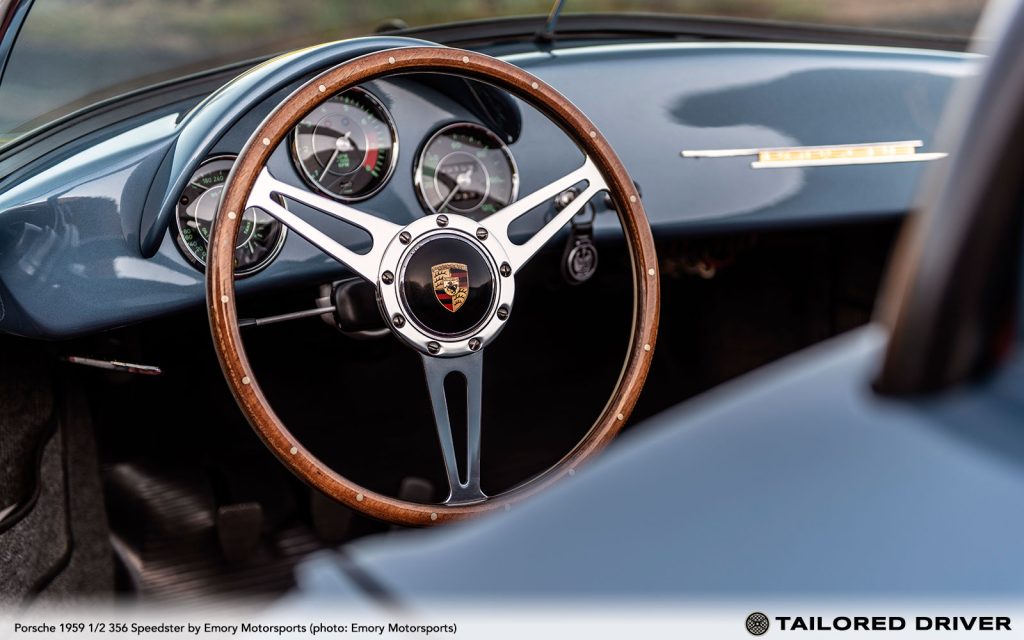
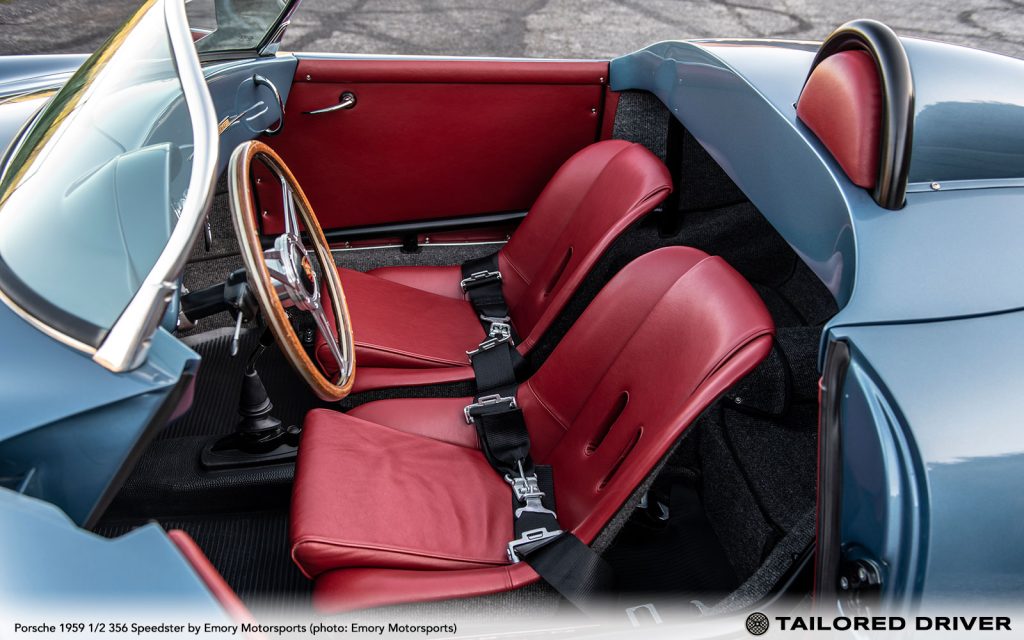
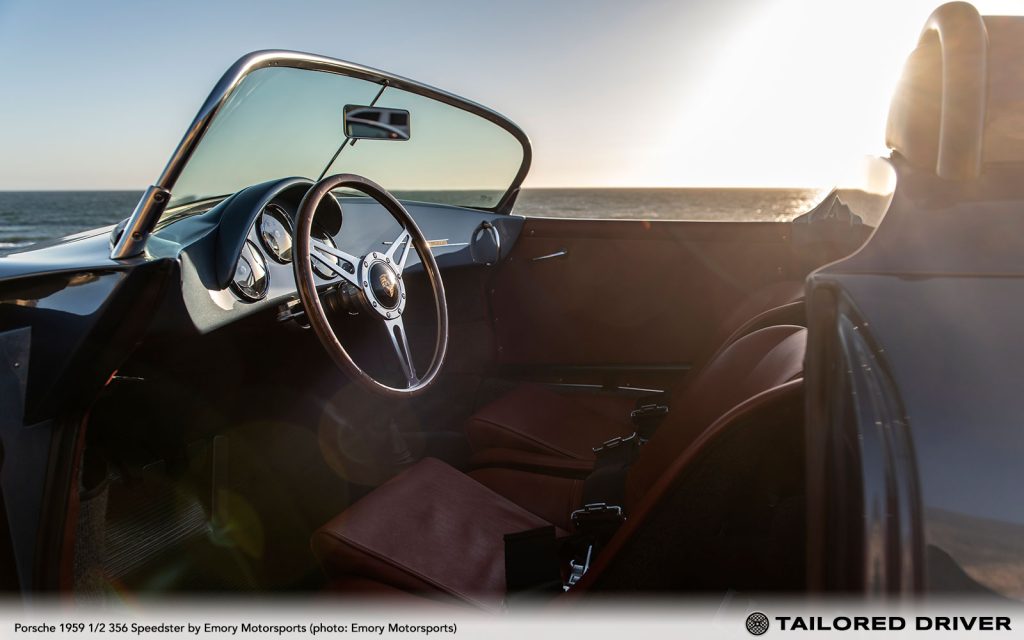
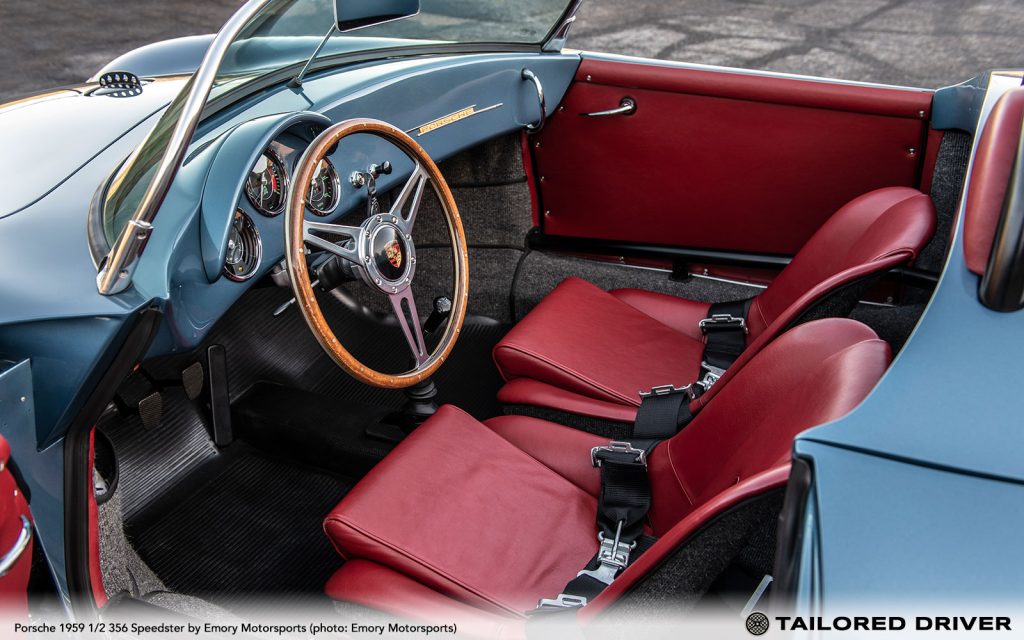
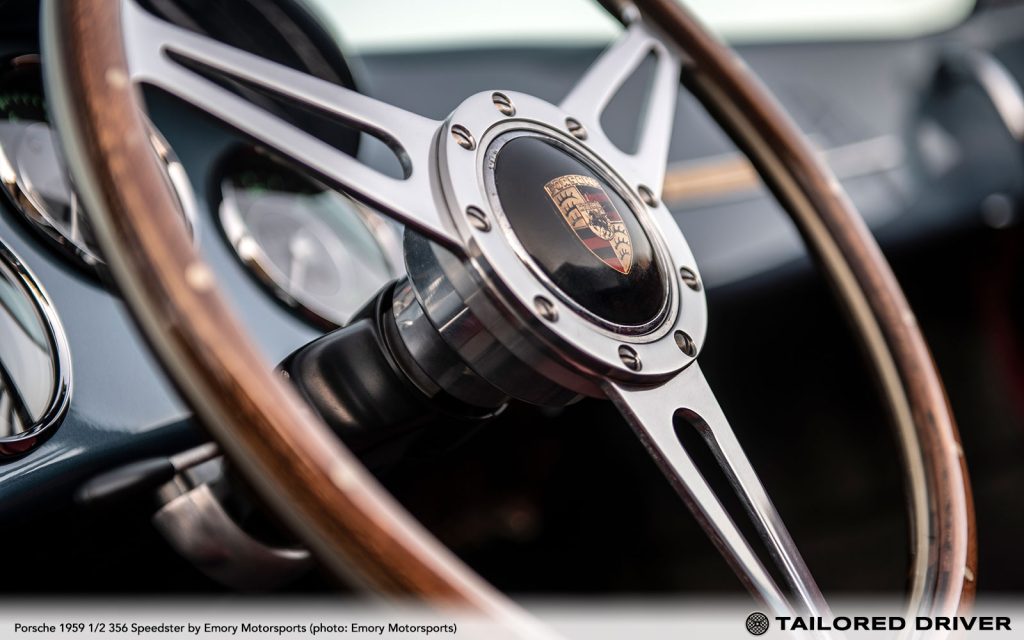
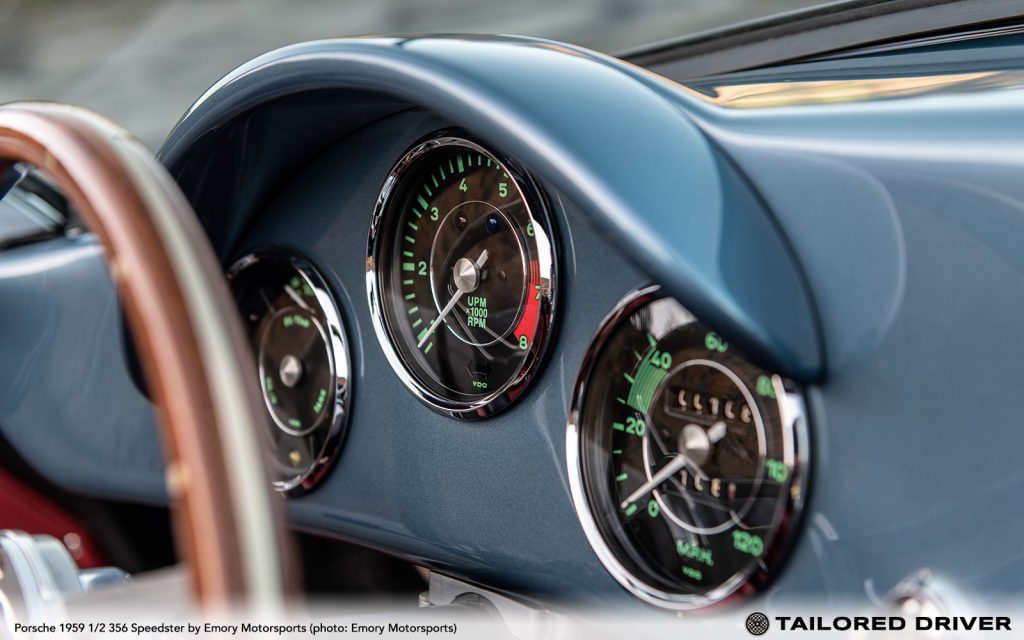
The Speedster aesthetic calls for a pristinely spartan interior which is clean and functional. Charcoal square-weave carpet gives the Hydes red leather upholstery additional pop. Speedster-style seats and dashboard seamlessly combine the old with the new. A 904-style triple gauge with speedo and tach provide a few extra data points to keep the driver informed while on the road. The interior is rounded out with black knobs and escutcheons, a Derrington steering wheel, and padded headrest.
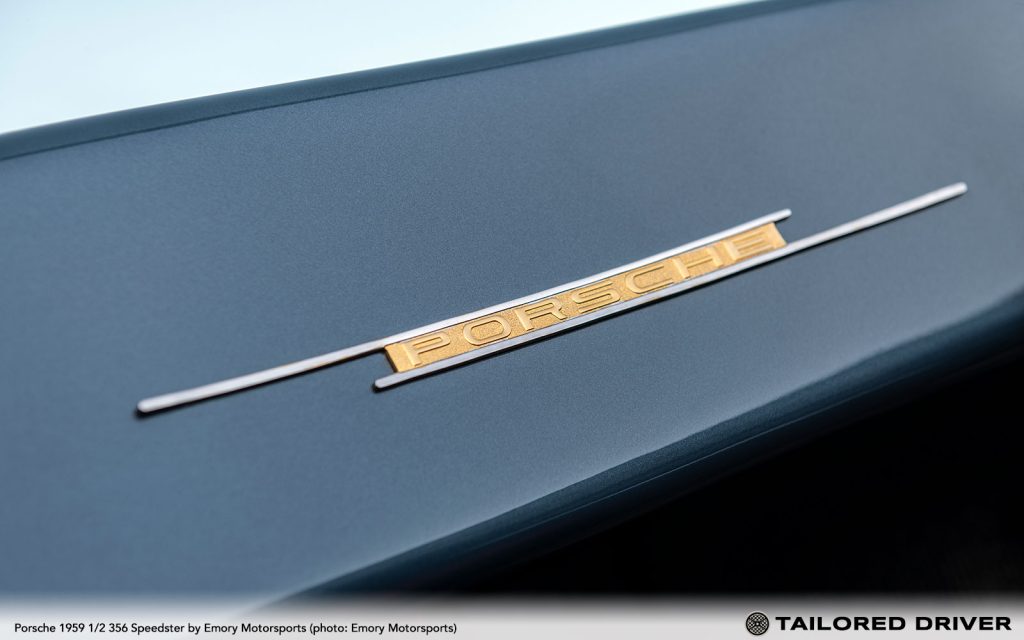
Reflecting on the Transitional Speedster, Rod Emory continues, “Porsche enthusiasts will notice that this build does not wear a “Speedster” emblem. This is a nod to the car’s coupé beginnings and to the idea that we are celebrating the best of what this car still had when we found it. The “1959½” designation also signifies how this car straddles model years and body styles. This Outlaw 356 illustrates just some of what is possible with our talented crew here at Emory Motorsports and the result is bringing new life to a car that would have been lost to history.”
For more information on Emory Motorsports, please call 971.241.7017 or visit EmoryMotorsports.com or @rodemory on Instagram.
#rodemory #emorymotorsports #emoryoutlawspeedster
#356outlaw #porsche356 #speedster #outlaw4
EMORY MOTORSPORTS 1959½ SPEEDSTER
Engine: 2.4-liter Emory-Rothsport “Outlaw-4” engine, full-flow oil system with remote filter and cooler, MSD twin-plug ignition with custom distributor, custom sport muffler, custom headers.
Power: 205 HP
Transaxle: 901 aluminum-case 4-speed.
Brakes: Proprietary 4-wheel discs with parking brake.
Suspension: 901 independent rear suspension with custom-narrowed trailing arms, Koni adjustable shocks, front and rear swaybars.
Tires: 195/65R15 Dunlop SP 5000
Wheels: 15×5 Tecnomagnesio with powder-coated satin-black finish, brushed wheel hubs.
Paint: Aquamarine metallic, hand-painted Mobil Pegasus.
Interior: Hydes red leather upholstery with carpeted seat backs, Speedster-style seats, padded headrest, 2-point competition harnesses, charcoal square-weave carpet with rubber floormats, black knobs and escutcheons, Derrington steering wheel, Speedster dashboard, 904 triple gauge.
Weight: 1,850 pounds.
About Emory Motorsports
Founded in 1996 by Amy and Rod Emory, Emory Motorsports initially provided turnkey prep, repairs, and logistics for vintage racers. When Rod Emory began doing custom builds, the company eventually evolved into one of the world’s leading resources for Porsche 356 customization and restoration.
Rod Emory’s automotive roots date to 1948, when his grandfather Neil Emory founded Valley Custom Shop. An innovator in body chopping and channeling, Neil Emory created the bodywork for the infamous land-speed record-holding SoCal Streamliner. Rod’s dad, Gary, created the first Baja Bug while working as parts manager at Chick Iverson Porsche in the 1960s. He later founded Porsche Parts Obsolete and became the go-to source for hard-to-find replacement parts.
Rod applied his grandfather’s sheet-metal fabrication skills and dad’s Porsche obsession and design sensibility to the 356 models. Porsche purists labeled the Emorys as ‘Outlaws’ when they dared attempt to enter shows in the 1990s with subtly modified cars that combined OE parts from different models. The Emorys happily became champions of the Porsche Outlaw movement. Since then, Emory Motorsports has stunningly rejuvenated more than 180 Porsche 356s and a few early 911s. The company also meticulously restored what is now regarded as the most historically significant Porsche ever, a 356 SL Gmund that took a class victory at the 1951 24 Hours of Le Mans–Porsche’s first international race win.
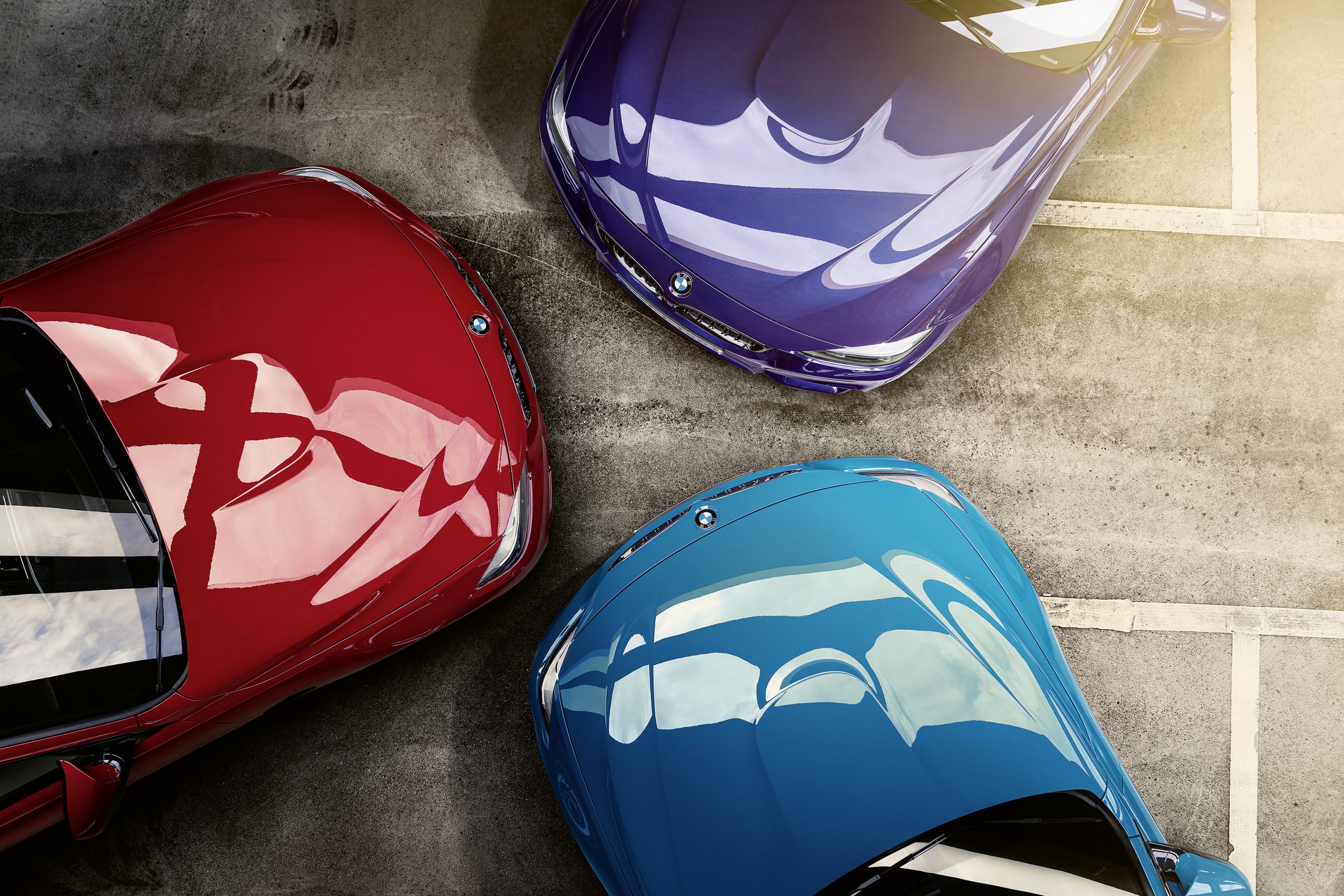
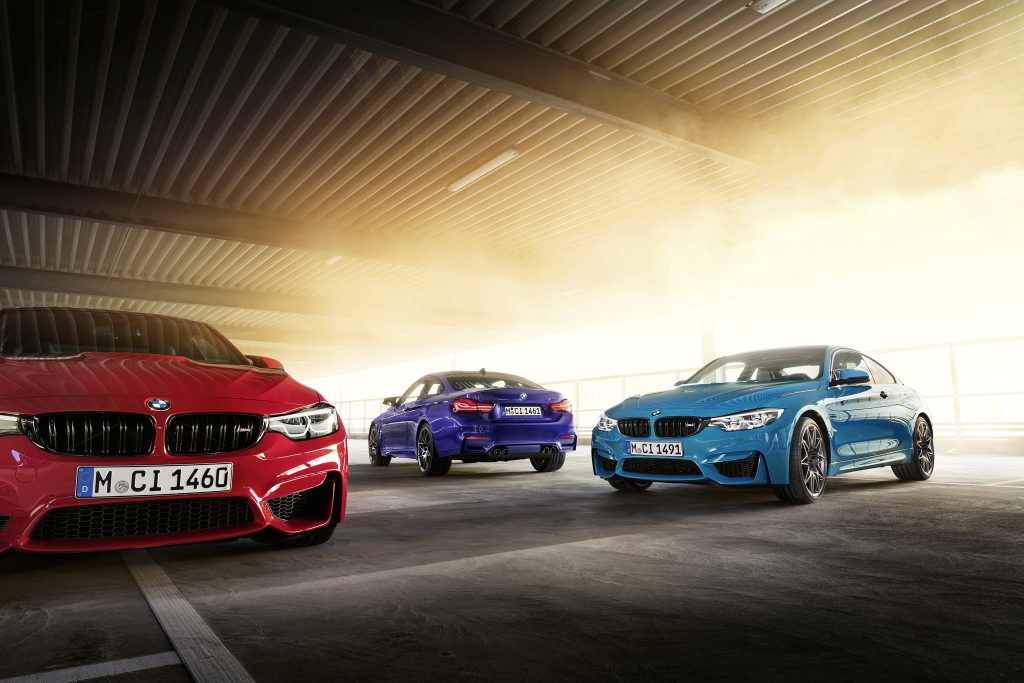
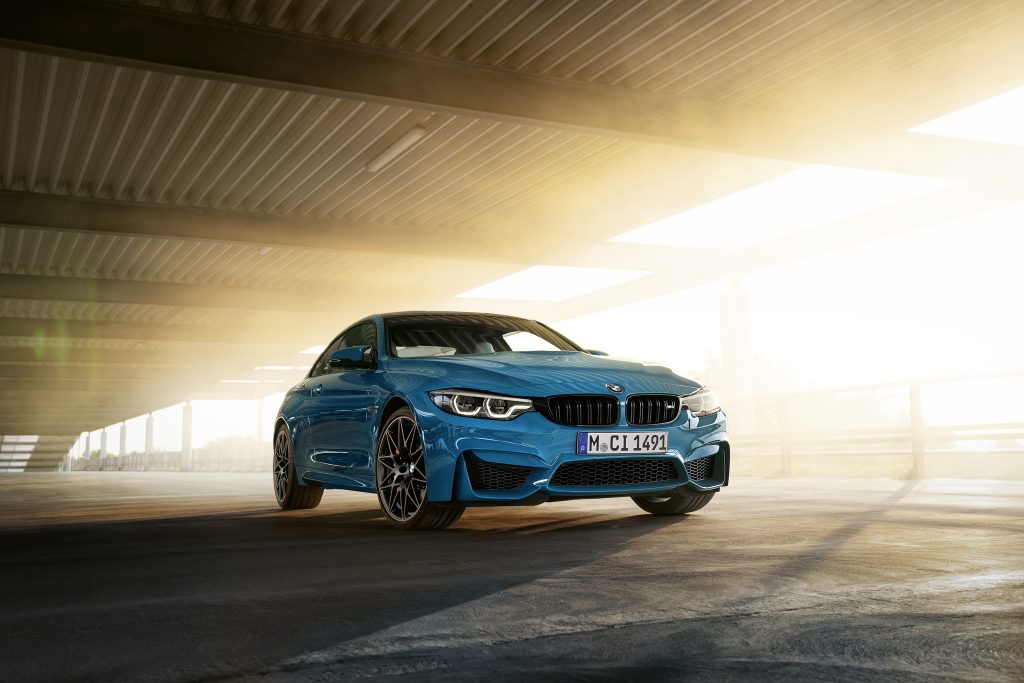
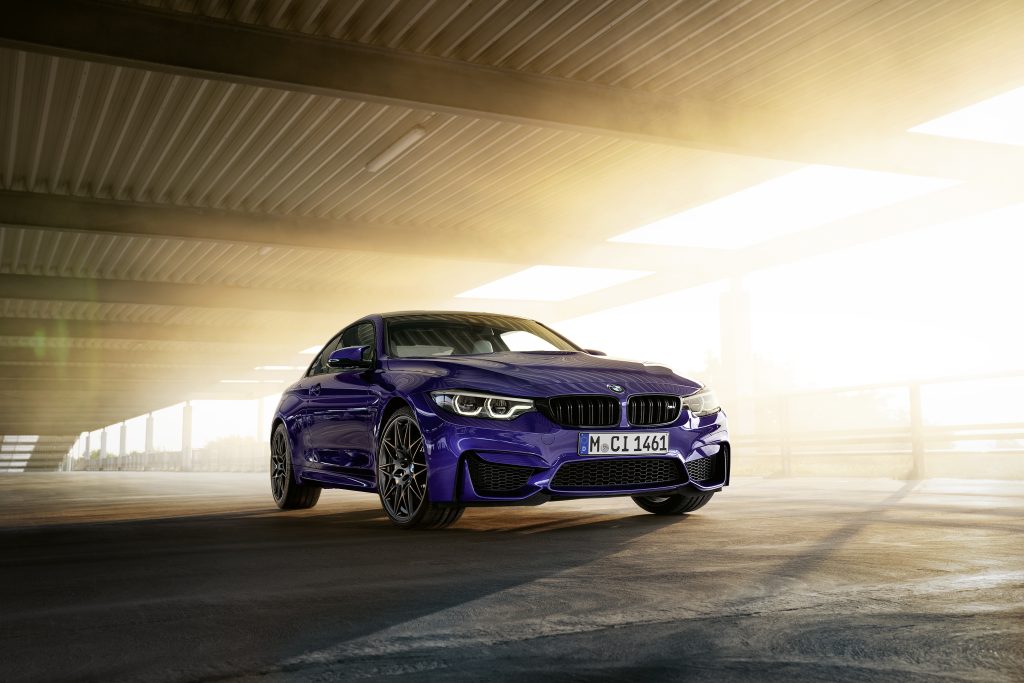
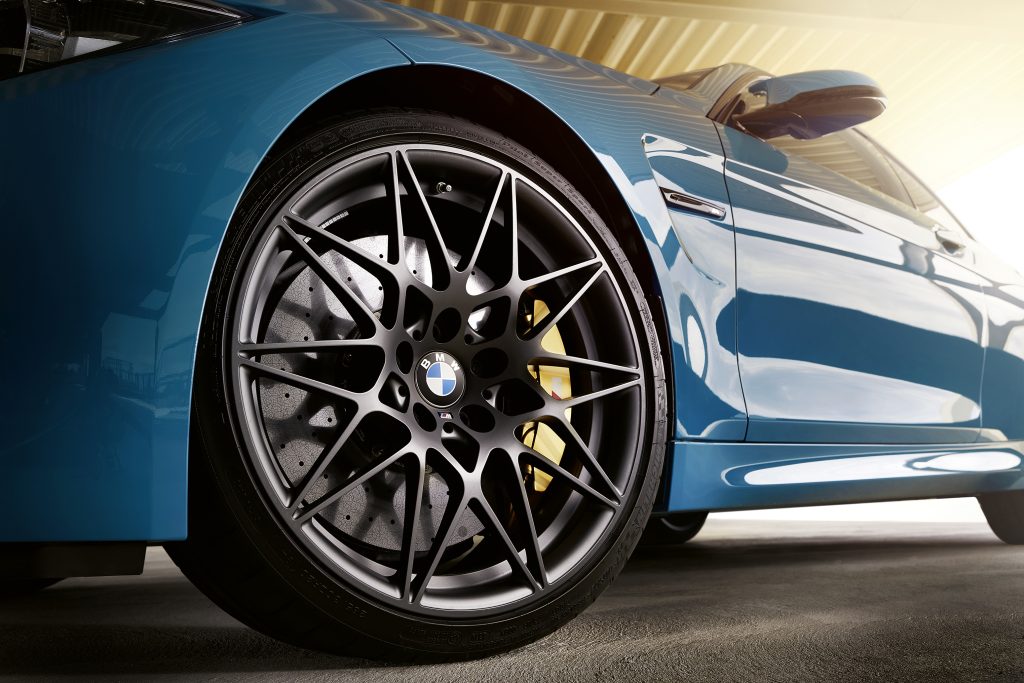
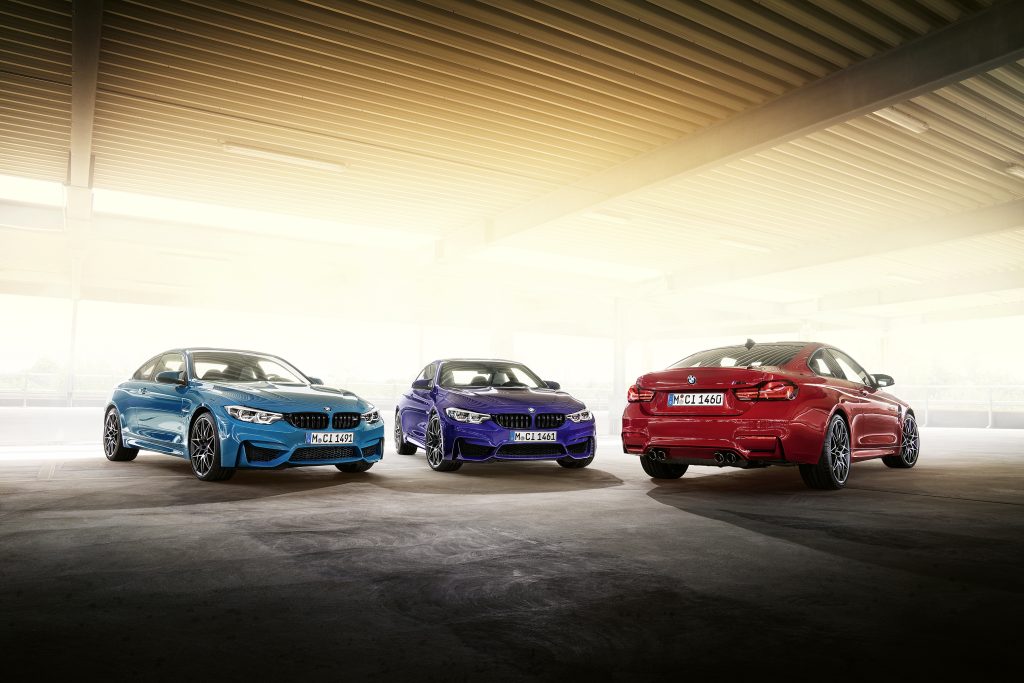
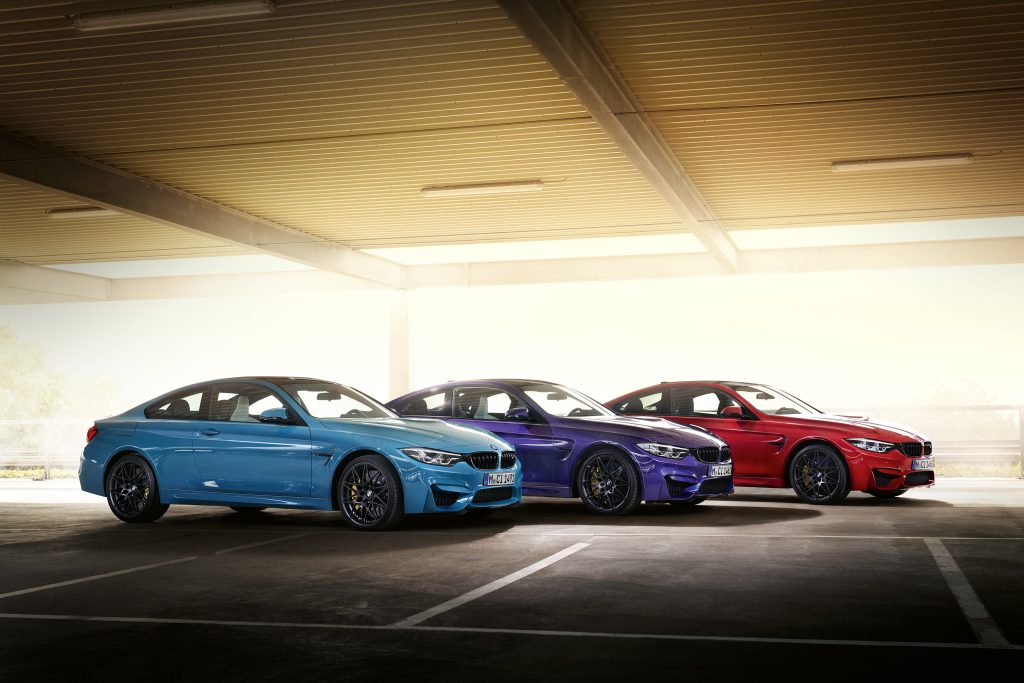
BMW M GmbH continues the series of attractive edition models with 750 limited-edition BMW M4 Coupes – body colours in special exclusive M colours and a unique interior design to match – world premiere during the DTM racing event on the Nürburgring.
[source: BMW AG]
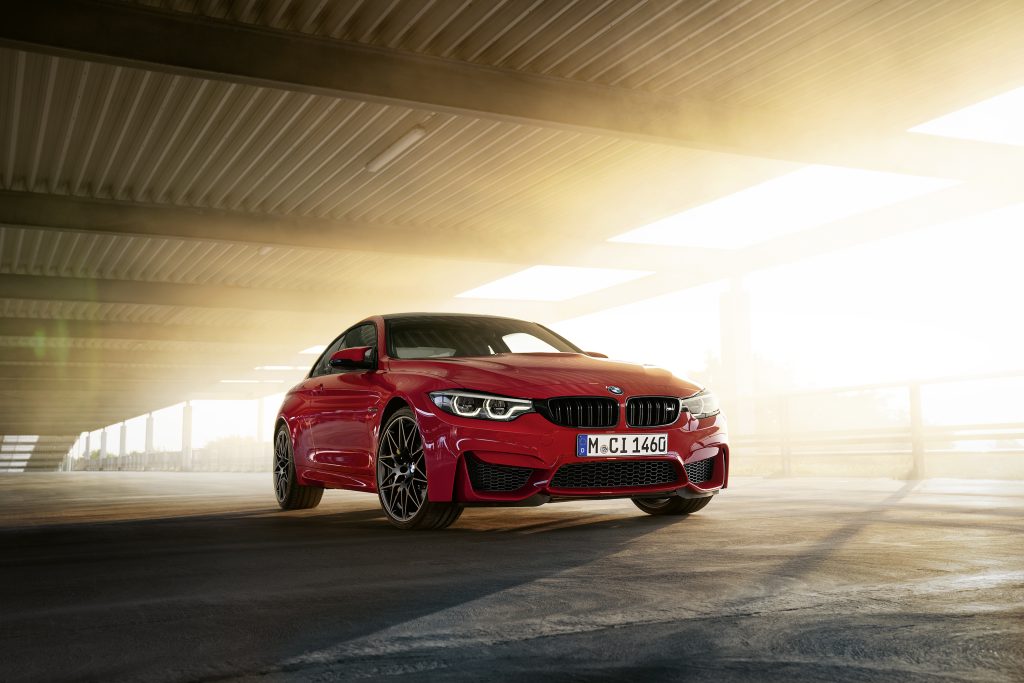
Munich. With the forthcoming races on the Nürburgring the current German Touring Car Masters (DTM) season will finally reach its decisive phase. Moreover, during the DTM weekend being held from 13 to 15 September 2019, visitors can expect a further attraction. The BMW M4 Edition ///M Heritage (combined fuel consumption: 10.0 – 9.3 l/100 km; combined CO2 emissions: 227 – 213 g/km) will make its world debut on the legendary racetrack in the Eifel. The special edition of the BMW M4 Coupe, which forms the basis of the BMW M4 DTM deployed by BMW M Motorsport, fascinates with an exclusive exterior and interior look reflecting the impressive tradition of the high-performance racing cars. The BMW M4 Edition ///M Heritage, powered by a 331 kW/450 hp straight six-cylinder engine with M TwinPower Turbo technology will be produced and sold worldwide between November 2019 and April 2020 as an edition model limited to 750 units.
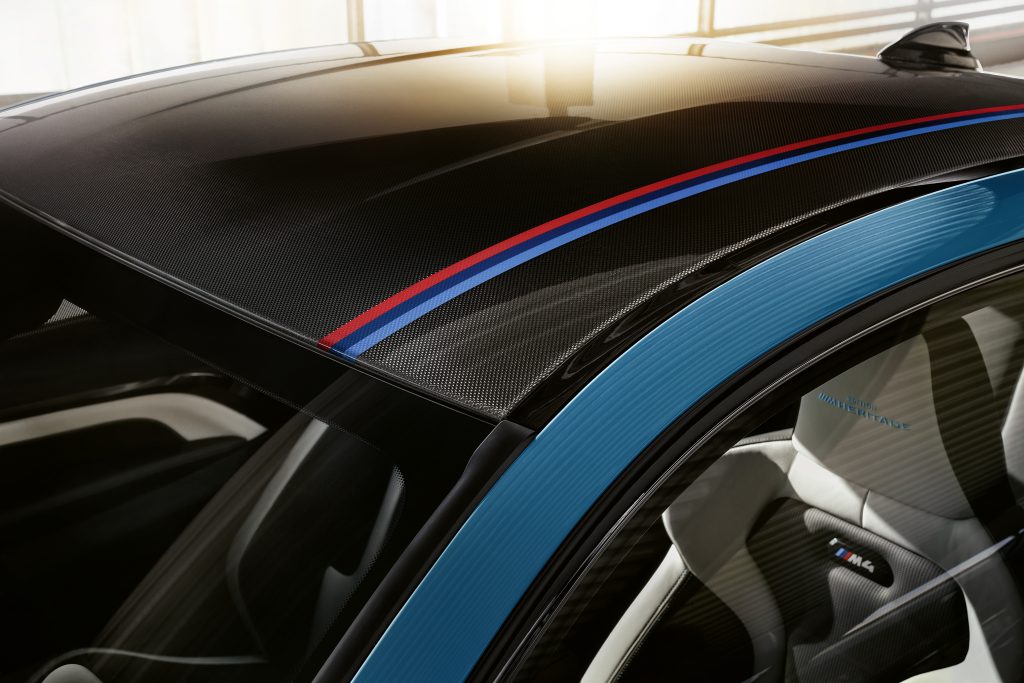
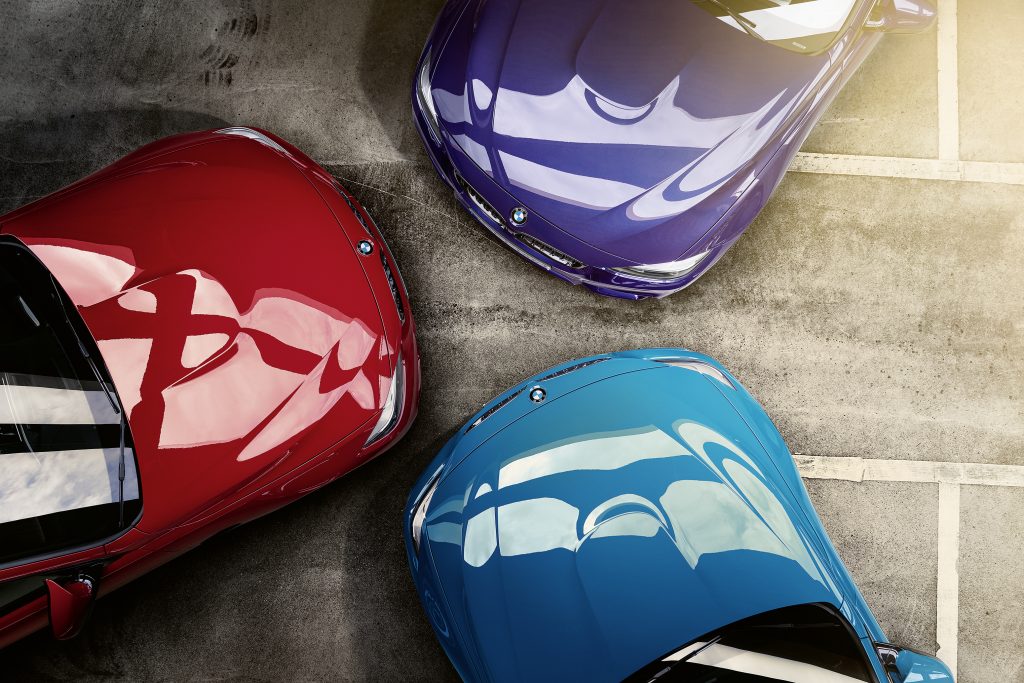
Light blue, dark blue and red – these are the colours by which motorsport fans immediately recognize the BMW M GmbH logo. Immediately after the founding of the BMW Motorsport GmbH in 1972, the characteristic colours already adorned these racing cars, which were based on the BMW 3.0 CSL and became highly successful in touring car racing. Since then, the distinctive stripes in the three classic BMW M GmbH colours have stood for exhilarating performance and exclusive design also on the road. The BMW M4 Edition///M Heritage takes up this unmistakable colour combination on unique exterior and interior design features. There is a choice of the three body colours Laguna Seca Blue (lagunasecablau; non-metallic uni; 448; BMW), Velvet Blue metallic (velvetblau; metallic; 379; BMW) and Imola Red (imolarot; non-metallic uni; 405; BMW) available for the edition model. Furthermore, the two-seater’s carbon-fibre reinforced plastic roof boasts a striking decorative strip in the BMW M colours, which is integrated into the CFRP composite at the factory using a special manufacturing process. Likewise unique are the forged, 20-inch M light alloy wheels in a star spoke design featuring the colour Orbit Grey matt and fitted with mixed tyres.
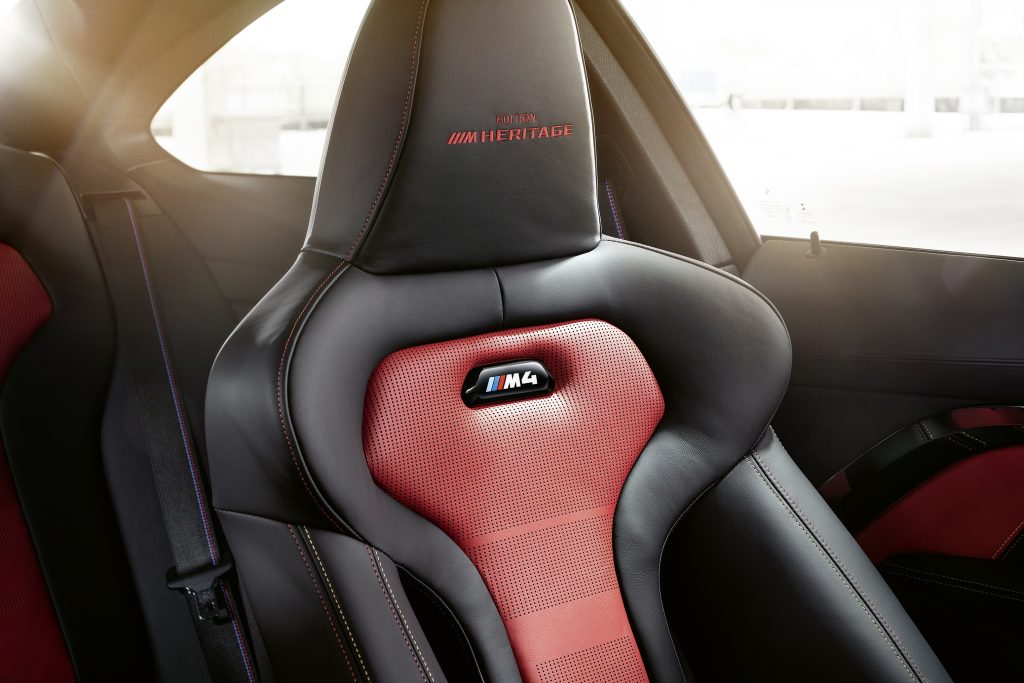
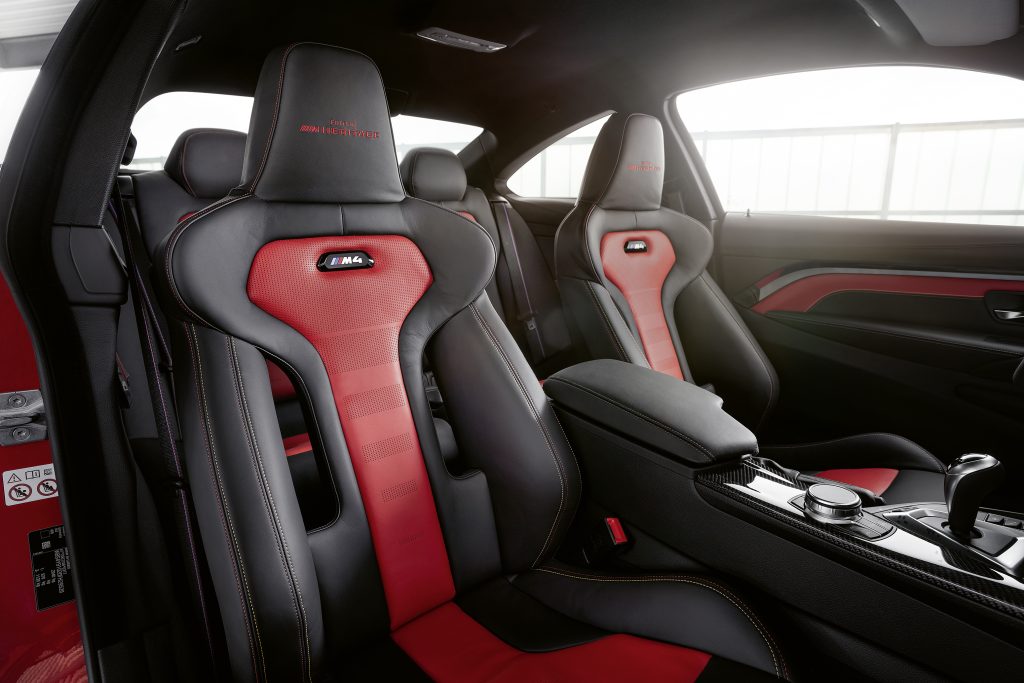
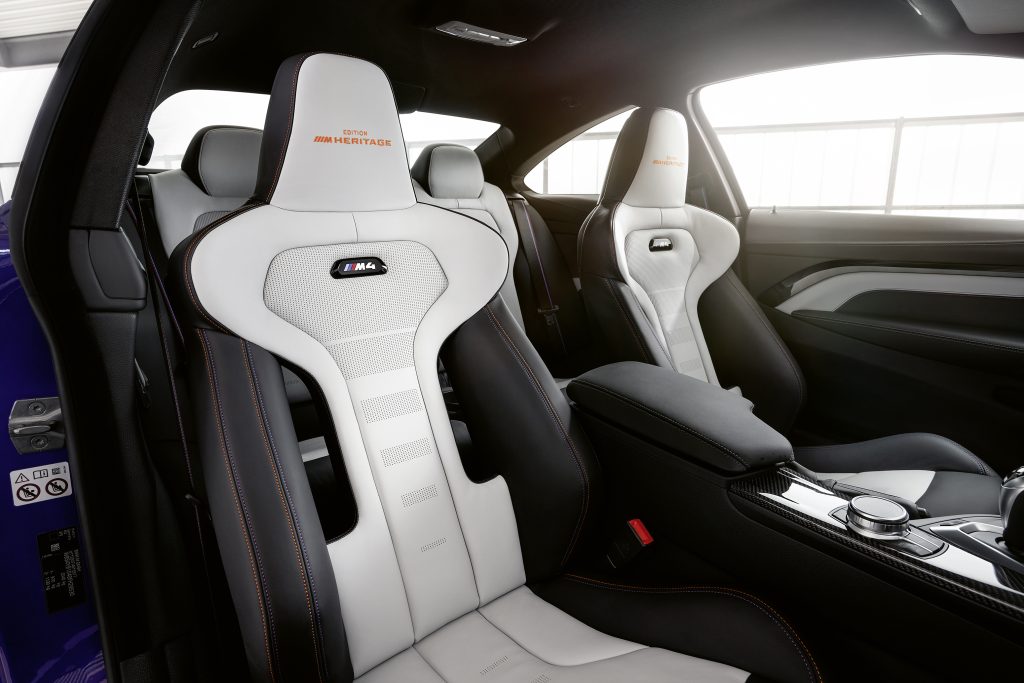
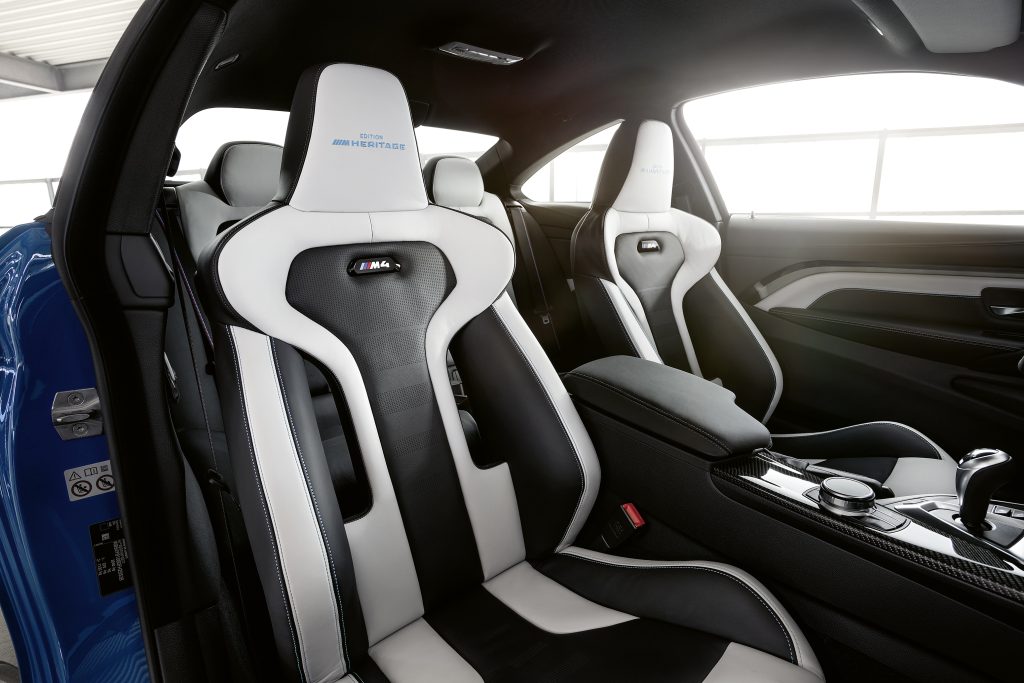
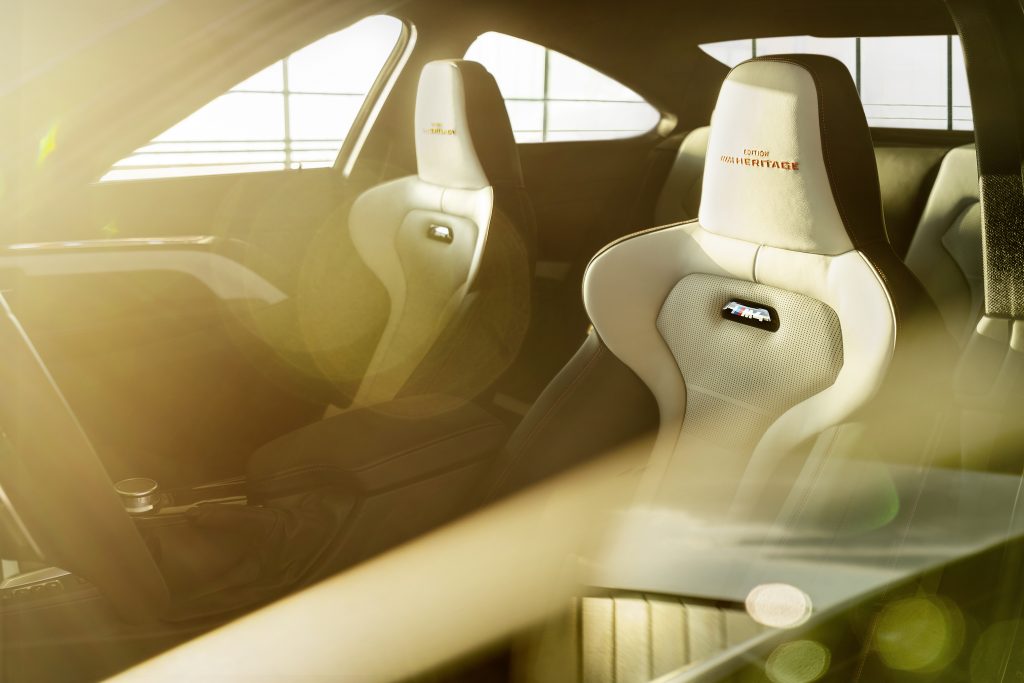
The interior of the edition model is also characterised by an exclusive selection of colours and materials. The spectrum of equipment includes model-specific full leather M seats in a bicolour design and with prominent openings within the area of the seatbacks. Each seat colour is oriented towards the exterior paint and is complemented by partly bicoloured contrast stitching. In conjunction with the exterior colours Laguna Seca Blue and Velvet Blue metallic, the seats come in Silverstone/Black with turquoise stitching or Velvet Blue and Orange respectively. With the exterior finish Imola Red, the seat colours Red and Black correspond with yellow and red contrast stitching.
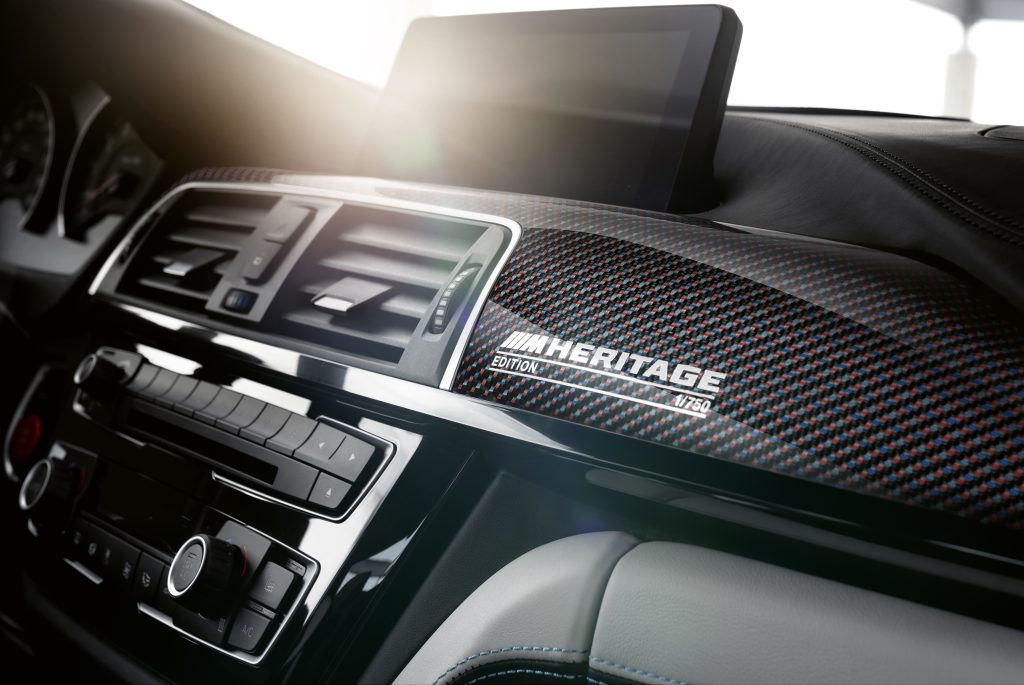
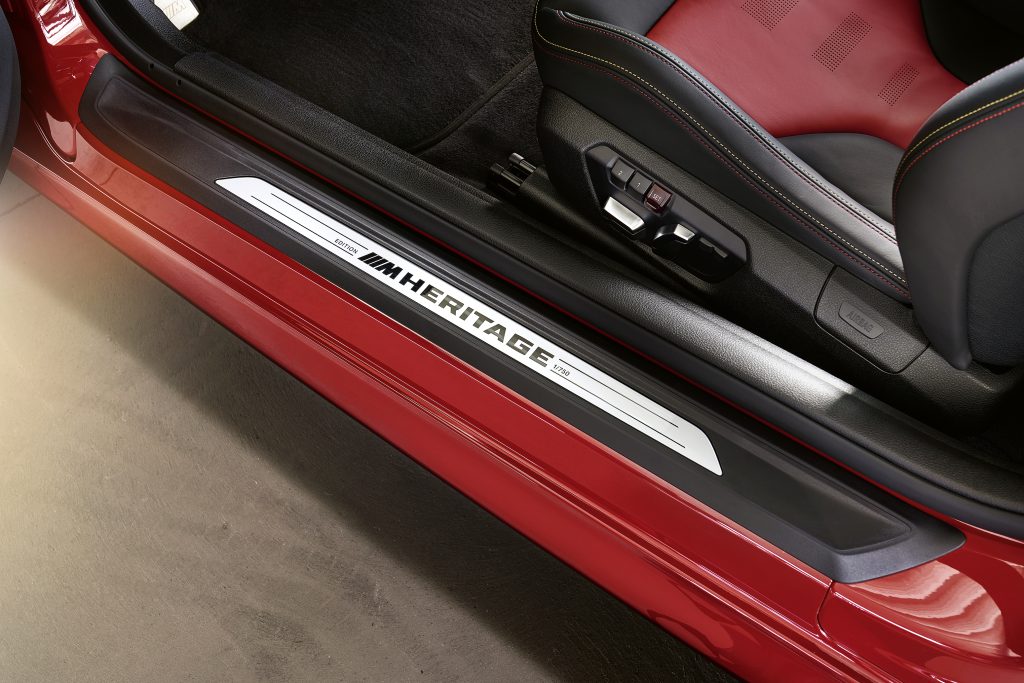
The both appealing and exclusive colour scheme continues with interior carbon trim strips designed exclusively for the BMW M4 Edition ///M Heritage and whose CFRP structure incorporates the stripe design featuring the three characteristic M colours. Both the interior trim strips and the door sills bear emblems with the imprints “Edition ///M Heritage” and “1/750” as an indication of the limited edition of this model. The lettering “///M Heritage” – in turquoise, orange or red respectively – is also to be found on the front headrests.
The BMW M4 Edition ///M Heritage offers a particularly exclusive opportunity to experience the handling characteristics of a high-performance sports car marked by dynamics, agility and precision. At the same time, with this model, the BMW M GmbH is continuing the tradition of exclusive special editions, a tradition that has been cultivated now for several model generations. They reflect the enthusiasm for exceptional sporting successes or awareness of the history of selected models, of which many have become much sought-after collectors’ items in the course of time.
Expressive paint finishes and a characteristic interior design were already hallmarks of the BMW M3 Edition of the year 2009. At that time, with the variants Alpine White, Black, Dakar Yellow and Monte Carlo Blue there were as many as four body colours available for the edition model based on the fourth generation of the BMW M3. In the year 2012, BMW Motorsport’s successful comeback in the DTM triggered the production of the BMW M3 DTM Champion Edition. During the first season following an almost 20-year break, BMW came first in the manufacturer’s rating, with the BMW Team Schnitzer winning the team classification. Moreover, the Canadian Bruno Spengler seized the driver’s title. Only 54 units of the edition model were produced – one for each racing victory BMW was able to clinch in the DTM by then. And there were several more in the years that followed. In the 2016 season, it was the German BMW Motorsport works driver Marco Wittmann in particular who was hard to beat and who eventually became the new DTM champion. The BMW M4 DTM Champion Edition, which was limited to 200 units, was brought to market in his honour. The strongly racing-oriented special edition not only exhibited exclusive design features but, above all, was provided with numerous innovations that had previously helped the 368 kW/500 hp BMW M4 GTS achieve its outstanding performance.
The same year, BMW M GmbH also presented an edition model of the BMW M3 Sedan in memory of the BMW M3, which had made its debut three decades previously. The special edition 30 Years M3 was finished exclusively in the colour Macao Blue metallic and produced in a limited quantity of 500 units. The latest example to date of a fascinating combination of performance and exclusiveness is the BMW M4 Convertible Edition 30 Years. This open-top high performance sports car was produced in a limited edition of 300 and presented in 2018 – three decades after the premiere of the first-generation BMW M3 Convertible. This edition model also featured exclusive paint finishes – namely Macao Blue metallic and Mandarin II uni – and a specific interior design, providing for unique and aesthetic driving pleasure both on country roads and on the racetrack.
From 12 August to 14 August, the AvD Oldtimer Grand Prix will attract many auto fans to the Nürburgring. Porsche will be there as well and showcase not only classics but also a special edition of the 911 Targa 4S.
[source: Porsche AG]
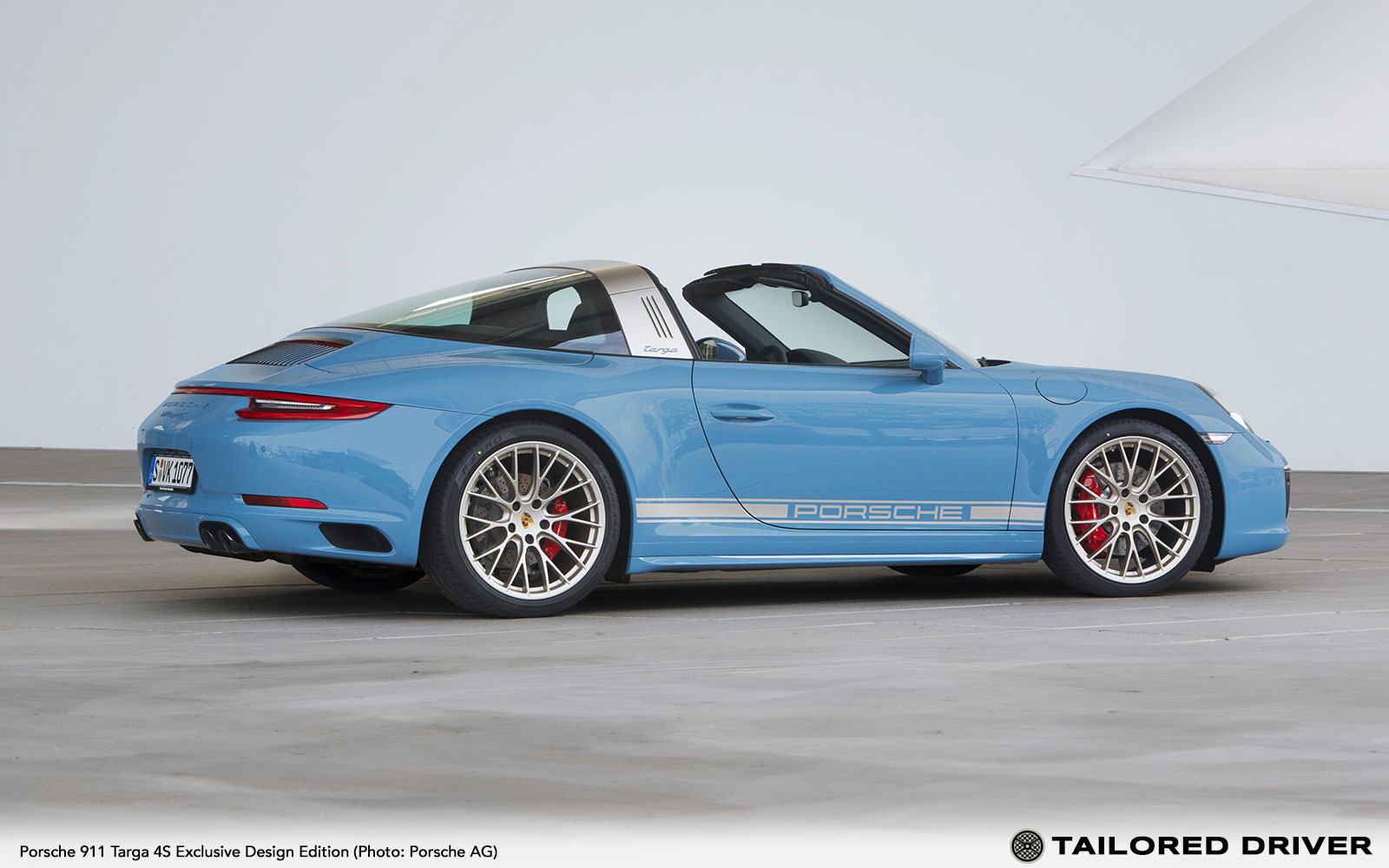
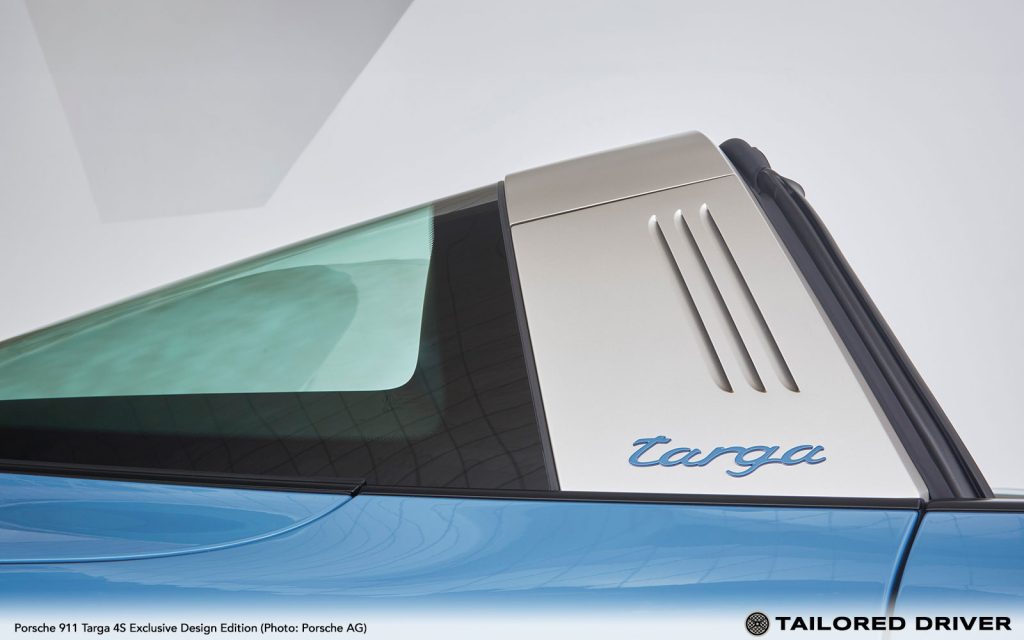
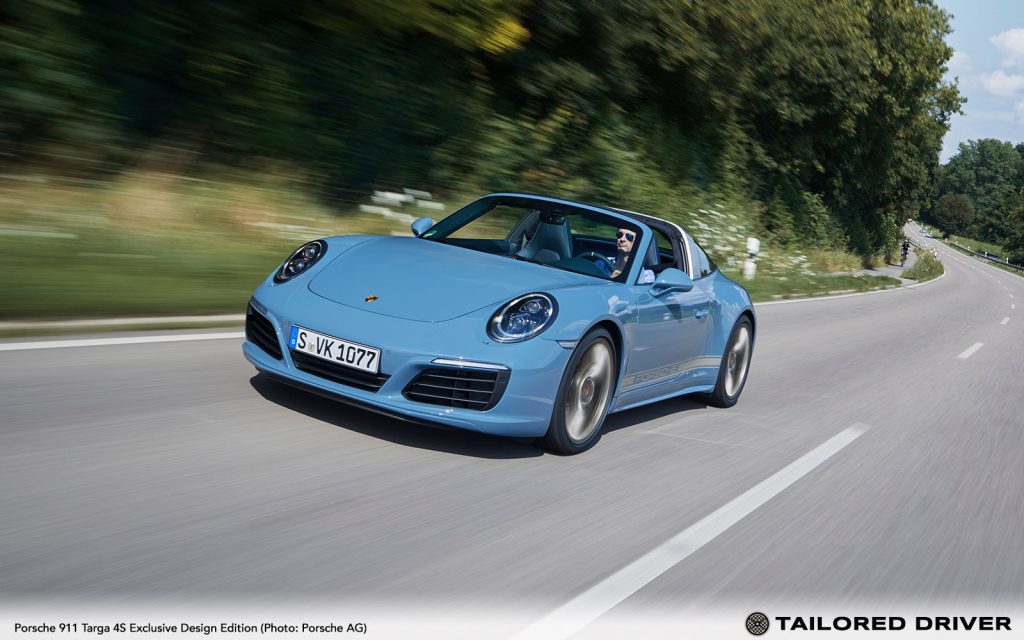
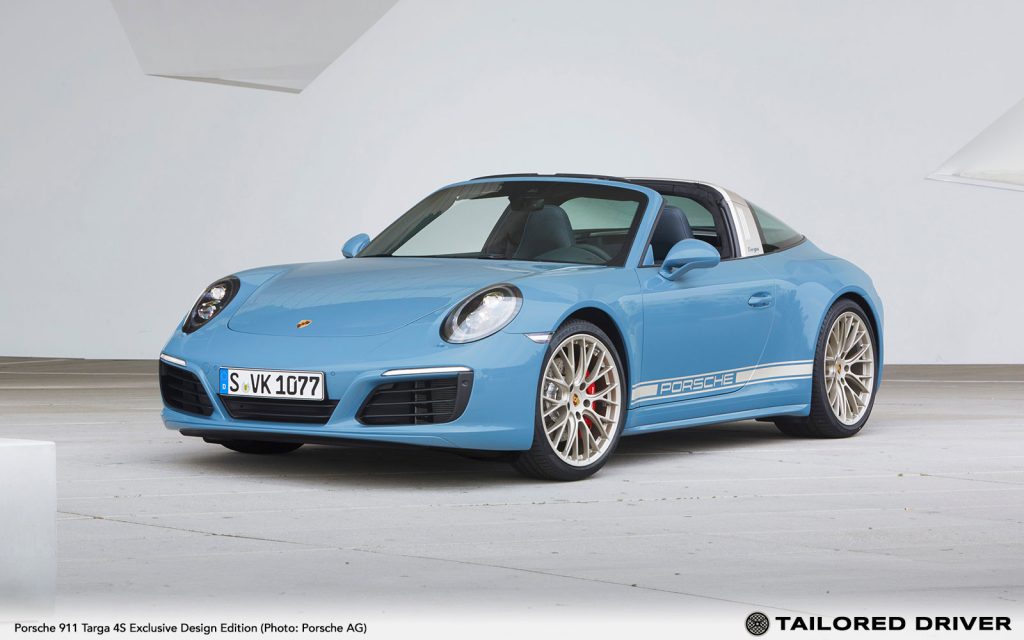
The 911 Targa is the modern classic in the 911 range. Porsche Exclusive has now further refined the vehicle’s distinct style and has developed the 911 Targa 4S Exclusive Design Edition. This collector’s item is presented in etna blue (solid), the standard colour for the 356 B (T5) in 1960 and 1961, with numerous elements coloured in white gold metallic (satin finish). The unique colour combination of the exclusive Targa also continues in the vehicle interior. The interior is graced by high-quality, enhanced equipment with many luxurious, hand-finished details. Powered by a 309-kW bi-turbo boxer engine (420-hp; 911 Targa 4S: Combined fuel consumption*: 9,0-8,0 l/100 km; Combined CO2-Emission*: 208-184 g/km), the special edition is only available for a short time.
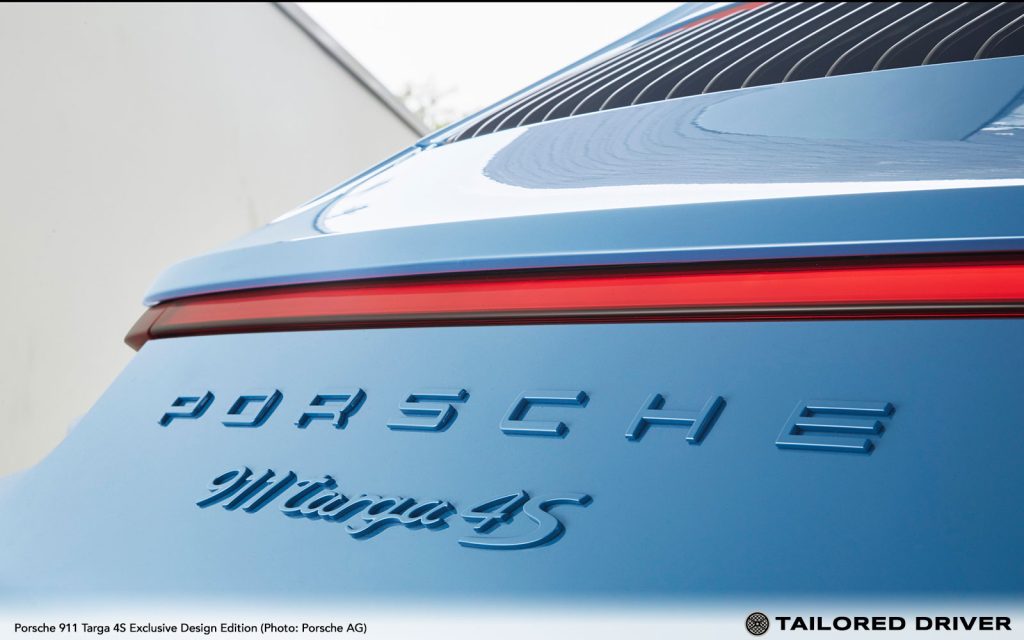
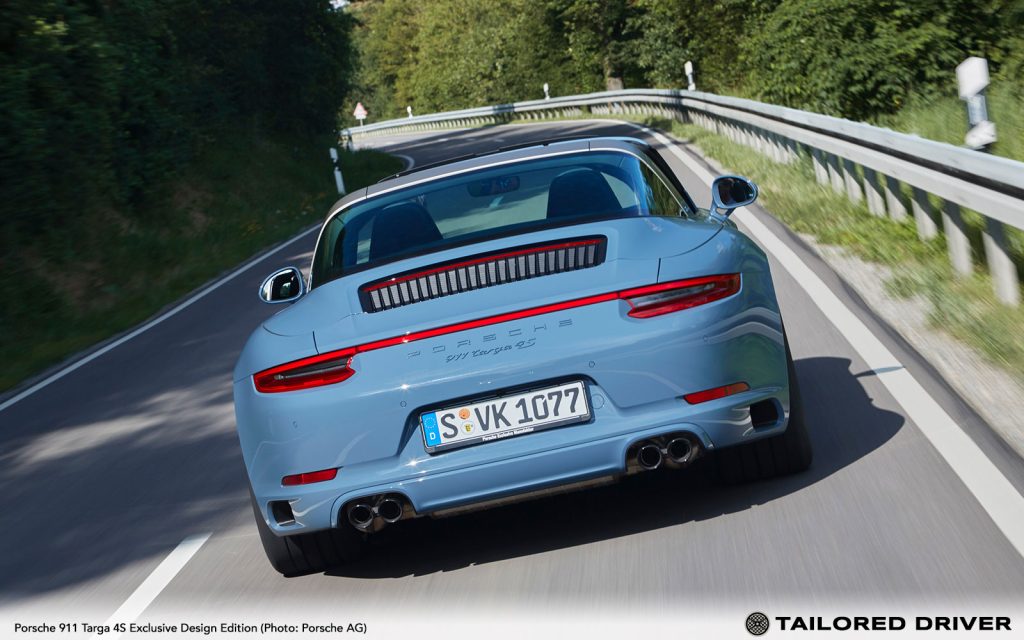
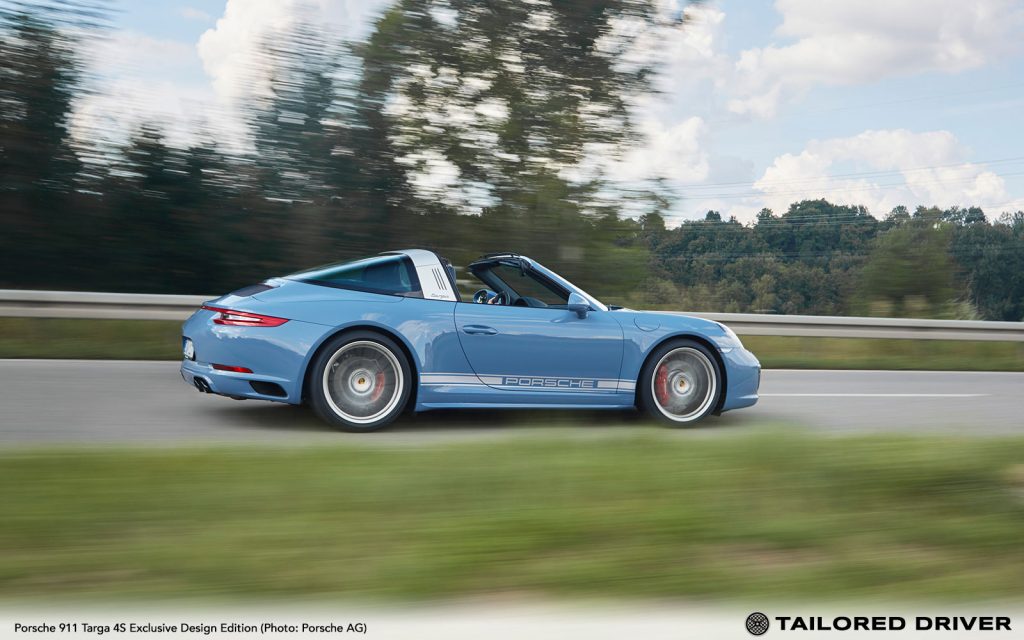
Many exterior details, such as the front spoiler, covers for the headlight washer system and “targa” logo on the Targa bar, are painted in the vehicle colour, with the black LED headlights providing an eye-catching contrast at the front. The Targa bar, 20-inch RS Spyder wheels and the decorative Porsche side logo glisten in white gold metallic. At the rear, the rear apron, the Porsche logo and the model designation are also coloured in etna blue (solid), while the rear lid grille and quadruple sports tailpipes are coloured black to deliver a dynamic contrast.
For 30 years, Porsche Exclusive has strived to deliver individuality
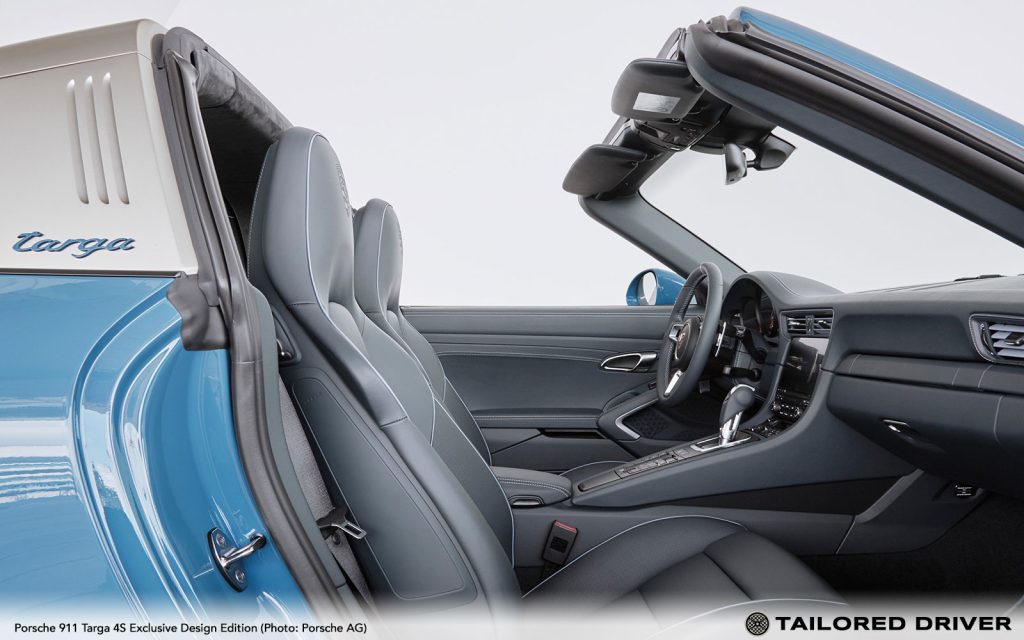
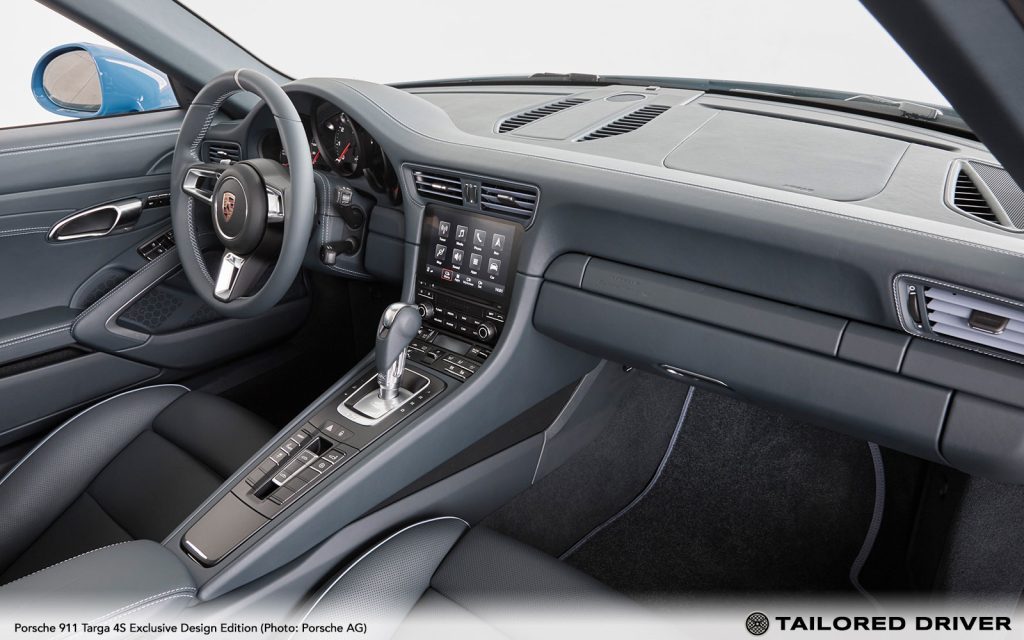
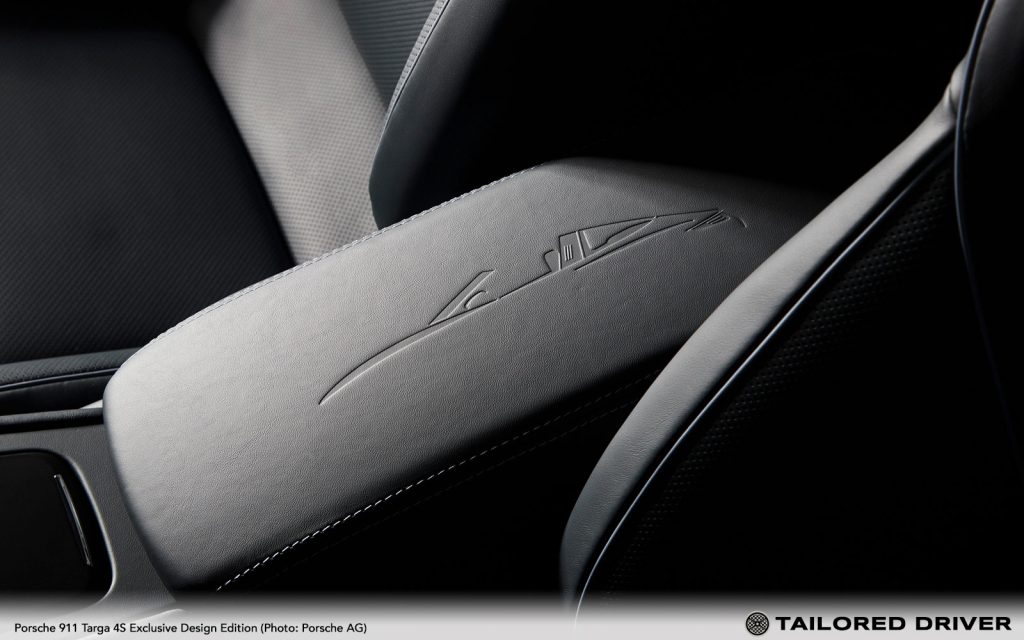
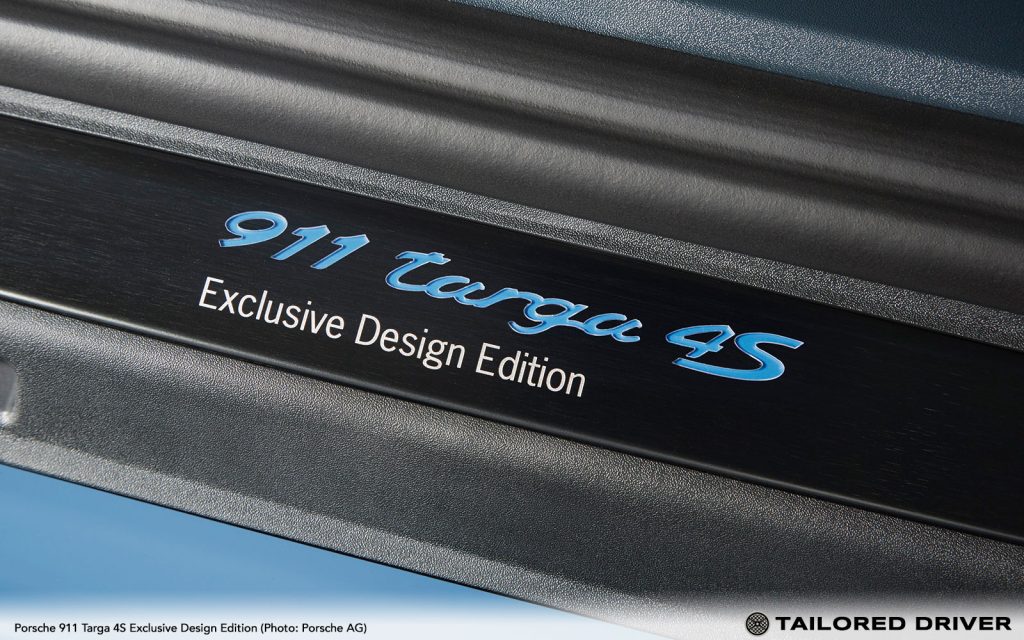
The interior of the 911 Targa 4S Exclusive Design Edition features door entry guards that are made from black, anodised stainless steel and bear the name of the edition. The first line “911 targa 4S” is illuminated in blue, while the second line “Exclusive Design Edition” is etched into the black steel. Luxurious comfort awaits the driver and passenger thanks to a high-quality, graphite-blue leather interior with adaptive Sports seats Plus and 18-way adjustment. The headrests are embossed with the Porsche logo and a 911 Targa silhouette adorns the cover of the storage compartment in the centre console. The lettering “Porsche Exclusive Manufaktur” on the trim of the dashboard highlights the vehicles exclusive origin. The decorative stitching of the seat leather, air nozzle slats and floor mat trim are all presented in Provence blue. The comprehensive refinement also includes leather trim on the seat backrests, steering column casing, parts of the dashboard and air nozzles.
Following their assembly, all vehicles are hand-finished on the Porsche Exclusive production lines in Zuffenhausen. For 30 years, Porsche Exclusive has strived to deliver individuality straight from the factory and boasts a long-standing tradition in the creation of limited vehicle projects. With each vehicle, the customer receives a specially designed indoor car cover as well as a bound photo album in graphite-blue leather, which documents the development process of their car. Every photo album features the specific vehicle identification number (VIN).
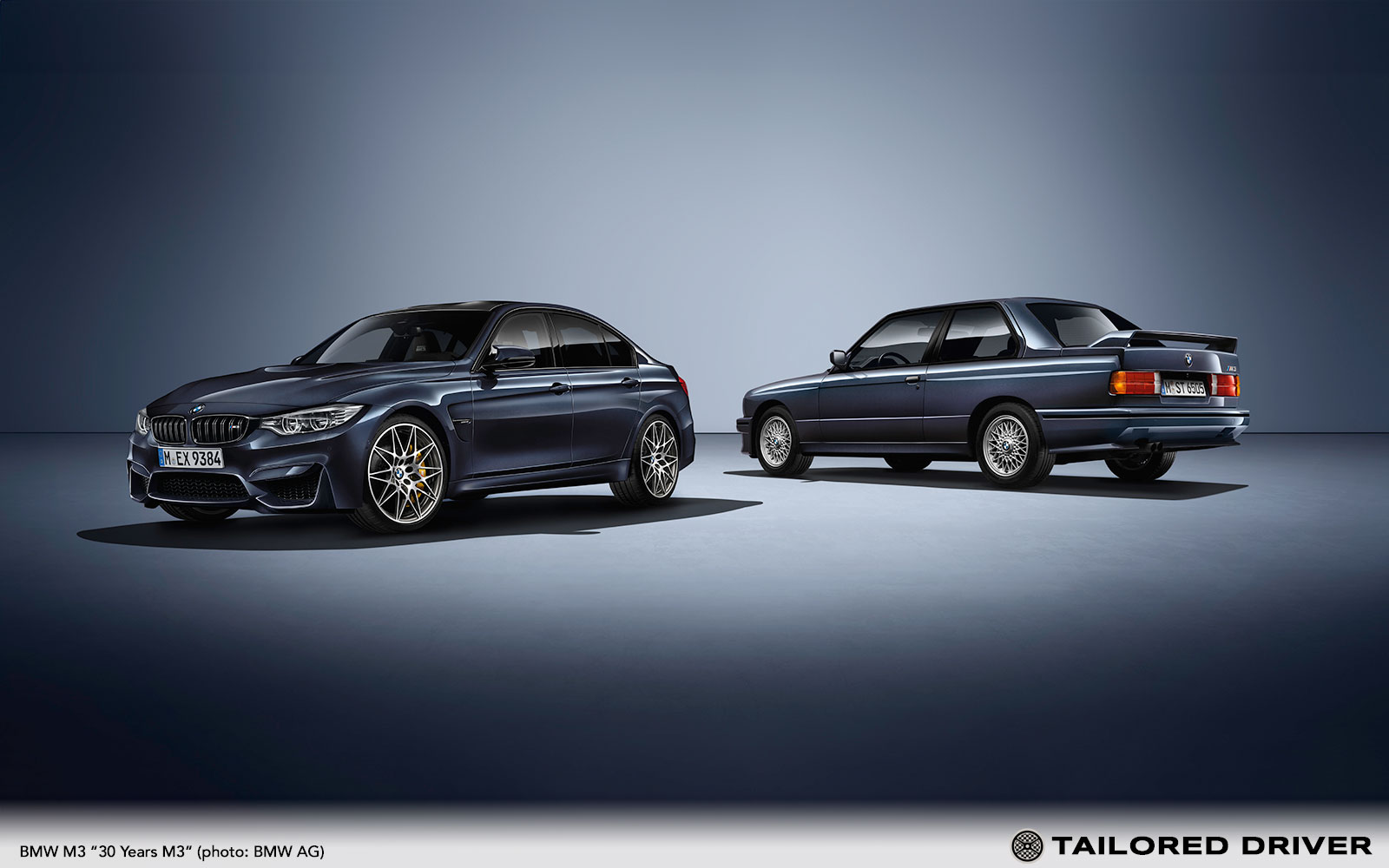
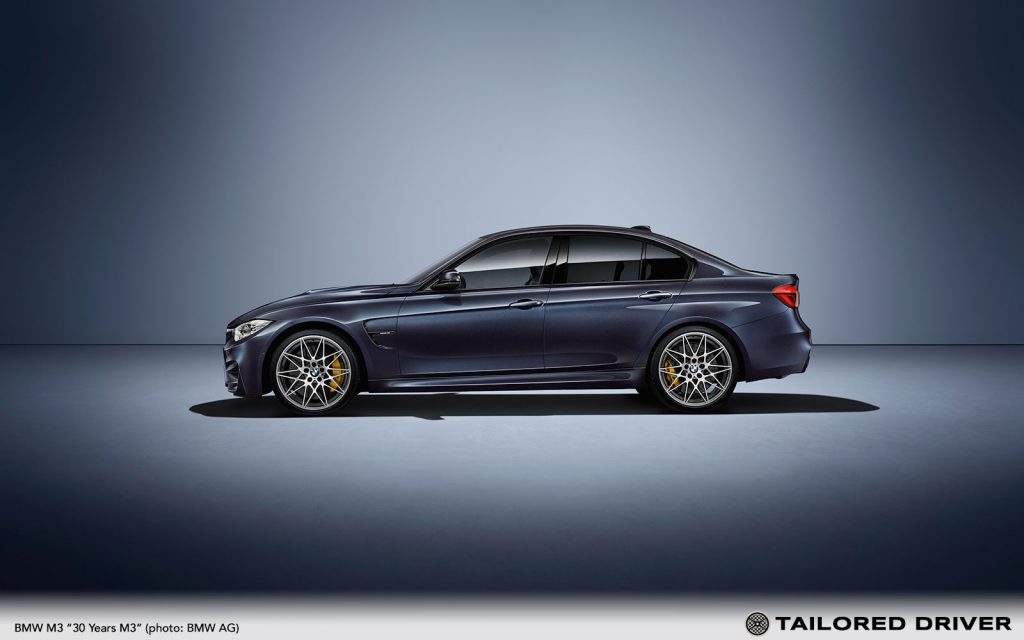
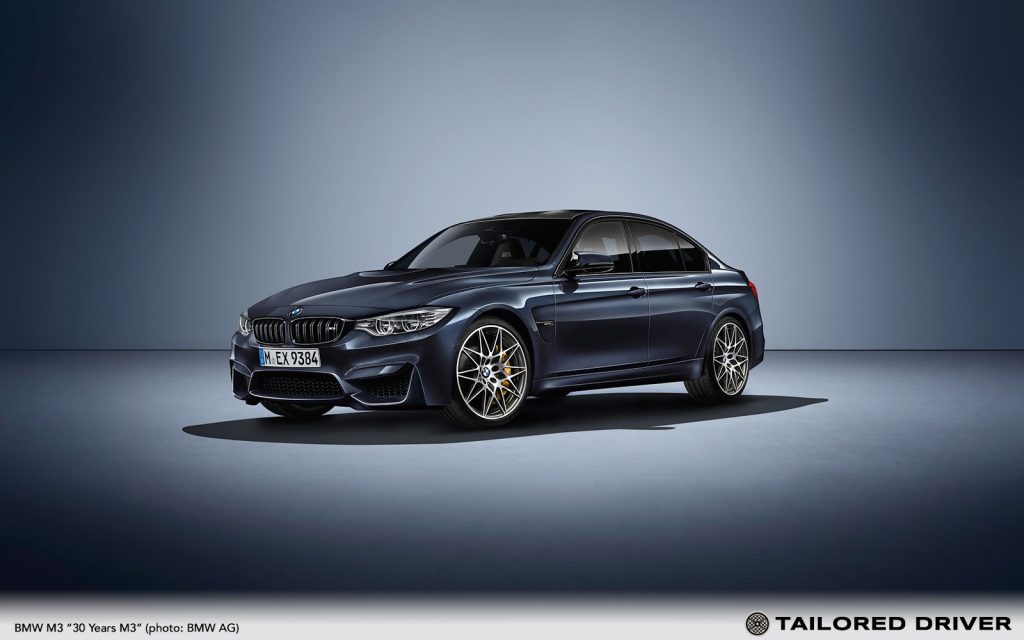
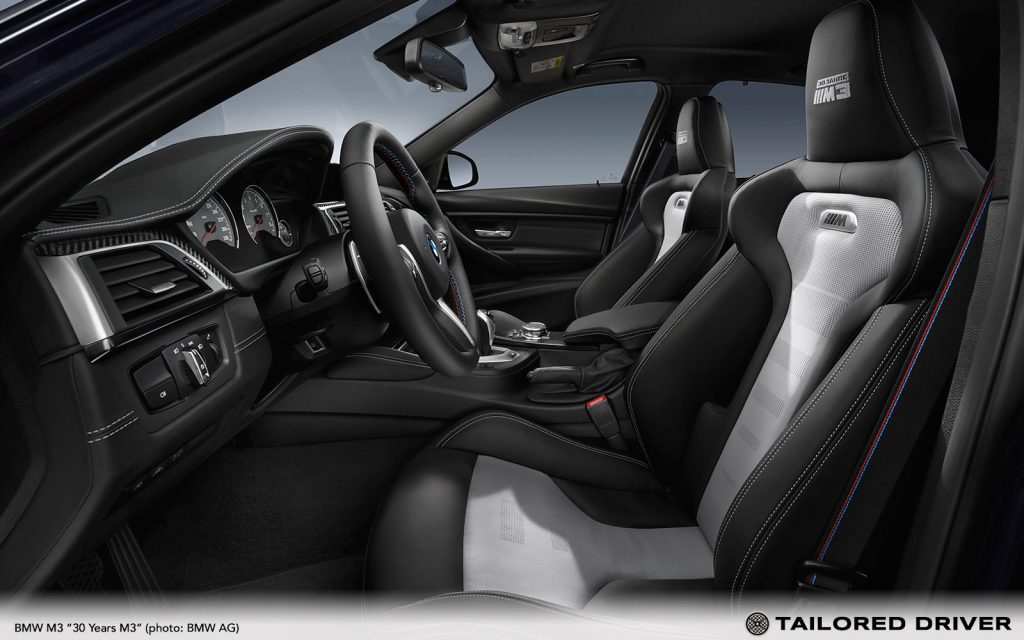
To mark the 30th anniversary of this automotive icon this summer, BMW M is launching the exclusive special edition of the BMW M3 “30 Years M3”, which is limited to 500 cars worldwide.
[source: BMW AG]
Munich. With the launch of the first generation of the BMW M3 in 1986, the BMW M GmbH, at that time operating under the name BMW Motorsport GmbH, revolutionized the sporty mid-range segment. No other manufacturer had previously ever deployed genuine motorsports technology so consistently in order to transform a high-volume production model like the BMW 3 Series into a thoroughbred high-performance sports car that is also fully suitable for everyday use. The first BMW M3 set the standard by which other manufacturers were measured.
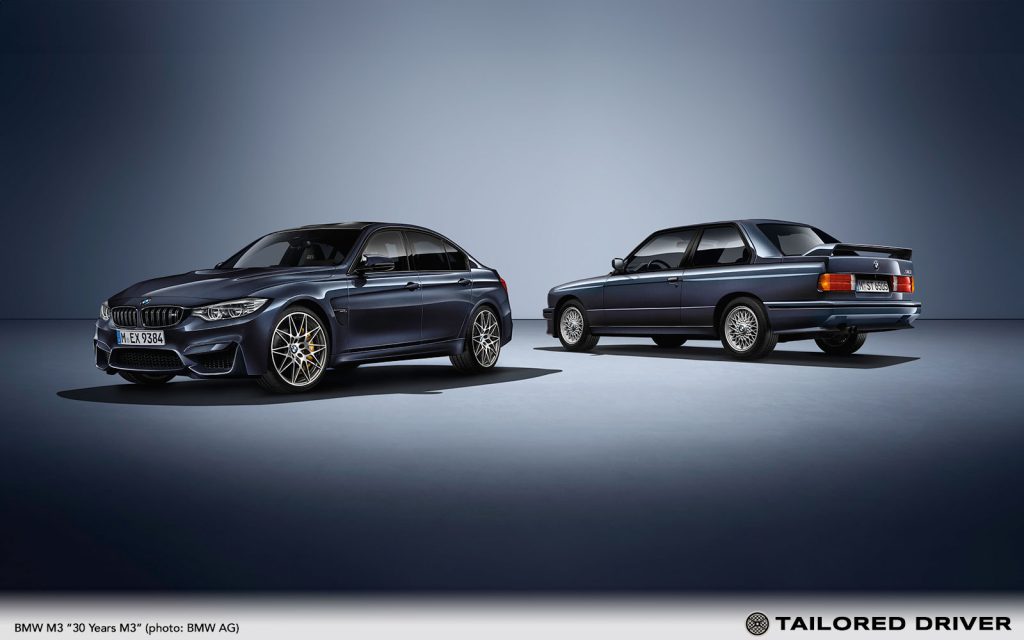
Meanwhile, BMW M has continuously refined its automotive icon across five model generations. And over all these years the BMW M3 has retained its original character. Probably no other automobile combines distinct racing genes and unrestricted day-to-day suitability into such a highly emotional overall concept. To mark the 30th anniversary of this automotive icon this summer, BMW M is launching the exclusive special edition of the BMW M3 “30 Years M3”, which is limited to 500 cars worldwide.
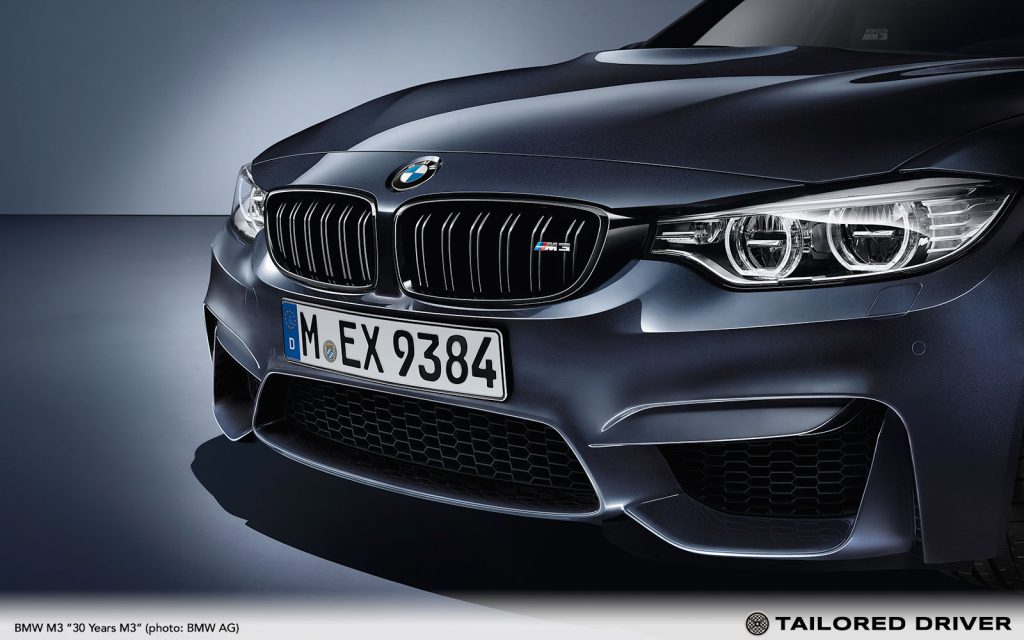
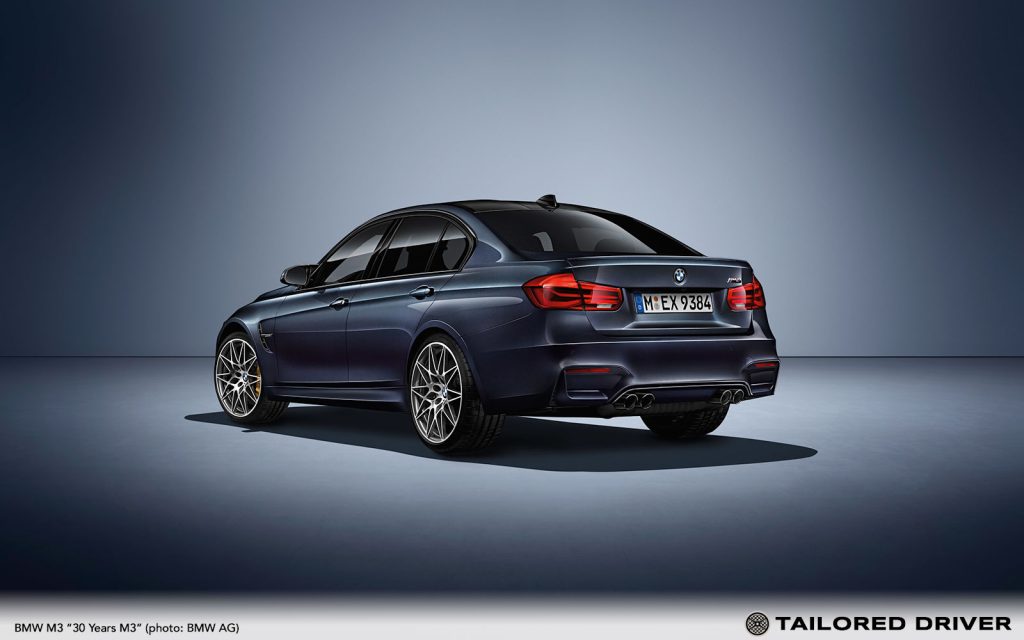
Edition “30 Years M3” in the legendary colour Macao Blue metallic. As a tribute to the first generation of the BMW M3, the anniversary edition “30 Years M3” is painted in the exclusive exterior colour Macao Blue metallic (macaoblau; metallic uni; 250; BMW), which once celebrated its premiere in BMW’s colour range as a special option for the first generation of the BMW M3.
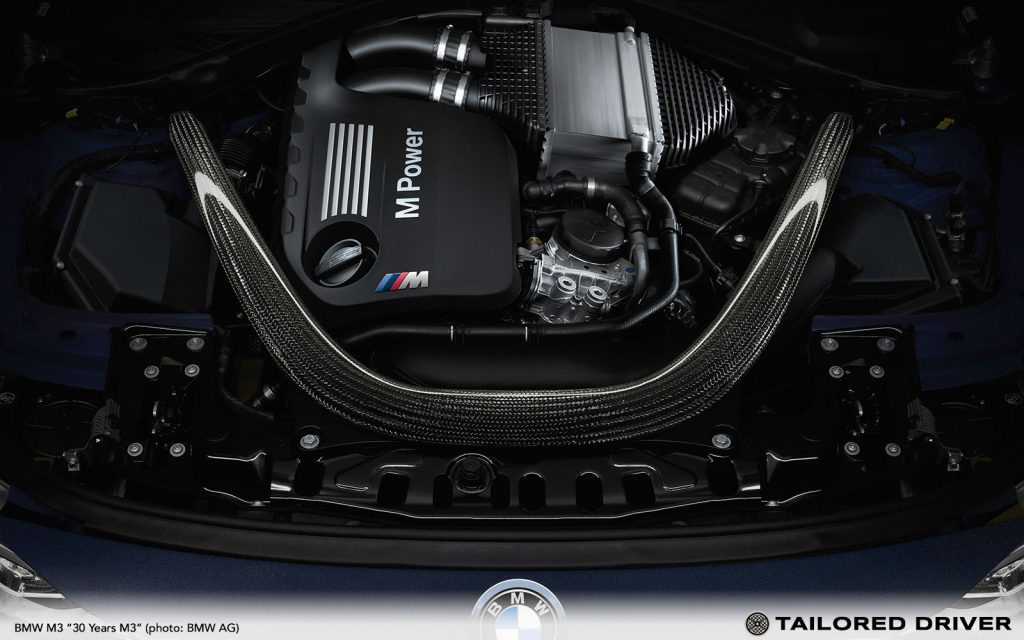
The edition “30 Years M3” builds on the Competition Package, which is optionally available for the BMW M3 series production model. It comprises an increase in engine output by 14 kW/19 hp to 331 kW/450 hp (BMW M3 “30 Years M3”: combined fuel consumption: 8.8–8.3 l/100 km, combined CO2 emissions: 204–194 g/km). Also included in the Competition Package is the Adaptive M suspension, which has been comprehensively aligned to the increased performance. Optimised features also include new springs, dampers and stabilisers, modified characteristic curves of the three modes Comfort, Sport and Sport+ as well as a correspondingly modified standard Active M differential on the rear axle and Dynamic Stability Control feature (DSC). Moreover, the Competition Package of the edition model includes forged 20-inch M light-alloy wheels with 666 M star spoke design and mixed tyres (front: 265/30 R20, rear: 285/30 R20).
All of these measures lead to a noticeable increase in dynamic performance, which is not least also reflected in enhanced acceleration. The BMW M3 “30 Years M3” with optional 7-speed M double clutch transmission sprints from 0 to 100 km/h in just 4 seconds, which is 0.1 seconds faster than the series production model. Even with the standard 6-speed manual transmission, the car completes this sprint 0.1 seconds faster than the production model.
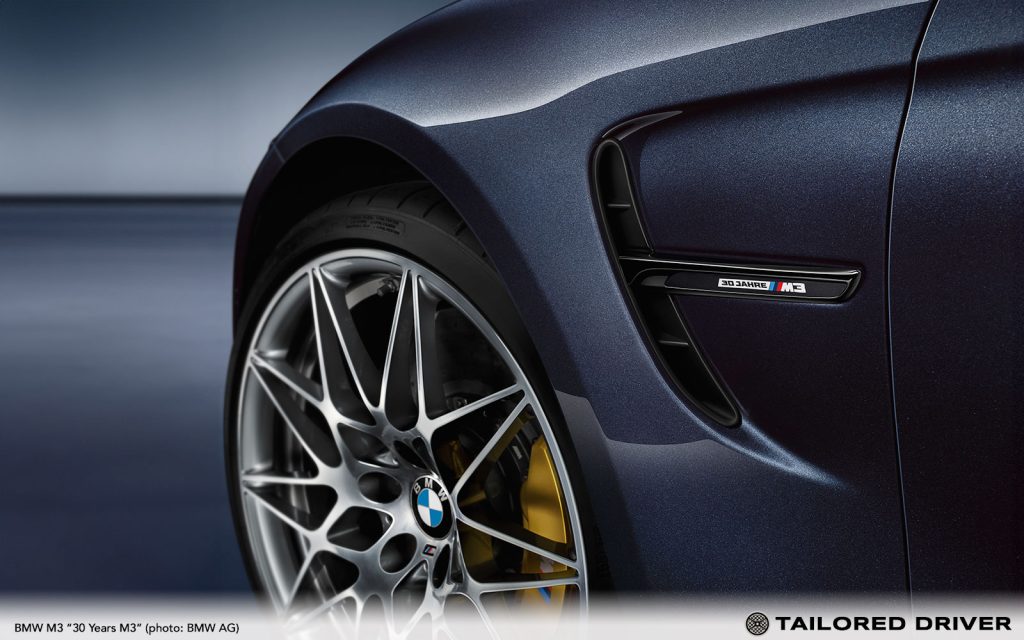
In terms of exterior design, the Competition Package also includes the BMW Individual High Gloss Shadow Line with enhanced features, including a black chrome tailpipe trim for the M sports exhaust system, the characteristic and potent sound of which contributes significantly towards the highly emotional driving experience. The edition model also features exclusively designed M gills in the front wings bearing the logo “30 Years M3”.
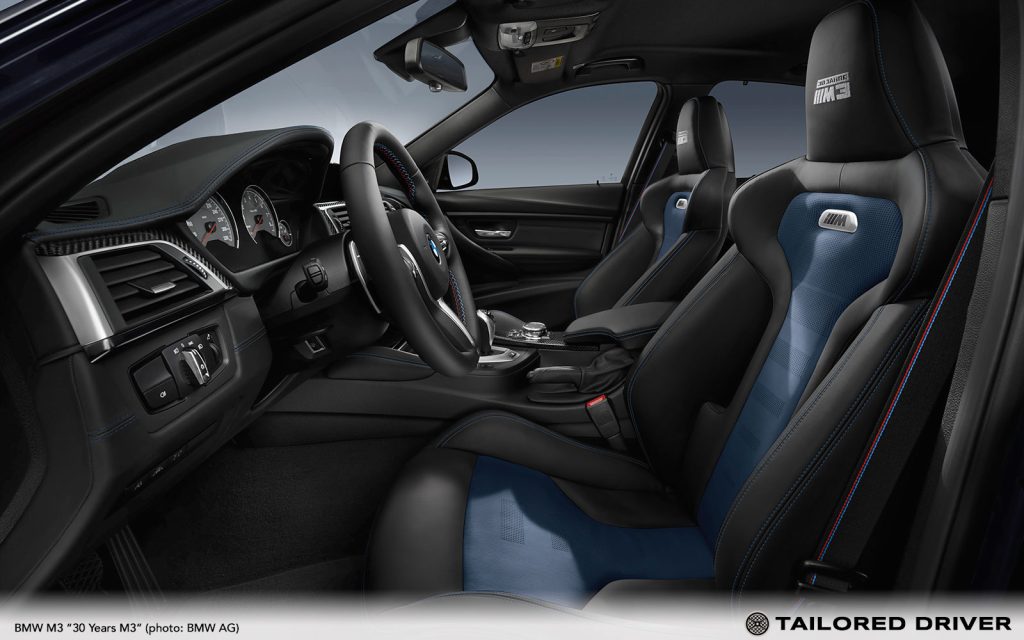
Sporty, functional interior with an exceptionally high-class ambience. The Competition Package upgrades the interior of the edition “30 Years M3” with specific M sports seats in a skeletal design that combine perfect support with distinct travel comfort over long-distances. Seatbelts with woven-in BMW M strips also enhance the sporty interior ambience.
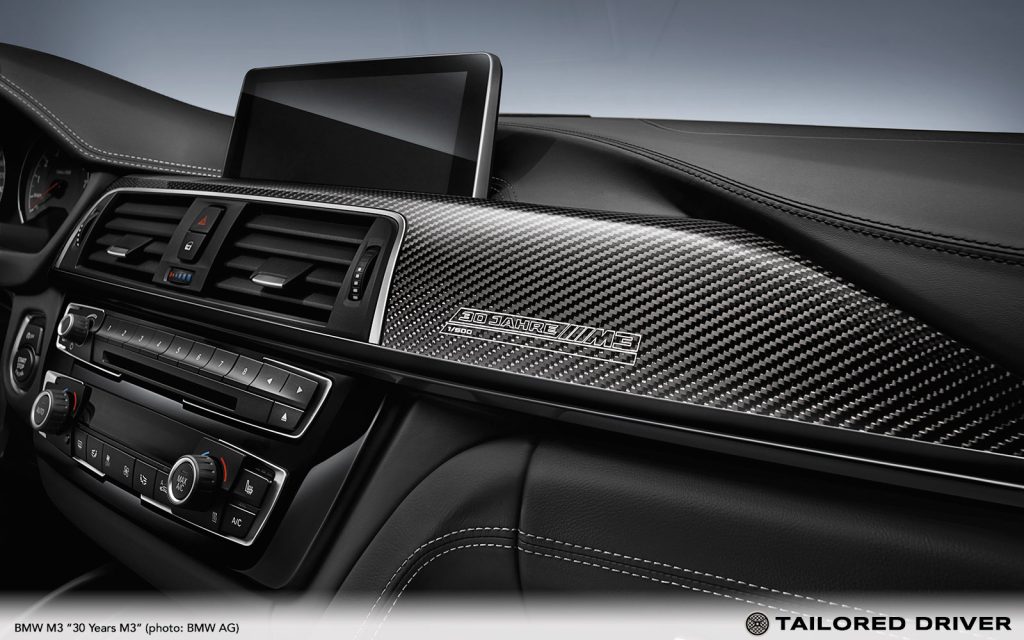
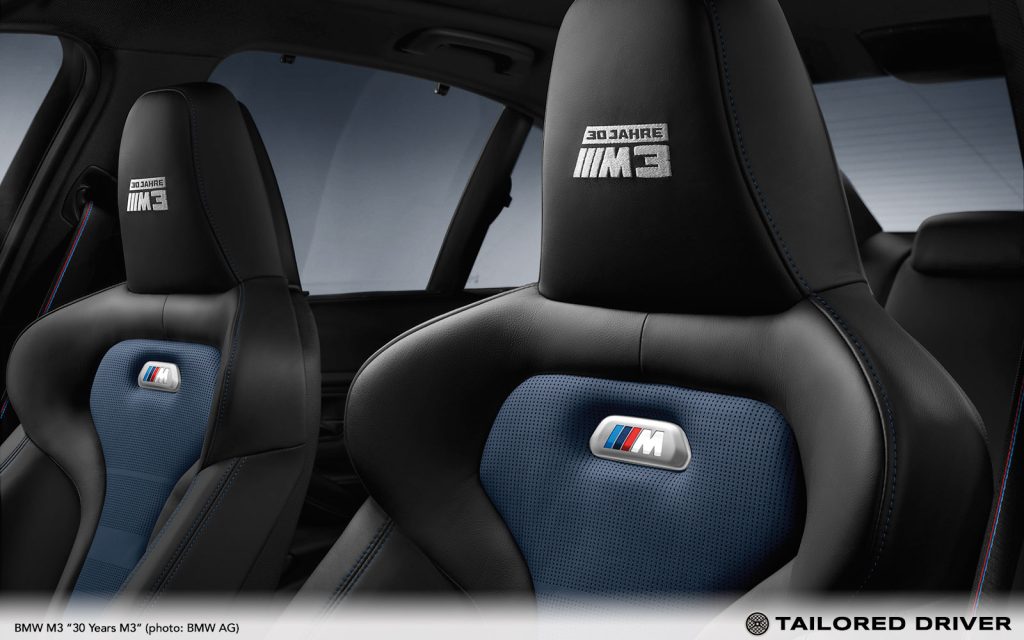
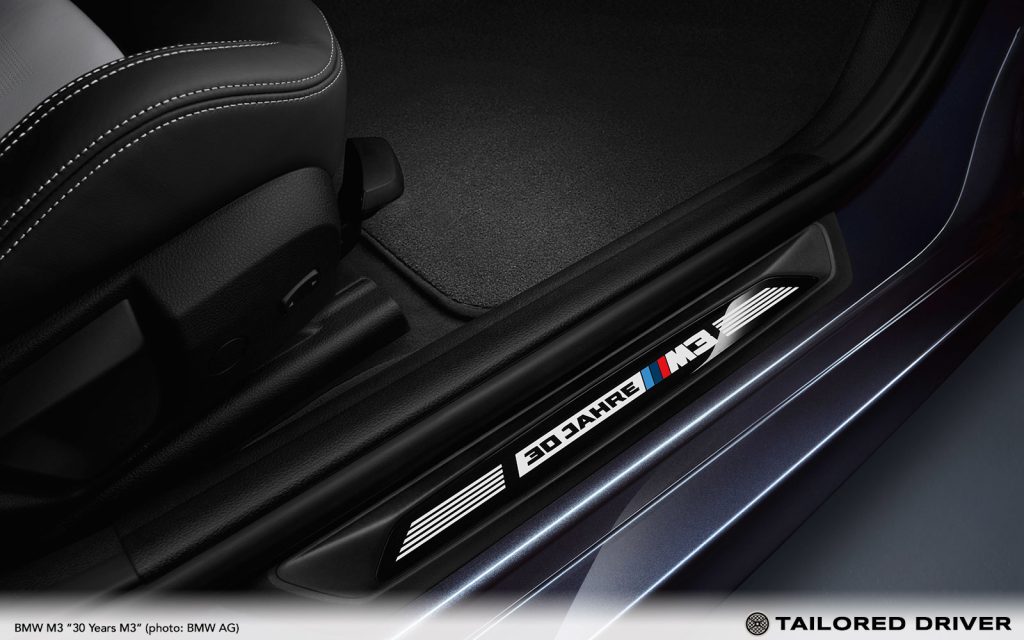
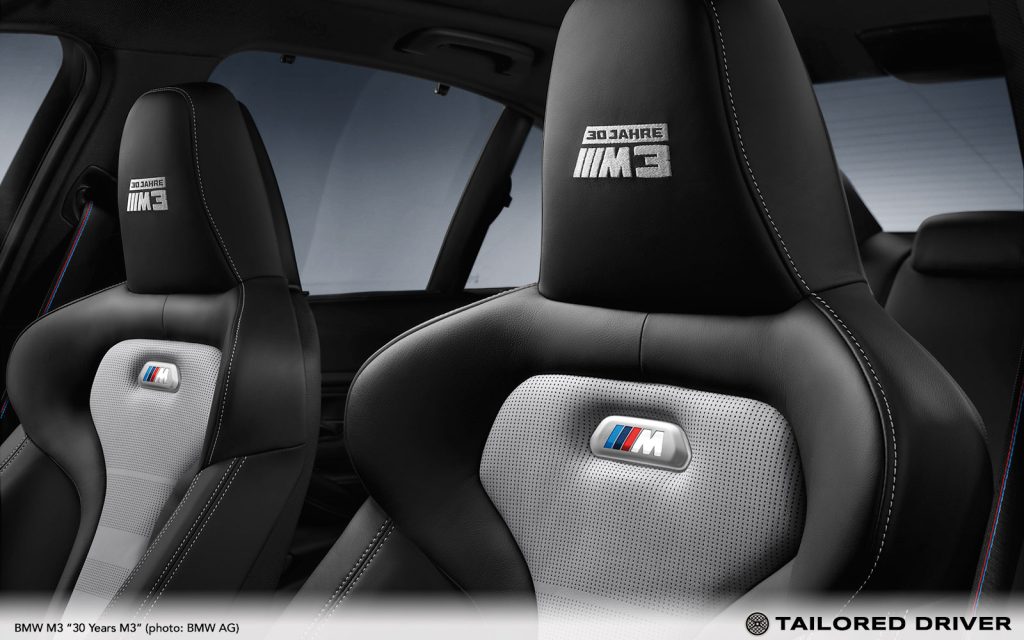
The logo “30 Years M3” on the front doorsills reminds both driver and front passenger of the BMW M company icon’s unique history. The wording “30 Years M3 1/500” on the carbon fibre interior trim strip of the instrument panel gives indication of the exclusiveness of the BMW M3 “30 Years M3”, which is limited to 500 cars worldwide. “30 Years M3” is embroidered into the front headrests.
The BMW M3 “30 Years M3” features an exclusive full leather Merino trim in bi-colour Black/Fjord Blue or optionally in Black/Silverstone with colour-matching contrast seams that effectively underscore the anniversary model’s sporty and sophisticated character.
Compared with the BMW M3 with Competition Package, the additional cost of the anniversary model is €10,000 in Germany. Market launch is scheduled for the summer of 2016 – this being exactly 30 years after the signing of the first contract for the purchase of a BMW M3.
1986 – a 3 Series with flared arches and impressive power. Around six months after BMW had stunned experts with the world premiere of the new BMW M3 at the International Motor Show in Frankfurt in the autumn of 1985, the time had finally come: In the spring of 1986, the first automotive journalists were given the opportunity on the racetrack in Mugello to test the “3 Series supercar”, which looked extremely spectacular not just because of its distinctively flared wheel arches. The 2.3-litre four-cylinder engine featuring four-valve technology delivered 147 kW/200 hp. This power unit was an ideal match for the two-door car, which weighed in at only 1,200 kilograms thanks to lightweight construction – the front and rear bumpers, the side sills and the boot lid including spoiler as well as other features were made of plastic. Acceleration from 0 to 100 km/h in 6.7 seconds and a top speed of 235 km/h are still impressive figures even today.
1988 saw the presentation of the Evo version of the BMW M3, which reached a top speed of 243 km/h thanks to a further enhanced power output of 220 hp. And in 1990, the highest upgrade version of the first model generation was launched to the market – the BMW M3 Sport Evolution, which had a 238 hp, 2.5-litre power unit under the bonnet and was limited to 600 cars.
Impressive proof of engineering skills in the development of the BMW M3 was delivered as early as in 1986 by the catalytic converter versions of the sports car. As the technicians had also given consideration to the use of exhaust gas purification technology right from the beginning of the development phase, each model version lost only 3 kW/5 hp in engine power as a result of being fitted with a catalyst; the effect on driving performance was only marginal.
1992 – from a thoroughbred racing car to an elegant coupe. Unlike the predecessor, the second generation of the BMW M3, which celebrated its debut in 1992, had not been specifically developed for deployment in motor sports. The significantly more discreet and elegant coupe featured a three-litre, six-cylinder engine with 210 kW/286 hp and a maximum torque of 320 Nm. As a result, the power unit, which was fitted with innovative VANOS camshaft control technology, delivered impressive proof of top-notch engineering skills. With its litre performance (97 hp/l) and specific torque (108 Nm/l), it set two world records for high-volume, naturally aspirated engines. The BMW M3 Coupe sprints from 0 to 100 km/h in exactly six seconds and top speed is electronically limited to 250 km/h.
The new BMW M3 stood out through the shape of its exterior mirrors. The aerodynamically optimized, double bridged mirror casings boasting a wing-shaped profile immediately distinguished the car from the series production versions of the BMW 3 Series Coupe. Even today, the distinctively shaped M exterior mirrors serve as one of the most characteristic identifying features of most M models.
In 1994, BMW M supplemented the BMW M3 range with two body variants at the same time. In addition to a convertible, the BMW M3 was also available for the first time as a four-door sedan. Customers were particularly pleased by the fact that the Sedan’s performance equalled that of the Coupe.
In 1995, within the framework of a comprehensive model upgrade, cubic capacity of the straight six-cylinder engine increased from 2,990 to 3,201 cubic centimeters and power output to 236 kW/321 hp. The new engine featured double VANOS, so in addition to a variably adjustable intake camshaft, it also had a synchronously operating exhaust camshaft. The result: In spite of increased power reserves and noticeably improved performance (e.g. 0–100 km/h in 5.5 seconds), the modified BMW M3 was extremely fuel-efficient.
From the summer of 1996, the BMW M3 became the world’s first high-volume production car to feature an automated manual transmission. The function of the sequential M transmission was racing-oriented: To shift gears up, the driver pulled the shift lever back, and to shift gears down, he or she simply pushed it forward. The system was extremely popular with customers, with almost every second BMW M3 that rolled off the production line at the BMW Regensburg plant at that time being fitted with this SMG transmission.
2000 – thoroughbred athlete with a self-confident appearance. The third generation of the BMW M3 sported a bolder look than its predecessor. Thanks to the aluminium bonnet with power dome, the distinctly wider wheel arches, the aerodynamically optimized boot lid including rear spoiler lip as well as the four tailpipes of the dual-flow exhaust system, the Coupe left no room for doubt about its power reserves and dynamics.
The car was also powered by a straight six-cylinder, naturally aspirated engine. The entirely redeveloped power unit delivered an output of 252 kW/343 hp from a displacement of 3,246 cubic centimetres and a maximum torque of 365 Nm. 5.2 seconds for the sprint to 100 km/h and just 5.4 seconds to accelerate from 80 to 120 km/h in fourth gear – these figures reflect this BMW M3’s performance potential. In the spring of 2001, just a few months after the Coupe, the Convertible made its debut, looking even more muscular with its low, concise waistline.
The BMW M3 CSL on sale from 2003 assumed an exceptional status. On this special model, which was consistently trimmed for lightweight construction – the abbreviation CSL has always been the term used by BMW for Coupe, Sport and Lightweight – an output of 265 kW/360 hp combined with an unladen weight of just 1,385 kilograms, which corresponds to a power-to-weight ratio of 3.85 kg/hp. The weight reduction was achieved not simply by omitting supposedly unnecessary (comfort-related) components, but through the principle of intelligent lightweight construction, i.e. by using the most suitable material in the right place. This included for example the roof made from carbon reinforced plastic (CRP) and the rear window fitted with thin glass. This paid off, as acceleration testifies: 0–100 km/h in 4.9 seconds, 0–200 km/h in 16.8 seconds.
2007 – fourth generation with V8 engine and CRP roof as standard. Instead of a straight six-cylinder engine featured by the two previous generations, the fourth edition of the BMW M3 had a naturally aspirated V8 engine under its bonnet. The high-revving, four-litre power unit delivered 309 kW/420 hp, weighed only 202 kilograms and was therefore 15 kg lighter than the previously deployed engine. Use of the intelligent lightweight construction concept was also further pursued in other areas. For instance, the BMW M3 Coupe featured as standard a CRP roof, the fibre structure of which remains visible beneath a clear coat. The front axle of the car was made almost entirely of aluminium.
The autumn of 2007 saw the market launch of the four-door version of the BMW M3, which sprinted from 0 to 100 km/h in 4.9 seconds and was therefore only a tenth of a second slower than the Coupe. The Convertible completed the model range just a few months later in the spring of 2008.
2014 – innovative engine technology and consistent lightweight construction. With the launch of the fifth generation of their top athlete in the spring of 2014, the BMW M GmbH not only presented both the Sedan and the Coupe simultaneously for the first time, but also brought the model designation into line with the new nomenclature of the series models. Thus, the Sedan bears the name BMW M3, the Coupe BMW M4 – like the Convertible that has been available since the autumn of 2014.
The entirely redeveloped straight six-cylinder engine featuring M TwinPower Turbo technology and a high-revving concept delivers a maximum output of 317 kW/431 hp and maximum torque of 550 Nm available across a broad engine speed range, thus exceeding the highest amount of torque offered by the previous BMW M3 by almost 40 percent. Fuel consumption and emissions are around 25 percent lower. Both the BMW M3 Sedan and the BMW M4 Convertible complete the sprint from 0 to 100 km/h in 4.1 seconds (with optional 7-speed dual clutch transmission).
In order to attain the highest level of driving dynamics coupled with exceptional fuel efficiency, vehicle weight (with standard equipment) was reduced by around 80 kilograms vs. the previous model. This again was made possible through the consistent implementation of intelligent lightweight construction measures. These include, among others, increased use of lightweight materials such as carbon fibre reinforced plastic as well as aluminium for numerous suspension and body components.
“Happy birthday, BMW M3” – friends and companions congratulate on the car’s 30th birthday.
“I will always have a very special connection to the BMW M3. My father used to drive a black BMW M3. I myself became DTM champion in 2012 driving a matt black BMW Bank M3. All BMW M3 production models have this very special racing character – similar to the new BMW M4. The BMW M GmbH has managed to bring a racetrack feel onto the road. It is not really easy to make such a powerful car so compact and roadworthy like BMW has done with the M3. The BMW M3 is sportiness in its purest form. And it will always stand out in my memories.” Bruno Spengler, professional racing driver, competing for the BMW Team MTEK in the DTM 2016, DTM champion 2012 in a BMW M3 DTM
“The BMW M3 is a fascinating car – today just as it was 30 years ago. I myself drove the M3 of that time around the racetrack. And compared to our racing cars of today, it was really hard work behind the wheel. During my very first DTM year of 2013, I celebrated victory in a BMW M3 DTM of the modern era. That was a very special moment. And I think the BMW M3 is simply made for creating such special moments.” Timo Glock, professional racing driver, competing for the BMW Team RMG in the DTM 2016, 91 Formula 1 Grand Prix races between 2004 and 2012
“For very many people – and for me, too – the BMW M3 is a synonym for success on the racetrack. Its motorsport genes were already evident in 1986 and still are to this very day. For me as a racing driver it feels great to also be able to drive such a sporty car off the racetrack. The BMW M3 a legend for good reason.” Martin Tomczyk, professional racing driver, competing for the BMW Team Schnitzer in the DTM
“The BMW M3 is undoubtedly the most important car in my long career as a racing driver. With this car I won the World Touring Car Championship, the DTM title, the Italian Touring Car Championship and celebrated numerous racing victories all over Europe. From the very first day, the BMW M3 was a winner and it retained this position for decades. Fans love the BMW M3 – and I love it too!” Roberto Ravaglia, ex professional racing driver, first touring car champion in history (1987), founder of the Team ROAL Motorsport
“The BMW M3 is a true icon. When the car made its racing debut in 1987, it was a winner right from the start, becoming the most successful touring car of all time. Driving this car was always a lot of fun. I experienced so many great moments and celebrated many victories with this car. I developed a really close bond with the BMW M3.” Johnny Cecotto, ex professional racing driver, 1989 – 1992 10 DTM race victories in a BMW M3, 1990 winner of “24-hour race Spa” in a BMW M3, 1992 winner of “24-hour race on the Nürburgring” in a BMW M3, 1993 ADAC GT Cup winner in a BMW M3 GTR, twice World Motorcycle Champion (1975/1978)
“For me the BMW M3 is simply the best. I believe everybody immediately associates the BMW M3 with the BMW M GmbH, even more than the M1 and the M5. A major part of its fascination is undoubtedly the result of its motor racing career. After all, to this day, the BMW M3 is the world’s most successful touring car. I myself own four BMW M3s from different years, my favourite still being the BMW M3 of the first generation – and this is not only because classic BMWs are my passion, but because I personally think the car’s design is simply the best.” Felipe Garcia, BMW enthusiast and collector, founder of Mint Classics in Münster, “Bavarian Sports Cars” dealer
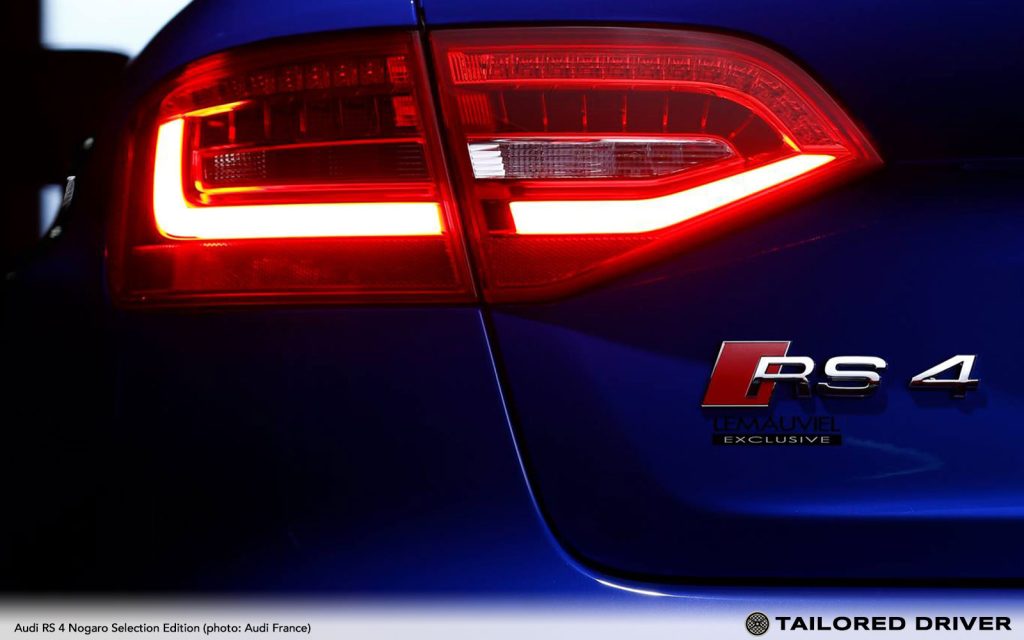
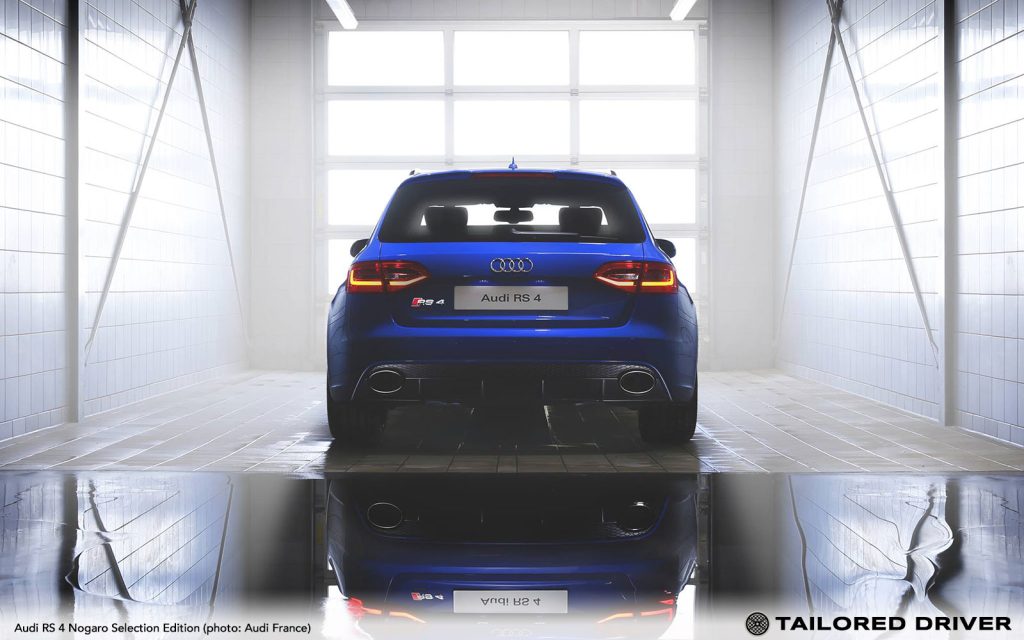
Audi RS 4 Avant Nogaro selection to celebrate world premiere in Geneva
[source: Audi UK, photos by Audi UK and Audi France]
Editor’s Note: This special edition model was produced for the European market and was never sold in North America.
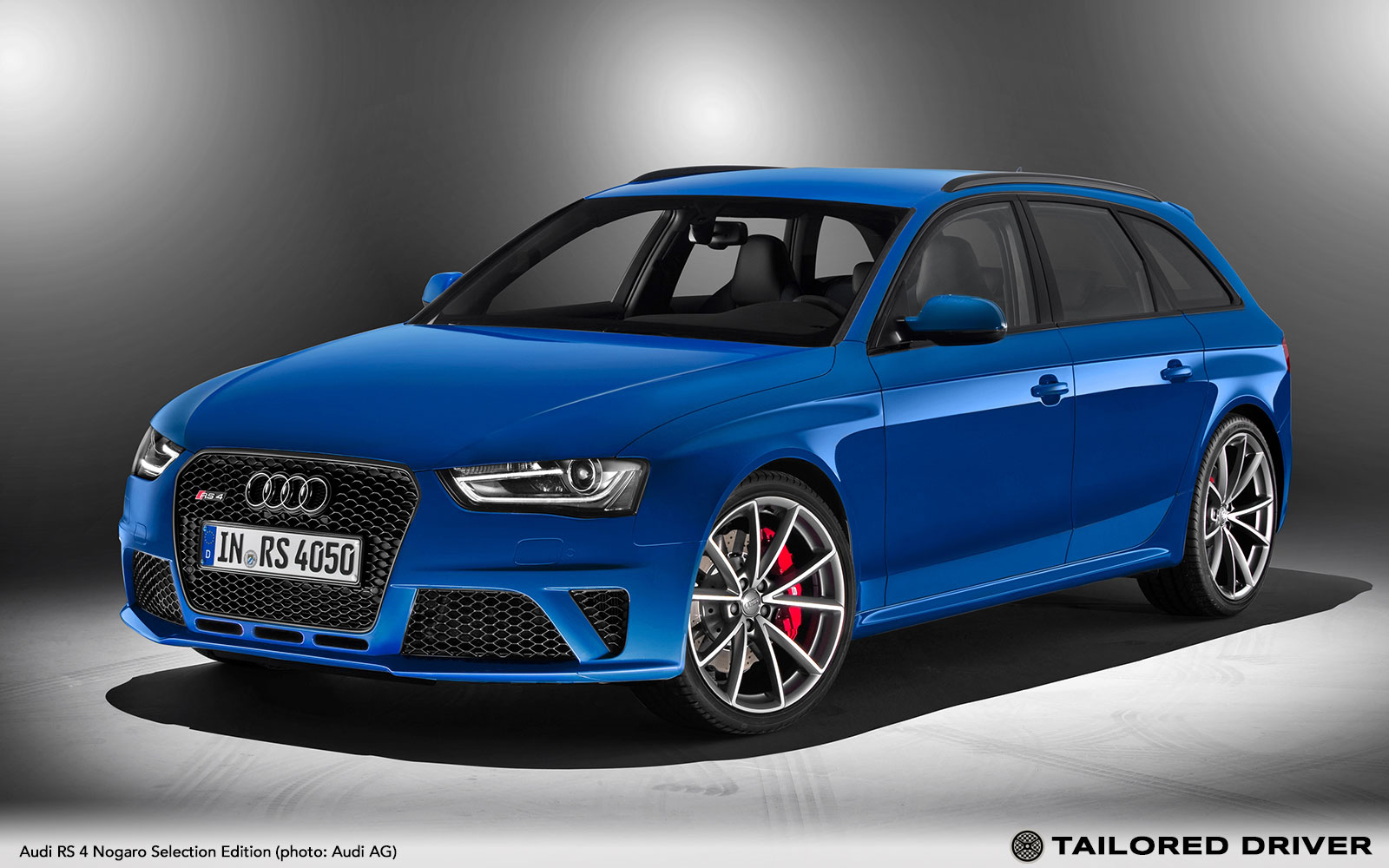
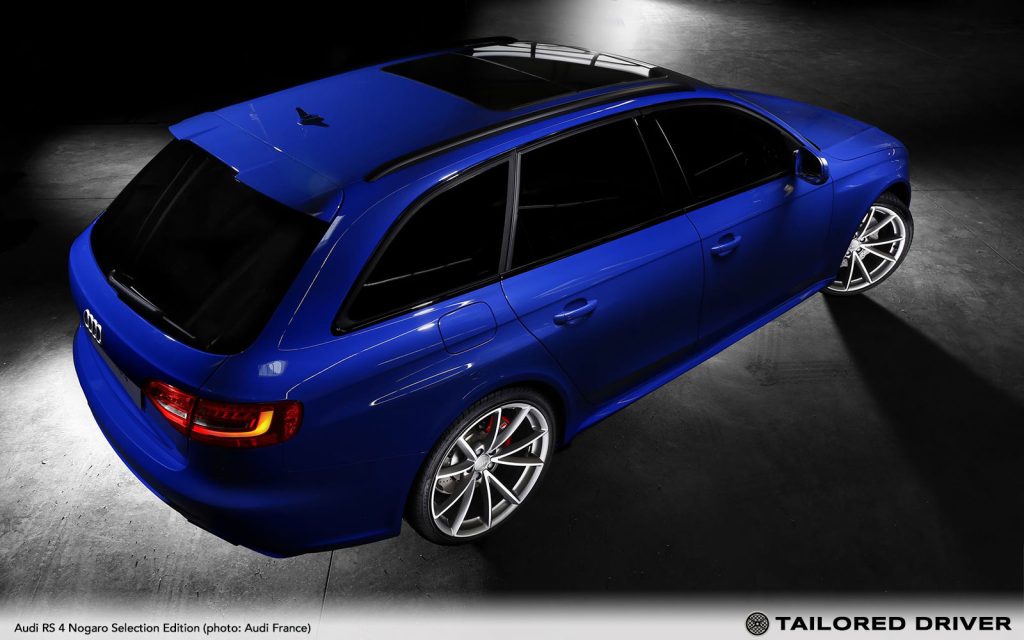
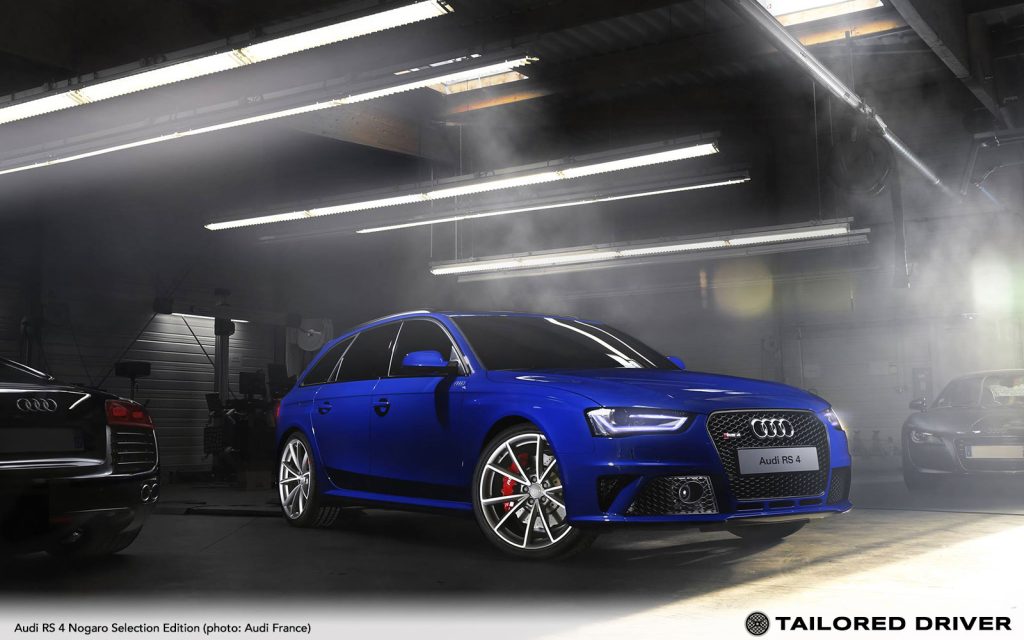
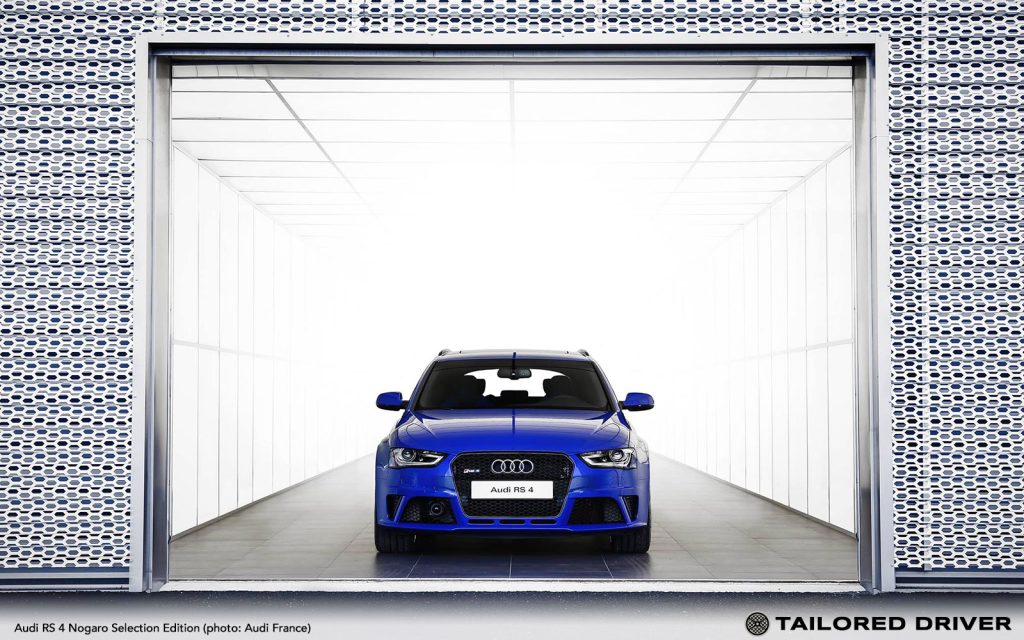
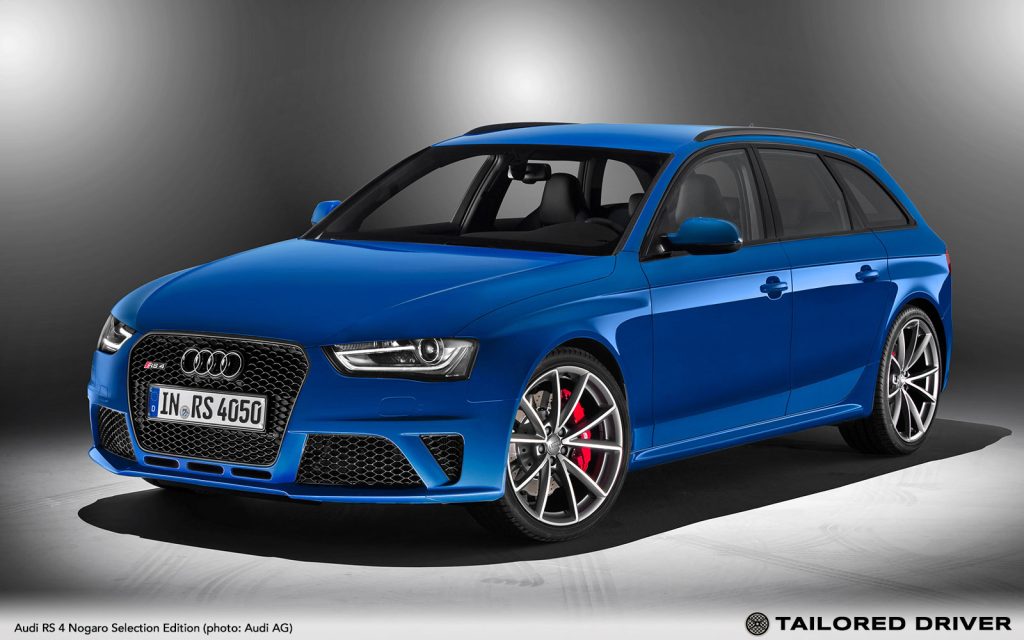
It is almost exactly twenty years since the once clearly defined boundary between versatile estate car and extreme sports car was blurred by the Audi Avant RS2, so the trailblazer for a high-performance breed which continues to flourish is being commemorated by the new RS 4 Avant Nogaro selection. The new special edition will make its debut at the Geneva Motor Show with Nogaro blue paint finish and exclusive equipment.
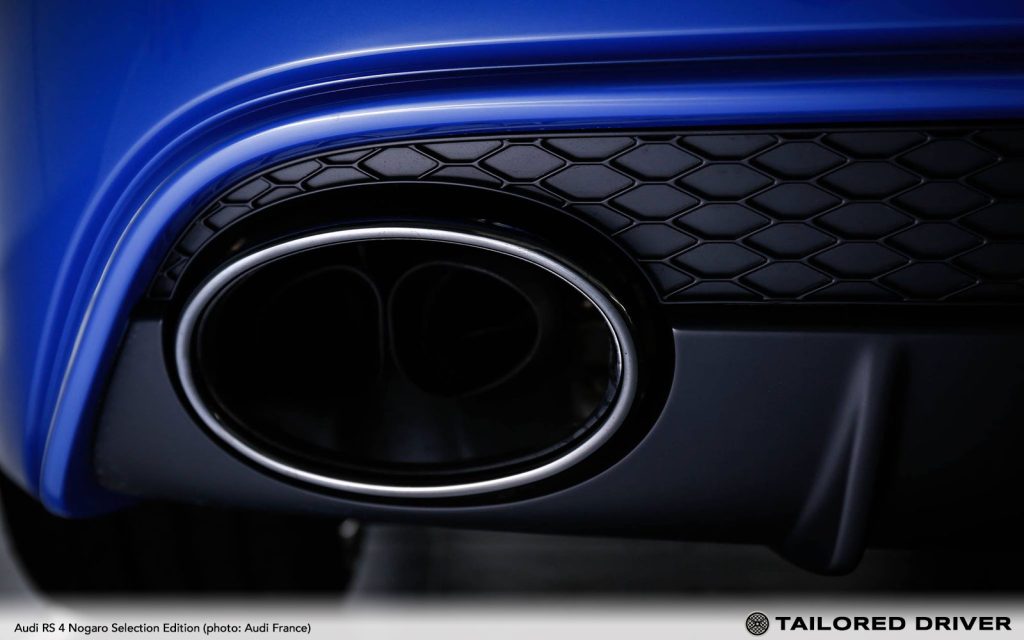
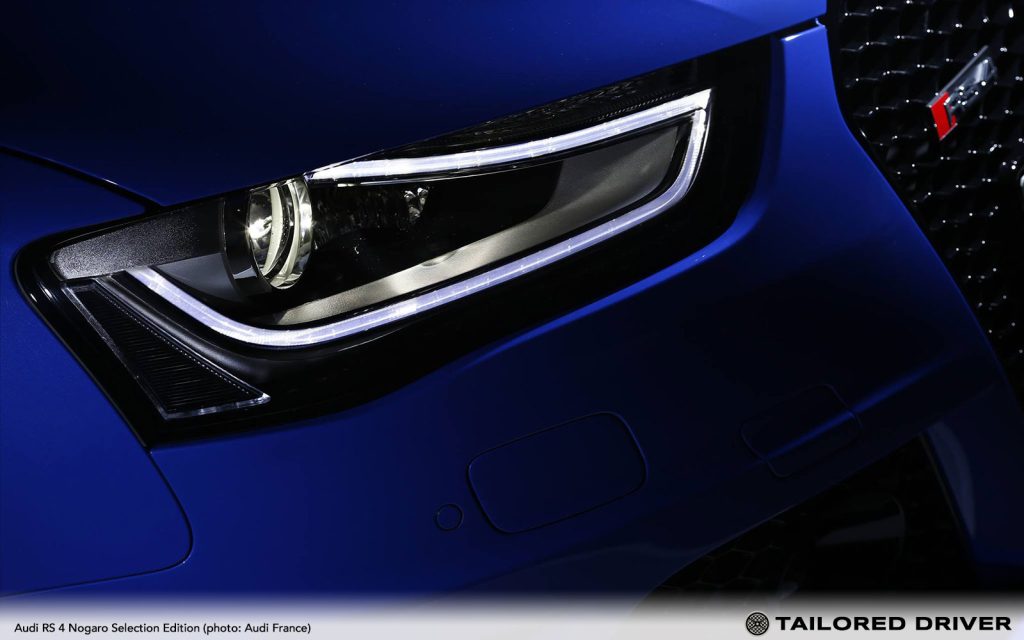
The customised Nogaro blue, pearl effect paint finish is the most immediately apparent tribute to the esteemed RS2 in the anniversary model. In addition, the frame of the Singleframe grille and the window surrounds are painted high-gloss black, and the roof rails matt black. The RS sports exhaust system terminates in two oval, high-gloss black tailpipe trims.
450PS: the high-revving V8
Under the bonnet of theAudi RS 4 Avant Nogaro selection sits a high-revving V8 naturally aspirated engine with a displacement of 4,163 cc. The 4.2 FSI delivers 450PS of power at 8,250 rpm, with peak torque of 430 Nm (317.15 lb-ft) available between 4,000 and 6,000 rpm. The resonant eight-cylinder engine powers the anniversary model from 0 to 62mph in 4.7 seconds and takes it to a governed top speed of 174mph. Its combined fuel economy is 26.4mpg – for a CO2 equivalent of 249 grams per kilometre.
With its high efficiency and tall top gear, the standard seven-speed S tronic also contributes to fuel efficiency. The driver can let the lightning-fast dual-clutch transmission shift operate automatically or change gears themselves using the selector lever or the steering wheel paddles.
The core of the quattro permanent all-wheel drive is the self-locking crown gear centre differential. The compact and lightweight component distributes torque at a default ratio of 40:60 between the front and rear axles. This ratio can be broadly varied as required – with up to 70 per cent of the power going to the front and a maximum of 85 per cent to the rear. The crown gear centre differential cooperates with the wheel-selective torque control, which makes handling at cornering limits even more dynamic through selective, small brake impulses. At the rear, the standard sport differential also actively distributes the power between the rear wheels.
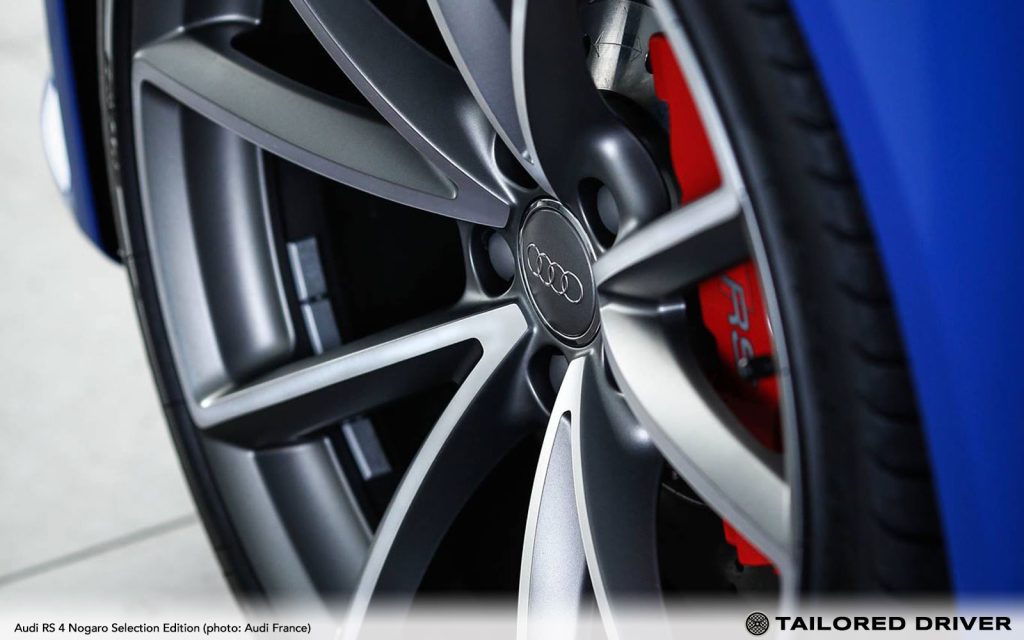
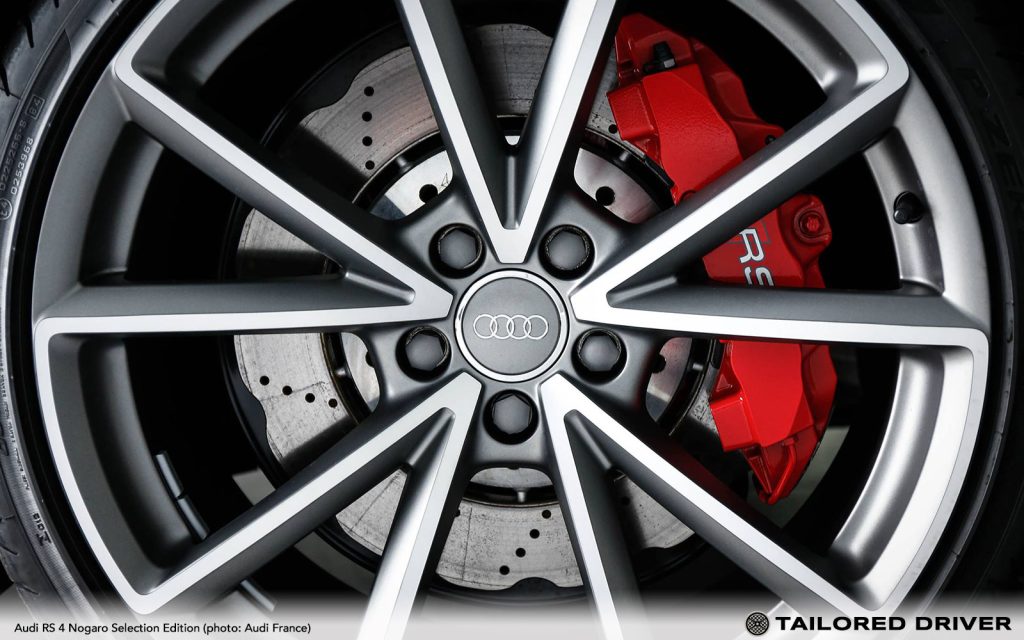
The Audi RS 4 Avant Nogaro selection rides on 265/30 series tyres. Behind the gloss turned finish 20-inch wheels in 5-V-spoke design gleam red-painted brake calipers bearing RS emblems. The brake discs featuring a wave design are internally ventilated, perforated and joined to the aluminium brake disc chambers by pins. Carbon-fibre-ceramic front discs are available at extra cost. The Electronic Stabilisation Control (ESC) offers a sport mode and can also be entirely deactivated as required.
Black and blue: the interior
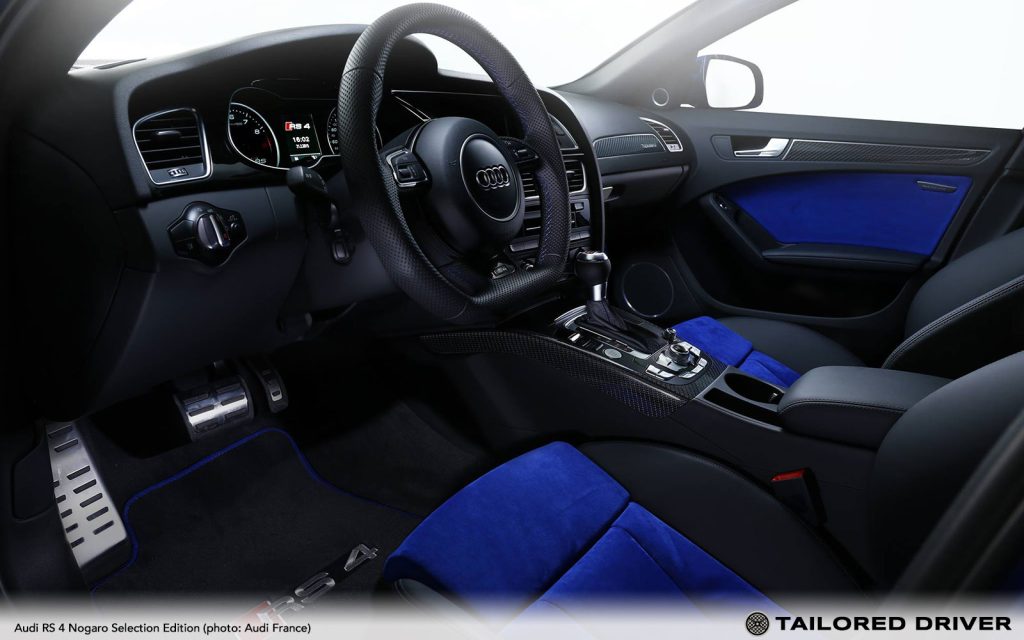
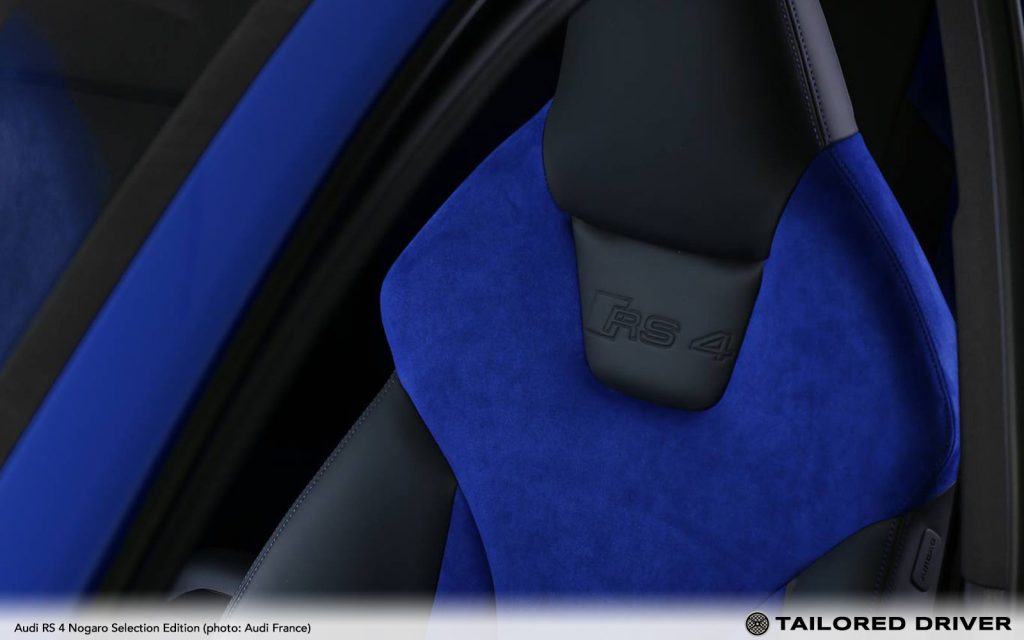
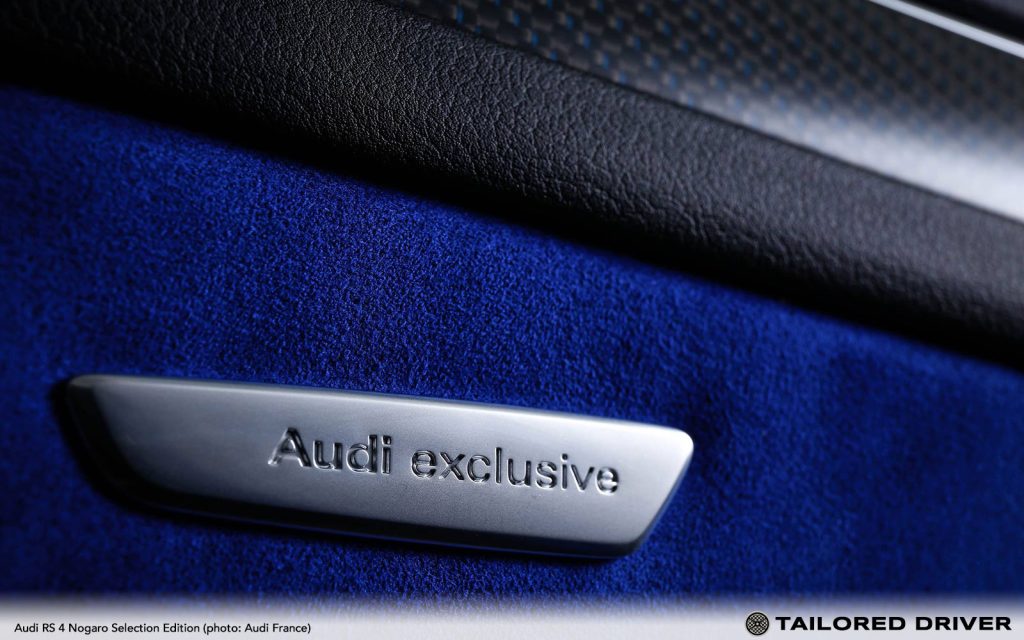
In the purposefully styled interior, Audi offers two different upholstery versions for the electrically adjustable S sport seats with their integrated head restraints. In both cases, the side sections are covered with black Valcona leather; the Alcantara trim for the centre sections and door trim inserts are coloured either black as well or Nogaro blue – in homage again to the Audi Avant RS2. The armrests are covered with black leather, with blue contrasting stitching providing accents. Black or Nogaro blue piping frames the black floor mats.
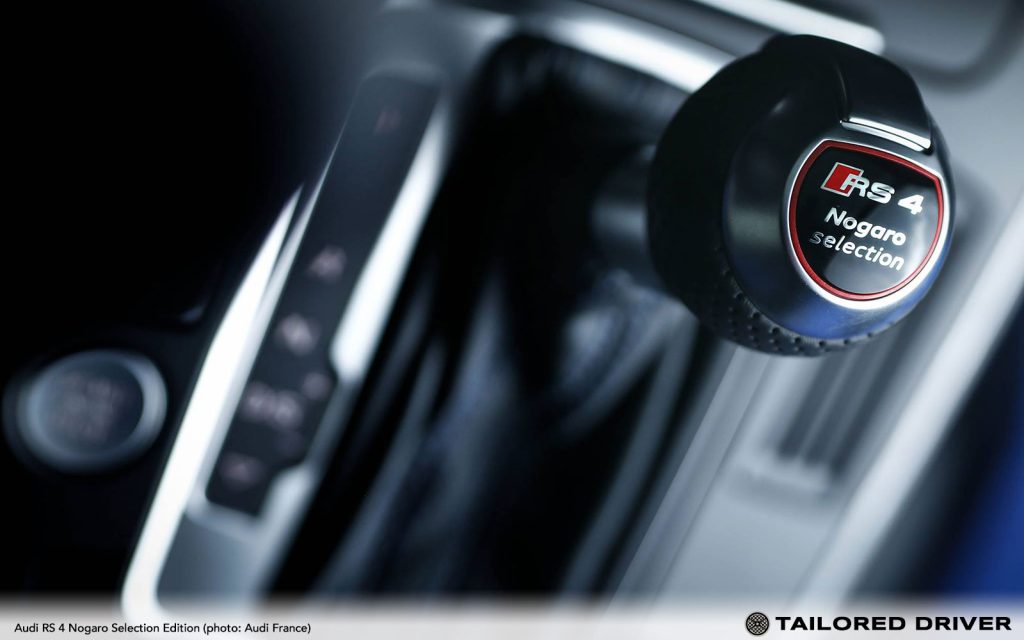
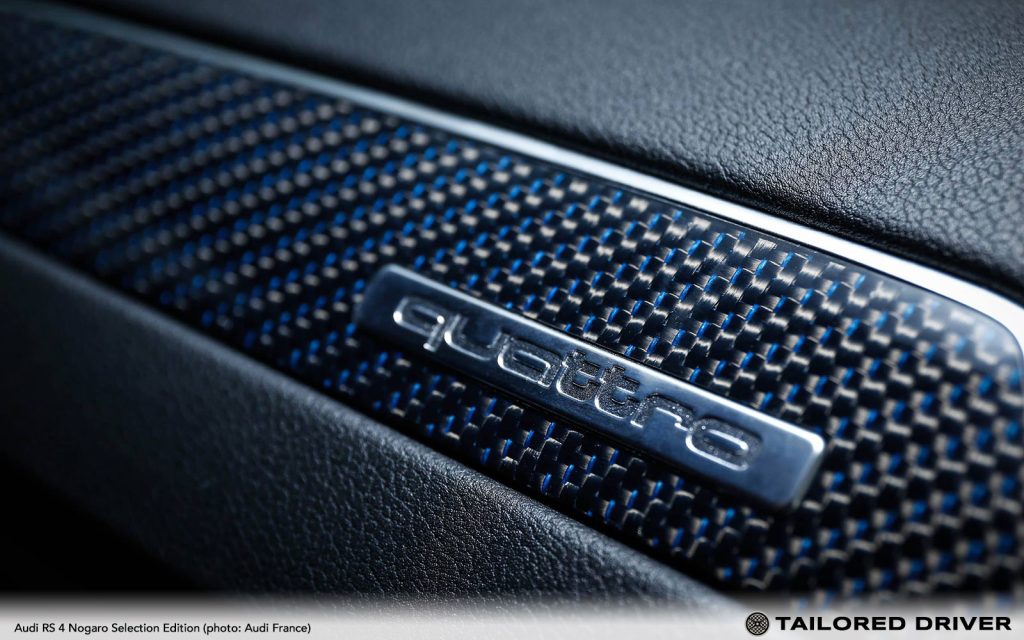
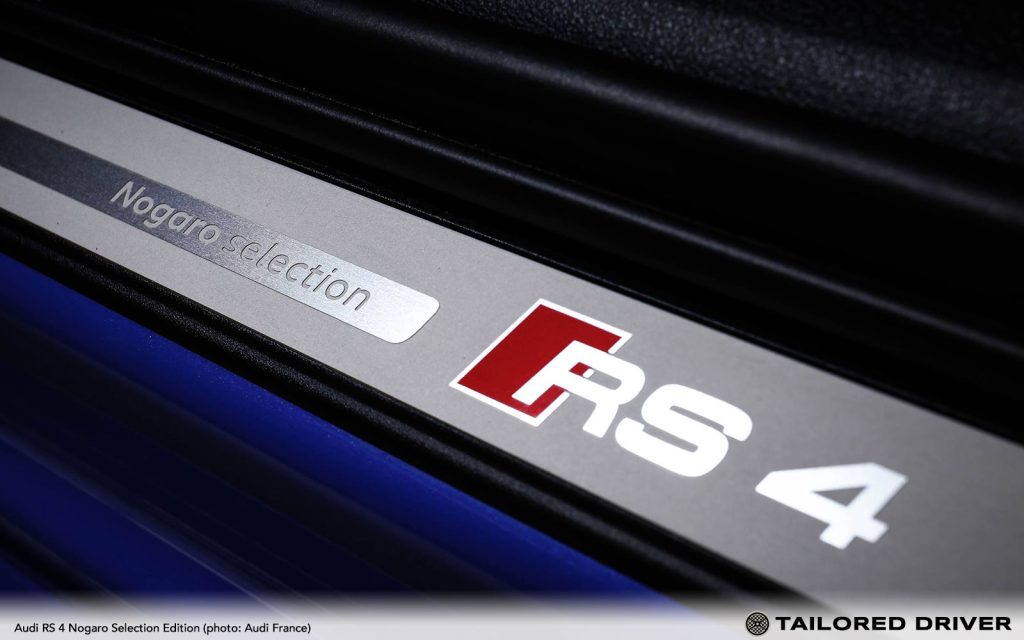
Black leather with blue stitching also refines the steering wheel rim and the selector lever boot. Blue threads run through the carbon inlays. A badge on the RS selector lever knob of the S tronic and the logos on the door sill trims refer to the special status of the anniversary model.
The Audi RS 4 Avant Nogaro selection will be available in mainland Europe later in 2014 as a limited edition. The possibility of UK specification production is still under discussion.
A modern classic: the Audi Avant RS2 from 1994
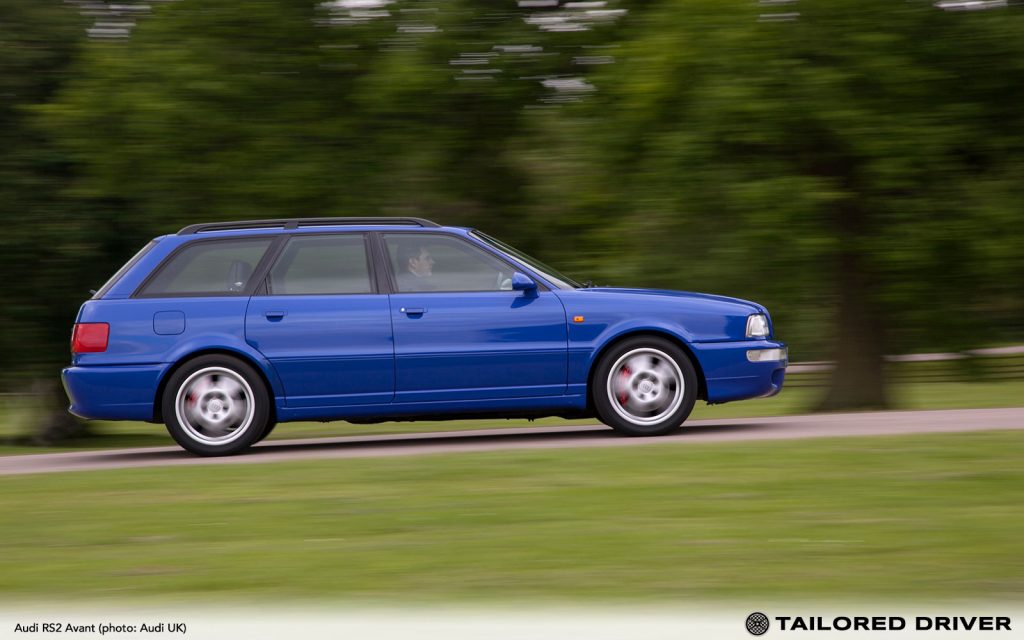
The Audi RS2 of 1994 was the first RS model from Audi and also the first high-performance model from the brand to combine full everyday suitability with a dynamic character, becoming the founder of a whole family of peformance-focused models. Audi developed the RS2 in conjunction with Porsche, with assembly taking place at Stuttgart-Zuffenhausen.
Its appearance alone was indicative of the power of the first RS model. The front bumper featured powerful air inlets, and the grille was painted black. The exterior mirrors came from Porsche, the rear was embellished by a full-width band of light, and the emblems were large-sized. The RS2 optionally left the assembly line with an exclusive Nogaro blue paint finish, recalling the two victories achieved by Frank Biela on the Nogaro circuit in the French Touring Car Championship of 1993.
The engine drew on Audi’s extensive experience in touring car racing. The 2.2-litre five-cylinder engine delivered 315PS by way of a large turbocharger, high boost pressure, expanded air ducting and adapted engine management. At 3,000 rpm 410 Nm (302.40 lb-ft) of torque was available, with the limiter only taking effect at 7,200 rpm. The RS2 accelerated from 0 to 62mphin 5.4 seconds and reached a top speed of 162mph. A six-speed manual transmission delivered the power to the quattro drivetrain, which had a manually activated locking differential at the rear axle.
The suspension with its all-round transverse links was derived from the set-up of the performance car which laid the foundations, the Audi S2. The shock absorbers were even firmer and the springs were shortened. Porsche supplied the 17-inch wheels, the large, internally ventilated brake discs and the red-painted four-piston calipers.
The interior was dominated by Silk Nappa leather and Alcantara in the colour anthracite, blue or silver grey, and the Recaro seats were electrically adjustable. The instruments bore white dials, while small indicators on the centre console kept the driver informed about the oil pressure, oil temperature and vehicle system voltage. CFRP inlays were optionally available.
Audi offered the RS2 at a base price of £39,500 in the UK. Within a construction period of barely two years 2,908 units were produced – more than the quantity originally planned.