Two characteristic design variants: Sport and Style
Each limited to 46 cars
Visit to the VR46 Motor Ranch and Misano racetrack forms exclusive highlight
[source: BMW AG]
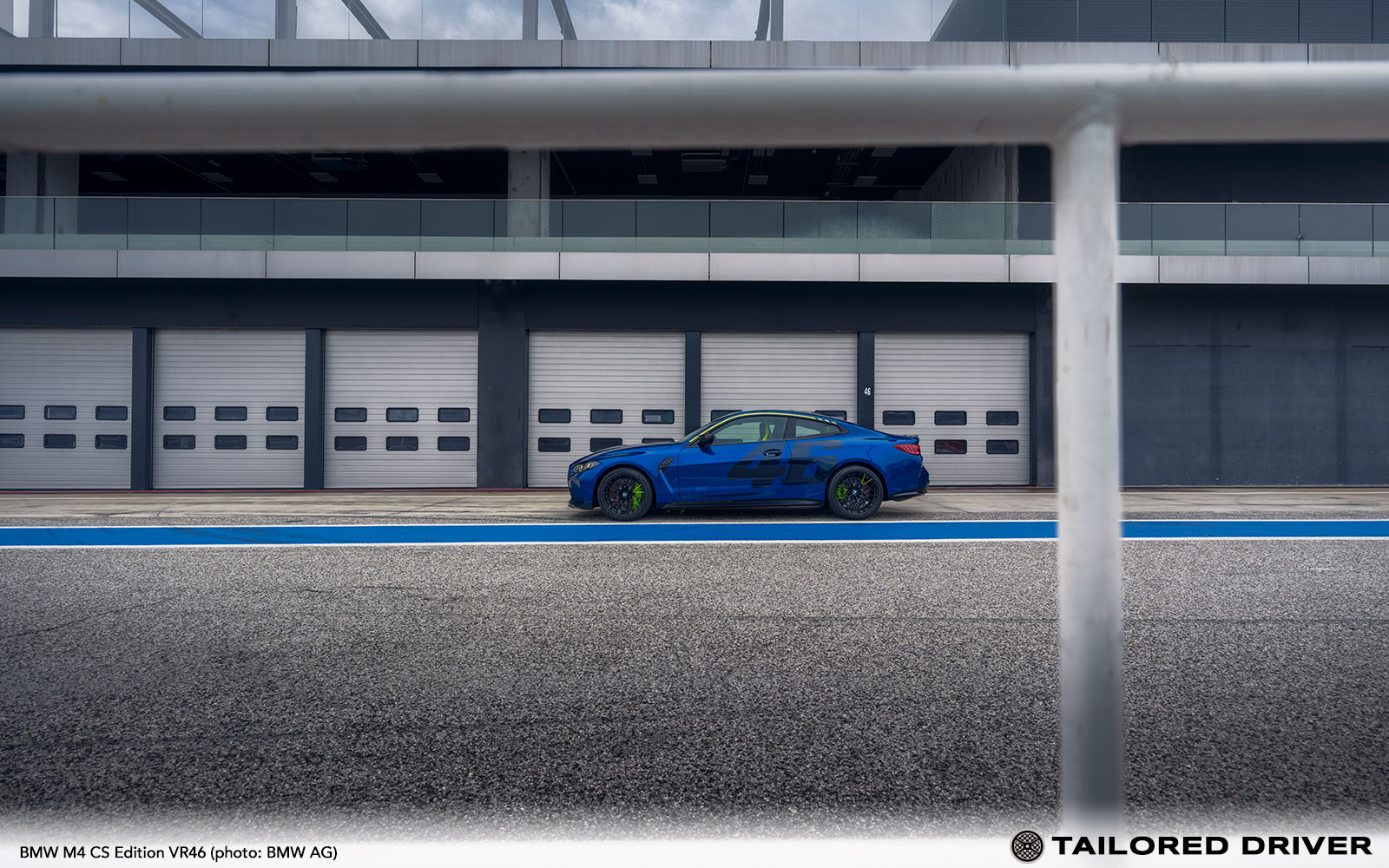
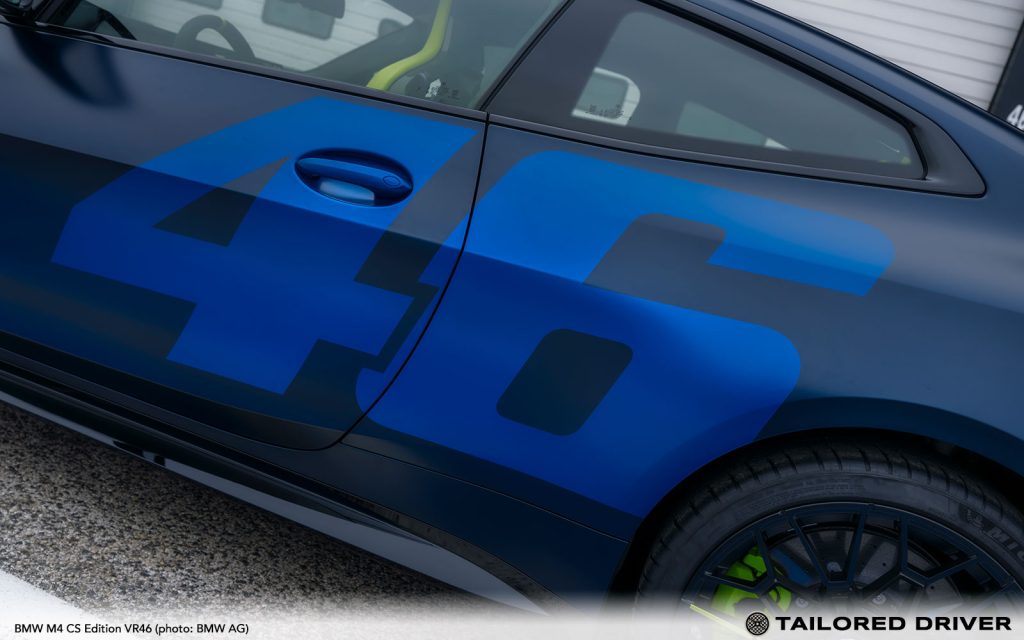
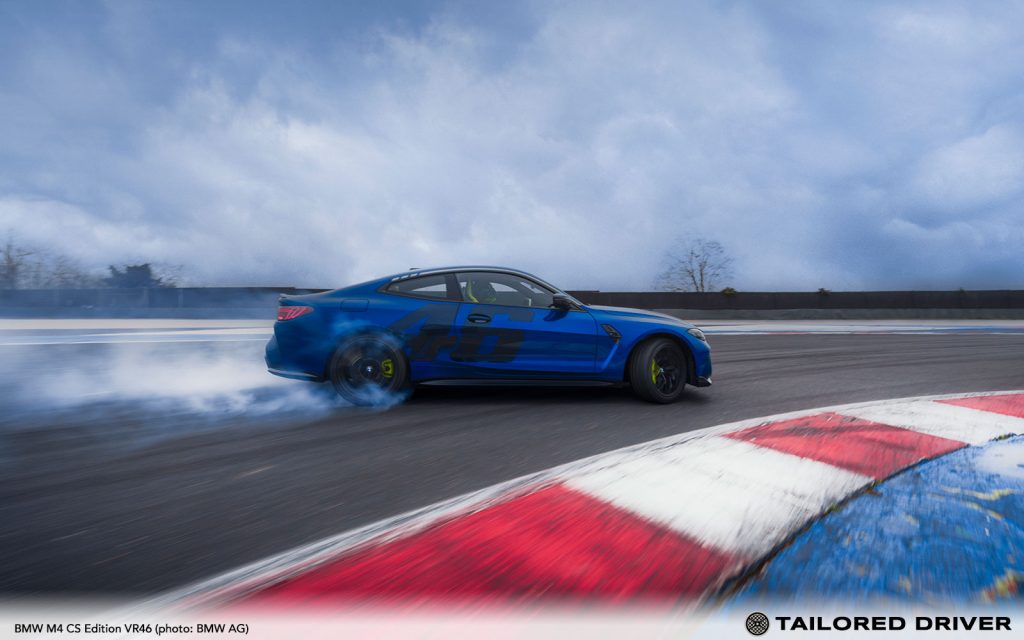
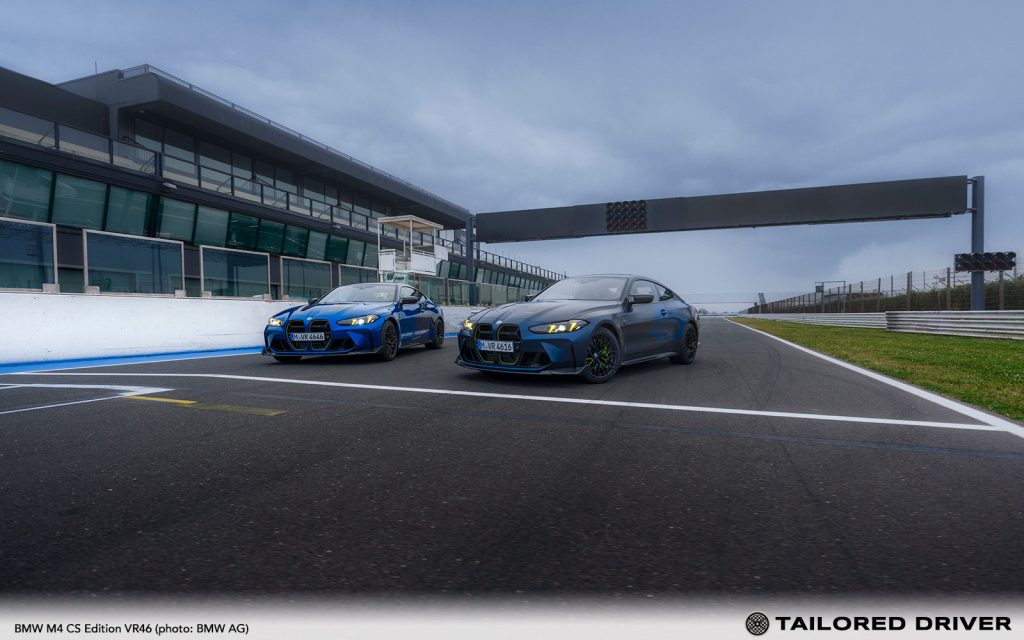
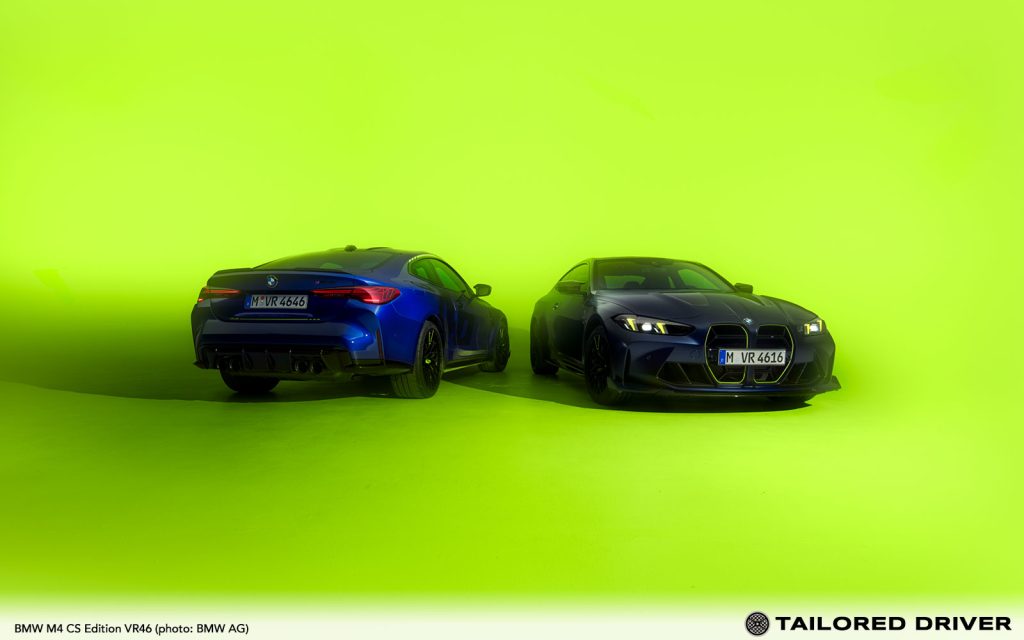
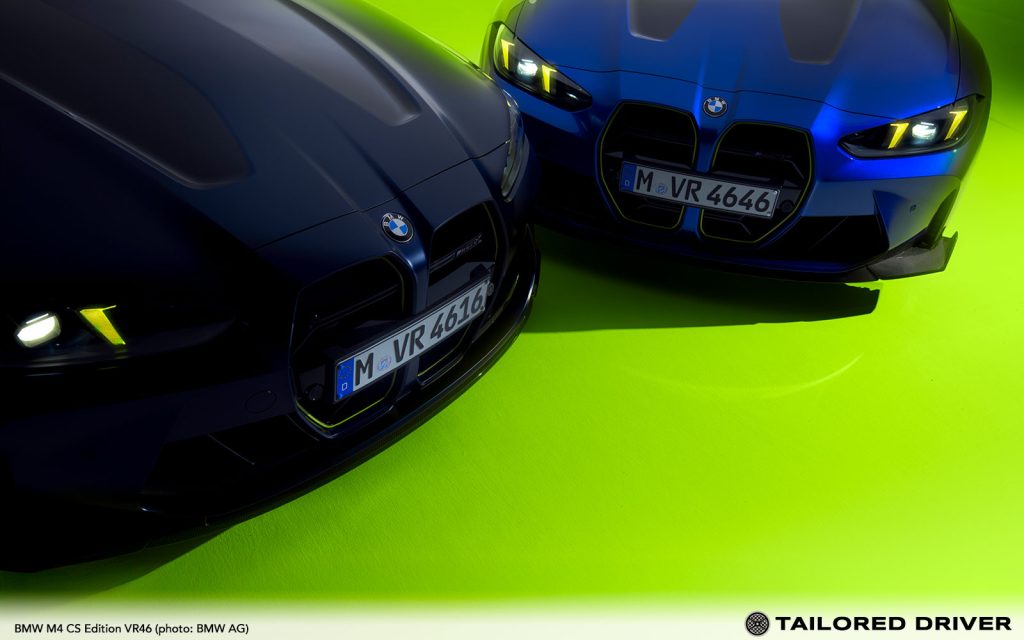
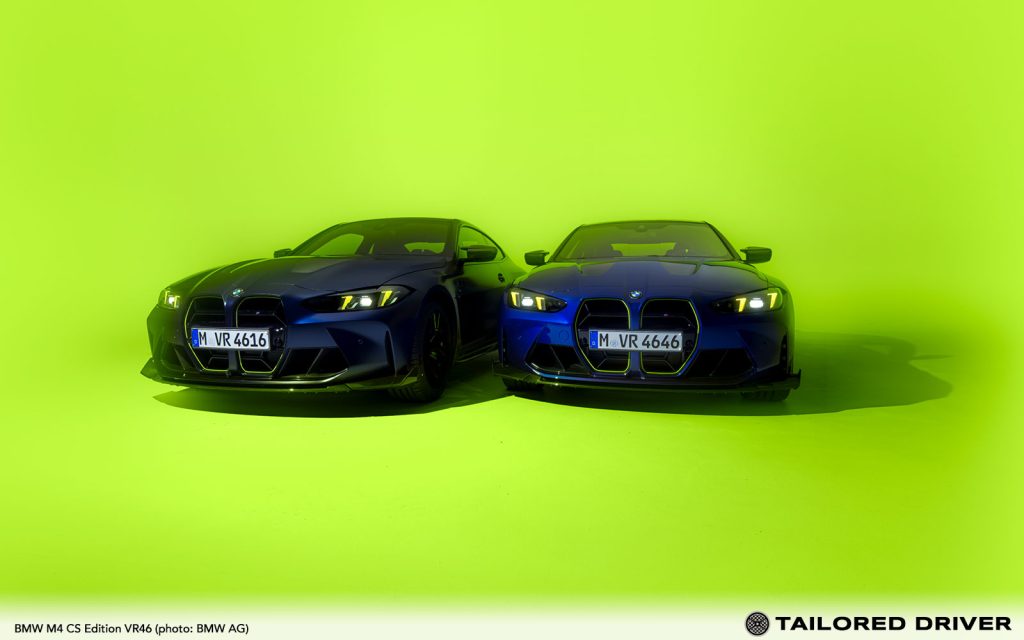
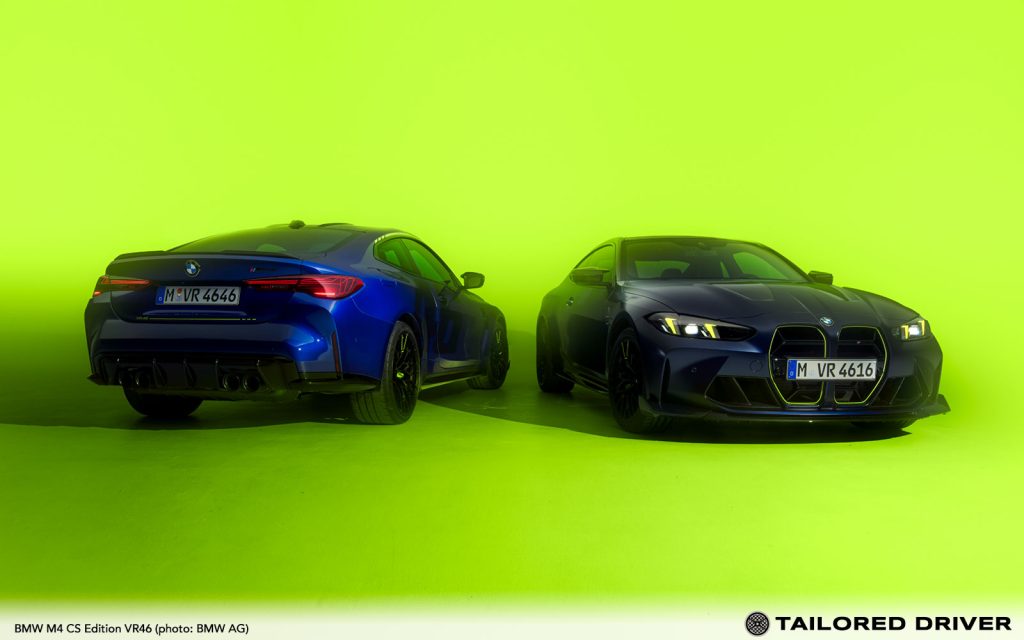
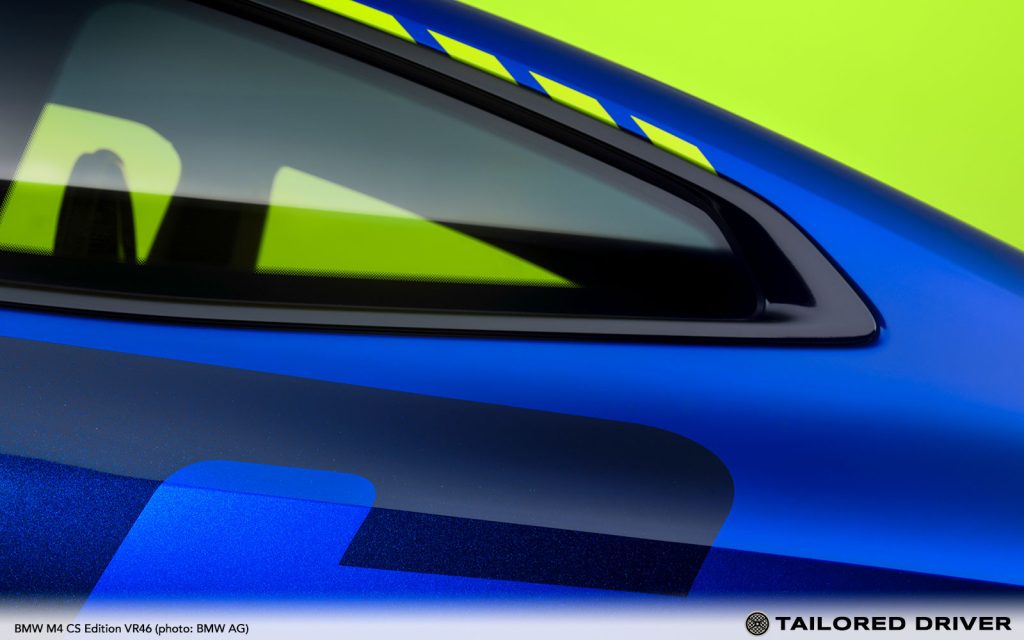
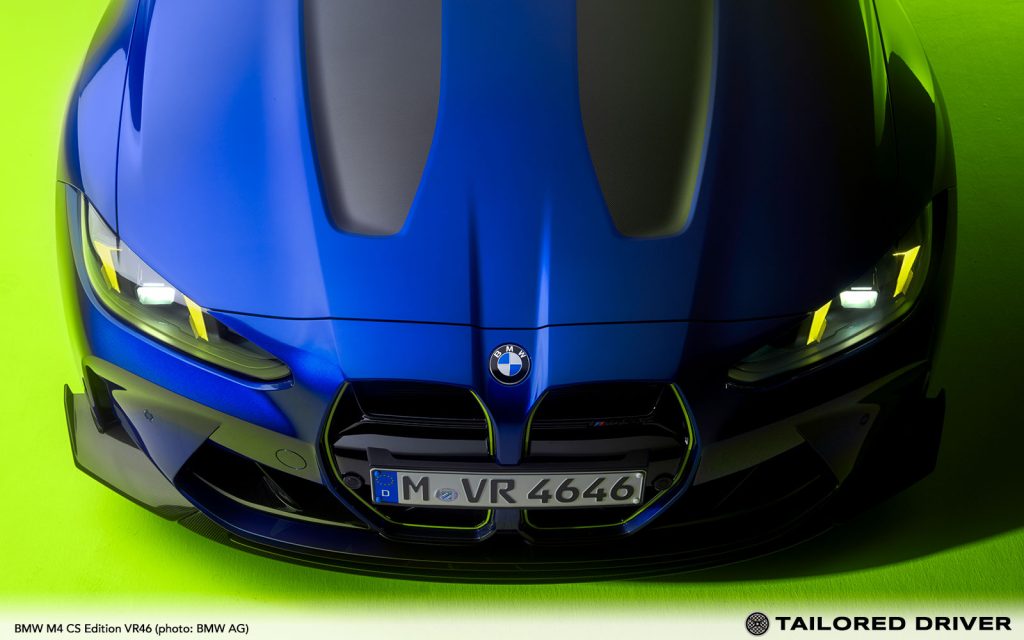
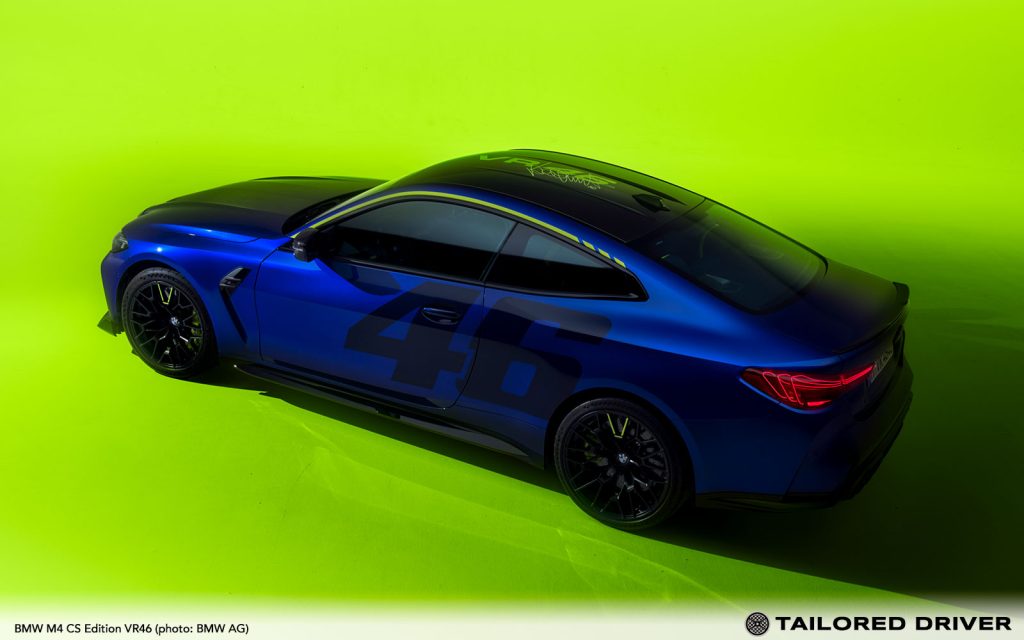
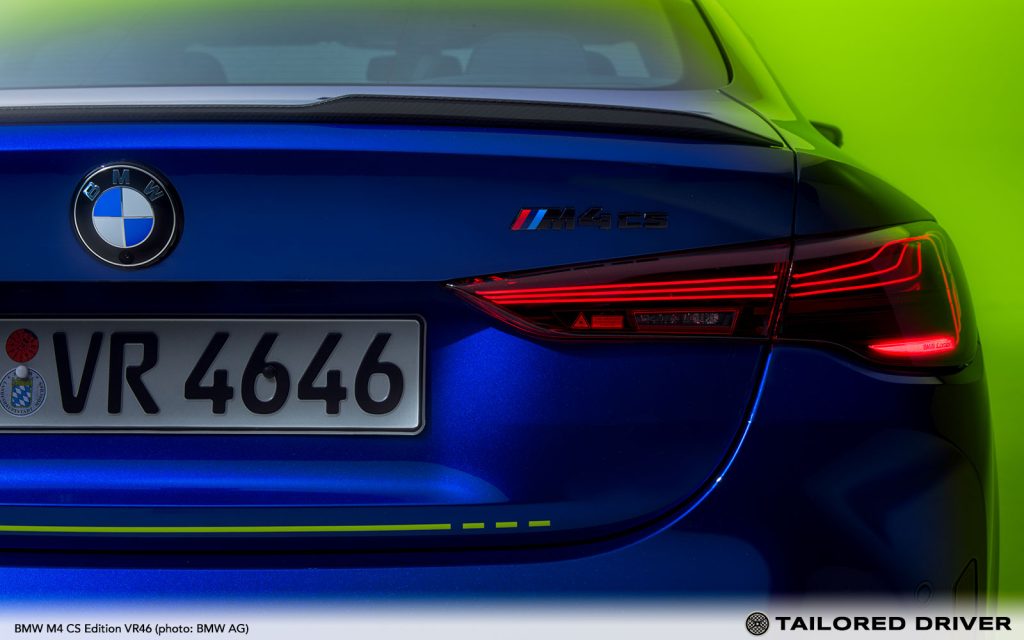
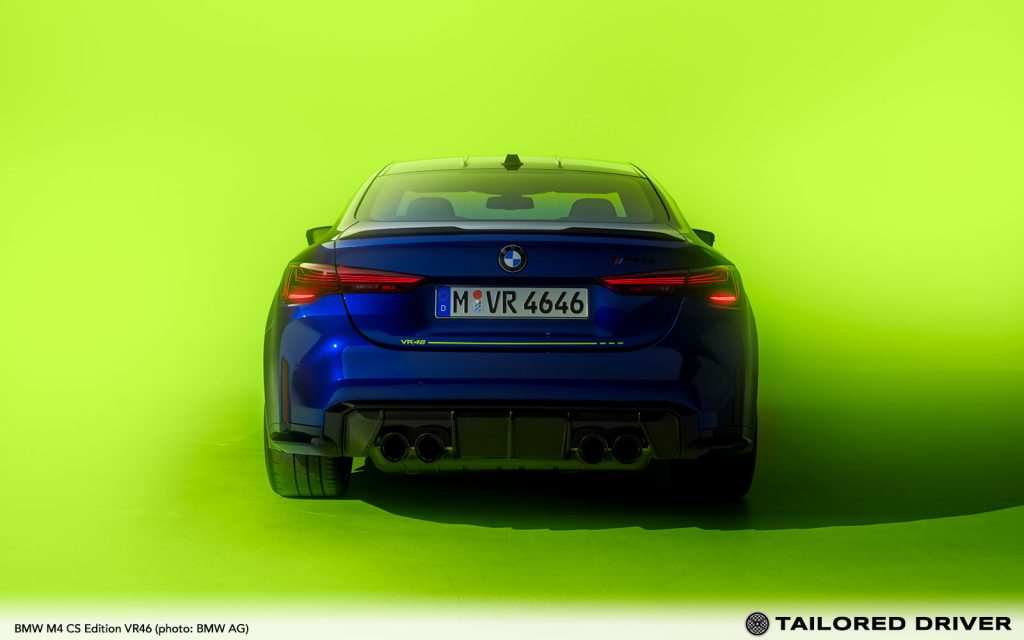
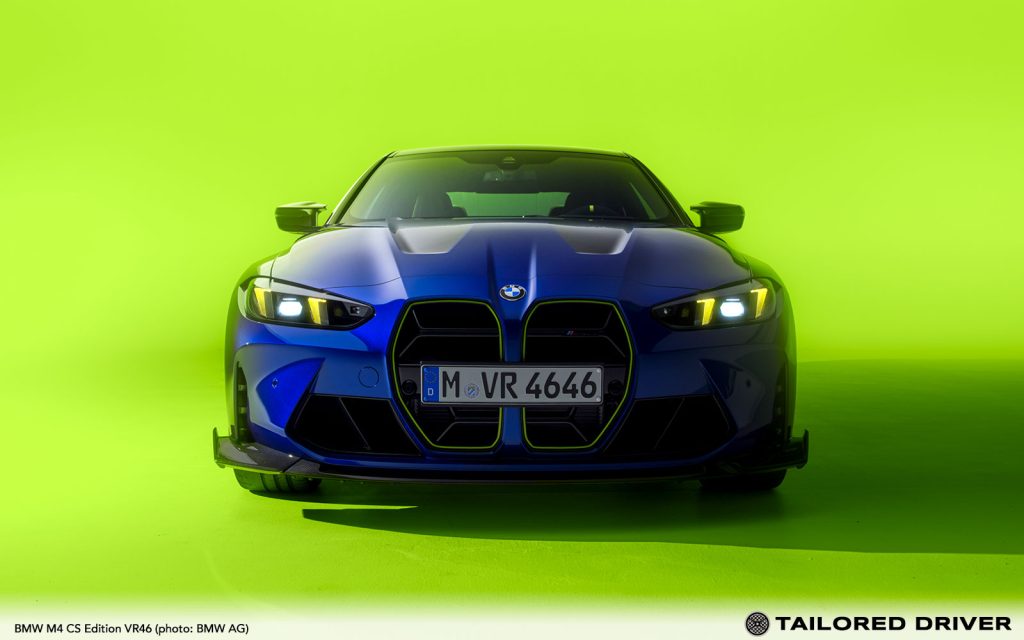
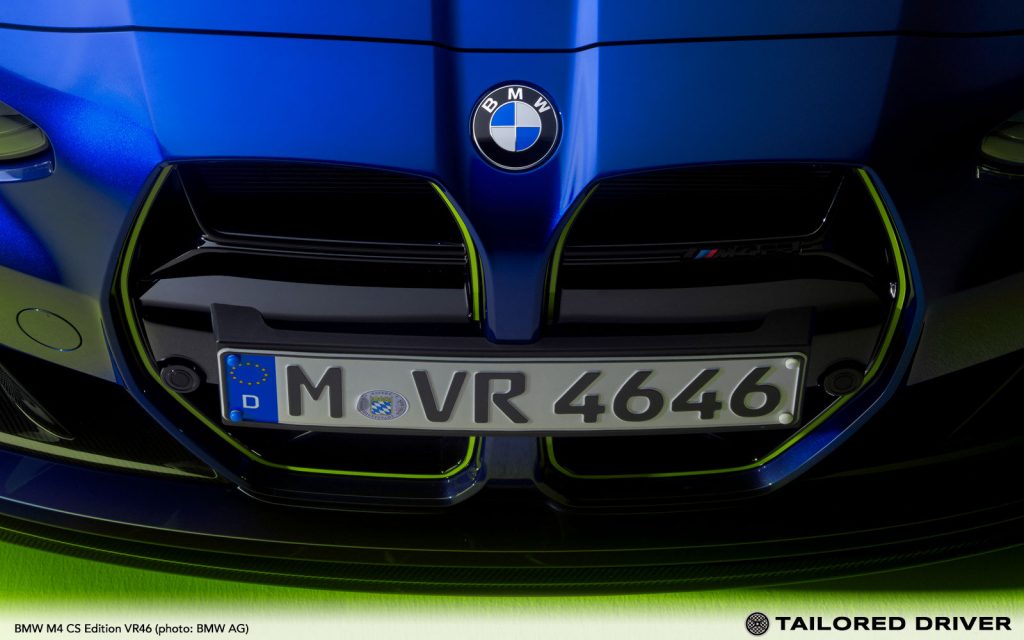
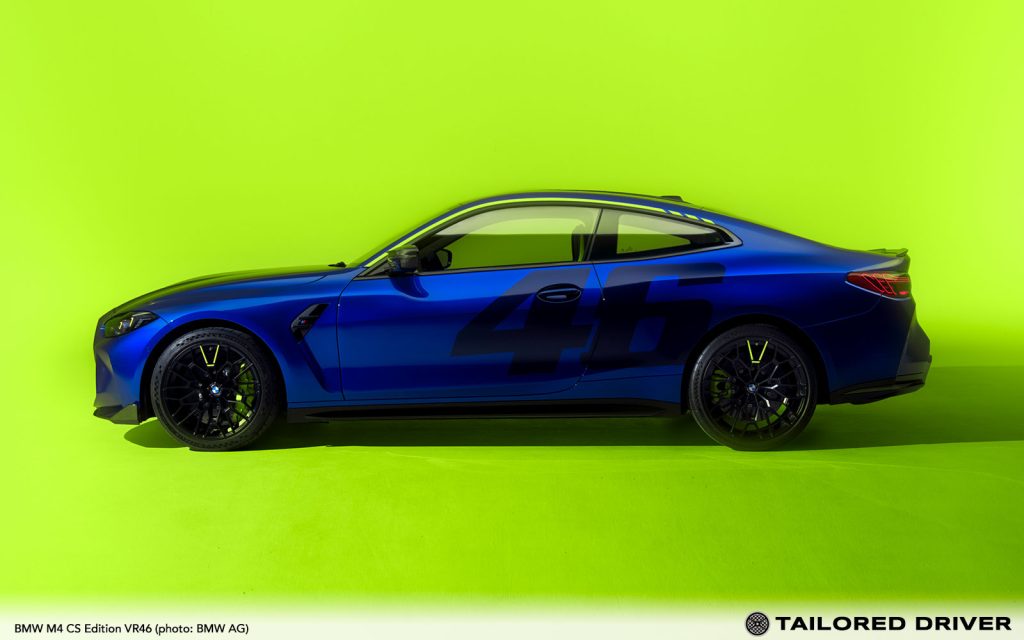
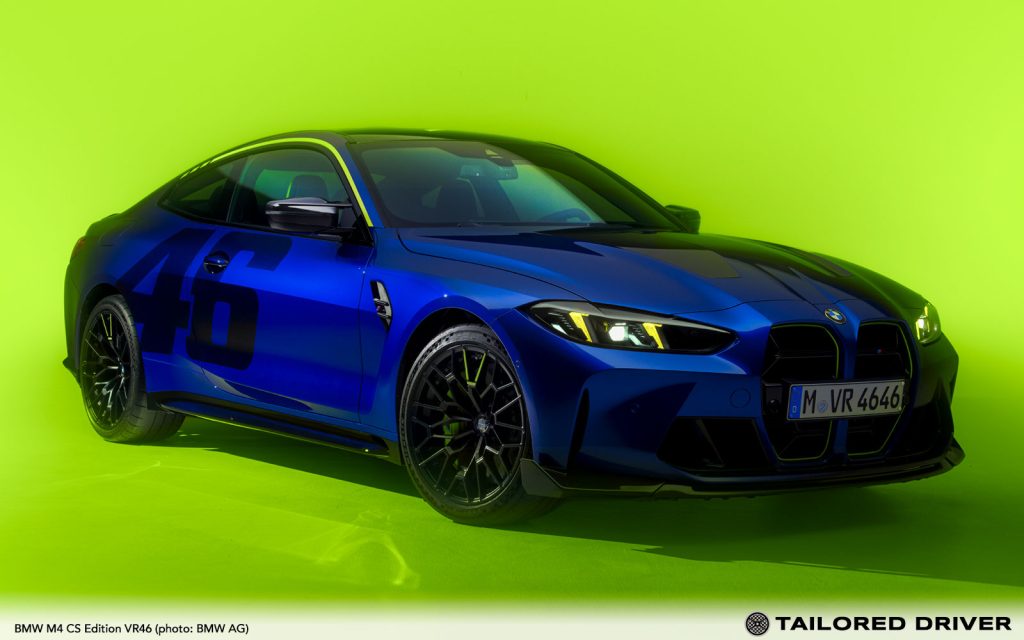
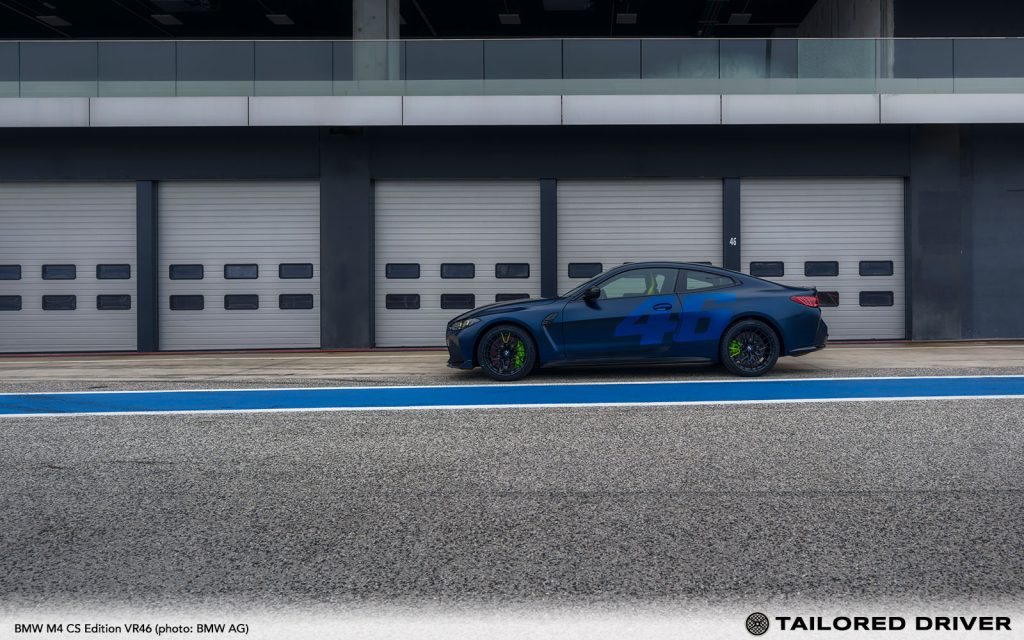
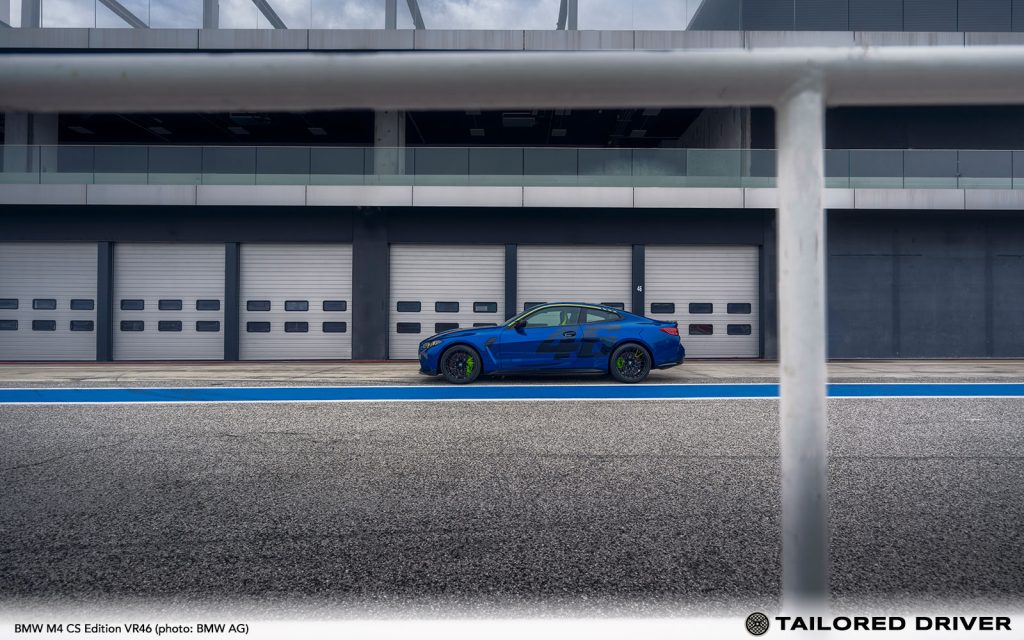
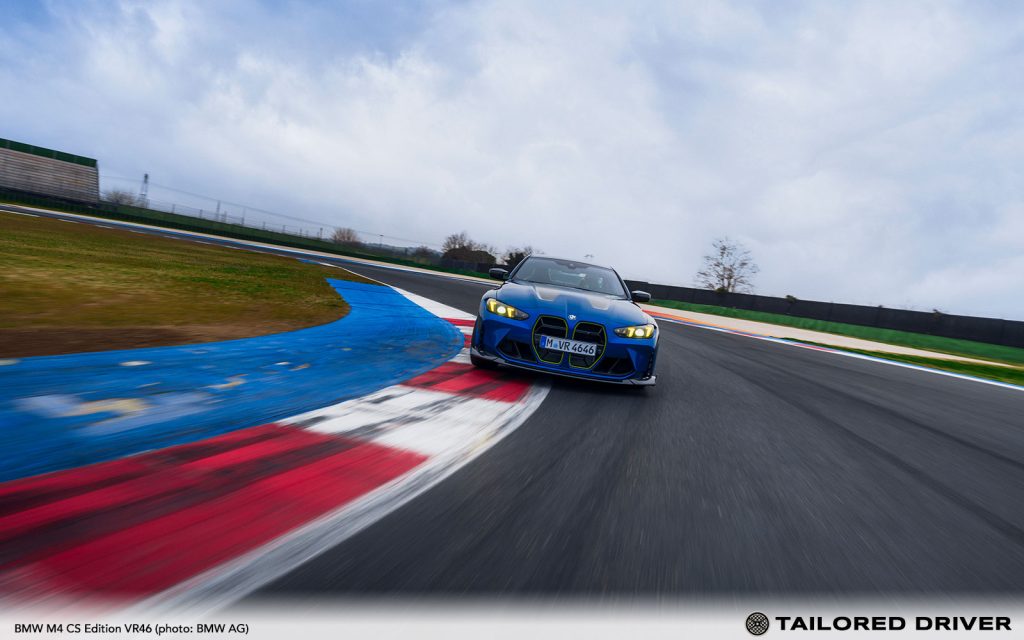
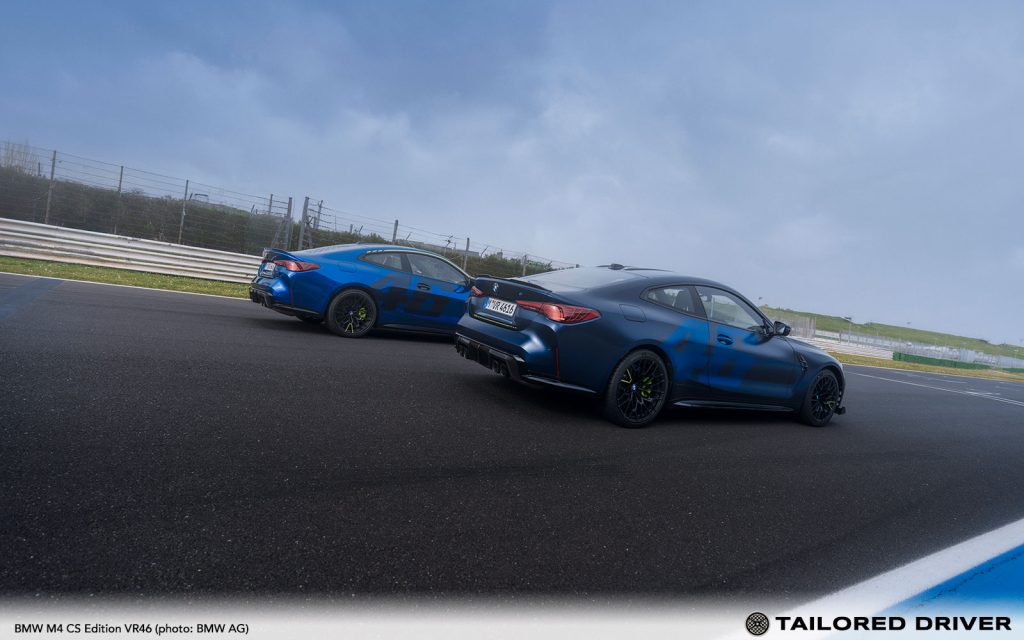
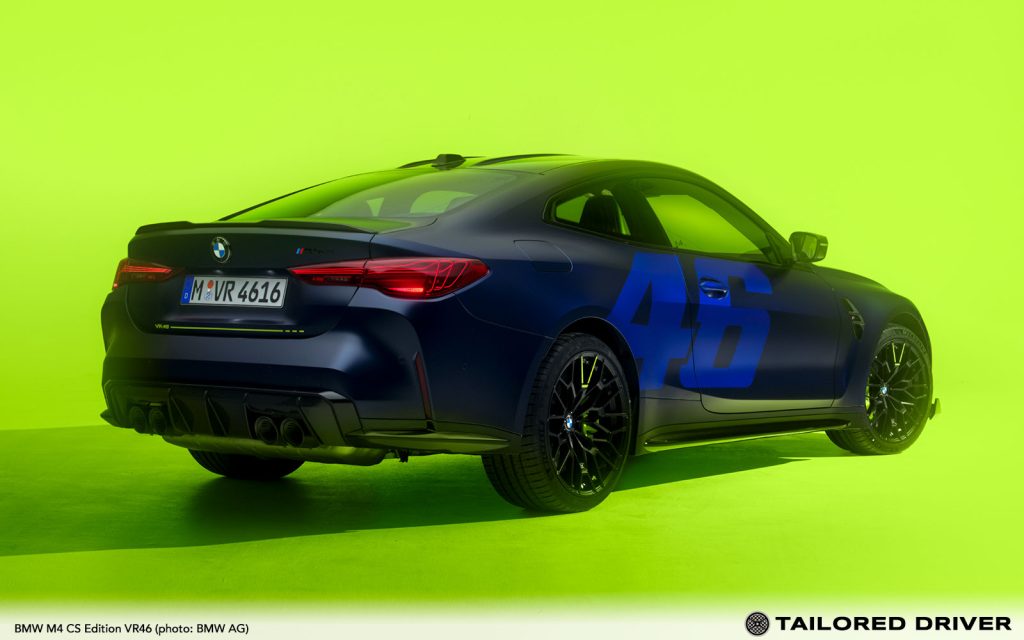
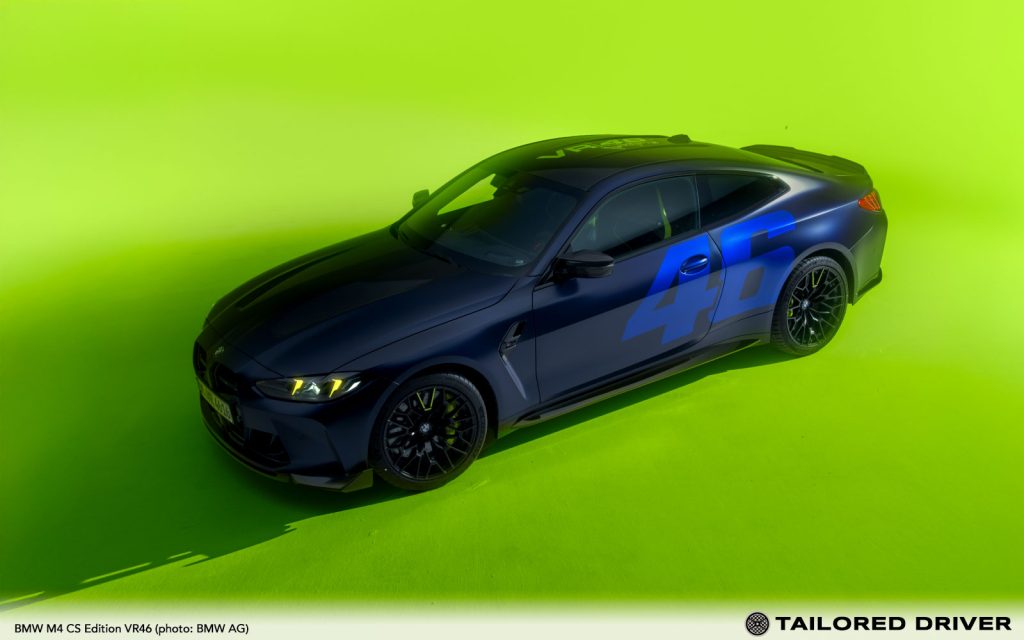
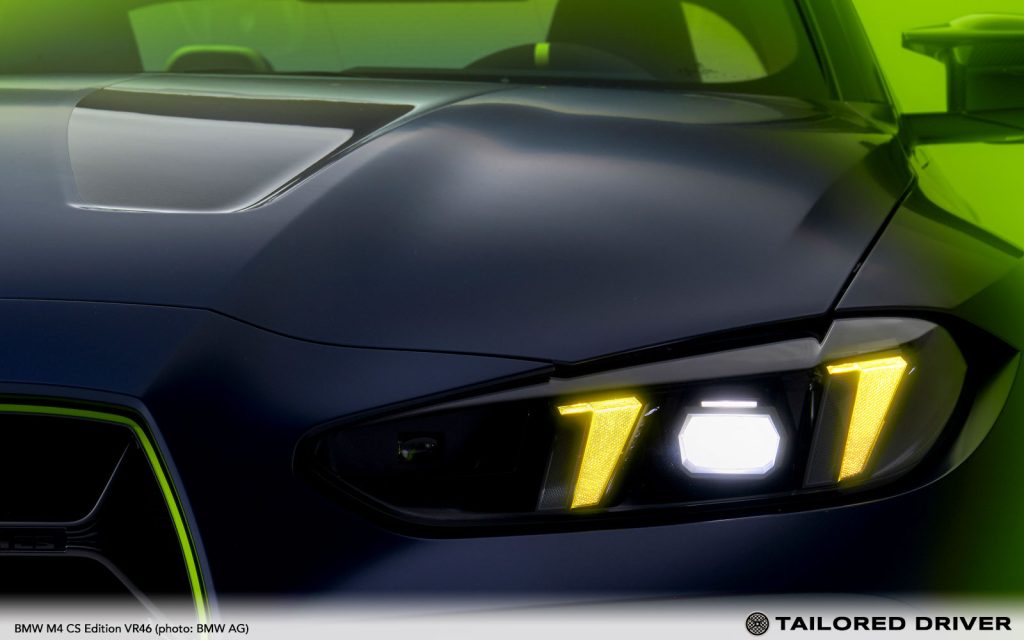
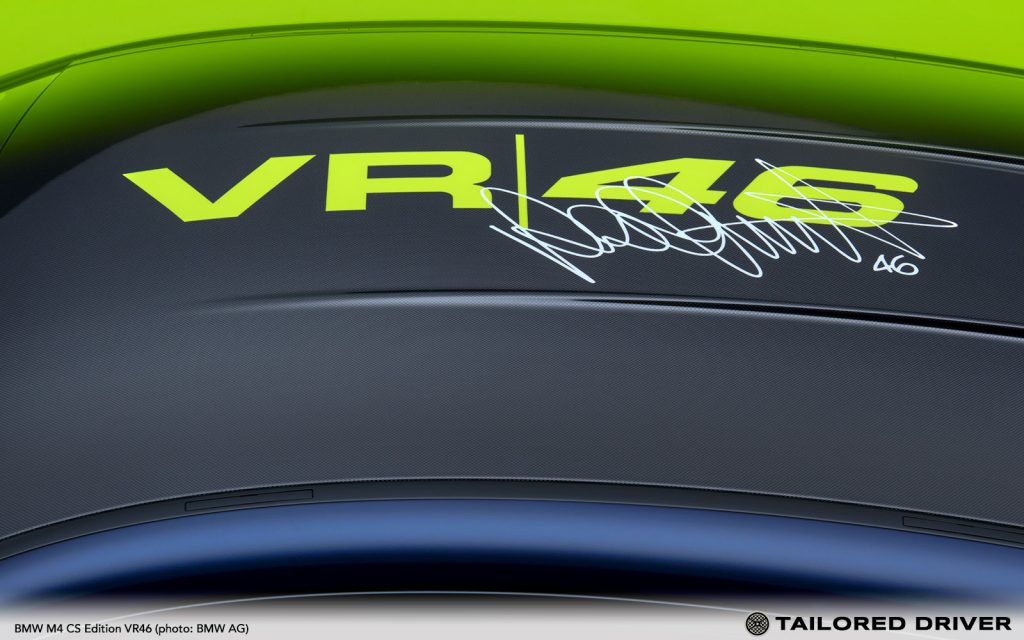
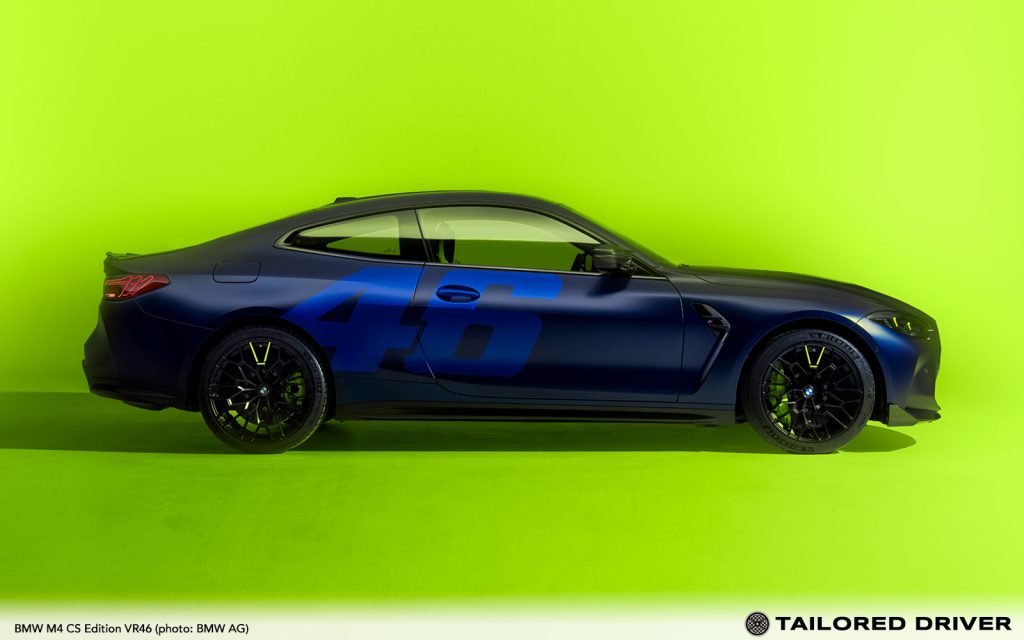
The #46 is now 46 – and BMW M has the perfect present to mark the birthday of nine-time motorcycle world champion and current BMW M works driver Valentino Rossi (ITA): the BMW M4 CS Edition VR46 (fuel consumption combined: 10.2 l/100 km [27.7 mpg imp]; CO2 emissions combined: 232 g/km in the WLTP cycle, CO2 class: G)*. This exclusive edition, produced at BMW Group Plant Dingolfing, is available in two distinctive design variants: Sport and Style. “The Doctor” himself was personally involved in the design process for the two versions, both of which will be built in a limited run of 46 cars. The world-famous number, which is Rossi’s trademark, features prominently in several places on and inside the BMW M4 CS Edition VR46 – for example, on the doors and the roof, which is made of carbon-fibre-reinforced plastic (CFRP).
Purchasing a BMW M4 CS Edition VR46 also comes with a once-in-a-lifetime experience comprising an exclusive, personal meeting with Valentino Rossi at his home – the VR46 Motor Ranch in Tavullia (ITA) – and a BMW M Driving Experience at the Misano race circuit (ITA).
“There is no other brand that has motorsport so deeply rooted in its DNA as BMW M. I am proud to be a BMW M works driver, and to share this passion. The fact that there is now a special VR46 edition, in which I was involved from the very beginning of the design process, makes me proud. When I see the BMW M4 CS Edition VR46 out on the road or on the race track later, it will be very cool,” says Valentino Rossi about the edition and the collaboration with BMW M.
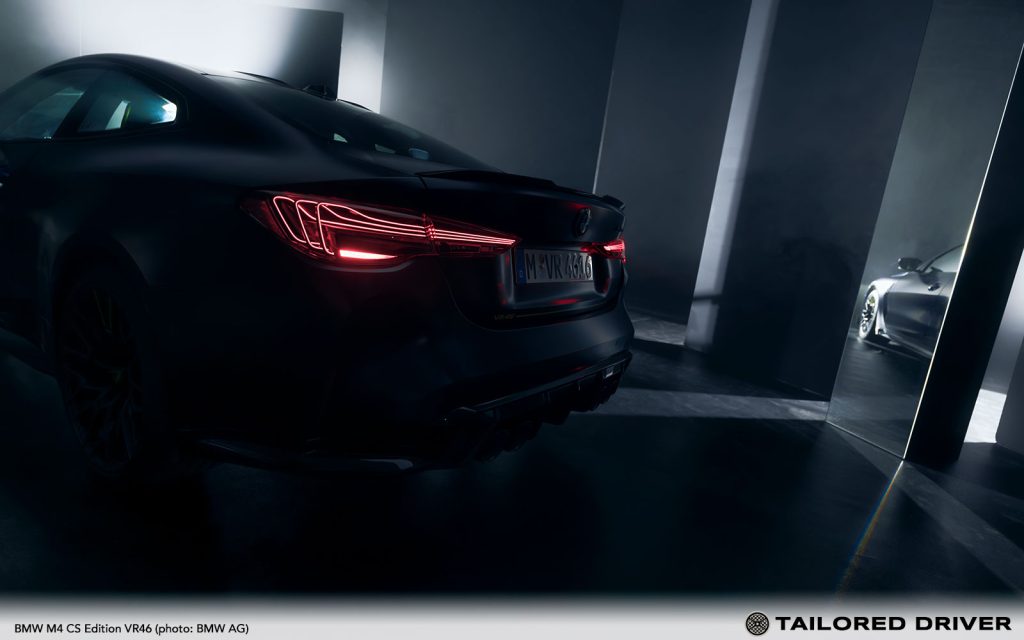
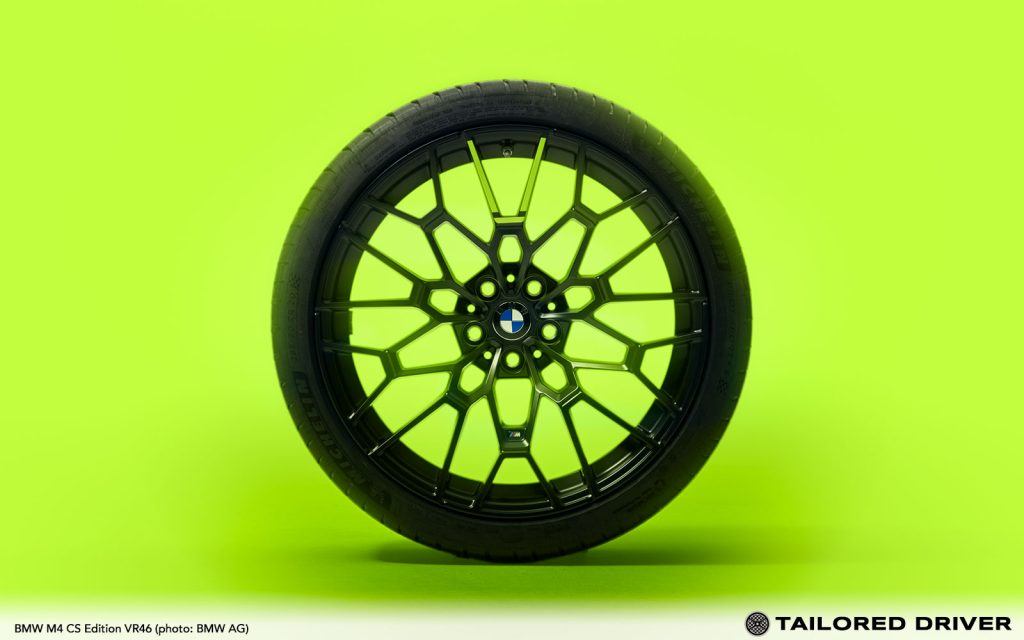
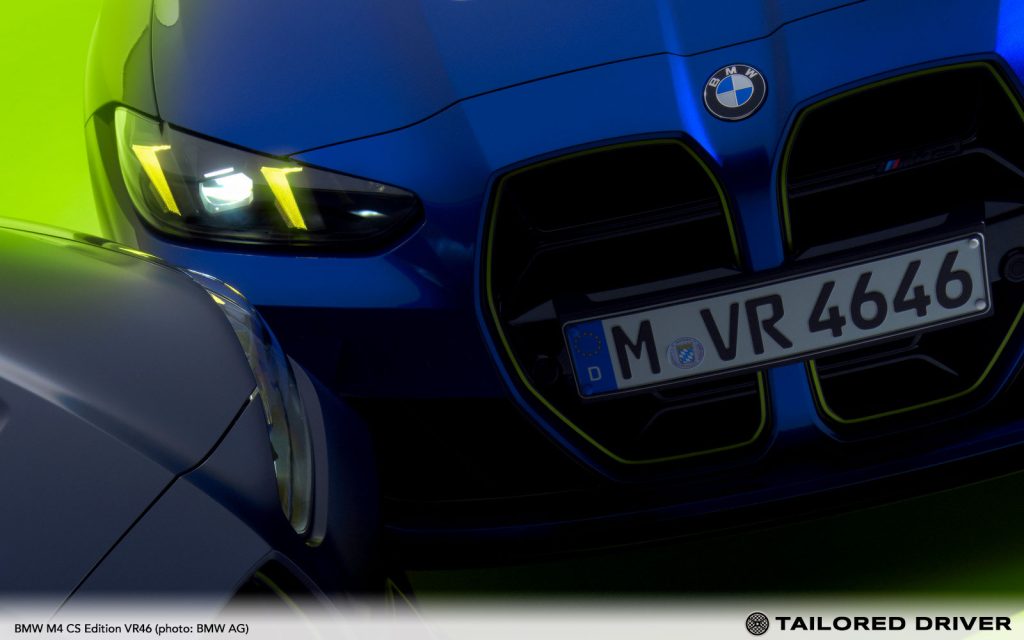
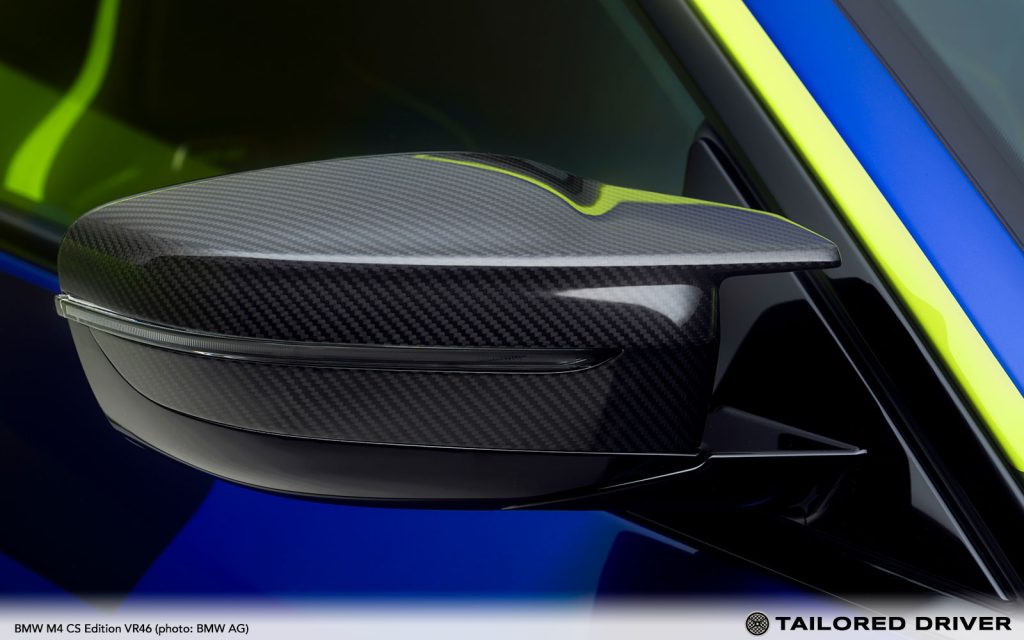
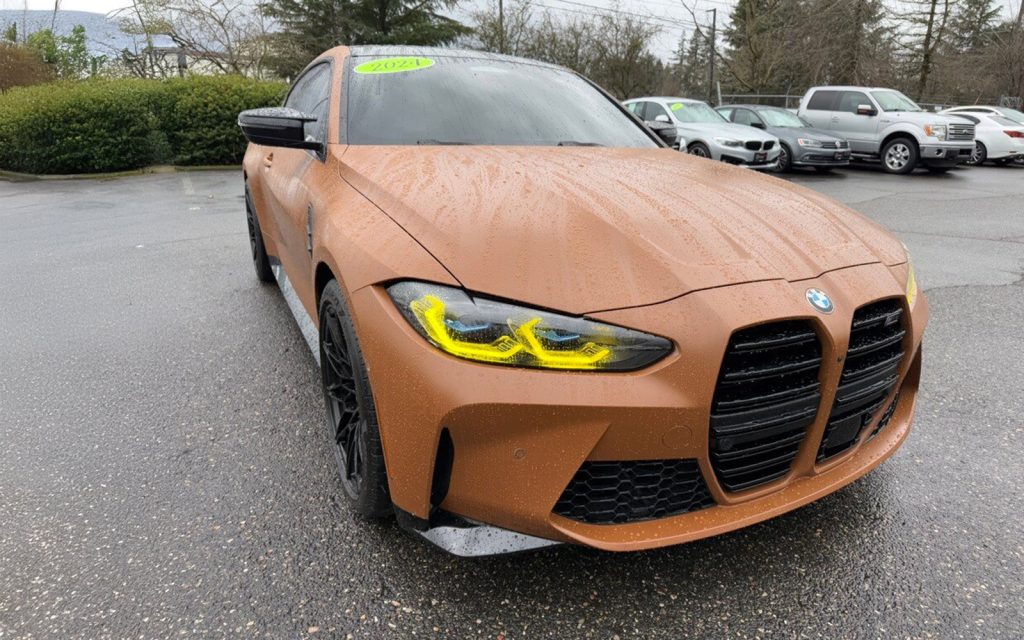
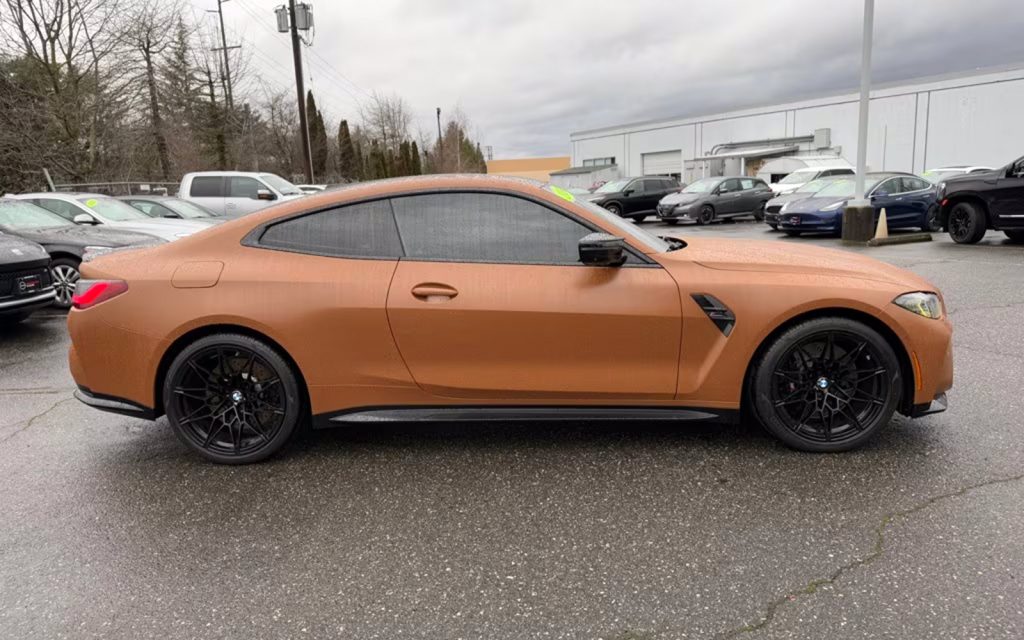
Exclusive BMW Individual paint finishes and special exterior and interior details One way in which the BMW M4 CS Edition VR46 differs from the BMW M4 CS (fuel consumption combined: 10.2 l/100 km [27.7 mpg imp]; CO2 emissions combined: 232 g/km in the WLTP cycle, CO2 class: G)* is its two exclusive BMW Individual paint finishes, which blend perfectly with the many exposed carbon surfaces, such as the indents in the bonnet. Other distinctive features include a host of exclusive exterior and interior details. The overall colour concept of the two design versions is inspired by Valentino Rossi’s preferred tones and expressive visual style. For example, the “Sport” has a finish in Marina Bay Blue metallic, while both sides of the car display an outsized “46” in the darker Tanzanite Blue metallic. In the “Style” design variant, the bodywork comes in matt Frozen Tanzanite Blue metallic, with the “46” this time in Frozen Marina Bay Blue metallic on both sides. In a nod to Rossi’s favoured colour scheme, the BMW M kidney grille outline and one of the V spokes in the forged M light-alloy wheels – which, as on racing cars, indicates the position of the tyre valve – are painted in bright yellow, as are the brake callipers with M logo and an accent strip over the door frames of the “Sport” variant. The carbon-fibre roof – like the sides of the car, painted by hand – is adorned with a large VR46 logo (also in yellow, of course) and Rossi’s signature. The tailgate features VR46 lettering.
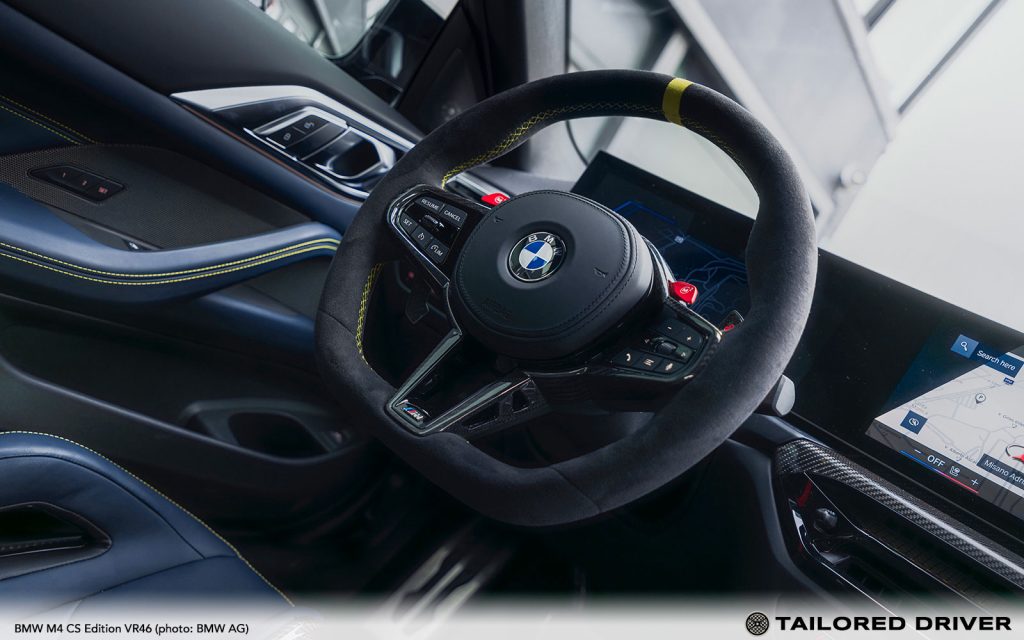
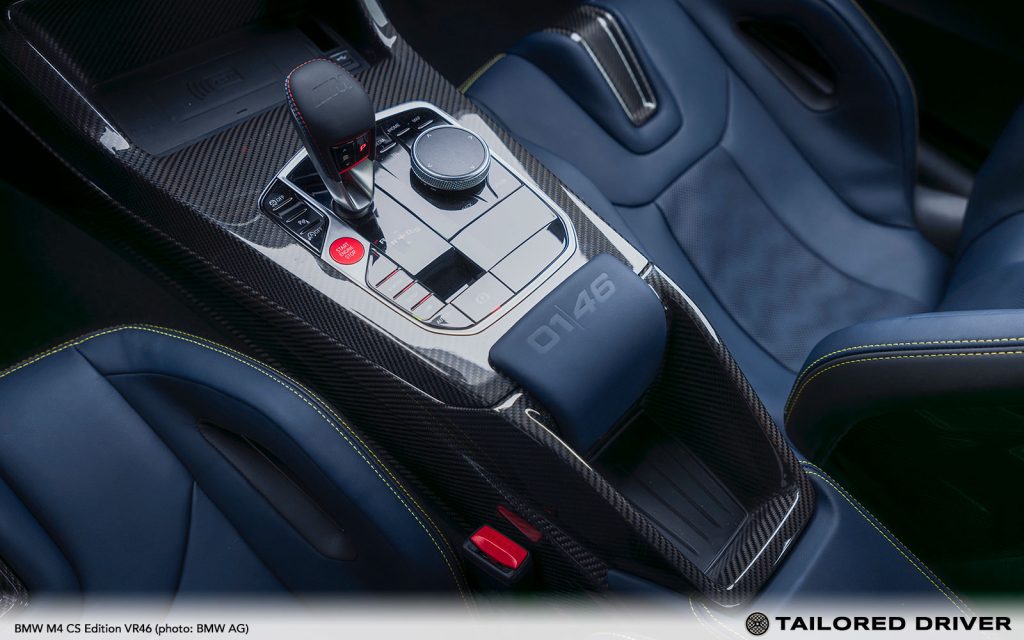
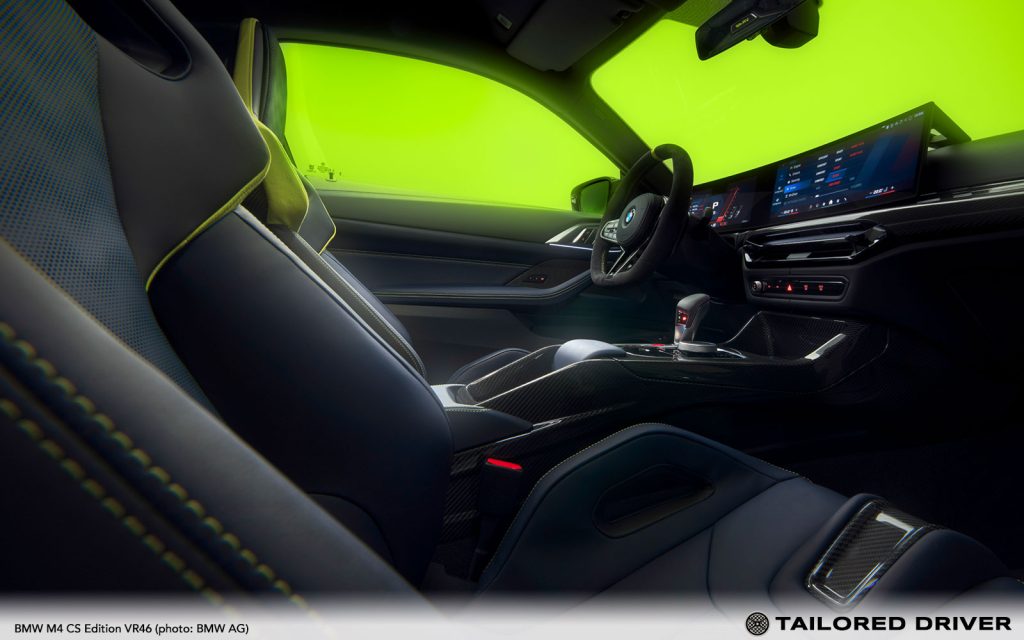
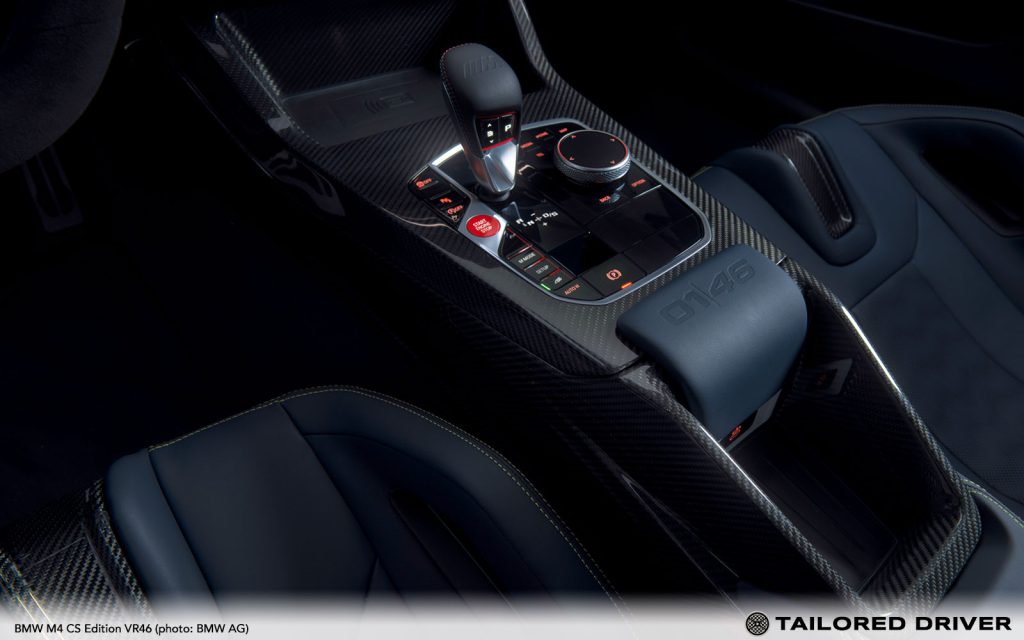
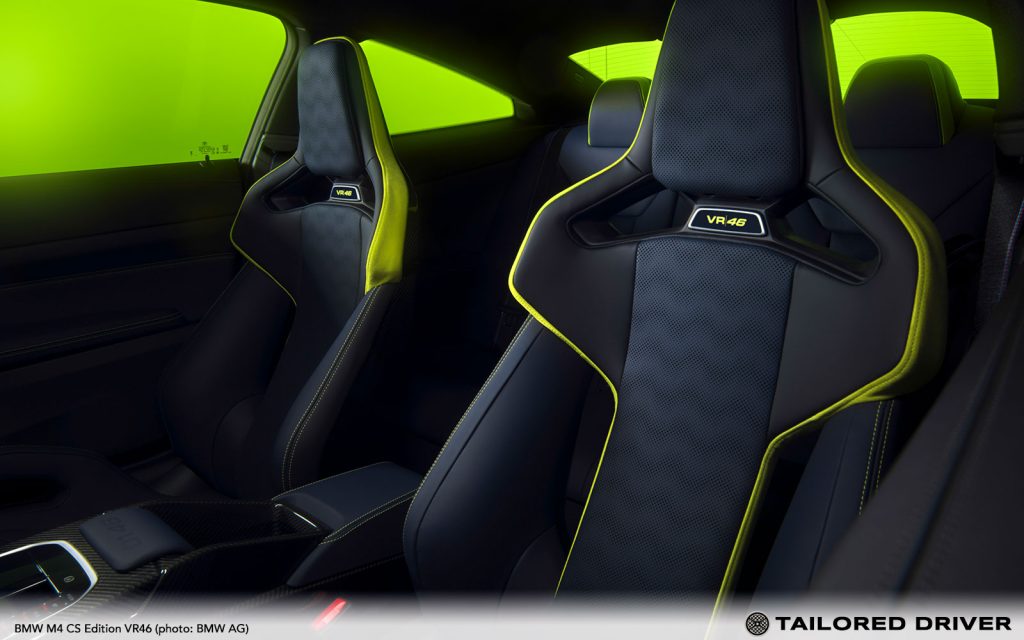
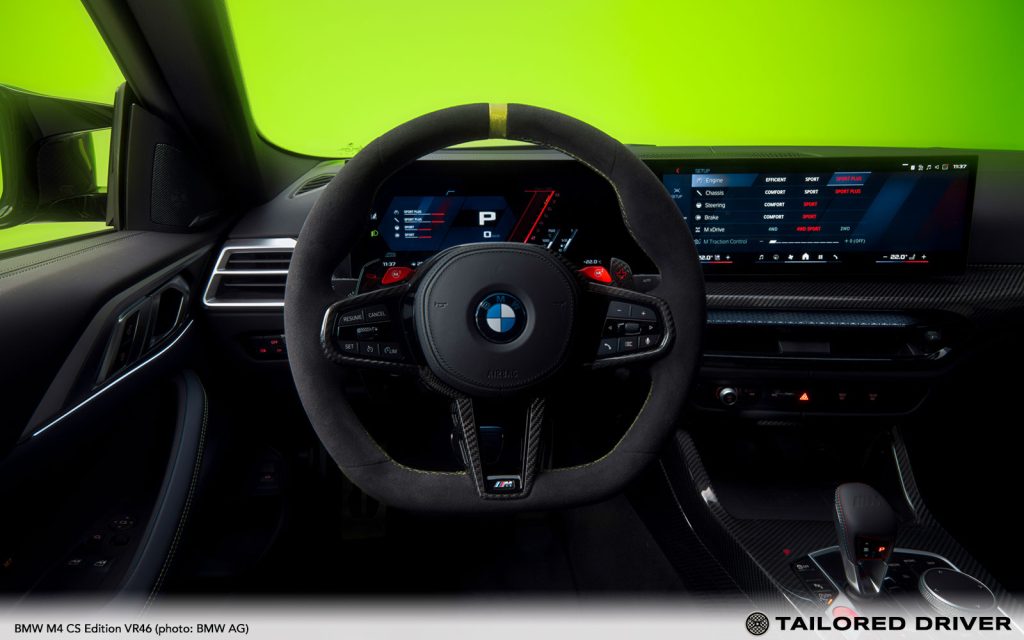
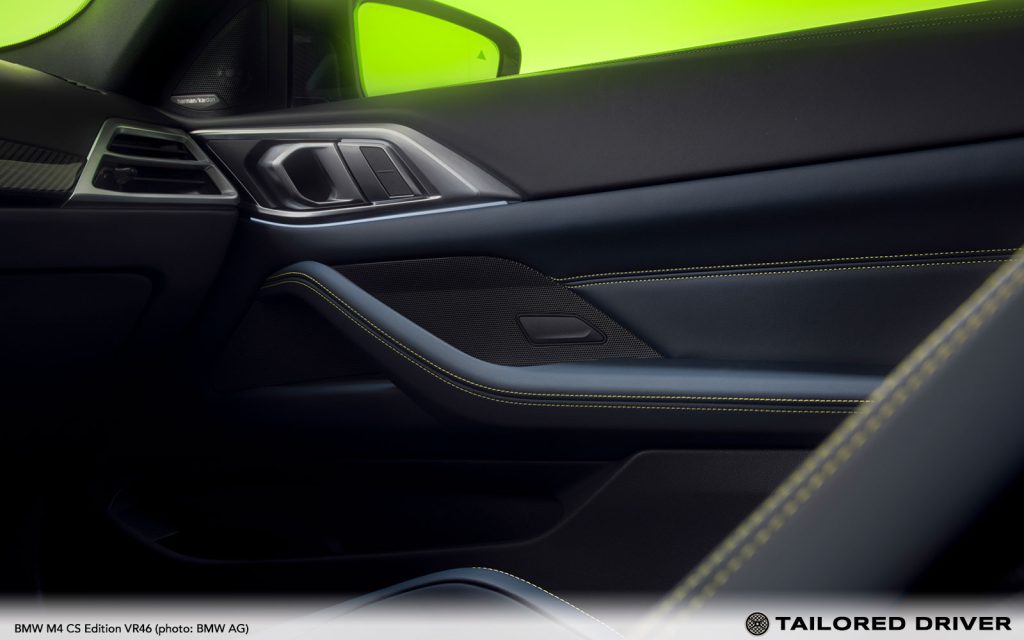
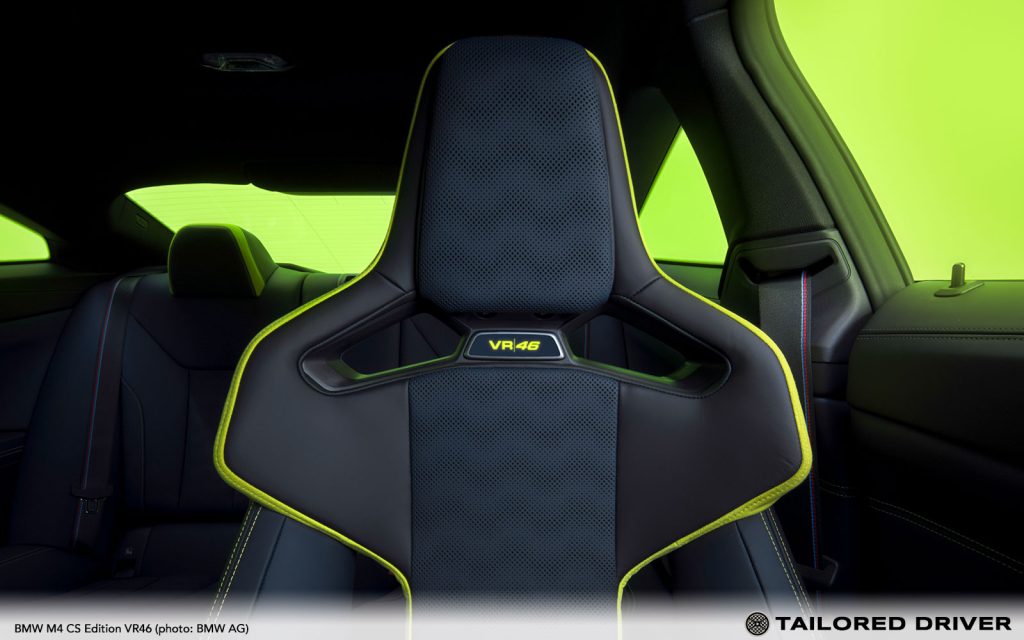
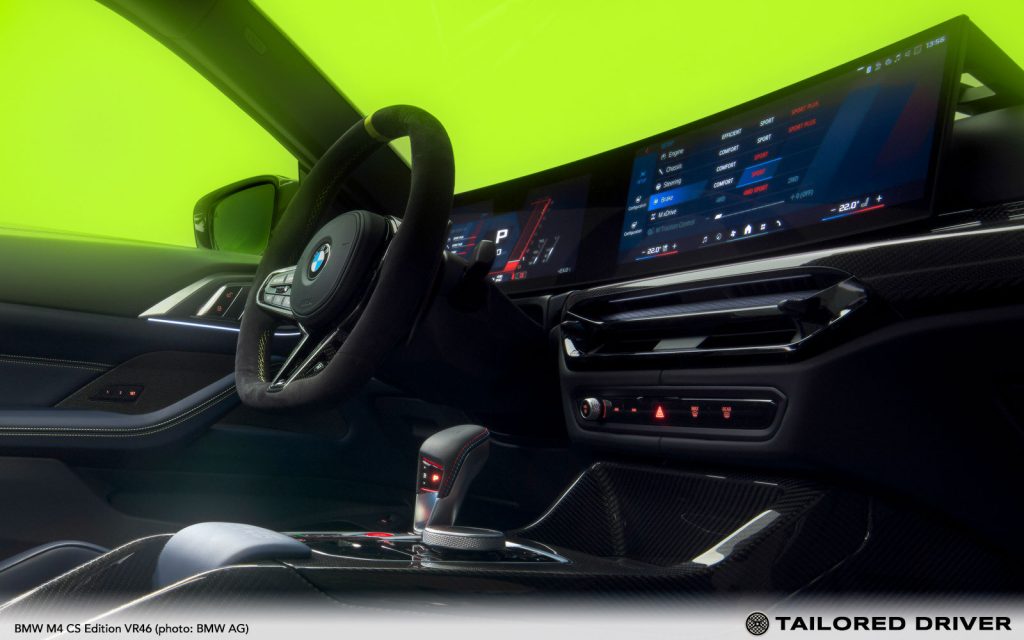
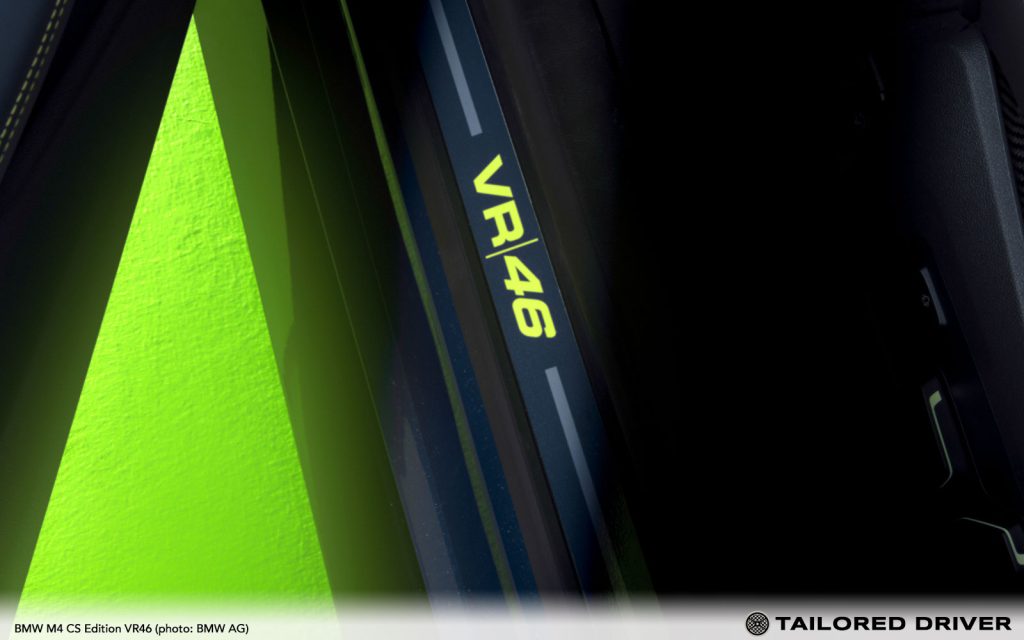
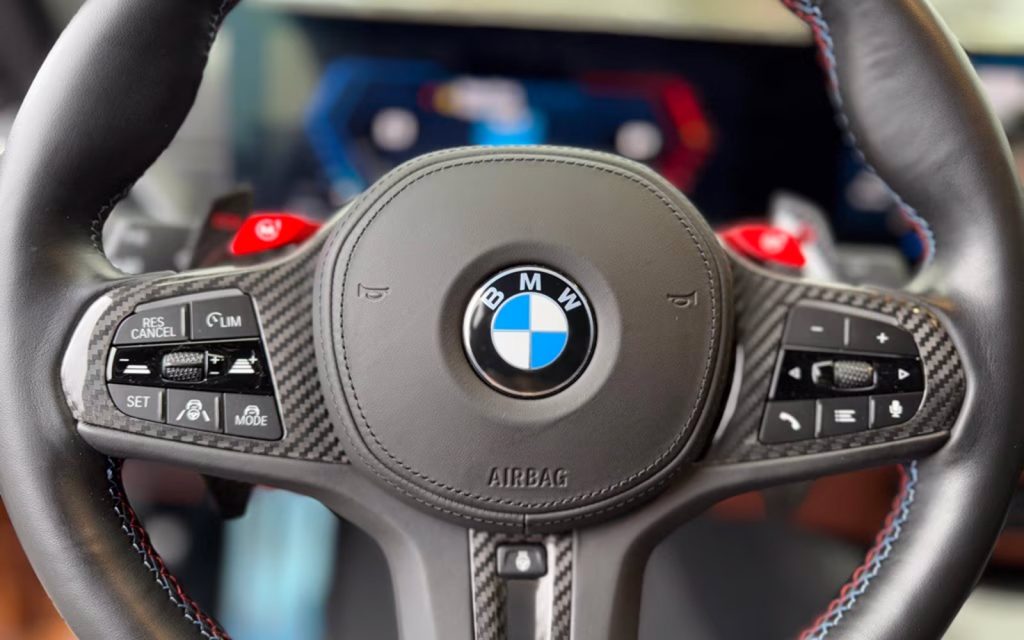
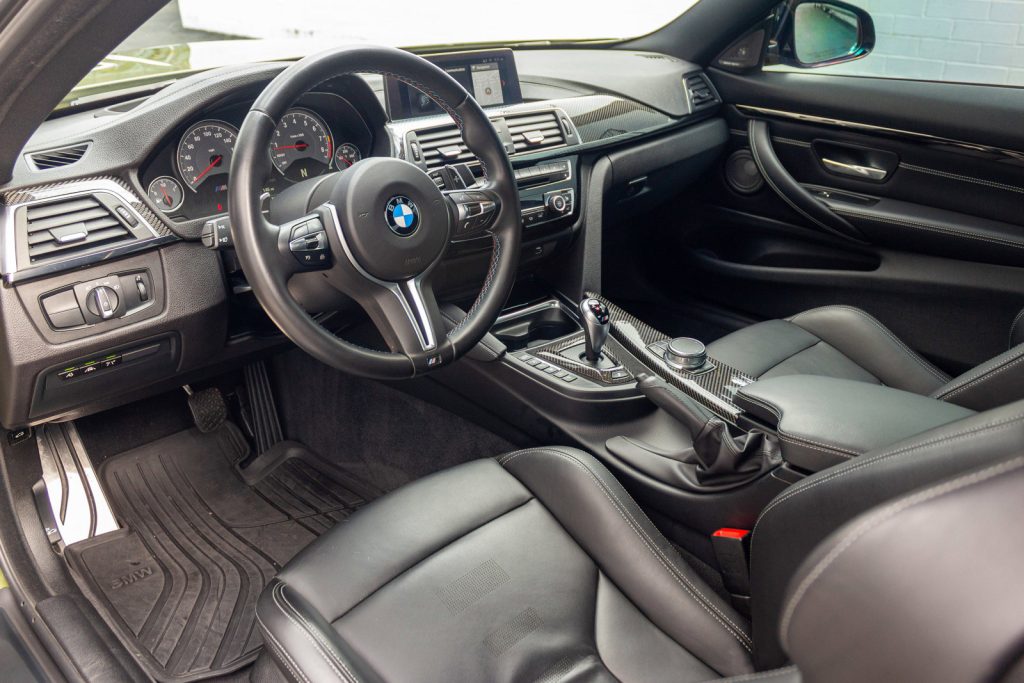
The yellow accents continue in the interior of the BMW M4 CS Edition VR46, which is predominantly Night Blue. The M Carbon bucket seats come with Merino leather upholstery in the Black/Night Blue colour combination. The Sao Paulo Yellow of the Alcantara shoulder area creates an exclusive contrast. The head restraints, like the door sill trims, feature a prominent yellow VR46 logo. Furthermore, the M Alcantara steering wheel with three-spoke design and flat-bottomed rim comes with yellow contrast stitching and a yellow centre marker. On the carbon-fibre centre console of all examples of the Edition VR46 is a badge stating “1/46”, identifying each Sport or Style car as one of the limited run.
Six-cylinder in-line engine with 405 kW/550 hp The beating heart of the BMW M4 CS Edition VR46 is a high-revving 3.0-litre, six‑cylinder in-line engine with M TwinPower Turbo technology. This power unit has had track performance as its raison d’être from day one of its development. The increase in the maximum charge pressure of the two mono-scroll turbochargers to 2.1 bar and model-specific tweaks to the engine management mean the edition model’s engine now generates 405 kW/550 hp, which is relayed to the road via an eight-speed M Steptronic transmission, the M xDrive intelligent all-wheel-drive system and the Active M Differential. Lightning-fast power development and optimised traction enable the car to accelerate from 0 to 100 km/h in 3.4 seconds, and from 0 to 200 km/h in 11.1 seconds. When applying the “1-foot rollout” method**, the figures read 3.1 seconds for the sprint from 0 to 100 km/h and 10.8 seconds for 0 to 200 km/h. Acceleration from 80 to 120 km/h takes 2.6 seconds in fourth gear and 3.3 seconds in fifth. The top speed of the edition model, which comes with the M Driver’s Package as standard, is electronically limited to 302 km/h.
Contributing to the excellent engine response is a model-specific engine mounting with increased spring rates. The rigid connection between the power unit and the vehicle’s structure enables particularly direct transmission of its power to the drivetrain every time the driver presses the accelerator. The oil supply system – like the cooling system – is designed to handle the specific challenges of track use, including consistently high revs and extreme lateral acceleration. The engine’s power delivery is accompanied by the emotionally stirring soundtrack generated by the dual-branch exhaust system, which features electrically controlled flaps, a titanium rear silencer with weight-minimising design and – in customary M fashion – two pairs of tailpipes painted in matt black.
Model-specific tuning for chassis technology and control systems The chassis technology for the new BMW M4 CS Edition VR46 has been tuned precisely to the performance characteristics of the engine, the overall vehicle concept and its weight distribution. The individually tuned axle kinematics and bespoke wheel camber settings, dampers, auxiliary springs and anti-roll bars serve to optimise steering precision, transmission of lateral control forces when cornering, spring and damping response, and wheel location. The electronically controlled dampers of the adaptive M suspension likewise come in a model-specific set-up, as do the electromechanical M Servotronic steering with variable ratio, and the integrated braking system.
46 – the trademark of an exceptional racer The number 46 has accompanied Valentino Rossi throughout his extraordinary career as a motorcycle racer and racing driver, and has become even more of a trademark than his nickname “The Doctor” or “Il Dottore”. Having seen his father Graziano Rossi race motorcycles with number 46, Valentino also opted for 46 from the start of his career – and never even swapped it for number 1 when he became world champion, as would have been his right.
Valentino Rossi claimed his first world title in the 125cc class in 1997. Two years later, he added the title in the 250cc class. In 2000, he took the step up to what was the top Grand Prix category, the 500cc class, in which he was crowned world champion in 2001. The following year, this category was replaced by the MotoGP class, and Rossi remained the dominant force. By 2005 he had added a further four world titles, and numbers eight and nine were to follow in 2008 and 2009. With these nine world championships and no fewer than 115 Grand Prix victories to his name, he is one of the three most successful motorcycle racers in history and a global motor sport and style icon. VR46 has become a worldwide trademark – and Rossi’s home town of Tavullia has even reduced its speed limit from the usual 50 km/h to 46 km/h in his honour.
BMW M works driver since the start of 2023 When the curtain fell on his motorcycle career at the finale to the 2021 season, Valentino Rossi turned his attention solely to car racing, having already attended multiple tests in Formula 1 race cars and made guest appearances in rallies and endurance races. Since the start of the 2023 season, he has been a BMW M works driver, plying his trade at the wheel of a BMW M4 GT3 for BMW M Team WRT in series including the GT World Challenge Europe and the FIA World Endurance Championship (FIA WEC) – which includes the 24 Hours of Le Mans (FRA). At the start of February 2025, he finished runner-up in a BMW M4 GT3 at the Bathurst 12 Hour (AUS), the opening round of this season’s Intercontinental GT Challenge (IGTC).
Exclusive meeting with Valentino Rossi in Italy An exclusive bonus that comes with purchasing a BMW M4 CS Edition VR46 is the opportunity to enjoy a very special two-day experience in Italy. Day one features a visit to the VR46 Motor Ranch in Tavullia, including a barbecue and a chance to talk shop with Valentino Rossi himself. On day two, you will head to the Misano World Circuit Marco Simoncelli for a special BMW M Driving Experience with the latest BMW M models. Rossi, at the wheel of a BMW M4 GT3, won GT World Challenge Europe Sprint Cup races at his home circuit in both 2023 and 2024.
*Consumption and emission figures:(fuel consumption combined: 10.2 l/100 km [27.7 mpg imp]; CO2 emissions combined: 232 g/km in the WLTP cycle, CO2 class: G)
** Value with “rollout” subtracted. With this alternative measuring method, time measurement only begins after leaving a light barrier. The distance not taken into account in the measurement (the “rollout”) is 1 foot = 30.48 cm.
The data on fuel consumption, CO2 emissions, power consumption and range refer to vehicles on the automotive market in Germany. All figures have already been calculated based on the new WLTP test cycle. Consumption and emission data refer to the German Passenger Car Energy Labelling Regulation (EnVKV).
CO2 EMISSIONS & CONSUMPTION.
Fuel consumption, combined 10.2 l/100 km [27.7 mpg imp]; CO2 emissions combined: 232 g/km in the WLTP cycle, CO2 class: G.
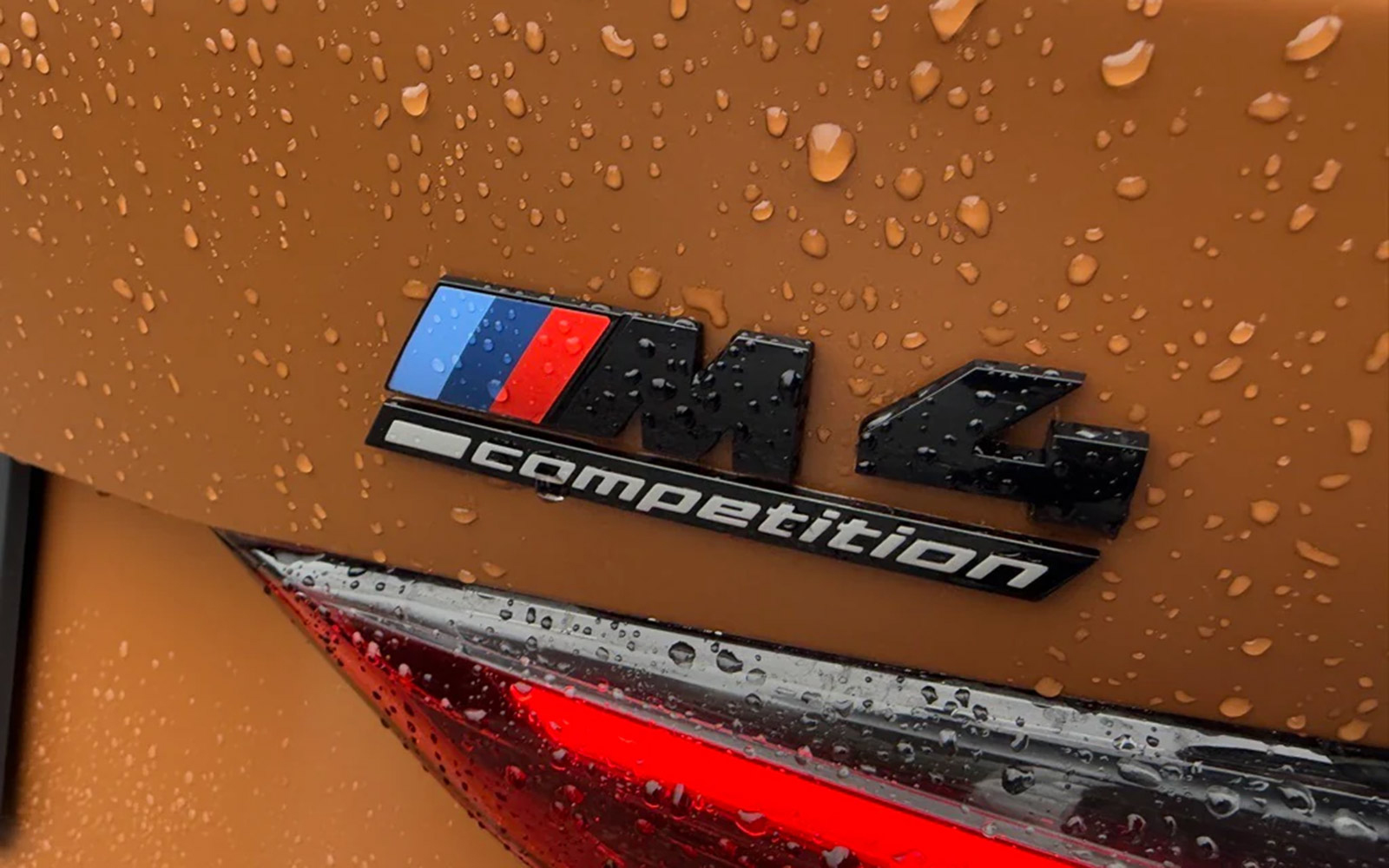
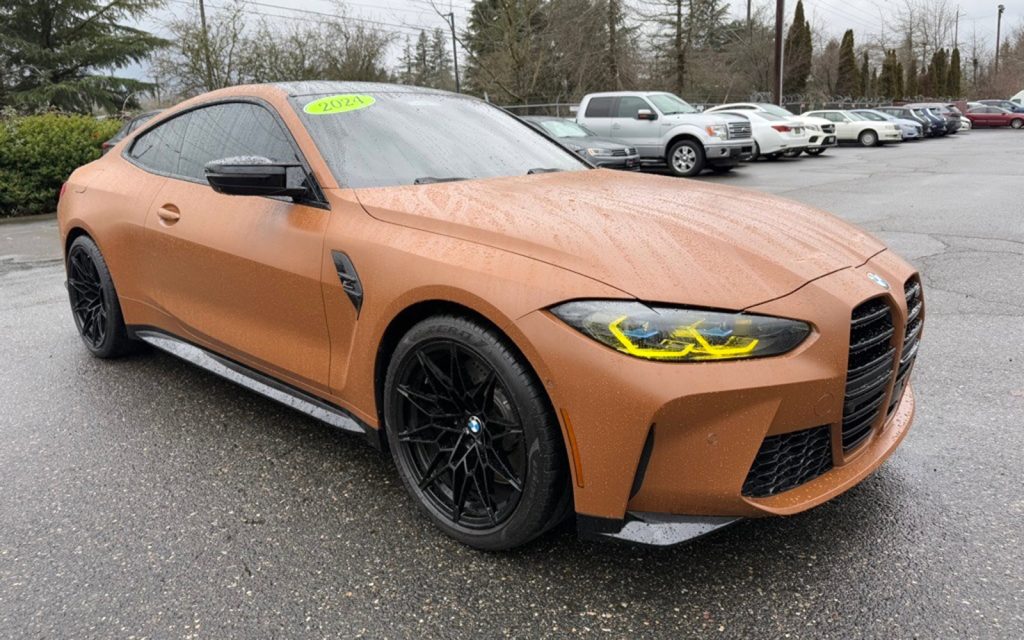
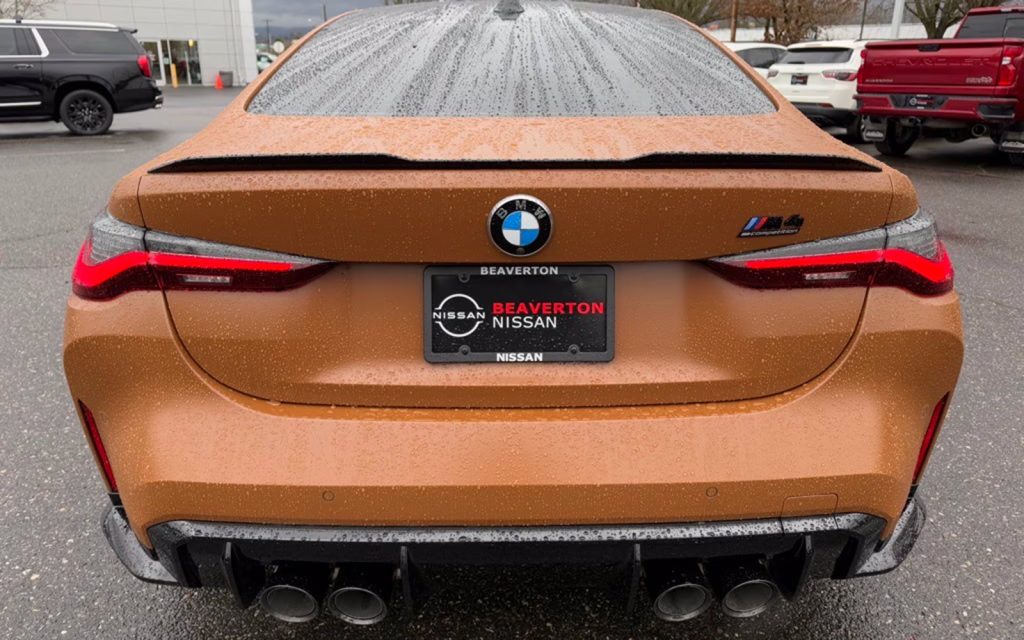
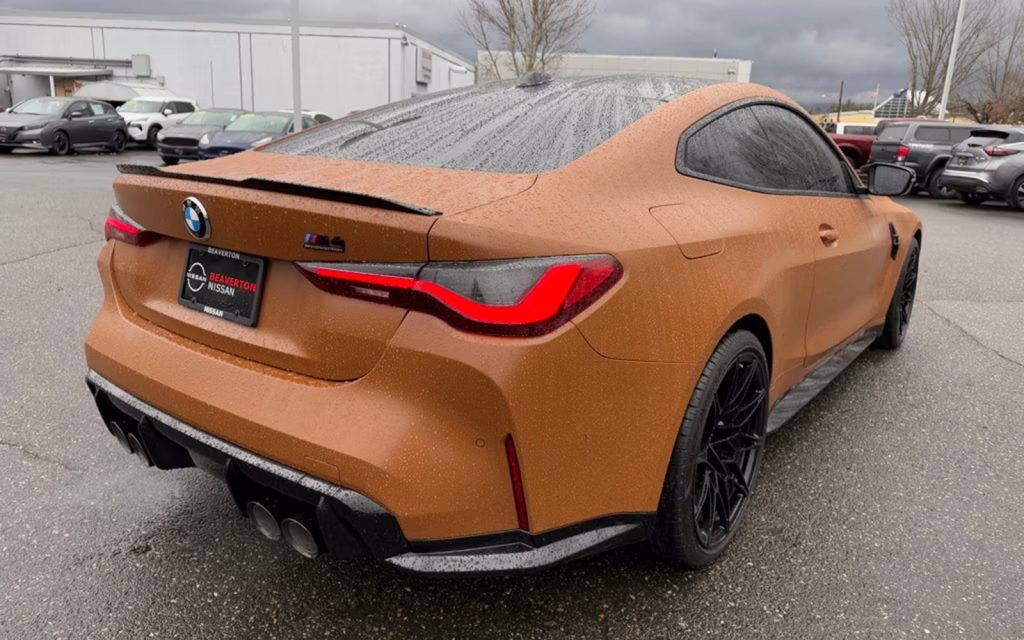
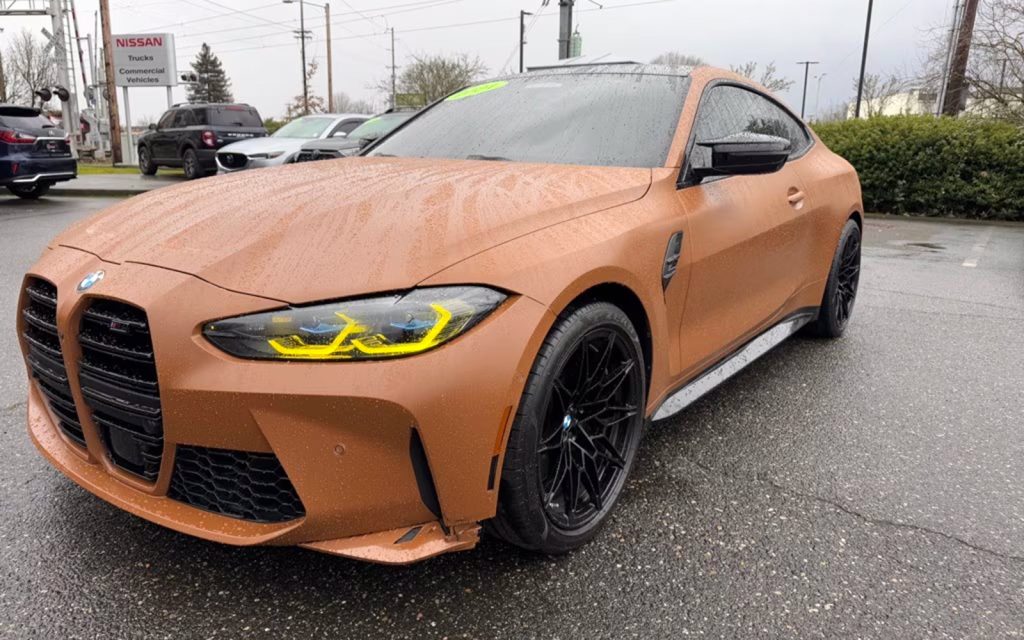
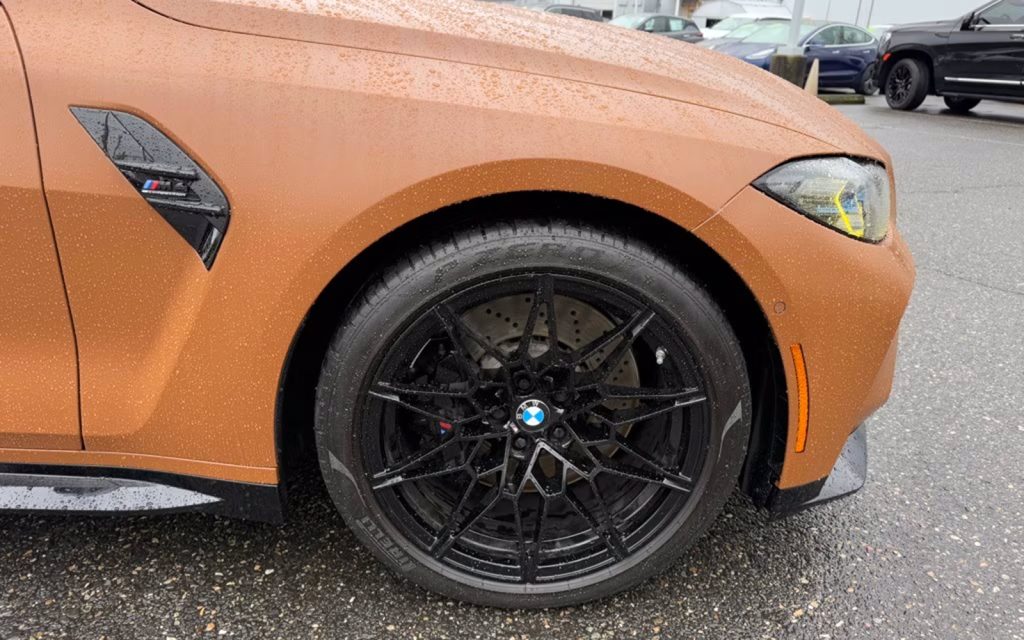
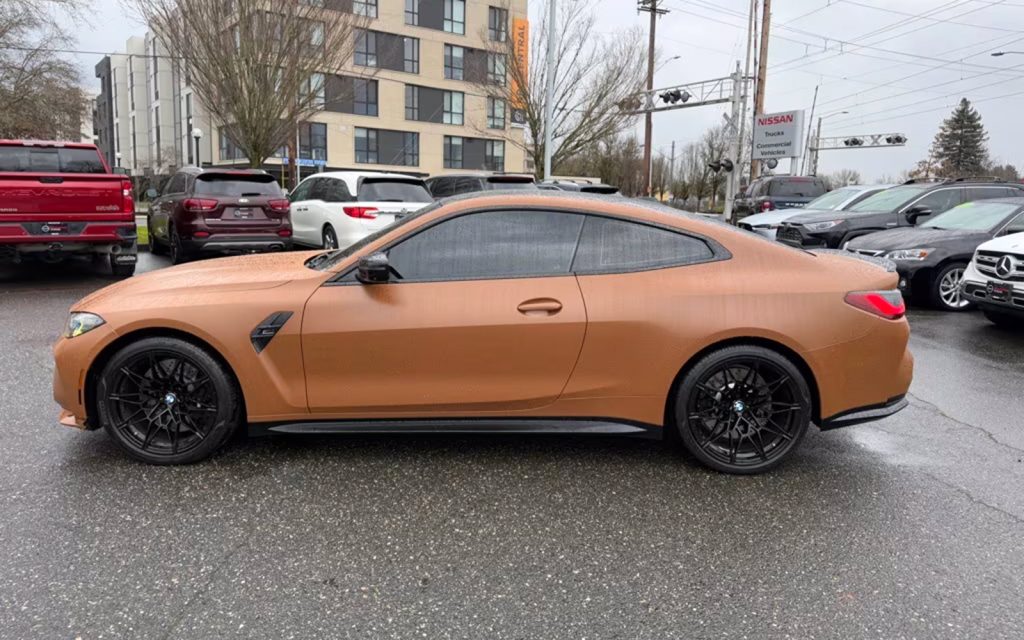
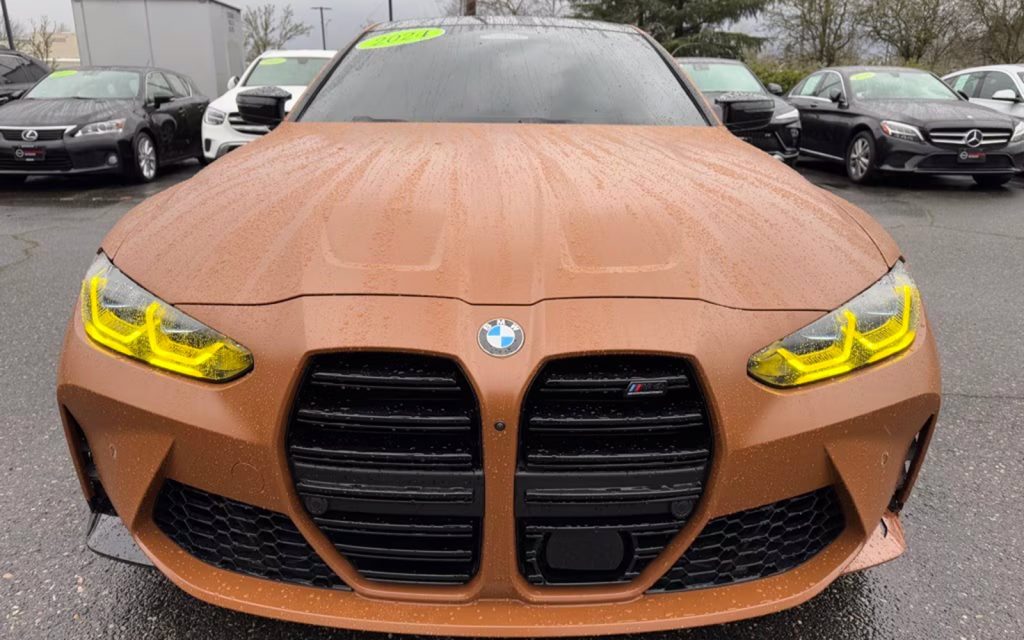
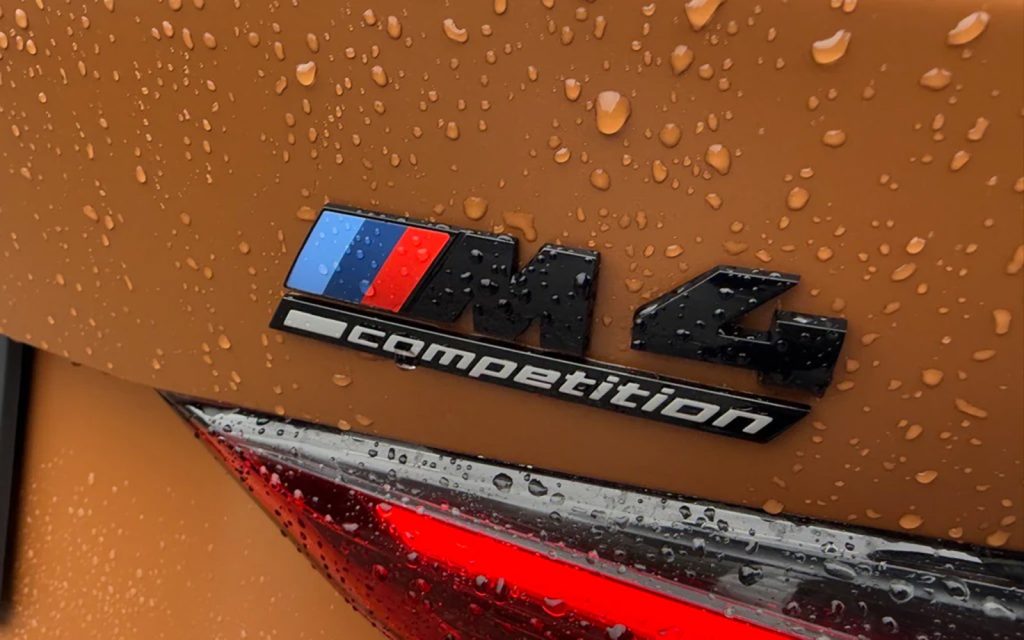
What: 2024 BMW M4 Competition Color: Sepia Brown II (sepiabraunii; non-metallic Uni; P7Y; BMW) VIN: WBS33AZ09RCP43984 Mileage: 12,093 Price: $81,990 CarFax:Link Window Sticker: N/A Location: Beaverton Nissan, Beaverton, OR Listing:Link
Why We Love It:
We’re solid fans of “tone-on-tone” cars, where the exterior and the interior are coordinated as the same color, perhaps off by a degree of shade. Now, throw in an unexpected color like brown and you’re playing at a whole other level of originality.
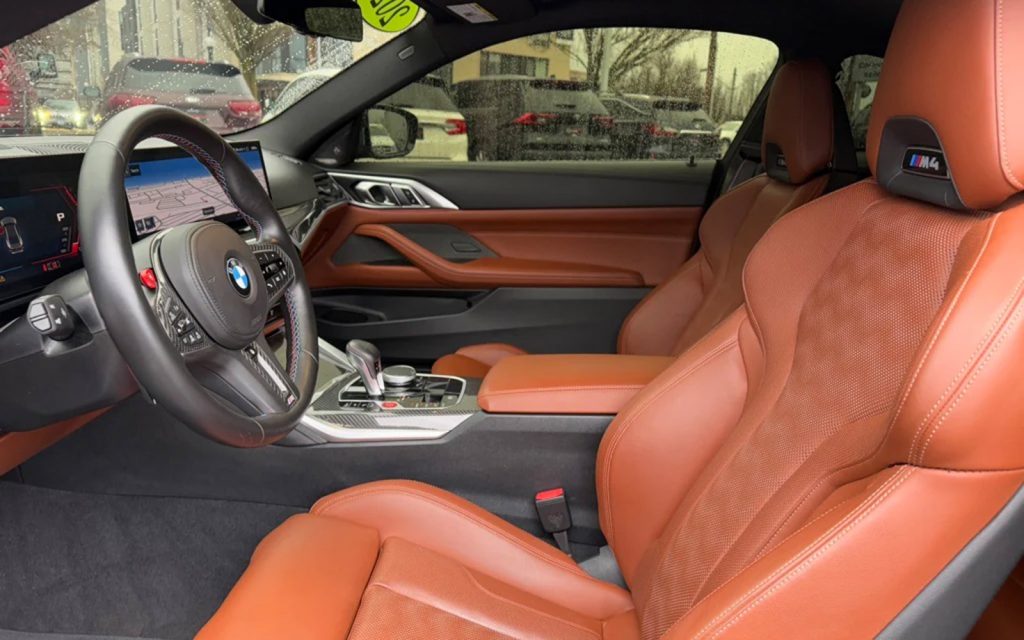
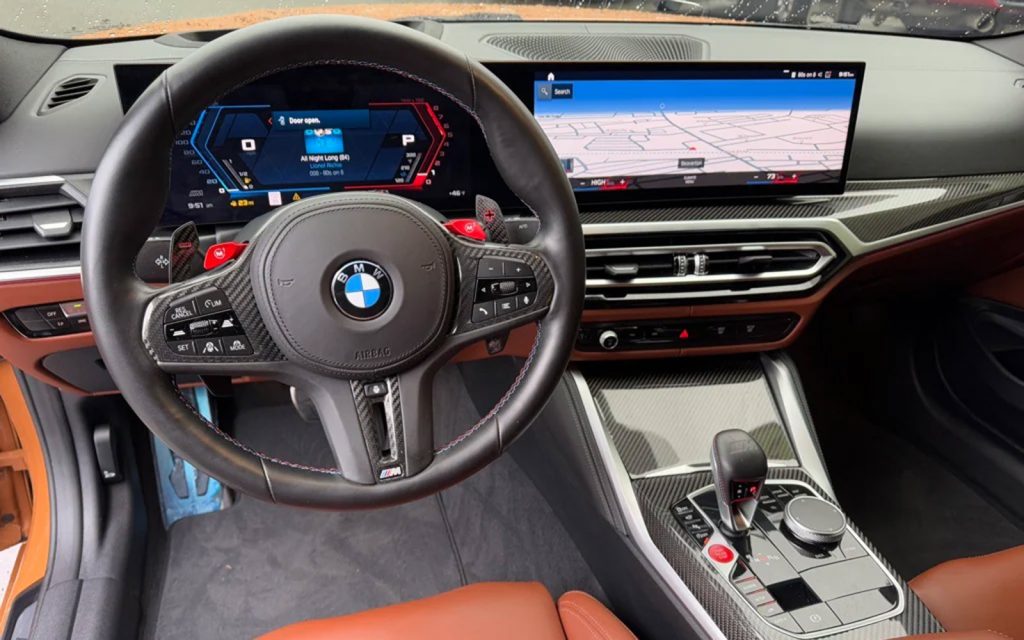
In the case of this G82-generation M4 Competition, that exterior color is BMW Individual Sepia II Brown and it’s paired with Tartufo Brown Leather. No doubt brown-on-brown is going to be polarizing, but to the people who get it this car likely has a whole other level of attraction.
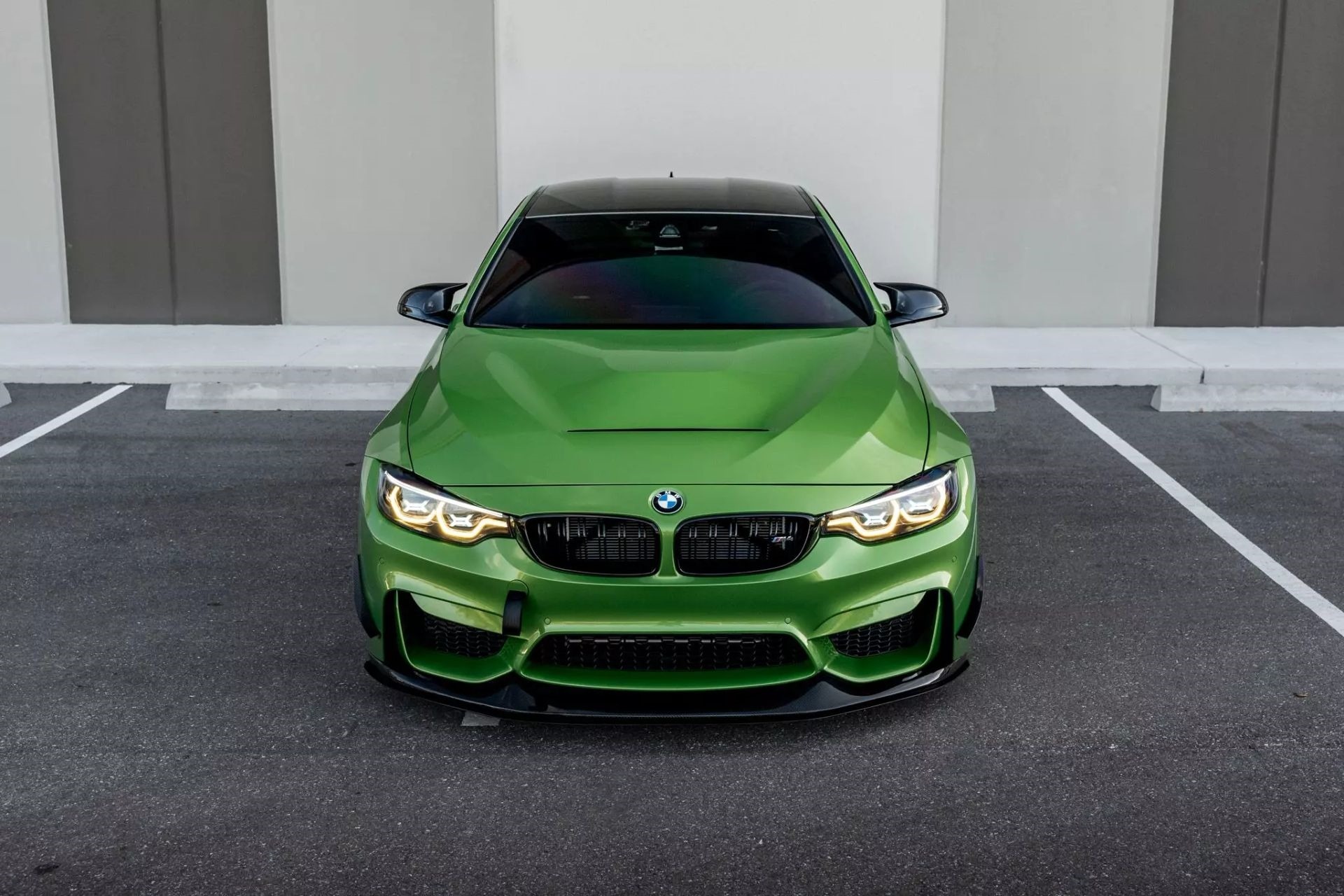
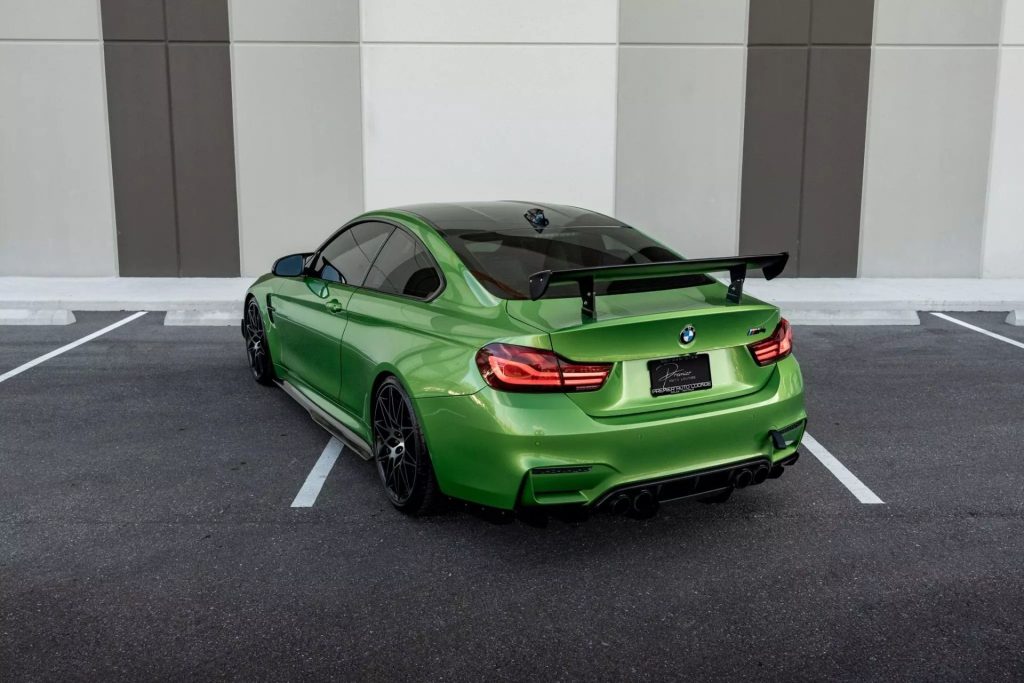
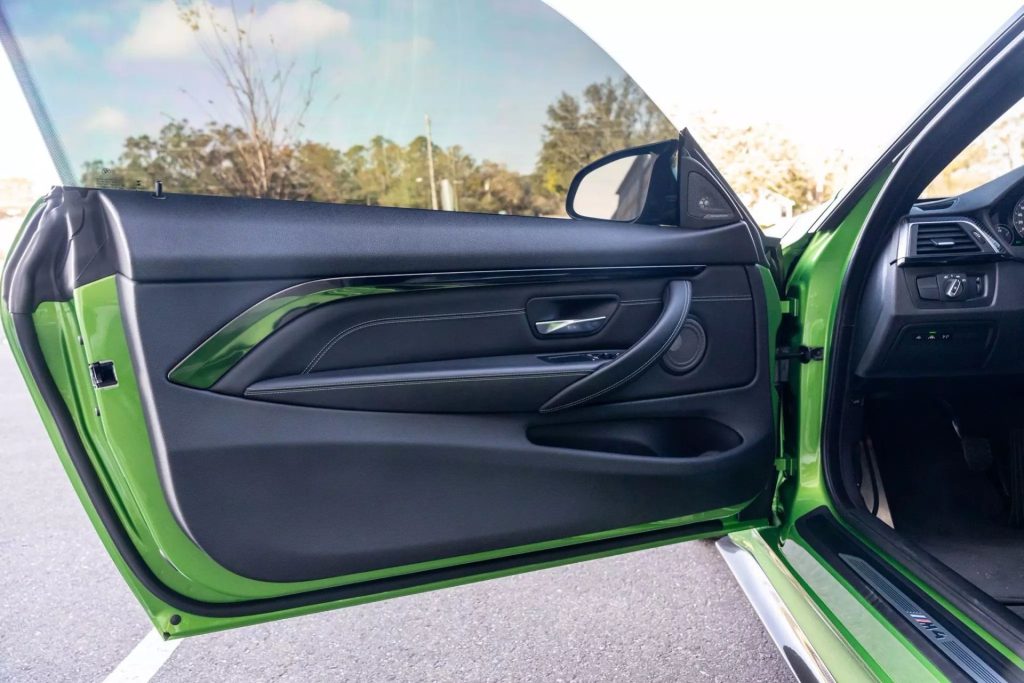
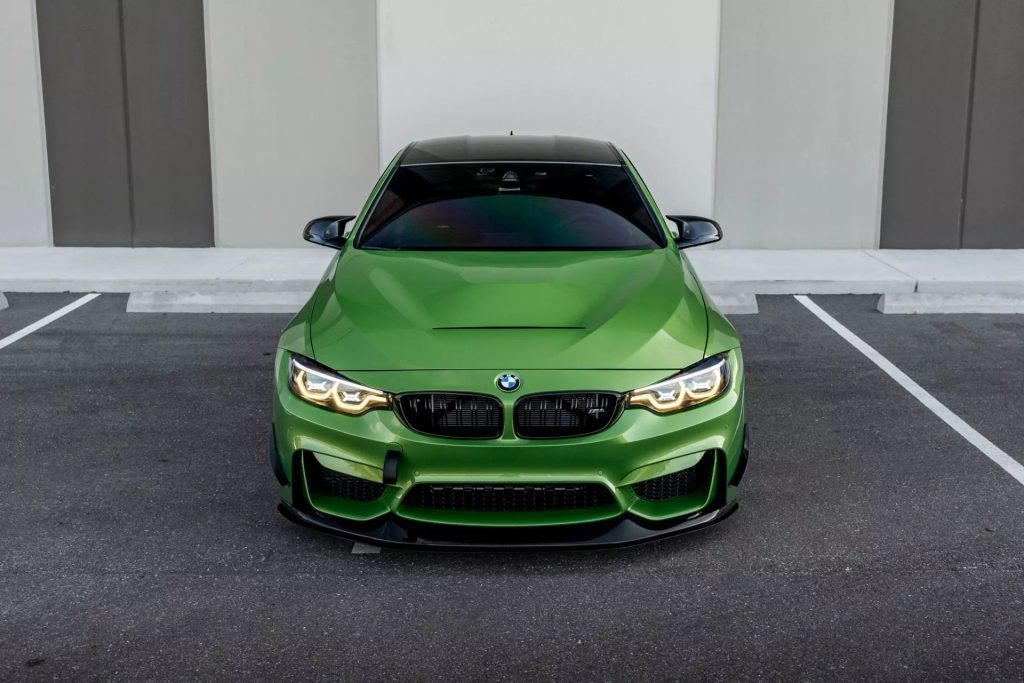
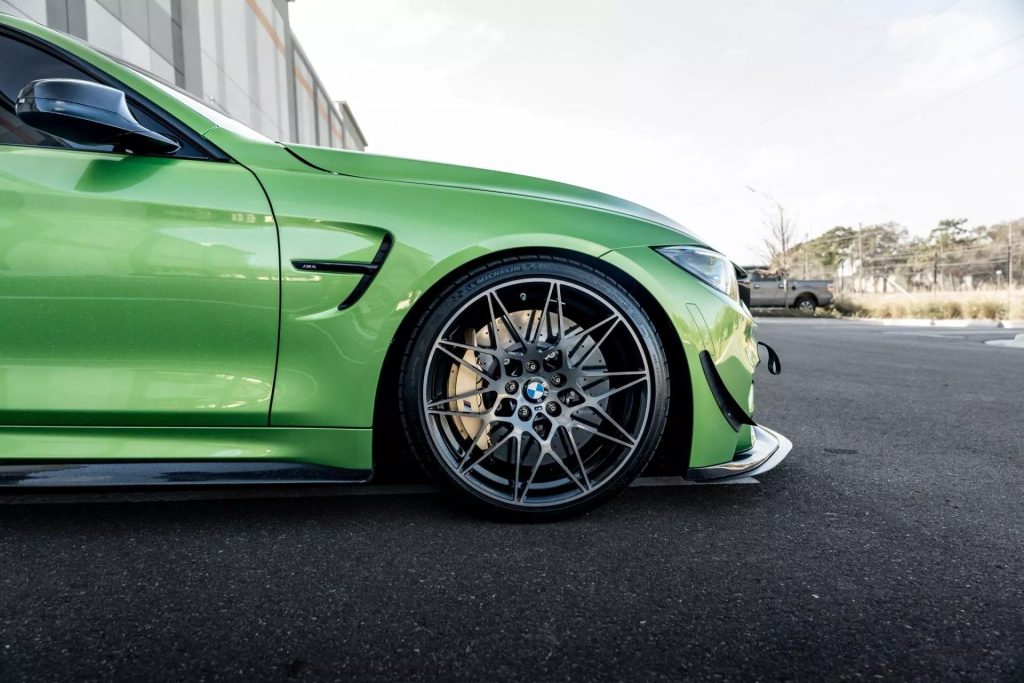
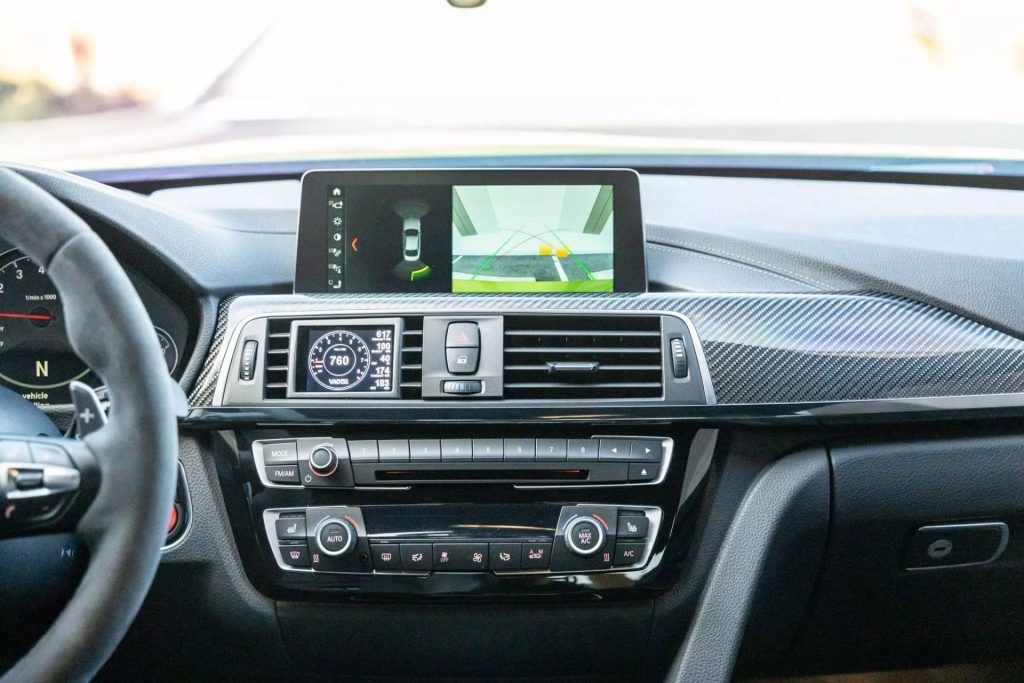
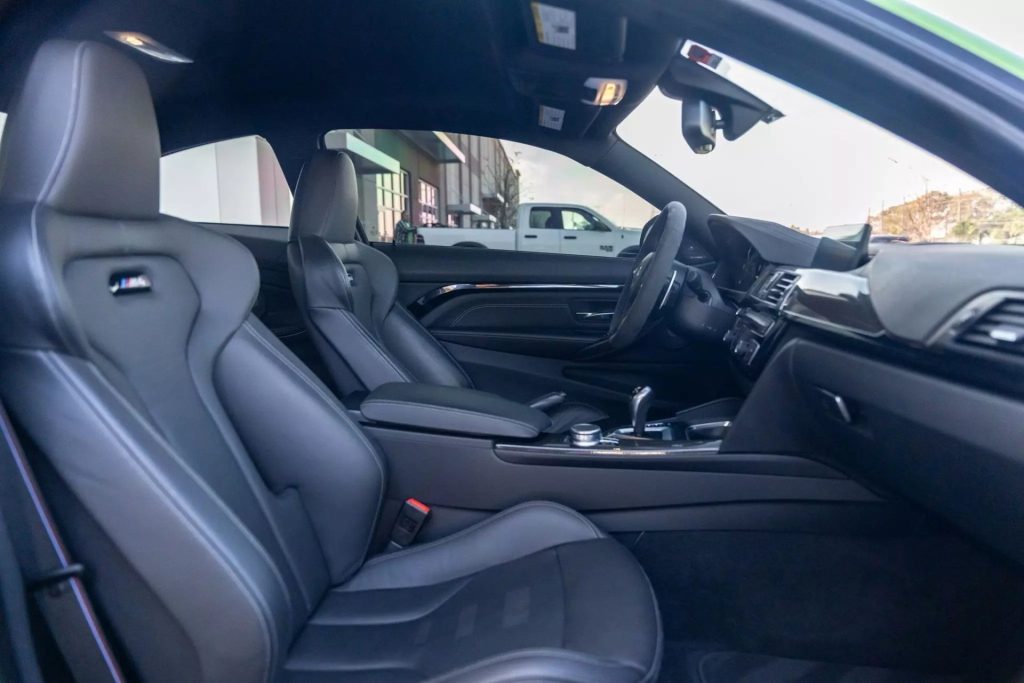
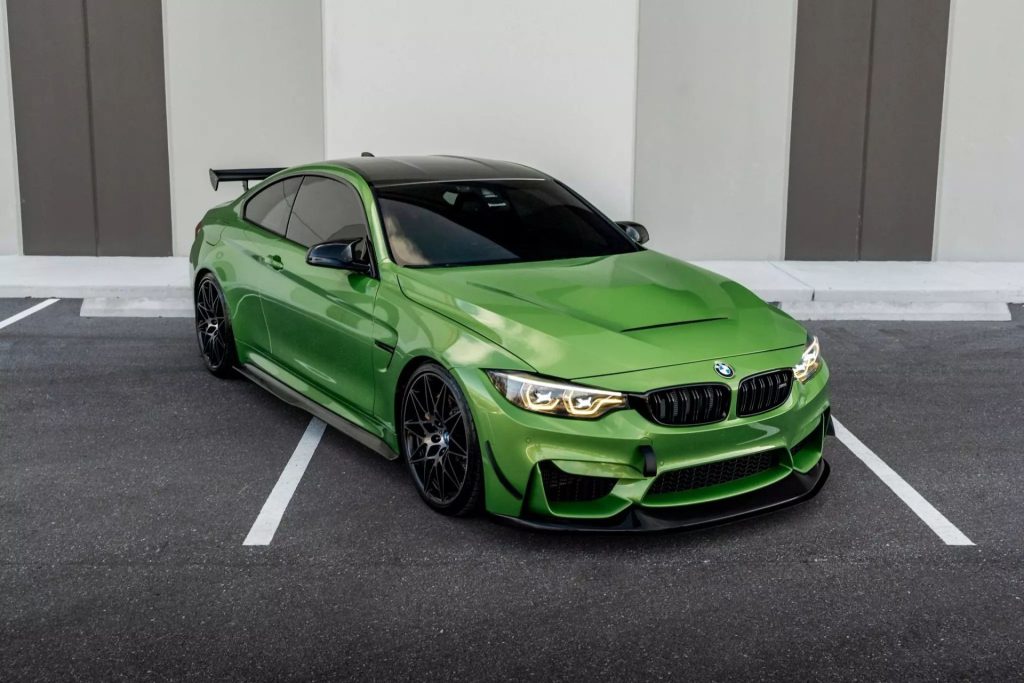
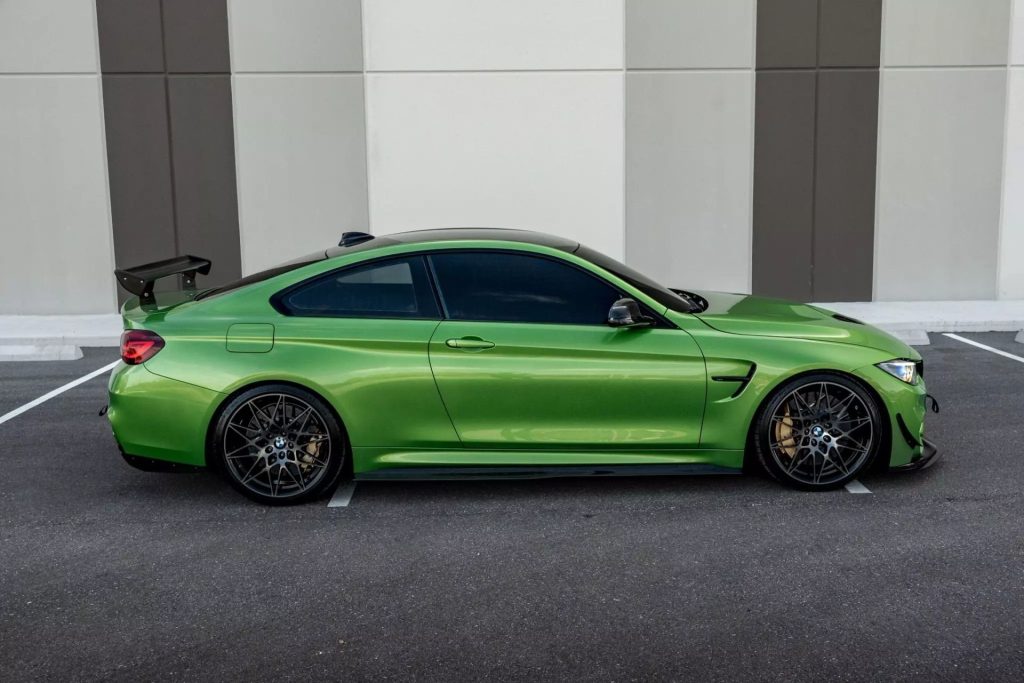
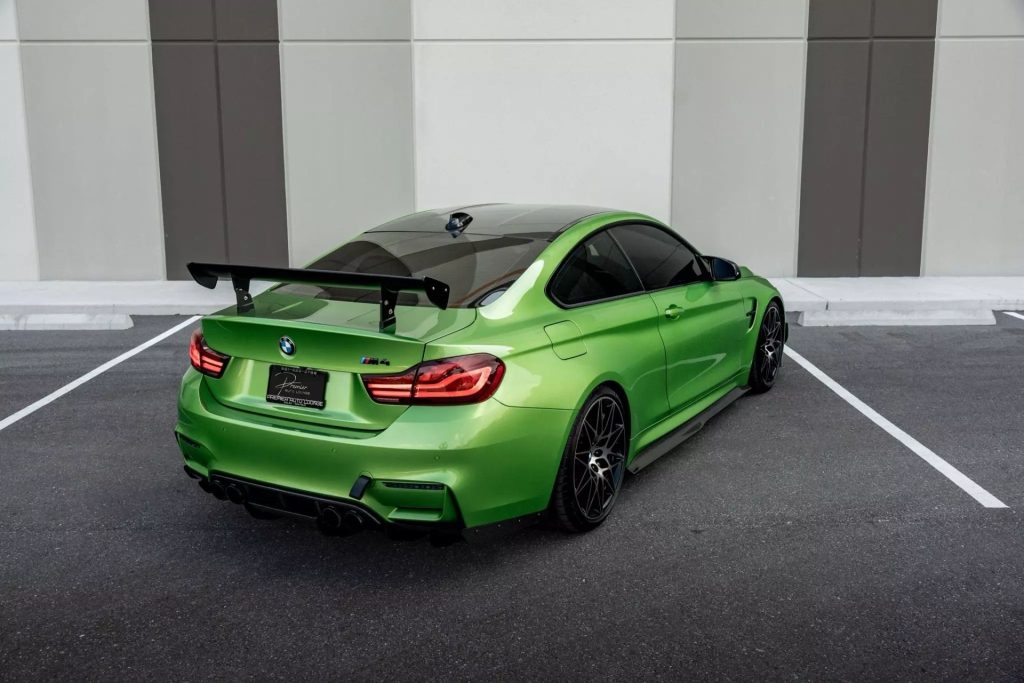
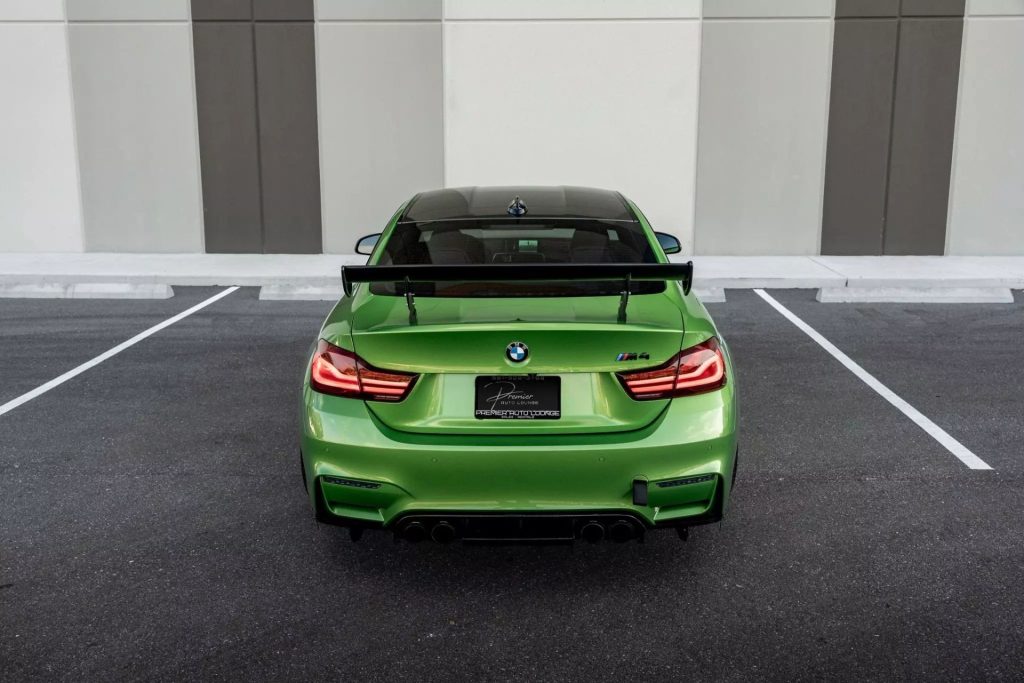
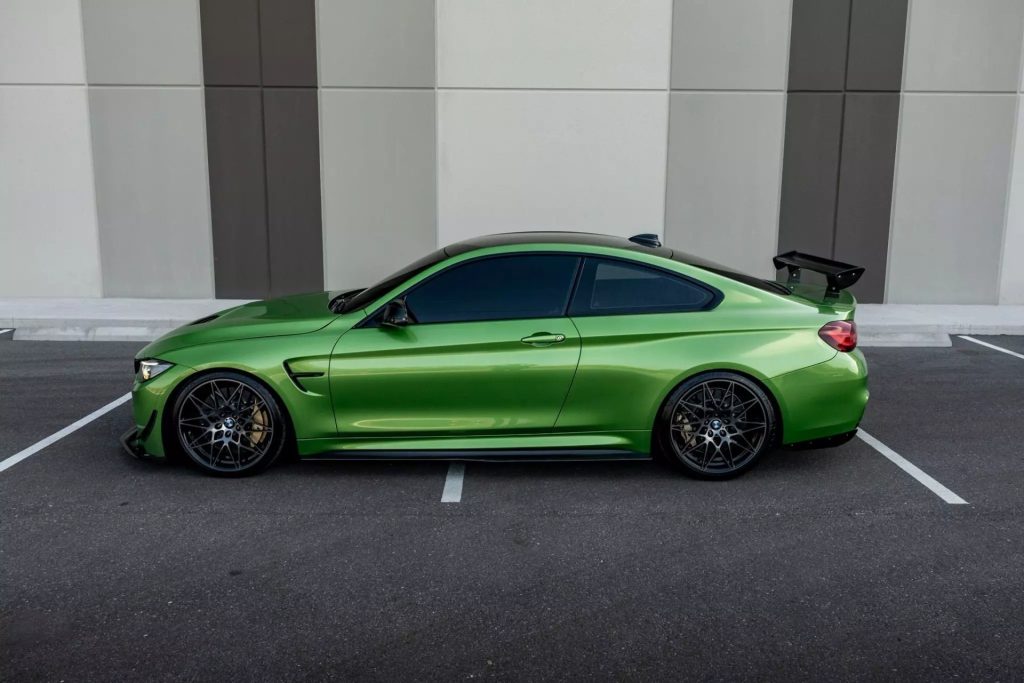
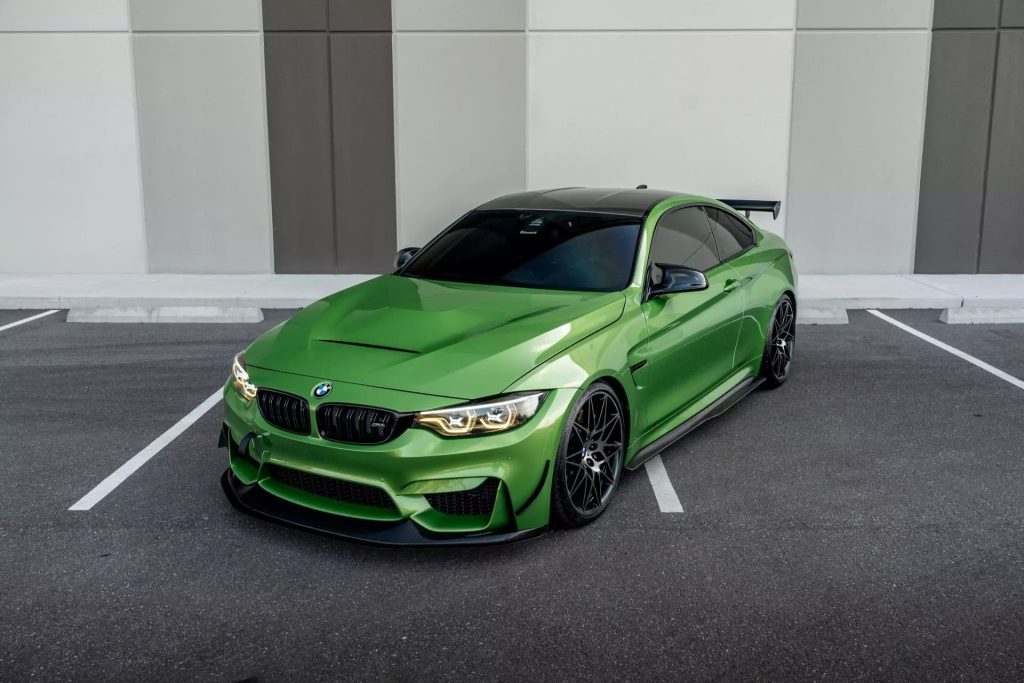
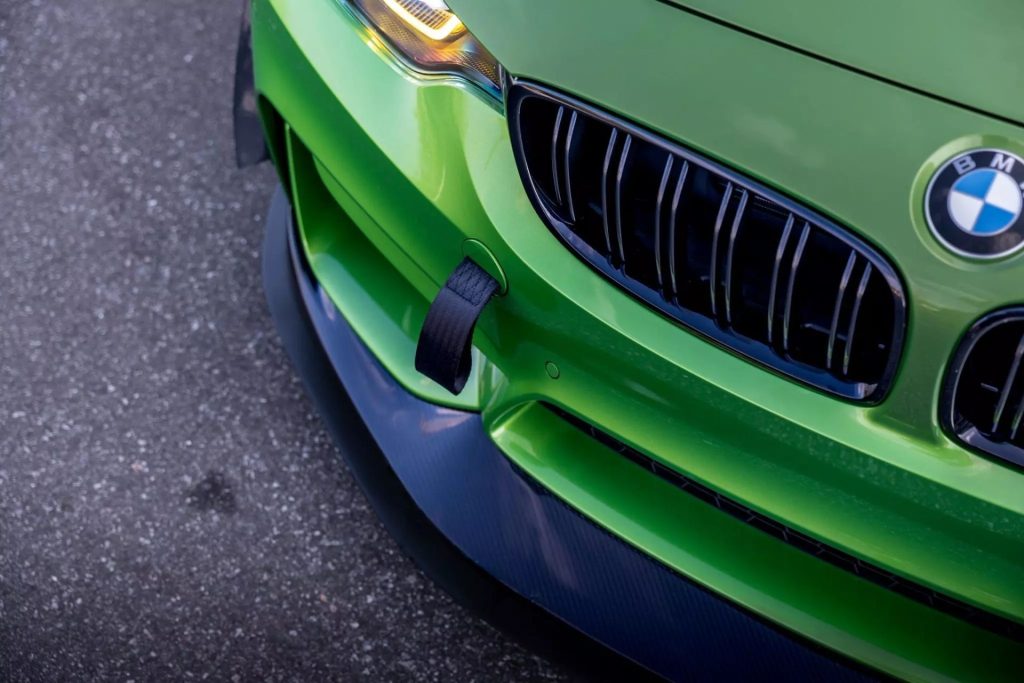
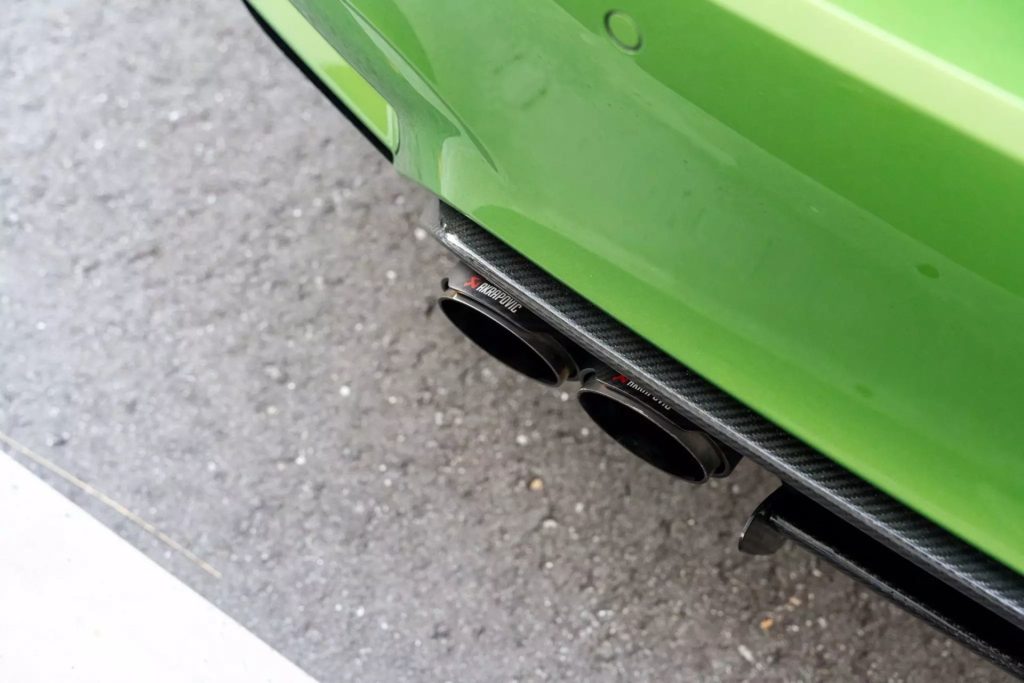
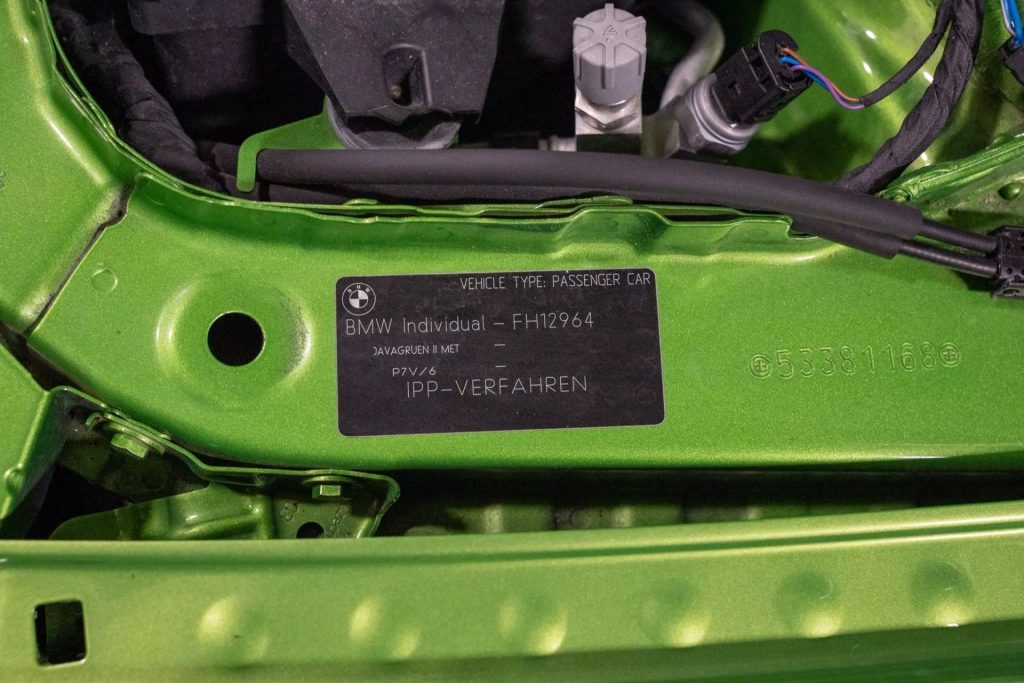
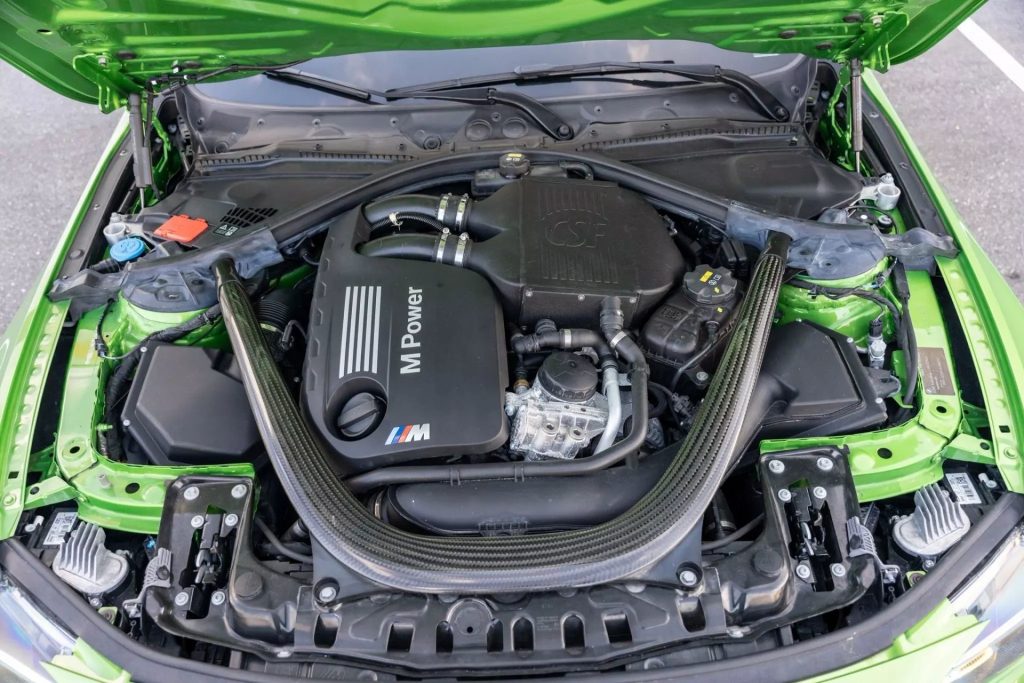
What: 2020 BMW M4 Competition Color: BMW Individual Java Green Metallic II (javagruen; metallic uni; P7V/6; BMW) VIN: WBS4Y9C05LFH12964 Mileage: 8,184 Price: $71,000 CarFax:Link Window Sticker: N/A Location: Premier Auto Lounge, Clearwater, FL Dealer Listing:Link
Why We Love It:
Java is an incredibly dynamic green- loud, but not obnoxious- at least to us. This M4 Competition’s prior owner took that Comp badge to heart, adding some choice track-focused OEM+ modifications, further helping it to stand out from the other M cars at Publix. That’s something we can get behind. Believe it or not, this is the second Java Green F80-gen M car we’ve featured from Clearwater, Florida’s Premier Auto Lounge. The dealer seems to pride itself on having a few Tailored Drivers in stock at any given time, meaning that there’s a good chance you’ll be seeing them again soon.
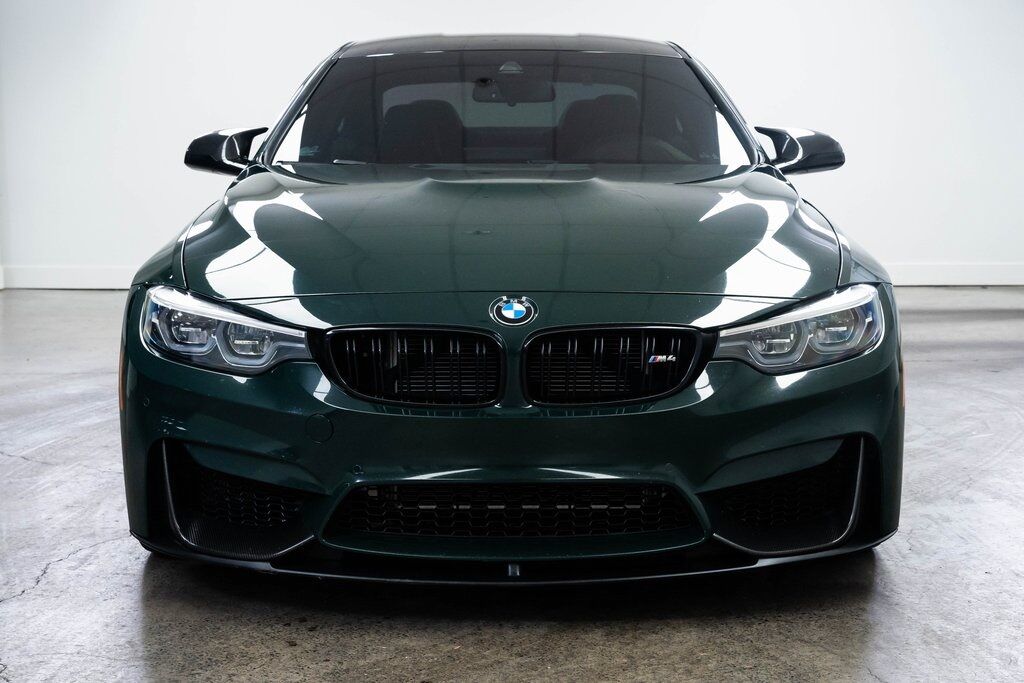
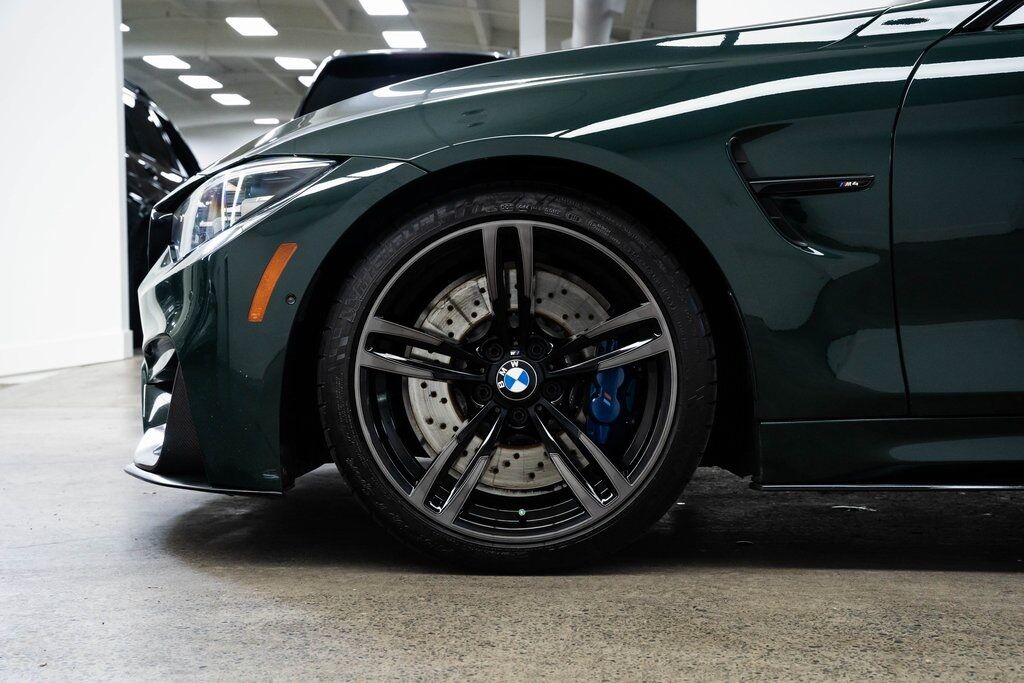
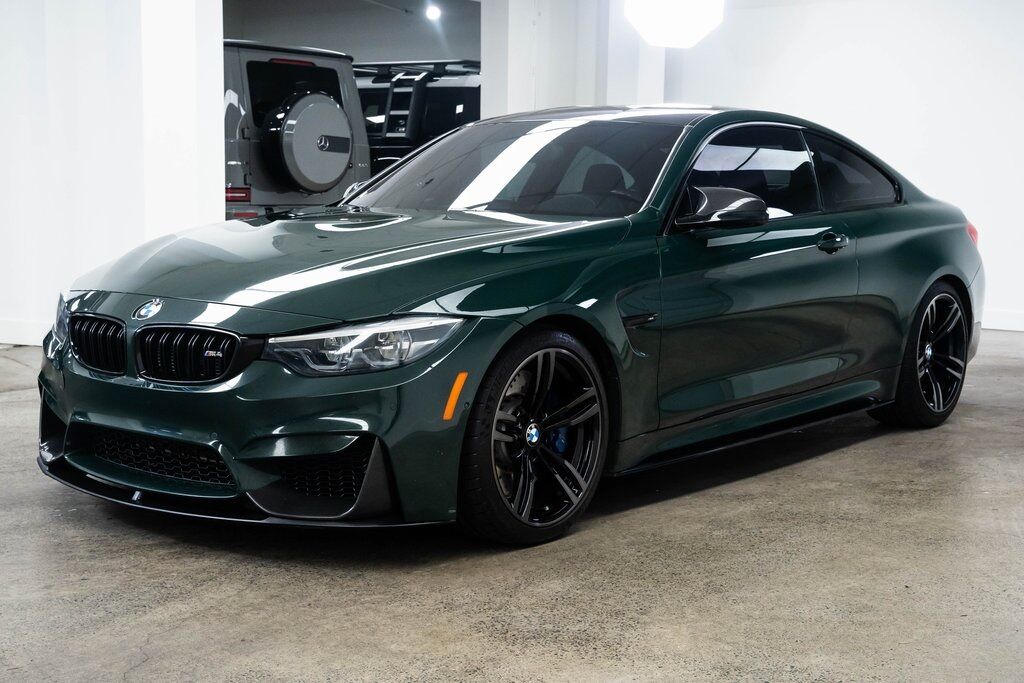
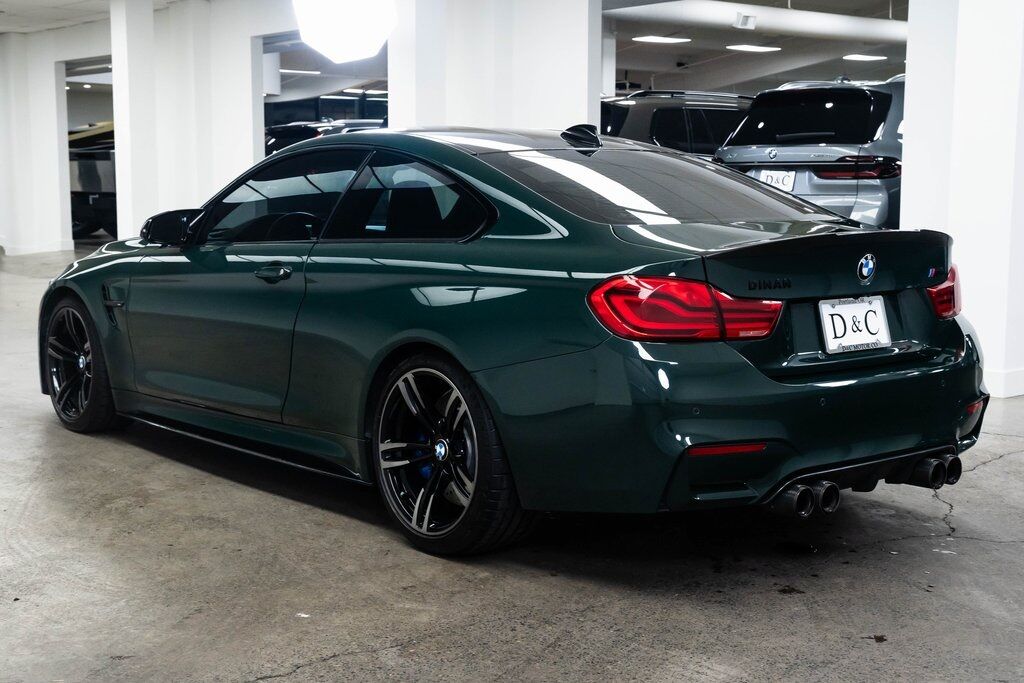
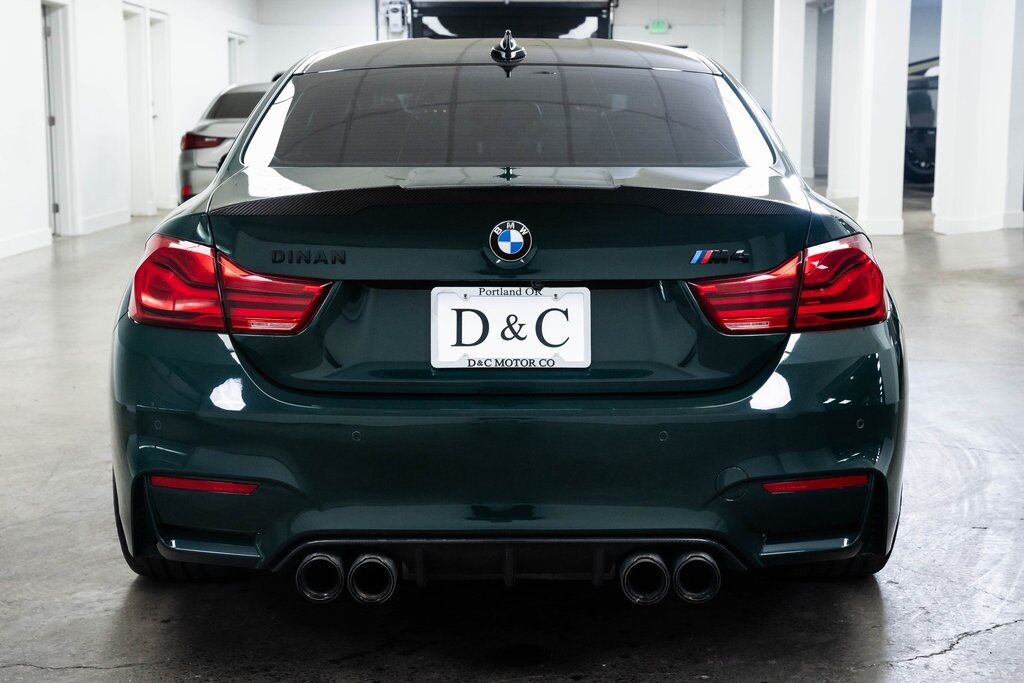
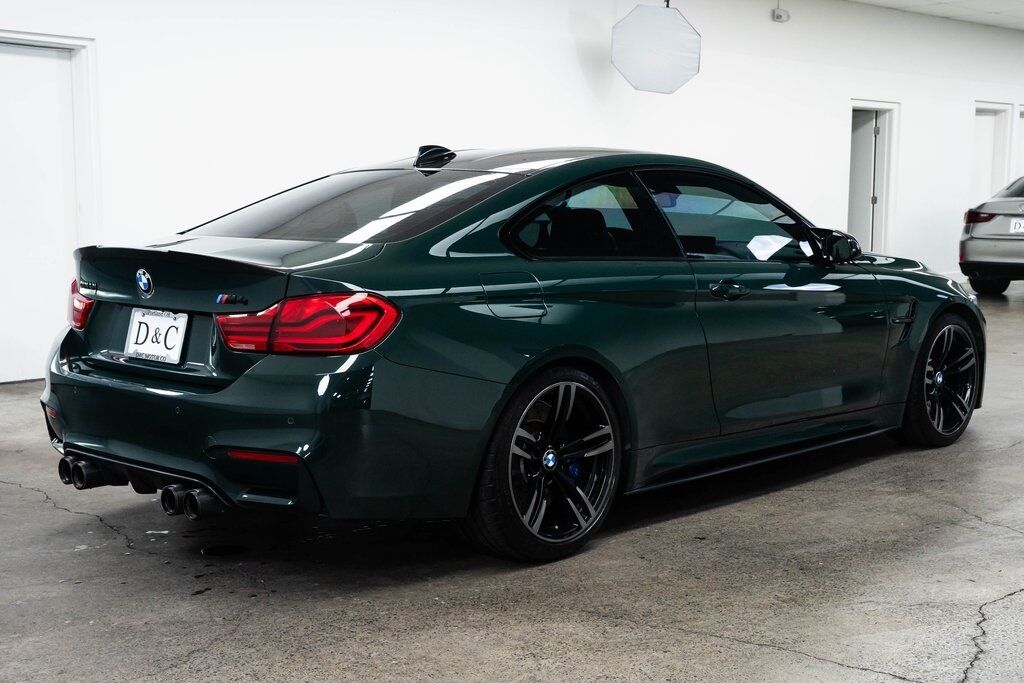
What: 2018 BMW M4 Competition Color: BMW Individual British Racing Green (553; 312; BMW) VIN: WBS4Y9C50JAC86736 Mileage: 34,065 Price at Time of this Writing: $54,990 CarFax:Link Window Sticker: N/A Location: Portland, OR Dealer listing:Link
Why we love it:
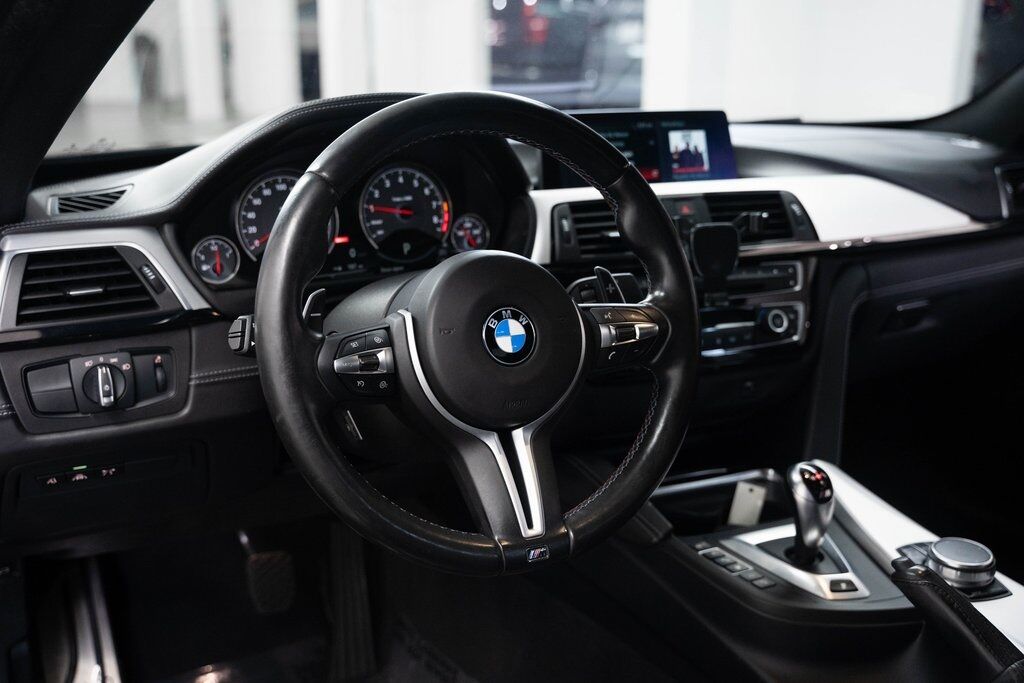
While not often thought as a Heritage color for BMW, British Racing Green had a fling with the brand in the ’90s, appearing on the E36 M3 GT and Z3 models. Nearly 30 years later, the color still looks the business on this M4 helping it to stand out in a subtle way. We also love that this M4 has been treated to a host of Dinan goodies (Coil Overs, Sway Bars and Intake), none of which fiddle with the ECU tune. On the inside, this Tailored Driver is optioned with extended leather and DCT transmission, making it a nice, comfortable place for commuting. We think it’s a great package.
We’ve said it before and we’ll say it again, BMW M is killing it in the social media game when it comes to showing off the brand’s most interesting colors and promoting their BMW Individual custom paint program. Several times a week, you can count on the team from Münich to share another unexpected paint option and this one certainly qualifies.
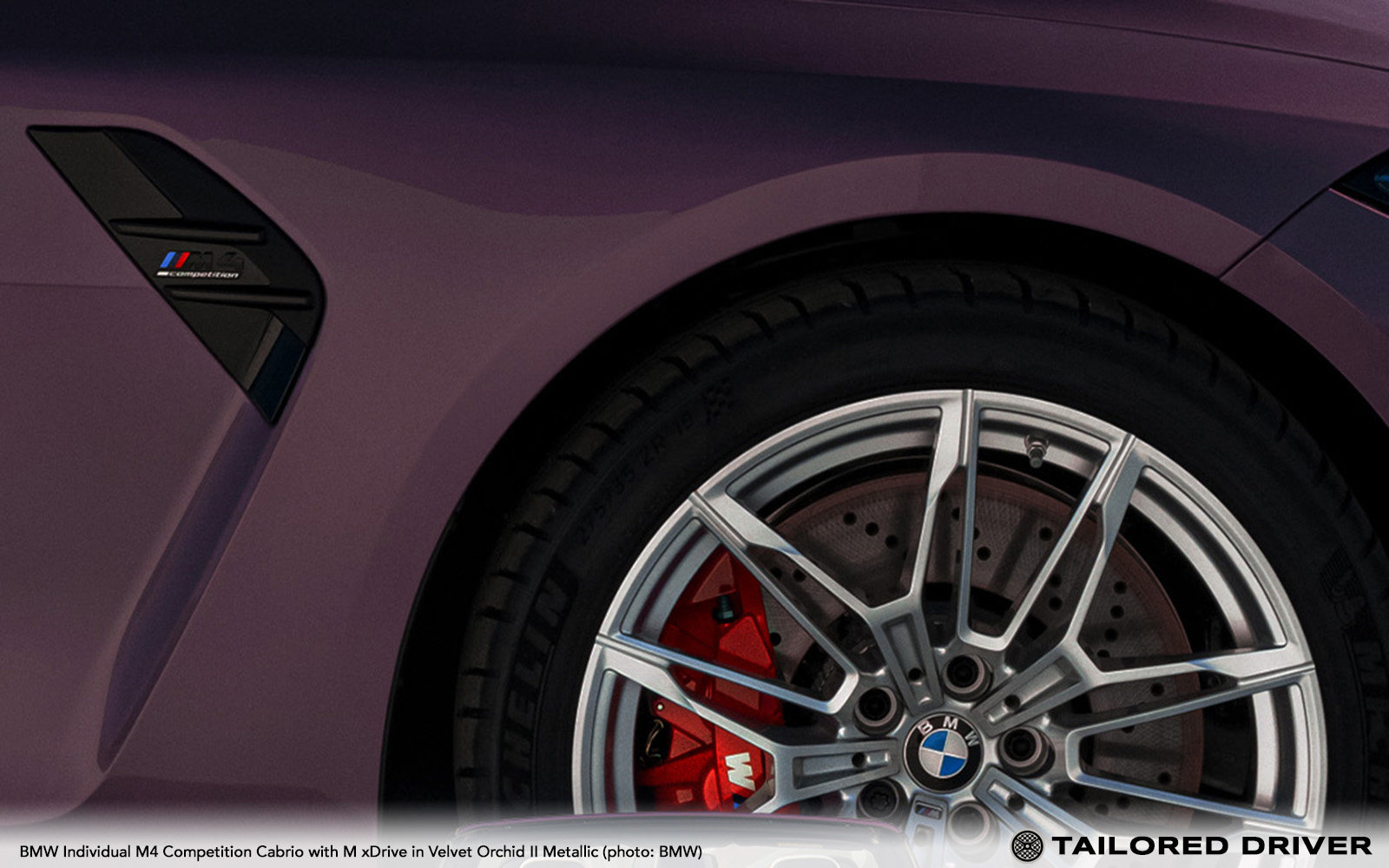
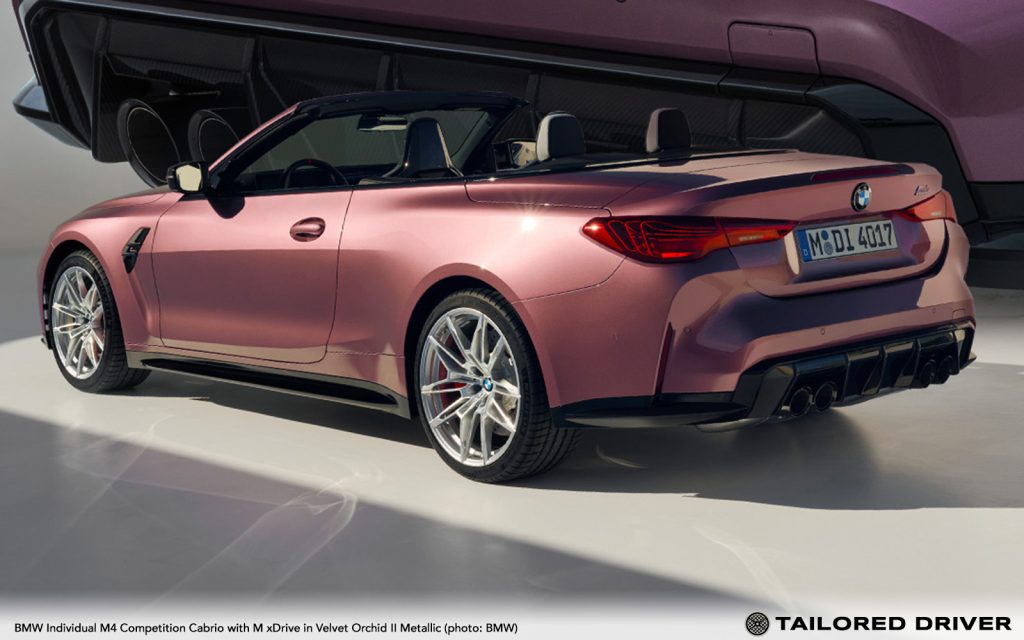
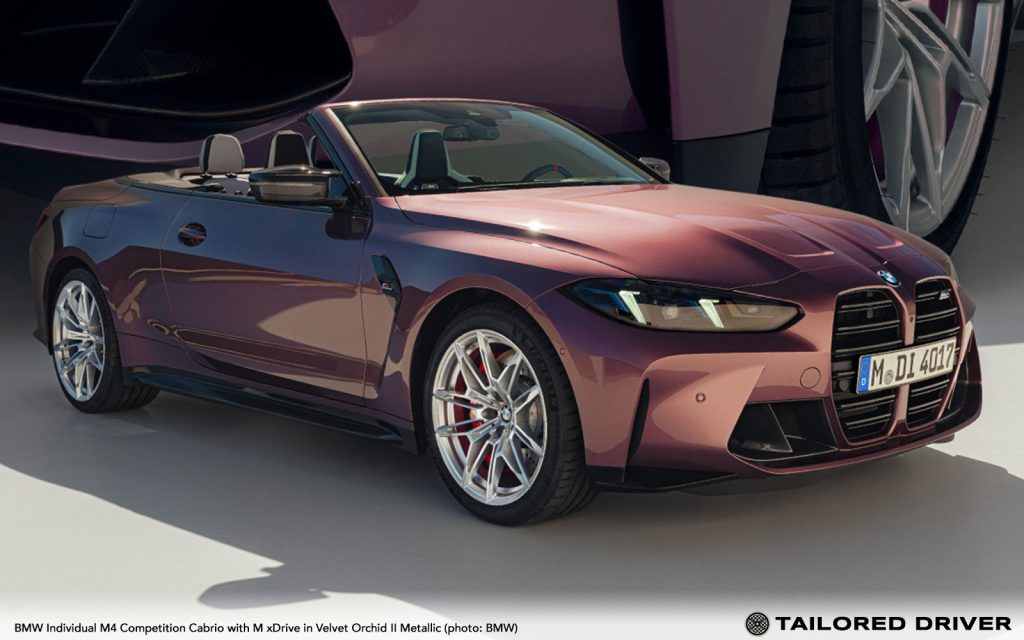
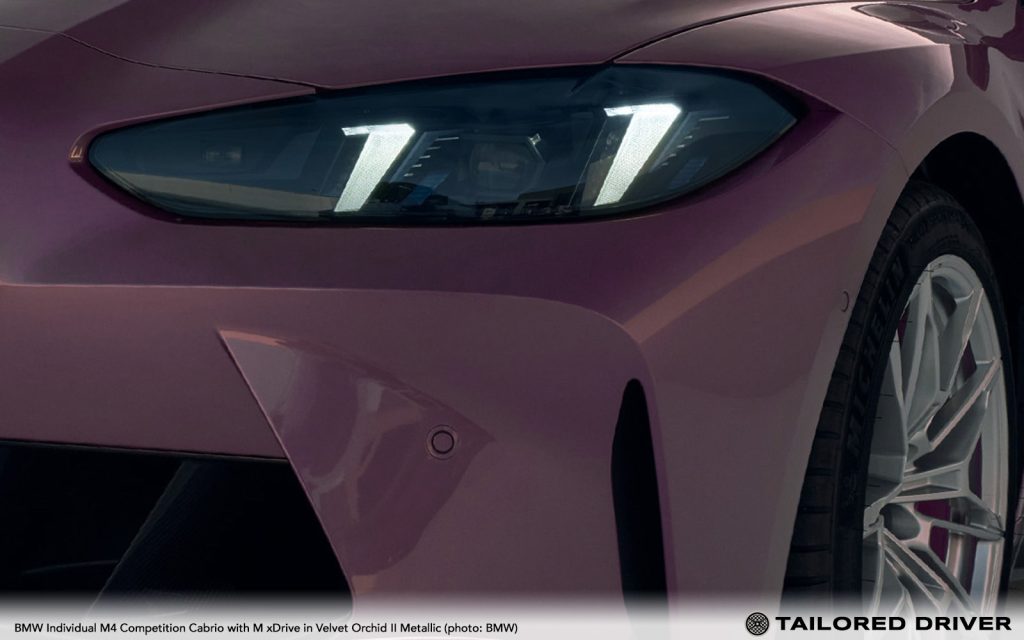
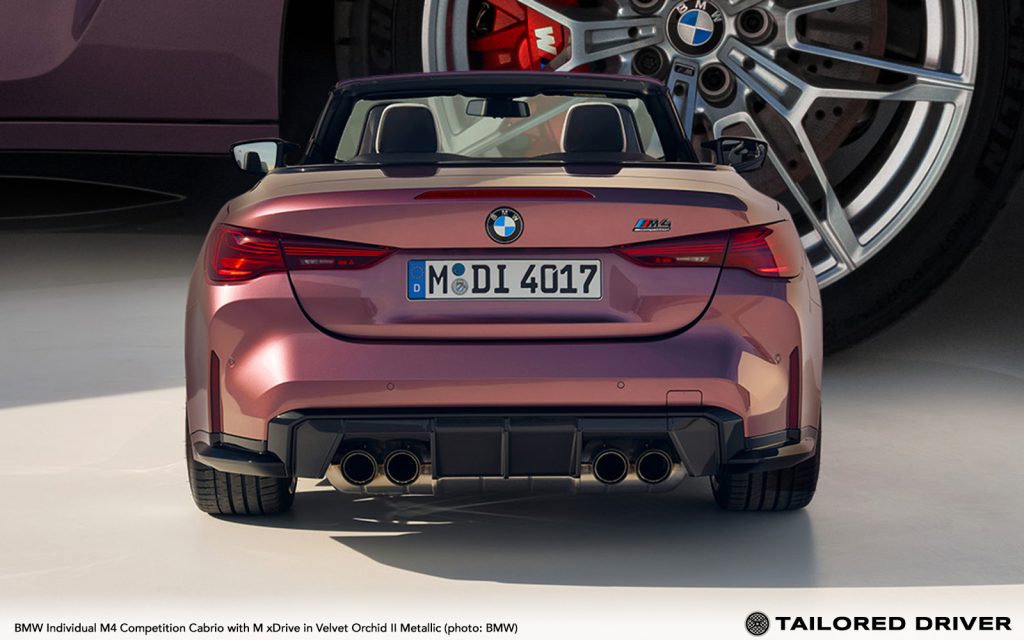
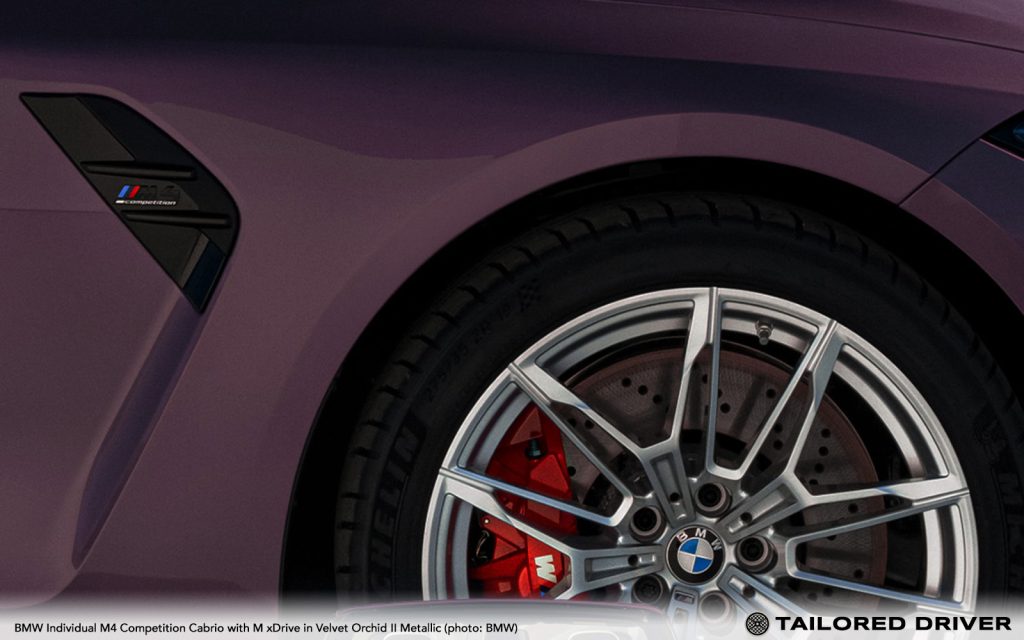
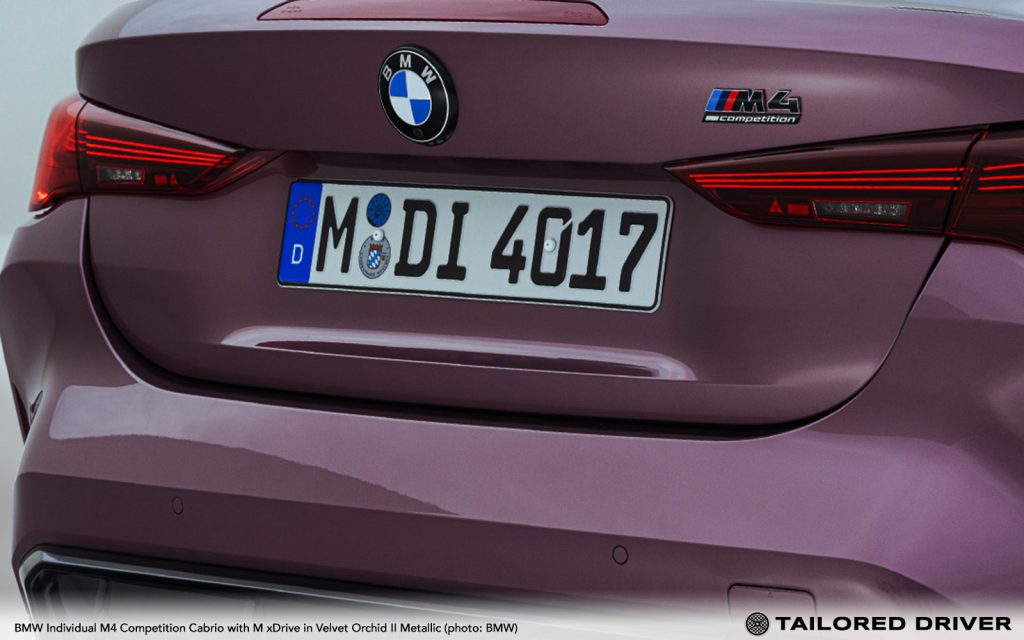
The car is a BMW M4 Competition Cabriolet with M xDrive, and the paint is BMW Individual Velvet Orchid II metallic(velvetorchidiimetallic; metallic; L74; BMW). This soft desaturated pink is something you definitely won’t find every day.
There’s no doubt that pinks are becoming more and more in fashion in the automotive paint color space, and it’s a testament to how normal this is. If you’d told us you’d ordered a BMW Cabriolet in a light metallic and red brake calipers we’d have probably made a hairdresser joke… yet here we are looking at this M4 Cabrio and thinking it’d make for a proper entry to a fantasy garage. Well played BMW M. Well played.
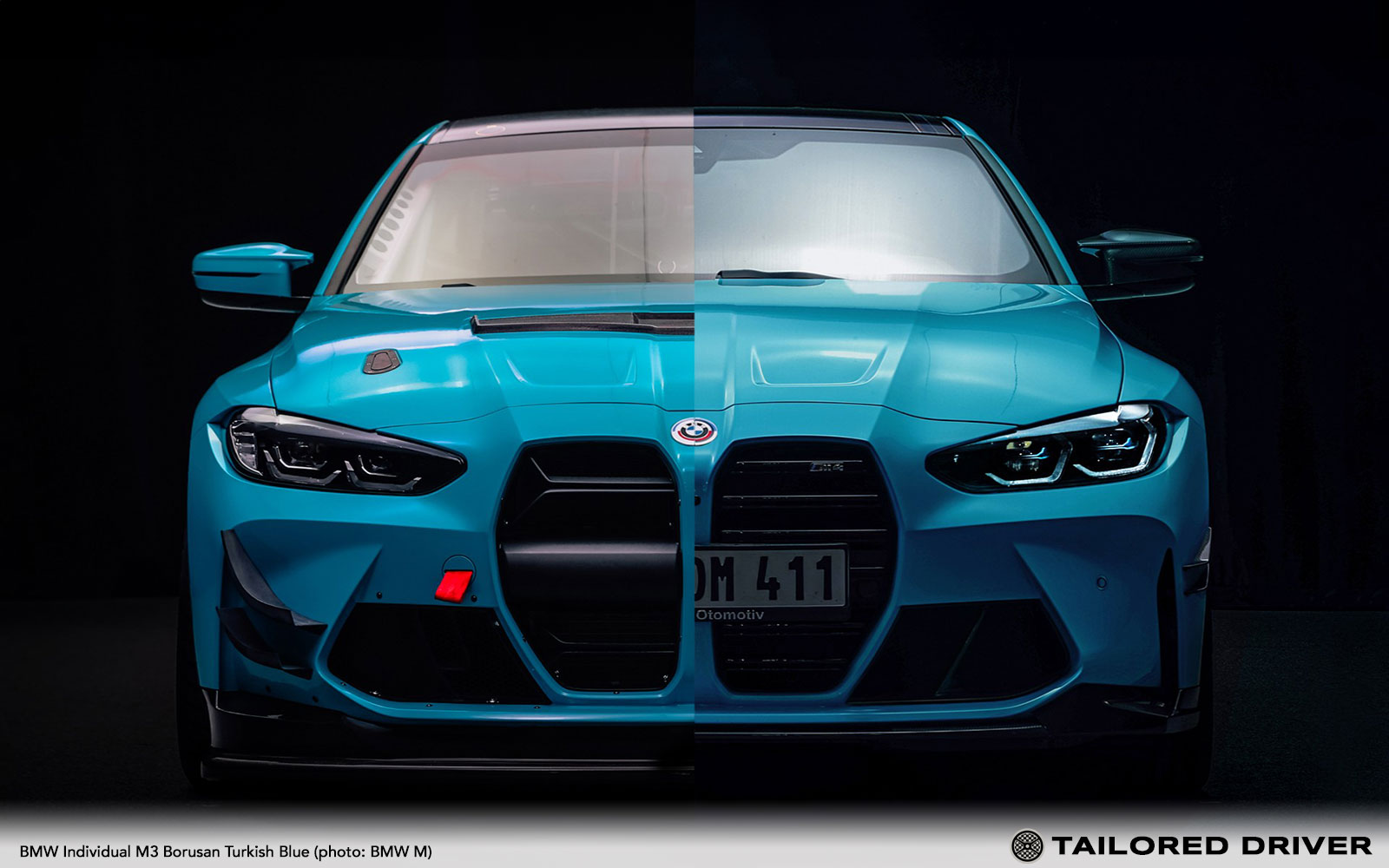
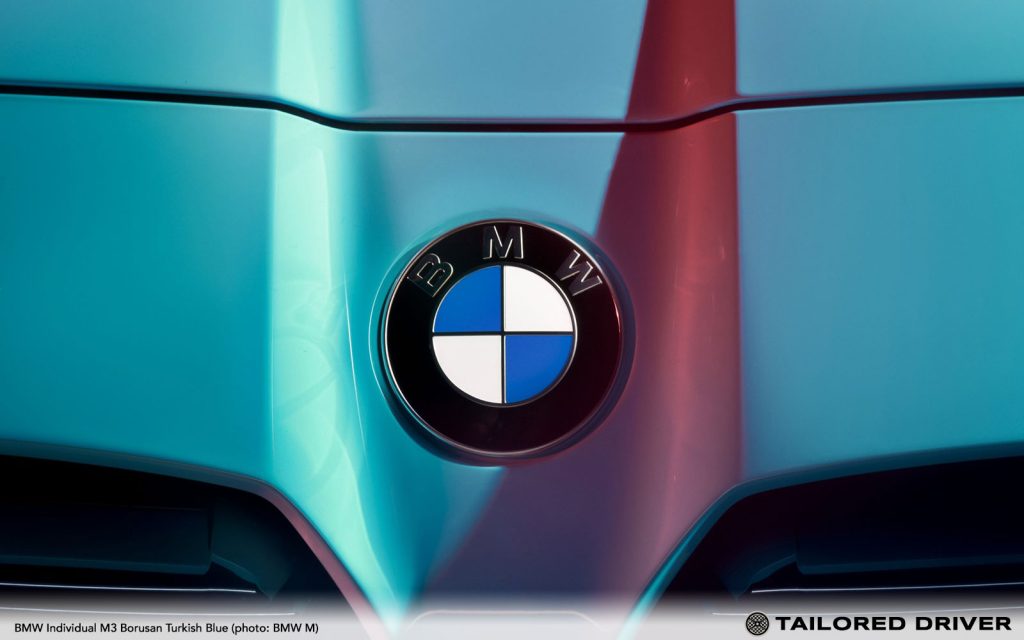
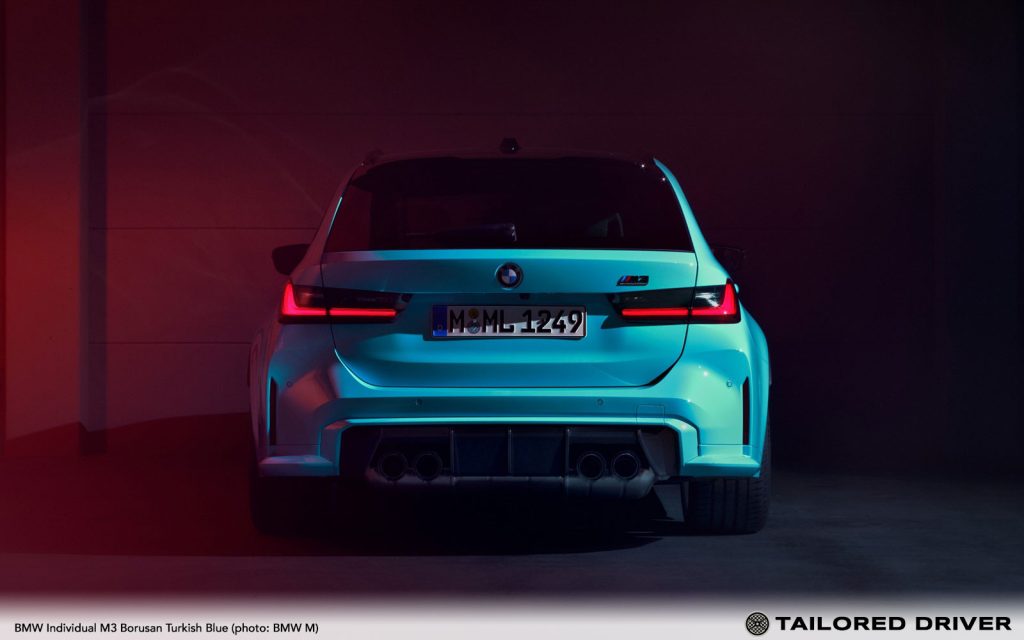
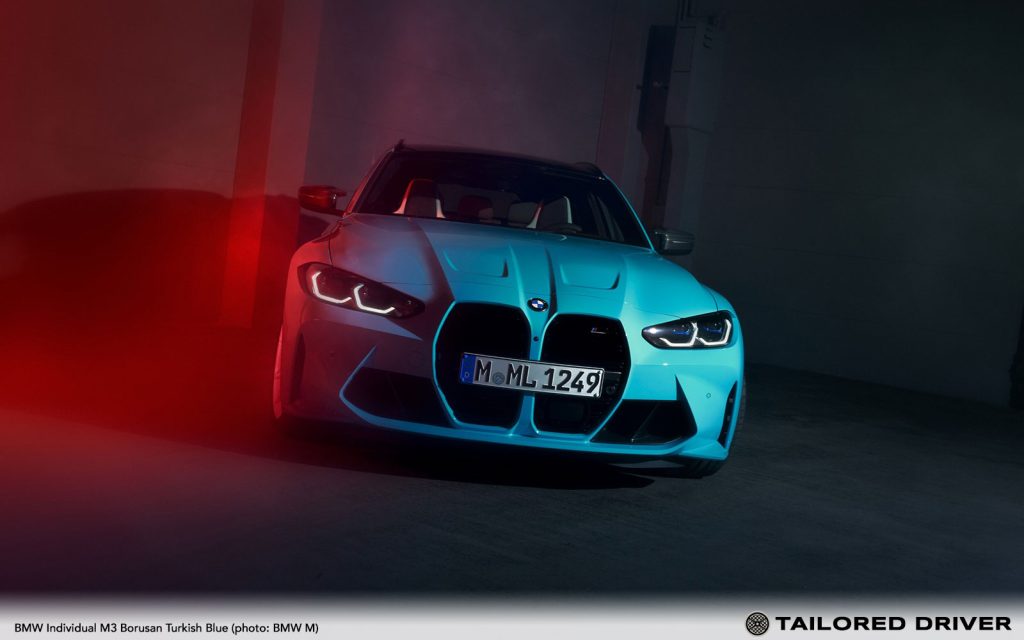
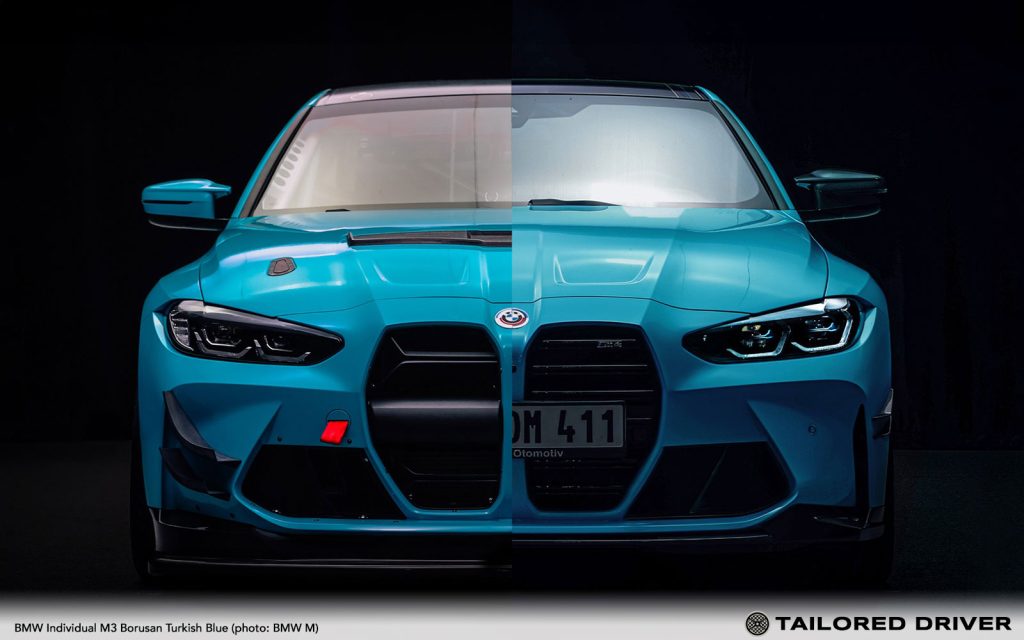
If you’re a fan of bold racing blues then it’s worth taking note of the latest set of M3 Competition Touring photos posted by BMW M to social media (HERE). BMW Individual Borusan Turkish Blue (borusantürkischblau; non-metallic; P9E; BMW) seems to fall more on the green side of the blue spectrum, almost similar to Porsche Riviera Blue.
On social media, the folks at BMW M have gotten quite adept at regularly posting great photography of interesting tailored builds in order to promote the BMW Individual program and its many, many offerings. They’re also using it to drive traffic to the BMW Individual Configurator, which makes for a great way to spend a couple hours imagining the possibilities.
Also, hat tip to Frank van Meet and the rest of the team at BMW M who keep building cars like a Borusan Turkish Blue M3 Competition in long roof, station wagon “Touring” guise. In a world of SUVs, driving enthusiasts can’t thank you enough.
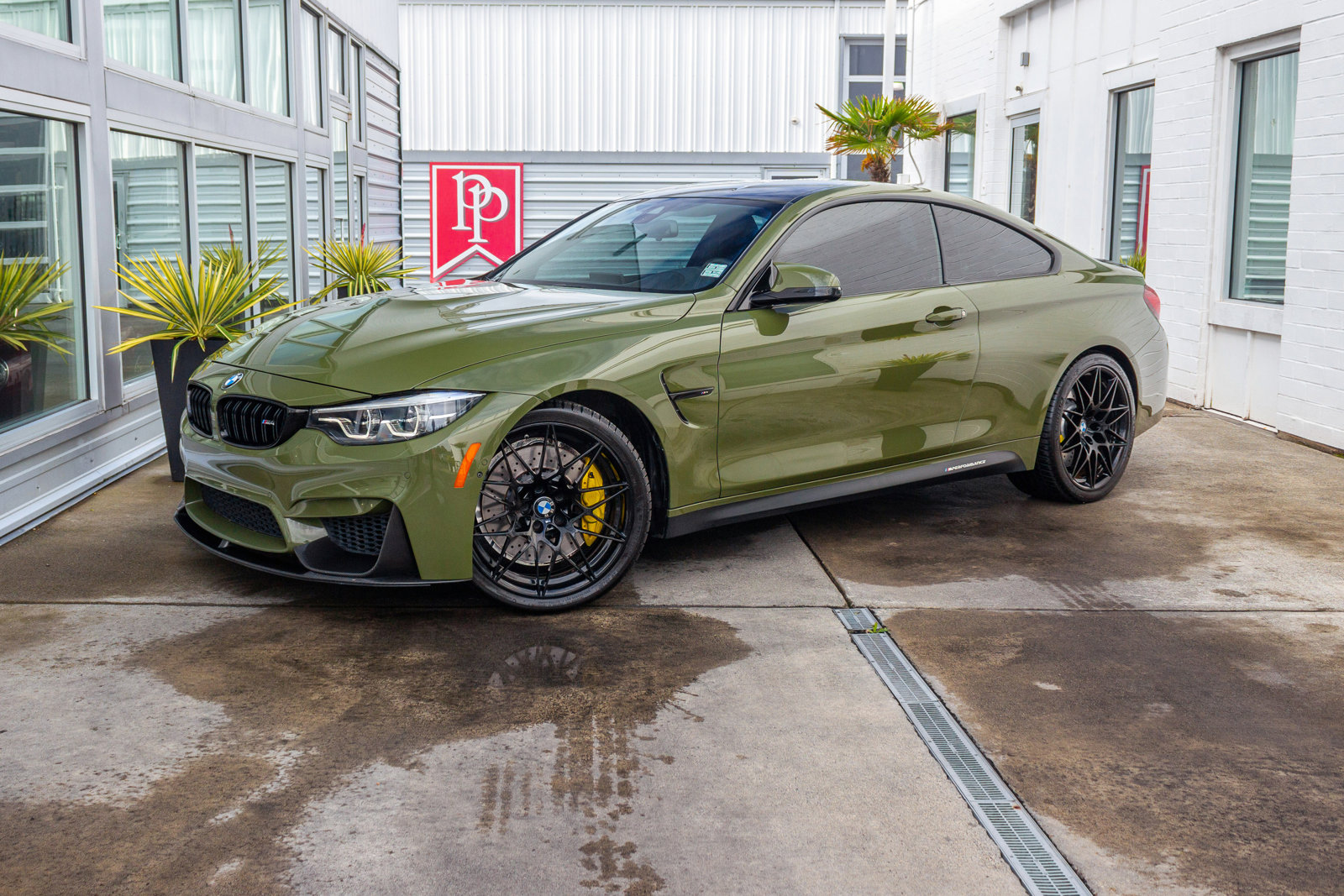
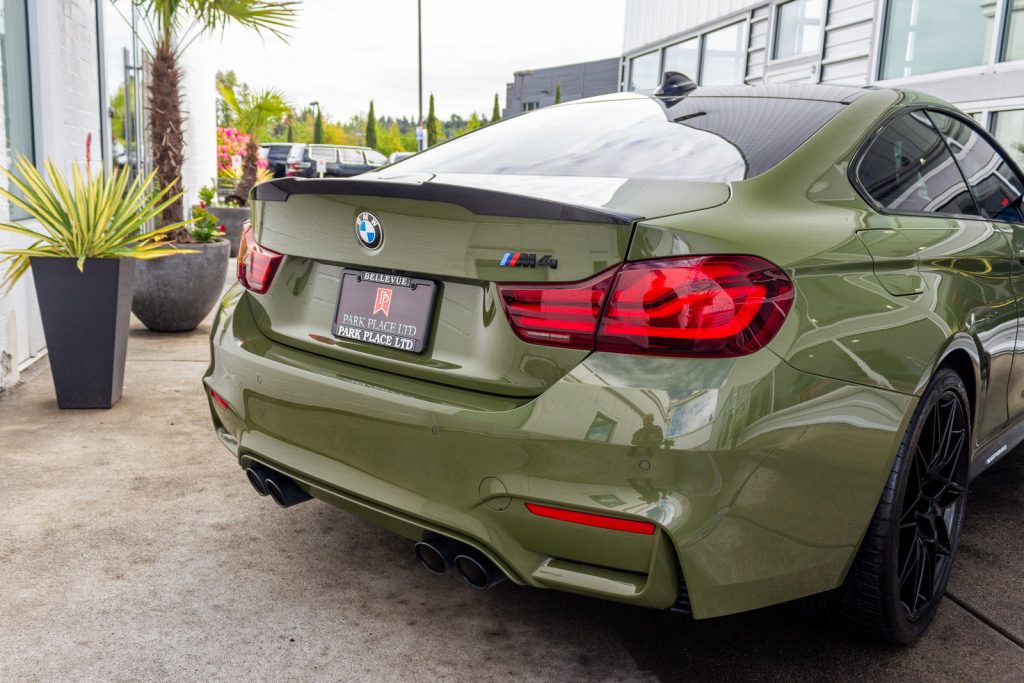
As anyone who had Army Men toys or even a casual interest in the armed forces can attest- Urban Green is just cool. This criminally(?) underused hue of green looks right at home on most sporty variants, and the BMW M4 (VIN: WBS4Y9C04LFH71553) you see here is no exception.
Featuring a claimed $16,880 in factory options, this highly spec’d BMW M4 is the kind of build that may cause some to initially scratch their heads, but really draws a crowd upon arrival.
This BMW Individual Urban Green M4 Coupe is currently on offer at Park Place LTD for $61,950, and does feature one minor incident on the CarFax. Find more info about this Tailored Driver, here.
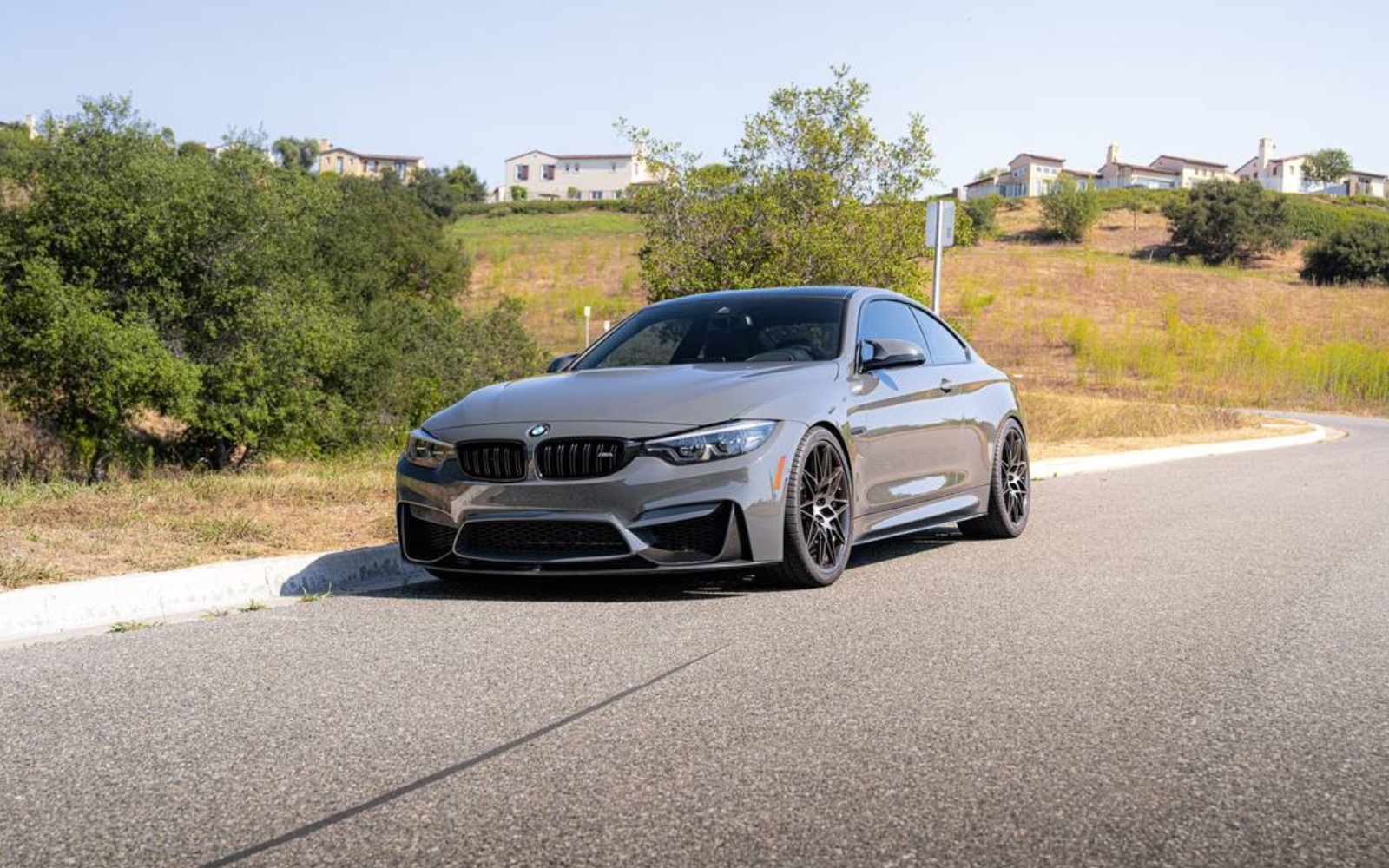
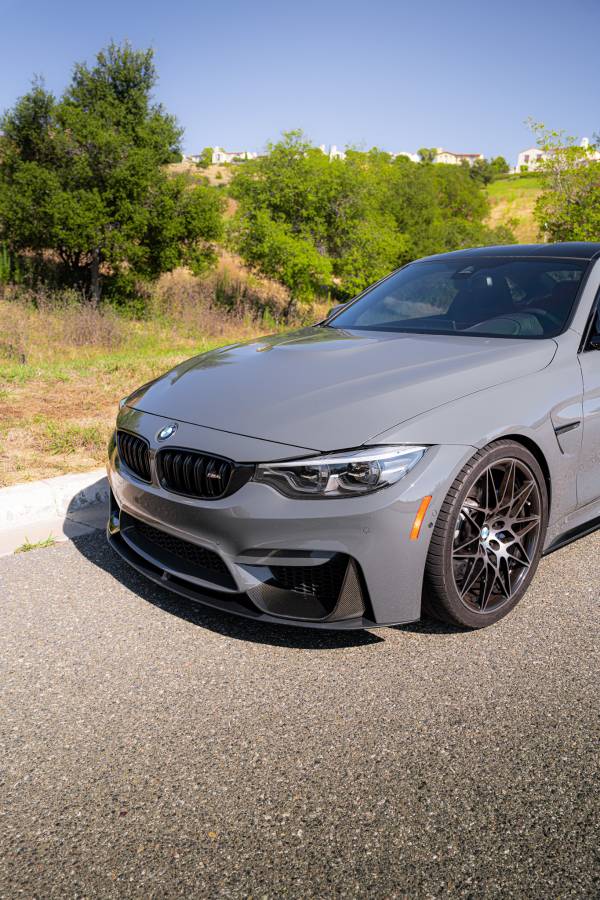
If you’re looking for an F82 Comp that checks most boxes, this one could be it. Clean title, low mileage, BMW Individual color and, clean CarFax. It’s slightly modded, but this could be the ONE for a proper enthusiast.
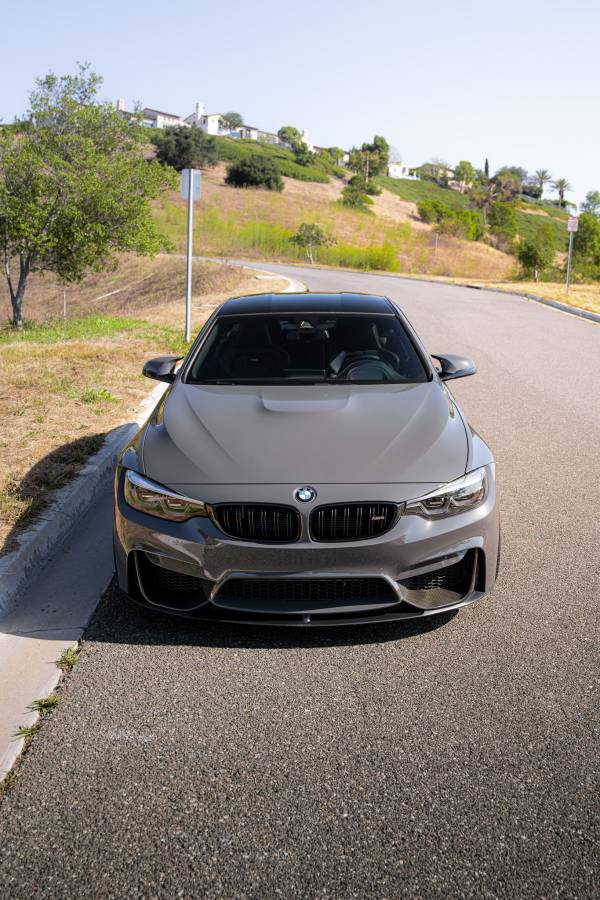
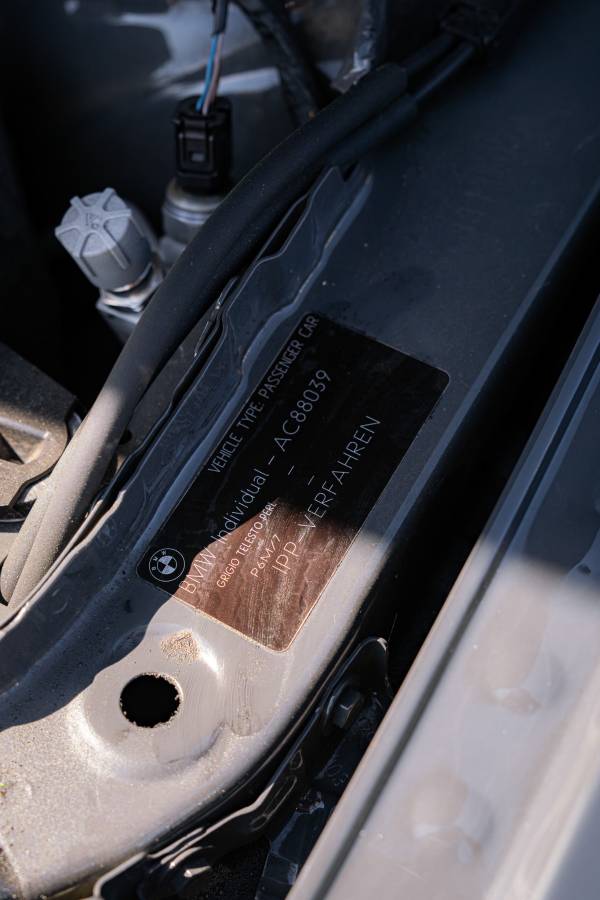
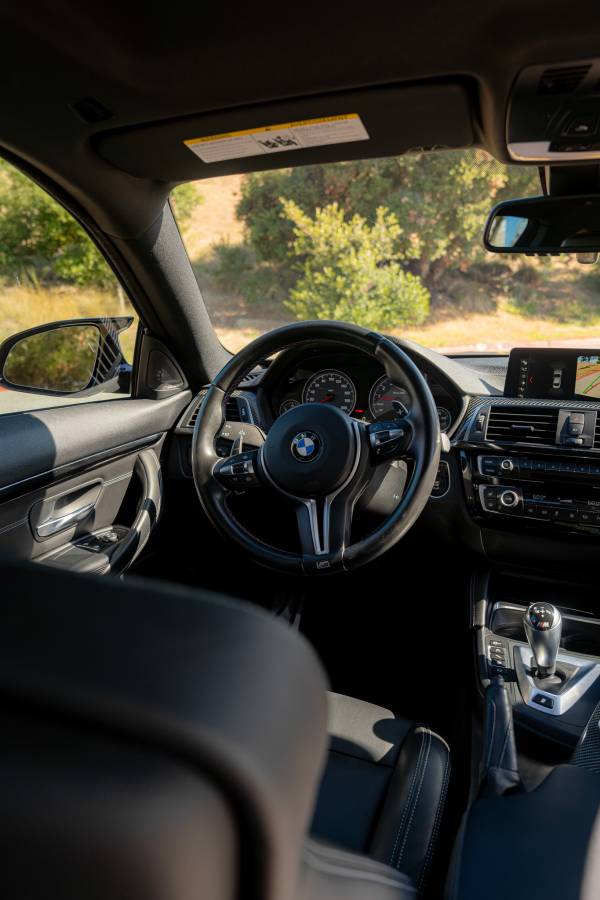
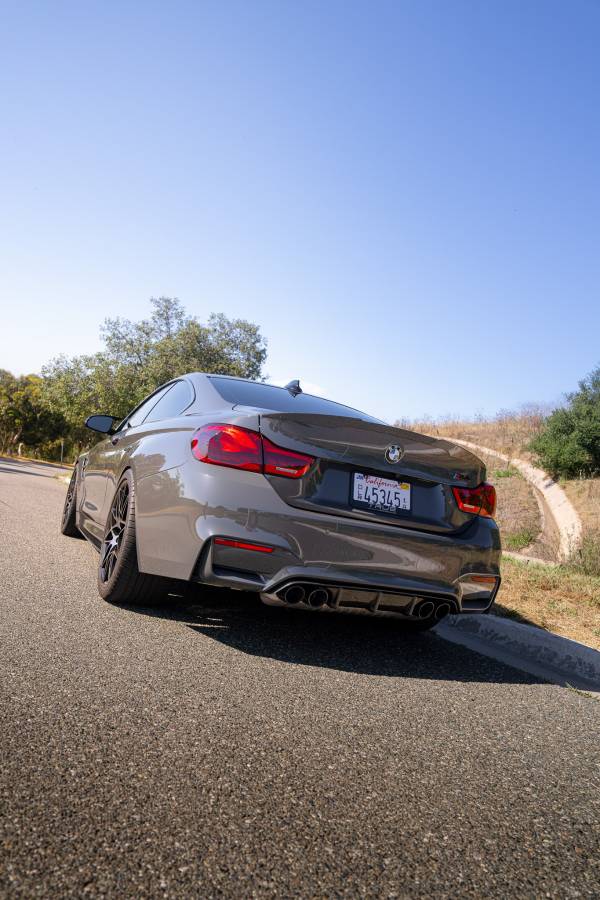
Here is a BMW Individual Grigio Telesto 2018 BMW M4 Competition with about 34,000 miles on it. Some mods include Active Autowerks Equal Length Resonated Midpipe, KW Has Lowering Springs, and Paint Protection Film on Front Bumper, Hood, Front Fenders, and Rear Quarter Panels. Bonus points for PPF, gotta protect that paint!
Seller states: “All service has been done on time. Oil changes, brake fluid flushes, brake pads, etc. Tires all have 8/32 or more of tread, zero leaks, and zero curb rash on any of the wheels. The car is bone stock engine-wise, has never been tuned, etc. It has been a weekend driver and garage kept for its entire life.” They even mention taking it to a shop in Costa Mesa for a pre-purchase inspection.
This definitely feels enthusiast-owned and you can tell the car was looked after. This is a win in our book. You can check out the Craigslist Ad HERE for more information. More photos below.
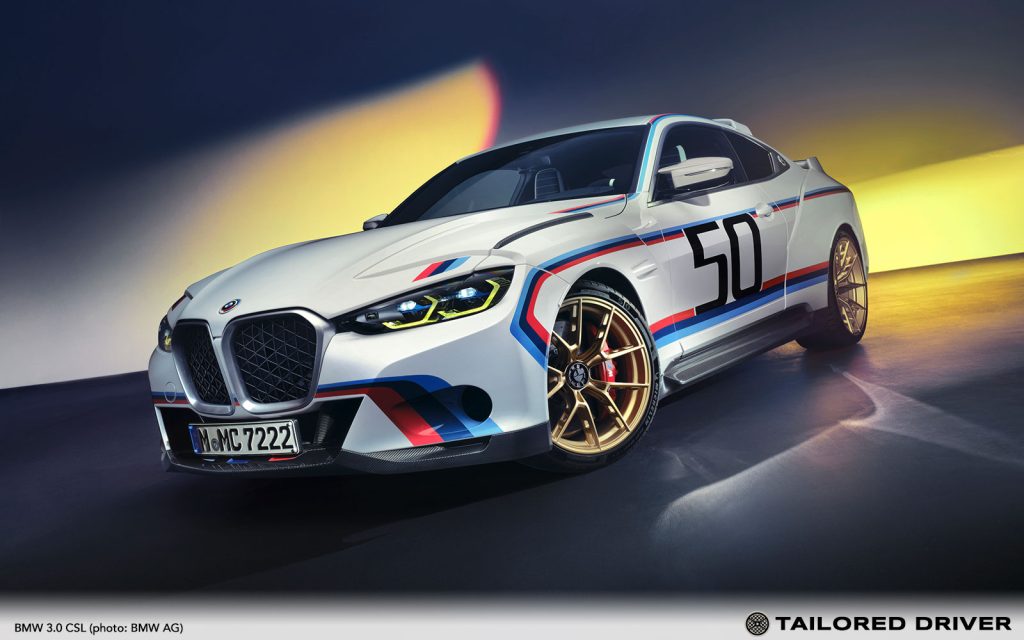
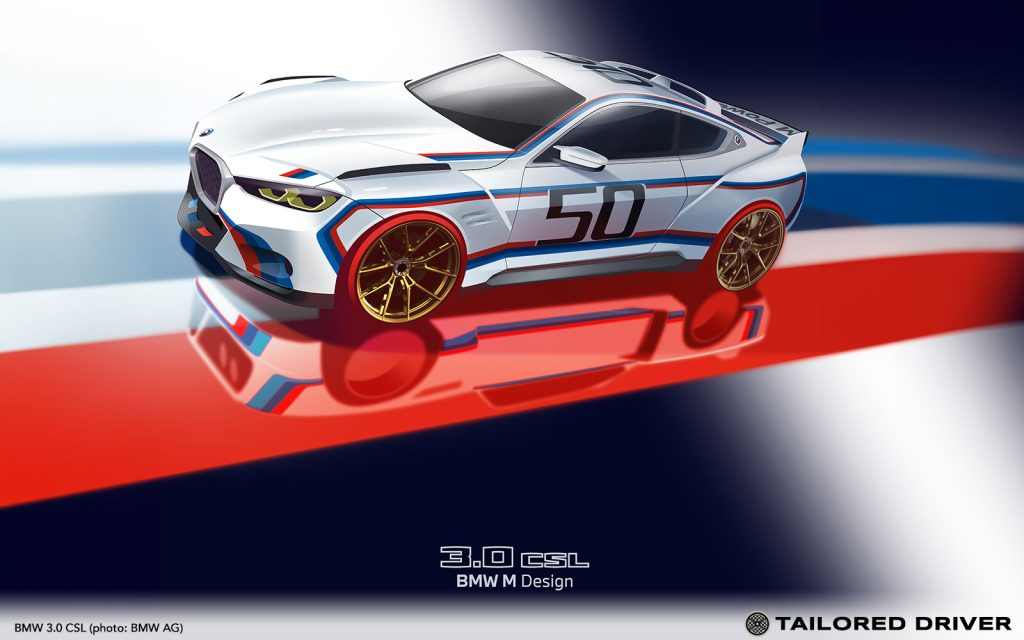
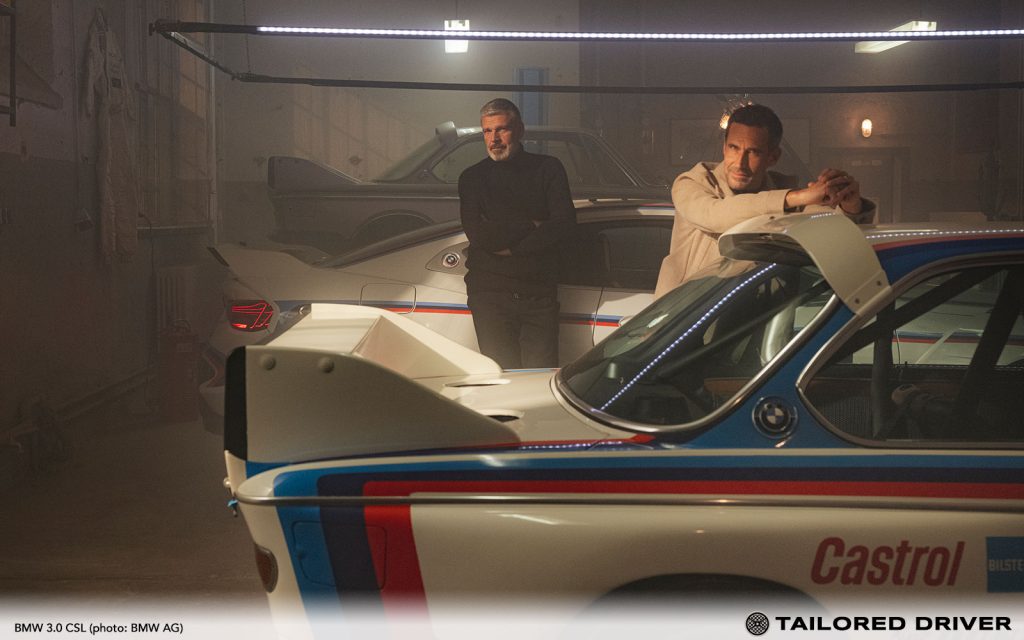
As the anniversary year comes to a close, BMW M GmbH is presenting the most exclusive special model the company has ever produced – a masterpiece of engineering embodying the essence from 50 years of racing passion and expressing its historic roots in a legendary model designation.
[source: BMW]
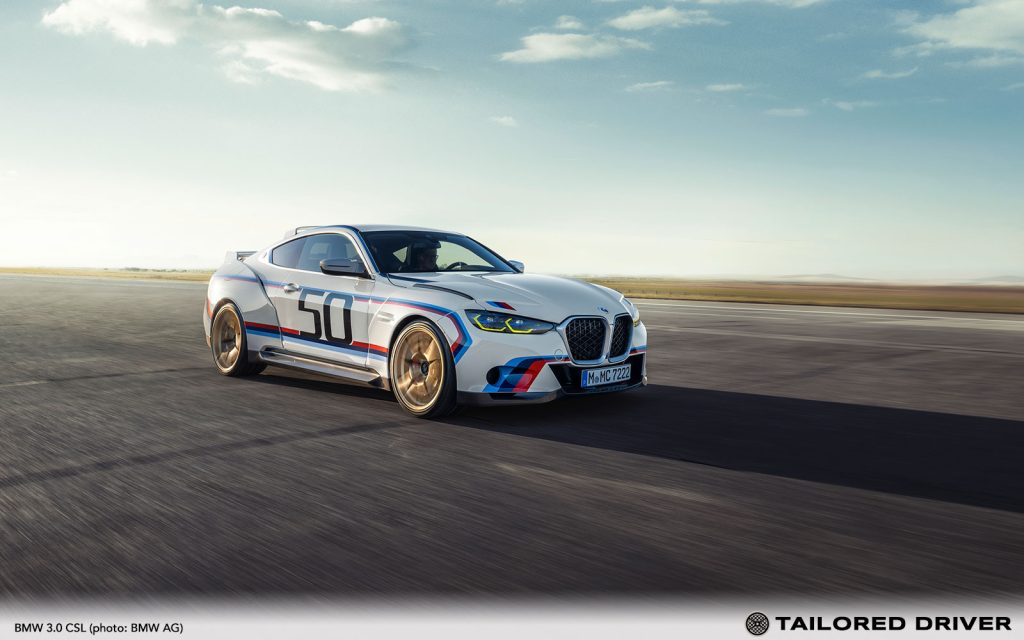
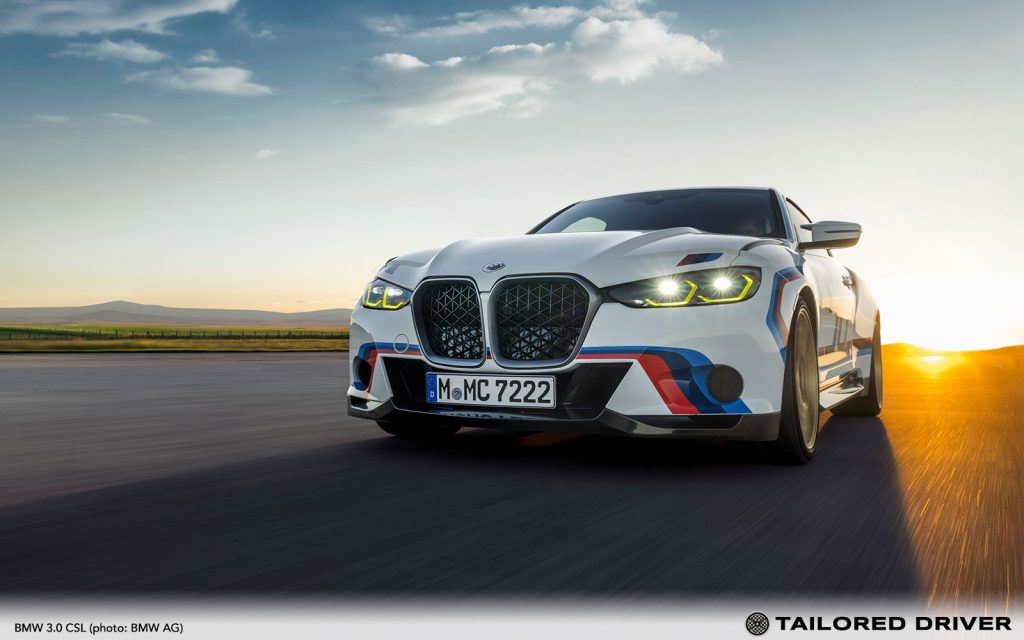
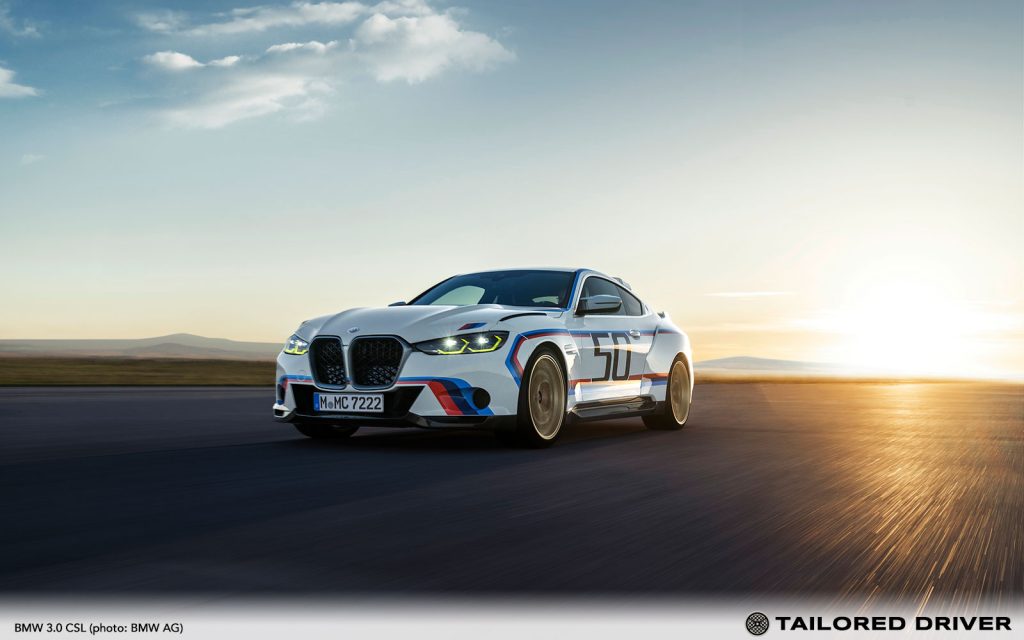
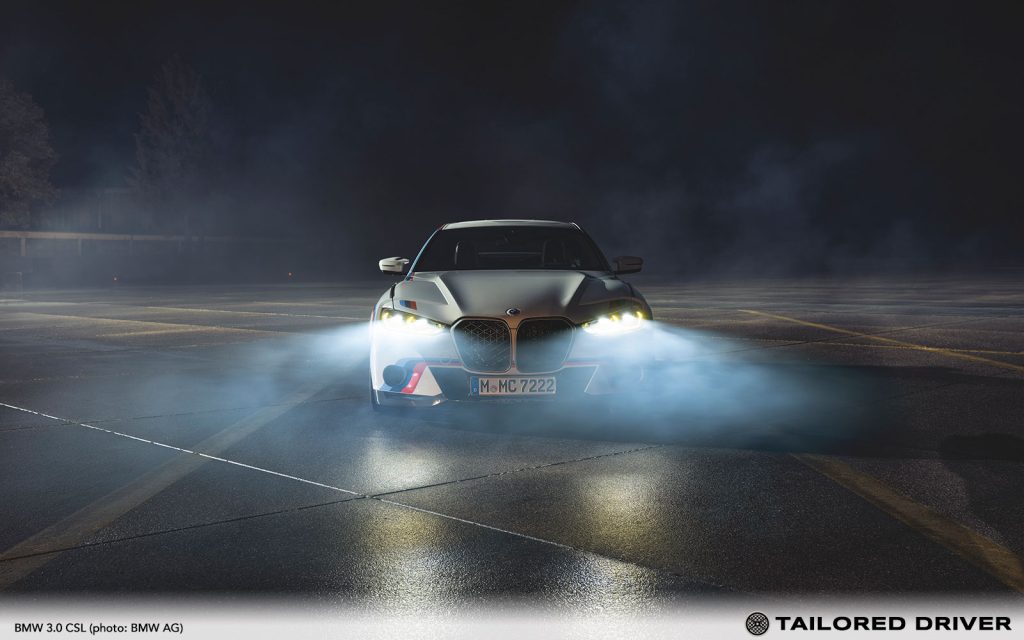
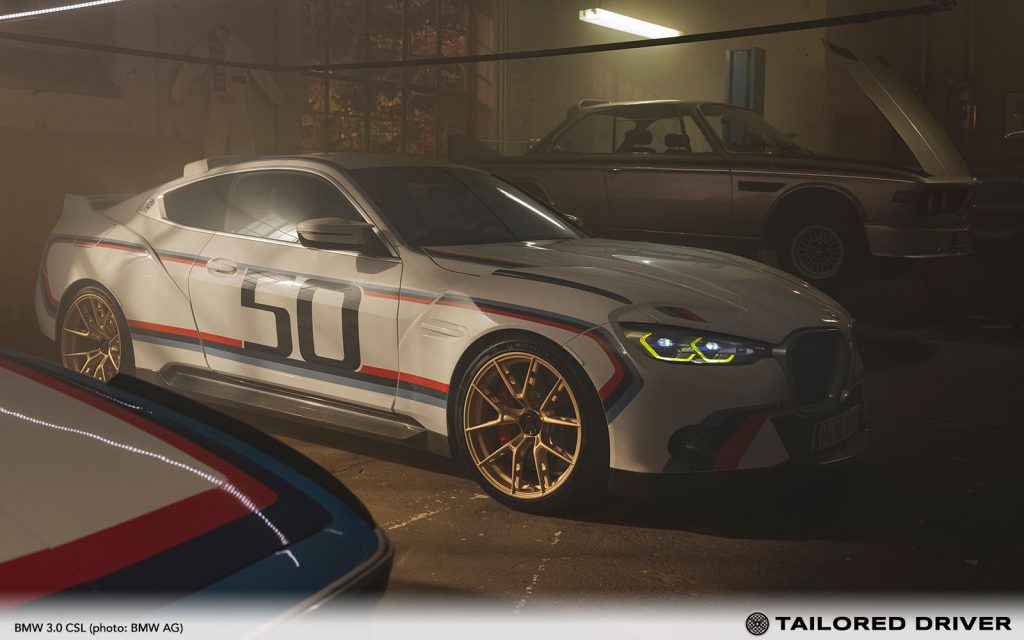
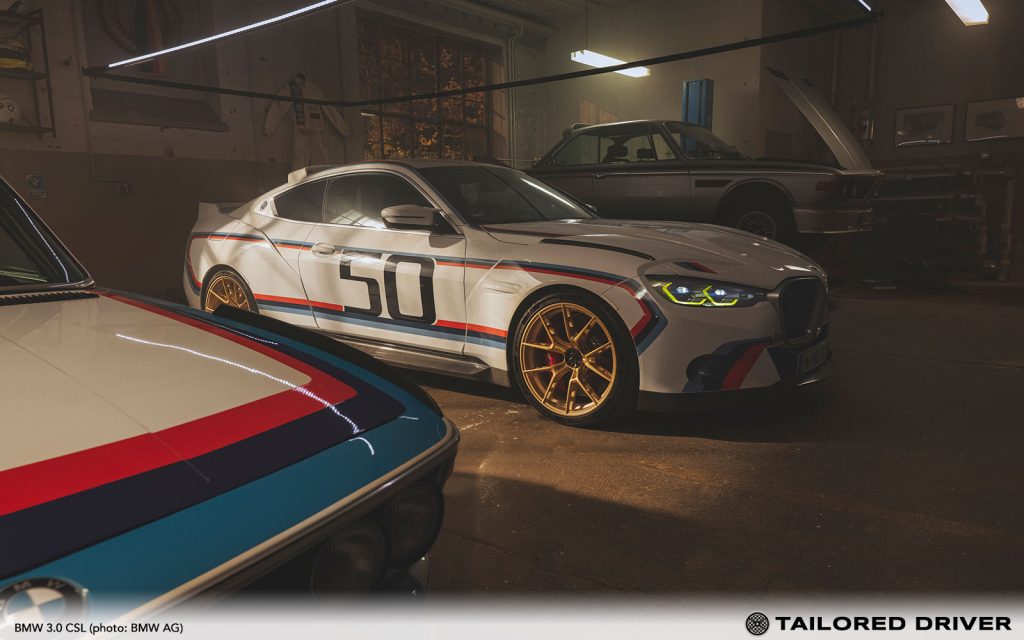
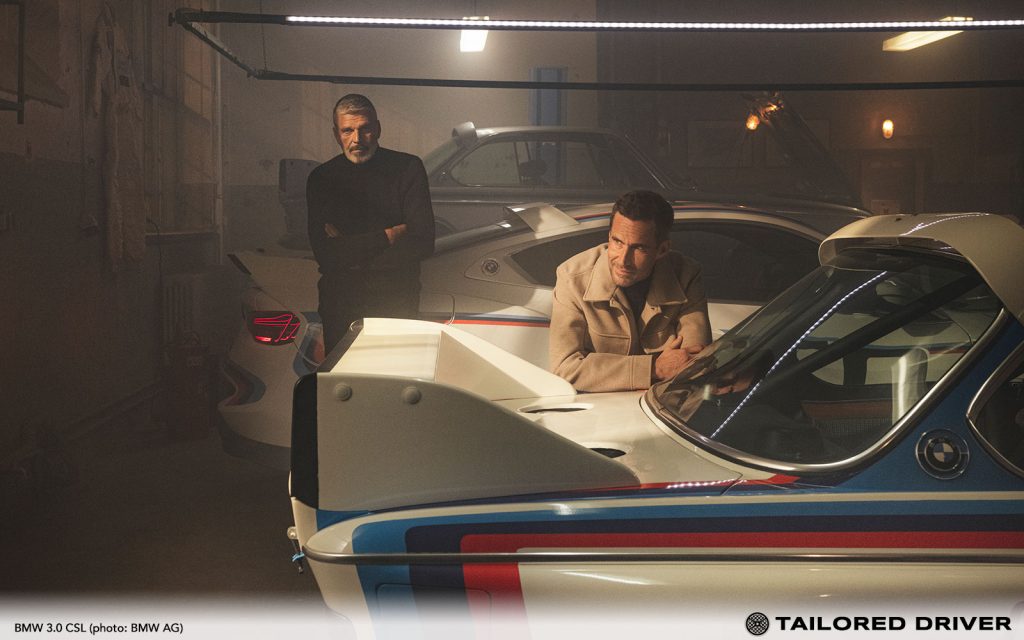
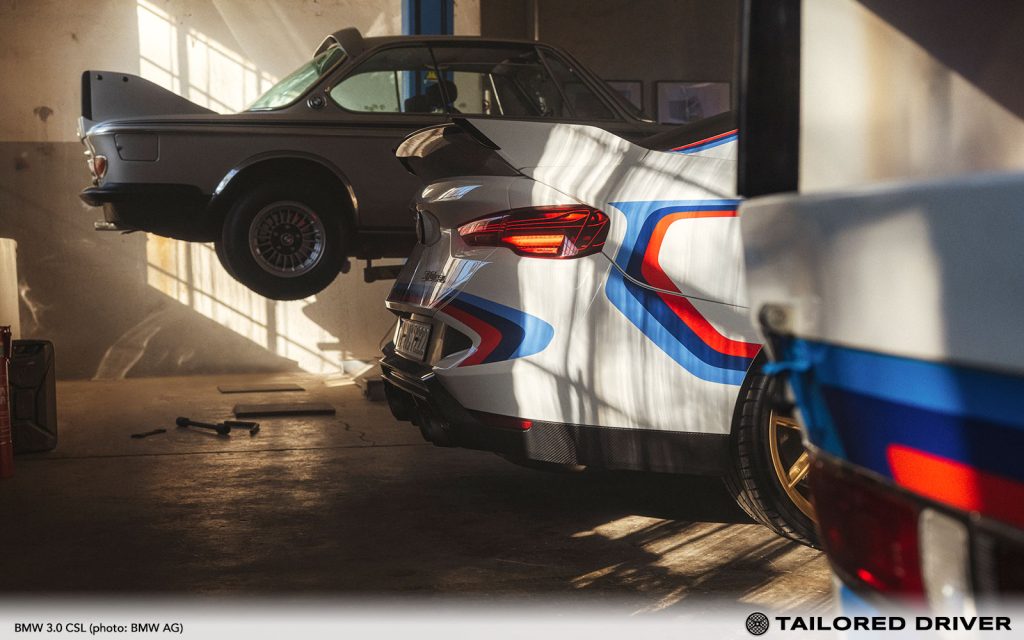
Munich. The BMW 3.0 CSL (fuel consumption combined: 11.0 l/100 km; CO2 emissions combined: 249 g/km according to WLTP; details according to NEDC: – ) combines a unique design with a puristic performance experience in two seats. It conveys to the present day in an extremely focused manner the concept created in the 1970s of applying racetrack technology designed for sheer driving pleasure on the road.
The BMW 3.0 CSL was developed with the intention of combining the best of five decades of racing expertise from BMW M GmbH in an automobile with a highly emotional aura. All facets of its character – dynamic exterior elegance, a classic sportscar cockpit, intelligent lightweight construction, a straight six-cylinder engine, manual transmission and rear-wheel drive – are based on traditional principles of a BMW M automobile. They complement each other with the help of the latest technology to create the ultimate symbol of fascination for top performance in the style of the brand that has been successful for 50 years. A ride in a BMW 3.0 CSL is therefore not only an exclusive high-performance experience, but also an emotional encounter with the history and the present of the world’s most powerful letter.
The BMW 3.0 CSL as a limited production run incorporating elaborate craftsmanship.
The BMW 3.0 CSL is produced in a strictly limited edition. To mark the anniversary, exactly 50 consecutively numbered units of the special model will go on sale. Right from the start, this gives the BMW 3.0 CSL the status of a rarity that will find its place in the vehicle collections of particularly loyal and enthusiastic fans of the BMW M brand.
The production of all vehicles will take around three months. Each and every one of them is created with absolute dedication to excellence in craftsmanship and precisely coordinated technologies in an elaborate manufacturing process at the external location of the BMW Group Dingolfing plant in Moosthenning, Lower Bavaria. The exclusive interior carbon fibre reinforced plastic (CFRP) components are produced by hand both in Munich and at the BMW Group component factory in Landshut by specially assigned bodywork specialists.
A specific process was also conceived for the paintwork of the BMW 3.0 CSL, in which craftsmanship and state-of-the-art technology complement each other to provide each individual part with its characteristic colour design. In addition, a team of 30 specially qualified and experienced technicians is responsible for the configuration and assembly of the vehicles. Due to the complexity of the processes in the manufactory, each BMW 3.0 CSL passes through eight assembly cycles at just as many production stations, a procedure that takes up to 10 days in all.
All in all, the extremely high proportion of individual manual work means that the time required to assemble a BMW 3.0 CSL is many times higher than that of a conventional BMW M automobile. After completion in the manufactory, each vehicle also undergoes a multi-stage quality inspection and approval process at the main Dingolfing plant before it is released for delivery to the customer. The BMW Group Plant Dingolfing is the company’s largest European production site. In addition to several BMW M automobiles, the luxury sedans of the BMW 7 Series and body components for Rolls-Royce Motor Cars are produced there.
The successful touring car – a role model in its time.
As the reincarnation of a legendary sports car both for the racetrack and the road, the BMW 3.0 CSL possesses all the characteristics of a puristic car. It embodies the joy of classic driving and an awareness of the traditional roots of BMW M GmbH in a uniquely exclusive form. Its eponymous role model is considered the first automobile to carry the DNA for maximum driving pleasure and passion, an unmistakeable feature of BMW M automobiles to this very day. In the founding year of BMW Motorsport GmbH, it was developed for use in touring car competitions, where it became the most successful racing car of its era.
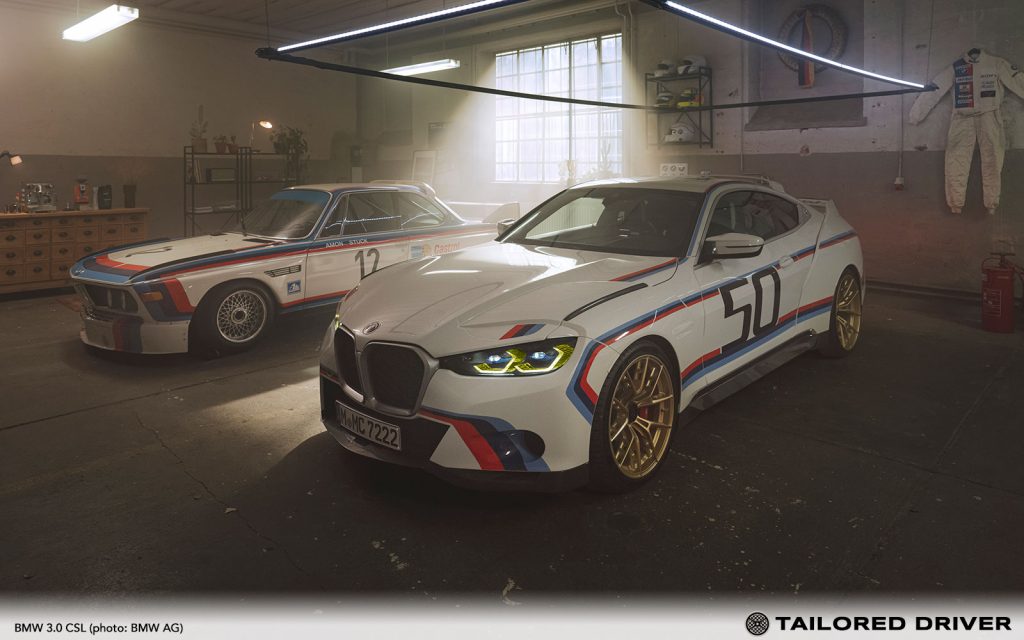
The racing version of the historic BMW 3.0 CSL won the European Touring Car Championship during its inaugural season in 1973 – and repeated this title win five more times in succession from 1975 to 1979. Drivers such as Toine Hezemans, Hans-Joachim Stuck, Chris Amon and Niki Lauda left the competition behind at the Nürburgring and numerous other circuits, followed by BMW’s first victories on US circuits as early as 1975. All these successes helped the works racing cars to gain international popularity.
“Coupe, Sport, Lightweight construction“: New interpretation of a legendary formula.
The road version of the racing car, which was developed for homologation purposes, became a widely known symbol of inspiring driving pleasure focused on the essentials, especially in its final stage of development. CSL – this combination of letters in the model designation stood for “Coupé, Sport, Leichtbau” (Coupe, Sport, Lightweight), a concise summary of the two-door car’s recipe for success.
In addition to wide wheel arches, its coupe-shaped body also received an eye-catching aerodynamics package, which included a front spoiler, air bars on the front side panels and a roof spoiler. Completing the design modifications vs. the other coupes in BMW large series was a rear wing that optimised the grip of the rear wheels. It was not approved for road use and therefore lay in the boot when the vehicle was delivered, but nevertheless received much public attention so that the Coupe was given the nickname “Batmobile”.
With an increased displacement of 3,153 cubic centimetres and a maximum output of 151 kW/206 hp, the most powerful straight six-cylinder engine with direct injection ever used in a BMW model ensured sporty power delivery. The powerful drive system was combined with refined suspension technology. Its unladen weight was just 1,270 kilograms.
The reduced weight was achieved through comprehensive lightweight construction. The doors were made of aluminium, as were the bonnet and the boot lid, which were supported on filigree retaining rods after opening. Numerous other body components such as the roof, side panels and luggage compartment partition were made of particularly thin sheet metal, and the chrome bumpers were replaced by plastic skirting. Lightweight bucket seats and the omission of insulation material, power steering and electric windows ensured optimal weight reduction. An overall power-to-weight ratio of 6.2 kilograms per horsepower was thus achieved.
The new BMW 3.0 CSL is the contemporary reinterpretation of all these features anchored in its model designation. Its coupe-shaped body sets traditional accents for sporty elegance and expressive dynamics. Its drive and suspension technology stems from the latest developments for racing cars and high-performance sports cars from BMW M GmbH. And the intelligent lightweight construction reaches an outstanding level, above all through the extensive use of carbon. The power-to-weight ratio of the BMW 3.0 CSL is a mere 2.9 kilograms per hp.
As an independent model from BMW M GmbH and despite the limited number of units, the BMW 3.0 CSL has undergone a complete series development process. In addition to the extensive quality and function tests and the driving dynamics tuning test drives under a wide range of conditions from city traffic to country roads and motorways to the race track, the BMW 3.0 CSL has also undergone comprehensive aerodynamic testing. Around 200 working hours were spent on optimising the airflow and aerodynamic balance of the vehicle, including 50 hours in the wind tunnel of the BMW Group’s Aerodynamic Test Centre. In addition, two pre-production vehicles of the BMW 3.0 CSL had to undergo a safety test in the form of a frontal and a side crash test in order to meet road legal requirements.
Unique, M-typical design, geared to the technical demands of fascinating performance.
With its classic coupe proportions and a traditional vehicle concept that combines a front engine and manual transmission with rear-wheel drive, the BMW 3.0 CSL follows in the footsteps of its historic ancestor. Distinctive air deflection elements, powerfully shaped wheel arches, a striking rear spoiler and numerous other details are unmistakably based on the design of the legendary coupe from the 1970s.
At the same time, its appearance is characterised by the principles that have always applied to BMW M automobiles: The specific exterior features are based on the technical requirements in terms of cooling air supply, aerodynamic balance and driving dynamics, which form the basis for highly fascinating performance. In this way, the BMW 3.0 CSL expresses timeless racing passion in an emotional and authentic way.
Powerful aesthetics pay tribute to the historical ancestor.
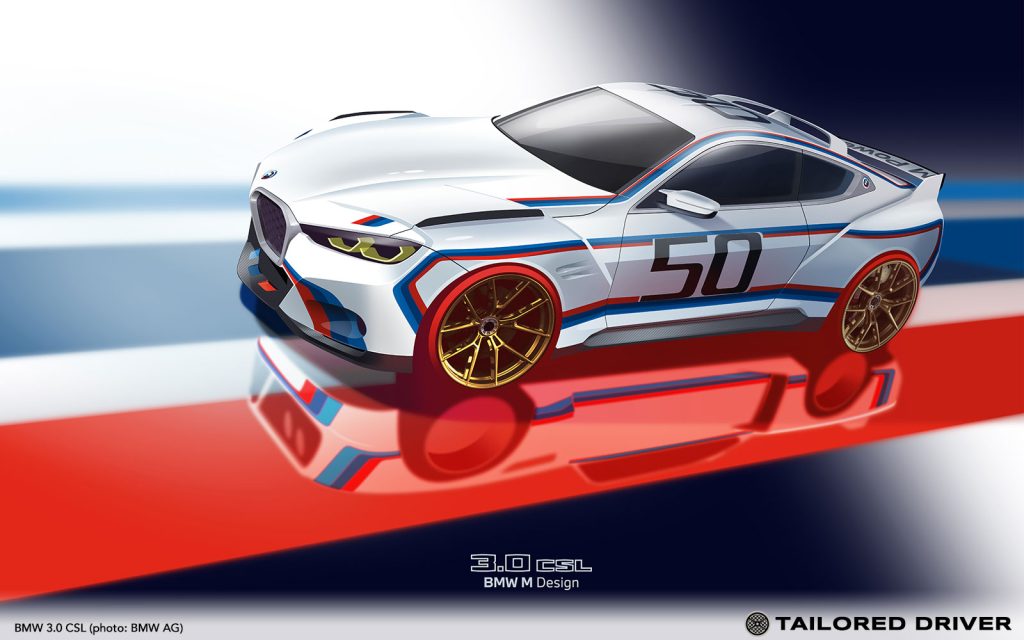
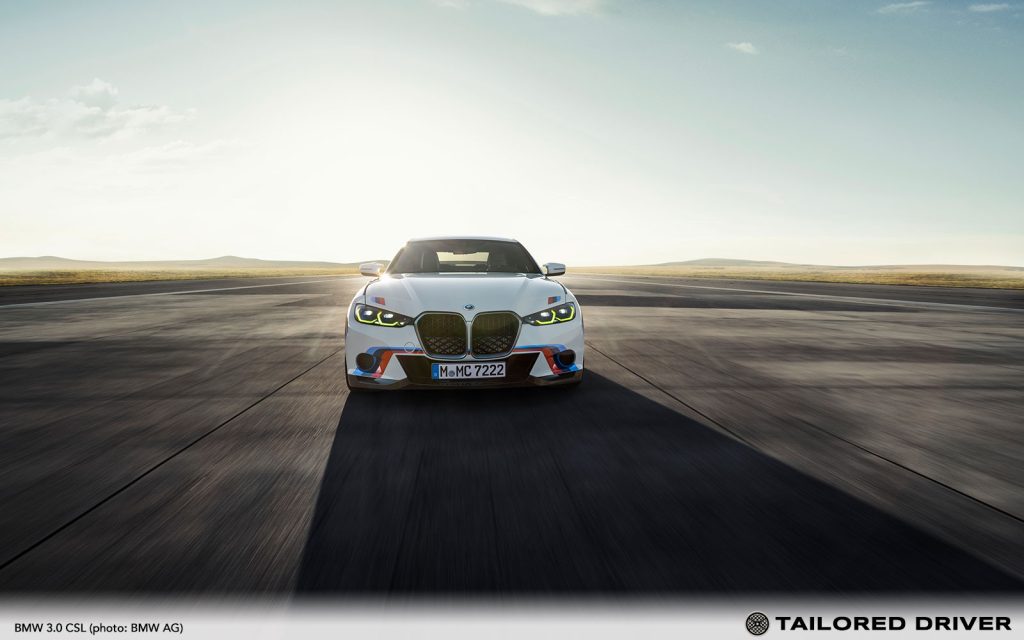
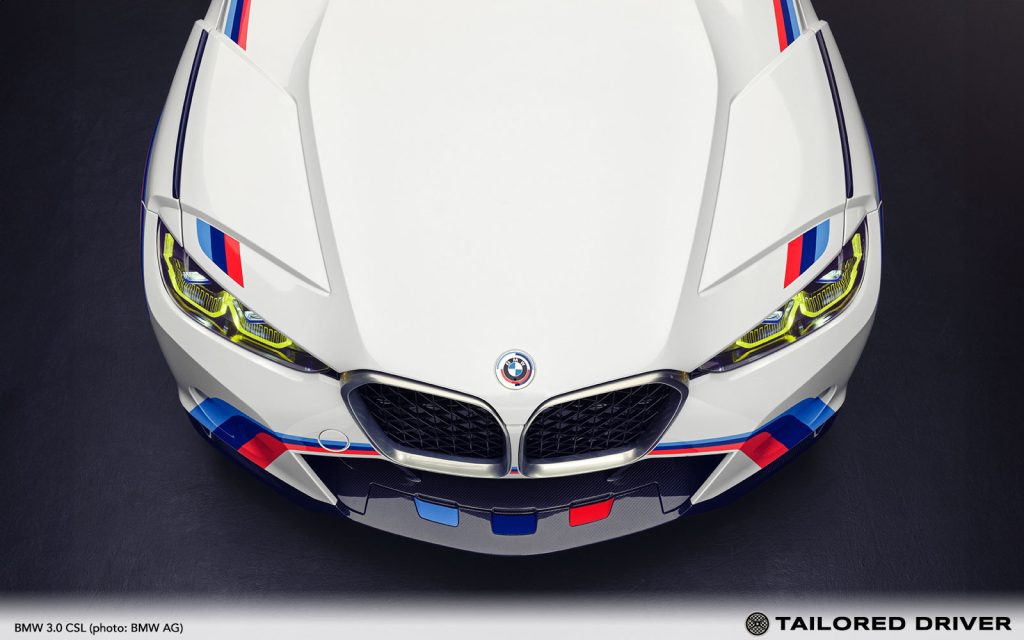
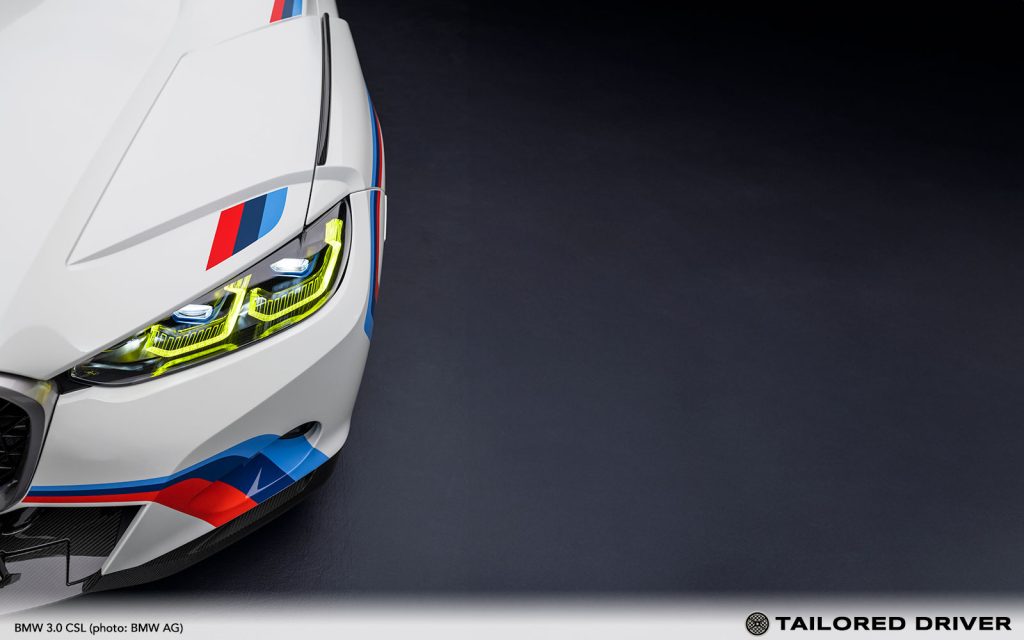
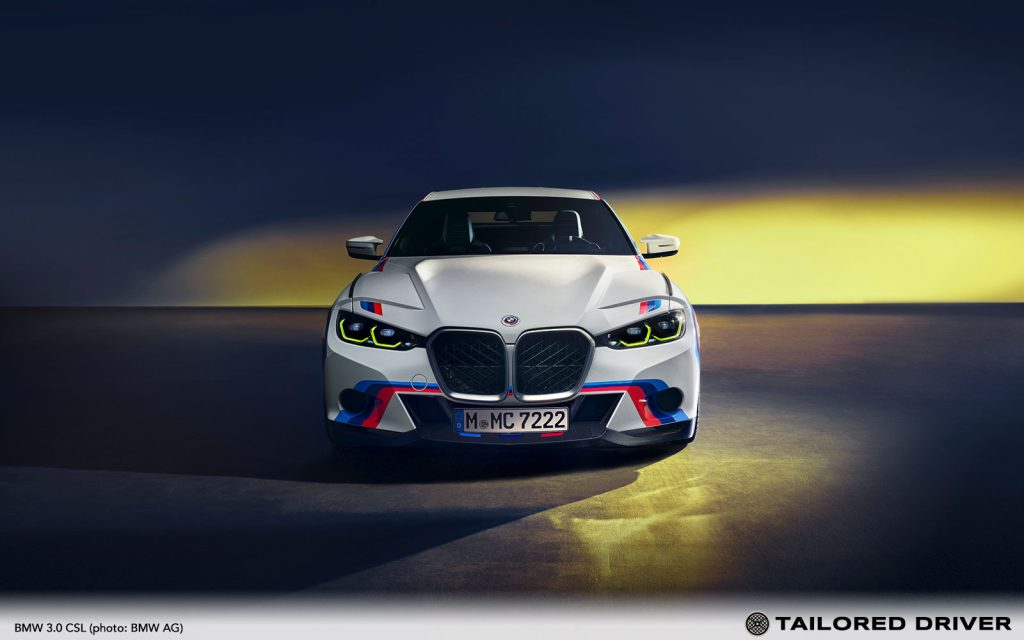
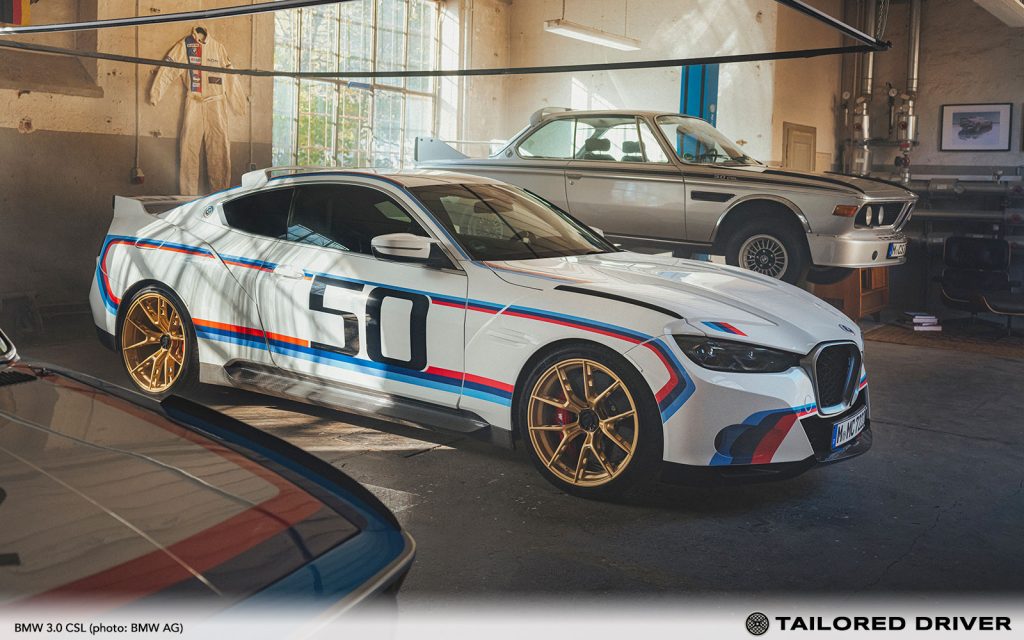
Power and athleticism are signalised by the front end of the BMW 3.0 CSL, which sits low on the road. At its centre is the distinctive BMW kidney grille with a lattice-shaped insert in a diamond structure. Its upright position relates to the front design of its historic ancestor. Like the side window surrounds, the kidney frame is finished in satin aluminium – a design feature that emphasises the special status of the BMW 3.0 CSL. Together with the BMW kidney grille, two generously dimensioned recesses in the front apron, reminiscent of the air intakes on the 1970s model, ensure reliable cooling of the drive and brake systems even in extremely dynamic driving situations. Sculpturally shaped air fins on the bonnet accentuate the classic lines.
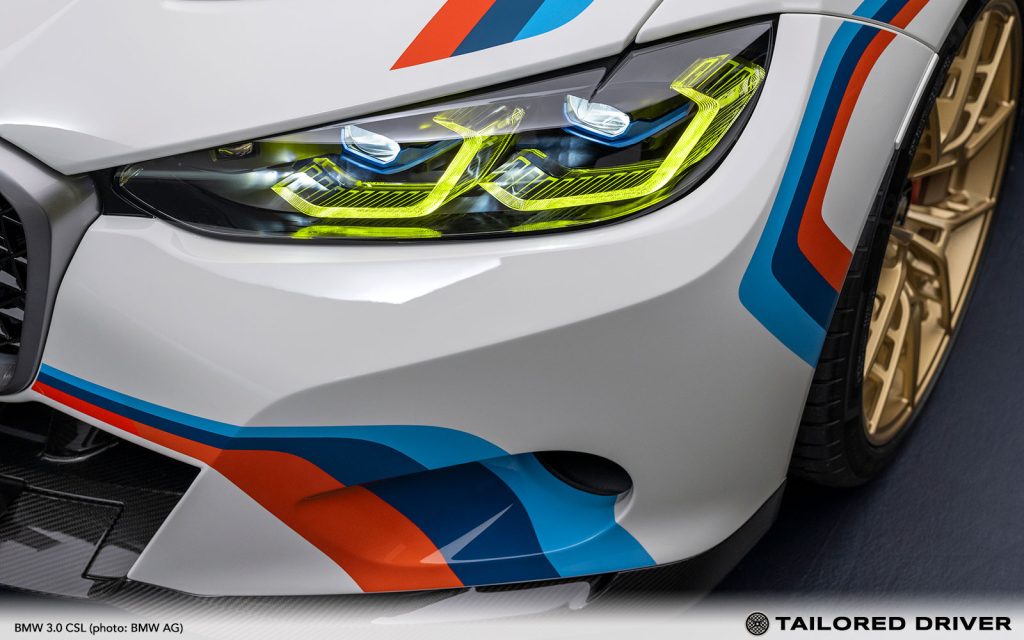
With their flat contours, the headlights create the characteristic focus on the road. The BMW Laser Light headlights shine in yellow, both during the welcome scenario after unlocking the doors and when the low and high beams are activated, thus making reference to successful GT racing cars. This detail is a subtle reference to the strong connection with motorsport and BMW M GmbH’s currently most successful competition vehicle, the BMW M4 GT3, which won both the drivers’ and team championships in the DTM in 2022 and whose power unit is based on the same straight-six engine as the power unit of the BMW 3.0 CSL. The BMW M4 GT3 achieved championship success right at the start of its racetrack career, much like the historic BMW 3.0 CSL, which once won the European Touring Car Championship in its inaugural season.
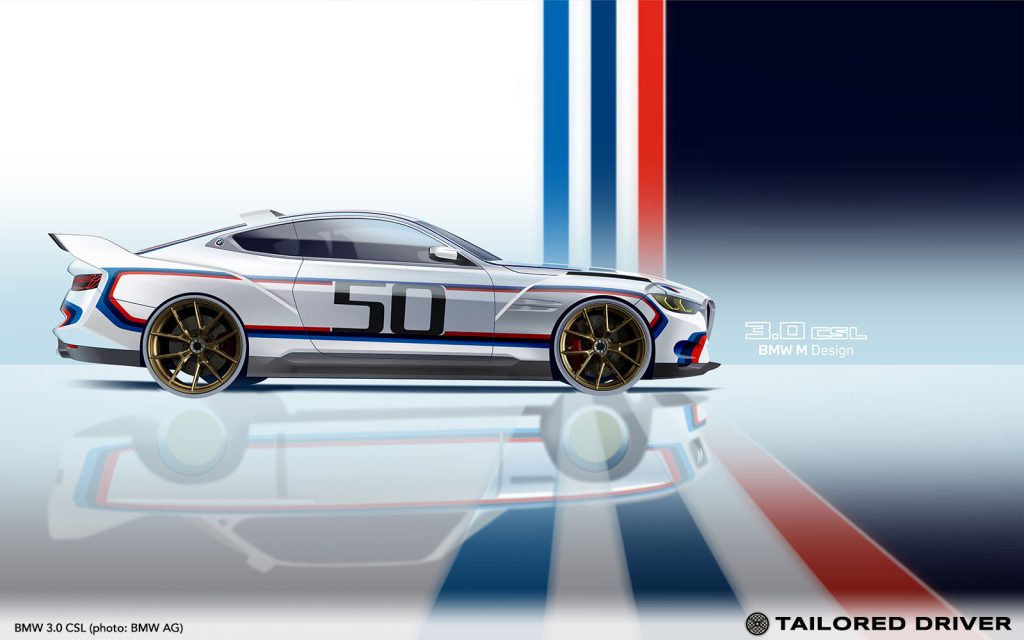
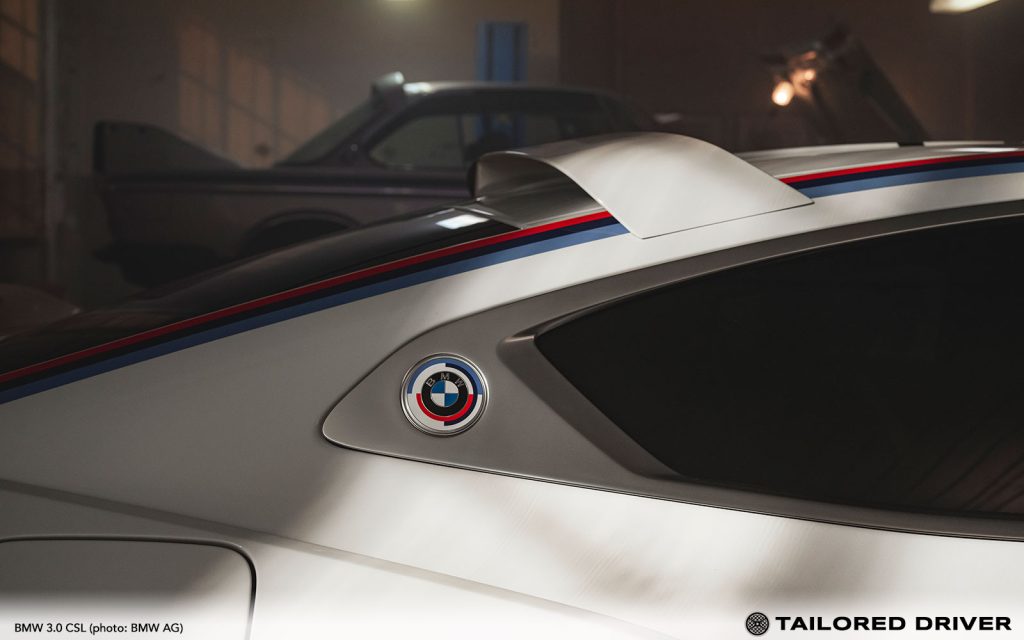
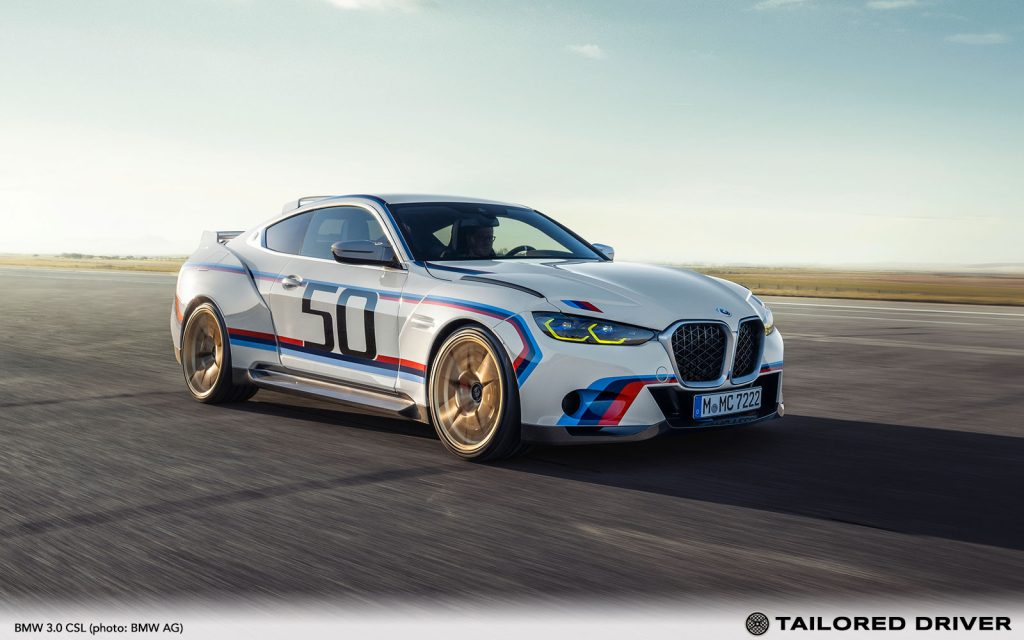
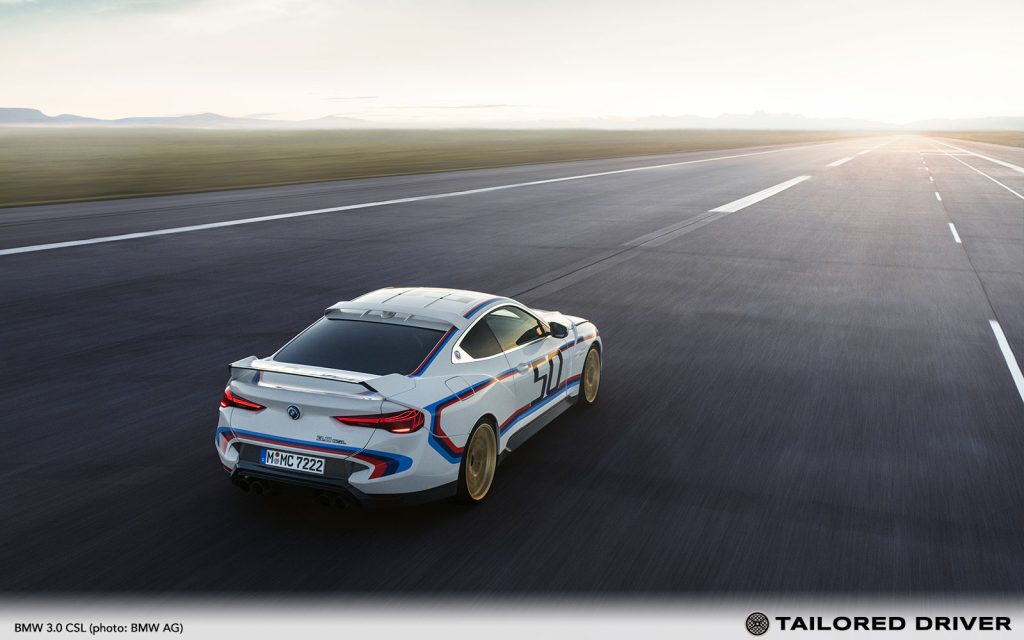
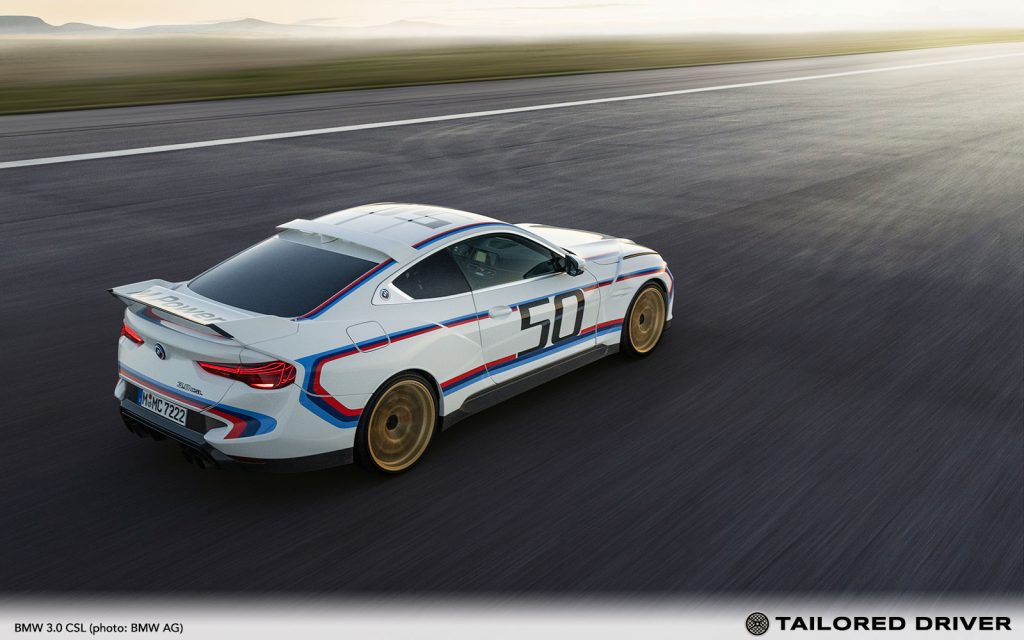
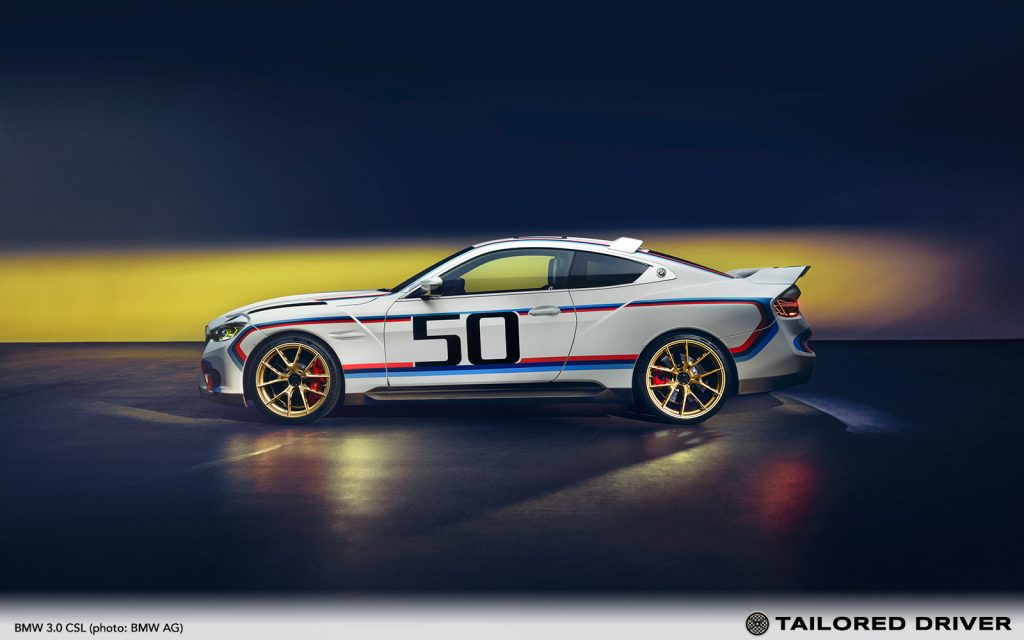
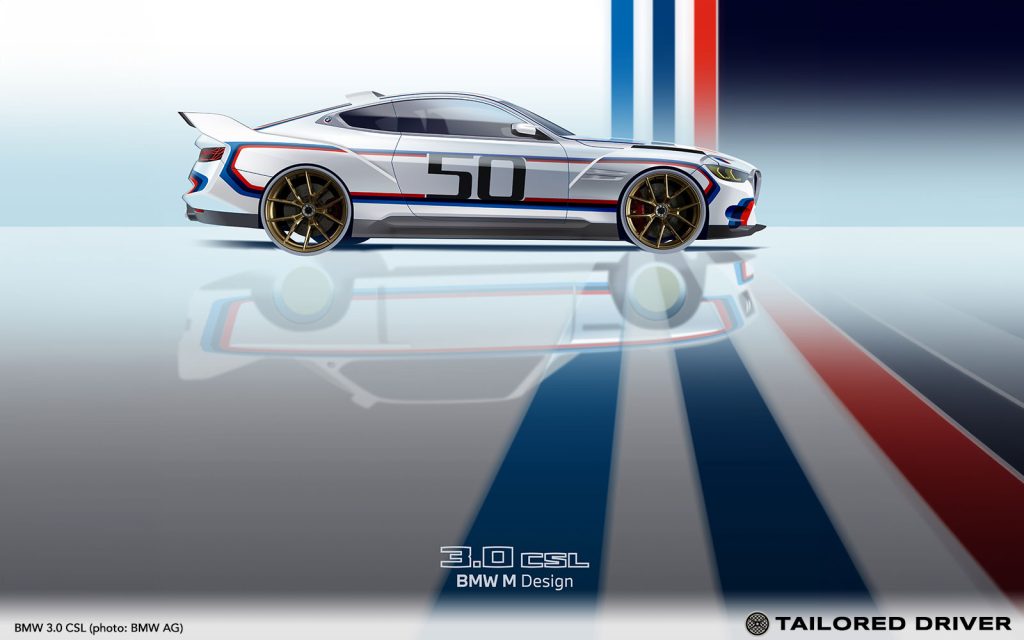
Viewed from the side, the long bonnet and wide wheelbase lend the BMW 3.0 CSL an appearance that is both sporty and classically elegant. The brand-typical coupe proportions in a three-box design also contribute to this. Particularly wide, diagonally offset side panels and wide side walls underline the dynamic appearance of the coupe even when stationary, with an air deflector extending along the roof line.
Wide wheel arches, central locking wheels produced exclusively for the BMW 3.0 CSL’s tyres.
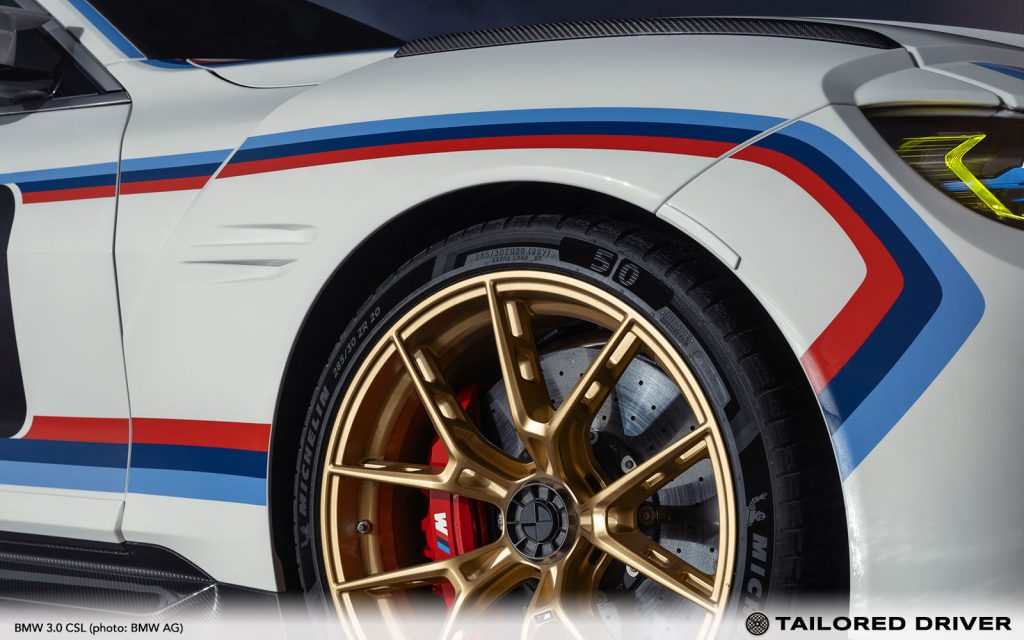
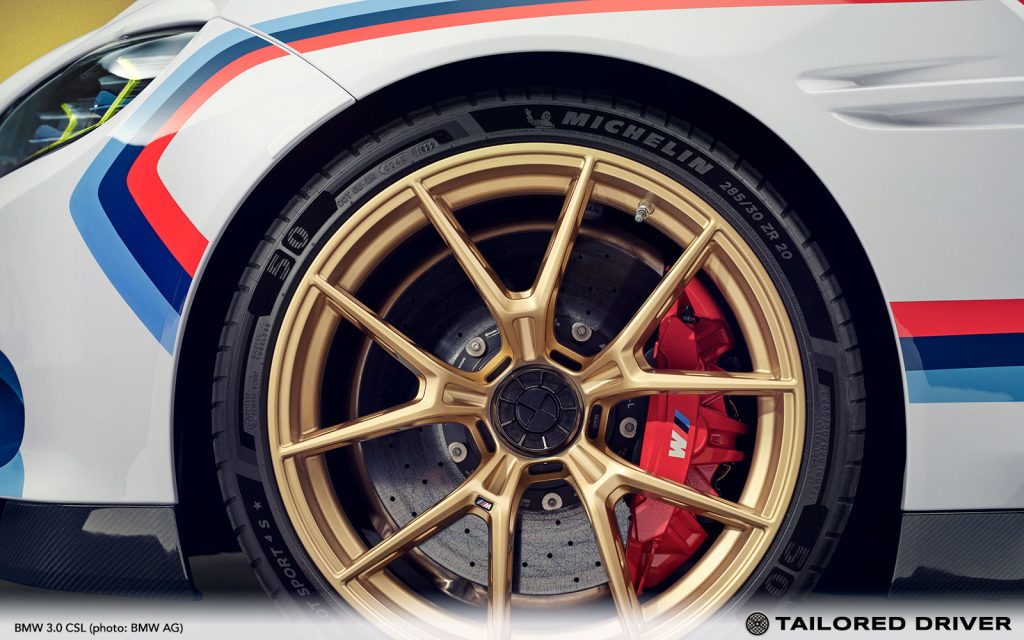
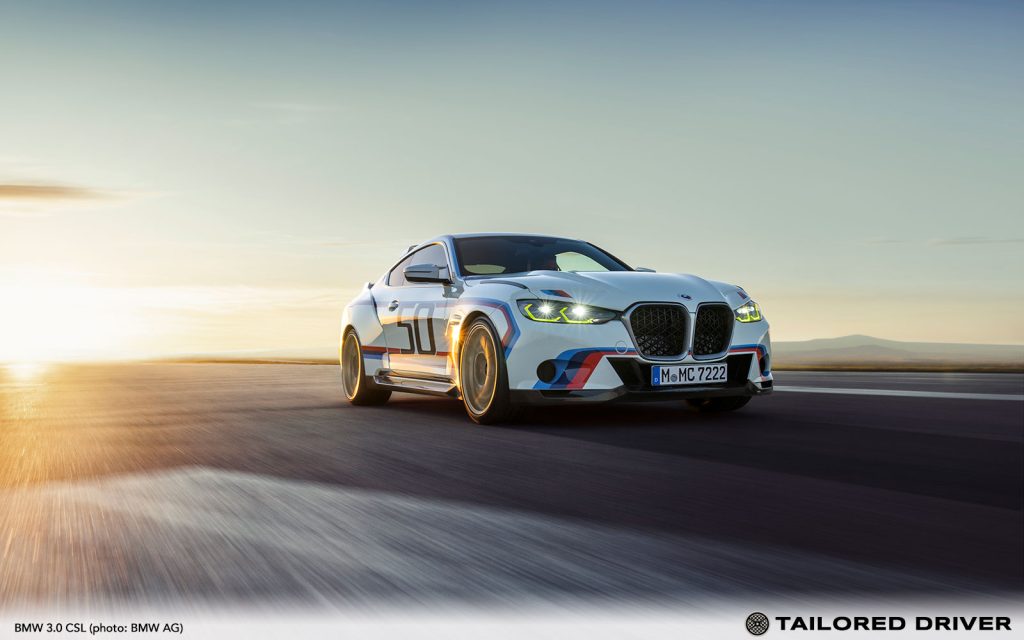
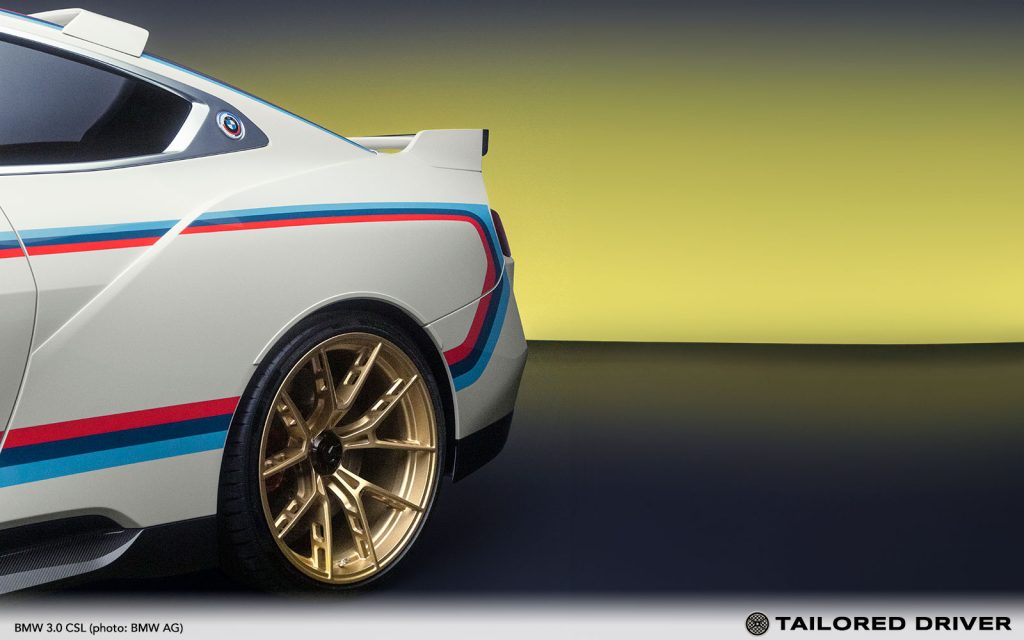
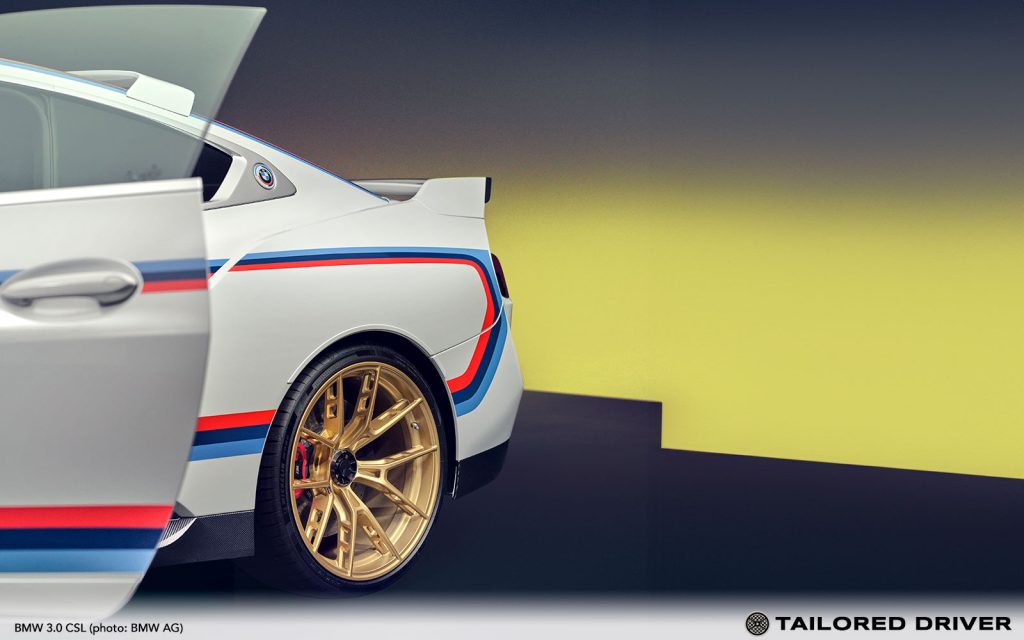
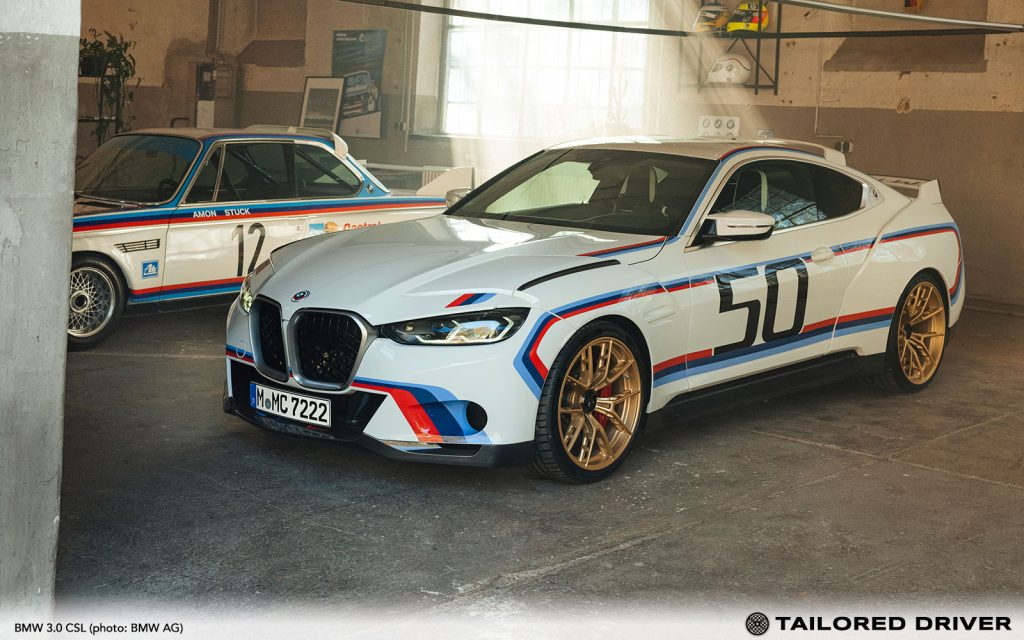
Muscular wheel arches give indication of the large track widths that contribute significantly to the vehicle’s high cornering dynamics. They offer space for the forged light-alloy wheels in a Y-spoke design, these being 20 inches on the front axle and 21 inches at the rear. With their filigree spokes, a gold-coloured paint finish in the style of the 1970s and a centre lock, they represent a highlight in terms of design and driving dynamics adapted directly from racing. The integration of the model-specific wheels into the pre-assembled axles of the BMW 3.0 CSL is part of the manufacturing process at the BMW Group’s Dingolfing plant. At 930 Nm, the torque applied during the assembly of the centre locks achieves the highest value for a BMW Group production vehicle.
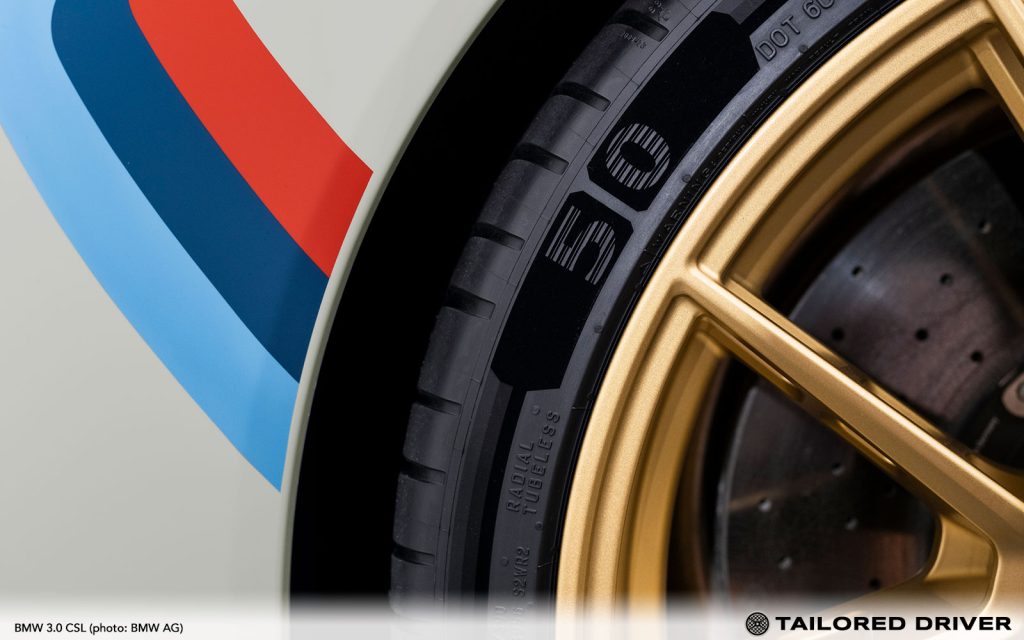
The forged light-alloy wheels are fitted with Michelin tyres developed exclusively for the BMW 3.0 CSL. They bear the number 50 embossed on the tyre sidewalls, providing another subtle reference to the anniversary of BMW M GmbH, on the occasion of which the special model was designed and built.
A tail wing in the style of the “Batmobile“.
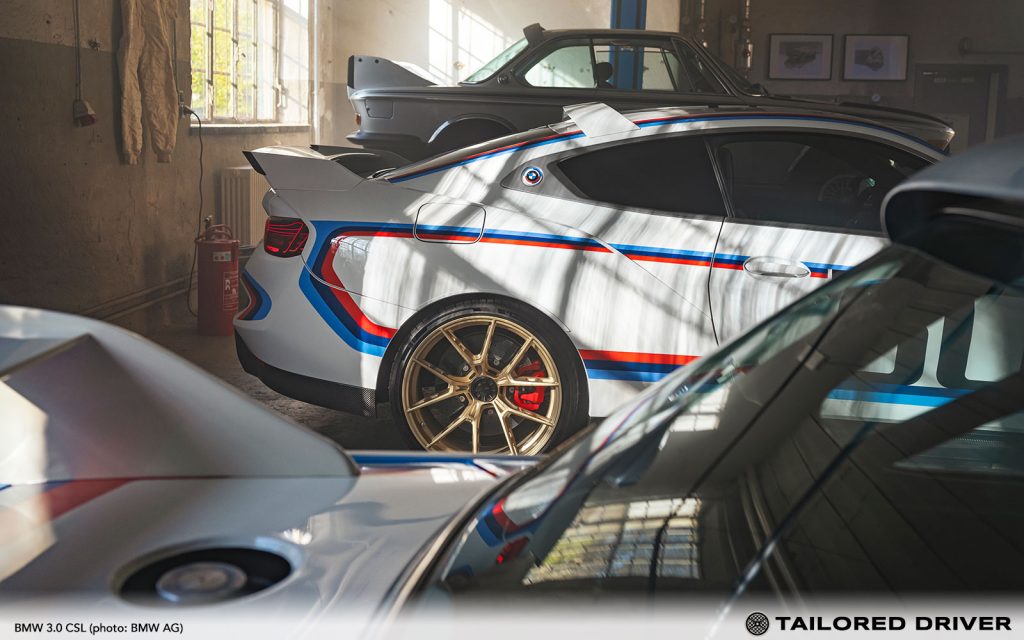
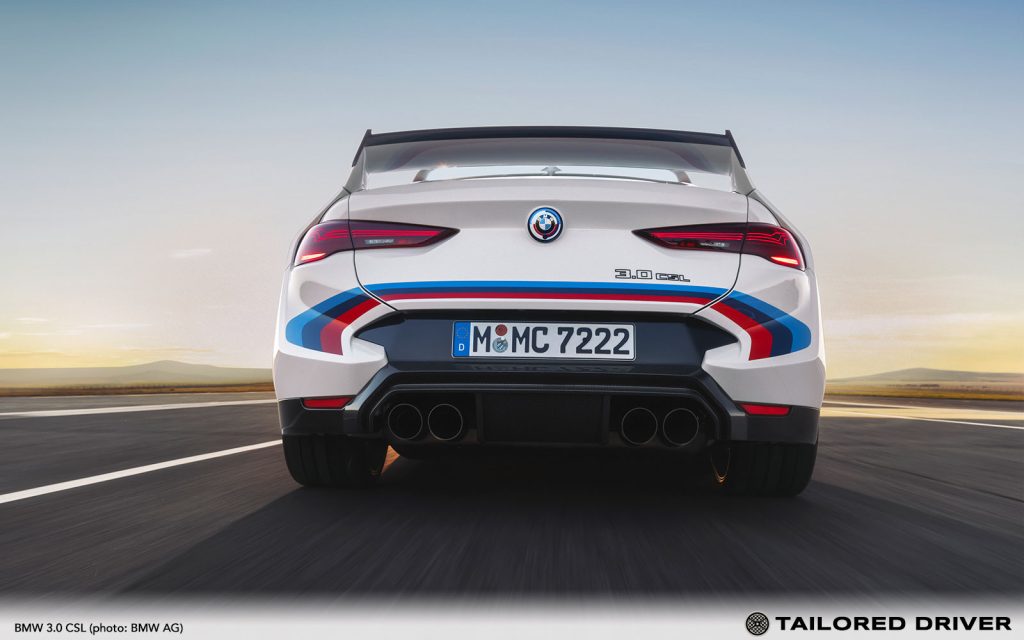
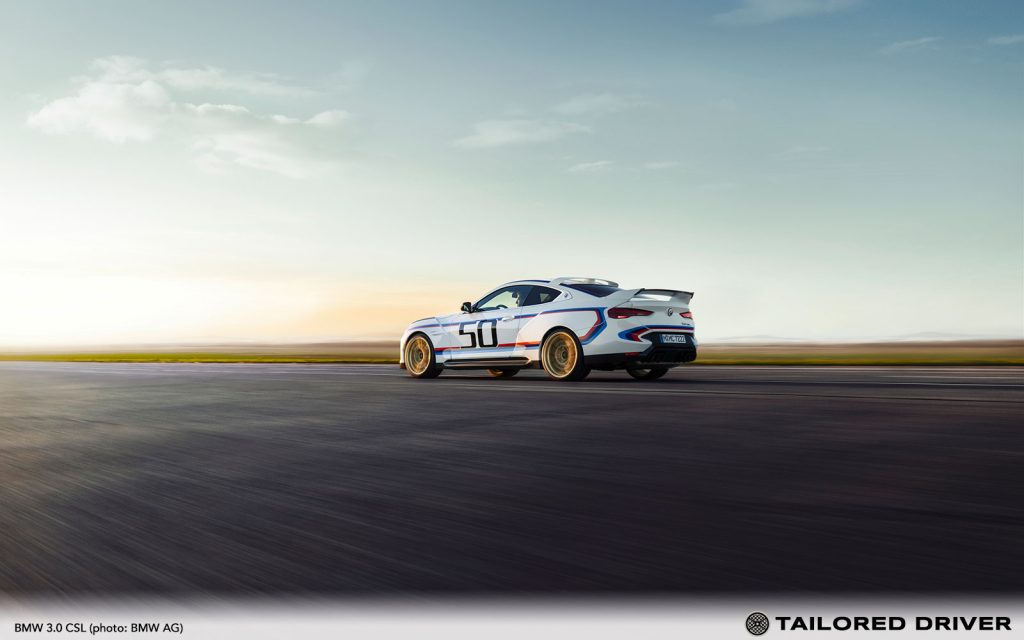
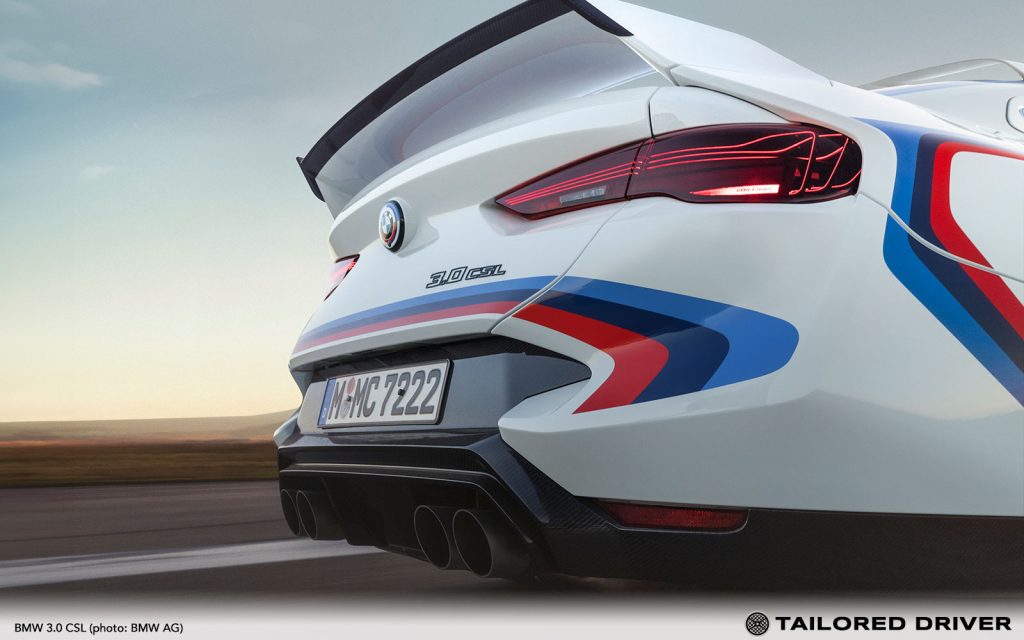
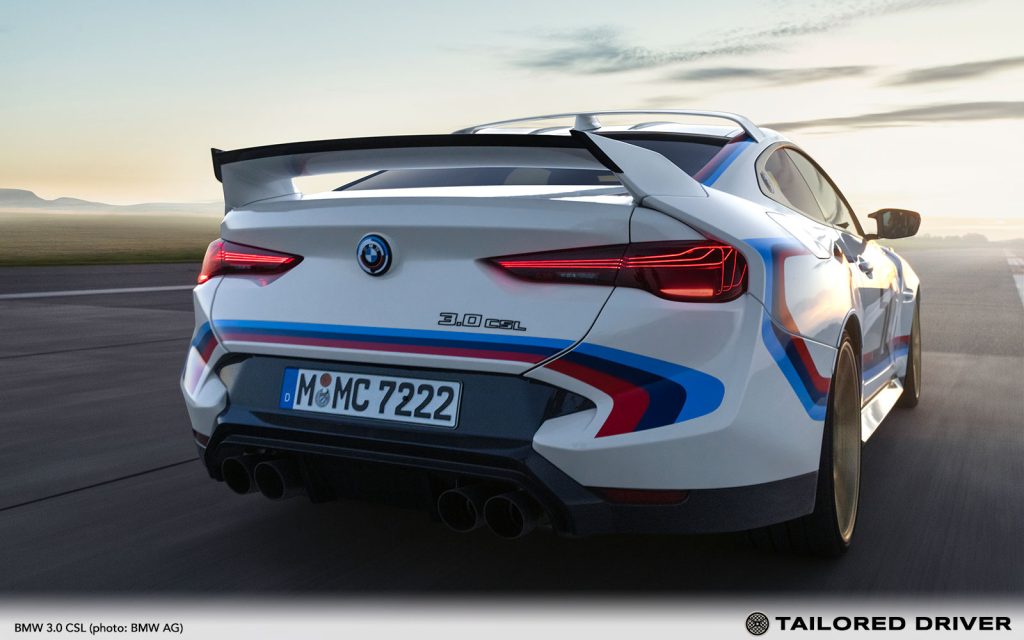
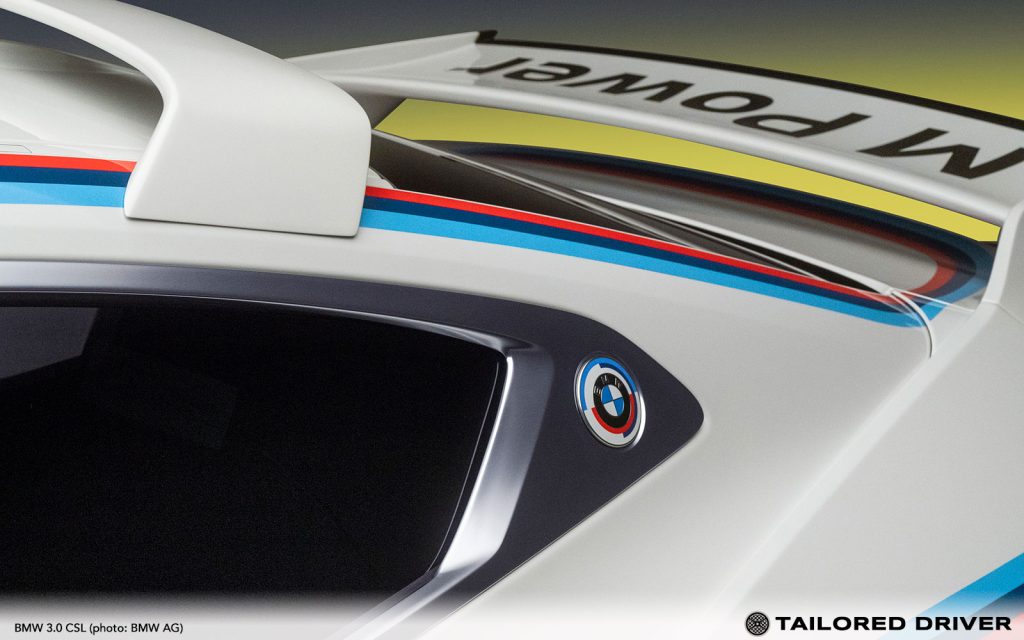
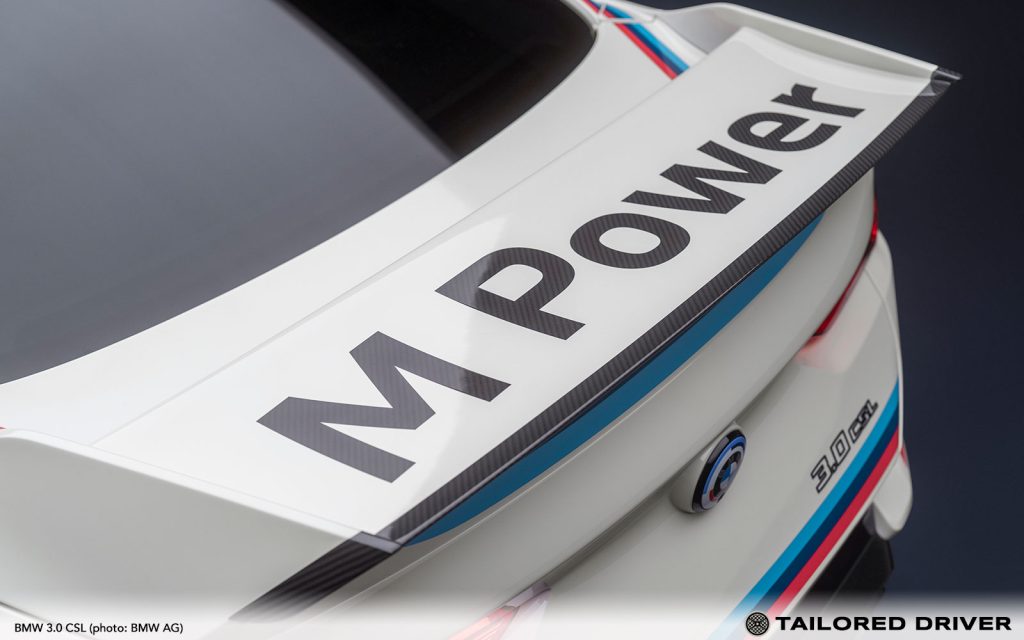
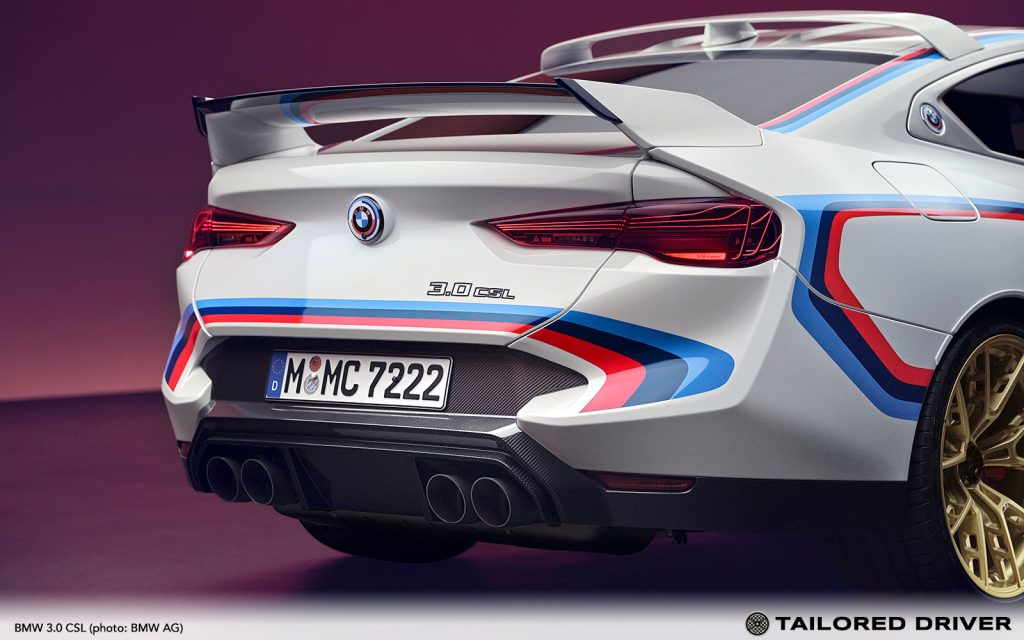
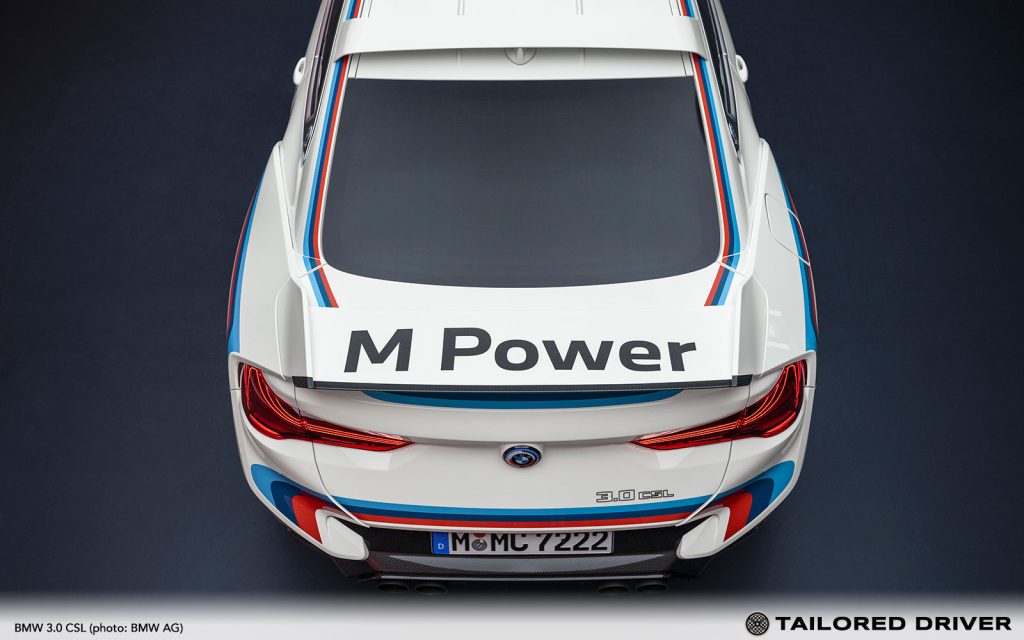
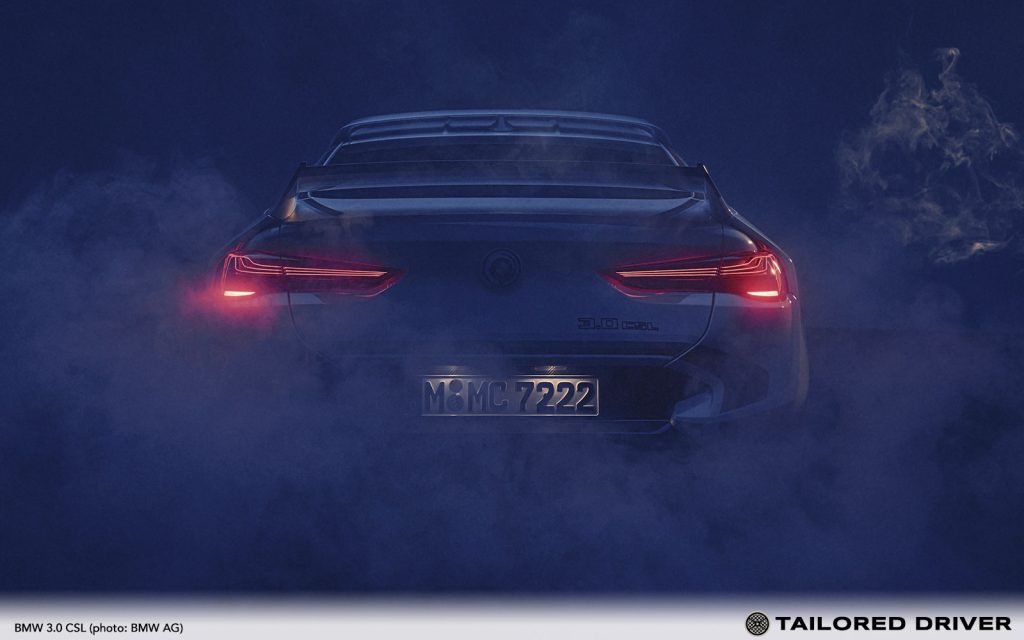
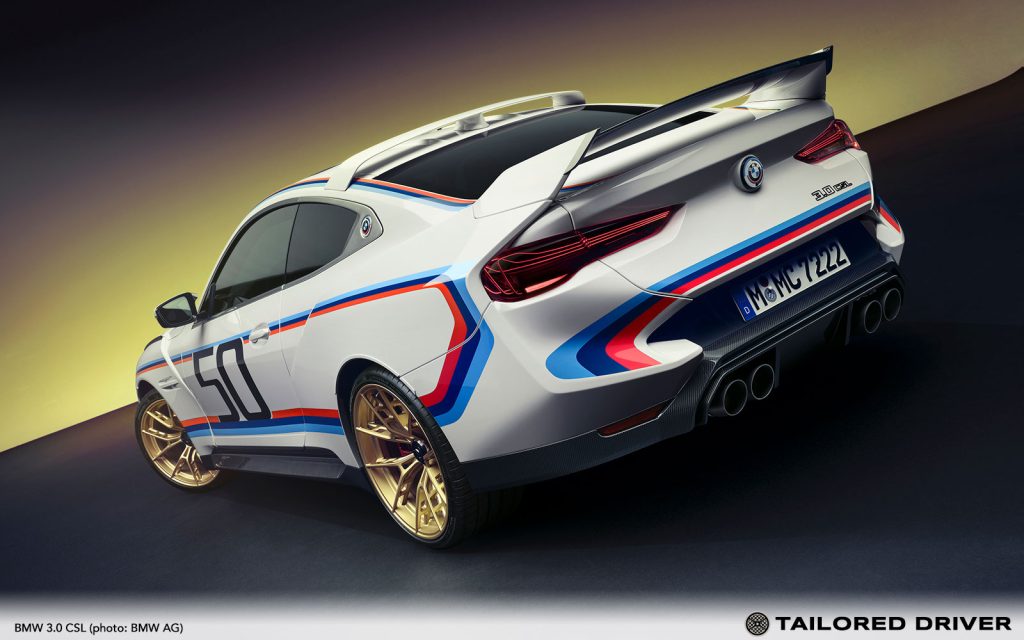
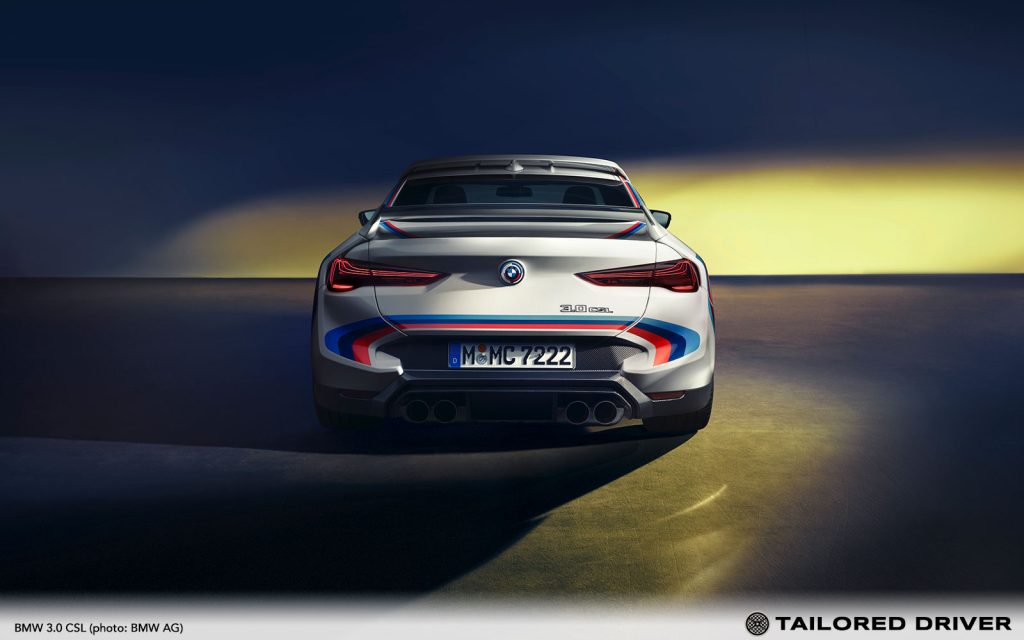
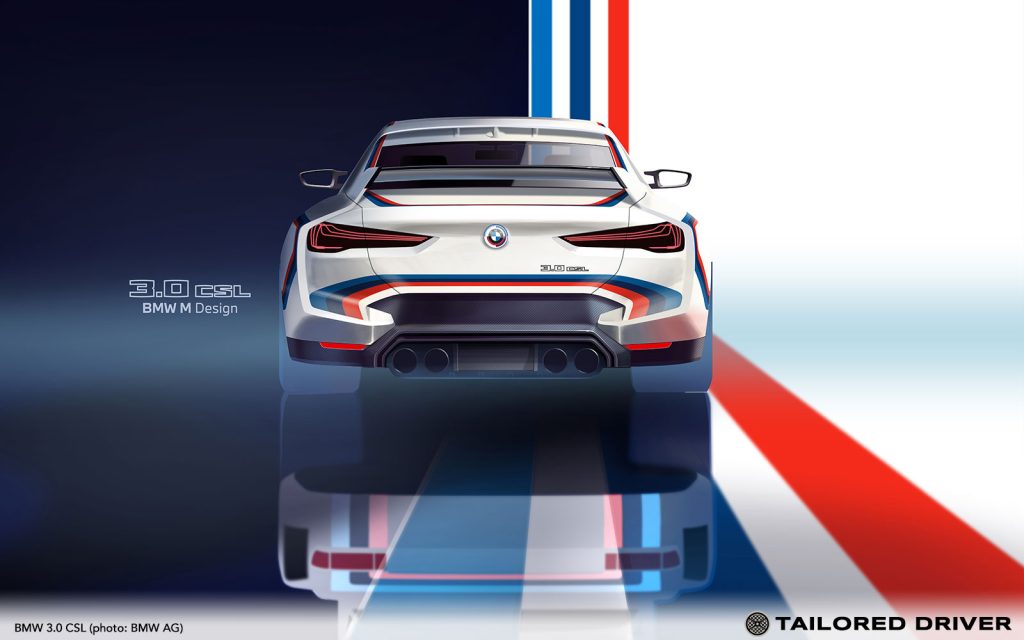
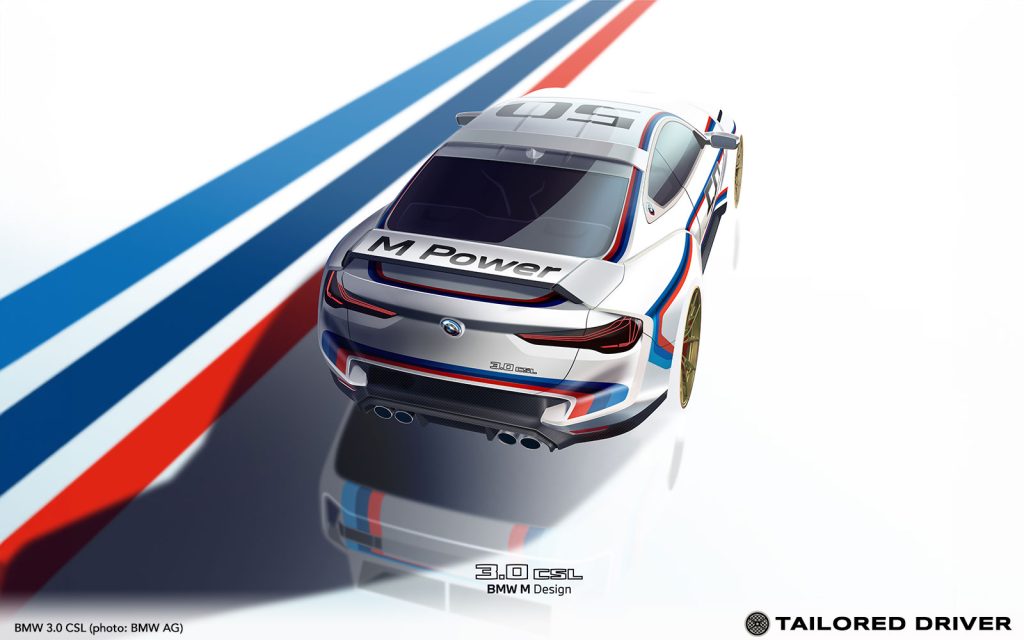
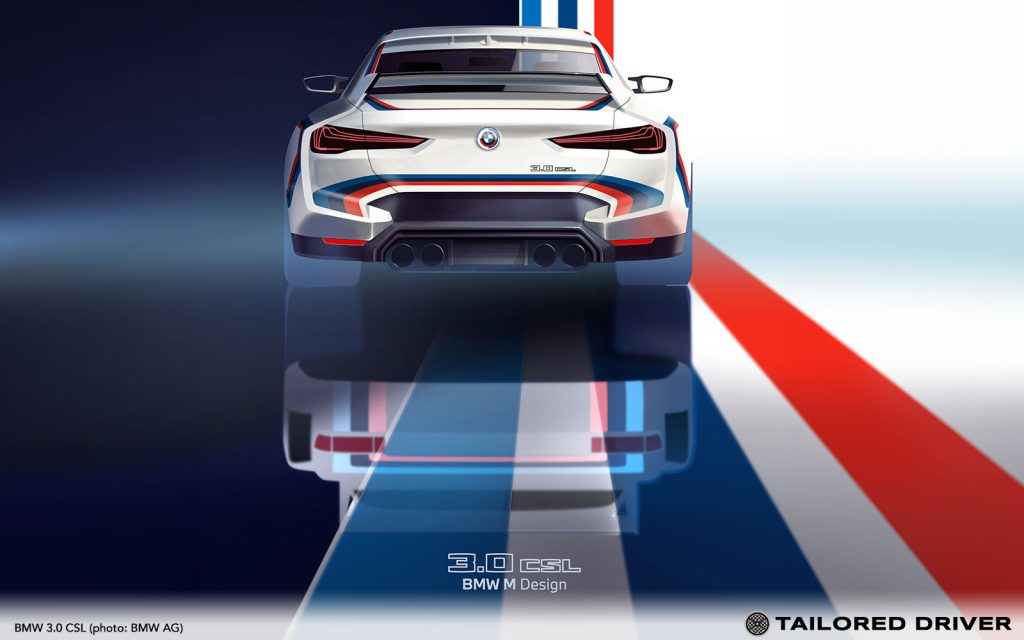
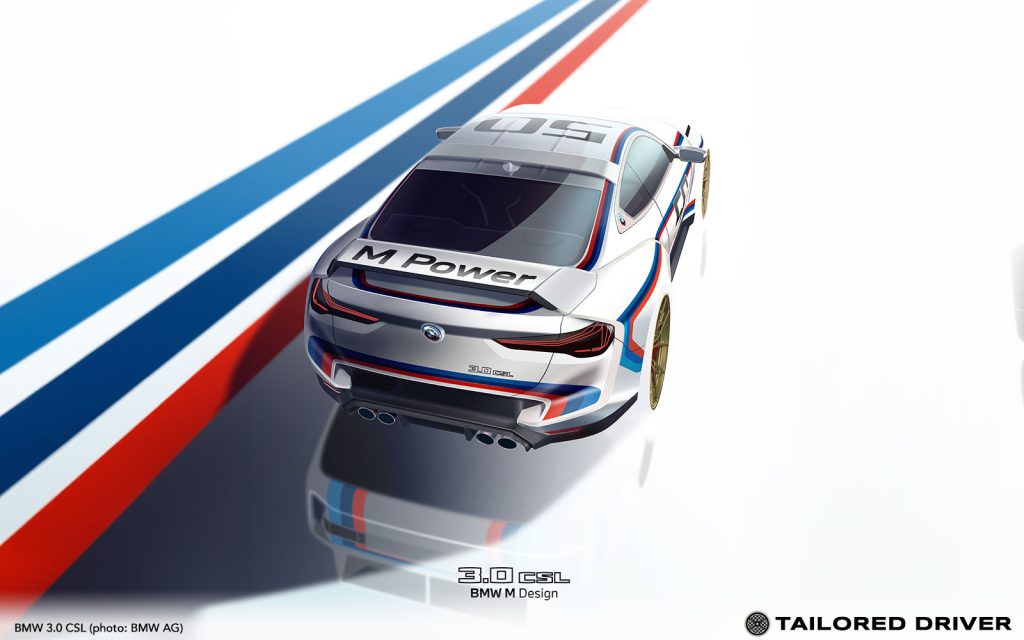
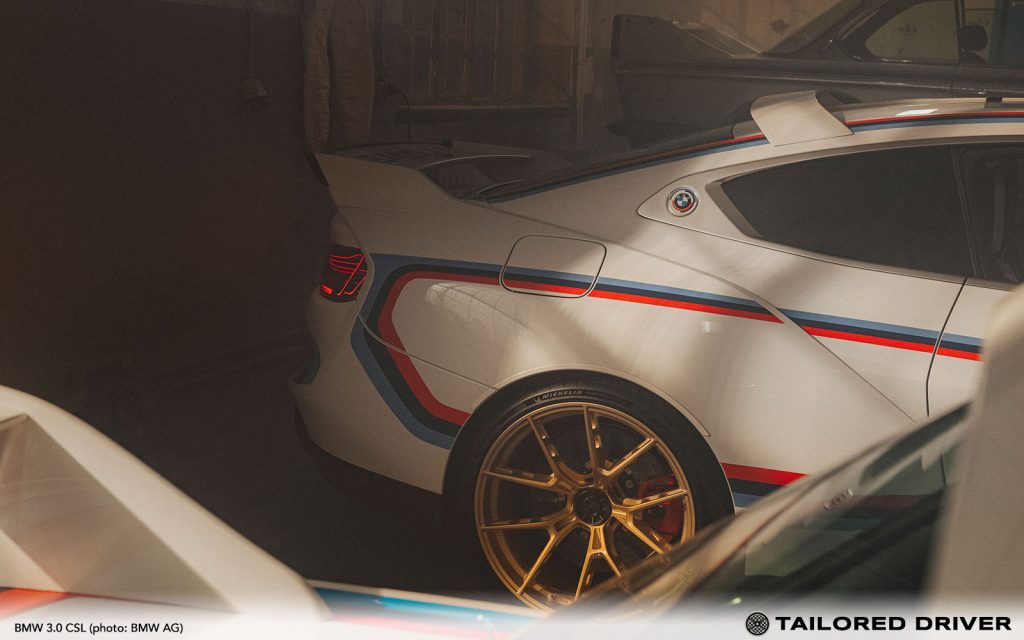
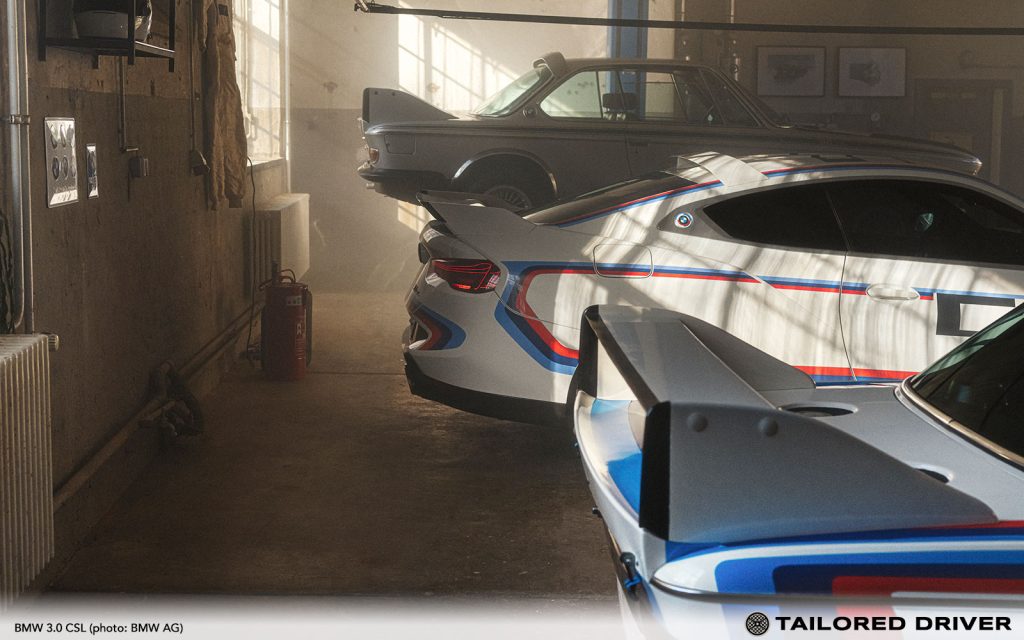
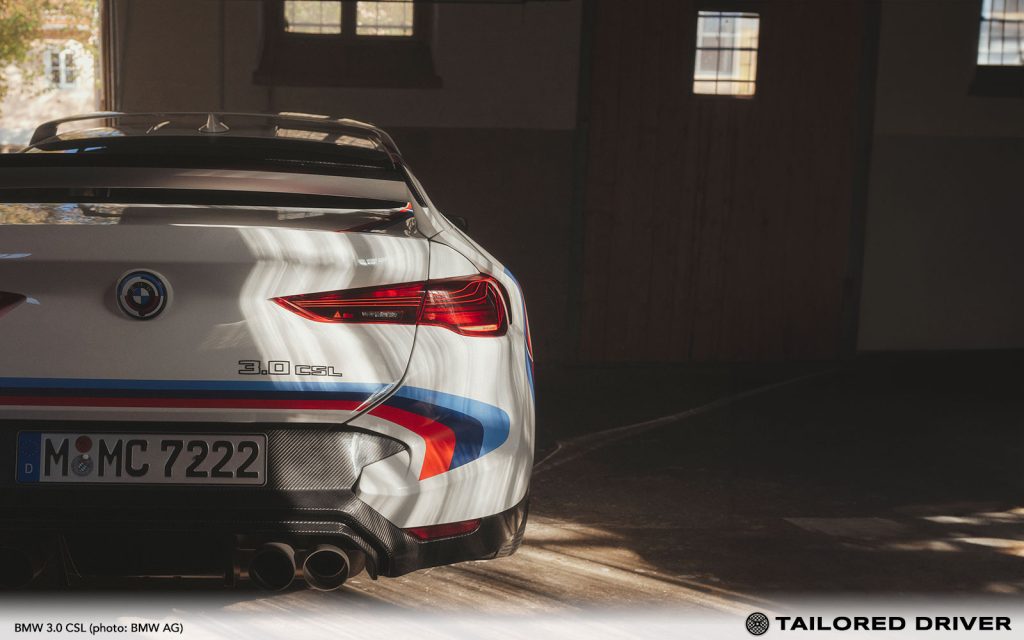
The rear view of the BMW 3.0 CSL is also characterised by powerful aesthetics and reinterpreted design features of its ancestor. The most striking feature is the rear wing, which is enclosed at the side and translates the characteristic appearance of the “Batmobile” into a modern design language. Designed to generate additional downforce and thus optimise traction on the rear axle, the air deflector encloses the entire rear section, thus becoming a dominant visual element. For the benefit of aerodynamic balance, it is combined with a strongly pronounced carbon diffuser in the rear apron, thereby optimising airflow in the underbody.
The four tailpipes of the exhaust system, which are arranged in an arrow shape in the centre of the rear apron and feature a particularly lightweight titanium rear silencer, also provide a striking accent. The rear lights of the BMW 3.0 CSL use innovative lighting technology to generate a fascinating, exclusive night design and a particularly vivid radiance. This is achieved by filigree laser light threads that appear to be free-floating inside the lights and create an expressive 3D effect through precise superimposition.
Elaborate paintwork in the style of classic racing cars.
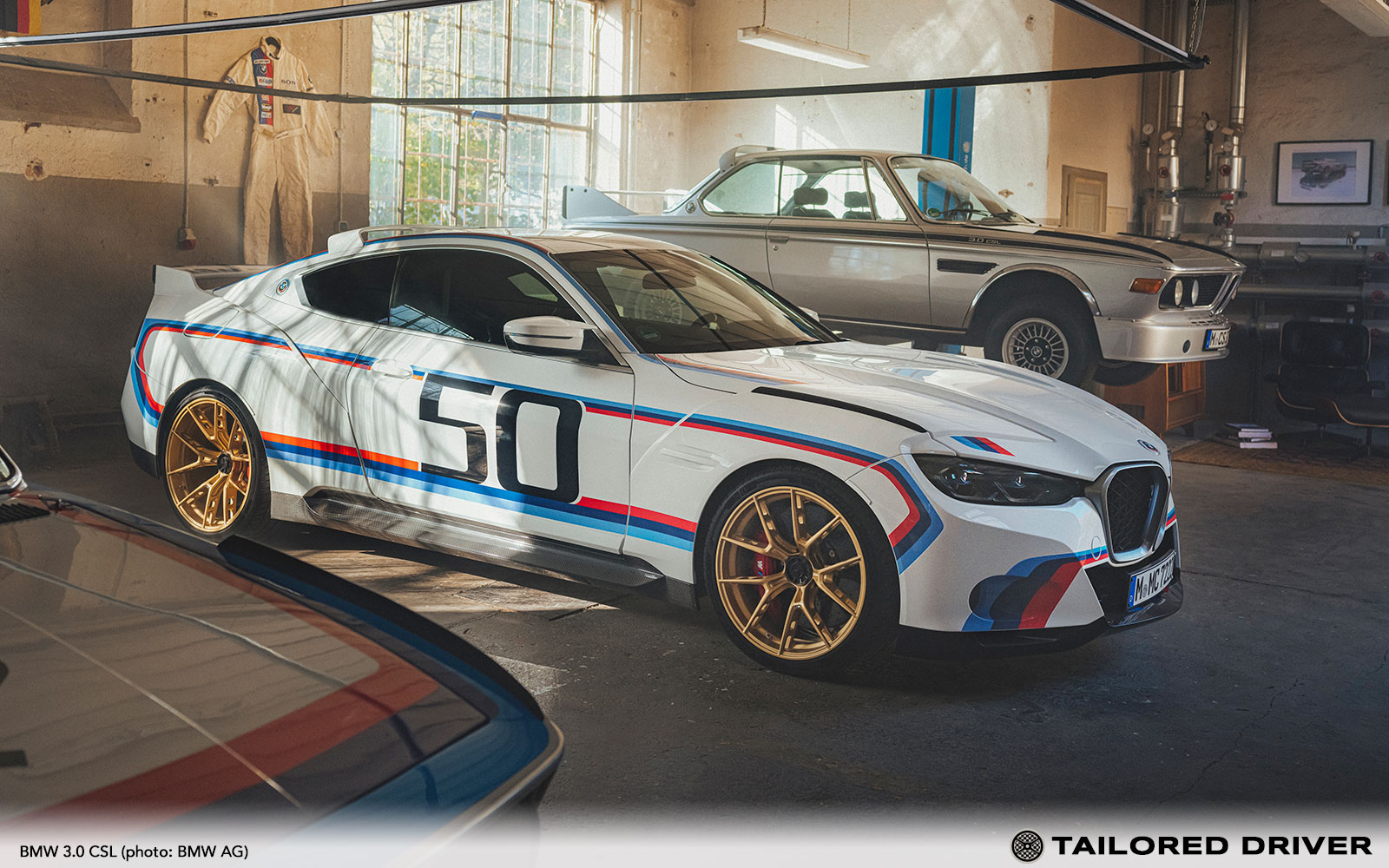
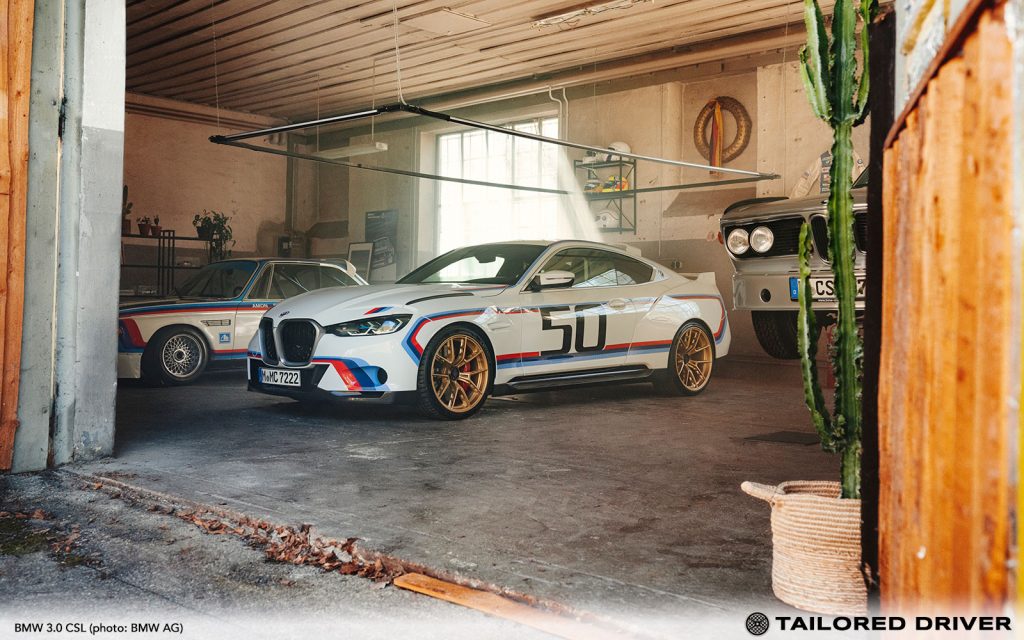
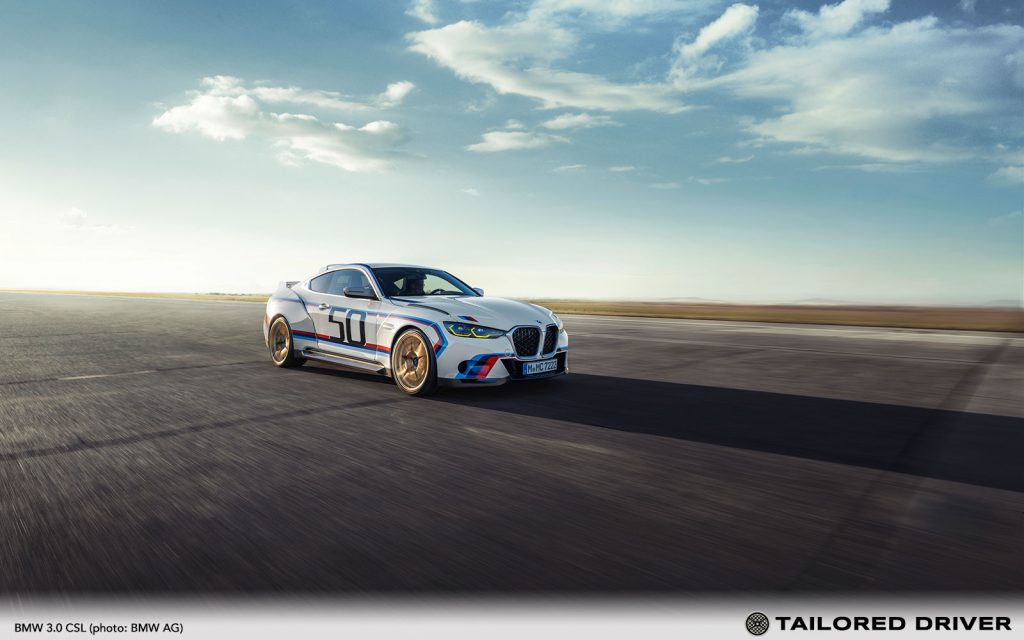
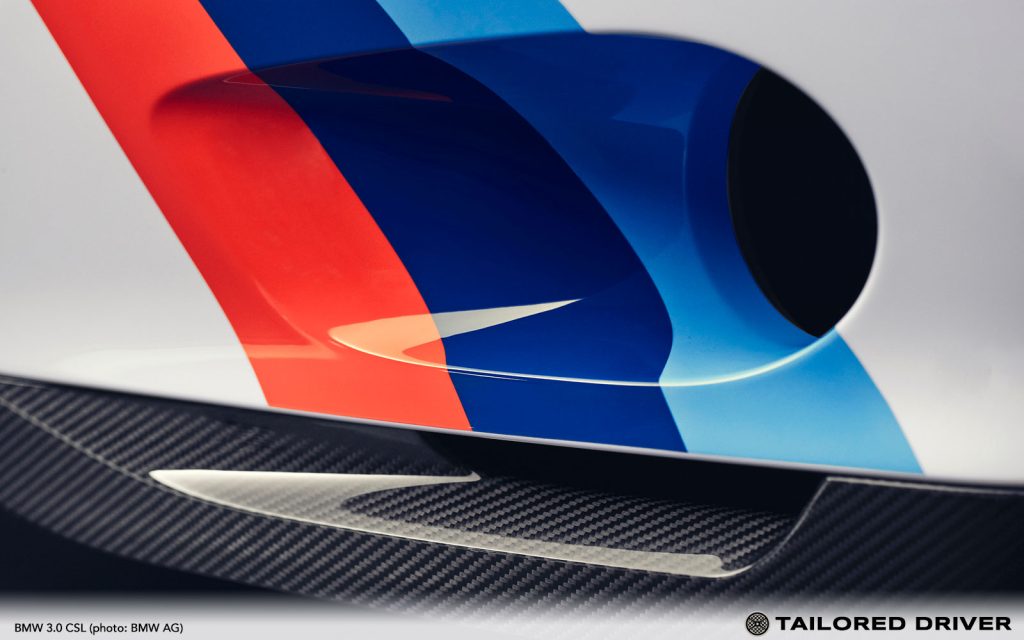
Right from the very beginning the 1970s, BMW Motorsport GmbH became imprinted in fans’ memories not only thanks to spectacular racing successes, but also through an unmistakable appearance. Just like the competition cars, the drivers’ outfits, the vehicle transporters and all other team equipment featured uniform stripes in blue, purple and red on a white background – a novelty at the time and a globally recognised trademark to this day. The BMW 3.0 CSL picks up on this tradition with a paint finish in Alpine white uni and an elaborately applied stripe decor in the BMW M GmbH colours. The lines on the body effectively reflect the dynamic surfaces, thus bringing to the fore the powerful aesthetics of the coupe even more clearly.
Both the base colour and the M stripes, known in technical jargon as livery, are applied largely by hand, involving an extremely high level of time and effort. A total of 22 individual parts are painted in a process specially designed for the BMW 3.0 CSL. Particular attention is paid to a highly precise arrangement of the areas of the body surfaces and livery stripes finished in visible carbon. In general, most of the exterior in Alpine white uni comprises carbon components, which are hand-painted by specialists. The high-tech material is only visible in the lettering on the roof and on the rear wing. For this purpose, these areas must be exposed during the painting process. In order to precisely position the livery stripes in the BMW M GmbH colours, the painters use masking by means of laser projection as well as customised contour films.
Each component with a livery paint finish has a throughput time of six working days. During this time, it completes up to eight paint processes, each with the necessary intermediate work steps such as sanding and masking the colour stripes. This results in a total of 134 paint processes for each vehicle, adding up to a total of 6,700 manual work sequences in the paint shop for the entire small series of the special model.
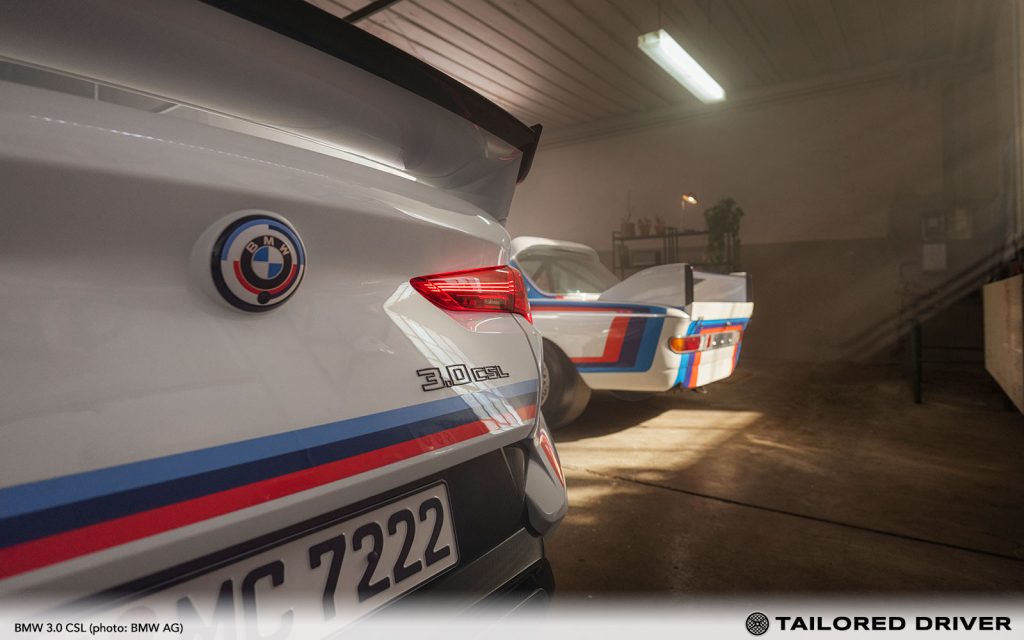
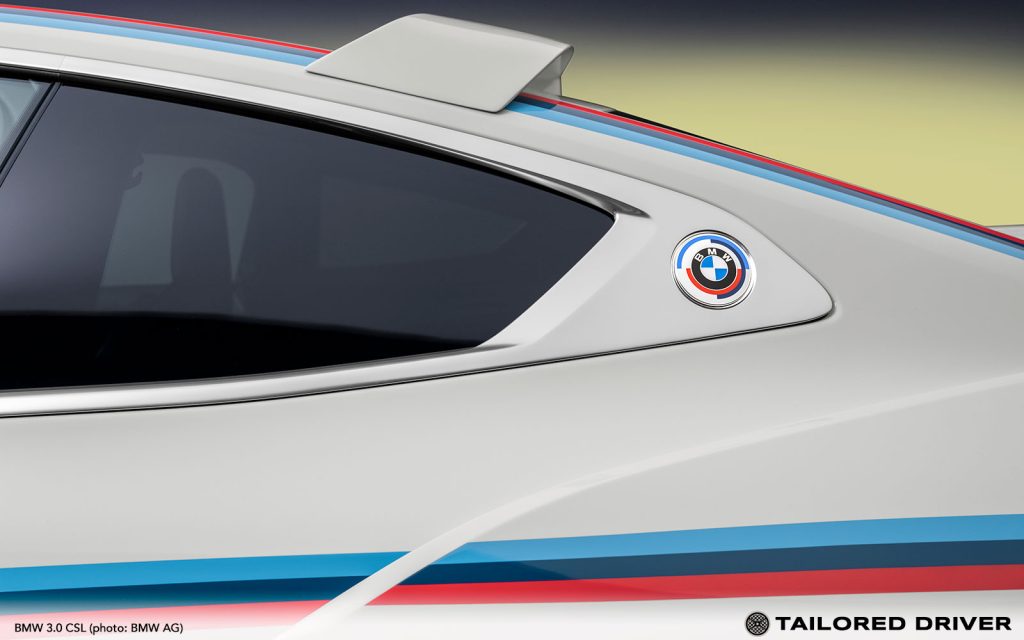
The number sequences on the doors and roof of the BMW 3.0 CSL, designed in the style of early racing cars, build a bridge from the past to the present. Their design in the style of racing numbers is based on the historical model of the first BMW M automobile developed for touring car racing, whilst the number 50 refers to the anniversary of BMW M GmbH. Another reminder of the 1970s are the two BMW logos positioned on the C-pillar, hence directly behind the counter-swing of the side window graphic known as the Hofmeister kink.
The most powerful straight six-cylinder power unit ever used in a road-legal BMW M automobile.
The BMW 3.0 CSL features the most powerful straight six-cylinder engine ever used in a road-legal BMW M automobile. This is also a tradition: in its final stage of development, the predecessor of the same name marked a new record with an engine output of 151 kW/206 hp – not only for six-cylinder models, but for all BMW production vehicles produced up to that point.
Since then, the straight six-cylinder engine with M Power has undergone an impressive development. Engines of the same design mobilised an output of 204 kW/277 hp in the BMW M1 as early as 1978 and 250 kW/340 hp in the second-generation BMW M5 from 1991. The fifth-generation BMW M3 was launched in 2014 with a 317 kW/431 hp straight-six engine featuring M TwinPower Turbo technology.
The straight six-cylinder engine of the BMW 3.0 CSL possesses the same technological roots as the power unit of the current DTM winning car. The 3.0-litre power unit offers spontaneous high revving thanks to the typical M high-revving concept and comprises, among other things, an extremely rigid crankcase in a sleeveless closed-deck design, a forged lightweight crankshaft and a cylinder head core featuring 3D printing technology. The cooling system and oil supply are also designed for extremely dynamic driving situations. For its championship win in the DTM, the BMW M4 GT3 was powered by a version of the latest straight six-cylinder engine with around 600 hp which, in its version designed for large-scale production in the current models of the BMW M3/BMW M4 series, delivers up to 375 kW/510 hp.
The version of the drive system with M TwinPower Turbo technology, which was further developed exclusively for the BMW 3.0 CSL, mobilises a maximum output of 412 kW/560 hp. The new record for straight six-cylinder models from BMW M GmbH with road approval underpins the special status of the vehicle. Its engine develops a maximum torque of 550 Nm and fascinates with a linear power delivery up to a maximum speed of 7,200 min-1.
6-speed manual transmission and rear-wheel drive for particularly intense driving pleasure.
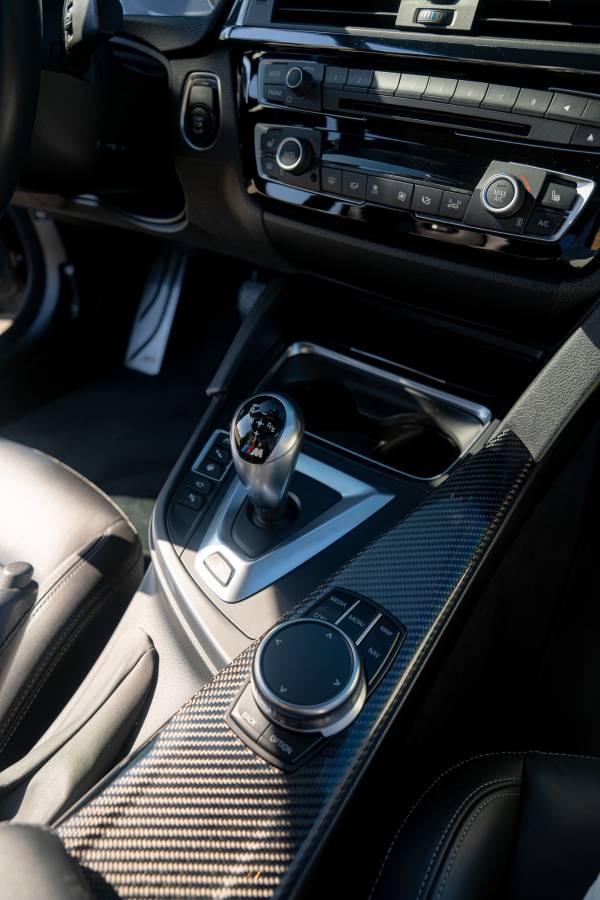
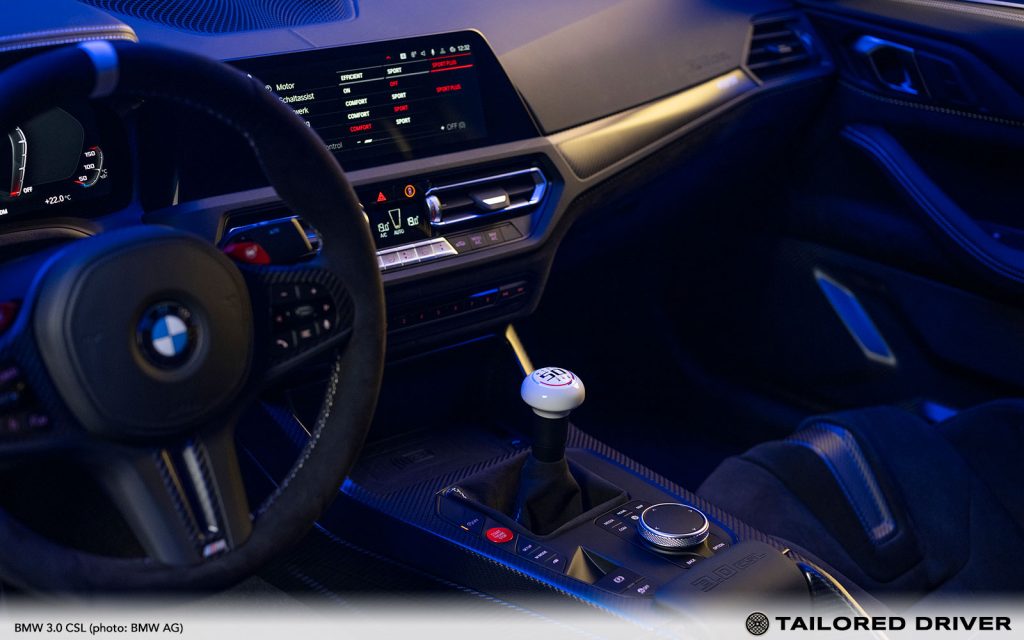
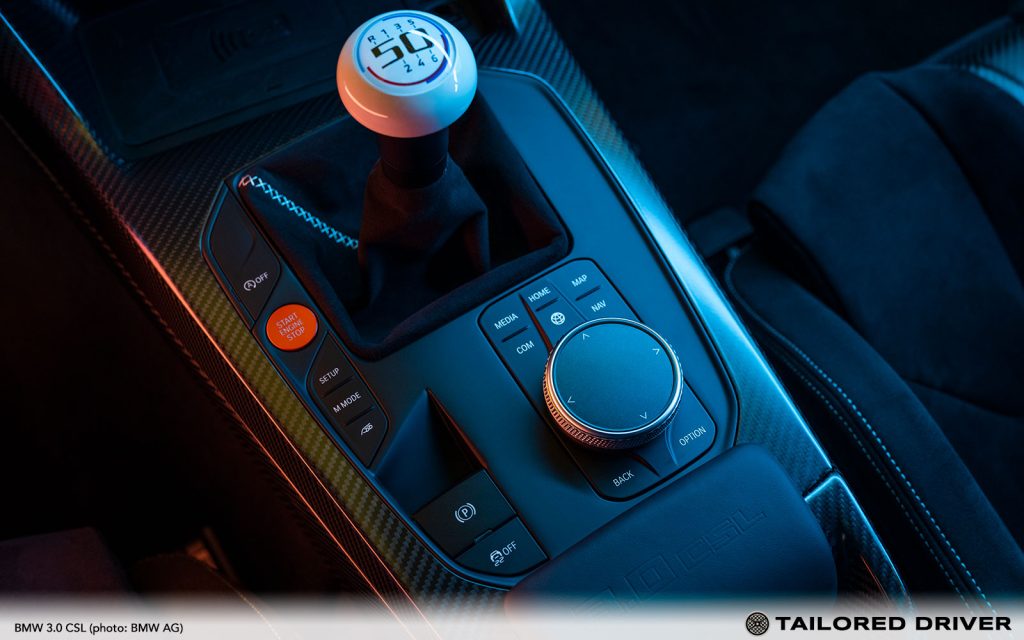
To transfer the drive power to the road, the developers of the BMW 3.0 CSL used a concept that has been tried and tested for decades for maximum driving pleasure and intensive interaction between driver and vehicle. The straight six-cylinder engine is coupled with a 6-speed manual gearbox whose spread and transmission ratios are ideally matched to the performance characteristics. Precisely defined gear shift travel enables fast and precise gear changing. The gearshift knob made exclusively for the BMW 3.0 CSL protrudes from the centre console and is a luxurious accessory. It immediately arouses anticipation for the manual gearshift, lies snugly in the hand and, with its white surface, the engraved gearshift diagram and the number 50, is reminiscent of the beginnings of BMW M GmbH in the 1970s. A tribute to modern technology is the shift assistant, which uses a connection speed control to ensure slip-free clutch engagement after downshifting when braking for corners. It can be activated or deactivated by the driver.
In traditional manner, the drive torque is transmitted to the road exclusively via the rear wheels of the BMW 3.0 CSL. For ambitious use on the race track, the driver can use the typical M linear build-up of lateral acceleration forces to steer the vehicle through bends with controlled drift manoeuvres. The Active M Differential in the rear-axle transmission also ensures superior dynamics. If necessary, it prevents torque compensation between the rear wheels and, at the same time, continuously and variably builds up a locking effect of up to 100 percent. The Active M Differential is linked to the DSC (Dynamic Stability Control) and precisely adjusts its locking effect to the respective driving situation. For example, traction is optimised on roads with different friction values for the right and left rear wheels. When accelerating dynamically out of bends, the driver receives noticeable feedback on the grip potential on the rear wheels and can thus optimally dose the use of the accelerator pedal.
Suspension technology tuned exclusively to each model, including M carbon-ceramic brake system and M Traction Control.
In the configuration of the suspension technology as well, state-of-the-art technology has been combined with a methodology for the harmonisation of all components that has matured over five decades. The suspension components used in the BMW 3.0 CSL represent the spearhead of development for high-performance sports cars by BMW M GmbH: a double-joint spring strut front axle and a five-link rear axle in M-specific design, an Adaptive M suspension with electronically controlled shock absorbers, the electromechanical M Servotronic steering with variable ratio and the M carbon ceramic brake system with adjustable characteristic curves.
The integrated application of all drive and chassis systems took place during intensive test drives on public roads as well as on race tracks, including the Nürburgring Nordschleife, which has been the ultimate testing ground for all BMW M automobiles for 50 years. Prior to testing, engineers at BMW M GmbH had designed and optimised the digital image of the BMW 3.0 CSL in every detail in a computer-aided design and development process. By incorporating virtual reality and other digital processes, it was possible to accelerate the series development process to the maximum extent. This detailed simulation and tuning process took into account the model-specific dimensions, vehicle weight and axle load distribution, the extremely high rigidity of the body and suspension connections as well as the aerodynamic balance of the BMW 3.0 CSL to ensure from the onset that typical M combination of agility, dynamics and handling precision.
Powerful deceleration performance, optimised fading stability, outstanding thermal stability and extremely high wear resistance are offered by the M carbon ceramic brake system. It combines six-piston fixed-calliper brakes and ceramic brake discs measuring 400×38 millimetres on the front axle with single-piston fixed-calliper brakes and 380×28-millimetre ceramic brake discs at the rear and features red-painted brake callipers. The M-specific design of the integrated braking system allows two characteristic pedal-feel curves to be displayed, which can be selected in the M Setup menu.
With the M Traction Control function, the driver can individually set the intervention thresholds of the wheel slip limitation. Ten levels are available for this purpose, and complete deactivation of the driving stability control is also possible via the M Dynamic Mode. The BMW 3.0 CSL is thus perfectly prepared for experiencing puristic performance on the race track.
Intelligent lightweight construction with maximum use of carbon components.
In the BMW 3.0 CSL, the tradition of intelligent lightweight construction, which has been cultivated since the 1970s, is reformulated and reshaped using state-of-the-art technology. To reduce weight in the body and chassis areas, carbon fibre reinforced plastic (CFRP) is used to an exceptionally high extent in addition to the minimal use of insulating material. BMW M GmbH is a pioneer in the use of CFRP in series-produced vehicles. As early as 2004, it equipped a large-series model with a carbon roof for the first time.
The BMW 3.0 CSL features CFRP components on virtually all bodywork sections. In addition to the roof, bonnet and boot lid, the front and rear aprons are made entirely of carbon. The front and rear side panel attachments, the side sills, the rear diffuser, the rear wing and rear spoiler are also made of the high-tech material. All carbon components are manufactured in small series, mostly by hand and exclusively for the BMW 3.0 CSL.
In addition, a targeted selection of materials and state-of-the-art design methods also lead to a significant reduction in the weight of other vehicle components. The roof spoiler of the BMW 3.0 CSL is made of glass fibre reinforced plastic. The titanium rear silencer of the BMW 3.0 CSL is around 4.3 kilograms lighter than a conventional steel component. The cast aluminium precision struts in the engine compartment, which connect the suspension strut domes to each other and to the front end, have a geometry that has been precisely matched to the forces acting in different driving situations. With the aid of numerical models agility and steering precision has been optimized with a minimum of material and weight.
Puristic sports car cockpit with M carbon full bucket seats.
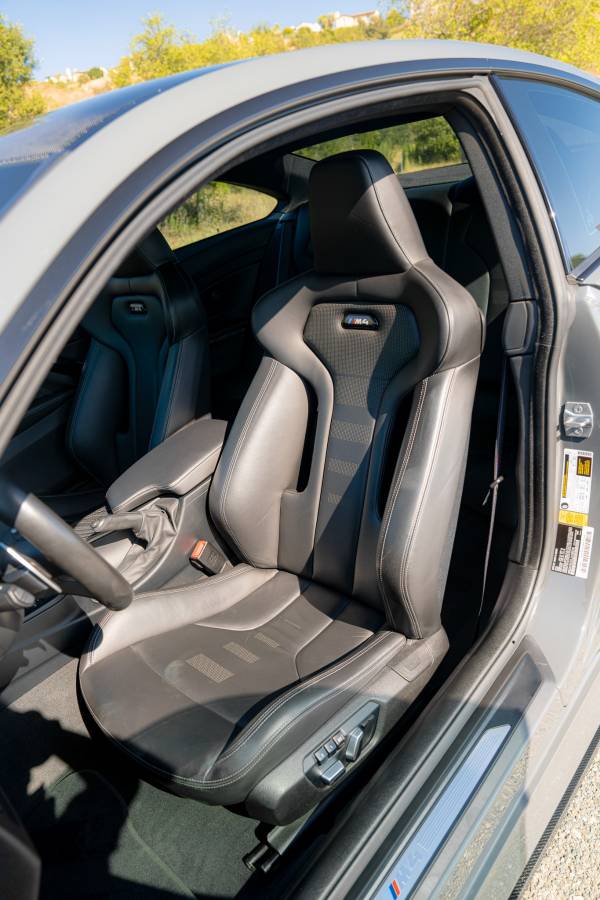
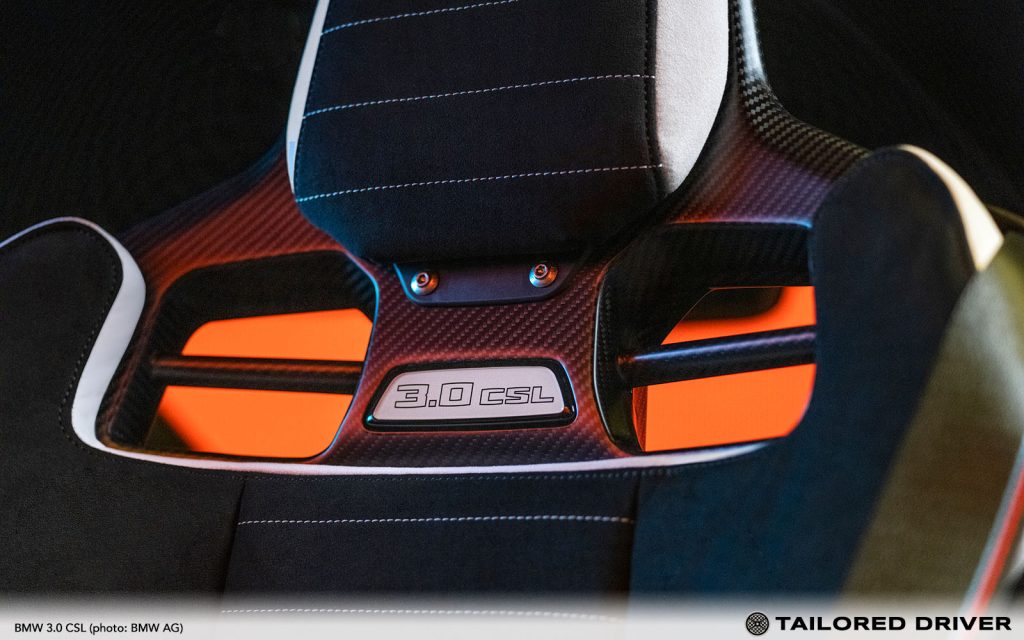
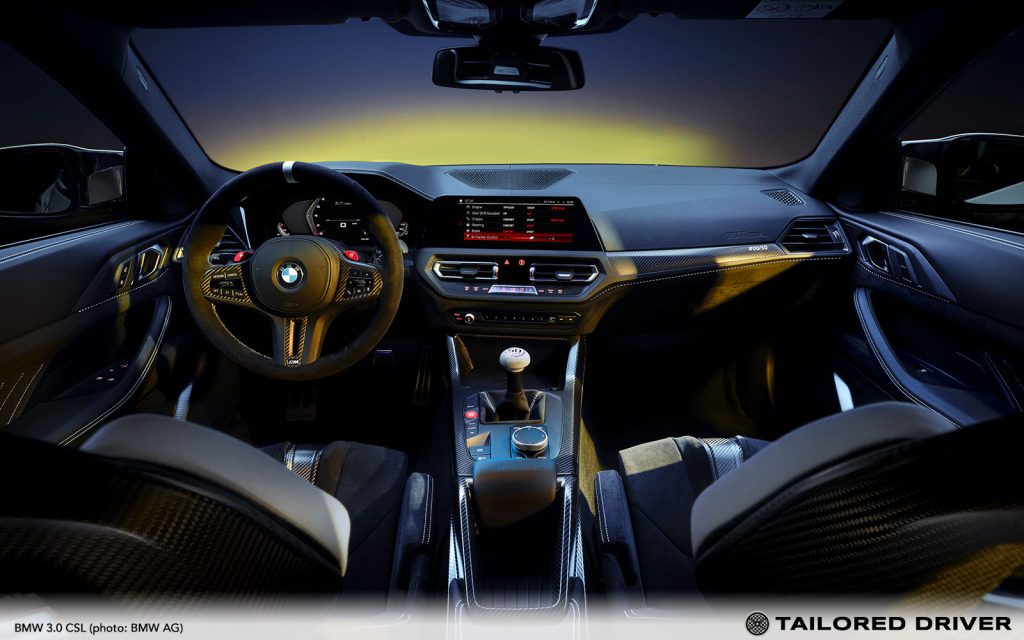
Also, in the interior of the BMW 3.0 CSL the use of carbon and other lightweight construction measures emphasise the puristic sports car characteristics. Instead of additional seats, the rear offers a storage compartment with two integrated helmet compartments. CFRP trim in the door panels and reduced acoustic insulation also contribute to the extremely sporty flair. The driver and front passenger sit in M Carbon full bucket seats, which convey a highly emotional and inimitable racing feeling every kilometre of the way. The diagonal connections between the seat surface and the backrest are reminiscent of the construction principle of the lightweight seats featured in the historic model. Seat height and inclination can be adjusted exclusively via a three-stage screw linkage in a workshop. The longitudinal position can be varied manually using a lever at the front edge of the seat. In addition, the M Carbon full bucket seats offer removable headrest inserts.
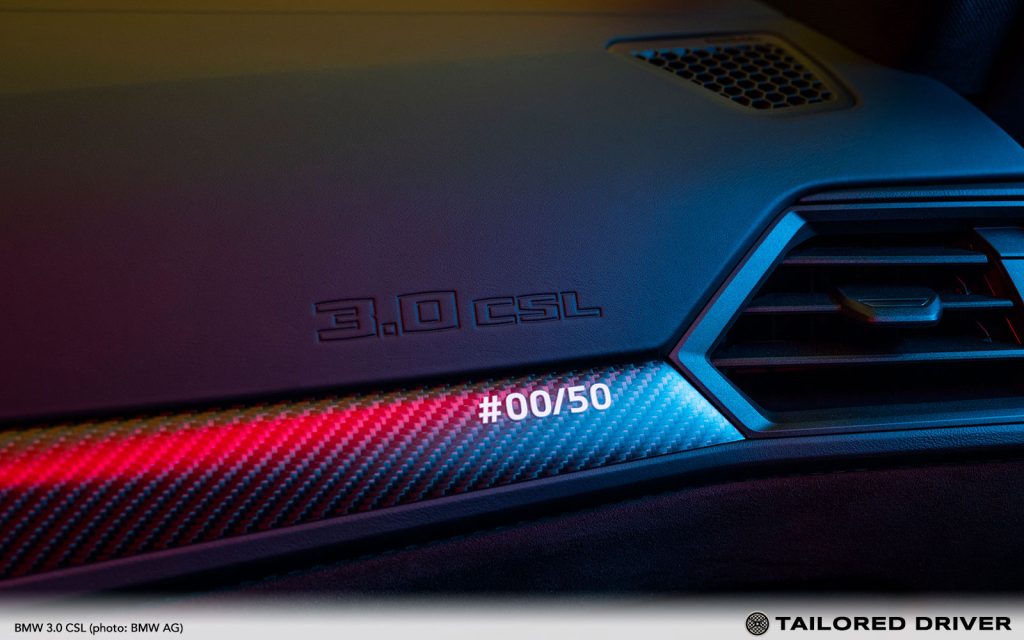
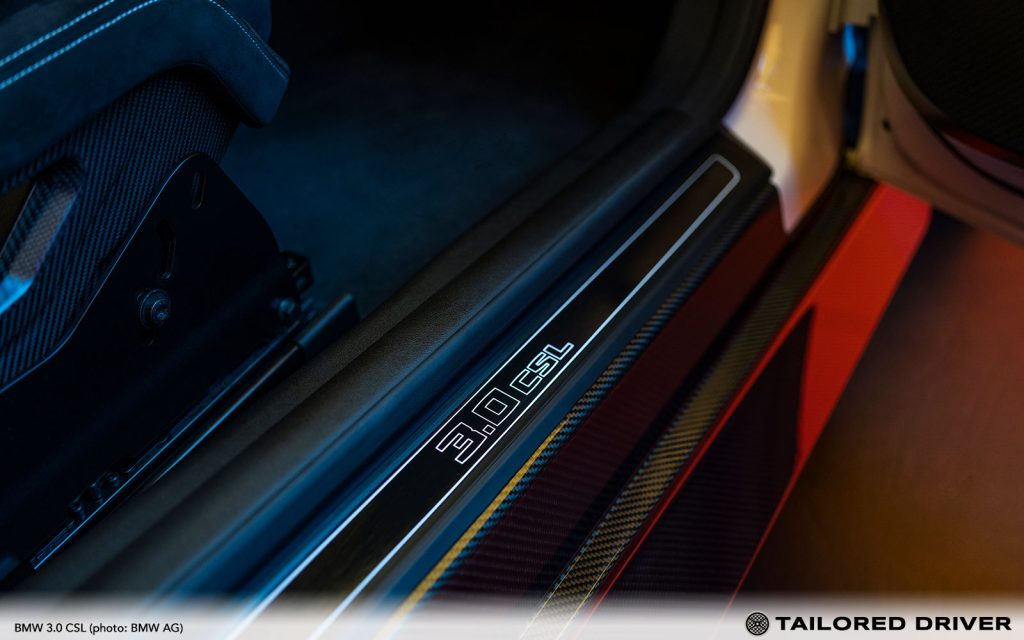
Over and above that, the interior of the BMW 3.0 CSL presents itself as a sports car cockpit that is puristic and exclusive. Black Alcantara seat surfaces and M seat belts are combined with an M Alcantara steering wheel, an anthracite roof liner, black Alcantara and matt carbon surfaces. Contrast stitching and other accents in white correspond with the exterior paintwork of the BMW 3.0 CSL, the model lettering of which is embossed into both the door sill trims and the seat surfaces. The white gearshift knob symbolises the classic form of interaction between driver and vehicle when changing gear. The red start/stop button and the likewise red M buttons on the steering wheel are available for activating the engine and for direct access to the vehicle’s overall setup. The matt interior trims in a carbon fibre finish feature sequential numbering for each of the 50 units available. This marking, documented in the interior from #01/50 to #50/50, corresponds in each case to the final digits of the suspension number, thus representing a clearly visible and authentic reference to the individual vehicle identity.
BMW M GmbH continues the series of attractive edition models with 750 limited-edition BMW M4 Coupes – body colours in special exclusive M colours and a unique interior design to match – world premiere during the DTM racing event on the Nürburgring.
[source: BMW AG]
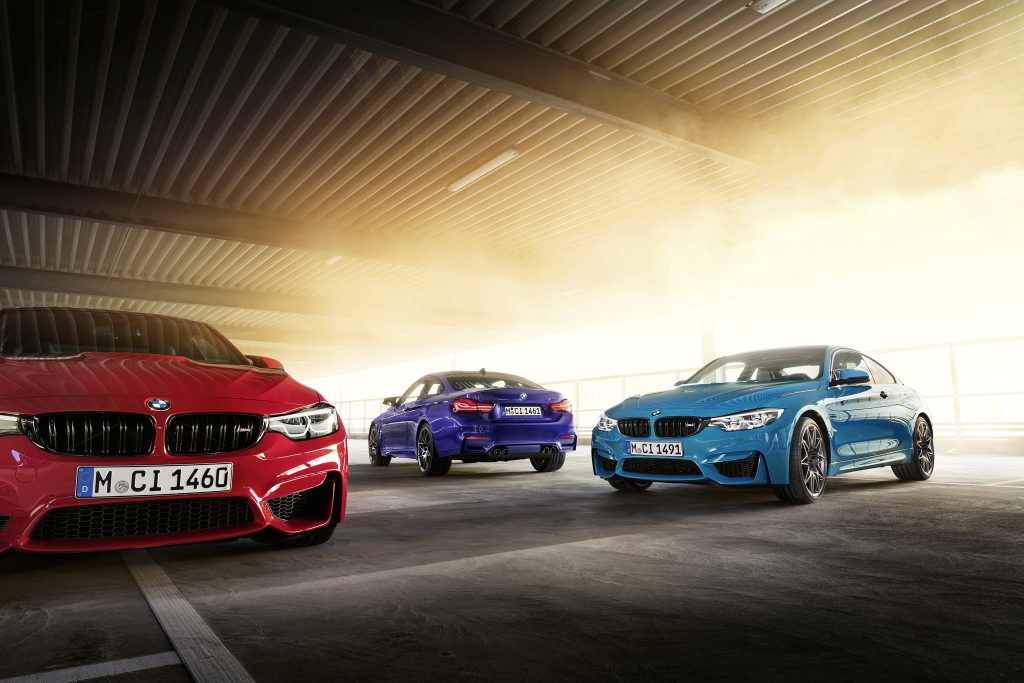
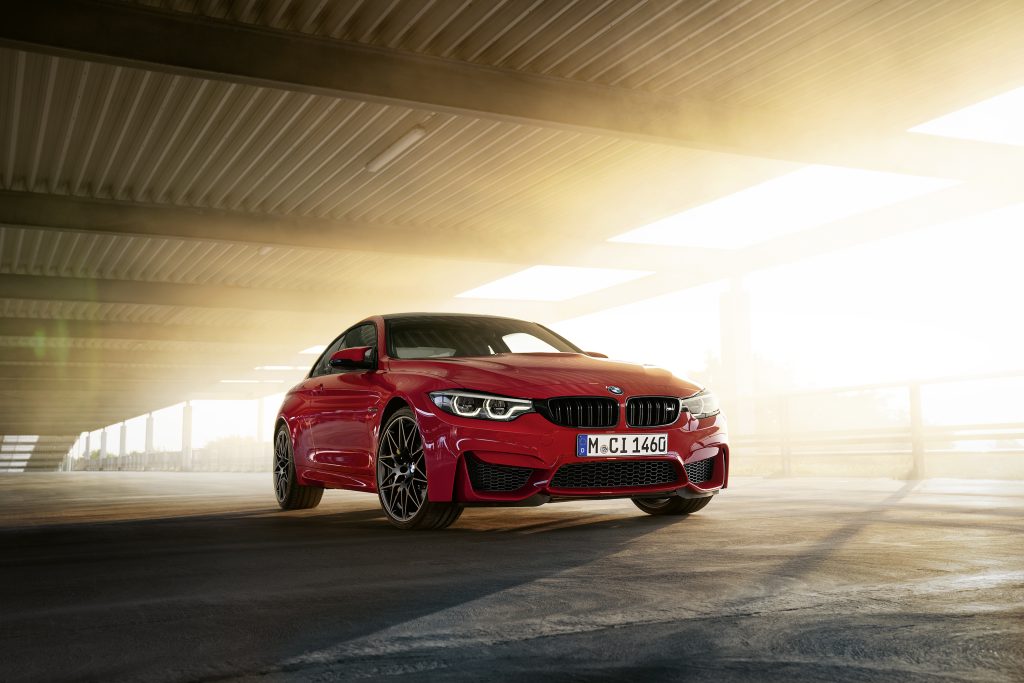
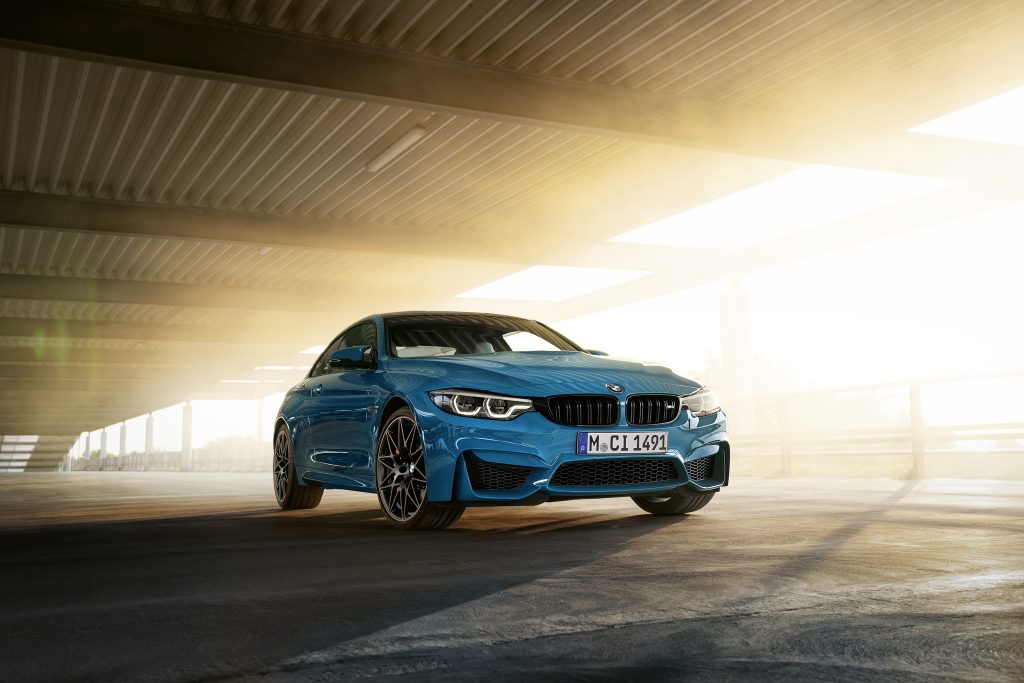
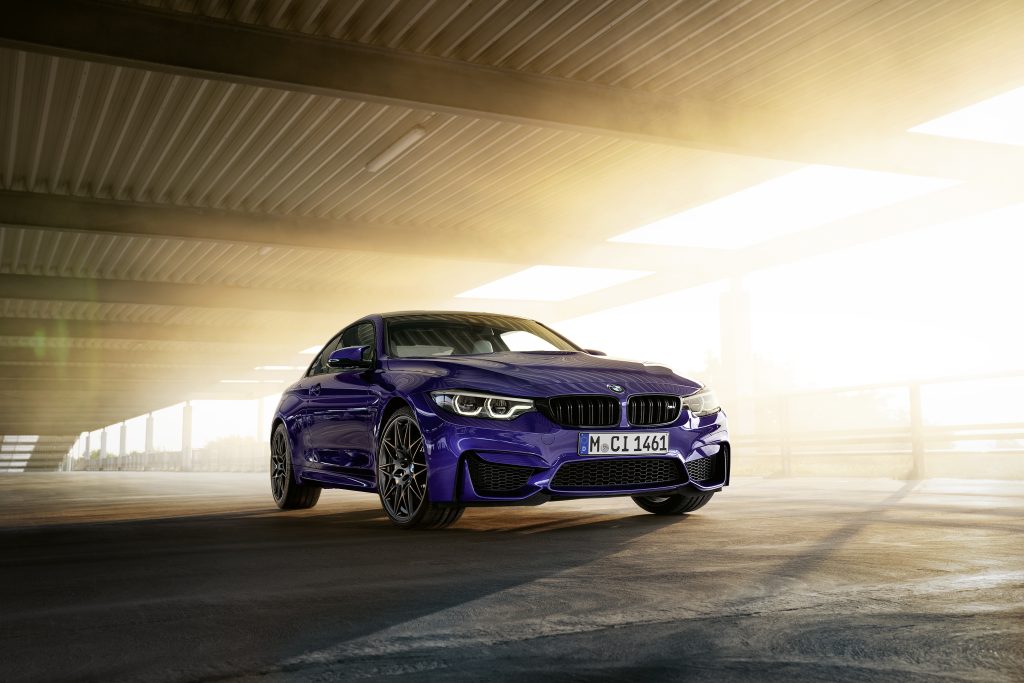
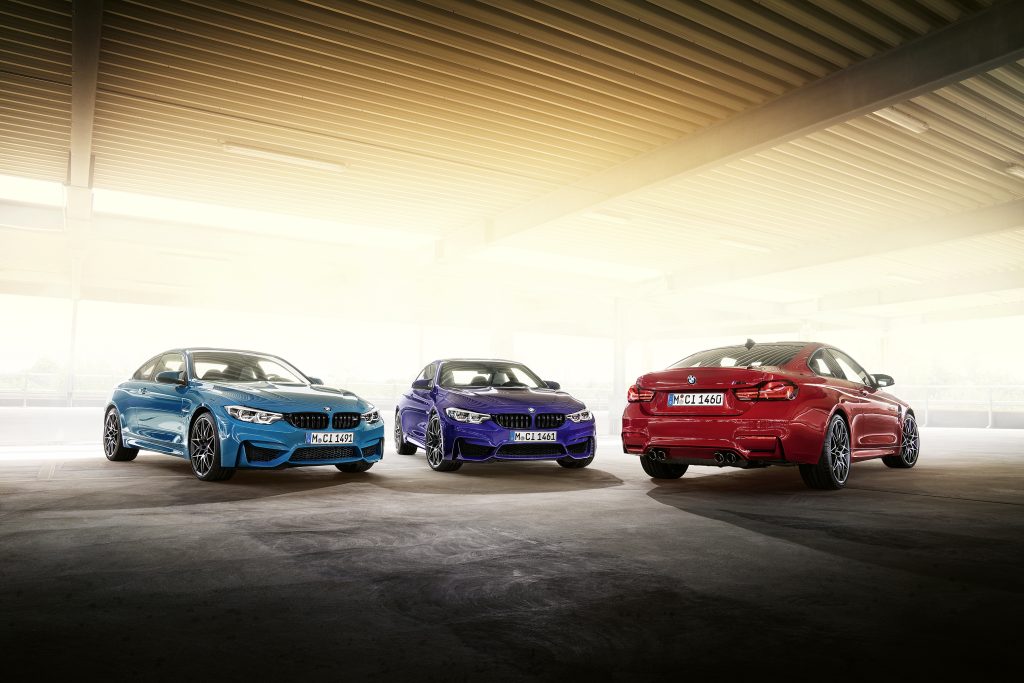
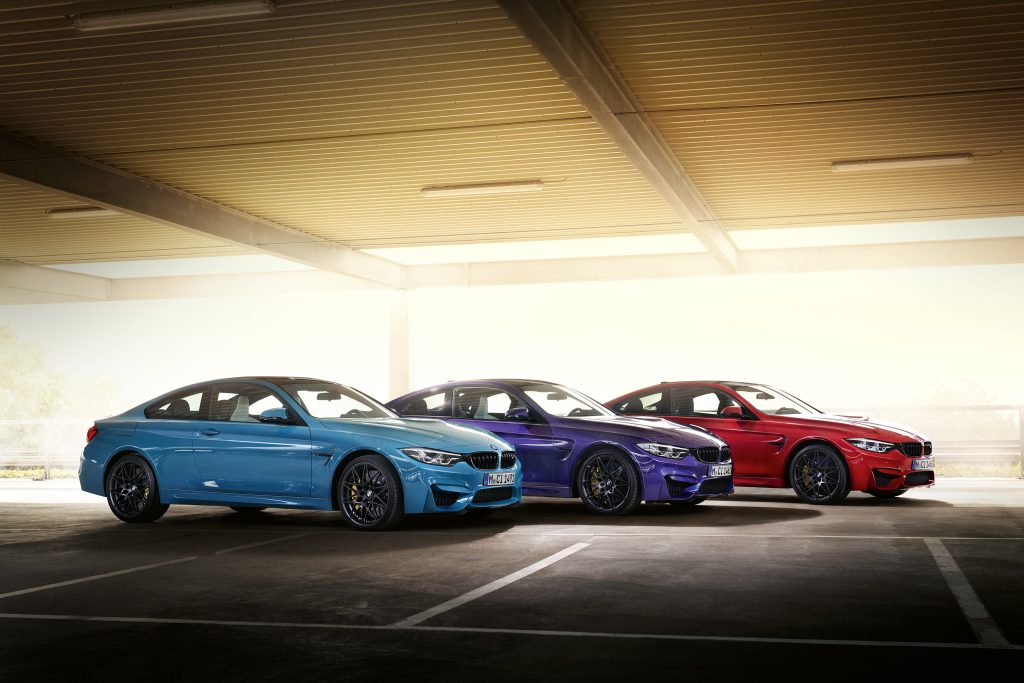
Munich. With the forthcoming races on the Nürburgring the current German Touring Car Masters (DTM) season will finally reach its decisive phase. Moreover, during the DTM weekend being held from 13 to 15 September 2019, visitors can expect a further attraction. The BMW M4 Edition ///M Heritage (combined fuel consumption: 10.0 – 9.3 l/100 km; combined CO2 emissions: 227 – 213 g/km) will make its world debut on the legendary racetrack in the Eifel. The special edition of the BMW M4 Coupe, which forms the basis of the BMW M4 DTM deployed by BMW M Motorsport, fascinates with an exclusive exterior and interior look reflecting the impressive tradition of the high-performance racing cars. The BMW M4 Edition ///M Heritage, powered by a 331 kW/450 hp straight six-cylinder engine with M TwinPower Turbo technology will be produced and sold worldwide between November 2019 and April 2020 as an edition model limited to 750 units.
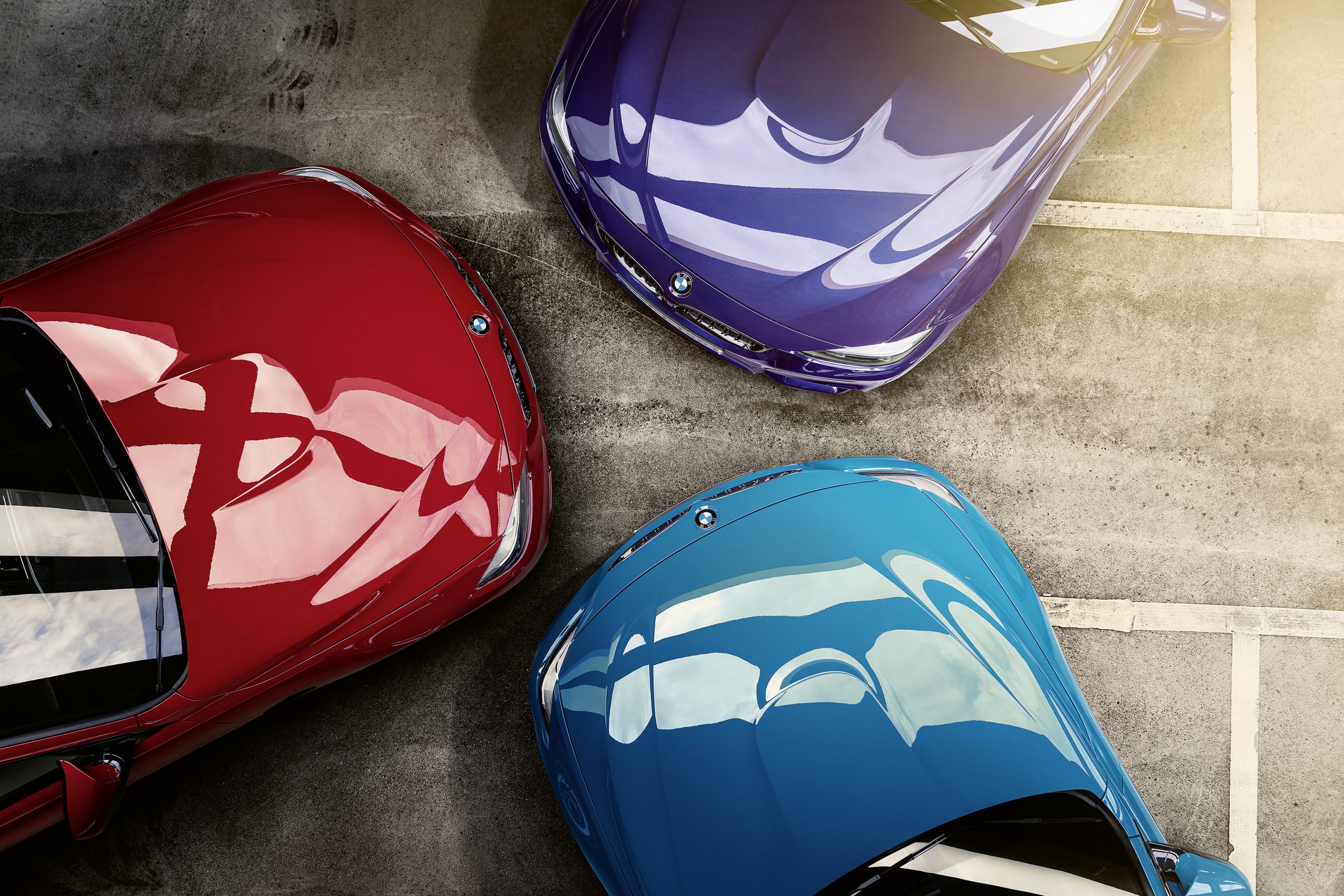
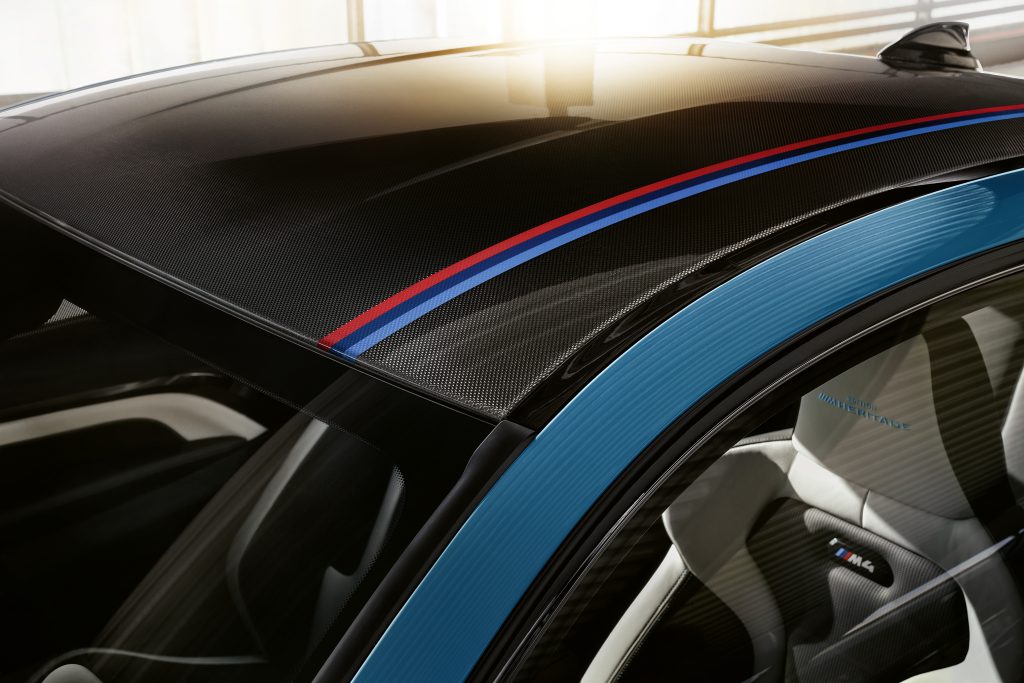
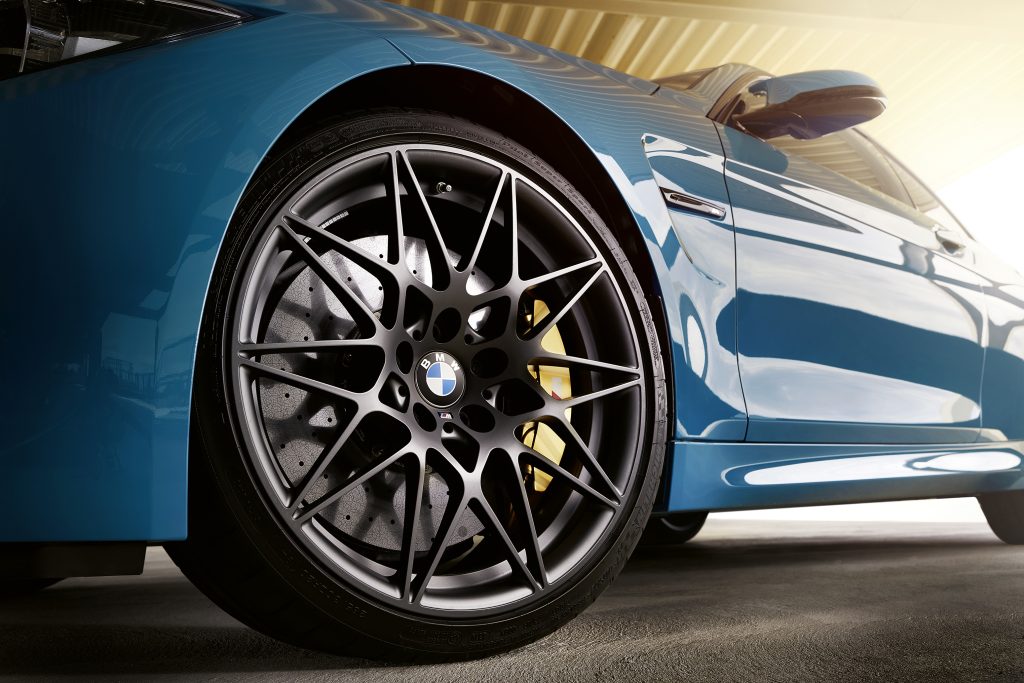
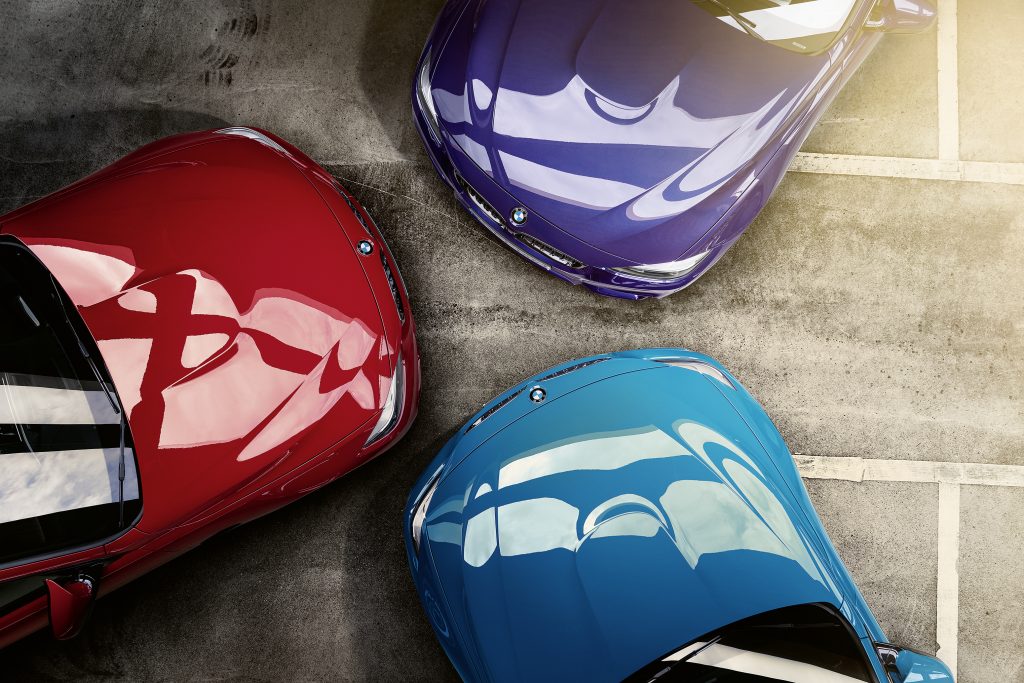
Light blue, dark blue and red – these are the colours by which motorsport fans immediately recognize the BMW M GmbH logo. Immediately after the founding of the BMW Motorsport GmbH in 1972, the characteristic colours already adorned these racing cars, which were based on the BMW 3.0 CSL and became highly successful in touring car racing. Since then, the distinctive stripes in the three classic BMW M GmbH colours have stood for exhilarating performance and exclusive design also on the road. The BMW M4 Edition///M Heritage takes up this unmistakable colour combination on unique exterior and interior design features. There is a choice of the three body colours Laguna Seca Blue (lagunasecablau; non-metallic uni; 448; BMW), Velvet Blue metallic (velvetblau; metallic; 379; BMW) and Imola Red (imolarot; non-metallic uni; 405; BMW) available for the edition model. Furthermore, the two-seater’s carbon-fibre reinforced plastic roof boasts a striking decorative strip in the BMW M colours, which is integrated into the CFRP composite at the factory using a special manufacturing process. Likewise unique are the forged, 20-inch M light alloy wheels in a star spoke design featuring the colour Orbit Grey matt and fitted with mixed tyres.
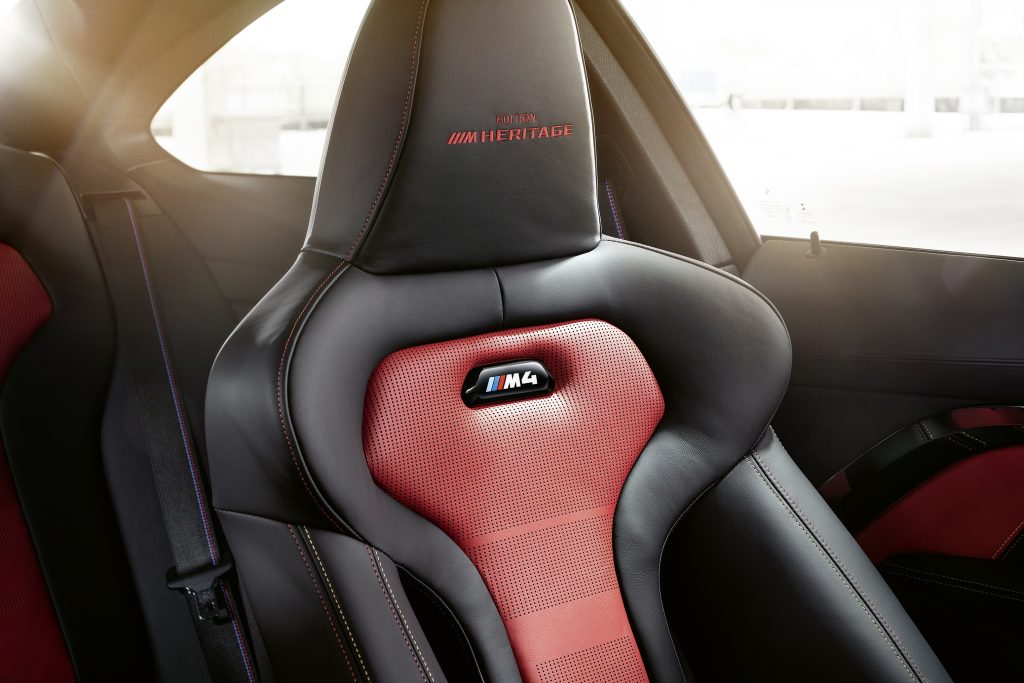
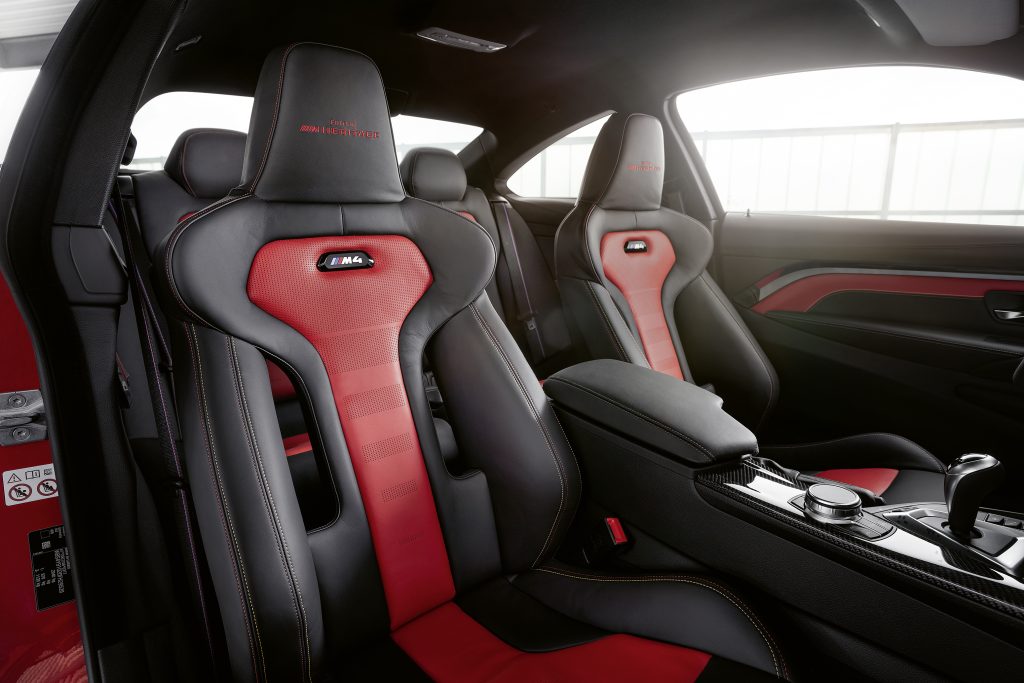
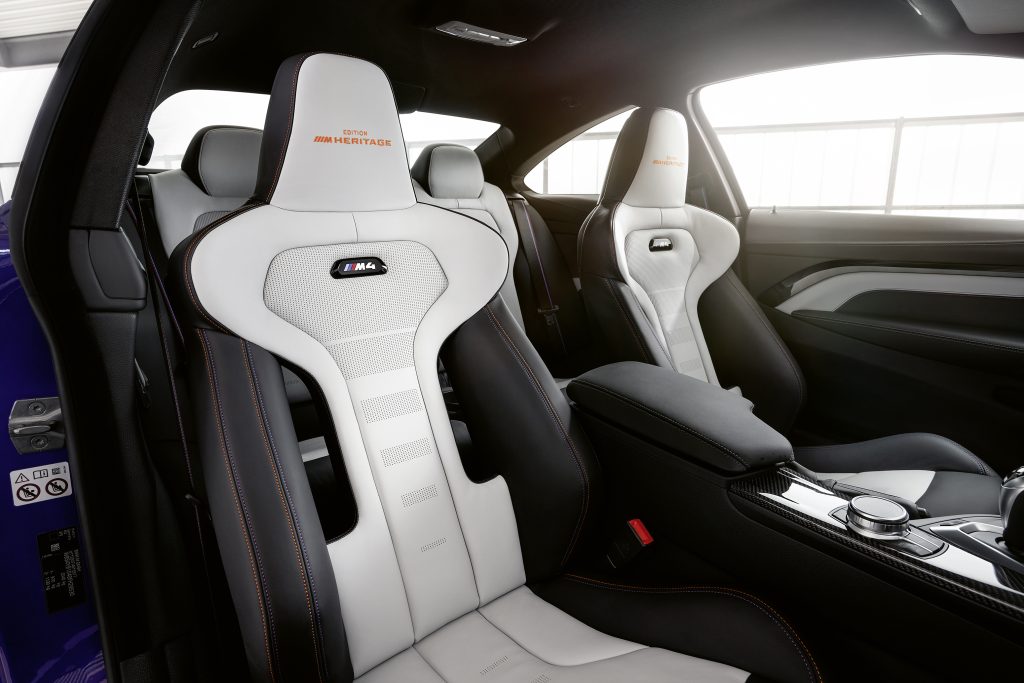
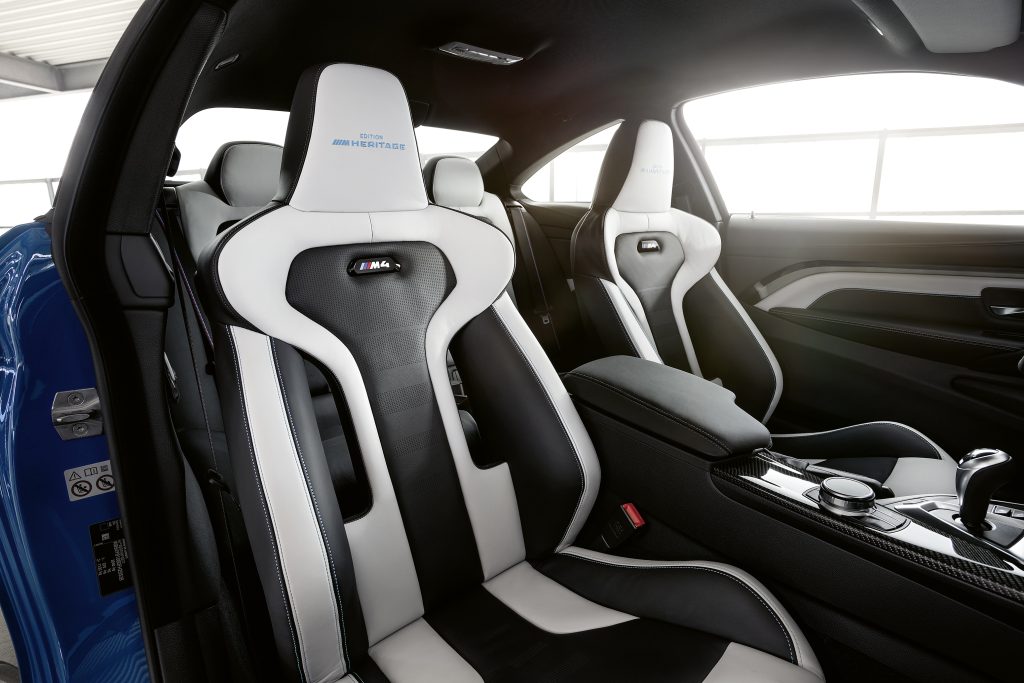
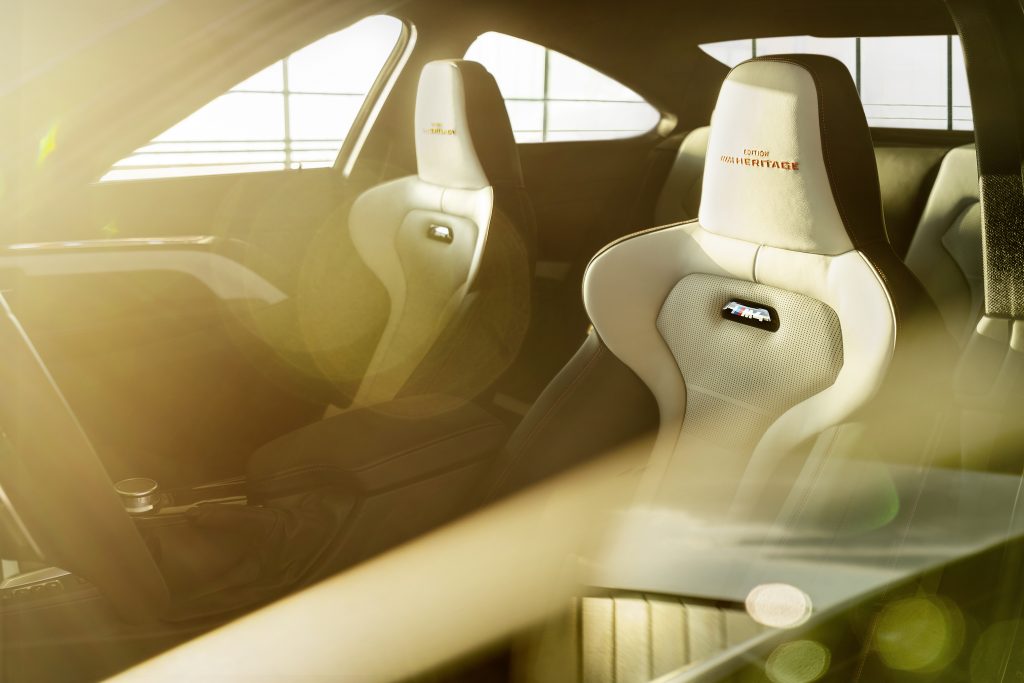
The interior of the edition model is also characterised by an exclusive selection of colours and materials. The spectrum of equipment includes model-specific full leather M seats in a bicolour design and with prominent openings within the area of the seatbacks. Each seat colour is oriented towards the exterior paint and is complemented by partly bicoloured contrast stitching. In conjunction with the exterior colours Laguna Seca Blue and Velvet Blue metallic, the seats come in Silverstone/Black with turquoise stitching or Velvet Blue and Orange respectively. With the exterior finish Imola Red, the seat colours Red and Black correspond with yellow and red contrast stitching.
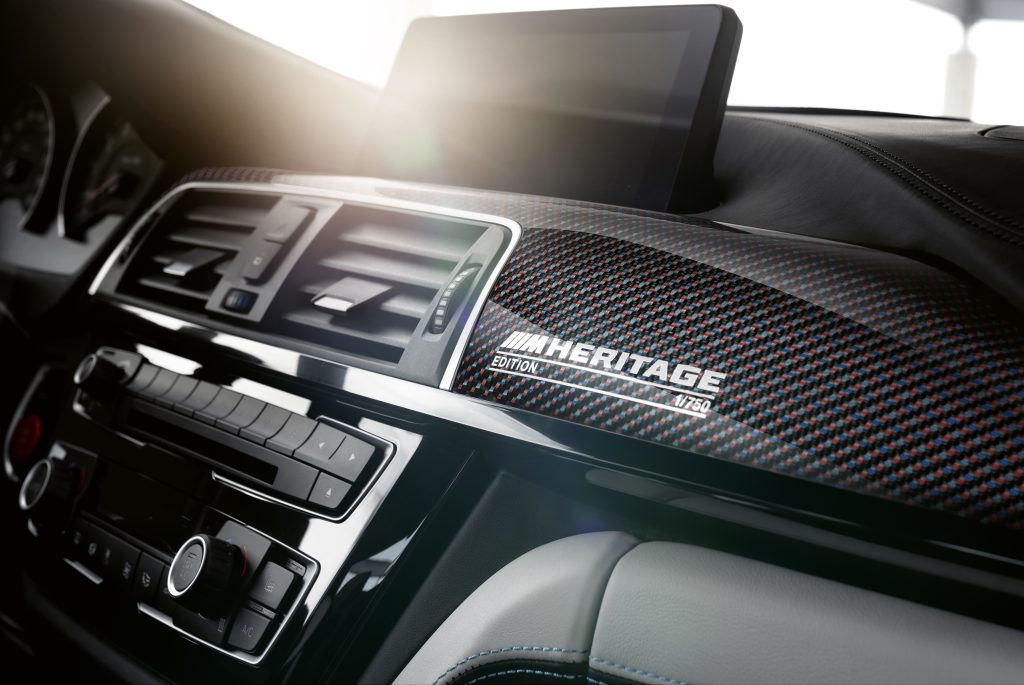
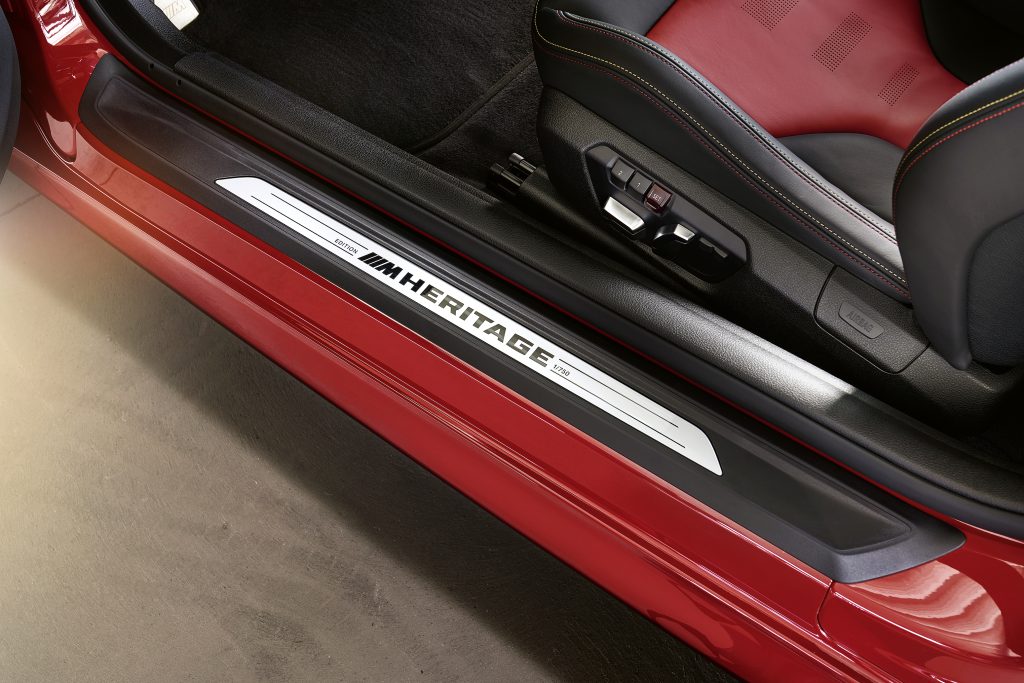
The both appealing and exclusive colour scheme continues with interior carbon trim strips designed exclusively for the BMW M4 Edition ///M Heritage and whose CFRP structure incorporates the stripe design featuring the three characteristic M colours. Both the interior trim strips and the door sills bear emblems with the imprints “Edition ///M Heritage” and “1/750” as an indication of the limited edition of this model. The lettering “///M Heritage” – in turquoise, orange or red respectively – is also to be found on the front headrests.
The BMW M4 Edition ///M Heritage offers a particularly exclusive opportunity to experience the handling characteristics of a high-performance sports car marked by dynamics, agility and precision. At the same time, with this model, the BMW M GmbH is continuing the tradition of exclusive special editions, a tradition that has been cultivated now for several model generations. They reflect the enthusiasm for exceptional sporting successes or awareness of the history of selected models, of which many have become much sought-after collectors’ items in the course of time.
Expressive paint finishes and a characteristic interior design were already hallmarks of the BMW M3 Edition of the year 2009. At that time, with the variants Alpine White, Black, Dakar Yellow and Monte Carlo Blue there were as many as four body colours available for the edition model based on the fourth generation of the BMW M3. In the year 2012, BMW Motorsport’s successful comeback in the DTM triggered the production of the BMW M3 DTM Champion Edition. During the first season following an almost 20-year break, BMW came first in the manufacturer’s rating, with the BMW Team Schnitzer winning the team classification. Moreover, the Canadian Bruno Spengler seized the driver’s title. Only 54 units of the edition model were produced – one for each racing victory BMW was able to clinch in the DTM by then. And there were several more in the years that followed. In the 2016 season, it was the German BMW Motorsport works driver Marco Wittmann in particular who was hard to beat and who eventually became the new DTM champion. The BMW M4 DTM Champion Edition, which was limited to 200 units, was brought to market in his honour. The strongly racing-oriented special edition not only exhibited exclusive design features but, above all, was provided with numerous innovations that had previously helped the 368 kW/500 hp BMW M4 GTS achieve its outstanding performance.
The same year, BMW M GmbH also presented an edition model of the BMW M3 Sedan in memory of the BMW M3, which had made its debut three decades previously. The special edition 30 Years M3 was finished exclusively in the colour Macao Blue metallic and produced in a limited quantity of 500 units. The latest example to date of a fascinating combination of performance and exclusiveness is the BMW M4 Convertible Edition 30 Years. This open-top high performance sports car was produced in a limited edition of 300 and presented in 2018 – three decades after the premiere of the first-generation BMW M3 Convertible. This edition model also featured exclusive paint finishes – namely Macao Blue metallic and Mandarin II uni – and a specific interior design, providing for unique and aesthetic driving pleasure both on country roads and on the racetrack.