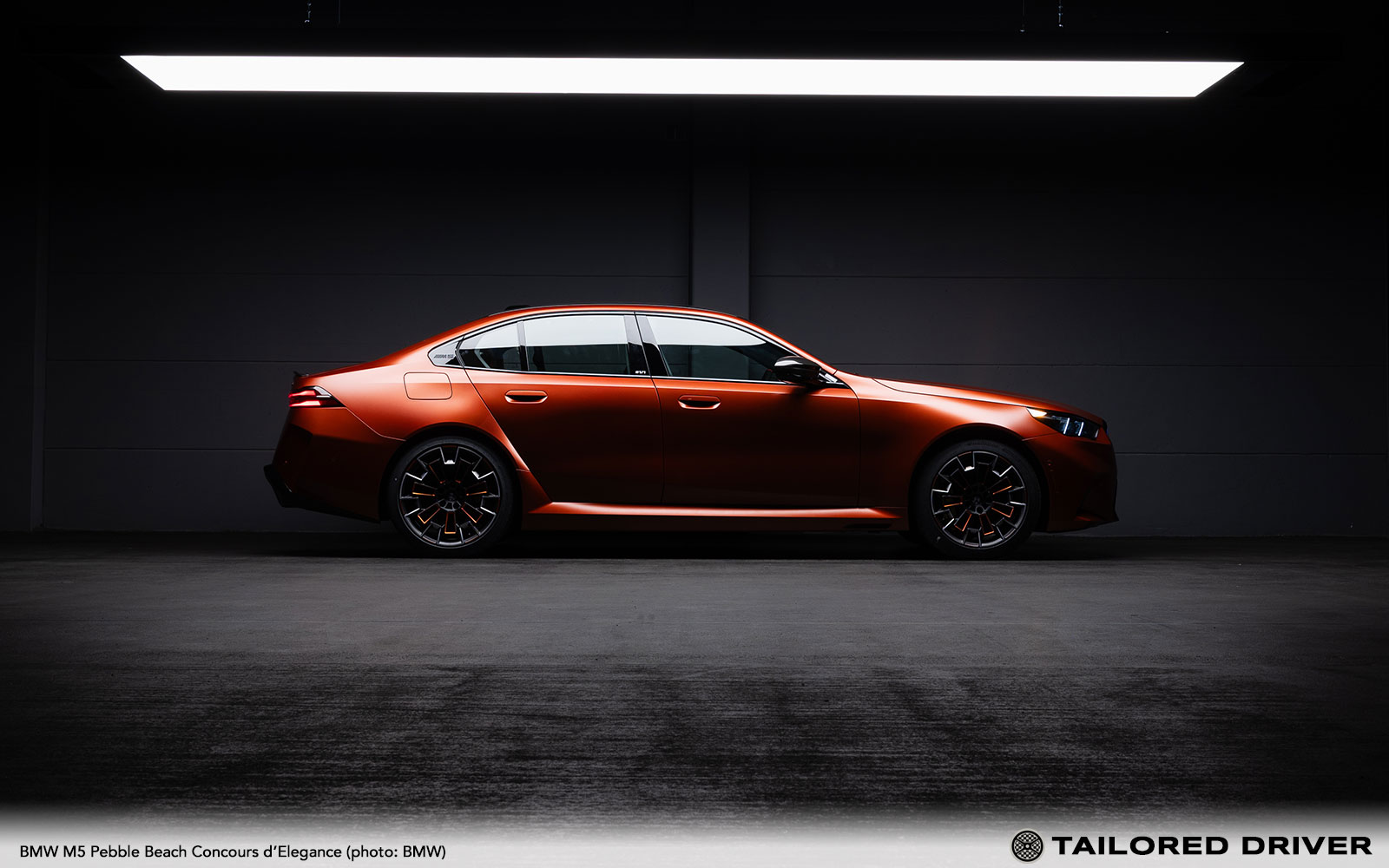
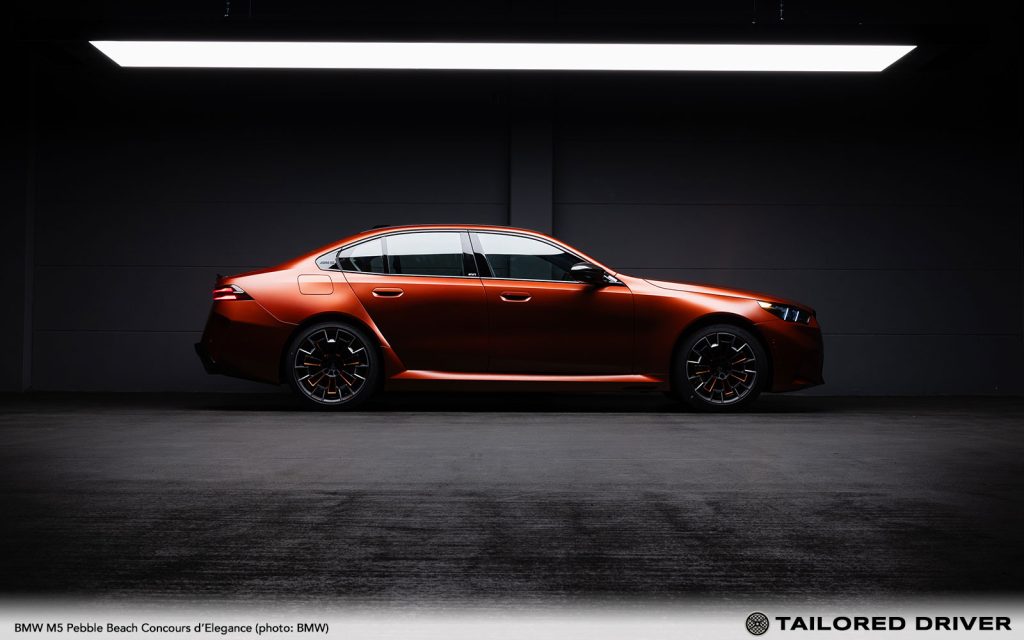
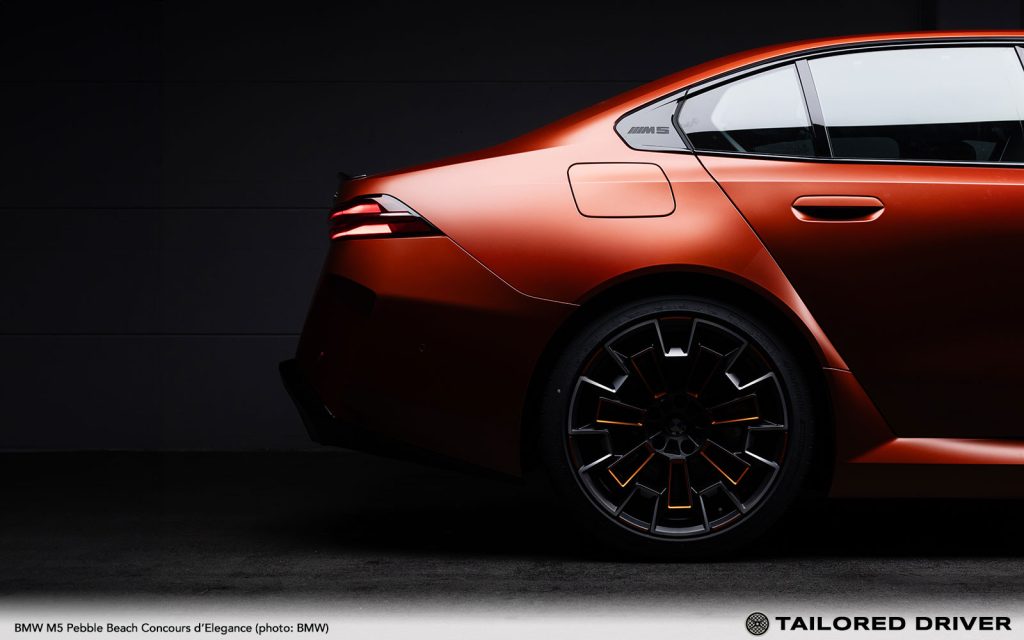
One-of-one 2025 BMW M5 is a collaboration between BMW M, BMW Individual, and the Pebble Beach Concours d’Elegance®.
Unique interior and exterior finishes and details created exclusively for this special automobile.
The first 2025 BMW M5 delivered in North America (estimated delivery October 2024).
Proceeds from the sale will go to the Concours’ charitable partner, Pebble Beach Company Foundation.
The vehicle will be auctioned by Gooding & Company on Friday, August 16.
[source: BMW AG]
Woodcliff Lake, NJ – The all-new seve nth generation BMW M5 was revealed to the world earlier this month at the Goodwood Festival of Speed. And now, to celebrate the arrival of the 717-hp M Hybrid-powered super sedan in the US, BMW M and BMW Individual in collaboration with the Pebble Beach Concours d’Elegance® have created a one-of-a-kind special automobile that will be auctioned during Pebble Beach Automotive Week. The 2025 BMW M5 Pebble Beach Concours d’Elegance #1/1 will be the first 2025 M5 delivered in North America, and is distinguished by exclusive paint and upholstery colors, wheels, and bespoke interior details that make this M5 entirely unique.
The 2025 BMW M5 Pebble Beach Concours d’Elegance #1/1 will be auctioned at no-reserve by Gooding & Company Friday, August 16. Proceeds from the sale will be donated to the Pebble Beach Company Foundation, a charity that supports literacy and education programs for disadvantaged young people in Monterey County.
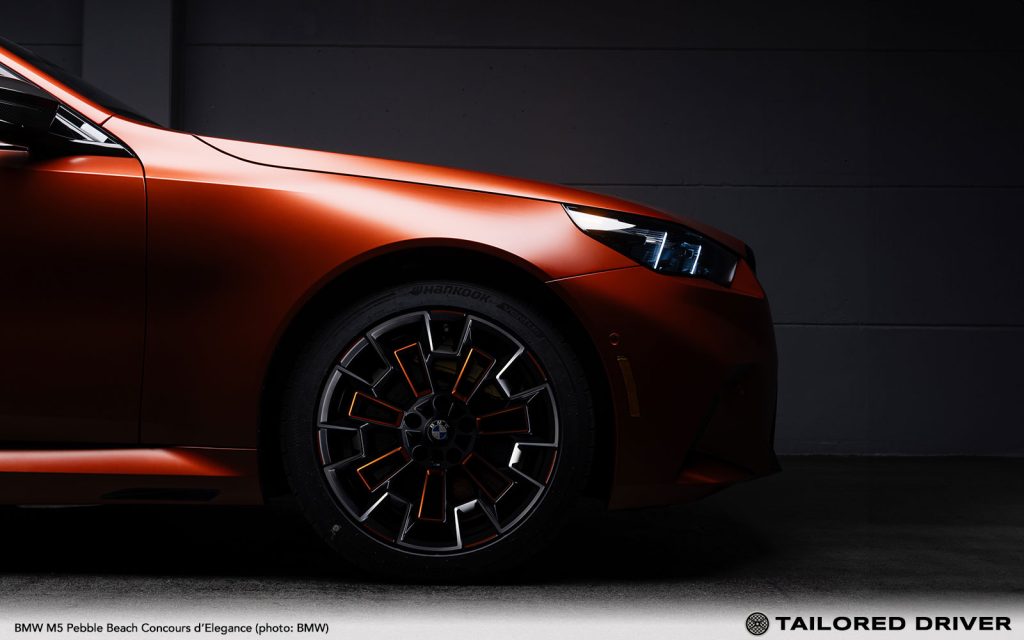
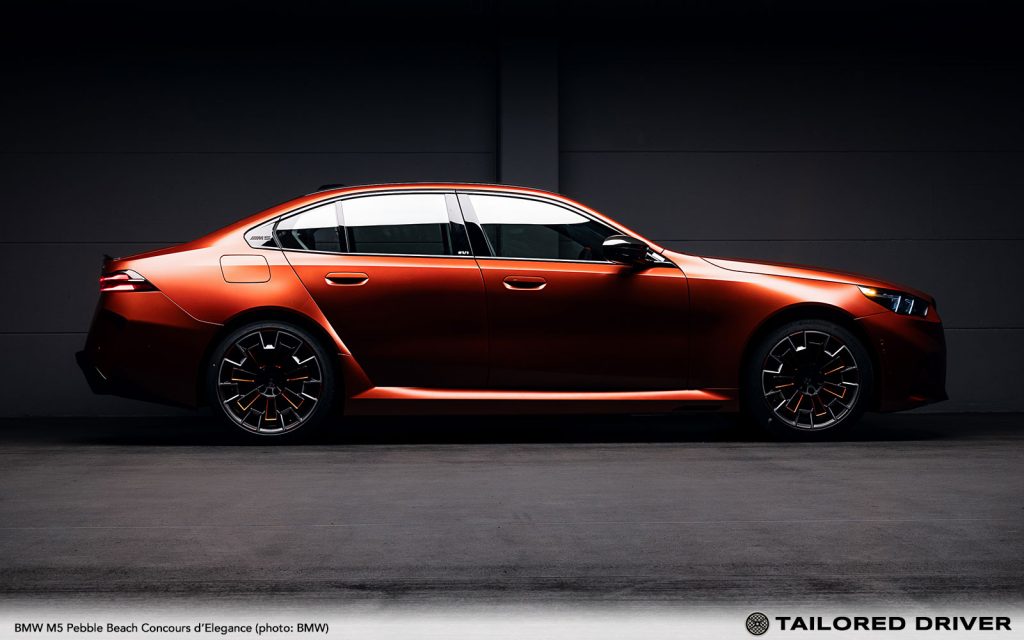
The only 2025 BMW M5 finished in BMW Individual Frozen Orange metallic. Taking inspiration from the spectacular orange hues of a Pebble Beach sunset, the BMW M5 Pebble Beach Concours d’Elegance #1/1 makes a strong first impression with its striking coat of BMW Individual Frozen Orange metallic (frozenorange; metallic matte; C41; BMW) paint. The stunning color was scheduled to be discontinued from BMW Plant Dingolfing prior to the start of M5 production, meaning the body of the Pebble Beach M5 had to be painted weeks in advance. This also ensured that no other 2025 M5 would be painted the same color.
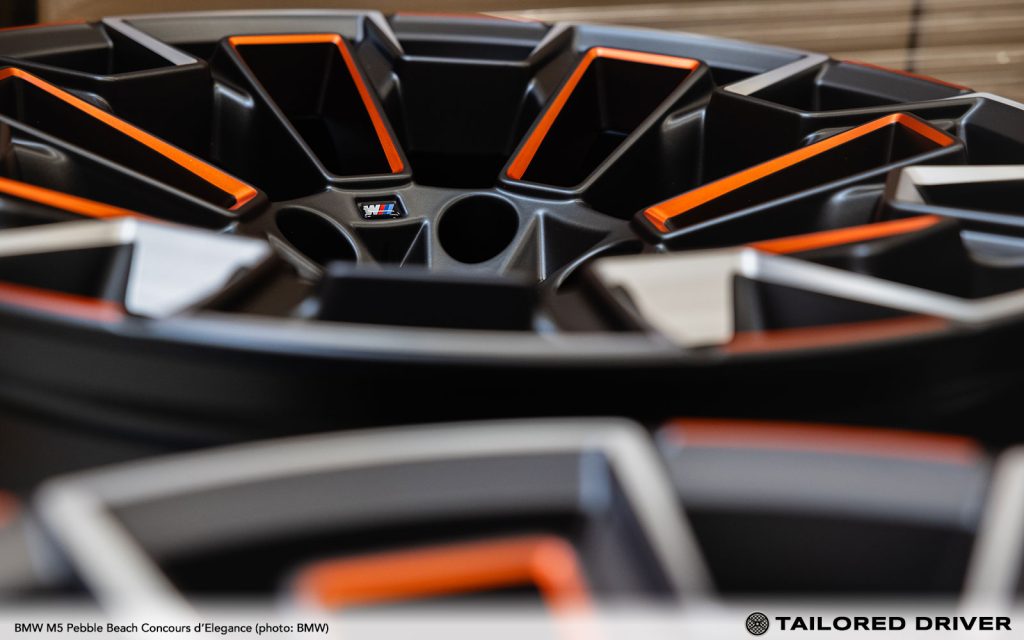
The paint is complimented by hand-painted orange accents on the staggered M Dual-Spoke Bicolor wheels, Style 951M, mounted on performance tires. The 20-inch front and 21-inch rear wheels surround massive M Carbon Ceramic brakes with calipers finished in Matte Gold.
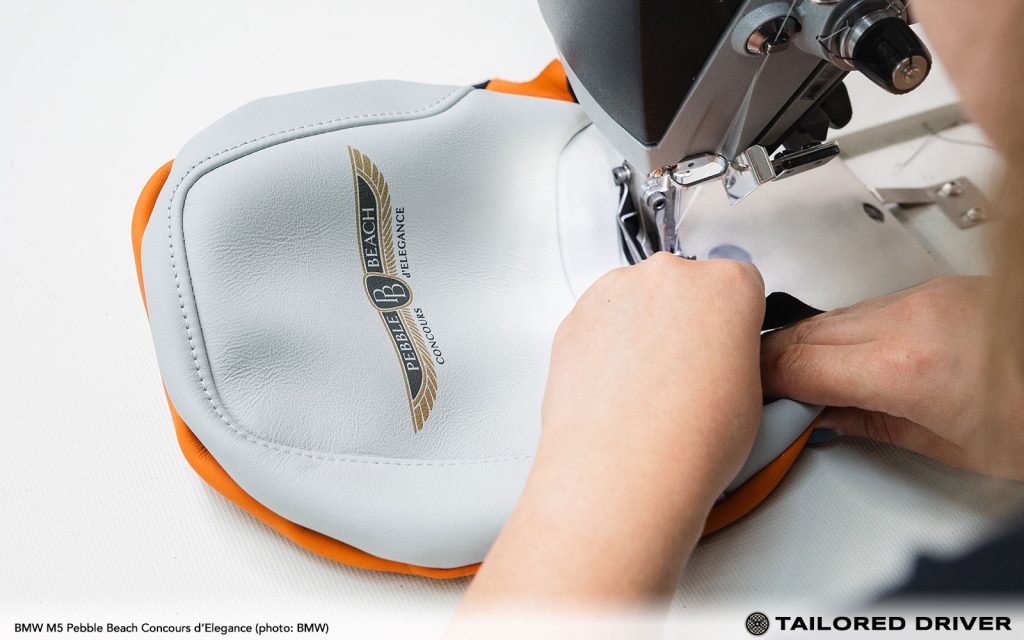
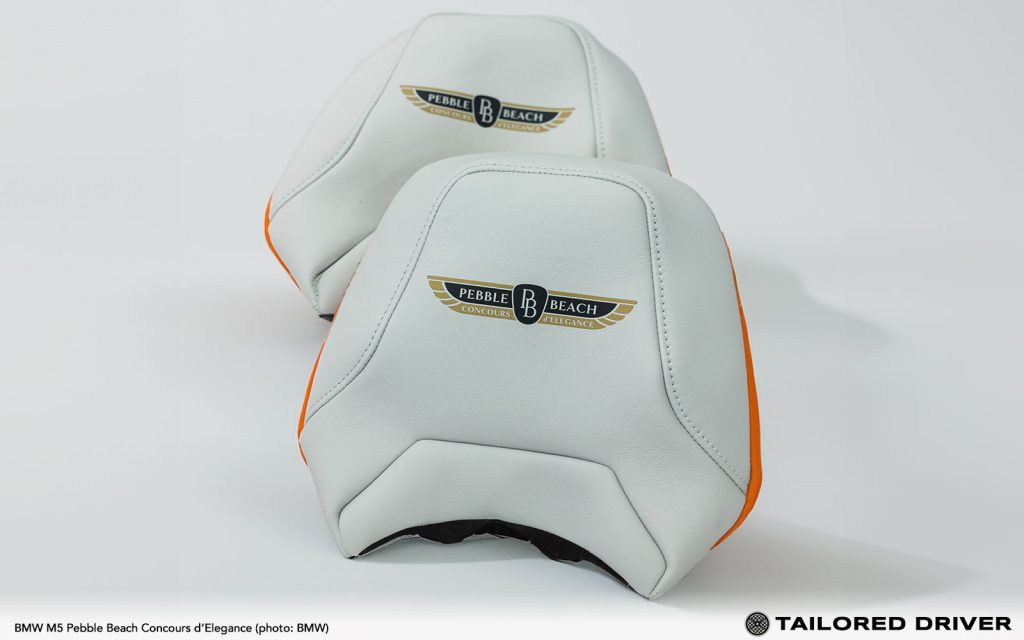
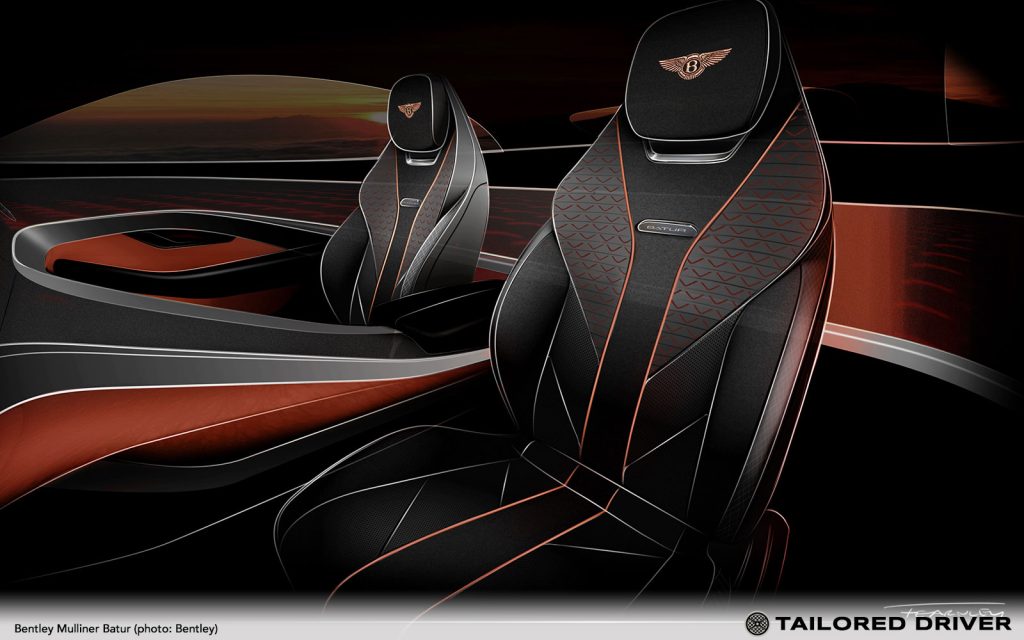
A dramatic interior package befitting such a distinctive vehicle. The tech-forward, driver-oriented interior has been appointed in a completely unique color scheme. The M Multi-Function seats are finished in Kyalami Orange and Silverstone Extended Merino leather – a combination created specifically for the #1/1 and unavailable on the standard production M5. The headrests of both front seats are emblazoned with the Pebble Beach Concours d’Elegance® logo, using an innovative new printing technology, just above the illuminated M5 badge.
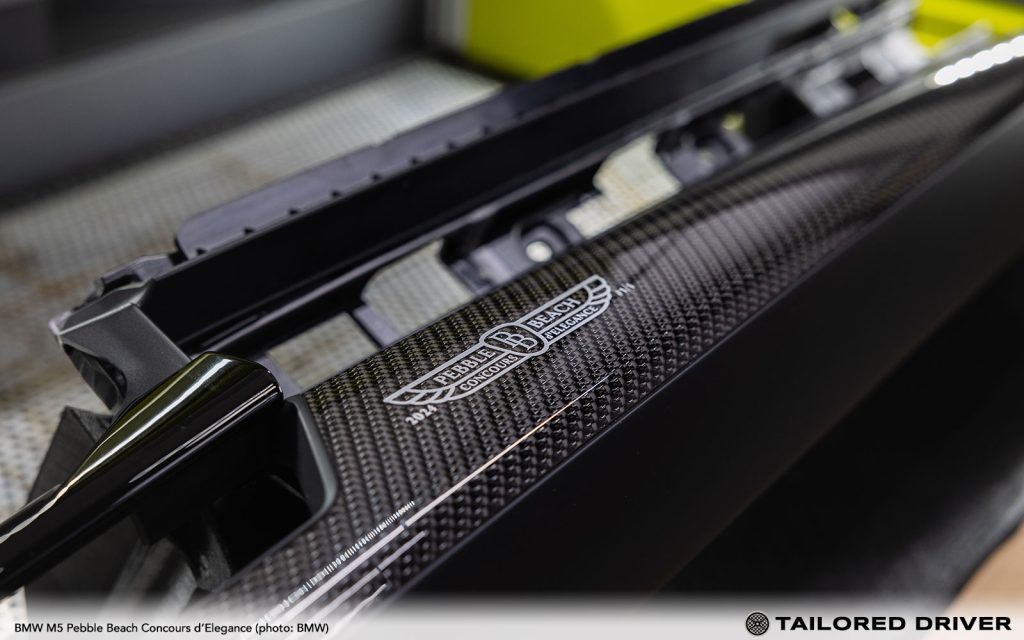
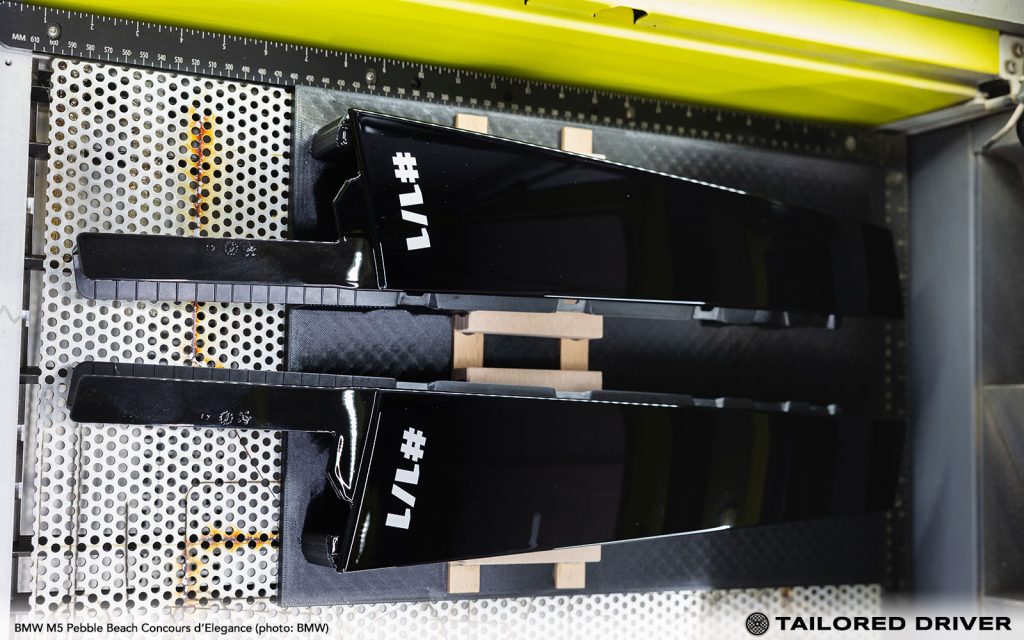
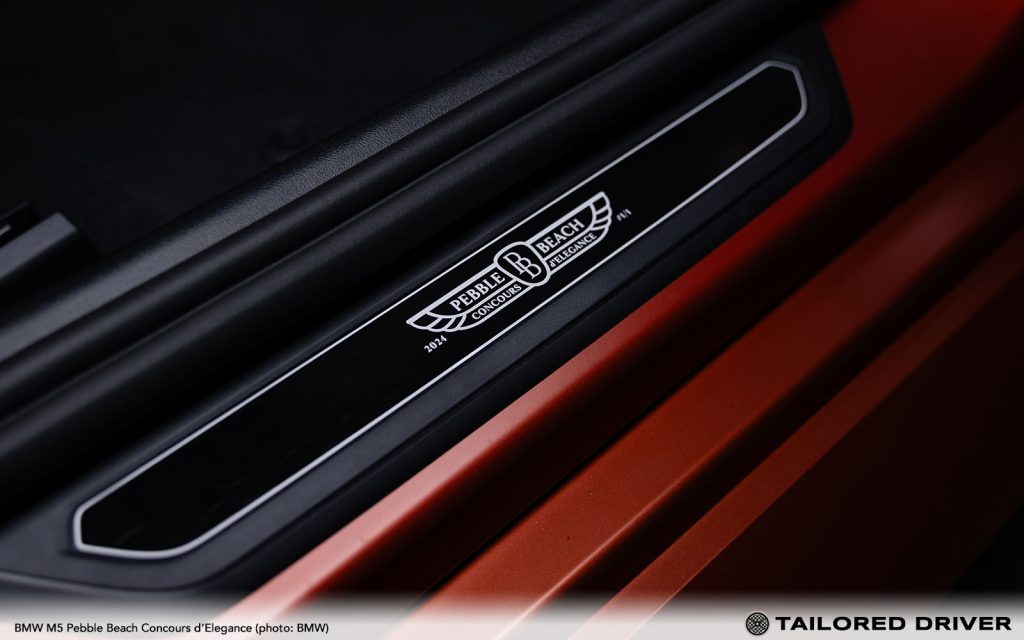
Carbon Fiber Silver Thread High Gloss trim with Dark Silver Accent spans the dashboard and is adorned with the 2024 Pebble Beach Concours d’Elegance® logo just to the right of the BMW Curved Display, with “#1/1” leaving no doubt about this M5’s individuality. The logo and #1/1 inscription are also present on the front doorsills.
In total, the 2025 BMW M5 Pebble Beach Concours d’Elegance #1/1 is fitted with over $57,000 worth of bespoke options. Much of the finishing was done by hand at the M works in Garching, the spiritual home of the M5 where the first two generations were largely hand-built.
Premium features and technology for the everyday drive. The 2025 BMW M5 Pebble Beach Concours d’Elegance #1/1 will spoil the winning bidder with a full complement of performance, luxury, and infotainment features.
The Driving Assistance Professional Package permits the Lane Keeping Assistant with Side Collision Protection and Distance Control to be used when travelling at highway speeds. At lower speeds up to 40 mph, the Traffic Jam Assistant can provide attentive, unlimited hands-free driving to ease the strain of especially dense traffic situations on limited access highways.
The Executive Package brings illumination to the kidney grille, a power rear sunshade and manual rear side window shades, front ventilated seats, and Parking Assistant Plus. The Carbon Package includes a CFRP roof panel, rear spoiler, and mirror caps. And M Drive Professional adds two additional, track-oriented driving modes – DYNAMIC and DYNAMIC PLUS – designed to ensure the combustion engine and electric motor are both active and the cooling system is conditioned for track driving.
Finally, the M Driver’s Package raises the M5’s top speed to 190 mph and includes a 1-day high-performance driving class at a BMW Performance Center.
It is estimated that delivery of the M5 Pebble Beach Concours d’Elegance #1/1 to the winning bidder will occur in late October 2024. Gooding & Company’s auction listing can be viewed here. Interested parties can register to bid at www.goodingco.com/register.
The 2025 BMW M5 Pebble Beach Concours d’Elegance #1/1 will be on display from 10:00 AM Wednesday, August 14, at Gooding & Company’s space at Pebble Beach Parc du Concours, located on the corner of Stevenson Drive and Portola Road in Pebble Beach.
BMW Group in America BMW of North America, LLC has been present in the United States since 1975. Rolls-Royce Motor Cars NA, LLC began distributing vehicles in 2003. The BMW Group in the United States has grown to include marketing, sales, and financial service organizations for the BMW brand of motor vehicles, including motorcycles, the MINI brand, and Rolls-Royce Motor Cars; Designworks, a strategic design consultancy based in California; a technology office in Silicon Valley and various other operations throughout the country. BMW Manufacturing Co., LLC in South Carolina is the BMW Group global center of competence for BMW X models and assembles the X3, X4, X5, X6 and X7 Sports Activity Vehicles as well as the BMW XM. The BMW Group sales organization is represented in the U.S. through networks of 349 BMW passenger car and BMW Sports Activity Vehicle centers,146 BMW motorcycle retailers, 104 MINI passenger car dealers, and 38 Rolls-Royce Motor Car dealers. BMW (US) Holding Corp., the BMW Group’s sales headquarters for North America, is located in Woodcliff Lake, New Jersey.
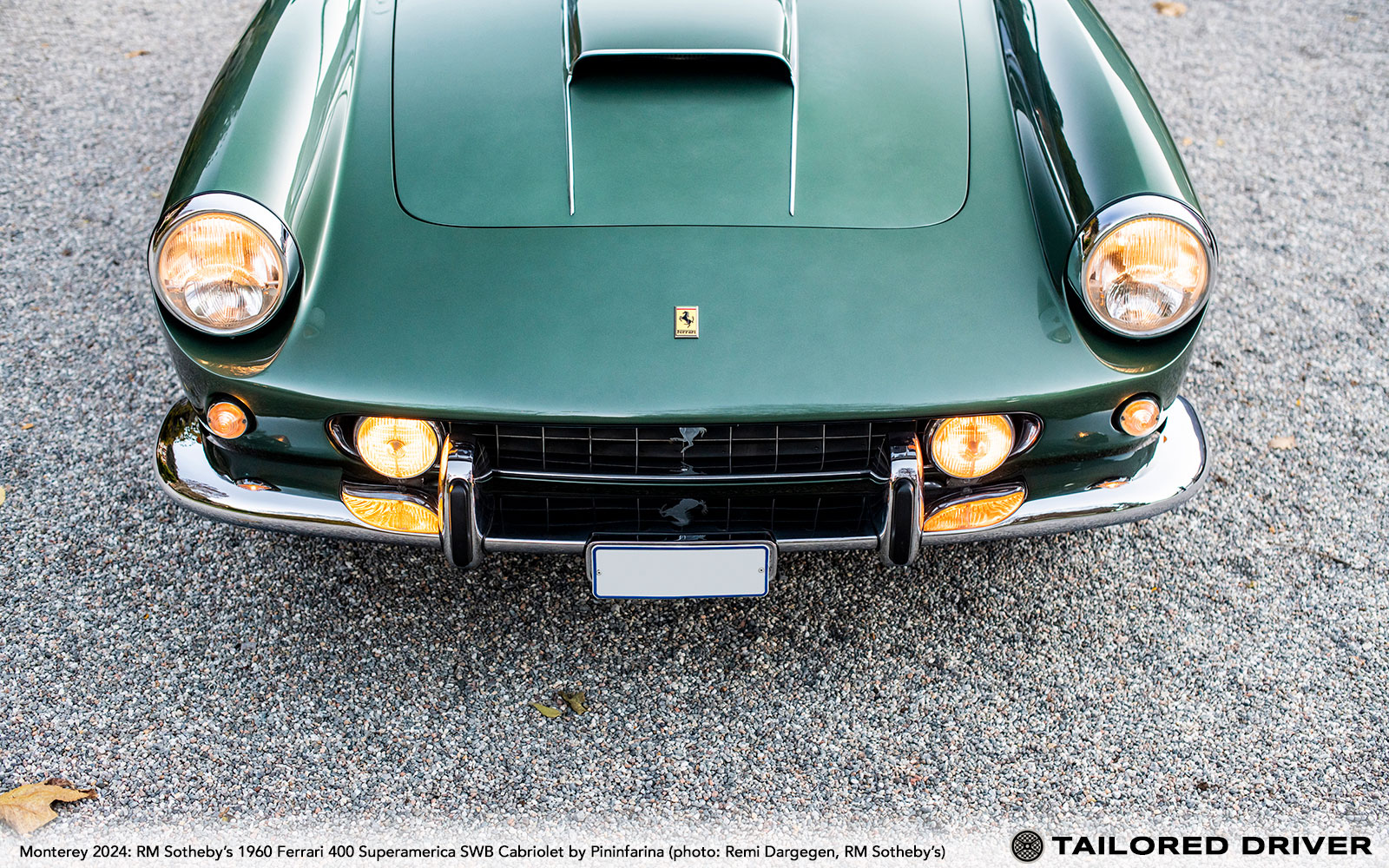
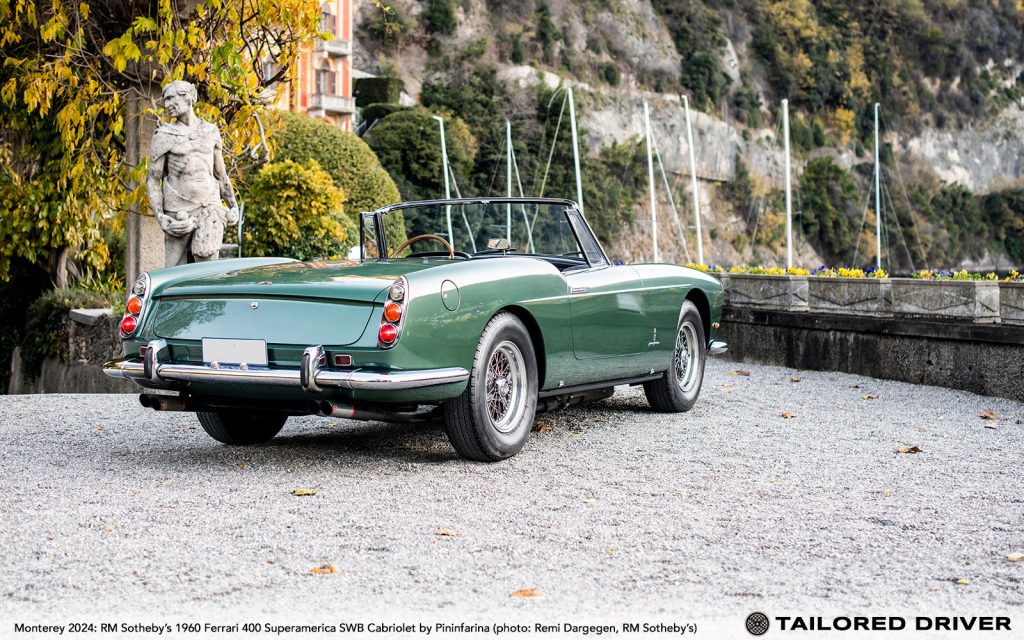
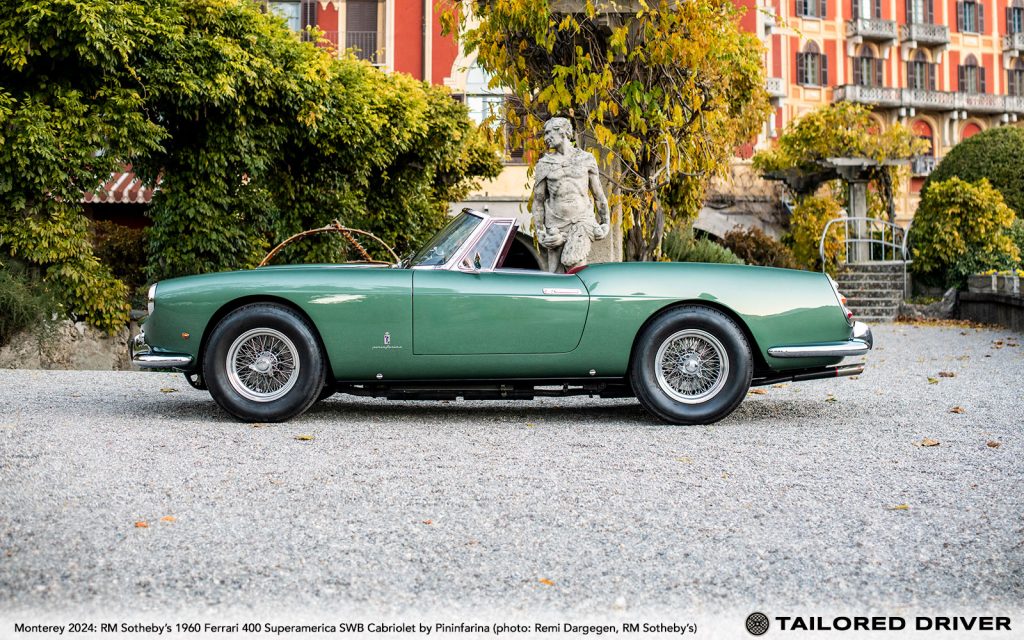
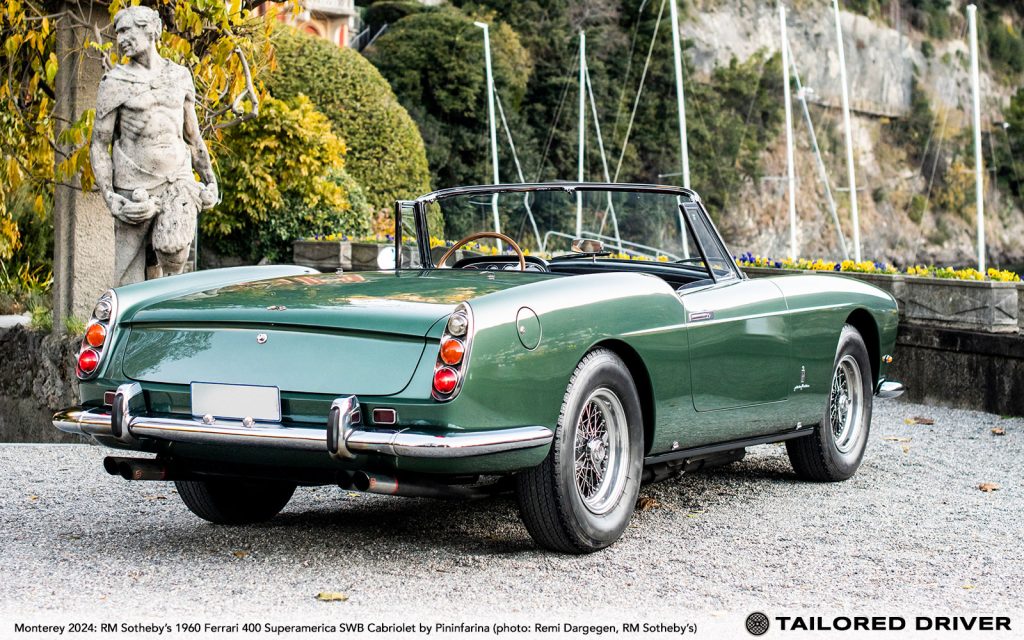
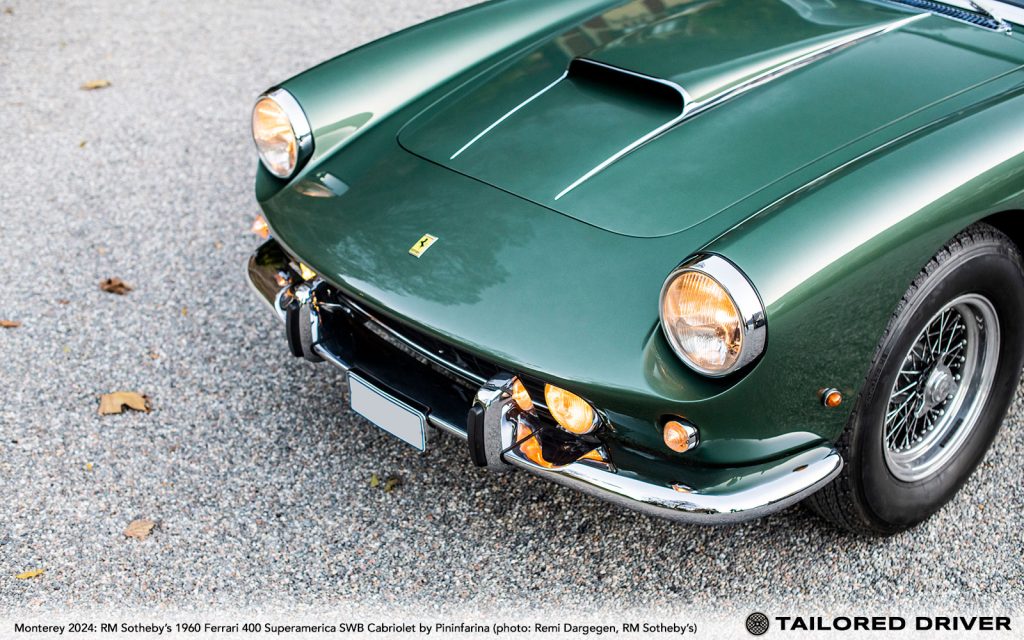
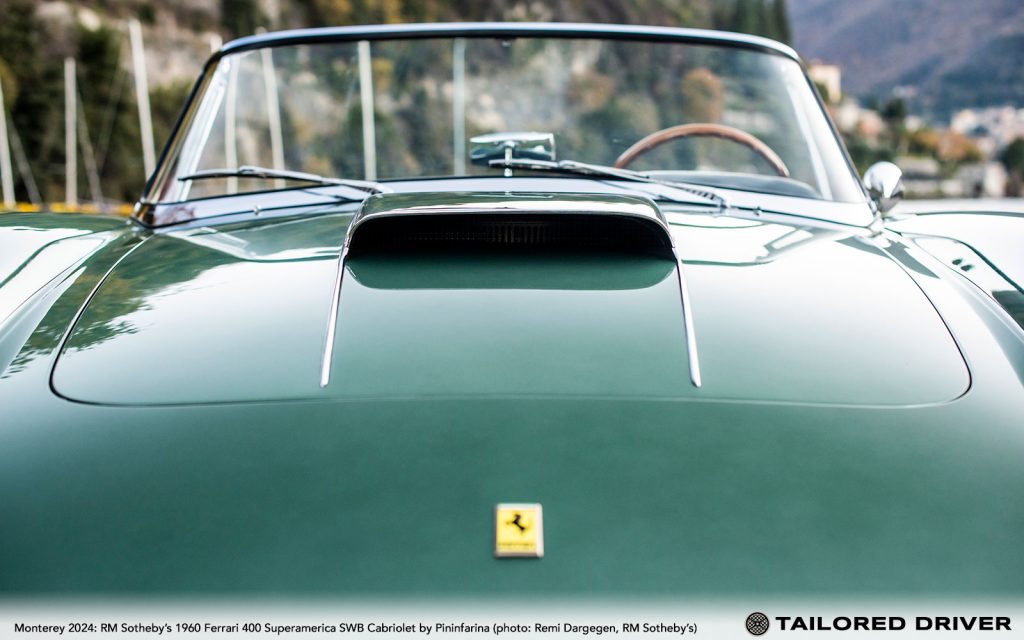
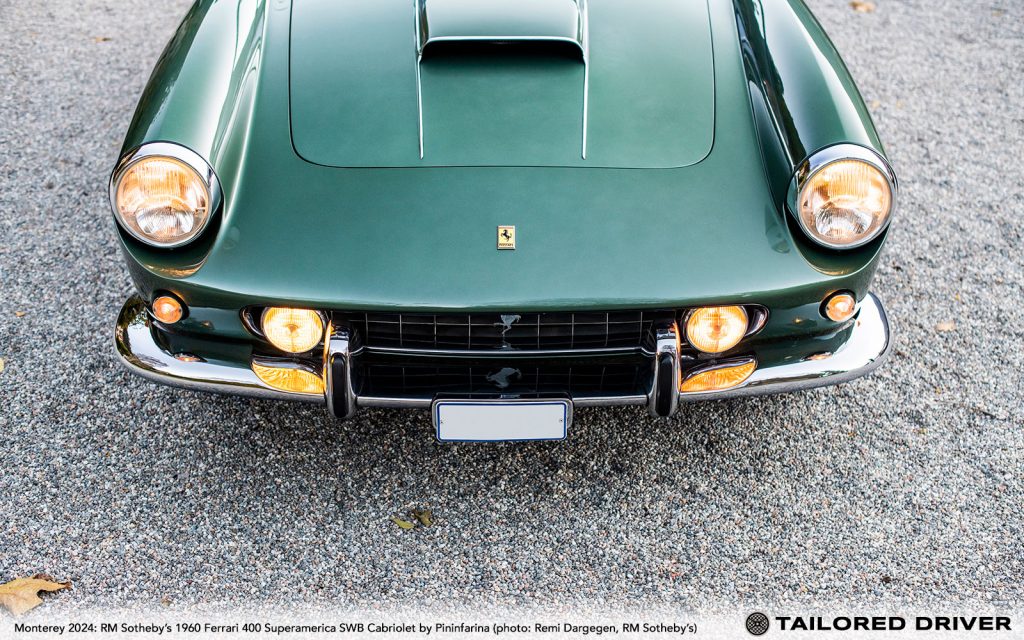
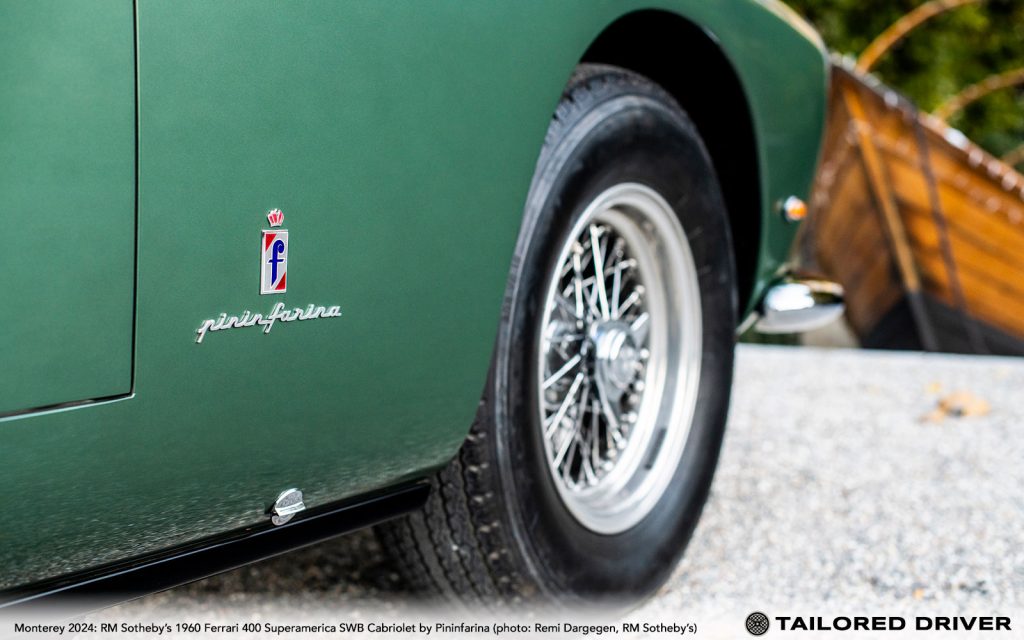
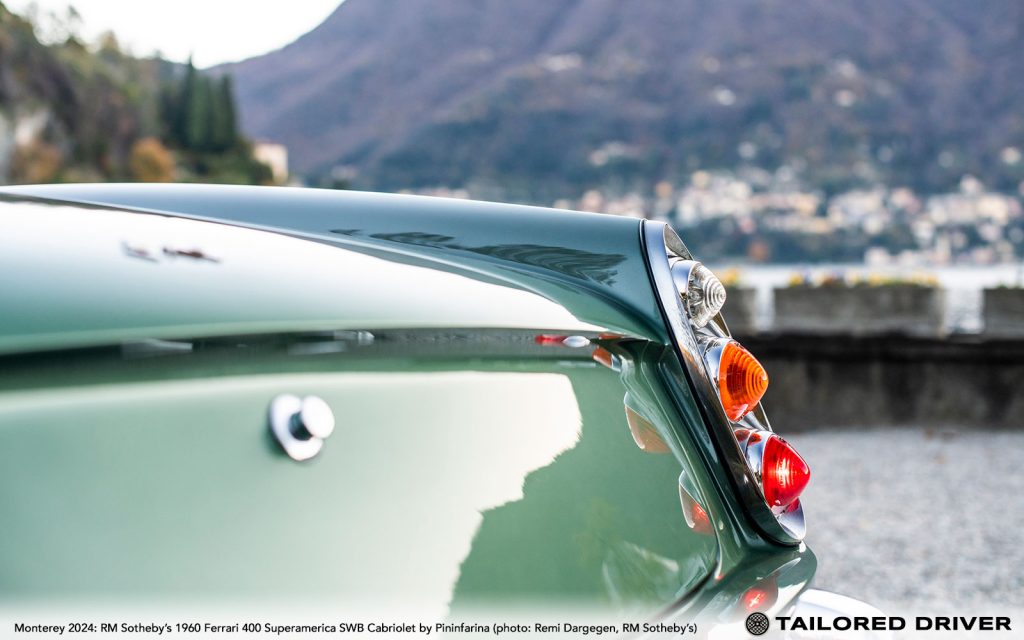
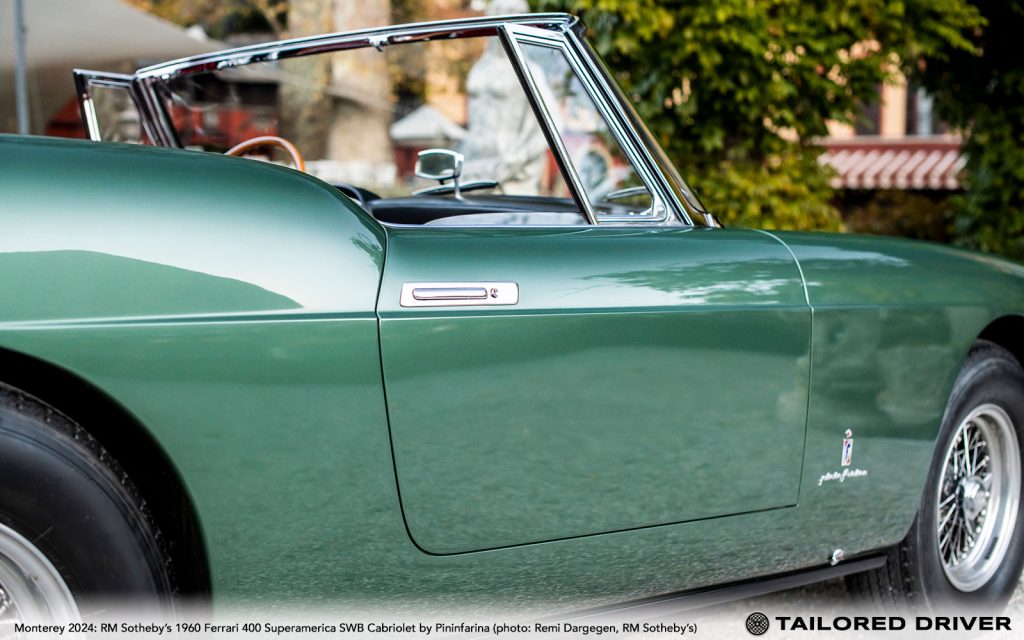
Third of just Seven short-wheelbase Ferrari 400 Superamerica Cabriolets, there’s no doubt this fully restored specimen (chassis #: 1945 SA) will command a large price when it crosses RM Sothebys’ block at Monterey Car Week in August. And while it is exemplary of the car-as-art 1960s era at Ferrari, it’s this car’s unique factory correct green hue of Verde Bottiglia that grabs our attention the most.
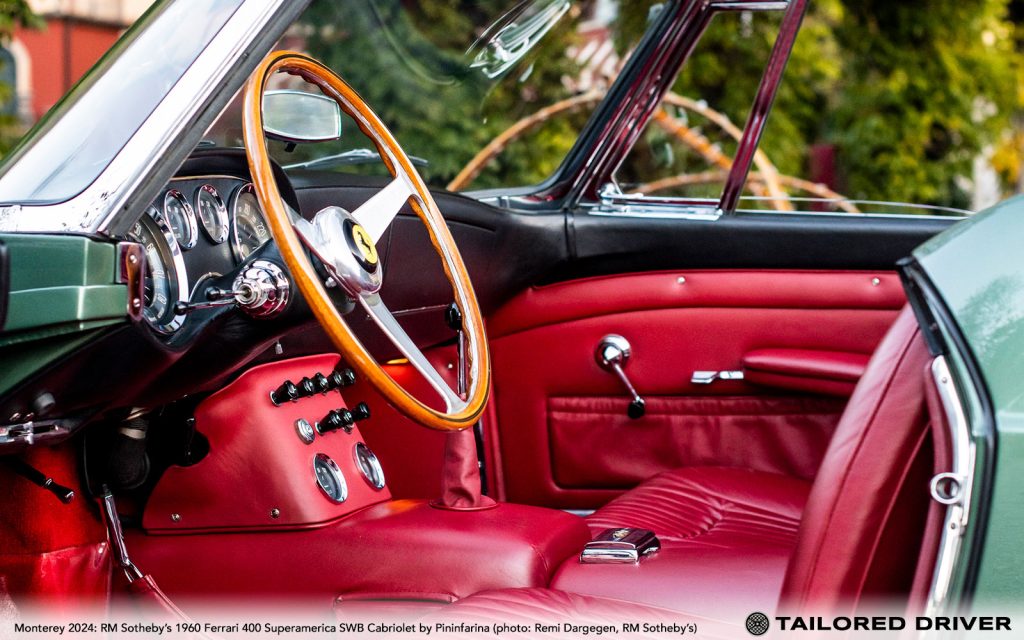
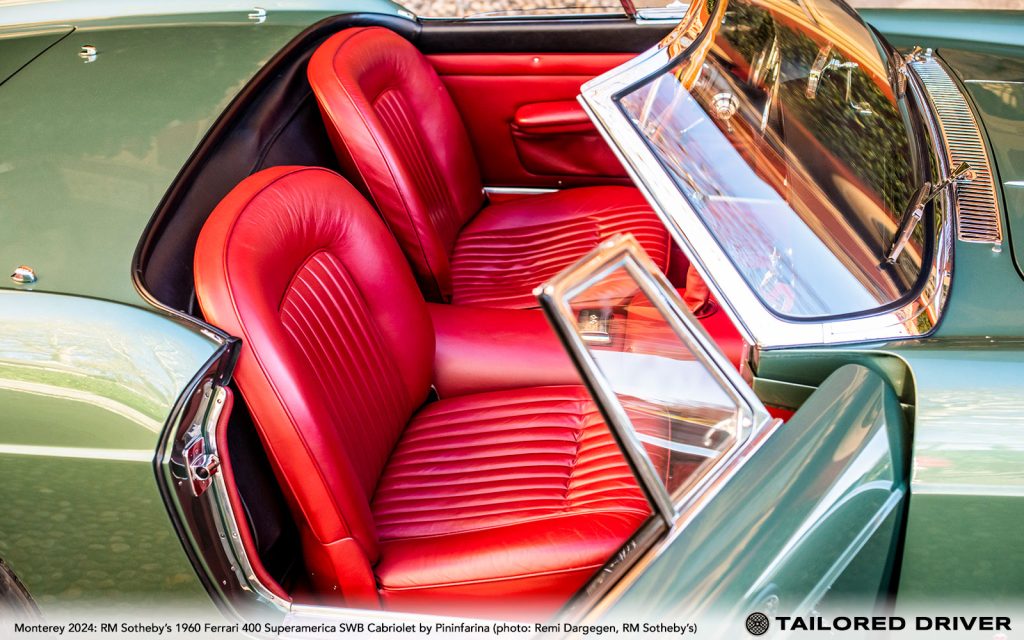
The color combination, Verde Bottiglia exterior with Rosso (red) leather is also fascinating. The pairing makes the car one of one, but even more interesting to us is how well the two colors work together. Green and red can be a mixed bag in how the two colors play off of each other, though they seem to work well here. Then again, what color combination wouldn’t work well on a 1960 Ferrari 400 Superamerica SWB Cabriolet by Pininfarina?
Check out the full description from RM below the photo gallery, and direct link to this Lot’s listing page HERE.
The third of seven short-wheelbase 400 Superamerica Cabriolets
Fully restored to concours standards by US-based Ferrari specialists Classic Coach and Greg Jones
Well-maintained by Autofficina Omega in its current ownership
Ferrari Classiche Red Book certified; finished in its striking, factory-correct, one-off combination of Verde Bottiglia over Rosso
Formerly of the Oscar Davis Collection
Seldom shown since its most recent restoration; an exciting concours opportunity
[source: RM Sotheby’s]
Addendum: Please note that an import duty of 2.5% of the purchase price is payable on this lot if the buyer is a resident of the United States.
Ferrari’s Superamerica models of the late 1950s and early 1960s were truly the last word in sporting excellence. Offering the very best money could buy in terms of luxury and performance, it is no surprise that these cars often found their way into the garages of heads of state, barons of industry, and other well-to-do individuals.
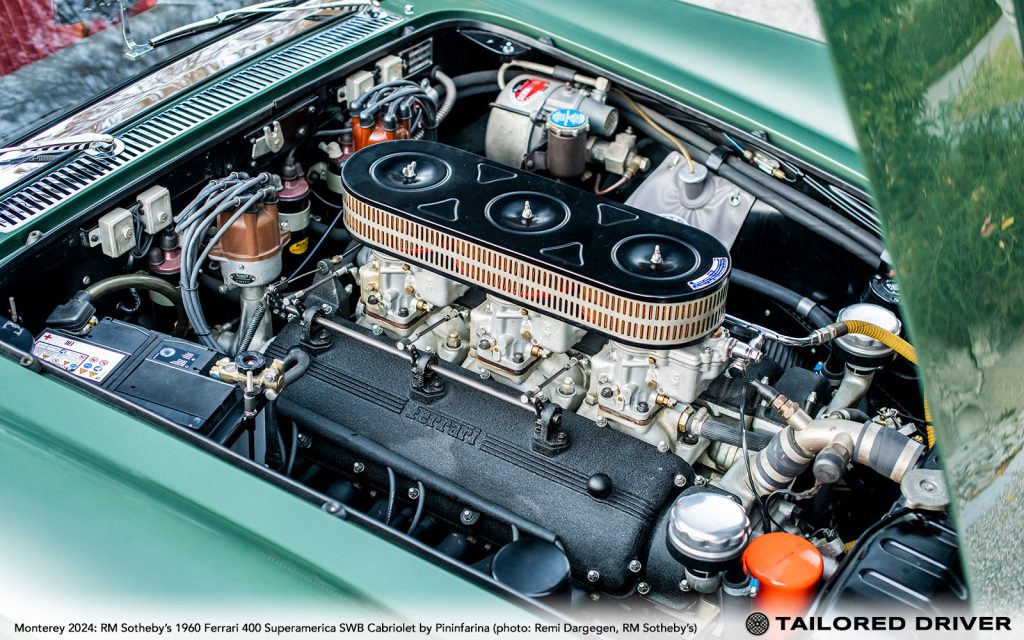
Succeeding the 410 Superamerica, the 400 Superamerica offered numerous improvements over its predecessor. While the engine decreased in displacement from 5.0 liters to 4.0 liters, several other new features countered this. The 5.0-liter V-12 was a “long-block” Lampredi-designed unit, while the revised smaller engine was based on the Colombo single-overhead-camshaft powertrain that was first utilized in the 250 Europa GT. To increase the capacity from 3.0 liters, the bore was enlarged to 77 millimeters and the stroke was lengthened to 71 millimeters, providing a total capacity of 3,967 cubic centimeters. Furthermore, a twin-coil and distributor ignition system was used, along with triple Weber carburetors, granting the engine an improved 340 horsepower—but also an incredible 400 Nm (295 pound-feet) of torque from 2,000 rpm and a maximum torque or 450 Nm (331 pound-feet) at 6,000 rpm.
As a result, these cars are considered today among the best-driving of 1960s Ferraris. Boasting 25% greater engine capacity than a 250 GT Berlinetta or California Spider, the 400 Superamerica produces far more horsepower and torque than either of its forebears. The 400 Superamerica was also fitted with an overdrive as standard—while no overdrive was available for the 250 GT models apart from the GTE—making it far more comfortable to drive over long distances. Finally, it is important to remember that the 400 Superamerica’s chassis and powertrain were so great that they provided the basis for the 330 LMB and 330 TRi racing cars, of which the 330 TRi LM won the 24 Hours of Le Mans in 1962.
The 400 Superamerica production run can be divided into two groups, based on either long- or short-wheelbase chassis. The first batch of cars produced—which includes the car on offer here, chassis 1945 SA—boasted a 2,420-millimeter chassis, while the second batch boasts the longer 2,600-millimeter chassis. Of the short-wheelbase cars, just 25 examples were produced, with only seven bodied as cabriolets.
THE THIRD OF SEVEN SHORT-WHEELBASE CABRIOLETS
Chassis number 1945 SA was constructed in mid-1960 as the third of those seven short-wheelbase cabriolets, and it was built to left-hand-drive configuration with open headlamps. It was finished in a beautiful, one-off color combination of Verde Bottiglia (MM 16364) over Rosso (VM 3171). It was fitted from new with a set of three Weber 46 DCF carburetors, like on a 250 SWB “SEFAC Hot Rod,” and a pair of Bosch ignition distributors. The coachwork was completed by Pinin Farina in July of 1960 and was sold new to Helmut Horton, a German entrepreneur based in Croglio, Switzerland. In January of the following year, the car was registered in Milan under Horten Italiana S.r.l, and it remained in Italy for the following three years under Horton’s ownership.
The Superamerica was officially exported out of Italy in spring of 1964 and was next known with a Mr. Warzits in Germany. By 1985, the car was acquired by Bernard Pfister of Geneva, Switzerland, now repainted white. Pfister repainted the car red in 1989 and it remained in Switzerland with him for the next few years, typically on display at Ferrari Suisse SA in Nyon.
In June 1997, 1945 SA was listed for sale in Marseille, France and was purchased one month later by Scott Rosen of Bedford Hills, New York. Subsequently exported to the United States, the car remained in his ownership for two years before being purchased by the late noted sports car enthusiast Oscar Davis of Elizabeth, New Jersey.
One year later, Davis sold the Superamerica to a Florida-based collector, yet the car would stay in northern New Jersey for the time being, as it was entrusted to Classic Coach for a full restoration. Founded in 1972 and well-known and regarded in Ferrari circles in the United States, Classic Coach was Ferrari’s first authorized bodywork repair facility in the US. Their owners would later open two authorized Ferrari dealerships in the US: Ferrari of Central Florida and Ferrari of Tampa Bay.
It was decided that chassis 1945 SA would be returned to its original color combination of Verde Bottiglia over Rosso during this complete, frame-off restoration. No cost was spared to restore the Superamerica back to a spectacular standard. Following the completion of the restoration work, the car was shipped to noted Ferrari specialist Greg Jones of Stuart, Florida. Jones was entrusted with further dialing in the car mechanically, ensuring that every facet of the car worked perfectly. Receipts for the work completed by both Classic Coach and Greg Jones are in the car’s history file.
Remaining with that owner until 2015, the car was sold via RM Sotheby’s to its current owner, a Monaco-based enthusiast—a discerning collector who happened to do business in the past with the first owner. With him, the car returned to Europe, and has been used and enjoyed as its manufacturer would have intended. Seen occasionally driving around the streets of Monaco, the car has been shown once at Elégance et Automobile à Monte-Carlo in 2019.
Chassis 1945 SA was granted Ferrari Classiche certification in 2016, confirming that it retains its original body, chassis, transmission, and rear axle. Classiche documentation notes that the current engine, stamped 1945 SA, is a replacement engine that was installed by the Ferrari factory in November of 1963. With its current owner, the car has been very well maintained by Autofficina Omega of Corrado Patella, including further mechanical work to ensure it drives and performs as one would expect. Its most recent service work with them was the fitment of a new clutch in February 2020.
Presenting in excellent condition throughout, this special 400 Superamerica SWB Cabriolet is sure to be welcomed with open arms at major concours events worldwide. Well-maintained and enjoyed with its current owner, it could easily be used on the road as a warm-weather weekend driver. Regardless of whether it is to be enjoyed on the open road or the concours lawn, it will certainly be a joy to own and will attract only the most favorable of compliments wherever it goes.
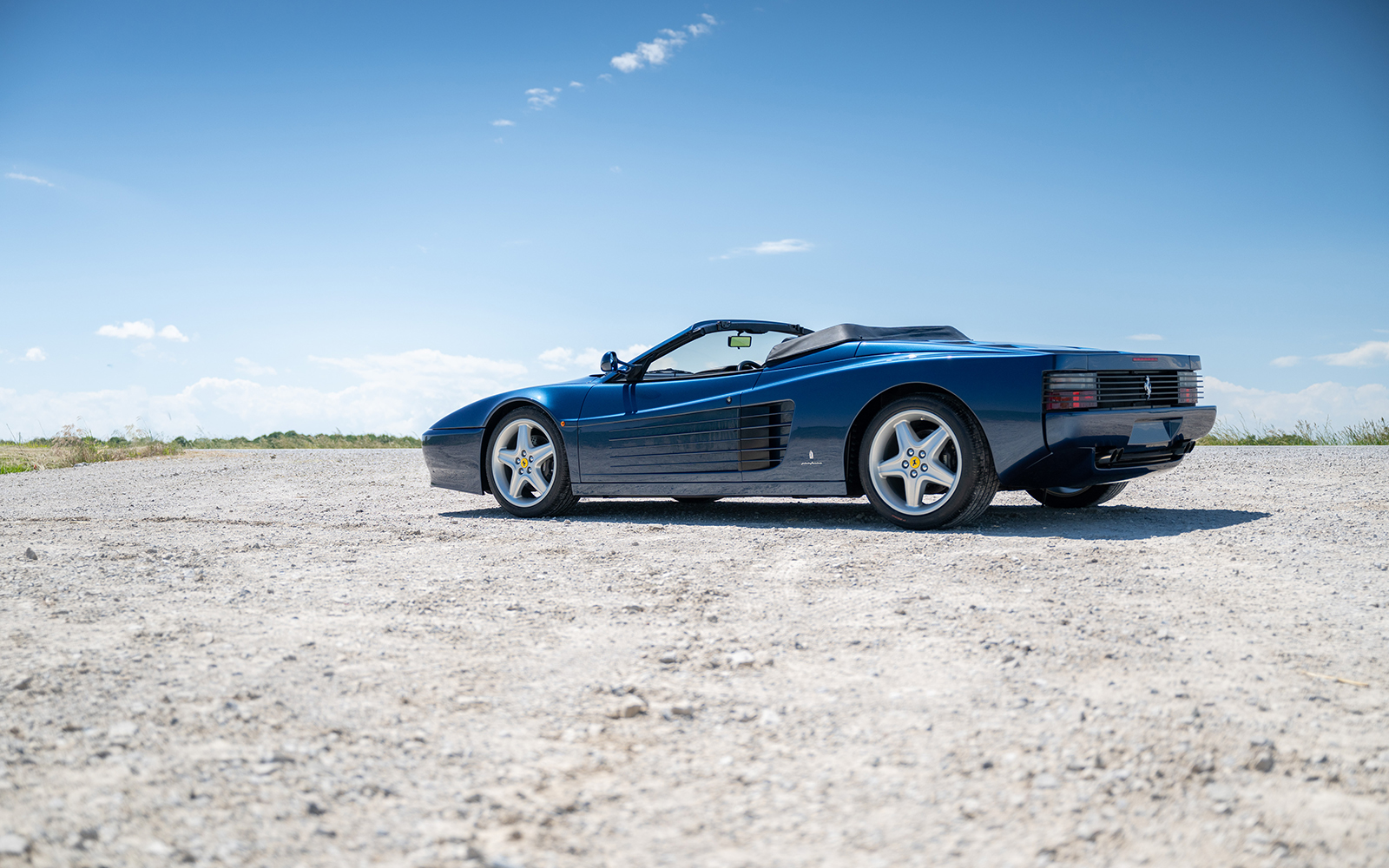
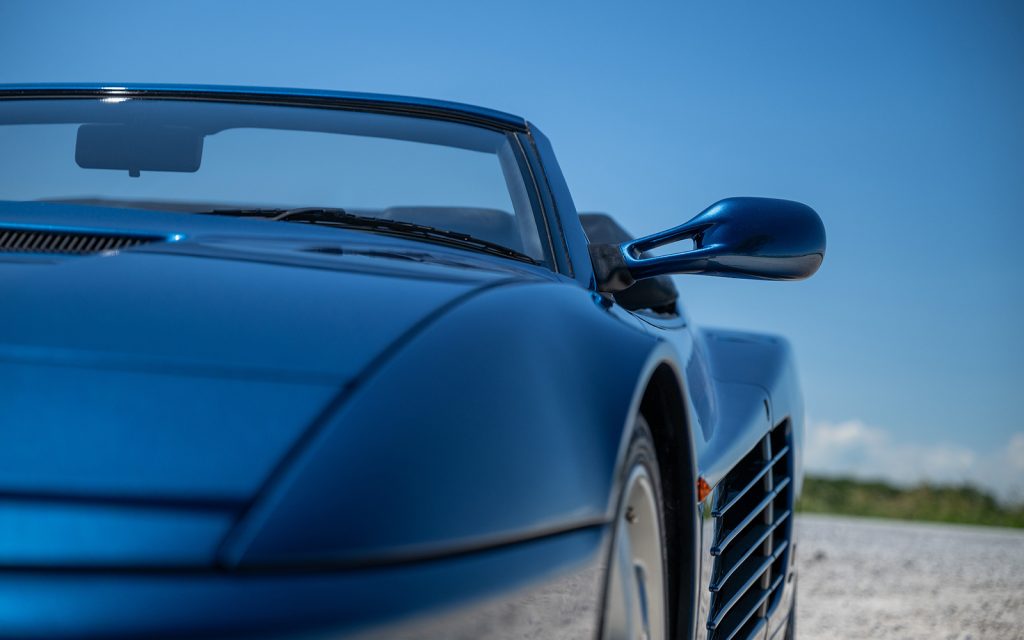
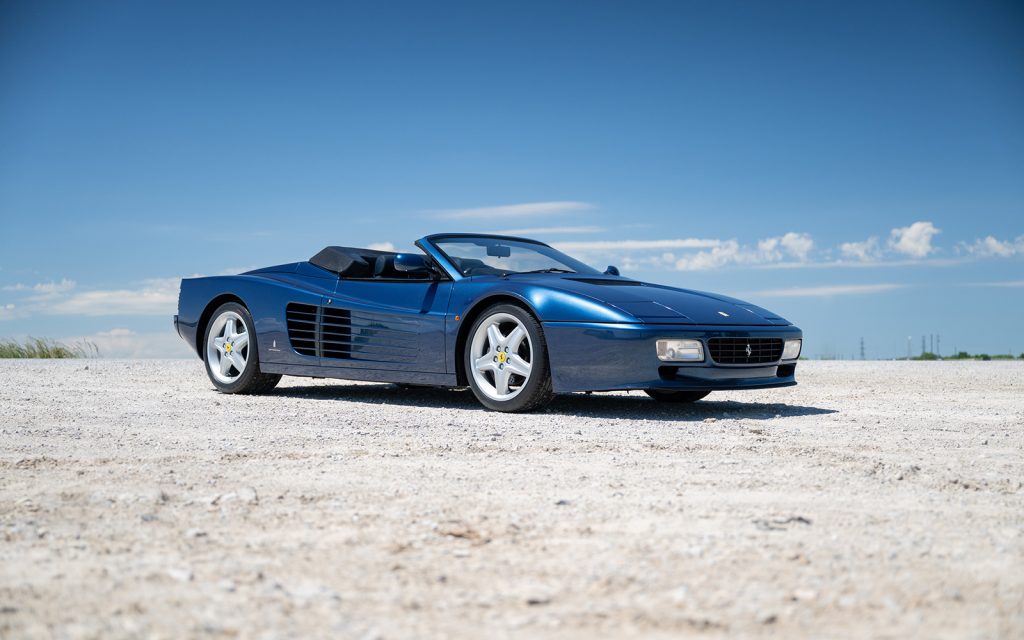
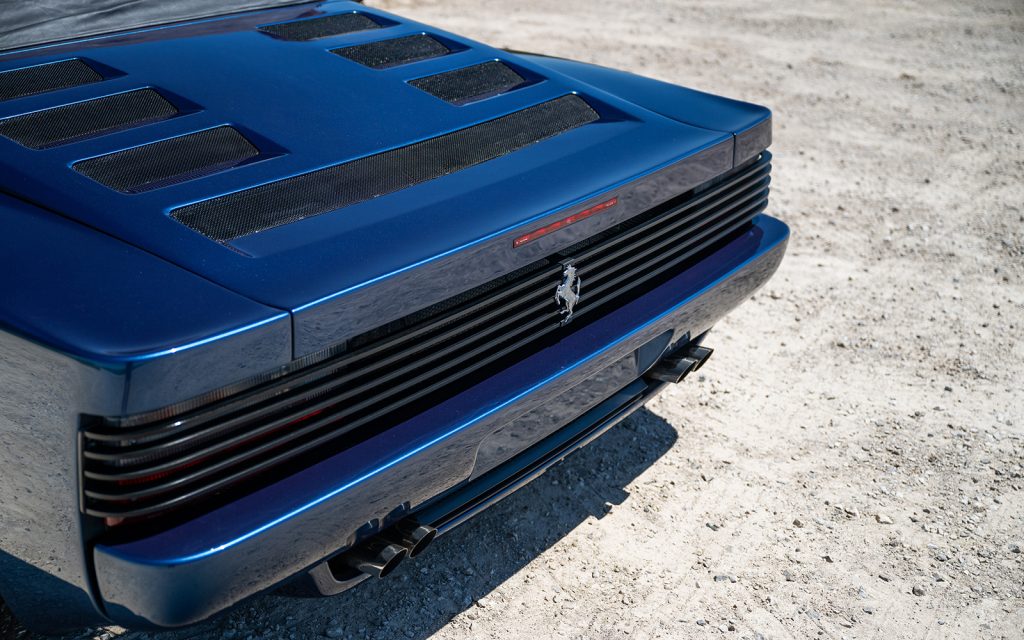
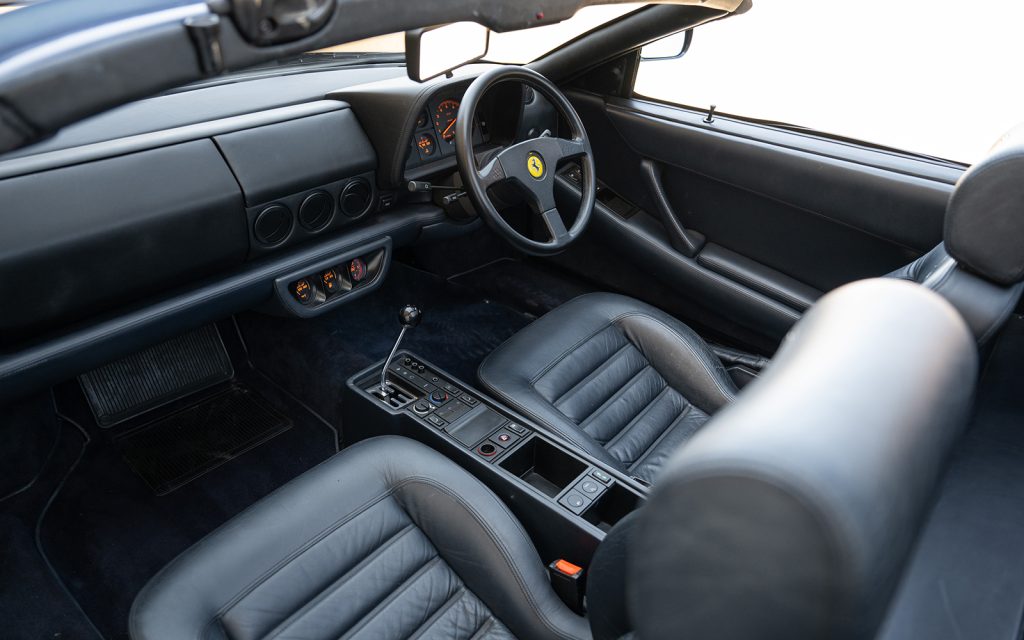
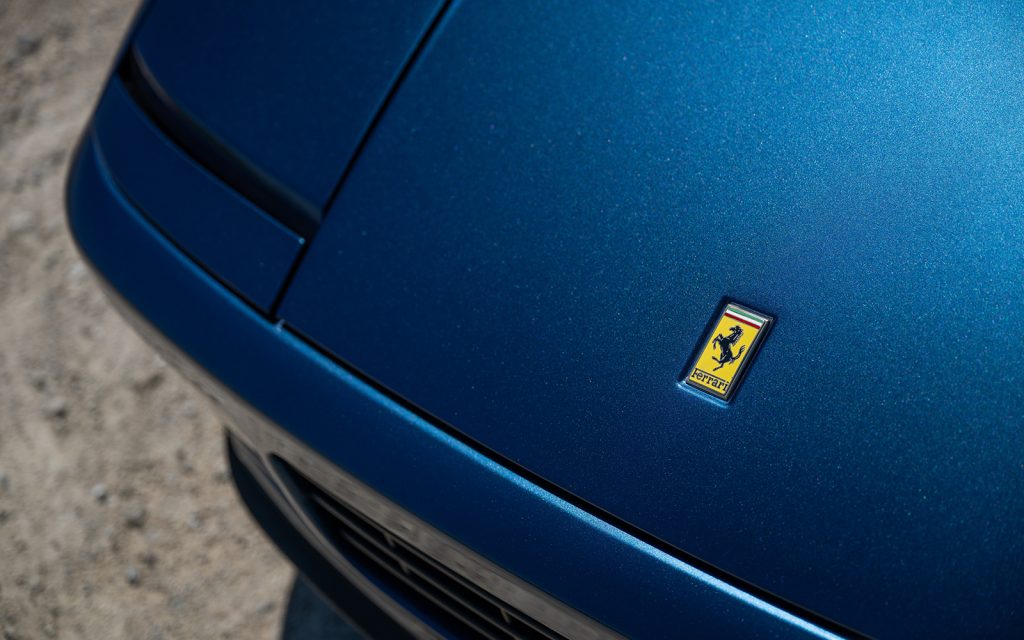
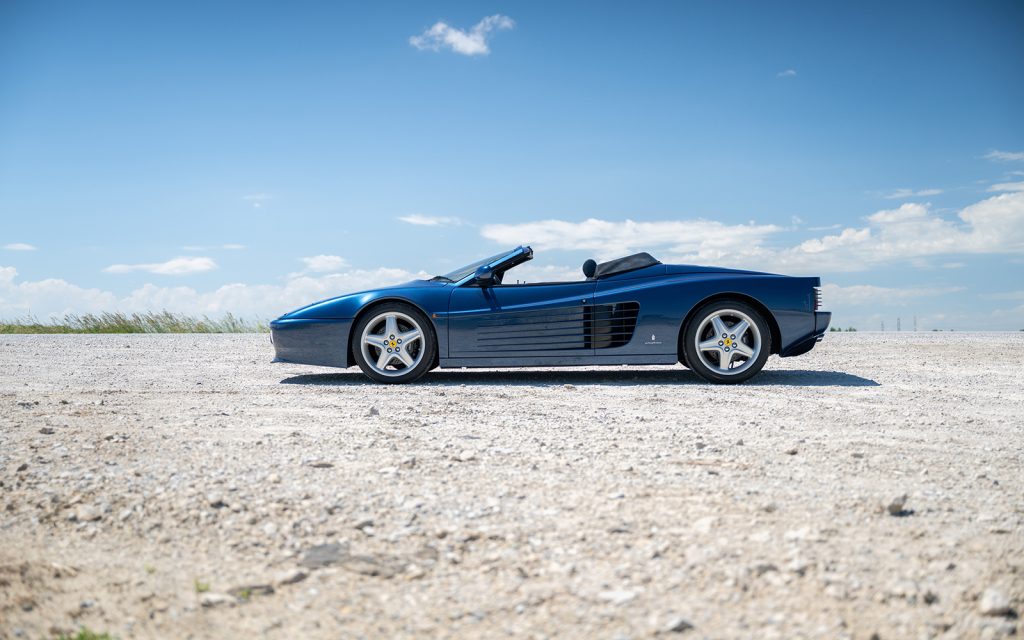
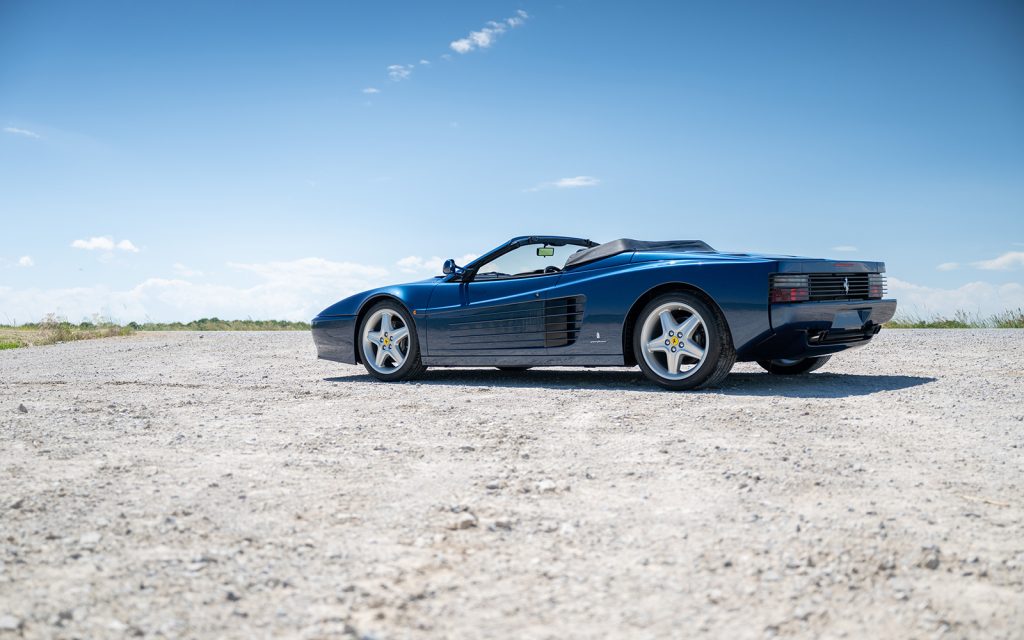
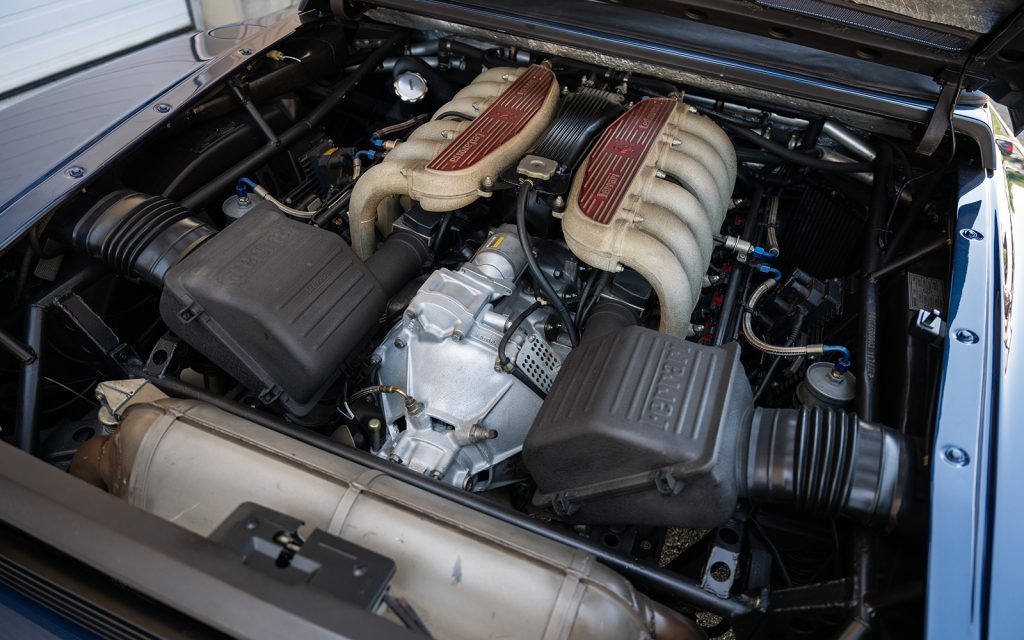
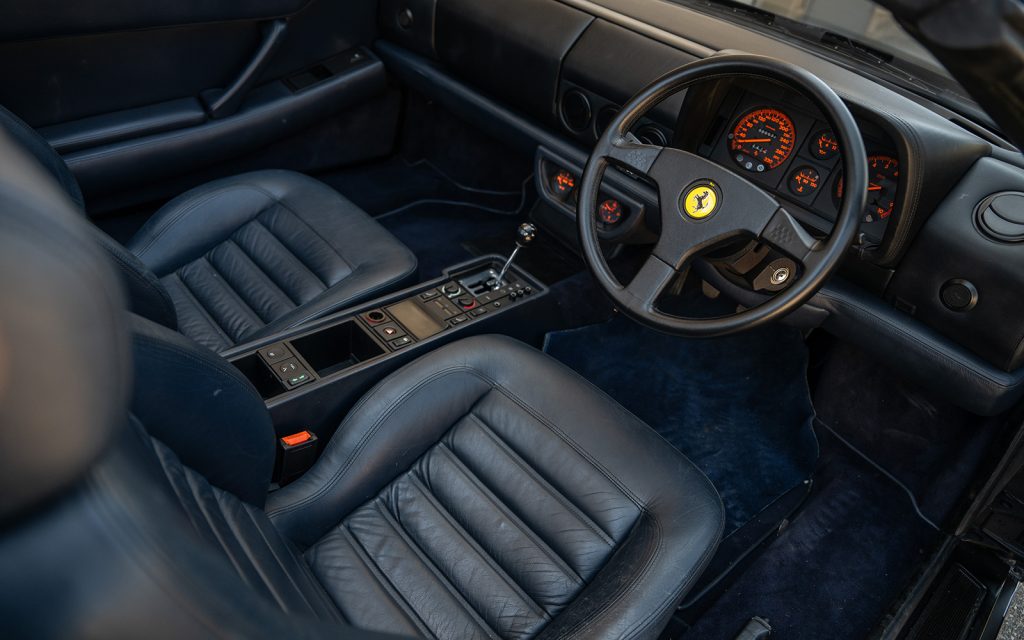
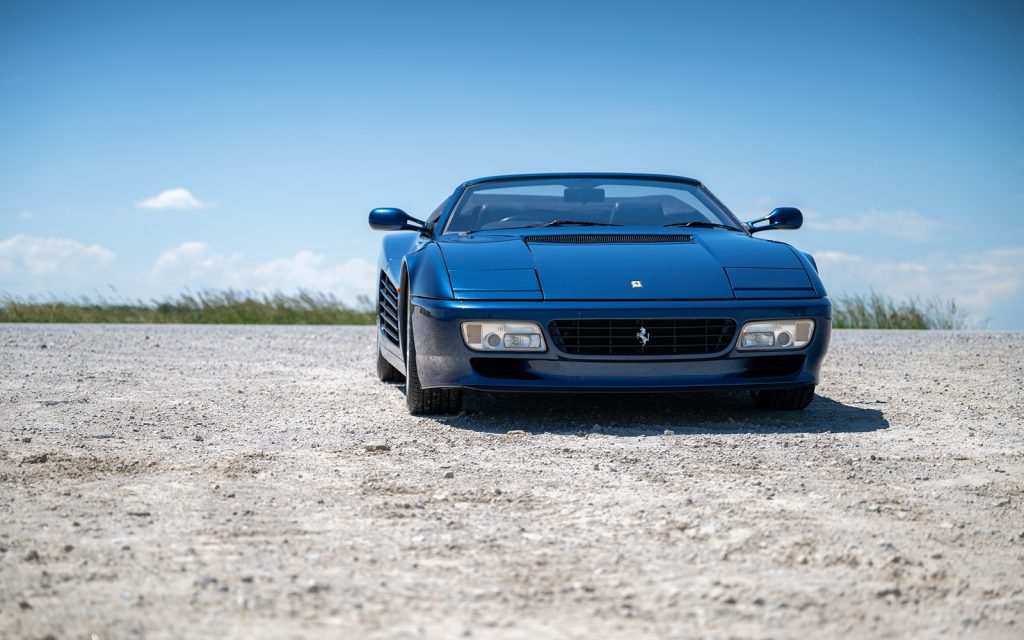
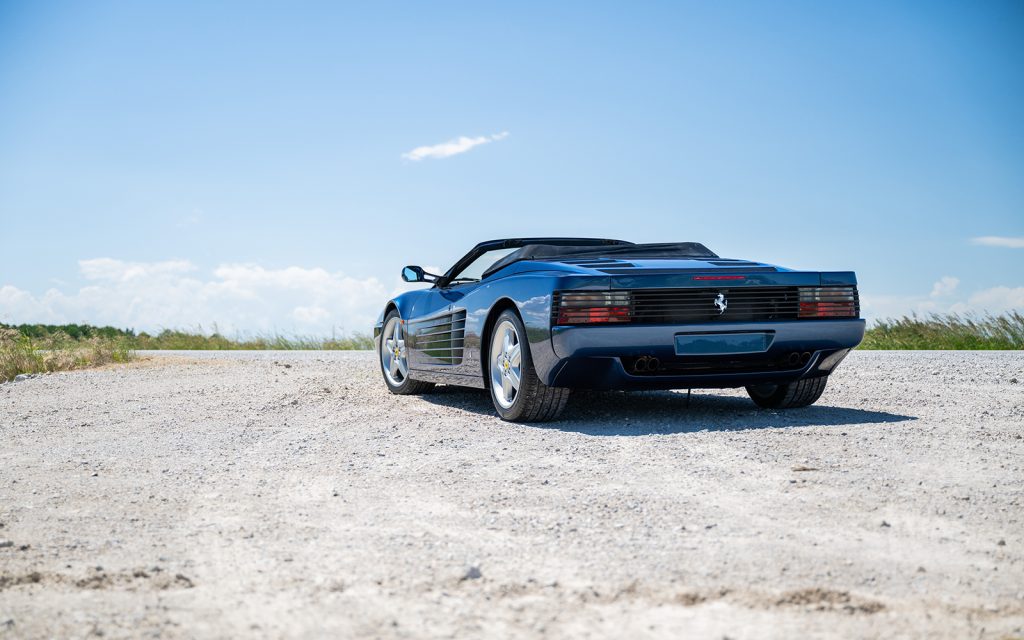
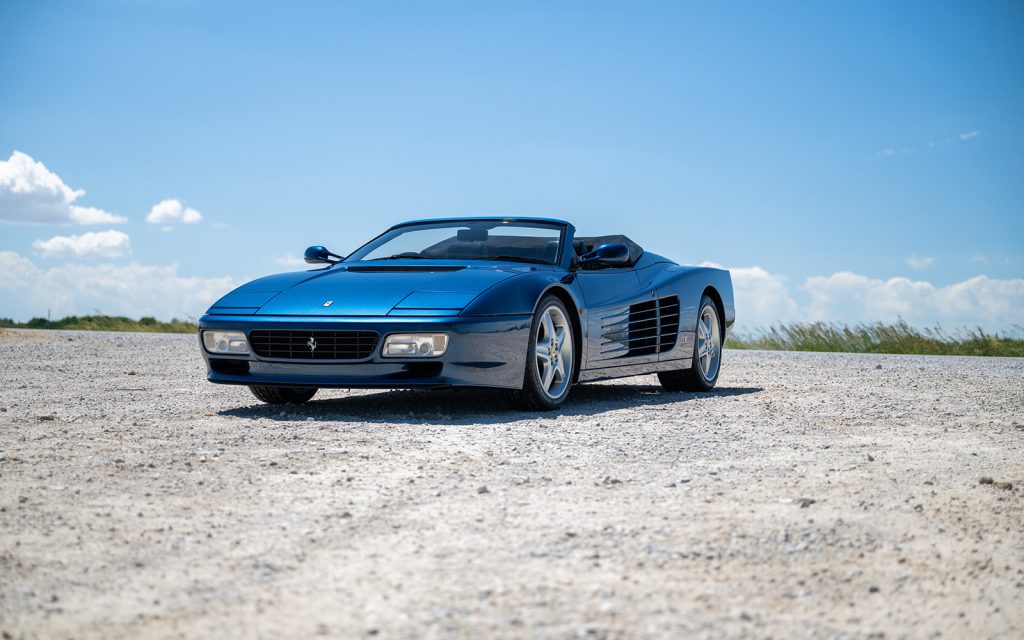
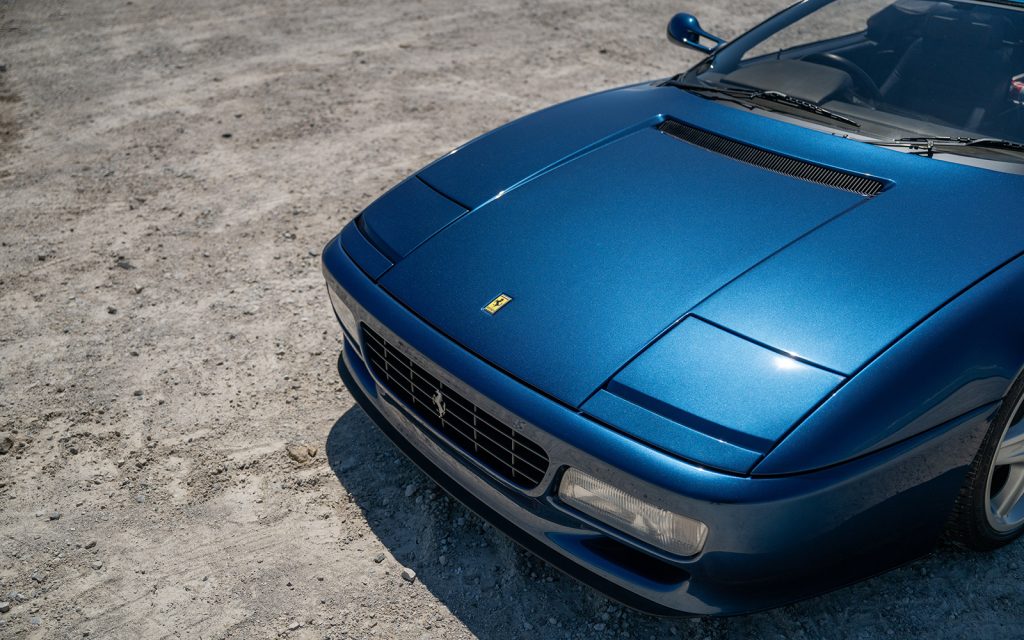
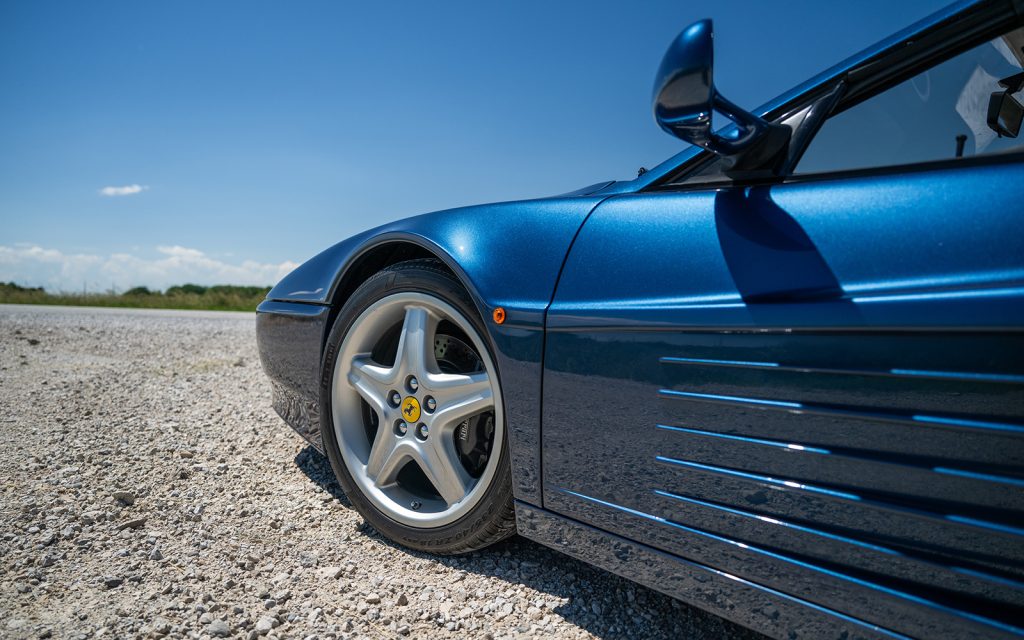
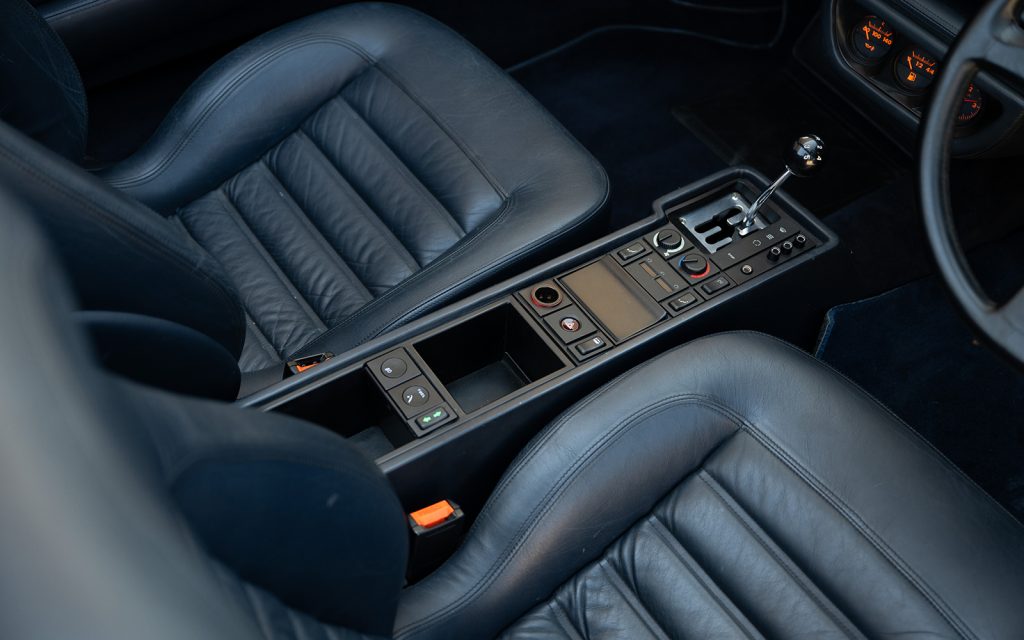
One car amidst the gaggle of Monterey Car Week auctions must certainly be this 1993 Ferrari 512 TR, one of just two Spyder conversions produced by Pininfarina in period for the royal family of Brunei. Finished in triple blue (Blue Cobalto paint, Blue Scar Connolly leather and blue soft top), the car marks a highly unique specification for an even more unique car.
We’ll post the full description from RM Sotheby’s below, while you can find more photos, documentation, details on the sale and more over on RM Sotheby’s website.
Monterey 2024: 1993 Ferrari 512 TR Spyder by Pininfarina
One of only two 512 TR conversions commissioned from Pininfarina by Ferrari, intended for the Royal Family of Brunei
The sole example finished in this stunning “triple blue” color combination
Powered by its matching-numbers 4.9-liter flat-12 engine and five-speed gearbox
Currently indicates fewer than 575 km (~360 miles) at time of cataloguing
Recently treated to $65,000 of cosmetic recommissioning by the eight-time Pebble Beach Concours-winning team at RM Auto Restoration; refinished in its original color and fitted with a new convertible top
Addendum: Please note that an import duty of 2.5% of the purchase price is payable on this lot if the buyer is a resident of the United States.
If asked to close your eyes and conjure the image of an 1980s Maranello model, your mind is likely to produce a visage of side-straked majesty in the form of a Ferrari Testarossa. It is a model intrinsically wedded to the decade of its introduction. Everyone from teenagers lusting over bedroom-wall posters, to captains of industry catching a glimpse of their reflection in glass-fronted offices—none could help fawning over this most Ferrari of Ferraris.
Arguably Ferrari’s hit car of the 1980s, the Testarossa was approaching its sixth year of production in 1990, and Maranello’s design team sought to update the iconic model for the coming decade. Returning to numeric nomenclature, its successor was dubbed the Ferrari 512 TR, with “5” representing the cubic capacity of the engine, “12” the number of cylinders, and “TR” standing for Testarossa. The 512 TR shared many similarities with its predecessor, but it was expertly tweaked by Ferrari both in terms of styling and engineering.
The marketing power of its 1980s dream machine had not diminished just because the decade rolled over, either. The initial design simply needed a few minor nips and tucks to keep it cutting edge. The most recognizable 512 TR addition was its front bumper, while other styling changes included a revised set of rear lights and new 18-inch alloy wheels. Numerous interior updates were needed to pass over the 1980s aesthetic baton to the 1990s, but the 512 TR’s most significant improvements were carried out upon its chassis and mechanicals.
The new model’s chassis was revised to allow both engine and transmission to sit 30 millimeters lower, improving the car’s center of gravity. While the displacement of the 512 TR’s inherited flat-12-cylinder engine remained the same as the Testarossa’s at 4,943 cubic centimeters, its power had been increased—due to a higher compression ratio, revised porting and inlets, bigger valves, as well as new Bosch Motronic M2.7 management—to a highly respectable 428 brake horsepower.
But perhaps the most warmly received of the 512 TR’s updates were those of its transmission—a prolonged complaint about the Testarossa—which was eased with a new single-plate clutch, sliding ball bearings, and better angle for the gearshift knob.
Yet despite all the improvements fitted to the iconic Testarossa model, some of Ferrari’s most discerning clients still required something more exclusive than the standard 512 TR.
‘APERTA, DUE POSTI, PER I REALI’
Given the right level of status—and the resources to back it up—Ferrari has always been willing to execute one-off coachbuilt commissions exclusively for its most important clients. This proud tradition goes back to the marque’s earliest days partnering with some of Italy’s finest carrozzerie and continues today with the Portfolio Coachbuilding Program at Ferrari’s Design Center. Behind doors which even the most astute of collectors may struggle to unlock, unique models considered too wild for mainstream manufacture are created; bespoke Ferrari projects straight from the imagination are brought to life.
But soaring high above even this rarified stratum of Ferrari VIPs exists the legendary domain of Brunei’s Royal Family, who commissioned not one or two custom Ferrari chassis, but multiple series of coachbuilt Ferrari models throughout the 1980s and 1990s. This outstanding 512 TR Spyder offered here is an exemplary specimen from one such series intended for Ferrari’s so-called “First Family.”
Throughout the 1980s and early 1990s, Alfred Tan, the proprietor of Singapore’s Hong Seh Motors, handled orders and delivery of Ferraris for the Brunei Royal Family as the marque’s sole distributorship in Southeast Asia. Tan communicated specific orders directly to Maranello, and from Maranello to Grugliasco, where Pininfarina’s Special Projects Team turned dream into reality. According to Paolo Garella, the former Pininfarina Special Projects Manager, Pininfarina began taking orders from Brunei directly starting in 1994, making the 512 TR Spyder the last model commissioned through Hong Seh Motors.
Having previously completed a series of Testarossa Spyders for Brunei, a new 512 TR-based series seemed only a natural progression. Correspondence between Tan and Ferrari’s Maurizio Parlato (on file) confirms as much, and while Ferrari produced a scant 88 right-hand drive 512 TRs between 1992 and 1994, just two of them were forwarded to Pininfarina during the same period for conversion to the coachbuilt “aperta” design of an open-topped Spyder. To this end, Garella notes that the orders for these two 512 TR Spyders were indeed placed through Ferrari by Alfred Tan, and Ferrari then sent reinforced chassis to Pininfarina’s Special Projects team to finish the aperta conversion. Once the body conversion had been completed, these two special Spyder conversions were then shipped back to Ferrari in Maranello to fit the mechanical parts and interior tailoring.
An accompanying Ferrari Certificate of Origin and Production Data sheet confirms that this 512 Spyder was delivered new to Hong Seh Motors during June 1993 and clothed in the bespoke “triple blue” color combination of Blu Cobalto over Blu Scuro Connolly leather with matching carpets and power-operated soft top. It is the only such 512 TR Spyder executed in this color combination.
Interestingly, neither right-hand drive 512 TR Spyder was ever delivered to Brunei’s famous garages for unknown reasons, with this example retained by Alfred Tan in Singapore for his personal collection. In January 1997, Tan exhibited this 512 TR Spyder at Ferrari’s 50th Anniversary celebrations in Rome, and at that time the Scuderia Ferrari driver Gianni Morbidelli joined Tan’s son, Edward, in the car during their parade through the city.
Rarely displayed elsewhere during Tan’s 30 years of ownership, in November 2023 this special Pininfarina Spyder was purchased by the consignor and immediately submitted to more than $65,000 of cosmetic recommissioning by RM Auto Restorations. Invoices on file illustrate more than 500 man-hours were spent to bring this barely enjoyed coachbuilt Ferrari back to a perfect presentation. Notable line items include a full refinishing in its original Blu Cobalto paint, new Blu Scuro carpets, and new Blu Scuro power-operated soft top.
As presented today, this 512 TR Spyder indicates fewer than 575 kilometers (~360 miles) at cataloguing time. Chassis 97310 arguably presents the only opportunity to own a special limited-production aperta variant of the Ferrari 512 TR, with only two ordered by the Ferrari factory and this car’s sister chassis not currently available.
Long owned and cared-for by the man who helped create such a rare beauty, this coachbuilt Blu Cobalto example would be the centerpiece of any aficionado’s collection, sure to draw attention wherever it goes, be it concours lawns or open roads.
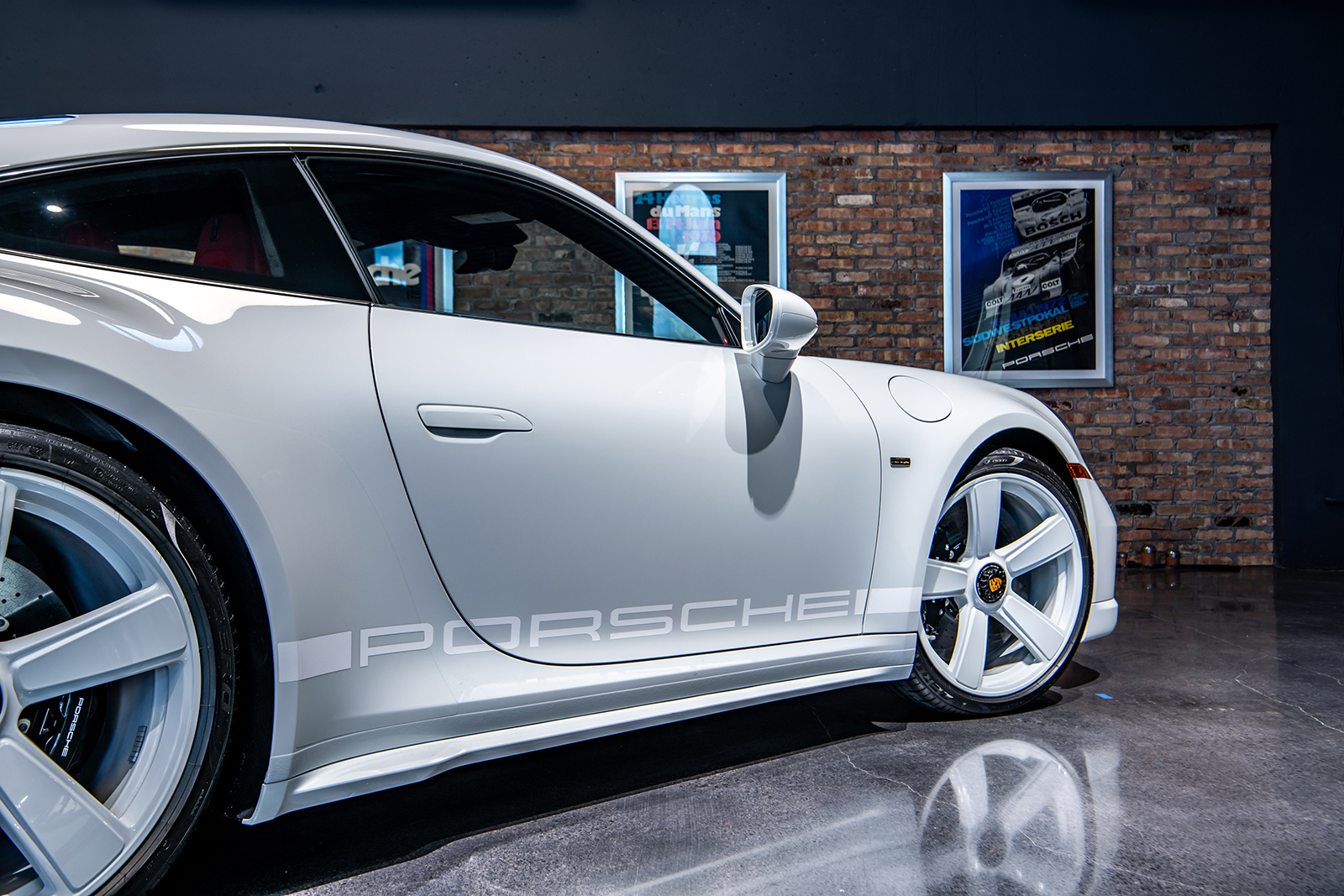
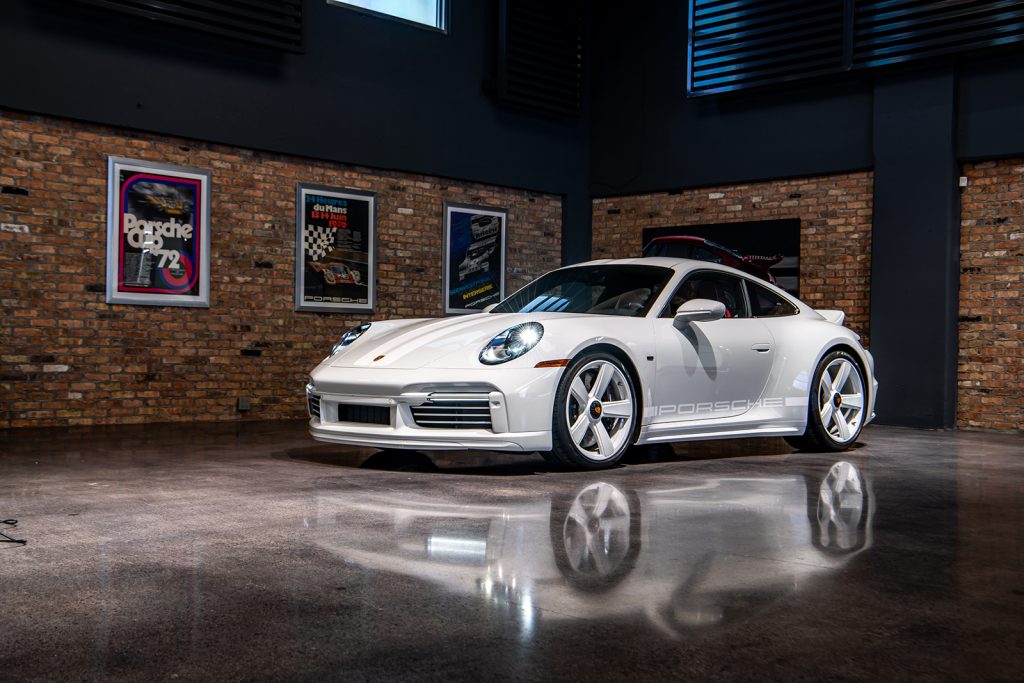
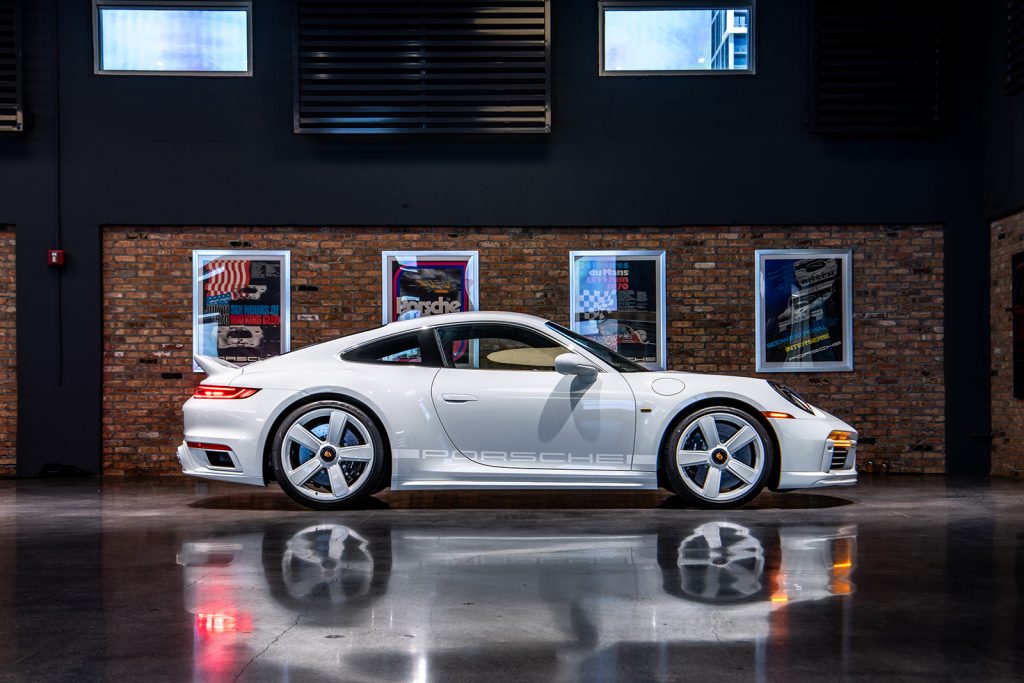
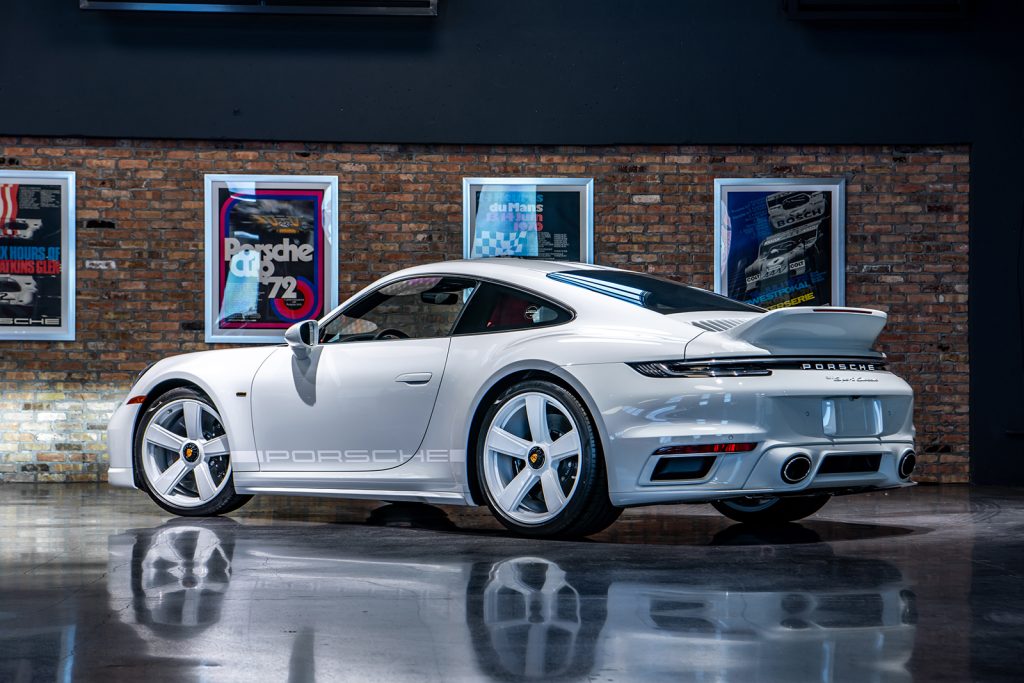
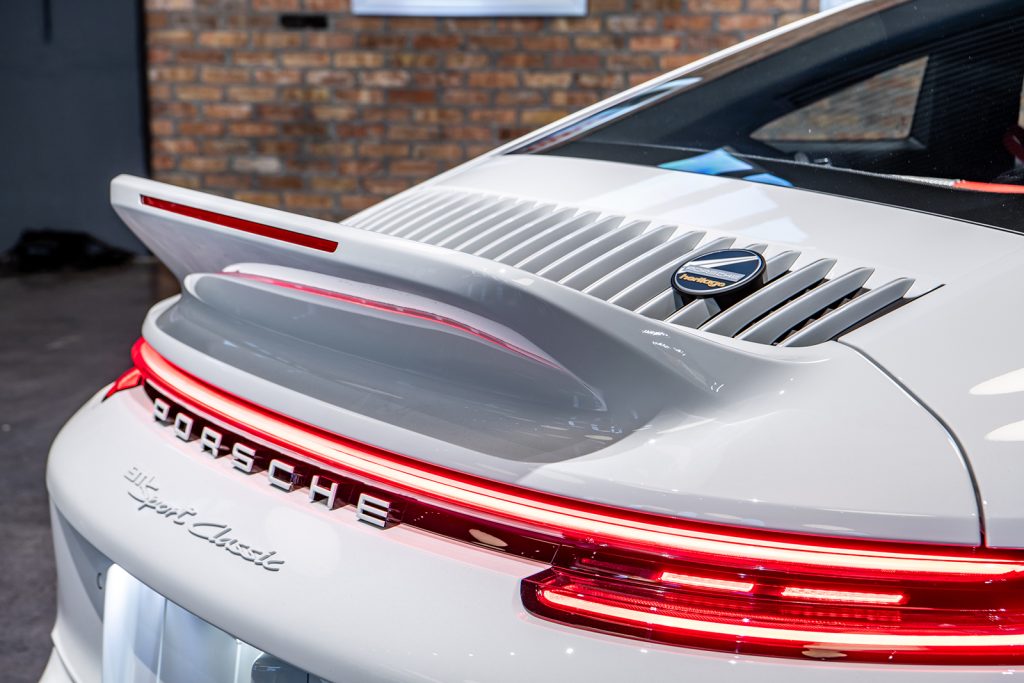
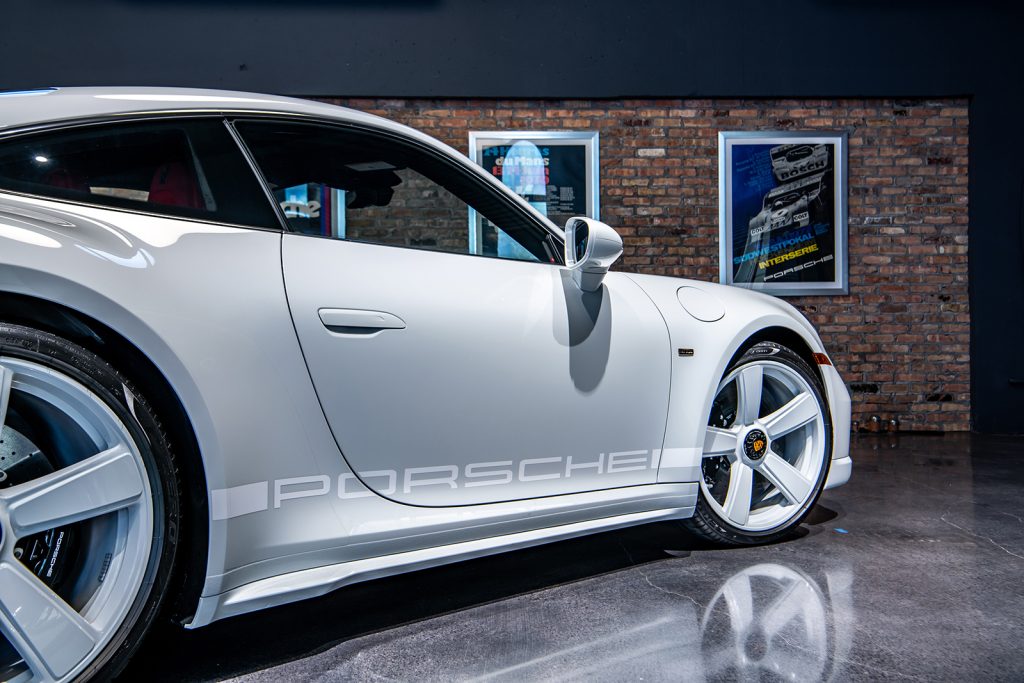
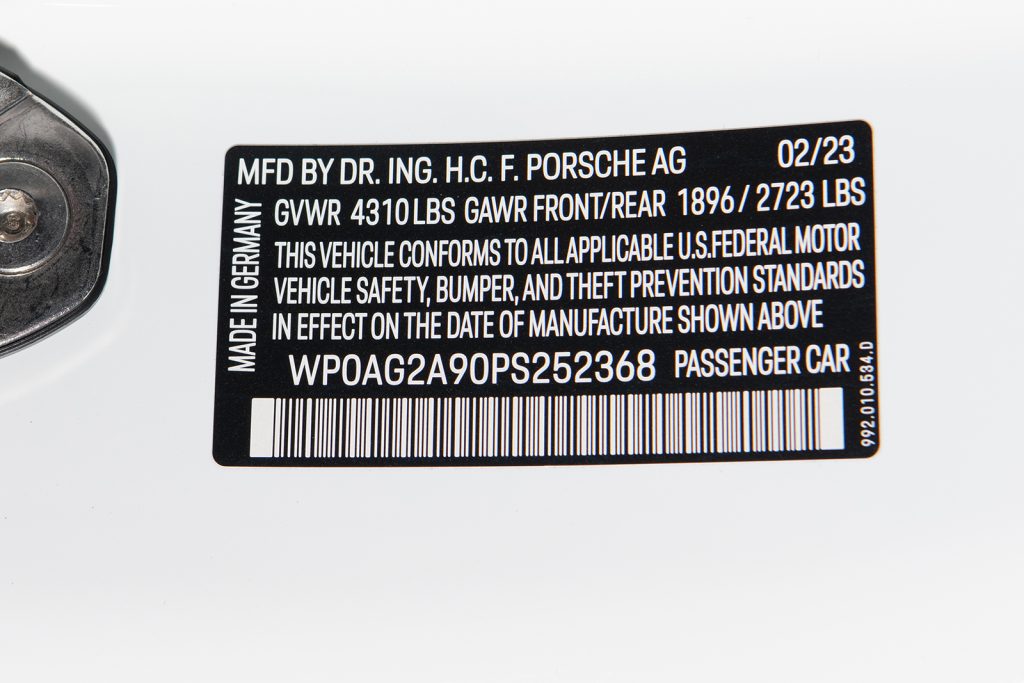
One tailored build headed for auction during Monterey Car Week 2024 is this very unique 2023 Porsche 911 Sport Classic (VIN: WP0AG2A90PS252368) being sold without reserve by RM Sotheby’s. Sold via Porsche North Houston, you may not be all that surprised looking at the spec that this 992 was built for the White Collection.
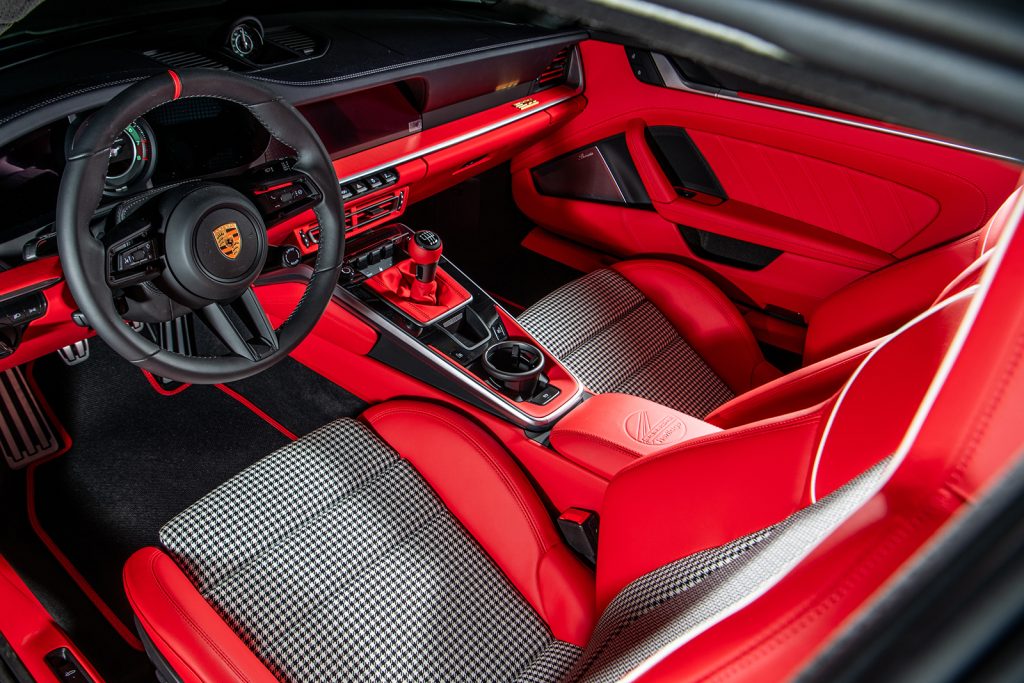
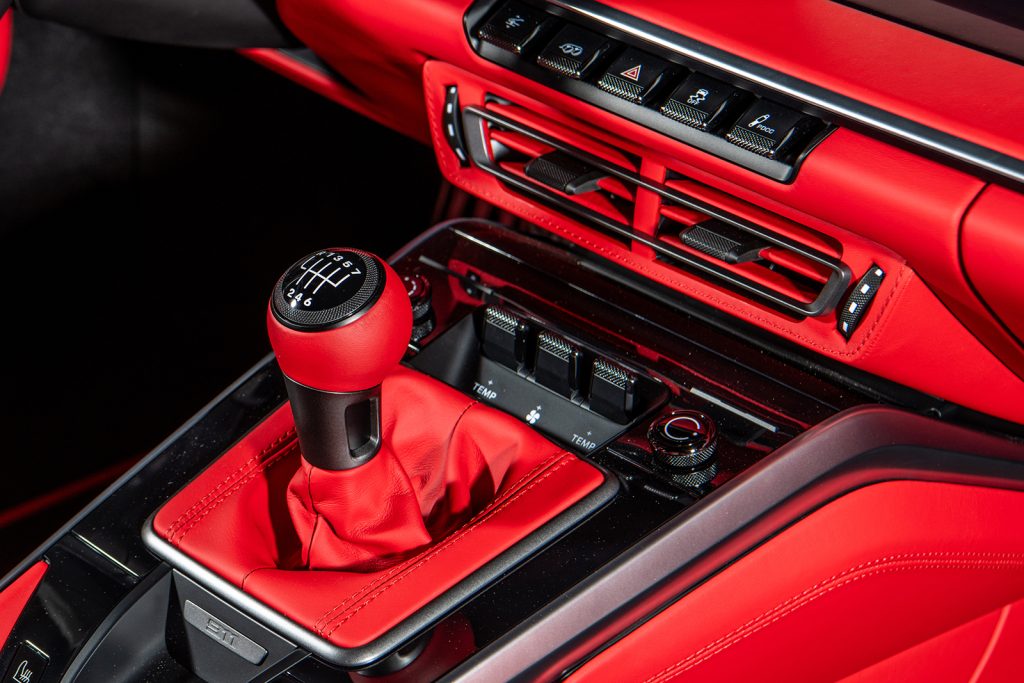
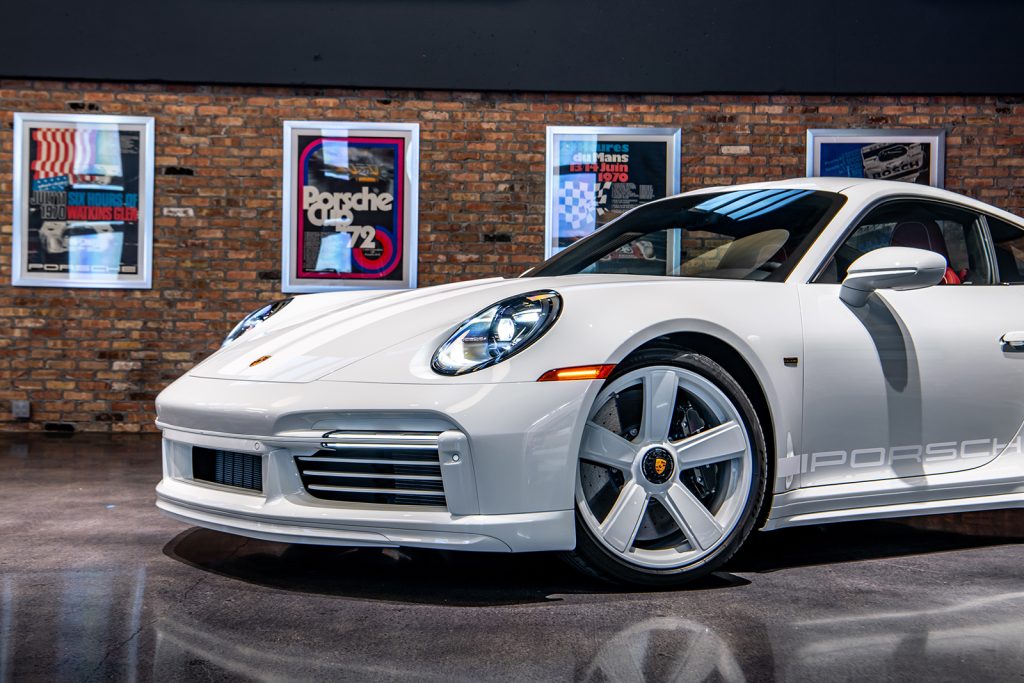
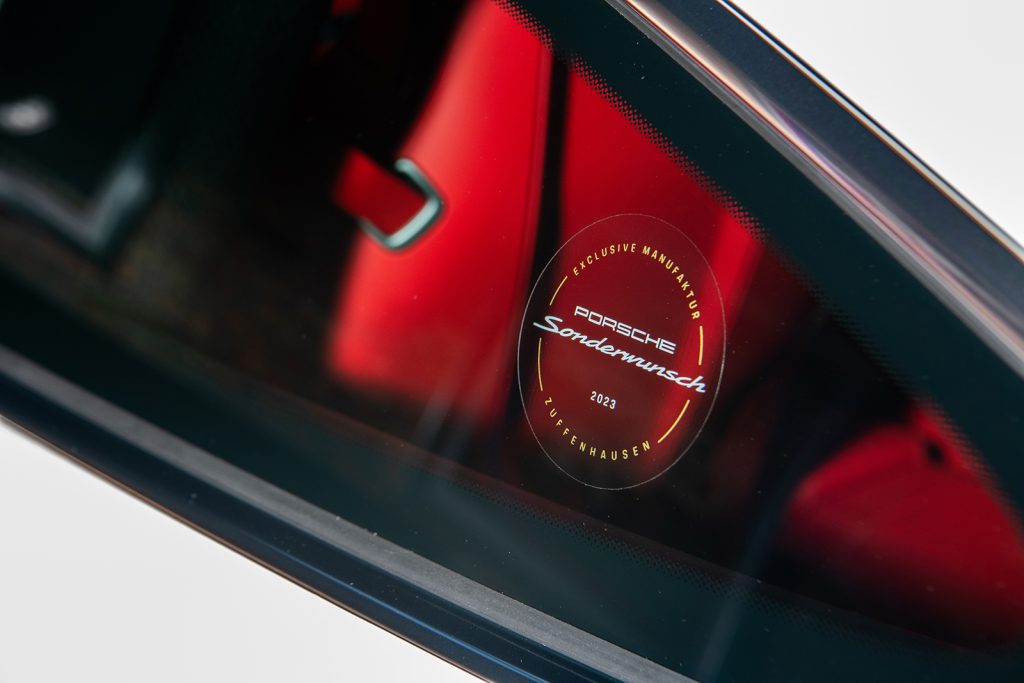
We’ve been unable to confirm the specific white, but the associated documents provided by RM do confirm the white that covers it is a Paint to Sample shade. It’s also worth noting that this car had plenty of Sonderwunsch factory commissioned modifications. These include many components color-matched white, and a striking red interior.
Below the gallery is a the full description provided by RM Sotheby’s. Find more photos and information on the car HERE.
EDITOR’S NOTE: We were unable to confirm this paint color during the writing of this story. If you know the color, please confirm it below in the comments or by direct messaging the author.
The most powerful Porsche Type 992 911 with a manual transmission
One of 1,250 examples produced
Delivered new to the White Collection
Extensively personalized with over $150,000 of Sonderwunsch Factory Commissioning, for a total new price of $448,535
Presented in virtually as-new condition with fewer than 77 miles on the odometer at the time of cataloguing
With so many iconic cars and significant achievements throughout the past 75 years, Porsche rightfully celebrates the company’s heritage by offering its most dedicated followers limited-production models inspired by their most beloved and sought-after historical creations. Cars like the 911 R, the several generations of Speedsters, and the original Type 997 Sport Classic have all offered modern performance with a dash of vintage panache.
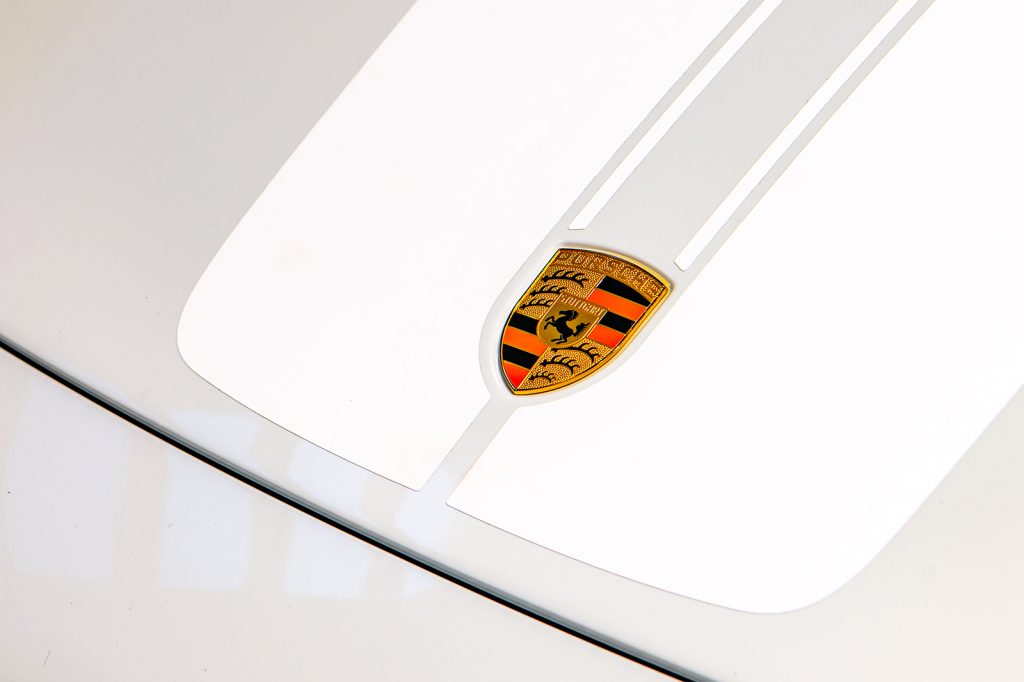
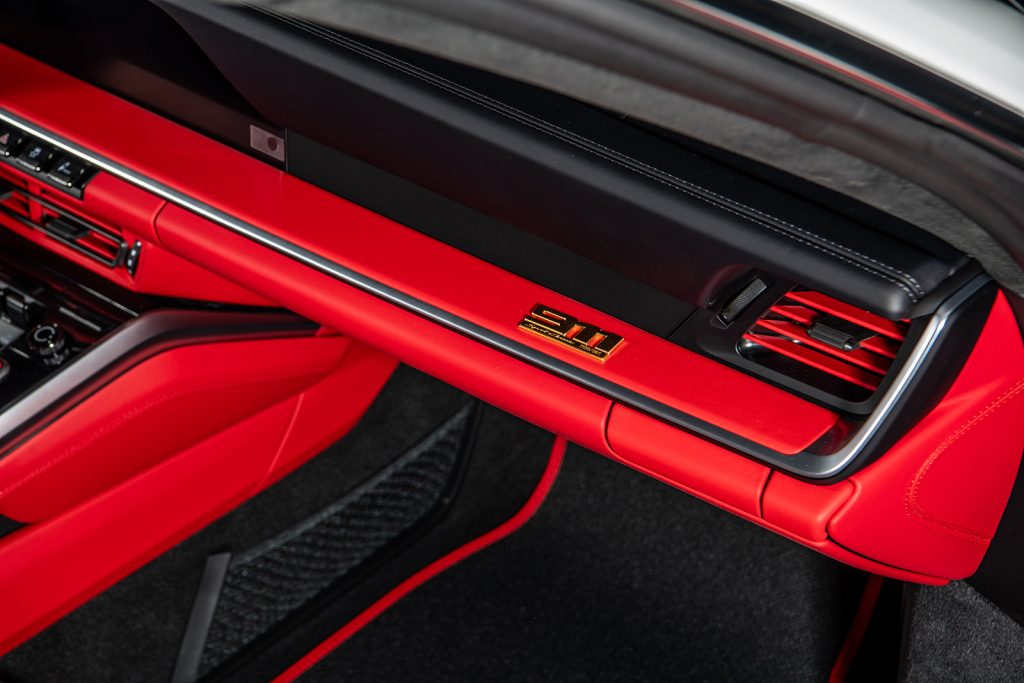
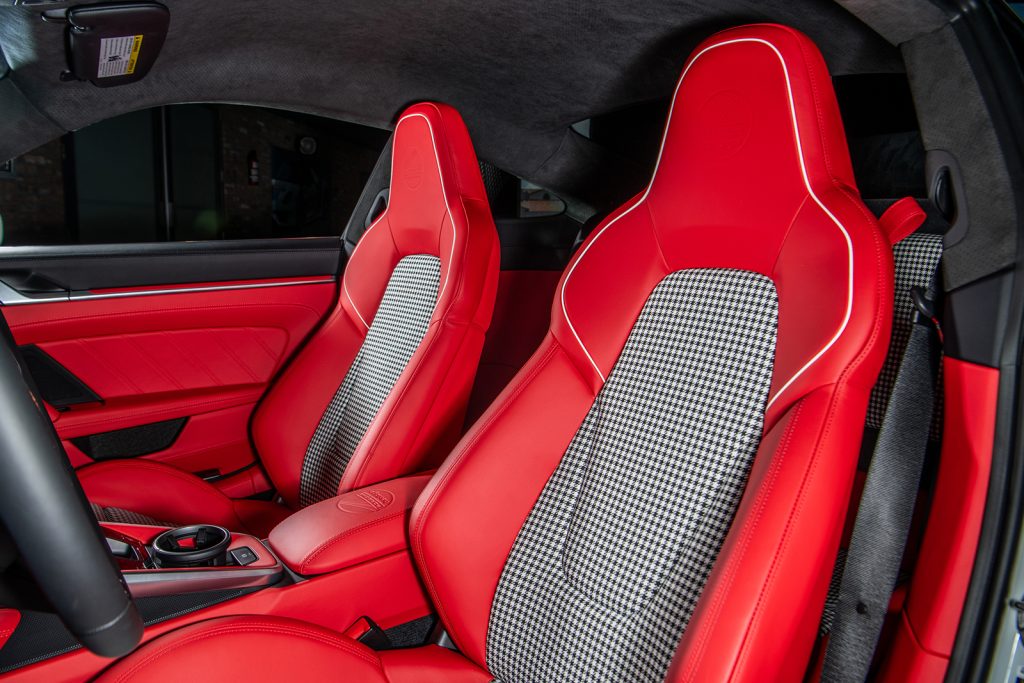
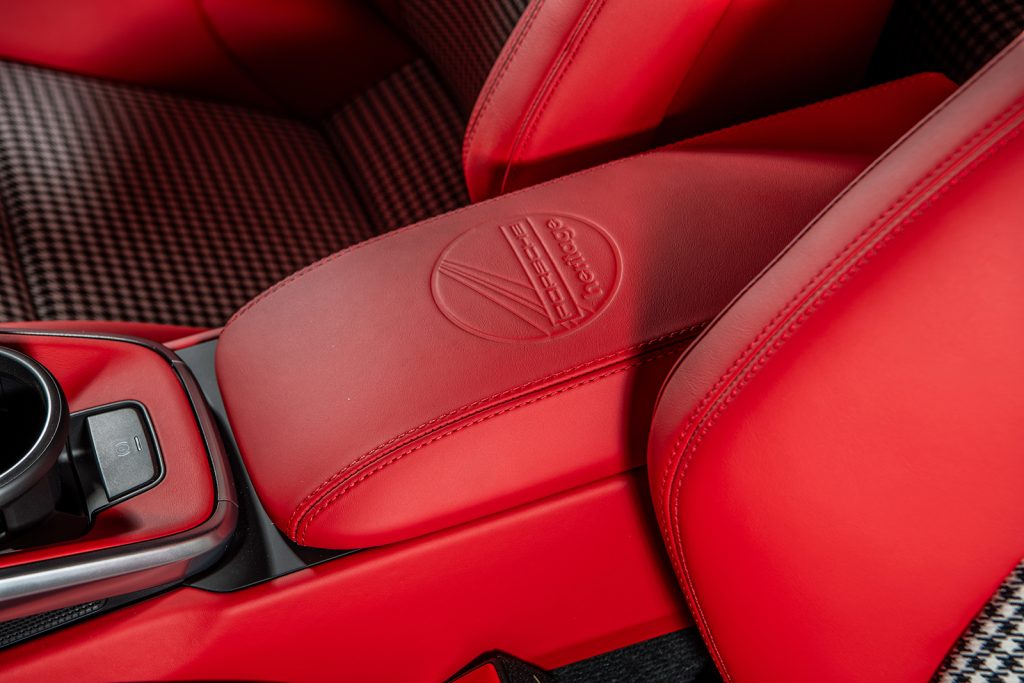
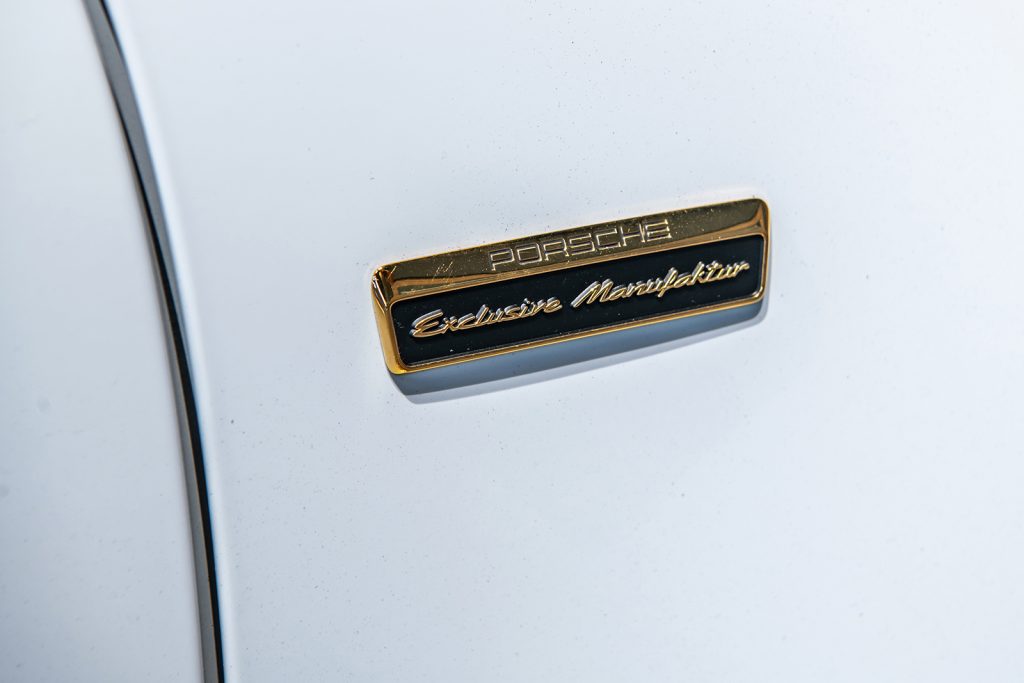
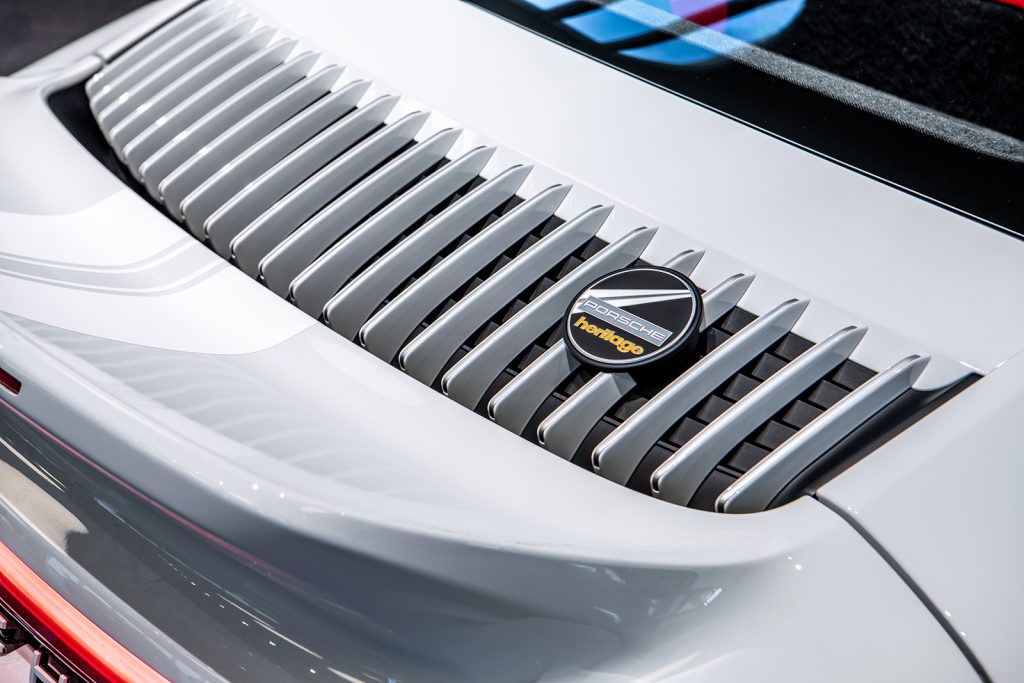
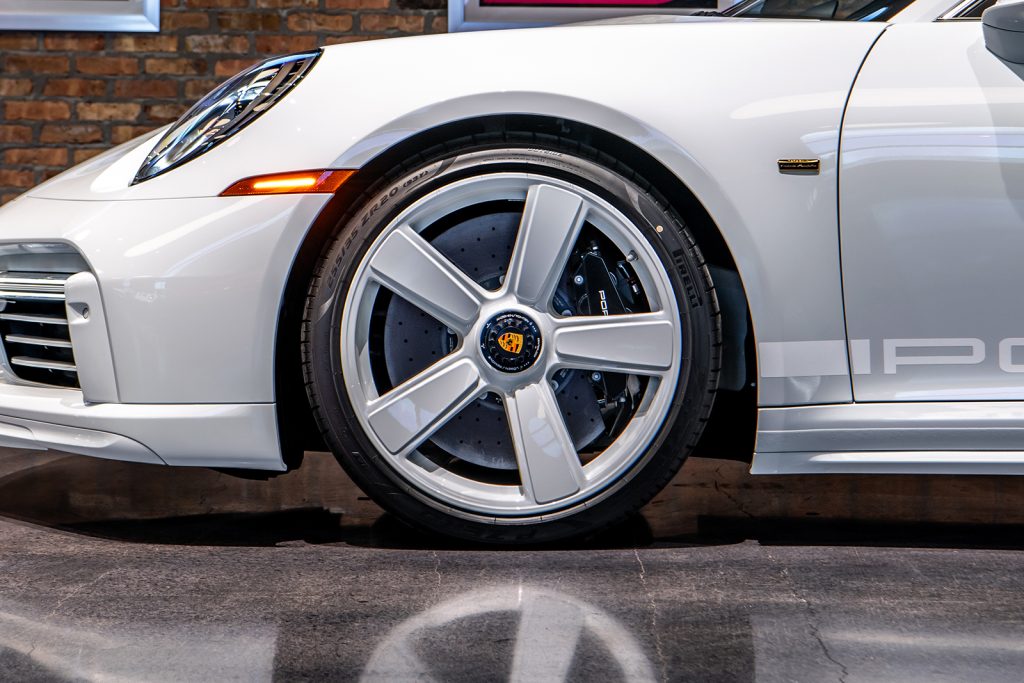
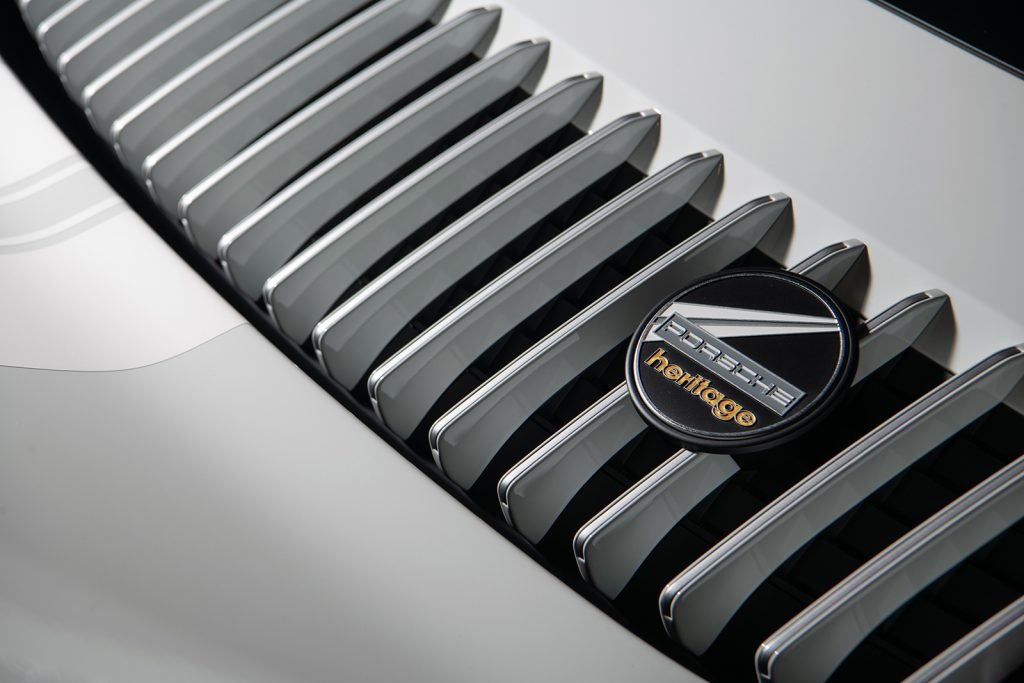
The latest iteration of the Sport Classic, now based on the Type 992 platform, presents a “greatest hits” collection of the most established Porsche design features wrapped around one of the most potent and engaging drivetrains ever fitted to a 911. This limited-edition model is easily identified by the 2.7 RS-inspired duck tail spoiler and Fuchs-style wheels on all four corners. Keener observers will note the double-bubble carbon fiber roof, gold-color badging, and a Porsche shield featuring the early-style bright red element of the Württemberg crest. Twin stripes streak across the hood, roof, and tail, further alluding to the firm’s immense racing history. The interior is covered with plenty of leather, distinctive houndstooth cloth on the doors and seat inserts, and green-accented instrumentation for a 1960s atmosphere. Lastly, a badge on the dashboard notes the serial number of each Sport Classic.
Utilizing the Turbo widebody and engine platform, the Sport Classic is the most powerful rear-wheel drive 911 of this generation so far. The twin-turbocharged 3.7-liter flat-six engine produces a whopping 542 horsepower, and while mildly detuned from its four-wheel drive brethren, this reduction has allowed for the option of a manual transmission (much to the delight of enthusiasts). The chassis is additionally fitted with carbon ceramic brakes, Porsche Dynamic Chassis Control, rear steering, Porsche Active Suspension Management, and a specially tuned exhaust as standard.
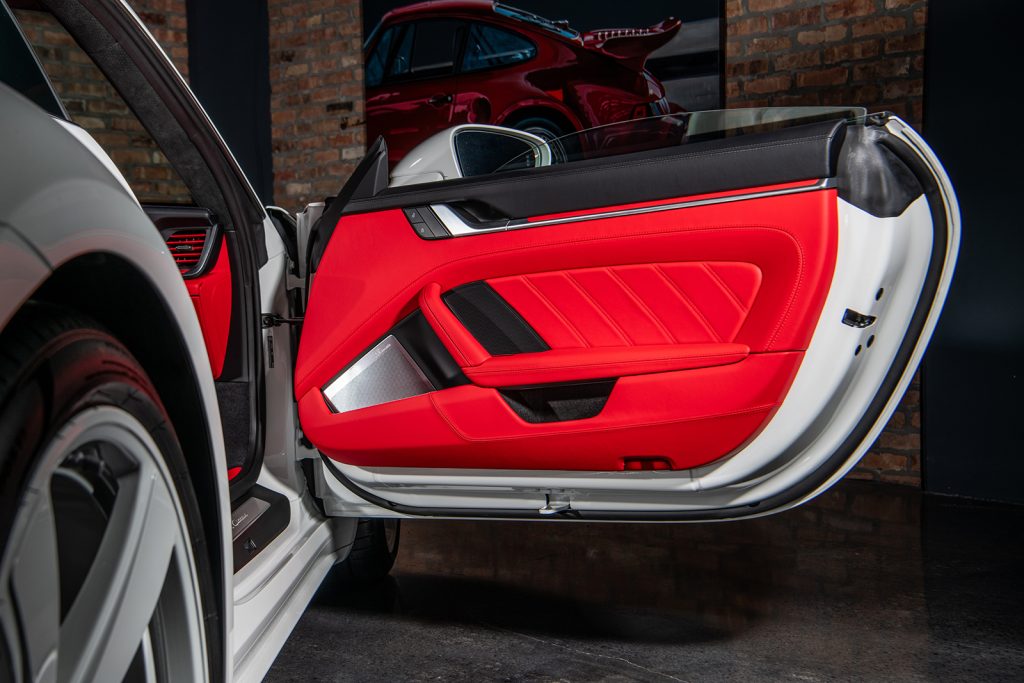
On offer is serial number 0923 of the 1,250 Sport Classics offered worldwide. An immensely special machine already, this example stands above its siblings courtesy of over $150,000 worth of Sonderwunsch Factory Commissioning. As shown on the CXX option sheet on file, the exterior is finished almost entirely in White, from the front-end air intakes to the wheels and around to the lower rear valance. Only matte white stripes and black wheel center locks provide contrast to this snowy exterior treatment. Alternatively, the sanguine interior features leather across most visible surfaces in a display of supreme luxury and customization. The air vents, center tunnel, knee pads, front trunk, rear side panels, lower dashboard, inner door sill guards, and even the owner’s manual wallet are all finished in Can Can Red hides. Houndstooth joins the mix on the door cards, seat inserts, and trunk pouch. The summation of this custom tailoring has resulted in a truly exquisite example of such a special Porsche.
Delivered new to the legendary White Collection, the 911 subsequently traded hands and today presents with fewer than 77 miles on the odometer at the time of cataloging. Thanks to this limited use, the car presents in virtually as-new condition and will undoubtedly be a highlight of any serious collection for decades to come.
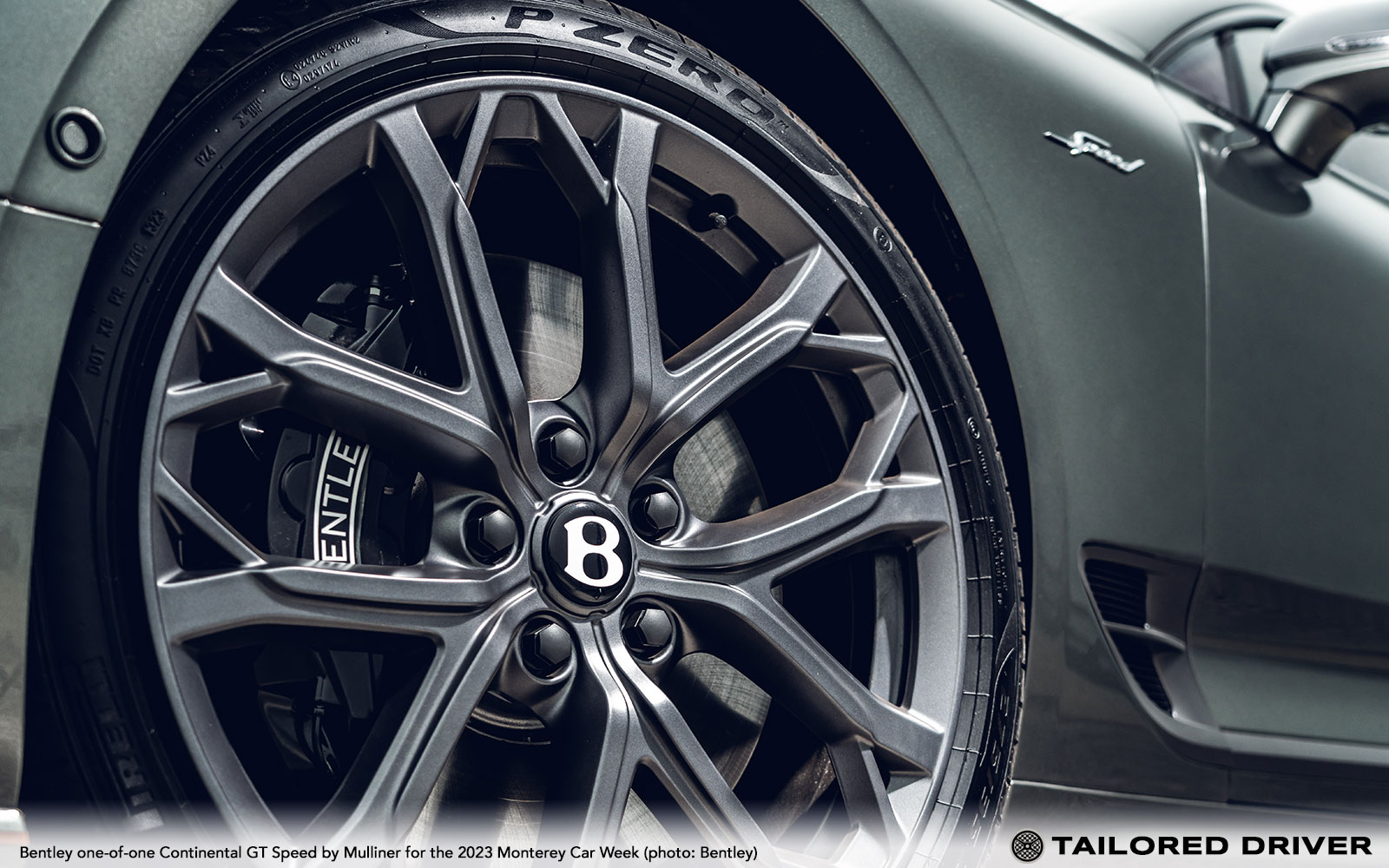
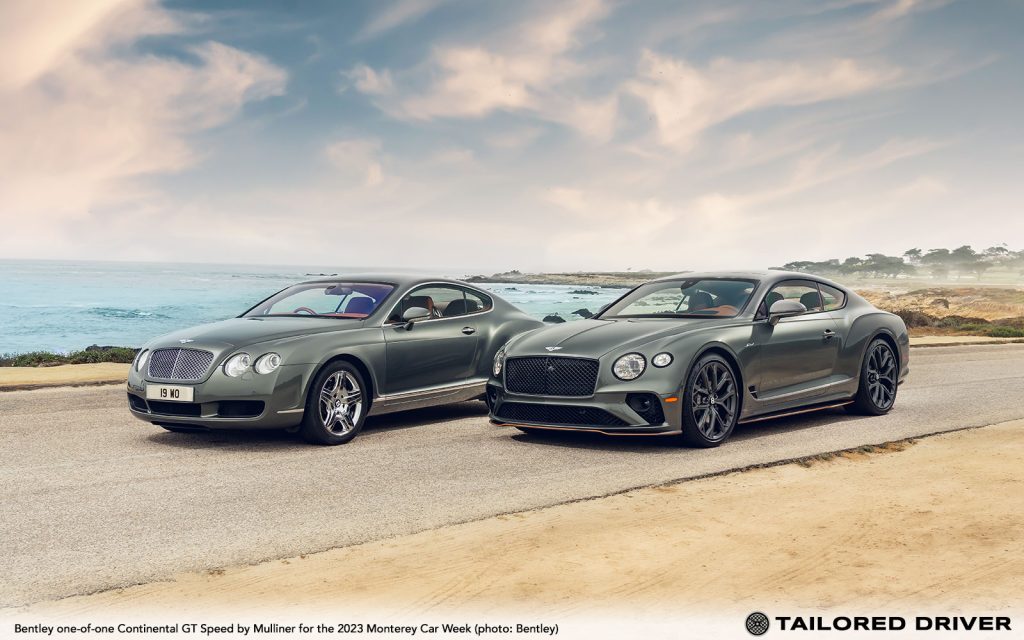
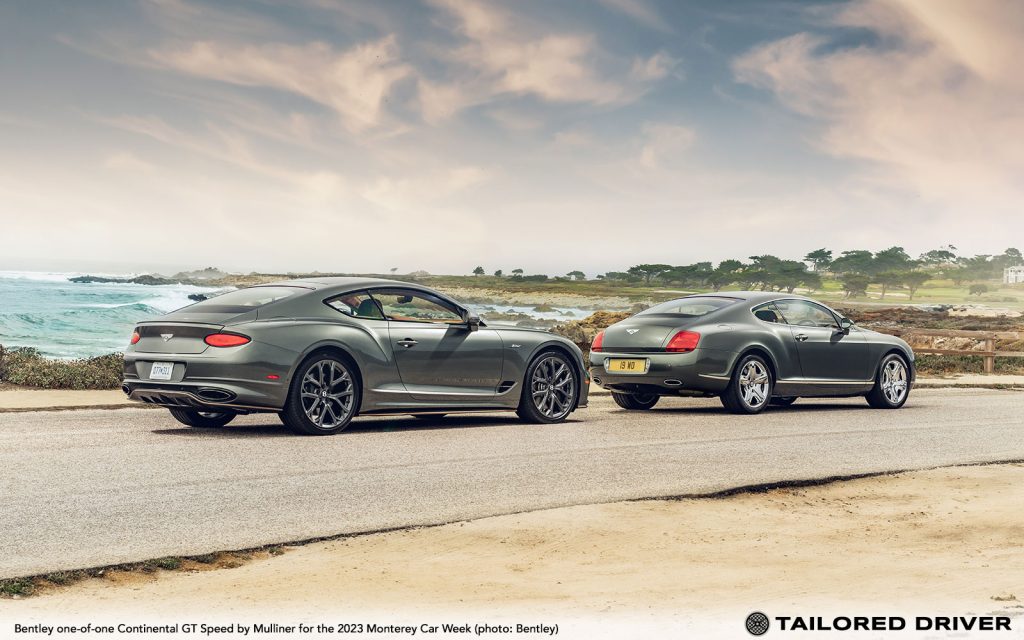
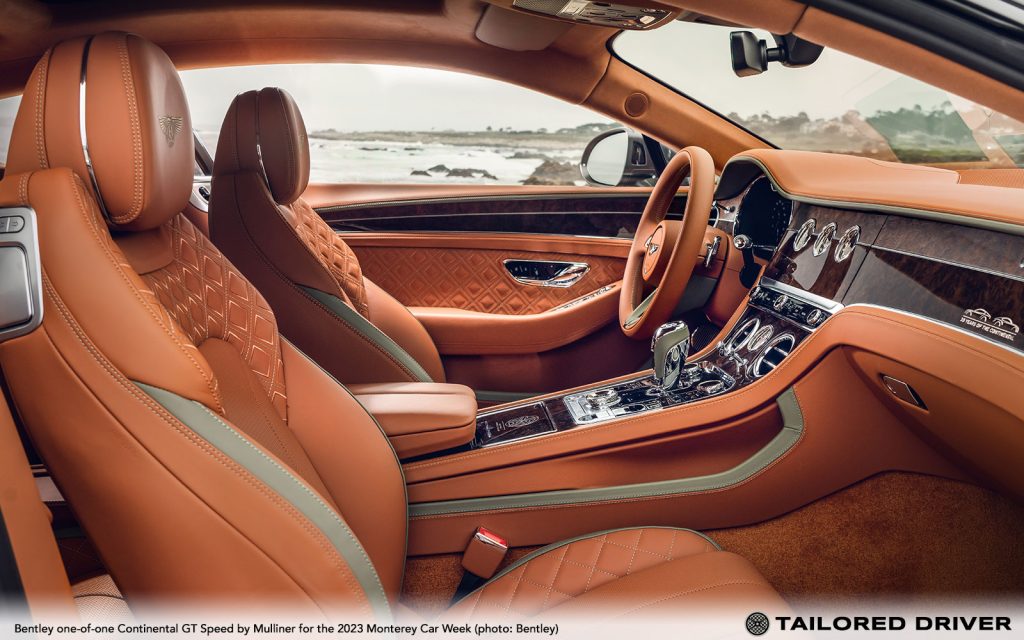
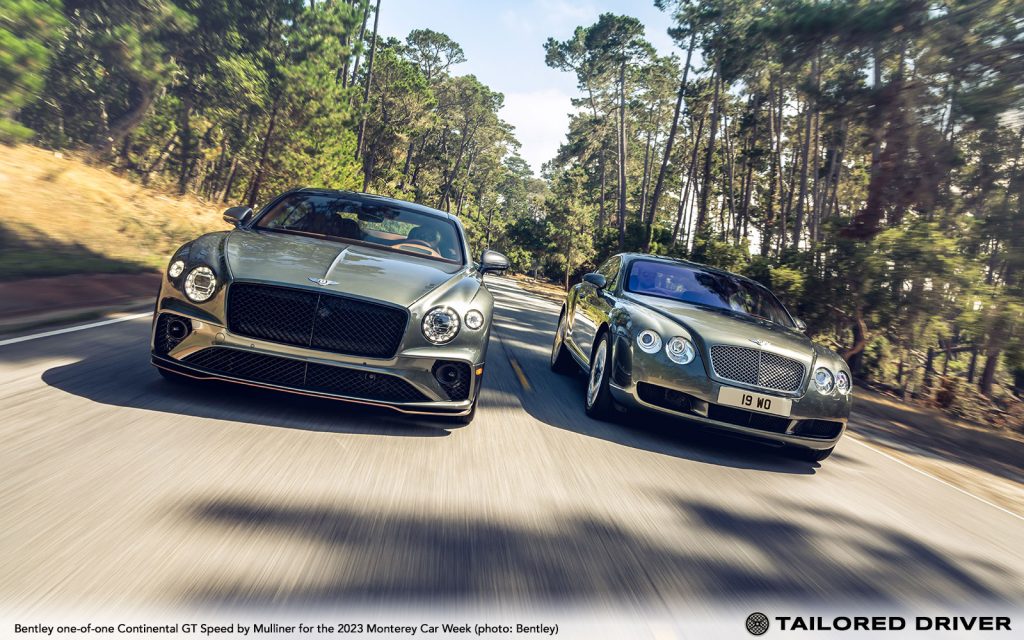
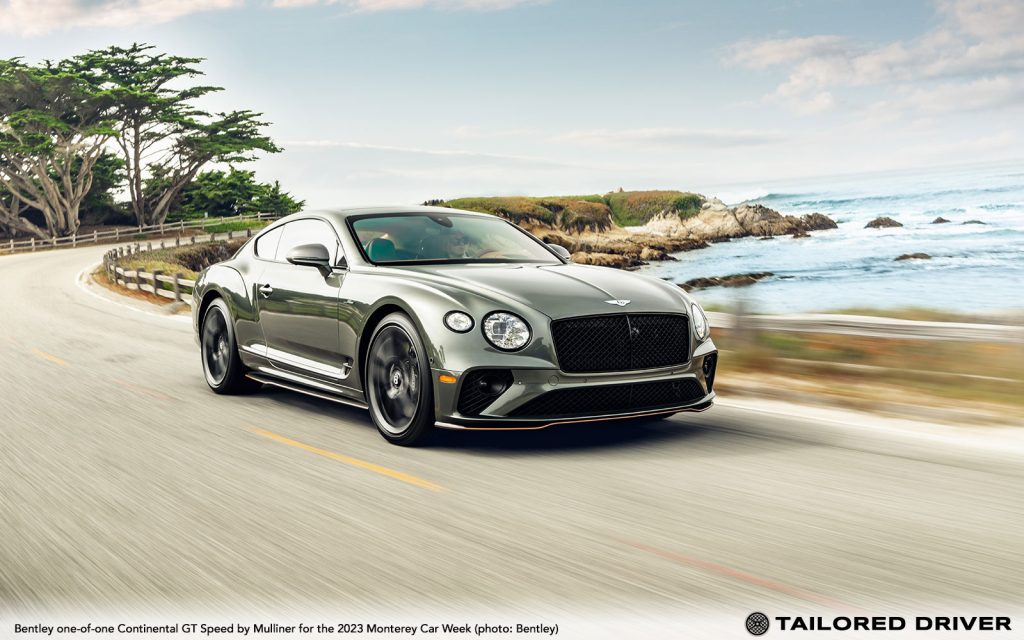
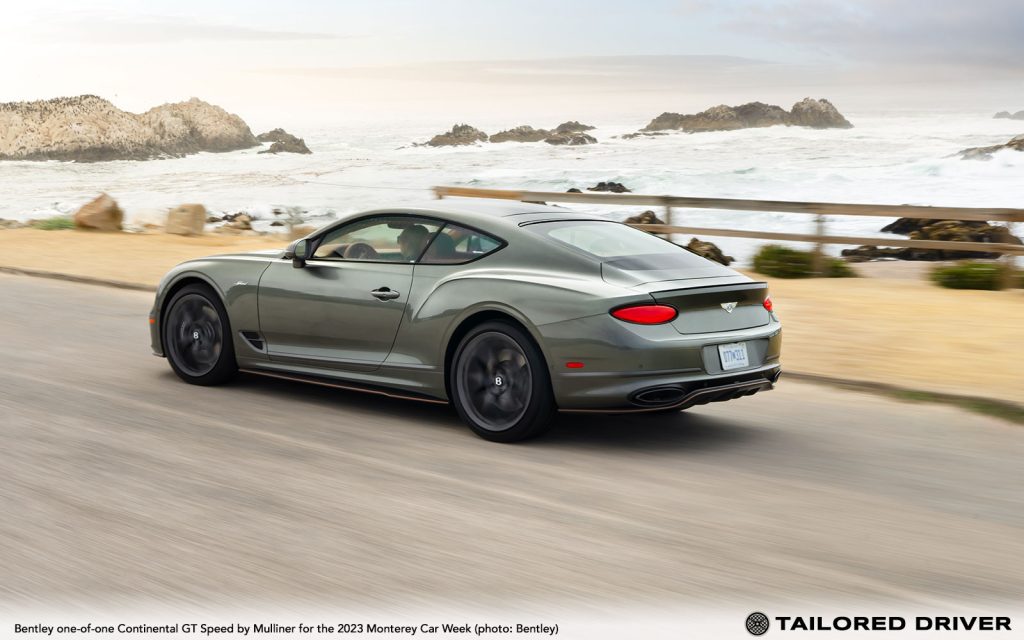
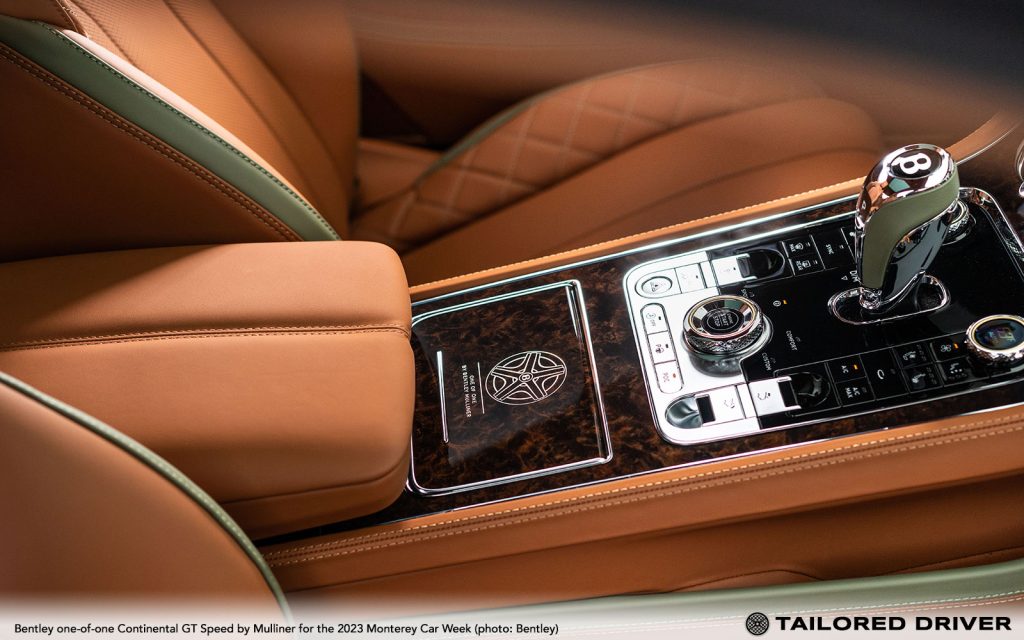
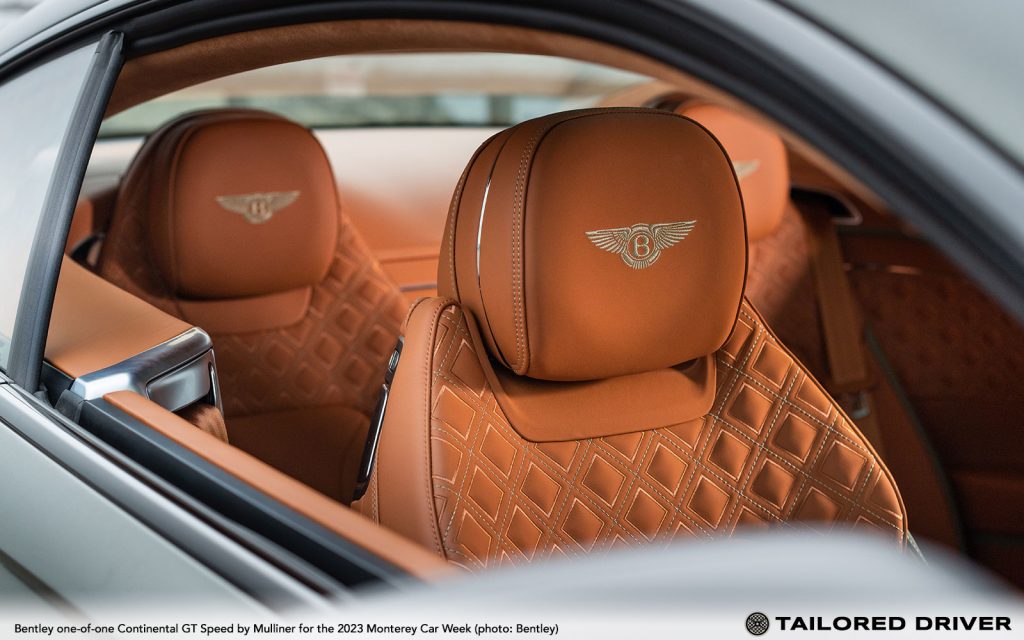
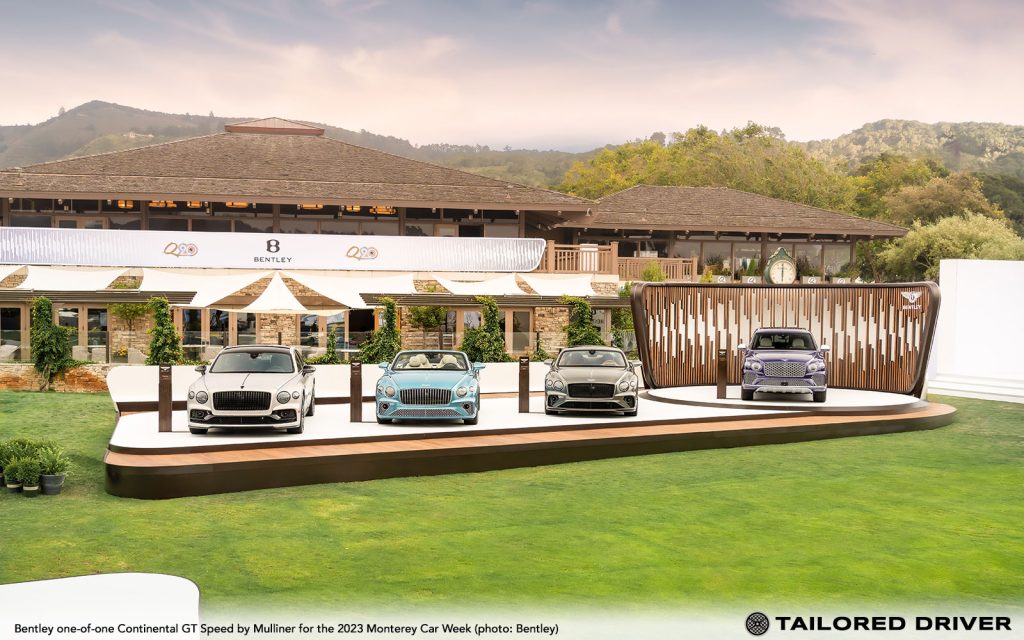
Crewe, England – Bentley Motors brought the 20th birthday celebrations of its now-iconic Continental GT to a close with the reveal and immediate sale of a one-of-one Continental GT Speed, with a specification inspired by that of the very first production Continental GT from 2003. The muse for the project – VIN20001, the first GT off the Crewe production line – was displayed alongside the 2023 version at The Quail, A Motorsports Gathering, also celebrating its 20th birthday and an ongoing part of Monterey Car Week.
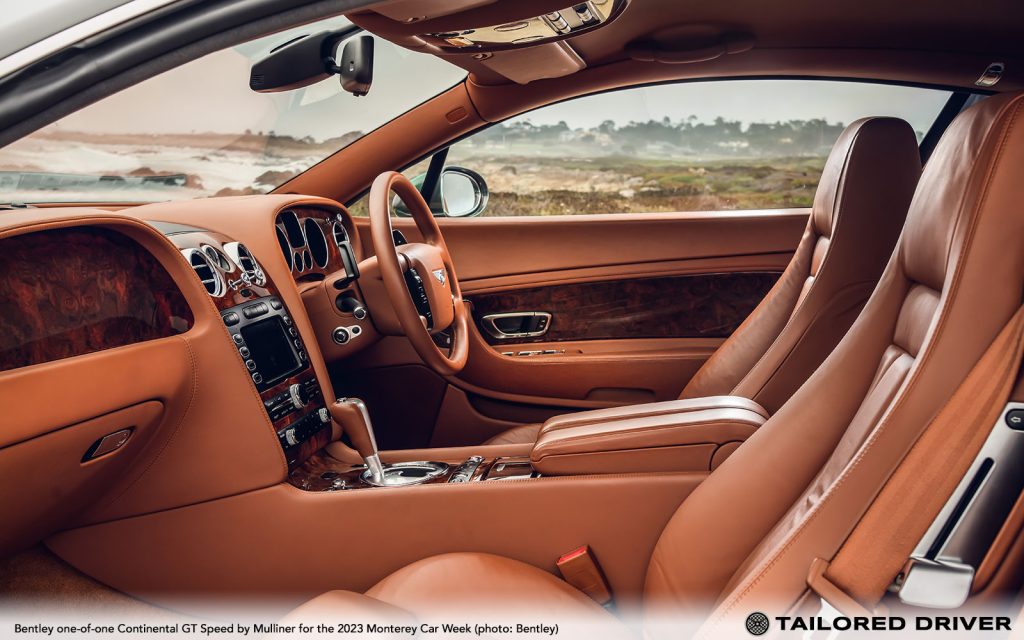
Having redefined the Bentley brand for the 21st century when it was launched in 2003, catalysing a ten-fold increase in sales, the Continental GT continues to be the benchmark for modern, luxury grand tourers. The first production car – the most important modern car in Bentley’s rejuvenated Heritage Collection – was finished in Cypress Green (cypressgreen; metallic UNI; 6604 / 9560119; Bentley) paint, with an interior of Saddle leather upholstery and Burr Walnut veneer. The bespoke 2023 Continental GT Speed displays a specially commissioned interior inspired by that of its illustrious forbear.
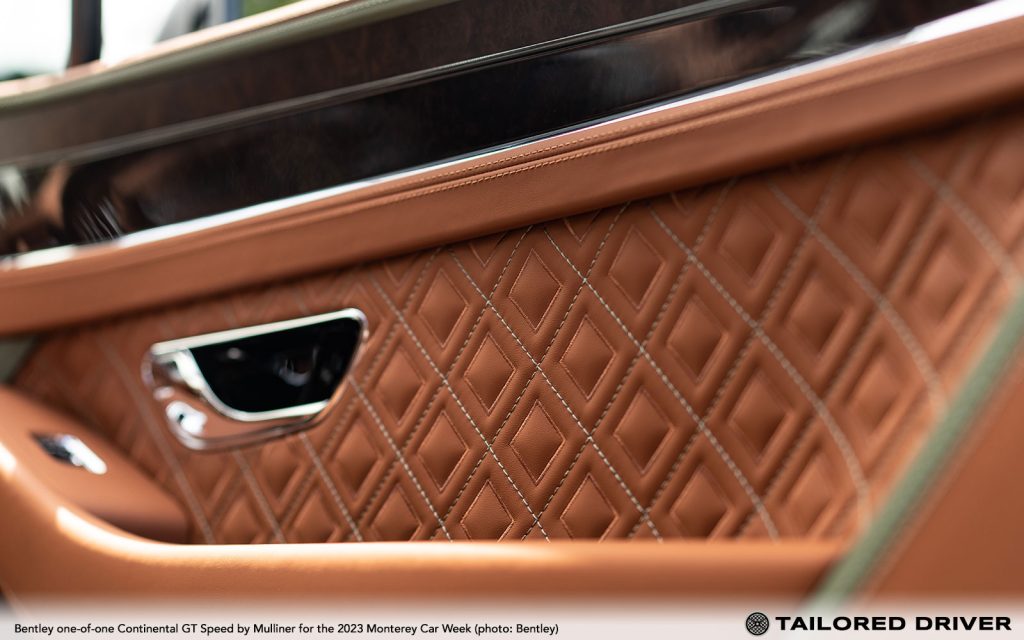
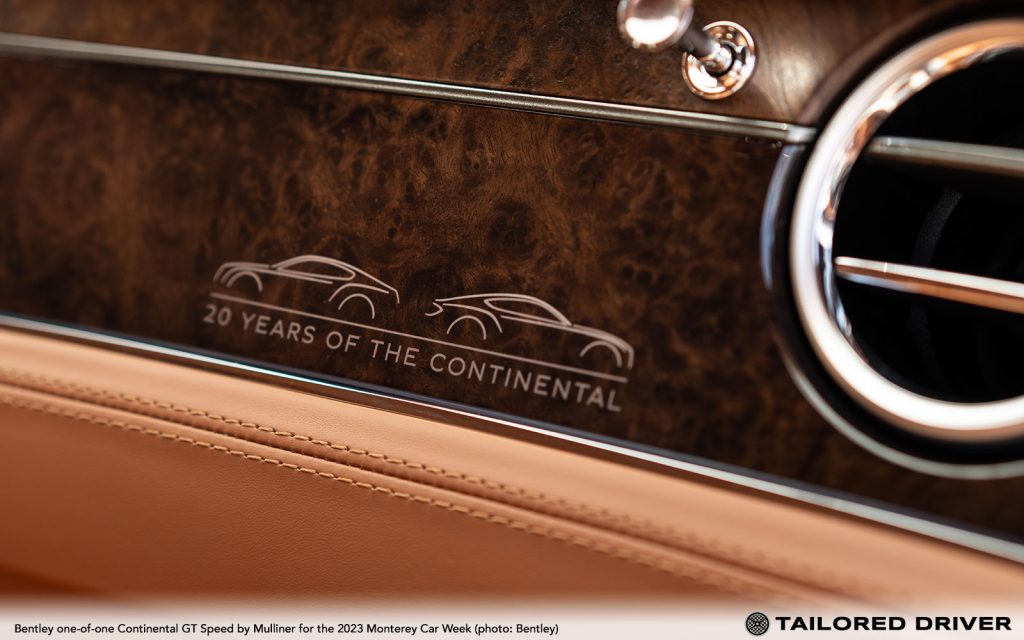
While Saddle leather and Burr Walnut veneer feature in both cabins, the third-generation model features subtle enhancements of the original model’s theme. The rich Saddle colour is complemented by an accent hide in ‘Special Green’, with contrast stitching in the same shade throughout. The fascia and waist rails feature two different veneer finishes – open pore Dark Burr Walnut over high gloss Dark Burr Walnut – separated by a painted pinstripe in Cypress, connecting the interior with the exterior.
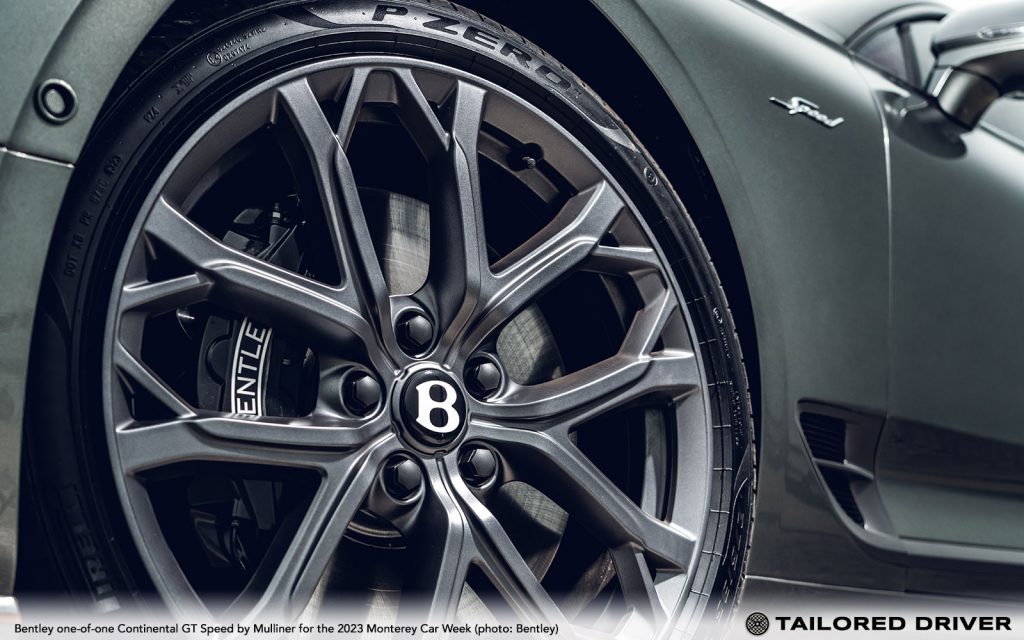
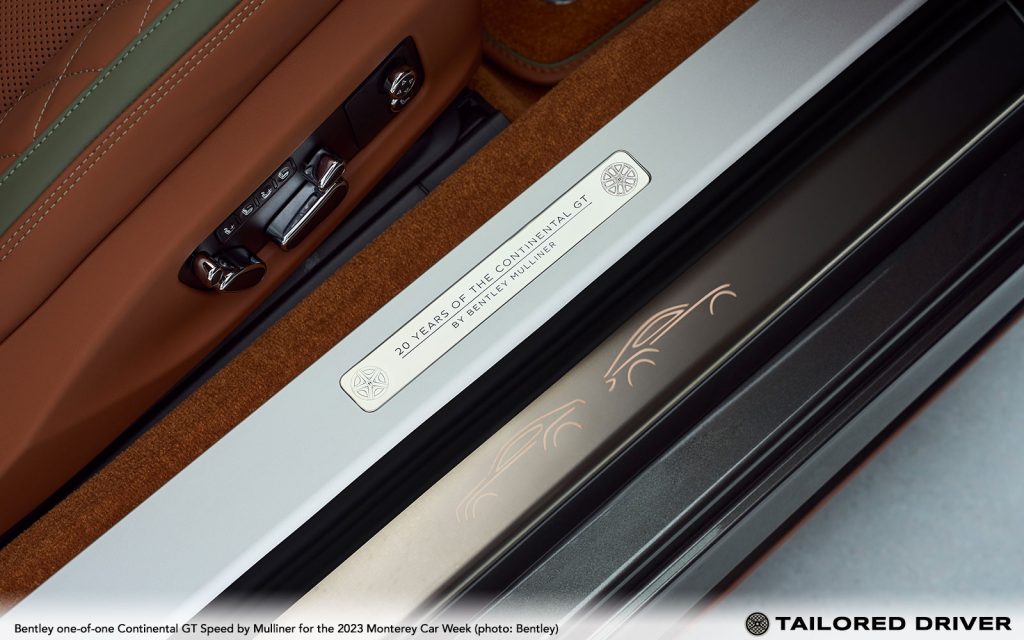
An extensive list of features includes the Blackline, Touring and Styling Specifications – together bringing polished black exterior brightware, a suite of technical enhancements and a carbon fibre front splitter, side skirts, diffuser and subtle boot lip spoiler respectively. Self-levelling Mulliner wheel badges finished the 22” Sports Wheels in unique Dark Grey Satin. The interior features Naim for Bentley audio and the Bentley Rotating Display, while the personalised treadplates read, ’20 years of the Continental GT by Bentley Mulliner’. Outline representations of the 2003 and 2023 Continental GTs feature on the fascia, centre console and outer sill. This celebratory one-of-one car has already been sold, was handed to its new owner at The Quail, and represents the highlight of four months of activities and events to celebrate this milestone in Bentley’s history.
20 Years and three generations
The impact of the first-generation Continental GT was seismic, not only redefining Bentley as a modern luxury brand but also creating a new market sector. The first all-new Bentley with no carried-over components since the original 3 Litre of 2019, the Continental GT was designed at the Crewe studio under then Design Director Dirk van Braeckel and Head of Exterior Design Raul Pires. The sleek lines of Bentley’s new grand tourer were inspired by those of the 1952 R Type Continental, with a Bentley ‘powerline’ that starts low at the front and follows the shoulder line of the bonnet and door before meeting a muscular rear haunch. Twin round headlamps and a Bentley mesh grille gave a subtle nod to the company’s thunderous Le Mans-winning racers of the 1920s.
Under the bonnet was an all-new 6.0-litre twin-turbo 48-valve W12 engine. This compact, smooth and powerful design developed 550 bhp and 650 Nm, powering all four wheels via a ZF six-speed automatic transmission. Acceleration from 0-62 mph took 4.8 seconds and top speed was a shade under 200 mph.
During the seven years the first-generation Continental GT remained in production it sired a family of models including the Continental GT Convertible, Continental Flying Spur, Continental GT Speed and Supersports.
Arrival of the V8
The second-generation Continental GT, launched in 6.0-litre W12 form at the Paris Motor Show in 2010, also saw the arrival of a second all-new Bentley engine. The efficient and charismatic 4.0-litre V8, which made its debut in 2012, endowed the Continental GT with an eager, agile and responsive character, accompanied by a characterful V8 exhaust backbeat. In 2017 the line-up was joined by the limited edition 710PS Supersports, its conception inspired by the Team Bentley racing GT3.
2018: the third generation
Bentley’s third generation Continental GT was launched in 2018. An entirely new design, its sharper, sleeker lines took full advantage of a new, purpose-designed platform. Even its W12 engine was all-new, paired with a new dual-clutch transmission. Highlights of the new model’s specification included three-chamber air springs and 48V electric active anti-roll control, while the on-board technology took a major leap forward thanks to all-new electrical architecture. It was simultaneously faster, more comfortable, more efficient and more luxurious than its predecessors – yet unmistakably still a Continental GT.
Around the world in 20 reviews
A Bentley ‘baton’, designed and created in house to represent the key lines of the Continental GT, visited Monterey to start a global journey – travelling in a variety of Continental GT models across Europe, the Middle East, China, Asia Pacific and the US before returning to Crewe. At journey’s end at Bentley’s Dream Factory in Crewe, the baton – which will contain 20 mementoes of the tour – will become a time capsule as a permanent reminder of a unique journey.
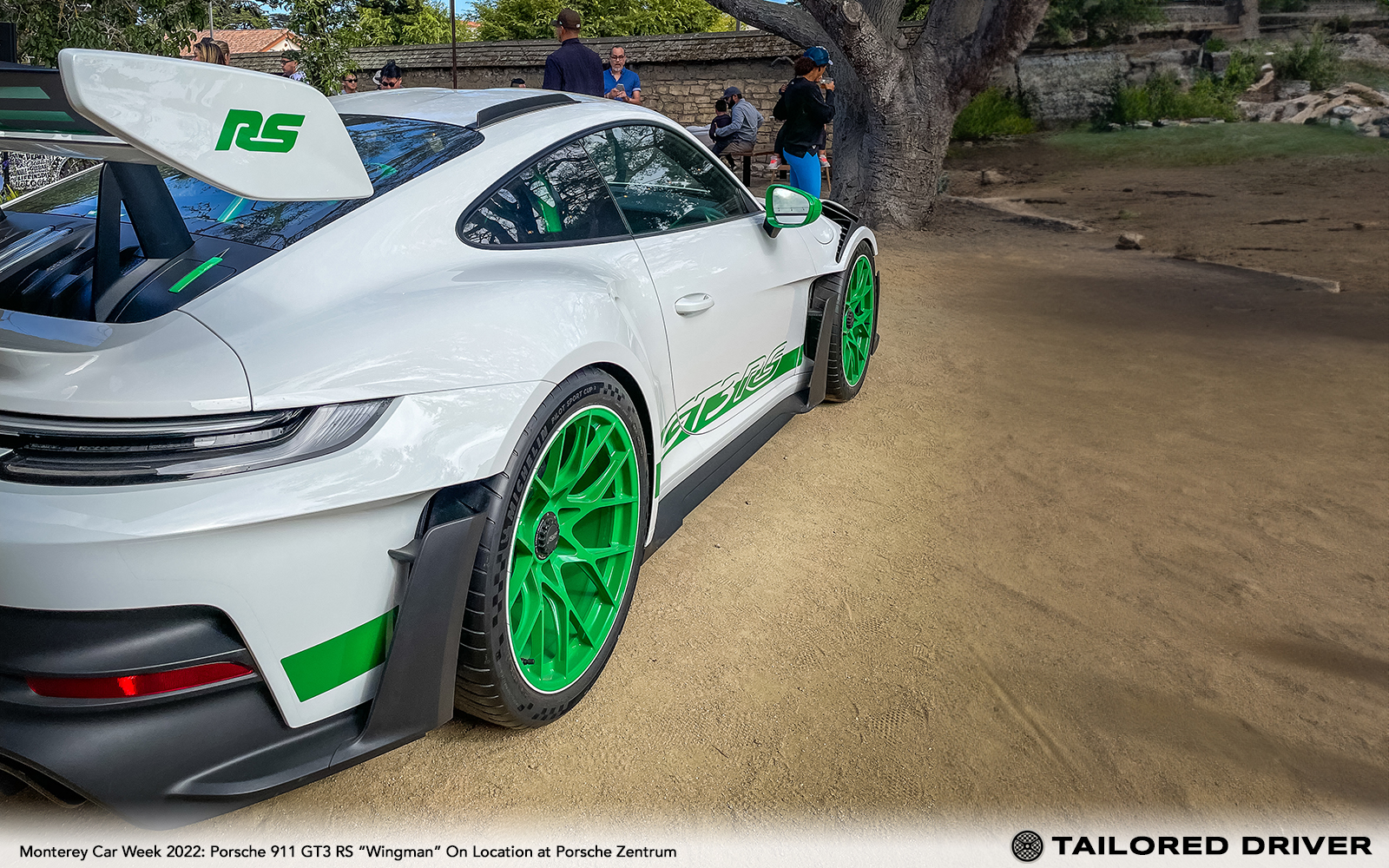
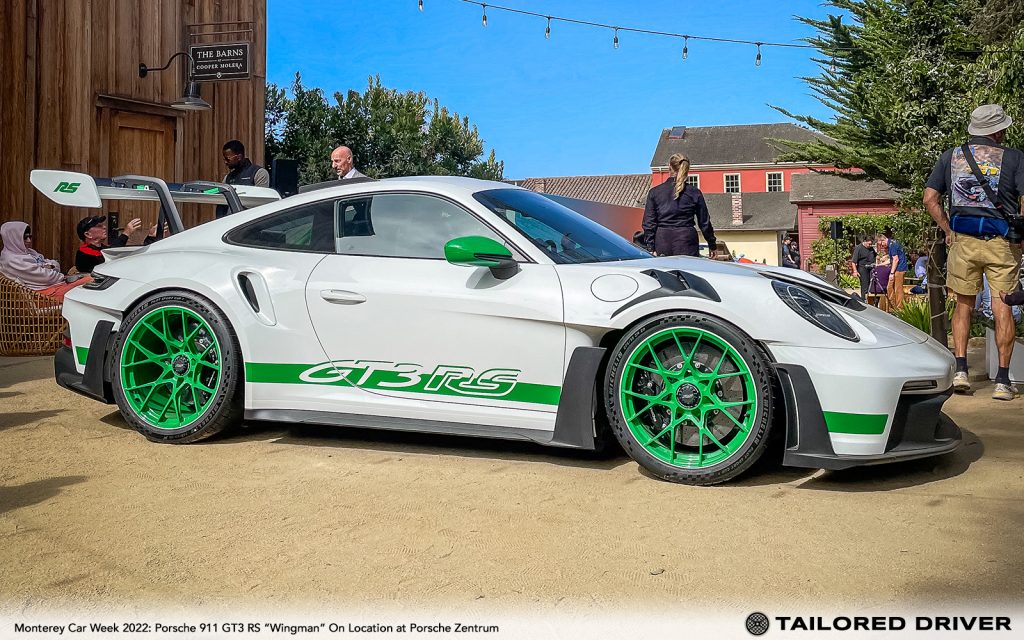
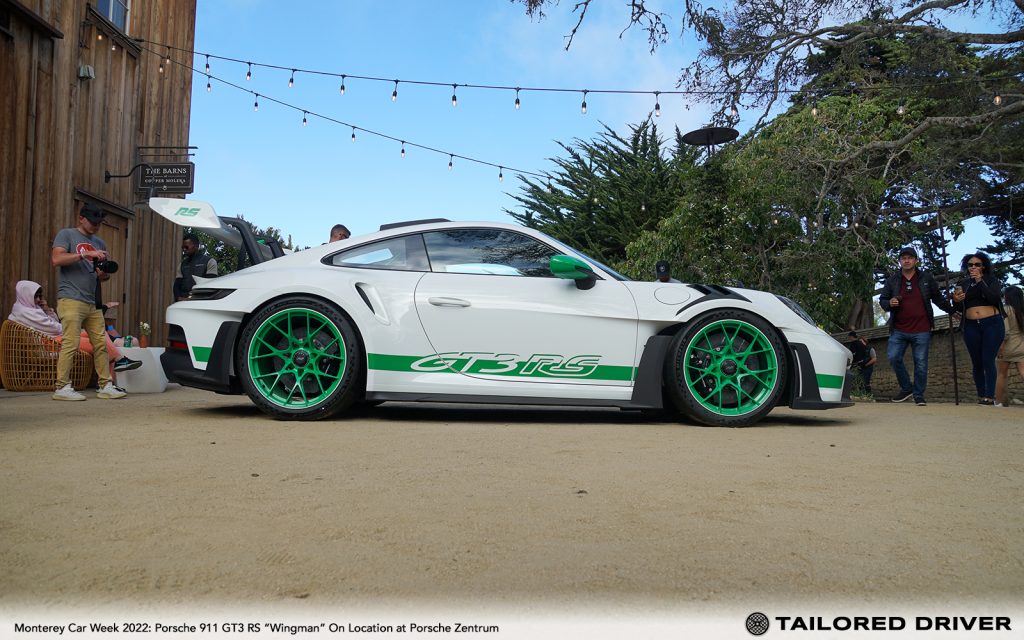
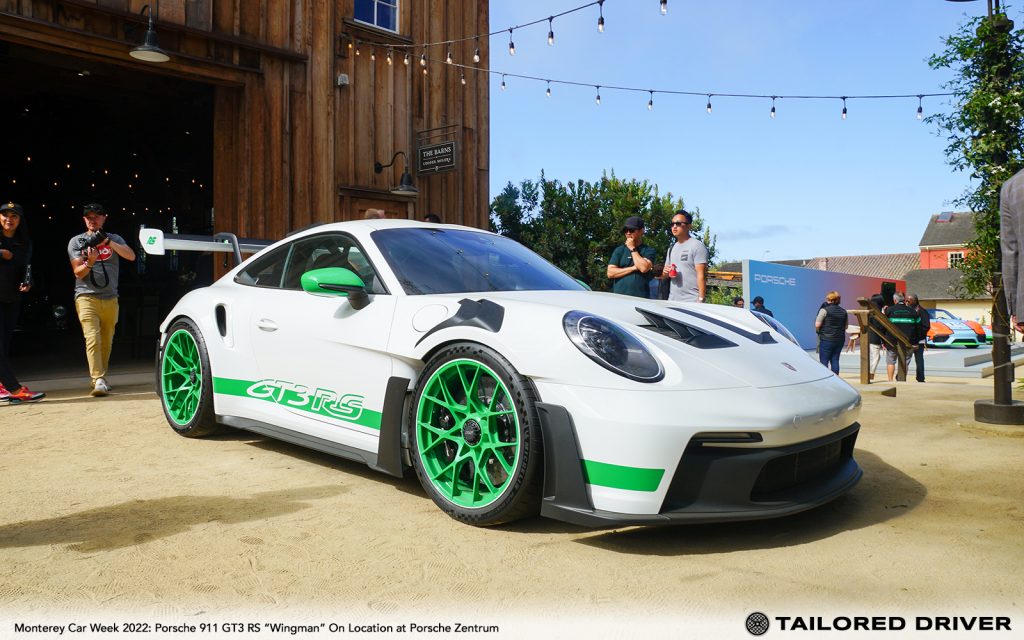
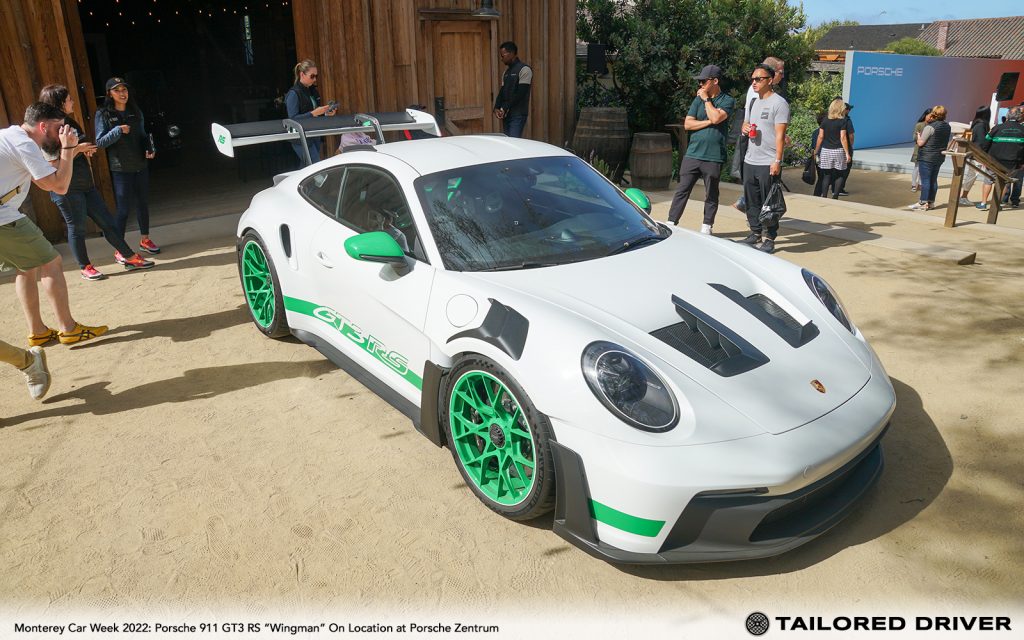
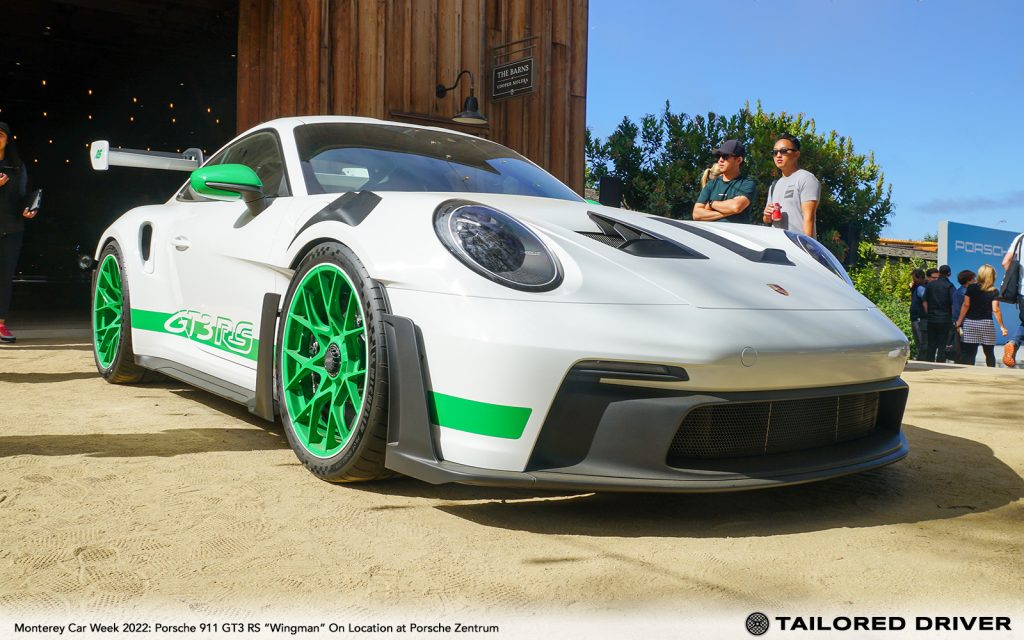
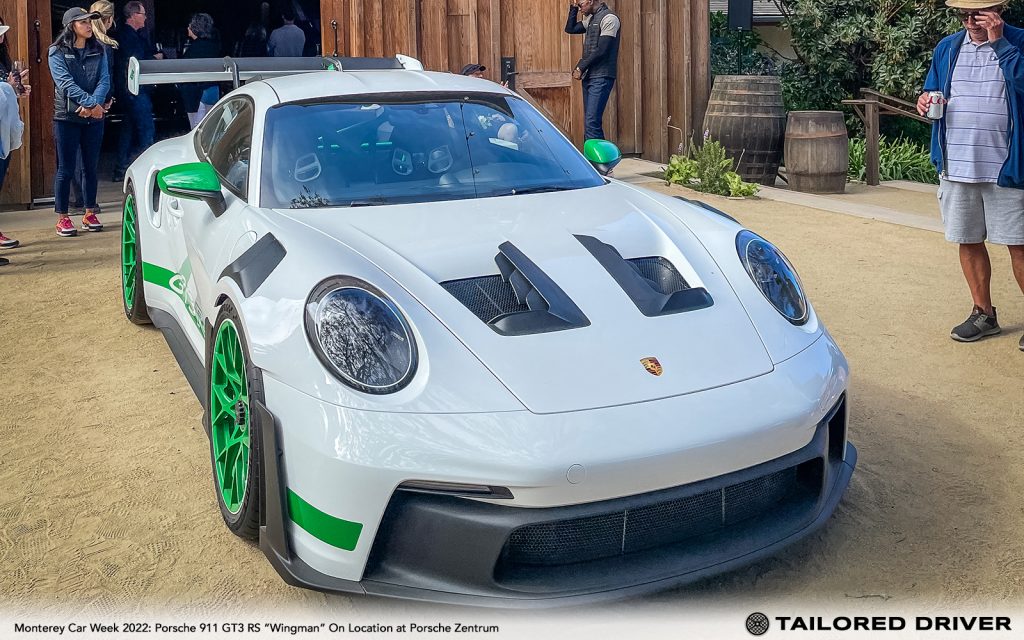
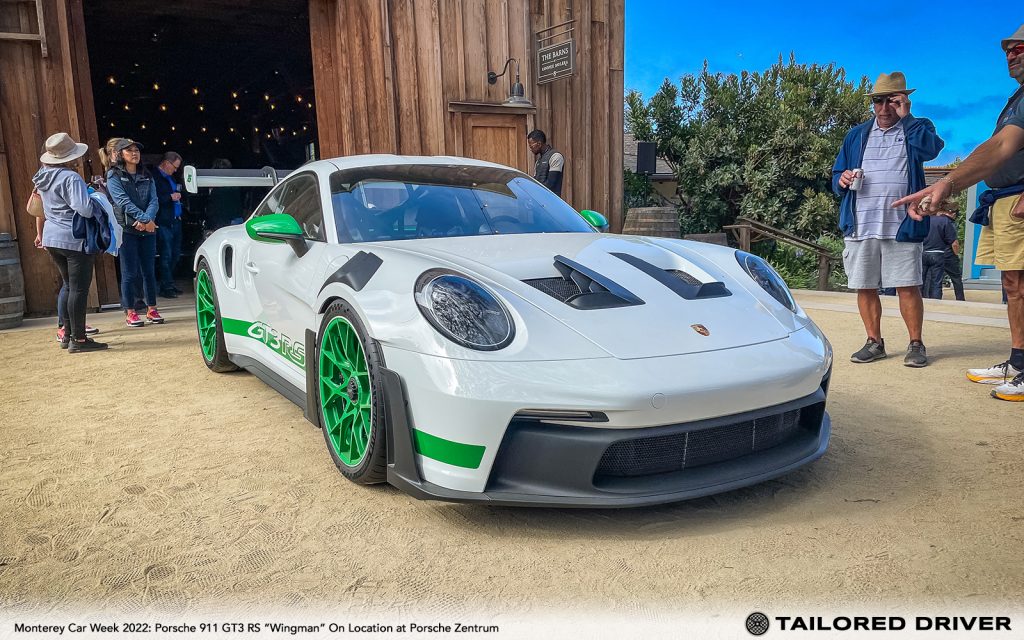
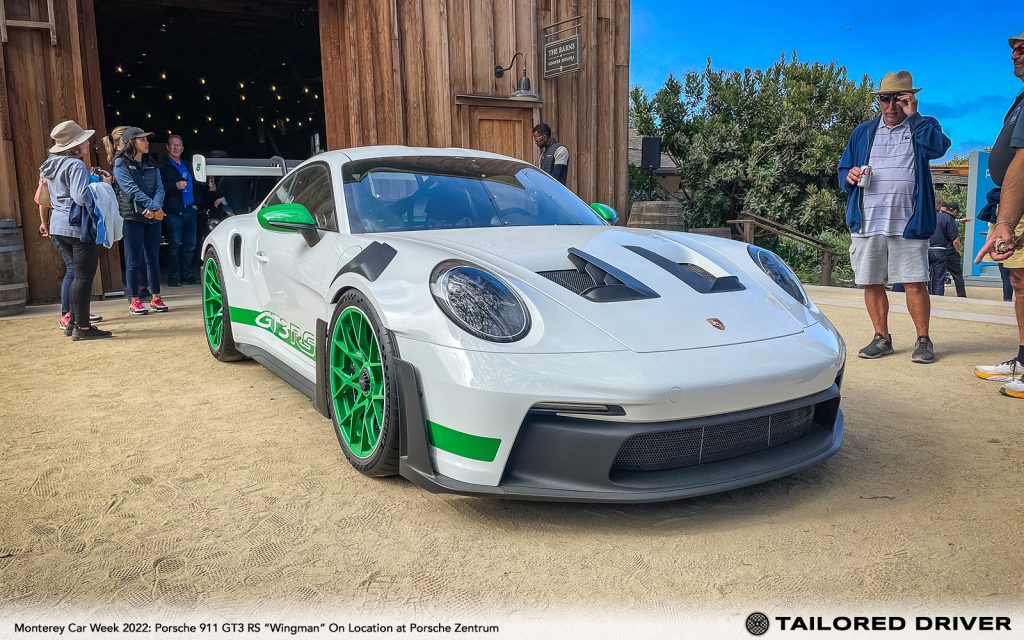
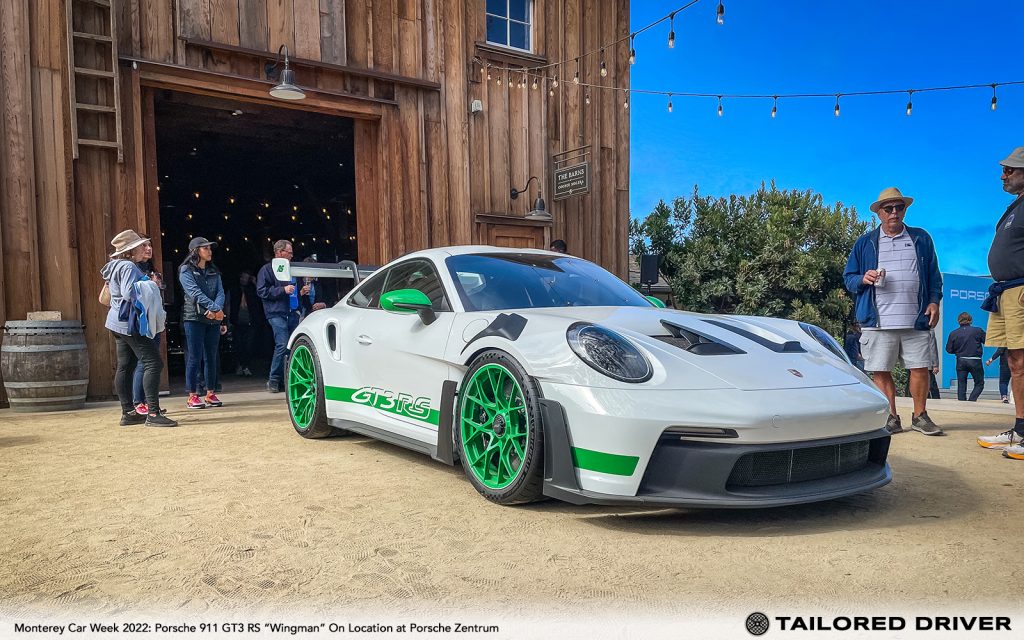
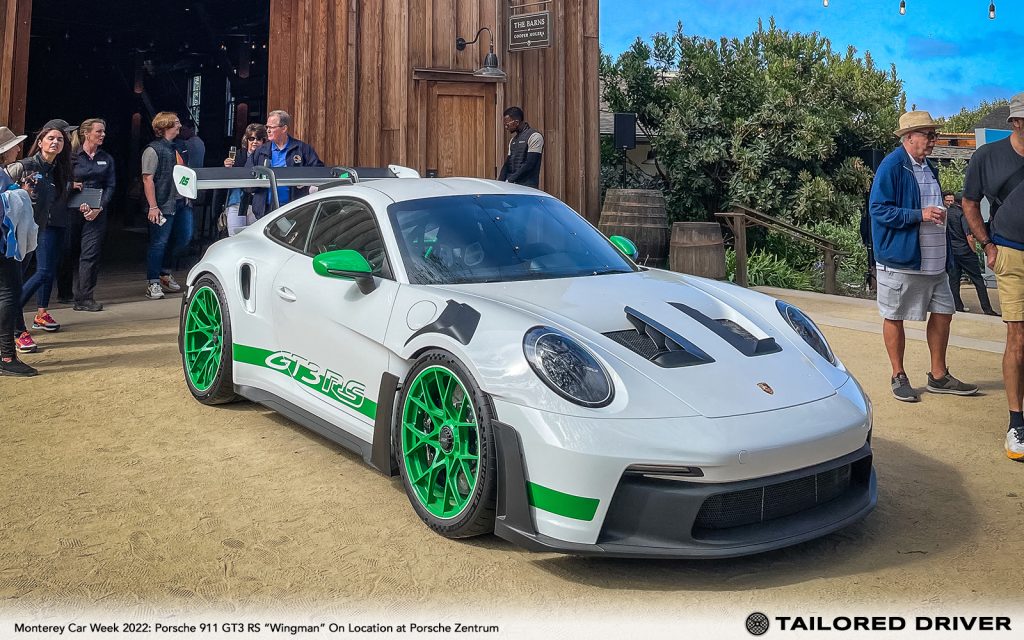
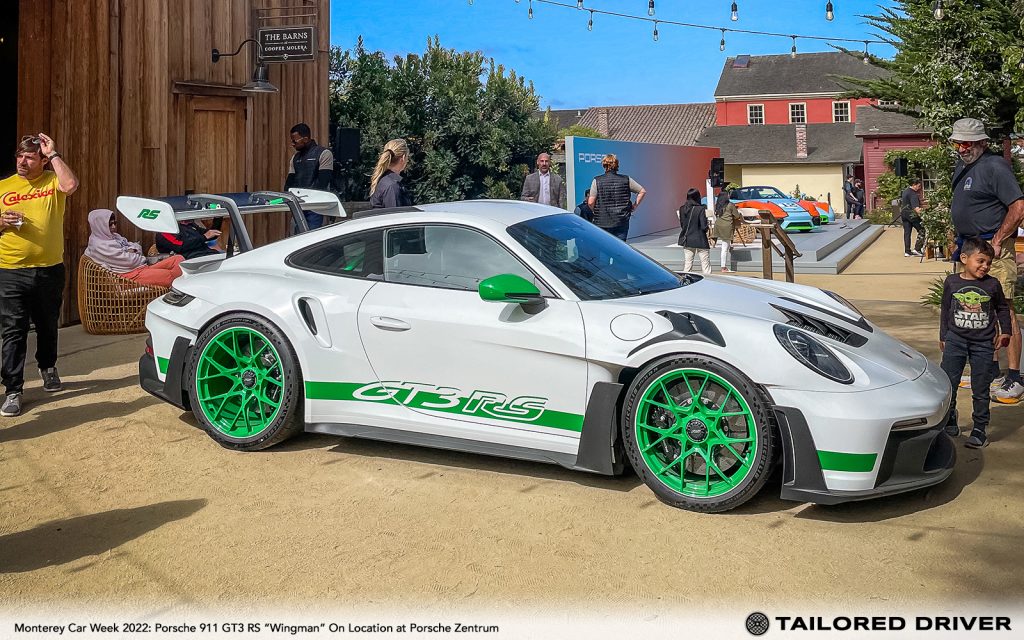
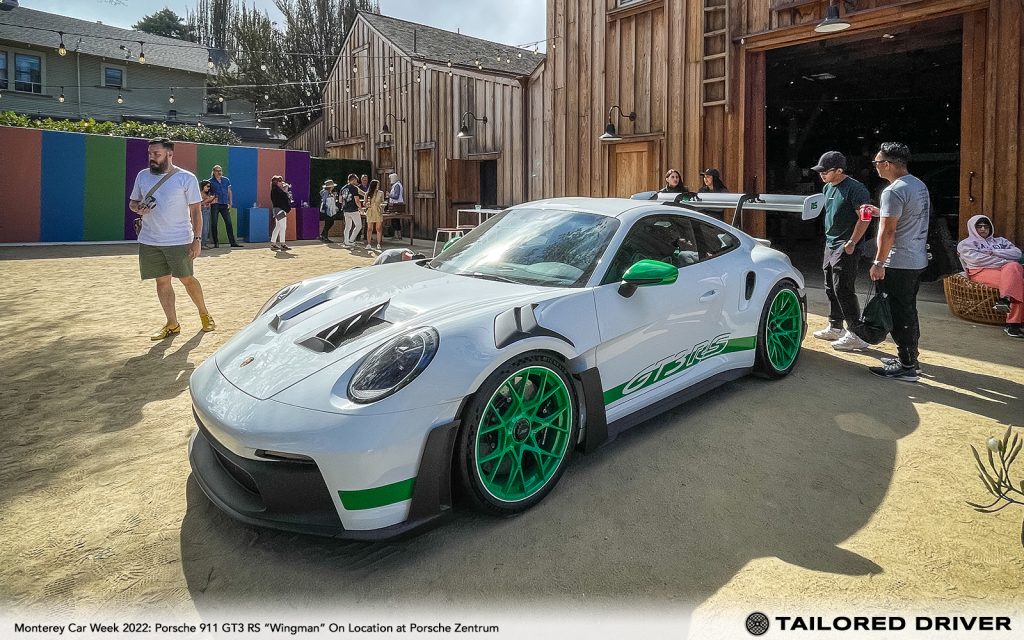
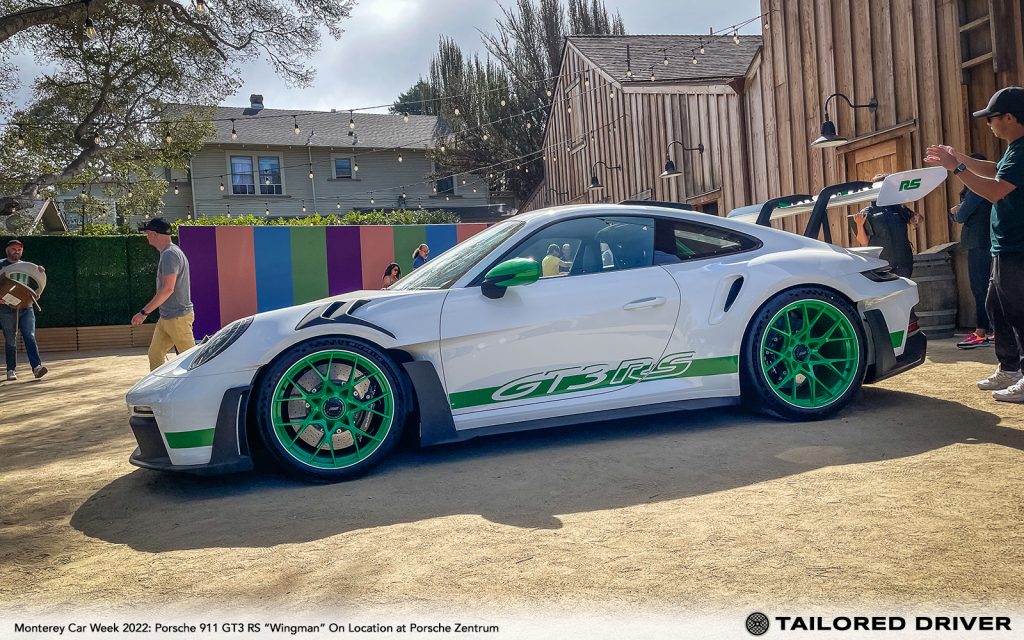
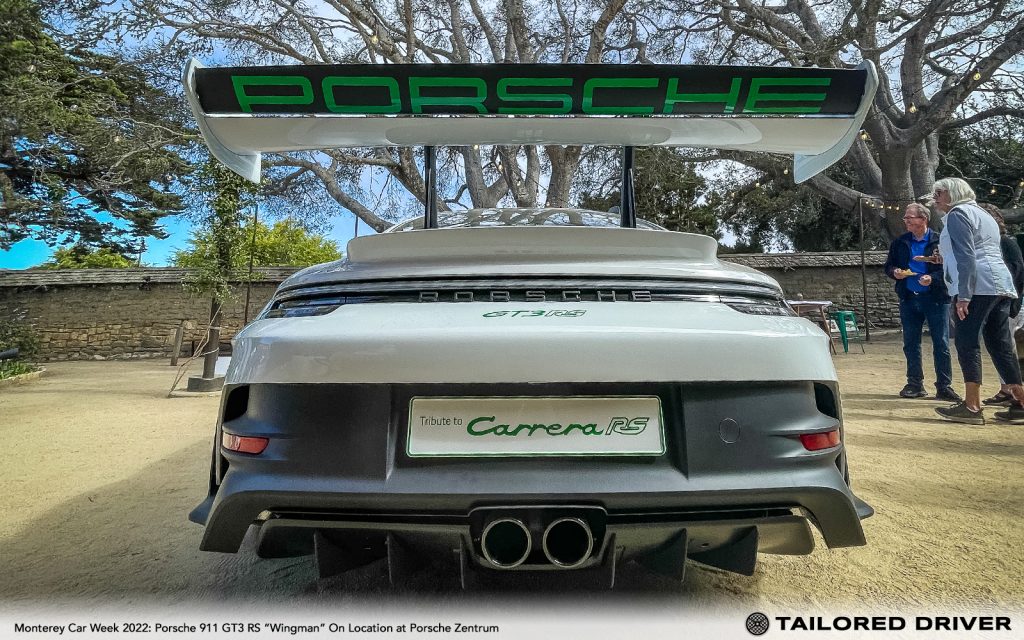
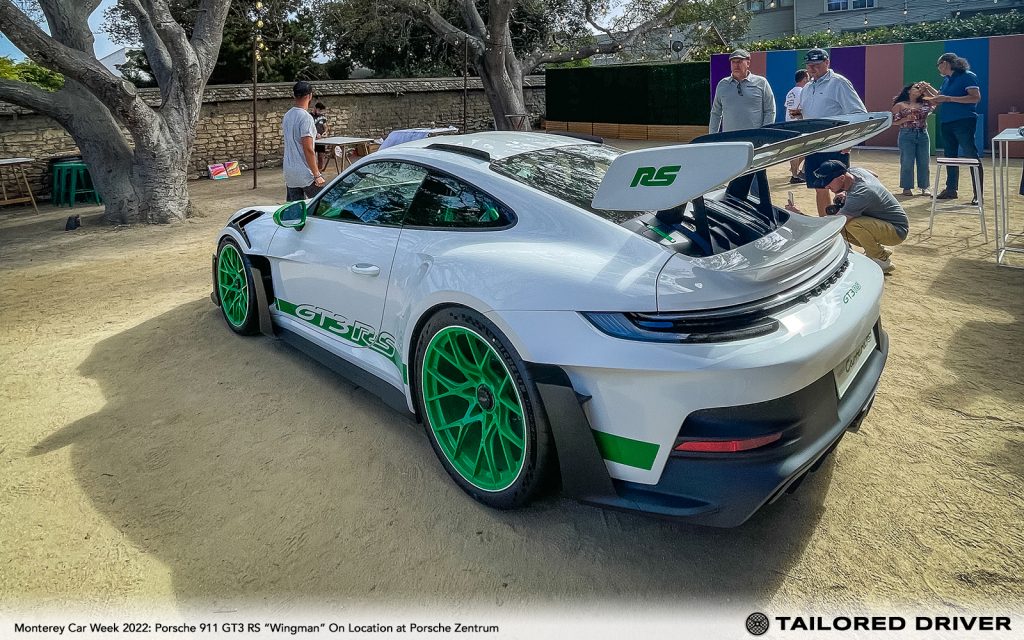
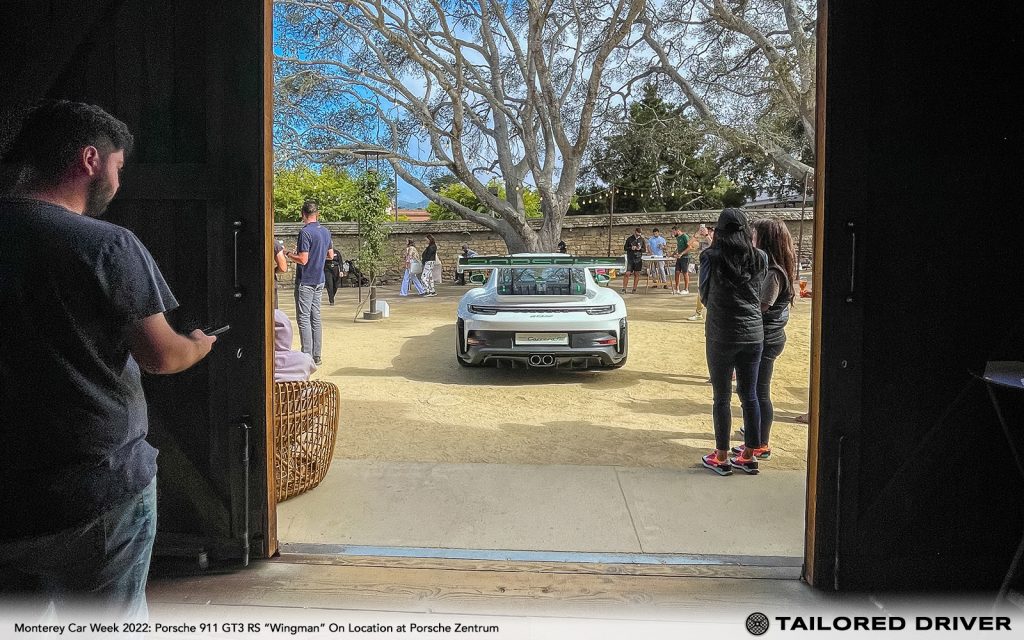
Porsche first pulled the wraps off its 992 GT3 RS show car at The Quail on Friday, and with end of secrecy now completed it headed over to the Porsche Zentrum at The Barns at Cooper Molera near downtown Monterey. That’s where we caught up with it.
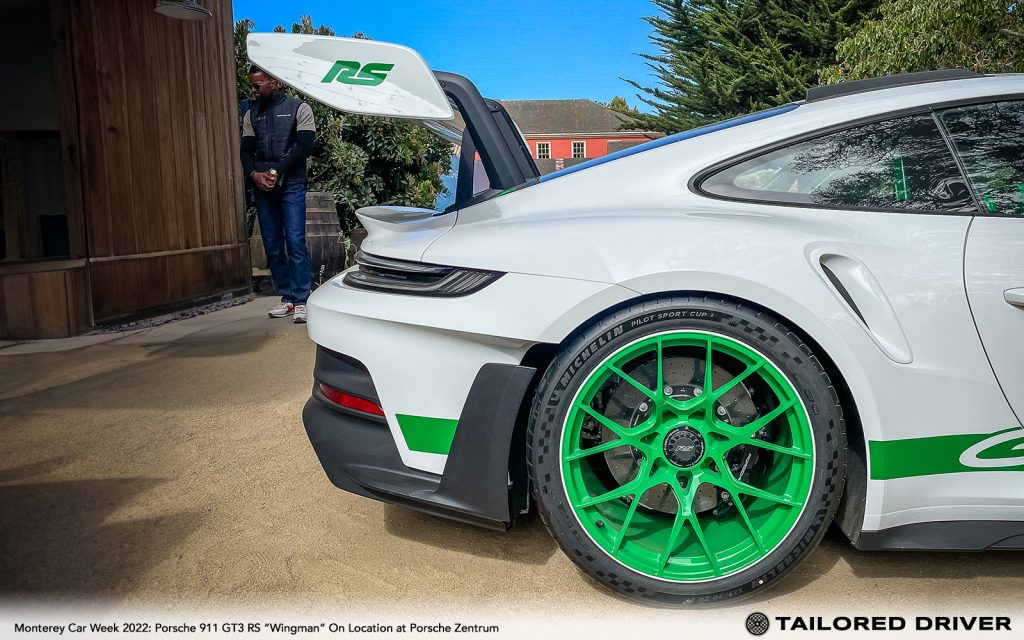
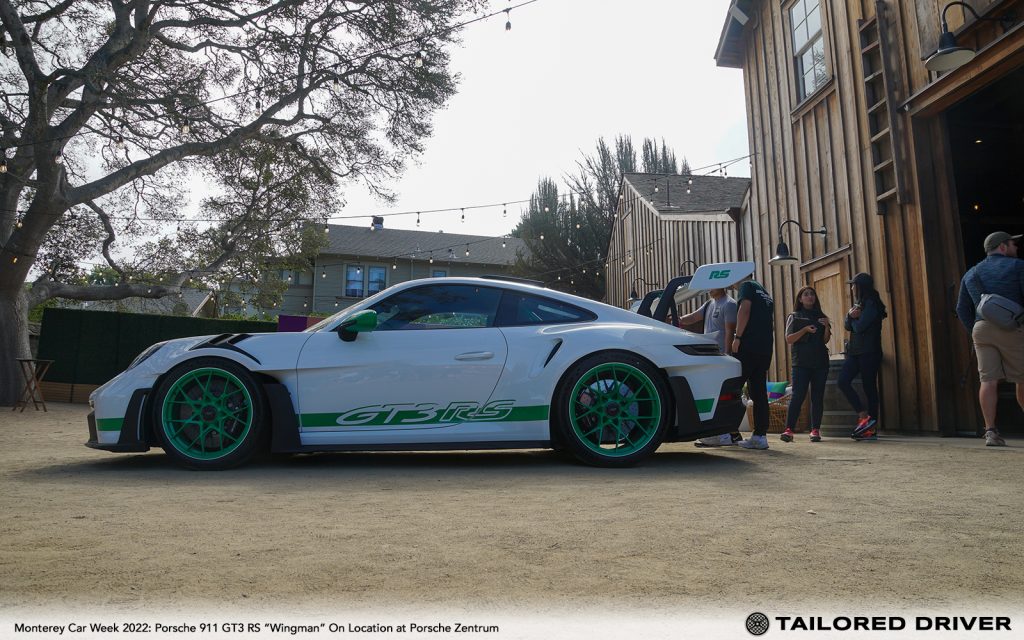
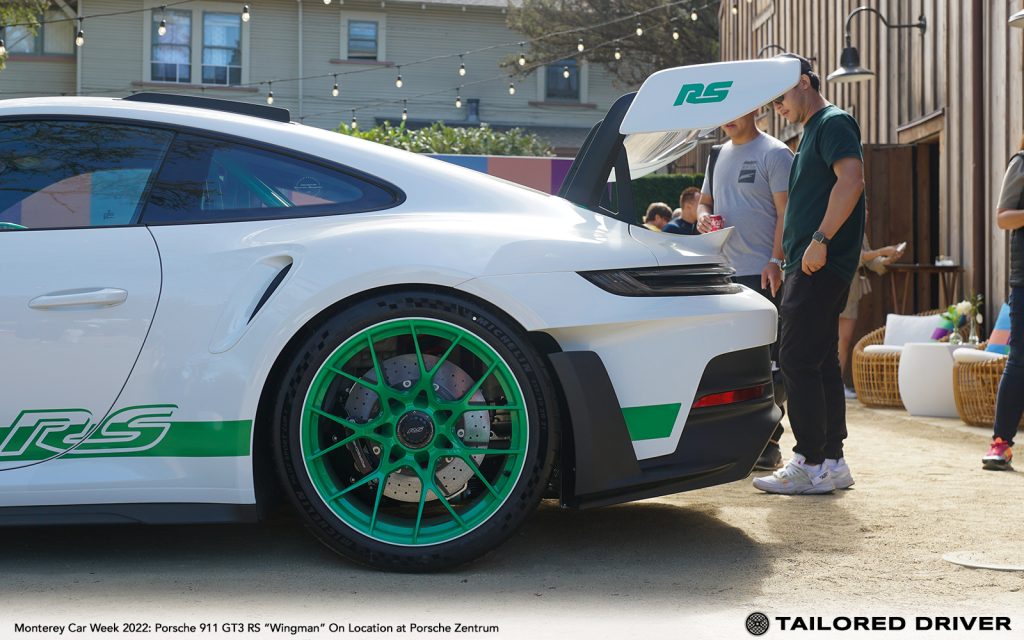
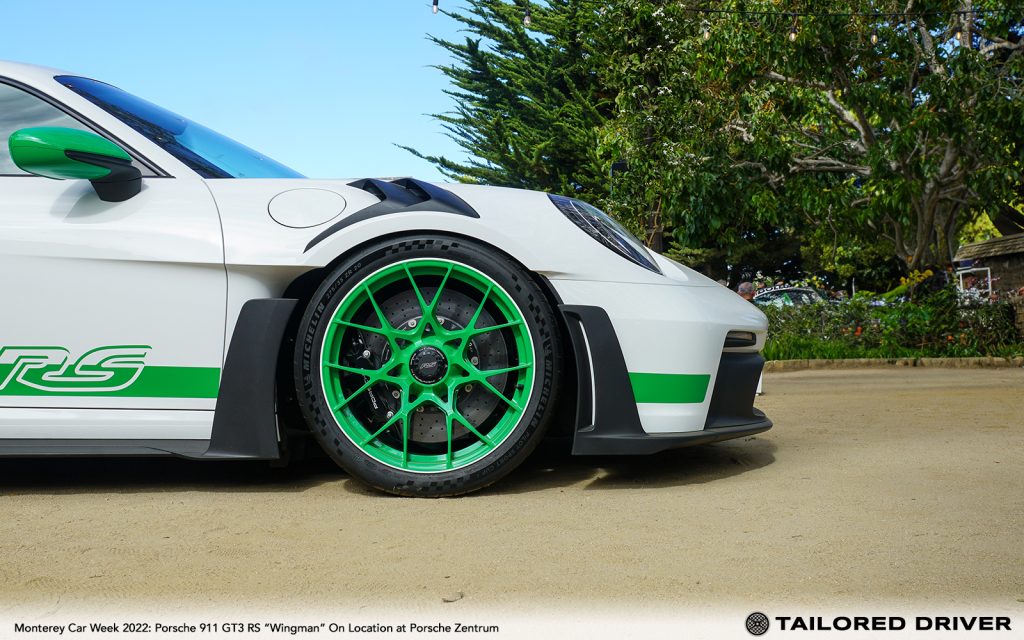
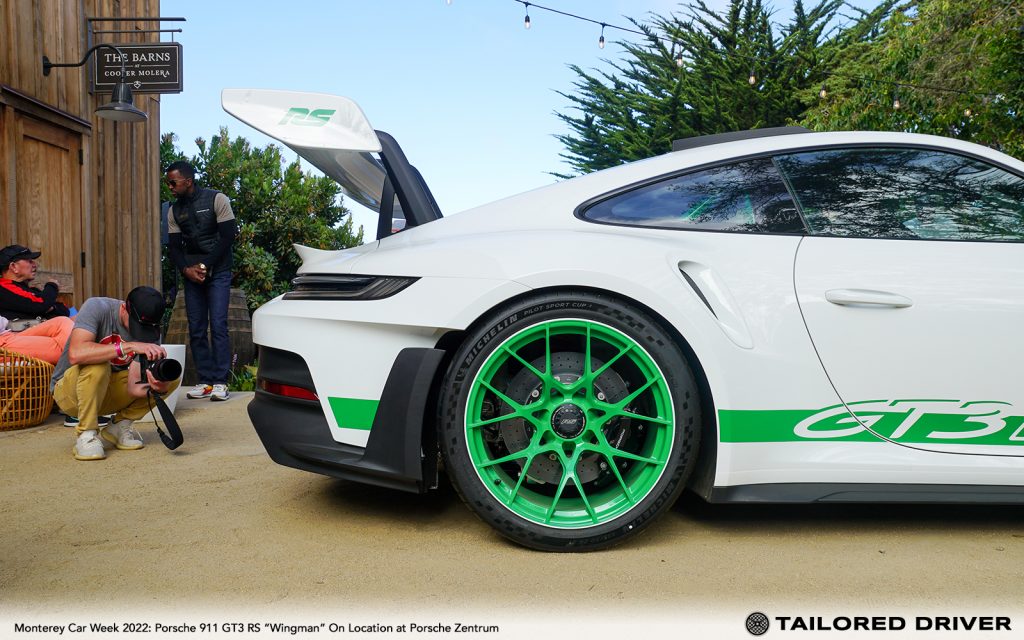
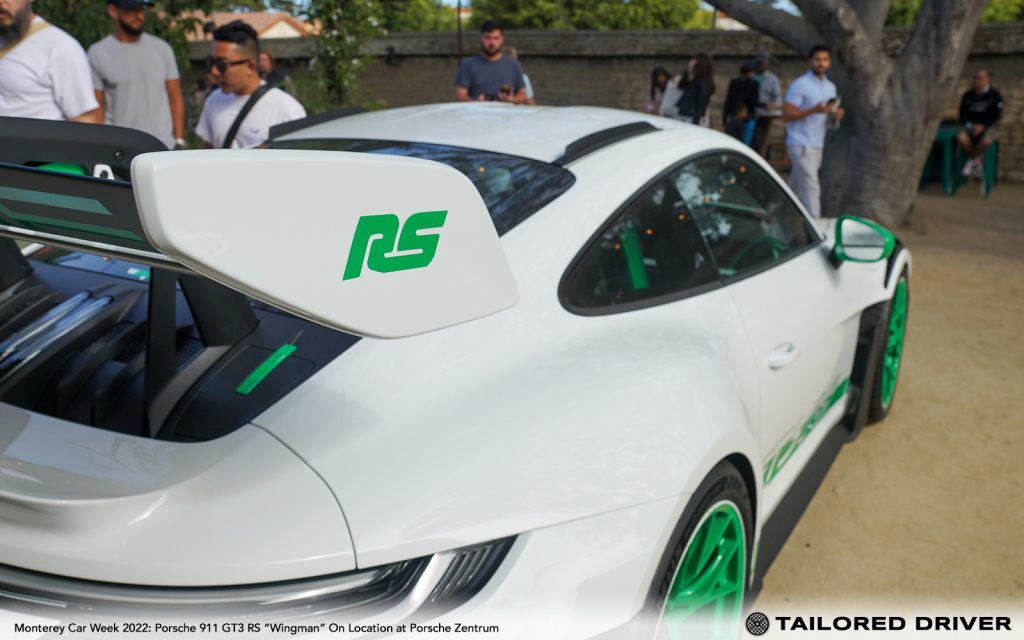
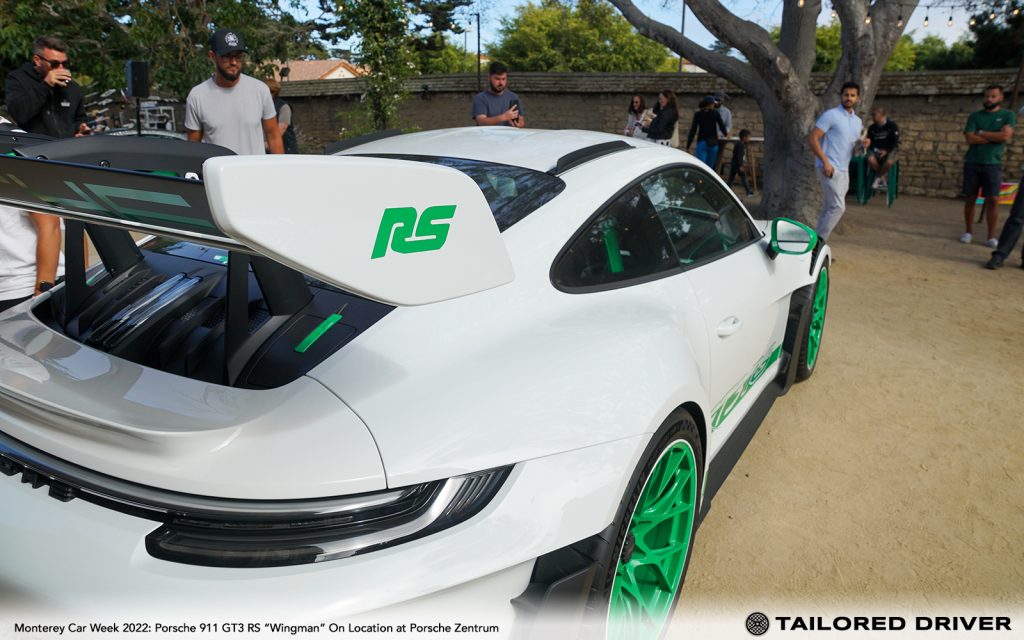
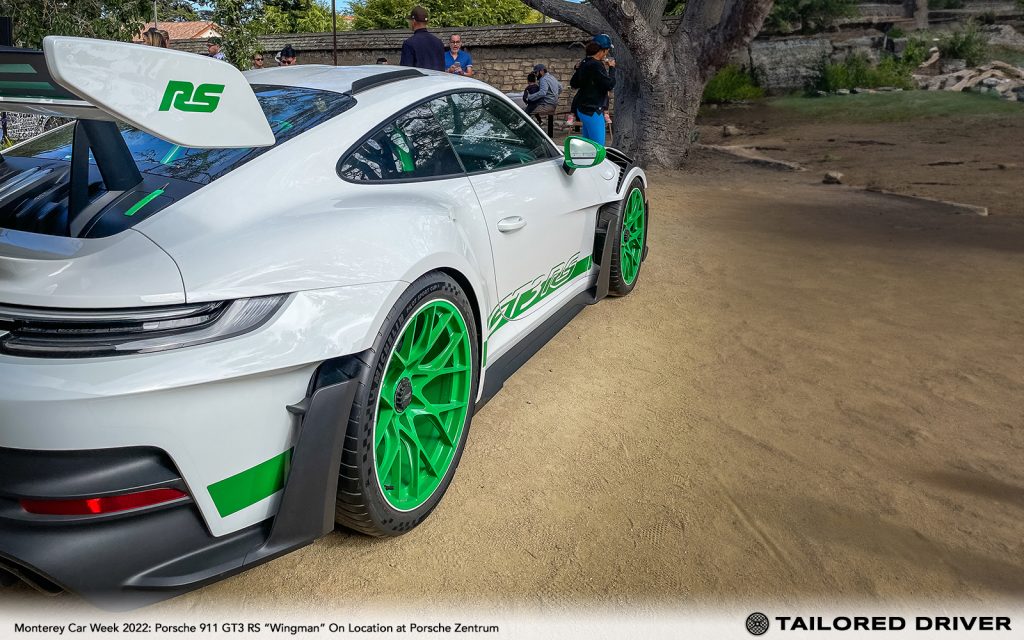
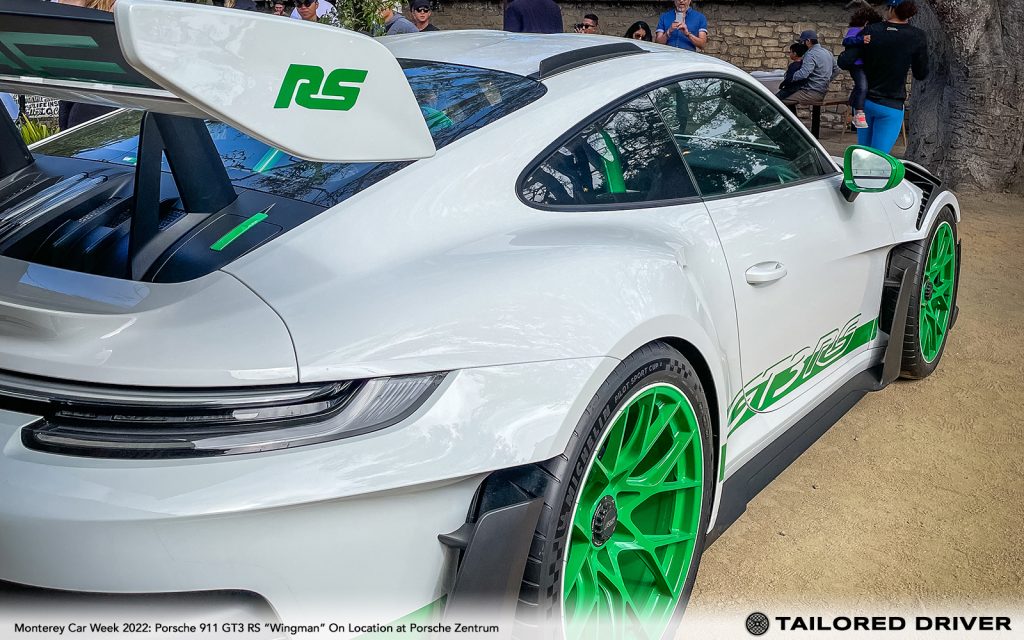
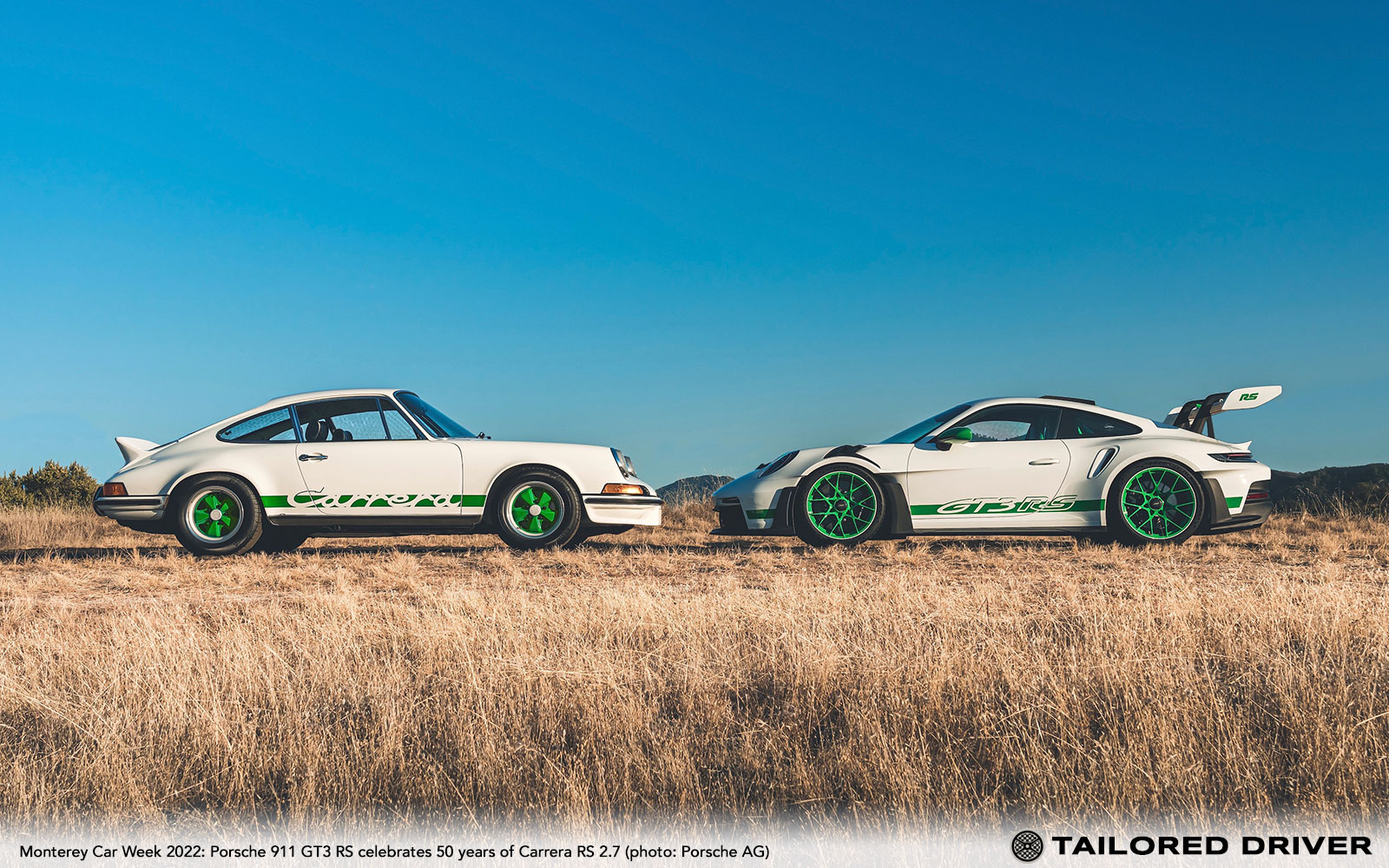
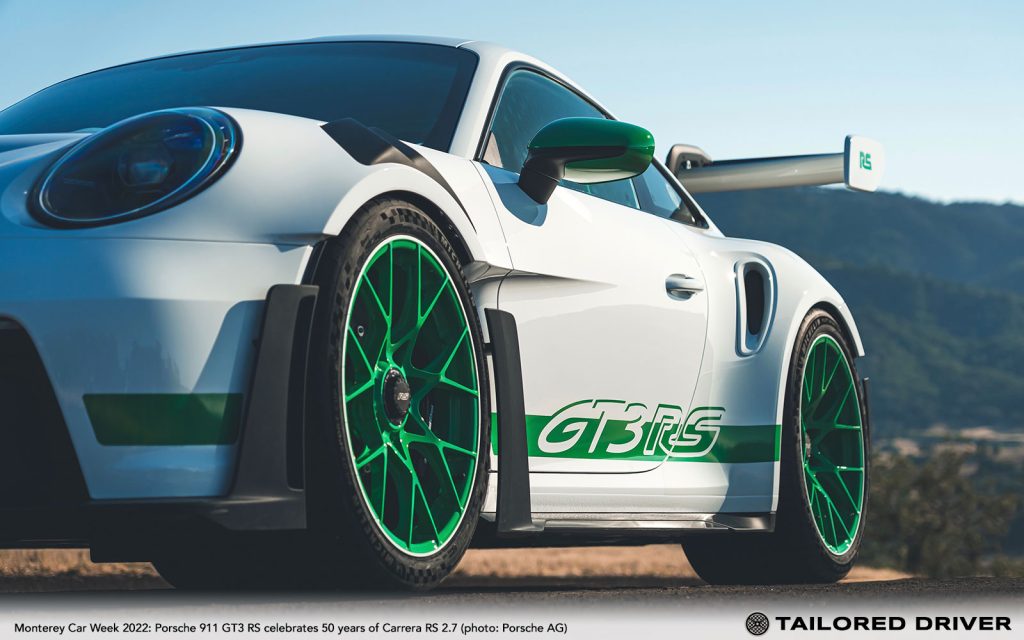
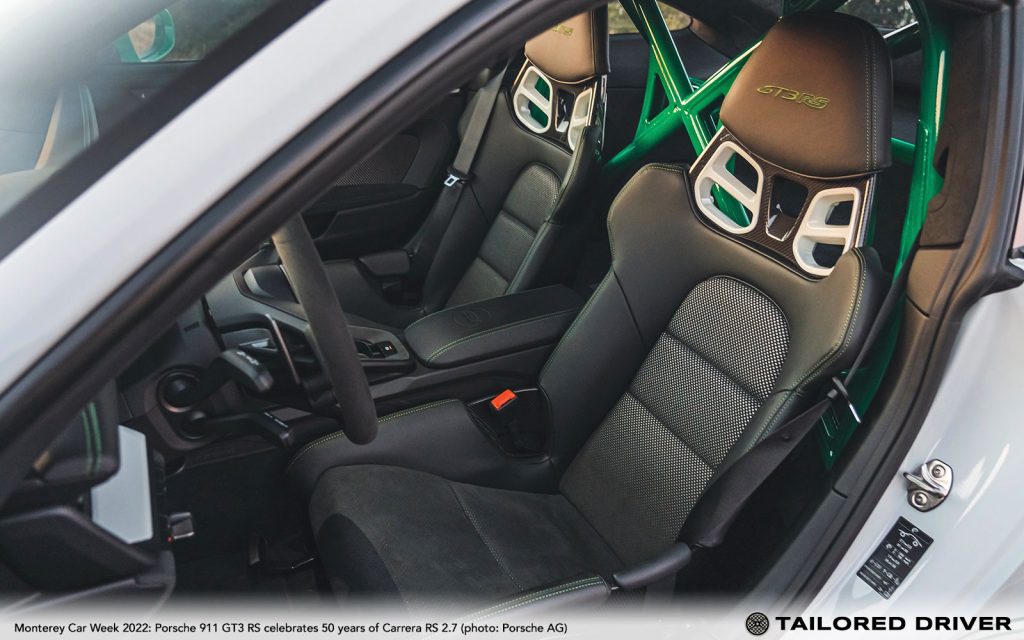
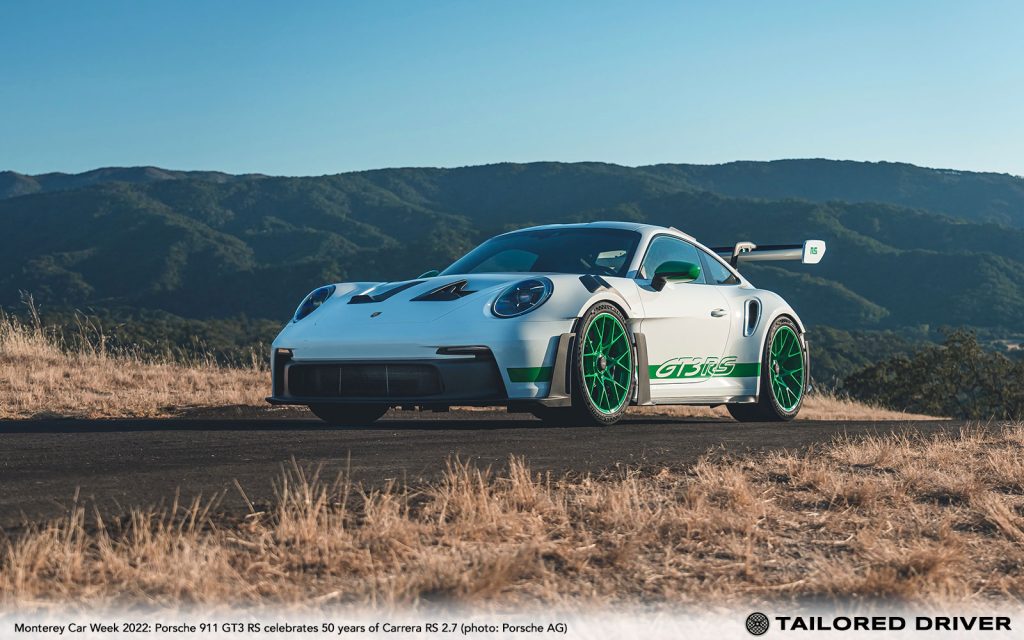
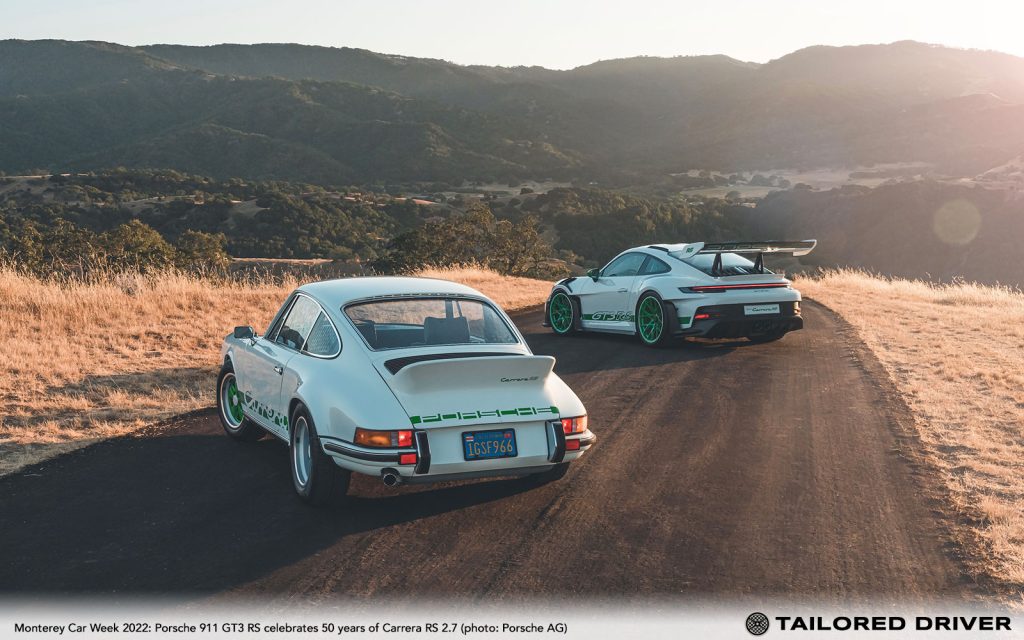
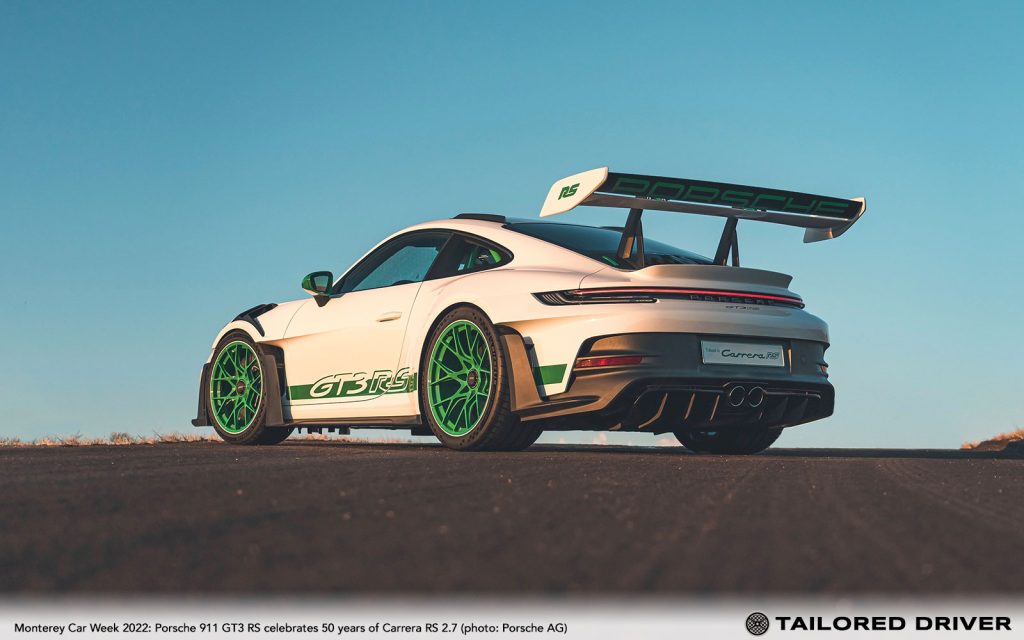
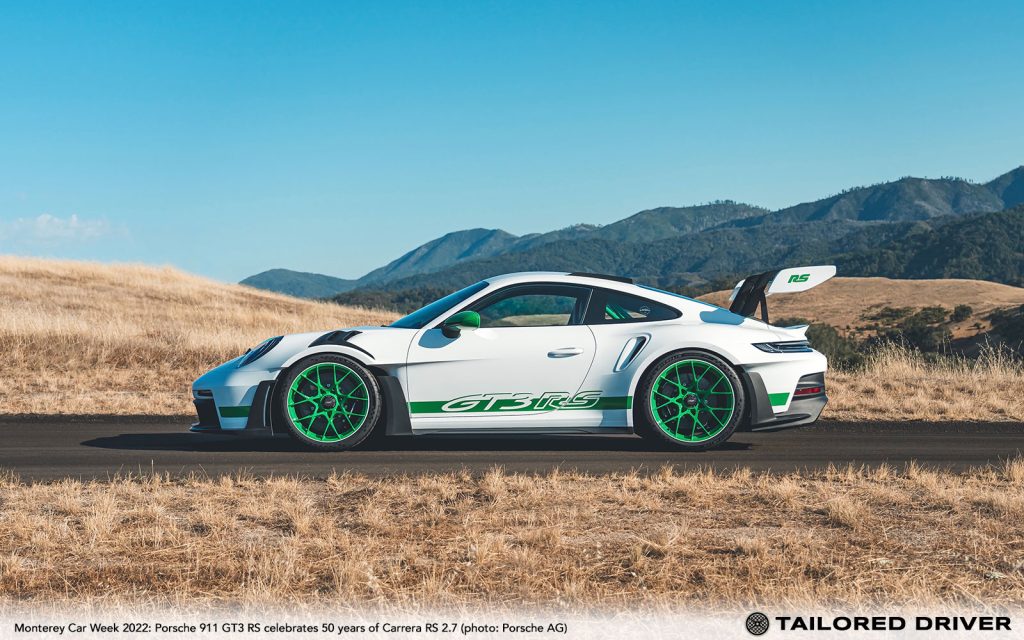
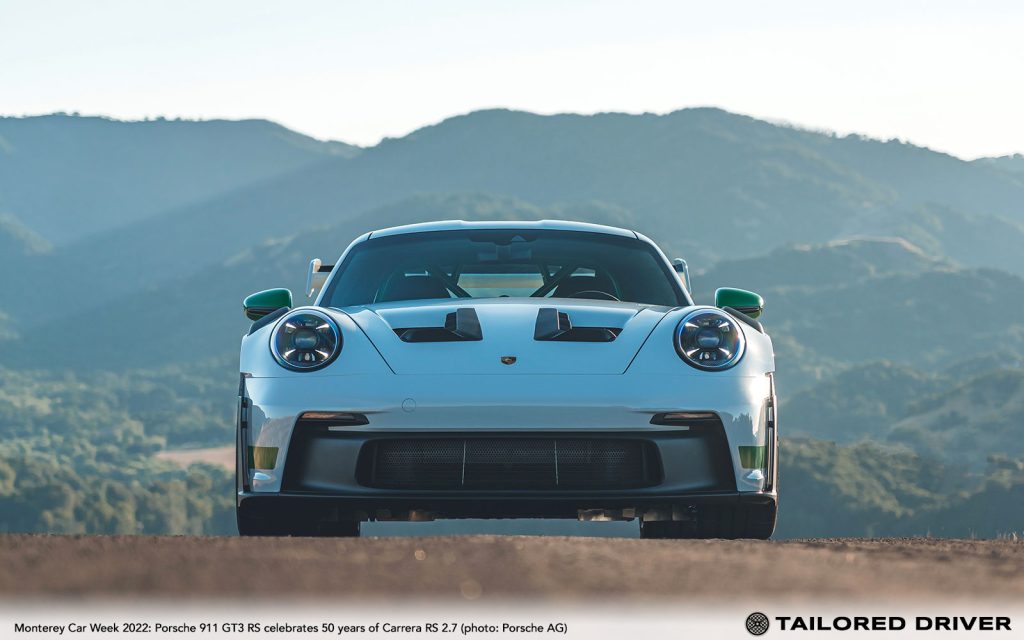
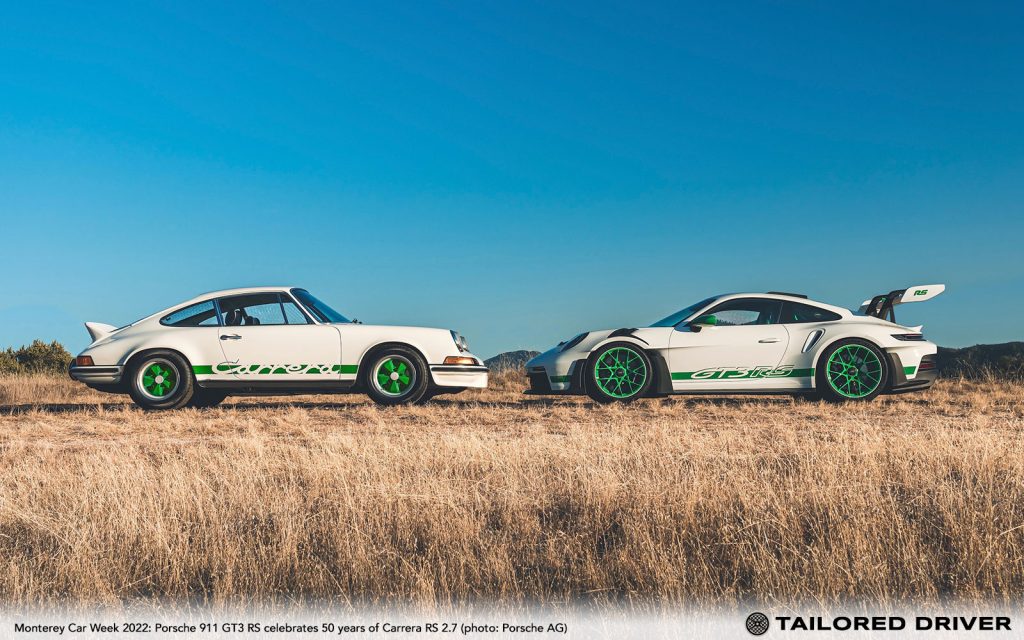
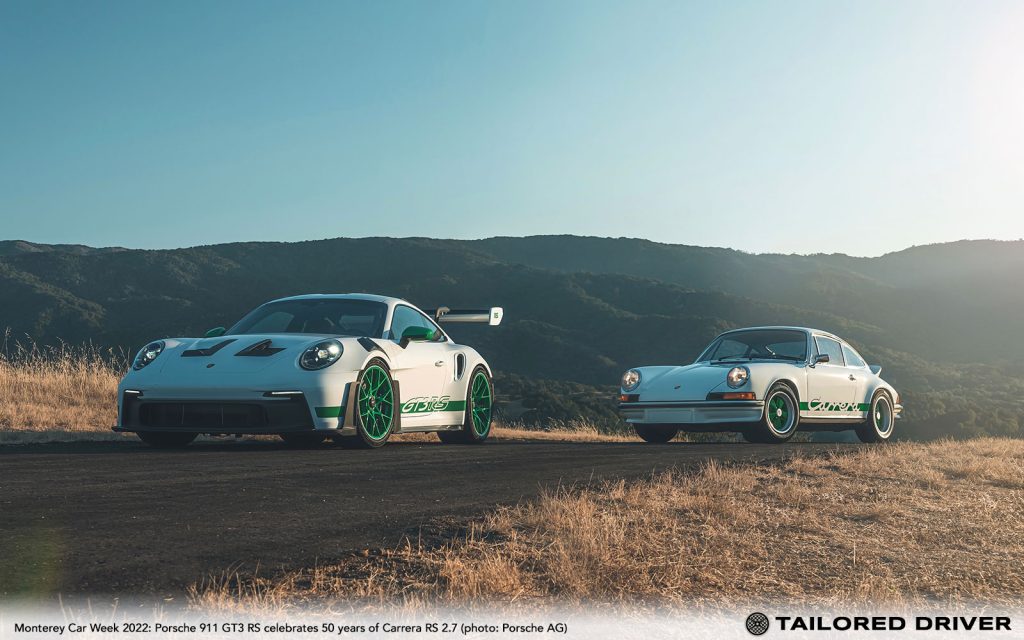
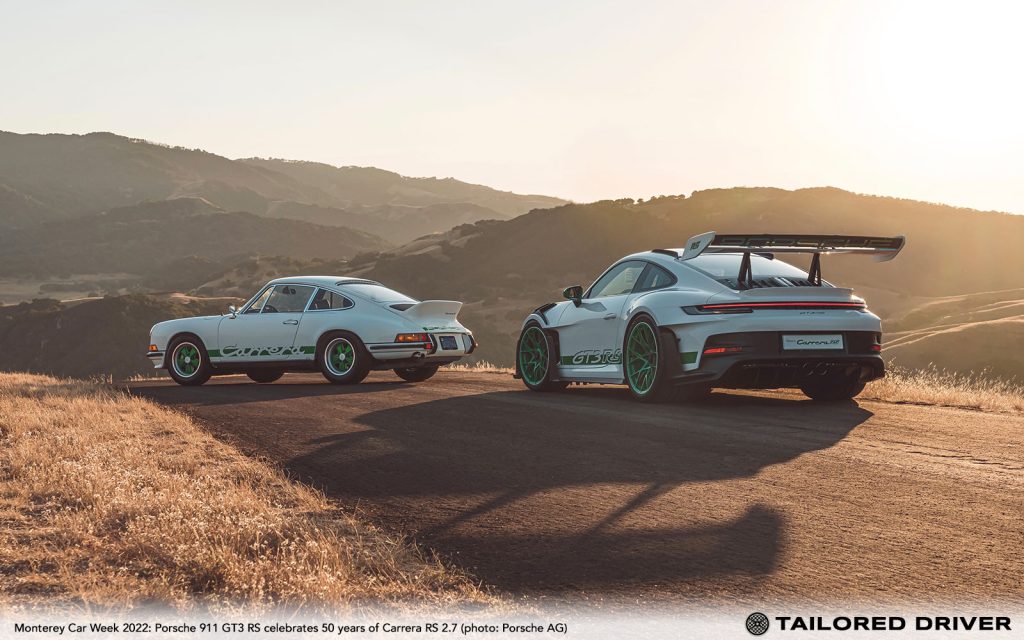
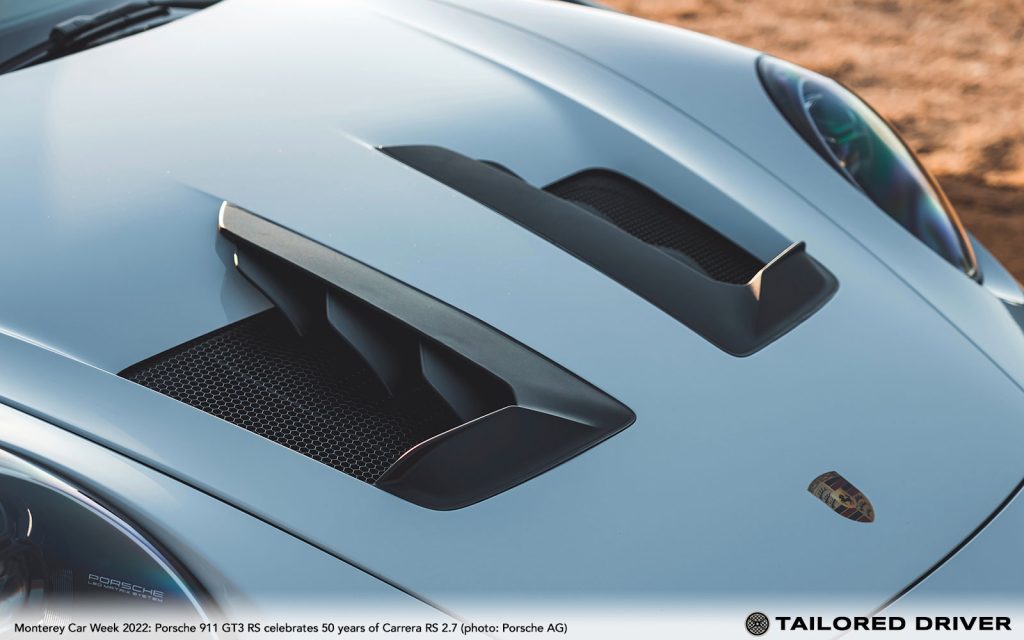
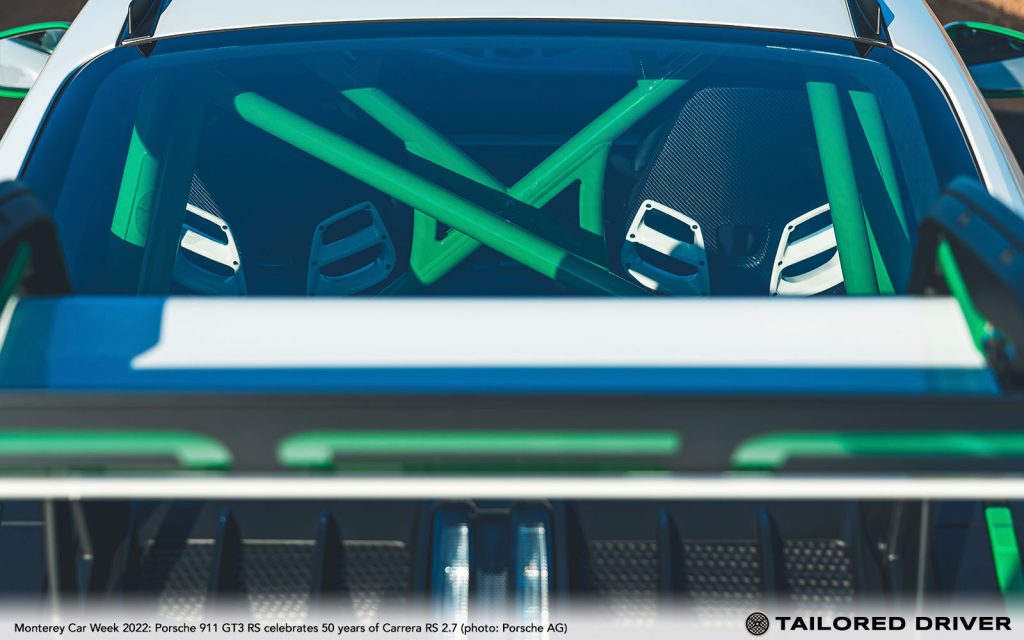
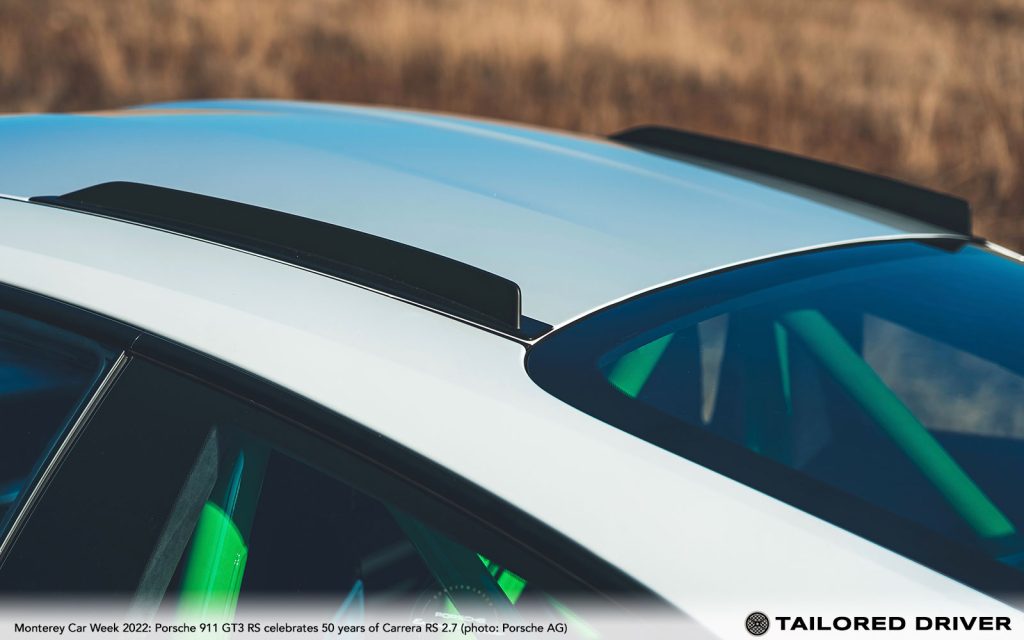
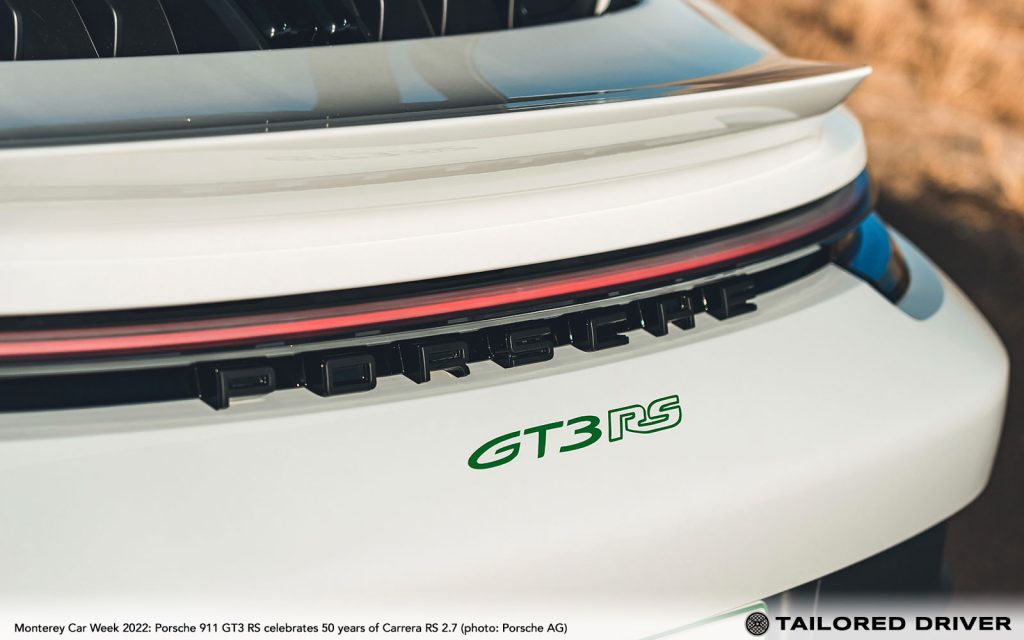
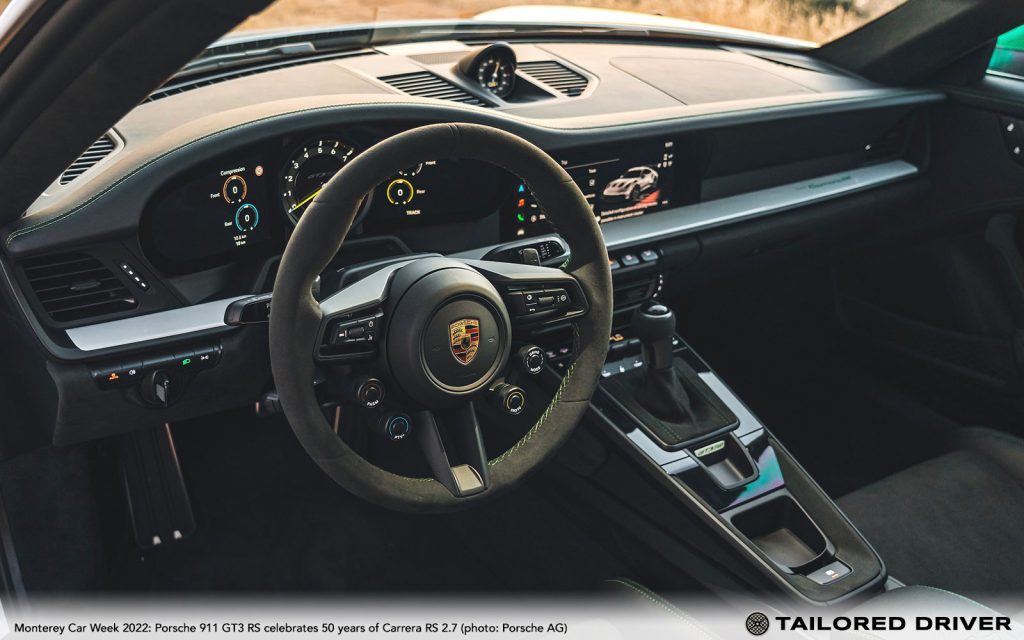
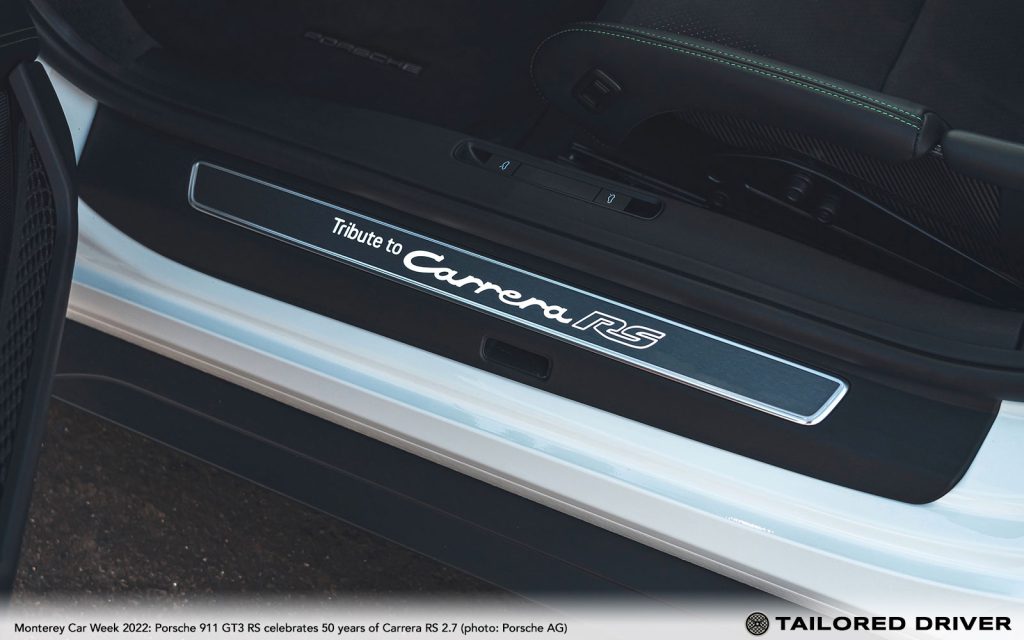
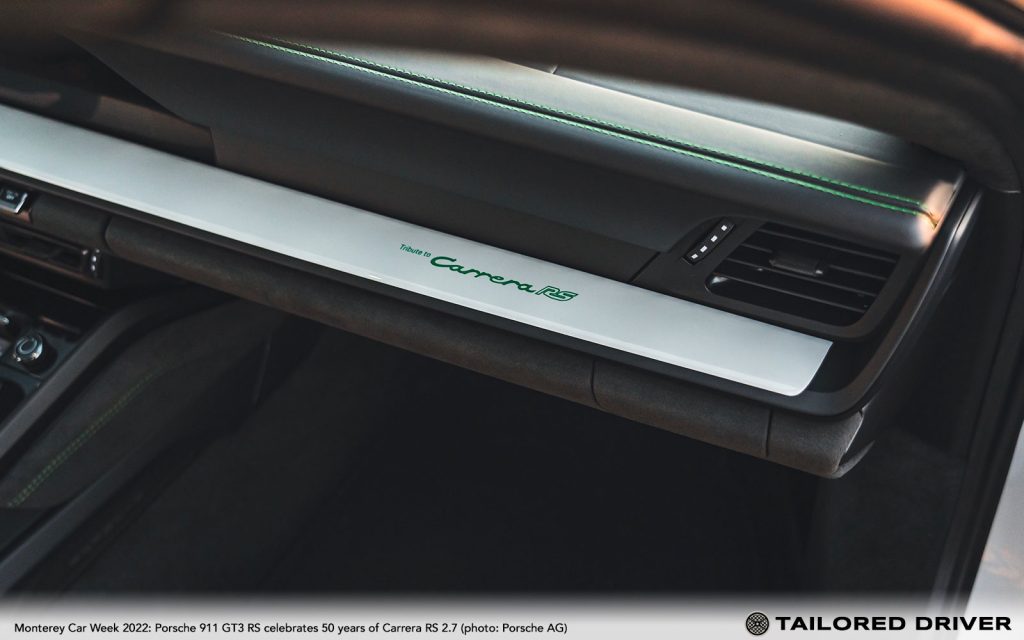
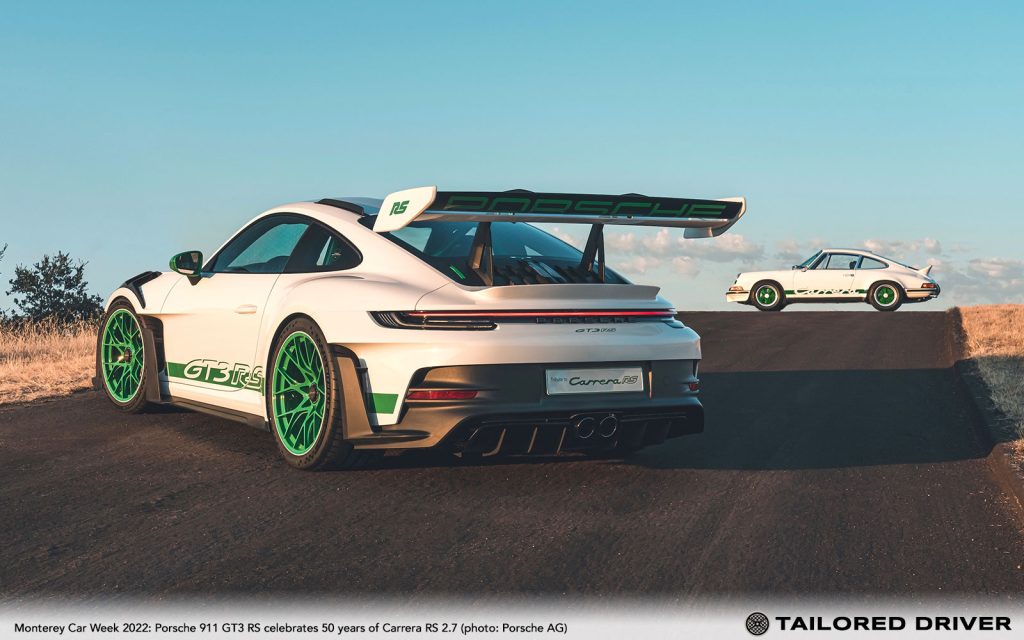
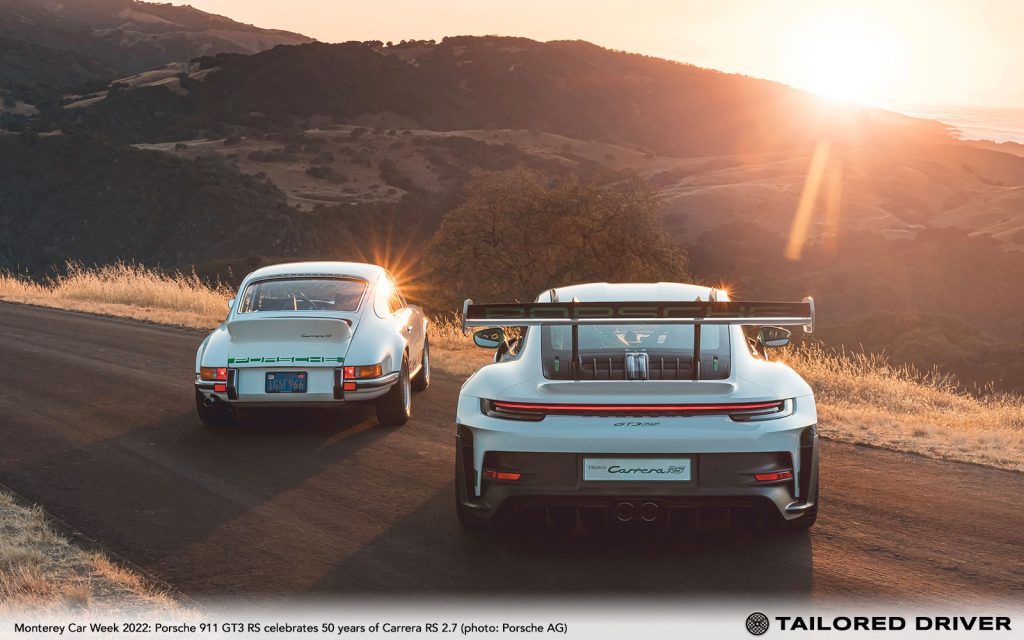
This show car, dubbed “Wingman” that no doubt pays tribute to its trick aerodynamics, pays tribute to 50 years of the original Carrera RS 2.7 with attention-grabbing green and white livery that will enjoy limited-availability as the Tribute to Carrera RS Package from Porsche Exclusive Manufaktur.
The main color of the Porsche is simply listed as white, while the eye-catching stripes are painted in Porsche Python Green. In person, it looks fantastic thanks to the iconic history associated.
“Wingman”, along with several other key Porsche models and historic cars, was on display for the remainder of Monterey Car Week and available for public view during operational hours of the Monterey Car Week Porsche Zentrum temporary facility.
Check out more photos from our first encounter with Wingman in the gallery below.
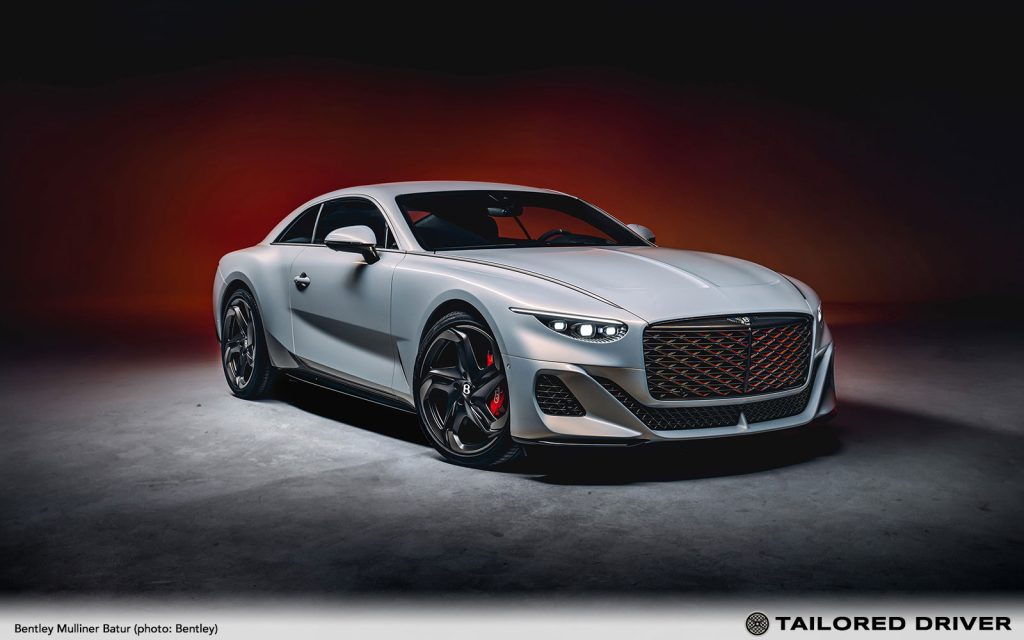
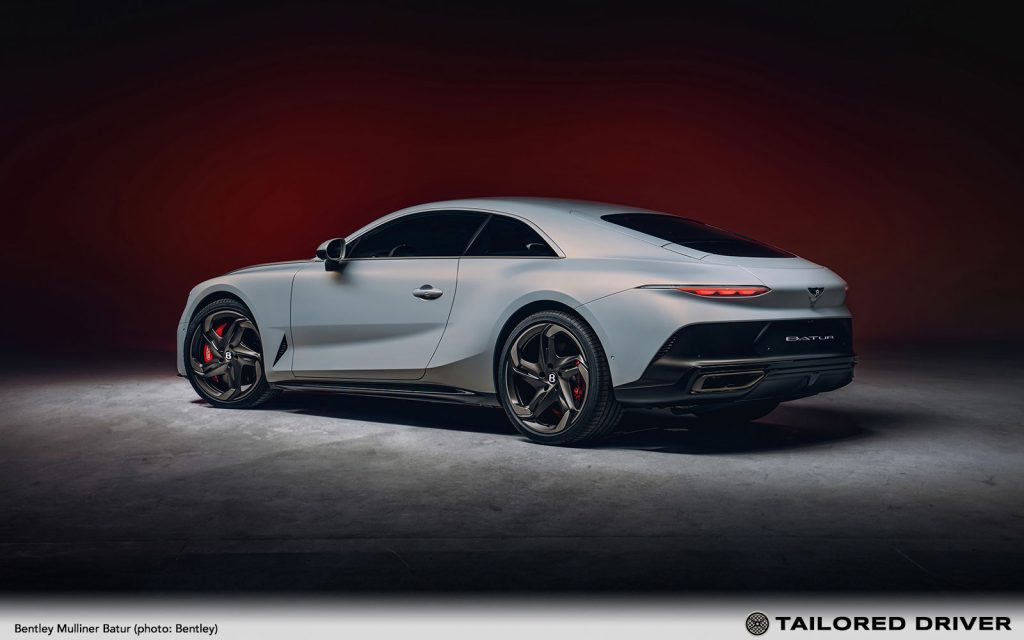
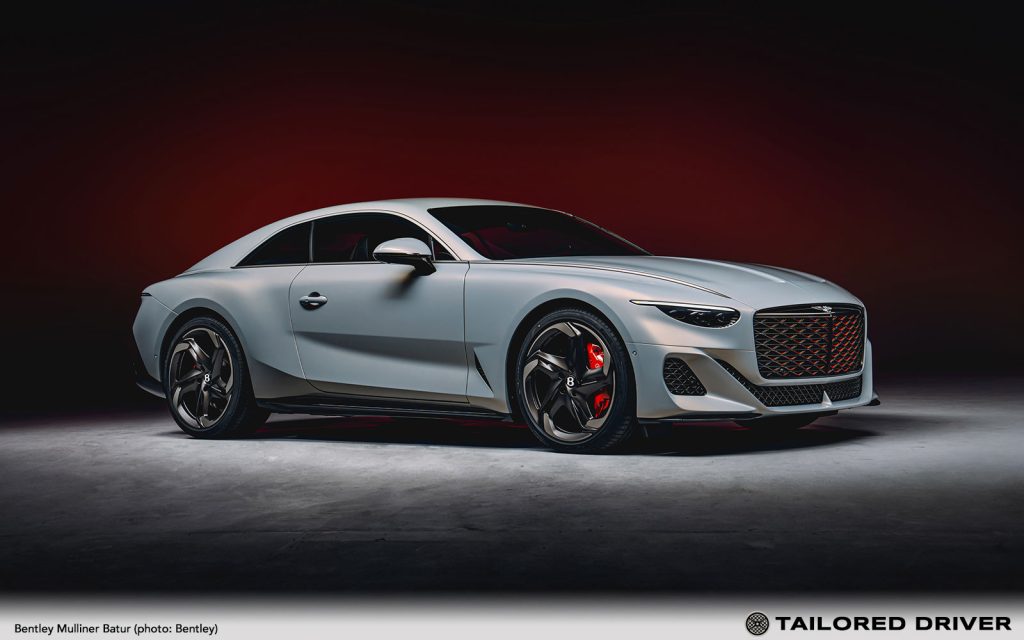
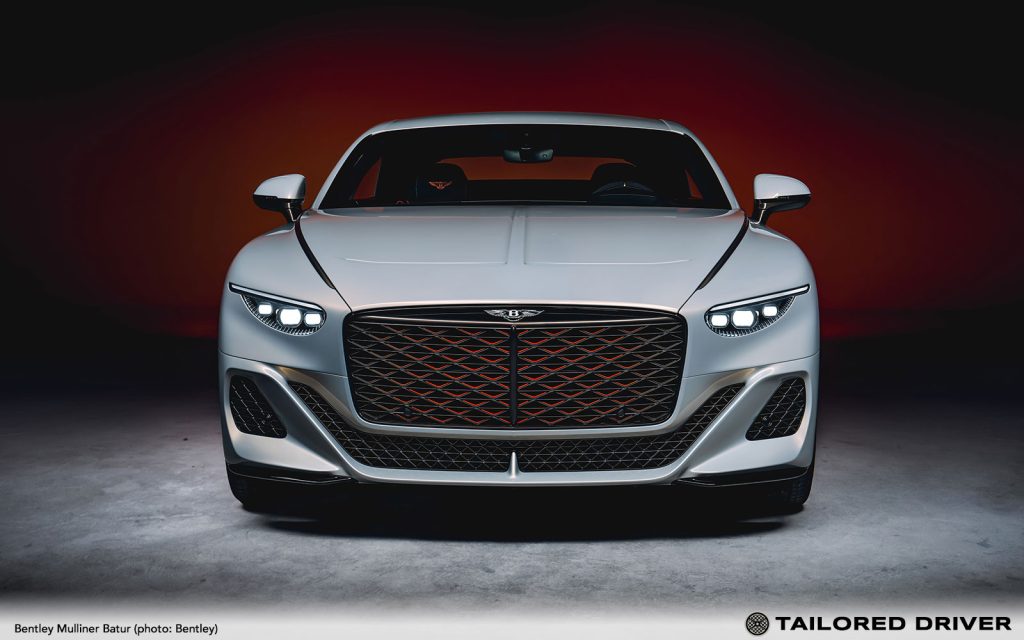
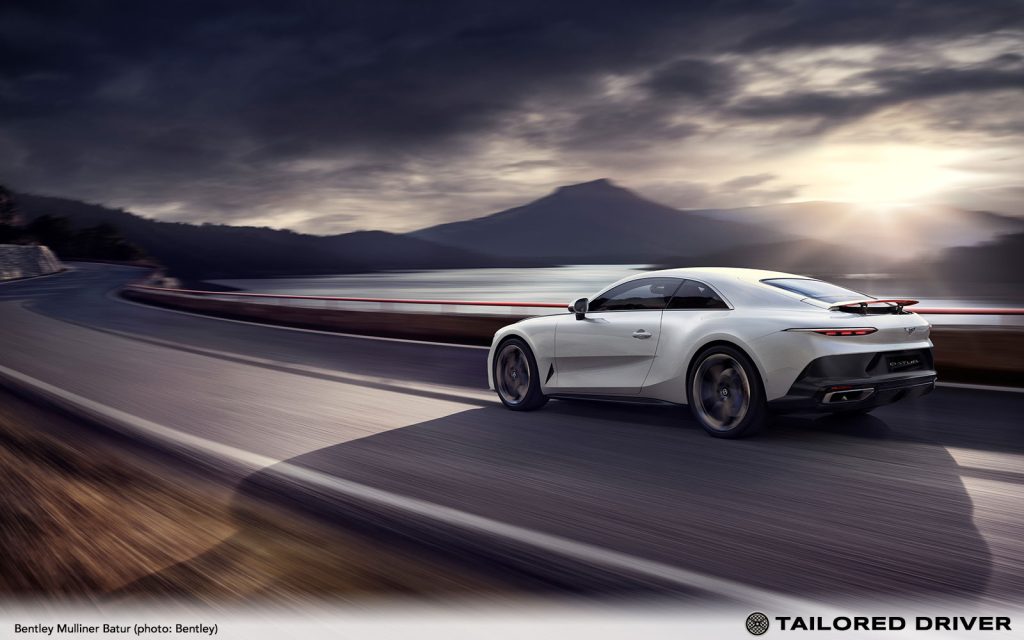
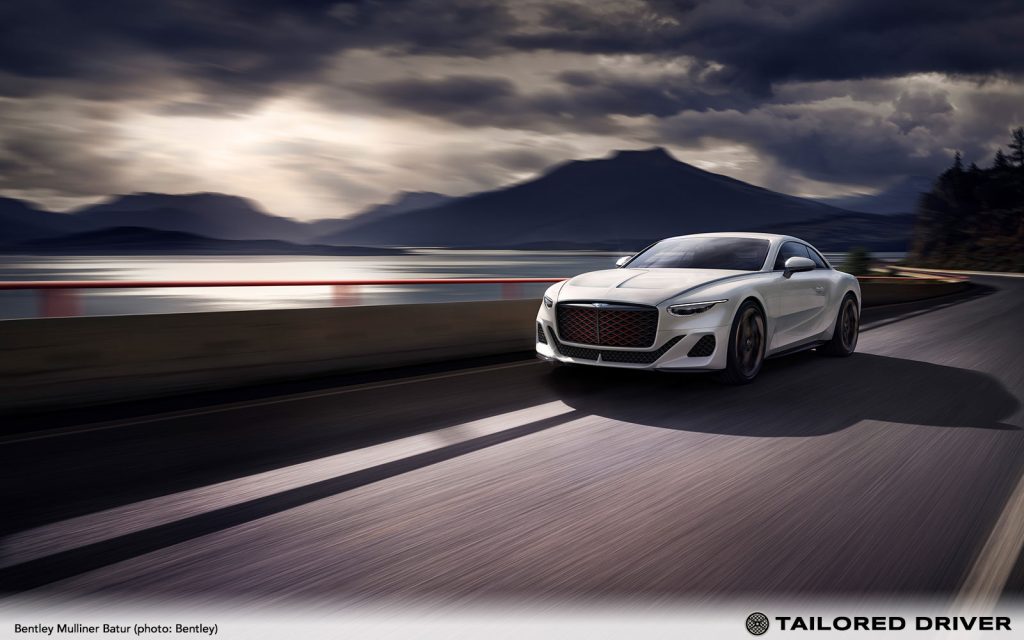
New Batur coupé previews new design language for Bentley
New design DNA shows direction for future Bentley BEVs
The next coachbuilt model from Mulliner – the oldest coachbuilder in the world, for over 250 years
Limited to just 18 series examples, all reserved by Mulliner clients and priced at £1.65m (exc. taxes and options) each
Most powerful Bentley in history, with 1,000 Nm development of iconic W12 engine now generating more than 740 PS
Endless array of options includes parts crafted in titanium, sustainable Natural Fibre composites and even 3D printed 18K gold.
Chassis technology including eLSD, four-wheel steering and 48V electric active anti-roll bars bring dynamism to match design and performance
Batur makes debut at Monterey Car Week in front of Bentley customers
Deliveries begin in mid-2023 after extensive development programme
[source: Bentley]
Crewe, England and Monterey, CA – Bentley Motors has today unveiled the Bentley Batur – a new two-door grand touring coupé limited to 18 series pieces that embodies the start of a design revolution at Bentley.
Created by Director of Design Andreas Mindt and his team, the Batur is a showcase of a new design DNA that will ultimately guide the design of Bentley’s future range of Battery Electric Vehicles (BEVs).
The collection of just 18 series examples of the Batur is the latest project by Bentley’s in-house bespoke and coachbuilding division, Mulliner, and succeeds the Bacalar – a run of 12 individually specified, designed and handcrafted Barchettas that relaunched coachbuilding at Bentley. Like its predecessor – the Bacalar – the Batur is named after a beautiful natural body of water. Lake Batur is an 88m deep, 16 km2 crater lake in Kintamani on the island of Bali, Indonesia, and provides nutrient-rich water to both local hot springs and agriculture.
The Batur will also be the most powerful Bentley yet, with a 740+ PS version of the iconic, hand-assembled 6.0-litre twin-turbocharged W12 engine that has metaphorically and literally powered Bentley’s success for the last two decades. As the engine enters its twilight years as part of Bentley’s Beyond100 transformation journey to being fully electrified, the Batur forms the first part of a celebration of the W12’s extraordinary power, torque and refinement. Engine performance will be matched to the most advanced Bentley chassis ever, with Speed-tuned air suspension, electric active anti-roll control, eLSD, four-wheel steering and torque vectoring.
All 18 examples of the Batur have already been reserved. Each one will be designed collaboratively with each customer, guided by Mulliner’s in-house design team. Customers will be able to specify the colour and finish of practically every surface of the Batur, to create a car as individual as they are. Each one will then be handcrafted over the course of several months in Mulliner’s workshop at Bentley’s carbon neutral factory in Crewe, England, with first deliveries expected in mid-2023.
The Batur was unveiled at Bentley’s Signature Party at Monterey Car Week, in front of almost 500 VIP guests, by Bentley’s Chairman and Chief Executive, Adrian Hallmark, who comments:
“The Batur is a significant car for Bentley. Far more than the heir to the highly successful Bacalar, the Batur showcases the design direction that we’re taking in the future as we develop our range of BEVs. Andi Mindt and his team have reimagined the classic Bentley design cues into a stronger, bolder design that remains both elegant and graceful.
“Beneath the beautiful exterior lies the most powerful engine we’ve ever developed. Our W12 engine is easily the most successful twelve-cylinder automotive engine in history, and as it approaches its retirement to make way for future hybrids and BEVs, we want to mark its accomplishments.
“The 18 lucky customers who have already reserved their Batur will enjoy an unrivalled co-creation experience with our Mulliner Design team in specifying their cars. The Batur is the next step in Mulliner’s expansion, demonstrating the demand for truly bespoke vehicles that combine luxury and performance in ways that only Bentley can deliver.”
A Design Revolution
The design of the Batur is the work of Bentley’s Director of Design, Andreas Mindt, and his team including Head of Exterior Design, Tobias Suehlmann and Head of Interior Design, Andrew Hart-Barron. The Bentley design DNA that has driven the creation of the Continental GT, Flying Spur and Bentayga families has been revolutionised for the Batur, introducing new themes, approaches and details. The new form language defines a new chapter for Bentley design, as part of Bentley’s Beyond100 transformational journey to become the world’s leading sustainable luxury mobility company.
The Batur previews the design principles that are driving the development of the company’s first BEV – due in 2025 – and the families of cars that follow.
Andreas Mindt explains the design:
“For any design team, the chance to redefine our own rules is the most exciting challenge. We have reimagined the Bentley design language, keeping some continuity to the past and present while also drastically changing key elements.
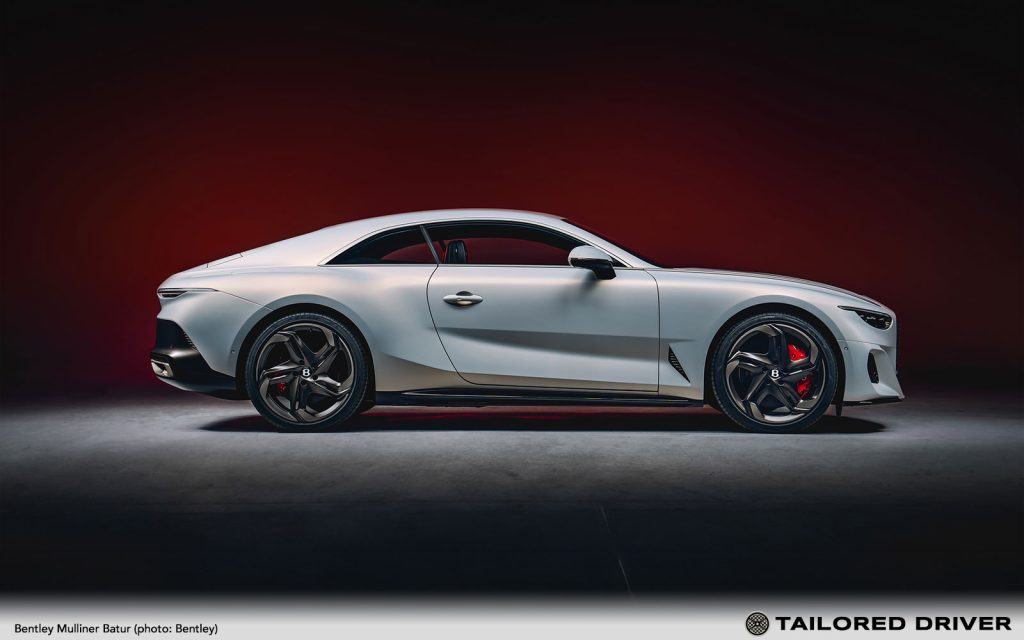
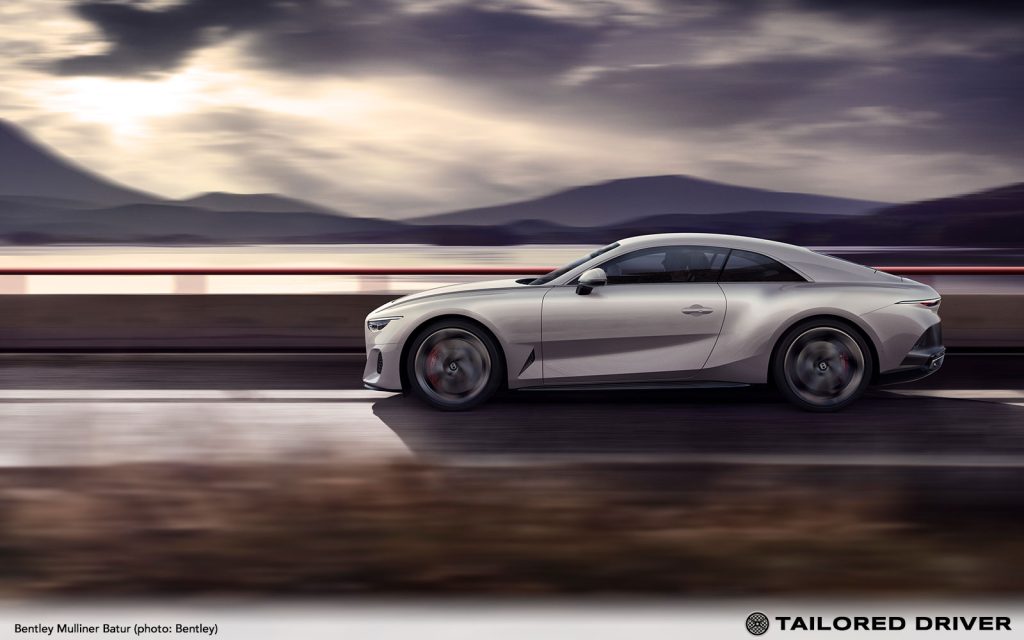
“The design of a modern Bentley should always be potent, inspirational and harmonious. The form has to be strong and muscular whilst remaining graceful – there must be both elegant flow and muscularity. The term we use is the “resting beast stance” – picture a lion or tiger, laying low in attack position in long grass. That powerful shape – of ultimate power at rest, that looks fast even when stationary – is one that drives our new interpretation of the classic Bentley power line and haunch.
“A mark of power and prestige has always been a long bonnet. Our new design cues include a line that stretches from the bonnet along the whole length of the car, connecting the bonnet into the body, making the car long and lean and giving an elongated proportion to the front end. We call this feature the “endless bonnet”, and it’s the only accent highlight to the cleaner shape. Meanwhile the visual mass of the car is moved rearwards, giving the impression that the car is sat on the rear axle, which adds further depth to the haunches.
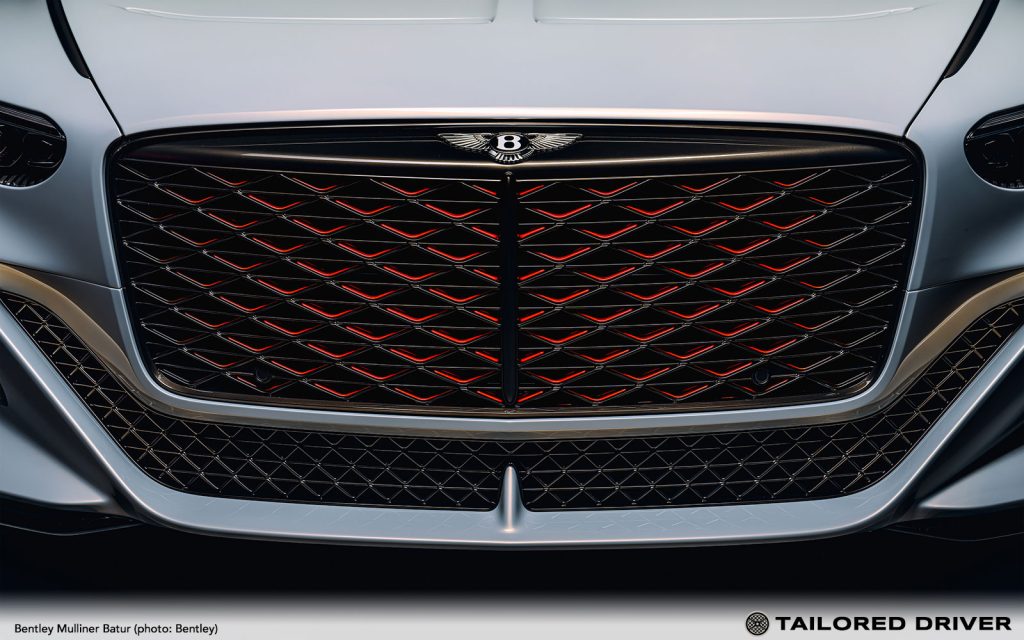
“At the very front of the car, we’ve modernised the famous Bentley grille and made it lower and more upright, to give a stronger face and a more dominant stance. This upright elegance brings self-confidence with a luxury stance. The grille is flanked by a new headlight shape and design, an evolution of the design used on Bacalar and maintaining the single large headlight either side. These are matched with all-new tail-lamps at the rear, that sit either side of a deployable spoiler.
“Overall, the form is cleaner and simplified, and we rely more on curvaceous surfaces bisected in the right places to reflect light and dark and bring more muscle to the design.”
The Next Exceptional Mulliner Project
The Batur is the heir and successor to the Bacalar, the 12-off Barchetta design that brought coachbuilding back to Mulliner. Mulliner has become adept at delivering complex projects, including the Bacalar and the Blower Continuation Series – the world’s first continuation of a pre-war car. The coachbuilding skills that have been reborn through both projects will combine with generational handcraftsmanship to deliver the 18 Baturs that are to be built, each one entirely and meticulously by hand.
Paul Williams, Director of Mulliner, comments:
“With Bacalar, we proved the appetite of our clients for truly bespoke and individual Bentleys. We’re building on that story with the Batur, and the fact that all 18 cars are already reserved is testament to the fact that our design team is creating cars that our clients want to buy. Batur is not only a beautiful handcrafted Bentley – it is the next member of a distinguished line of cars coachbuilt by Mulliner, which include the W.O. Bentley’s favourite car in the 8 Litre and the now truly-iconic R-Type Continental.”
Mulliner’s in-house design team will co-create every Batur with its customer, working together for several hours through a specially-created Mulliner visualiser that allows any part of the car to be customised in colour and surface finish. Endless samples of unique materials bring texture to the process, and the resulting designs will be truly individual and created by the customer – limited only by their imagination. From the main exterior paint to the surface finish of the air vents, and literally everything in between, each customer will specify even the tiniest of details.
Through handcrafted materials and exceptional colours, each Batur will then be brought to life by Mulliner’s team of automotive artisans in a process taking several months for each car.
Exterior Details
Beyond the exterior form of the car lies an almost endless array of choices for each car’s future owner to make. Paint choice is infinite – starting with the full Mulliner colour palette and travelling beyond into fully bespoke paint and even hand-painted graphics.
The aerodynamic additions of front splitter, side skirts and rear diffuser can be crafted in both carbon fibre or new, sustainable Natural Fibre composite.
The exterior brightware can be any mix of light and dark, satin or gloss or even titanium. As per the first car, another option is graduated contrast colour to the front grille, for a vibrant ombre effect.
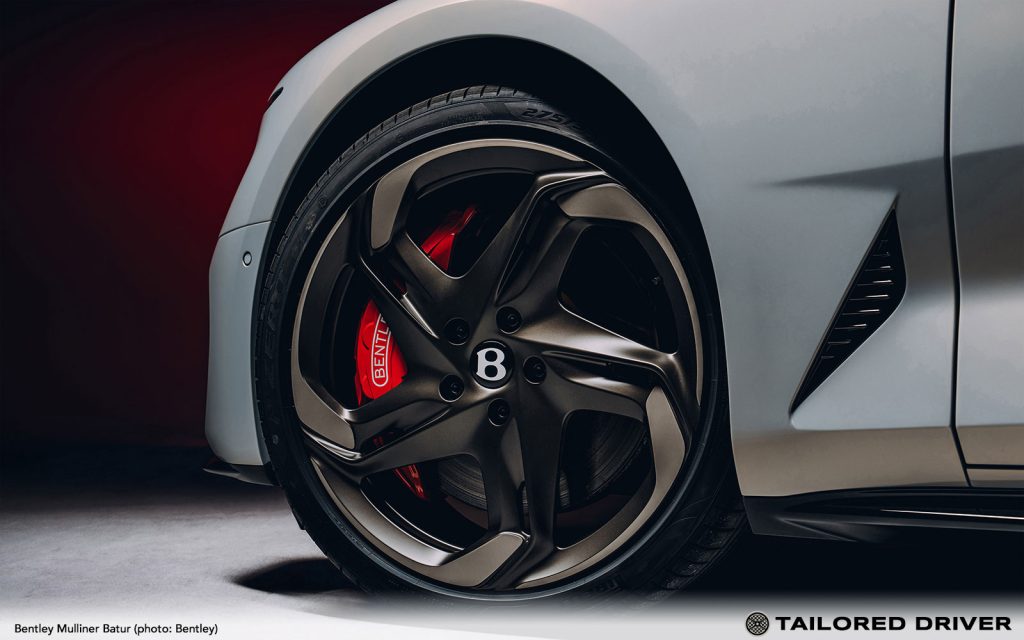
The Batur sits on unique 22” wheels, with the ‘standard’ option being painted in Black Crystal and then surface bright machined and polished. A darker option combines dark gloss faces with satin spokes, while customers can also choose to paint-match the wheels to the body with or without contrast finish, or to choose a totally different contrast colour.
The car revealed in Monterey has been specified to showcase the Batur’s form language. The exterior paintwork is a bespoke colour – Bonneville Pearlescent Silver – that provides flowing contrast across the curvaceous surfaces. The bodywork is underscored by carbon fibre front splitters, side skirts and rear diffuser painted in Black Crystal. The front of the car features a grille of exceptional art – with the main matrix finished in Gloss Dark Titanium, accented with contrast chevrons in a horizontal ombre pattern that flows from Hyperactive Orange in the centre and gradually darken to the sides to Black Crystal. The “endless bonnet” line is finished in Satin Titanium paint, as are the 22” wheels – with the spokes in Satin Dark Titanium to match the grille.
A Cabin of Sustainable Bespoke Beauty
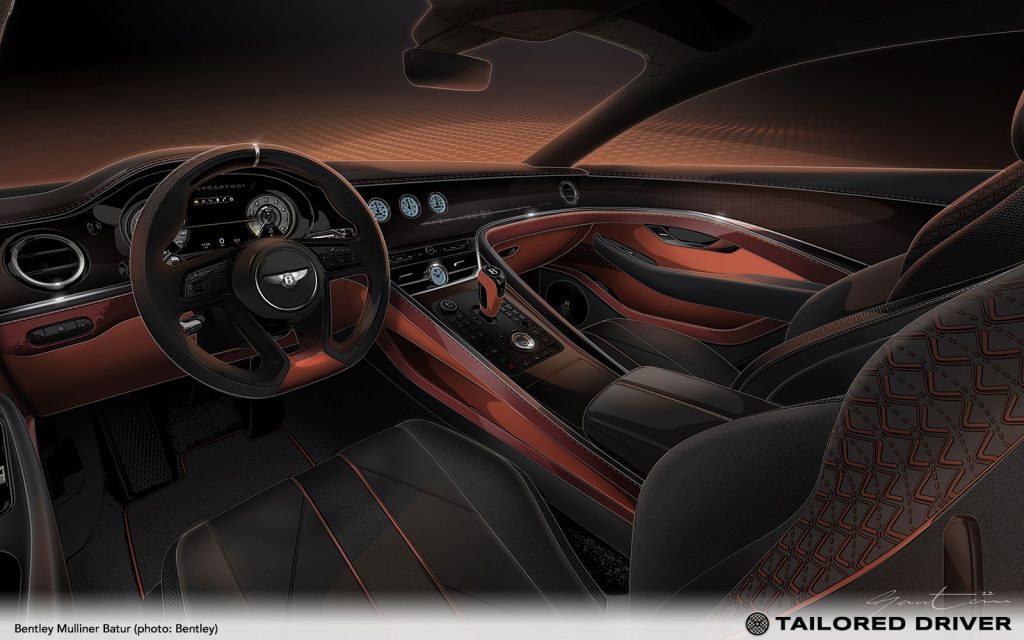
The two-seat interior space of the Batur is designed for ultimate personalisation and long-distance grand touring. Inspired by the success of the interior design of the Bacalar, the Batur builds on the core elements of the Bacalar’s cabin design and adds new sustainable luxury features.
Every element of the cabin is tailored to the customer’s specifications. Clients can choose from a variety of sustainable interior materials, including:
Low-carbon leather sourced from Scotland, which travels significantly smaller distance than leather sourced from outside the UK.
Sustainable tannage leather from Italy, in five different colours.
Dinamica, an alternative suede-like sustainable material to leather.
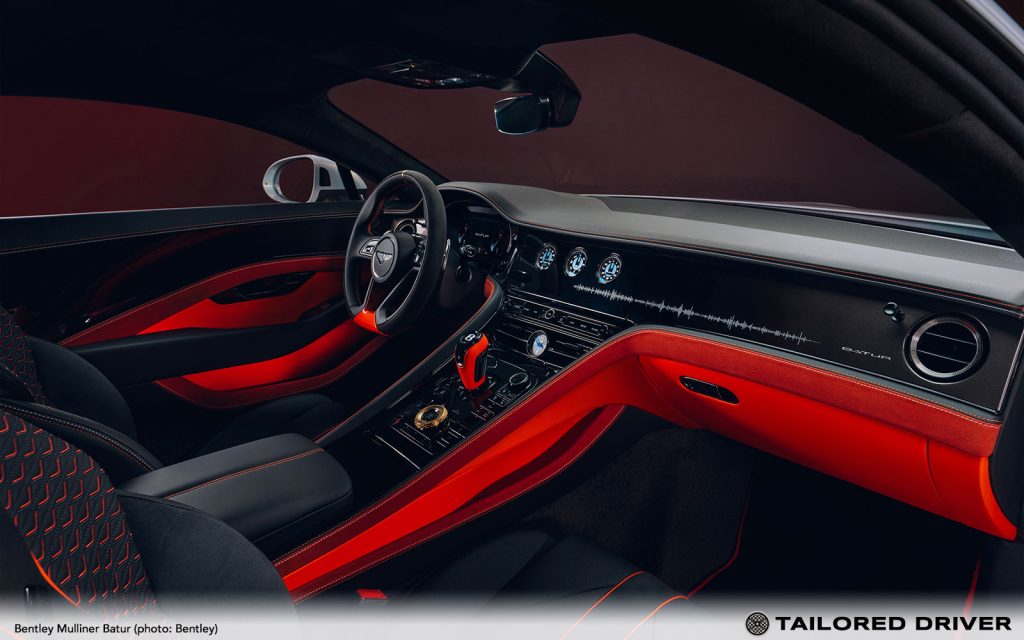
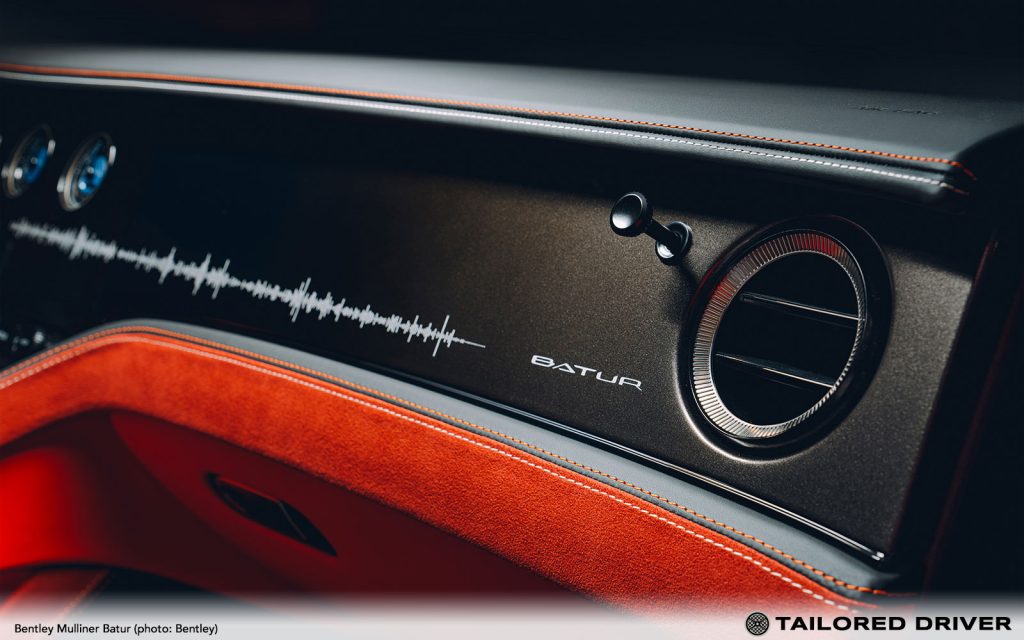
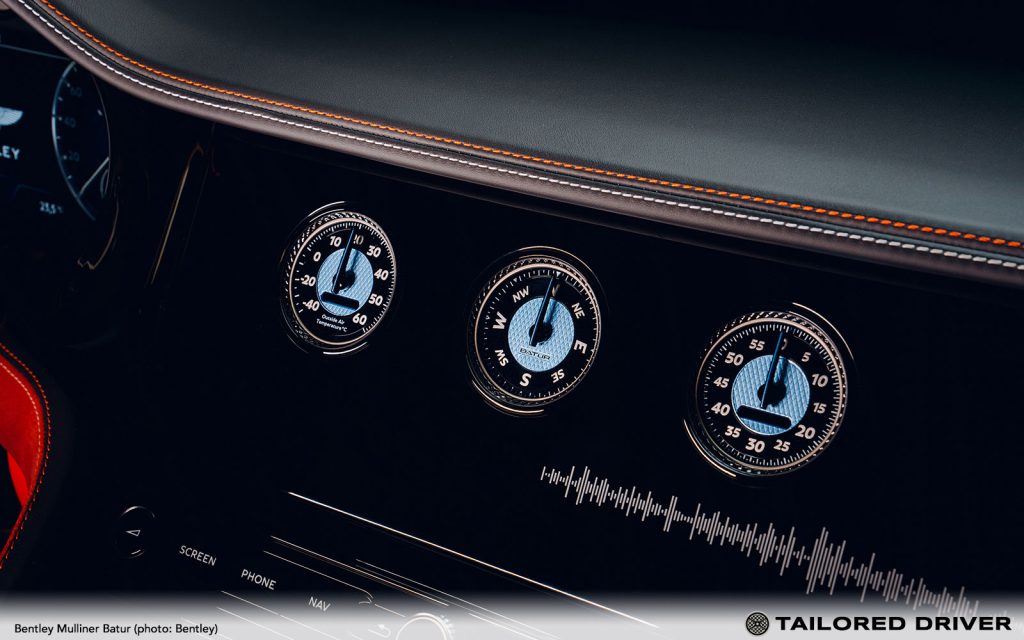
The range of veneers available for the fascias include a new material for Bentley – Natural Fibre composite, which is a sustainable alternative to carbon fibre. Available as a 2×2 twill weave and finished in satin lacquer, the Natural Fibre composite brings a new sustainable texture to the cabin. Regardless of the veneer chosen, the passenger fascia panel is finished with a unique etching of the audio signature of the W12 engine – and bespoke etching is also available.
The final sustainable elements are the carpets, which are matched to the leather and made from recycled yarn, in a first for Bentley.
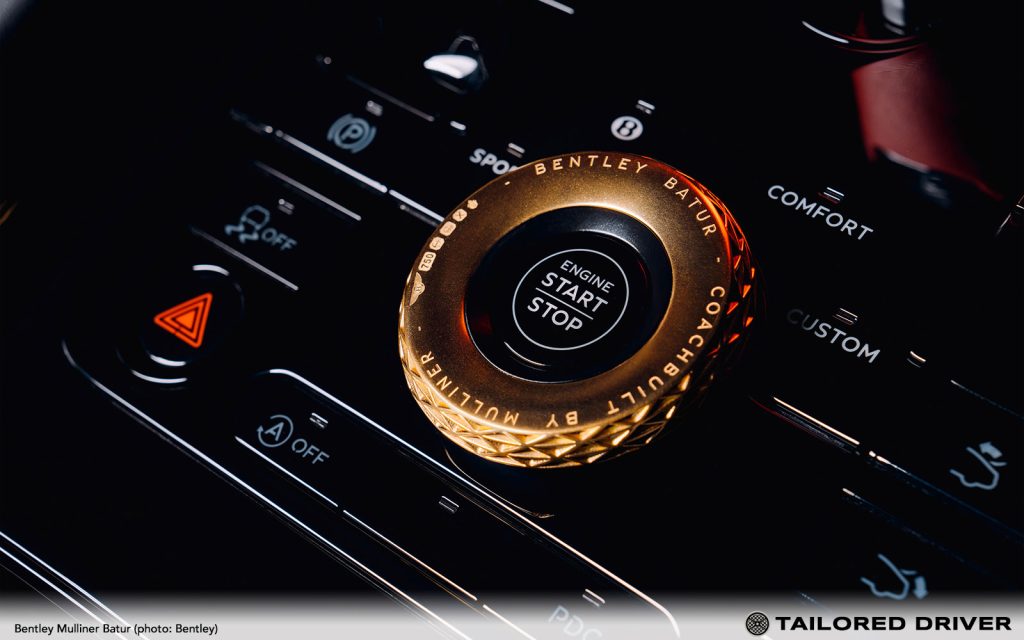
Clients will choose between bright or dark treatments to the interior brightware and titanium options are also available. Certain controls – like the organ stops for ventilation – are even available in 3D-printed 18K gold.
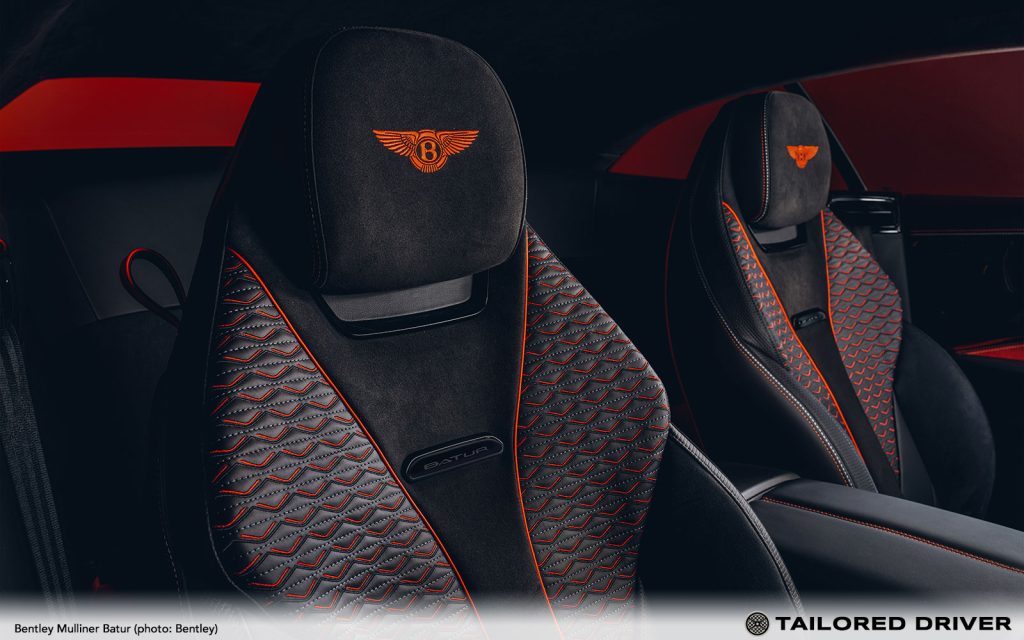
The interior of the launch Batur has been trimmed by hand in a stunning combination of black, red and orange – specifically, Beluga, Hotspur and Hyperactive. Beluga main hide is contrasted with new, even more sustainable low CO2 Mulliner Hyperactive Orange leather. A complementary texture is provided through the use of Dinamica – a suede-like alternative to leather – in both Beluga and Hotspur. Unique “Batur Chevrons” to the outer wings of the seats are finely embroidered by hand in Snap Orange thread, whilst the remainder of the upholstery carries a white thread in contrast throughout. The soft elements are completed with a new feathered artisan piping in Beluga, with Hyperactive Orange piping to the seat centres and a Hyperactive Orange finish to the lower spoke of the steering wheel.
The veneers to the Instrument Panel, fascias and doors are Gloss Black painted, with a ‘guitar fade’ to Fine Brodgar that flows from the fascias to the doors, before fading back to black. The fascia is completed with a unique piece of art – a laser-etched sound wave, which represents the unique sound generated by the W12 engine. The metallic elements of the interior are a blend of Black Anodised Aluminium and Satin Titanium, completed with a hallmarked 18 karat gold Bentley Dynamic Drive Selector and ‘12 o’clock’ steering wheel centre band.
The Mighty W12
The Batur features the most powerful engine yet fitted to a Bentley. The 6.0-litre W12 that started the rebirth of Bentley with the Continental GT in 2002 has been through several design iterations since, and is now the most advanced twelve-cylinder engine in the world. It has always been hand-crafted in Bentley’s carbon neutral factory in Crewe, England.
For the Batur, a new intake system, upgraded turbochargers, new intercoolers and extensive recalibration more than 740 PS and 1,000 Nm of torque, to deliver exceptional performance for this new pinnacle grand tourer. This development of the engine is in celebration of its achievements over 20 years, over which time it has been developed to produce nearly 40% more power while fuel economy has improved by 25%. For the Batur, the W12 is paired with Bentley’s eight-speed double-clutch transmission, and a sports exhaust to provide a soundtrack in keeping with the level of performance. The entire exhaust system is in titanium, while the finishers are 3D-printed in titanium in a first for Bentley.
As Bentley moves towards the era of electrification, the W12 is entering its twilight years. Before its retirement, this engineering masterpiece is worthy of commendation, and the Batur is the perfect home for the ultimate development of W12 performance.
A Chassis System to Match
As well as being the most power and most exclusive Bentley coupe to date, the Batur will also be the most dynamic.
Adaptive three-chamber air springs each have three switchable chambers, changing the volume of the air spring and so its effective stiffness. The driver can select the balance between ride comfort and body control using the four-mode Drive Dynamics Control in the centre console, choosing between Sport, Bentley, Comfort and Custom.
The Drive Dynamics Control also changes the behaviour of the 48V electric active anti-roll control system, which can provide up to 1,300 Nm of anti-roll torque in 0.3 seconds or completely decouple the wheels at either end of each axle. The anti-roll control system can also be used to adjust the roll stiffness front-to-rear, giving the Batur sharper turn-in and greater ability to balance the car on the throttle when in Sport mode.
Overall traction and cornering grip is maximised through the use of an electronic Limited Slip Differential (eLSD) that actively vectors drive torque across the chassis. This is complemented by torque vectoring by brake, whereby the car can lightly brake the inside rear wheel on turn-in for greater front-axle response, and also lightly brake both inside wheels on corner exit to move power across to the outside, loaded wheels for better traction.
Braking is via Bentley’s CSiC (Carbon-Silicon-Carbide) braking system, with 440 mm front and 410 mm rear discs, matched with 10-piston front and four-piston rear calipers. The Batur rides on bespoke 22” wheels with Pirelli tyres.
Monterey, CA – The 2023 Porsche 911 GT3 RS made its first in-person appearance today at The Quail, A Motorsports Gathering, only two days after its digital world premiere. The show car – customized by the GT Model Line and Style Porsche – is a tribute to the 1972 911 Carrera RS 2.7.
Additionally, as announced by Kjell Gruner, President and CEO of Porsche Cars North America Inc. (PCNA), the car will serve as inspiration for a limited-availability Porsche Exclusive Manufaktur offering exclusive to U.S. customers: a Tribute to Carrera RS Package.
“America is the second home of the 911 and a special tribute exclusive to the U.S. is the perfect way to celebrate the 50th anniversary of the 911 Carrera RS 2.7,” said Gruner. “So many of us idolized the original 1972 car. We want to create a special experience that combines exclusive options on the new GT3 RS with a one-of-a-kind list of accompanying items. Together, it will be an exciting and individual tribute to the RS lineage. This is a live project in its early stages, and is being created by enthusiasts, for enthusiasts as a joint effort between our colleagues in Zuffenhausen, Flacht and our team in America. The ideas and concepts are really exciting and we’re having a lot of fun developing it – all of us are looking forward to sharing more details with you soon.”
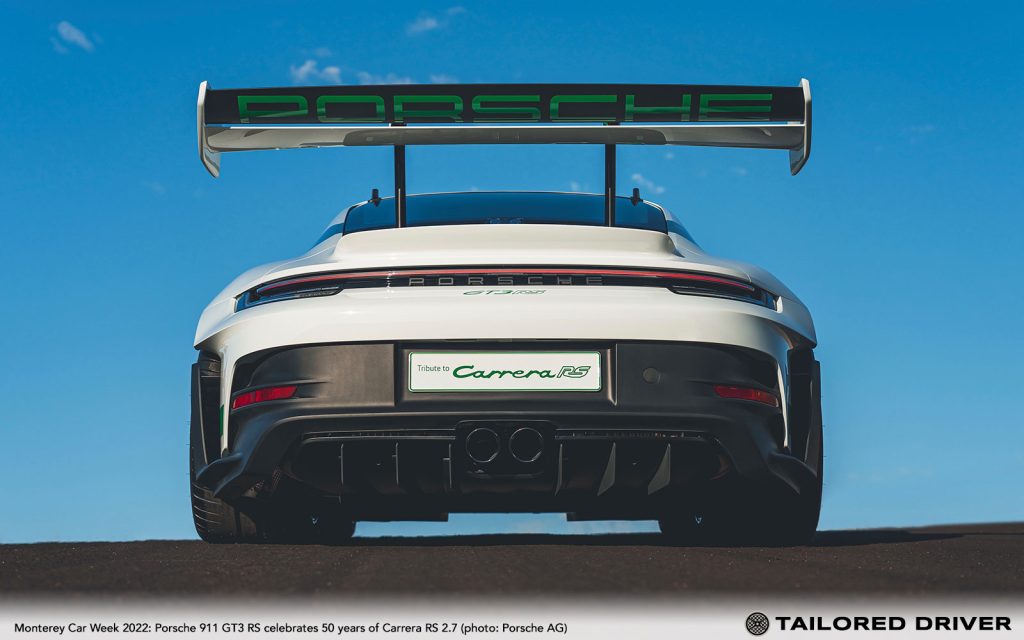
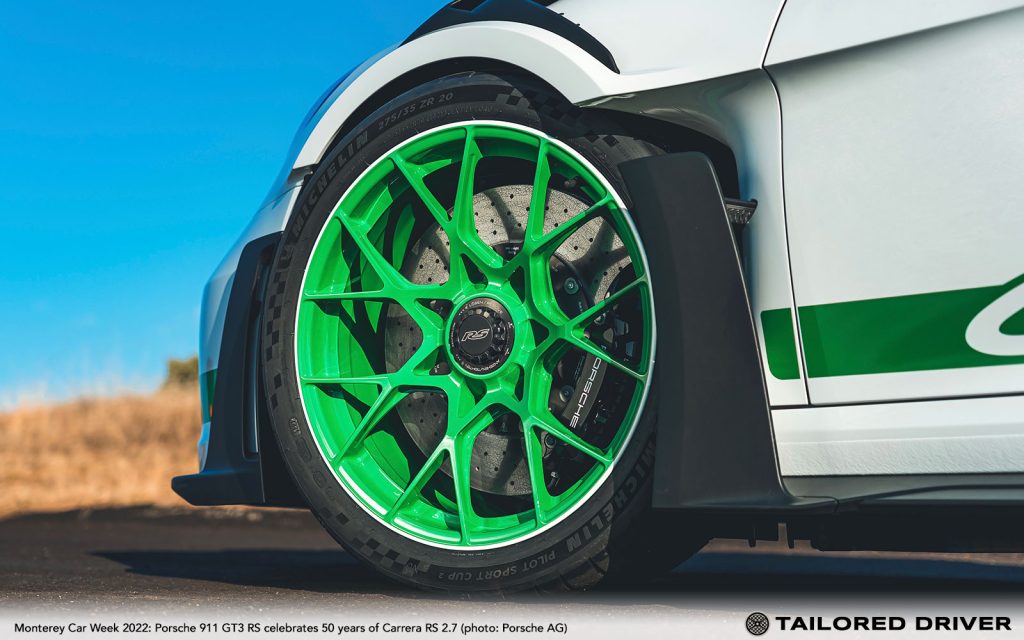
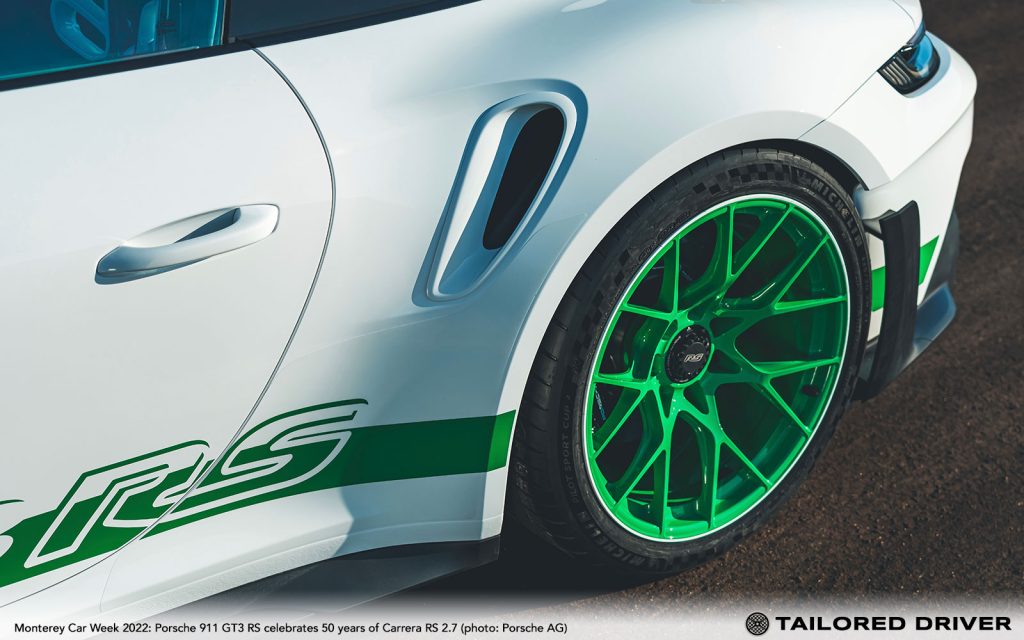
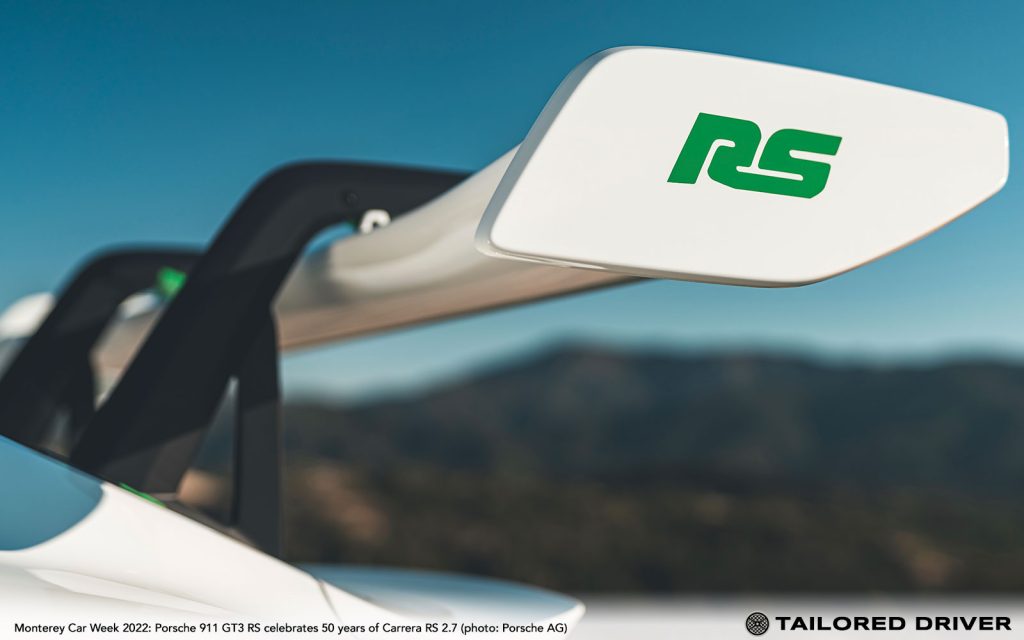
Appropriately for Monterey Car Week, the model on display is extensively personalized. Finished in white with key areas in Python Green, the car is a direct reference to the iconic white and green color configuration offered in 1972 on the first 911 “RS” model as well as a new interpretation of it. In this instance, the body is finished in non-metallic white including side air intakes painted to match with model designation graphics on the sides and rear in Python Green, forged aluminum wheels in Python Green with white pinstripes. Exclusive Design taillights emphasize the green-on-white theme by eliminating the red color from the rear taillights and third brake light. Finally, the side plates on the left and right ends of the large rear wing are painted white with RS logos in Python Green.
“Porsche Exclusive Manufaktur allows customers to personalize their car to a point where the vehicle is as much a reflection of them as it is of Porsche,” said Karl-Heinz Volz, Director of Exclusive Manufaktur Options. “Personalization is a Porsche tradition dating back to our first production model, the 356, when a customer requested a wiper be added to the rear window of their car. Today it is an incredibly extensive personalization program, offering options ranging from small changes to true one-off creations.”
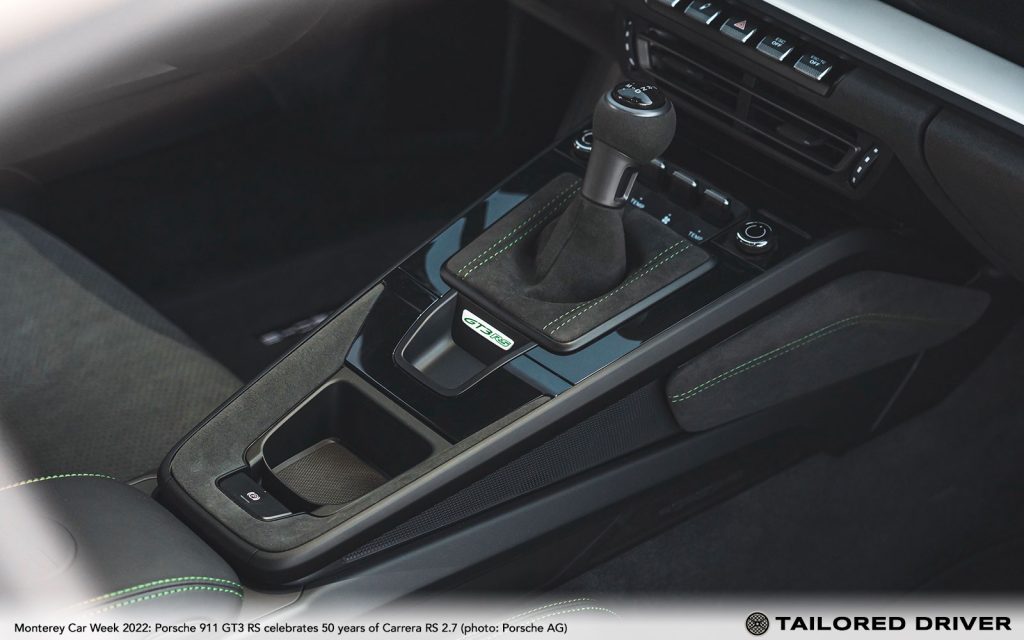
The headlights also feature a pinstripe ring in white, something that is not available via the normal list of factory-available options. The color combination continues inside the car with matching stitching, trim panels in white to match the exterior.
“As a car enthusiast growing up, my walls were plastered with models that I was particularly fond of. One of the most influential was the 911 Carrera RS 2.7. As a young kid it captured me imagination and even today it puts a smile on my face,” Andreas Preuninger, Director GT Model Lines, said. “That’s where the styling inspiration of the 996 GT3 RS came from, which was one of my first projects at Porsche. At the time, that car felt totally extreme so colors nodding to the forefather made sense. Today, it’s a very emotional moment for me to pay tribute to the first 911 RS model with our most extreme and capable 911 GT3 RS yet.”
About the 2023 911 GT3 RS
The 2023 Porsche 911 GT3 RS is the most extreme street-legal 911 model yet. Its 4.0-liter naturally aspirated boxer six-cylinder engine generates 518 hp, and revs to 9,000 rpm (911 GT3 RS: Fuel consumption* combined (WLTP) 13.2 l/100 km, CO₂ emissions* combined (WLTP) 299 g/km, CO2 class G ). That power is routed exclusively to the rear wheels via a seven-speed PDK dual-clutch automatic transmission. Making extensive use of motorsport-derived aerodynamics, it generates more than 900 lbs. of downforce at 124 mph and 1,895 lbs of downforce at 177 mph.
This is also the first example of a 911 GT3 RS with active aerodynamics, a feature that is used to offer incredible levels of downforce, provide deceleration assistance by creating an air brake, and by offering a Drag Reduction System (DRS) that can reposition aerodynamic elements to cut drag at the driver’s command in certain conditions.
About the 1972 / 1973 911 Carrera RS 2.7
Fifty years ago, the world knew the 911 Carrera RS 2.7 as Germany’s fastest sports car. It began as a homologation special and featured many technological innovations. It was the most powerful version of the first-generation 911, generating 210 PS at 6,300 rpm and 188 lb.-ft. of torque at 5,100 rpm from its air-cooled flat-six developed by Hans Mezger and Valentin Schäffer.
A more potent engine was only part of the success story. Much like the new 911 GT3 RS, wind tunnel testing and aerodynamic science introduced never-before-seen technology to the 911. The ducktail, now as much an icon of style as an element of function, was critical in achieving stability at high speeds. Not only did it unlock the ability to drive faster, but it did so without incurring additional drag. In fact, it reduced the drag coefficient
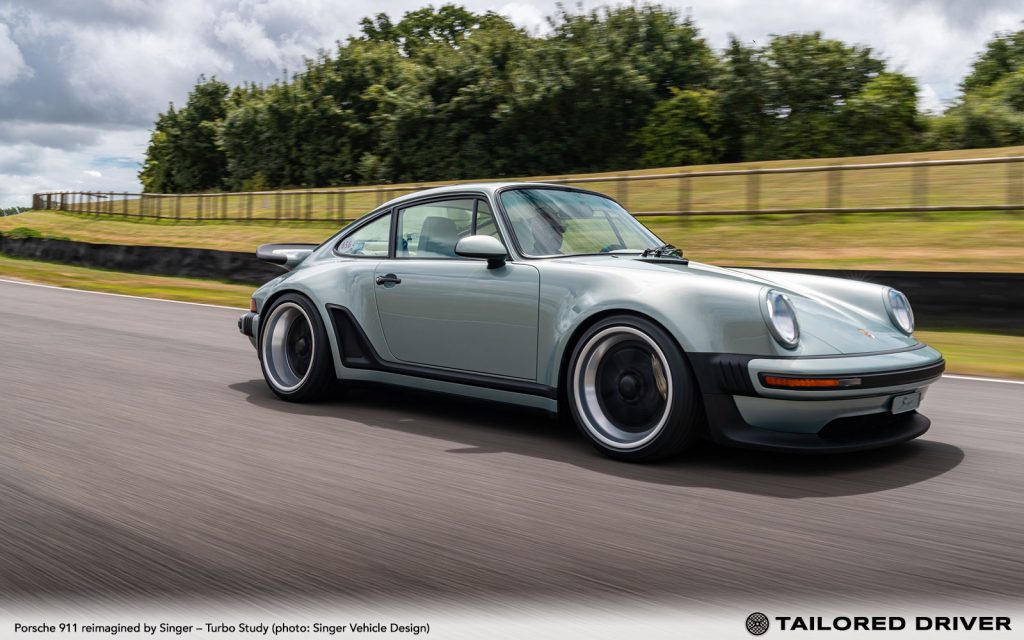
A new chapter in Singer’s automotive services in collaboration with owners of the air-cooled, Type 964 Porsche 911
The first road-going, turbocharged Porsche 911 reimagined by Singer
Presented in Wolf Blue, with a specification focused on high-speed, luxury grand touring
[source: Singer Vehicle Design]
Los Angeles, CA — Singer returns to TheQuail, A Motorsport Gathering for 2022 with the first restoration of a Type 964 Porsche 911 enabled by the results of the company’s Turbo Study.
Singer’s Founder and Executive Chairman, Rob Dickinson notes, “The first Porsche 911 reimagined by Singer was presented during Monterey Car Week in 2009, so it’s fitting that we’re returning to The Quail this year to present our latest idea – in celebration of the iconic Porsche 930 Turbo. Singer is a philosophy and every car we restore encapsulates our unique perspectives, the personal vision of the owner, and a celebration of heritage – reimagined with twenty-first century engineering.”
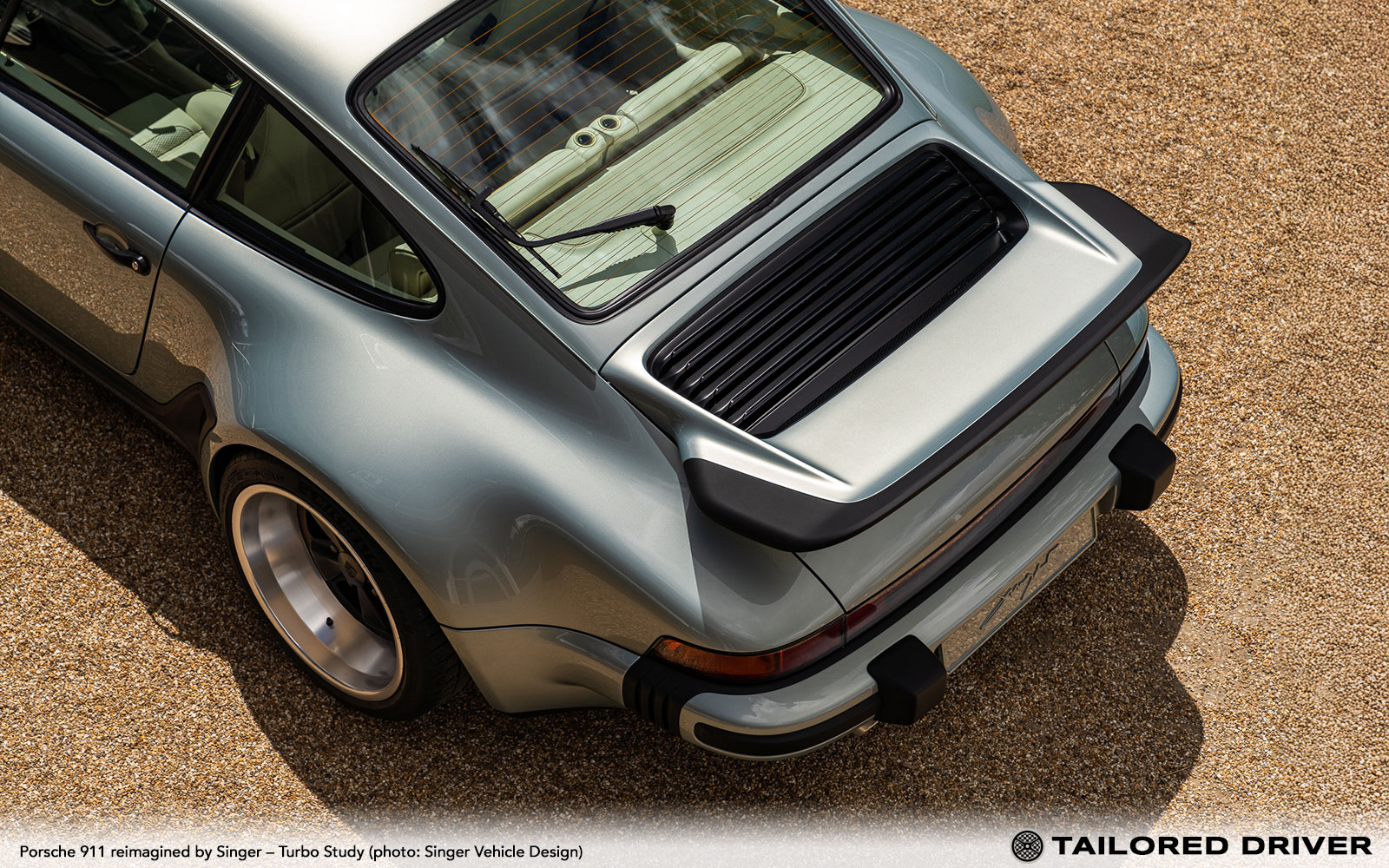
Turbo Study Making its North American debut is the Porsche 911 reimagined by Singer – Turbo Study.
This next generation of services from Singer encompasses:
A celebration of the iconic, era-defining 930 Turbo, launched in 1975
Collaboration with owners of the Type 964 Porsche 911 on the first road-going restorations to feature forced-induction
Highly capable grand-touring, sports and everyday performance
The car presented at The Quail has been specified using the results of the Turbo Study to reflect a personal vision. This owner has pursued a focus on high-performance, luxury grand touring capabilities, including:
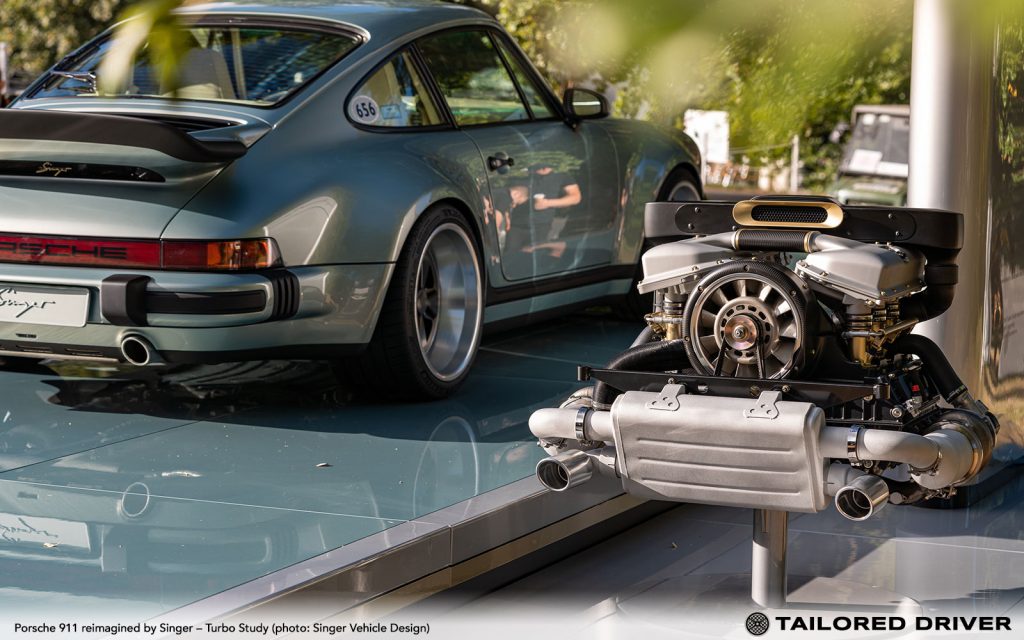
3.8L, twin turbocharged flat-six with air to water intercooling
510 HP
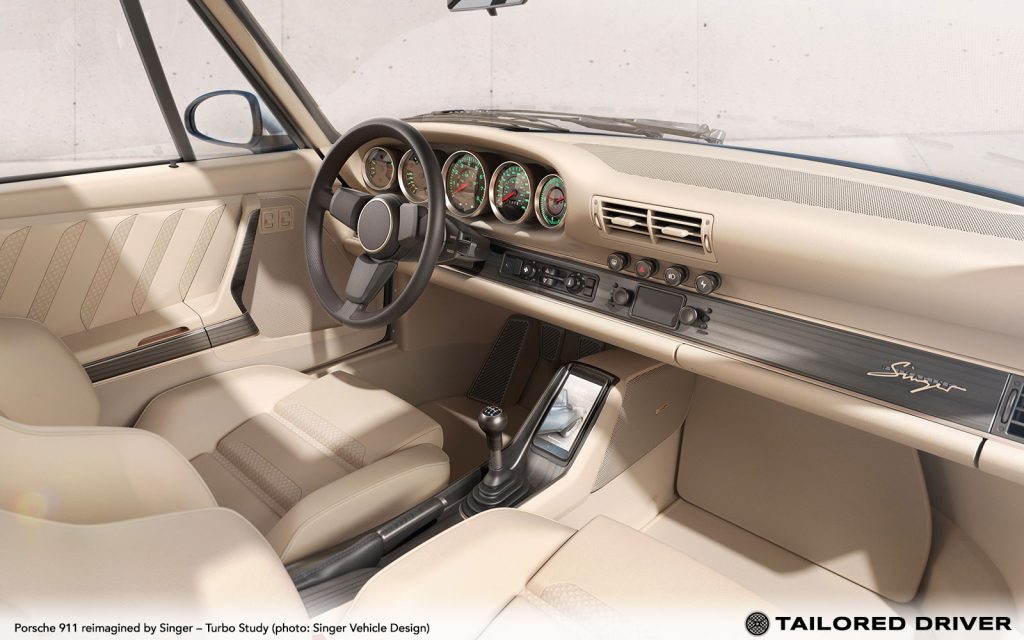
6-speed manual transmission
Rear-wheel-drive and touring-optimized suspension
Carbon-ceramic braking system
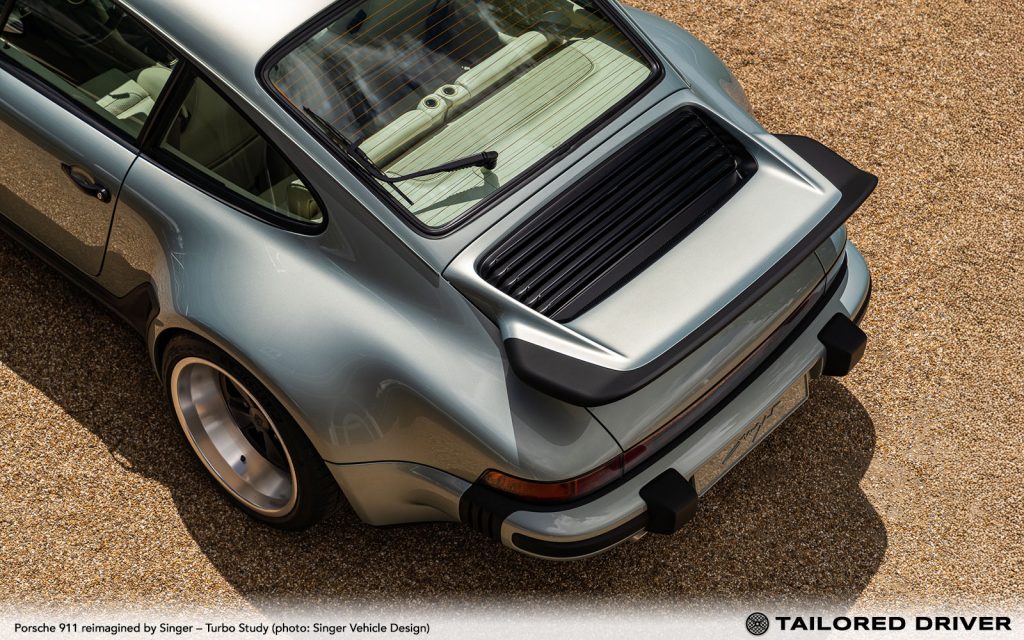
The iconic whale tail rear spoiler and shark fin air intake – reimagined
Lightweight carbon fiber bodywork in Wolf Blue
Interior presented in Sand with Black Forest wood accents
Overview Founded in California in 2009, Singer has become globally known and respected for its celebration of the Porsche 911. The company undertakes bespoke restorations for owners of the air-cooled cars. Singer is guided by a philosophy that encompasses:
A passionate focus on iconic design and a homage to the world’s most iconic sportscars.
Highly personalized restorations with superlative attention to detail, guided by the Singer’s mantra Everything is Important.
Modern engineering and material science combined with beautifully executed interiors and jewel-like details.
A deep connection with California and its automotive zeitgeist.
Over the past decade Singer has become a luxury brand with a global clientele and is now synonymous with the concept of Reimagining – bringing together heritage with twenty-first century engineering and material science. The brand has been growing beyond car culture, with an award-winning Swiss watchmaking division, Singer Reimagined, launched in 2017.
About Singer Group, Inc. Singer Group, Inc. (Singer) restores and reimagines 1989 to 1994 Porsche 911s, based on the 964 chassis at the direction of its clients. Singer does not manufacture or sell automobiles. Singer’s Global Partner Network supports owners across North America, Europe, the Middle East, Asia and Australasia.
Singer is not sponsored, associated, approved, endorsed nor, in any way, affiliated with Porsche Cars North America, Inc., or Dr. Ing. h.c.F. Porsche, AG. The Porsche® name and crest, 911® and TARGA® are trademarks of Dr. Ing. h.c.F. Porsche AG, and any other products mentioned are the trademarks of their respective holders. Any mention of trademarked names or other marks is for purpose of reference only.
The product of Singer’s painstaking effort is a Porsche 911 restored and reimagined by Singer. Out of respect for Porsche, and to respect Porsche’s trademark rights, this incredible machine should never under any circumstances be referred to or described as a “Singer,” “Singer 911,” “Singer Porsche 911” or a “Porsche Singer 911,” or in any other manner that suggests that it is anything but a Porsche 911 that has been restored and reimagined by Singer.
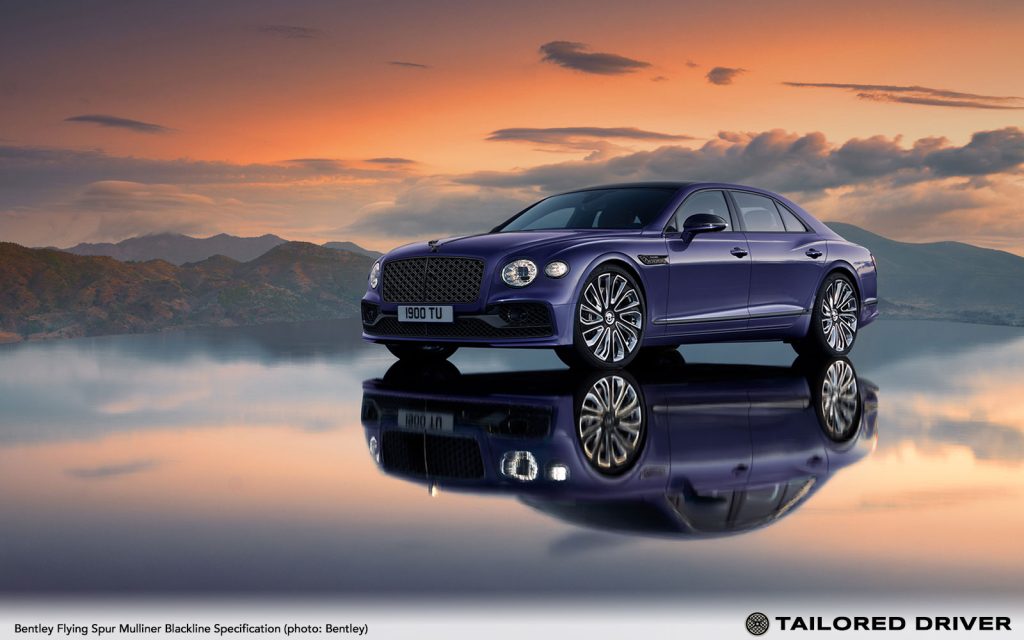
Flying Spur Mulliner now available with Blackline Specification
Contemporary alternative exterior to Bentley’s most luxurious and powerful model
22” wheel design, with self-levelling centre badge, exclusive to Mulliner
Available with Bentley’s V6 Hybrid, V8 and W12 powertrains
Almost every one in five Continental GT Mulliner orders now specified with Blackline
[source: Bentley]
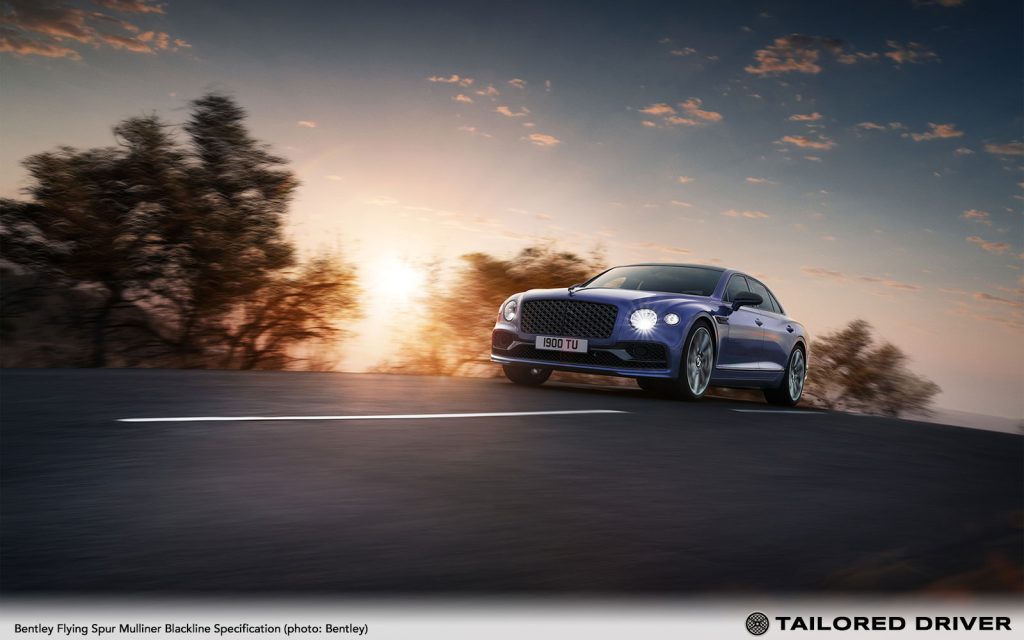
Crewe, England – Revealed at the prestigious Monterey Car Week in California in 2021, the elegantly appointed Flying Spur Mulliner sits at the pinnacle of the Flying Spur family, combining the very finest in modern craftsmanship and breath-taking luxury. The introduction of Blackline Specification to the Flying Spur Mulliner builds on the increasing customer popularity of the GT Mulliner Blackline, with an uptake of nearly 20 per cent. Contemporary external treatments replacing bright chrome are now offered across all Mulliner models.
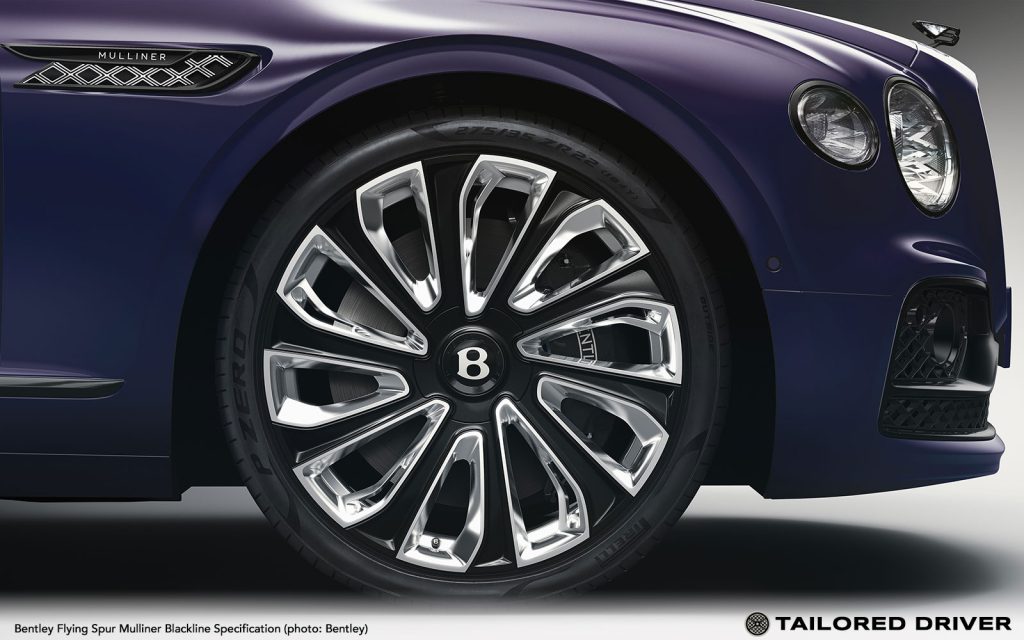
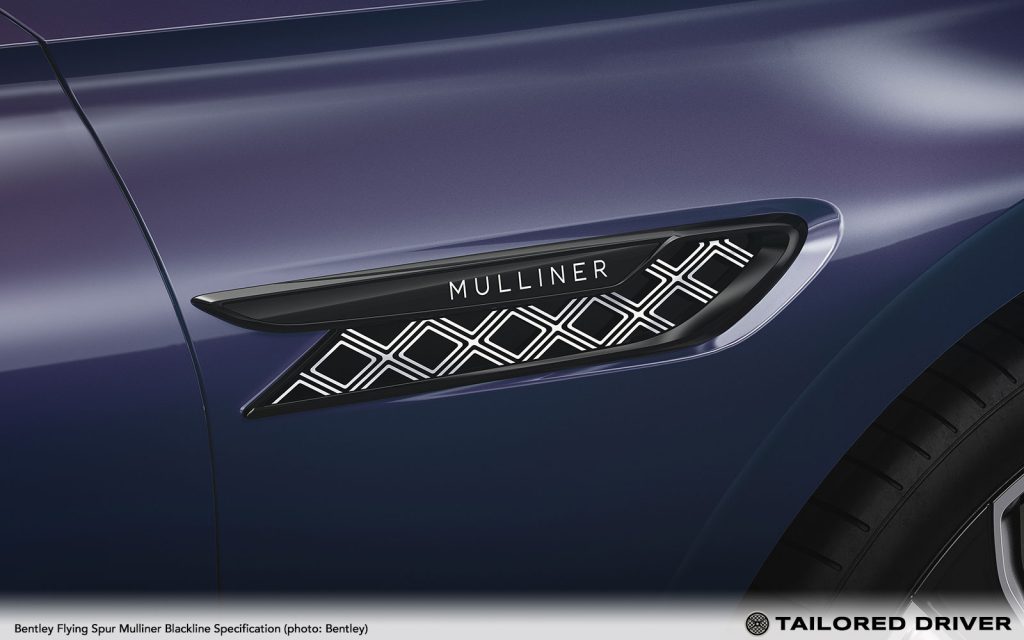
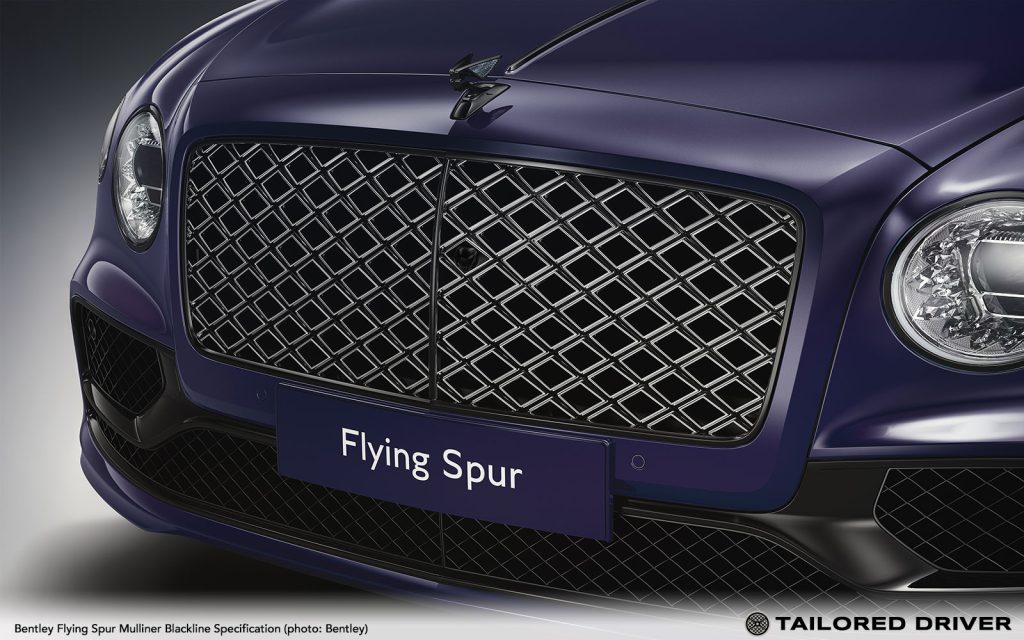
The Flying Spur Mulliner Blackline Specification replaces all of the exterior brightware (excluding the Bentley ‘Winged B’ badge) for gloss black versions. In place of the satin silver upper mirror caps typical of a Flying Spur Mulliner, for the Blackline Specification the mirrors are finished in gloss Beluga black. The signature Mulliner matrix wing vents are also blackened, and finished with bright Mulliner branding. The radiator grille remains black with bright edges to the 3D design and the lower bumper grilles are also finished in black.
The Blackline Specification also offers an optional black 22” Mulliner wheel with contrast polished ‘pockets’, or alternatively 22” Mulliner gloss black wheel with self-levelling badges featuring chrome rings are also available. The new specification allows Mulliner customers further visual contrast with lighter exterior palettes or elegantly blend in with darker colour choices.
The luxurious interior of the Flying Spur remains unchanged from the existing Mulliner edition, allowing customers to enjoy any colour combination they choose as part of Mulliner’s limitless offering, or one of eight recommended three-colour combinations, using Bentley’s wide palette of hides and threads.
The Flying Spur Mulliner Blackline Specification is available with Bentley’s V8 and W12 powertrains, as well as the new V6 Hybrid. When equipped with Bentley’s 6.0-litre, twin-turbocharged W12, the Flying Spur Mulliner accelerates from 0-60 mph in 3.7 seconds (0-100 km/h in 3.8 seconds) and is capable of a top speed of 207 mph (333 km/h). The new generation 4.0-litre, twin-turbocharged V8 delivers a top speed of 198 mph (318 km/h) and 0-60 mph in 4.0 seconds (0-100 km/h in 4.1 seconds). The new V6 Hybrid accelerates from 0-60 mph in 4.1 seconds (0-100 km/h in 4.3 seconds) with a top speed of 177 mph (285 km/h).
Curated Luxury
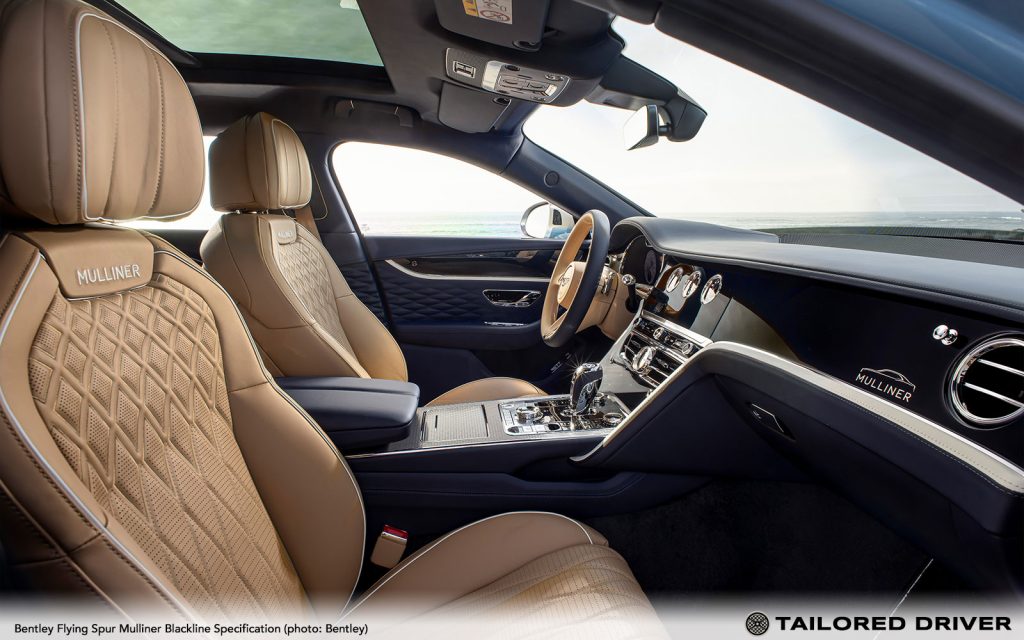
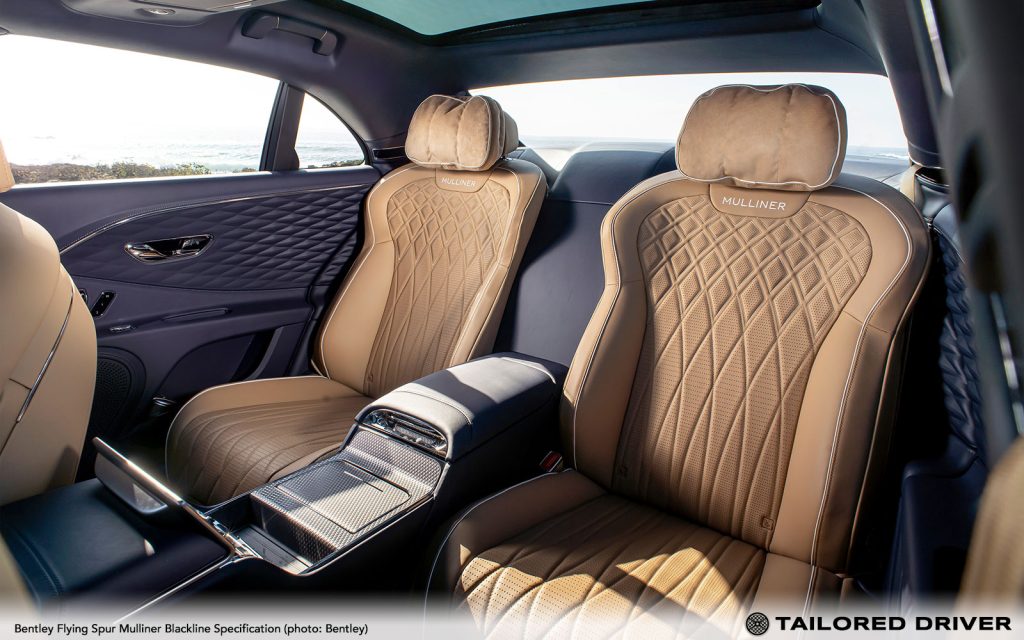
The interior of the Flying Spur Mulliner offers a unique choice of exquisite detail and tactile finishes, and demonstrates the skilled craftsmanship of all Mulliner products. There are eight individually curated interiors to choose from consisting of three colours – a main, secondary and an accent.
One of the bolder curated interiors – Flare – is a combination of Beluga leather to the instrument panel, door trims and headlining while a rich red leather called Hotspur emphasises the style of the seats. Linen micro-piping, embroidery and accent line combines a third colour into the unique Mulliner interior.
The Mulliner Driving Specification is fitted as standard, bringing the “Diamond-in-Diamond” quilting to the seats, and three-dimensional leather to the doors. Contrast seat piping matches the accent that surrounds the occupants from the centre console, around the instrument panel and finishes beneath the door waistrail, highlighting the Bentley B chrome inlays.
Modern craftsmanship and breath-taking luxury combine in the diamond milled technical finish that is applied to the centre and rear consoles. The centrepiece feature on the dashboard alongside chrome bullseye vents is a stunning, brushed silver Mulliner clock.
The classic Bentley theme continues in the LED driver’s instrument panel, with stylish new and exclusive Mulliner graphics. The now famous Bentley Rotating Display, sports pedals, heated duo-tone 3-spoke steering wheel and panoramic sunroof further add to the luxurious ambience.
Unique Mulliner electrically-operated picnic tables are mounted to the rear of the front seats and can be deployed with a single press of a button. The veneered tables, which feature unique overlay, lower and self-level to reveal a leather-trimmed surface with a recess for a pen or stylus. Holding the button down returns the table gracefully to its home position.
Mulliner returns to Monterey Car Week
Mulliner will debut a stunning new model – the Batur – later this week at Monterey Car Week. So much more than the successor to Bacalar, the Bentley Mulliner Batur reveals an all-new design language for Bentley that showcases themes and forms that will define Bentley’s future range of Battery Electric Vehicles (BEVs).