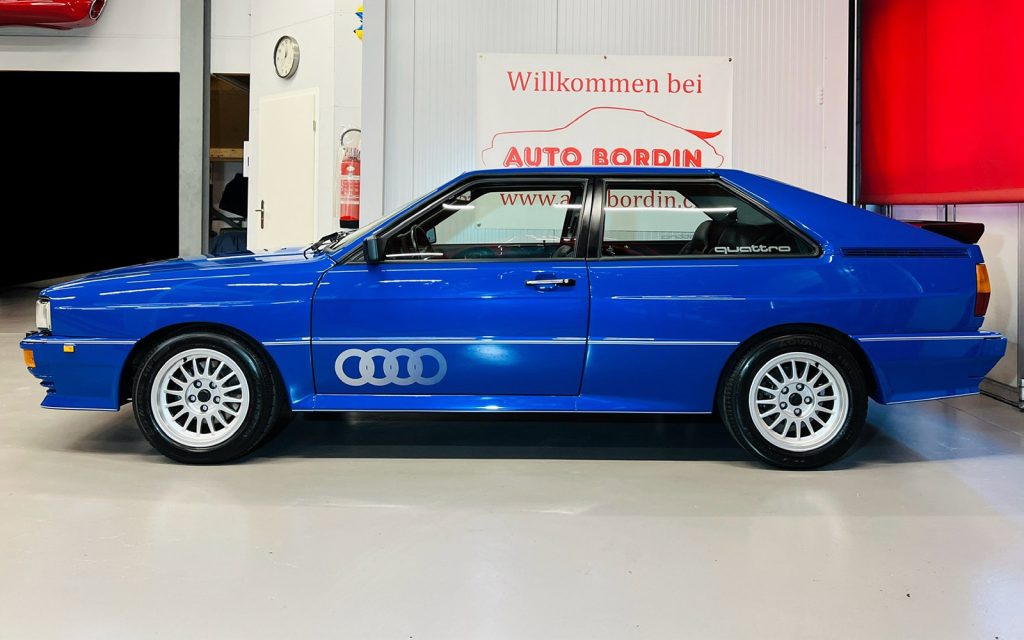
What: 1983 Audi quattro
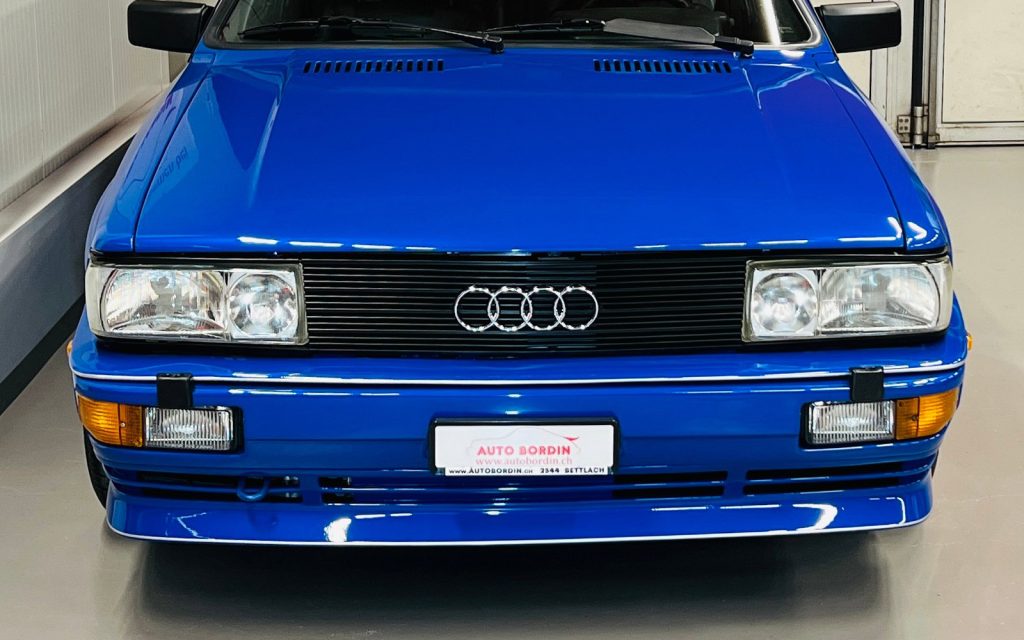
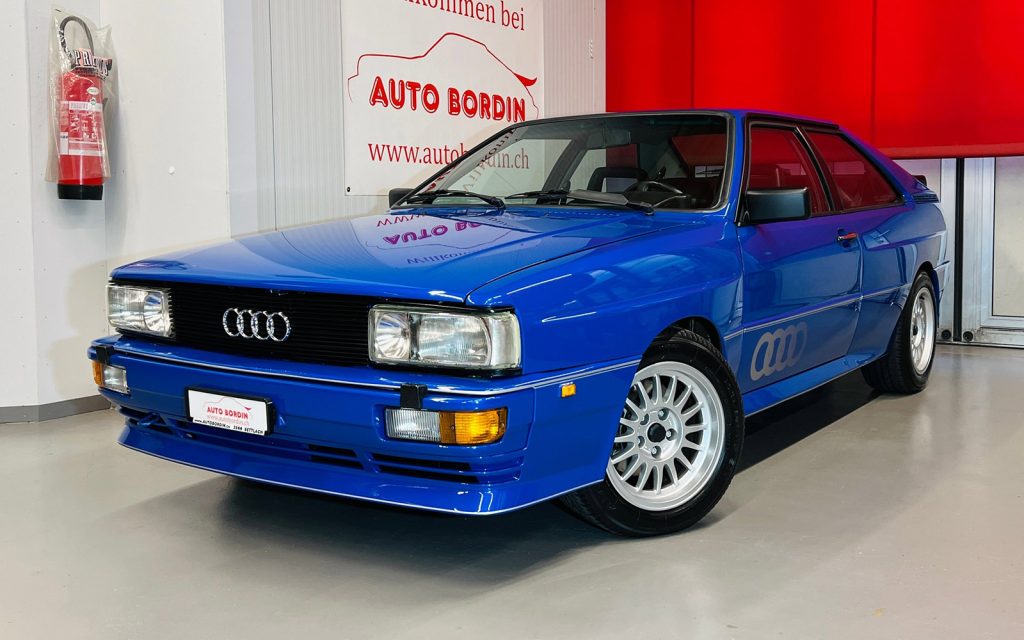
Color: Audi exclusive Nogaro Blue (nogaroblau; pearl effect UNI; Z5M; Audi)
VIN: N/A
Mileage: 124,500 km, 77,360 miles
Price: CHF 98’000
CarFax: N/A
Window Sticker: N/A
Location: Auto Bordin GmbH, Bettlach, Switzerland
Link: Link
Despite evidence you may see here suggesting otherwise, Nogaro Blue as a paint color didn’t show up at Audi until the RS2 era. If you’re doing the math, that’s about a decade before this 1983 Audi quattro left the factory. Yet here it sits.
So how’d it happen? Auto Bordin, the Swiss dealer listing this car tells the story fairly comprehensively, and so we’re going to post the English translation below. In case you don’t have time for that though, its’ worth noting that the car received a considerable full restoration with complete color change to Nogaro Blue.
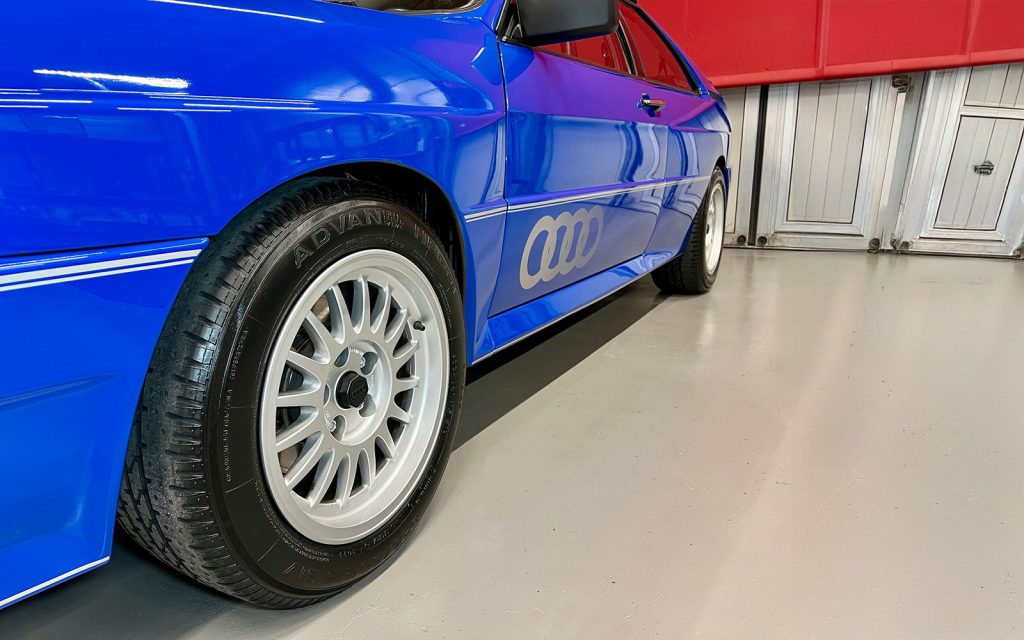
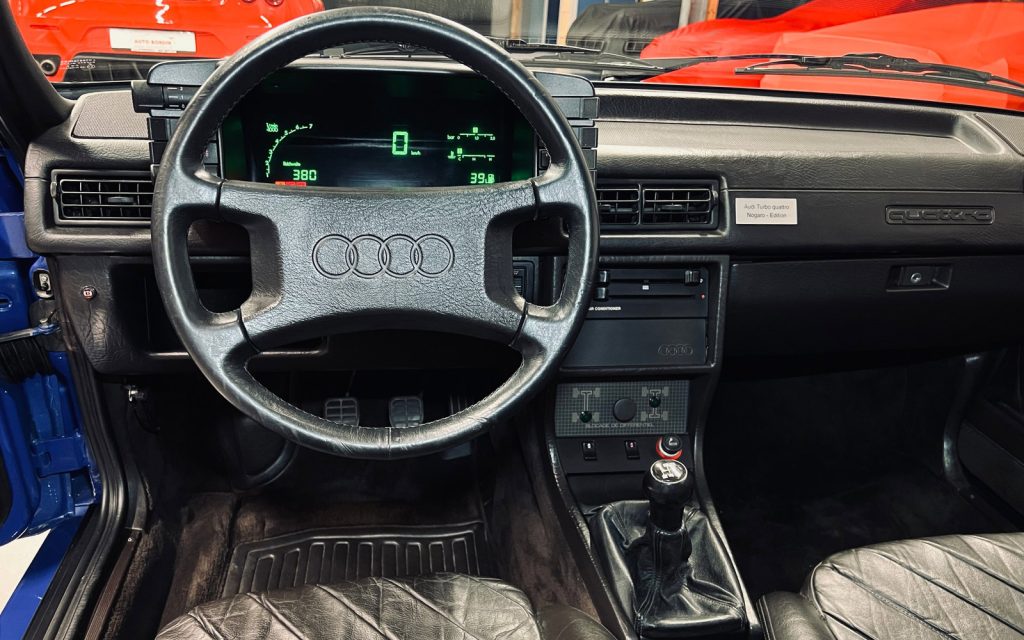
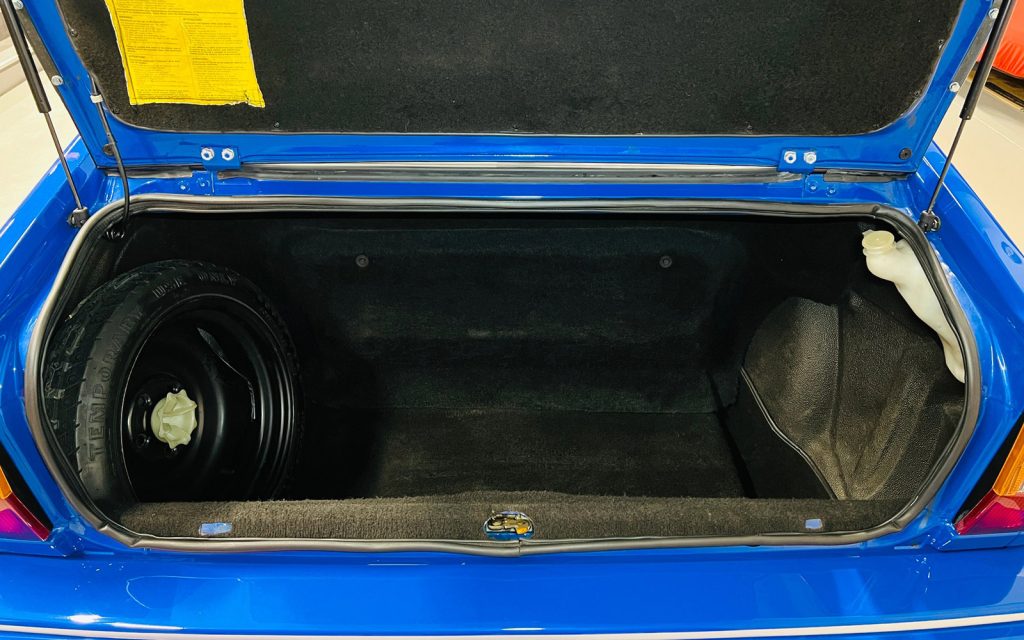
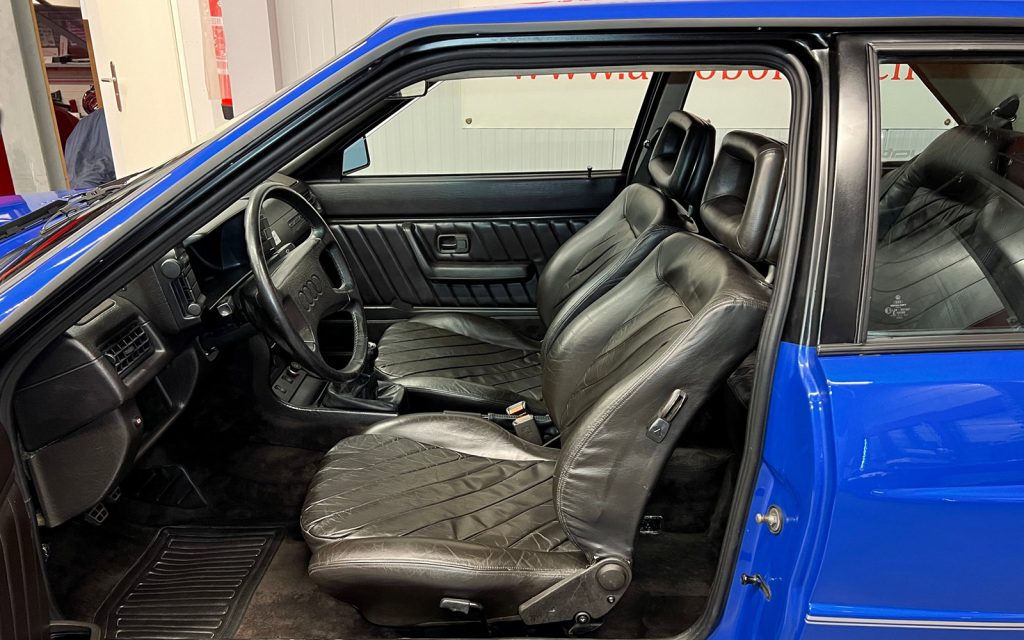
It’s interesting that an earlier pre-facelift quattro was chosen. Perhaps that’s a preference for the vertical grille and headlight design of the original. It’s also interesting that they kept the original seat leather that shows wear, although from a collector standpoint that was probably a smart move and the reasoning is explained in the full description.
So, has this car grabbed your attention yet? If so, let’s begin the full listing description below.
Begin listing text: source Auto Bordin, Translation by Apple
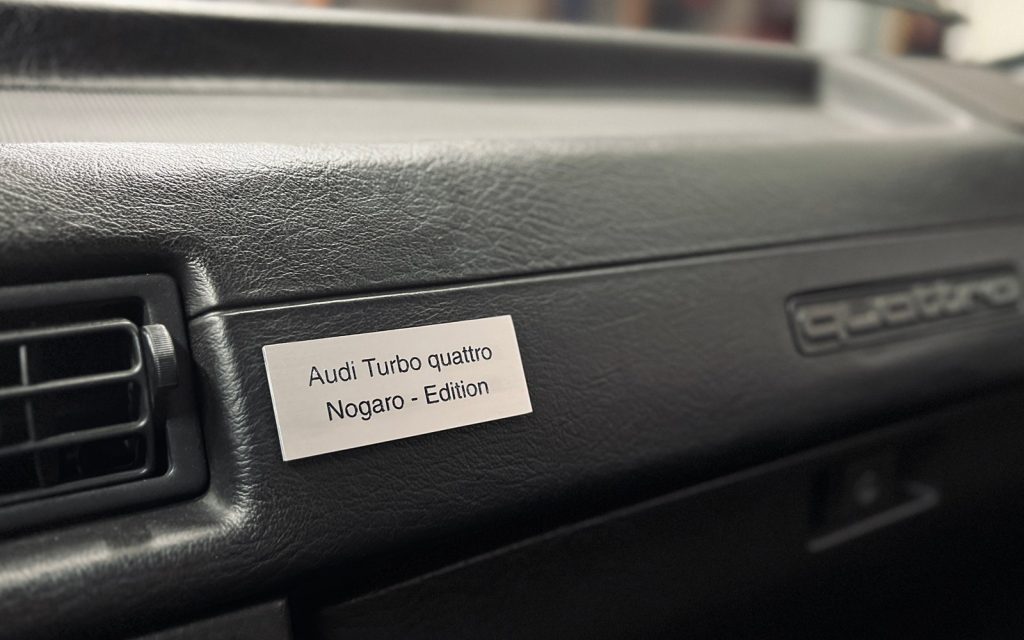
Audi Turbo quattro “Nogaro Edition” – An Urquattro like certainly not a second
An Audi Urquattro in the color nogaro blue – which Urquattro owner did not have this thought? At the beginning probably no one, since the color only became popular with the Audi RS2 in the 90s. But at that time one could not imagine that this color would be so important for Audi that it could be called THE AUDI BLUE today. But it was not only Audi that had discovered this color for itself in the 90s. While it was called nogaro blue at Audi, it was called jazz blue at VW and maritime blue at Porsche. And since the RS2 was a collaboration between Audi and Porsche, they naturally decided to present this car in this special blue. Since the Audi RS2, almost all RS successor models have been associated with this color. So also the direct successor of the RS2, the RS4 B5 and even the S4 models, were gladly ordered in this color. A phenomenon of the 90s and early 2000s? No, even in 2014, Audi put a nogaro blue RS2 at the Geneva Motor Show together with the then most current Audi RS4 B8 on the stand and launched the “Nogaro Selection” and later also with the RS6 C7 as a limited “Nogaro Edition”. This color has become as historically important for Audi as the name “quattro” that people would like to use it to lift very special models again and again.
Let’s now come back to the previous train of thought, that every Urquattro owner probably had the idea of making his Urquattro like this when he saw the Audi RS2, but hardly anyone did it then….
No wonder, because an Urquattro was not disassembled and repainted so quickly, like a 911 from the 80s. And those who did it, usually did this in addition to the rust control and then hardly wanted to remove the windows or even the engine. So those who were then repainted were simply done à la “farmer painting”.
And to be fair enough, we would never have made this effort to want to do it better, because an Urquattro to paint, including engine compartment and without window rubber’s, means nothing more than work, work and work again… Unimaginable at that time, because the Urquattro used to have hardly the value it has today, where it would be worthwhile “more or less”. The question arises, why don’t you do it today, now that the Urquattro has finally become valuable enough? Quite simply, firstly, where are the spare parts for such a project and secondly, the Urquattro’s that you can buy today as a restoration object, are so rusty that it is almost reflected into an impossible project, if you then have to reshape each rusty sheet metal yourself. In the end, it is not a million Ferrari where this effort is worthwhile and a perfect, well-preserved Urquattro is certainly not taken apart for such a project nowadays.
You notice what we want to get. Actually, it would not be a thing of impossibility, but it is then so elaborate that no one wants to do it and so would be a newly built, nogaro blue Urquattro, something like a unique piece.
And it is precisely in front of such a Urquattro that we are now. And of course you ask yourself rightly – didn’t you just talk about the fact that it’s almost a thing of impossibility and yet we are now facing such an Urquattro? Now this question can only be answered by the following story.
For this we go back to the 90s. Where the then second owner of this Urquattro’s decided, when he got problems with the cylinder head gasket and he wanted to repair the engine again, he still saw the possibility of making his dream of the nogaro blue Urquattro come true. Because if we take out the engine to revise it, we can also take apart the rest of the Urquattro’s at the same time and have it professionally repainted, according to the words to his son at the time.
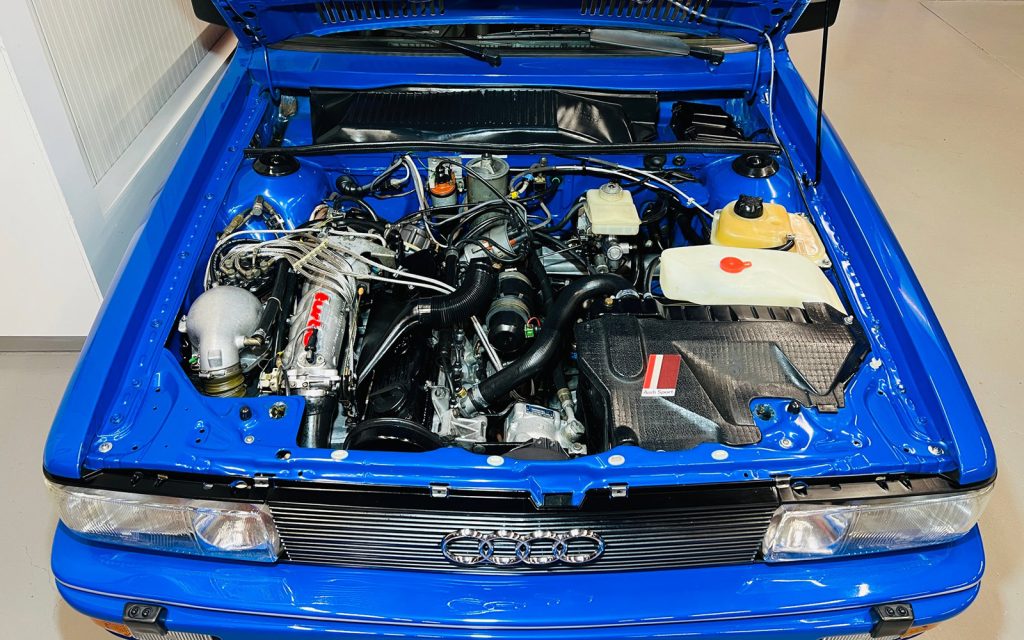
Said and done, the Urquattro was completely taken apart and taken to a renowned body shop near us. In the meantime, the owner went looking for spare parts. The bodywork itself was not enough for him, he also wanted to restore the vehicle and so many new parts from Audi had to come.
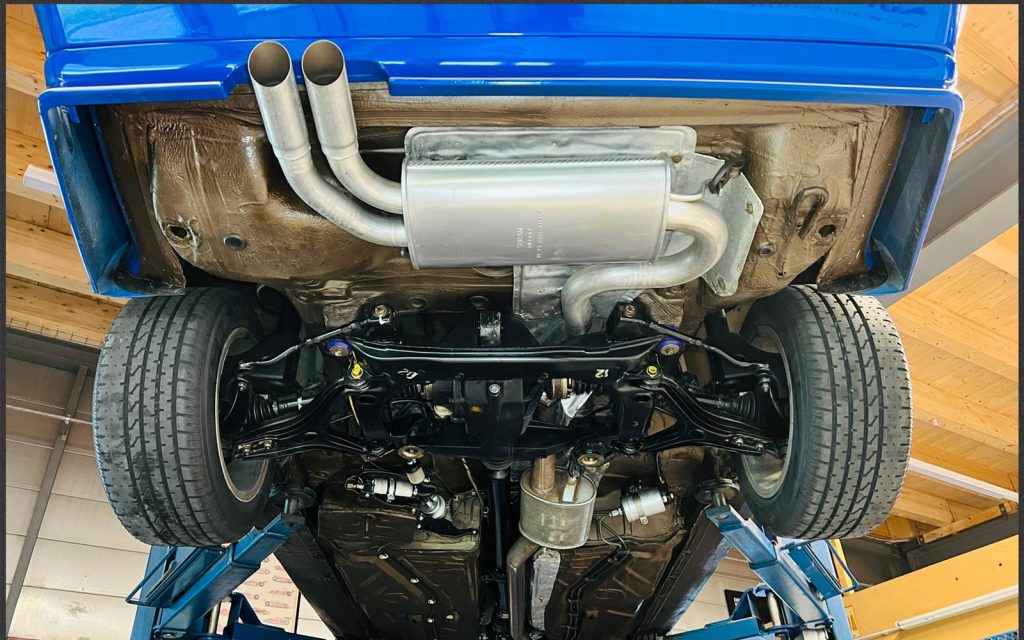
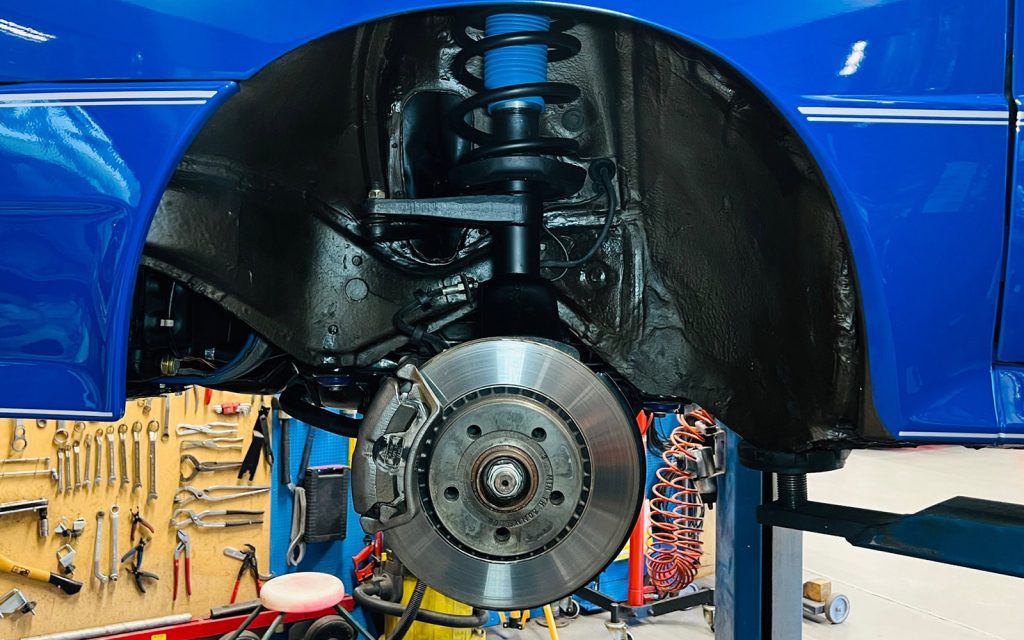
Connoisseurs are probably thinking now – Audi Urquattro and get new parts at AUDI/AMAG – great joke… but that was not the case in the 90s. He was able to order many new parts for the Urquattro, since it was still a current vehicle at the time and thus came to parts that one would only dream of today if one would get them new and original from Audi. Among other things a new KKK Turbo including collector, completely new cylinder head, various hoses, disc rubbers, complete decor and many other specific original parts….
The time in the body shop passed, because on the one hand they took the work seriously and on the other hand to keep the whole thing as economically as possible, it was agreed with the body shop that you could take enough time and you should just work on it when you have time. What you see in retrospect, you can never say to a body shop, because firstly there is never time left anyway and secondly it is not just a year, but then more than three years. But they just wanted a perfect result and so the body was made like that of a new car and extensively sealed with Dinitrol so that rust will never be an issue again.
As fate had, the owner unfortunately died before the Urquattro left the body shop. So that now the son of the deceased owner stood in front of an empty body and several parts. What do you do in such a situation? Not selling at all, this is a memory of the father, in the end you also helped with the project and on the other hand you can’t just assemble it quickly. It simply lacks the time and also the know-how, since you have not taken it apart 100% yourself.
In total, almost 30 years passed and no work was done on the vehicle until the son finally decided to sell the vehicle and it came to us in 2021.
We decided to take over the project. Not because we wanted to do this job, but because we were simply storn away when we saw the Urquattro in this color live. In addition, we liked the impeccable body condition, as well as all the new parts that were available.
At that time we did not know ourselves whether we wanted to do the Urquattro or not. On the one hand, the appeal was great, because we knew that there would never be a second nogaro blue Urquattro at this level and on the other hand we knew that it is not exactly without rebuilding such a vehicle from scratch and this even more so if you have not even taken it apart yourself, but someone else and this without pictures as help. There is probably nothing more complex than wanting to restore a German rally car, including turbo technology and vacuum lines until it no longer works and differential locks and electronics and and and…
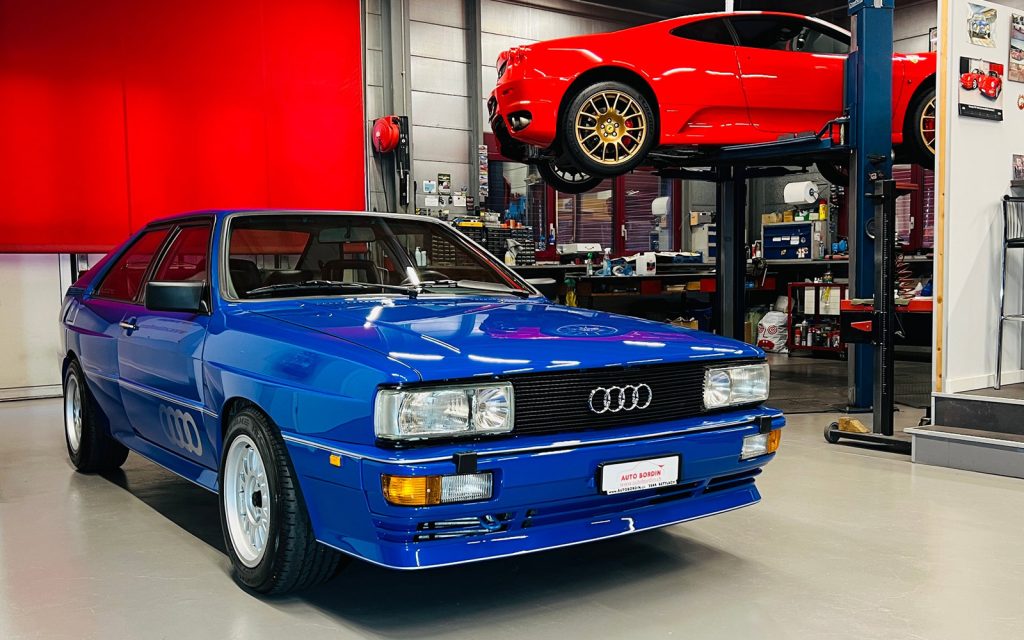
To keep the whole thing short – after three winters where we said ourselves we always do a little something about it as soon as we have time, it is now finished. The nogaro blue Urquattro freshly shown as a veteran in July 2024 and to be honest, we wouldn’t want to do this a second time, but somehow you supplant the whole thing when you stand in front of the finished car – breathtakingly beautiful, especially outside when the sun shines on this color.
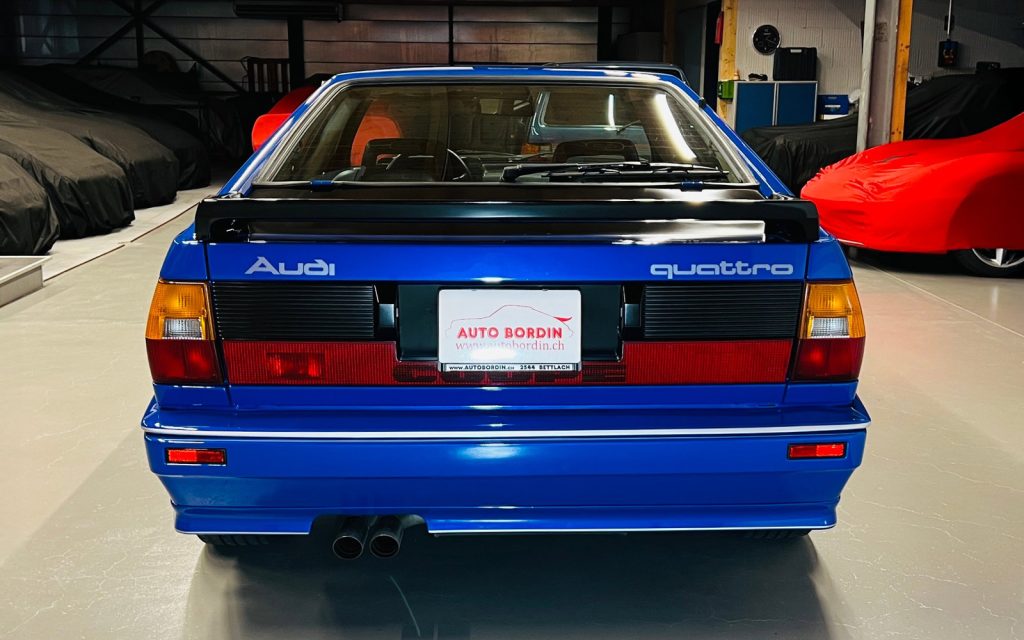
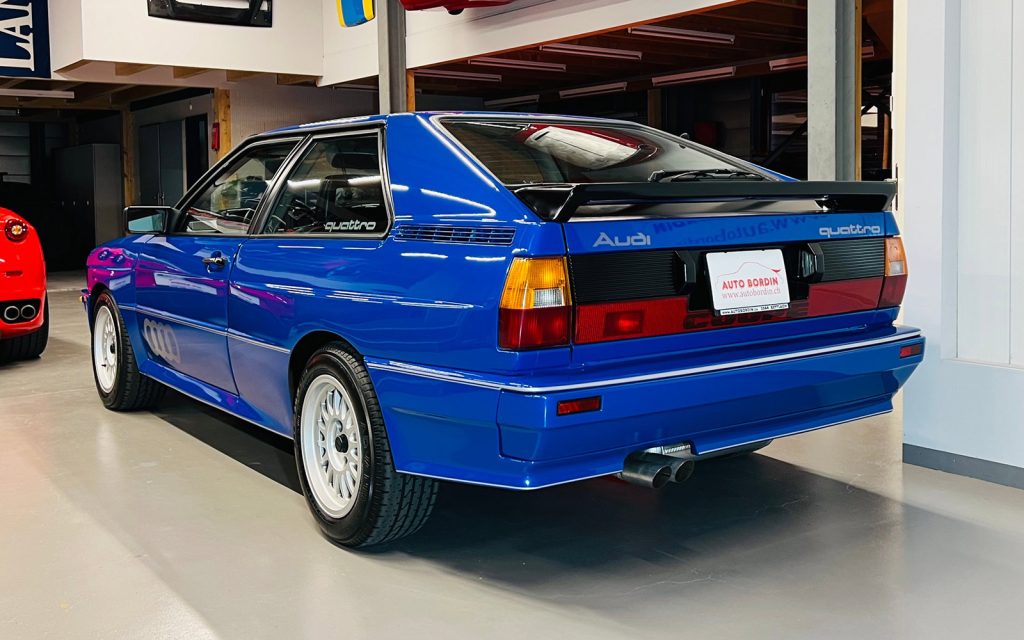
Our ultimate goal was to make the vehicle as if it were ordered from the factory in the special color nogaro blue. Say no tuning or tinted windows, white rims, dark taillights since Jg. 1983, no blue spoiler, etc. Even from the decor it had to look like fresh from the factory with all the emblems etc. Only this and no different is seen from our point of view, the nogaro blue Urquattro, a tribute to the later RS2.
We also do not want to lean so far out of the window and say that this is probably the only nogaro blue Urquattro that was made at this level, yet we are convinced that hardly anyone has ever made this effort.
The pictures speak for themselves, even if there are only 16, we have of course archived more pictures about the whole process for you. Nevertheless, you must have seen the vehicle in real life, not to mention driving. Because here you can see all the new parts, how powerful the newly built 5 cylinder turbo engine accelerates and this fortunately without a catalyst as with the later unsaleable Edition models…
It is a Urquattro for individualists, not for original fetishists. And yet it is not a vehicle that one would not describe as original at first glance. As a successful rally vehicle, the Urquattro always had its charm of wanting to have it in a different color. Until now it was only available in red or white as an “exciting color” and now it is available for ONE lucky one even in nogaro blue.
Errors, errors and prior sale reserved, no liability for printing and typing errors / Despite the great care, ad errors are not excluded / Exchange possibly possible / On parle français / Parliamo italiano / Anonymous inquiries and SMS will not be answered! Test drive only with purchase and against deposit of Fr. 200.-