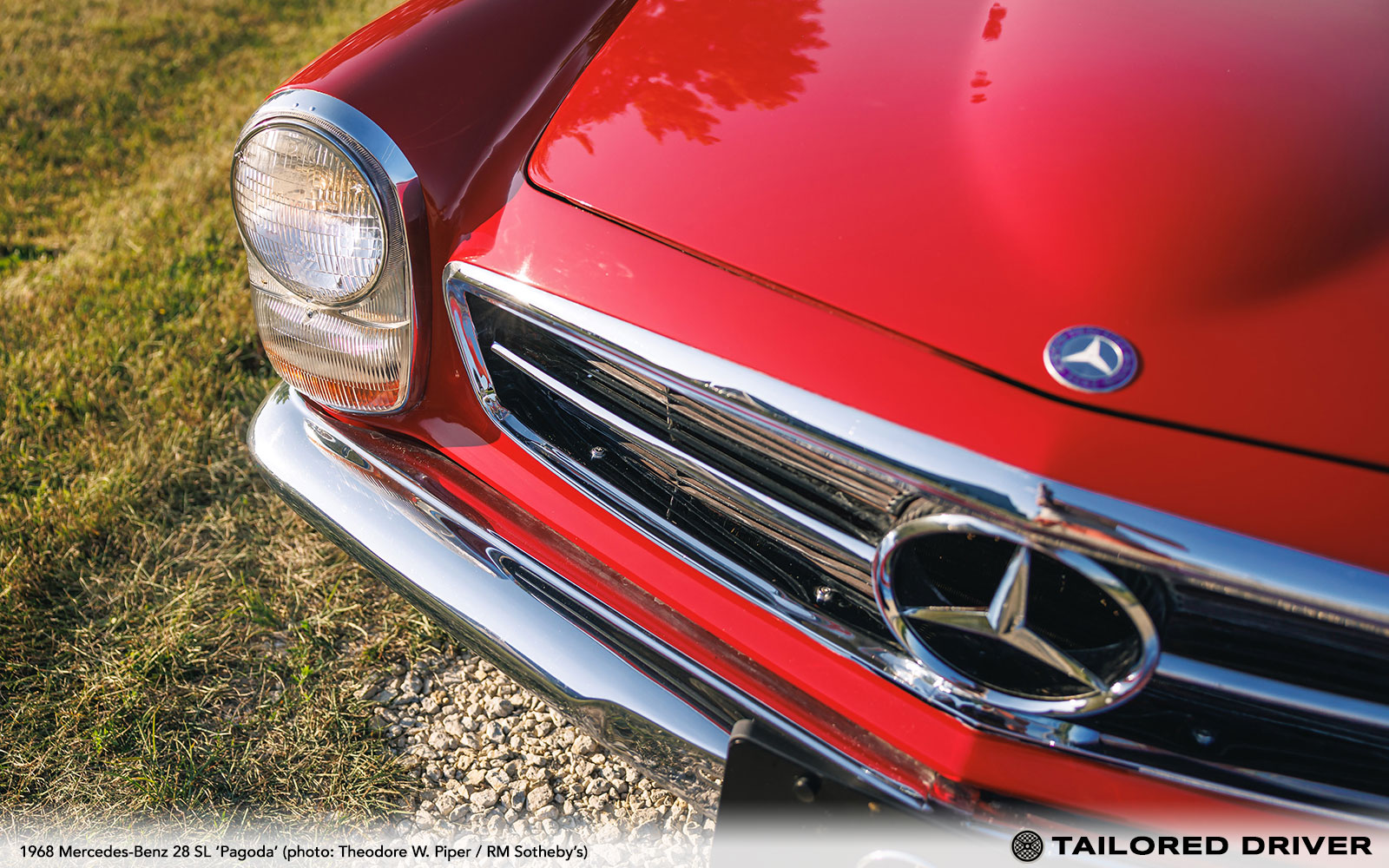
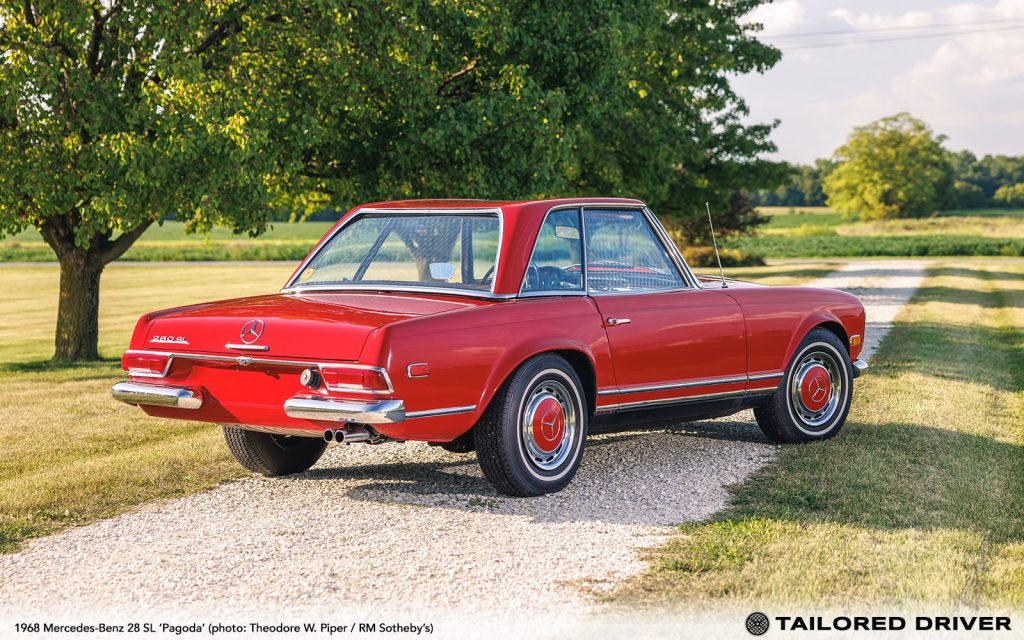
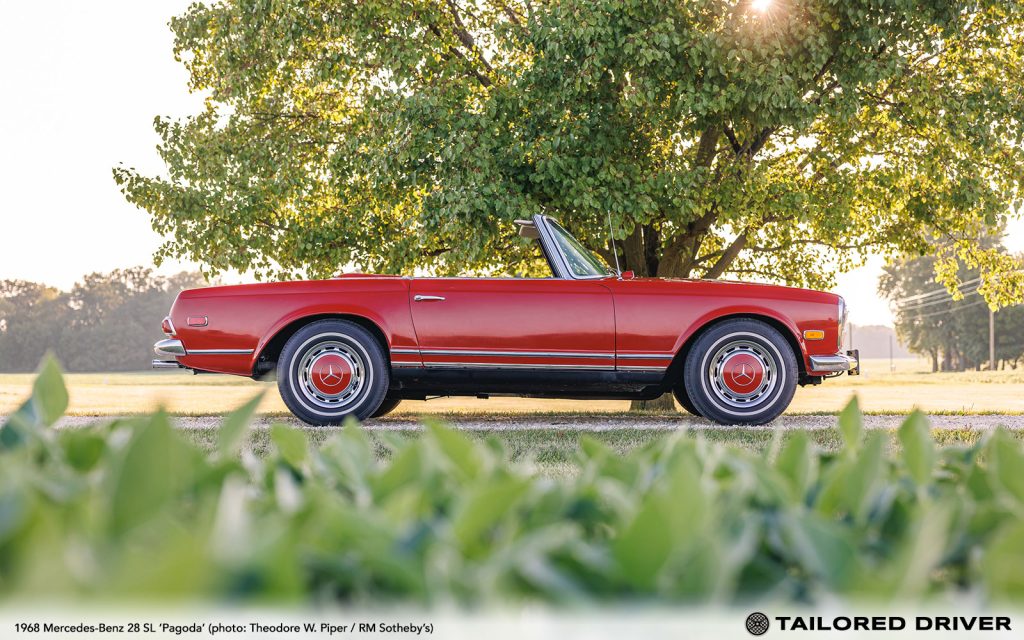
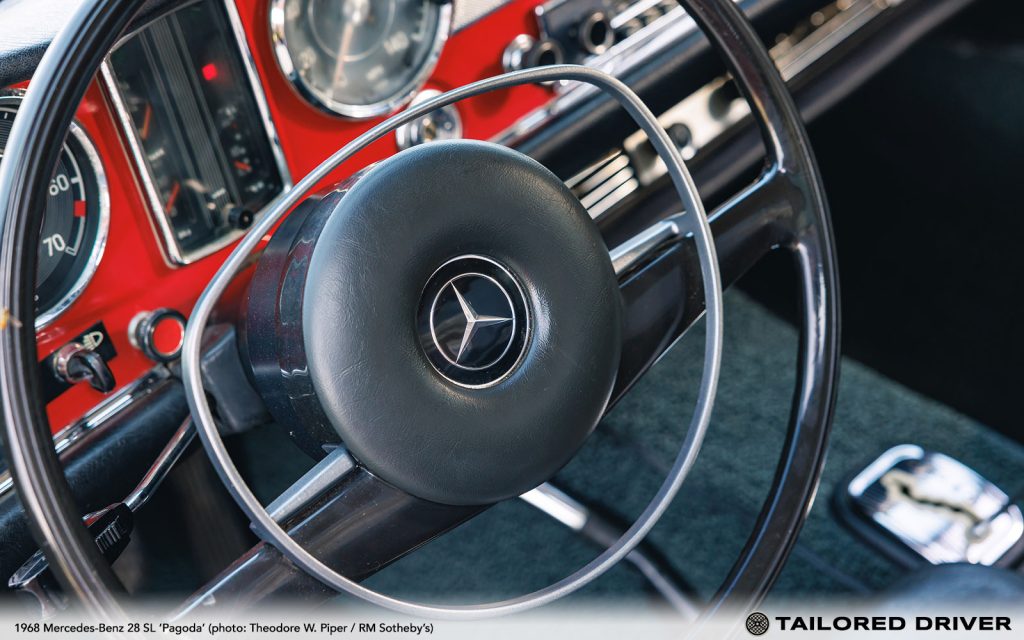
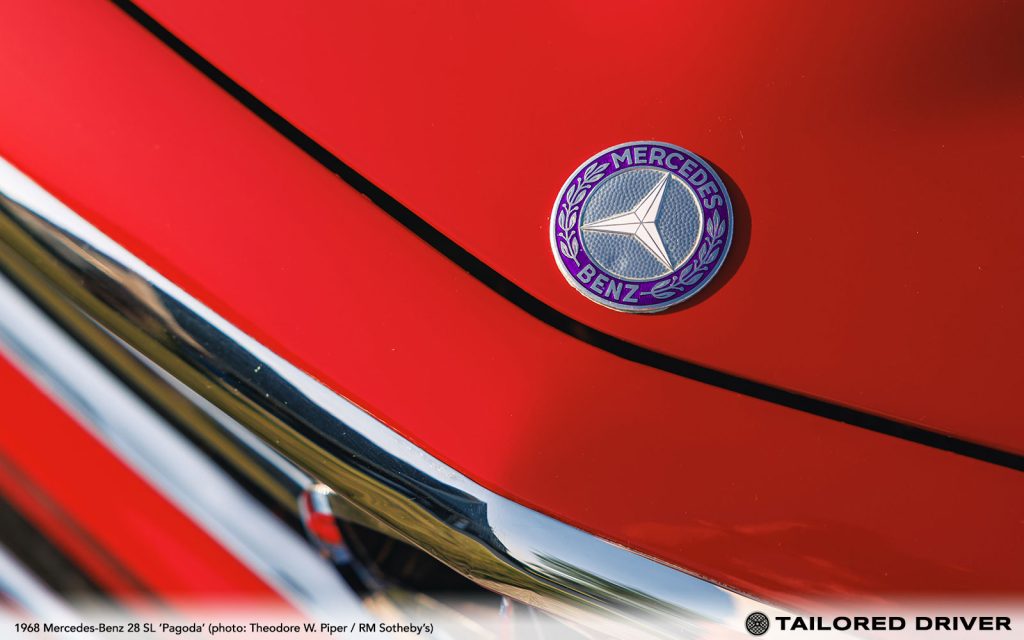
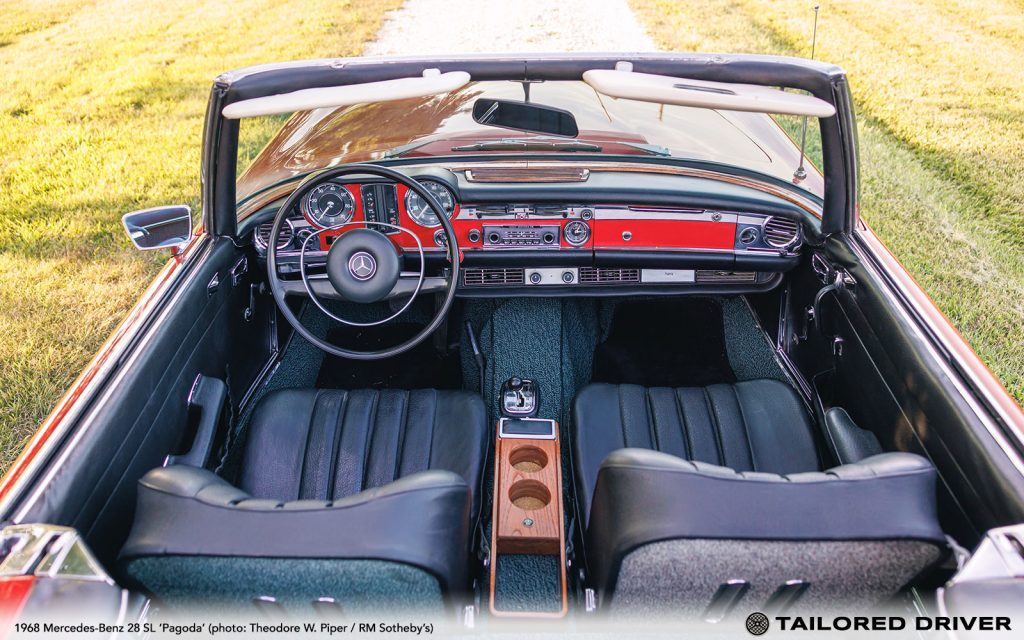
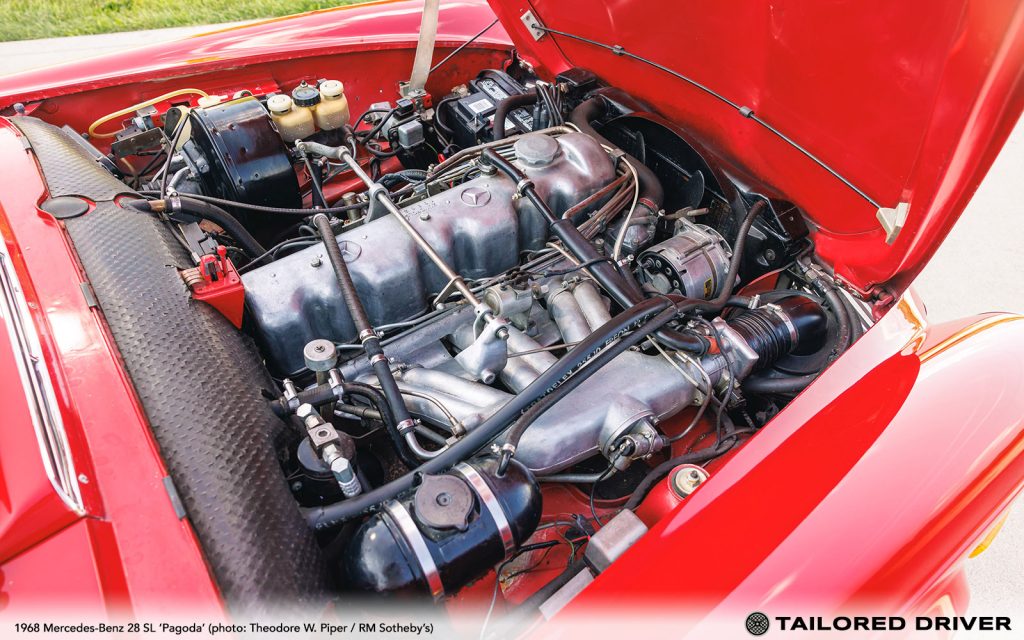
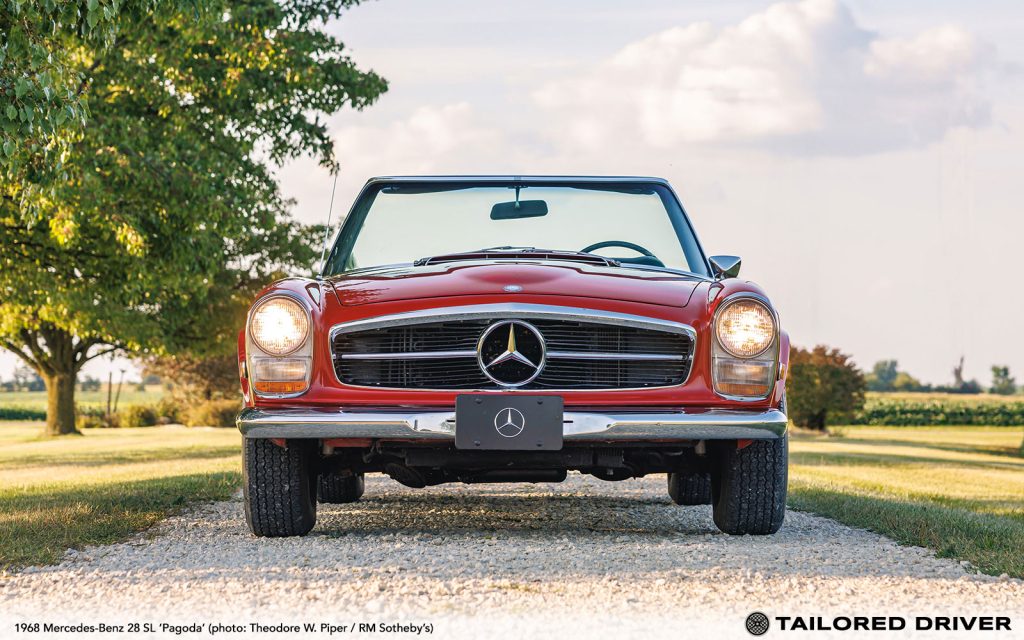
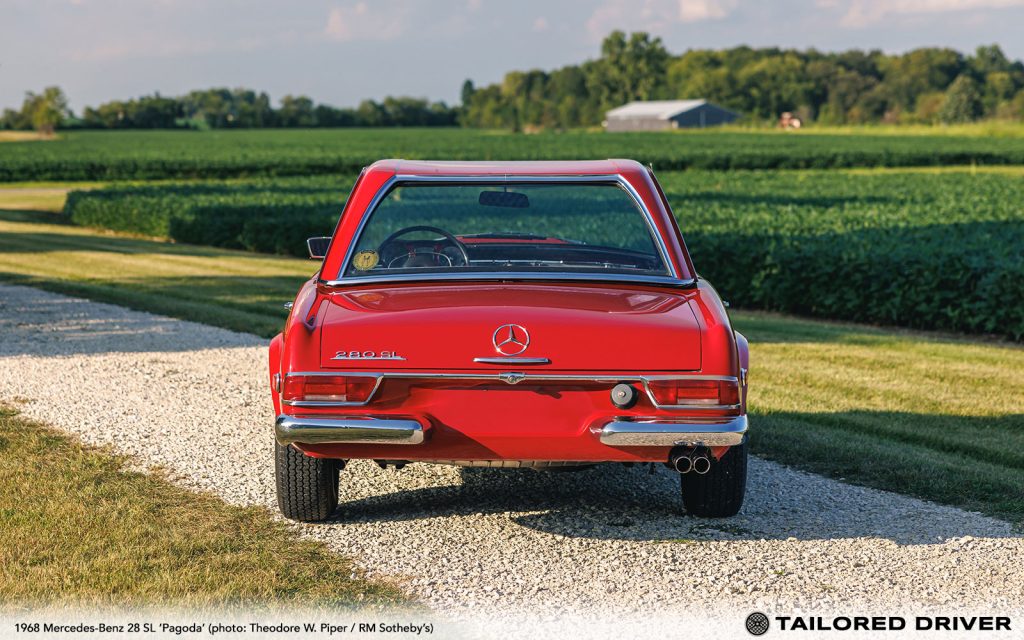
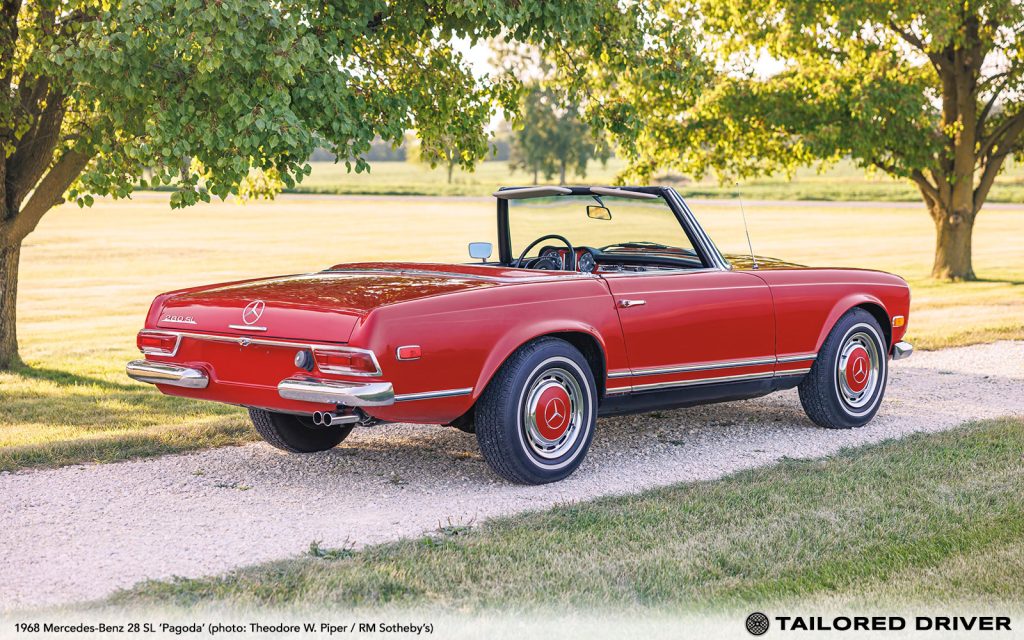
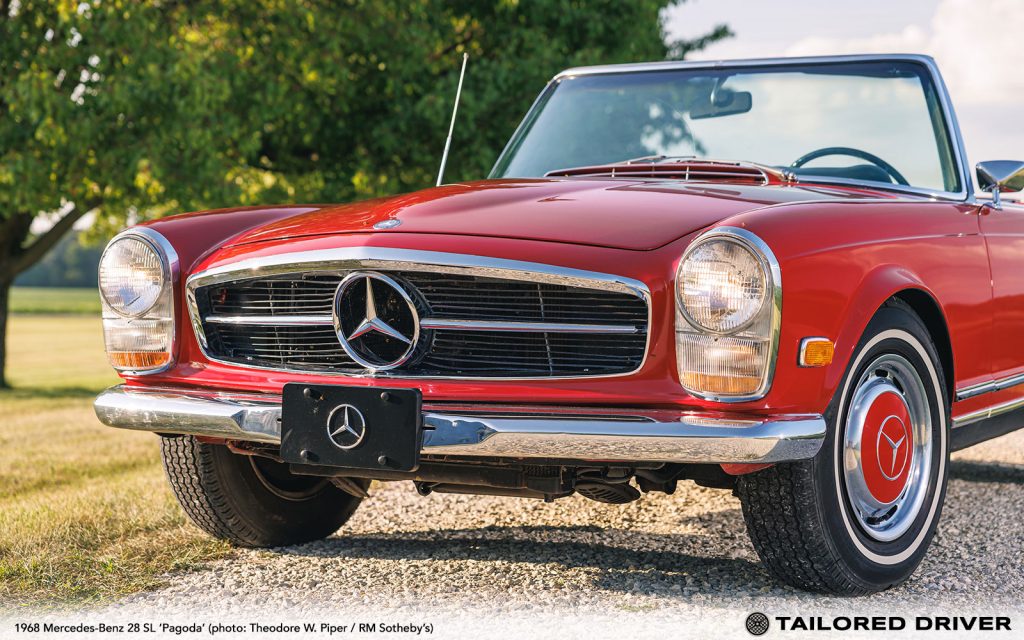
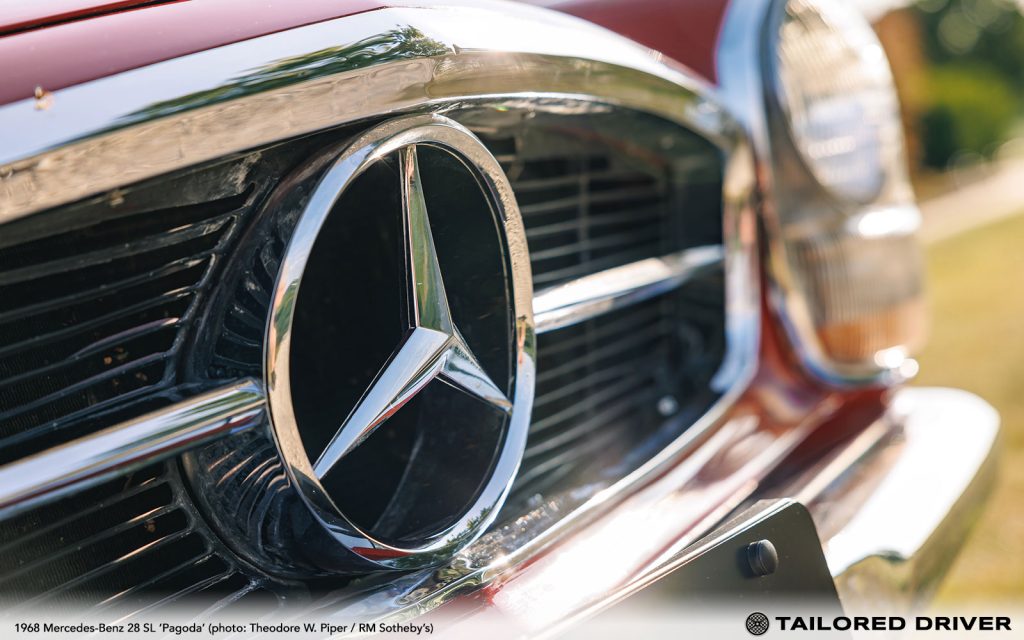
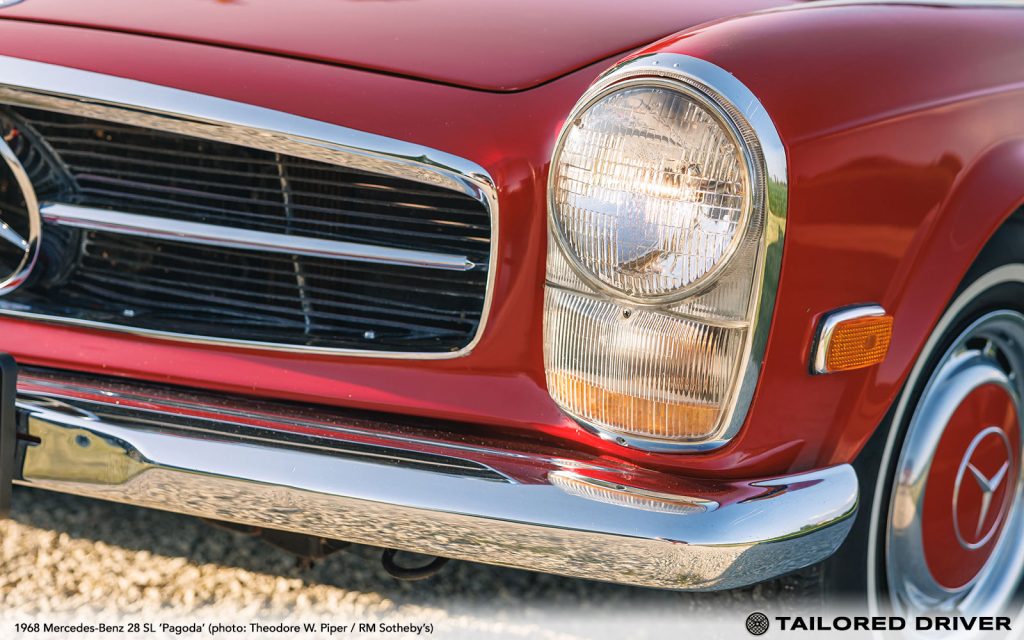
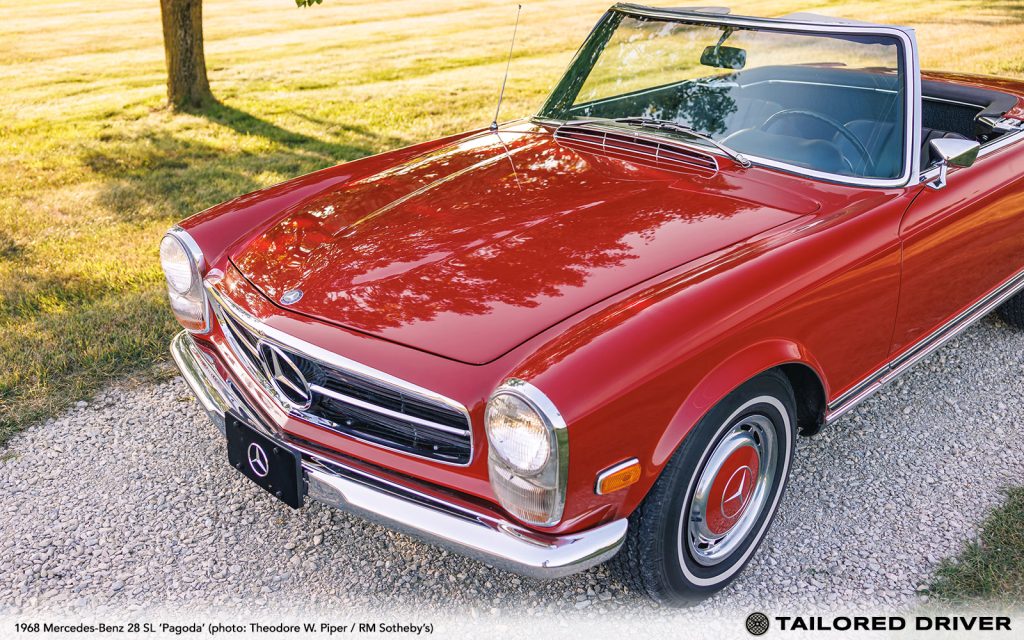
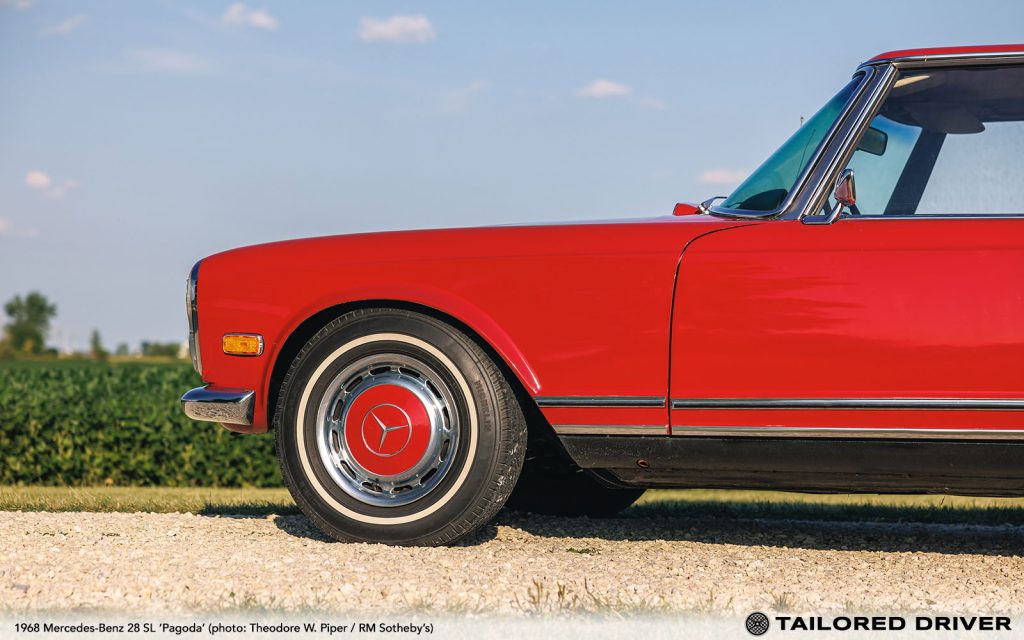
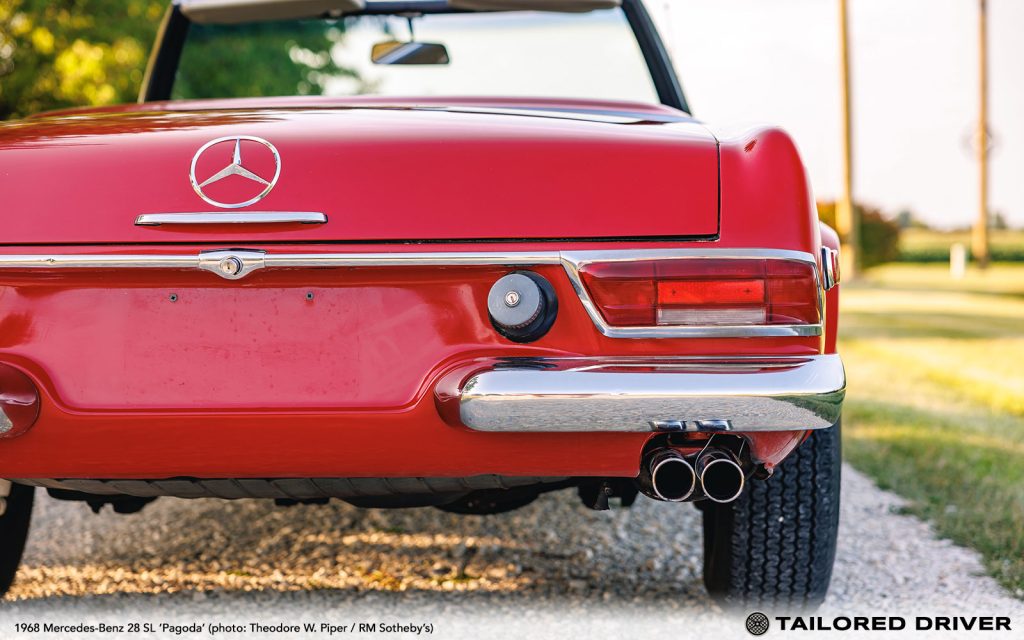
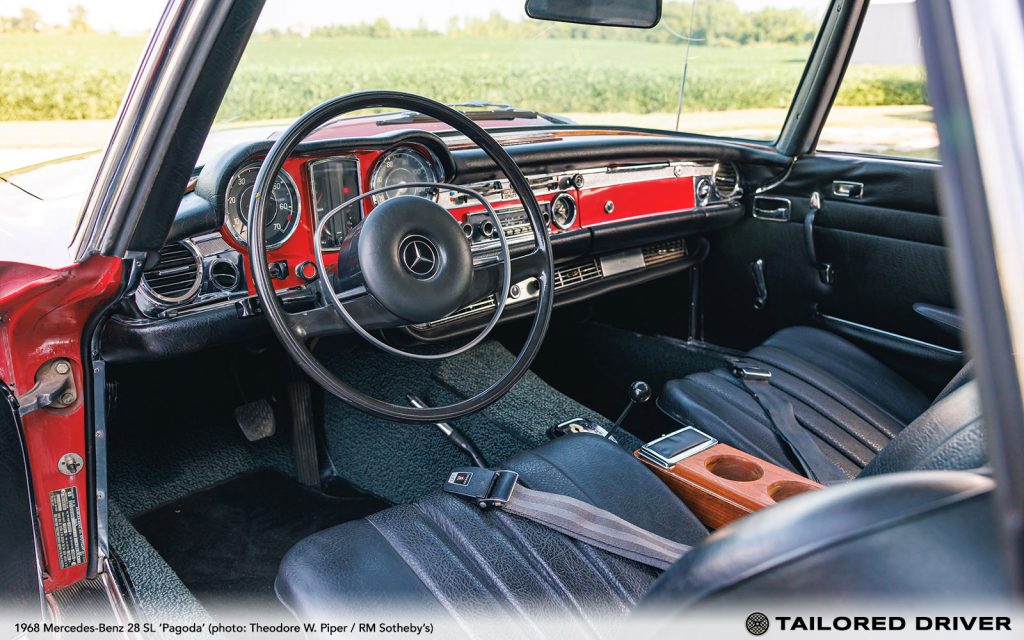
This week is RM Sotheby’s Hershey Sale, part of the Hershey Car Week centralized around the Antique Automobile Club of America’s annual national meet in Hershey, PA. Not your typical wine and cheese car week such as Monterey or Audrain, Hershey gets a slightly different mix than you would expect from RM at the more opulent events. We’re particularly appreciative of classic drivers in their mix, and found this 1968 Mercedes-Benz 280 SL ‘Pagoda’ (VIN 113.044.12.001739) to be particularly attractive.
For the uninitiated, the ‘Pagoda’ name comes from the removable hard top produced with these cars, something that made them more luxurious as compared to the other convertibles competing with this W113-generation Mercedes SL from 1963 to 1971.
Like a lot of classic cars, the W113 may have looked ungainly when the less curvaceous R107 with its dual round headlights and larger bumpers debuted in 1971. In the time since then though, the W113 has become more of an iconic classic than its successor, making them highly sought after and collectible with prices often going into six figures.
This particular car is painted Signal Red (signalrot; non-metallic UNI; 568; Mercedes-Benz), a common name of the period for more basic and/or primary colors and often centering around traffic signals – Red, Yellow, Green and Orange. Signal Red then is more of a pure and basic red. It also looks quite good on the 280 SL Pagoda.
Below is the full description of the car listed for sale in Hershey by RM Sotheby’s. You can also link directly to the car on RM Sotheby’s website that includes further documentation and many more photos HERE.
Hershey 2024, Lot 176: 1968 Mercedes-Benz 280 SL ‘Pagoda’
A wonderfully presented, early production “Pagoda”
Wears factory-correct color Signal Red (568) over black vinyl (131) with matching hardtop
Offered from two decades of cherished, family ownership
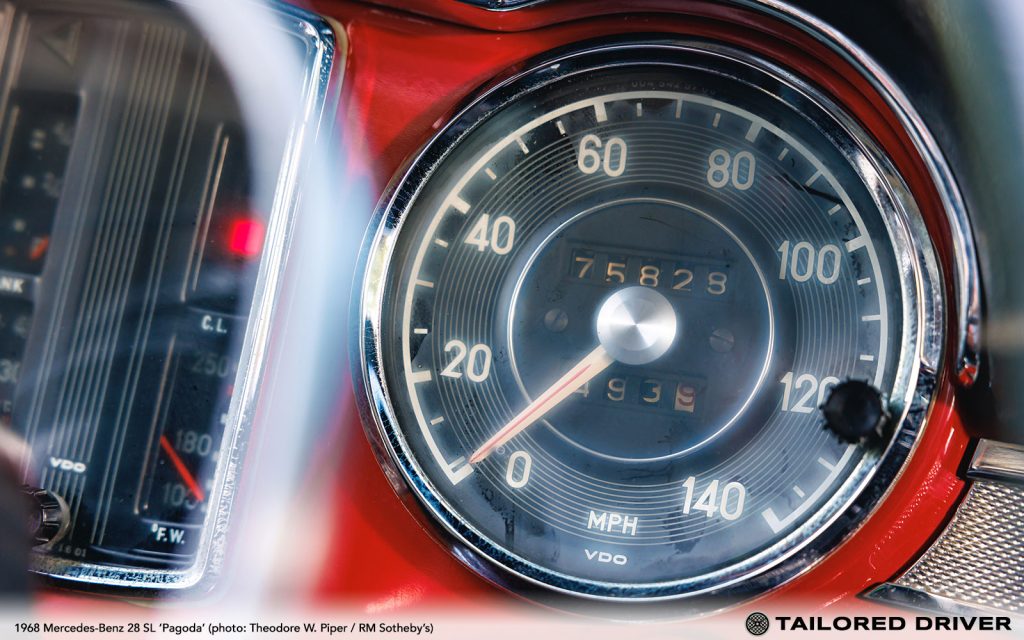
Fewer than 76,000 actual miles indicated at time of cataloguing
Ideal open-air cruising configuration featuring power steering, automatic transmission, and air conditioning
The elegant styling and undeniable appeal of the Mercedes-Benz 230 SL “Pagoda” made the German two-seater popular at the time of its first availability in the 1960s. Its long-lasting charm has sustained demand as a coveted collector car since then.
The 230 SL debuted in 1963 and would be steadily improved upon, first with the 250 SL in late 1966, with displacement of its inline six-cylinder engine enlarged from 2.3 to 2.5 liters, followed a year later by the final iteration on the W113 chassis, the 280 SL, with displacement further increased to 2.8 liters. Production lasted until 1971 but its appeal with collectors and enthusiasts persists to this day, particularly with beautifully presented examples such as the one offered here.
This early Signal Red over black vinyl 280 SL is a US-market car that was equipped new with the coveted optional “Pagoda” hardtop in matching Signal Red. Other factory features include single seats, power steering, a floor-shift automatic transmission, front and rear bumper guards, instrumentation in miles, a driver-side outside mirror, a Becker Europa radio, and whitewall tires. While manual examples are rarer, many collectors, including the consignor, feel that an automatic transmission is more fitting to the nature of the 280 SL.
Over the past two decades, this lovely “Pagoda” has remained within the cherished ownership of the same family. While under their care it has been enjoyed on a regular basis and benefited from continual routine maintenance. Additionally, an aftermarket air-conditioning system has been added to improve the car’s specification to its most ideal open-touring configuration.
As presented, this 280 SL indicated fewer than 76,000 actual miles at the time of cataloguing. A timeless classic that has only become more desirable as the years have passed, this attractive 280 SL is a delightful and approachable example of this storied model.
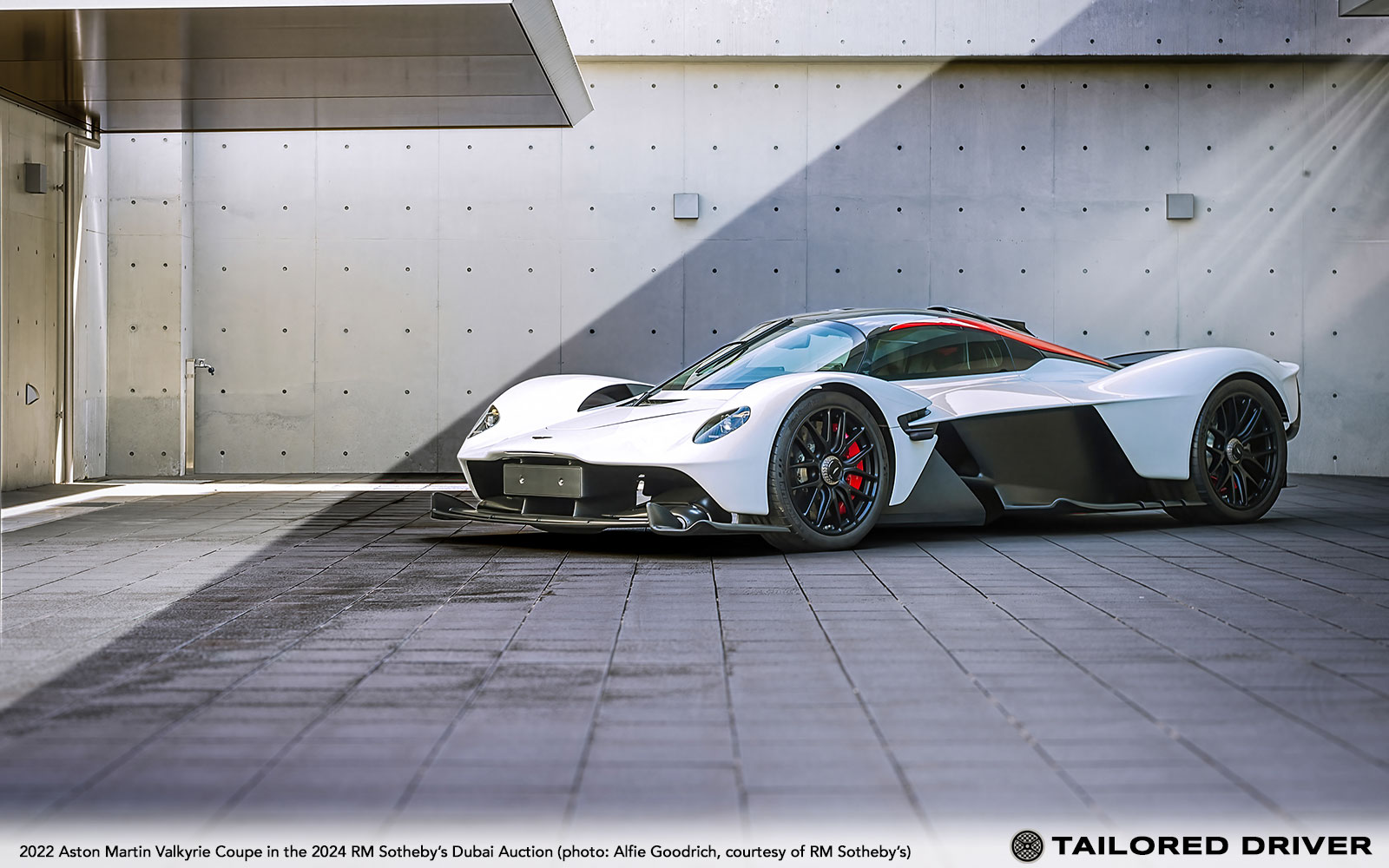
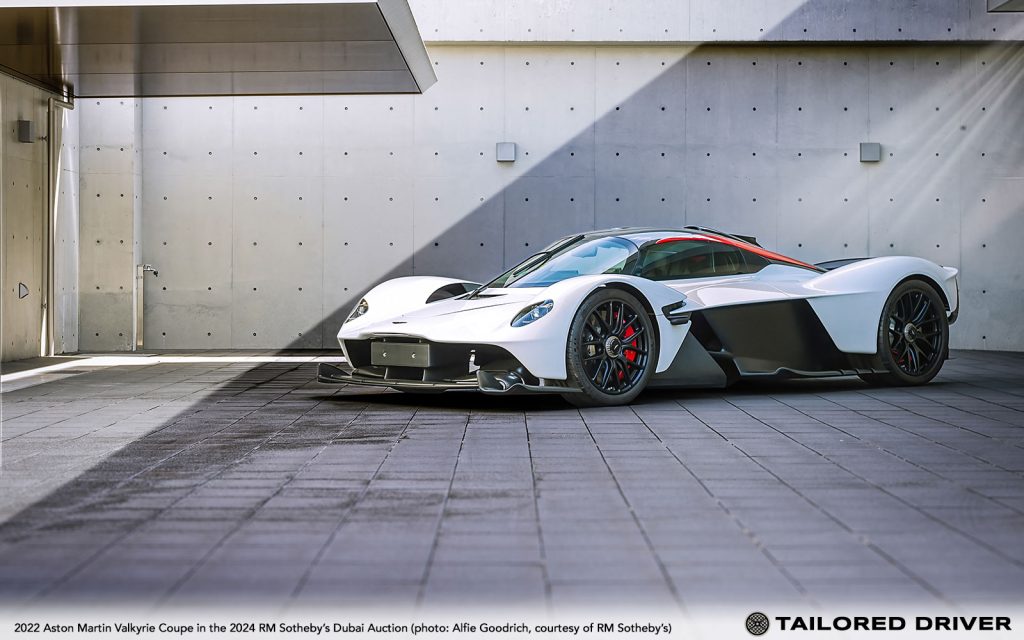
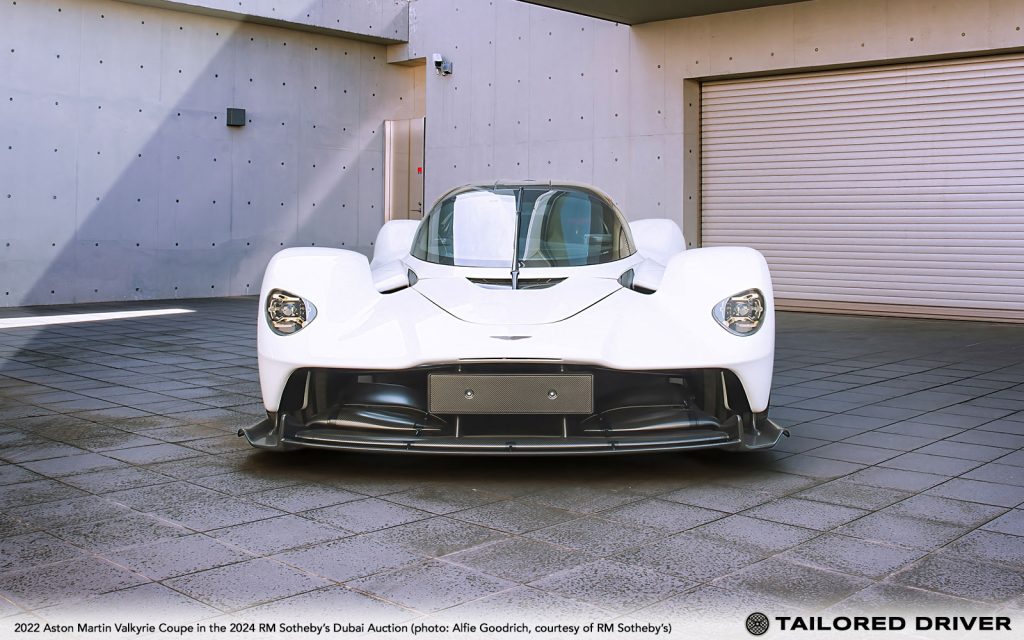
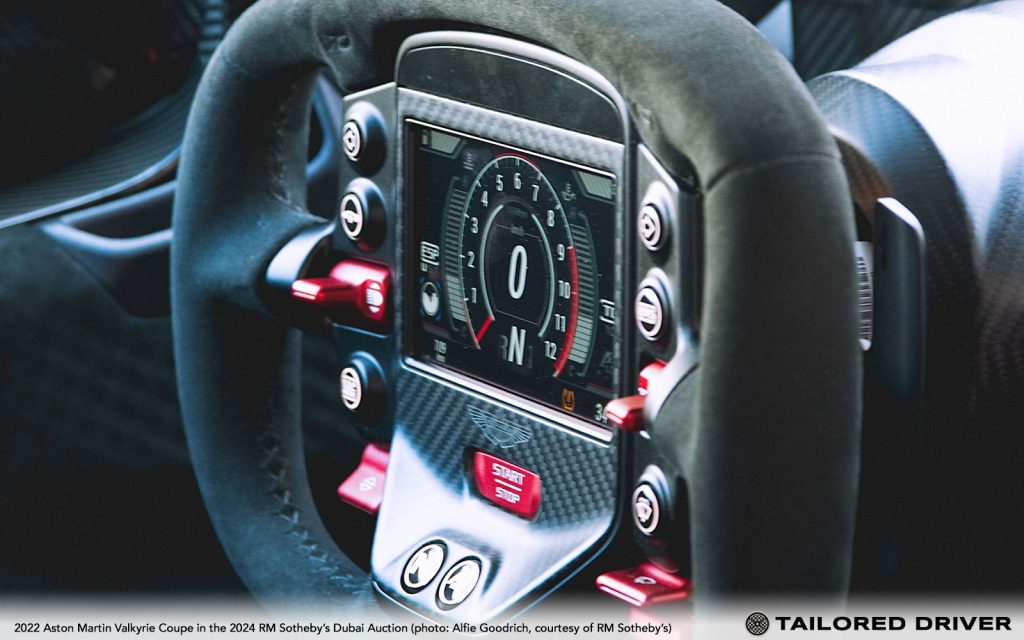
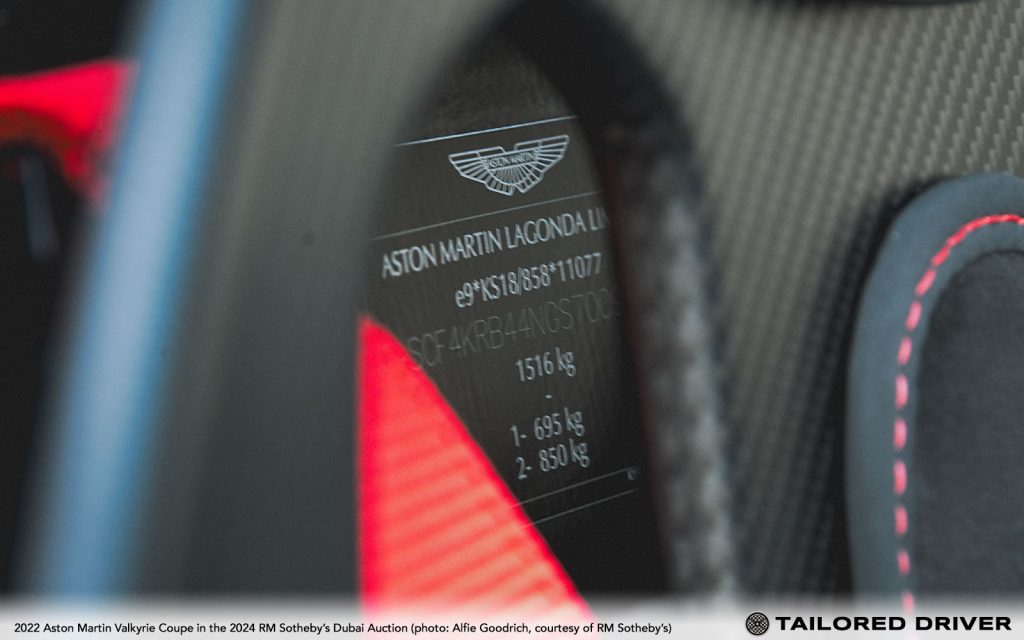
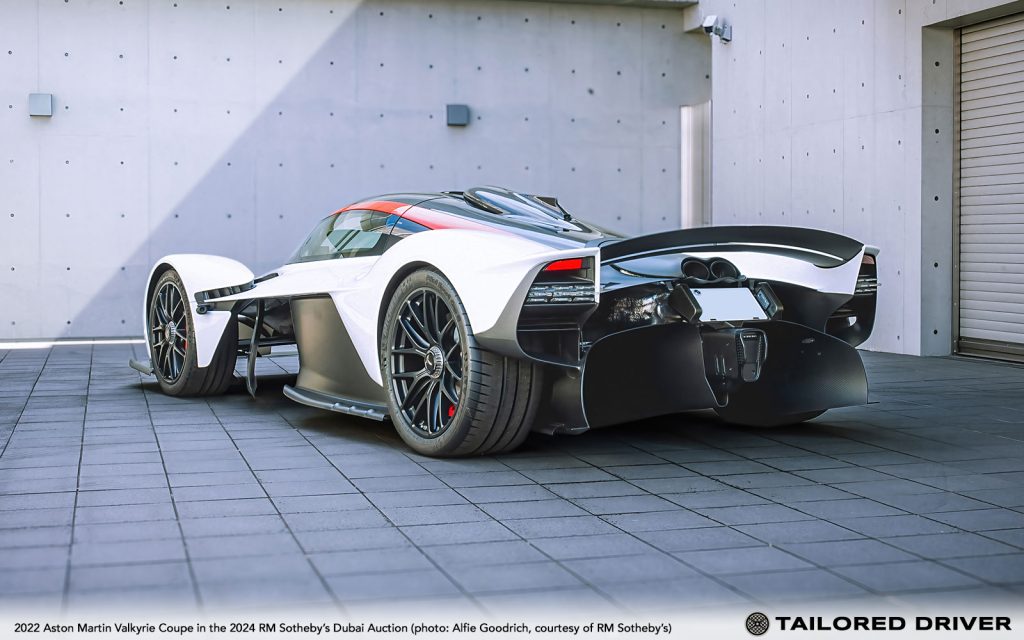
One of just 150 examples of the Adrian Newey-designed Aston Martin Valkyrie is headed for sale as part of RM Sotheby’s upcoming Dubai Auction. It’s a rare occurrence when these cars go up for public sale, offering us a chance to take a closer look at the specification.
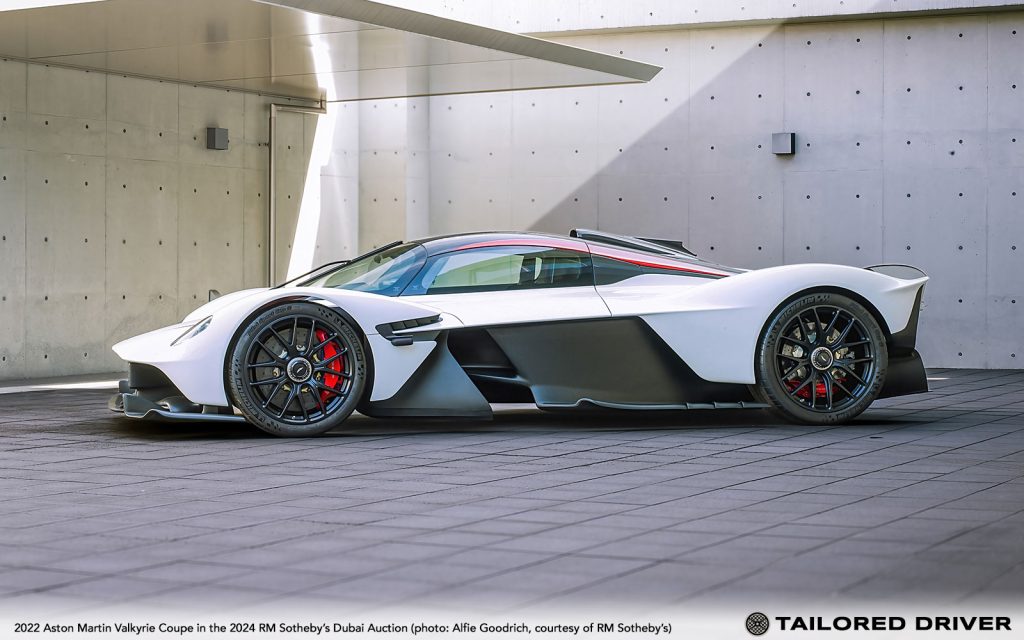
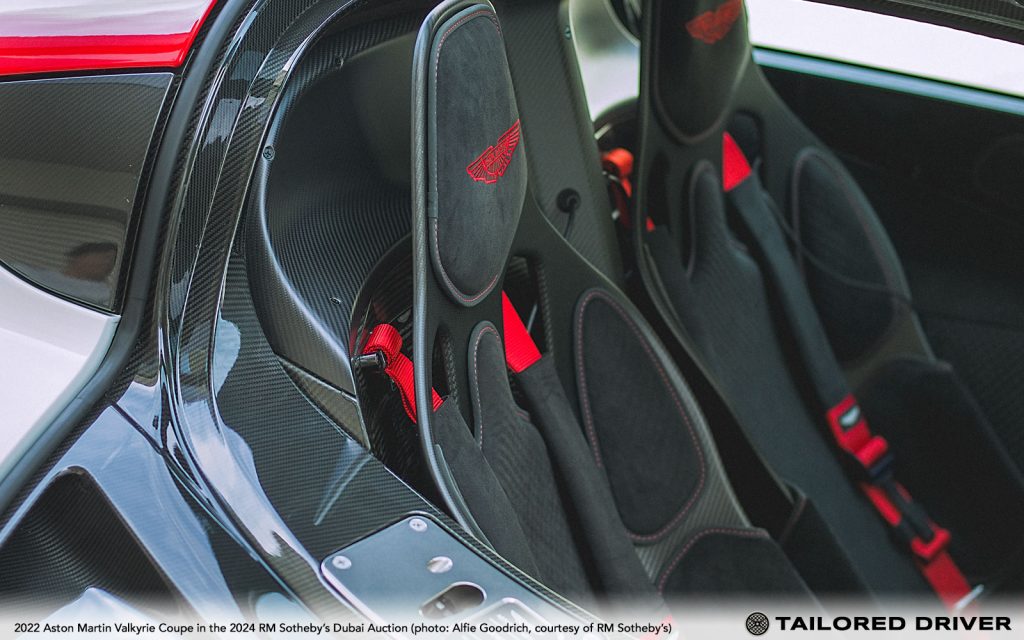
This car (chassis: SCF4KRB44NGS70090) is painted Lunar White. It features gloss carbon roof and red graphic strakes. Inside, Pure Black Deboss Alcantara is accented by Spicy Red stitching according to the RM Sotheby’s auction catalogue.
Want to read more? We’ve got the Lot description below and you can also find it directly over at RM Sotheby’s auction website HERE.
One of only 150 examples of Aston Martin’s ultimate Valkyrie road-legal hypercar
Co-designed by multiple Formula 1 championship-winning designer Adrian Newey
Exterior finished in Lunar White with a gloss carbon roof featuring red graphic strakes; Pure Black Deboss Alcantara interior complemented by Spicy Red stitching
Powered by an electric motor-assisted Cosworth V-12 making 1,160 horsepower; capable of 0 to 100 km/h in 2.6 seconds and a claimed top speed exceeding 400 km/h
Single ownership from new; displays only 109 kilometres at the time of cataloguing
[source: RM Sotheby’s]
The original “Nebula” internal codename for what would eventually become the Valkyrie was entirely fitting. Aerospace-grade engineering runs throughout this fully carbon fibre, road-legal hypercar that is capable of single-seater levels of performance. The letters in “Nebula” also denoted the key stakeholders involved, with multiple Formula 1 World Championship-winning car designer Adrian Newey and his Red Bull Racing team working alongside Aston Martin as the marque dramatically pivoted away from the grand tourers with which it had long been most associated.
A seven-year gestation period for the Valkyrie (the final model name derived from Norse mythology) reflected the project’s immense complexity. Elegant bodywork featuring the trademark Aston Martin-grille does without unsightly aerodynamic devices. An emphasis was placed instead on the open underfloor that employs Venturi tunnels running either side of the teardrop-shaped cockpit to feed an enormous diffuser. For this attempt at creating a Grand Prix car for the streets, extreme management of the airflow allows the Valkyrie to achieve over 3.5-G through high-speed corners, approximately three times that of a conventional sports car. All told, it can generate a genuinely tyre-bursting two tonnes of downforce.
Under the skin, there’s no steel to be found in the structure of the car. To achieve the best power-to-weight ratio, carbon fibre dominates the chassis, of which the engine is fully stressed member. Rather than conventional mounts that dampen the experience, the 65-degree, naturally aspirated, 6.5-litre V-12 is attached directly to the monocoque with four bolts. Created by Cosworth, who started on the project by developing a straight-three unit, the engine has a screaming rev limit of some 11,100 rpm. Fitted with an electric motor and a battery pack suppled by Rimac, the Valkyrie develops a total of 1,160 horsepower, which is sent to the rear wheels only via a Ricardo-manufactured seven-speed sequential transmission.
The attention-to-detail involved with realising the Valkyrie is simply staggering. On most Aston Martin models, the famous “Wings” badge is enamelled and proudly protrudes from the bonnet. Such an item was deemed too heavy and too disruptive to the airflow in this application but substituting it for a mere decal was deemed unsatisfactory. As such, this car is optioned with a special titanium badge just 40 microns thick. Quoted as being 99.4 per cent lighter than normal, the new symbol was then laid into the paint for a flush fit.
Further underlining the engineering boundaries being pushed throughout, Aston Martin says the rear brake light is the smallest and brightest ever fitted to a production car. What’s more, there are a reported 15,187 adjustable parameters across the Valkyrie. This ultimately led to the fitment of a hydraulics system with 17 different actuators borrowed from a Boeing Apache helicopter to keep pace with the active aerodynamics, double wishbone suspension, and damping.
Then there’s the single windscreen wiper. While it was initially thought that the model might do without, the potential for a car to one day be caught at a set of red lights in a downpour led Aston Martin to find a company that could provide a sleek unit that would not spoil the silhouette but would still clean the extremely curved windscreen. As a result, after a year of development on the wiper alone, the Valkyrie uses the same supplier as the Space Shuttle programme.
A truly astonishing feat of engineering, this 2022 model year example has been consigned to auction by its original owner. The Valkyrie’s odometer remarkably reads just 109 kilometres at the time of cataloguing.
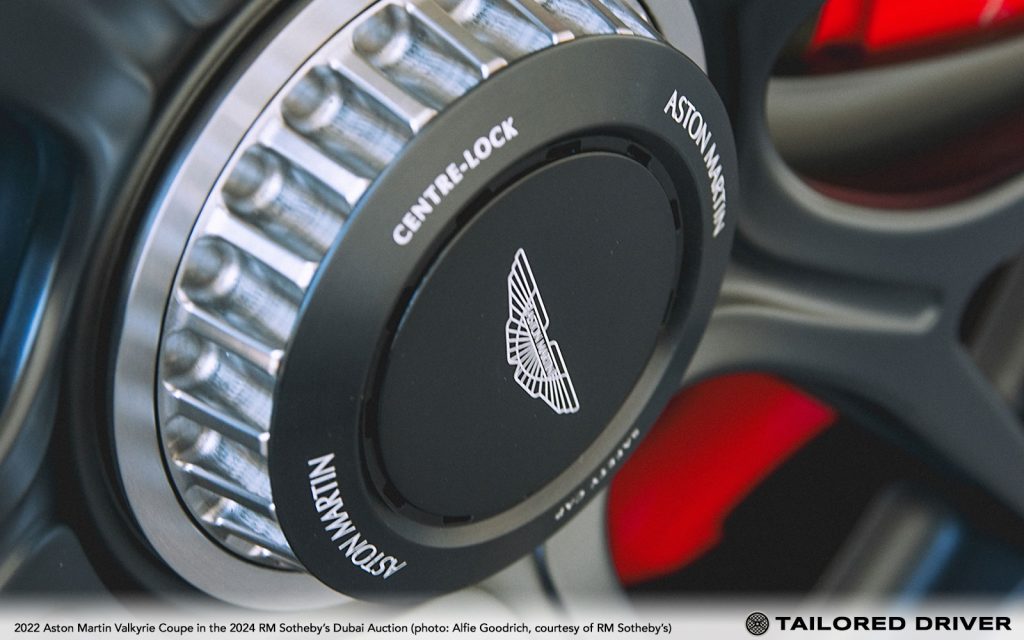
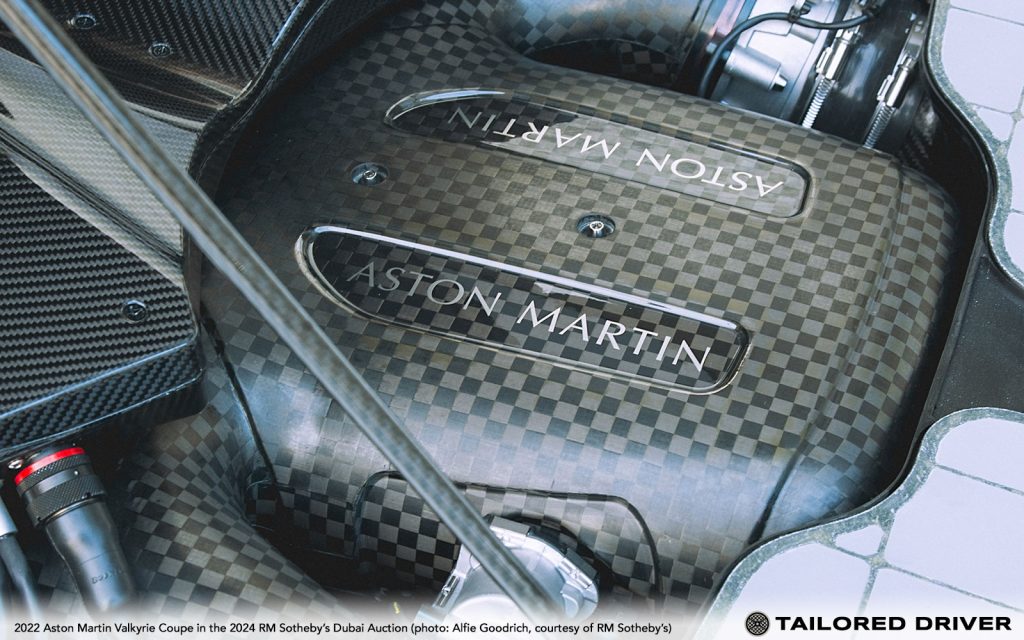
Ordered new to Japan, factory records show that this left-hand drive, European-specification car carries a 19 October 2022 build date. It was finished predominantly in Lunar White, with the exterior also featuring a gloss carbon roof panel and striking red graphic strakes. Red callipers for the enormous carbon-ceramic brakes nestle behind Satin Black Magnesium wheels, which are remarkably lighter than their accompanying tyres. In addition, almost £120,000 was spent on options, with this Valkyrie gaining a polished carbon engine plenum, Inconel exhaust system with black finishers, plus a gloss carbon engine cover.
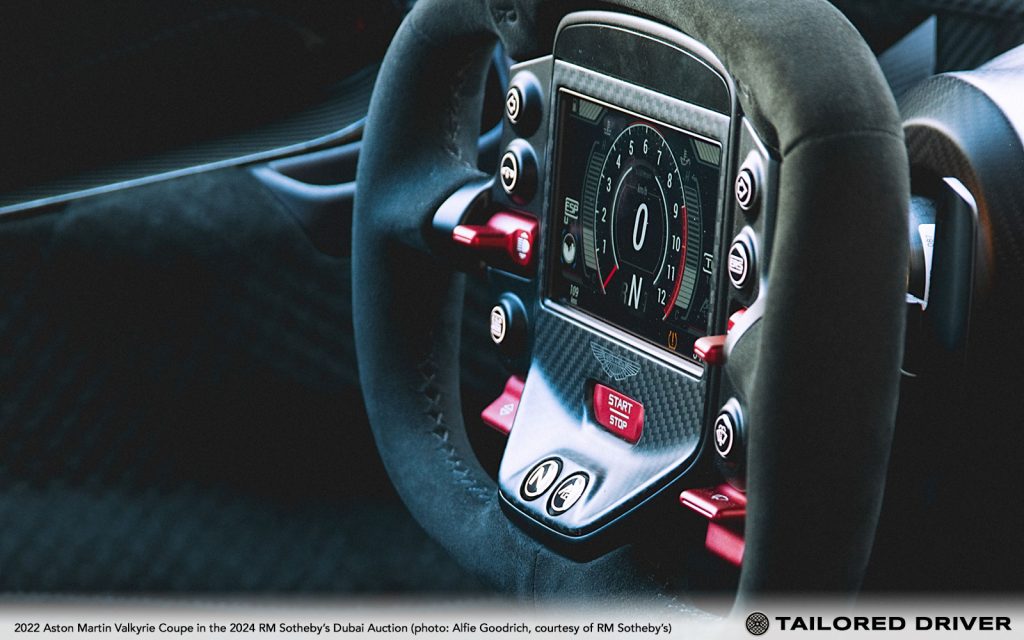
As for the compact cockpit, a copy of the build sheet records that the racing-style seats were trimmed in Pure Black Deboss Alcantara complemented by Twill Satin Carbon Fibre for the roof inserts. To match the exterior accents, the optional six-point race harness and anodised switchgear were specified in red, while the stitching is listed as “Spicy Red”. This Valkyrie was sold new on 10 March 2023 ahead of a service being carried out on 24 November later that year, with the car then recorded at 84 kilometres.
Given the very limited numbers in which the Valkyrie was produced, here is an incredible opportunity to purchase an as-new coupé example that would surely be among the crowning glories of any significant sports car or motorsport-inspired collection.
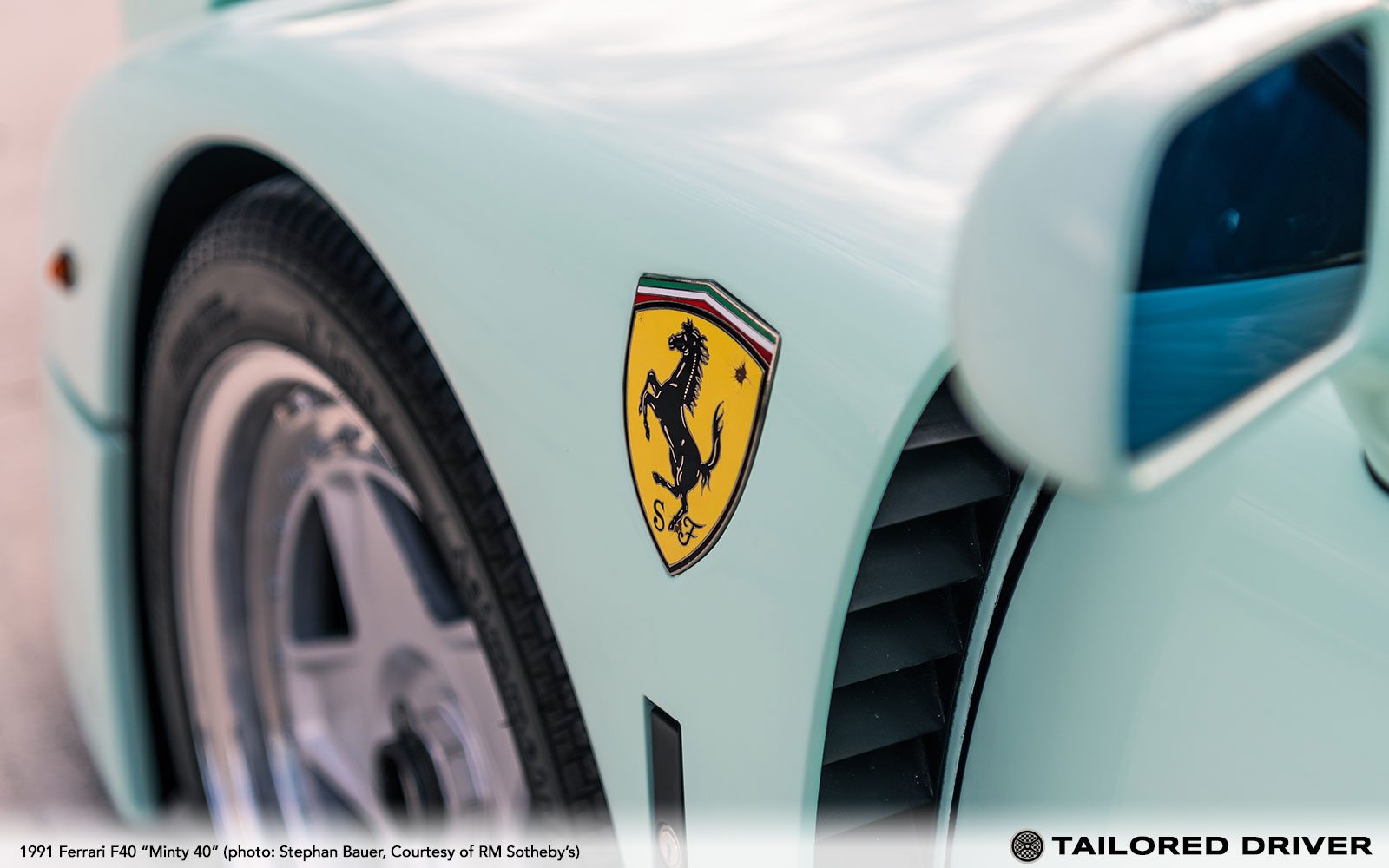
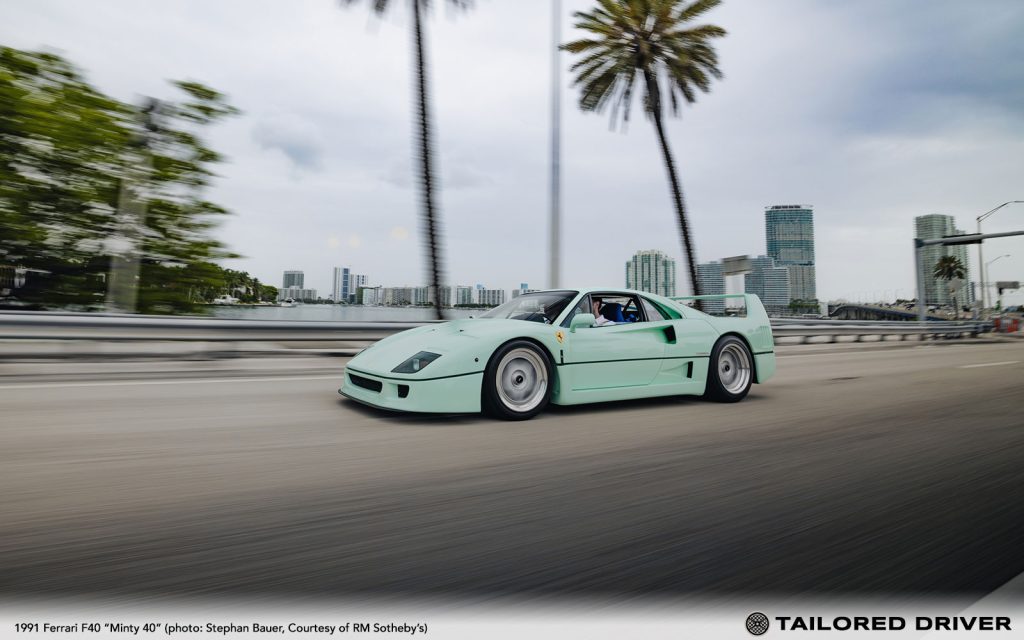
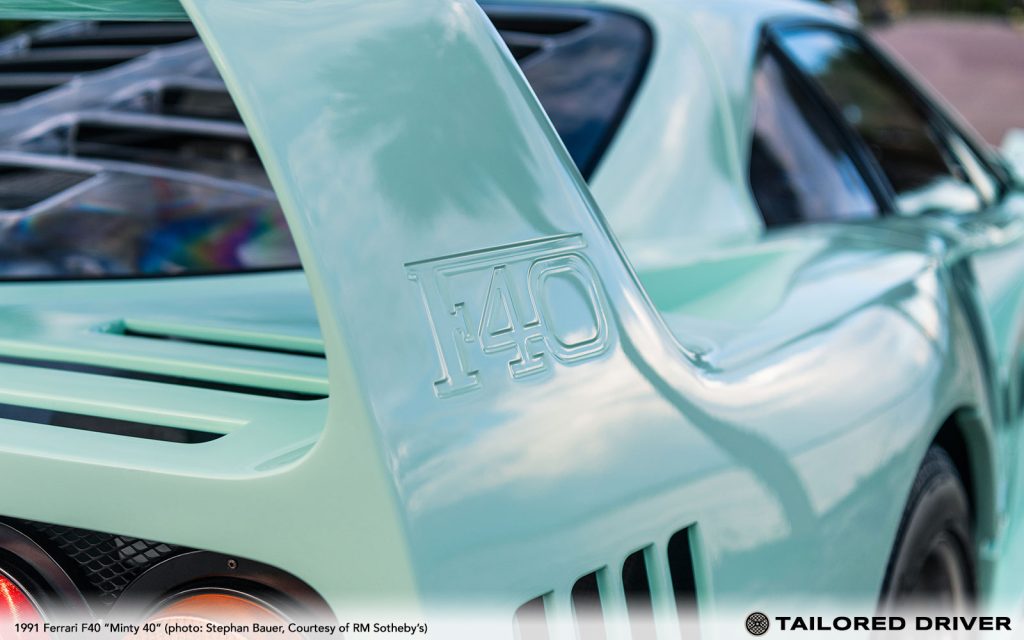
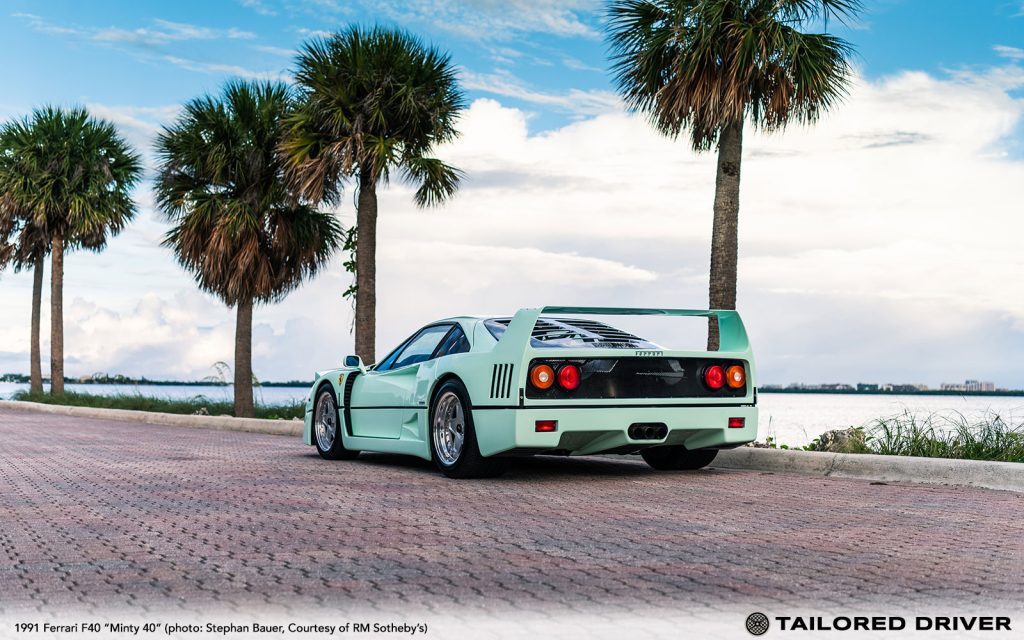
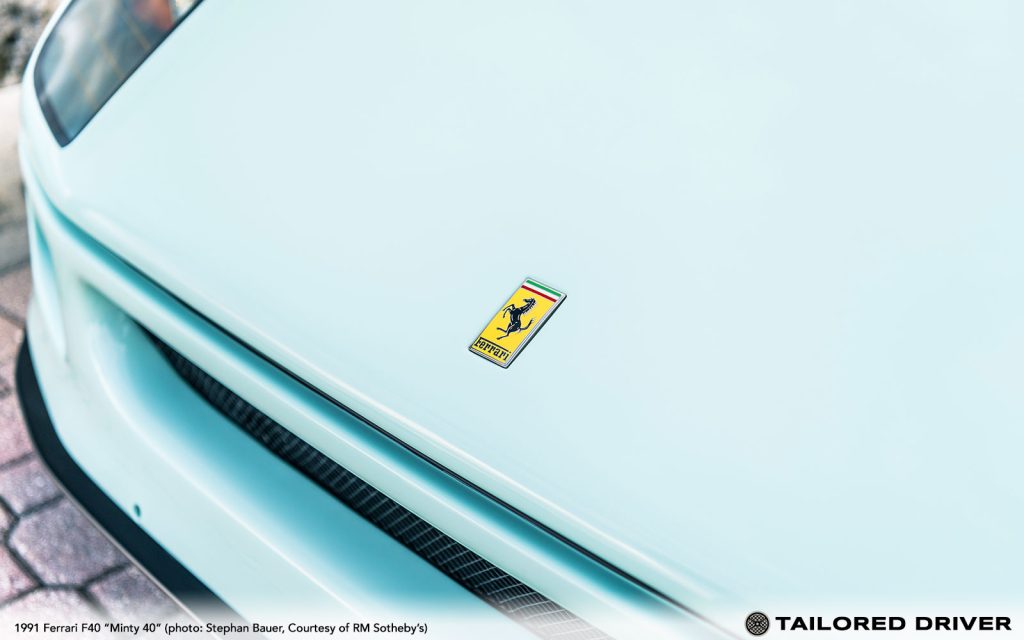
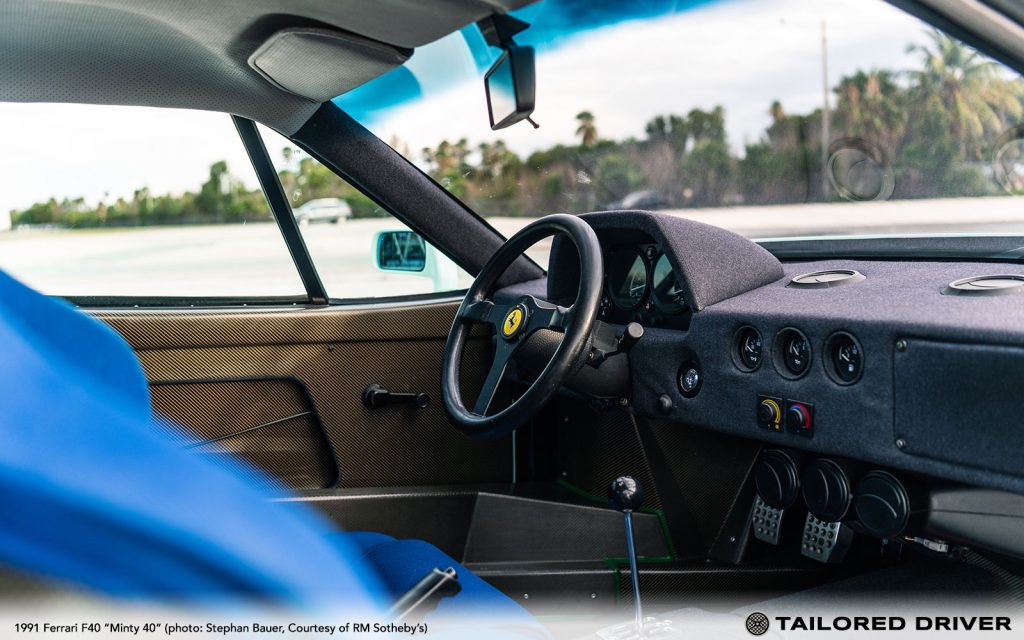
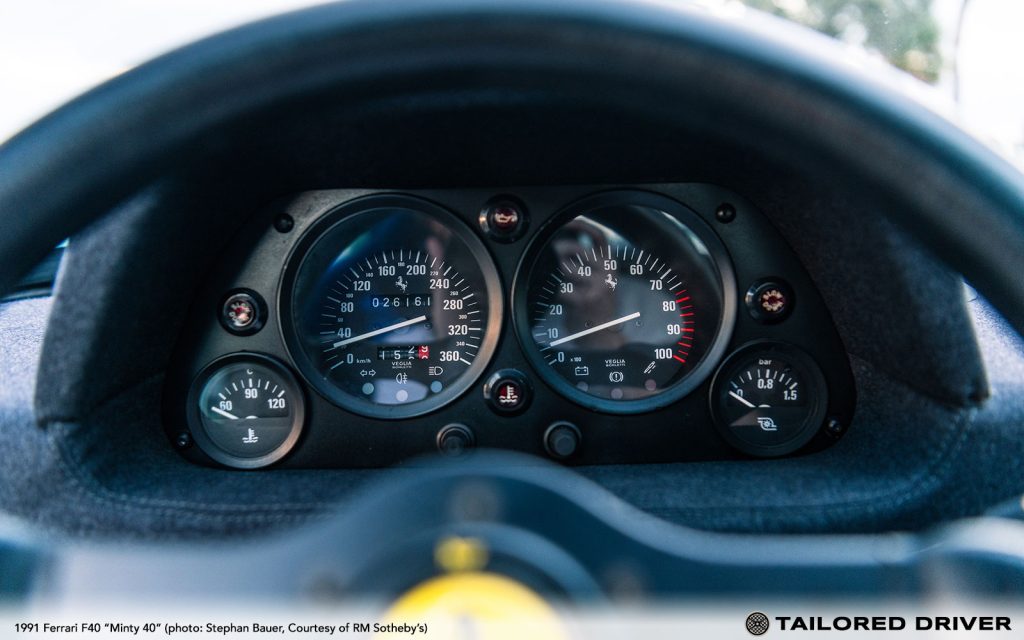
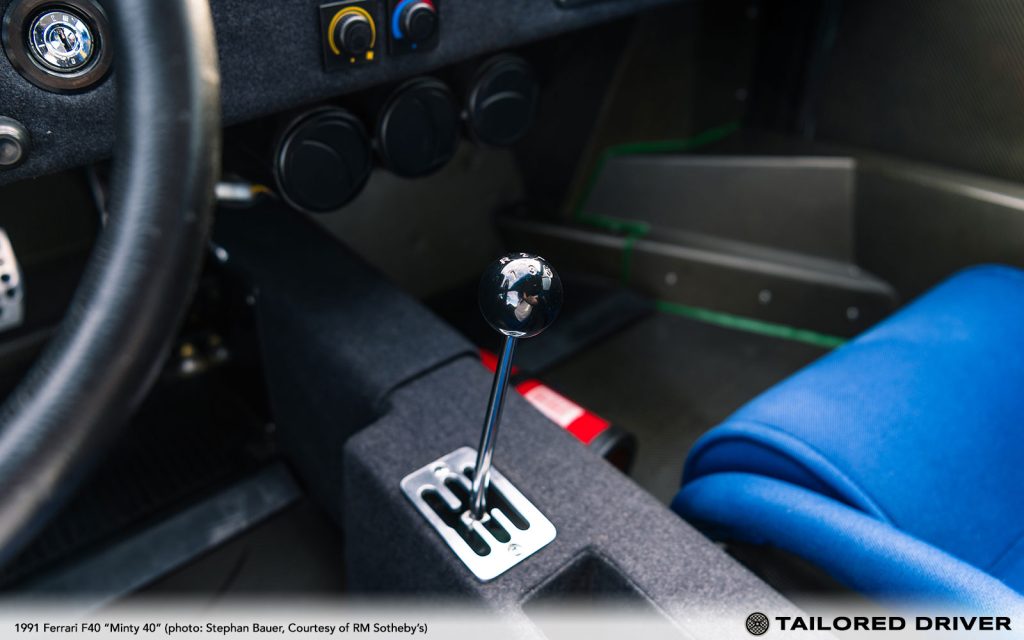
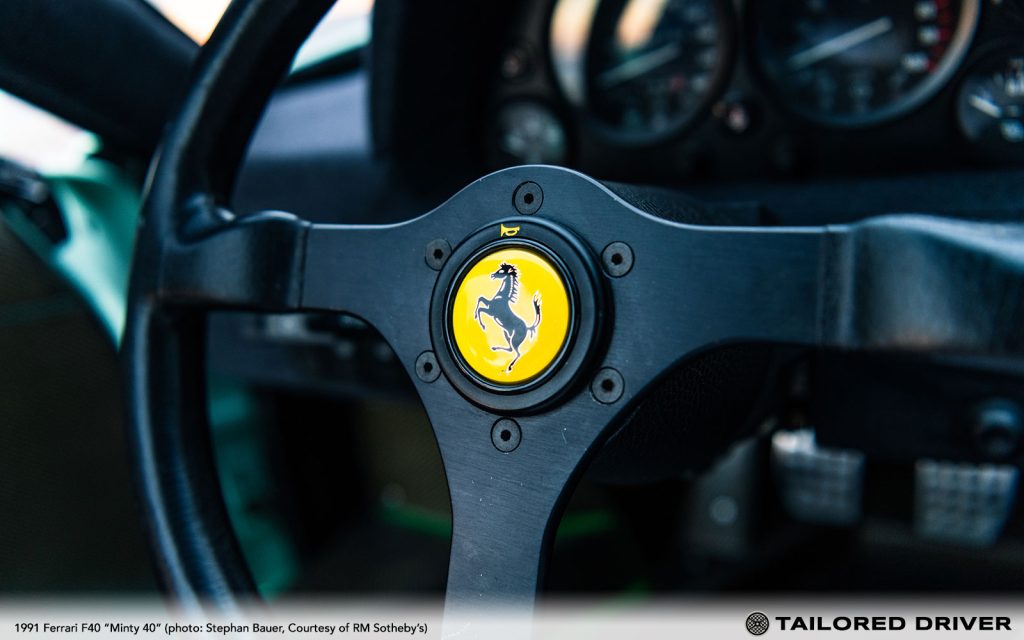
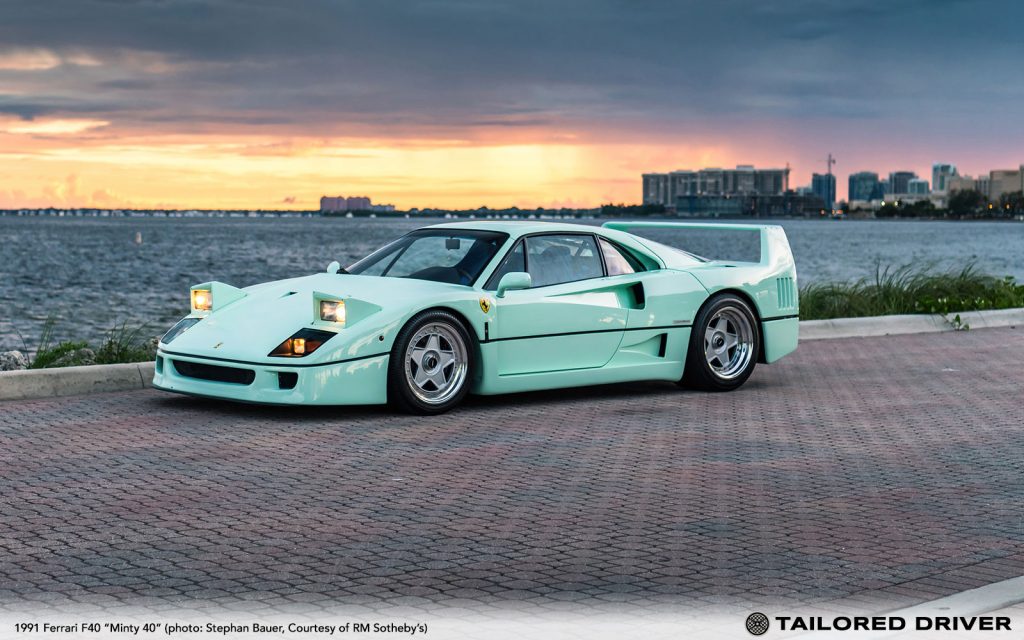
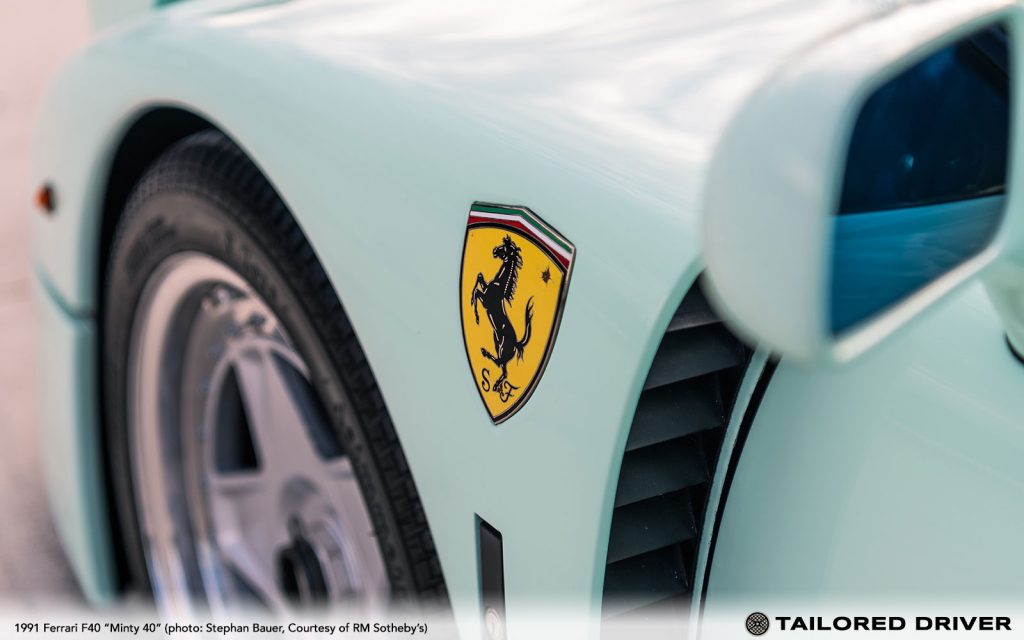
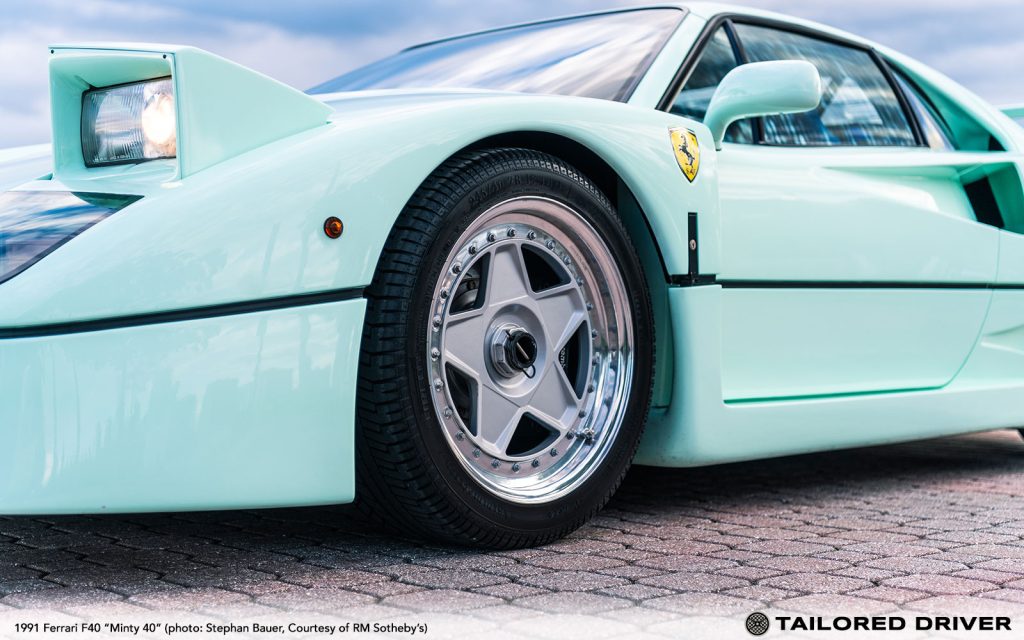
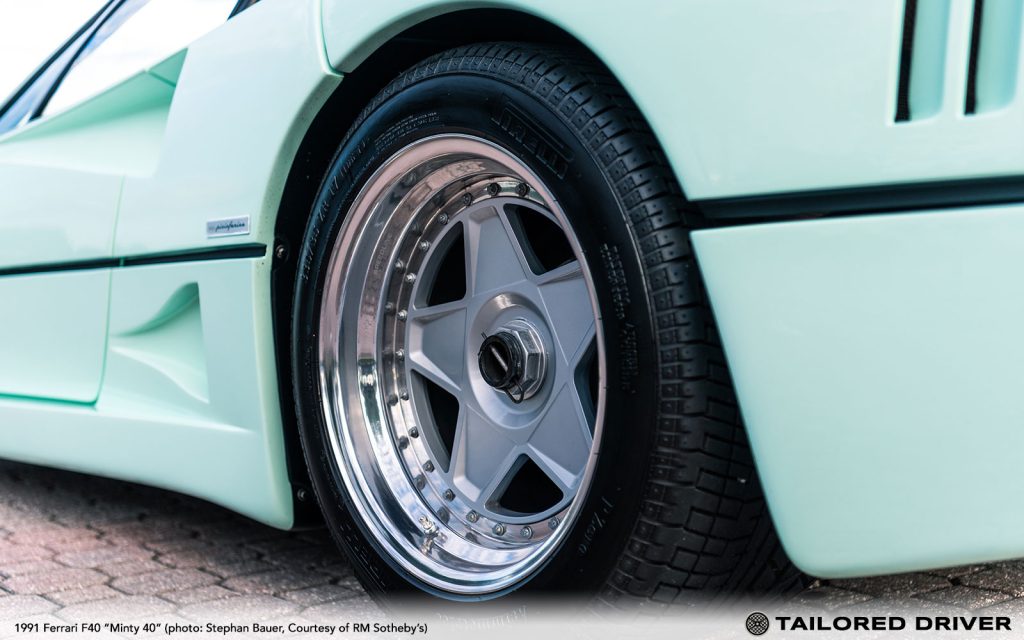
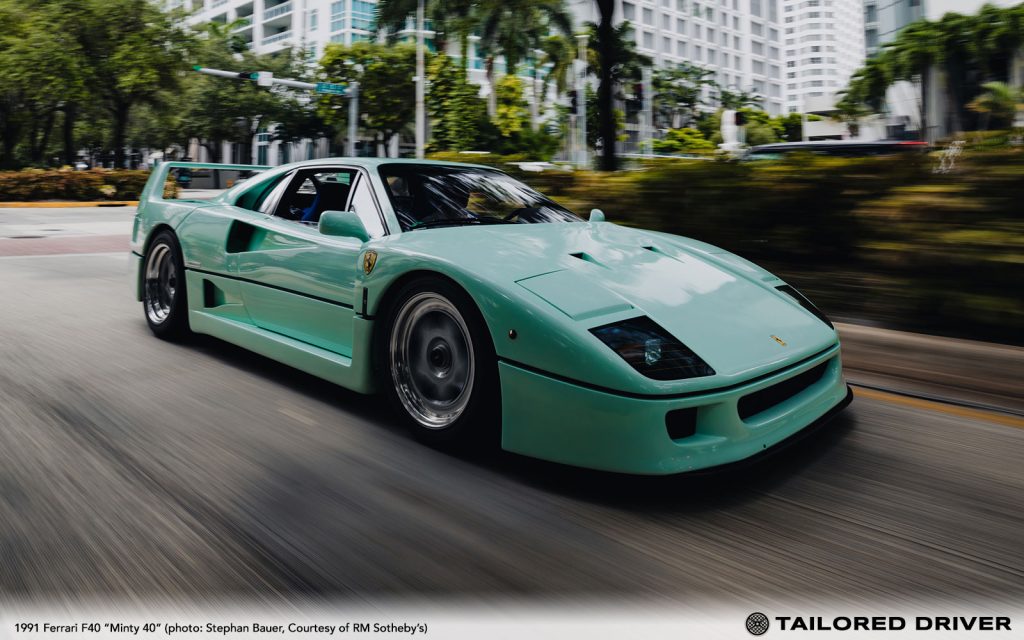
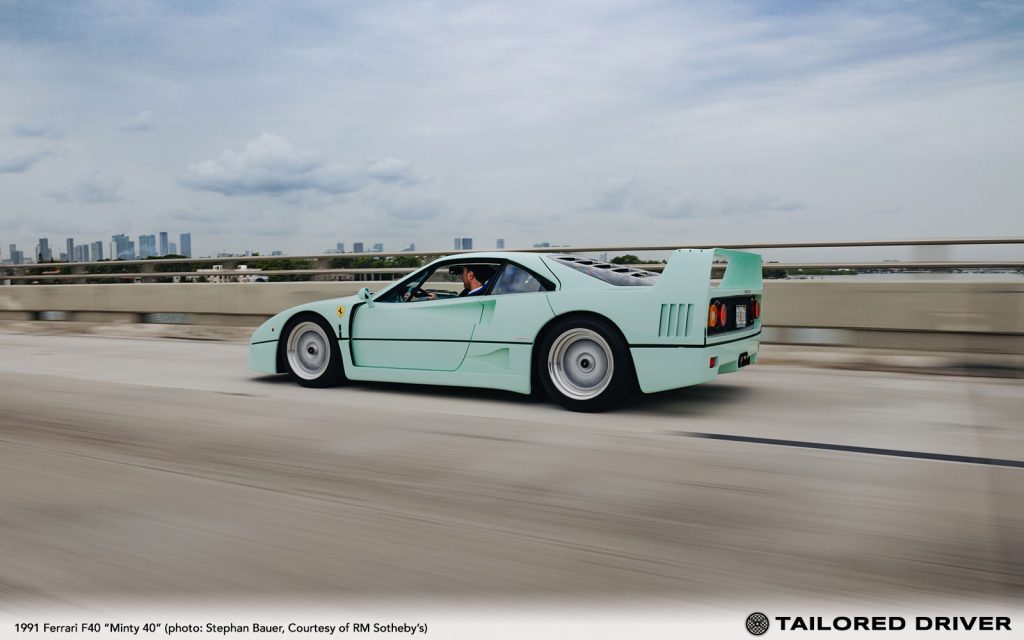
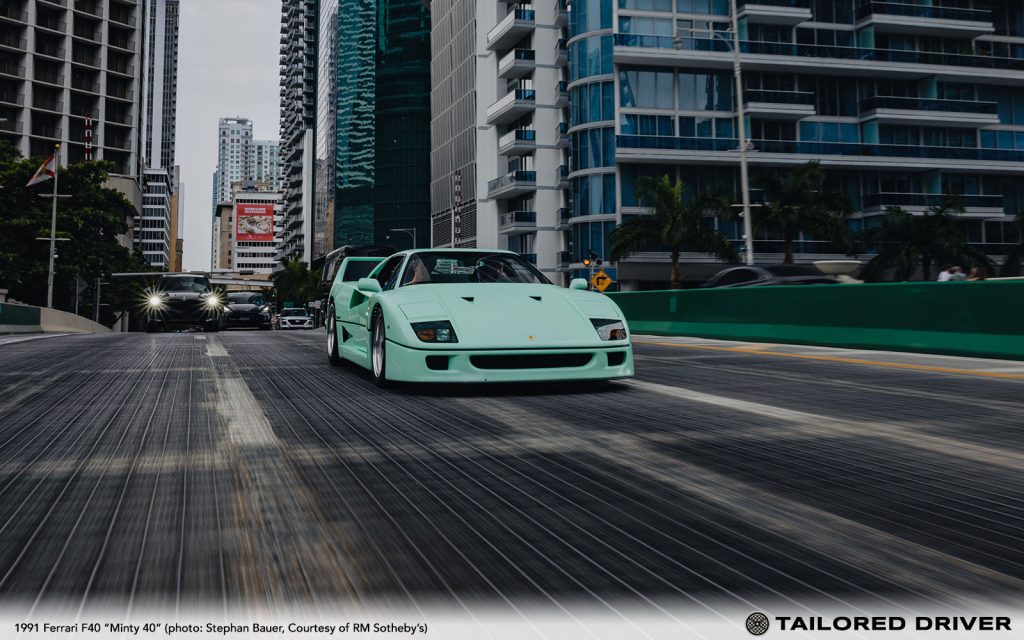
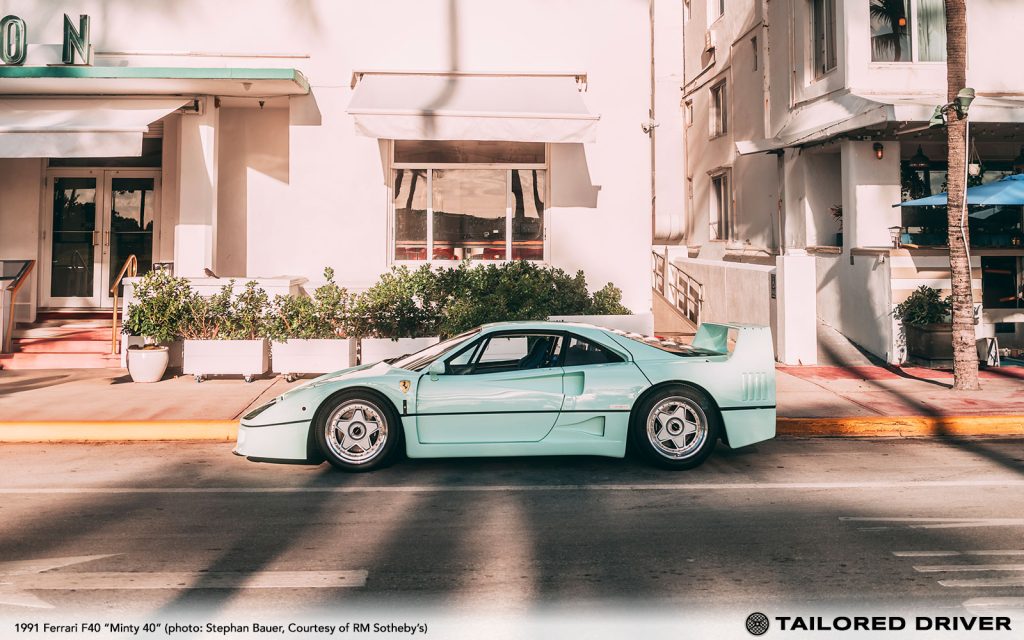
If you’re headed to Monterey Car Week, one auction car you definitely shouldn’t miss is Lot #362 at RM Sotheby’s, one very unusual 1991 Ferrari F40. Dubbed “Minty 40” for obvious reasons, the color is Verde Pallido also famously sprayed on a Ferrari 250 GTO for Stirling Moss and raced in the 1962 24 Hours of Le Mans by Innes Ireland and Masten Gregory.
Okay, so technically it’s a respray. Chassis number ZFFGJ34B000088538 was originally built in Rosso Cross over a red Staffa Vigogna interior. It was involved in an accident, requiring it to be repaired (which is detailed in the RM Sotheby’s synopsis below. Given it wasn’t in as-delivered condition any longer, its most recent owner decided to change things up into the car you see here. And now that this last owner is ready to move on, the car will be auctioned off later this week during Monterey Car Week.
Check out more photos and details on the car via the RM Sotheby’s link HERE. We’ve also reprinted the RM Sotheby’s written description of the car below, and added a few photos. Even more photos and supporting documents are available via the RM Sotheby’s link.
1991 Ferrari F40 ‘Minty 40’
[source: RM Sotheby’s]
The “Minty Forty,” a spectacular, utterly unique interpretation of the iconic F40
Finished in homage to chassis 3505 GT, the Verde Pallido Ferrari 250 GTO famously built for Stirling Moss
European-market example retaining its matching-numbers engine and gearbox
Reproduced in exacting scale form by Amalgam; accompanied by an example of this limited-production model
A truly one-of-a-kind supercar, sure to cause a sensation wherever it goes
Addendum: Please note that due to California emissions, this vehicle must be sold to a dealer or out-of-state resident.
There is no such thing as an “ordinary” F40. A car with such a pedigree, with such outrageous design, such compelling performance, and of such rarity, could never be anything but spectacular.
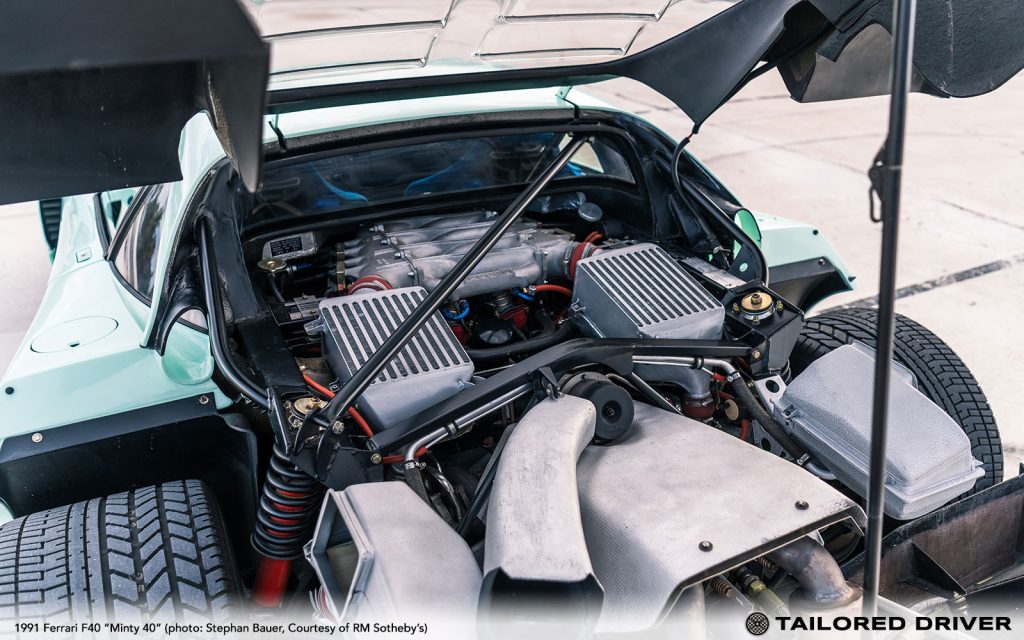
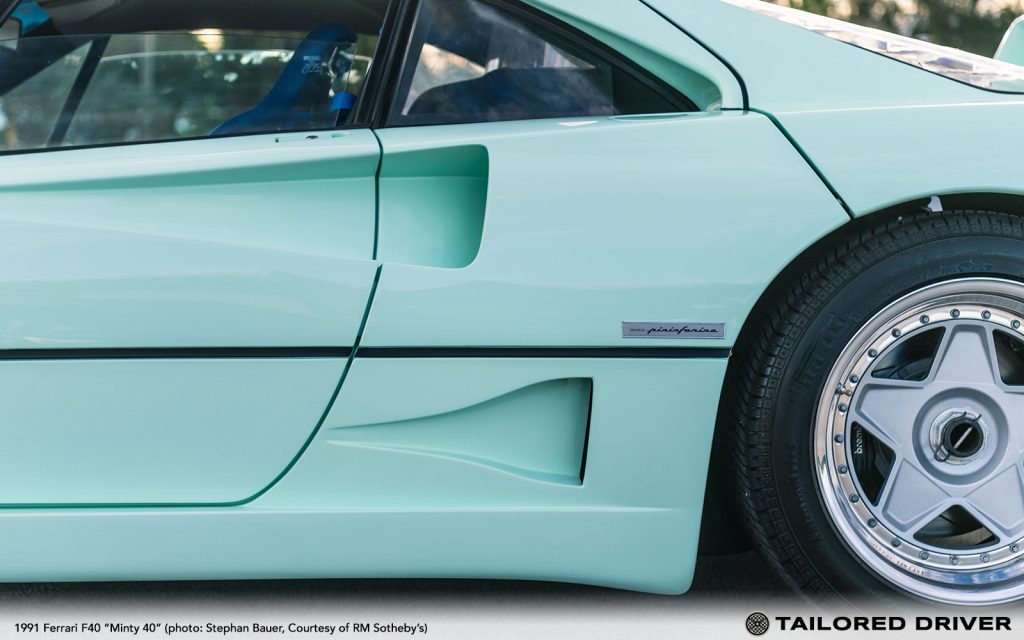
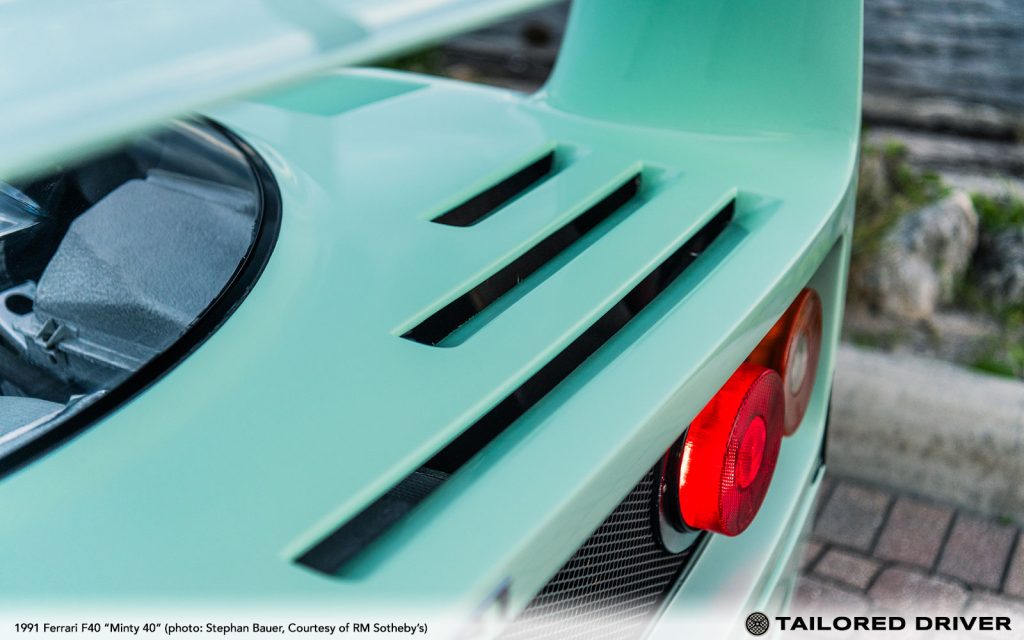
Notable for being the last supercar developed during Enzo Ferrari’s lifetime, the F40 was a pure distillation of everything Il Commendatore had poured into his company over the preceding four decades. Evolving from the cancelled Group B 288 GTO Evoluzione into a 40th anniversary road car, it did not lose its competition-inspired mission brief. The F40 featured a race-developed steel tube-frame chassis with four-wheel double-wishbone independent suspension, coil-over Koni shock absorbers, and four-caliper ventilated disc brakes. Pietro Camardella’s coachwork design, executed under the direction of Leonardo Fioravanti and aerodynamically perfected in Pininfarina’s wind tunnel, was built with paneling woven from Kevlar and carbon fiber, reducing curb weight while greatly increasing structural rigidity.
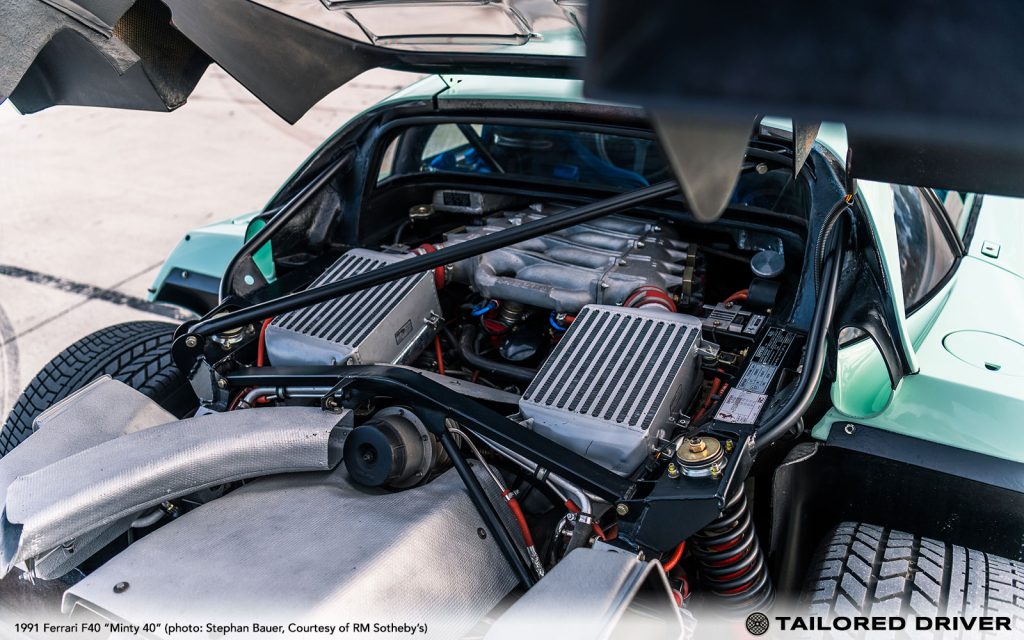
Positioned behind the driver was a twin-turbocharged V-8 displacing 2.9 liters and fitted with IHI turbochargers and Behr intercoolers; this engine was married to a five-speed transaxle actuated by a gated shifter. The resulting performance was nothing short of astounding, as the type F120 040 engine developed 478 horsepower and 425 pound-feet of torque, capable of launching the F40 to 60 mph from standstill in just 3.8 seconds and achieving a top speed of 201 mph (thereby eclipsing the Porsche 959 and Lamborghini Countach).
With aggressive looks and stupefying performance, each of the 1,235 Ferrari F40s built for worldwide sale remains a traffic-stopping mechanical masterpiece. Yet each of these 1,235 left the Ferrari factory in Maranello finished in one single color: Rosso Corsa.
CHASSIS 88538
The car offered here, chassis 88538, was no different—at first. Completed on 27 February 1991 in the F40’s signature Rosso Corsa over a red Stoffa Vigogna interior, it was distributed to Ferrari Deutschland GmbH and sold to its first owner, Dieter Wolf of Wölfersheim, Germany via Auto Becker of Düsseldorf that May. Mr. Wolf was obviously an active F40 owner; according to research on file by Ferrari historian Marcel Massini, he attended the F40 meeting in Mugello, Italy in 1992, as well as a Ferrari Club Deutschland gathering the following year.
In 1994, chassis 88538 was acquired by the then German Ferrari Club president, and noted collector, Arnold Gardemann. During his care in around 1998 the car was involved in an accident and was sold to a Dutch owner, who commissioned noted specialists Forza Service in the Netherlands to repair the car to factory specifications. As part of these repairs the front clamshell was replaced; however, today body numbers are present on the on the door hinge, rear spoiler, and rear fender. During the recent respray, when the red paint was removed, a repair to one sill was noted. In 2008, after the repairs had long been completed, the car received its Ferrari Classiche Certification, confirming that it retains its matching numbers engine and gearbox, and attesting that the repairs were carried out to full original specifications and standards.
After the completion of this work, chassis 88538 returned to the roads of Europe, appearing at the Ferrari Club Germany 25th Anniversary Meeting in Baden-Baden, Germany. In 2003, Forza Service replaced the odometer, confirming in writing that due to mechanical failure the car’s odometer (then displaying 11,442 kilometers) was replaced with an odometer that displayed 7,118 kilometers. More recently, it participated in the Ferrari Tribute to the Mille Miglia for three consecutive years, from 2010–2012.
After changing hands at auction in 2014 and privately in 2017, it was acquired by its present owner in 2021. Initially he had planned to repaint the car red; however, with the car fully stripped, a new idea emerged. Even if chassis 88538 was preserved in as-delivered configuration, it would never be a true “in the wrapper” specimen.
But could this actually be liberating? Could this F40 be driven, just as Enzo intended, making a bold statement in the process?
THE ‘MINTY FORTY’ IS BORN
One glance at chassis 88538 shows the path its owner took—and its head-turning new look was a key step in giving this F40 an identity all its own. Its paint is a clear homage to Ferrari chassis 3505 GT, the famous Verde Pallido 250 GTO built for Sir Stirling Moss and eventually raced at the 1962 24 Hours of Le Mans by Innes Ireland and Masten Gregory.
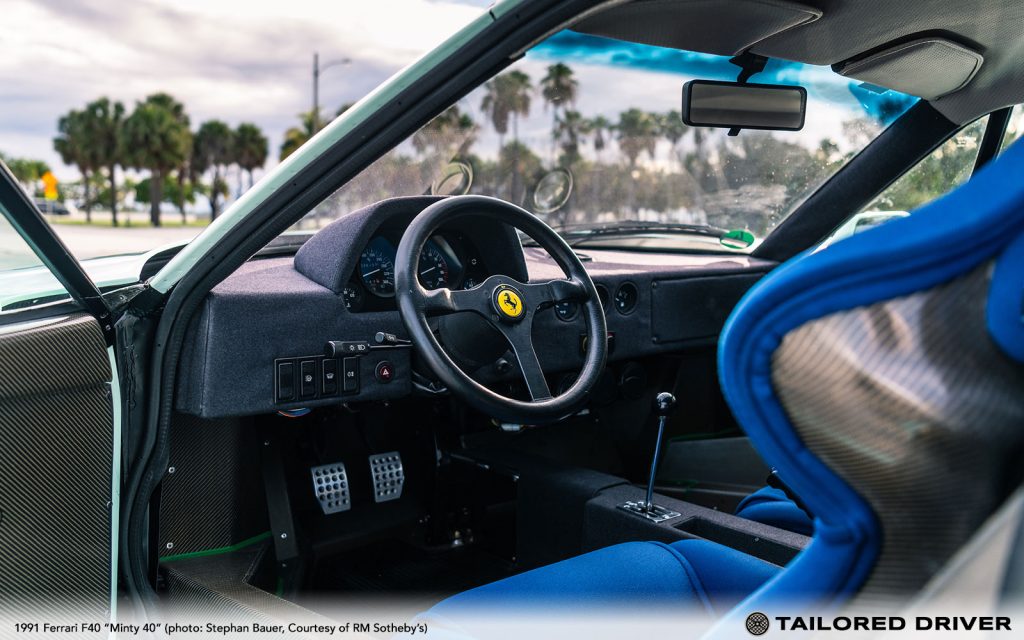
The 250 GTO is, much like the F40, most often seen wearing classic Ferrari red; chassis 3505 GT’s unique livery sets it instantly apart from its distinguished peers, and the beautiful pale green shade has inspired paint colors on subsequent Ferrari models—though never, until now, on an F40. To complement the exterior color, the interior was expertly re-trimmed in blue by one of the most talented trimmers in the region, more used to refitting aircraft interiors than cars. His work is exceptional, and brings a new coherence to the “Minty” concept.
Historical context aside, it one look is all it takes to see how this machine got its enduring nickname: the “Minty Forty.” Chassis 88538 has been in effect a one-car show since its debut in this form, turning heads and appearing in countless posts on social media. It has even been honored with an official Ferrari licensed product by being reproduced, in exacting 1:8 and 1:18 scale form, by renowned model-maker Amalgam (1:18 scale Amalgam model accompanies the sale). It is, simply, sensational—and making the already-incredible F40 into even more of a spectacle is no mean feat!
Now ready for its next caretaker, chassis 88538 has been maintained by Schaltkulisse since 2022 as documented by invoices on file. Fuel tanks were replaced in 2022, alongside the major timing belt service, in total over €43,000 has been spent on the car in the last 18 months excluding the cost of painting the car in its new color, ensuring the car is as good as it looks. At time of cataloguing, it has been driven a little over 31,000 kilometers, or nearly 19,300 miles; a healthy amount for an F40, this is clearly just the beginning of its epic journey.
Sure to make an impression wherever it ventures, the “Minty Forty” is an intensely charismatic machine that demands to roar down the open road, not sit parked in a garage. It is not for the faint of heart.
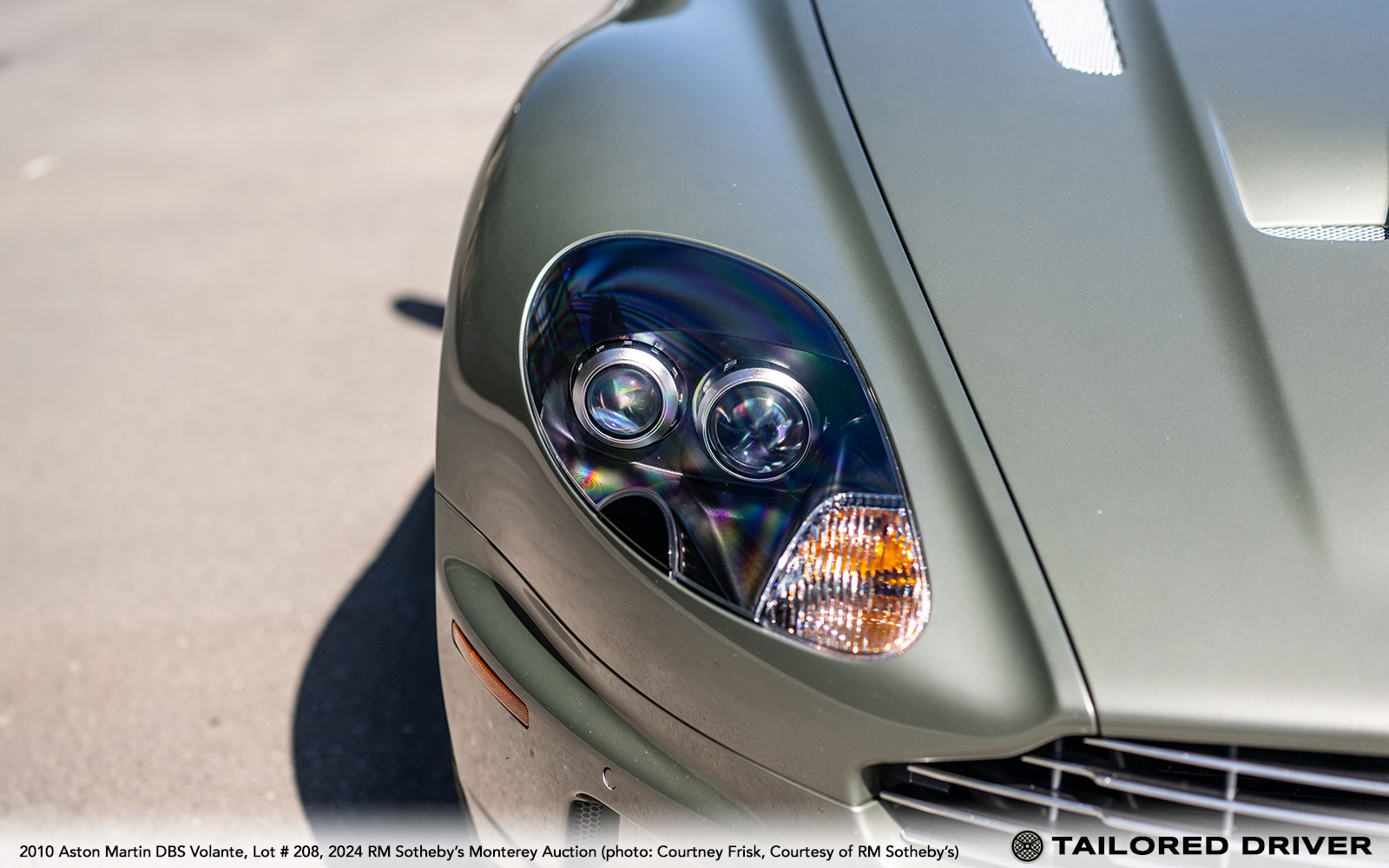
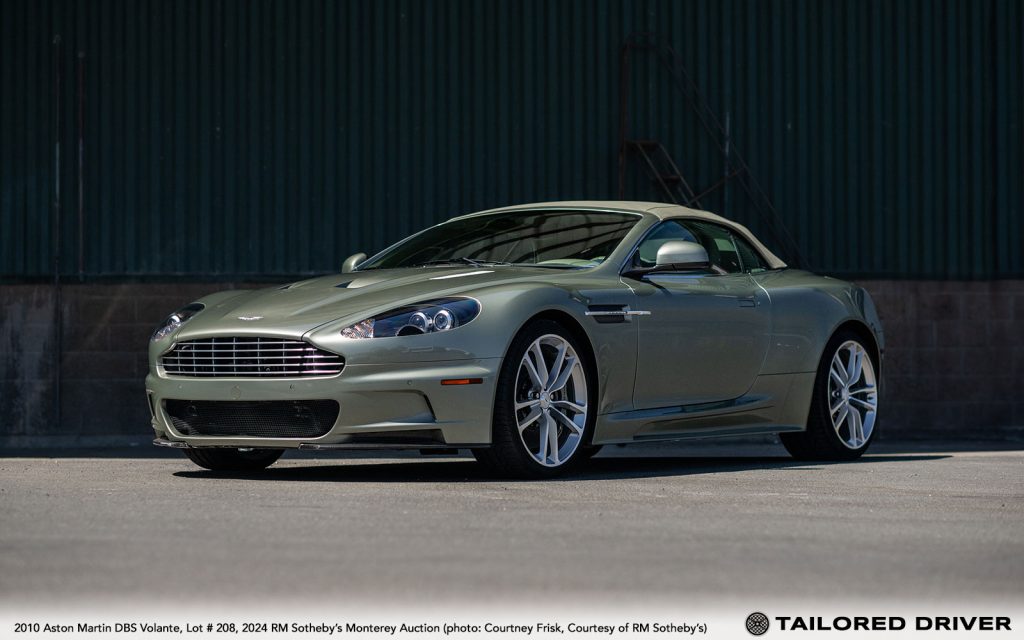
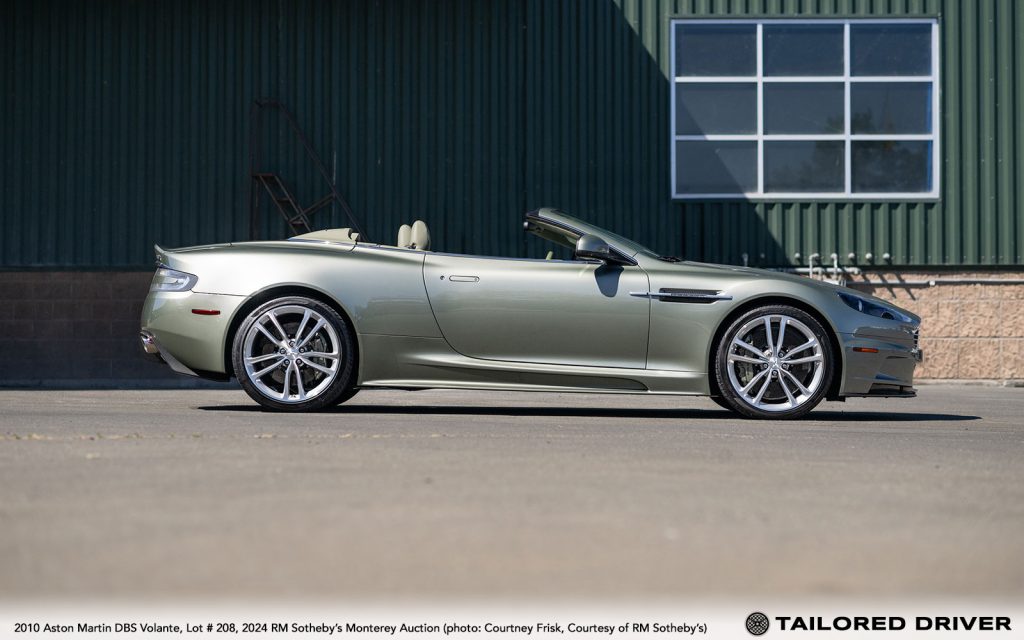
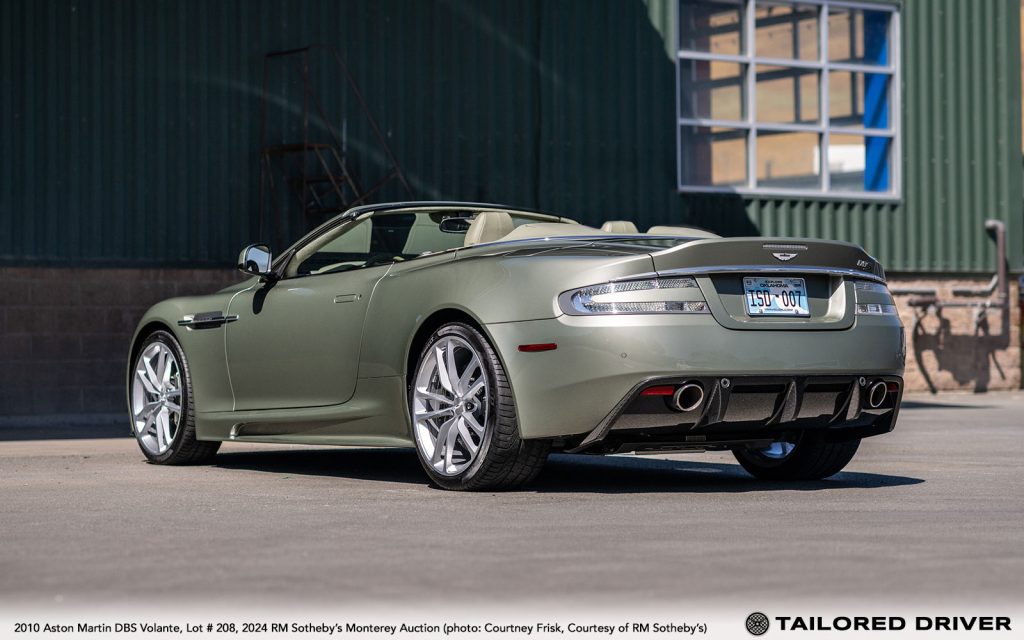
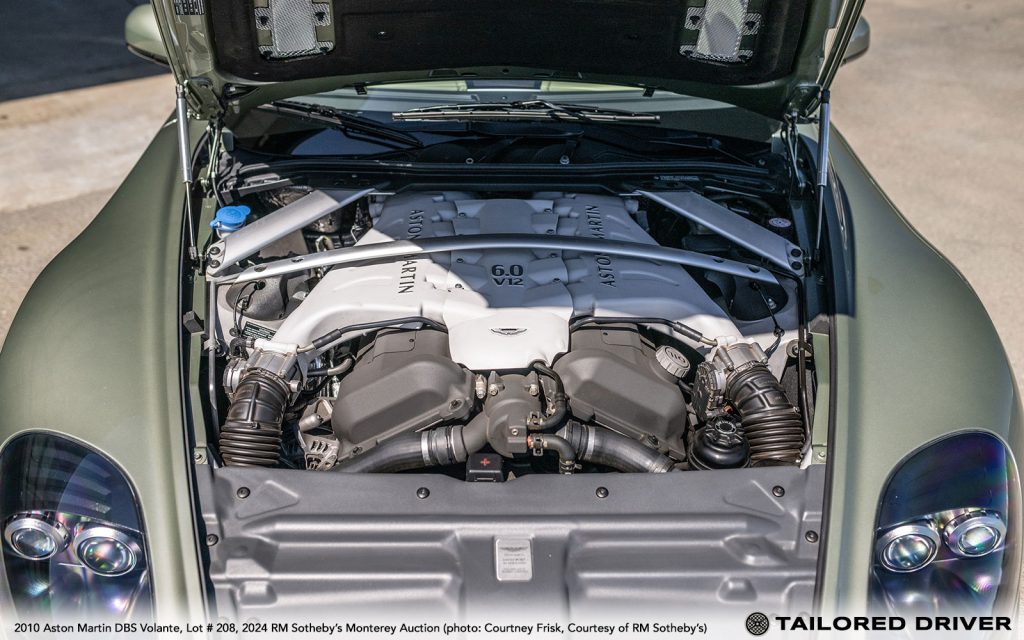
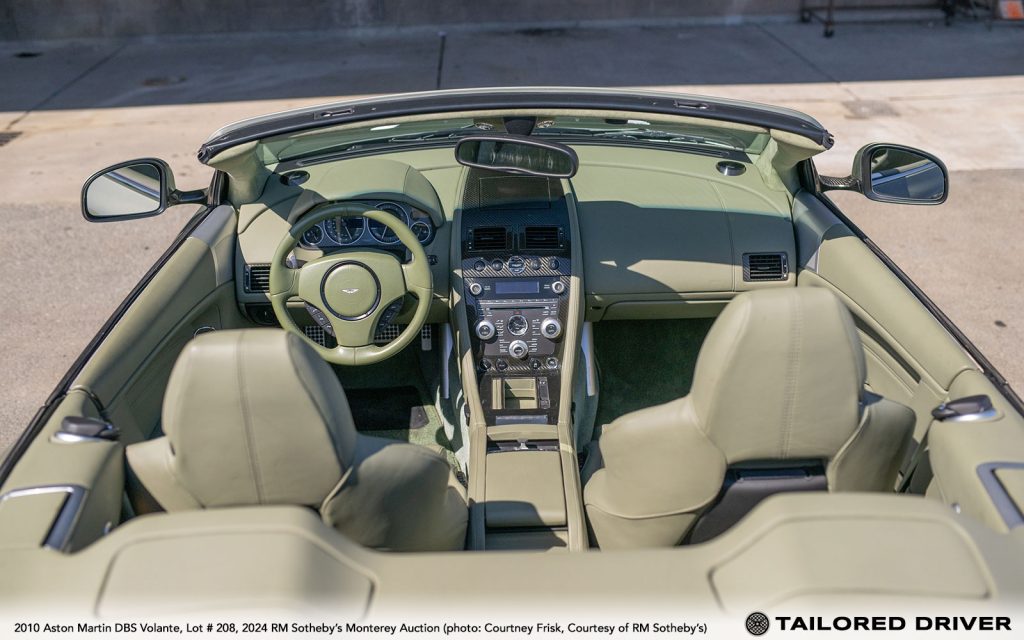
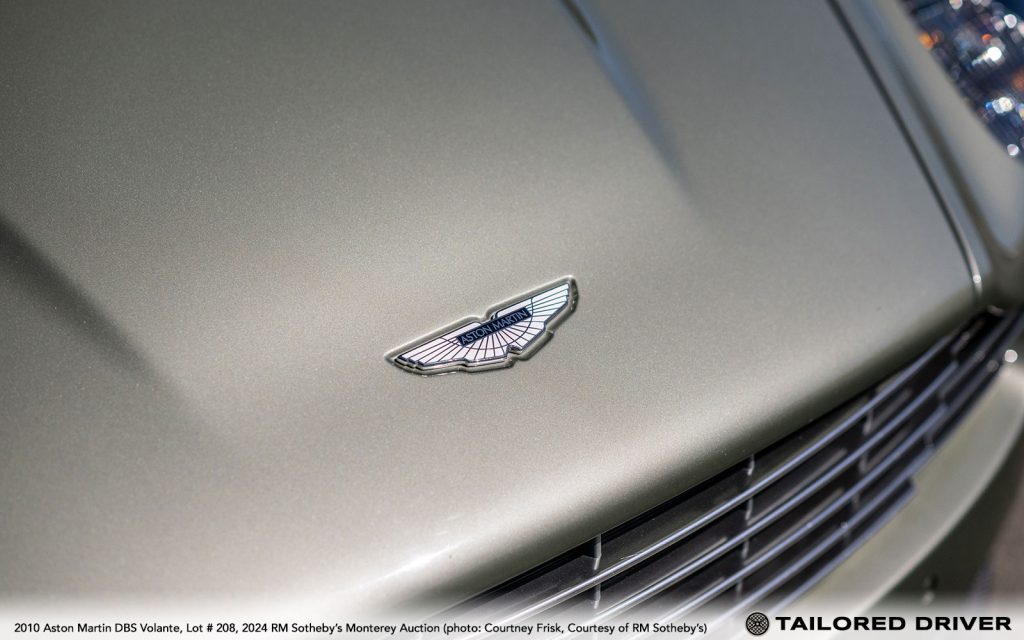
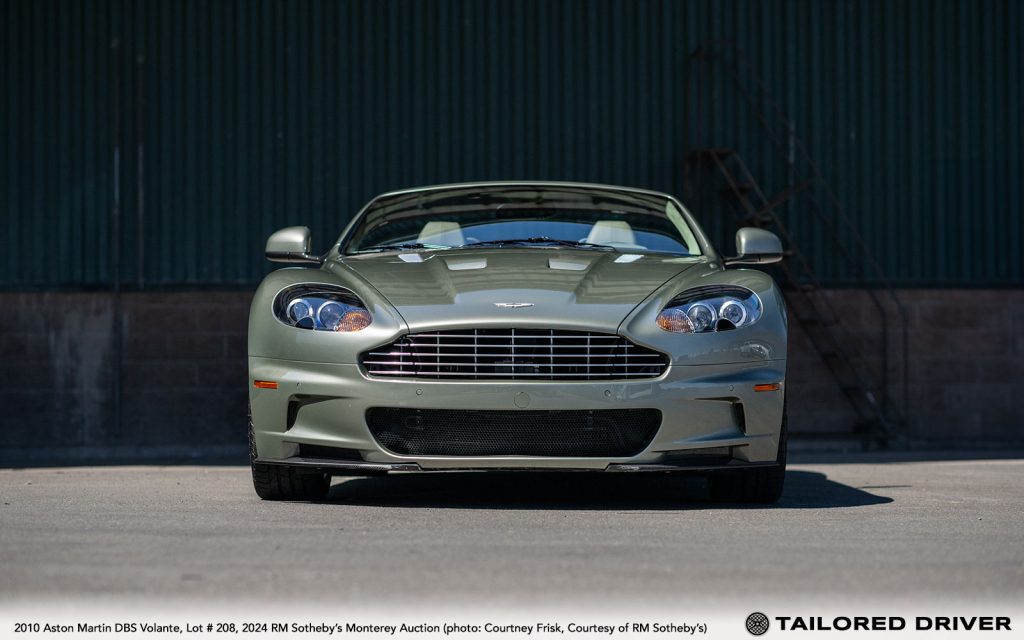
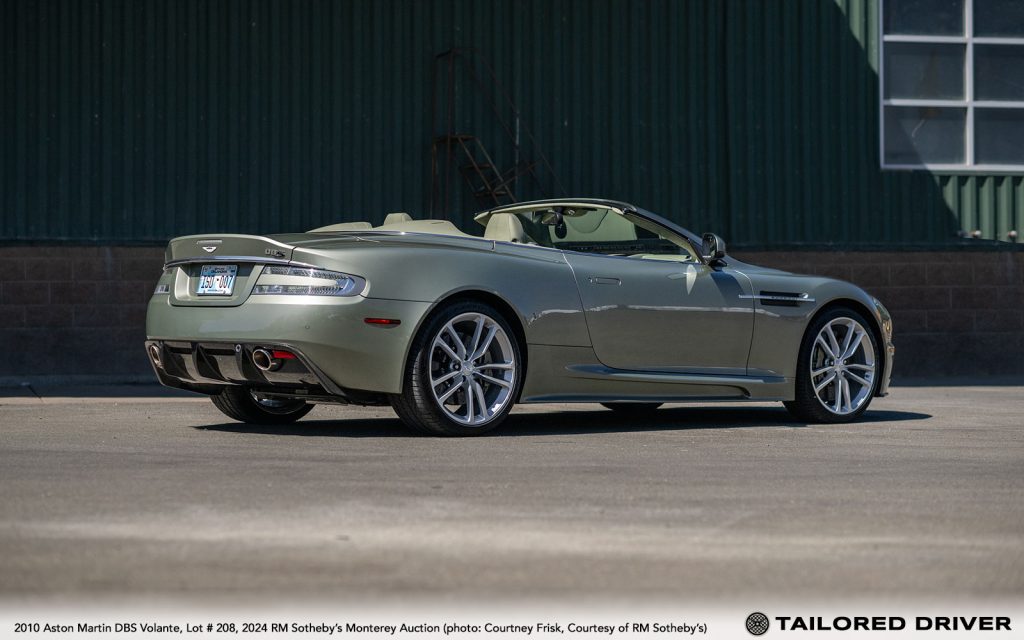
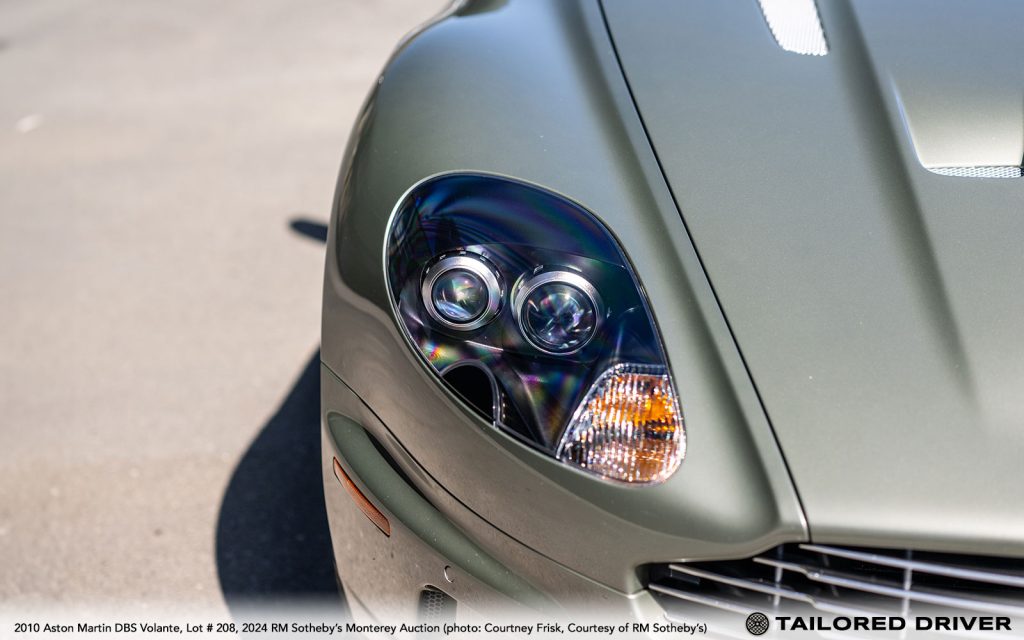
In the grand scheme of things, 2010 isn’t exactly the age of classic car we’ve come to expect from major auction house sales at concours weeks such as Monterey. So, when a newer car makes a showing, it’s usually very special or very tailored. In that vein, this green-on-green DBS Volante (chassis # SCFFDCCD2AGE11881) breathed on by in-house Aston Martin tailoring department Q definitely qualifies.
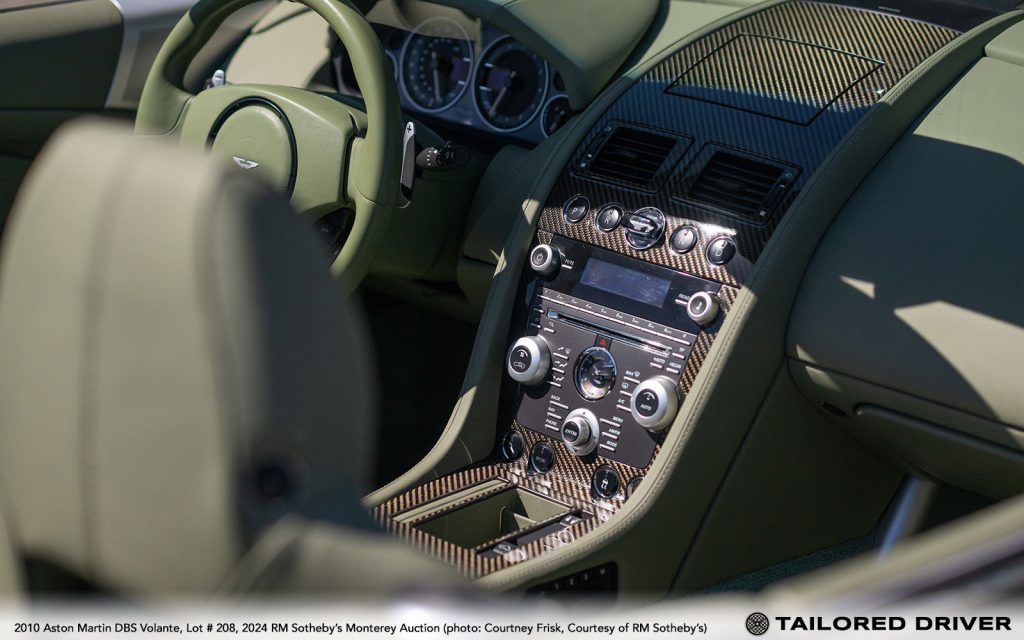
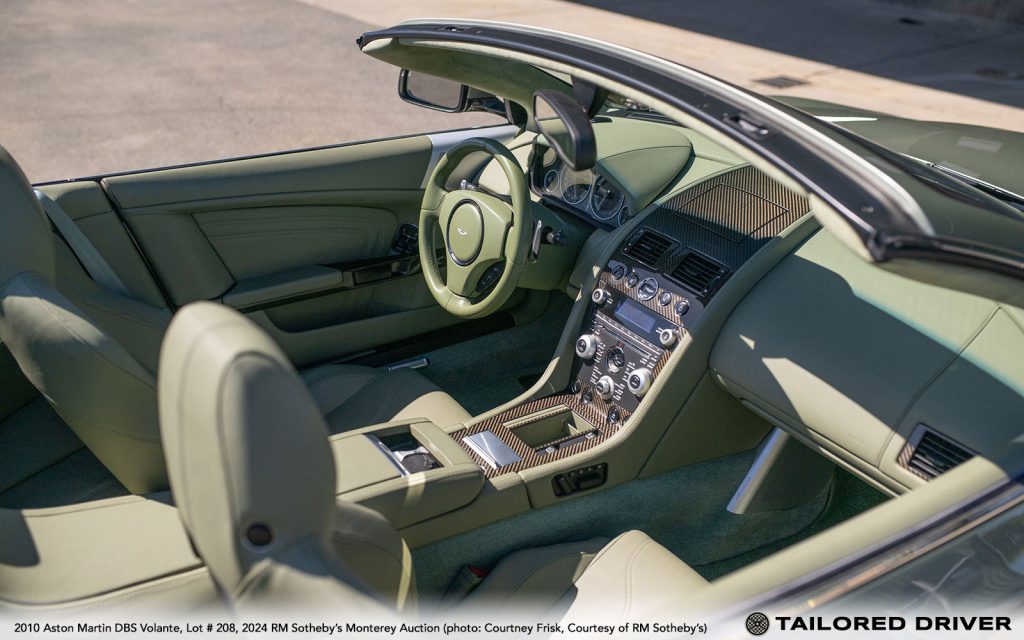
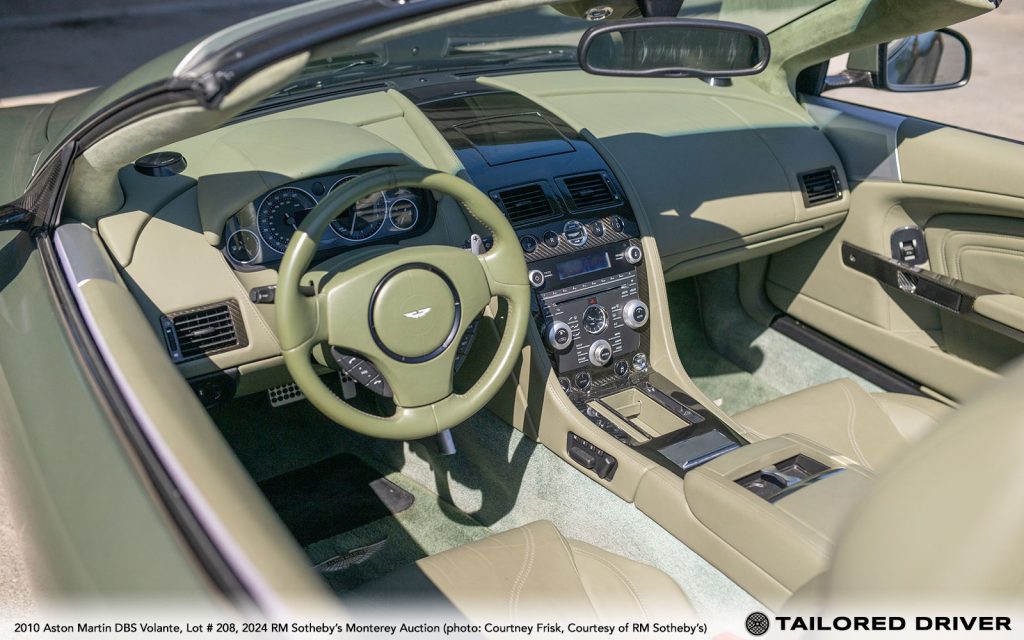
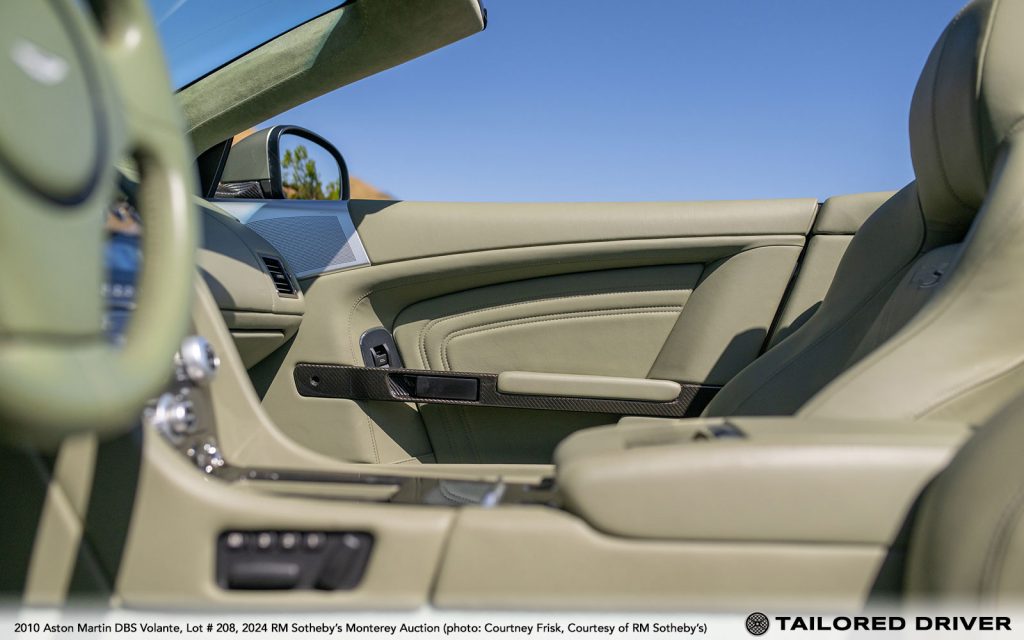
In this case, the car’s exterior is referred to as California Sage, while the interior is Absynthe Green. With only about 845 Volantes believed to have been produced, the drop-top DBS is already rare. However, green-on-green is a whole other level of rare… even from a British marque.
This car will be up for sale as part of RM Sotheby’s Monterey auction. We’re going to go ahead and share the full model description from RM below, but make sure to follow the link HERE in order to see the full photo gallery and learn information on where and when to bid.
Lot #208: 2010 Aston Martin DBS Volante
Aston Martin’s luxurious open-top flagship; timeless styling meets modern performance
Finished in Q-specification California Sage over an Absynthe Green leather interior
Thrilling 5.9-liter naturally aspirated V-12 producing 510 hp
Driven a modest 16,172 miles at cataloguing; carefully maintained and accompanied by service invoices
One of only 845 DBS Volantes believed to have been produced in total
When it debuted at the 2009 Geneva Motor Show, the DBS Volante brought together two legendary names from Aston Martin’s past that, to devotees of the marque, needed no introduction.
First, DBS. The inaugural DBS arrived in 1967, toward the tail end of Aston Martin’s crucial David Brown era, as a muscular yet elegant tourer. The DBS nameplate was revived in 2007; true to form, it was an imposing machine wrapped in instant-classic styling. Motivation came from a 510-horsepower version of the company’s 5.9-liter V-12, which could be paired with either six-speed manual or six-speed automatic gearboxes.
Second is Volante. Italian for “flying,” it has—since the introduction of the DB Short-Wheelbase Volante in 1965—been used to denote convertible versions of Aston Martin’s exquisite tourers. More than that, the word instantly conjures the carefree thrills and romance that one can only experience behind the wheel of a fine open-top automobile.
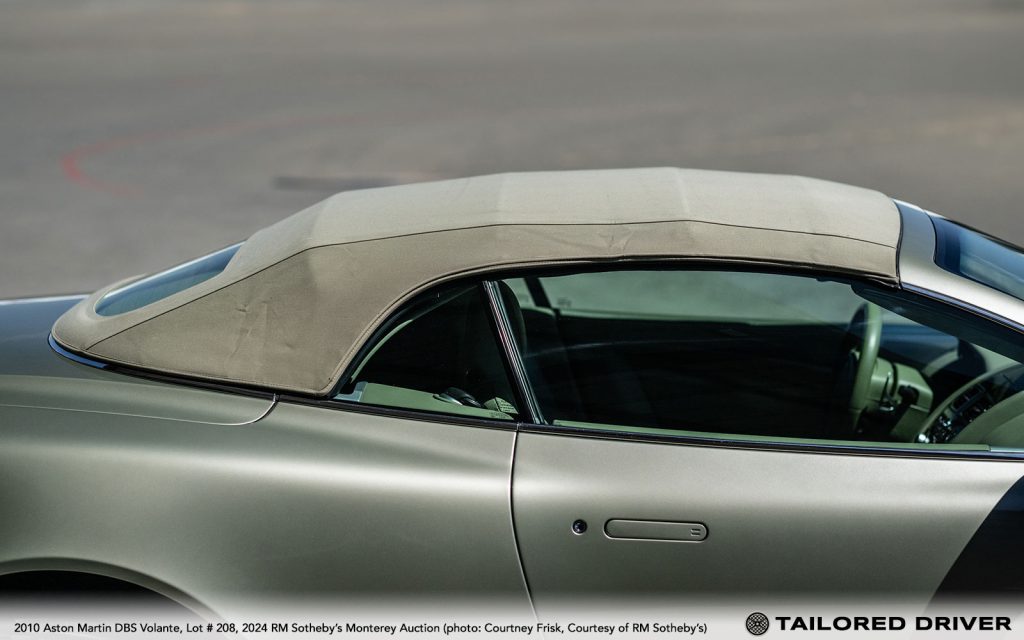
Of course, one need not be a student of Aston Martin history to recognize that the DBS Volante is something special. Luxurious features abound, including a power fabric top that can stow away in as little in 15 seconds at speeds of up to 30 mph. Adaptive driving modes and carbon-ceramic brakes provide confident handling and secure stopping no matter how spirited one decides to get behind the wheel.
With only 845 examples believed to have been built in total, the DBS Volante is an undoubtedly rare beast. The car offered here further distinguishes itself with its stunning color combination: Q-specification California Sage over an Absynthe Green leather interior. Further options include the six-speed automatic transmission, 10-spoke diamond-turned Silver wheels, Magnum Silver meshes and Silver fascia trim inlays, and seatbelts in Warm Charcoal.
Enhancing its desirability, this DBS Volante has enjoyed a life of modest use and diligent care. After its acquisition by the consignor in 2019, it has been treated to regular maintenance as well as close attention to cosmetic condition, with further service to ensure proper operation of its convertible top; invoices on file detail the work performed. At the time of cataloguing, the car displayed only 16,272 miles.
Positioned as Aston Martin’s flagship convertible tourer when new, and every bit as impressive today, the DBS Volante seems destined to age as finely as the British marque’s great historical offerings. With its striking specification and history of limited use, this is an example worthy of careful consideration by the discriminating collector.
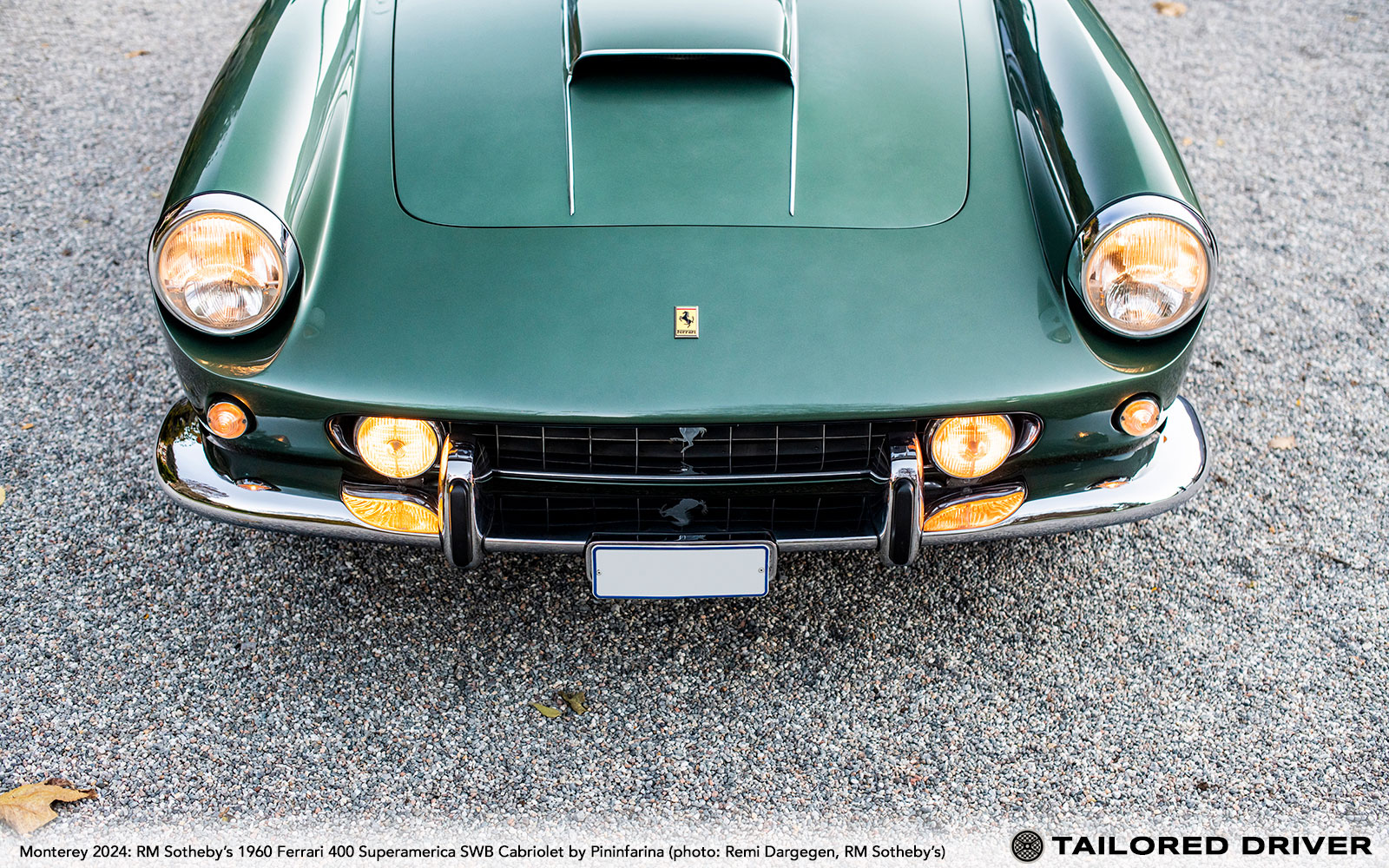
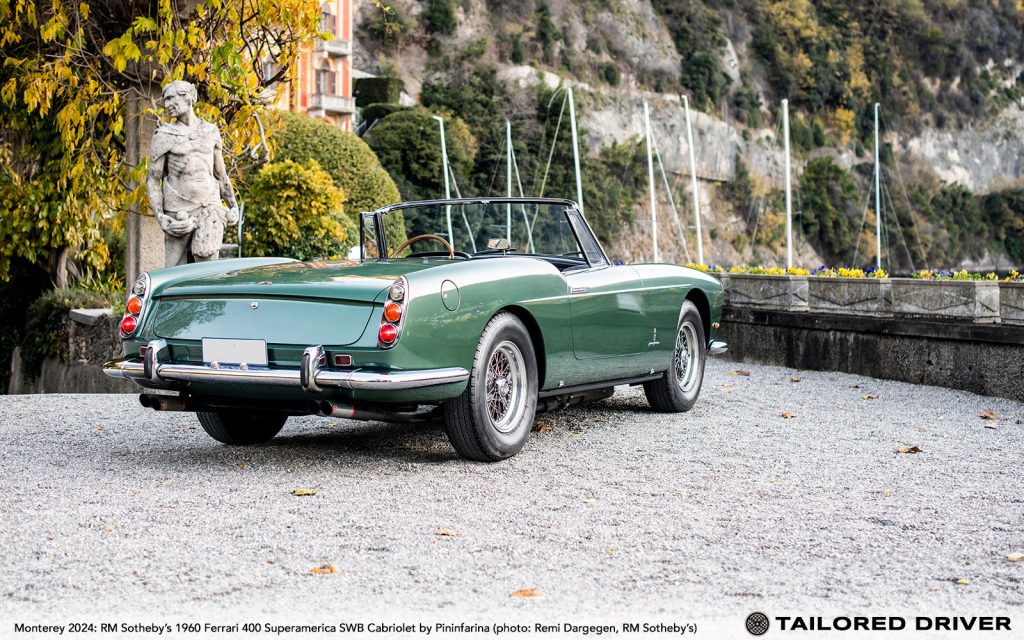
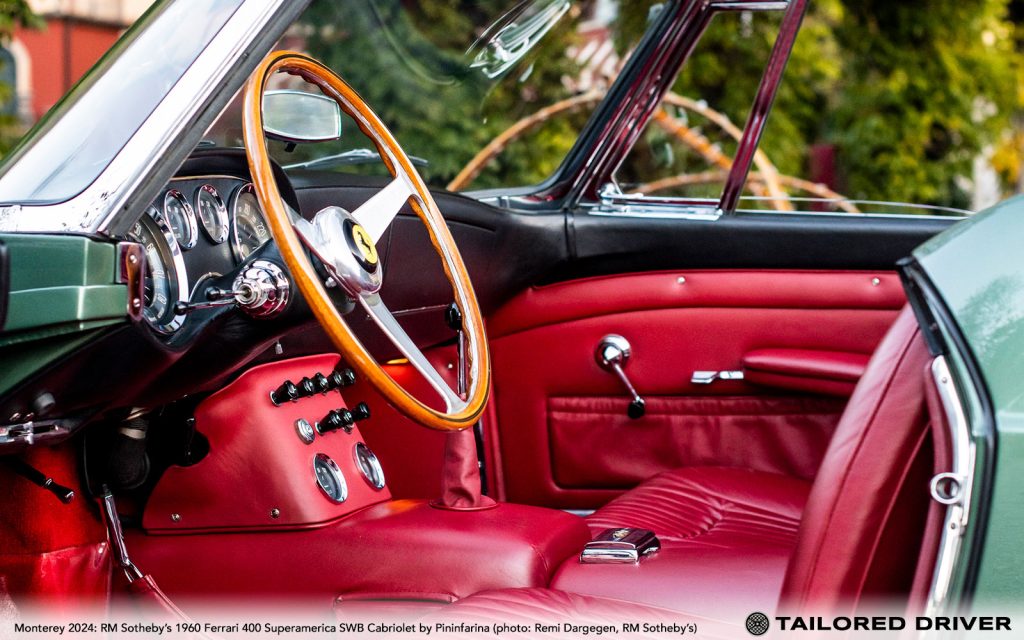
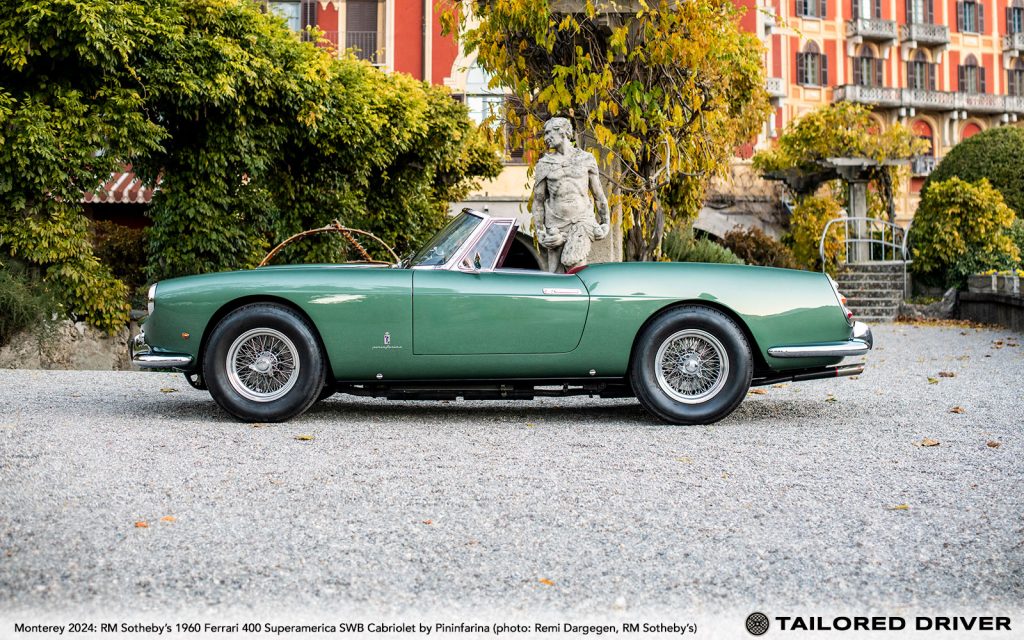
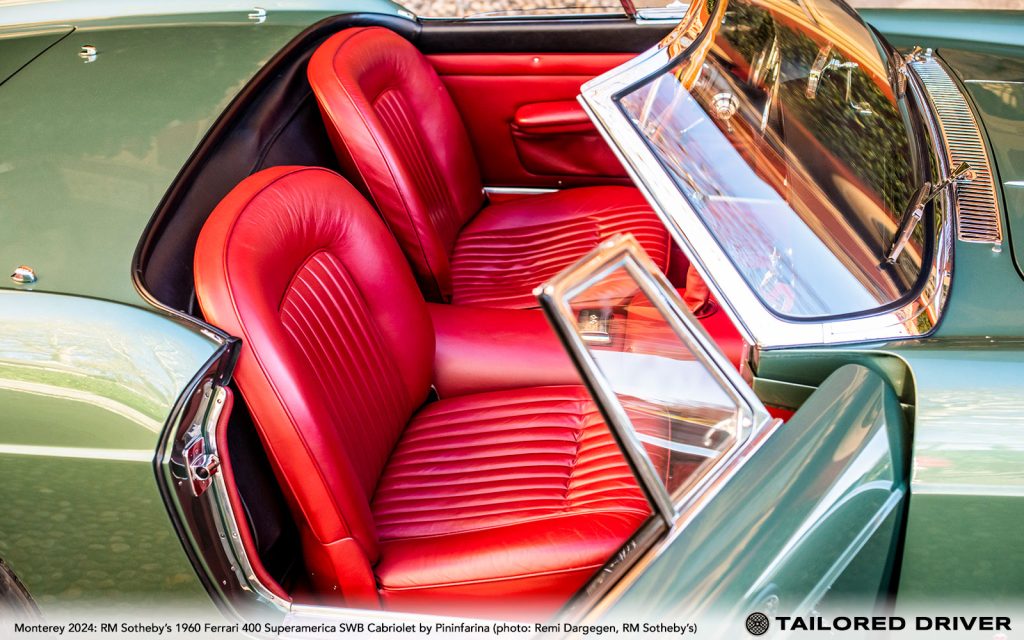
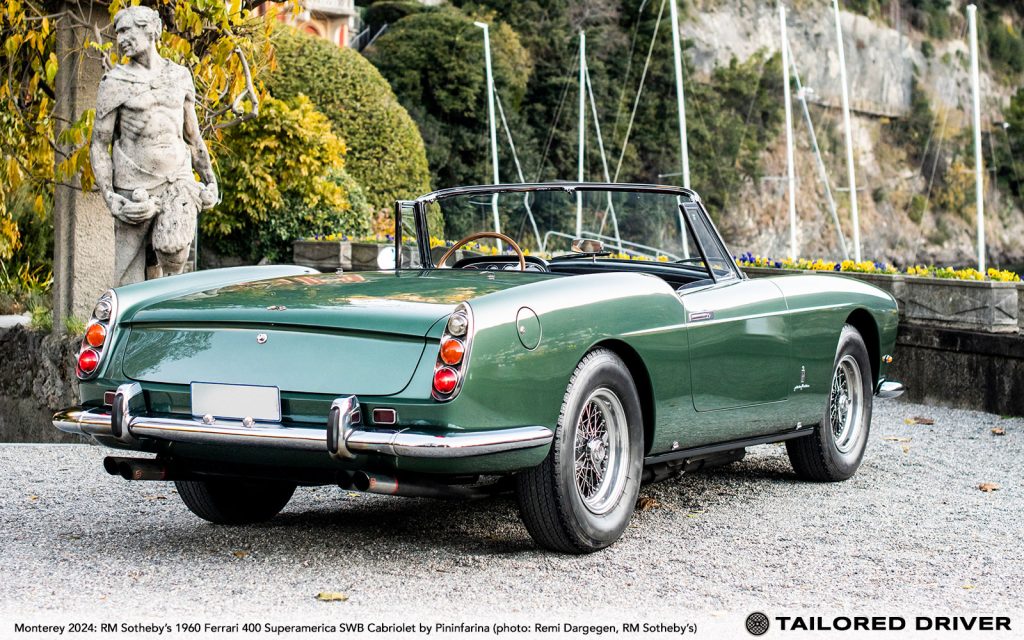
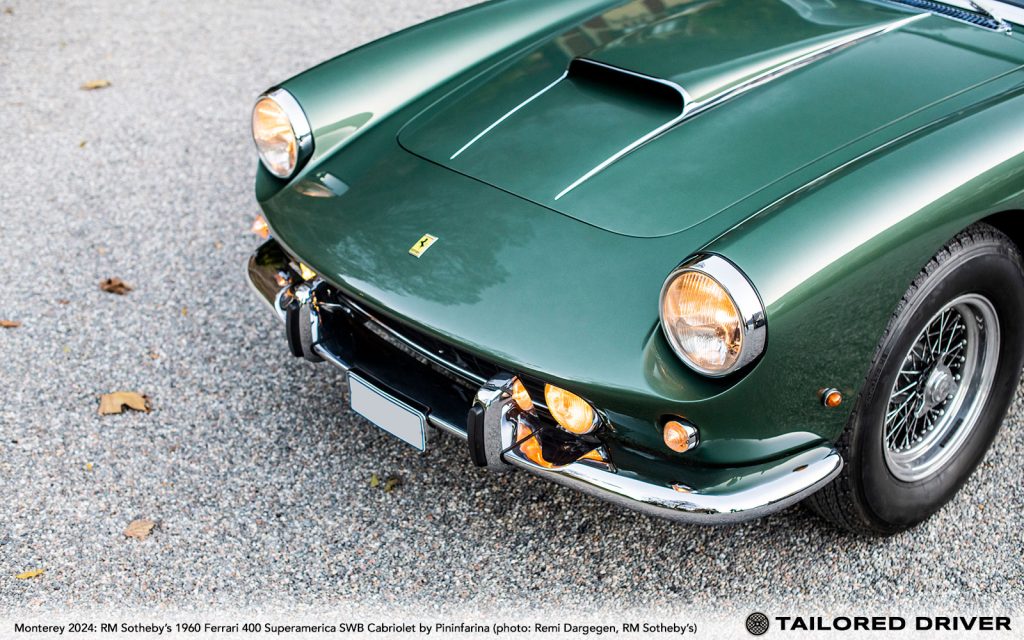
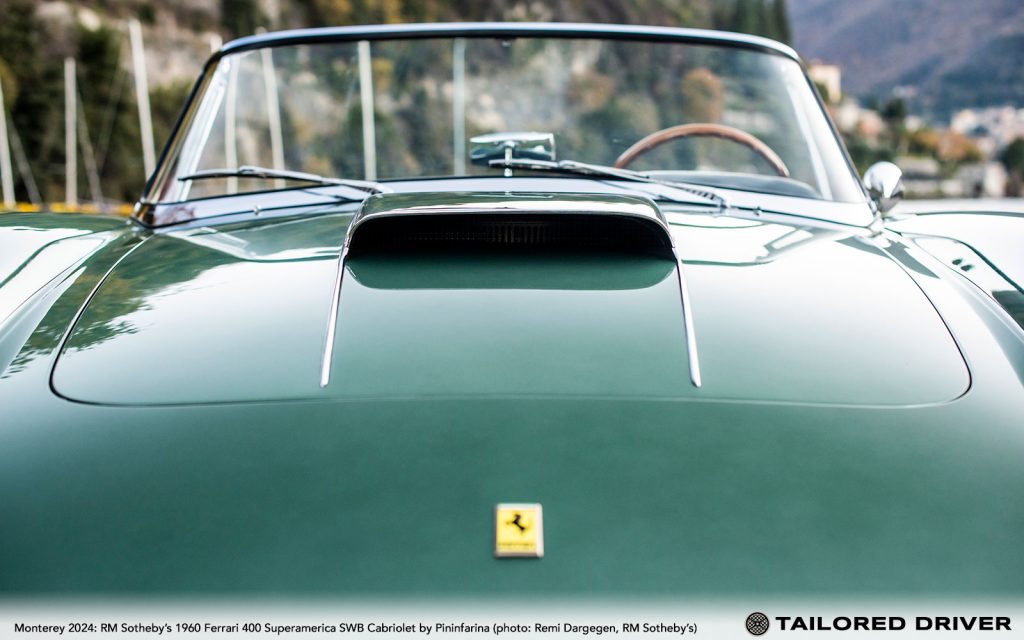
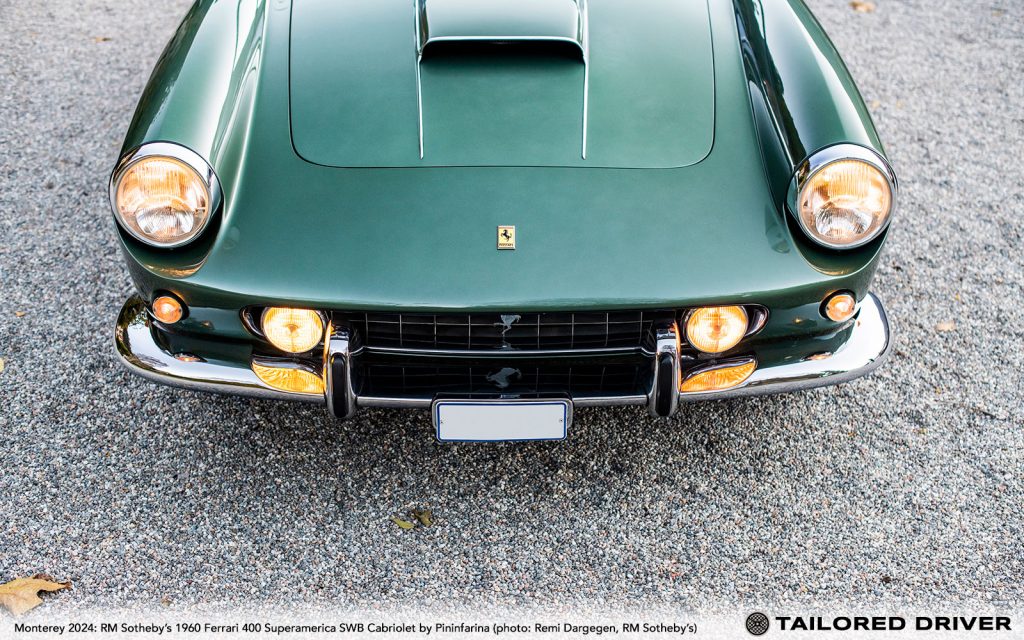
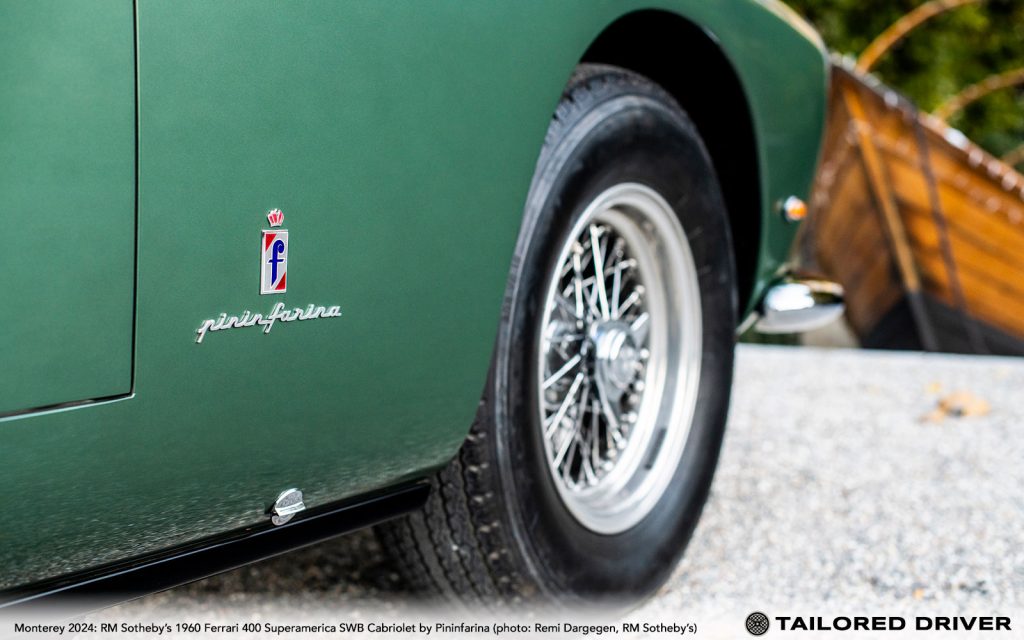
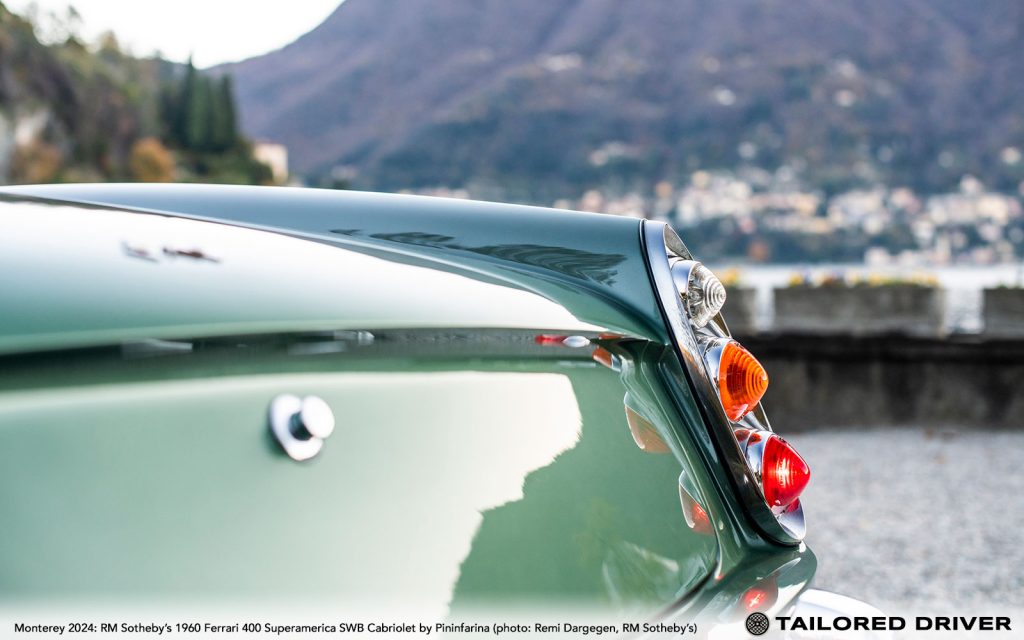
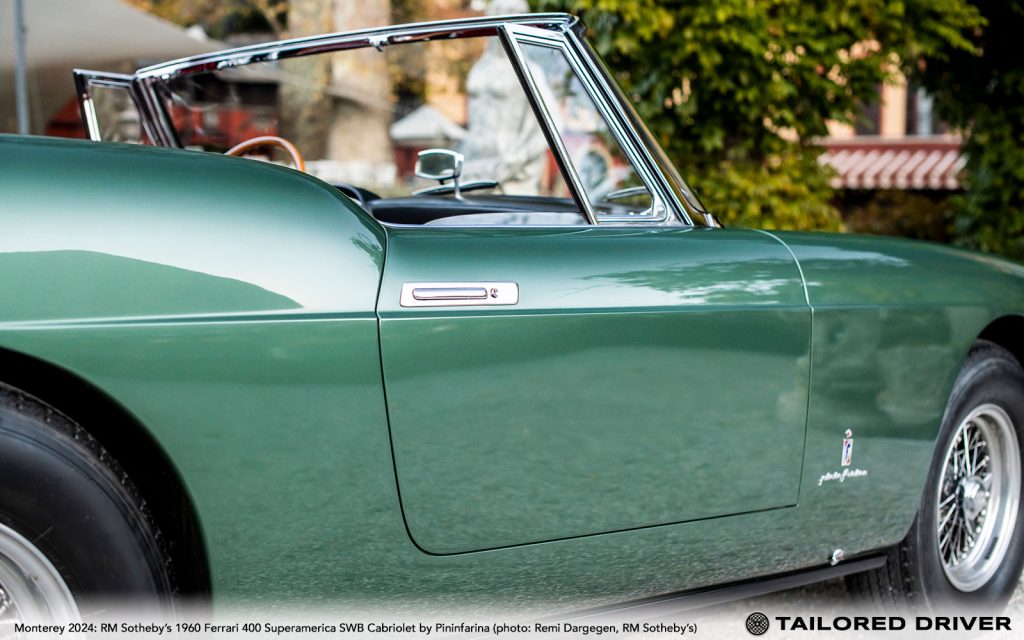
Third of just Seven short-wheelbase Ferrari 400 Superamerica Cabriolets, there’s no doubt this fully restored specimen (chassis #: 1945 SA) will command a large price when it crosses RM Sothebys’ block at Monterey Car Week in August. And while it is exemplary of the car-as-art 1960s era at Ferrari, it’s this car’s unique factory correct green hue of Verde Bottiglia that grabs our attention the most.
The color combination, Verde Bottiglia exterior with Rosso (red) leather is also fascinating. The pairing makes the car one of one, but even more interesting to us is how well the two colors work together. Green and red can be a mixed bag in how the two colors play off of each other, though they seem to work well here. Then again, what color combination wouldn’t work well on a 1960 Ferrari 400 Superamerica SWB Cabriolet by Pininfarina?
Check out the full description from RM below the photo gallery, and direct link to this Lot’s listing page HERE.
The third of seven short-wheelbase 400 Superamerica Cabriolets
Fully restored to concours standards by US-based Ferrari specialists Classic Coach and Greg Jones
Well-maintained by Autofficina Omega in its current ownership
Ferrari Classiche Red Book certified; finished in its striking, factory-correct, one-off combination of Verde Bottiglia over Rosso
Formerly of the Oscar Davis Collection
Seldom shown since its most recent restoration; an exciting concours opportunity
[source: RM Sotheby’s]
Addendum: Please note that an import duty of 2.5% of the purchase price is payable on this lot if the buyer is a resident of the United States.
Ferrari’s Superamerica models of the late 1950s and early 1960s were truly the last word in sporting excellence. Offering the very best money could buy in terms of luxury and performance, it is no surprise that these cars often found their way into the garages of heads of state, barons of industry, and other well-to-do individuals.
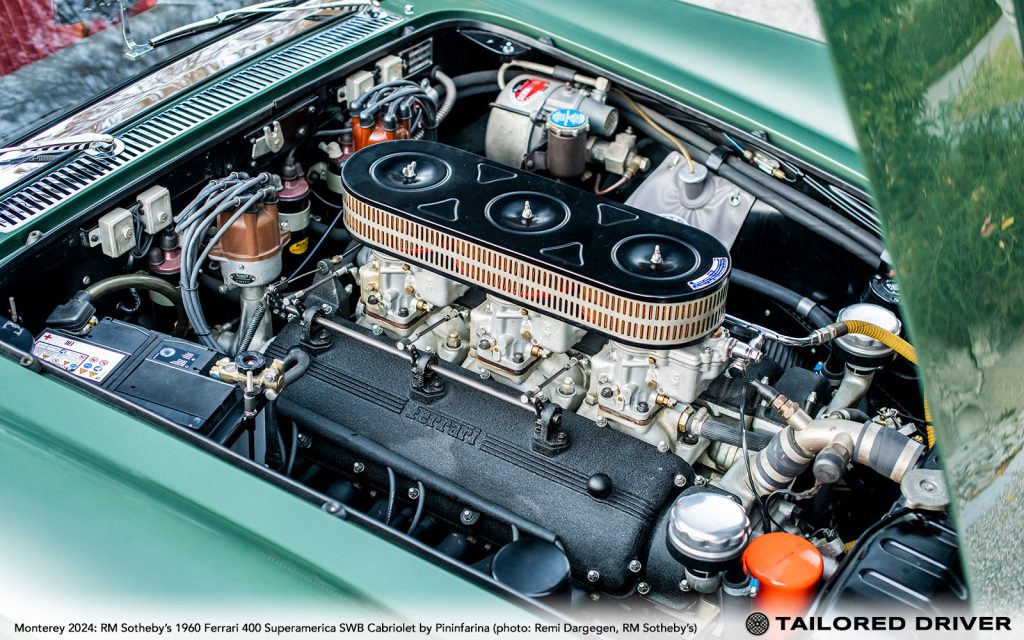
Succeeding the 410 Superamerica, the 400 Superamerica offered numerous improvements over its predecessor. While the engine decreased in displacement from 5.0 liters to 4.0 liters, several other new features countered this. The 5.0-liter V-12 was a “long-block” Lampredi-designed unit, while the revised smaller engine was based on the Colombo single-overhead-camshaft powertrain that was first utilized in the 250 Europa GT. To increase the capacity from 3.0 liters, the bore was enlarged to 77 millimeters and the stroke was lengthened to 71 millimeters, providing a total capacity of 3,967 cubic centimeters. Furthermore, a twin-coil and distributor ignition system was used, along with triple Weber carburetors, granting the engine an improved 340 horsepower—but also an incredible 400 Nm (295 pound-feet) of torque from 2,000 rpm and a maximum torque or 450 Nm (331 pound-feet) at 6,000 rpm.
As a result, these cars are considered today among the best-driving of 1960s Ferraris. Boasting 25% greater engine capacity than a 250 GT Berlinetta or California Spider, the 400 Superamerica produces far more horsepower and torque than either of its forebears. The 400 Superamerica was also fitted with an overdrive as standard—while no overdrive was available for the 250 GT models apart from the GTE—making it far more comfortable to drive over long distances. Finally, it is important to remember that the 400 Superamerica’s chassis and powertrain were so great that they provided the basis for the 330 LMB and 330 TRi racing cars, of which the 330 TRi LM won the 24 Hours of Le Mans in 1962.
The 400 Superamerica production run can be divided into two groups, based on either long- or short-wheelbase chassis. The first batch of cars produced—which includes the car on offer here, chassis 1945 SA—boasted a 2,420-millimeter chassis, while the second batch boasts the longer 2,600-millimeter chassis. Of the short-wheelbase cars, just 25 examples were produced, with only seven bodied as cabriolets.
THE THIRD OF SEVEN SHORT-WHEELBASE CABRIOLETS
Chassis number 1945 SA was constructed in mid-1960 as the third of those seven short-wheelbase cabriolets, and it was built to left-hand-drive configuration with open headlamps. It was finished in a beautiful, one-off color combination of Verde Bottiglia (MM 16364) over Rosso (VM 3171). It was fitted from new with a set of three Weber 46 DCF carburetors, like on a 250 SWB “SEFAC Hot Rod,” and a pair of Bosch ignition distributors. The coachwork was completed by Pinin Farina in July of 1960 and was sold new to Helmut Horton, a German entrepreneur based in Croglio, Switzerland. In January of the following year, the car was registered in Milan under Horten Italiana S.r.l, and it remained in Italy for the following three years under Horton’s ownership.
The Superamerica was officially exported out of Italy in spring of 1964 and was next known with a Mr. Warzits in Germany. By 1985, the car was acquired by Bernard Pfister of Geneva, Switzerland, now repainted white. Pfister repainted the car red in 1989 and it remained in Switzerland with him for the next few years, typically on display at Ferrari Suisse SA in Nyon.
In June 1997, 1945 SA was listed for sale in Marseille, France and was purchased one month later by Scott Rosen of Bedford Hills, New York. Subsequently exported to the United States, the car remained in his ownership for two years before being purchased by the late noted sports car enthusiast Oscar Davis of Elizabeth, New Jersey.
One year later, Davis sold the Superamerica to a Florida-based collector, yet the car would stay in northern New Jersey for the time being, as it was entrusted to Classic Coach for a full restoration. Founded in 1972 and well-known and regarded in Ferrari circles in the United States, Classic Coach was Ferrari’s first authorized bodywork repair facility in the US. Their owners would later open two authorized Ferrari dealerships in the US: Ferrari of Central Florida and Ferrari of Tampa Bay.
It was decided that chassis 1945 SA would be returned to its original color combination of Verde Bottiglia over Rosso during this complete, frame-off restoration. No cost was spared to restore the Superamerica back to a spectacular standard. Following the completion of the restoration work, the car was shipped to noted Ferrari specialist Greg Jones of Stuart, Florida. Jones was entrusted with further dialing in the car mechanically, ensuring that every facet of the car worked perfectly. Receipts for the work completed by both Classic Coach and Greg Jones are in the car’s history file.
Remaining with that owner until 2015, the car was sold via RM Sotheby’s to its current owner, a Monaco-based enthusiast—a discerning collector who happened to do business in the past with the first owner. With him, the car returned to Europe, and has been used and enjoyed as its manufacturer would have intended. Seen occasionally driving around the streets of Monaco, the car has been shown once at Elégance et Automobile à Monte-Carlo in 2019.
Chassis 1945 SA was granted Ferrari Classiche certification in 2016, confirming that it retains its original body, chassis, transmission, and rear axle. Classiche documentation notes that the current engine, stamped 1945 SA, is a replacement engine that was installed by the Ferrari factory in November of 1963. With its current owner, the car has been very well maintained by Autofficina Omega of Corrado Patella, including further mechanical work to ensure it drives and performs as one would expect. Its most recent service work with them was the fitment of a new clutch in February 2020.
Presenting in excellent condition throughout, this special 400 Superamerica SWB Cabriolet is sure to be welcomed with open arms at major concours events worldwide. Well-maintained and enjoyed with its current owner, it could easily be used on the road as a warm-weather weekend driver. Regardless of whether it is to be enjoyed on the open road or the concours lawn, it will certainly be a joy to own and will attract only the most favorable of compliments wherever it goes.
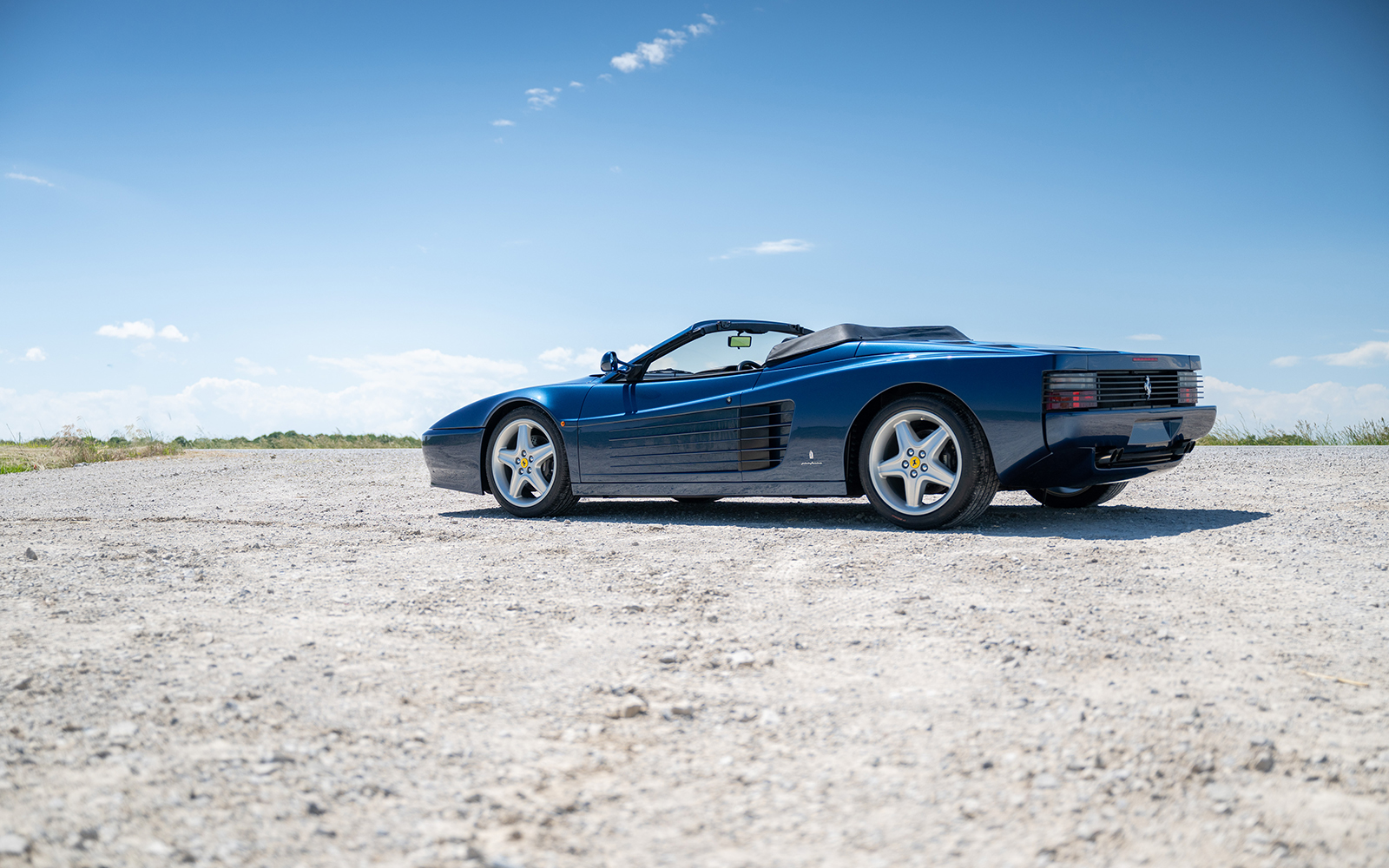
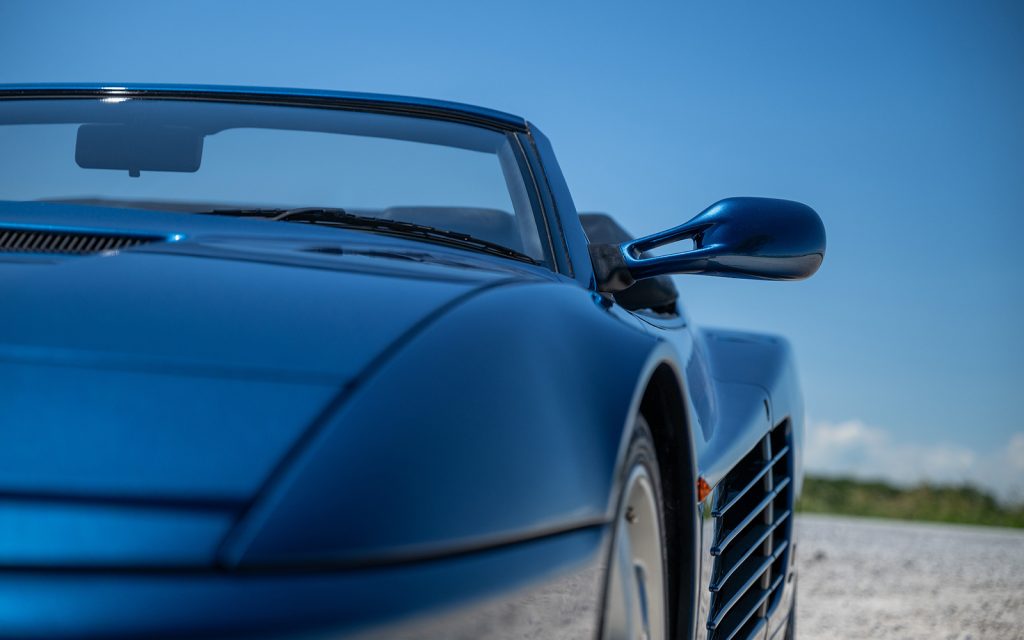
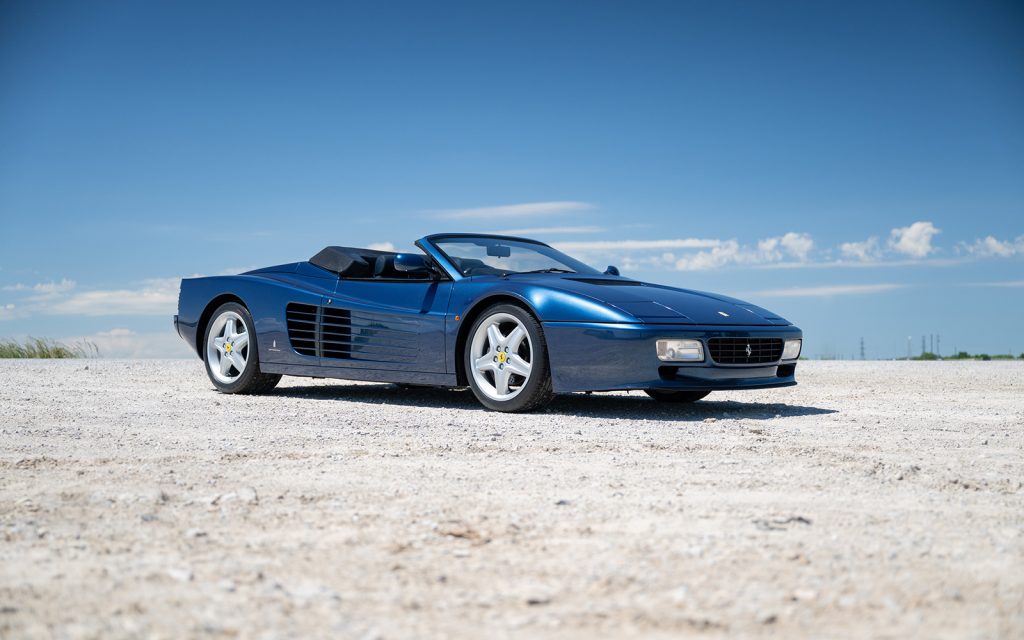
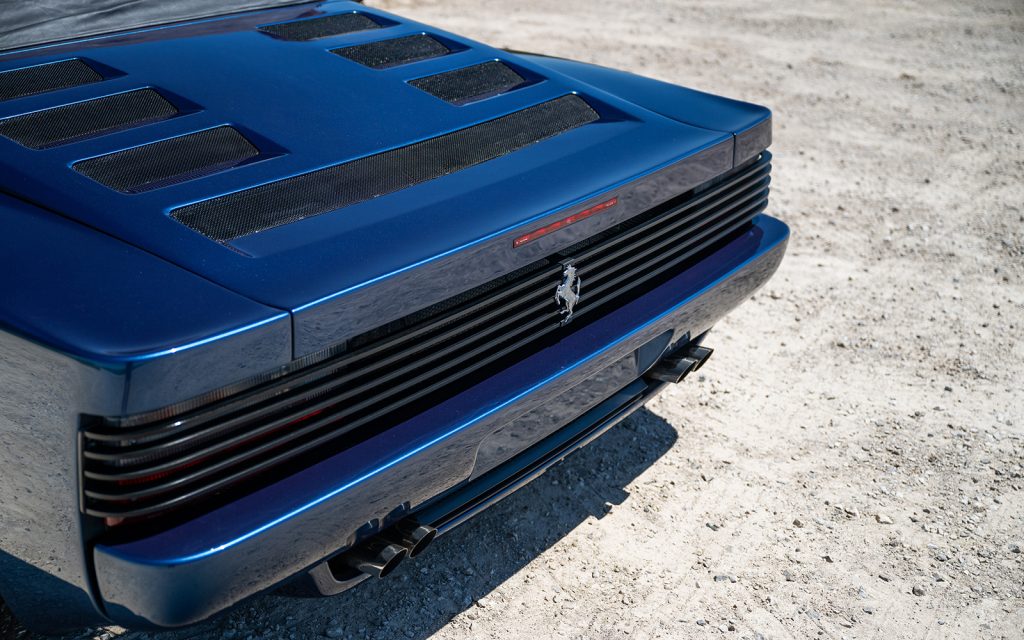
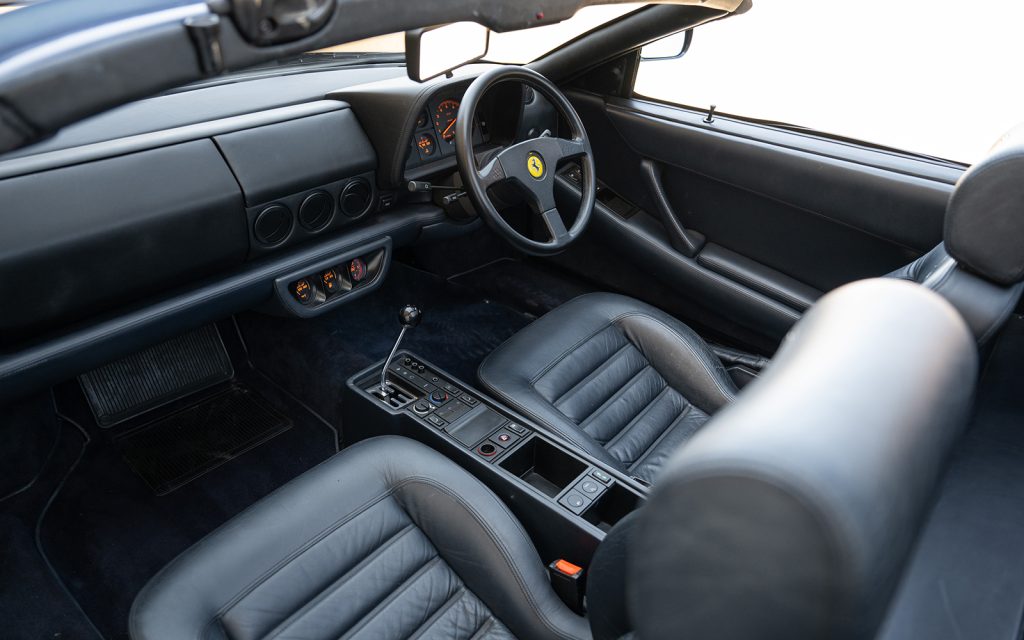
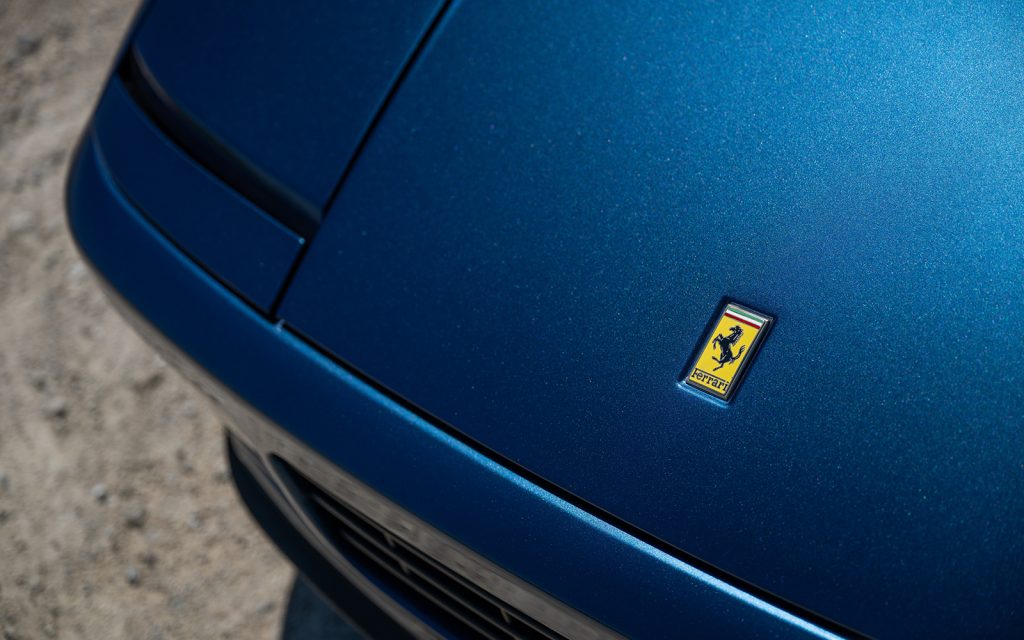
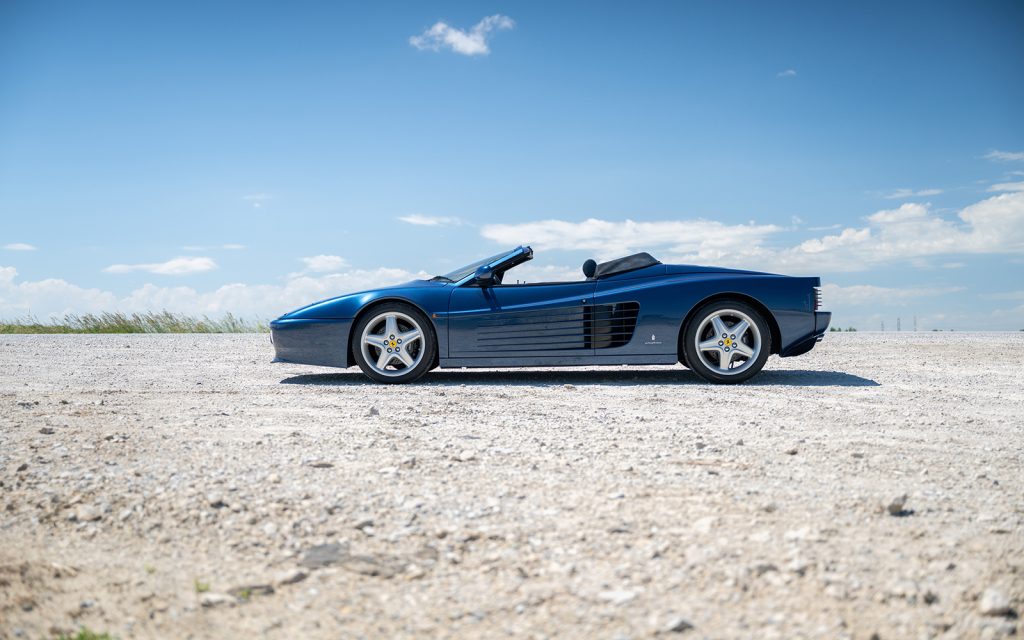
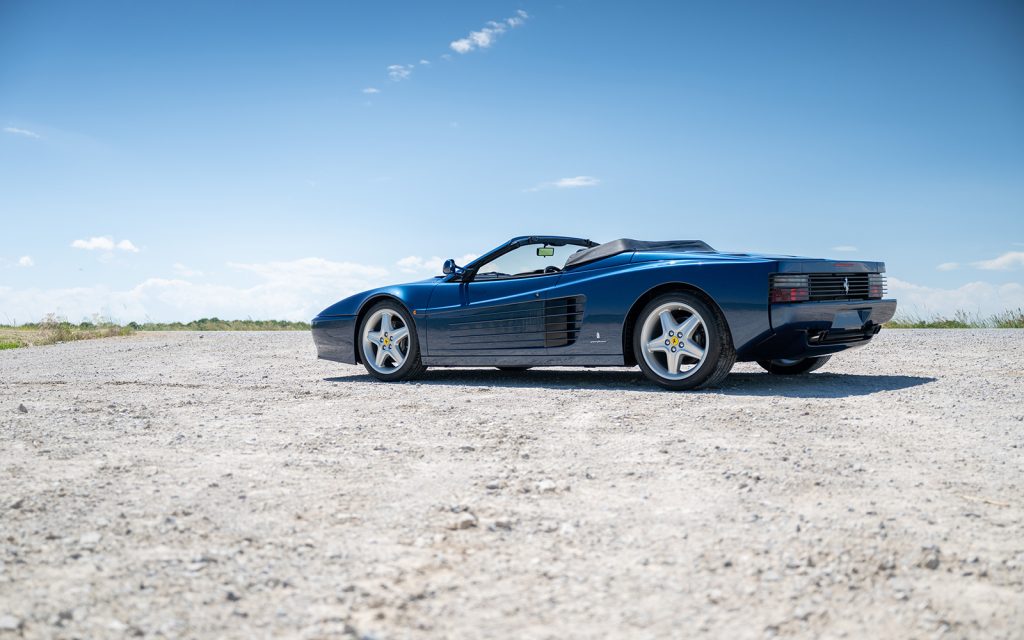
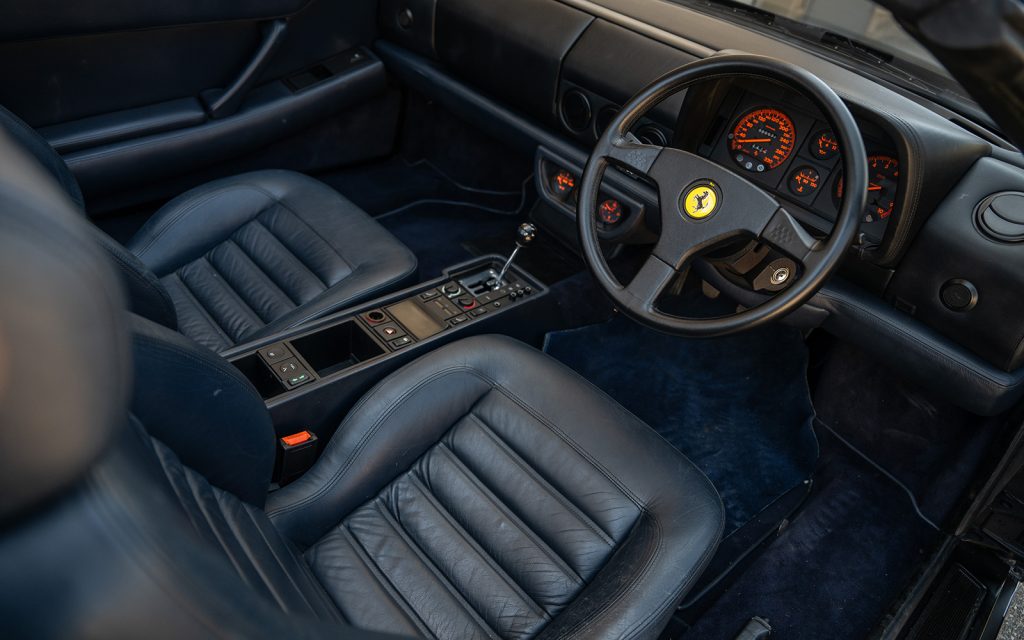
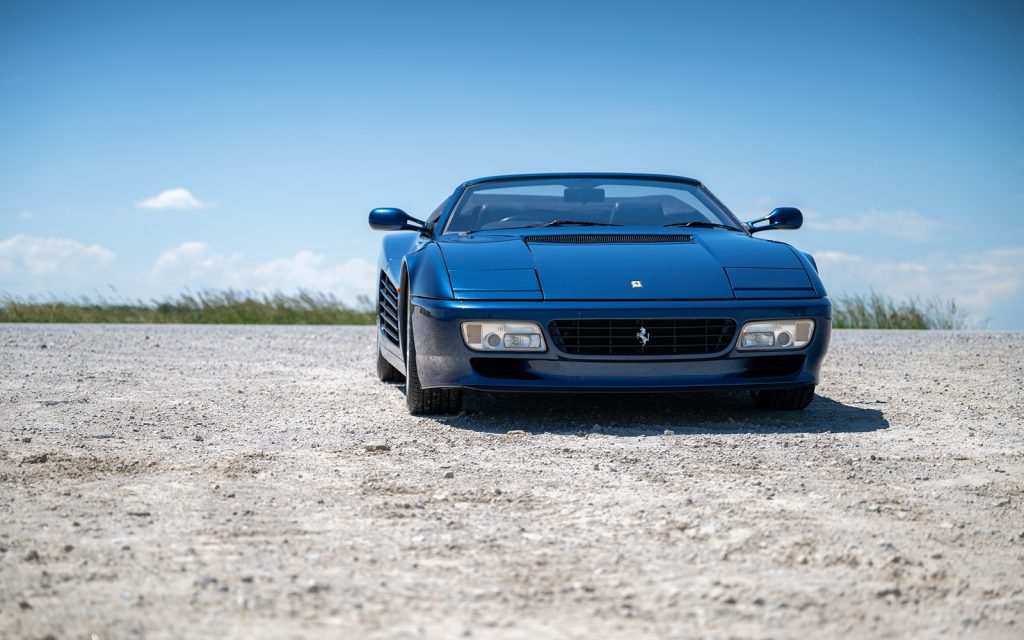
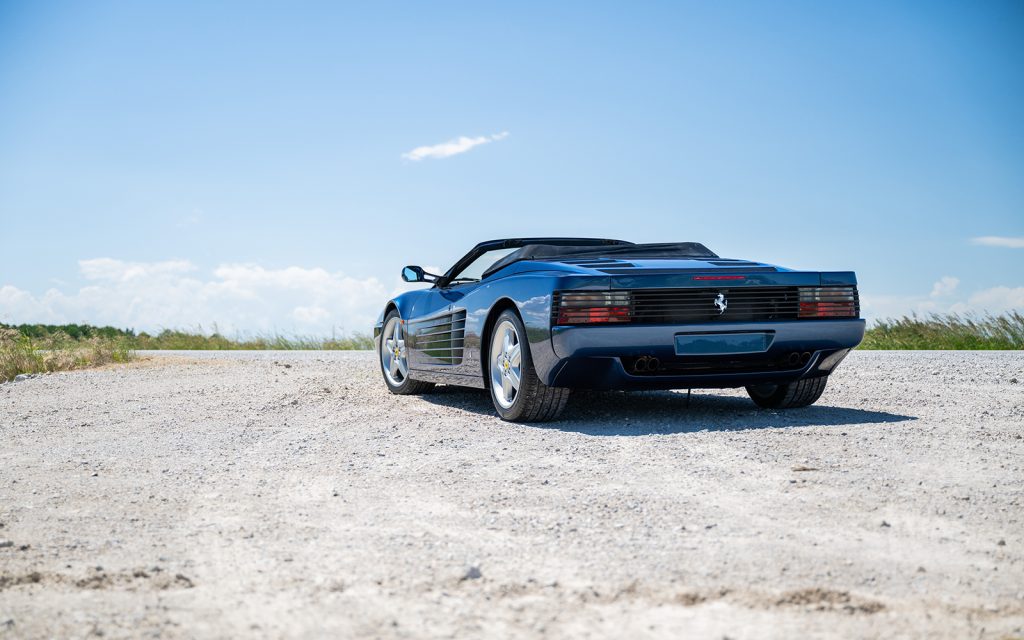
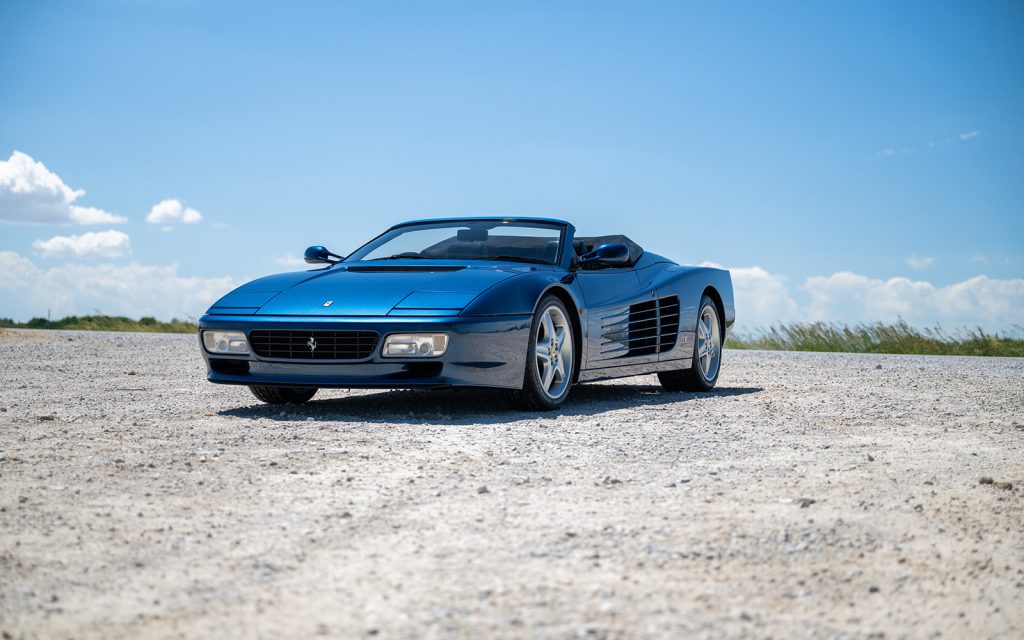
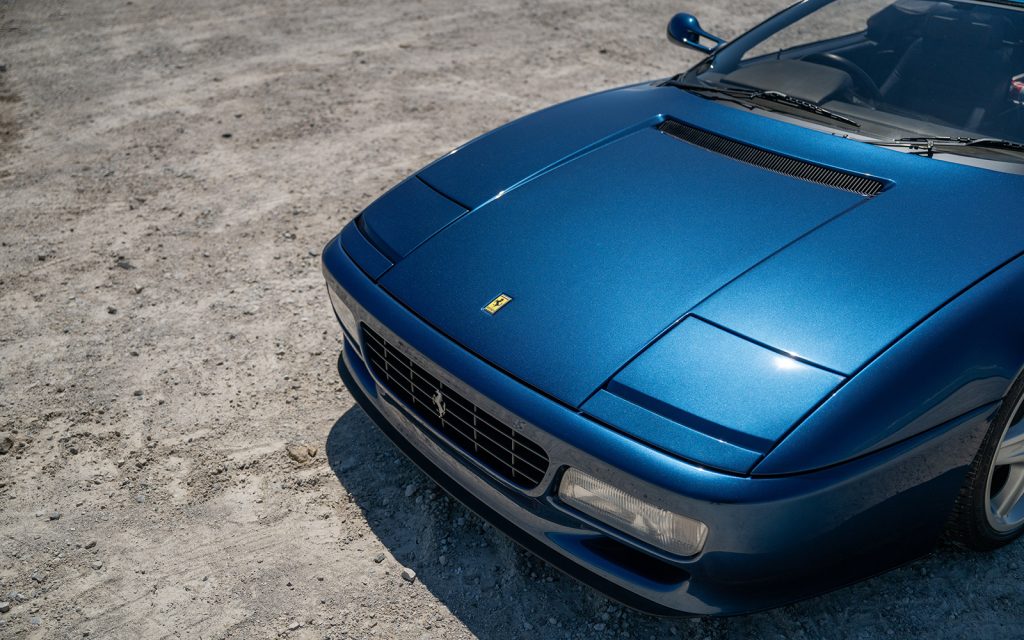
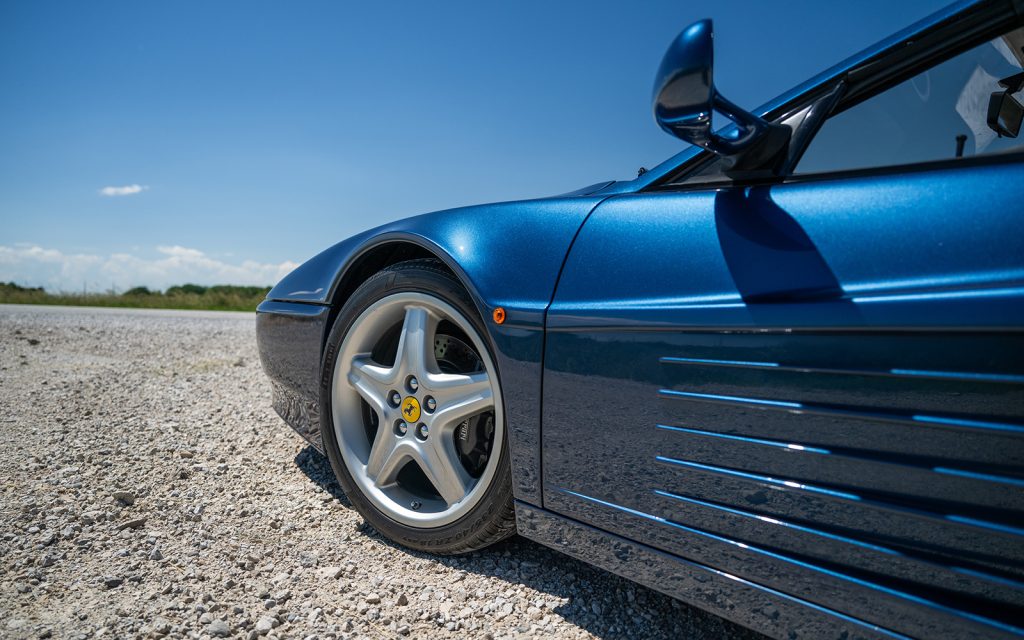
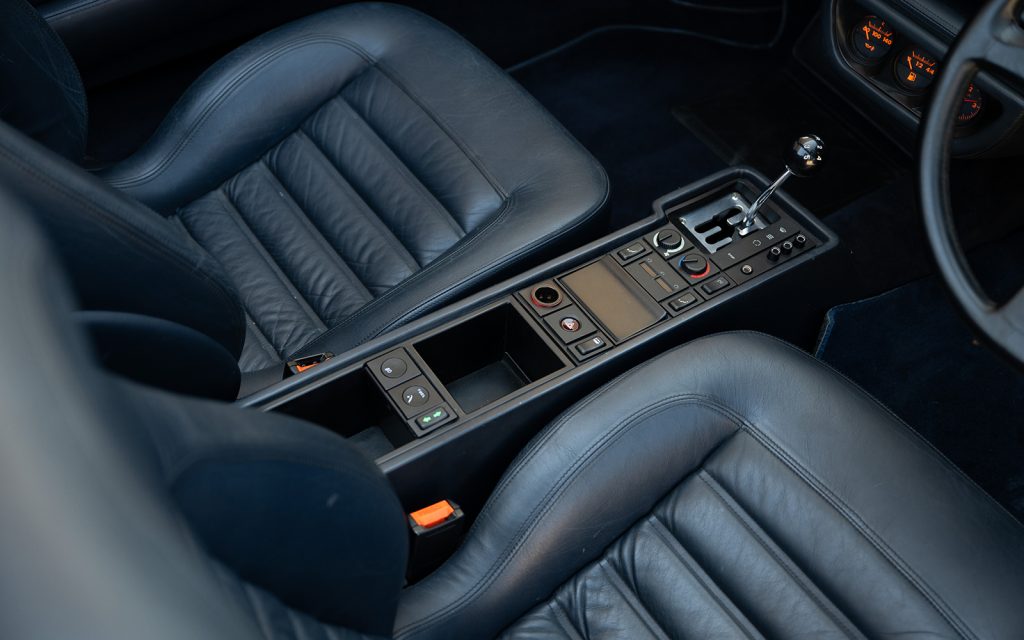
One car amidst the gaggle of Monterey Car Week auctions must certainly be this 1993 Ferrari 512 TR, one of just two Spyder conversions produced by Pininfarina in period for the royal family of Brunei. Finished in triple blue (Blue Cobalto paint, Blue Scar Connolly leather and blue soft top), the car marks a highly unique specification for an even more unique car.
We’ll post the full description from RM Sotheby’s below, while you can find more photos, documentation, details on the sale and more over on RM Sotheby’s website.
Monterey 2024: 1993 Ferrari 512 TR Spyder by Pininfarina
One of only two 512 TR conversions commissioned from Pininfarina by Ferrari, intended for the Royal Family of Brunei
The sole example finished in this stunning “triple blue” color combination
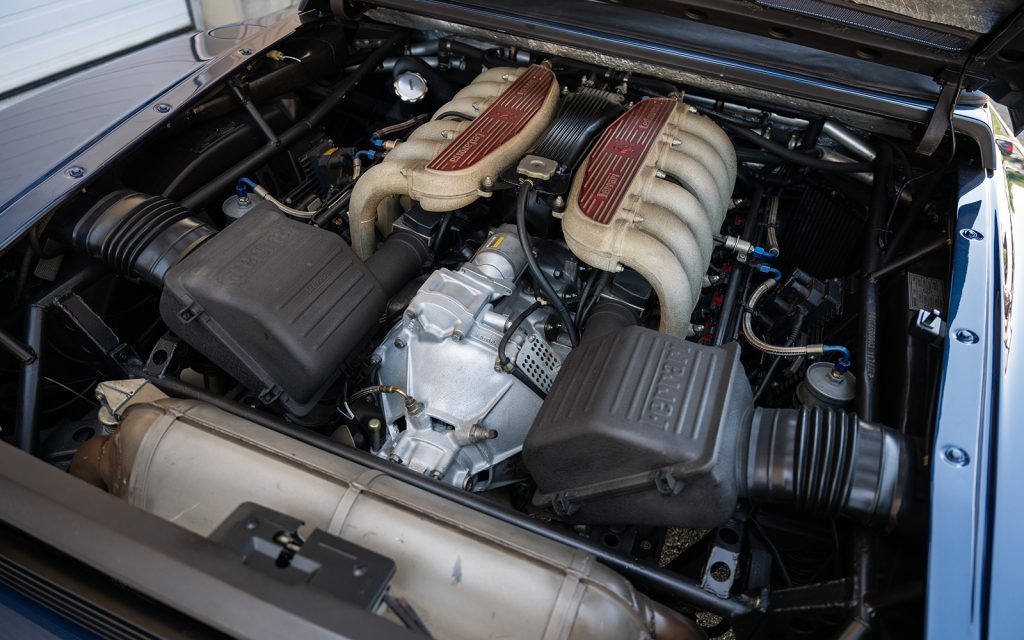
Powered by its matching-numbers 4.9-liter flat-12 engine and five-speed gearbox
Currently indicates fewer than 575 km (~360 miles) at time of cataloguing
Recently treated to $65,000 of cosmetic recommissioning by the eight-time Pebble Beach Concours-winning team at RM Auto Restoration; refinished in its original color and fitted with a new convertible top
Addendum: Please note that an import duty of 2.5% of the purchase price is payable on this lot if the buyer is a resident of the United States.
If asked to close your eyes and conjure the image of an 1980s Maranello model, your mind is likely to produce a visage of side-straked majesty in the form of a Ferrari Testarossa. It is a model intrinsically wedded to the decade of its introduction. Everyone from teenagers lusting over bedroom-wall posters, to captains of industry catching a glimpse of their reflection in glass-fronted offices—none could help fawning over this most Ferrari of Ferraris.
Arguably Ferrari’s hit car of the 1980s, the Testarossa was approaching its sixth year of production in 1990, and Maranello’s design team sought to update the iconic model for the coming decade. Returning to numeric nomenclature, its successor was dubbed the Ferrari 512 TR, with “5” representing the cubic capacity of the engine, “12” the number of cylinders, and “TR” standing for Testarossa. The 512 TR shared many similarities with its predecessor, but it was expertly tweaked by Ferrari both in terms of styling and engineering.
The marketing power of its 1980s dream machine had not diminished just because the decade rolled over, either. The initial design simply needed a few minor nips and tucks to keep it cutting edge. The most recognizable 512 TR addition was its front bumper, while other styling changes included a revised set of rear lights and new 18-inch alloy wheels. Numerous interior updates were needed to pass over the 1980s aesthetic baton to the 1990s, but the 512 TR’s most significant improvements were carried out upon its chassis and mechanicals.
The new model’s chassis was revised to allow both engine and transmission to sit 30 millimeters lower, improving the car’s center of gravity. While the displacement of the 512 TR’s inherited flat-12-cylinder engine remained the same as the Testarossa’s at 4,943 cubic centimeters, its power had been increased—due to a higher compression ratio, revised porting and inlets, bigger valves, as well as new Bosch Motronic M2.7 management—to a highly respectable 428 brake horsepower.
But perhaps the most warmly received of the 512 TR’s updates were those of its transmission—a prolonged complaint about the Testarossa—which was eased with a new single-plate clutch, sliding ball bearings, and better angle for the gearshift knob.
Yet despite all the improvements fitted to the iconic Testarossa model, some of Ferrari’s most discerning clients still required something more exclusive than the standard 512 TR.
‘APERTA, DUE POSTI, PER I REALI’
Given the right level of status—and the resources to back it up—Ferrari has always been willing to execute one-off coachbuilt commissions exclusively for its most important clients. This proud tradition goes back to the marque’s earliest days partnering with some of Italy’s finest carrozzerie and continues today with the Portfolio Coachbuilding Program at Ferrari’s Design Center. Behind doors which even the most astute of collectors may struggle to unlock, unique models considered too wild for mainstream manufacture are created; bespoke Ferrari projects straight from the imagination are brought to life.
But soaring high above even this rarified stratum of Ferrari VIPs exists the legendary domain of Brunei’s Royal Family, who commissioned not one or two custom Ferrari chassis, but multiple series of coachbuilt Ferrari models throughout the 1980s and 1990s. This outstanding 512 TR Spyder offered here is an exemplary specimen from one such series intended for Ferrari’s so-called “First Family.”
Throughout the 1980s and early 1990s, Alfred Tan, the proprietor of Singapore’s Hong Seh Motors, handled orders and delivery of Ferraris for the Brunei Royal Family as the marque’s sole distributorship in Southeast Asia. Tan communicated specific orders directly to Maranello, and from Maranello to Grugliasco, where Pininfarina’s Special Projects Team turned dream into reality. According to Paolo Garella, the former Pininfarina Special Projects Manager, Pininfarina began taking orders from Brunei directly starting in 1994, making the 512 TR Spyder the last model commissioned through Hong Seh Motors.
Having previously completed a series of Testarossa Spyders for Brunei, a new 512 TR-based series seemed only a natural progression. Correspondence between Tan and Ferrari’s Maurizio Parlato (on file) confirms as much, and while Ferrari produced a scant 88 right-hand drive 512 TRs between 1992 and 1994, just two of them were forwarded to Pininfarina during the same period for conversion to the coachbuilt “aperta” design of an open-topped Spyder. To this end, Garella notes that the orders for these two 512 TR Spyders were indeed placed through Ferrari by Alfred Tan, and Ferrari then sent reinforced chassis to Pininfarina’s Special Projects team to finish the aperta conversion. Once the body conversion had been completed, these two special Spyder conversions were then shipped back to Ferrari in Maranello to fit the mechanical parts and interior tailoring.
An accompanying Ferrari Certificate of Origin and Production Data sheet confirms that this 512 Spyder was delivered new to Hong Seh Motors during June 1993 and clothed in the bespoke “triple blue” color combination of Blu Cobalto over Blu Scuro Connolly leather with matching carpets and power-operated soft top. It is the only such 512 TR Spyder executed in this color combination.
Interestingly, neither right-hand drive 512 TR Spyder was ever delivered to Brunei’s famous garages for unknown reasons, with this example retained by Alfred Tan in Singapore for his personal collection. In January 1997, Tan exhibited this 512 TR Spyder at Ferrari’s 50th Anniversary celebrations in Rome, and at that time the Scuderia Ferrari driver Gianni Morbidelli joined Tan’s son, Edward, in the car during their parade through the city.
Rarely displayed elsewhere during Tan’s 30 years of ownership, in November 2023 this special Pininfarina Spyder was purchased by the consignor and immediately submitted to more than $65,000 of cosmetic recommissioning by RM Auto Restorations. Invoices on file illustrate more than 500 man-hours were spent to bring this barely enjoyed coachbuilt Ferrari back to a perfect presentation. Notable line items include a full refinishing in its original Blu Cobalto paint, new Blu Scuro carpets, and new Blu Scuro power-operated soft top.
As presented today, this 512 TR Spyder indicates fewer than 575 kilometers (~360 miles) at cataloguing time. Chassis 97310 arguably presents the only opportunity to own a special limited-production aperta variant of the Ferrari 512 TR, with only two ordered by the Ferrari factory and this car’s sister chassis not currently available.
Long owned and cared-for by the man who helped create such a rare beauty, this coachbuilt Blu Cobalto example would be the centerpiece of any aficionado’s collection, sure to draw attention wherever it goes, be it concours lawns or open roads.
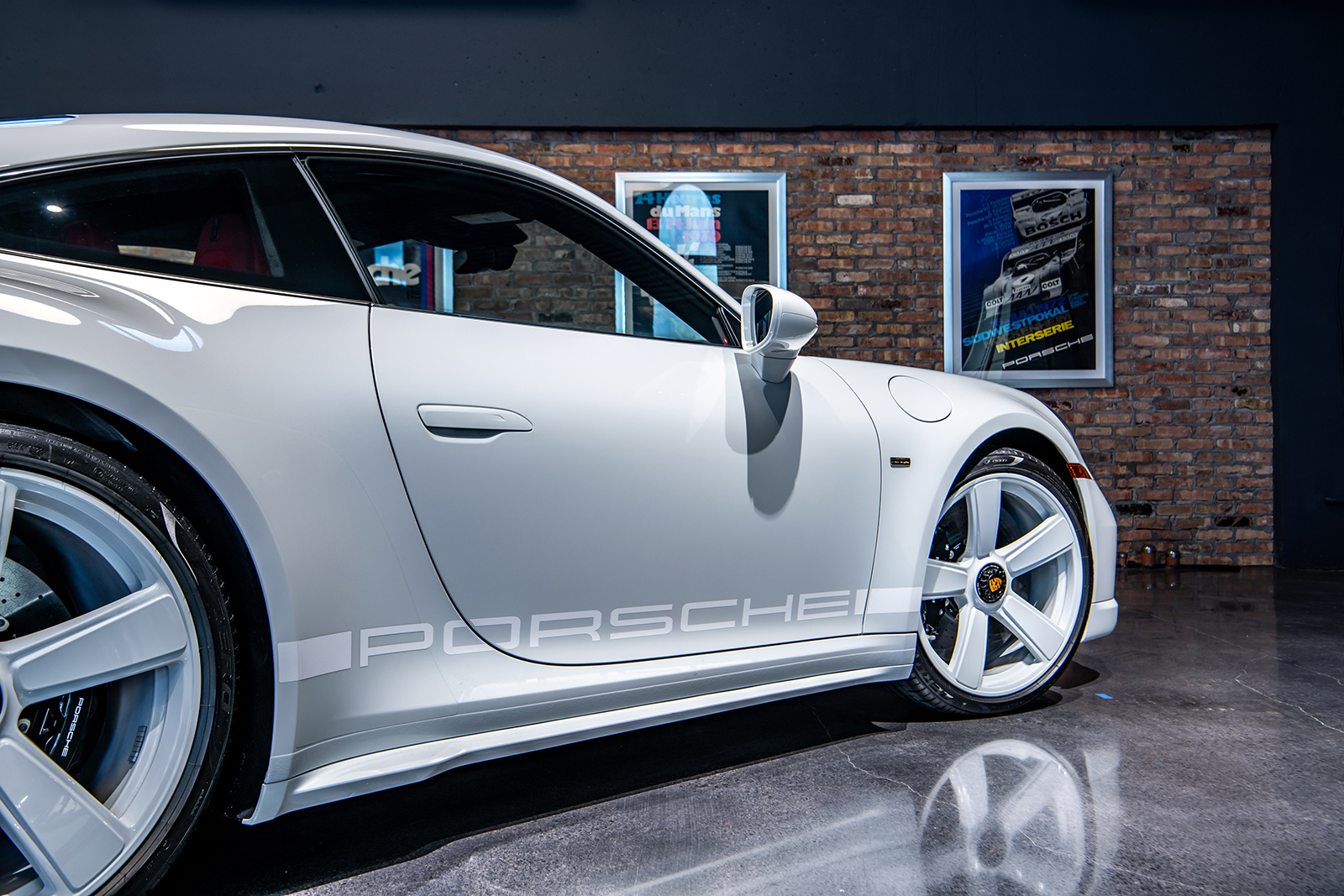
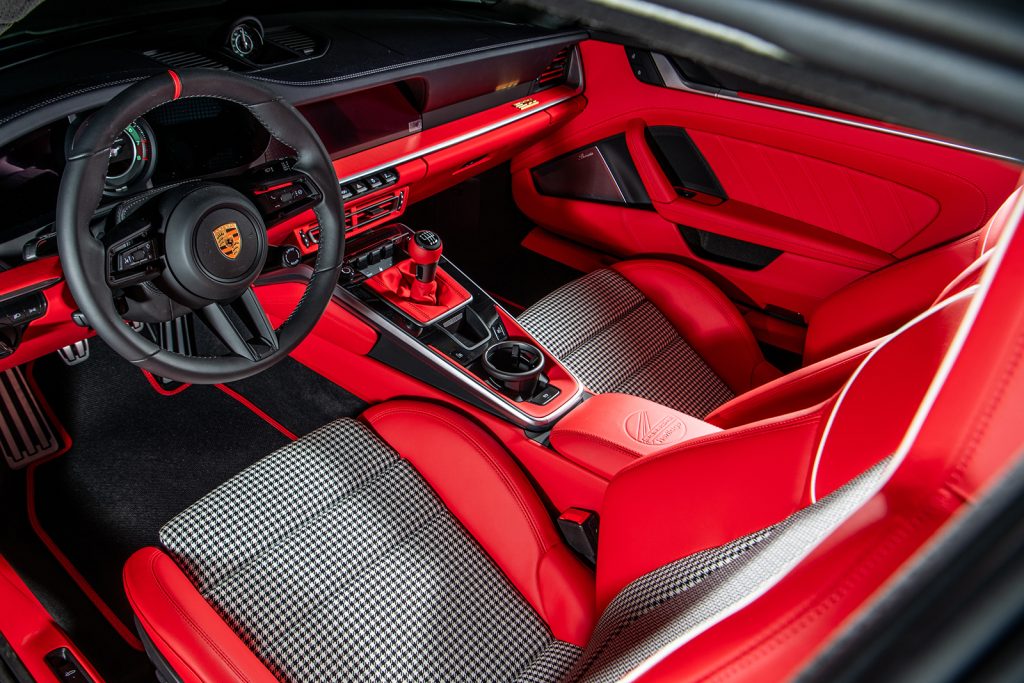
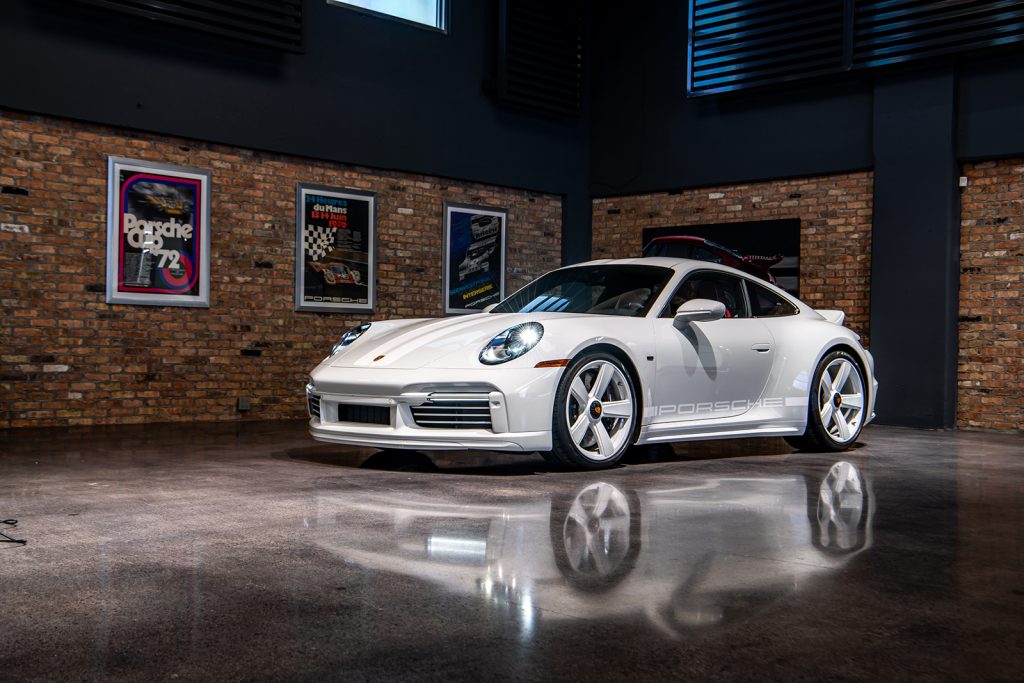
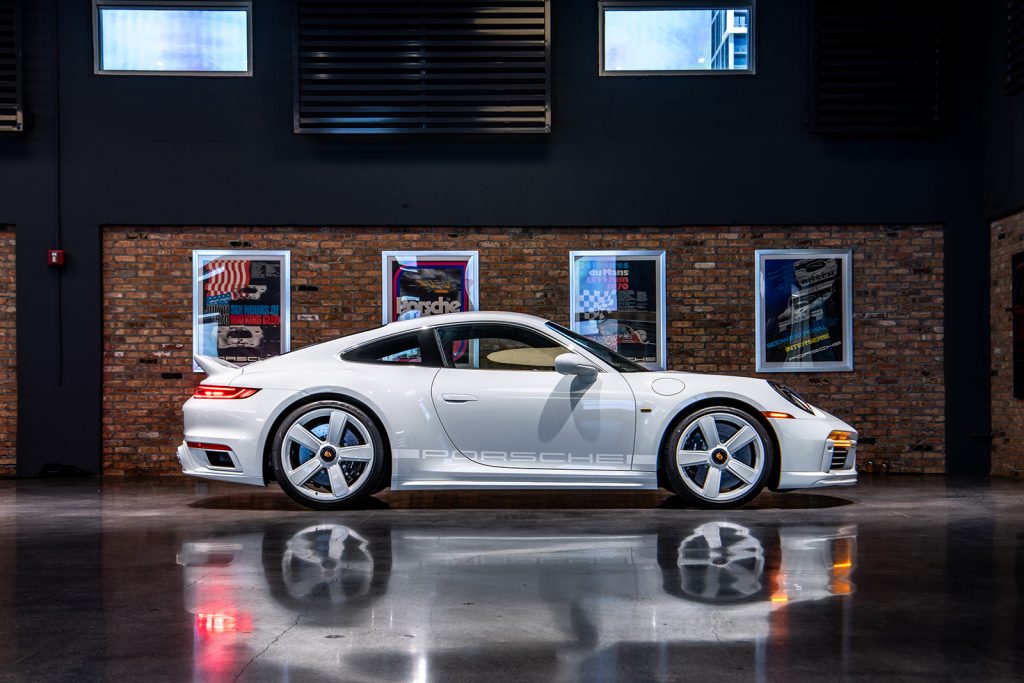
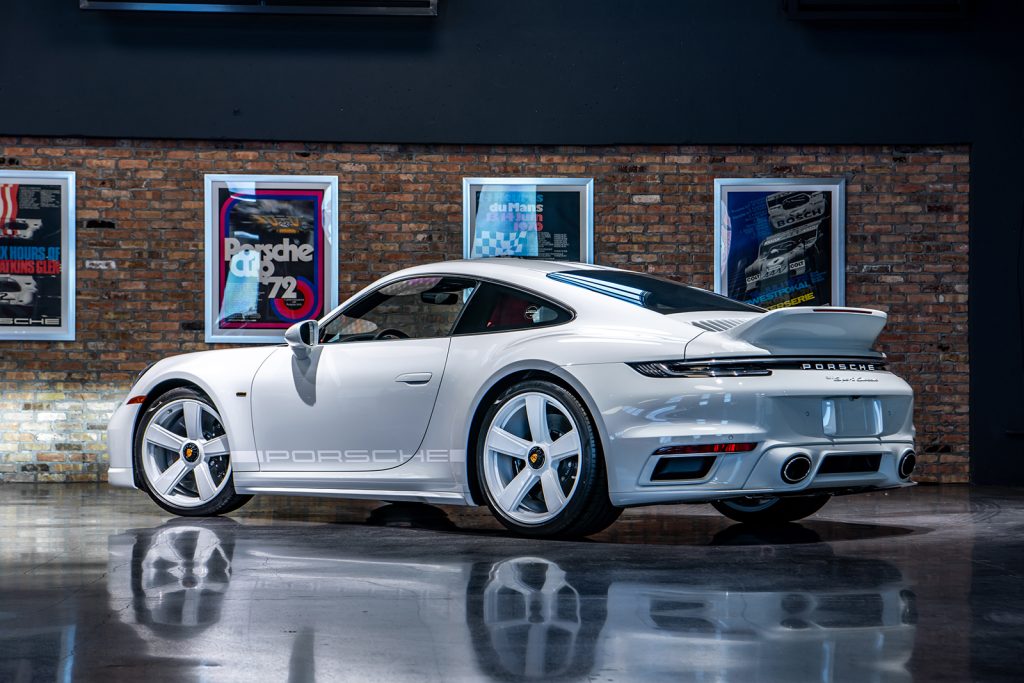
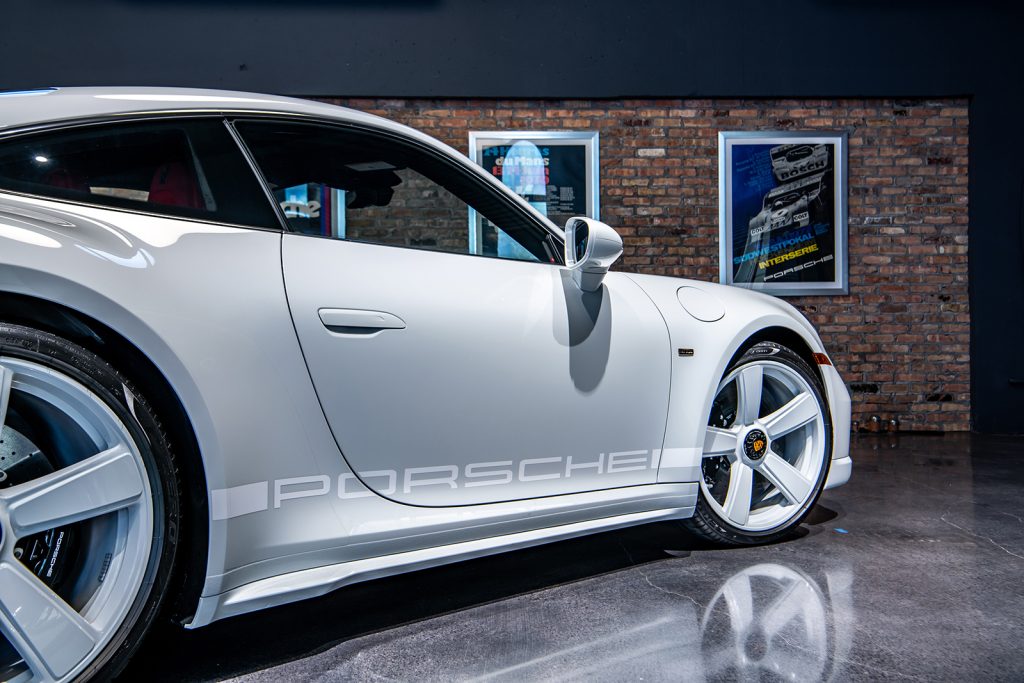
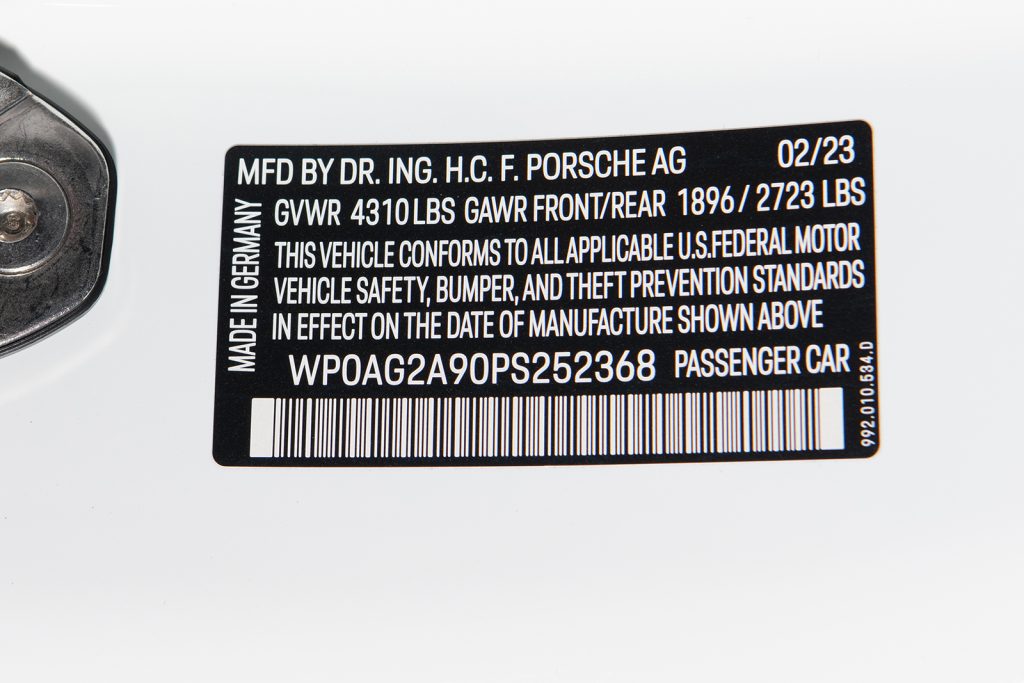
One tailored build headed for auction during Monterey Car Week 2024 is this very unique 2023 Porsche 911 Sport Classic (VIN: WP0AG2A90PS252368) being sold without reserve by RM Sotheby’s. Sold via Porsche North Houston, you may not be all that surprised looking at the spec that this 992 was built for the White Collection.
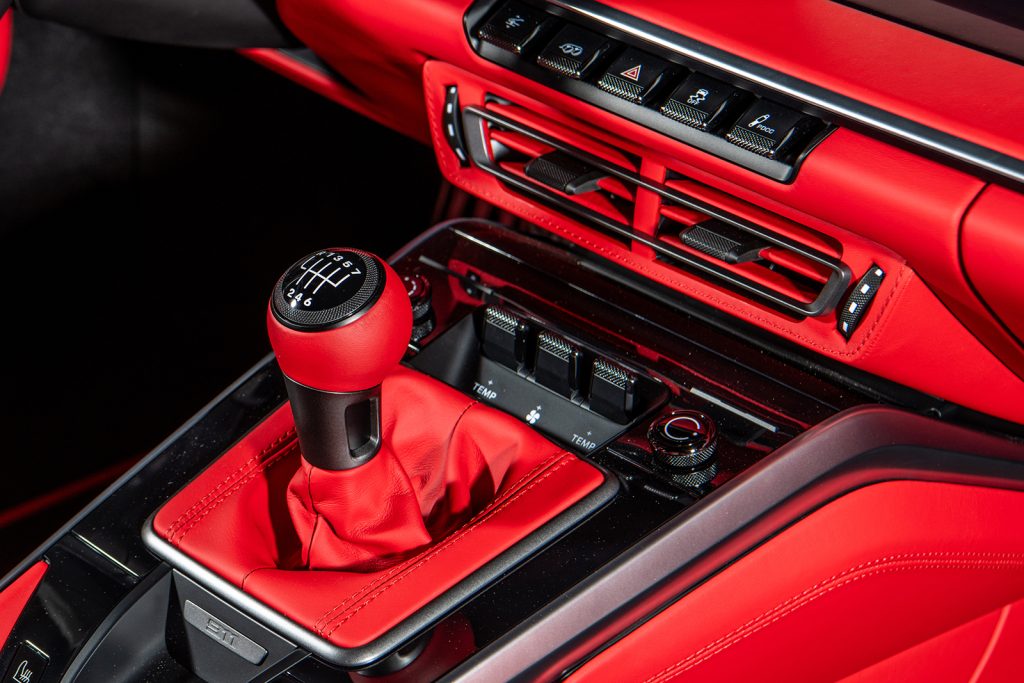
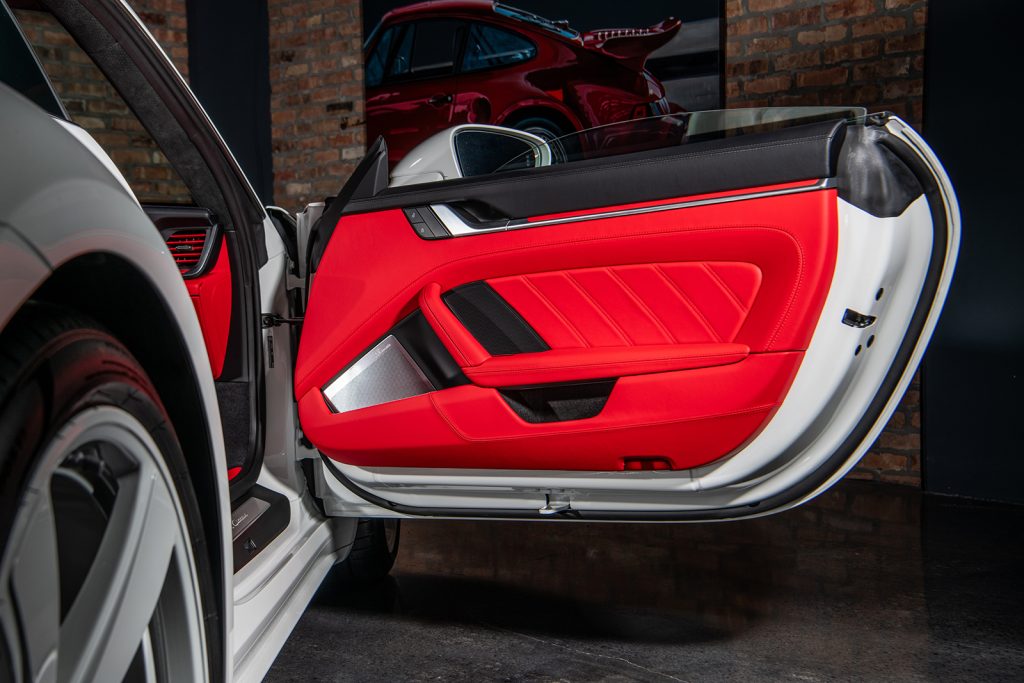
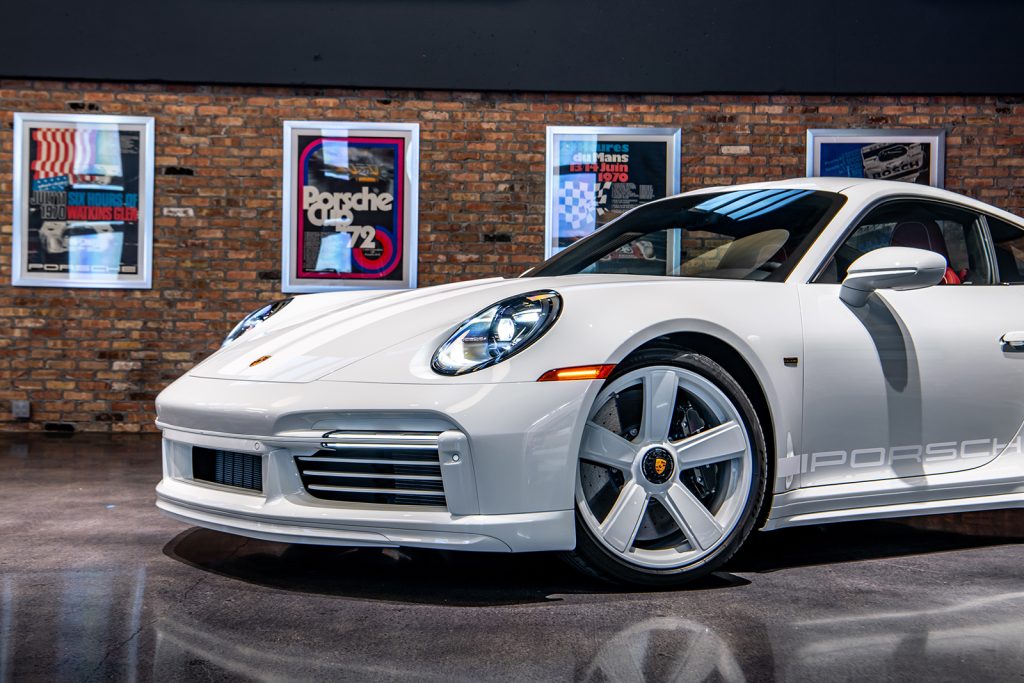
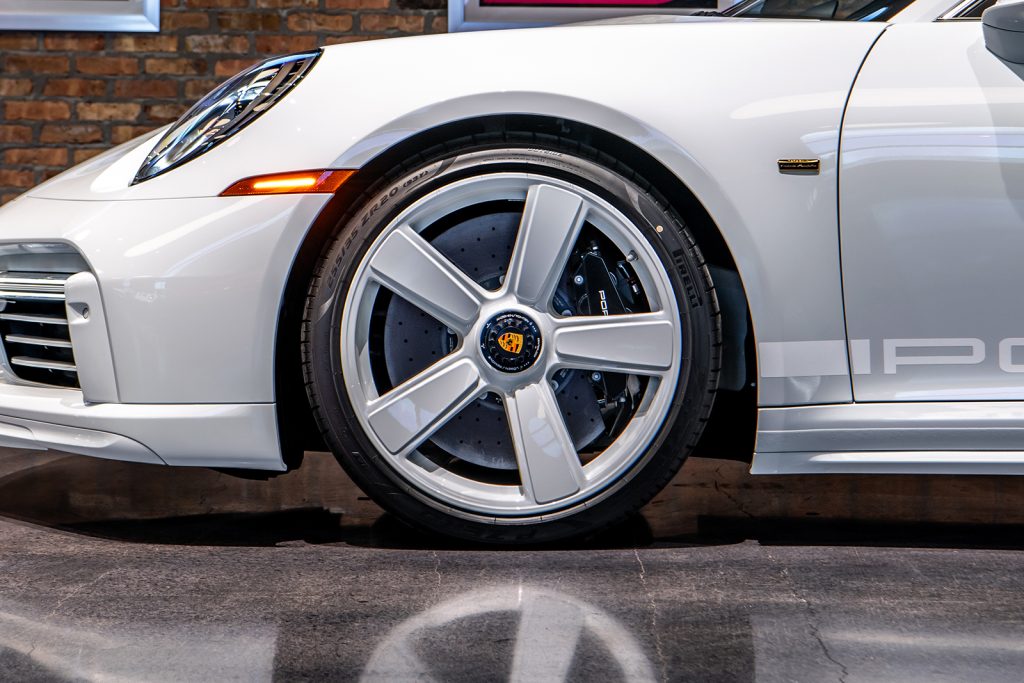
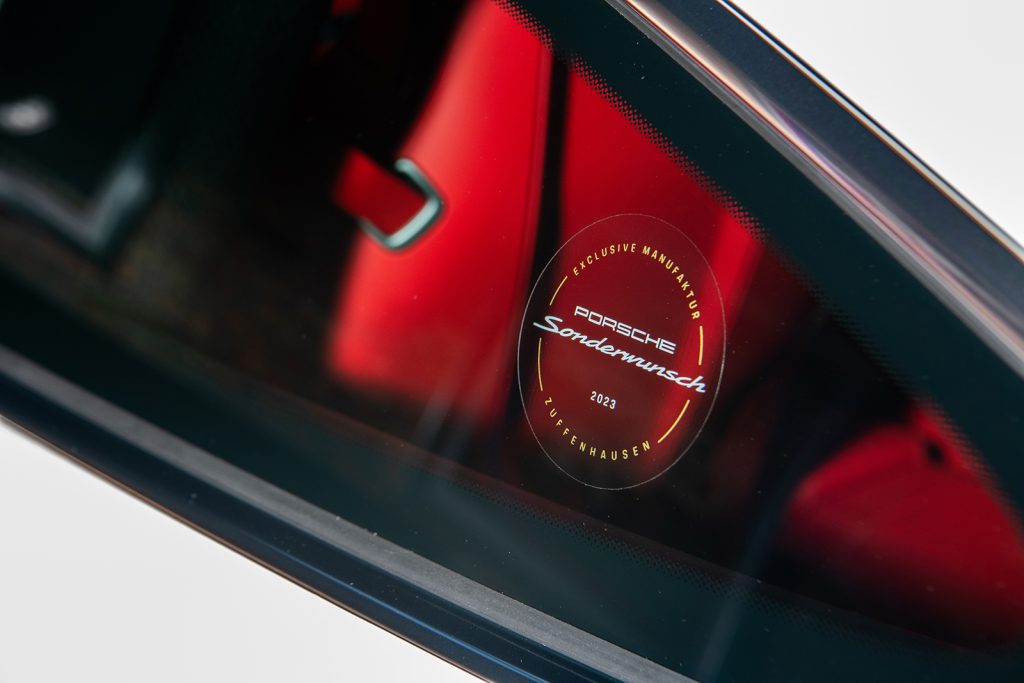
We’ve been unable to confirm the specific white, but the associated documents provided by RM do confirm the white that covers it is a Paint to Sample shade. It’s also worth noting that this car had plenty of Sonderwunsch factory commissioned modifications. These include many components color-matched white, and a striking red interior.
Below the gallery is a the full description provided by RM Sotheby’s. Find more photos and information on the car HERE.
EDITOR’S NOTE: We were unable to confirm this paint color during the writing of this story. If you know the color, please confirm it below in the comments or by direct messaging the author.
The most powerful Porsche Type 992 911 with a manual transmission
One of 1,250 examples produced
Delivered new to the White Collection
Extensively personalized with over $150,000 of Sonderwunsch Factory Commissioning, for a total new price of $448,535
Presented in virtually as-new condition with fewer than 77 miles on the odometer at the time of cataloguing
With so many iconic cars and significant achievements throughout the past 75 years, Porsche rightfully celebrates the company’s heritage by offering its most dedicated followers limited-production models inspired by their most beloved and sought-after historical creations. Cars like the 911 R, the several generations of Speedsters, and the original Type 997 Sport Classic have all offered modern performance with a dash of vintage panache.
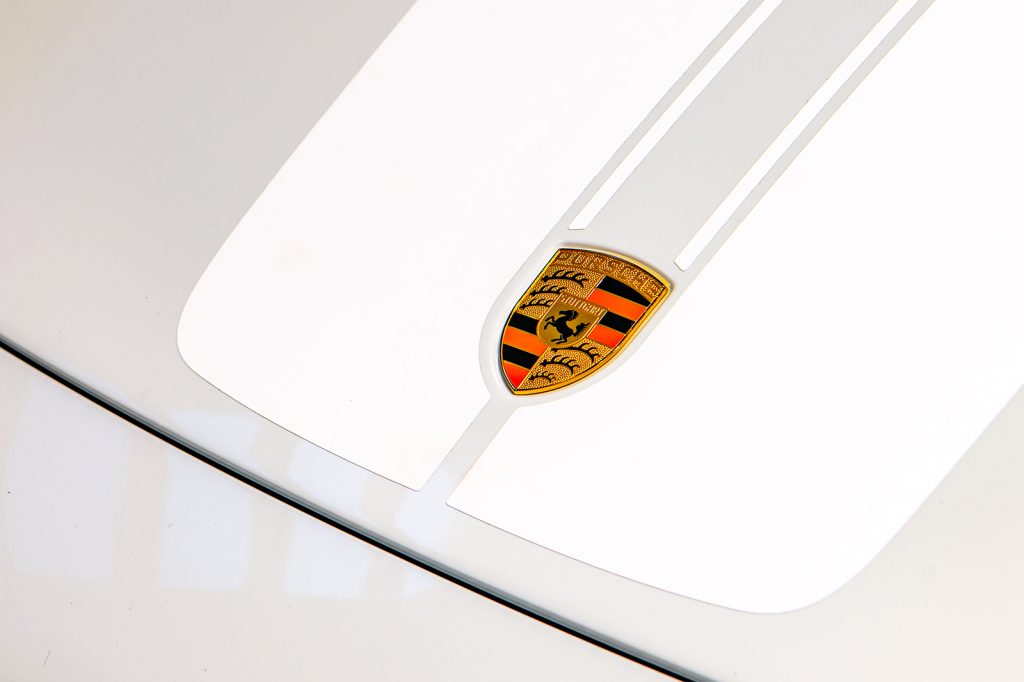
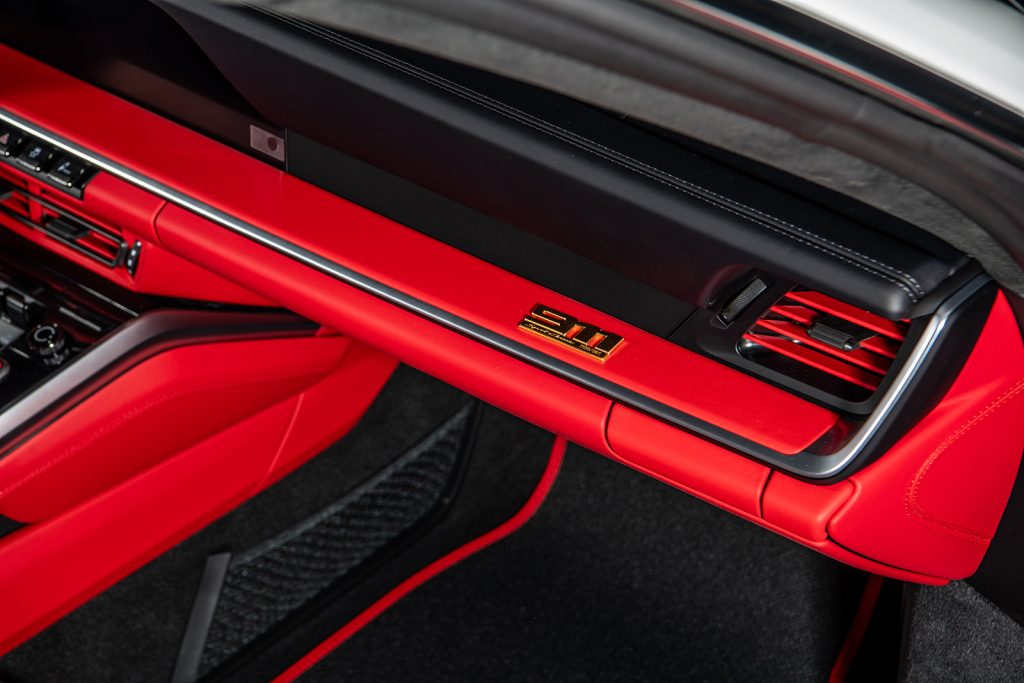
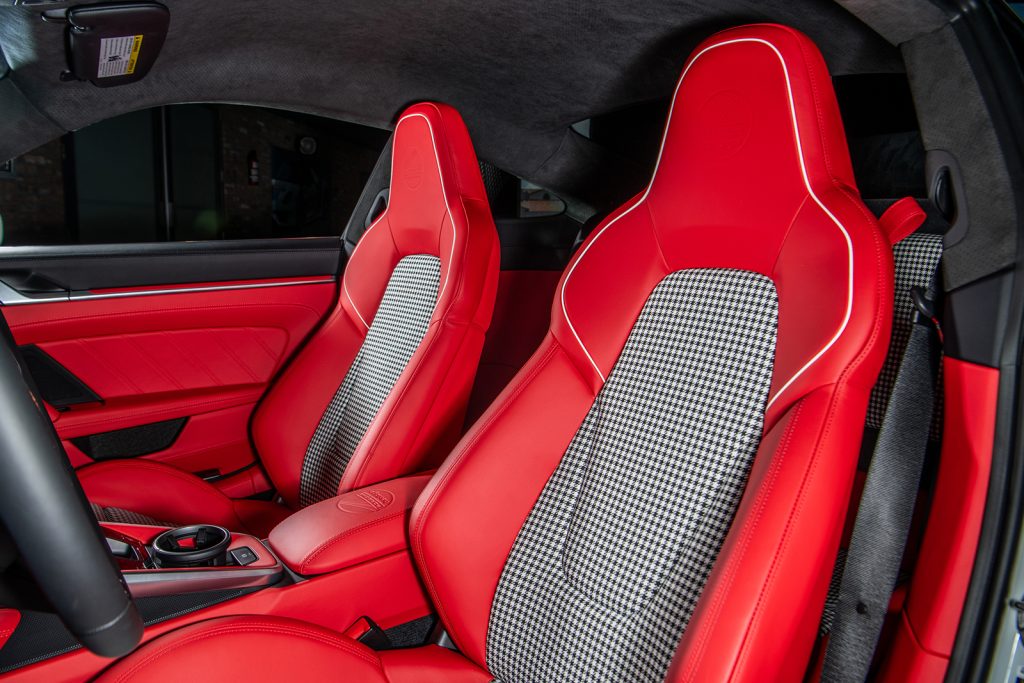
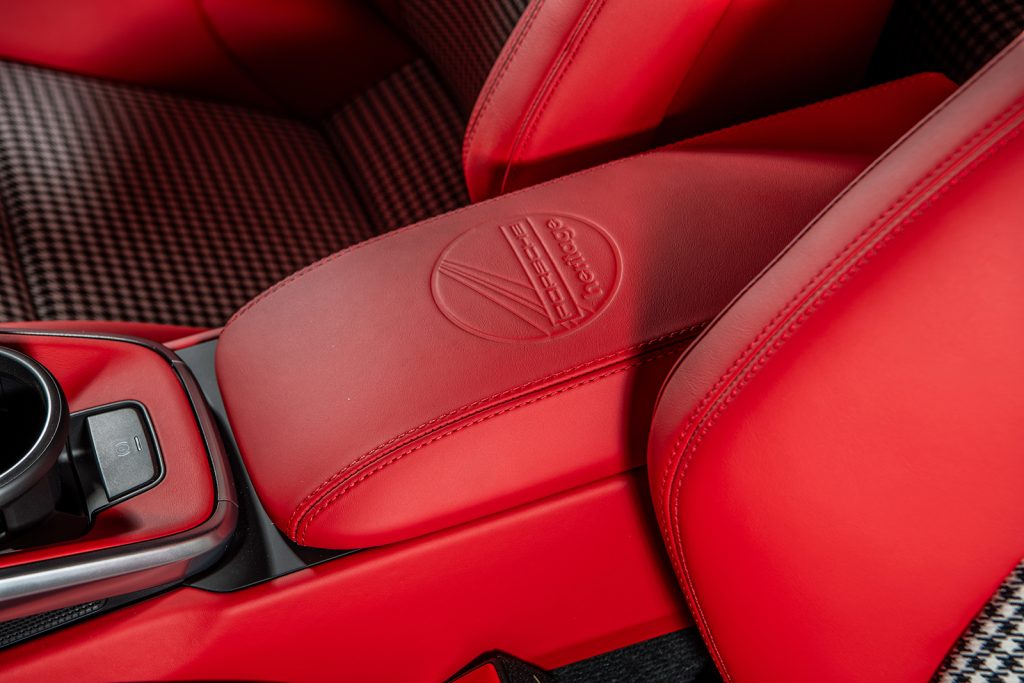
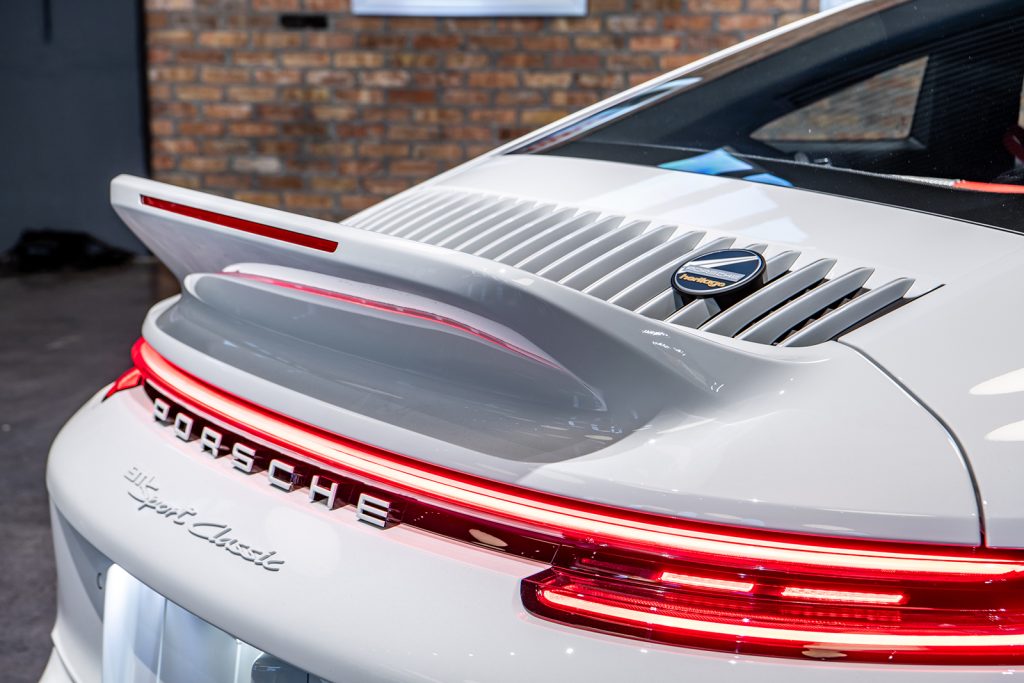
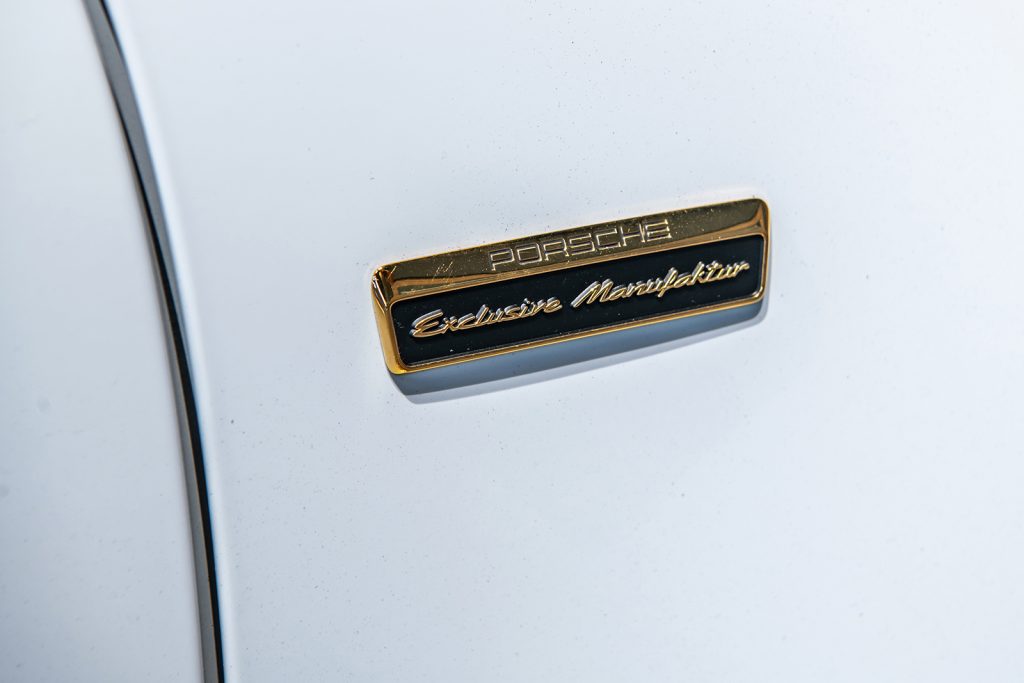
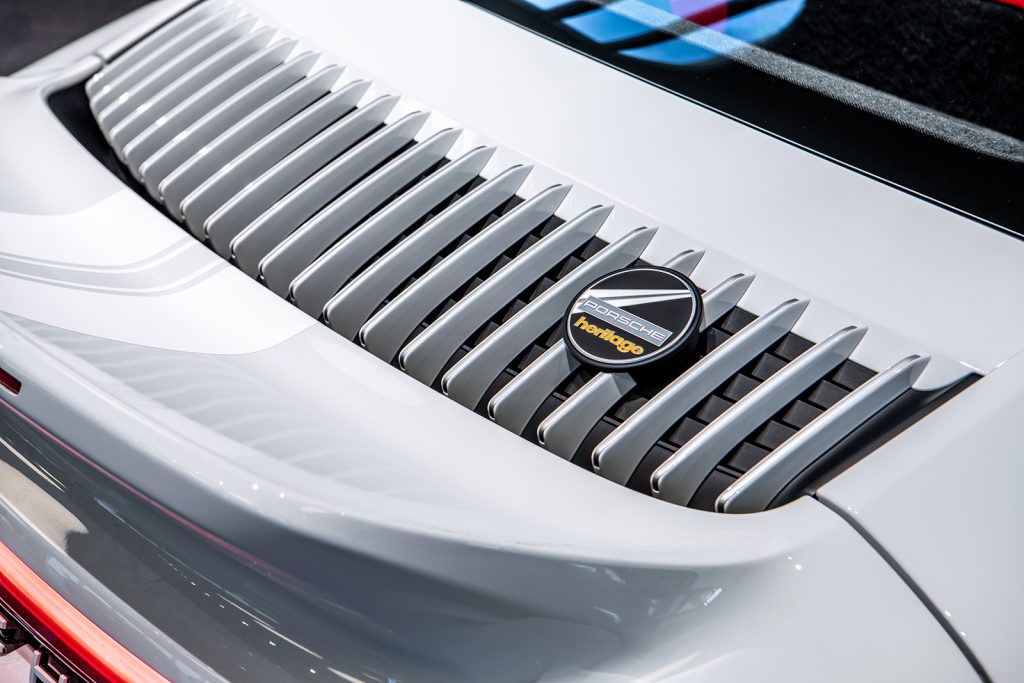
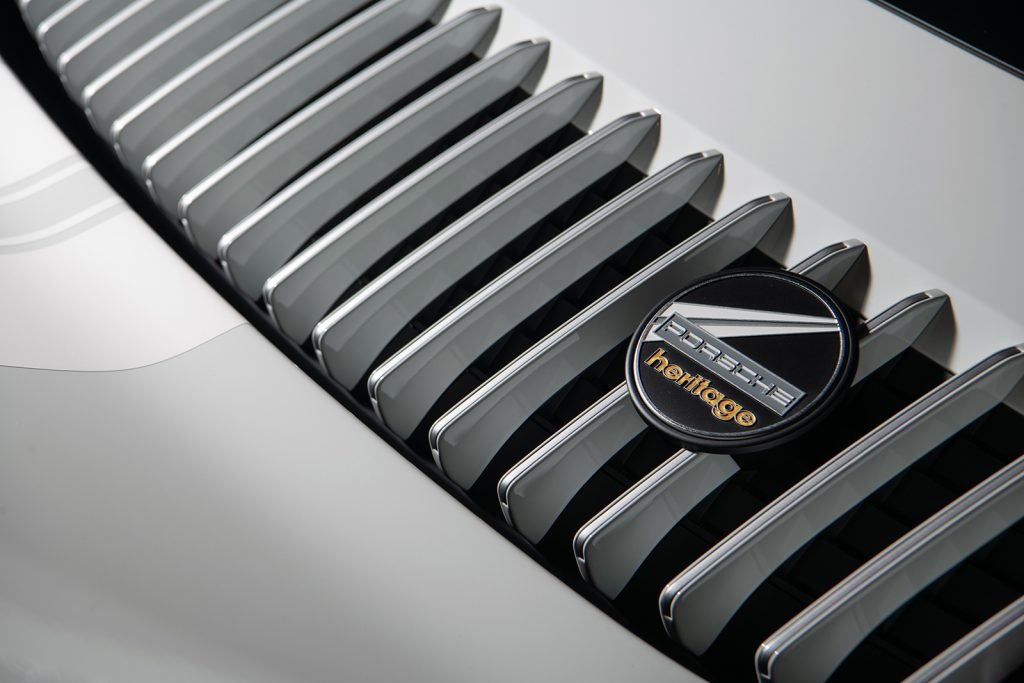
The latest iteration of the Sport Classic, now based on the Type 992 platform, presents a “greatest hits” collection of the most established Porsche design features wrapped around one of the most potent and engaging drivetrains ever fitted to a 911. This limited-edition model is easily identified by the 2.7 RS-inspired duck tail spoiler and Fuchs-style wheels on all four corners. Keener observers will note the double-bubble carbon fiber roof, gold-color badging, and a Porsche shield featuring the early-style bright red element of the Württemberg crest. Twin stripes streak across the hood, roof, and tail, further alluding to the firm’s immense racing history. The interior is covered with plenty of leather, distinctive houndstooth cloth on the doors and seat inserts, and green-accented instrumentation for a 1960s atmosphere. Lastly, a badge on the dashboard notes the serial number of each Sport Classic.
Utilizing the Turbo widebody and engine platform, the Sport Classic is the most powerful rear-wheel drive 911 of this generation so far. The twin-turbocharged 3.7-liter flat-six engine produces a whopping 542 horsepower, and while mildly detuned from its four-wheel drive brethren, this reduction has allowed for the option of a manual transmission (much to the delight of enthusiasts). The chassis is additionally fitted with carbon ceramic brakes, Porsche Dynamic Chassis Control, rear steering, Porsche Active Suspension Management, and a specially tuned exhaust as standard.
On offer is serial number 0923 of the 1,250 Sport Classics offered worldwide. An immensely special machine already, this example stands above its siblings courtesy of over $150,000 worth of Sonderwunsch Factory Commissioning. As shown on the CXX option sheet on file, the exterior is finished almost entirely in White, from the front-end air intakes to the wheels and around to the lower rear valance. Only matte white stripes and black wheel center locks provide contrast to this snowy exterior treatment. Alternatively, the sanguine interior features leather across most visible surfaces in a display of supreme luxury and customization. The air vents, center tunnel, knee pads, front trunk, rear side panels, lower dashboard, inner door sill guards, and even the owner’s manual wallet are all finished in Can Can Red hides. Houndstooth joins the mix on the door cards, seat inserts, and trunk pouch. The summation of this custom tailoring has resulted in a truly exquisite example of such a special Porsche.
Delivered new to the legendary White Collection, the 911 subsequently traded hands and today presents with fewer than 77 miles on the odometer at the time of cataloging. Thanks to this limited use, the car presents in virtually as-new condition and will undoubtedly be a highlight of any serious collection for decades to come.