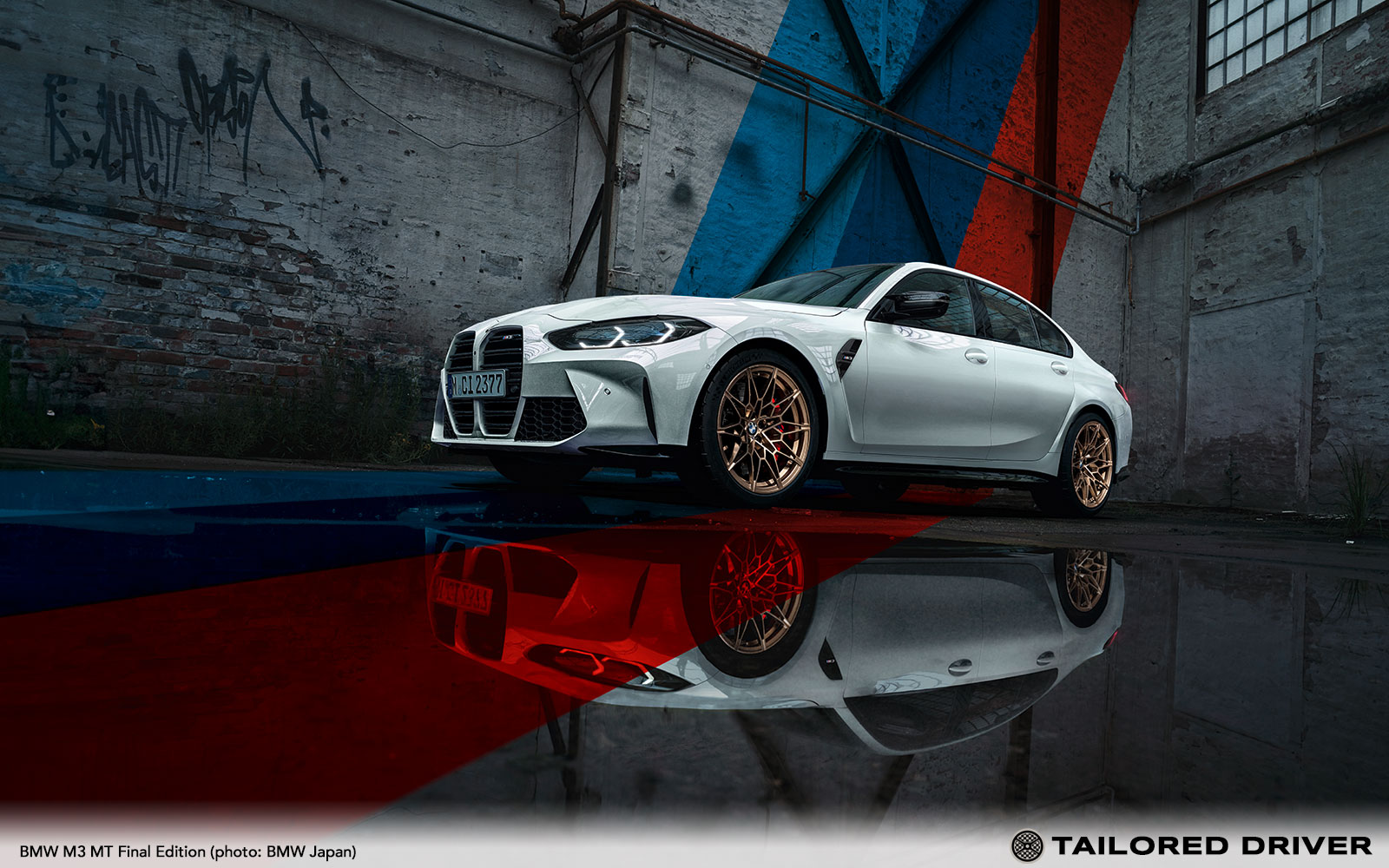
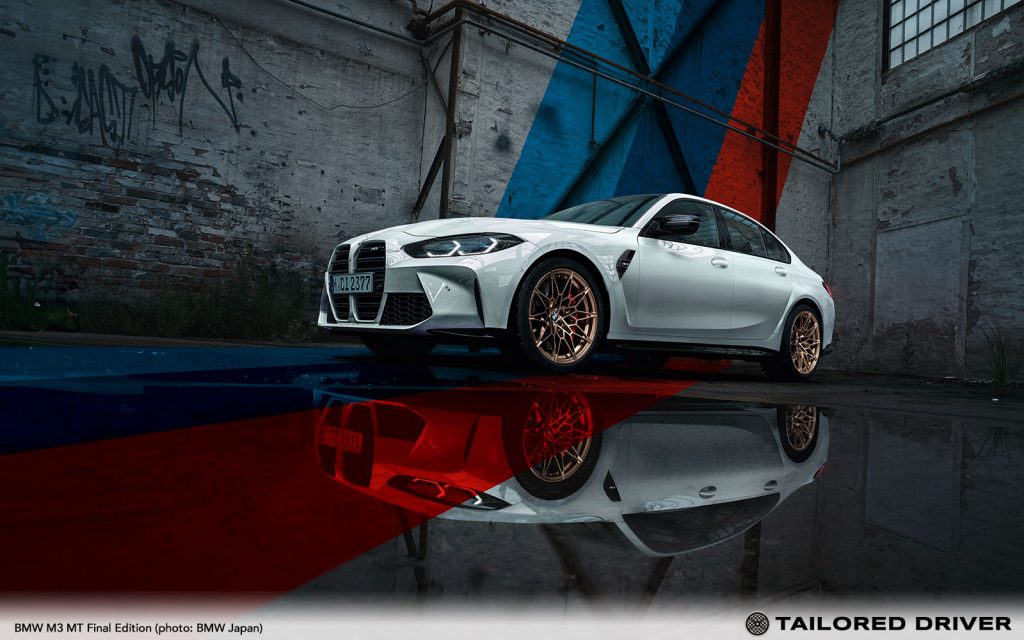
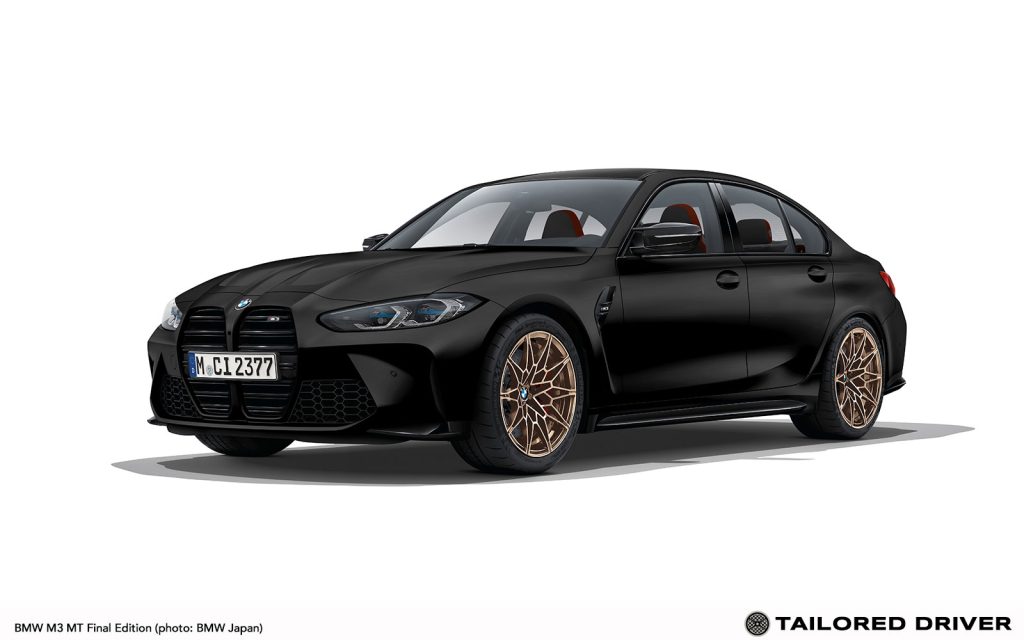
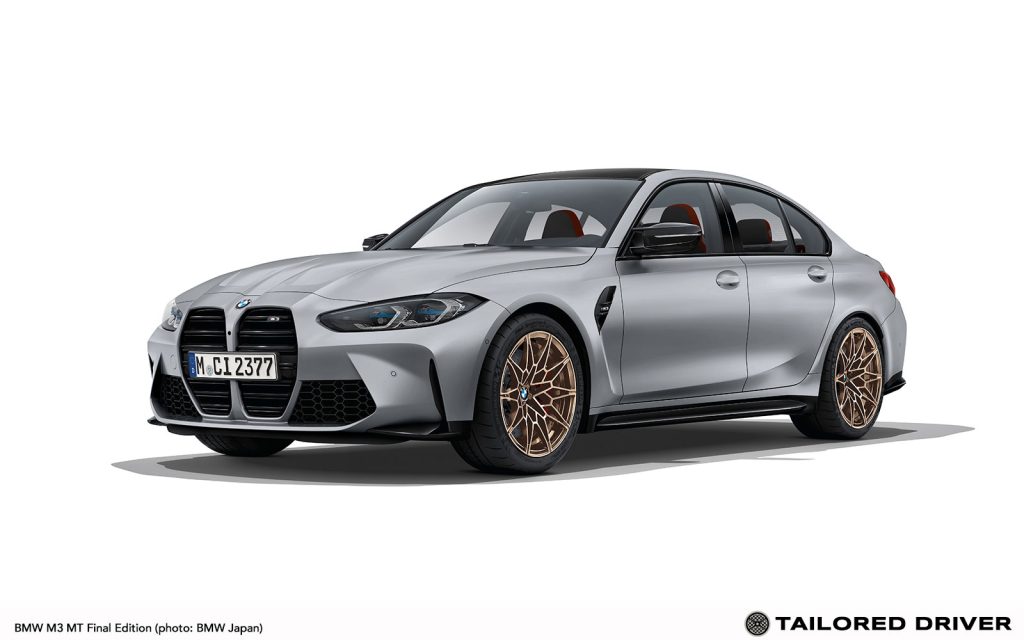
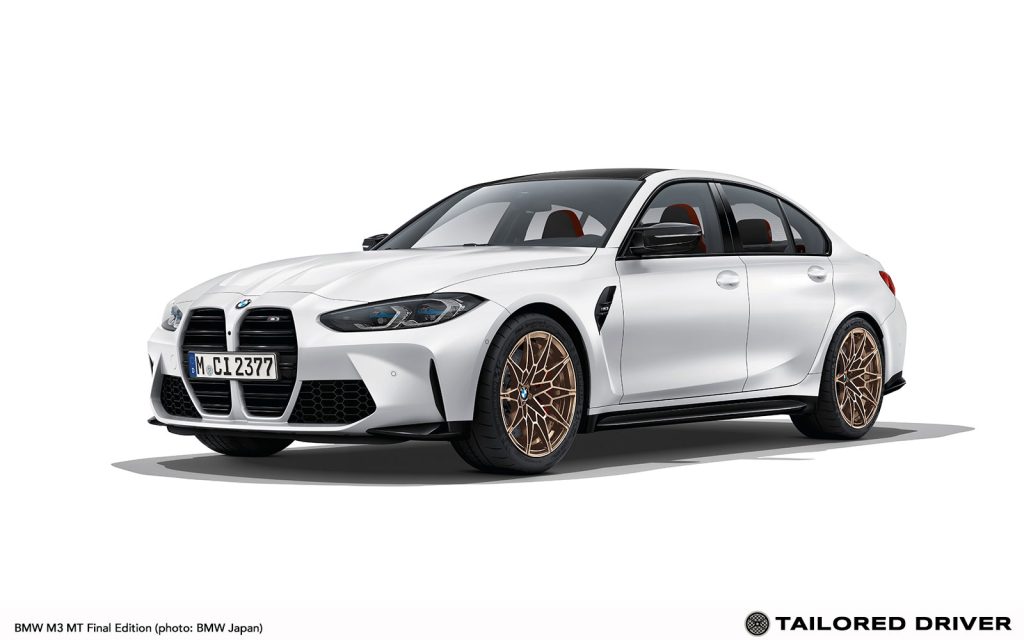
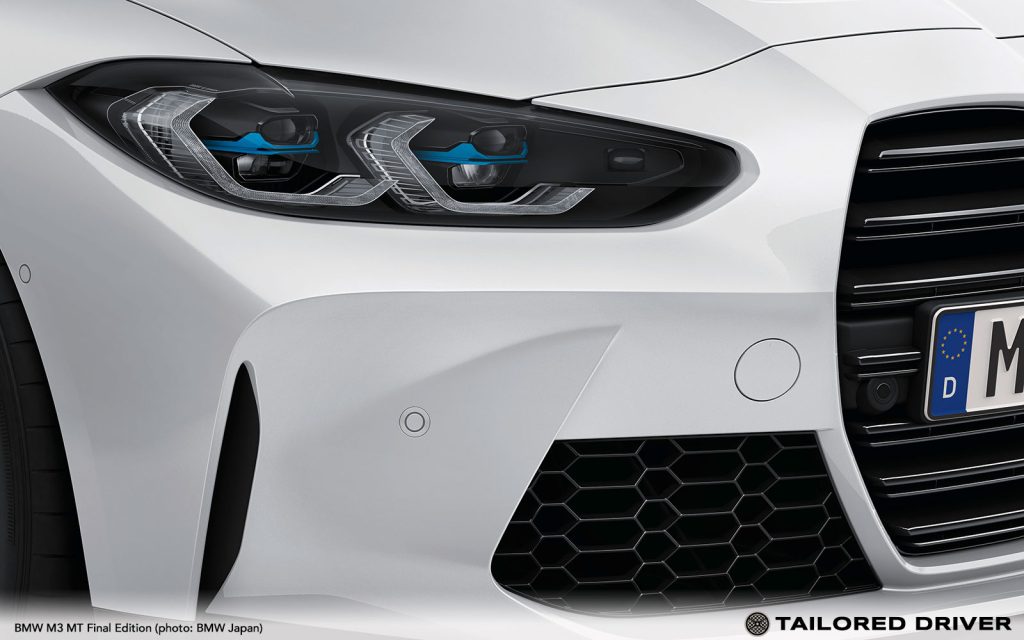
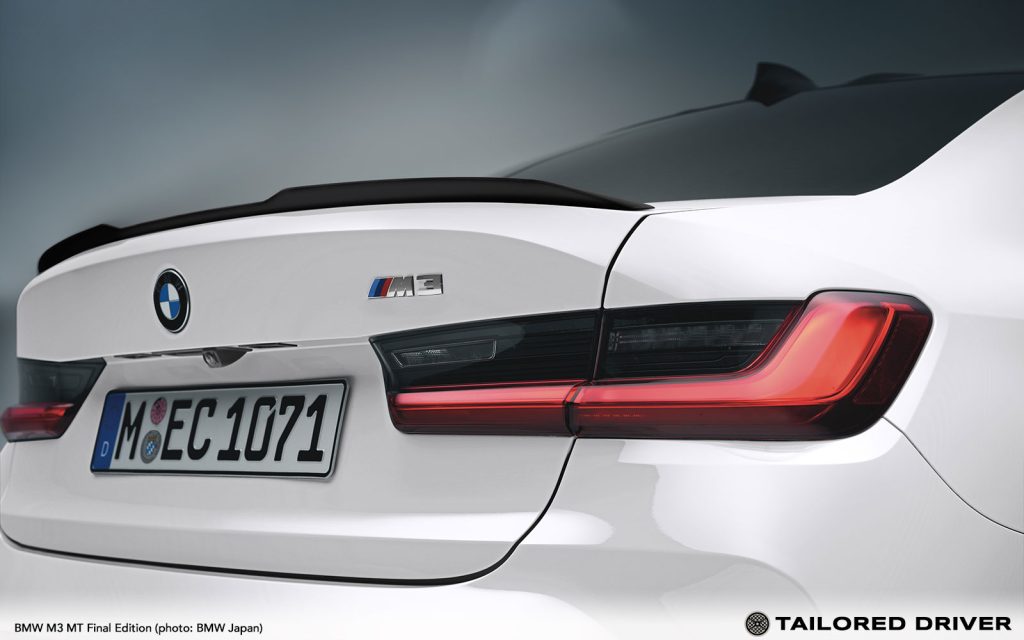
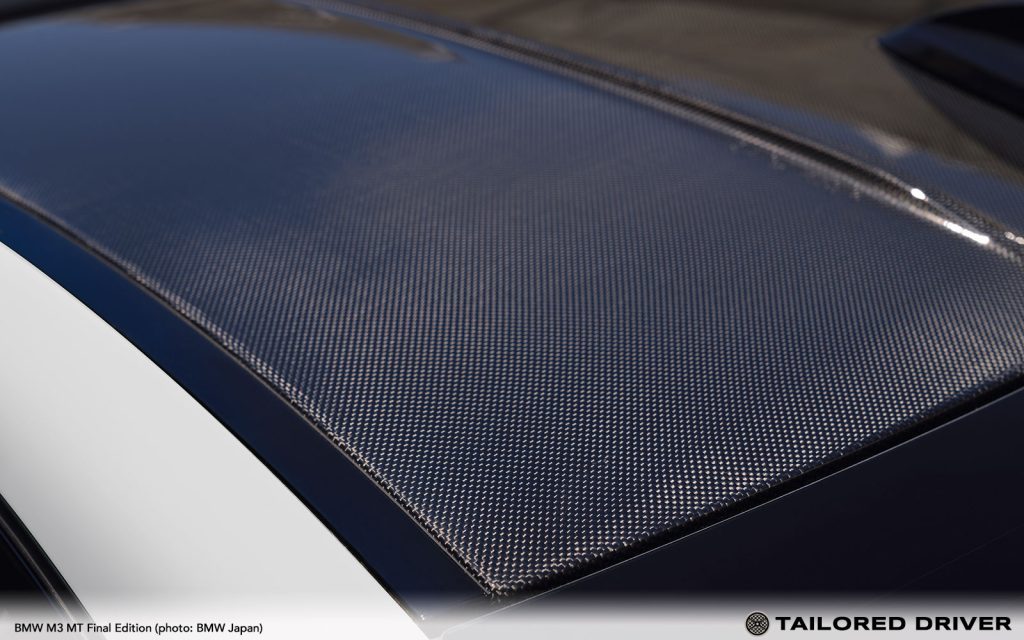
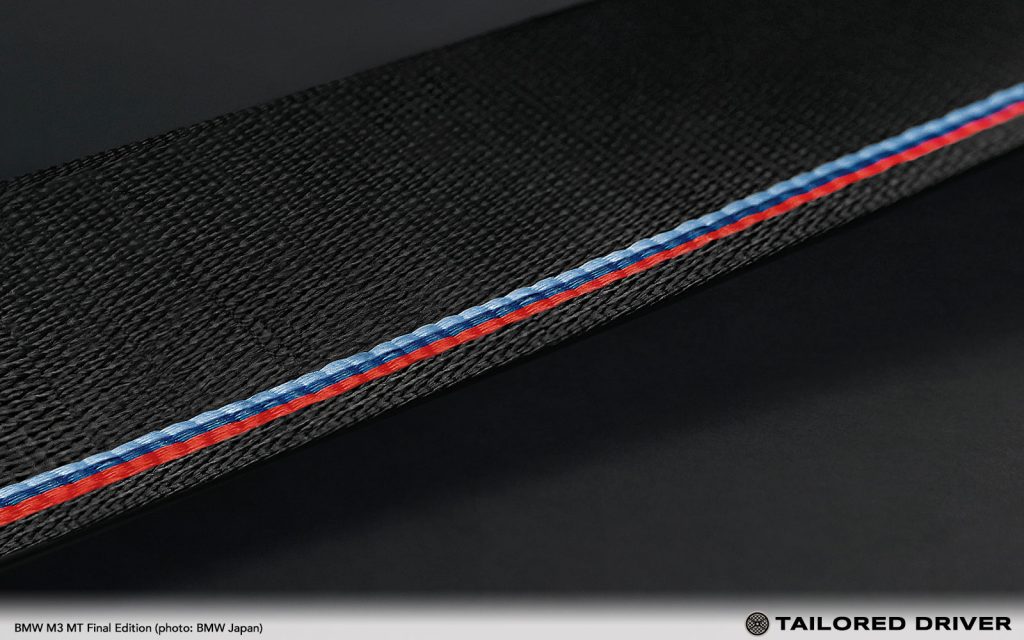
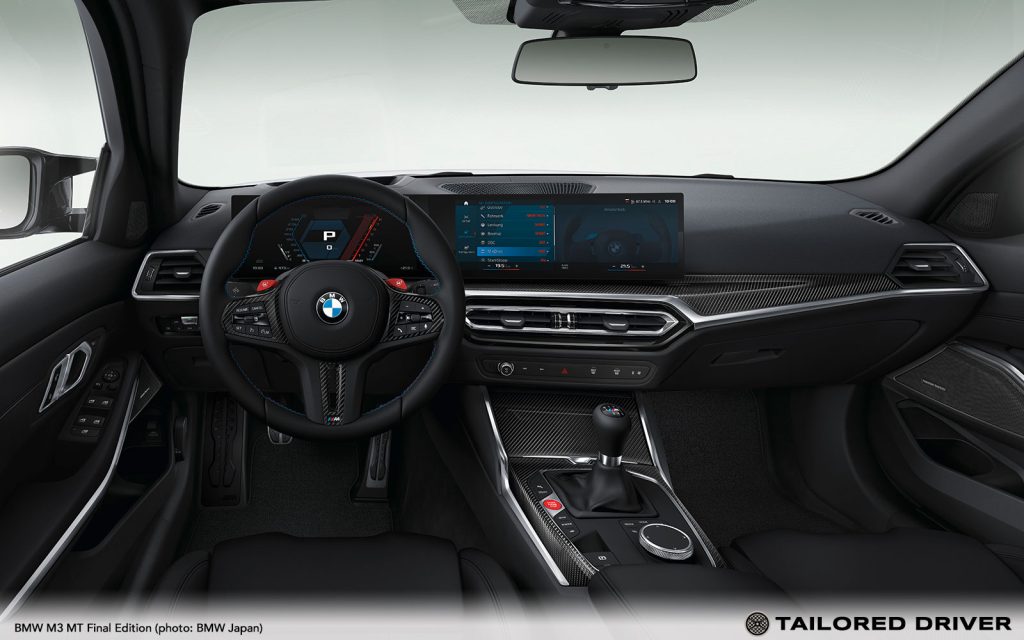
The last model with manual transmission of the BMW M3
Limited to 150 units in Japan
Order acceptance starts only on the dedicated website
[source: BMW Japan]
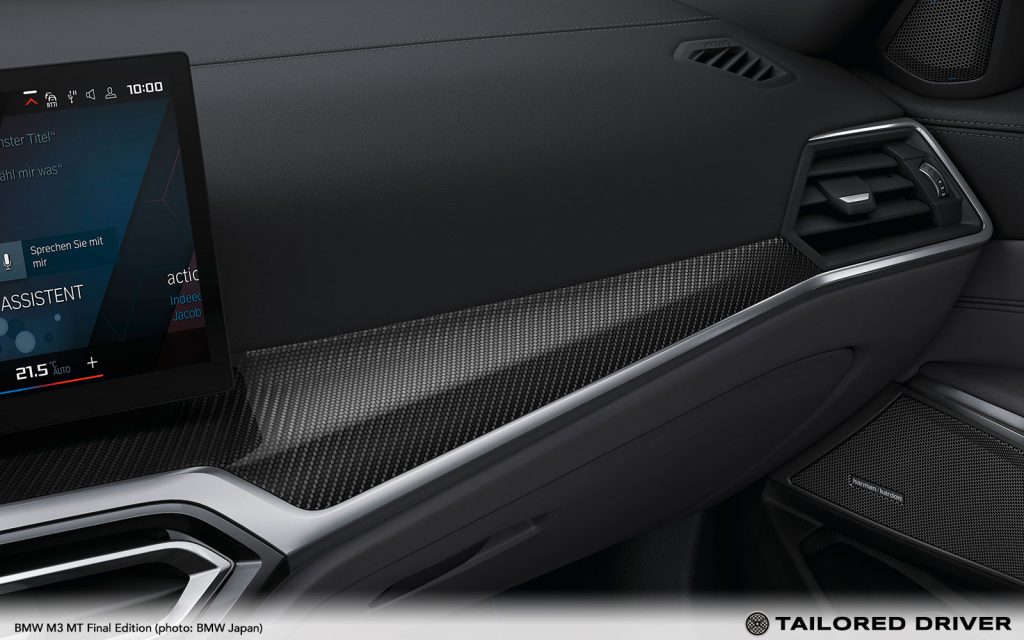
BMW Co., Ltd. (President: Masatoshi Hasegawa) is a limited edition car equipped with a manual transmission on the BMW M3 “BMW M3 MT Final Edition (M3 MT) From today until 11:59 p.m. on March 27 this year, orders will be accepted only on the order acceptance website. It will be introduced in Japan, limited to 150 units, and if the number of orders exceeds the limited number, the winner will be determined by the end of May this year by the strict lottery. The car is scheduled to start after the second quarter of this year.
There are two categories of high-performance machine M models developed by BMW M. One is an M high-performance model that enables full-fledged driving on the circuit, and the other is an M-performance model that incorporates technology cultivated on the circuit to improve driving performance. The limited edition car “BMW M3 MT Final Edition” announced this time will be positioned as an M high-performance model.
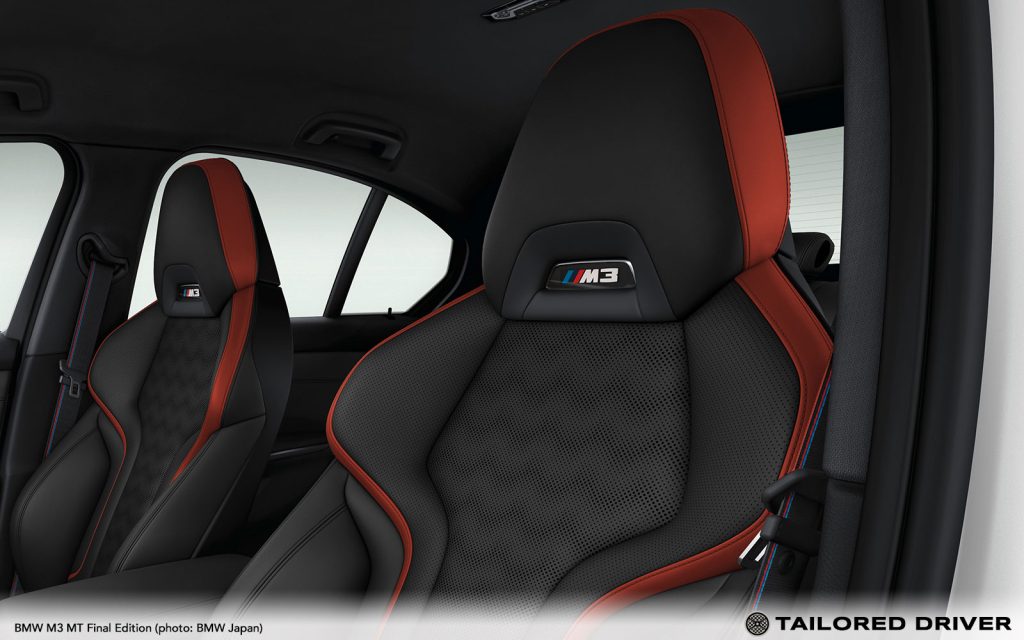
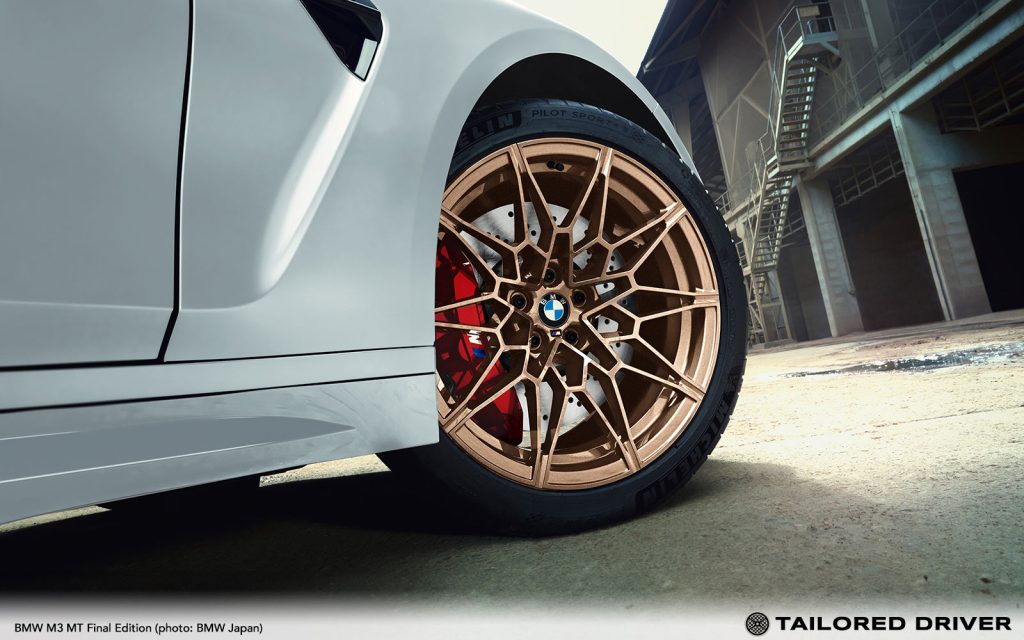
The BMW M3 is a high-performance model with overwhelming driving performance on the circuit, but it is a driving machine that combines practicality in everyday driving in a high dimension as a 4-door model. The limited edition car “BMW M3 MT Final Edition”, which will be created to commemorate the 35th anniversary of the BMW M3’s first victory in the German Touring Car Championship, is a manual trunk that does not normally have a lineup. At the same time, it is a right-hand drive model equipped with a transmission, and at the same time, it is dry when the BMW M3 won the first championship at the German Touring Car Championship, such as dedicated gold-painted wheels and exclusive red accents on the seats. It is a model reminiscent of the racing machine driven by the bar, Roberto Labarria.
In addition, the BMW M3 MT Final Edition will be the last model to be equipped with a manual transmission.
The above manufacturer’s suggested retail price is the vehicle price that does not include accessory prices, taxes (excluding consumption tax), insurance premiums, and various expenses associated with registration.
Right handle, MT specification.
The breakdown of the 150-unit limited exterior colors is 50 aluminum white (weißaluminium; metallic; 825; BMW), 50 black sapphire (schwarzsaphir; metallic; 475; BMW), and 50 M-Brooklyn gray (brooklyngrau; metallic; C4P; BMW).
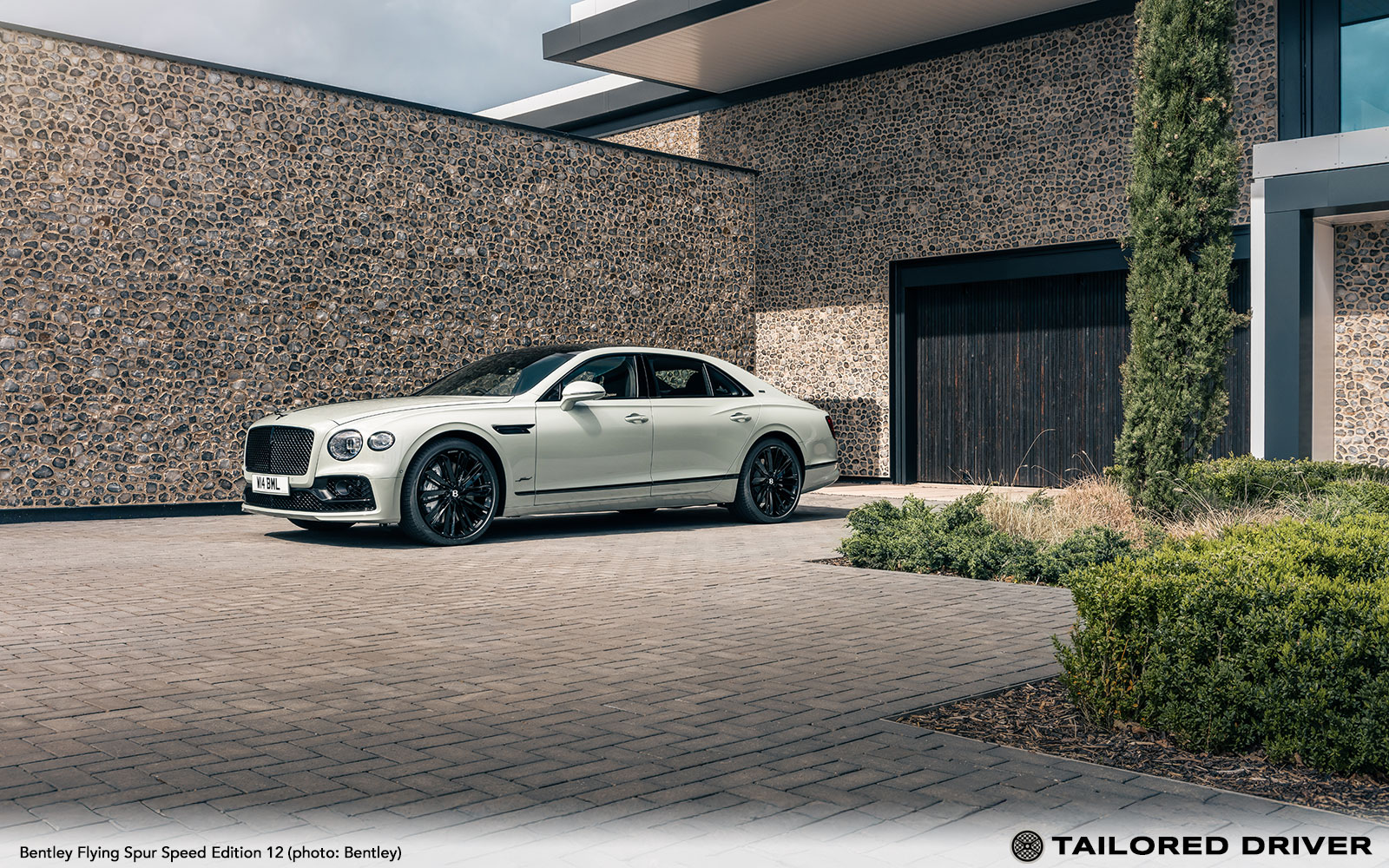
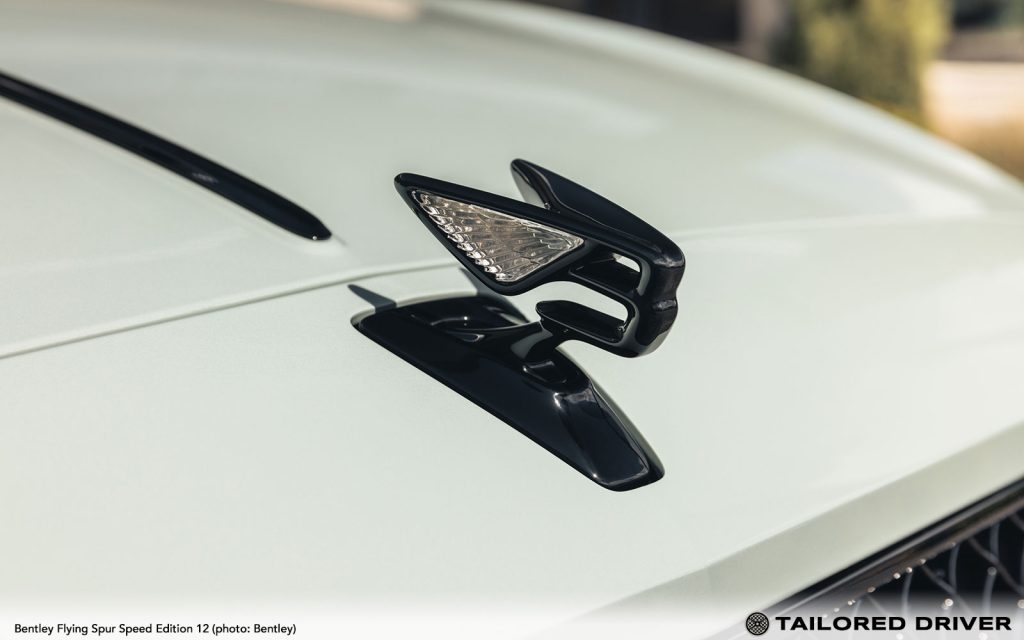
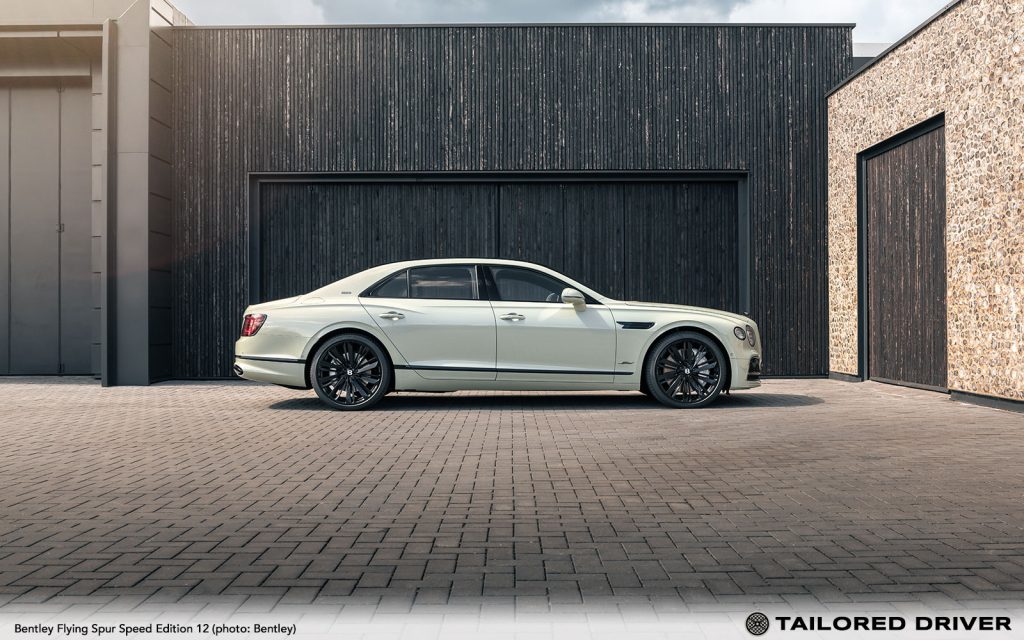
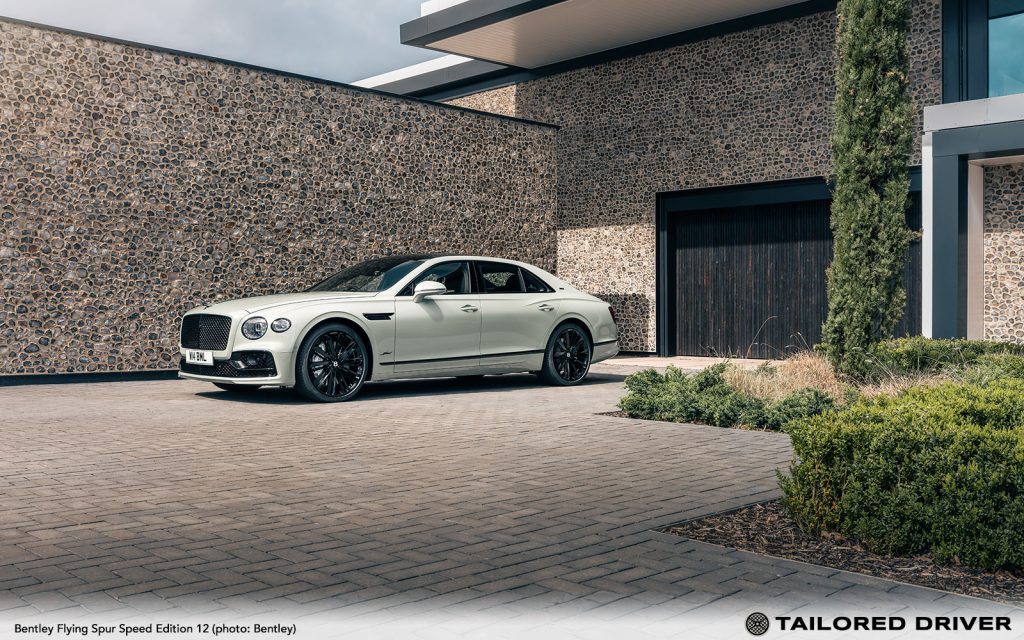
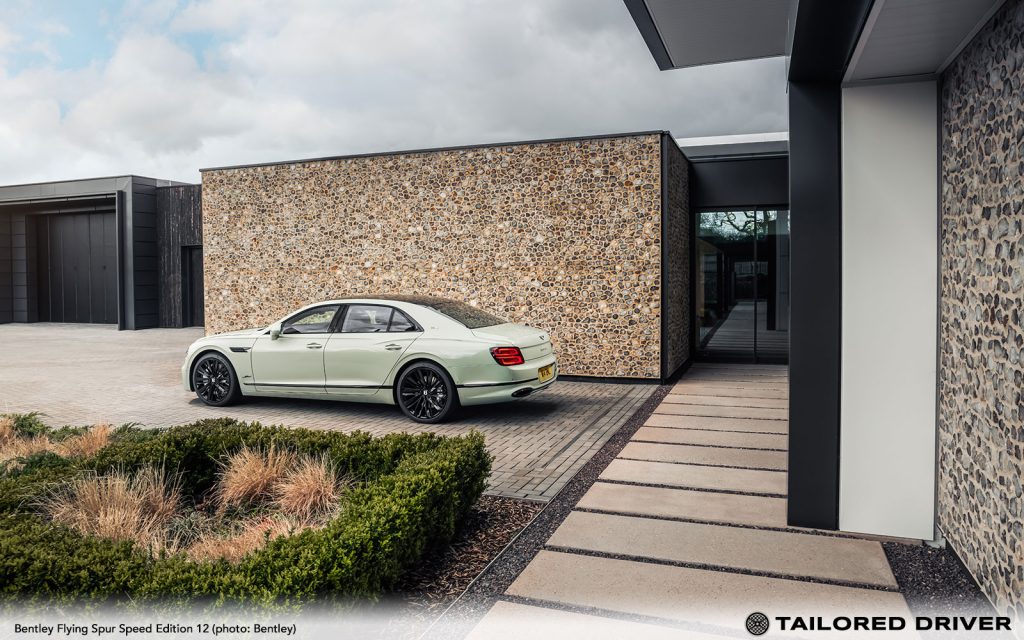
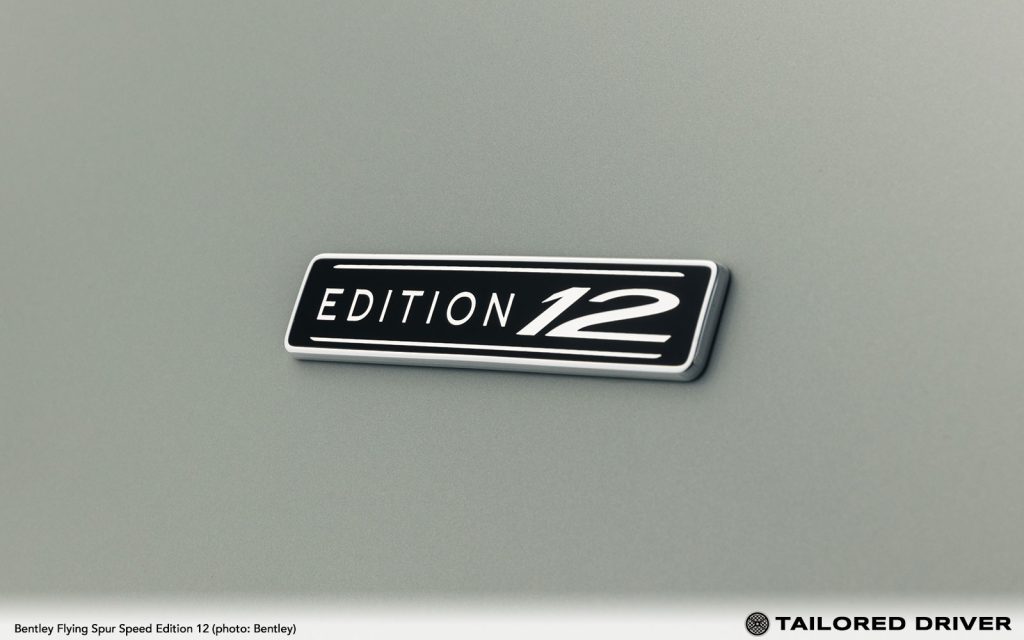
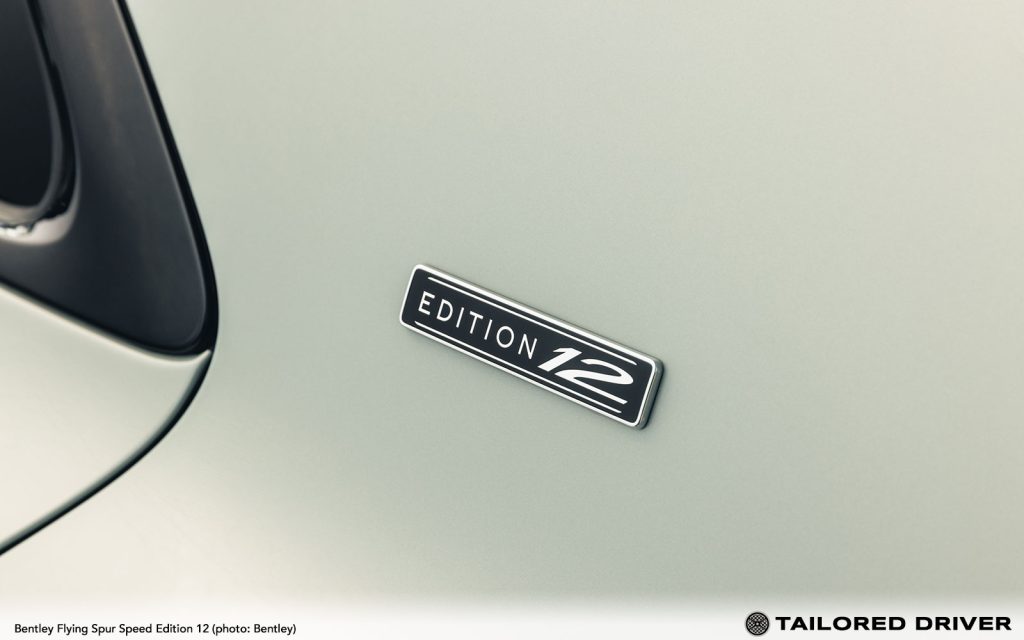
Limited Edition Flying Spur Speed Edition 12 celebrates end of an era for Bentley’s iconic W12 engine
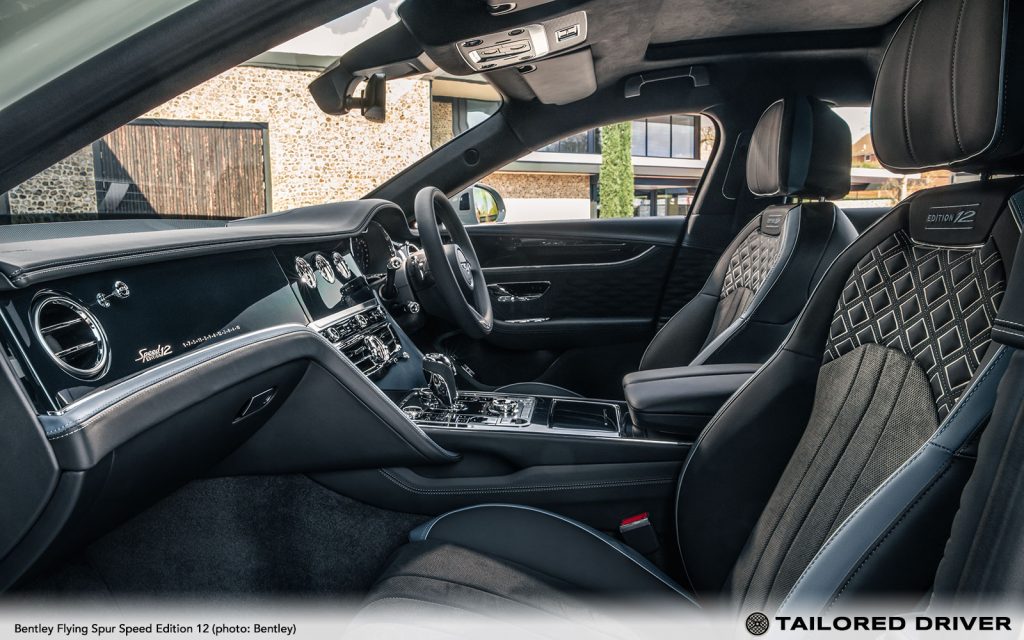
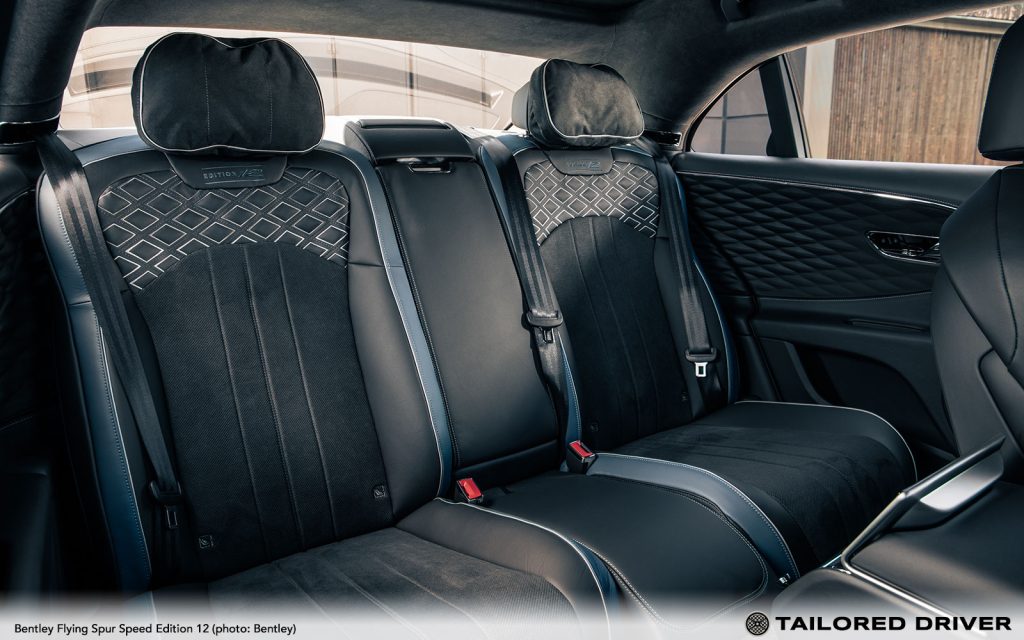
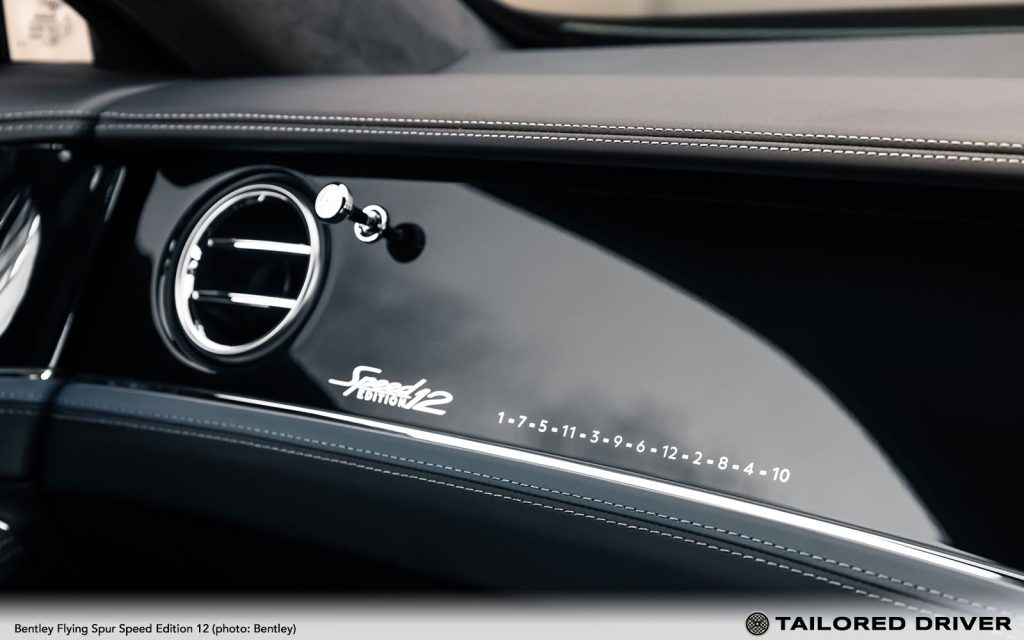
Final Speed Edition 12 cars feature unique fascia engine display and commemorative scale model of legendary W12 engine
Bentayga EWB First Edition and Continental GTC Mulliner V8 also displayed at Belgian Riviera event
[source: Bentley]
Münich, Germany – Bentley Brussels, Knokke and Antwerp will showcase one of the final vehicles to be fitted with the luxury British automotive brand’s legendary W12 engine at the Zoute Grand Prix, a week-long series of exclusive automotive activities held on the Belgian Riviera.
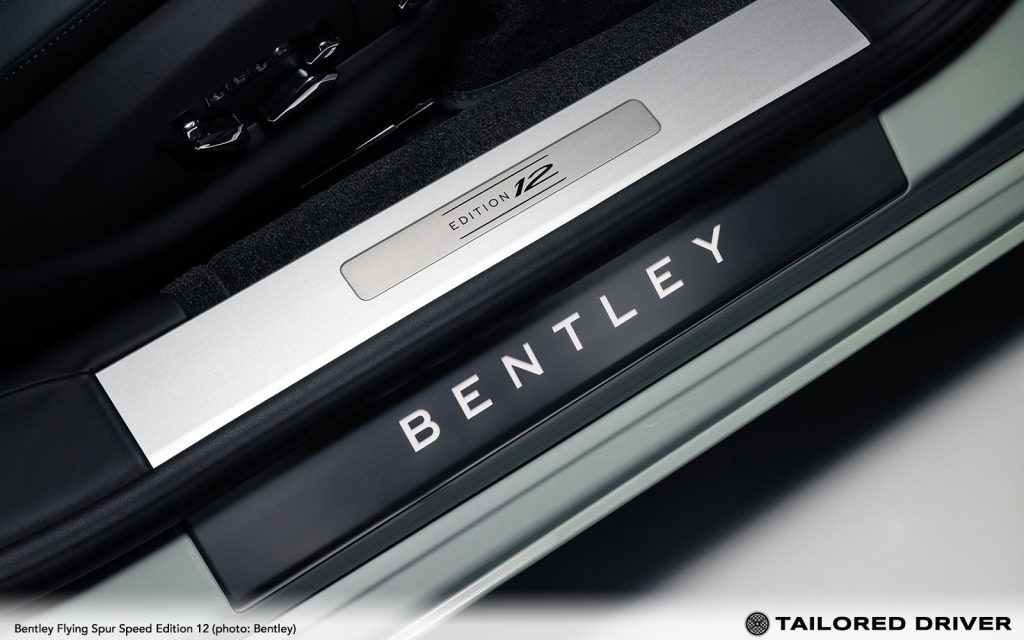
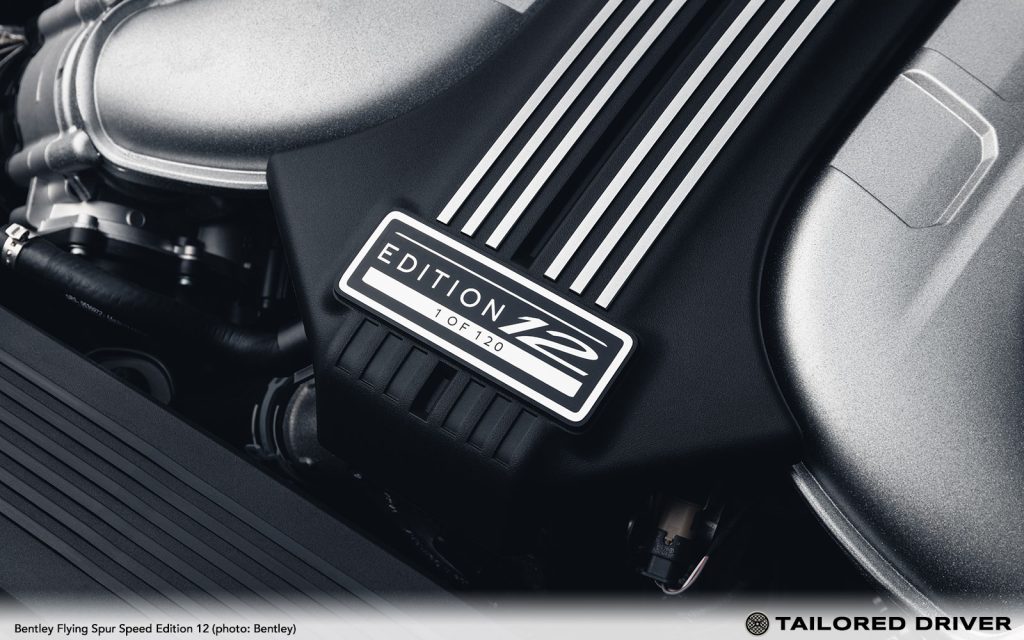
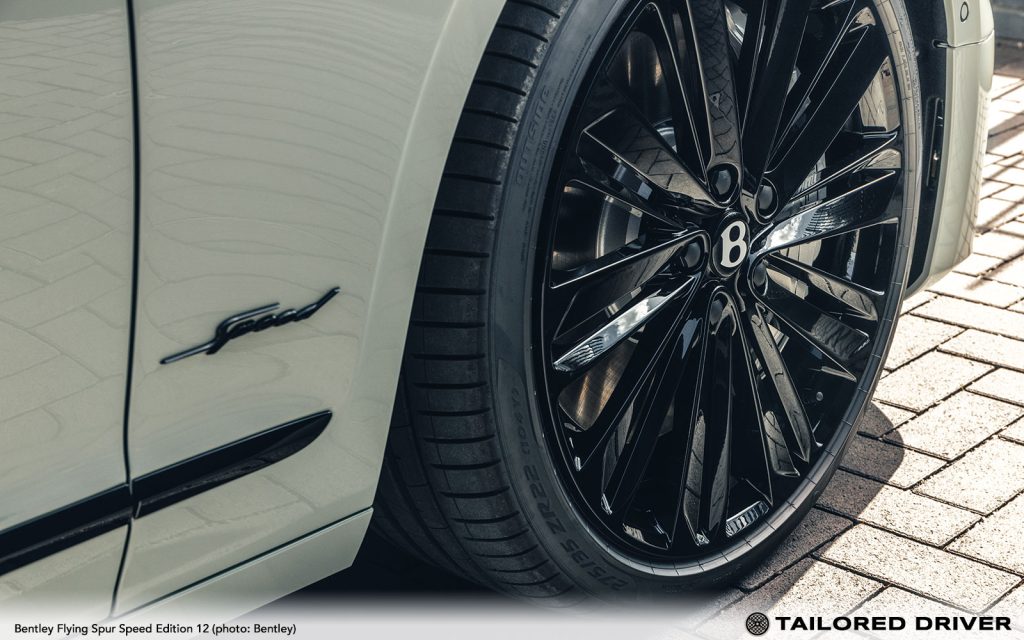
The full Bentley range will be displayed at the Prado, a Bentayga EWB, a Continental GTC as well as a Flying Spur Speed Edition 12. The Flying Spur Speed Edition 12 is one of the only 120 examples to be built, a supremely powerful sedan that pays homage to Bentley’s 6.0-litre W12 unit, which is due to end production in 2024 and ordering in a few weeks in Europe.
The W12 engine ensures the Flying Spur Speed 12 is one of the fastest, four-door sedans in the world. Capable of 0-100 km/h in 3.6 seconds and a top speed of 333 km/h, the phenomenal W12 also produces 659 PS and 900 Nm of torque. First introduced in the original Continental GT in 2003, the engine has since become an icon of Bentley’s DNA.
A genuine collector’s car, the Flying Spur Speed 12 Edition is also afforded a range of unique commemorative features. The dashboard fascia displays a visual representation of the W12’s firing sequence, while every owner will receive a scale model of the engine, handcrafted from a genuine recycled W12 block and housed in a special presentation case. A full-size example of a W12 engine itself will be on show alongside the Flying Spur Speed Edition 12.
Bentley will also showcase the Bentayga EWB First Edition V8, in eye-catching Pale Brodgar (palebrodgar; metallic UNI; 6754 / 9560180; Bentley) over Brodgar (brodgar; metallic UNI; 6753 / 9560179; Bentley) two-tone paintwork. Inside, the luxurious SUV features a colour split interior of Portland and Burnt Oak hide, with Dark Stained Burr Walnut veneer. A Continental GT Convertible Mulliner V8 will complete the trio of Bentley models. This open-air tourer is painted in Onyx, complemented by a Cambric lightweight cotton interior in Linen, with contrasting Beluga hide, finished with a Grand Black with Diamond Milled trim.
All visitors are welcome to the Bentley stand at the Zoute Grand Prix in Knokke-Heist, Belgium, which is taking place from October 5 – 8.
Bentley is represented in Belgium by D’Ietern Luxury Performance Group and operates from Bentley Antwerp, Bentley Brussels and Bentley Knokke.
Iconic 1953 Grand Tourer inspires one-off Continental GT Azure
Historic specification based on Bentley’s own R-Type Continental – JAS 949 – on its 70th birthday
Recreated through the use of Mulliner’s Personal Commissioning Guide – the doorway for unlimited personalisation
Heritage paint, luxurious rich interior and finished with unique crafted cross banding and bespoke inlays
70 years of craftsmanship, design and innovation span the two coupés
Continental GT Azure offers wellness and comfort to provide a modern magic carpet
New model joins Bentley’s UK press fleet
Iconic Grand Tourer photographed at an iconic location
[source: Bentley]
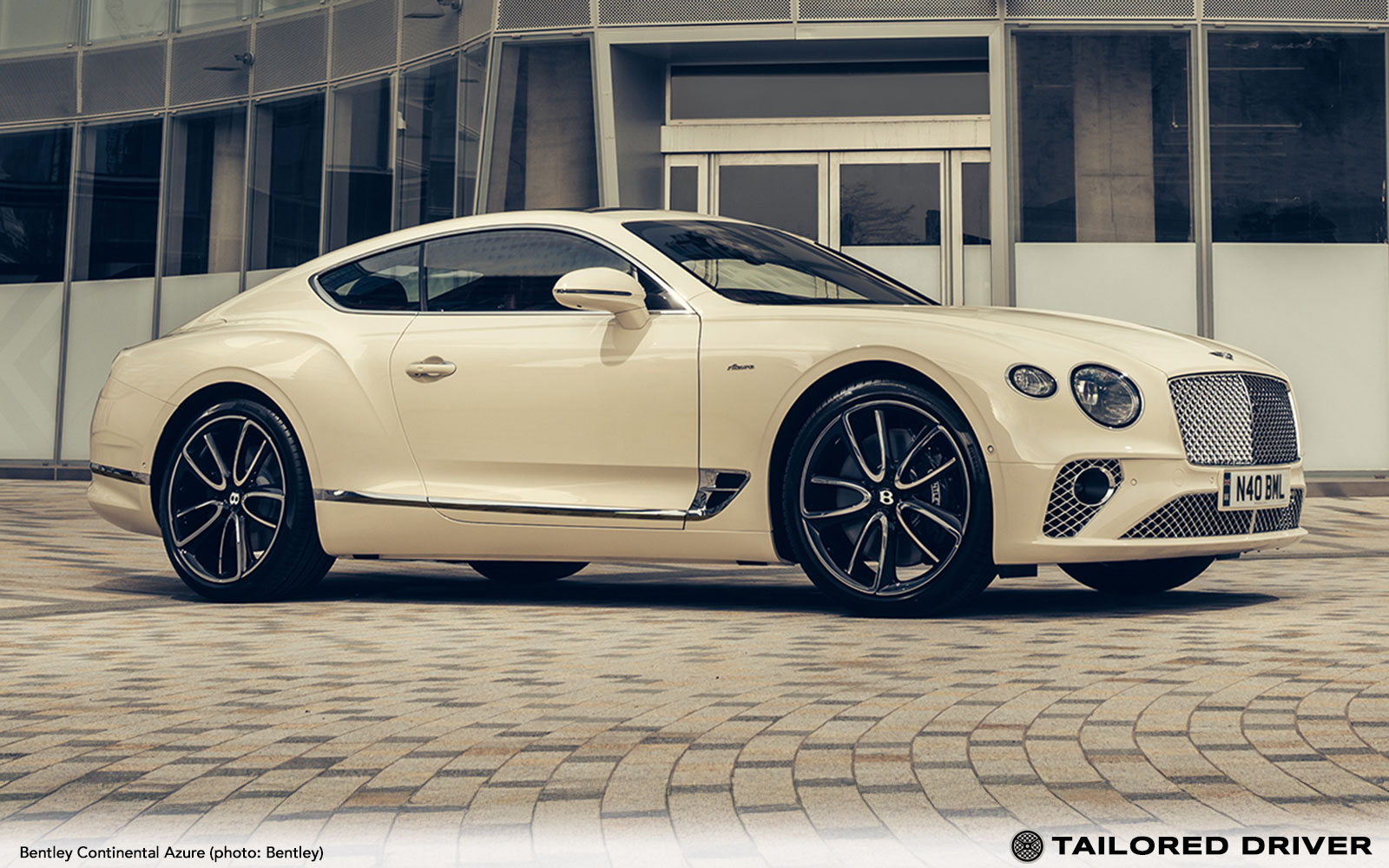
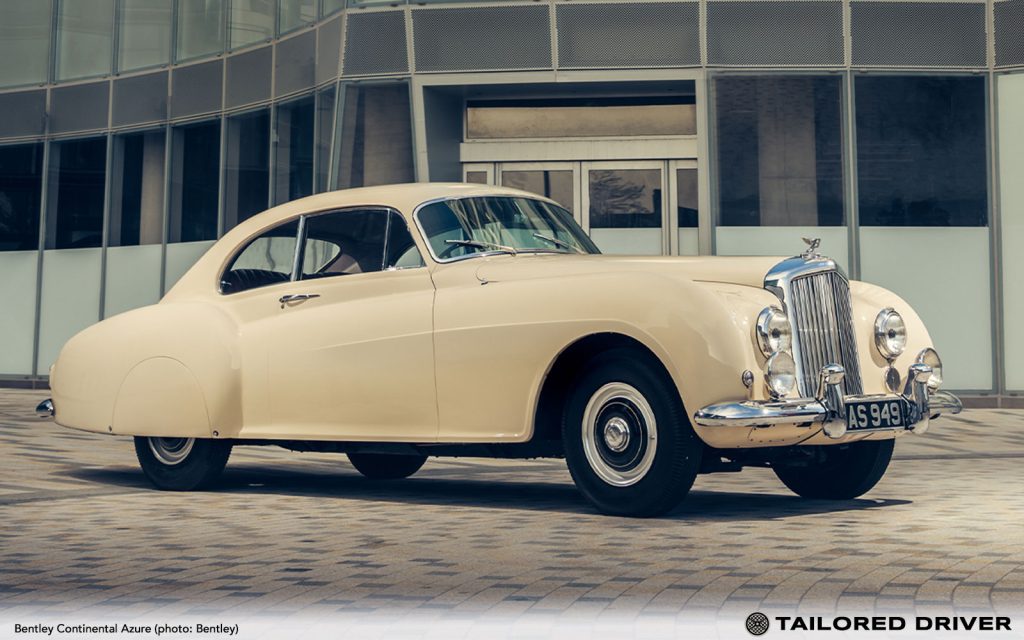
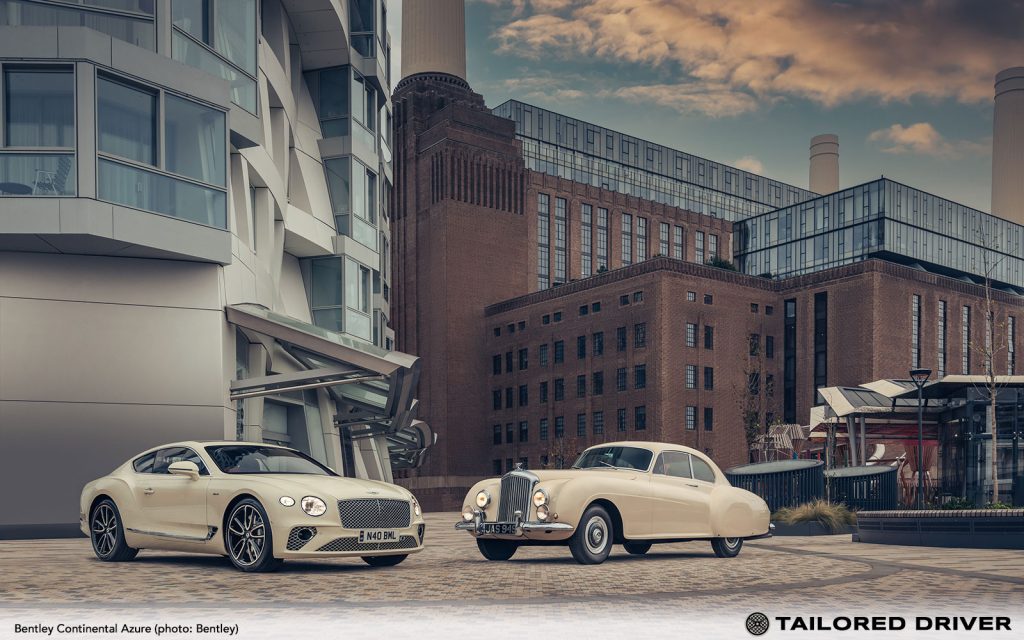
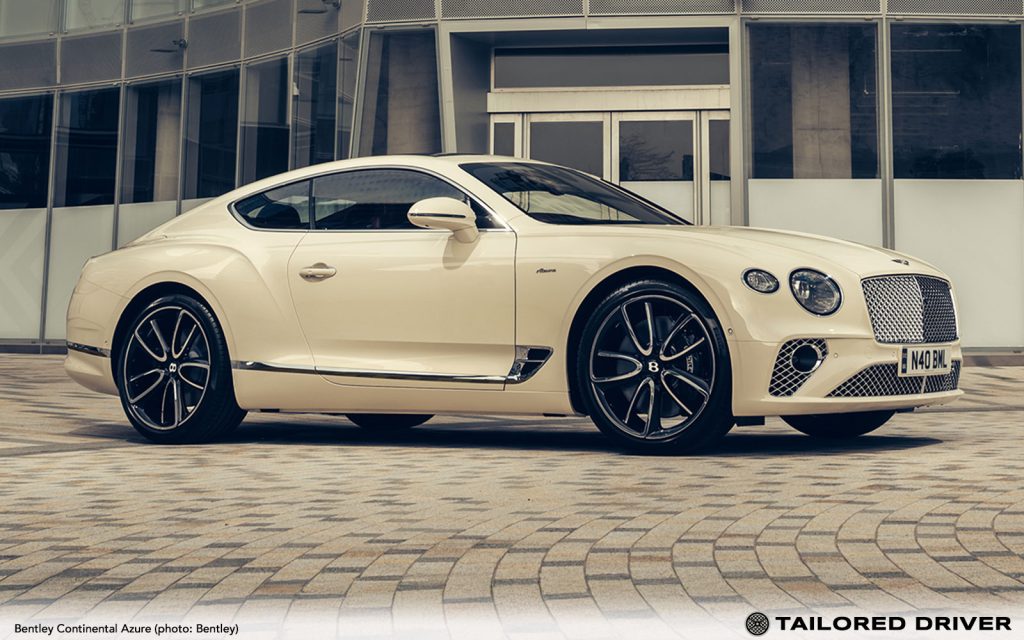
Crewe, England – Bentley Motors has handcrafted a unique and one-off Continental GT Azure, inspired by Bentley’s retained example of the iconic R-Type Continental, JAS 949. The new Continental GT is in honour of JAS 949’s 70th birthday, celebrating one of the important style icons in Bentley’s history. JAS 949 is one of only 208 examples of the R Type Continental ever built – but the car had a greater impact than the limited numbers suggest. The beautiful Bentleys old and new have been photographed at an equally spectacular London landmark that is itself a 21st century reinvention of a 1950s icon – Battersea Power Station in south London.
Quoted as ‘a modern magic carpet which annihilates great distances’ the R-Type Continental was the fastest four-seat luxury saloon in the world when launched in 1952. The three key design lines of the car – the power line from the front wheel, the rear haunch and the roofline – were the inspiration for the first generation Continental GT in 2003 and every Continental GT since. The latest Azure members of the Continental GT family continue to celebrate elegance and timeless design, directly descended from the R-Type Continental, while adding a focus on wellbeing behind the wheel.
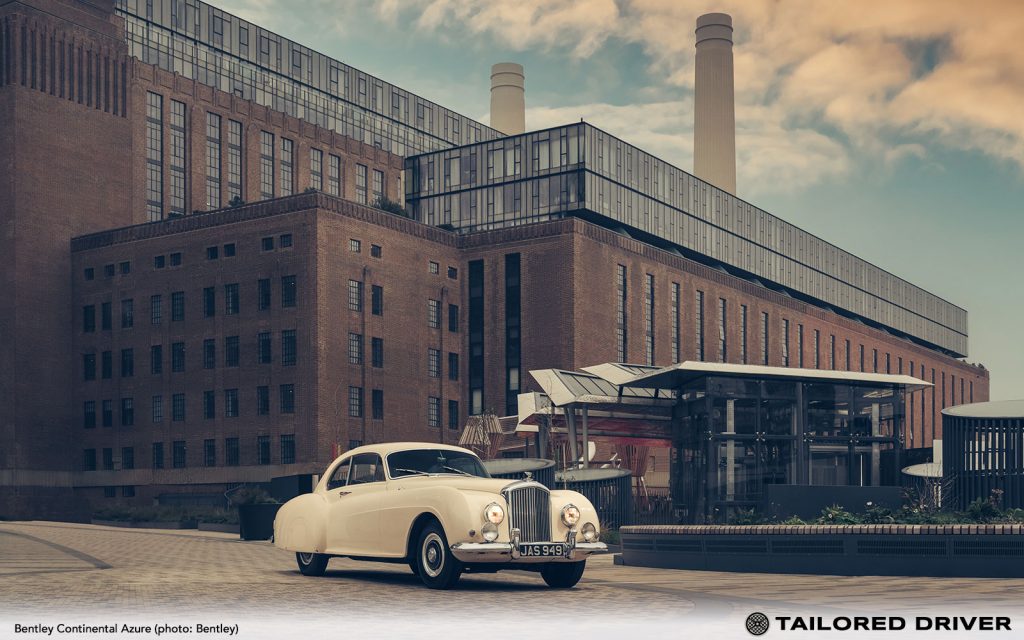
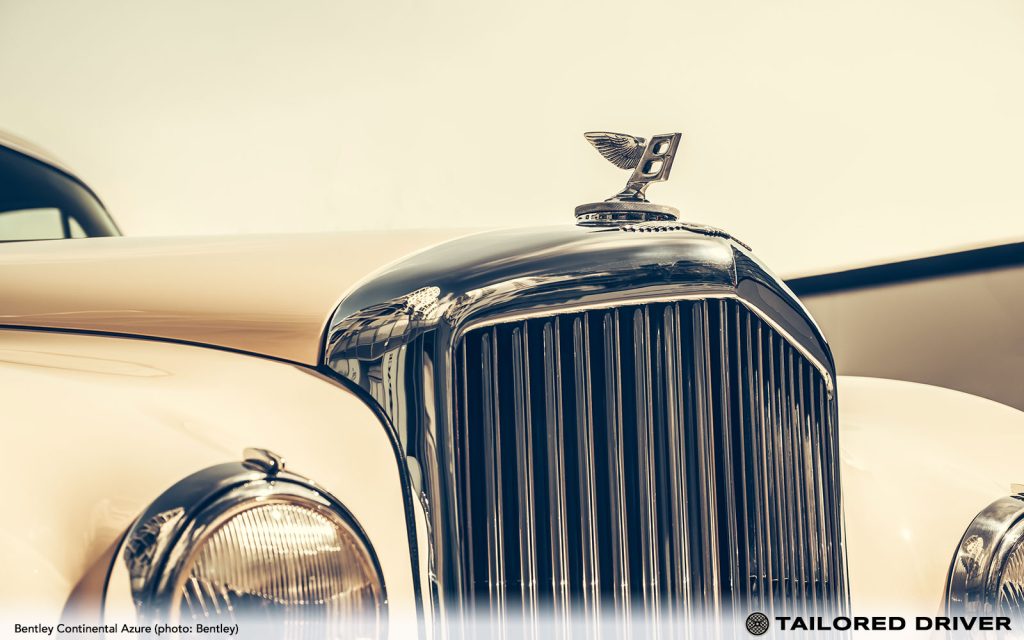
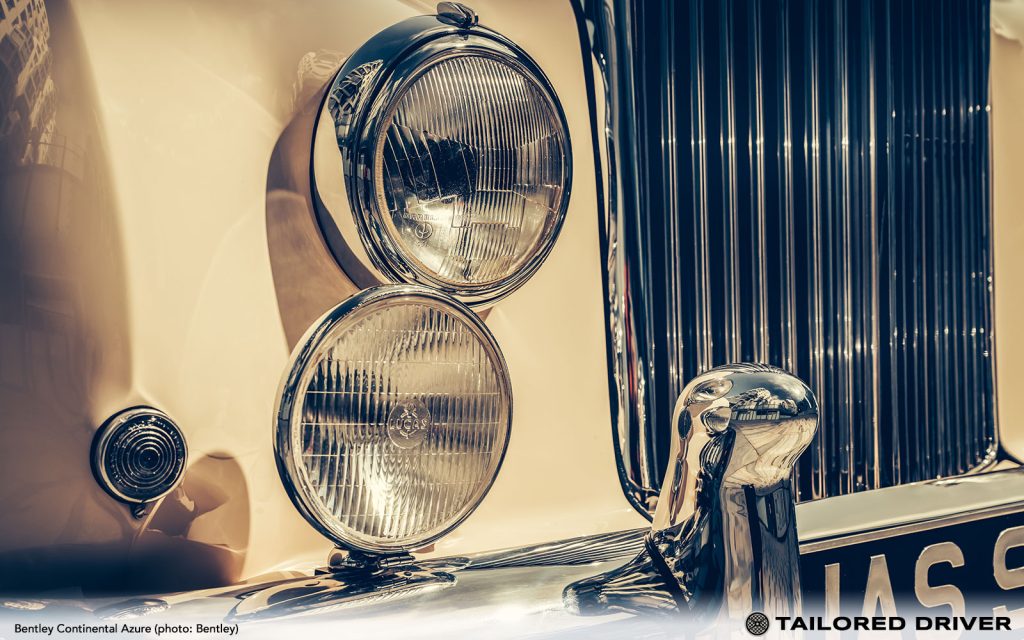
Using Mulliner’s Personal Commissioning Guide, the new Continental GT Azure has been curated in homage to one of the most iconic members of Bentley’s 43-car Heritage Collection. JAS 949 is Bentley’s own R-Type Continental, and resides in the newly opened Heritage Garage at Bentley’s carbon-neutral campus in Crewe. Bentley acquired JAS 949 in 2001 and has maintained it in excellent mechanical order while sympathetically preserving its patina. The car is driven on the road on a regular basis.
JAS 949 was delivered to its first owner, Dr Rowland Guenin of Switzerland, in December 1953. It was ordered in Ivory with a Red interior and a manual gearbox, a specification it retains today along with the original 4.6-litre engine.
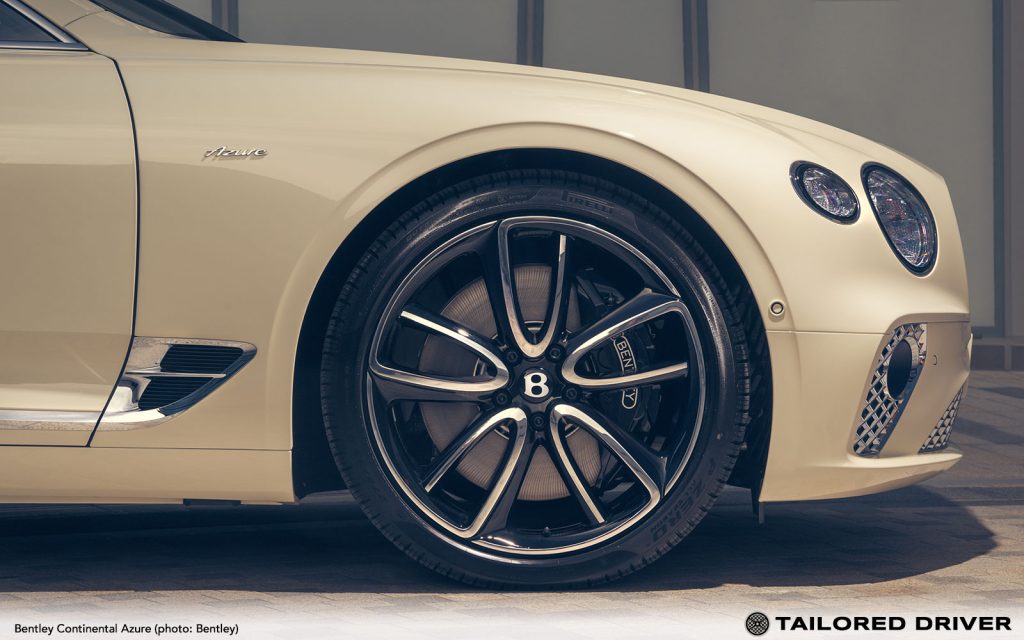
To recreate the closest specification for the modern interpretation of JAS 949, a new Continental GT V8 Azure has been hand painted in Old English White (oldenglishwhite; non-metallic; 6964 / 9561066; Bentley) – a faithful re-creation of the heritage paint colour that dates back to the 1950s. As per the muse, the Continental GT is fitted with bright chrome (including the matrix grille). While JAS 949 rides on 16” wheels, the newer version runs on 22” hand-finished wheels, in a black and polished finish as per the original.
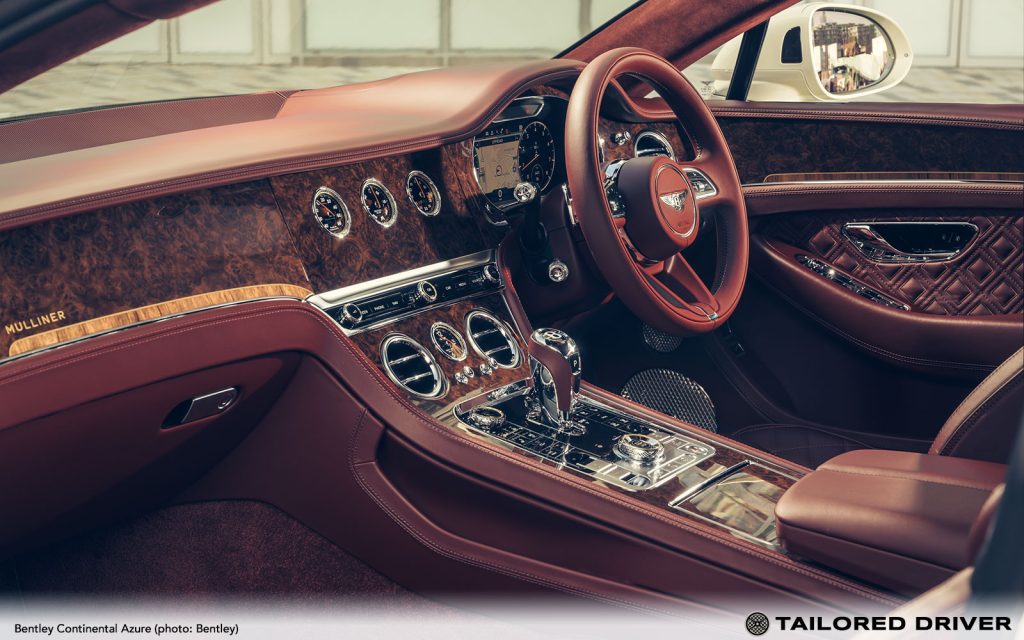
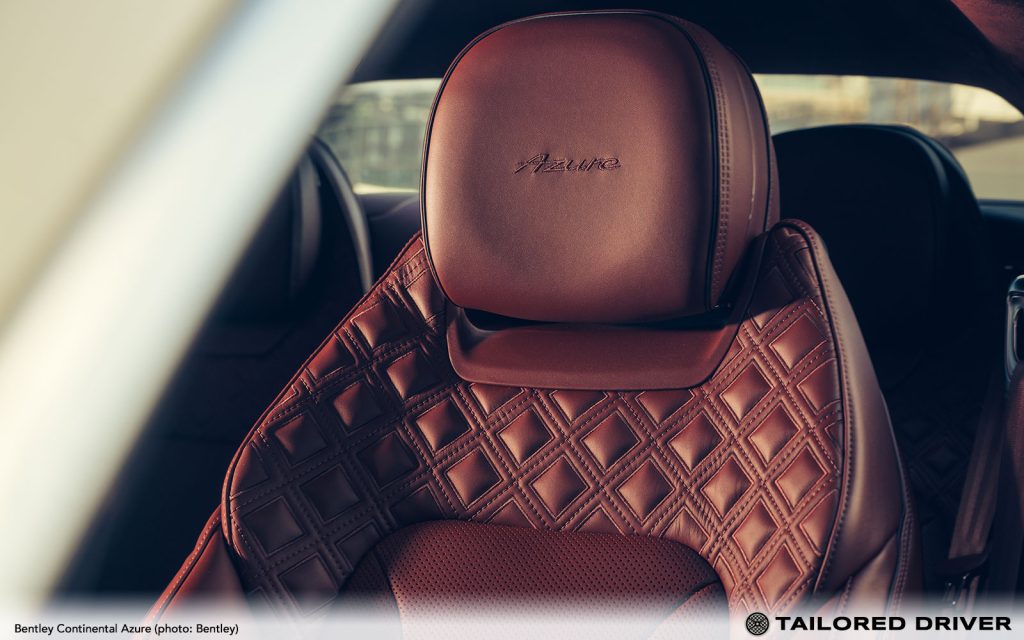
Inside the beautiful cabin, Cricket Ball leather can be seen throughout providing a cosseting, deep and rich heritage feel for the driver and passengers and mirroring the hide colour of JAS 949. To provide contrast and to preserve the design lines of the cabin, hand-applied piping in Beluga leather brings accents to the seats.
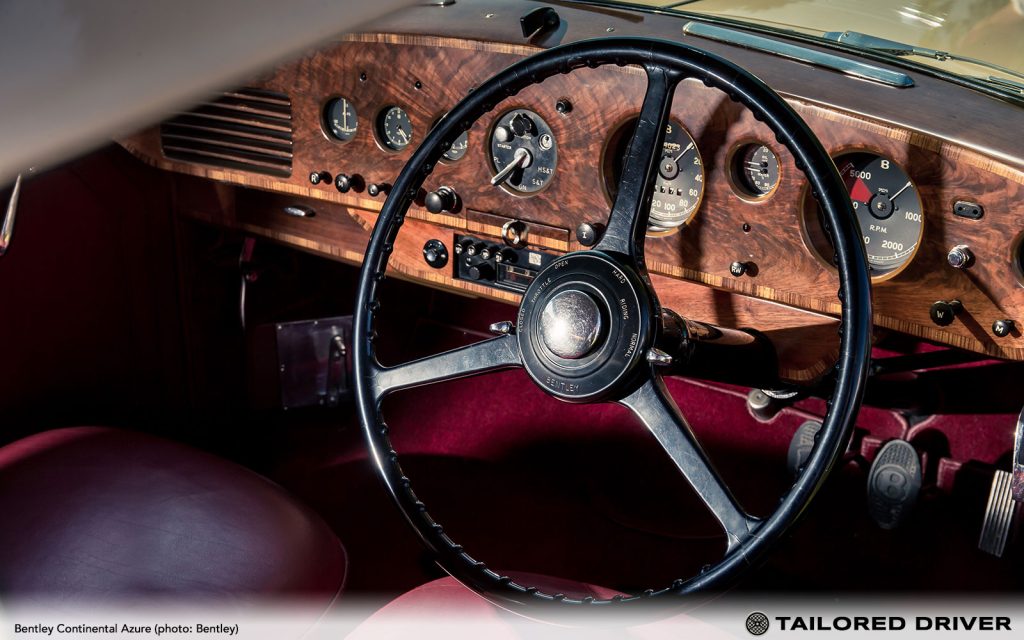
Adding a contemporary aspect, the Burr Walnut veneer has been left as open pore, providing a closer texture to the patinated finish in JAS 949. Selected from only the very best, most figured stock available, open-pore veneer is painted with just three ultra-thin layers of lacquer, together totalling only 0.1 mm in thickness. By comparison, Bentley’s High Gloss lacquer coating is 0.5 mm thick and has a glossy, smooth finish. Each layer is applied by hand and sanded between applications, ensuring the lacquer sticks to the natural grooves of the wood. The resulting finish is wax-like and perfectly highlights the authentic, natural colour and texture of the wood species.
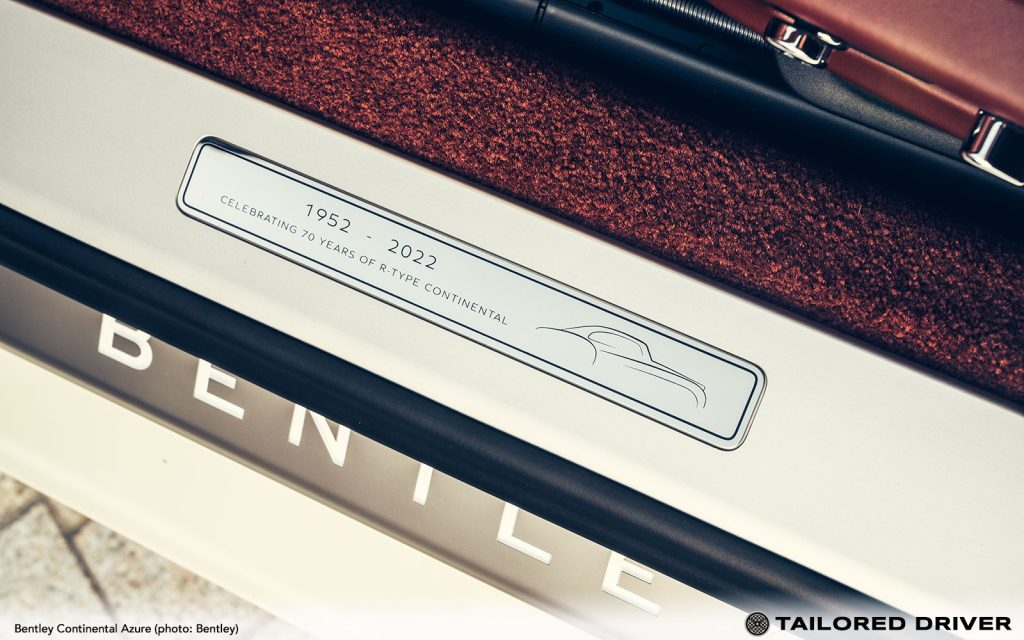
Through Bentley’s revered craftsmanship, cross banding inlays are still available today. Reflecting the interior details of JAS 949, the cross banding of the new Continental GT Azure uses Australian straight grain veneer with a boxwood inlay, enhanced with a Bentley Mulliner overlay in a rich gold. The finishing touches of the silhouette of the R-Type Continental have been added to the fascia veneer and interior treadplates to complete the cabin.
The Development Of The Original R-Type Continental
The brainchild of Chief Projects Engineer Ivan Evernden and Chief Stylist John Blatchley, the R-Type Continental set a template that continues to inspire Bentley designers.
Two pre-war coachbuilt specials, the ‘Embiricos’ Bentley and Corniche, had shown the advantages of improved aerodynamics. In the early 1950s, Ivan Evernden took inspiration from these one-off creations to create a sleek coupé based on the R Type Bentley saloon.
The power of the 4,566cc, six-cylinder in-line engine was raised from 140 to 153 bhp, and the transmission featured a higher final drive ratio. The prototype – OLG 490, nicknamed Olga – averaged 118.75 mph over five laps (with a best lap of just under 120 mph) at the banked Montlhèry track near Paris.
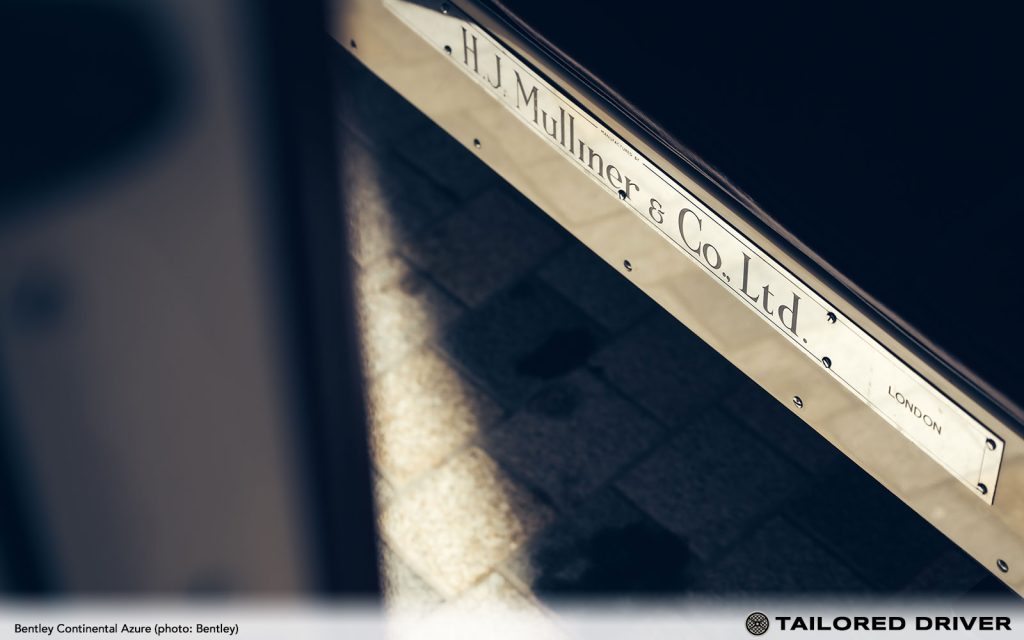
To keep down to the target weight, coachbuilders HJ Mulliner crafted the bodywork, window frames, windscreen surround, backlight, seat frames and bumpers in aluminium. Even at a pared-down weight, tyre choice was critical; no standard road tyre existed which could carry a two-ton car at speeds in excess of 115 mph, and Dunlop Medium Distance Track tyres were specified.
The first production model was delivered to its owner in June 1952 and by the time production ended in 1955, 208 R Type Continentals had been made. Of these, 193 were bodied by HJ Mulliner. Others included Park Ward (four dropheads and two coupés), Franay (five), Graber (three) and Farina (one).
Re-creating A Modern Magic Carpet
The new Continental GT Azure is designed to enhance the wellbeing and comfort of the vehicle’s occupants, making every journey a relaxing experience regardless of distance.
Seating is the foundation for driving comfort and control, and all Bentley Azures feature the Front Seat Comfort Specification as standard. This includes a massage function with six programmable settings which promotes the constant micro-adjustments in muscle and posture that are so vital in preventing fatigue, adjustable side bolsters, electric seatbelt adjustment and comfort headrests.
Another key element of the Continental GT Azure is Bentley Dynamic Ride, Bentley’s 48V active anti-roll control system that enhances ride comfort and limits roll for smoother, more relaxing journeys. The system cushions driver and passengers from excessive movement by electronically decoupling the anti-roll bars when appropriate to smooth the ride, then applying up to 1300 Nm of anti-roll torque in 0.3 seconds when cornering to keep the body flat and stable.
The Continental GT Azure also features as standard, the Touring Specification which includes driver assistance systems, imbuing the driver with a sense of confidence and relaxed control whatever the traffic or weather conditions. Adaptive Cruise Control* maintains a set distance from the vehicle in front, slowing down (to a halt if necessary) when the vehicle in front does so and resuming the set speed once the lane is clear. Together with Lane Assist*, Traffic Assist* and Bentley Safeguard, the Bentley’s suite of on-board radar and camera systems constantly monitor the surrounding traffic and roads and can intervene if necessary to prevent or avoid an accident.
The relaxing and re-energising environment of the Azure cabin, that reduces driver fatigue, through its multisensory and science-informed design, can only help to enhance the safety of the car. Studies have shown that in 20 per cent of all road collisions, tiredness has played a role.
The driver’s sense of relaxed control is further enhanced by the Head-up Display, providing directions and navigation directly in the line of sight, and by Night Vision, which uses infra-red cameras to identify pedestrians, cyclists and fauna outside the beam of the LED headlights.
A History Of Refinement
Bentley is remarkable among automotive brands in that it has always spanned the extremes of performance and refinement. Even in the company’s early days, when the Bentley Boys were racing and winning at Brooklands and Le Mans in their thunderous racing green machines, founder W.O. Bentley was obsessive in his pursuit of smoothness and refinement. “I have put up with a lot of noise in my time, but I don’t like it,” he wrote in his autobiography, adding, “I hate noise for the sake of noise. To me 70 mph in silence is far more creditable than a noisy 80 mph.” Today’s Bentley’s Azures are quieter at 150 miles an hour than anything W.O. Bentley would have experienced at 70.
The new Continental GT Azure now joins Bentley’s UK press fleet, where it will be available for media loans along with the opportunity to drive JAS 949.
R-Type Continental – JAS 949
Continental GT Azure
Date Produced
1953
2023
Body
Two-door, four-seat grand tourer made by HJ Mulliner in aluminium over a steel frame.
Steel and aluminium monocoque, superformed aluminium exterior panels.
Engine
4566 cc 6-cylinder in-line with pushrod overhead inlet, side exhaust valve. Cast iron block, aluminium cylinder head. Zenith downdraft carburettor.
3996 cc V8 TSI, two twin-scroll turbochargers, direct injection, 32 valves with cylinder deactivation. Aluminium block and heads.
Power
153 bhp (114 kW) @ 4000 rpm.
542 bhp (404kW) @ 6000 rpm.
Transmission
Rear wheel drive, 4-speed close-ratio gearbox.
ZF eight-speed dual-clutch gearbox, active all-wheel drive.
Chassis
Independent front suspension with coil springs, wishbones and anti-roll bar. Rear suspension live axle with semi-elliptic leaf springs. Double-acting lever arm dampers; ride control on rear.
Aluminium front double wishbones, aluminium multi-link rear design, 48V active anti-roll bars, three-chamber air suspension, Continuous Damping Control.
An Iconic Photography Location for an Iconic Grand Tourer
Battersea Power Station has been an iconic London landmark for over 90 years. Work began at the site in the late 1920s, and in 1955 the second half of the Power Station, Power Station B, and the landmark’s fourth and final chimney were completed, enabling the station to supply a fifth of London’s electricity at its peak. Bentley Motors too had grown and developed in this timeframe – building from success at Le Mans in the 1920s, and with an established factory in Crewe, the 1950’s saw the introduction of the iconic R Type Continental.
Battersea Power Station was decommissioned in 1983, and sat dormant for nearly 30 years, before a consortium of Malaysian companies purchased the site in 2012 to bring this legendary London landmark and the surrounding area back to life as one of the most exciting and innovative mixed use neighbourhoods in the world. Today, Battersea Power Station is a new neighbourhood for all with a vibrant mix of shops, bars, restaurants, leisure experiences, residences and public realm, with more to come.
The neighbourhood was the perfect place to photograph the new Continental GT Azure and JAS 949 together – with both the cars and the location reflecting the best of the 1950s and the present day.
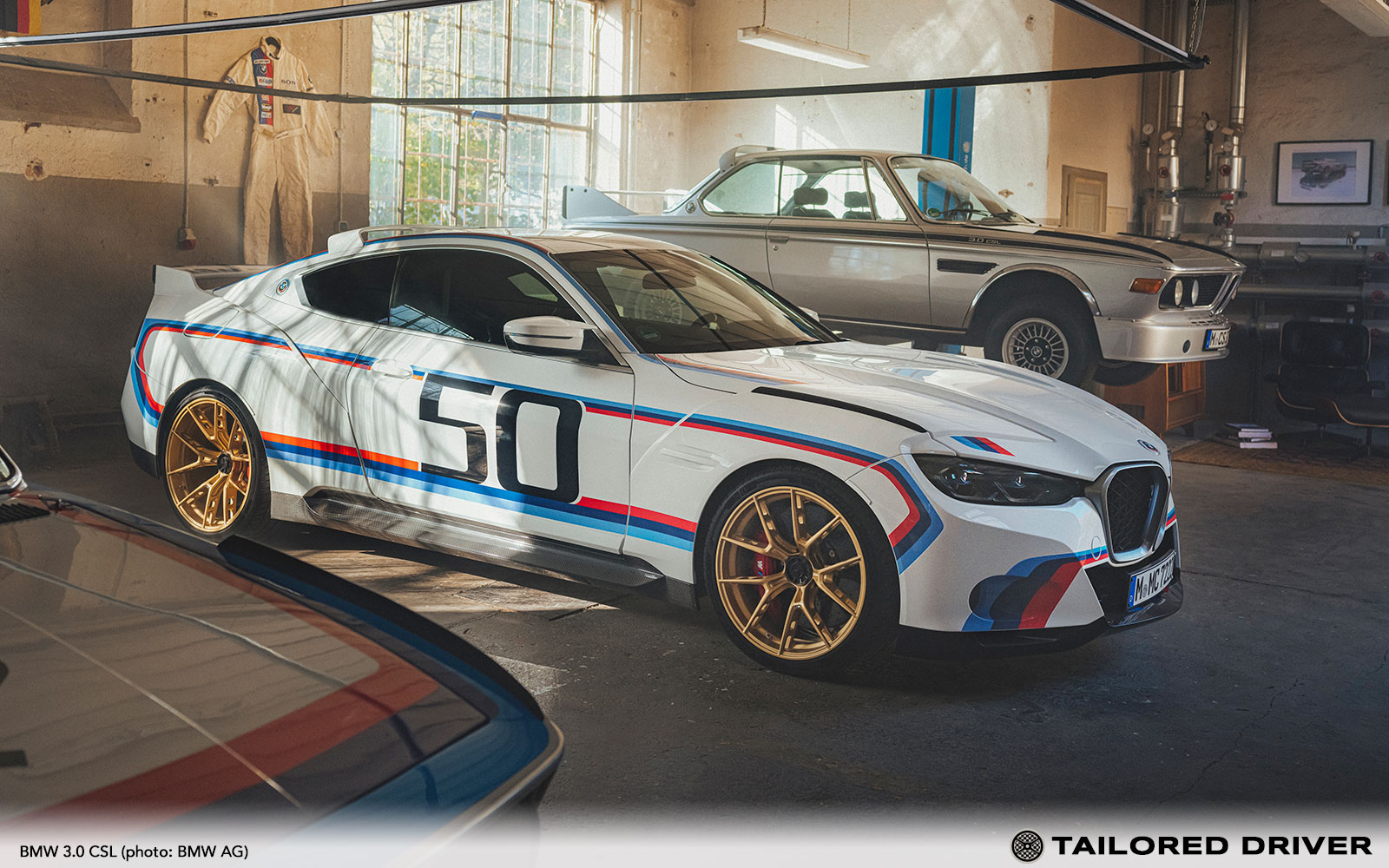
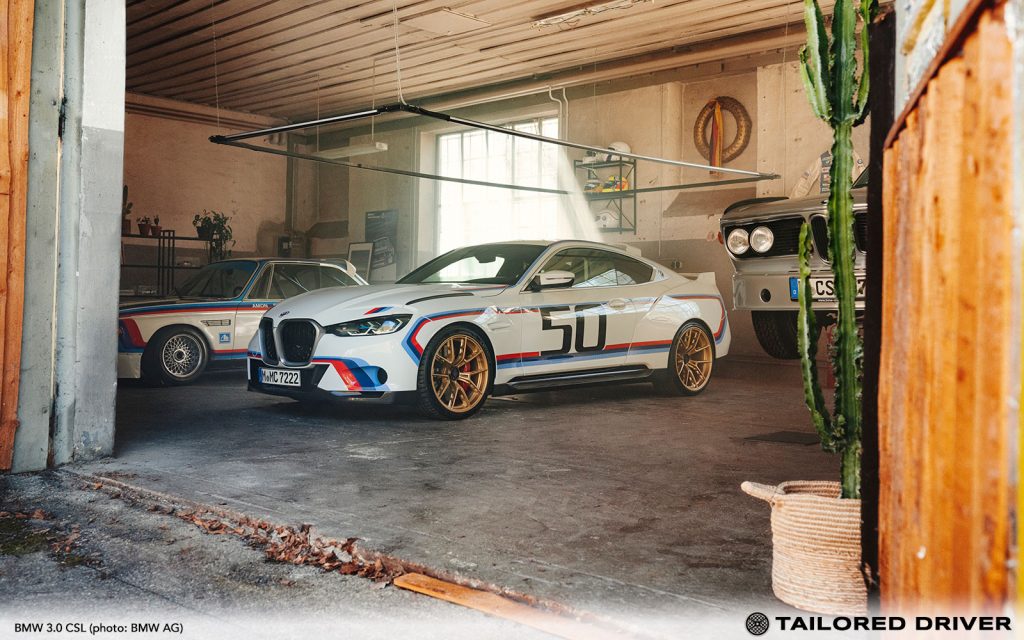
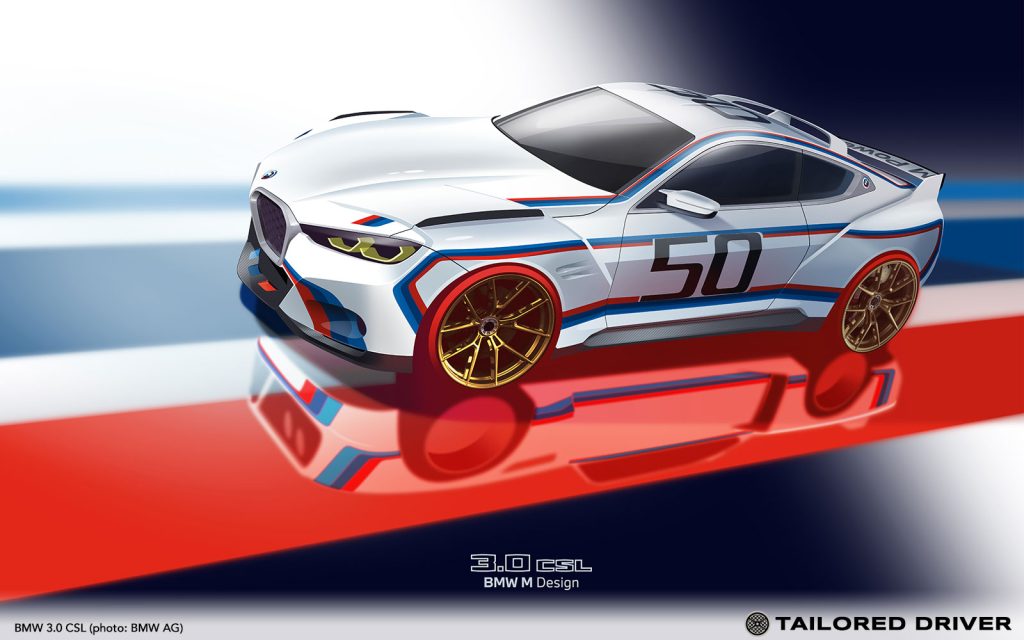
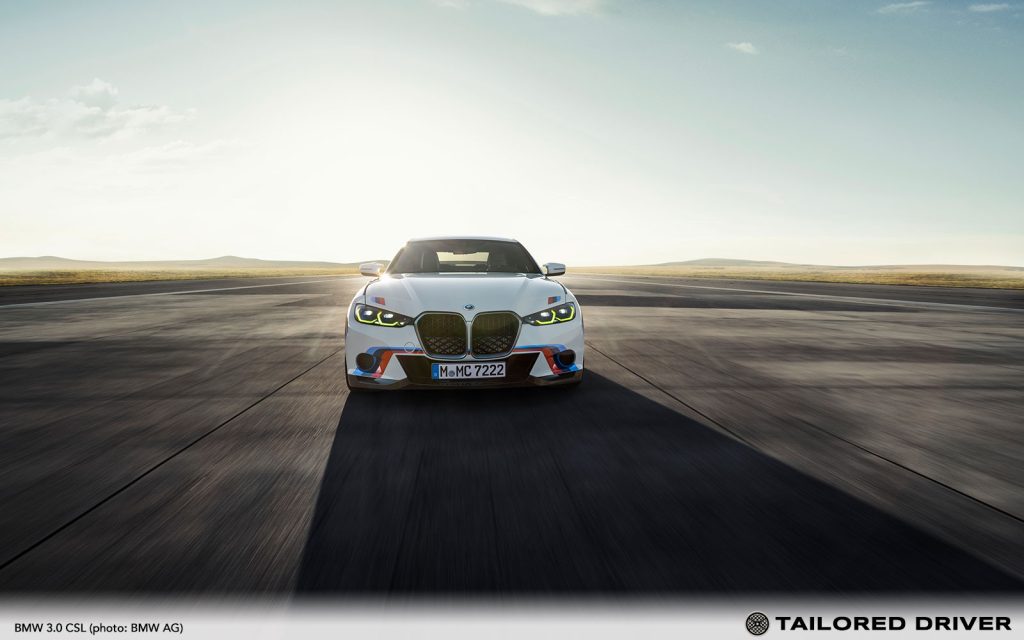
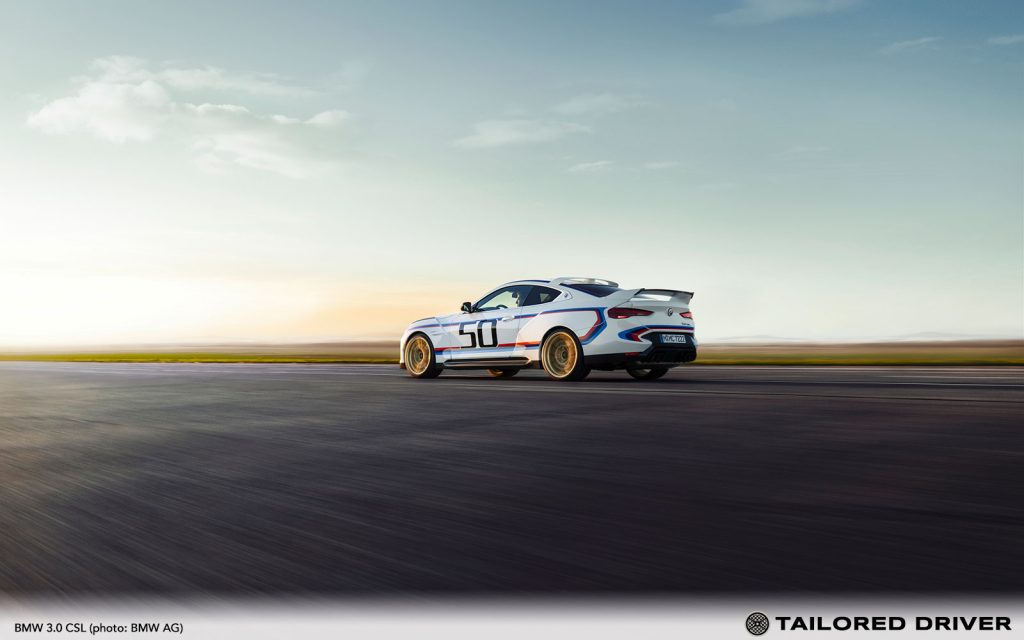
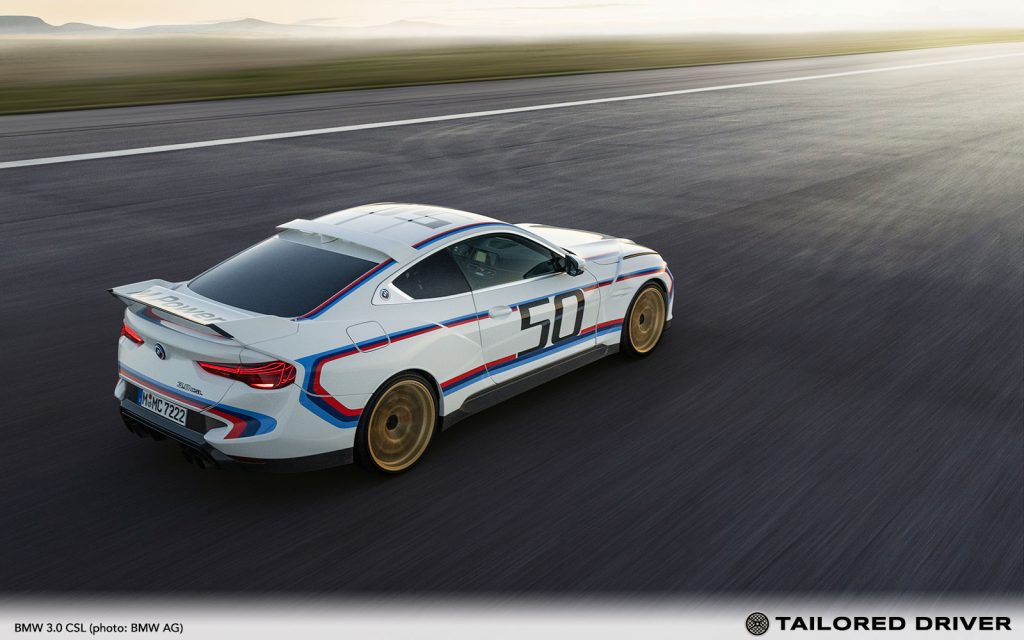
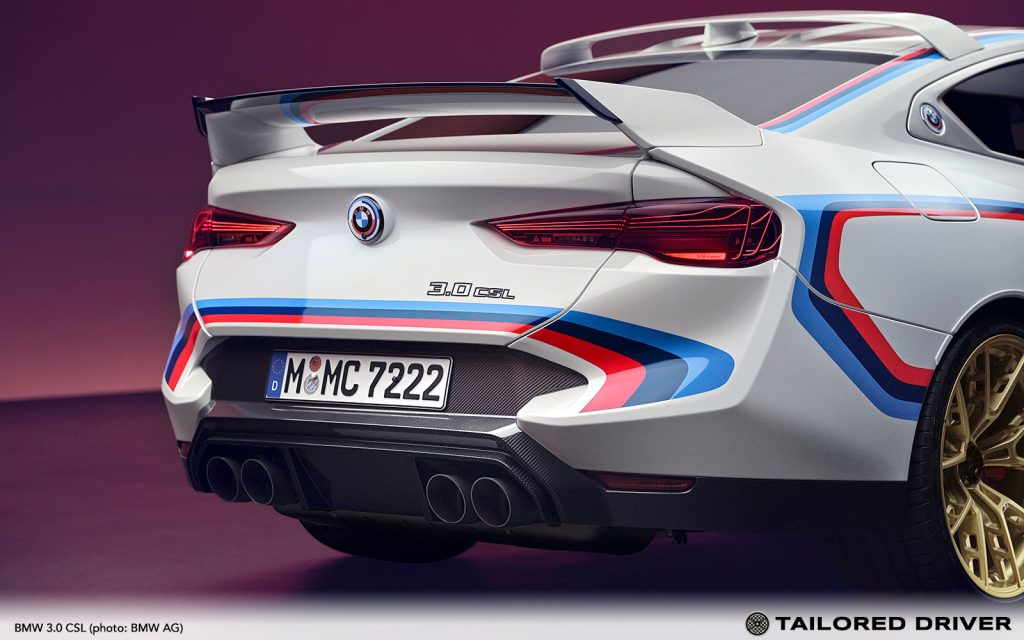
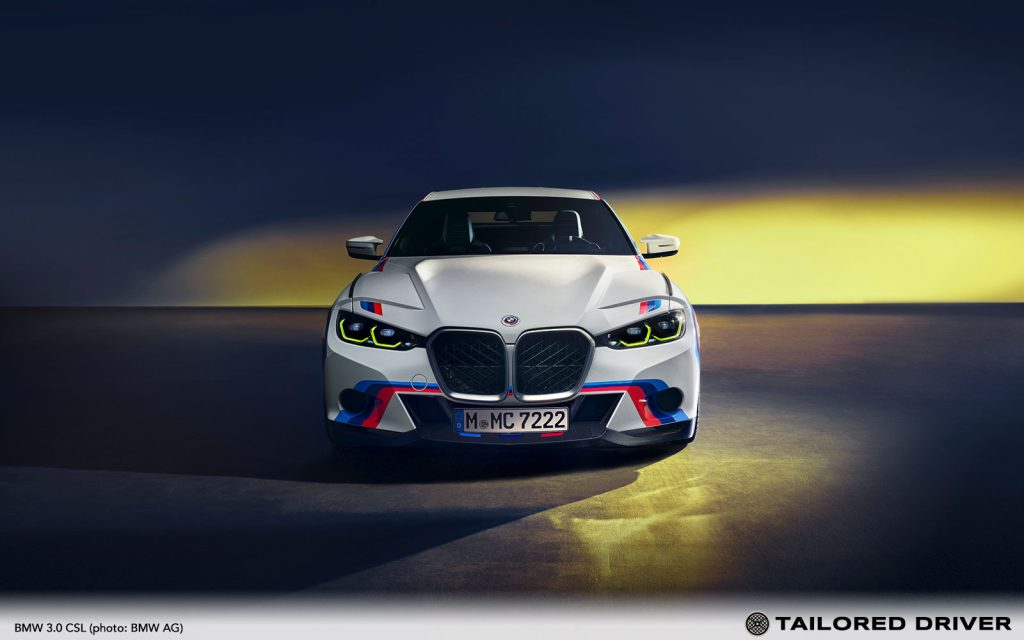
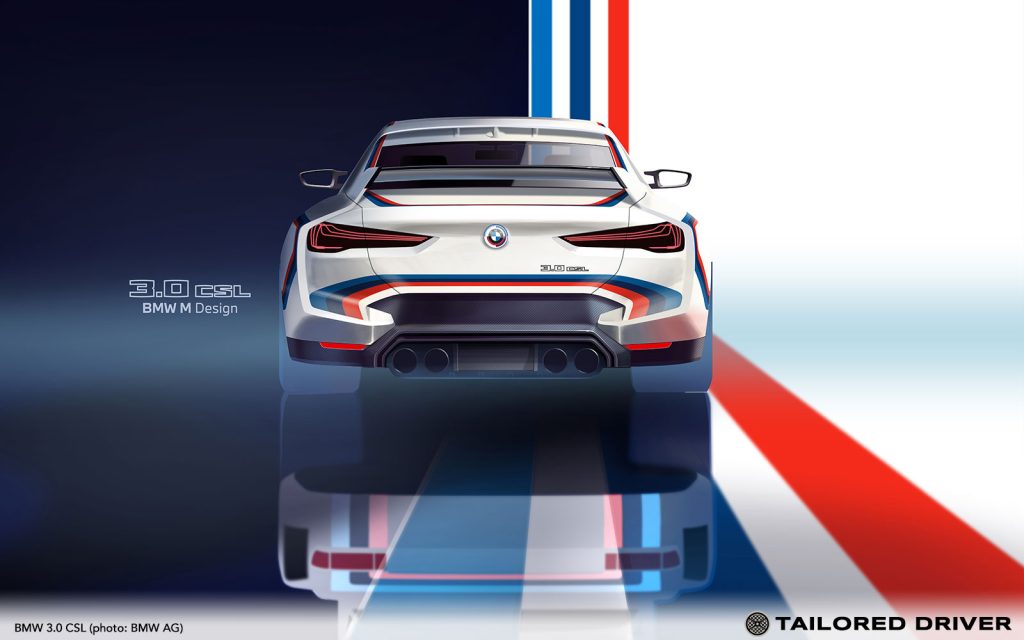
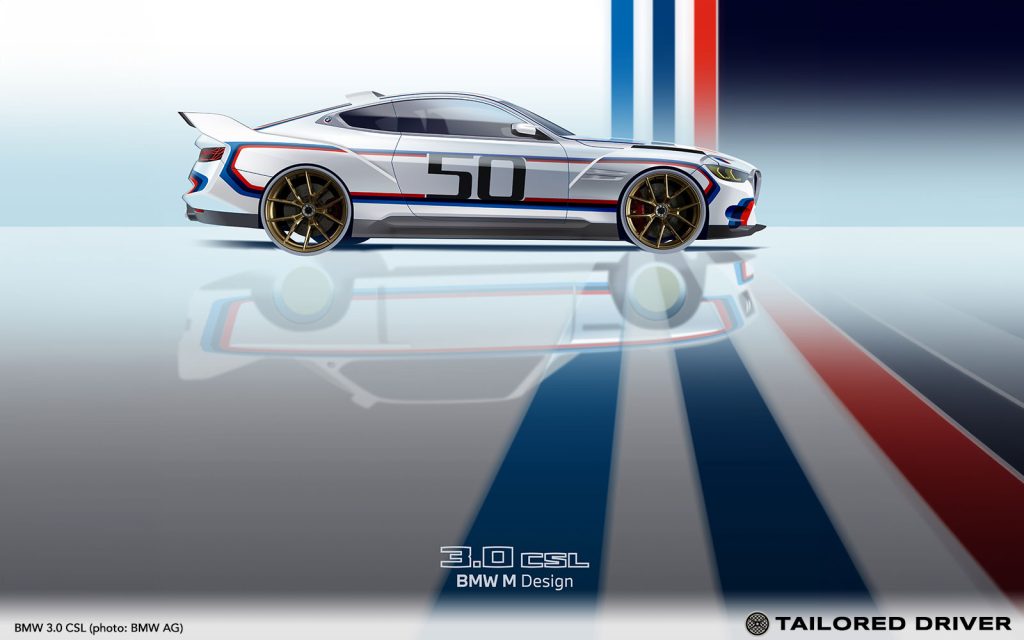
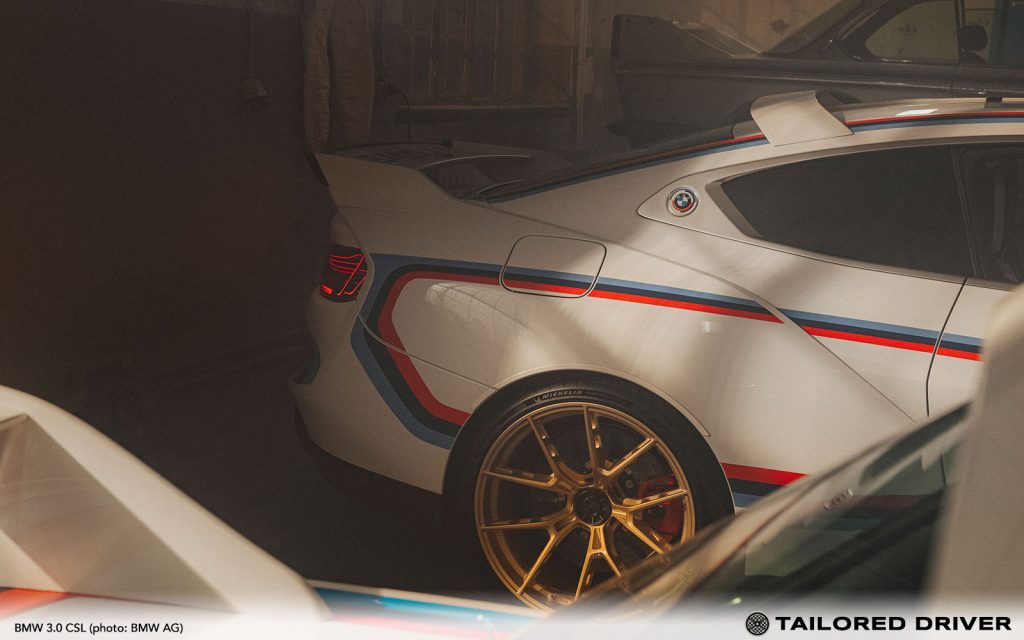
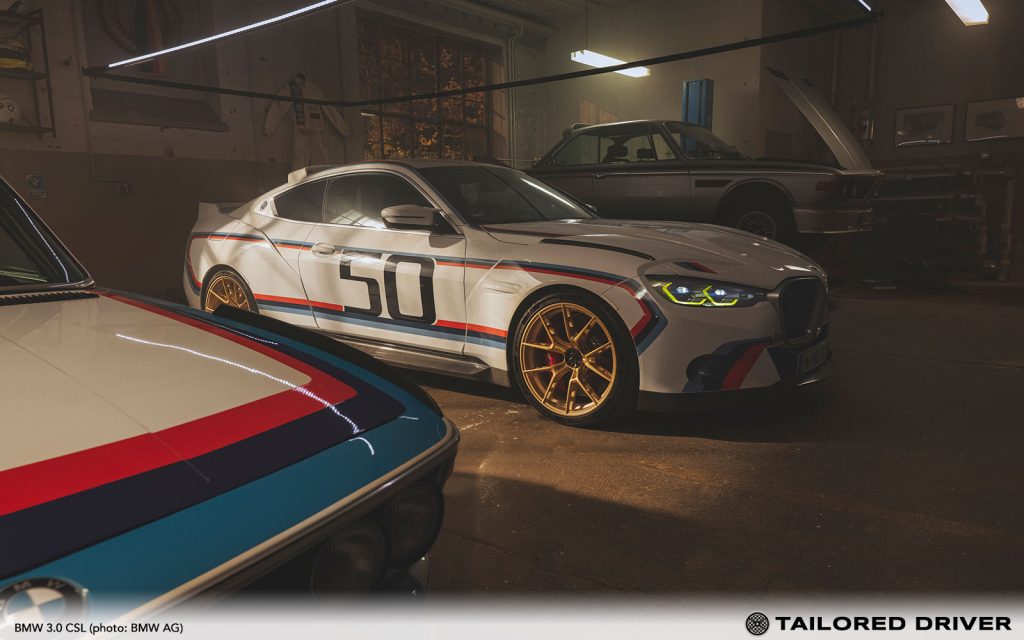
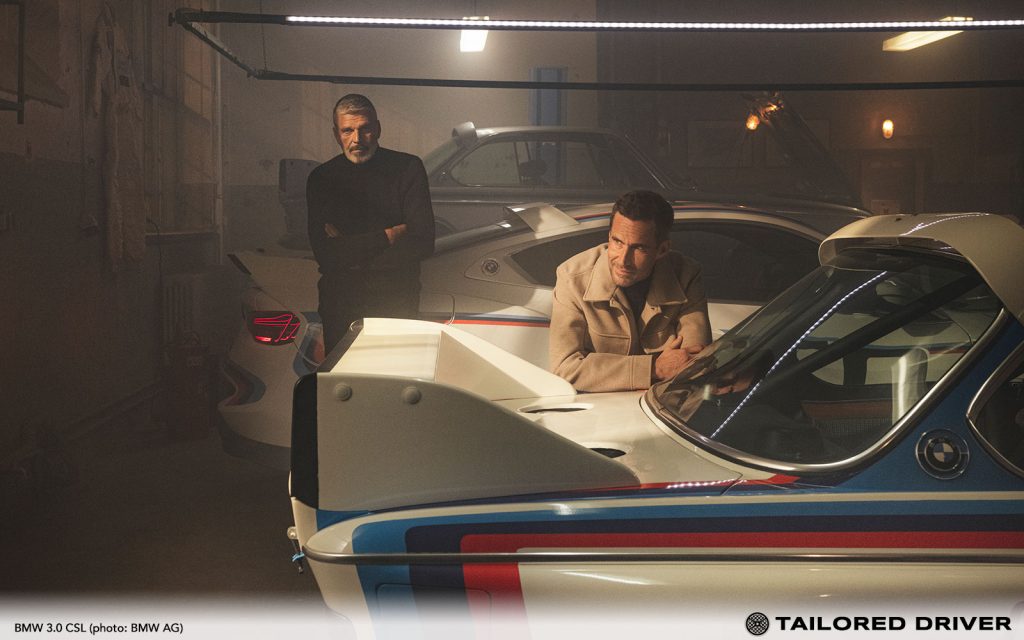
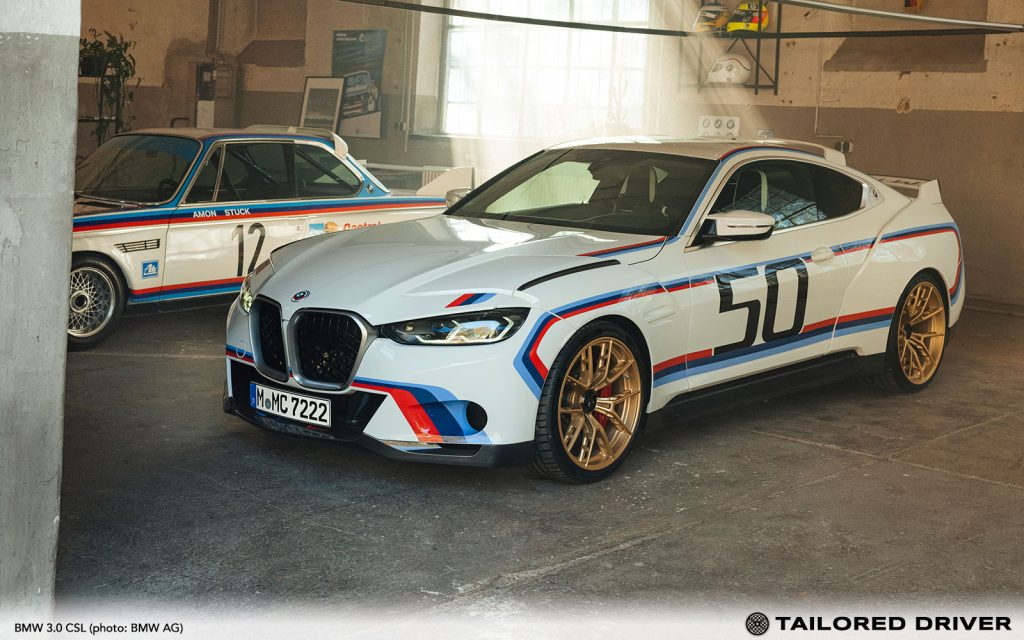
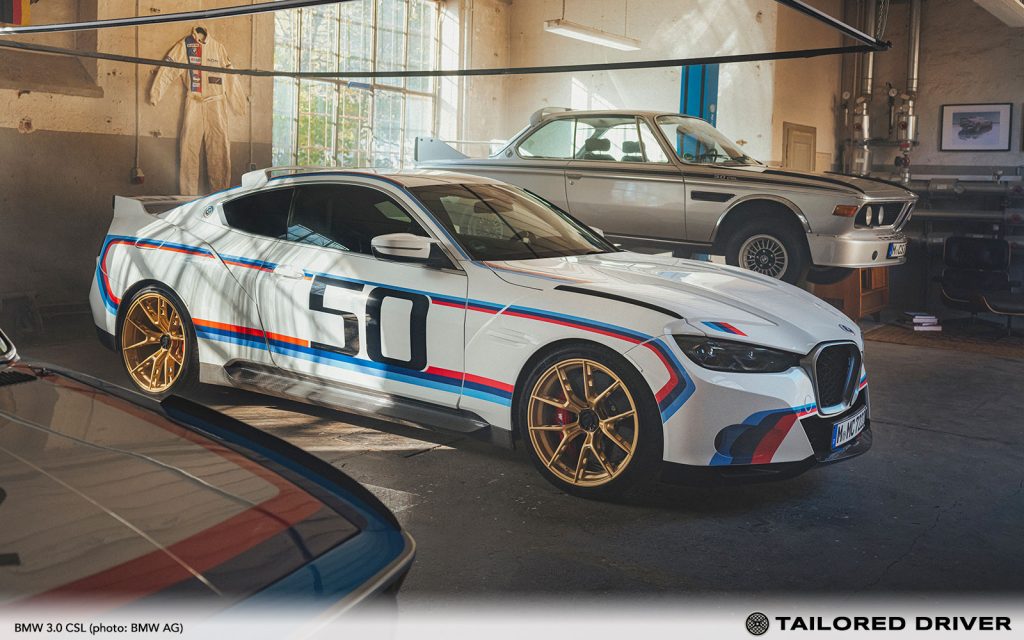
As the anniversary year comes to a close, BMW M GmbH is presenting the most exclusive special model the company has ever produced – a masterpiece of engineering embodying the essence from 50 years of racing passion and expressing its historic roots in a legendary model designation.
[source: BMW]
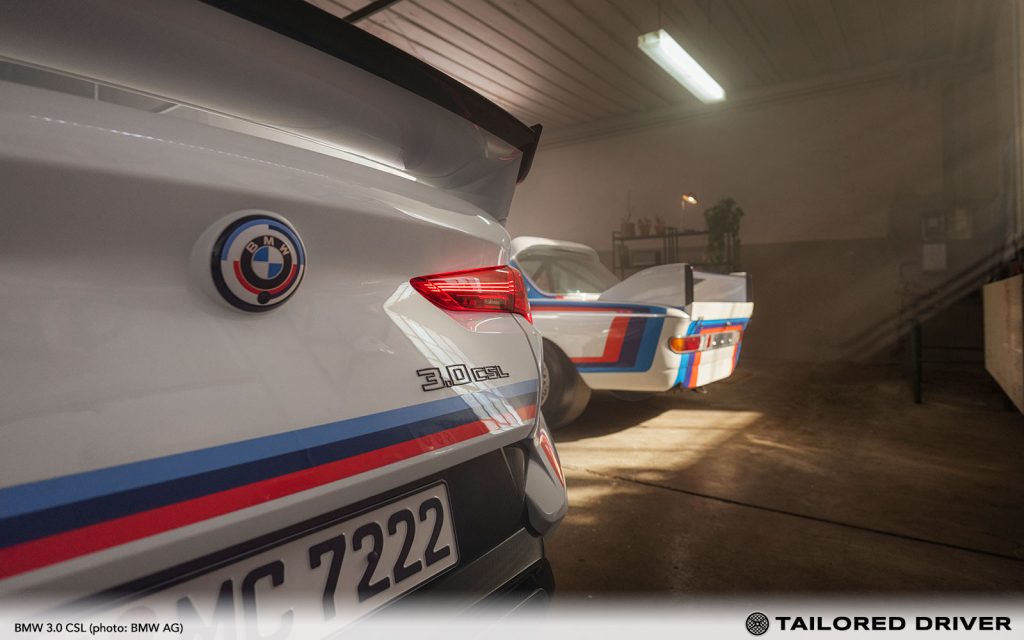
Munich. The BMW 3.0 CSL (fuel consumption combined: 11.0 l/100 km; CO2 emissions combined: 249 g/km according to WLTP; details according to NEDC: – ) combines a unique design with a puristic performance experience in two seats. It conveys to the present day in an extremely focused manner the concept created in the 1970s of applying racetrack technology designed for sheer driving pleasure on the road.
The BMW 3.0 CSL was developed with the intention of combining the best of five decades of racing expertise from BMW M GmbH in an automobile with a highly emotional aura. All facets of its character – dynamic exterior elegance, a classic sportscar cockpit, intelligent lightweight construction, a straight six-cylinder engine, manual transmission and rear-wheel drive – are based on traditional principles of a BMW M automobile. They complement each other with the help of the latest technology to create the ultimate symbol of fascination for top performance in the style of the brand that has been successful for 50 years. A ride in a BMW 3.0 CSL is therefore not only an exclusive high-performance experience, but also an emotional encounter with the history and the present of the world’s most powerful letter.
The BMW 3.0 CSL as a limited production run incorporating elaborate craftsmanship.
The BMW 3.0 CSL is produced in a strictly limited edition. To mark the anniversary, exactly 50 consecutively numbered units of the special model will go on sale. Right from the start, this gives the BMW 3.0 CSL the status of a rarity that will find its place in the vehicle collections of particularly loyal and enthusiastic fans of the BMW M brand.
The production of all vehicles will take around three months. Each and every one of them is created with absolute dedication to excellence in craftsmanship and precisely coordinated technologies in an elaborate manufacturing process at the external location of the BMW Group Dingolfing plant in Moosthenning, Lower Bavaria. The exclusive interior carbon fibre reinforced plastic (CFRP) components are produced by hand both in Munich and at the BMW Group component factory in Landshut by specially assigned bodywork specialists.
A specific process was also conceived for the paintwork of the BMW 3.0 CSL, in which craftsmanship and state-of-the-art technology complement each other to provide each individual part with its characteristic colour design. In addition, a team of 30 specially qualified and experienced technicians is responsible for the configuration and assembly of the vehicles. Due to the complexity of the processes in the manufactory, each BMW 3.0 CSL passes through eight assembly cycles at just as many production stations, a procedure that takes up to 10 days in all.
All in all, the extremely high proportion of individual manual work means that the time required to assemble a BMW 3.0 CSL is many times higher than that of a conventional BMW M automobile. After completion in the manufactory, each vehicle also undergoes a multi-stage quality inspection and approval process at the main Dingolfing plant before it is released for delivery to the customer. The BMW Group Plant Dingolfing is the company’s largest European production site. In addition to several BMW M automobiles, the luxury sedans of the BMW 7 Series and body components for Rolls-Royce Motor Cars are produced there.
The successful touring car – a role model in its time.
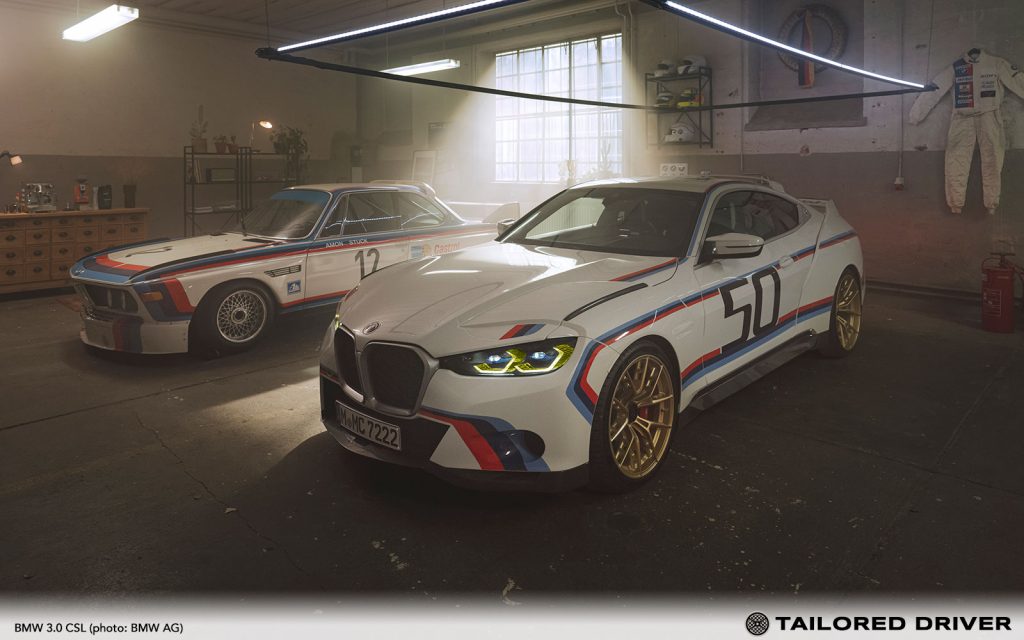
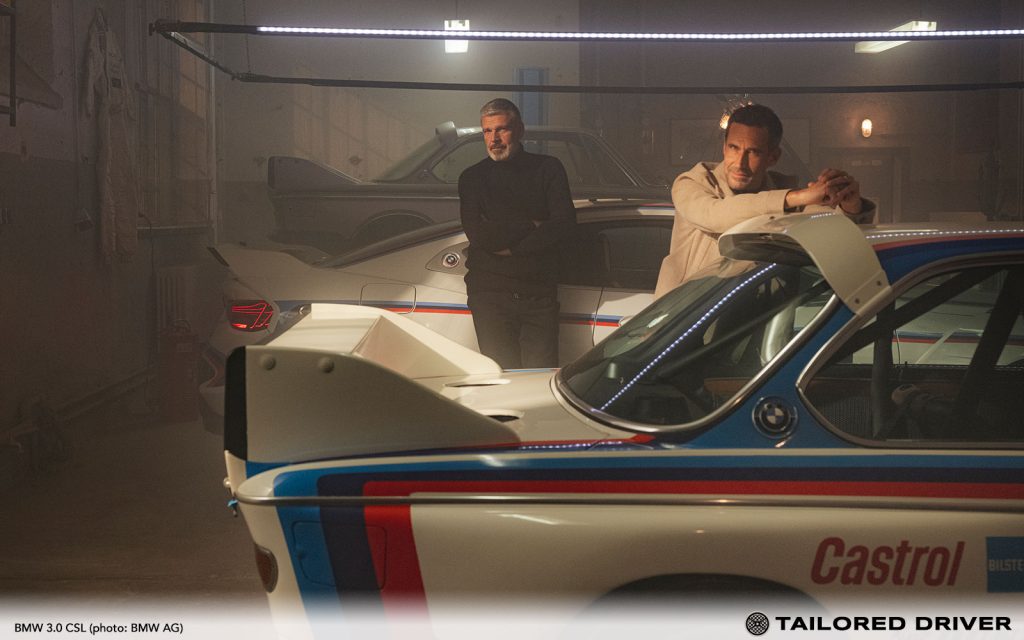
As the reincarnation of a legendary sports car both for the racetrack and the road, the BMW 3.0 CSL possesses all the characteristics of a puristic car. It embodies the joy of classic driving and an awareness of the traditional roots of BMW M GmbH in a uniquely exclusive form. Its eponymous role model is considered the first automobile to carry the DNA for maximum driving pleasure and passion, an unmistakeable feature of BMW M automobiles to this very day. In the founding year of BMW Motorsport GmbH, it was developed for use in touring car competitions, where it became the most successful racing car of its era.
The racing version of the historic BMW 3.0 CSL won the European Touring Car Championship during its inaugural season in 1973 – and repeated this title win five more times in succession from 1975 to 1979. Drivers such as Toine Hezemans, Hans-Joachim Stuck, Chris Amon and Niki Lauda left the competition behind at the Nürburgring and numerous other circuits, followed by BMW’s first victories on US circuits as early as 1975. All these successes helped the works racing cars to gain international popularity.
“Coupe, Sport, Lightweight construction“: New interpretation of a legendary formula.
The road version of the racing car, which was developed for homologation purposes, became a widely known symbol of inspiring driving pleasure focused on the essentials, especially in its final stage of development. CSL – this combination of letters in the model designation stood for “Coupé, Sport, Leichtbau” (Coupe, Sport, Lightweight), a concise summary of the two-door car’s recipe for success.
In addition to wide wheel arches, its coupe-shaped body also received an eye-catching aerodynamics package, which included a front spoiler, air bars on the front side panels and a roof spoiler. Completing the design modifications vs. the other coupes in BMW large series was a rear wing that optimised the grip of the rear wheels. It was not approved for road use and therefore lay in the boot when the vehicle was delivered, but nevertheless received much public attention so that the Coupe was given the nickname “Batmobile”.
With an increased displacement of 3,153 cubic centimetres and a maximum output of 151 kW/206 hp, the most powerful straight six-cylinder engine with direct injection ever used in a BMW model ensured sporty power delivery. The powerful drive system was combined with refined suspension technology. Its unladen weight was just 1,270 kilograms.
The reduced weight was achieved through comprehensive lightweight construction. The doors were made of aluminium, as were the bonnet and the boot lid, which were supported on filigree retaining rods after opening. Numerous other body components such as the roof, side panels and luggage compartment partition were made of particularly thin sheet metal, and the chrome bumpers were replaced by plastic skirting. Lightweight bucket seats and the omission of insulation material, power steering and electric windows ensured optimal weight reduction. An overall power-to-weight ratio of 6.2 kilograms per horsepower was thus achieved.
The new BMW 3.0 CSL is the contemporary reinterpretation of all these features anchored in its model designation. Its coupe-shaped body sets traditional accents for sporty elegance and expressive dynamics. Its drive and suspension technology stems from the latest developments for racing cars and high-performance sports cars from BMW M GmbH. And the intelligent lightweight construction reaches an outstanding level, above all through the extensive use of carbon. The power-to-weight ratio of the BMW 3.0 CSL is a mere 2.9 kilograms per hp.
As an independent model from BMW M GmbH and despite the limited number of units, the BMW 3.0 CSL has undergone a complete series development process. In addition to the extensive quality and function tests and the driving dynamics tuning test drives under a wide range of conditions from city traffic to country roads and motorways to the race track, the BMW 3.0 CSL has also undergone comprehensive aerodynamic testing. Around 200 working hours were spent on optimising the airflow and aerodynamic balance of the vehicle, including 50 hours in the wind tunnel of the BMW Group’s Aerodynamic Test Centre. In addition, two pre-production vehicles of the BMW 3.0 CSL had to undergo a safety test in the form of a frontal and a side crash test in order to meet road legal requirements.
Unique, M-typical design, geared to the technical demands of fascinating performance.
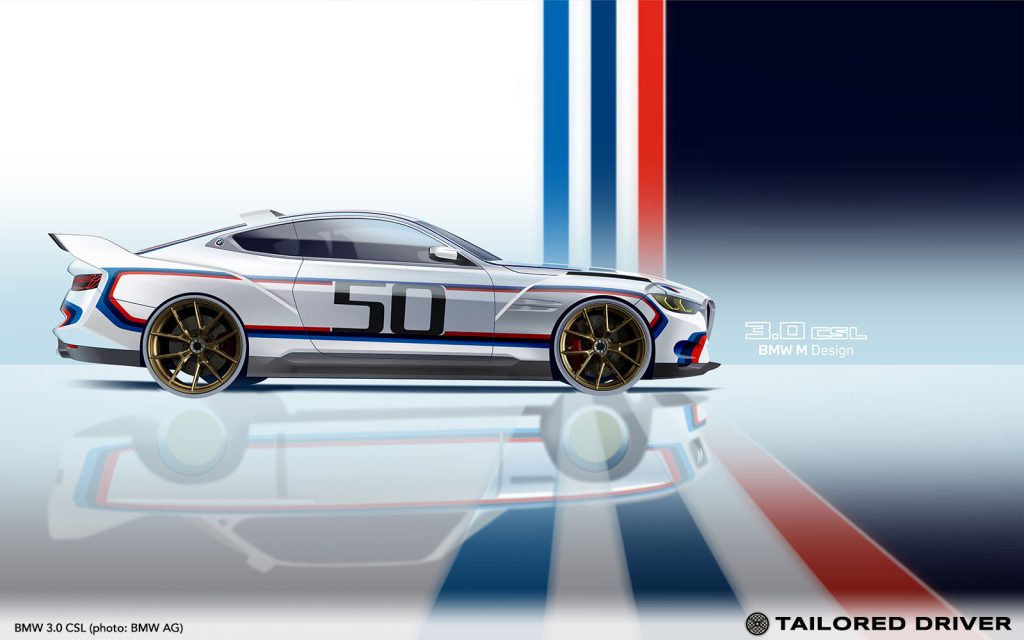
With its classic coupe proportions and a traditional vehicle concept that combines a front engine and manual transmission with rear-wheel drive, the BMW 3.0 CSL follows in the footsteps of its historic ancestor. Distinctive air deflection elements, powerfully shaped wheel arches, a striking rear spoiler and numerous other details are unmistakably based on the design of the legendary coupe from the 1970s.
At the same time, its appearance is characterised by the principles that have always applied to BMW M automobiles: The specific exterior features are based on the technical requirements in terms of cooling air supply, aerodynamic balance and driving dynamics, which form the basis for highly fascinating performance. In this way, the BMW 3.0 CSL expresses timeless racing passion in an emotional and authentic way.
Powerful aesthetics pay tribute to the historical ancestor.
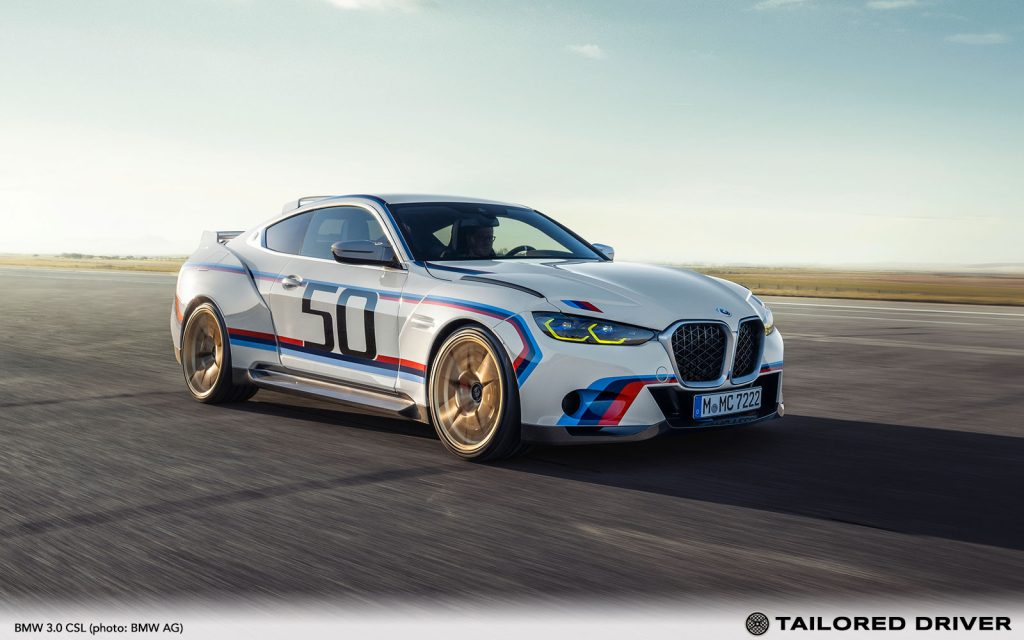
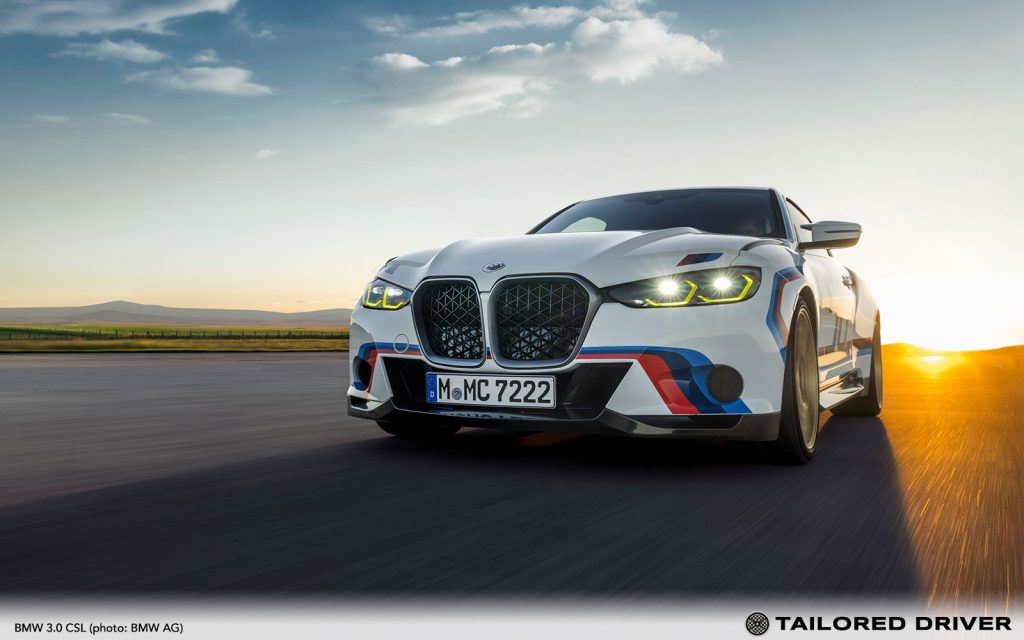
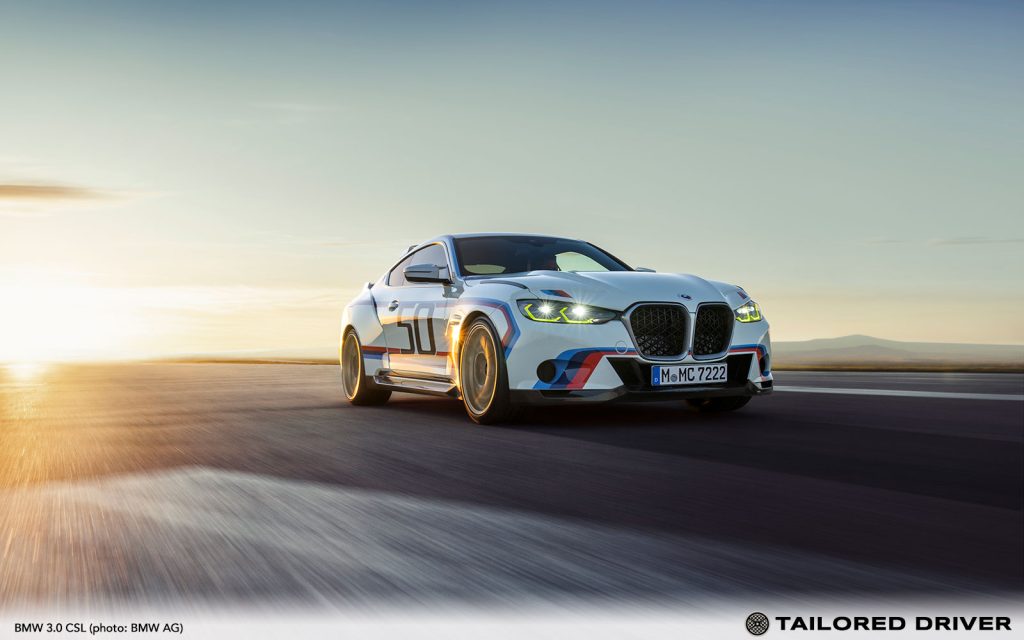
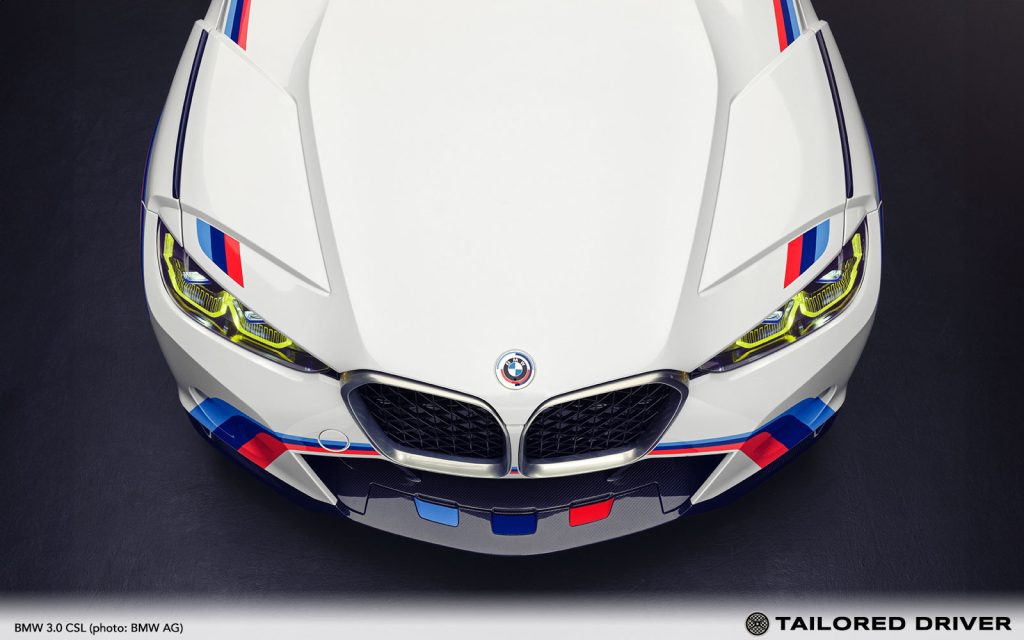
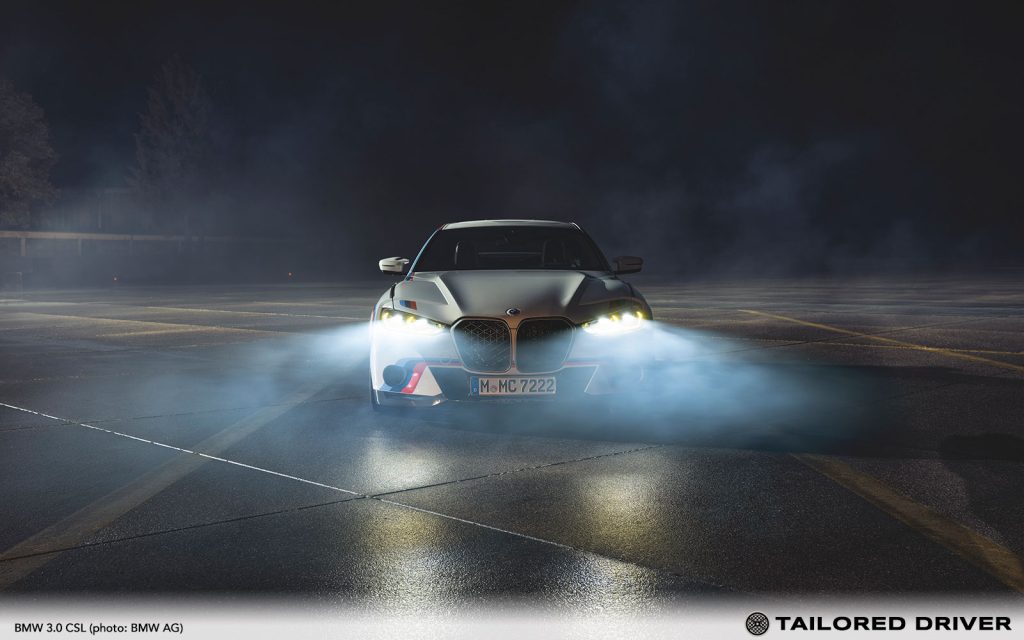
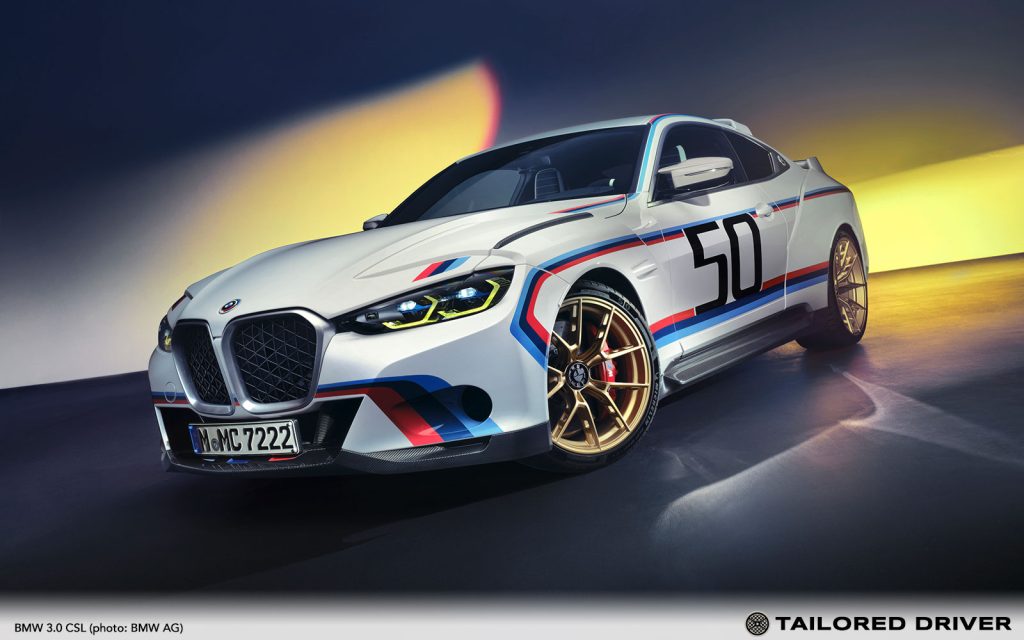
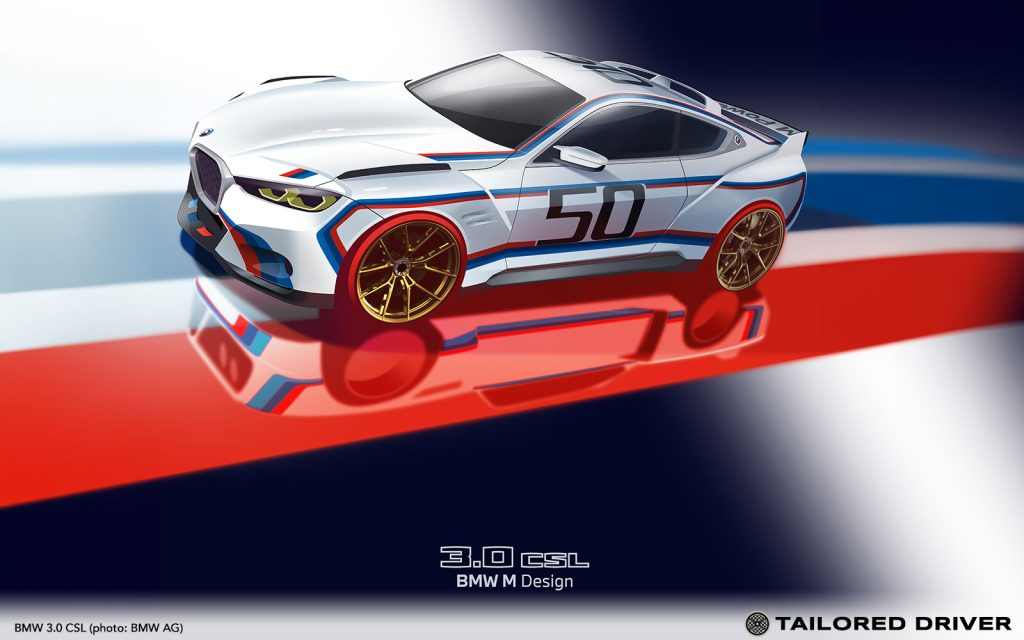
Power and athleticism are signalised by the front end of the BMW 3.0 CSL, which sits low on the road. At its centre is the distinctive BMW kidney grille with a lattice-shaped insert in a diamond structure. Its upright position relates to the front design of its historic ancestor. Like the side window surrounds, the kidney frame is finished in satin aluminium – a design feature that emphasises the special status of the BMW 3.0 CSL. Together with the BMW kidney grille, two generously dimensioned recesses in the front apron, reminiscent of the air intakes on the 1970s model, ensure reliable cooling of the drive and brake systems even in extremely dynamic driving situations. Sculpturally shaped air fins on the bonnet accentuate the classic lines.
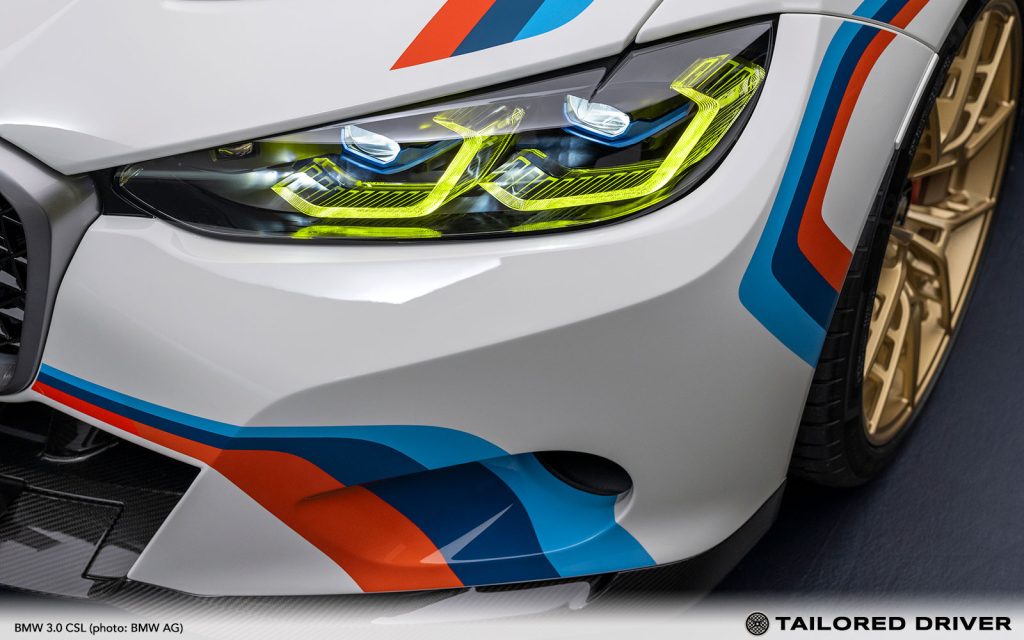
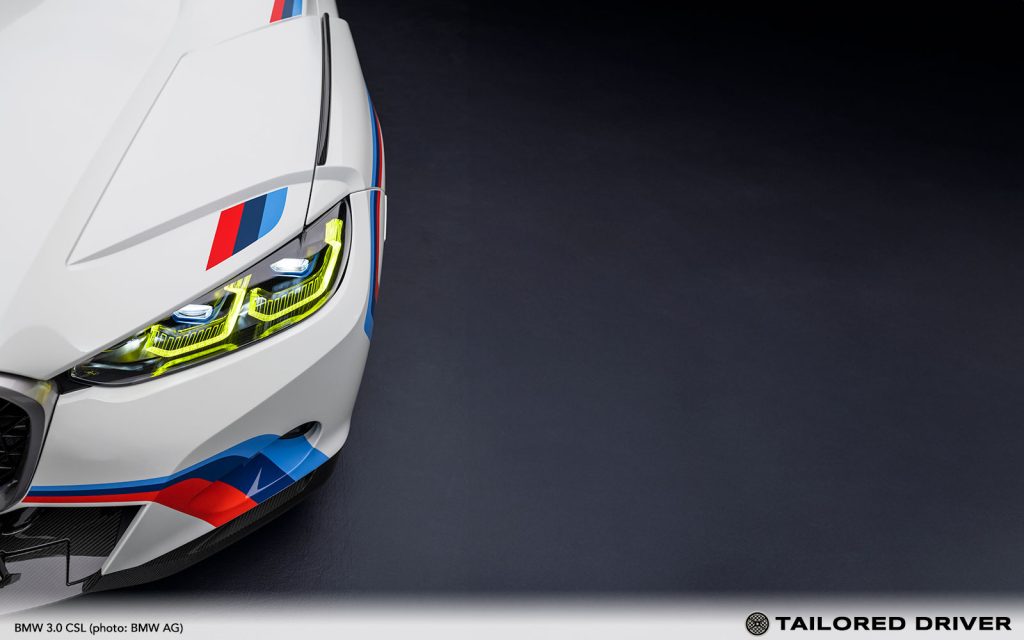
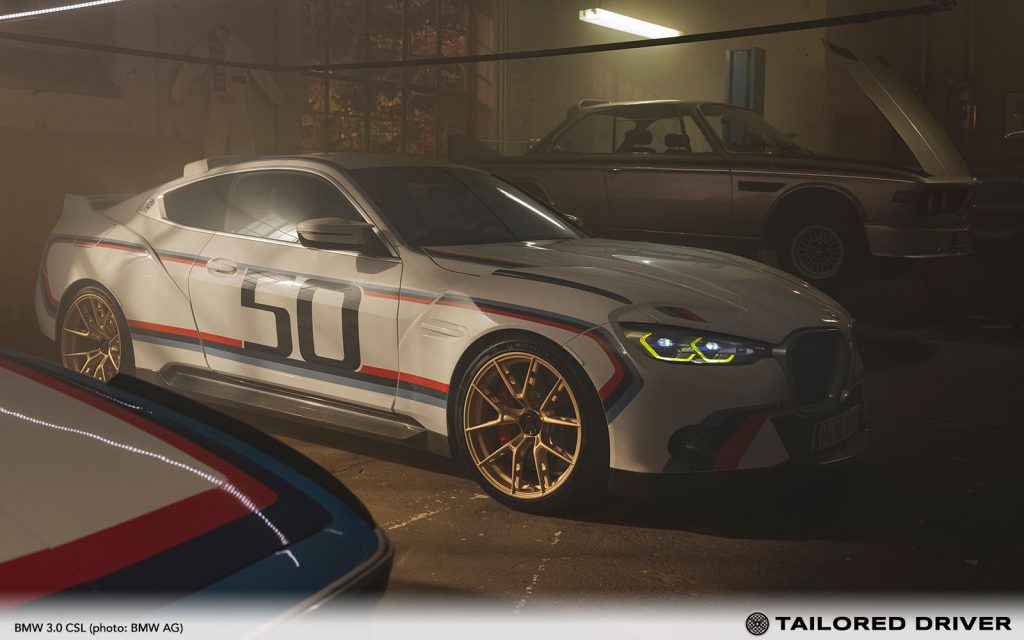
With their flat contours, the headlights create the characteristic focus on the road. The BMW Laser Light headlights shine in yellow, both during the welcome scenario after unlocking the doors and when the low and high beams are activated, thus making reference to successful GT racing cars. This detail is a subtle reference to the strong connection with motorsport and BMW M GmbH’s currently most successful competition vehicle, the BMW M4 GT3, which won both the drivers’ and team championships in the DTM in 2022 and whose power unit is based on the same straight-six engine as the power unit of the BMW 3.0 CSL. The BMW M4 GT3 achieved championship success right at the start of its racetrack career, much like the historic BMW 3.0 CSL, which once won the European Touring Car Championship in its inaugural season.
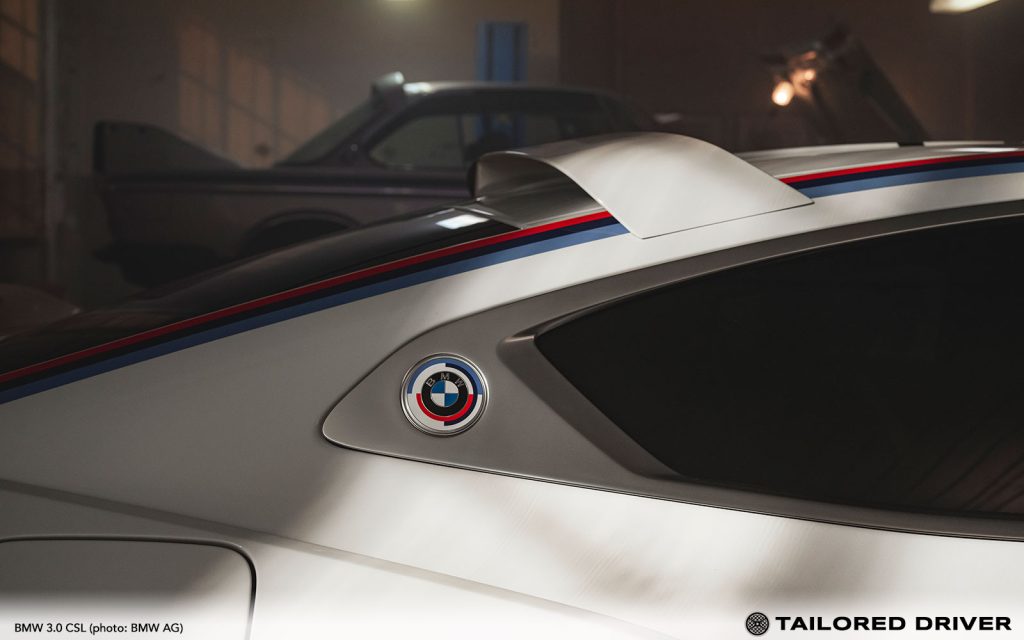
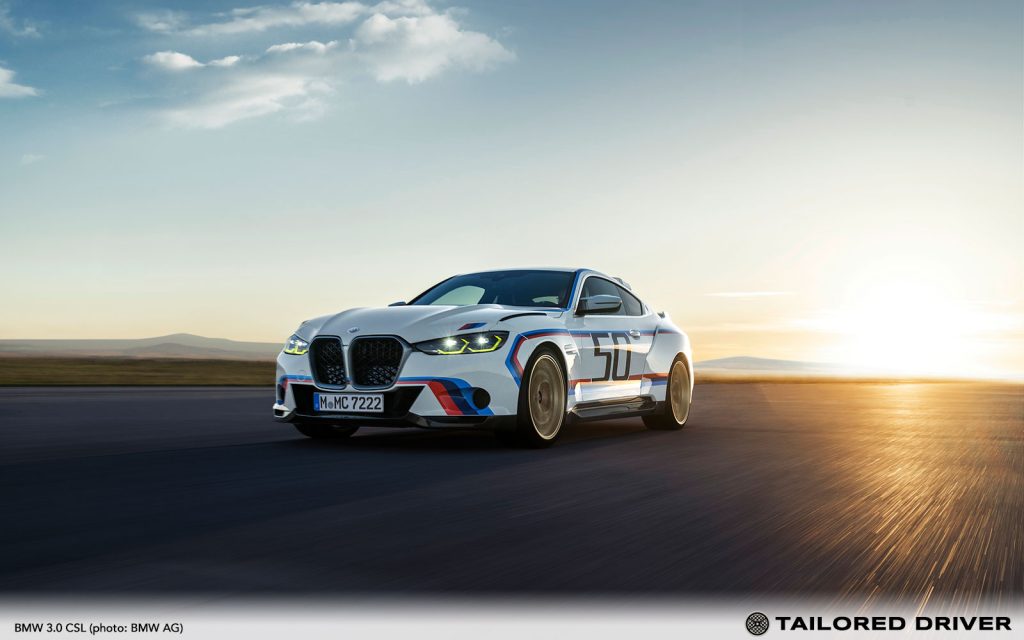
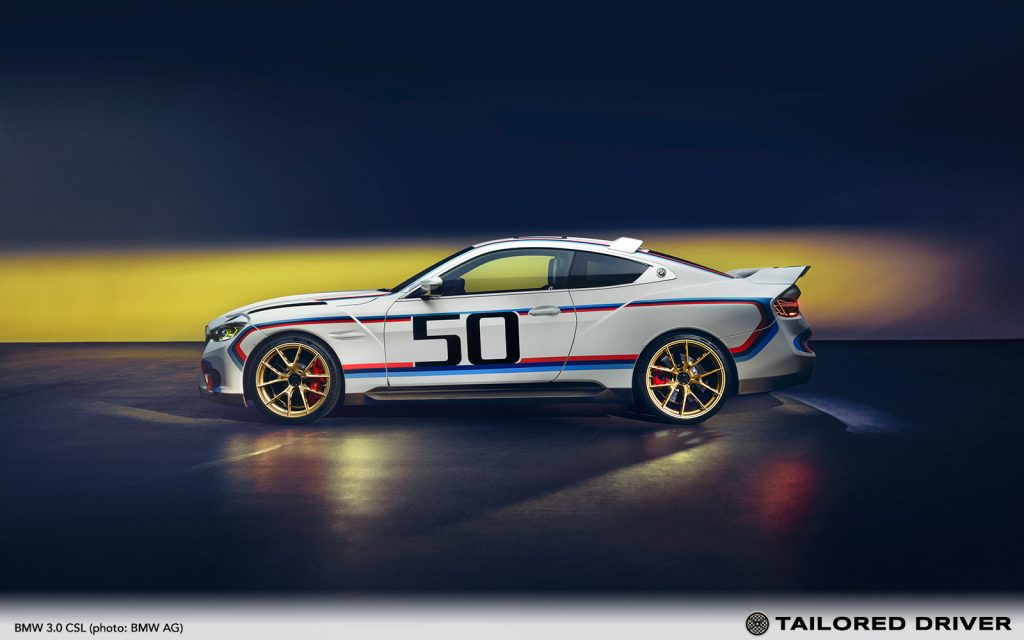
Viewed from the side, the long bonnet and wide wheelbase lend the BMW 3.0 CSL an appearance that is both sporty and classically elegant. The brand-typical coupe proportions in a three-box design also contribute to this. Particularly wide, diagonally offset side panels and wide side walls underline the dynamic appearance of the coupe even when stationary, with an air deflector extending along the roof line.
Wide wheel arches, central locking wheels produced exclusively for the BMW 3.0 CSL’s tyres.
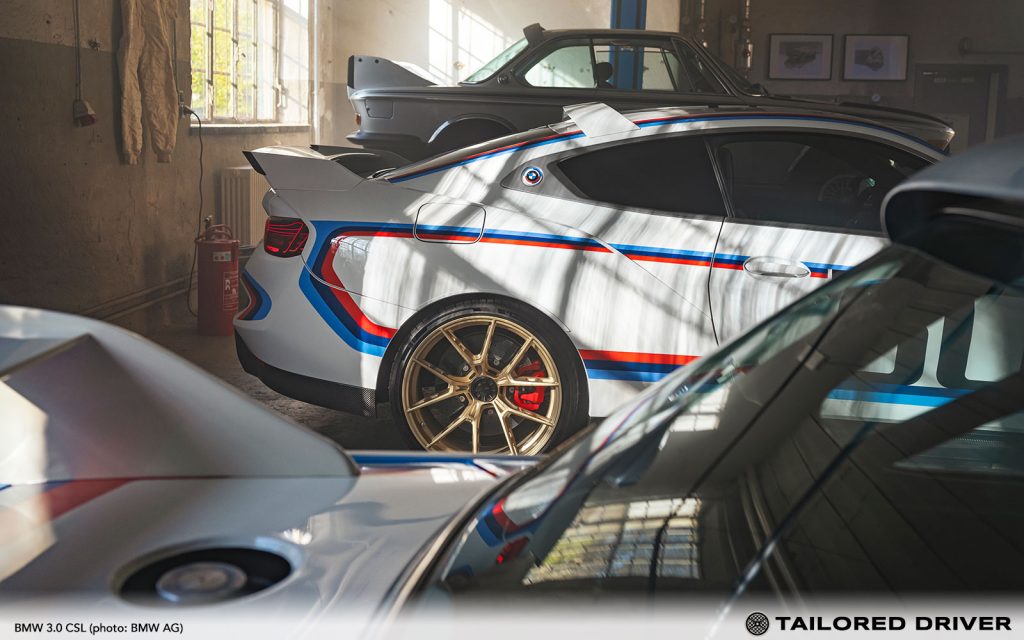
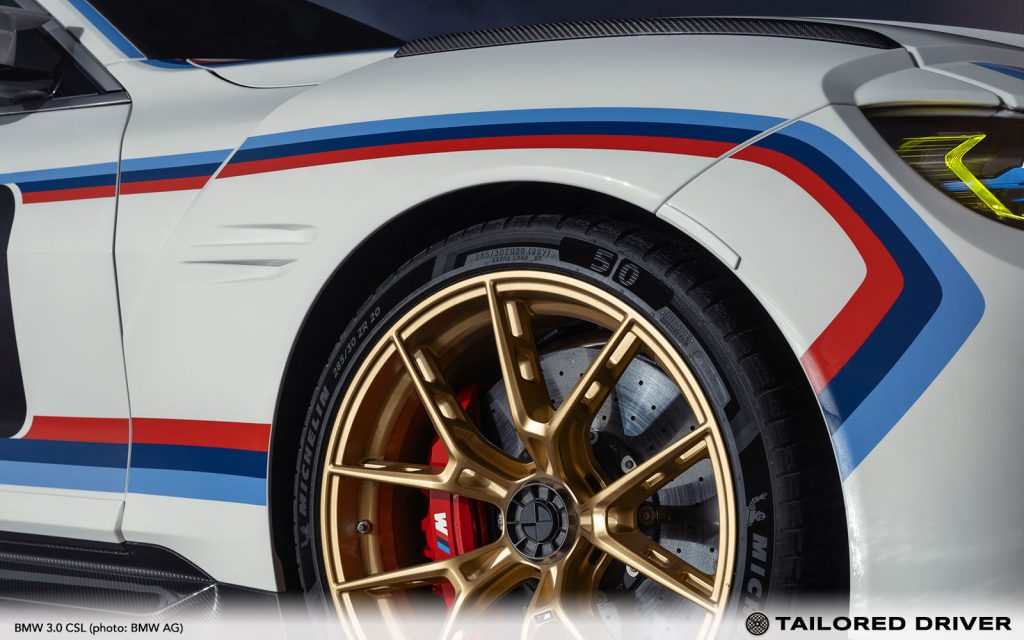
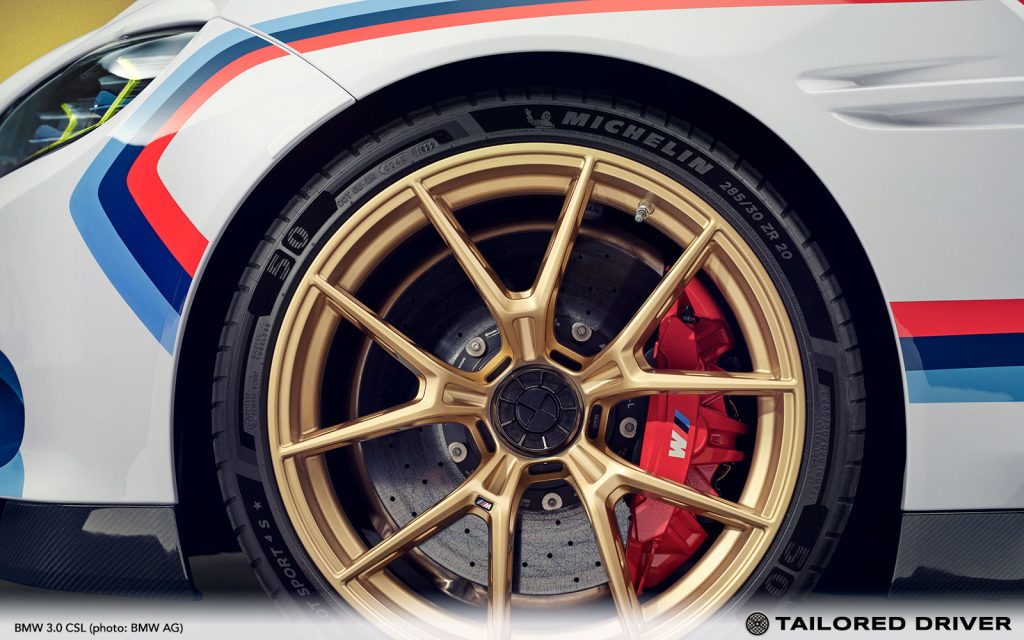
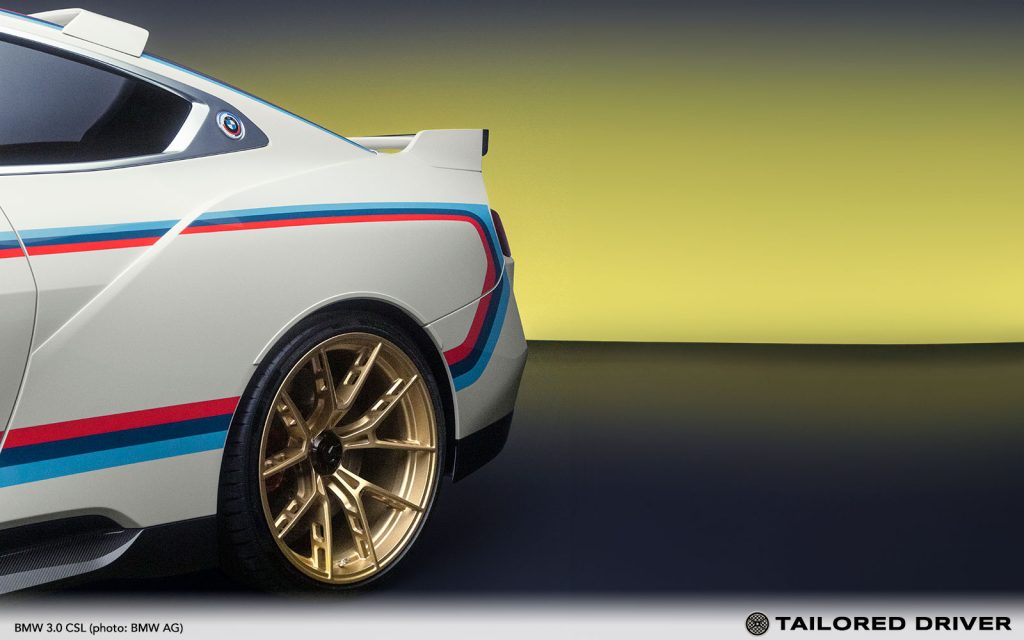
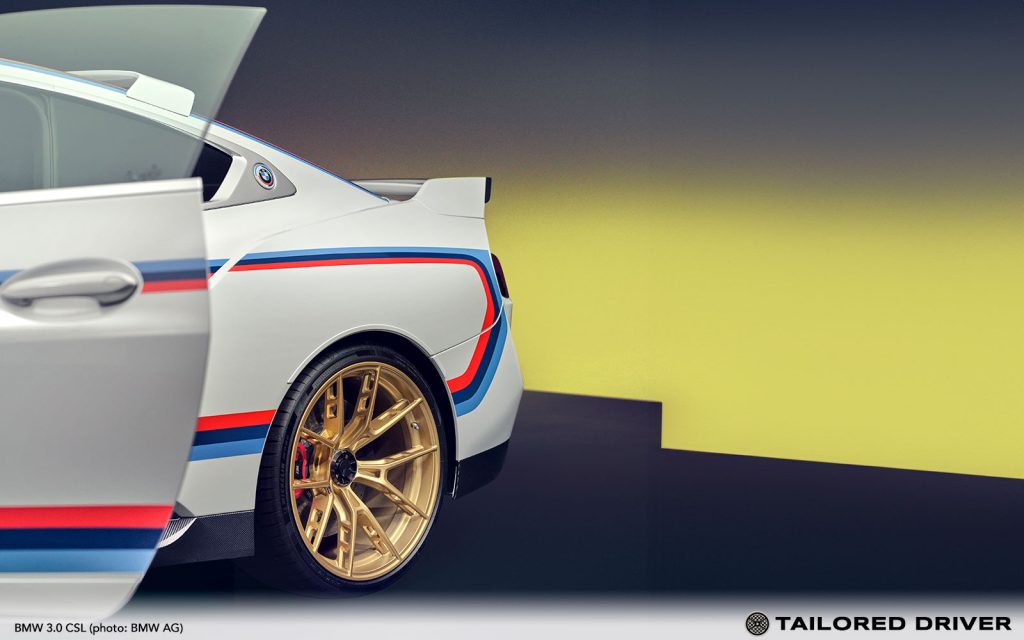
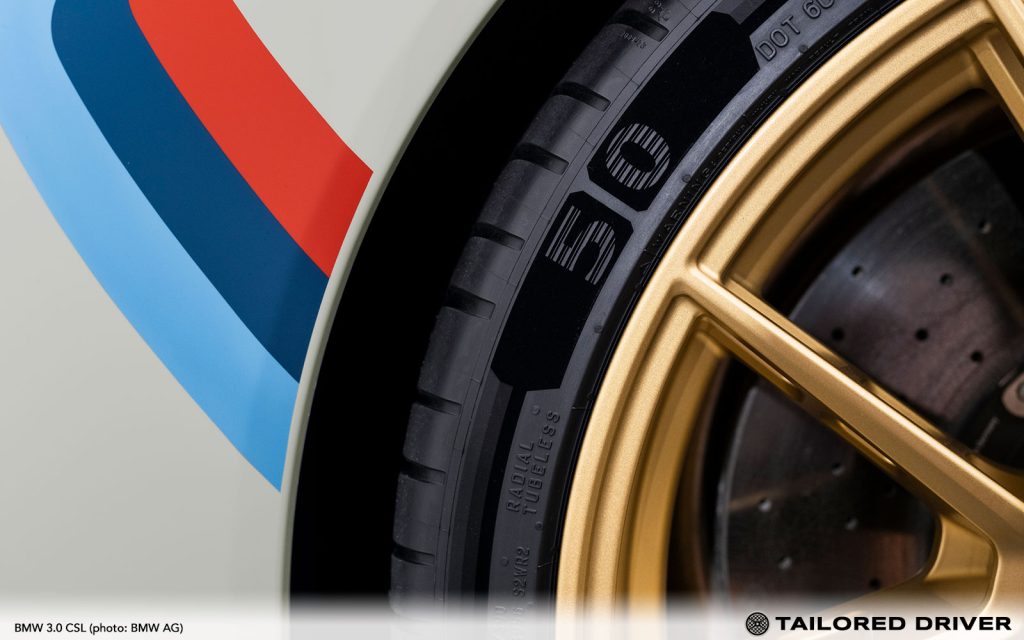
Muscular wheel arches give indication of the large track widths that contribute significantly to the vehicle’s high cornering dynamics. They offer space for the forged light-alloy wheels in a Y-spoke design, these being 20 inches on the front axle and 21 inches at the rear. With their filigree spokes, a gold-coloured paint finish in the style of the 1970s and a centre lock, they represent a highlight in terms of design and driving dynamics adapted directly from racing. The integration of the model-specific wheels into the pre-assembled axles of the BMW 3.0 CSL is part of the manufacturing process at the BMW Group’s Dingolfing plant. At 930 Nm, the torque applied during the assembly of the centre locks achieves the highest value for a BMW Group production vehicle.
The forged light-alloy wheels are fitted with Michelin tyres developed exclusively for the BMW 3.0 CSL. They bear the number 50 embossed on the tyre sidewalls, providing another subtle reference to the anniversary of BMW M GmbH, on the occasion of which the special model was designed and built.
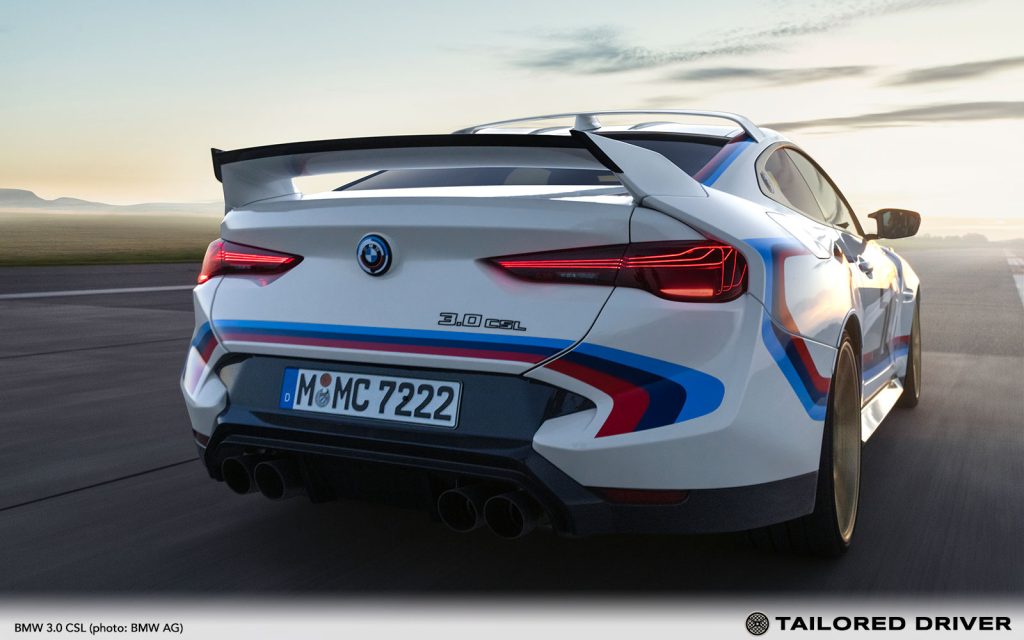
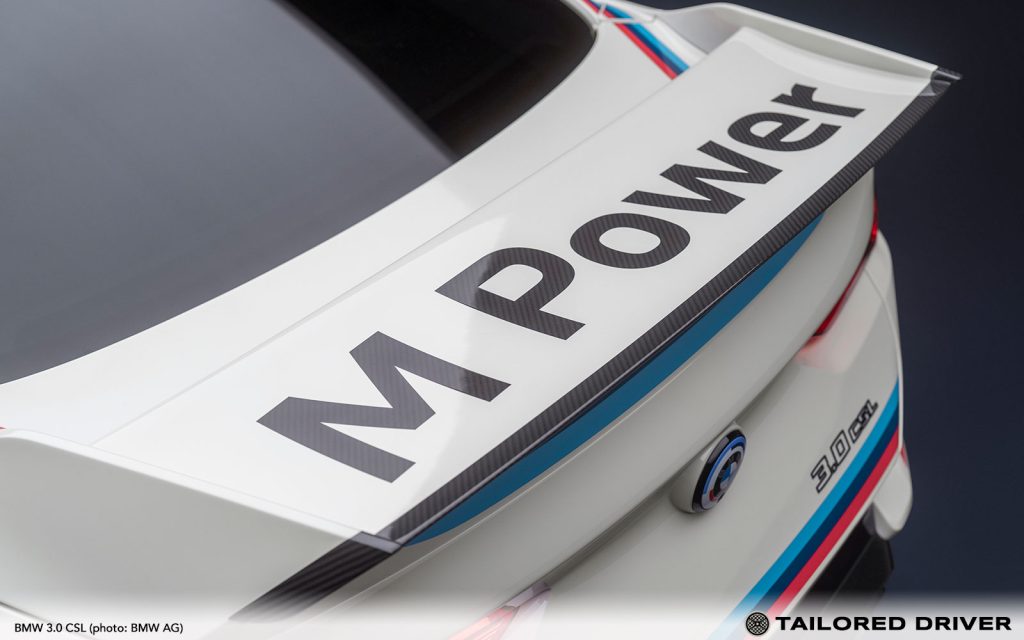
A tail wing in the style of the “Batmobile“.
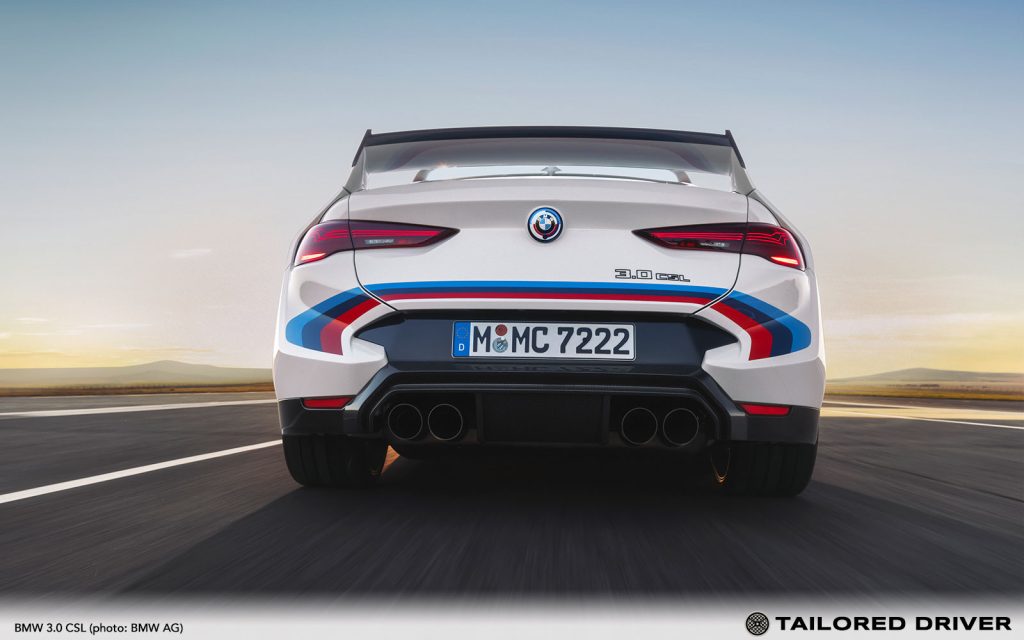
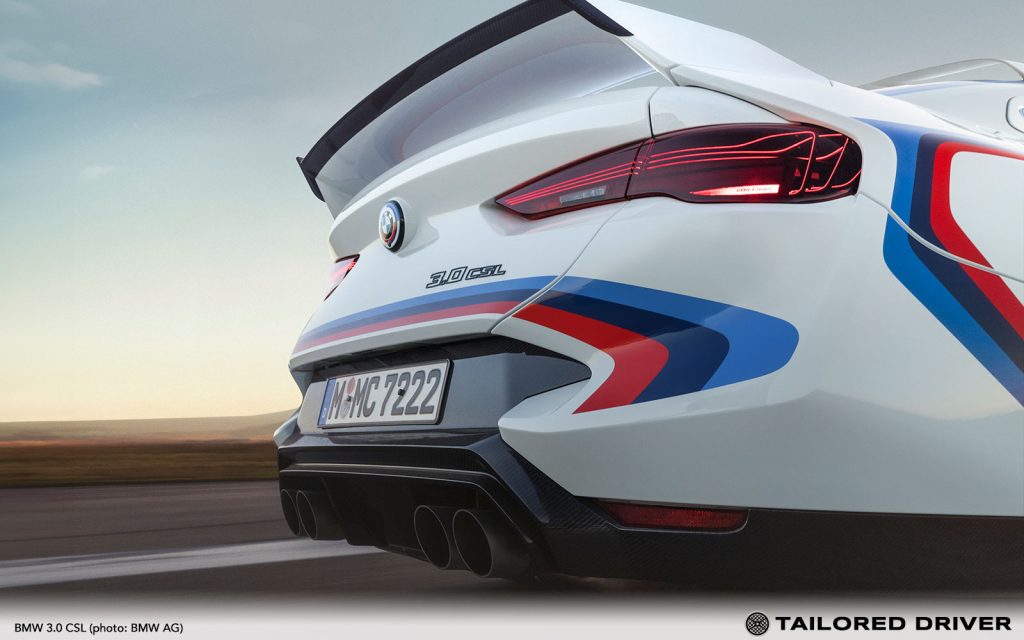
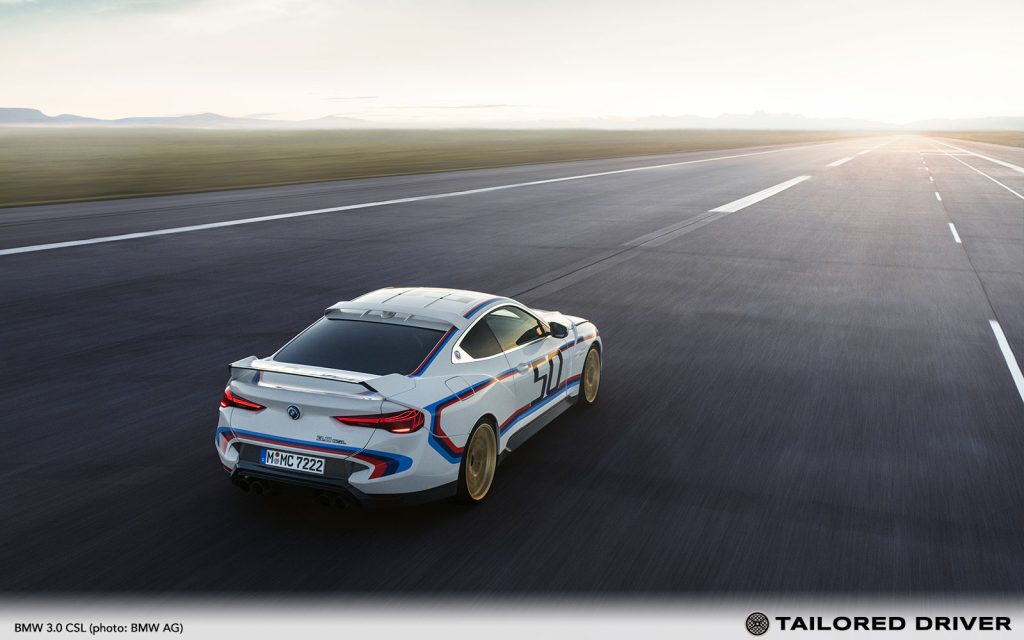
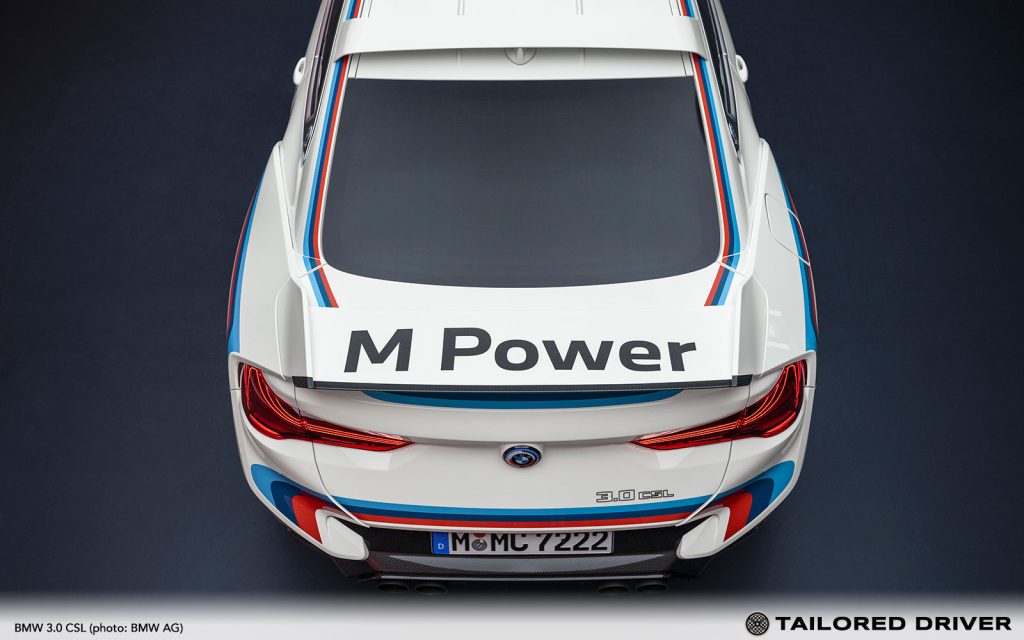
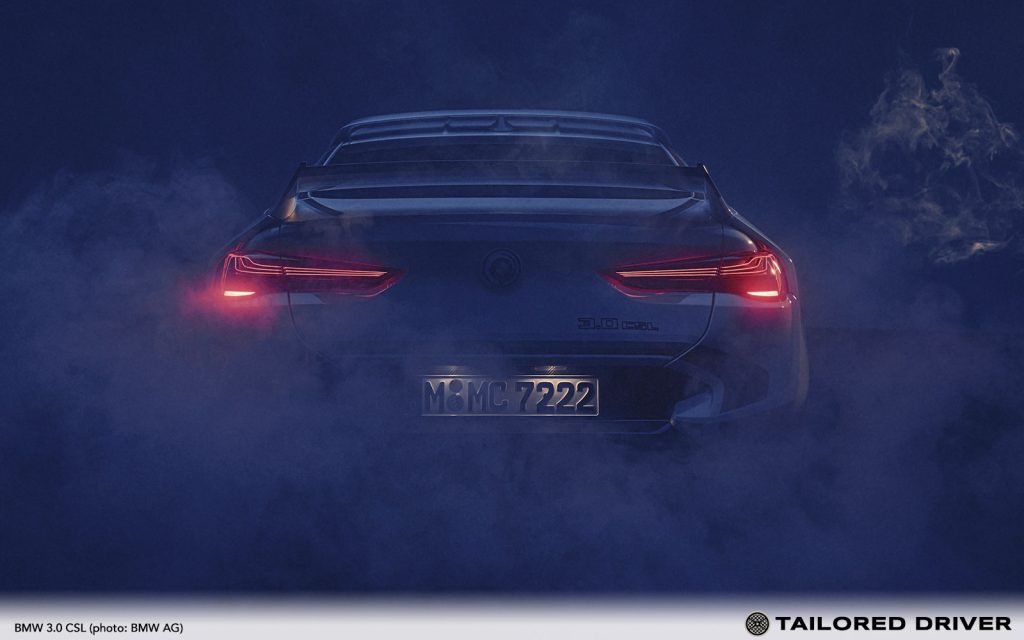
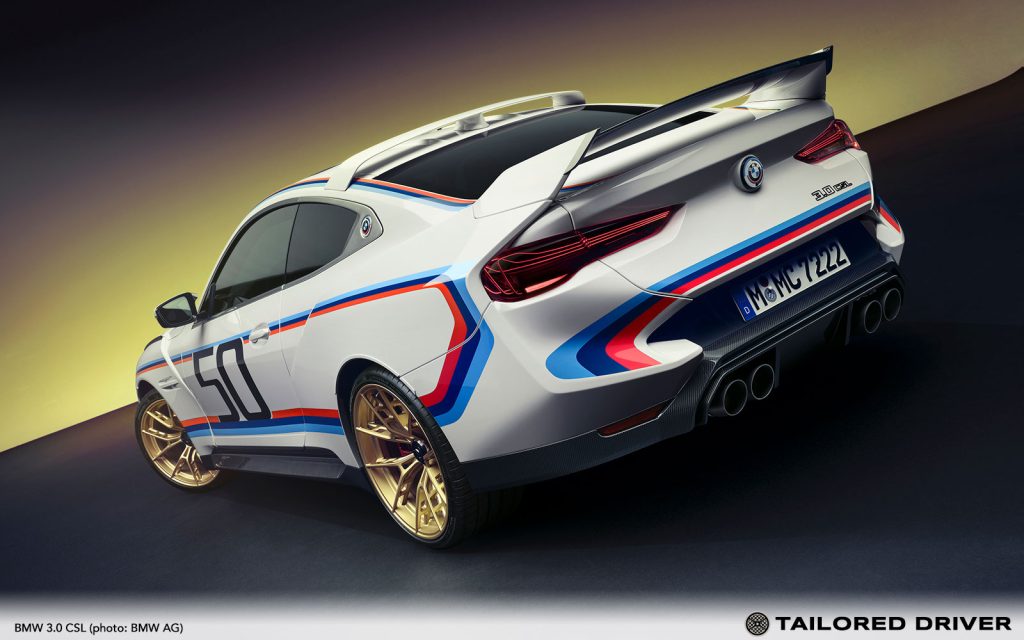
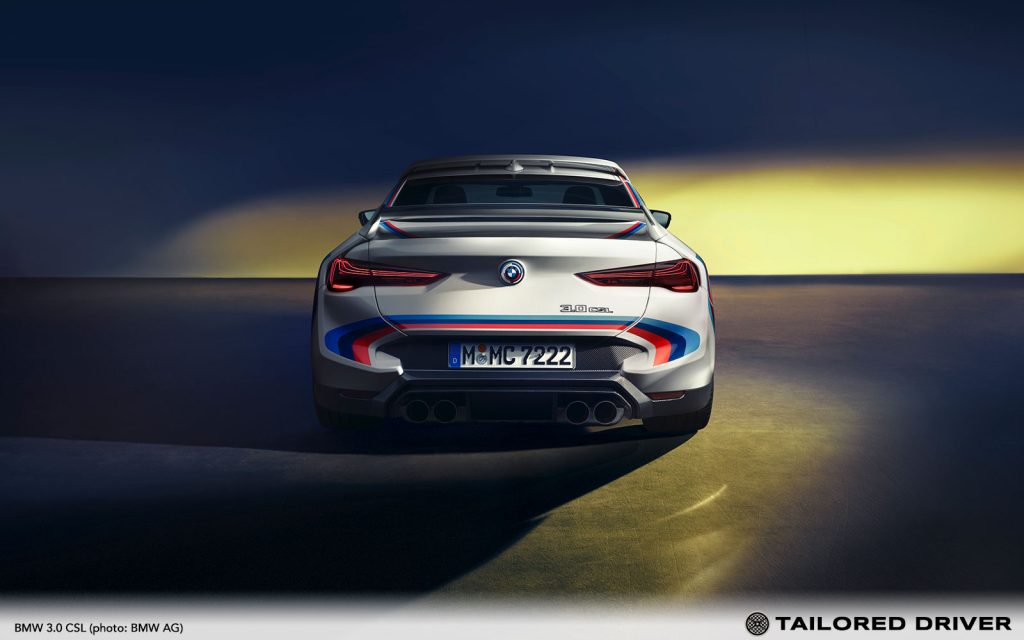
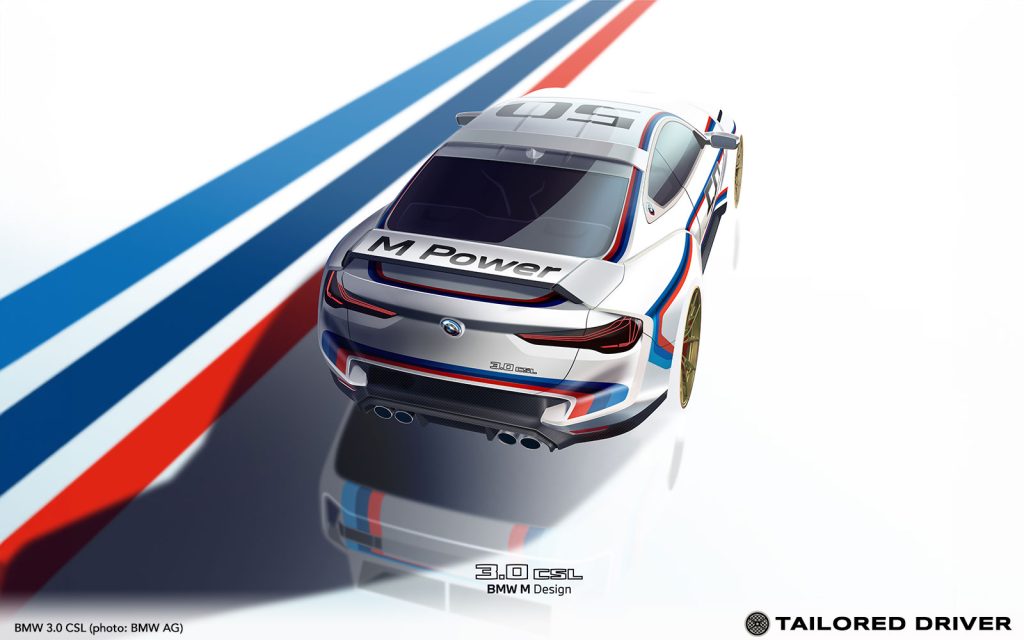
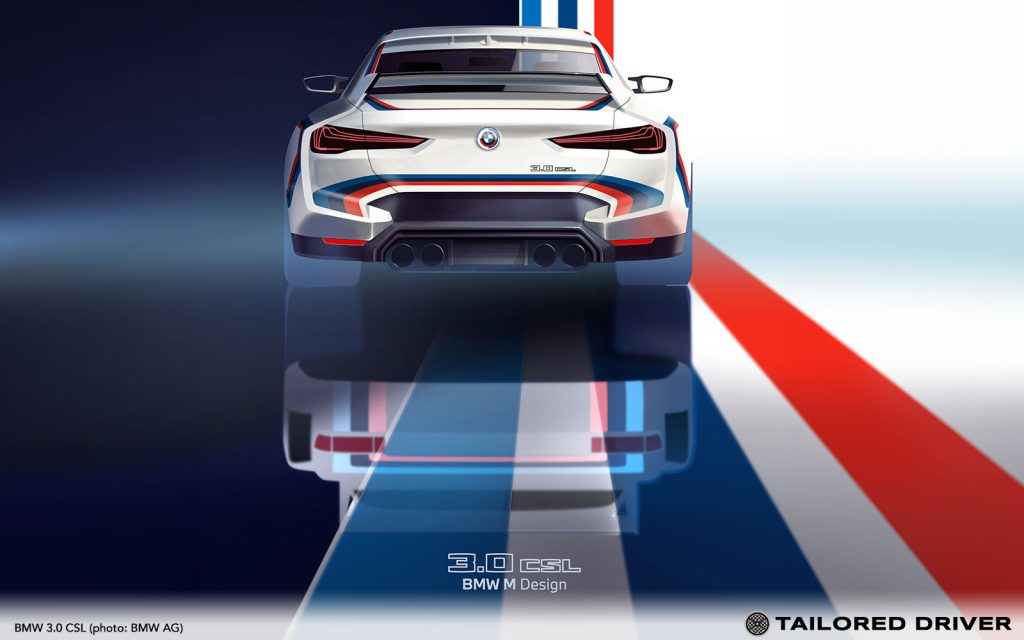
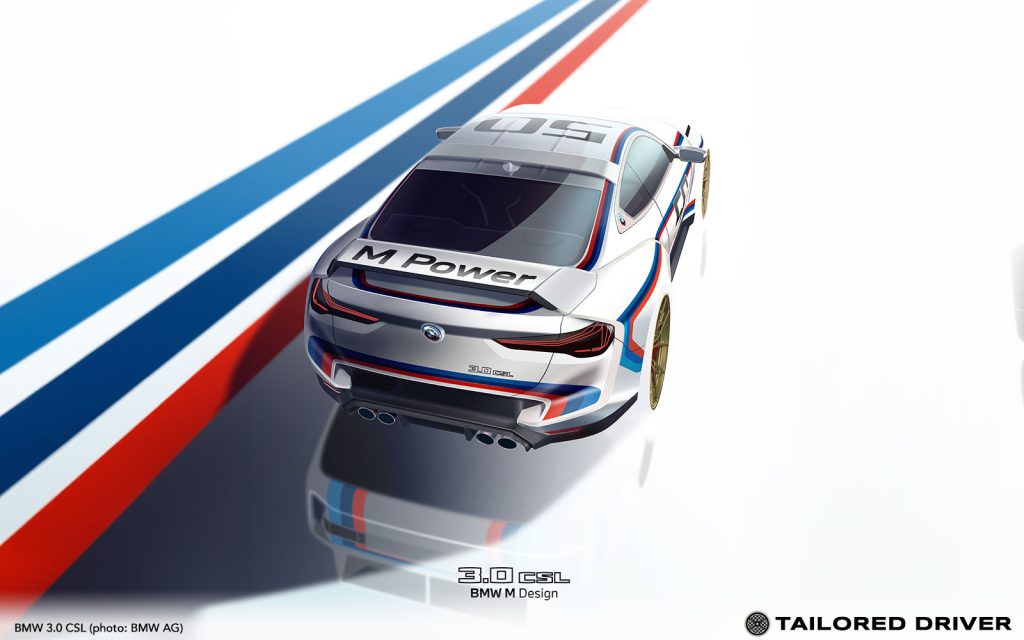
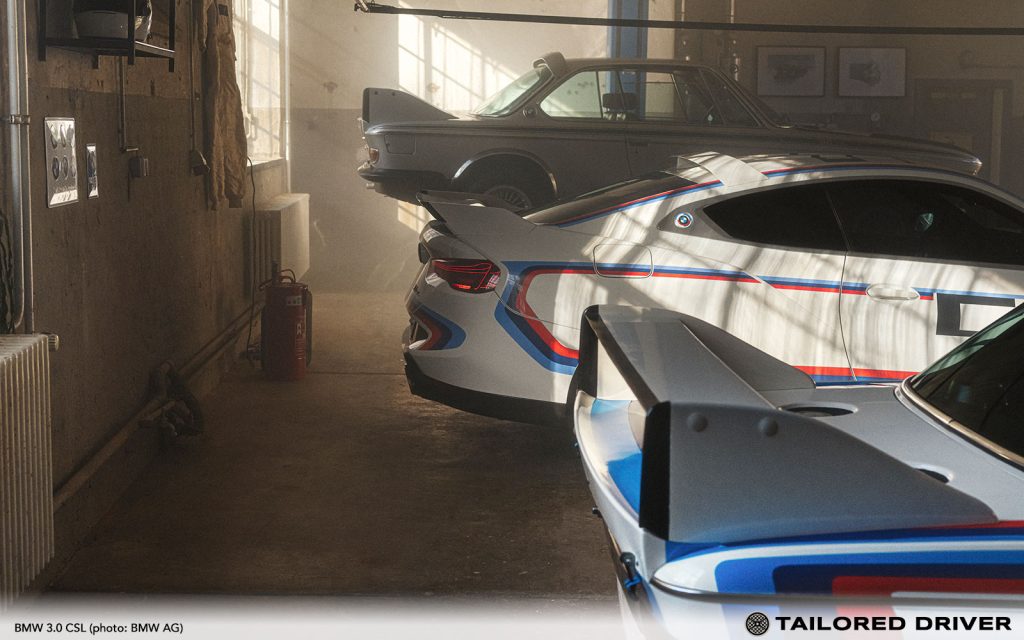
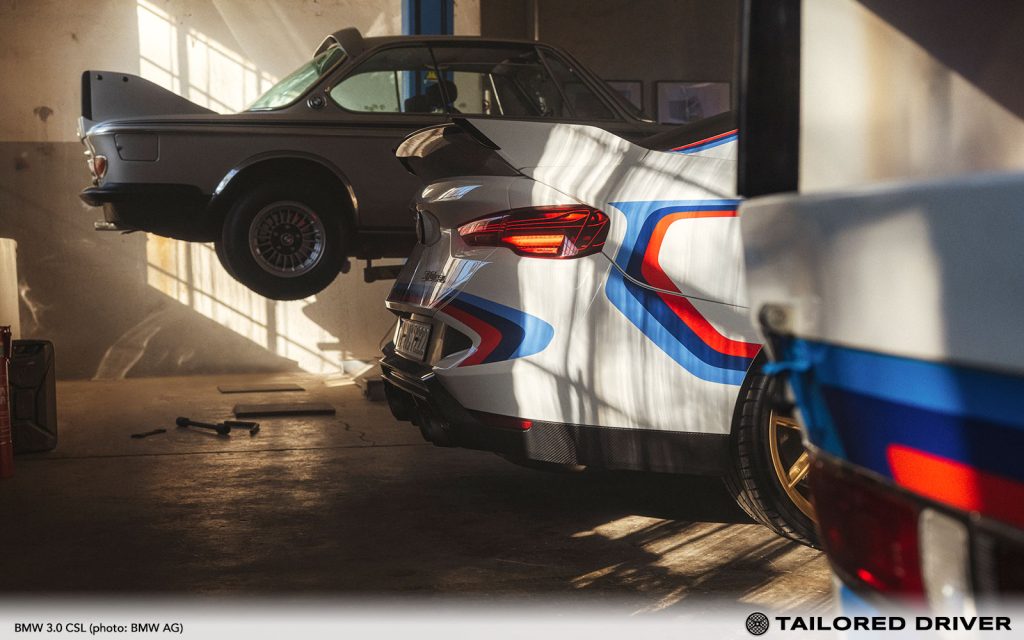
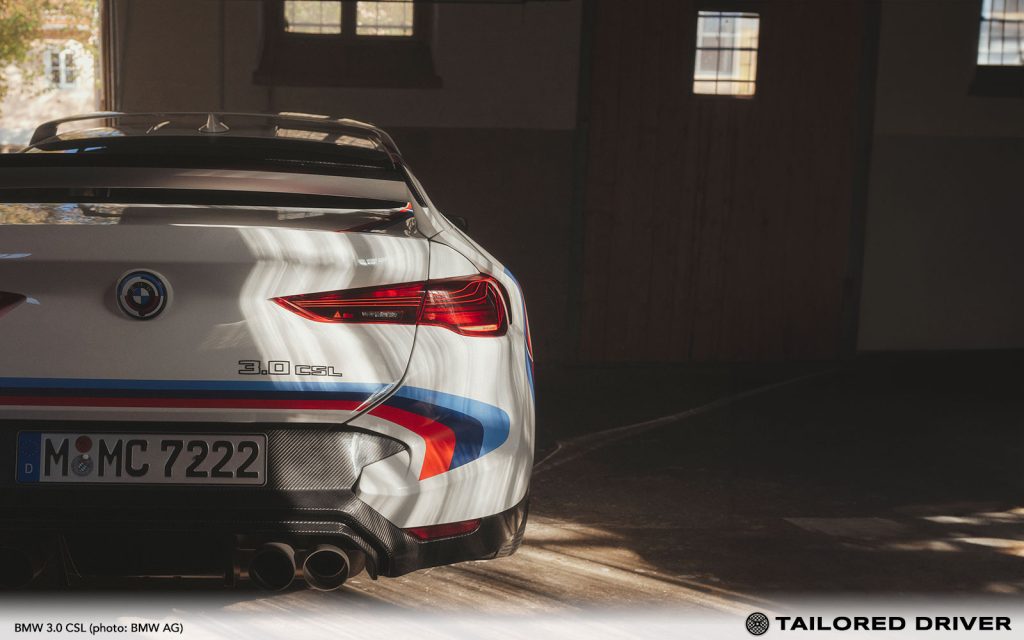
The rear view of the BMW 3.0 CSL is also characterised by powerful aesthetics and reinterpreted design features of its ancestor. The most striking feature is the rear wing, which is enclosed at the side and translates the characteristic appearance of the “Batmobile” into a modern design language. Designed to generate additional downforce and thus optimise traction on the rear axle, the air deflector encloses the entire rear section, thus becoming a dominant visual element. For the benefit of aerodynamic balance, it is combined with a strongly pronounced carbon diffuser in the rear apron, thereby optimising airflow in the underbody.
The four tailpipes of the exhaust system, which are arranged in an arrow shape in the centre of the rear apron and feature a particularly lightweight titanium rear silencer, also provide a striking accent. The rear lights of the BMW 3.0 CSL use innovative lighting technology to generate a fascinating, exclusive night design and a particularly vivid radiance. This is achieved by filigree laser light threads that appear to be free-floating inside the lights and create an expressive 3D effect through precise superimposition.
Elaborate paintwork in the style of classic racing cars.
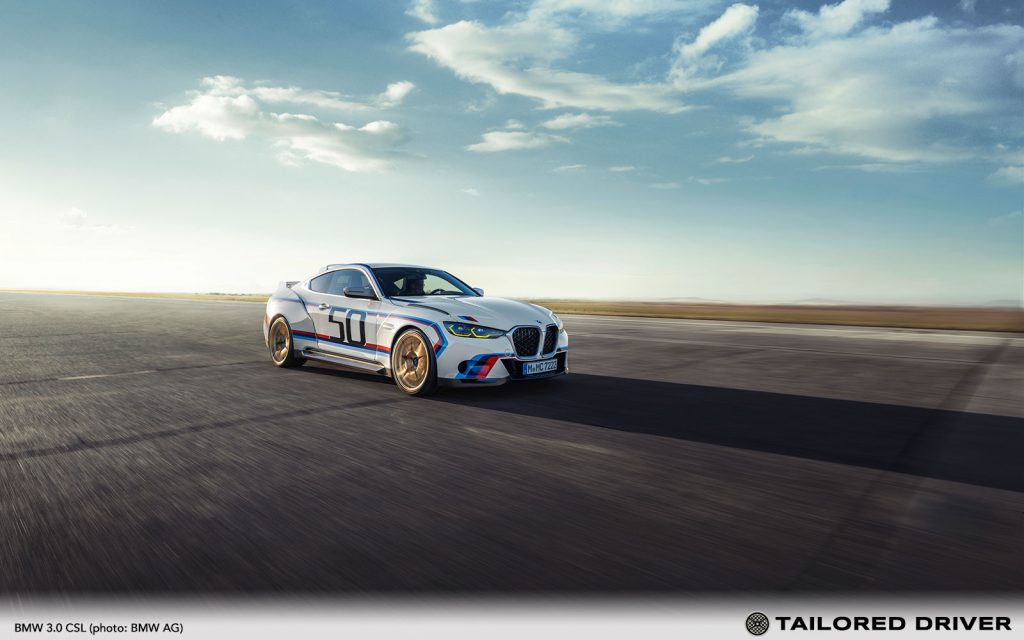
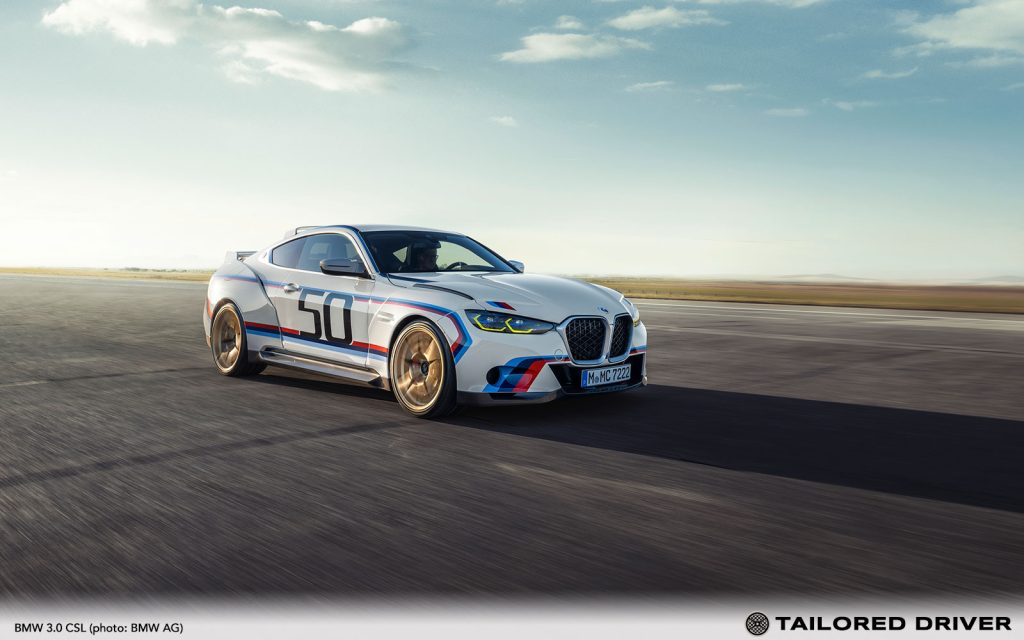
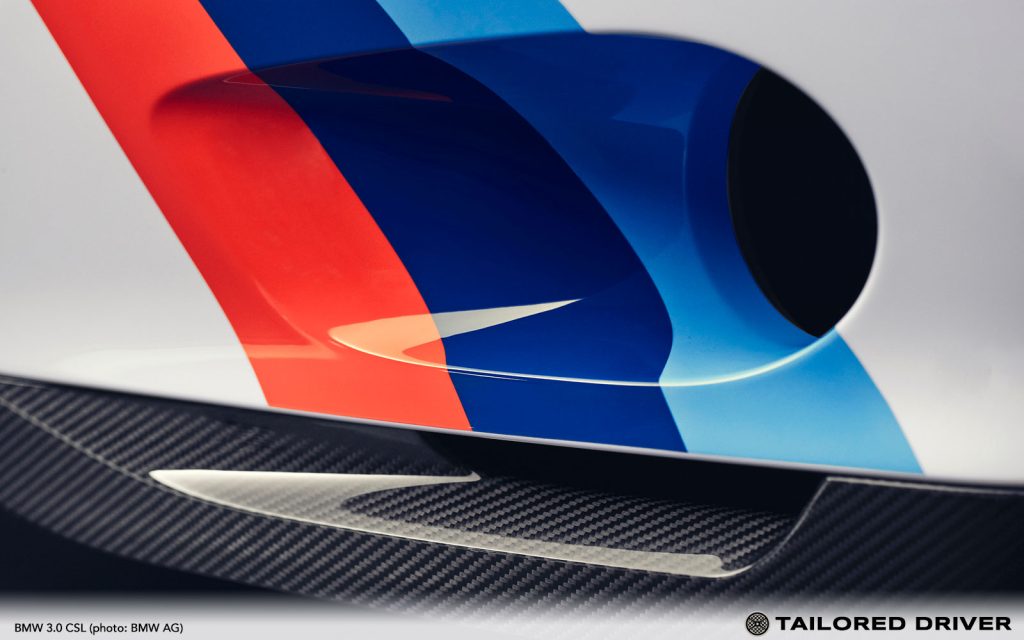
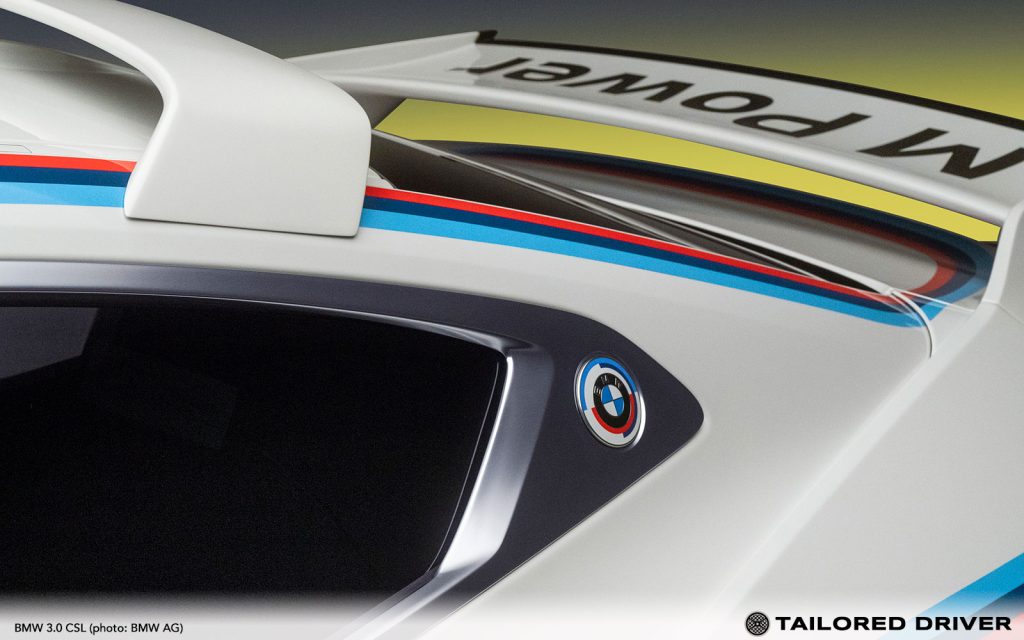
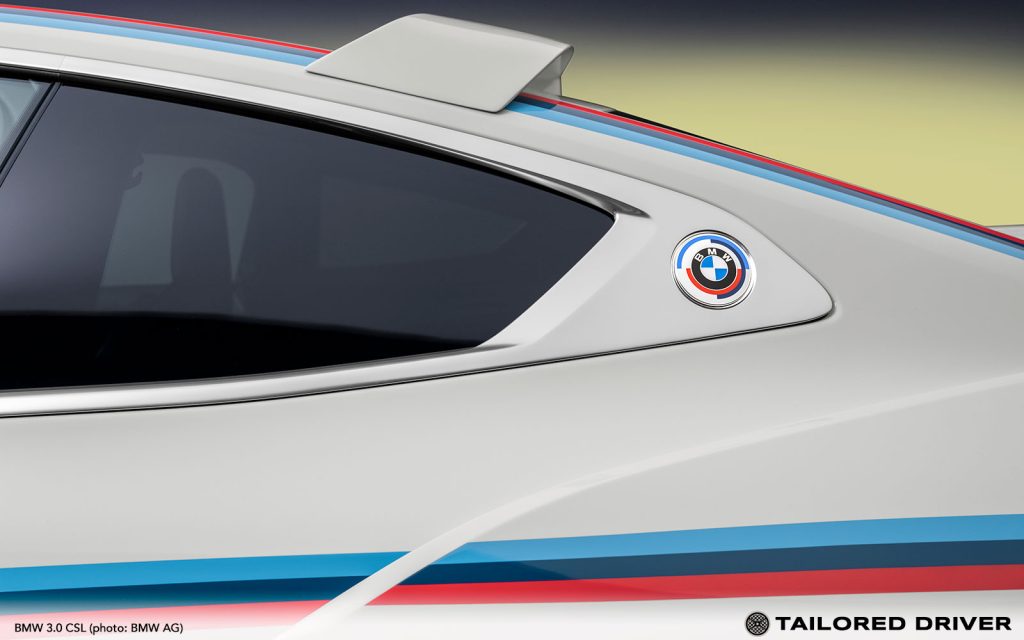
Right from the very beginning the 1970s, BMW Motorsport GmbH became imprinted in fans’ memories not only thanks to spectacular racing successes, but also through an unmistakable appearance. Just like the competition cars, the drivers’ outfits, the vehicle transporters and all other team equipment featured uniform stripes in blue, purple and red on a white background – a novelty at the time and a globally recognised trademark to this day. The BMW 3.0 CSL picks up on this tradition with a paint finish in Alpine white uni and an elaborately applied stripe decor in the BMW M GmbH colours. The lines on the body effectively reflect the dynamic surfaces, thus bringing to the fore the powerful aesthetics of the coupe even more clearly.
Both the base colour and the M stripes, known in technical jargon as livery, are applied largely by hand, involving an extremely high level of time and effort. A total of 22 individual parts are painted in a process specially designed for the BMW 3.0 CSL. Particular attention is paid to a highly precise arrangement of the areas of the body surfaces and livery stripes finished in visible carbon. In general, most of the exterior in Alpine white uni comprises carbon components, which are hand-painted by specialists. The high-tech material is only visible in the lettering on the roof and on the rear wing. For this purpose, these areas must be exposed during the painting process. In order to precisely position the livery stripes in the BMW M GmbH colours, the painters use masking by means of laser projection as well as customised contour films.
Each component with a livery paint finish has a throughput time of six working days. During this time, it completes up to eight paint processes, each with the necessary intermediate work steps such as sanding and masking the colour stripes. This results in a total of 134 paint processes for each vehicle, adding up to a total of 6,700 manual work sequences in the paint shop for the entire small series of the special model.
The number sequences on the doors and roof of the BMW 3.0 CSL, designed in the style of early racing cars, build a bridge from the past to the present. Their design in the style of racing numbers is based on the historical model of the first BMW M automobile developed for touring car racing, whilst the number 50 refers to the anniversary of BMW M GmbH. Another reminder of the 1970s are the two BMW logos positioned on the C-pillar, hence directly behind the counter-swing of the side window graphic known as the Hofmeister kink.
The most powerful straight six-cylinder power unit ever used in a road-legal BMW M automobile.
The BMW 3.0 CSL features the most powerful straight six-cylinder engine ever used in a road-legal BMW M automobile. This is also a tradition: in its final stage of development, the predecessor of the same name marked a new record with an engine output of 151 kW/206 hp – not only for six-cylinder models, but for all BMW production vehicles produced up to that point.
Since then, the straight six-cylinder engine with M Power has undergone an impressive development. Engines of the same design mobilised an output of 204 kW/277 hp in the BMW M1 as early as 1978 and 250 kW/340 hp in the second-generation BMW M5 from 1991. The fifth-generation BMW M3 was launched in 2014 with a 317 kW/431 hp straight-six engine featuring M TwinPower Turbo technology.
The straight six-cylinder engine of the BMW 3.0 CSL possesses the same technological roots as the power unit of the current DTM winning car. The 3.0-litre power unit offers spontaneous high revving thanks to the typical M high-revving concept and comprises, among other things, an extremely rigid crankcase in a sleeveless closed-deck design, a forged lightweight crankshaft and a cylinder head core featuring 3D printing technology. The cooling system and oil supply are also designed for extremely dynamic driving situations. For its championship win in the DTM, the BMW M4 GT3 was powered by a version of the latest straight six-cylinder engine with around 600 hp which, in its version designed for large-scale production in the current models of the BMW M3/BMW M4 series, delivers up to 375 kW/510 hp.
The version of the drive system with M TwinPower Turbo technology, which was further developed exclusively for the BMW 3.0 CSL, mobilises a maximum output of 412 kW/560 hp. The new record for straight six-cylinder models from BMW M GmbH with road approval underpins the special status of the vehicle. Its engine develops a maximum torque of 550 Nm and fascinates with a linear power delivery up to a maximum speed of 7,200 min-1.
6-speed manual transmission and rear-wheel drive for particularly intense driving pleasure.
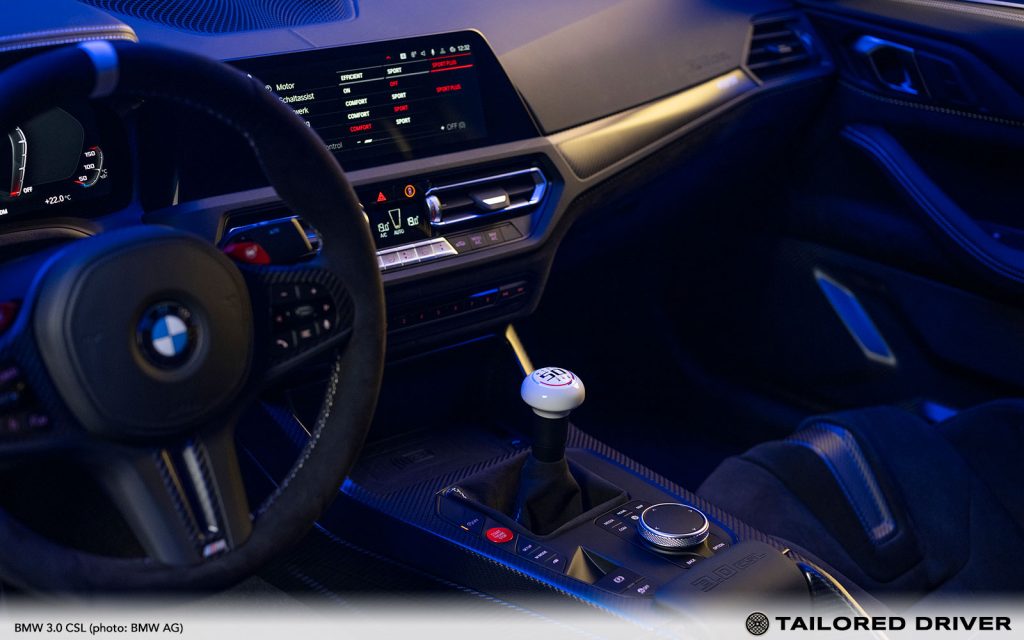
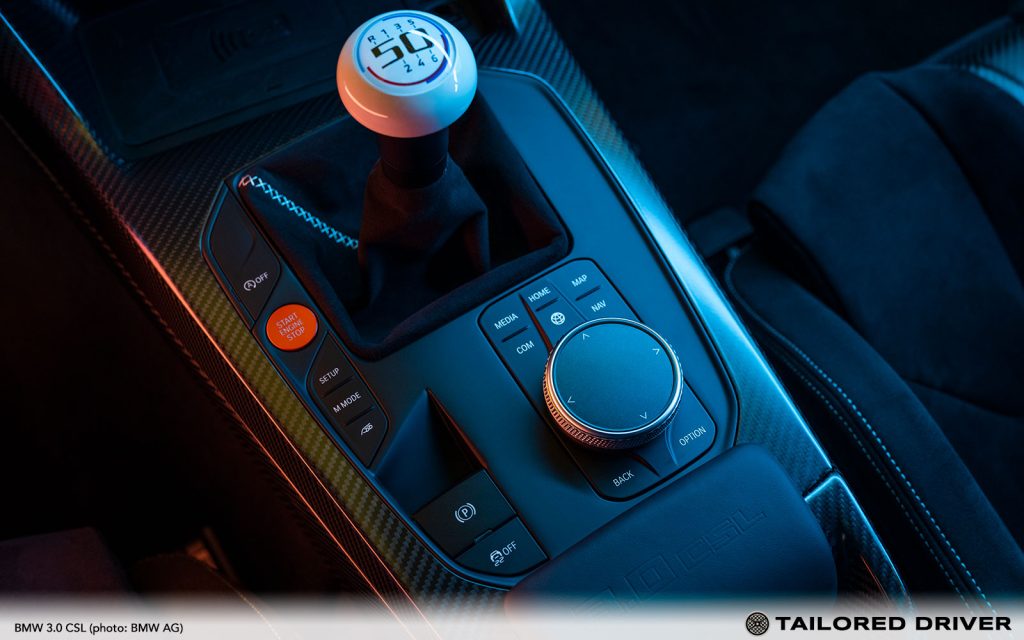
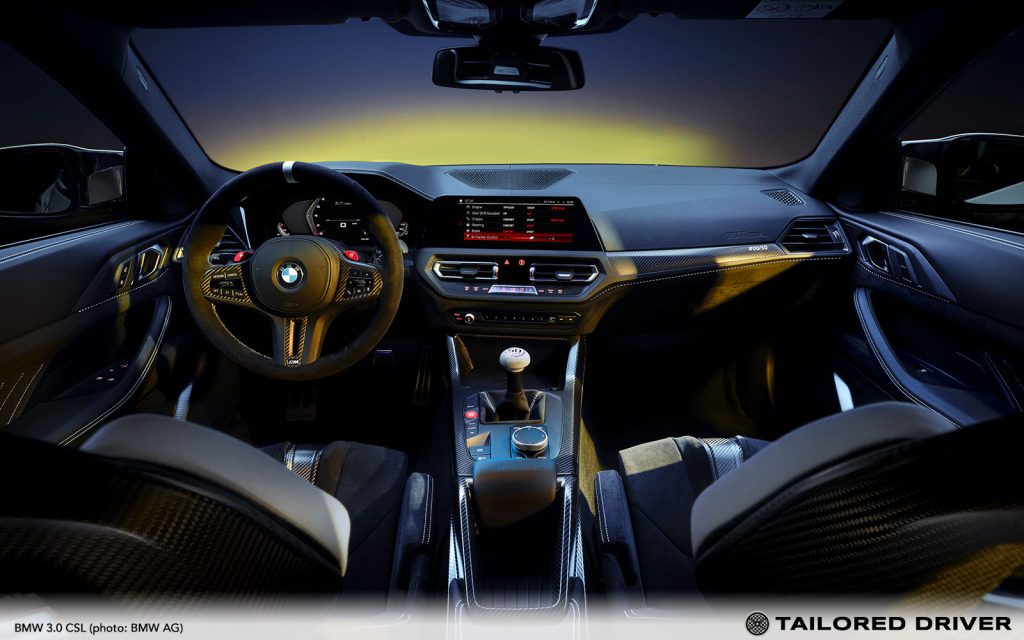
To transfer the drive power to the road, the developers of the BMW 3.0 CSL used a concept that has been tried and tested for decades for maximum driving pleasure and intensive interaction between driver and vehicle. The straight six-cylinder engine is coupled with a 6-speed manual gearbox whose spread and transmission ratios are ideally matched to the performance characteristics. Precisely defined gear shift travel enables fast and precise gear changing. The gearshift knob made exclusively for the BMW 3.0 CSL protrudes from the centre console and is a luxurious accessory. It immediately arouses anticipation for the manual gearshift, lies snugly in the hand and, with its white surface, the engraved gearshift diagram and the number 50, is reminiscent of the beginnings of BMW M GmbH in the 1970s. A tribute to modern technology is the shift assistant, which uses a connection speed control to ensure slip-free clutch engagement after downshifting when braking for corners. It can be activated or deactivated by the driver.
In traditional manner, the drive torque is transmitted to the road exclusively via the rear wheels of the BMW 3.0 CSL. For ambitious use on the race track, the driver can use the typical M linear build-up of lateral acceleration forces to steer the vehicle through bends with controlled drift manoeuvres. The Active M Differential in the rear-axle transmission also ensures superior dynamics. If necessary, it prevents torque compensation between the rear wheels and, at the same time, continuously and variably builds up a locking effect of up to 100 percent. The Active M Differential is linked to the DSC (Dynamic Stability Control) and precisely adjusts its locking effect to the respective driving situation. For example, traction is optimised on roads with different friction values for the right and left rear wheels. When accelerating dynamically out of bends, the driver receives noticeable feedback on the grip potential on the rear wheels and can thus optimally dose the use of the accelerator pedal.
Suspension technology tuned exclusively to each model, including M carbon-ceramic brake system and M Traction Control.
In the configuration of the suspension technology as well, state-of-the-art technology has been combined with a methodology for the harmonisation of all components that has matured over five decades. The suspension components used in the BMW 3.0 CSL represent the spearhead of development for high-performance sports cars by BMW M GmbH: a double-joint spring strut front axle and a five-link rear axle in M-specific design, an Adaptive M suspension with electronically controlled shock absorbers, the electromechanical M Servotronic steering with variable ratio and the M carbon ceramic brake system with adjustable characteristic curves.
The integrated application of all drive and chassis systems took place during intensive test drives on public roads as well as on race tracks, including the Nürburgring Nordschleife, which has been the ultimate testing ground for all BMW M automobiles for 50 years. Prior to testing, engineers at BMW M GmbH had designed and optimised the digital image of the BMW 3.0 CSL in every detail in a computer-aided design and development process. By incorporating virtual reality and other digital processes, it was possible to accelerate the series development process to the maximum extent. This detailed simulation and tuning process took into account the model-specific dimensions, vehicle weight and axle load distribution, the extremely high rigidity of the body and suspension connections as well as the aerodynamic balance of the BMW 3.0 CSL to ensure from the onset that typical M combination of agility, dynamics and handling precision.
Powerful deceleration performance, optimised fading stability, outstanding thermal stability and extremely high wear resistance are offered by the M carbon ceramic brake system. It combines six-piston fixed-calliper brakes and ceramic brake discs measuring 400×38 millimetres on the front axle with single-piston fixed-calliper brakes and 380×28-millimetre ceramic brake discs at the rear and features red-painted brake callipers. The M-specific design of the integrated braking system allows two characteristic pedal-feel curves to be displayed, which can be selected in the M Setup menu.
With the M Traction Control function, the driver can individually set the intervention thresholds of the wheel slip limitation. Ten levels are available for this purpose, and complete deactivation of the driving stability control is also possible via the M Dynamic Mode. The BMW 3.0 CSL is thus perfectly prepared for experiencing puristic performance on the race track.
Intelligent lightweight construction with maximum use of carbon components.
In the BMW 3.0 CSL, the tradition of intelligent lightweight construction, which has been cultivated since the 1970s, is reformulated and reshaped using state-of-the-art technology. To reduce weight in the body and chassis areas, carbon fibre reinforced plastic (CFRP) is used to an exceptionally high extent in addition to the minimal use of insulating material. BMW M GmbH is a pioneer in the use of CFRP in series-produced vehicles. As early as 2004, it equipped a large-series model with a carbon roof for the first time.
The BMW 3.0 CSL features CFRP components on virtually all bodywork sections. In addition to the roof, bonnet and boot lid, the front and rear aprons are made entirely of carbon. The front and rear side panel attachments, the side sills, the rear diffuser, the rear wing and rear spoiler are also made of the high-tech material. All carbon components are manufactured in small series, mostly by hand and exclusively for the BMW 3.0 CSL.
In addition, a targeted selection of materials and state-of-the-art design methods also lead to a significant reduction in the weight of other vehicle components. The roof spoiler of the BMW 3.0 CSL is made of glass fibre reinforced plastic. The titanium rear silencer of the BMW 3.0 CSL is around 4.3 kilograms lighter than a conventional steel component. The cast aluminium precision struts in the engine compartment, which connect the suspension strut domes to each other and to the front end, have a geometry that has been precisely matched to the forces acting in different driving situations. With the aid of numerical models agility and steering precision has been optimized with a minimum of material and weight.
Puristic sports car cockpit with M carbon full bucket seats.
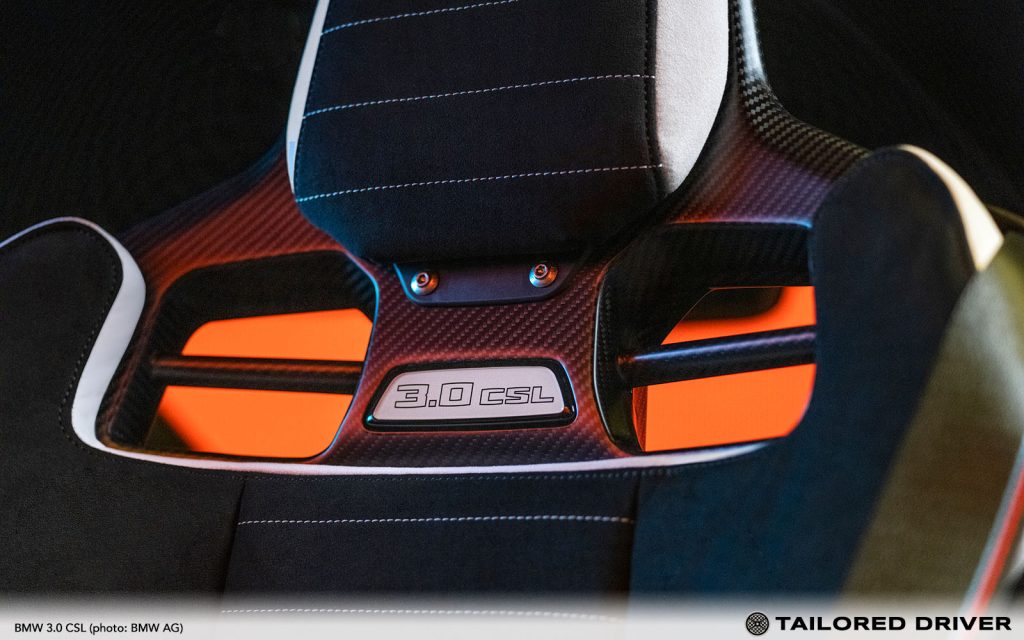
Also, in the interior of the BMW 3.0 CSL the use of carbon and other lightweight construction measures emphasise the puristic sports car characteristics. Instead of additional seats, the rear offers a storage compartment with two integrated helmet compartments. CFRP trim in the door panels and reduced acoustic insulation also contribute to the extremely sporty flair. The driver and front passenger sit in M Carbon full bucket seats, which convey a highly emotional and inimitable racing feeling every kilometre of the way. The diagonal connections between the seat surface and the backrest are reminiscent of the construction principle of the lightweight seats featured in the historic model. Seat height and inclination can be adjusted exclusively via a three-stage screw linkage in a workshop. The longitudinal position can be varied manually using a lever at the front edge of the seat. In addition, the M Carbon full bucket seats offer removable headrest inserts.
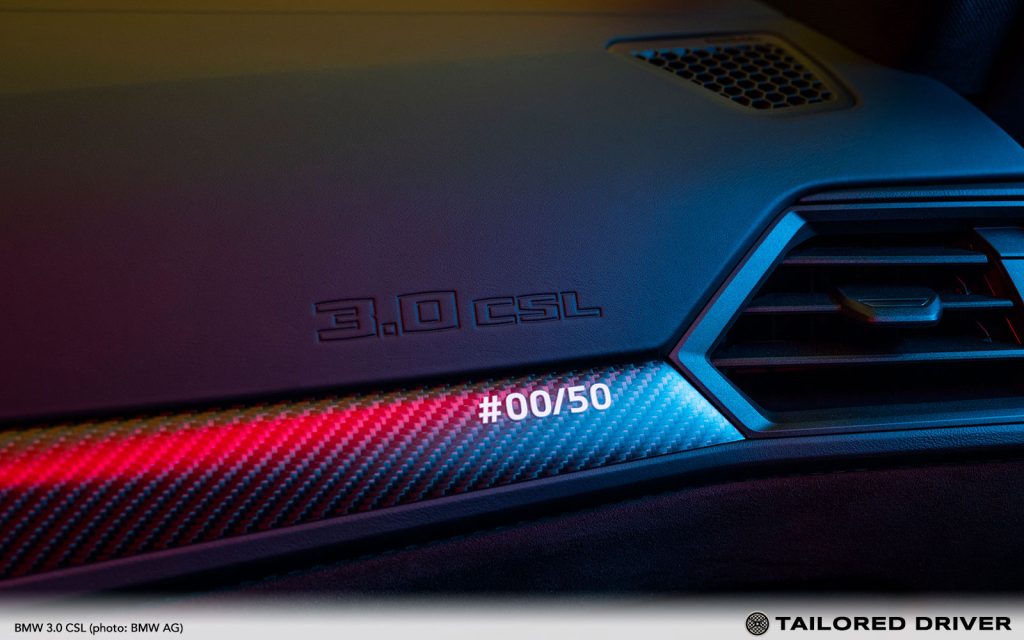
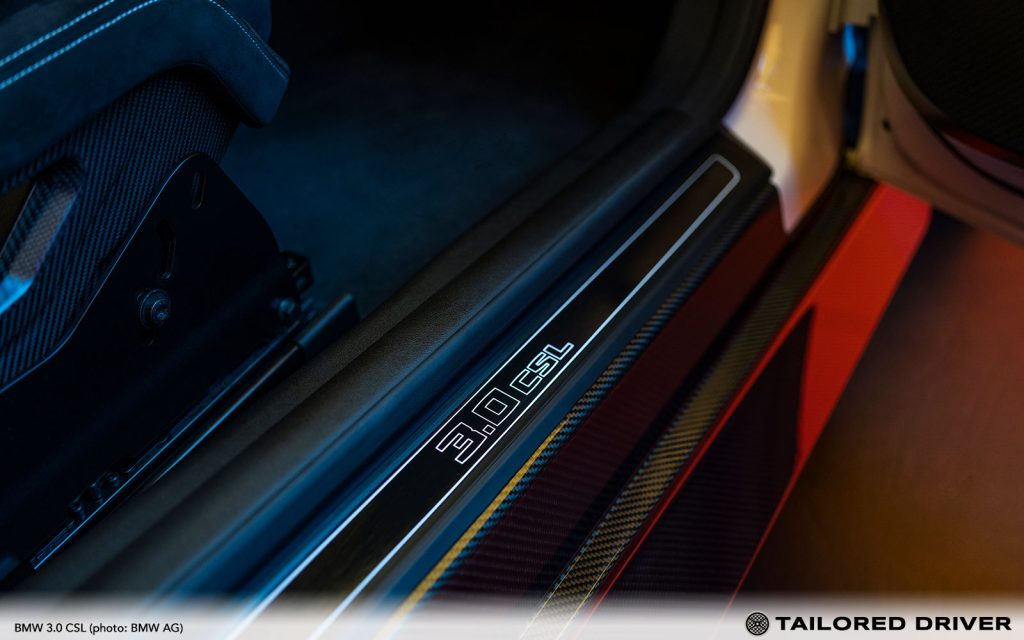
Over and above that, the interior of the BMW 3.0 CSL presents itself as a sports car cockpit that is puristic and exclusive. Black Alcantara seat surfaces and M seat belts are combined with an M Alcantara steering wheel, an anthracite roof liner, black Alcantara and matt carbon surfaces. Contrast stitching and other accents in white correspond with the exterior paintwork of the BMW 3.0 CSL, the model lettering of which is embossed into both the door sill trims and the seat surfaces. The white gearshift knob symbolises the classic form of interaction between driver and vehicle when changing gear. The red start/stop button and the likewise red M buttons on the steering wheel are available for activating the engine and for direct access to the vehicle’s overall setup. The matt interior trims in a carbon fibre finish feature sequential numbering for each of the 50 units available. This marking, documented in the interior from #01/50 to #50/50, corresponds in each case to the final digits of the suspension number, thus representing a clearly visible and authentic reference to the individual vehicle identity.
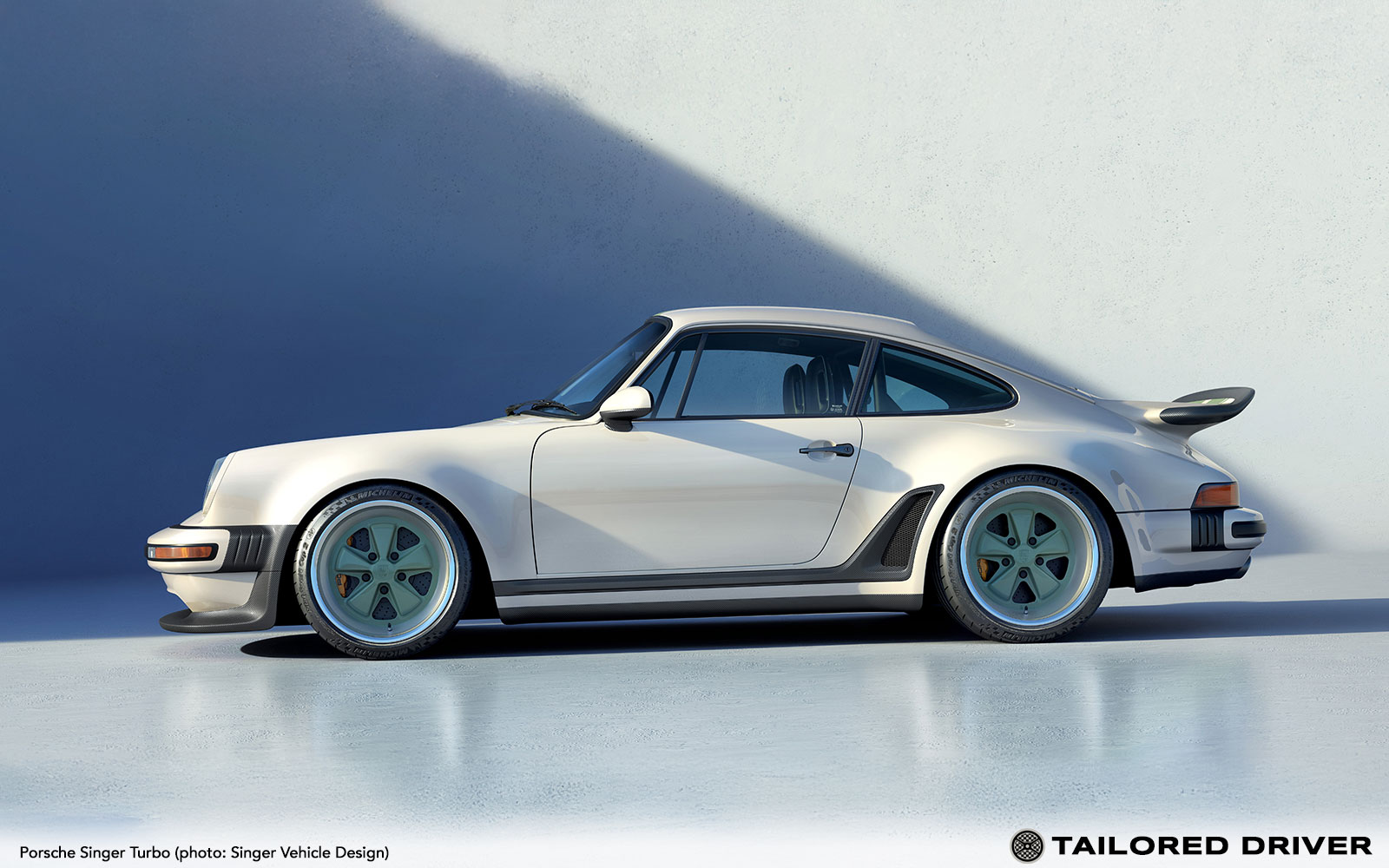
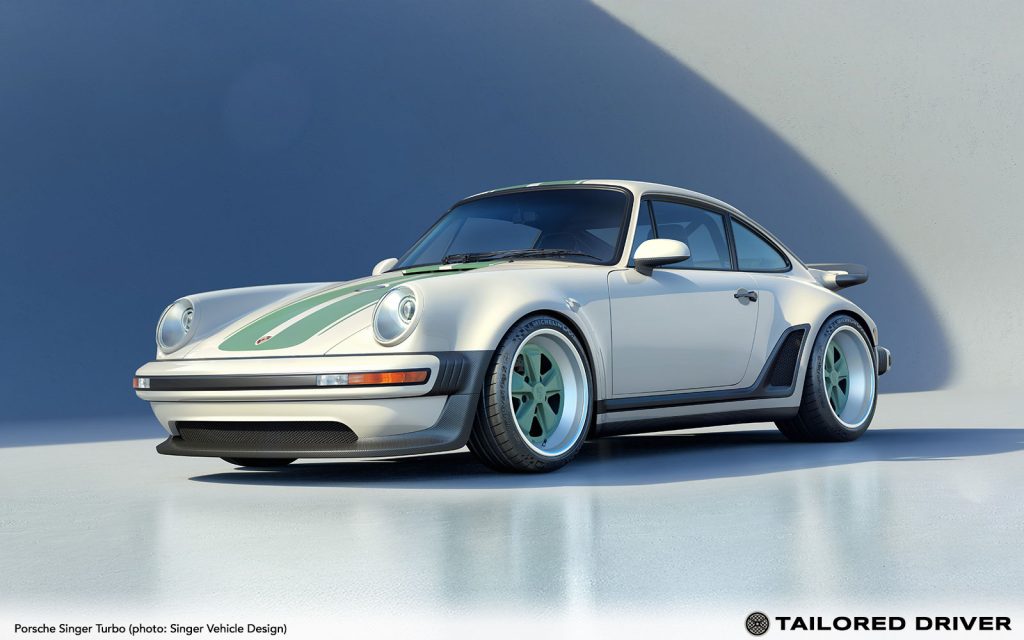
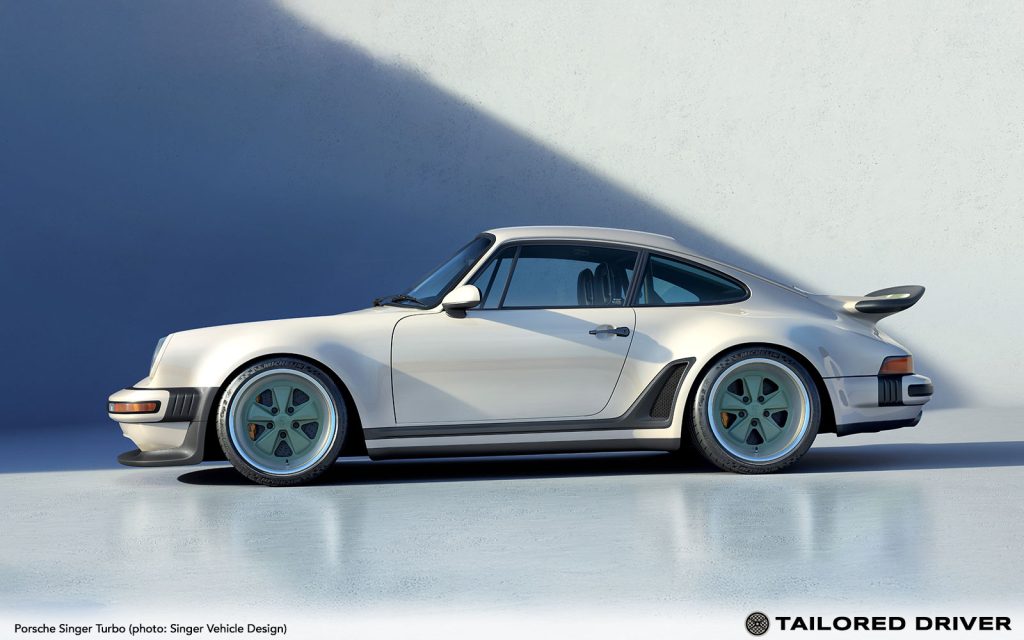
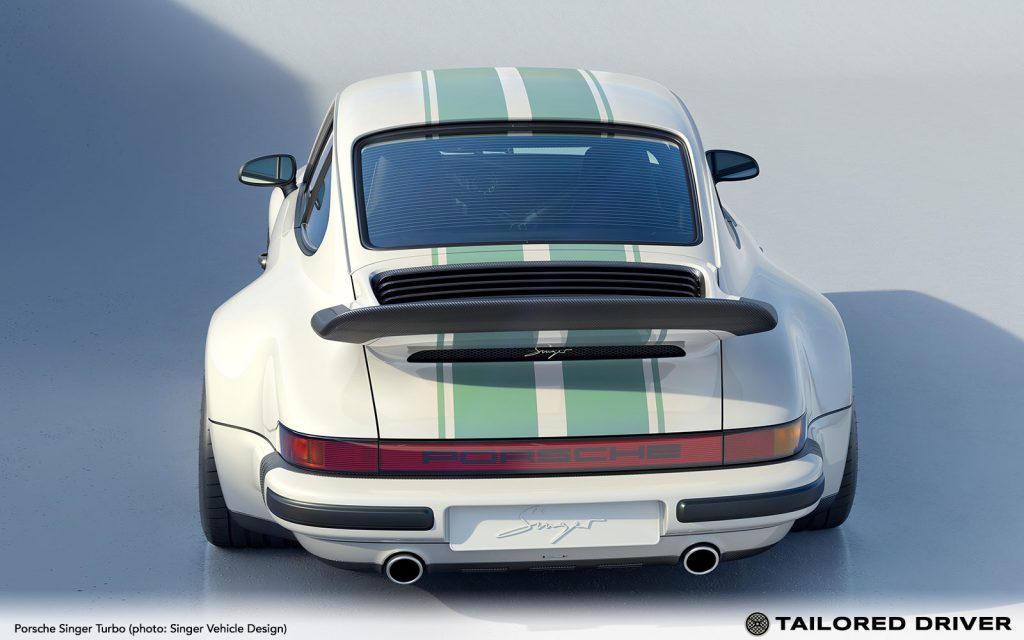
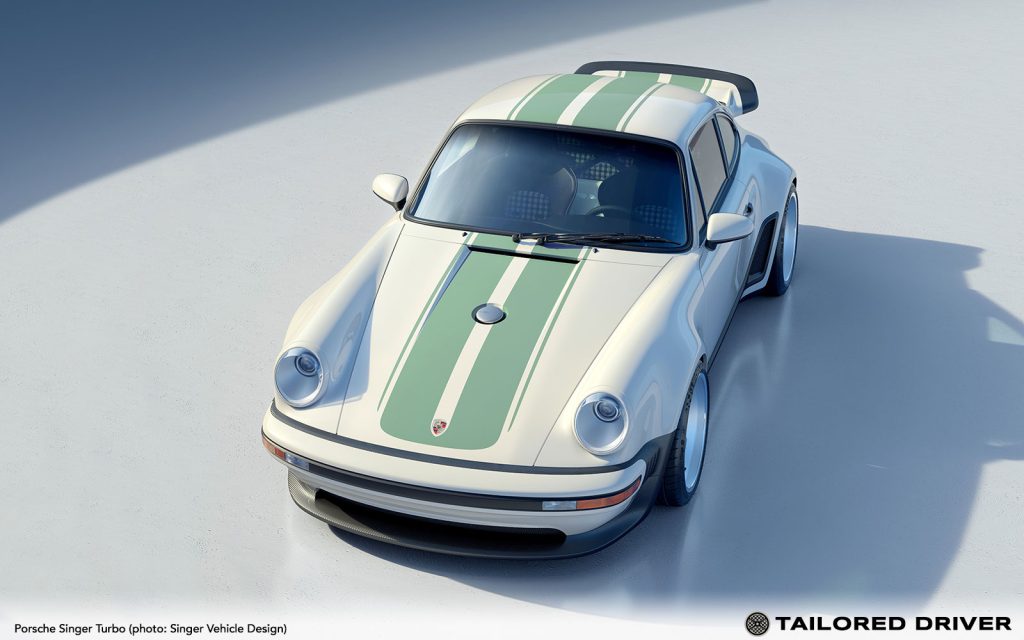
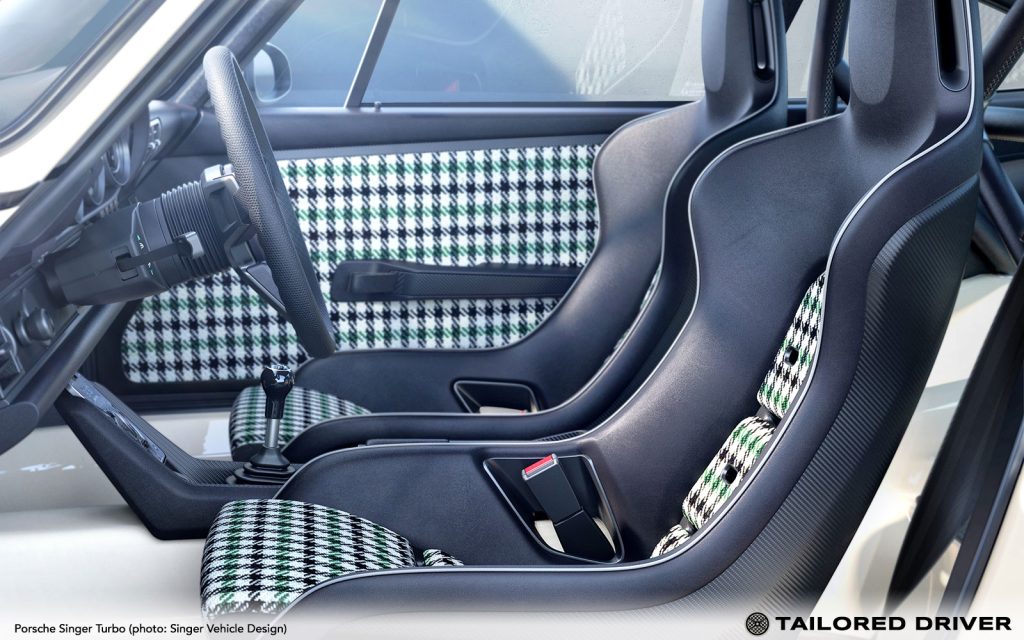
Californian luxury brand Singer adds a sports focus to their Turbo Study restoration services. This Porsche 911 reimagined by Singer is specified by its owner to focus on sports performance, including a power increase to 510 HP. The results illustrate the capabilities enabled by the study and Singer’s collaboration with owners to deliver a personal vision. To learn more, view Turbo Study.
Front ¾ showing carbon fibre bodywork in Turbo Racing White, front decklid with centre-mounted fuel filler, lowered ride height and visual carbon fiber elements for front splitter and rear shark fin air intake.
Side profile showing carbon fibre bodywork in Turbo Racing White, lowered ride height, visual carbon fiber elements for front splitter, louvred bumpers, rear shark fin air intake and whale tail rear spoiler.
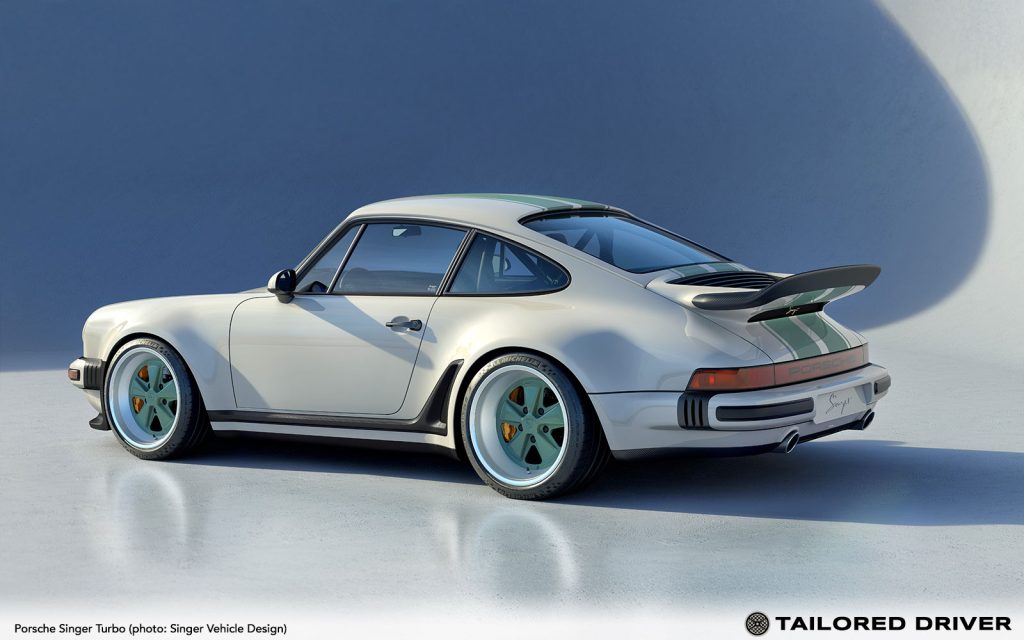
Left rear ¾ showing whale tail rear spoiler with visual carbon fiber elements, louvred bumpers, widened track, functional shark fin engine intake, rear bumperette delete and carbon fibre bodywork in Turbo Racing White
Rear view showing rear bumperette delete, whale tail rear spoiler with visual carbon fiber elements, twin exhaust pipes, and carbon fibre bodywork in Turbo Racing White.
Elevated front view showing carbon fibre bodywork in Turbo Racing White with double green top stripes, and external, center-mounted fuel filler.
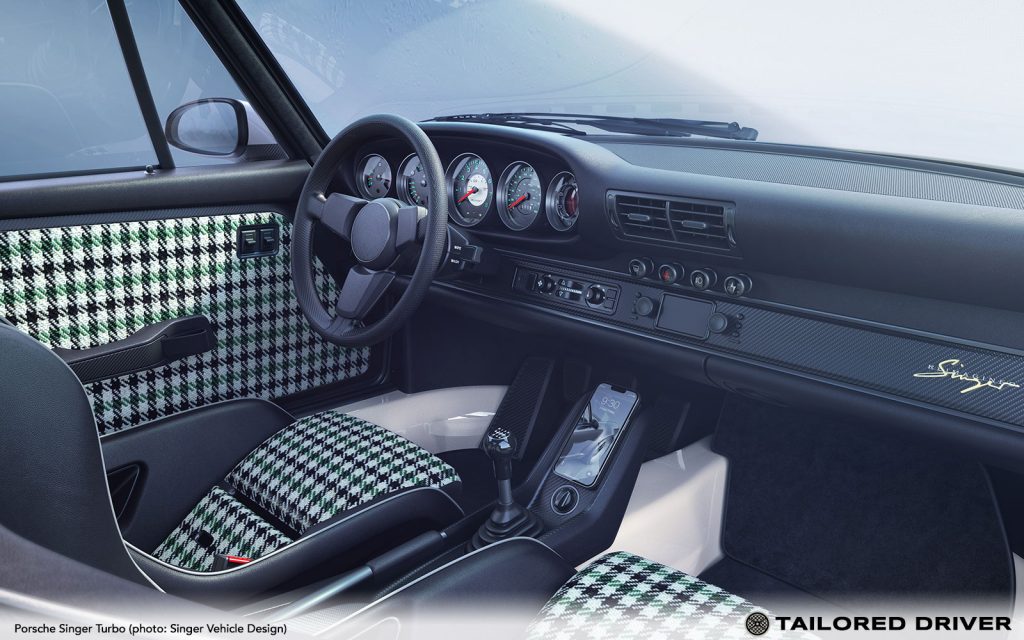
Bespoke interior specified with a sports focus. Presented in Houndstooth “Grun” cloth with visual carbon fiber accents, lightweight door trims, and painted surfaces for sills and transmission tunnel. Lightweight carbon fiber seats, six-speed manual transmission, inductive phone charging, air-conditioning.
Bespoke interior specified with a sports focus. Lightweight carbon fiber track seats and door trims in bespoke Houndstooth “Grun” cloth. Sills and transmission tunnel painted to match exterior in Turbo Racing White. Rear cross-brace.
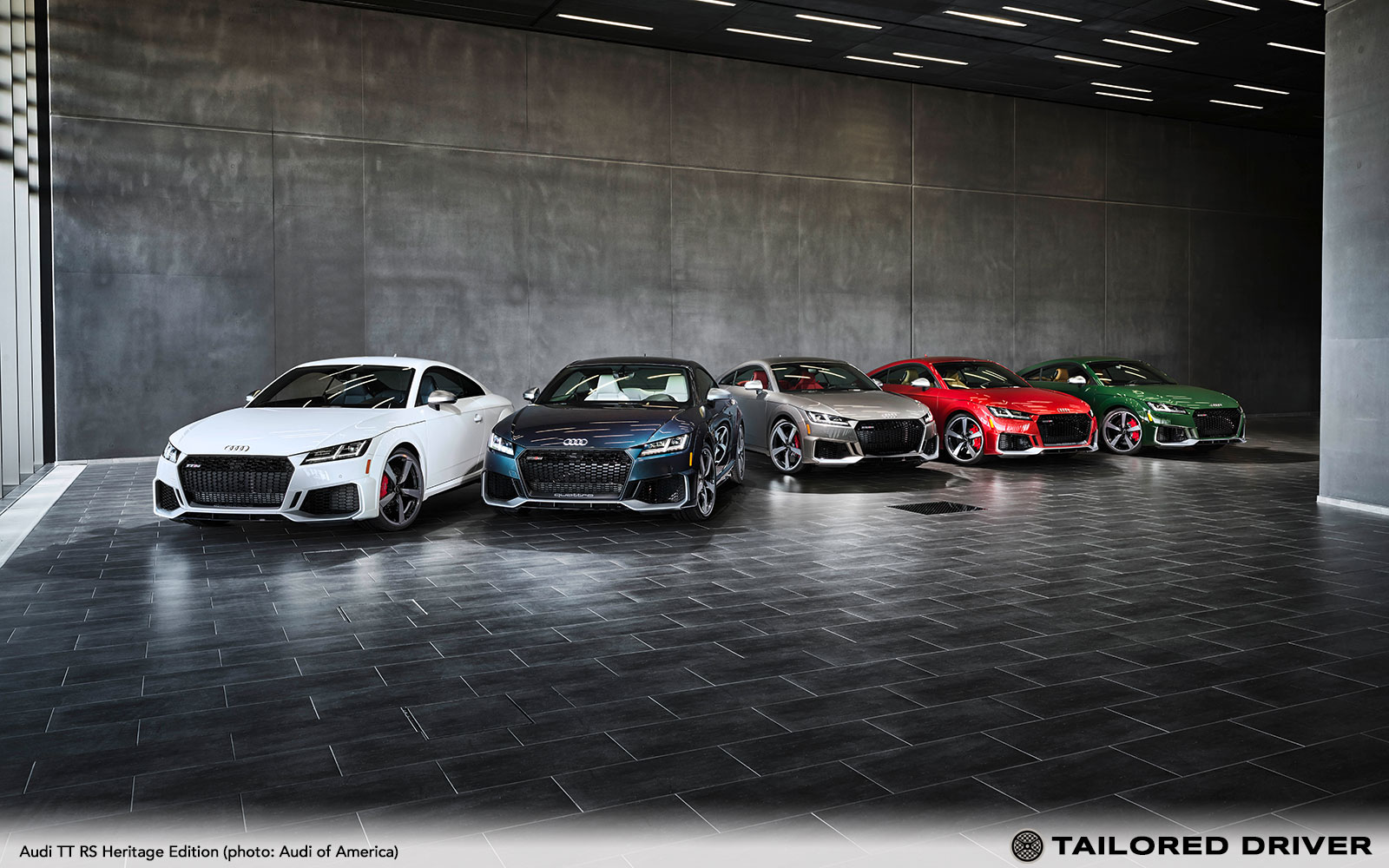
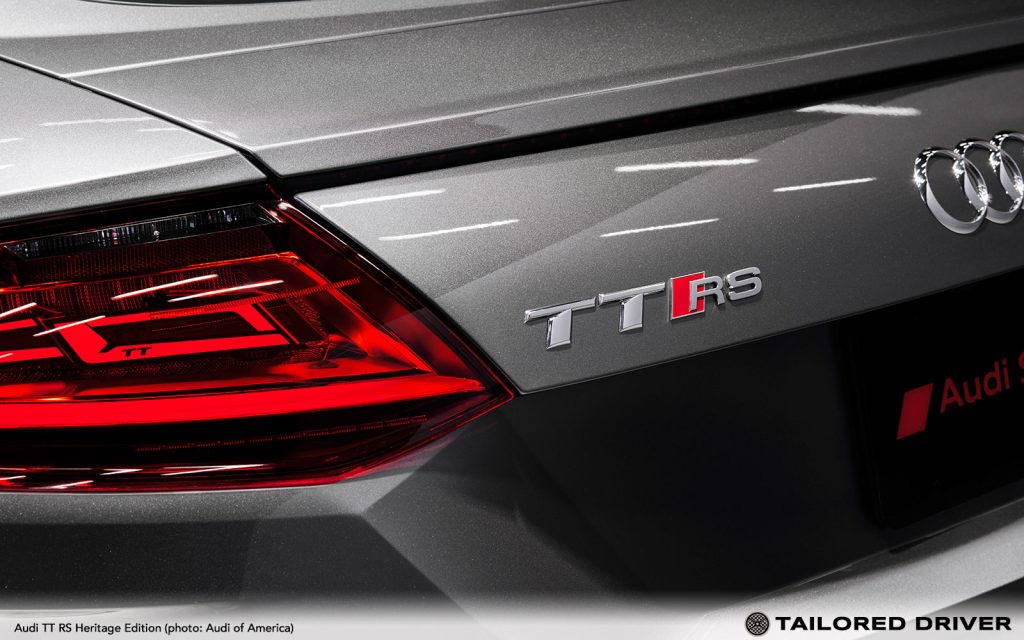
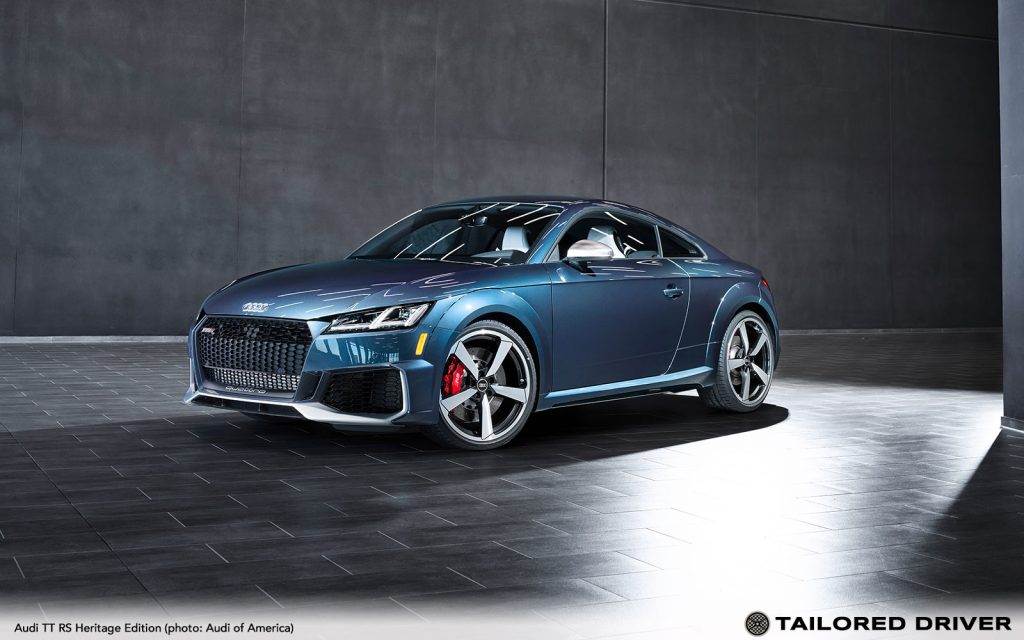
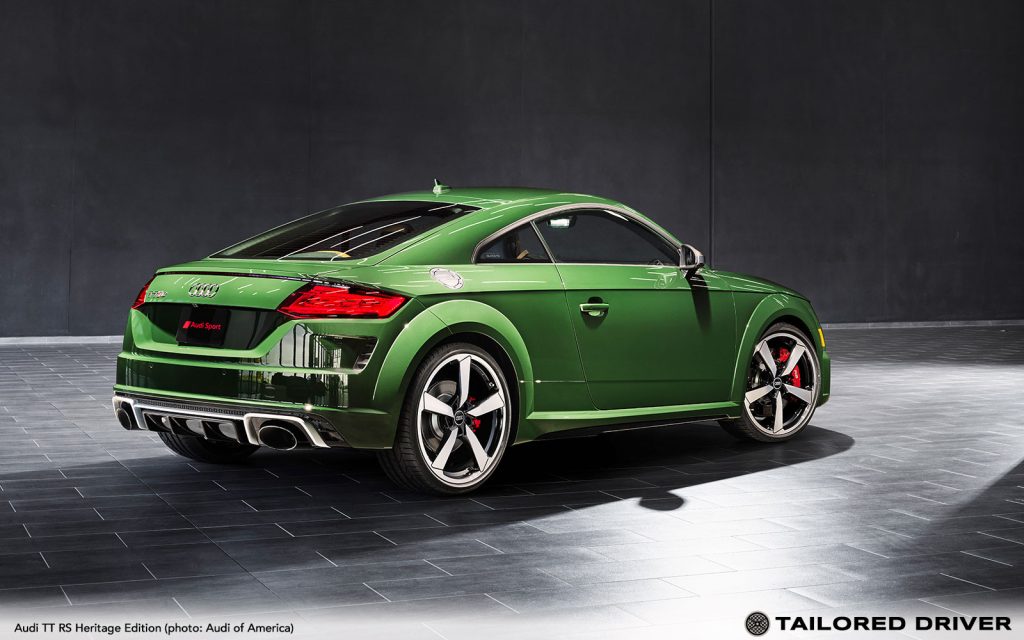
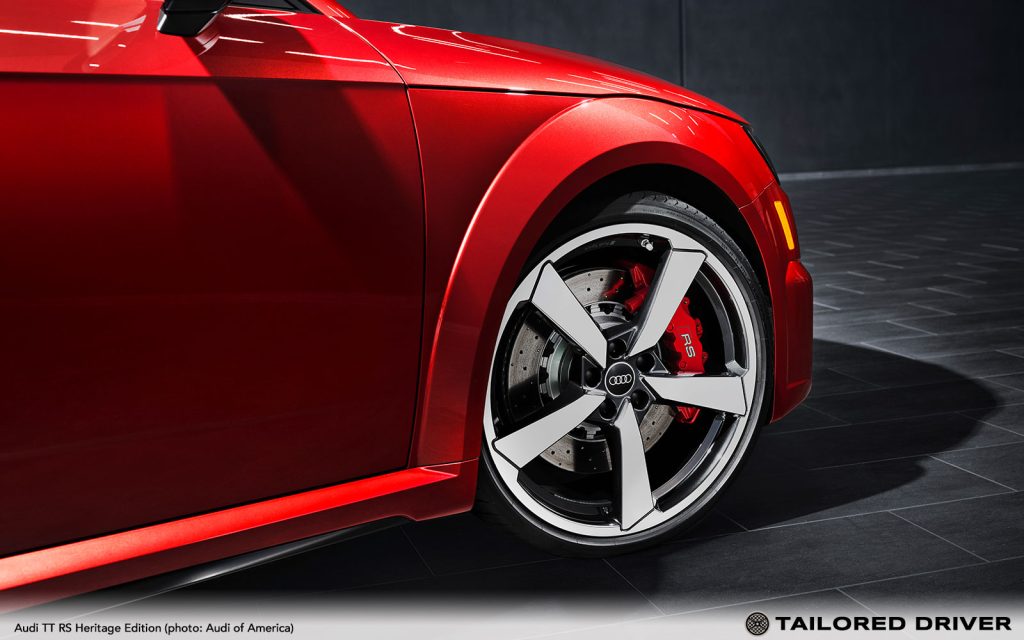
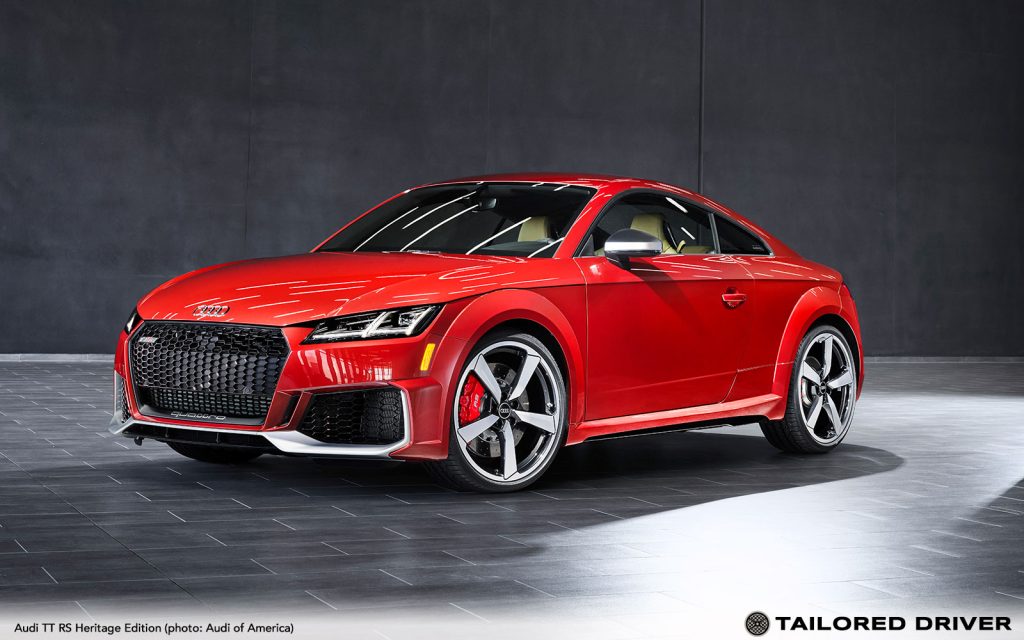
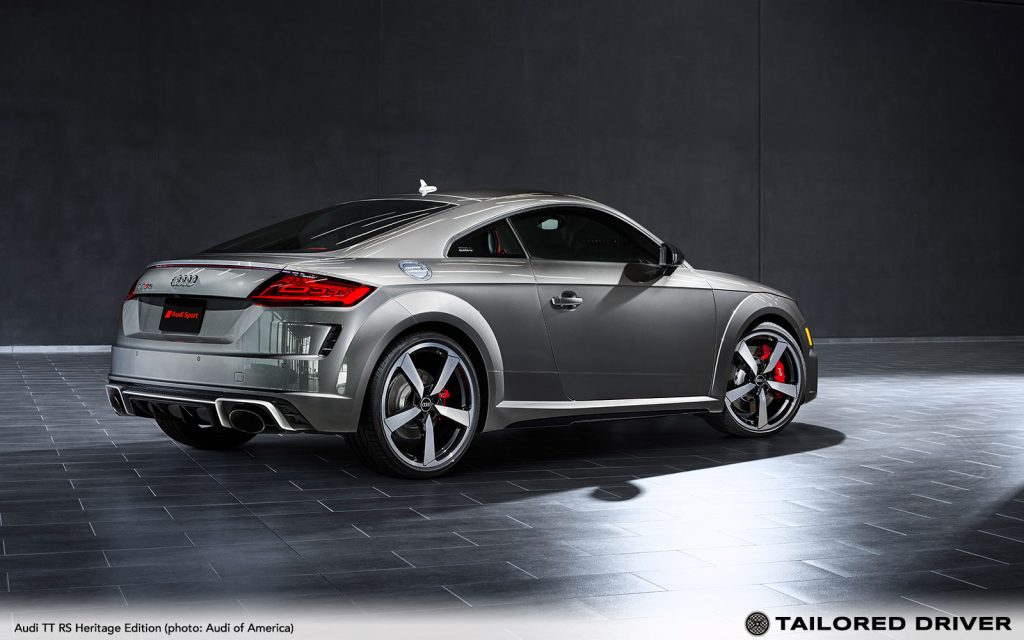
Audi TT RS no longer offered after the 2022 model year in the U.S.
Five Audi heritage colors celebrate legendary five-cylinder engine and bids farewell to pinnacle performance of a design icon in the U.S.
Limited number of just 50 (10 of each) color combinations available
[source: Audi of America, Color Code Information Researched and Provided by Tailored Driver]
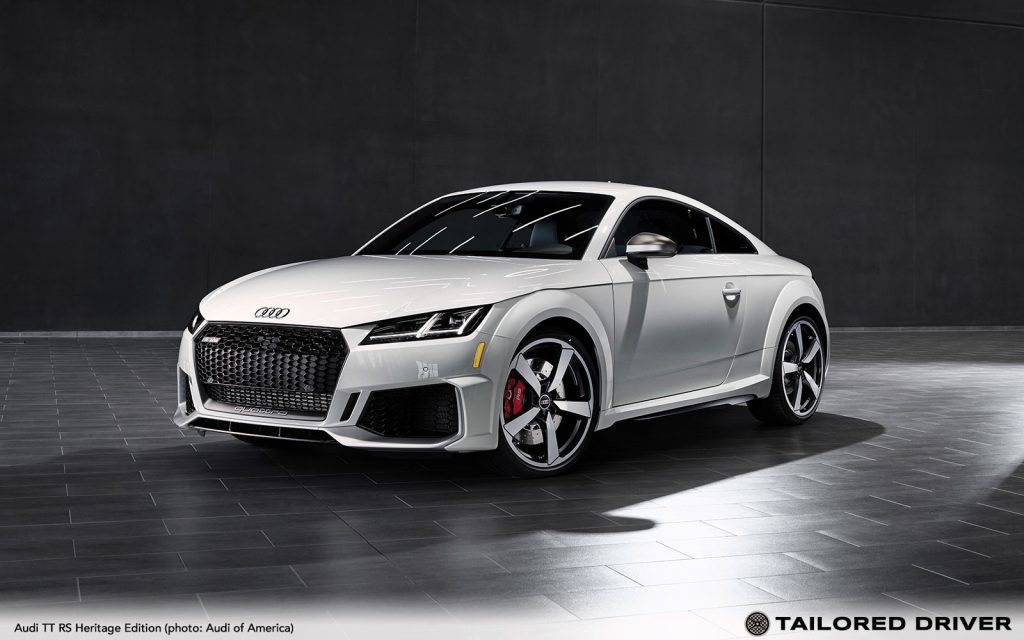
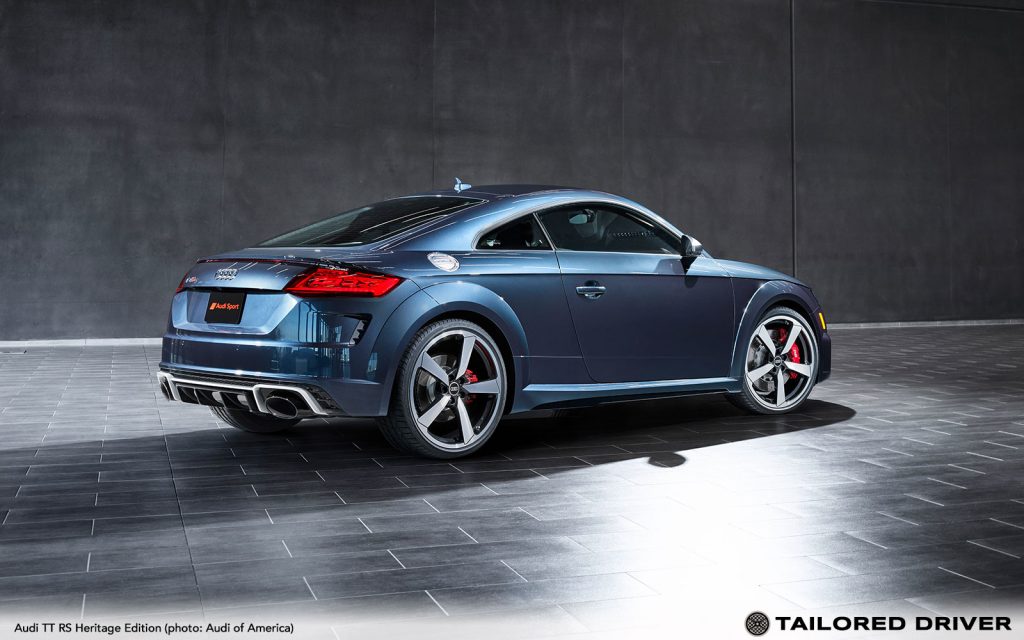
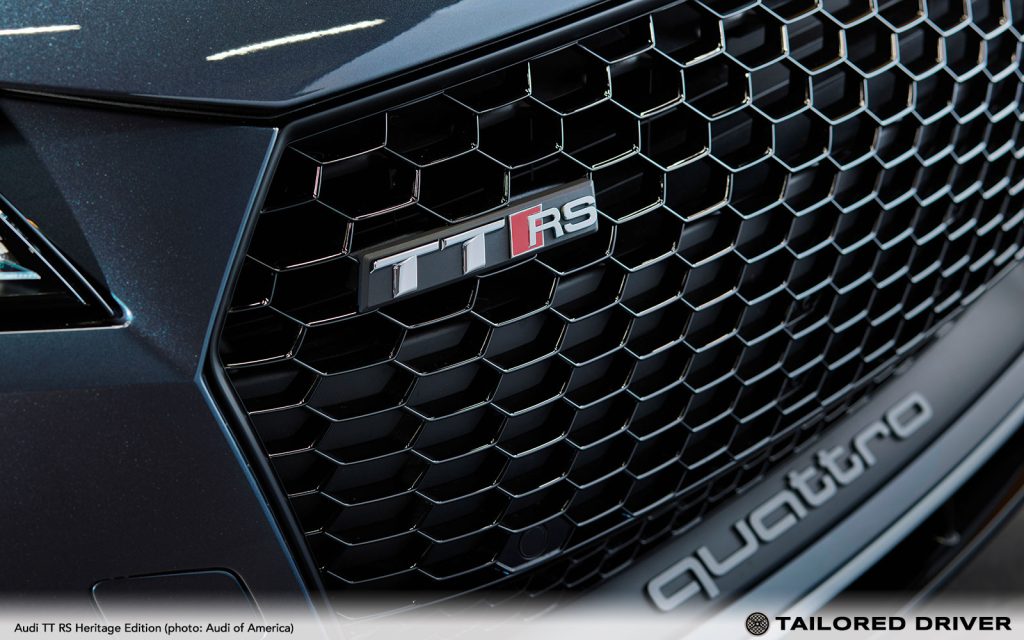
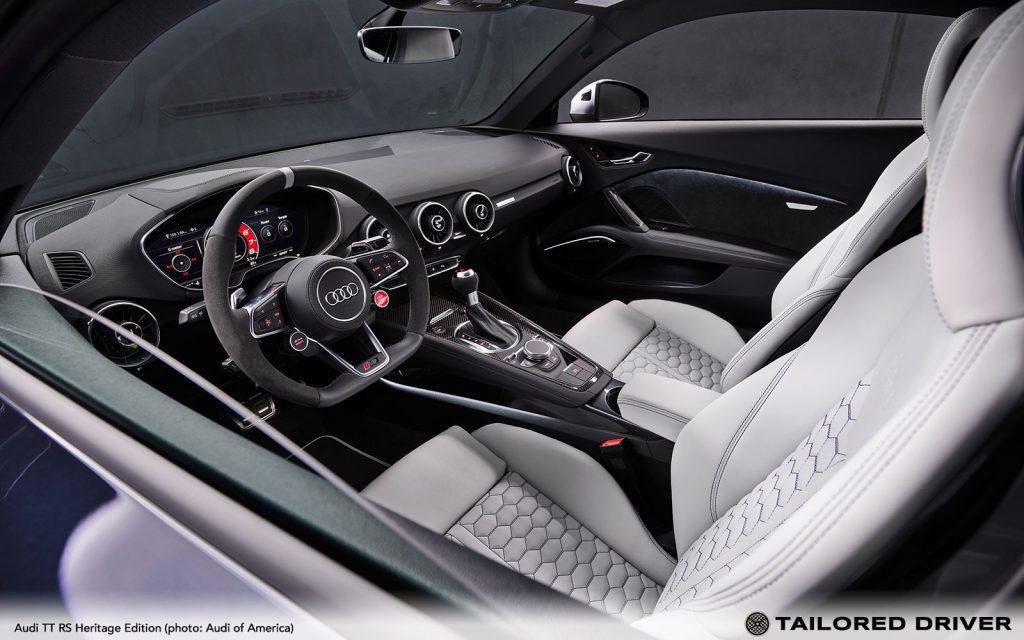
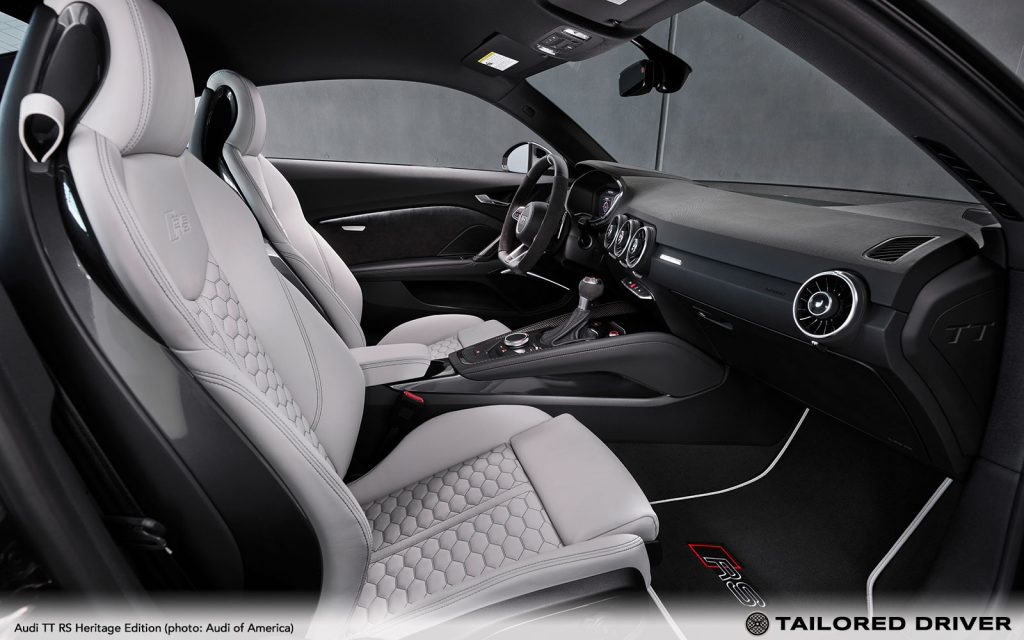
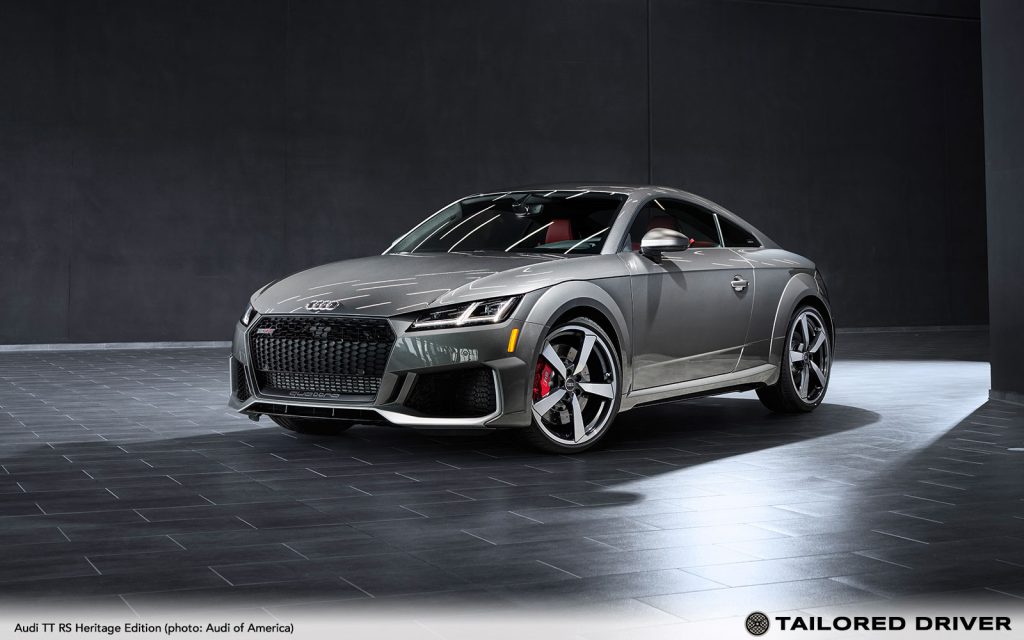
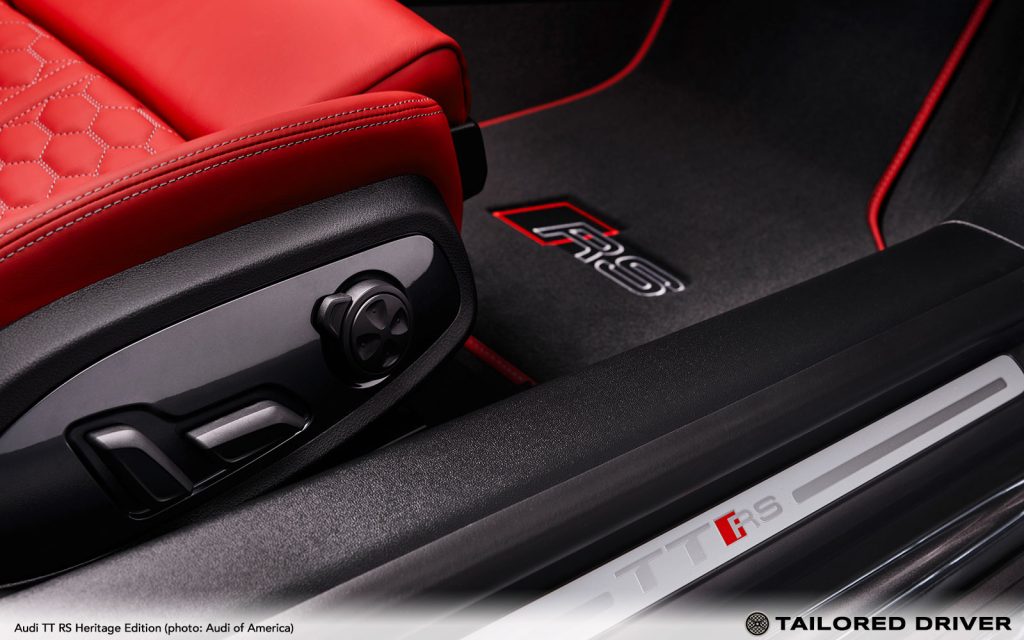
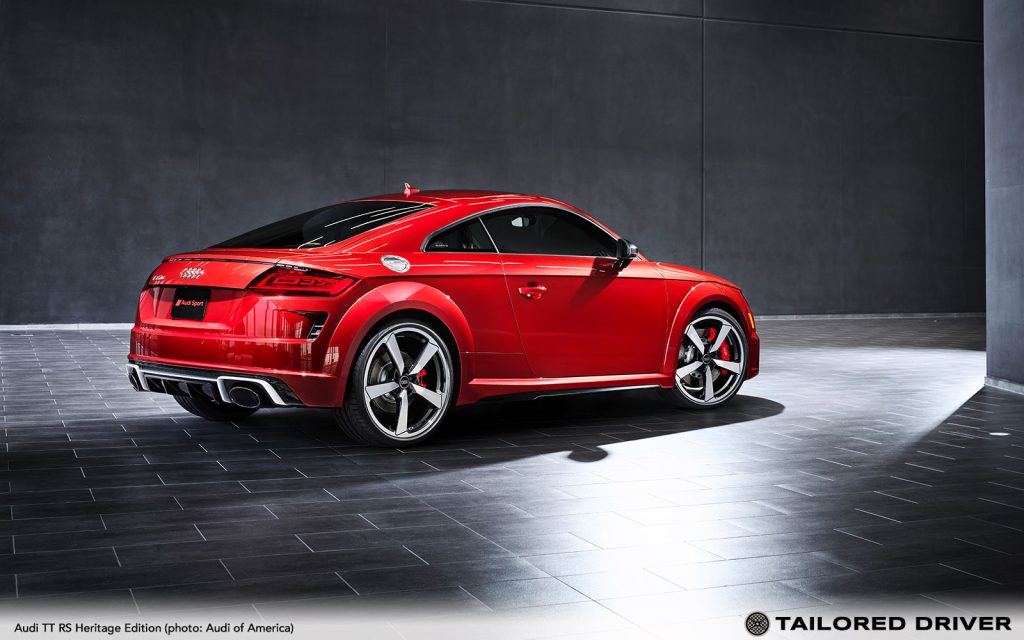
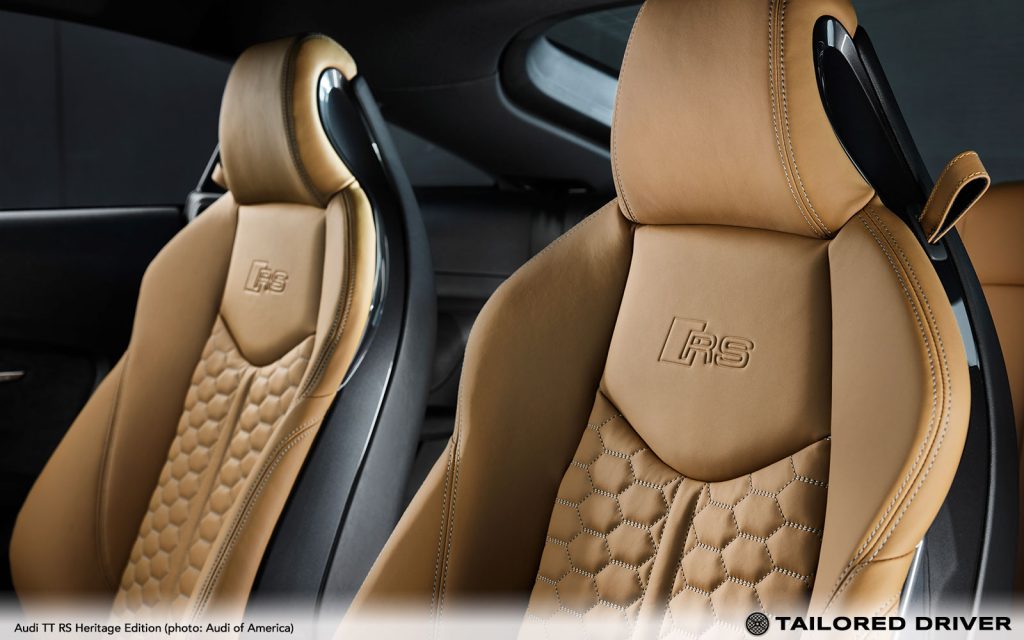
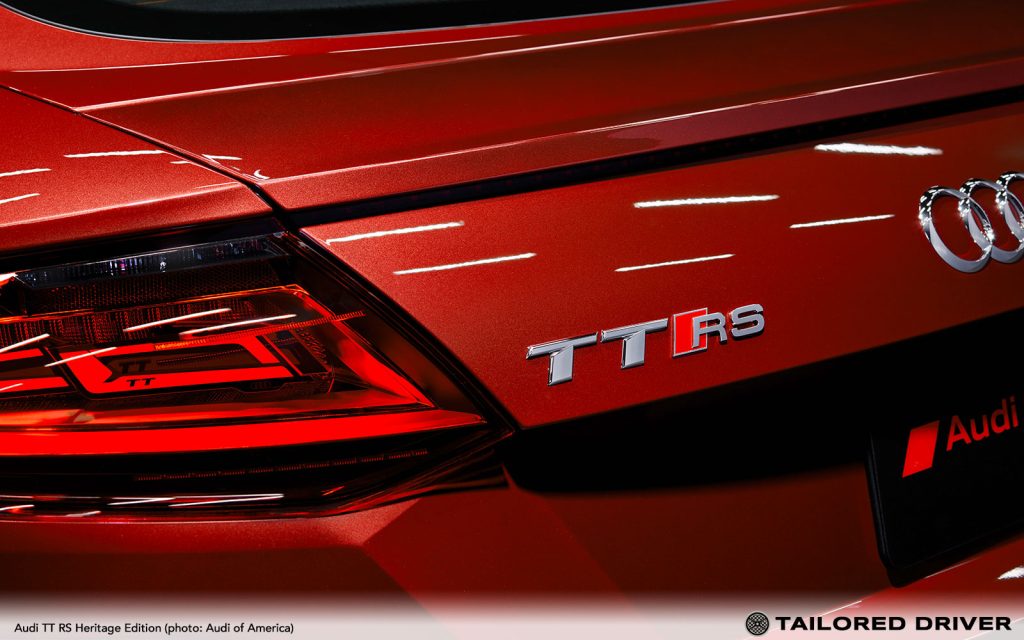
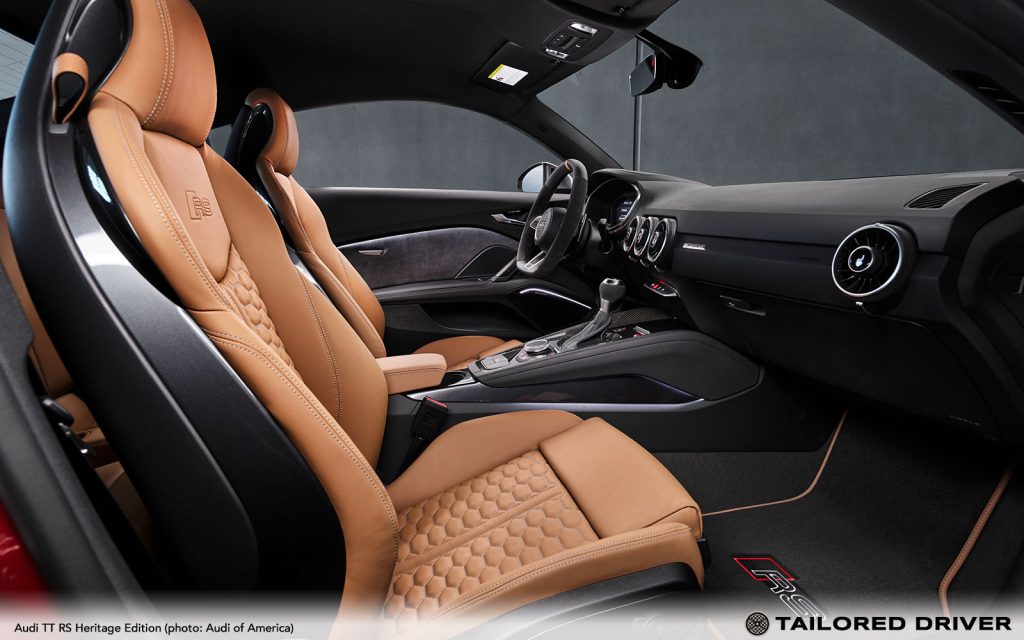
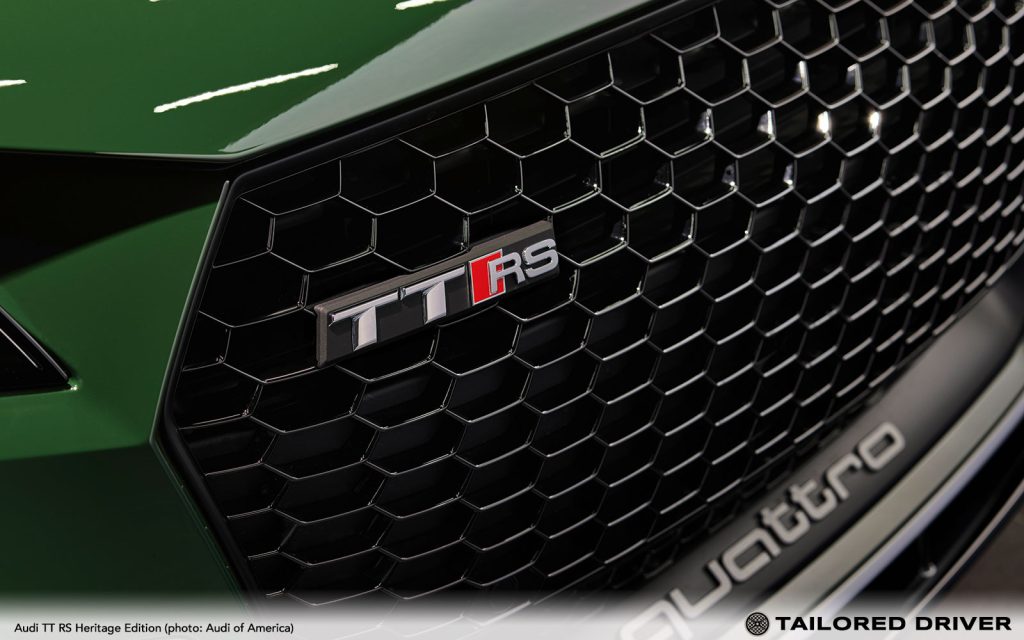
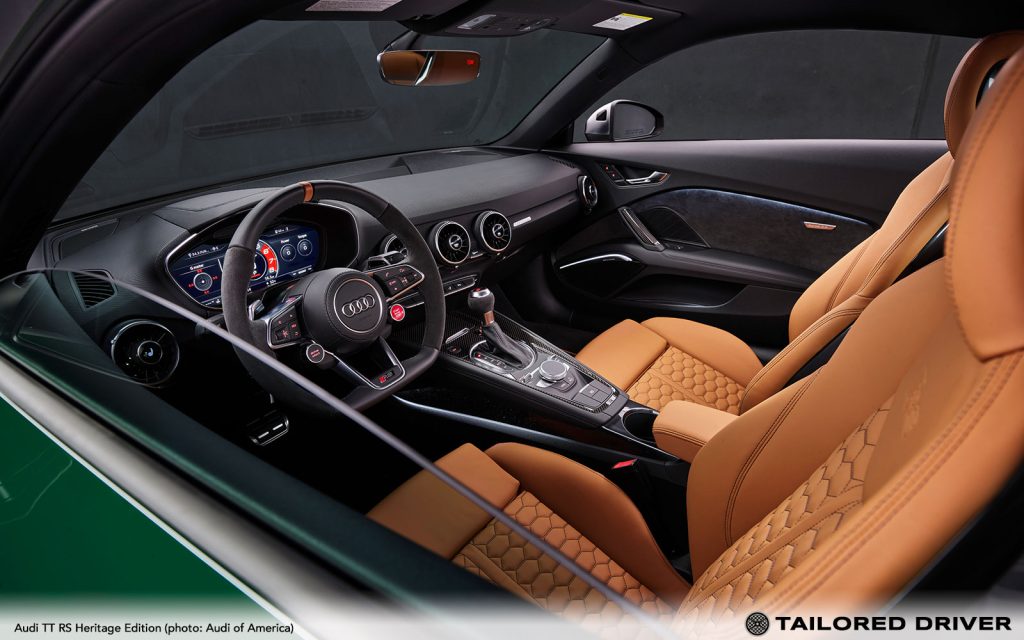
HERNDON, VA – Today, Audi of America announces a limited offering of 50 special units of the 2022 Audi TT RS Heritage Edition that combines the power of the emotive Audi five-cylinder engine heritage along with the storied paint colors that once adorned the Audi Ur-quattro. While still available outside of the U.S., the 2022 Audi TT RS Heritage Edition signals the appropriate farewell to the remarkable high-performance coupe following the 2022 model year. The TT and TTS models will continue to be available in international markets and in the U.S. market.
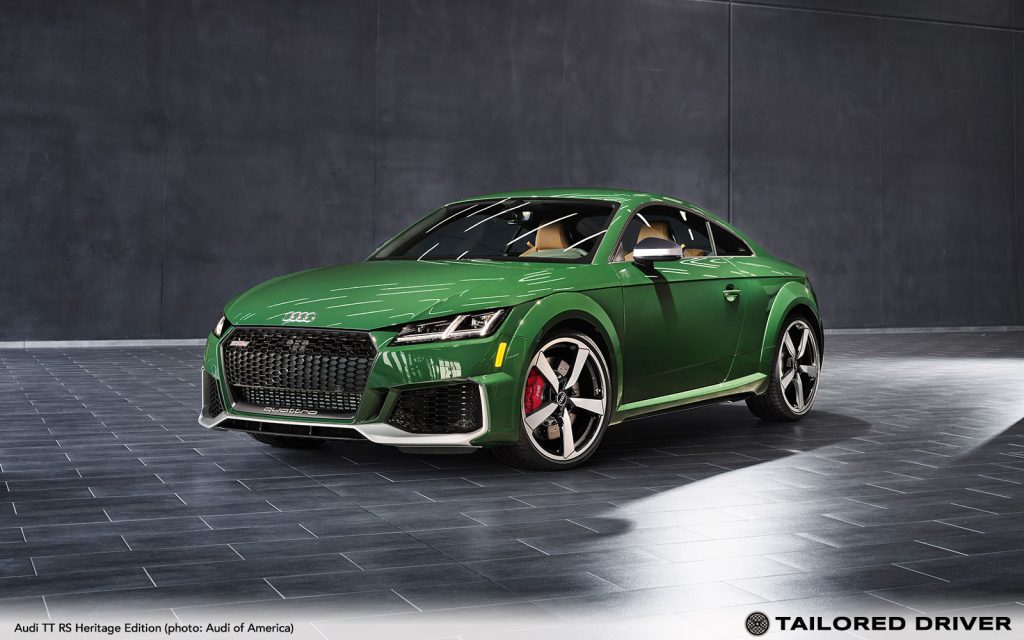
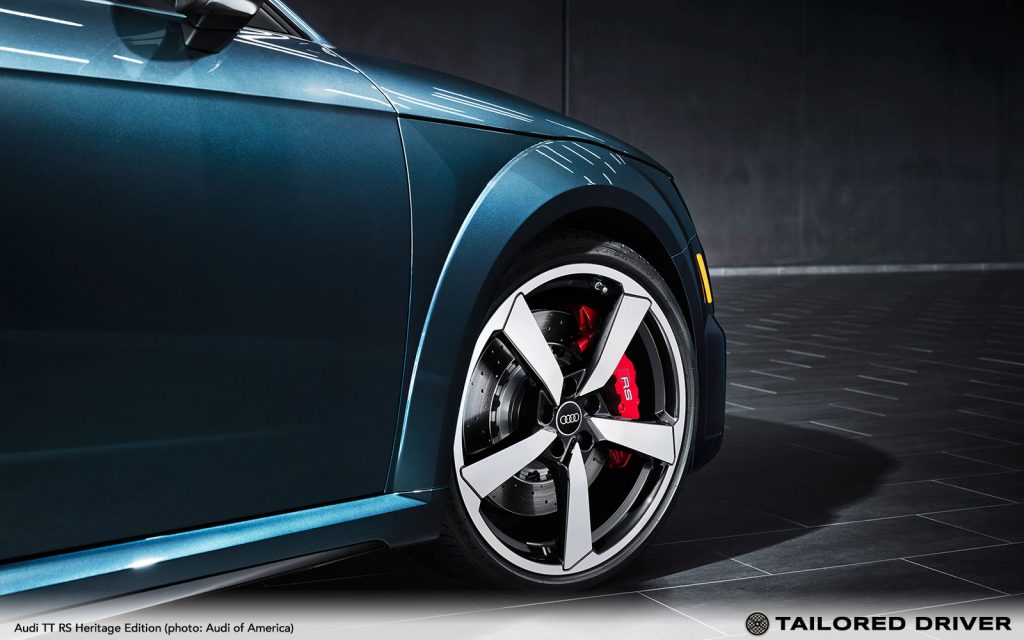
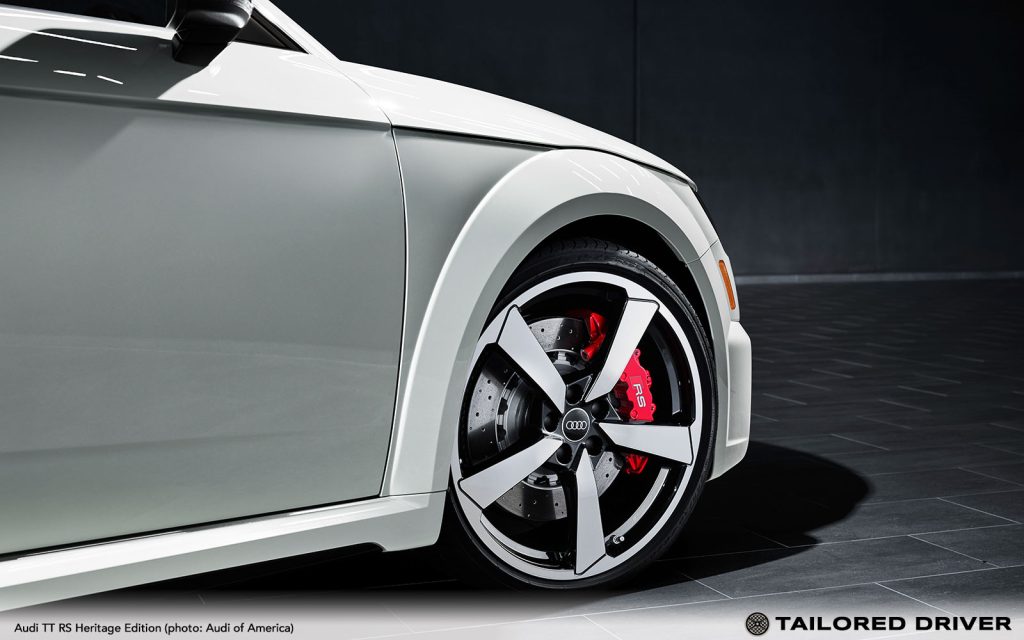
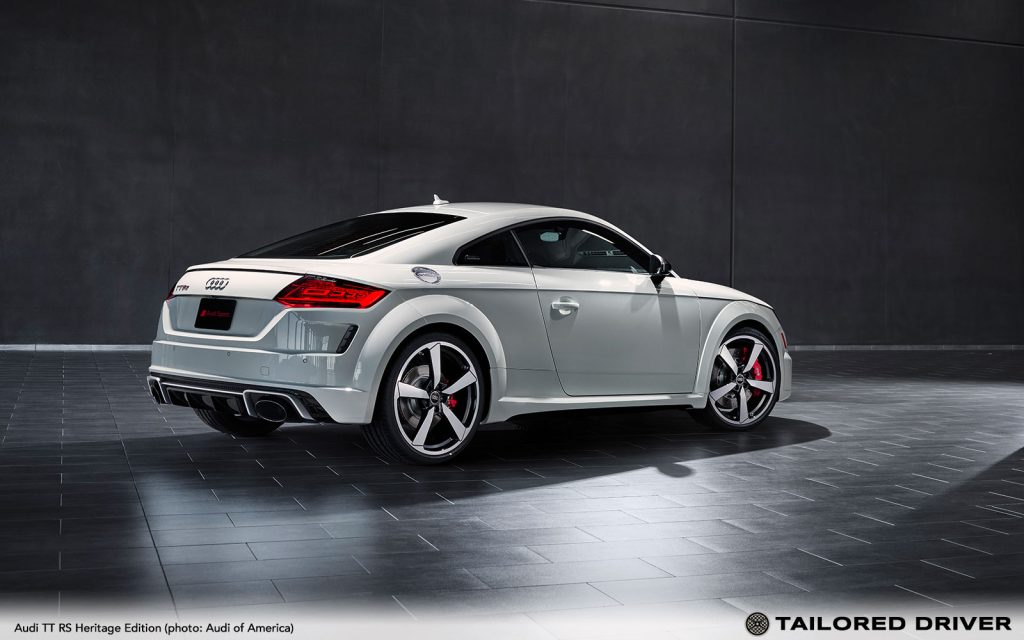
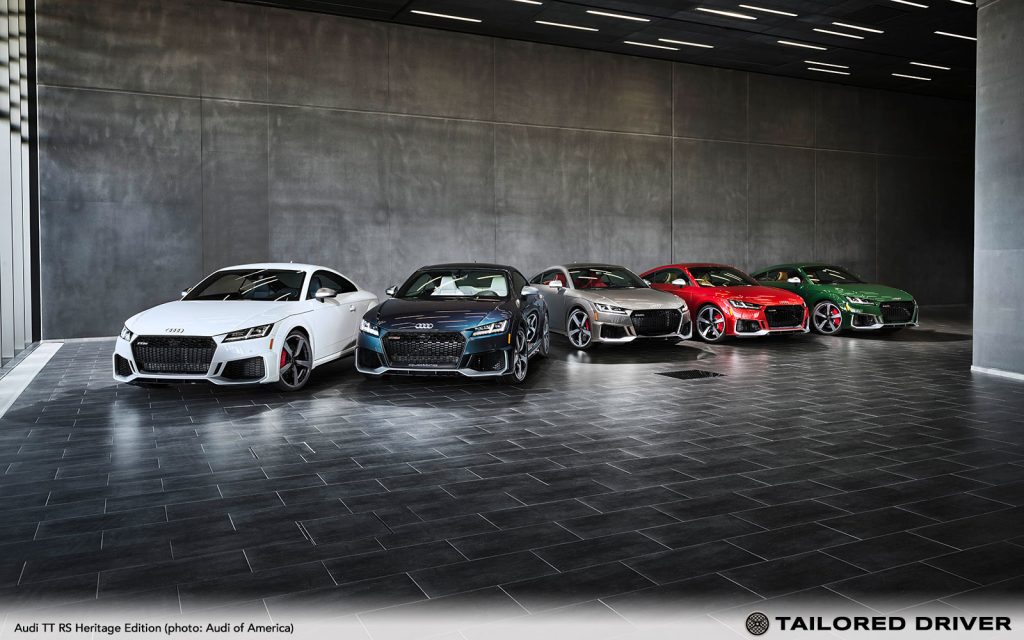
Five heritage color combinations celebrate the legendary five-cylinder engine For the 2022 model year, a limited number of just 50 highly collectible TT RS models will be available with the Heritage Edition nomenclature that blends five different exterior paints of the past that celebrate the heritage of the Audi Ur-quattro. The legendary Ur-quattro was powered by the storied Audi five-cylinder engine of its time with the modern version supporting the high performance Audi TT RS today. The limited TT RS Heritage Edition is available in five different color combinations, listed below in the five-cylinder firing order, and is limited to only 10 units of each.
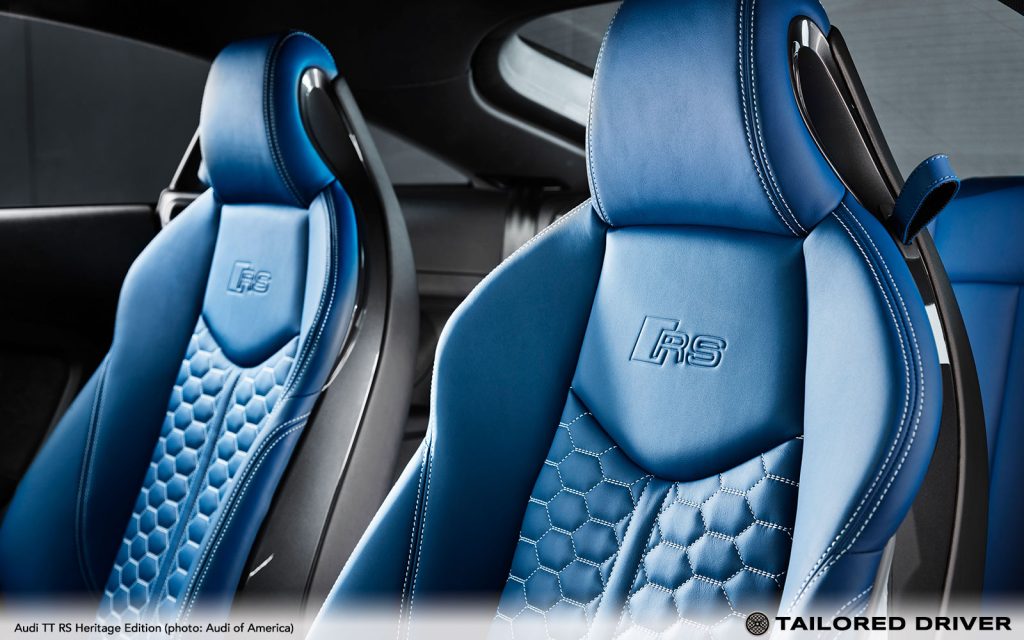
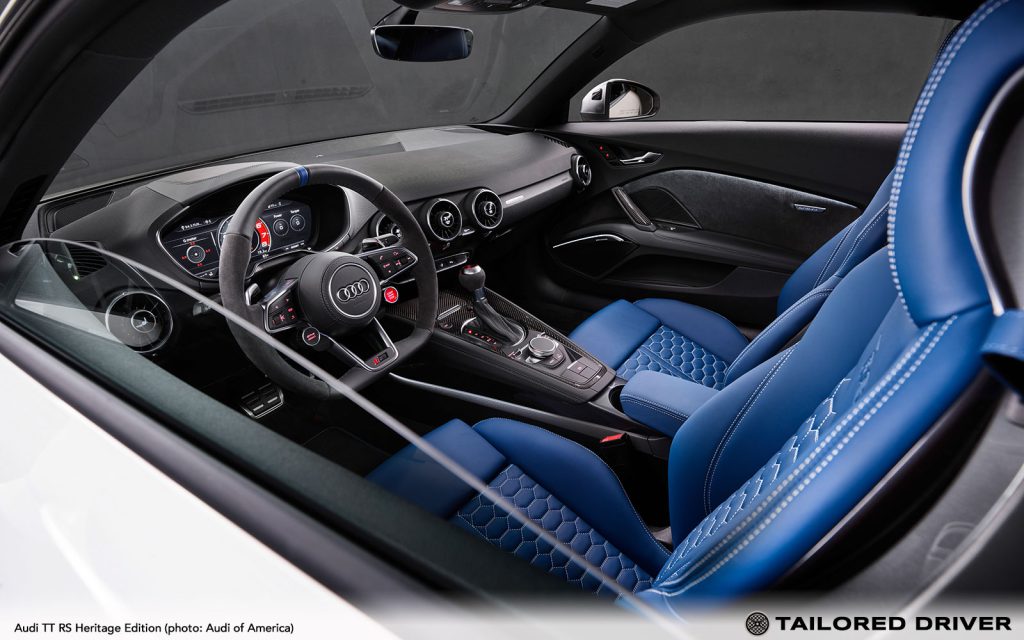
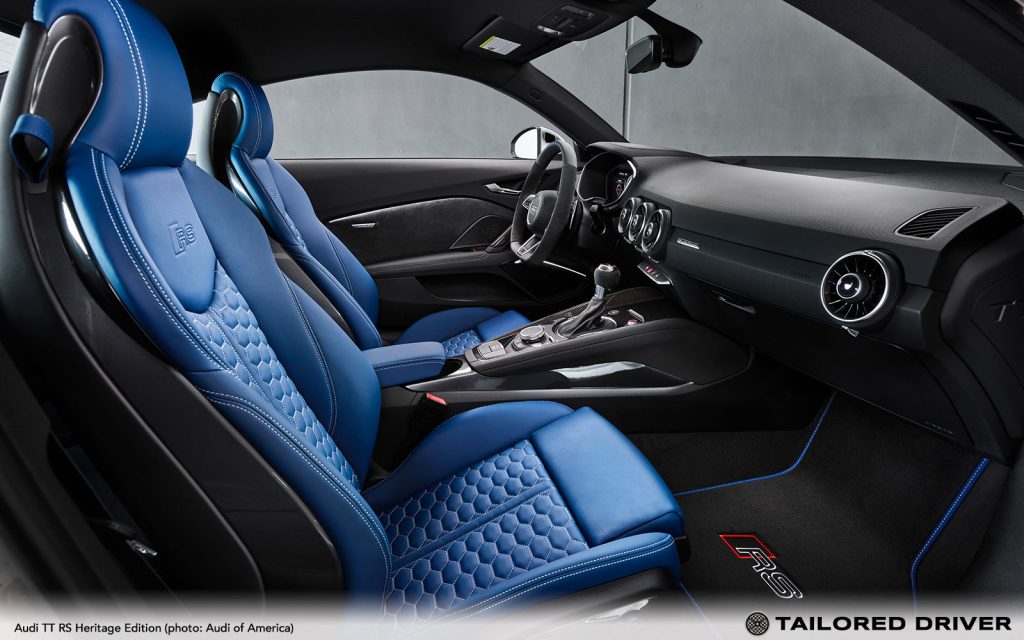
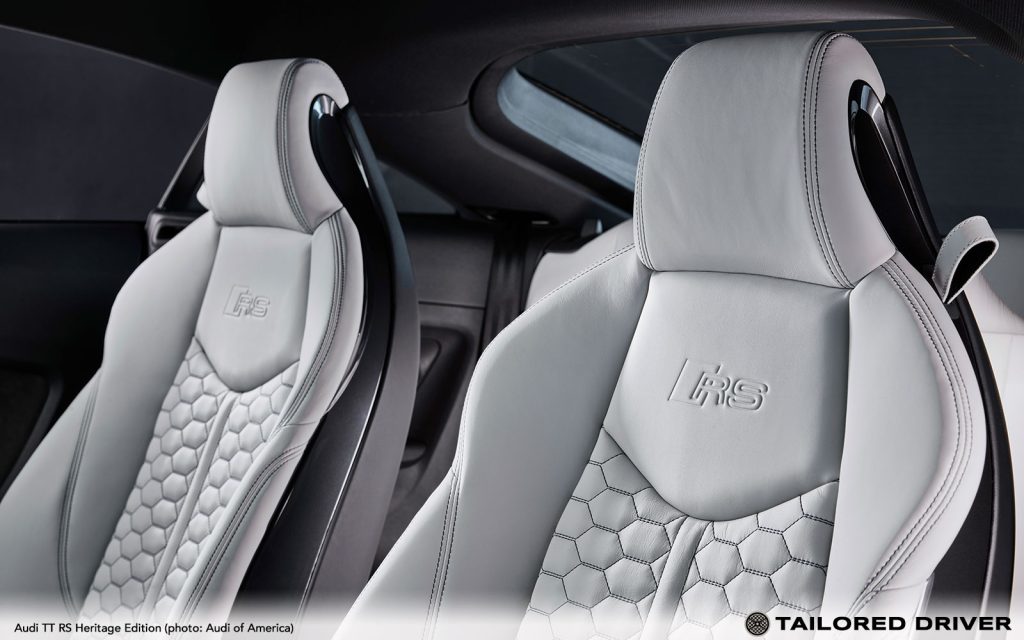
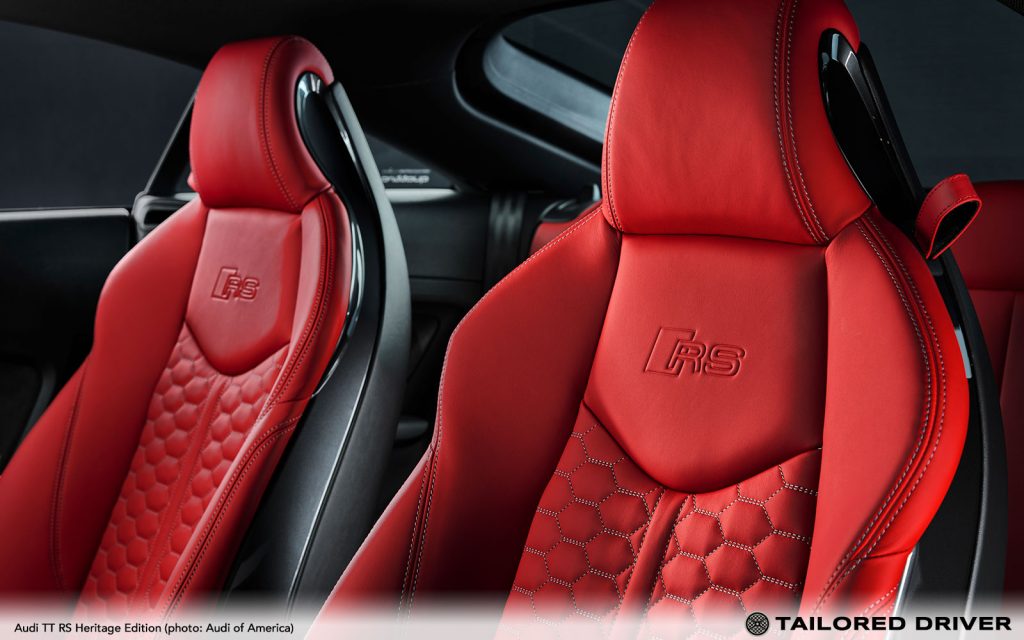
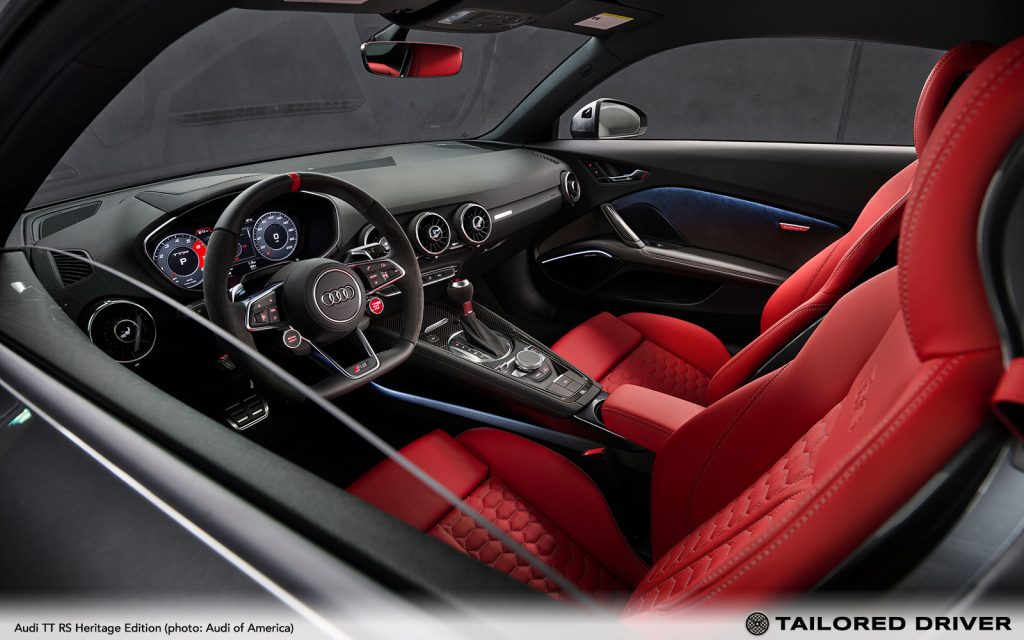
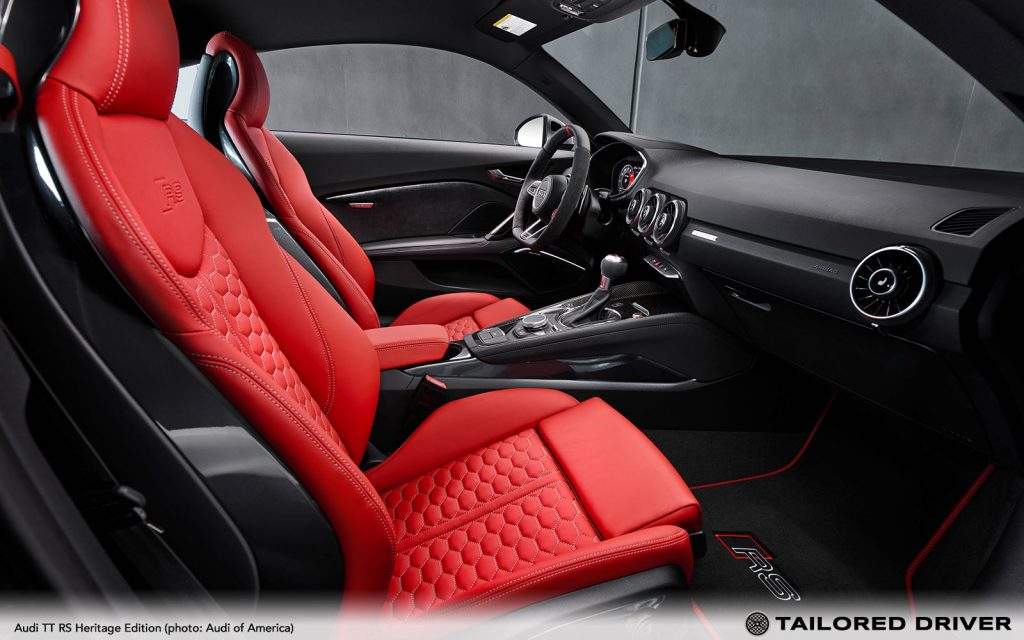
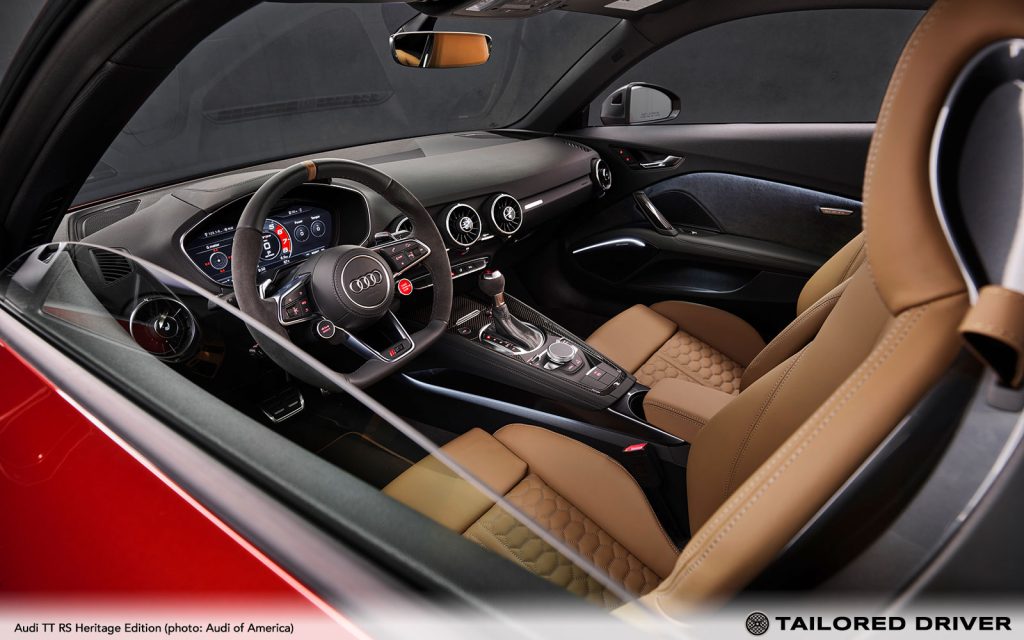
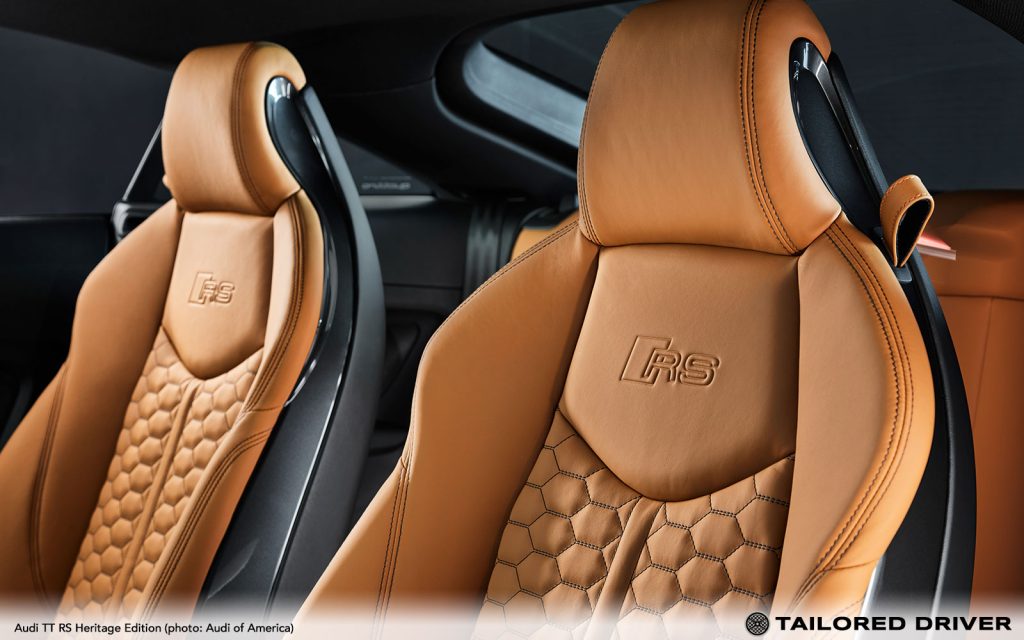
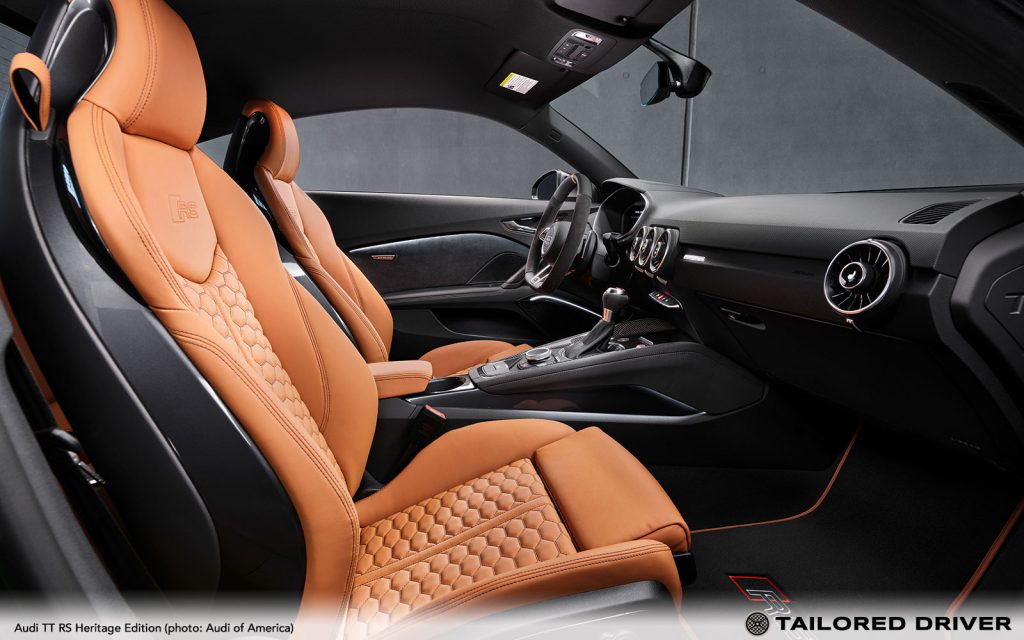
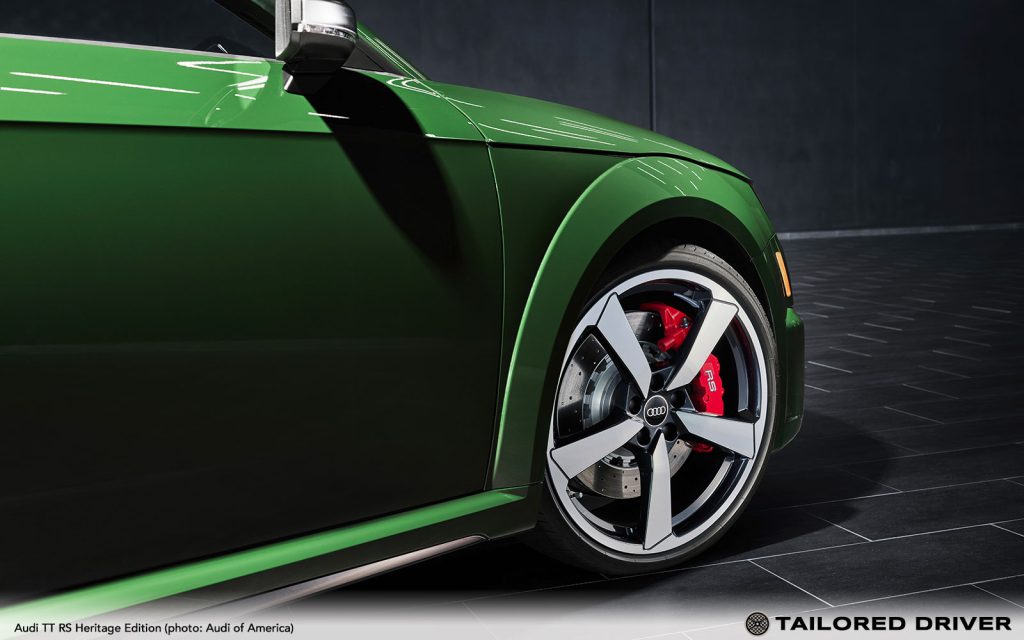
1. Alpine White (alpinweiß; non-metallic UNI; L90E; Audi) with Ocean Blue leather and Diamond Silver stitch 2. Helios Blue metallic (heliosblaumetallic; metallic UNI; LA5Y; Audi) Diamond Silver leather and Ocean Blue stitch 4. Stone Gray metallic (steingraumetallic; metallic UNI; LY7U; Audi) with Crimson Red leather and Jet Gray stitch 5. Tizian Red metallic (tizianrotmetallic; metallic UNI; LB3V; Audi) with Havanna Brown leather and Jet Gray stitch 3. Malachite Green metallic (malachitgrünmetallic; metallic UNI; LY6A; Audi) with Cognac Brown leather and Black stitch
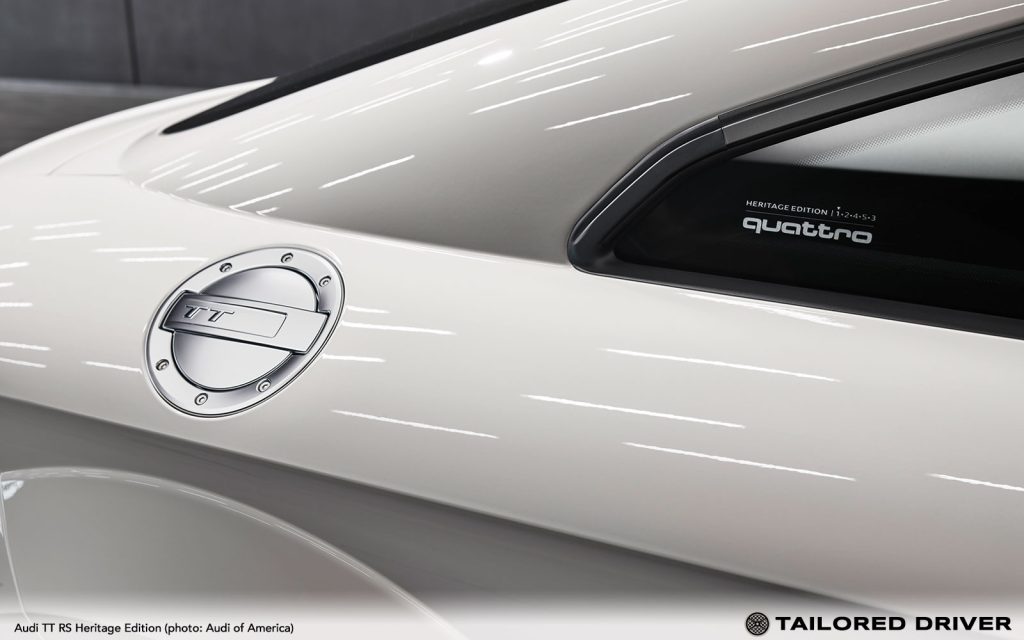
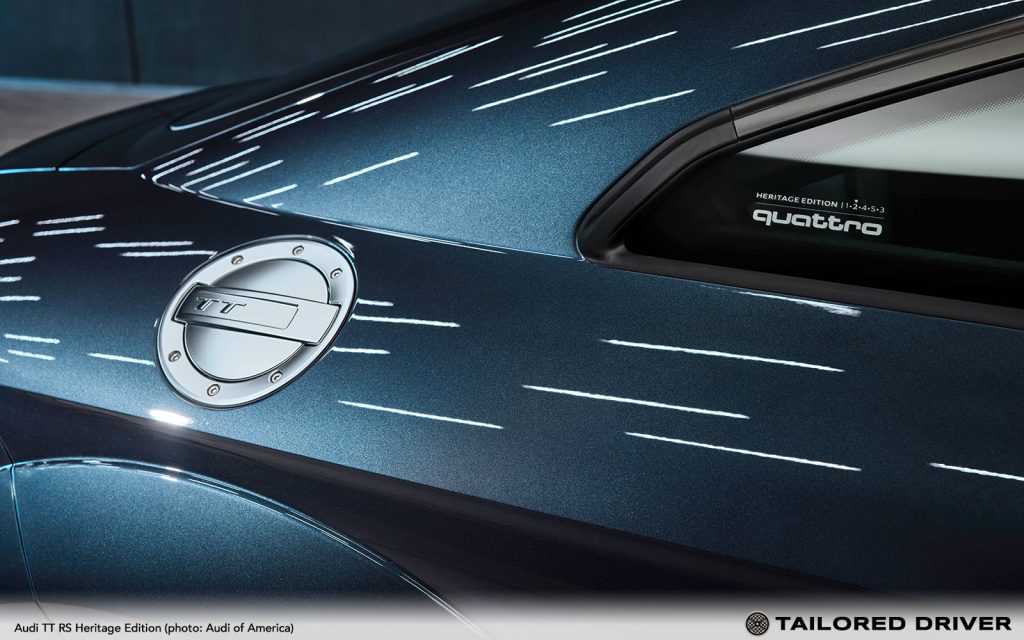
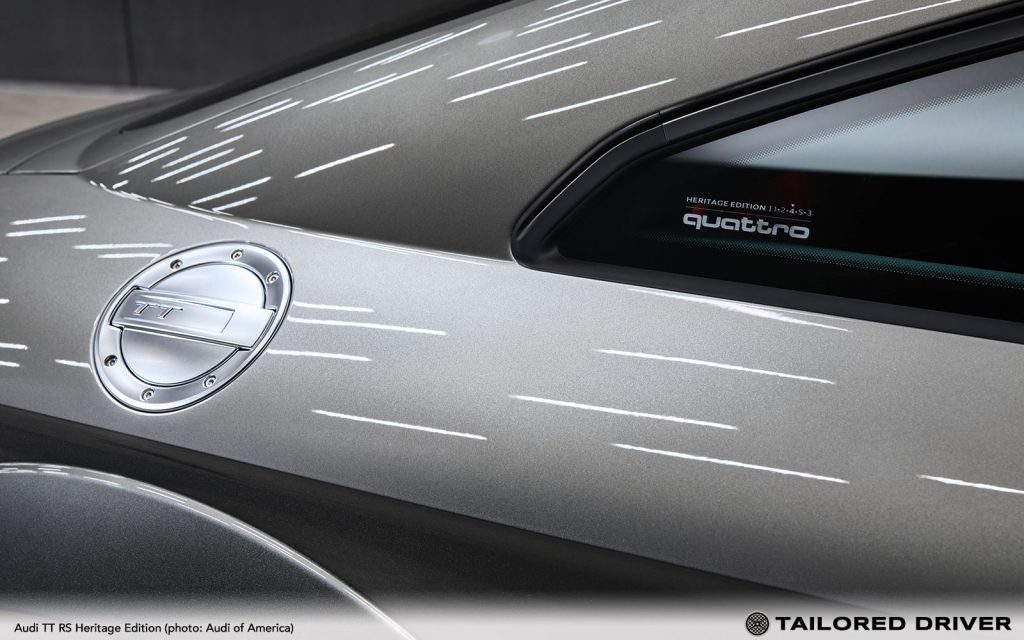
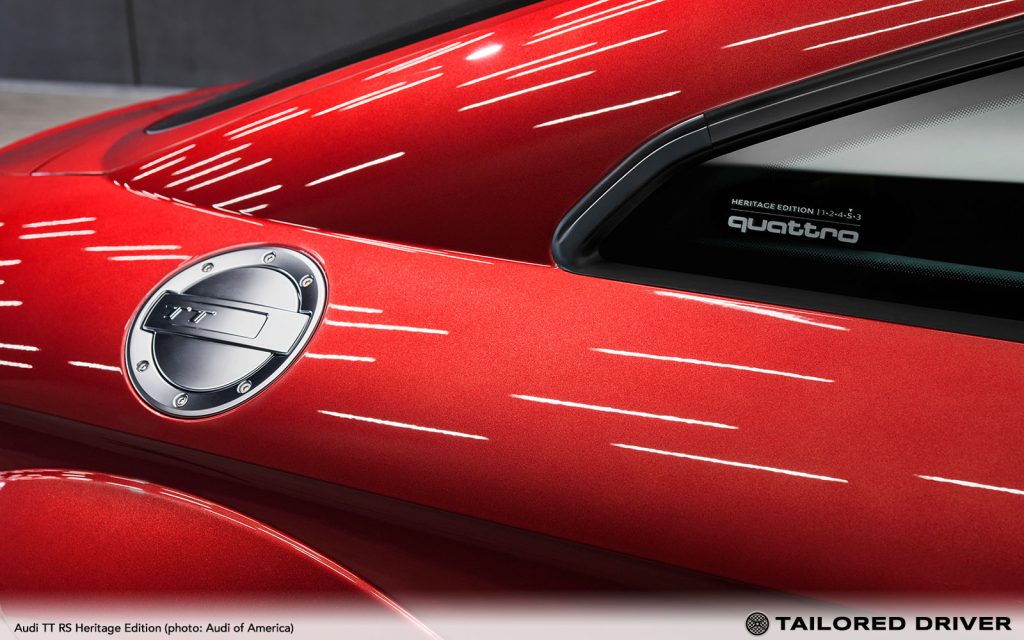
The interior leather and contrast stitching combinations are leveraged from the current Audi exclusive portfolio of upholstery selections, and include several first-time color combinations for the U.S. market. To further underline the exclusivity of the limited edition model, the TT RS Heritage Edition exhibits an understated, yet distinctive etch of “HERITAGE EDITION” script followed by the firing order of the five-cylinder engine “1-2-4-5-3”, underlined by a “quattro” script in the rear quarter glass on the right side of each car.
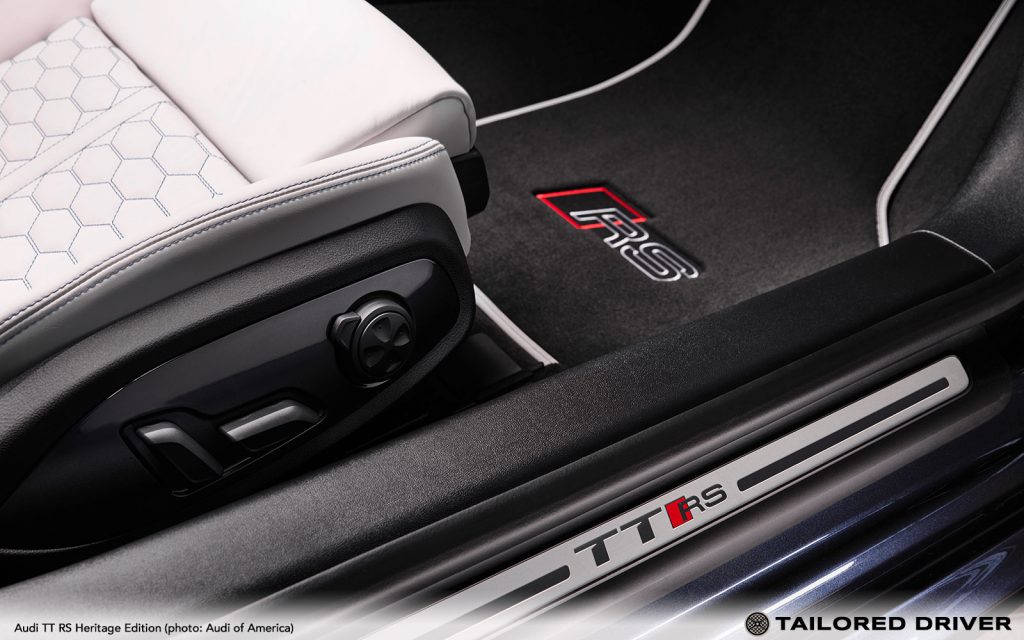
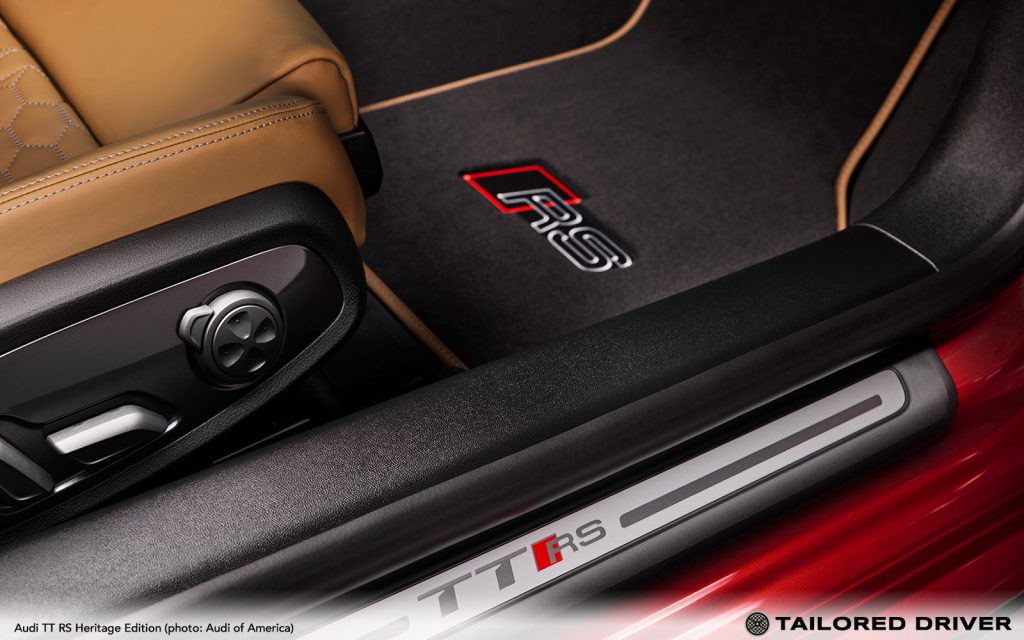
Additionally, the TT RS Heritage Edition presents an exclusive list of standard equipment:
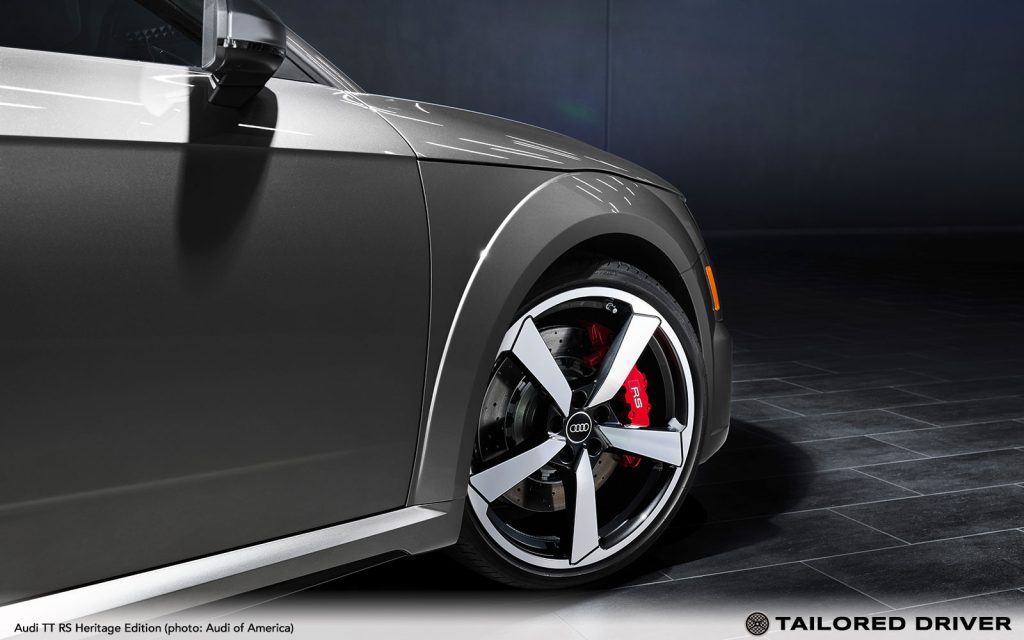
20” 5-arm cutter design wheels in bi-color anthracite finish
Audi exclusive etching in rear quarter glass
174 mph top speed limiter
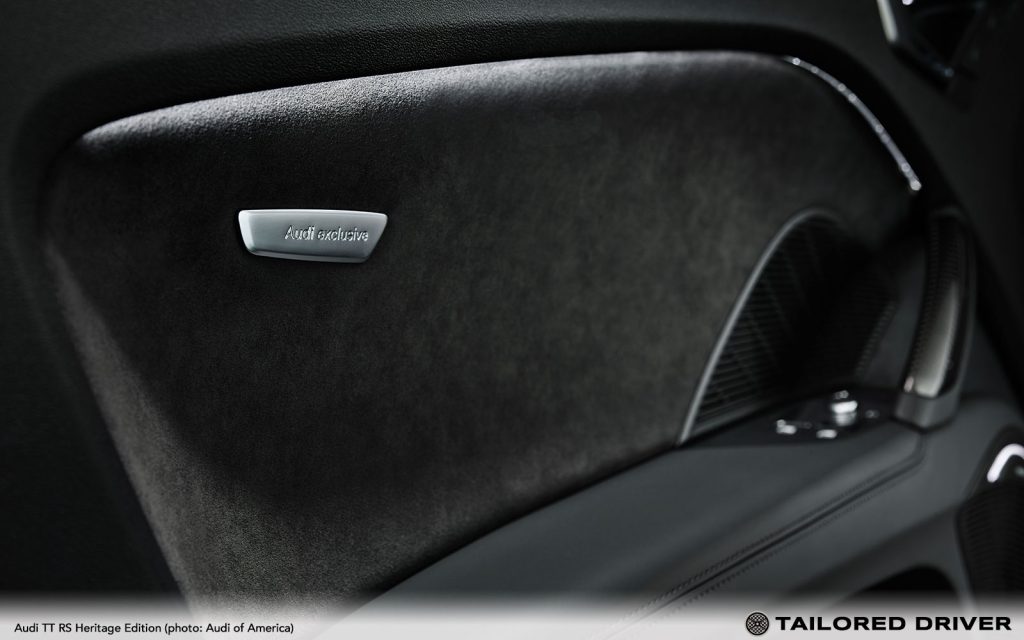
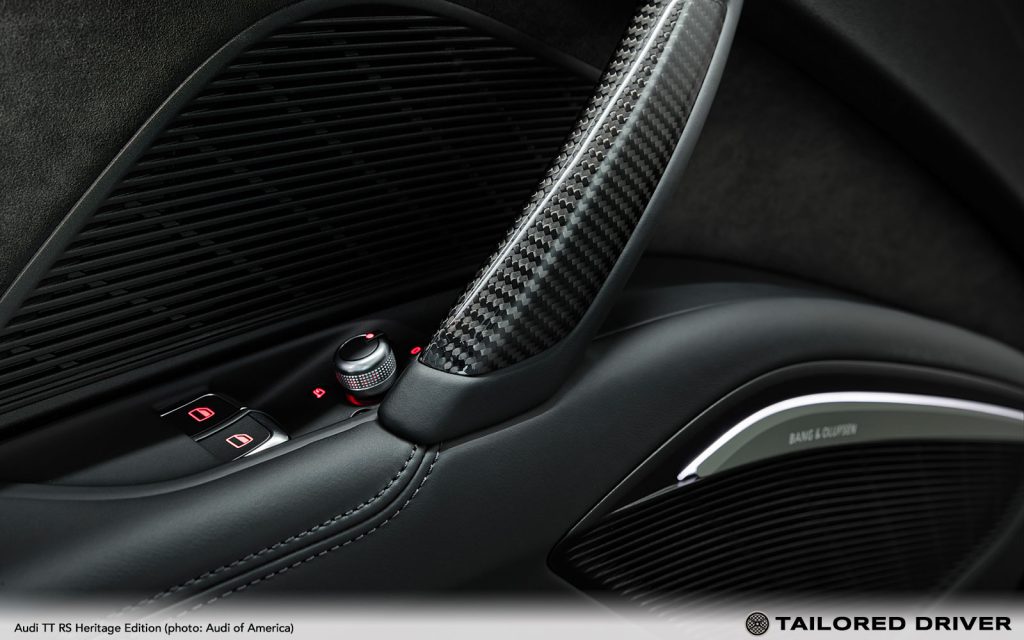
Alcantara covered steering wheel with 12 o’clock marker in leather color
Alcantara covered shift lever
Alu-optic exterior elements including mirror housings
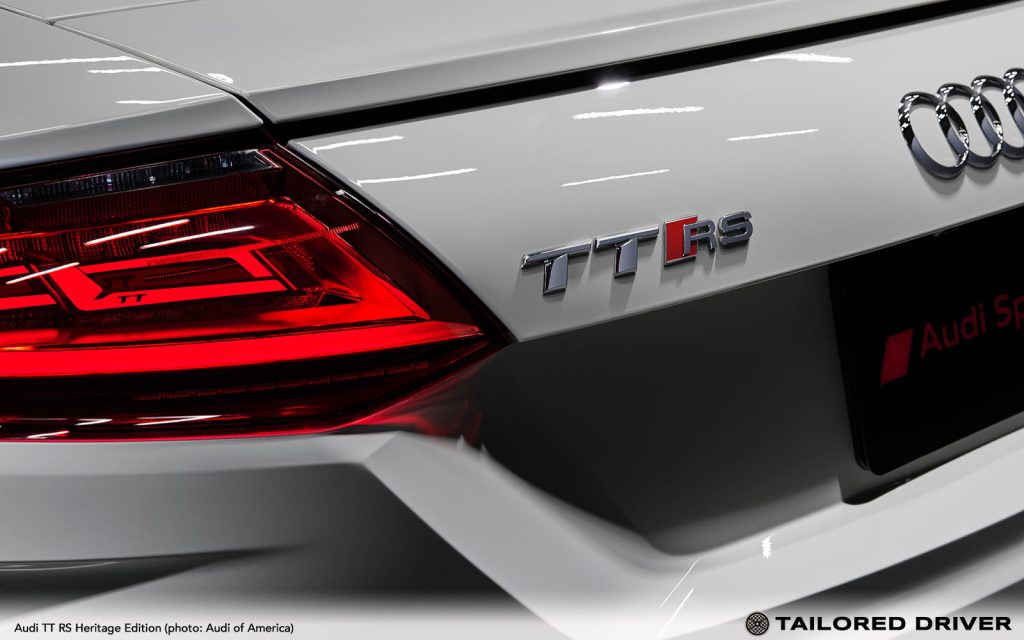
OLED taillights
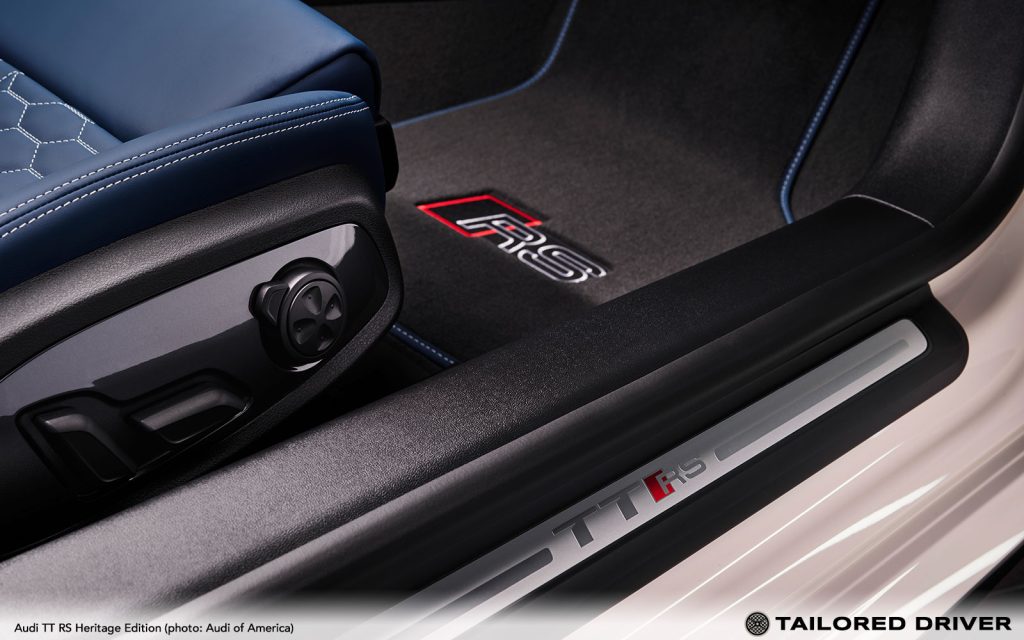
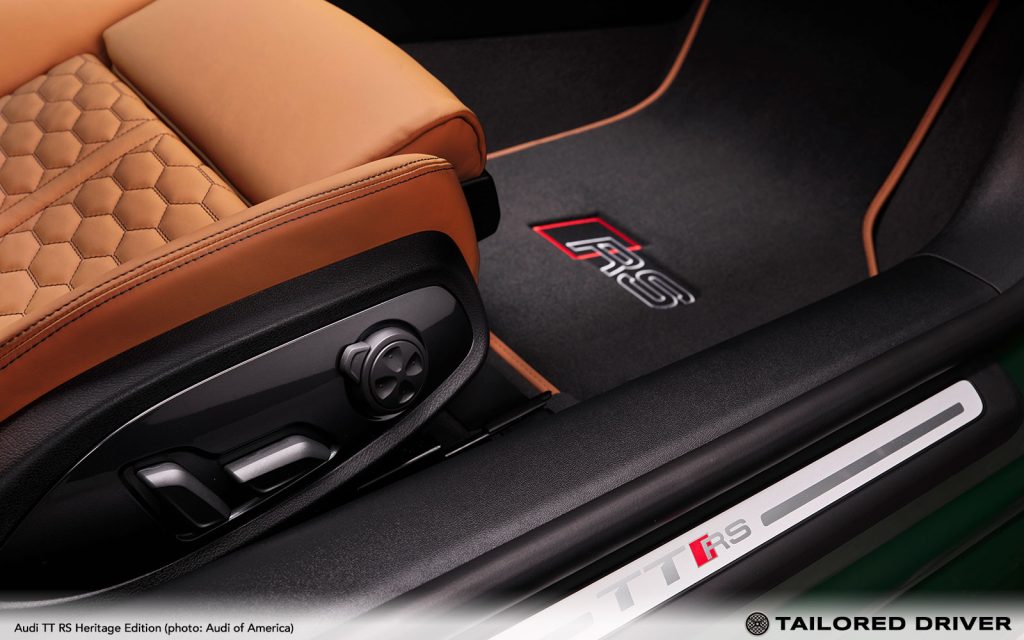
RS logo floor mats with contrast stitching
Sport exhaust with black tips
Electric spoiler / rear wing delete
Hear that heritage sound? It’s legendary performance. The five-cylinder engine has deep historical roots in Audi’s DNA, and is a fundmental pillar of the emotional connection to the Audi Sport brand. The engine has achieved countless victories in motorsports from courses in rally around the world to the tarmac in the IMSA GTO and at the Nuerburgring in the legendary 24-hour race, the 5 cylinder has prevailed. It even earned the “International Engine of the Year Award” nine times in a row since 2010. Yet – it is the unique and distinctive sound of the five-cylinder engine that has captured the emotion of enthusiasts. Due to the odd number of cylinders, and more specifically, the 1-2-4-5-3 firing order, the Audi five-cylinder engine’s sound is unmistakable and presents a symphonic rhythm that is accompanied by deep tone characteristics.
Besides its visibility in motorsports, the legendary engine harkens back to the Ur-quattro coupe from the 1980s, and has been a part of just two U.S. market Audi products over the last few years – the Audi TT RS Coupe and RS 3 Sedan. The engine remains one of brand’s more powerful engines with 394 horsepower and 354 lb-ft of torque that brings the TT RS Coupe from 0-60 mph in just 3.6 seconds.
The return of the five-cylinder. A social network comeback Until 2012, the five-cylinder engine remained absent from the Audi portfolio for nearly 30 years. In 2009, the first Audi TT RS made its global debut in the world markets, and was only a dream to drive on the roads stateside, until Audi of America took a stance to get the car to the U.S. In 2011, Audi of America would exhibit a signed petition on Facebook to bring the first generation TT RS to the U.S. market – the petition resulted in an astounding 12,000 signatures in just one month.
After the success of the social media campaign, Audi of America brought the product in limited production run for just two model years, 2012-2013. In both years, Audi of America offered a total of approximately 1,200 highly collectible TT RS models properly outfitted exclusively with a six-speed manual transmission, which became the final manual transmission offer in any Audi RS- model, globally.
Fond farewell While 2022 is the last model year for the TT RS in the U.S., the model will live on in other international markets for some time. The 2022 Audi TT RS Heritage Edition and the 2022 Audi TT RS model are expected to go on sale in the U.S. toward the beginning of 2022. The TT RS celebrated its 10 year anniversary since its introduction as a 2012 model year in the US market.
The limited edition model, no doubt to become a sought after model for enthusiasts and collectors alike, celebrates the victory, performance, and expansive history of the legendary five-cylinder engine for the Audi brand which will continue to be available once the all-new RS 3 goes on sale next summer in the U.S.
MSRP pricing detail
Model
2022 Audi TT RS Heritage Edition
$85,350
2022 Audi TT RS
$73,200
Prices exclude $1,045 destination charge, sales taxes, title, options, and dealer charges. Dealer sets actual price.
At Audi of America, we believe the Future is Electric. Our U.S. model lineup will be 30 percent electrified, including fully electric vehicles and plug-in hybrids, by 2025, and globally we are committed to net CO2 neutrality by 2050. In 2020, Audi sold 186,620 vehicles in the U.S., and this year, we look forward to the next chapter in our journey to reinvent premium mobility with the arrivals of the fully electric Audi e-tron GT and Audi Q4 e-tron. Learn more about who we are and how we’re working to create a more electric, innovative, and inclusive future at audiusa.com or media.audiusa.com.
This information and any vehicle specifications are preliminary and subject to change.
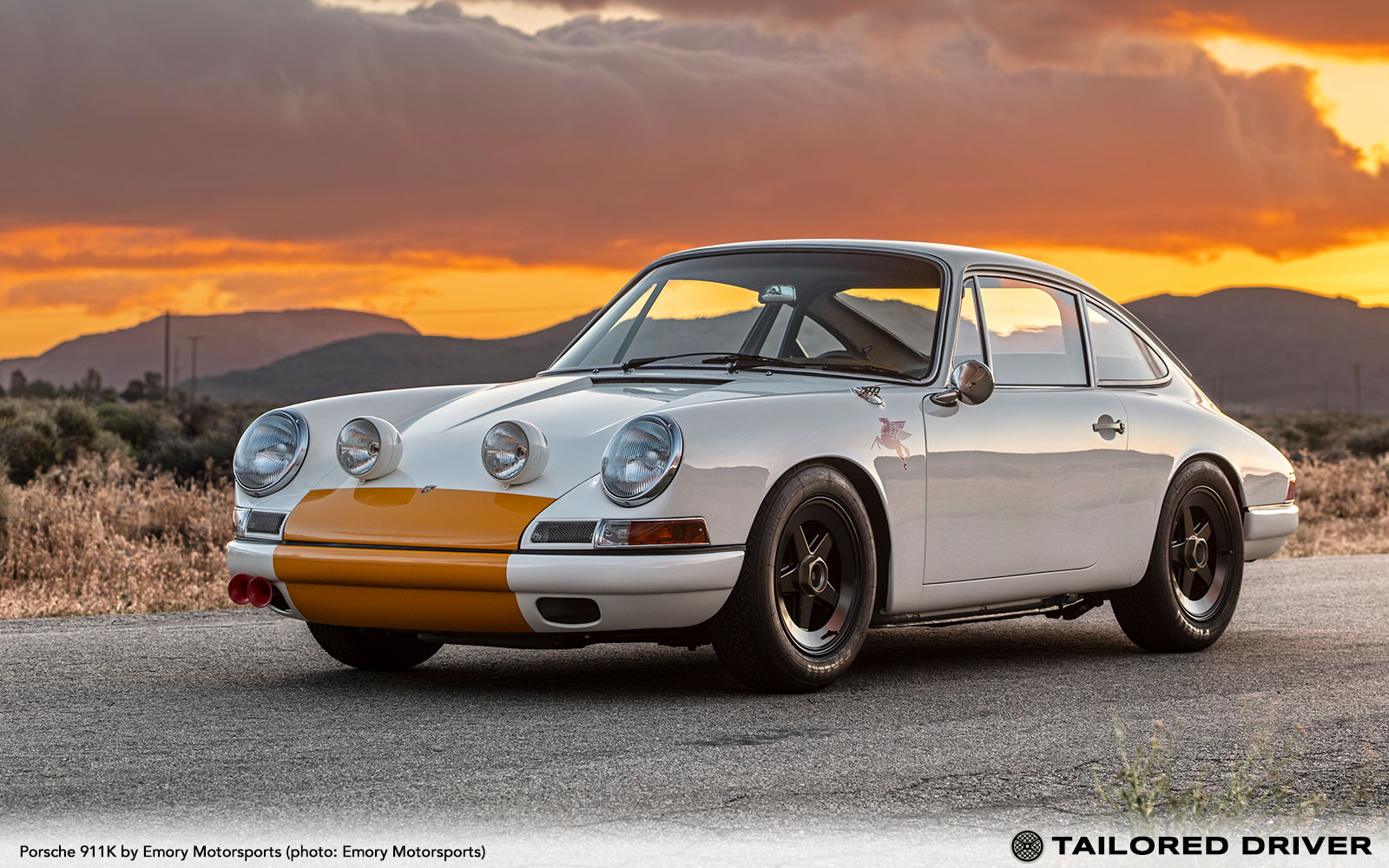
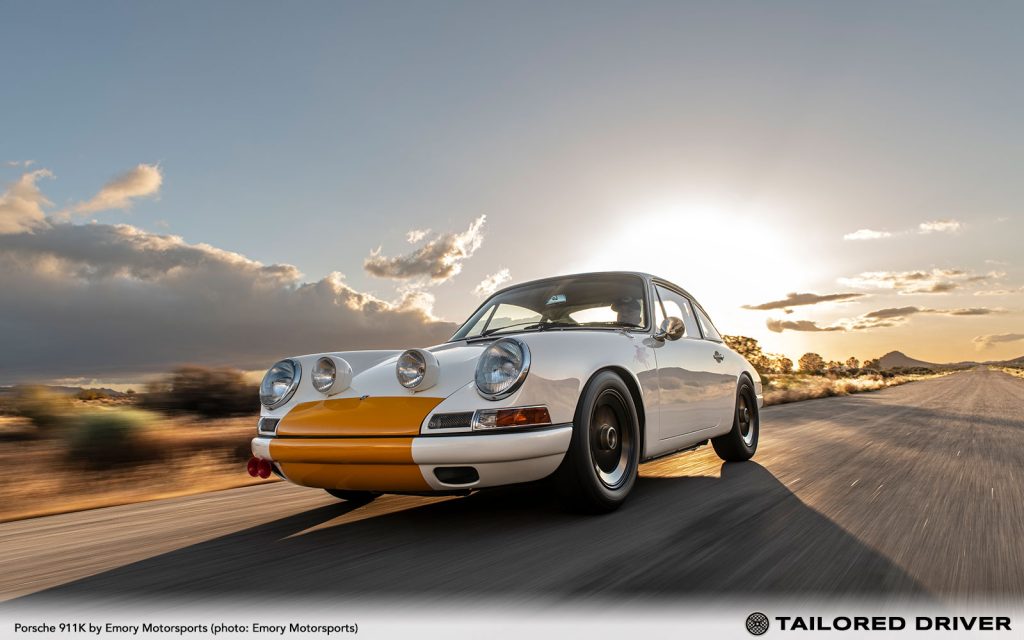
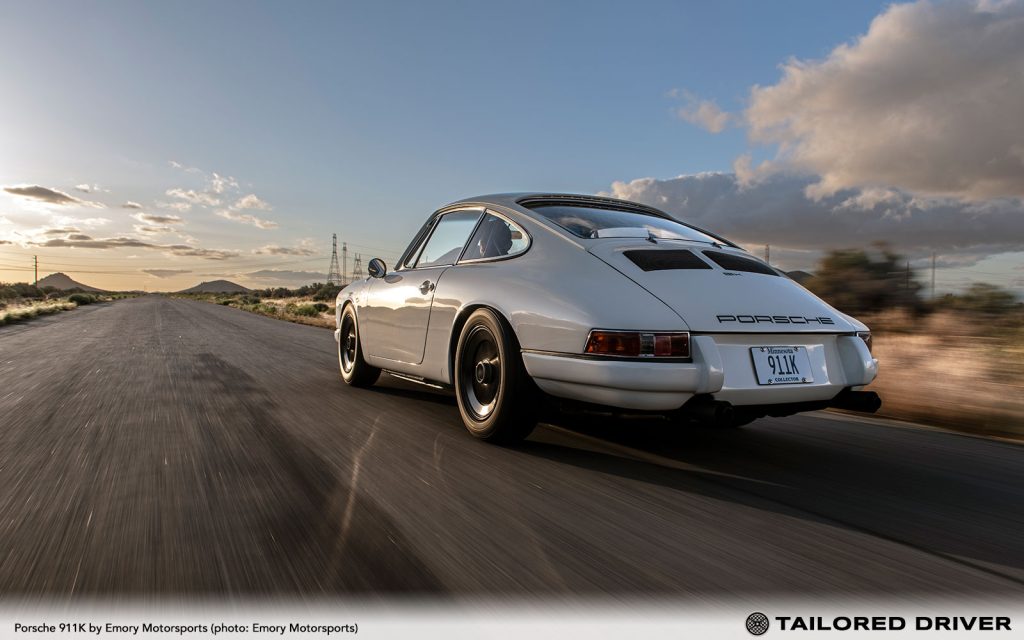
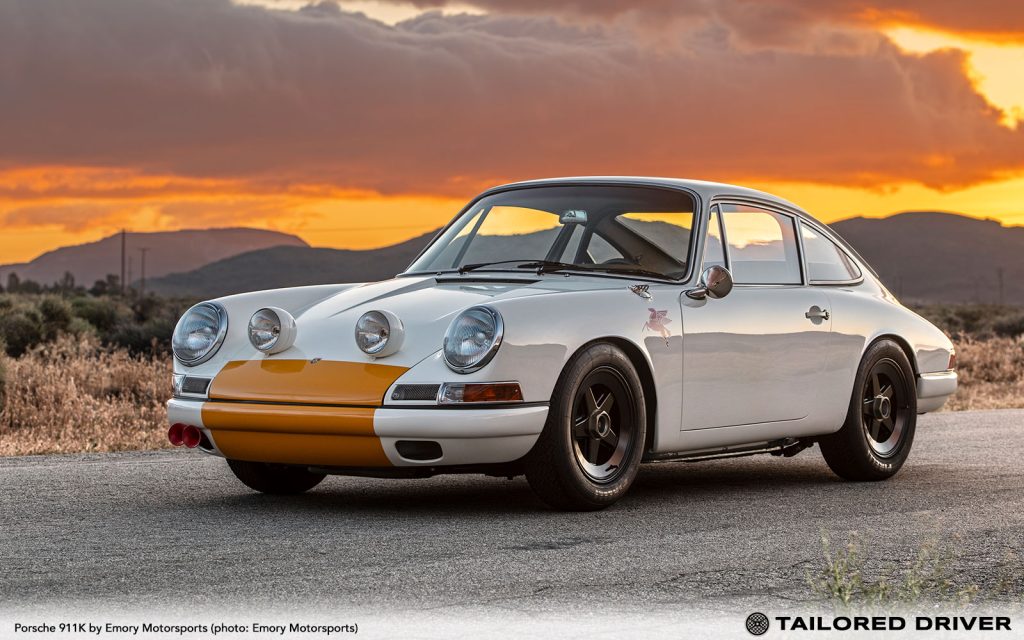
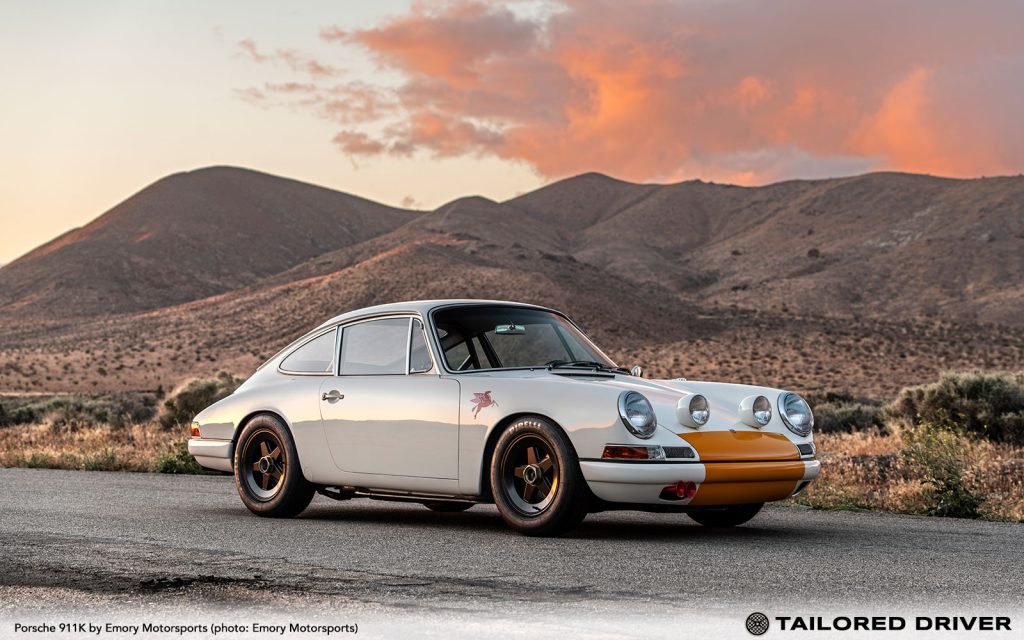
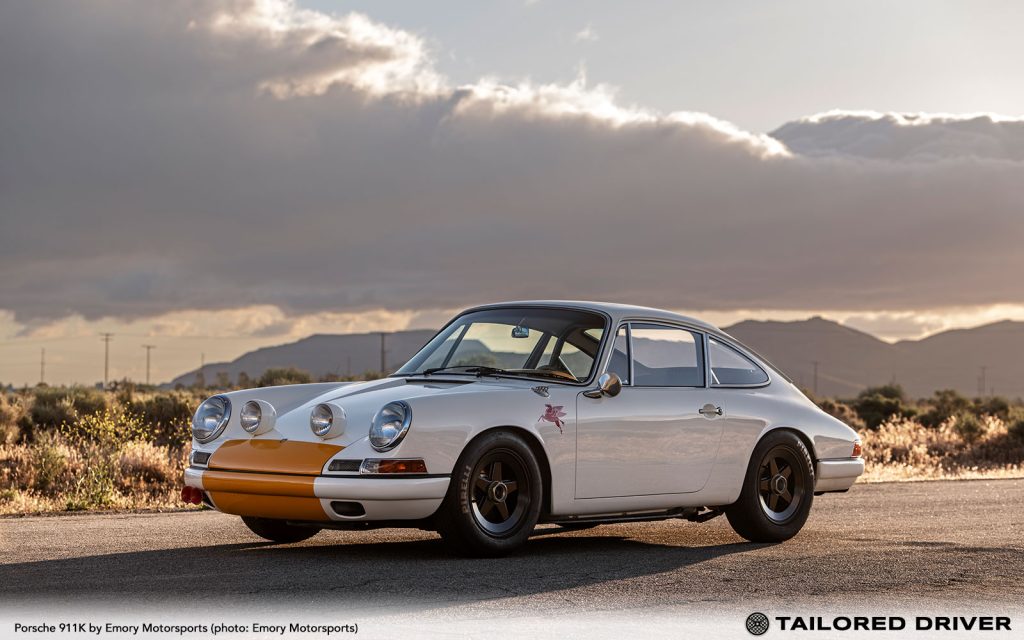
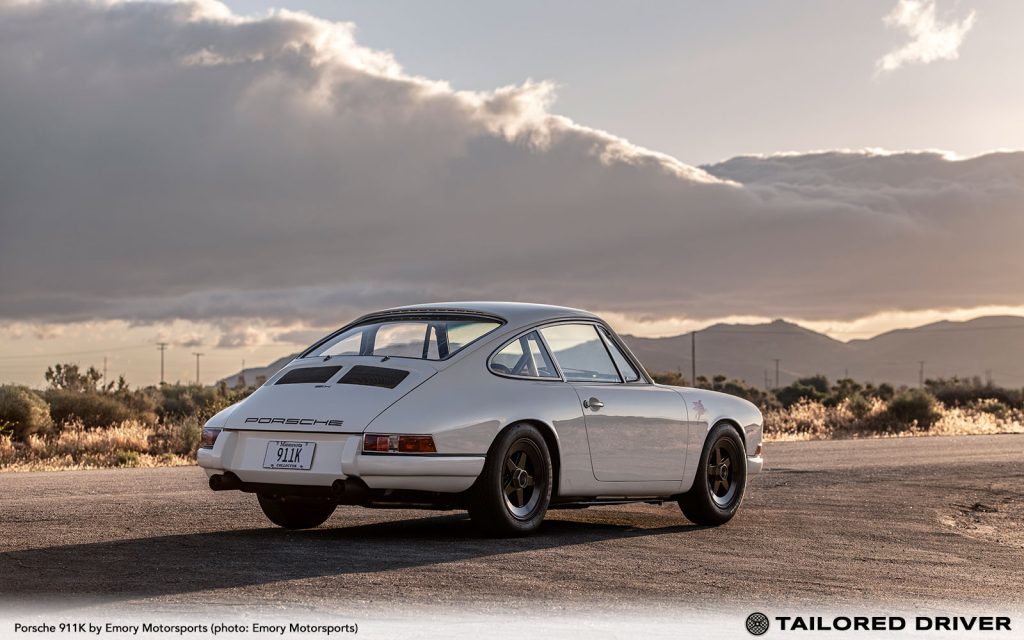
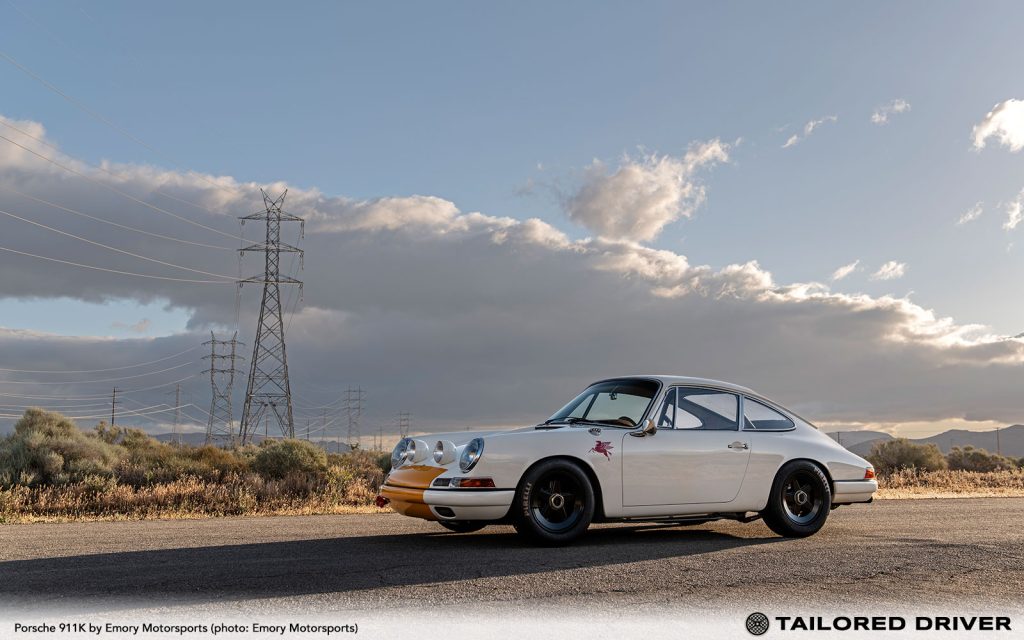
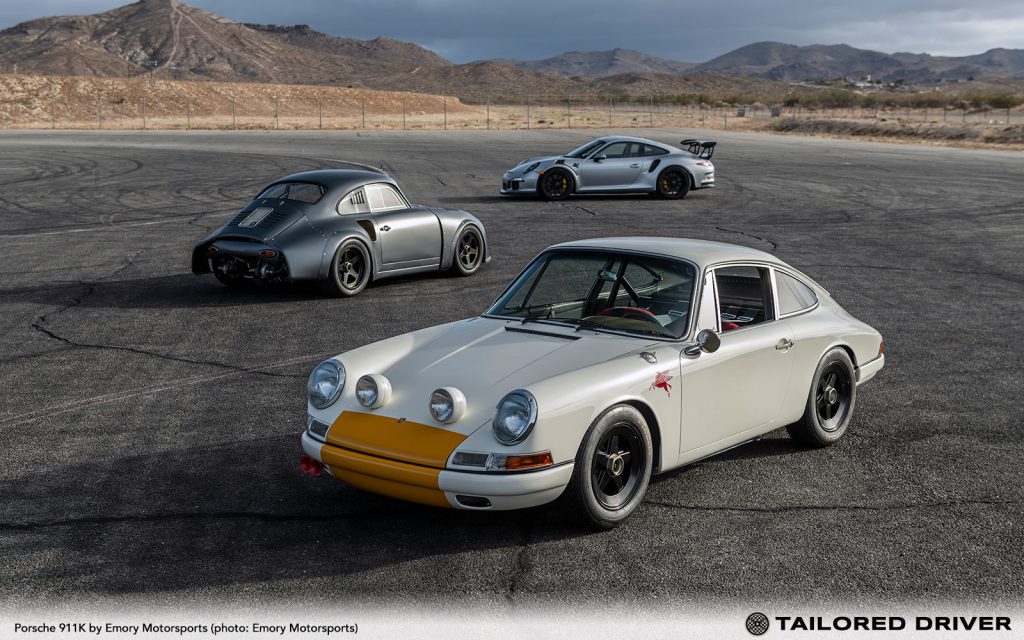
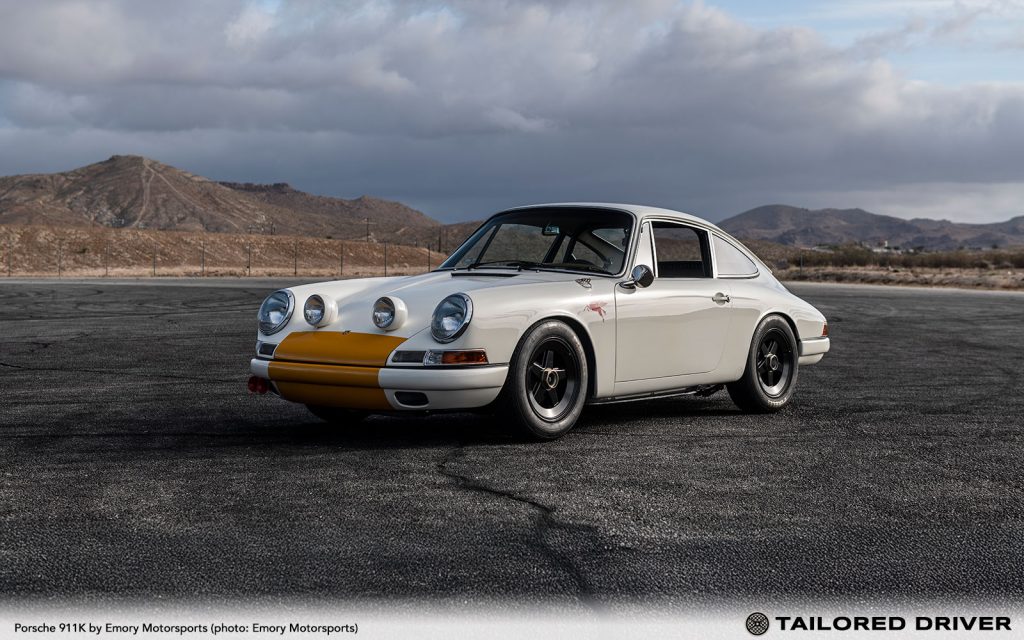
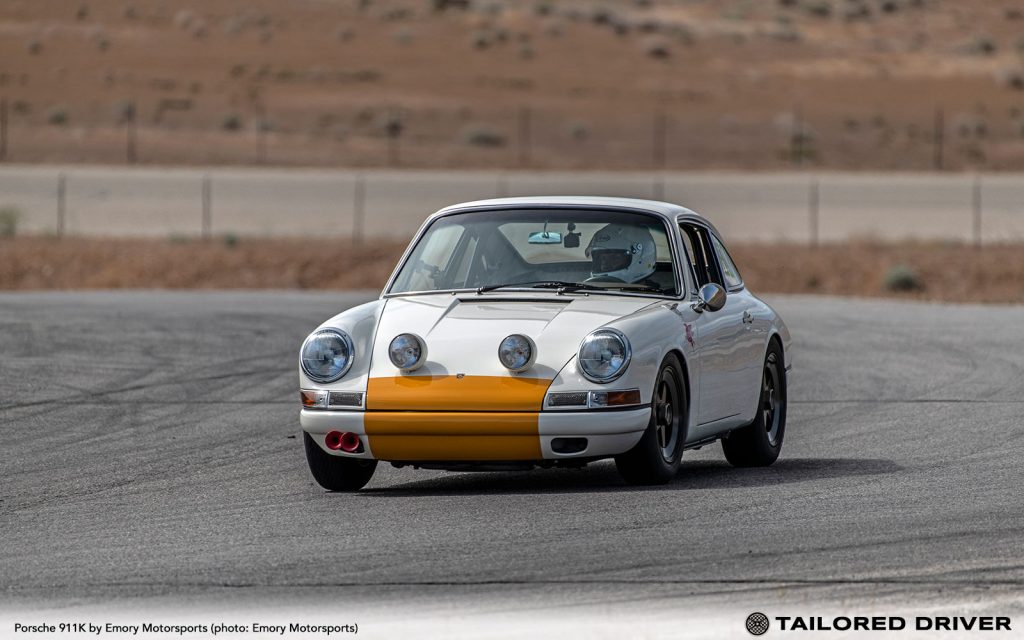
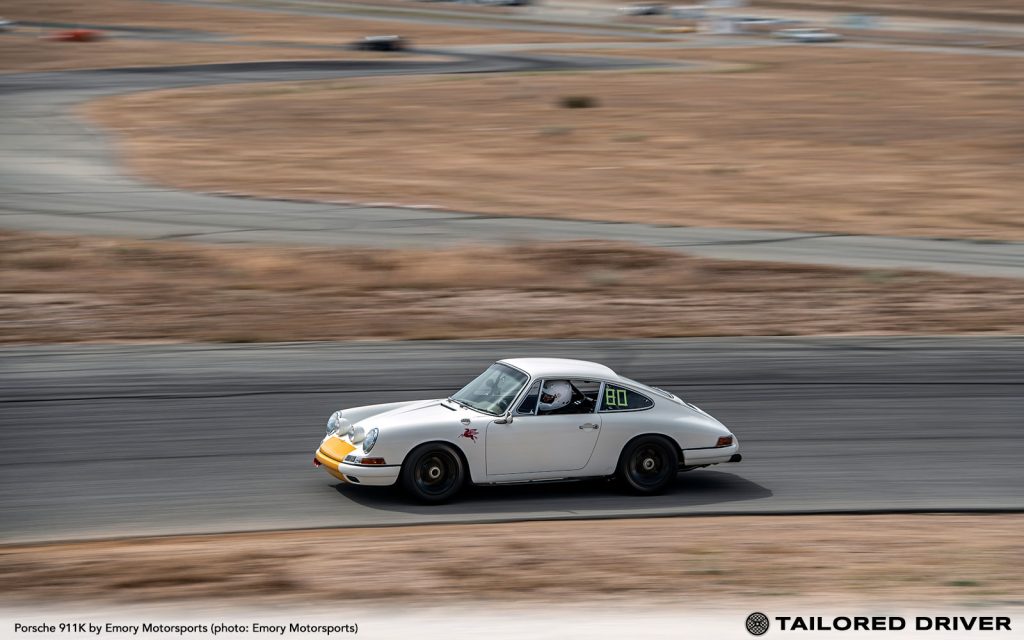
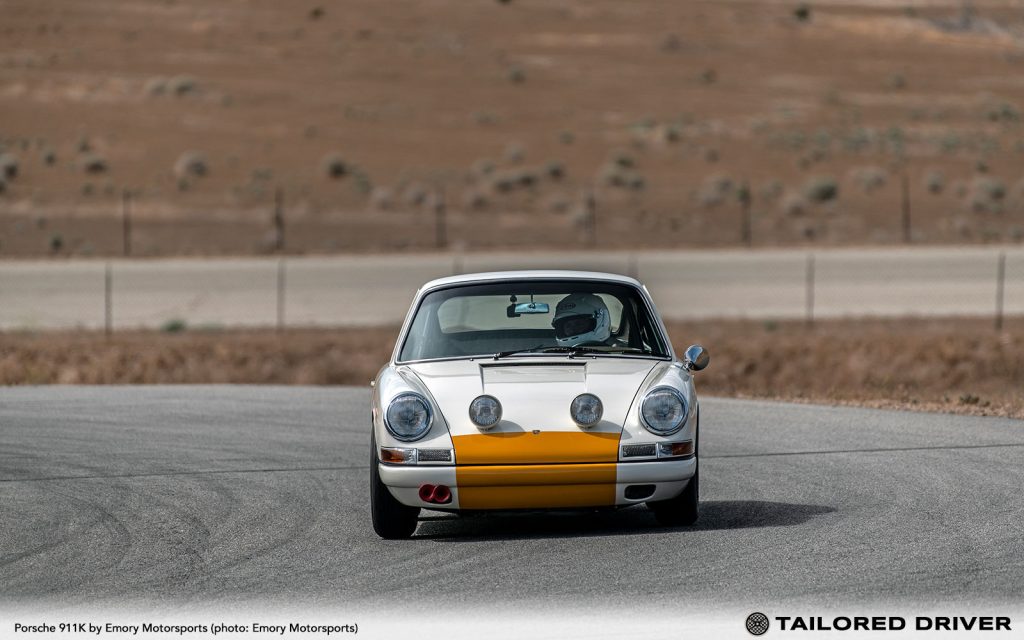
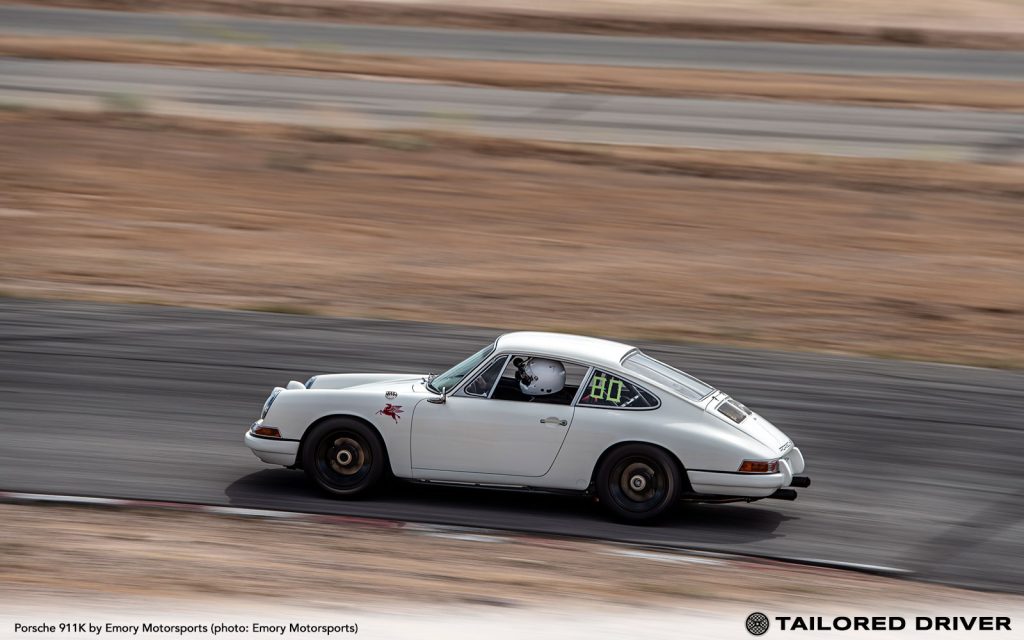
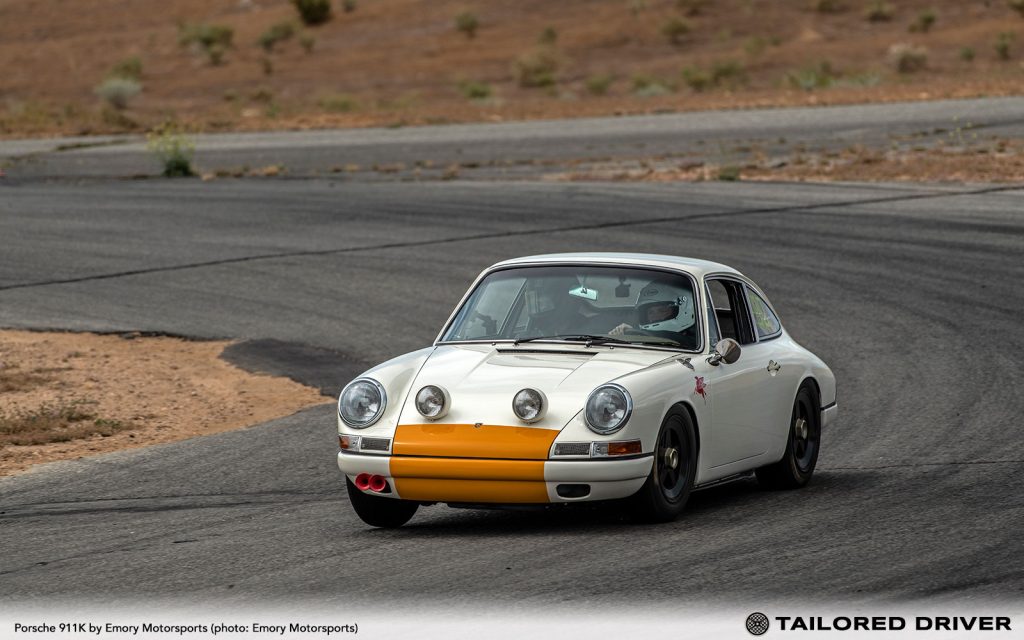
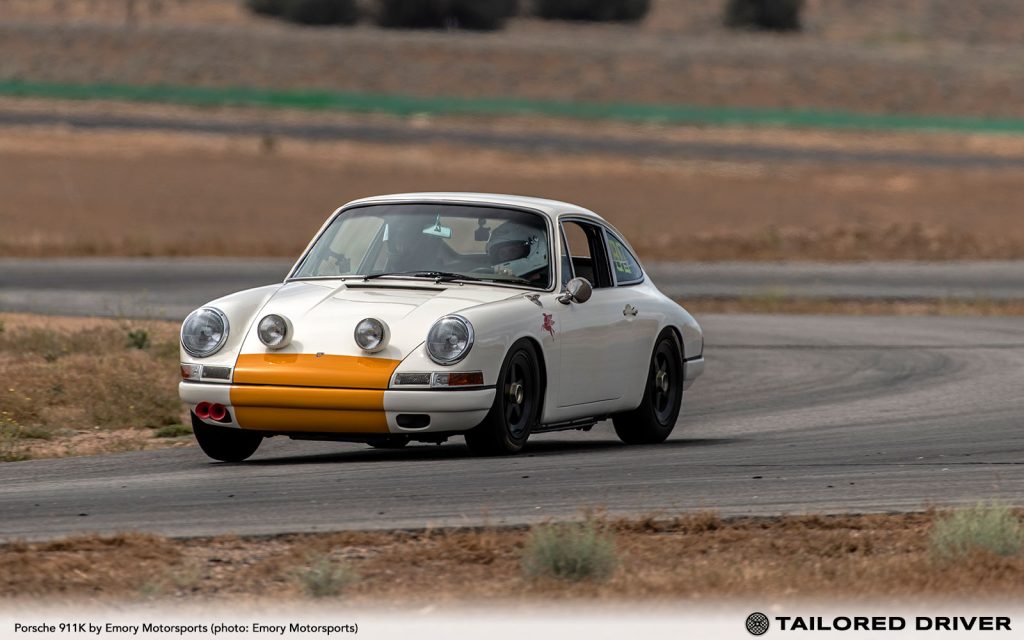
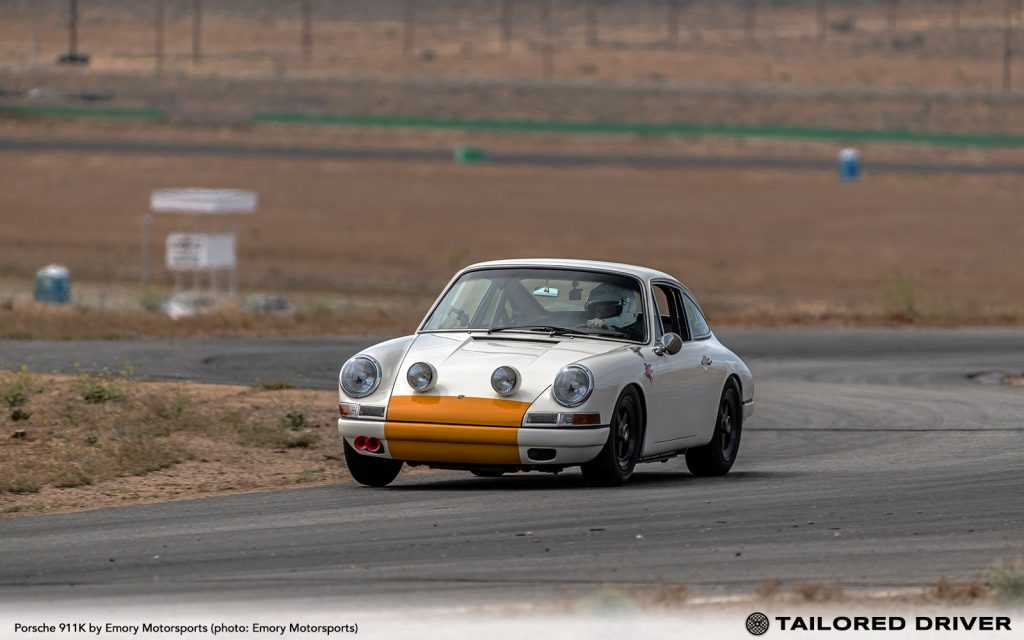
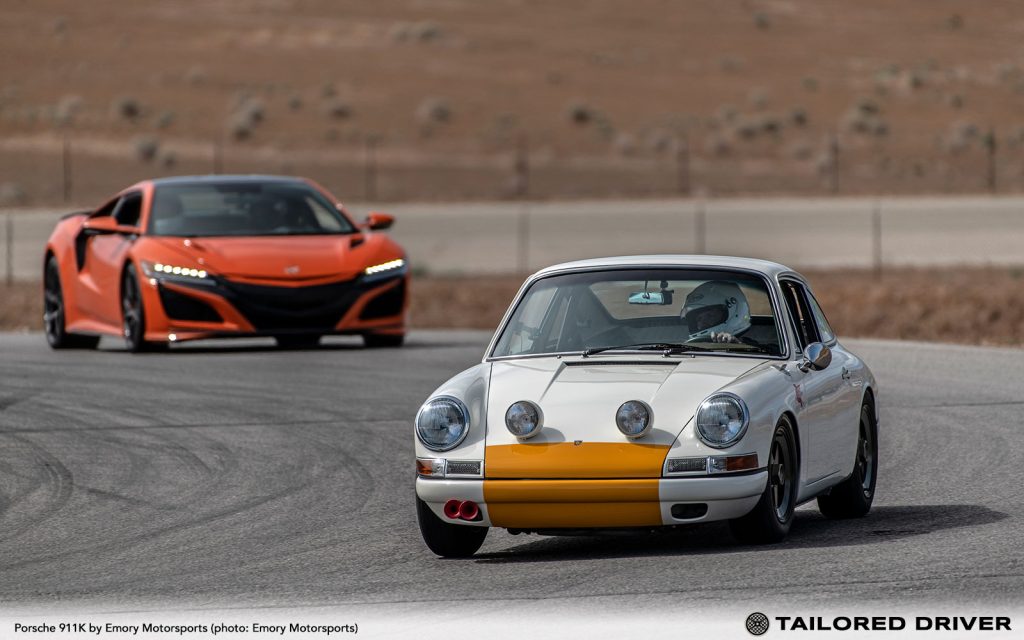
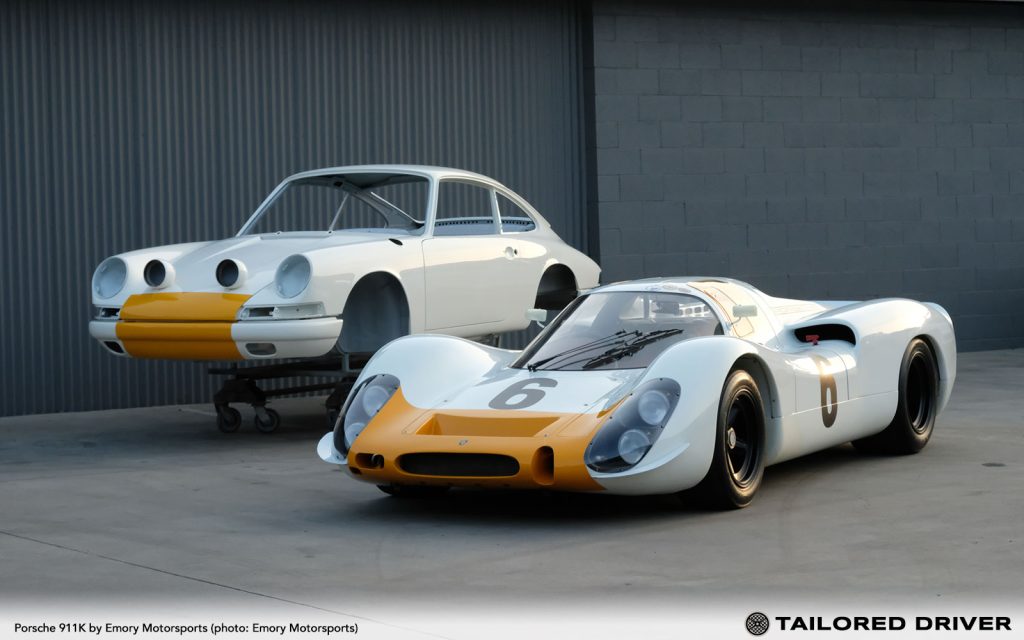
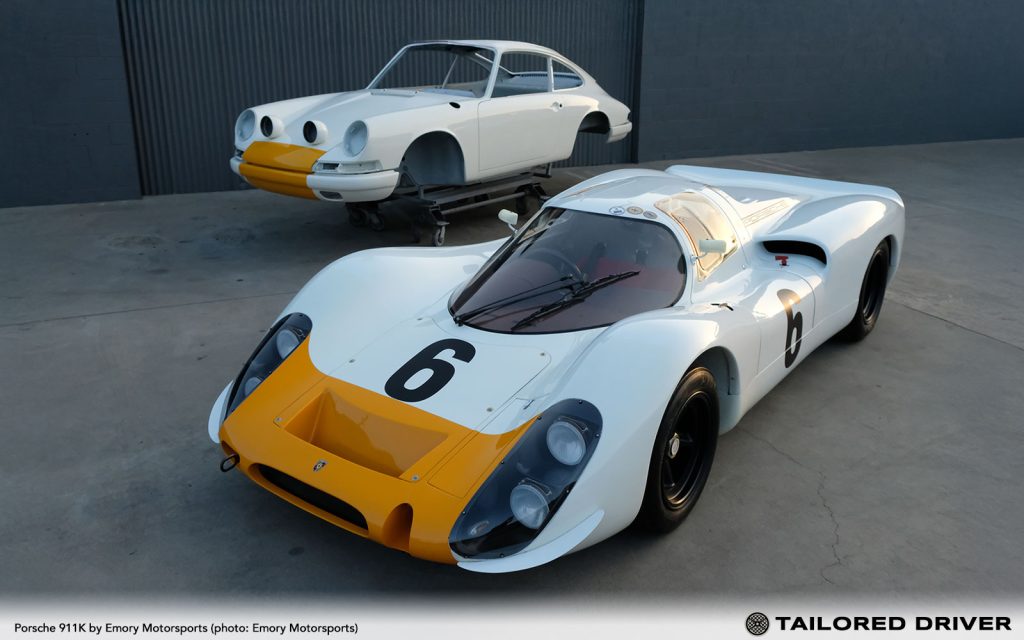
NORTH HOLLYWOOD, CA – The Porsche 911 is among the most iconic and collectible automobiles to ever grace the highway, and Emory Motorsports is excited to unveil its first-ever fully custom 911: the Emory Outlaw 911K. Third-generation car customizer and world-renowned Porsche 356 expert Rod Emory has compiled a lifetime of automotive experience to develop this stunning creation.
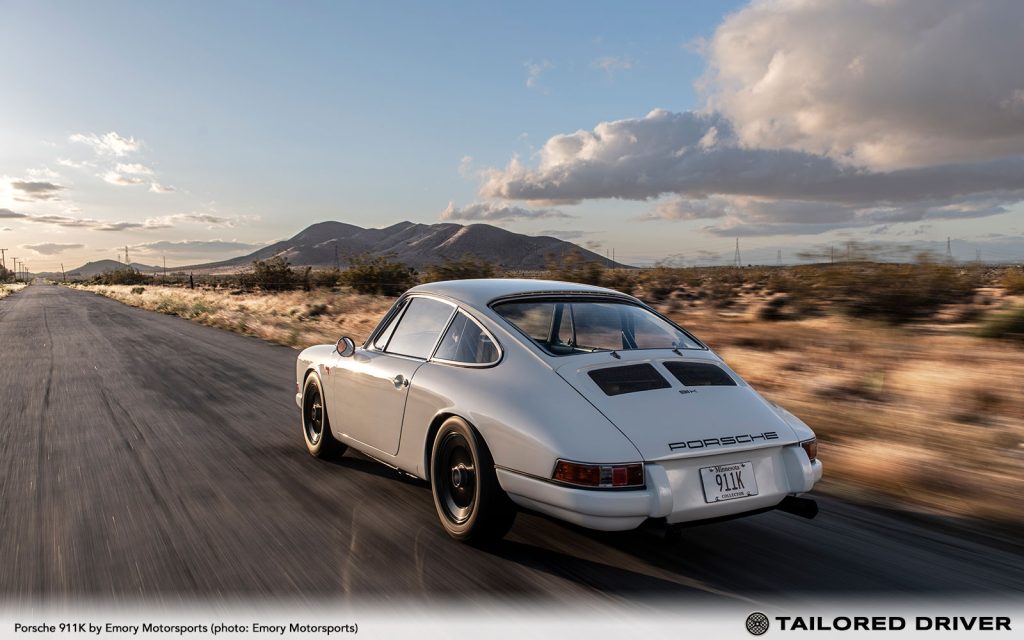
Every aspect of the car is built for agility and the essential design language of Porsche’s early works prototypes and 911s are retained as an echo of Porsche Motorsports’ competition vehicles from 1960s. This is a unique and purposeful combination of mechanical parts and a sleek bullet-shaped body which produce the perfect track and rally weapon.
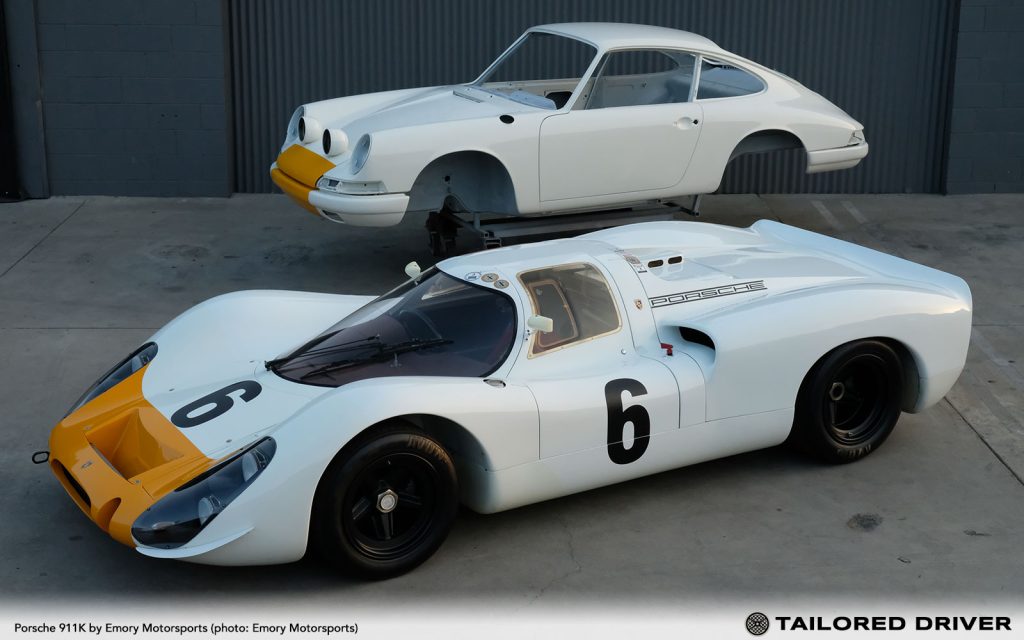
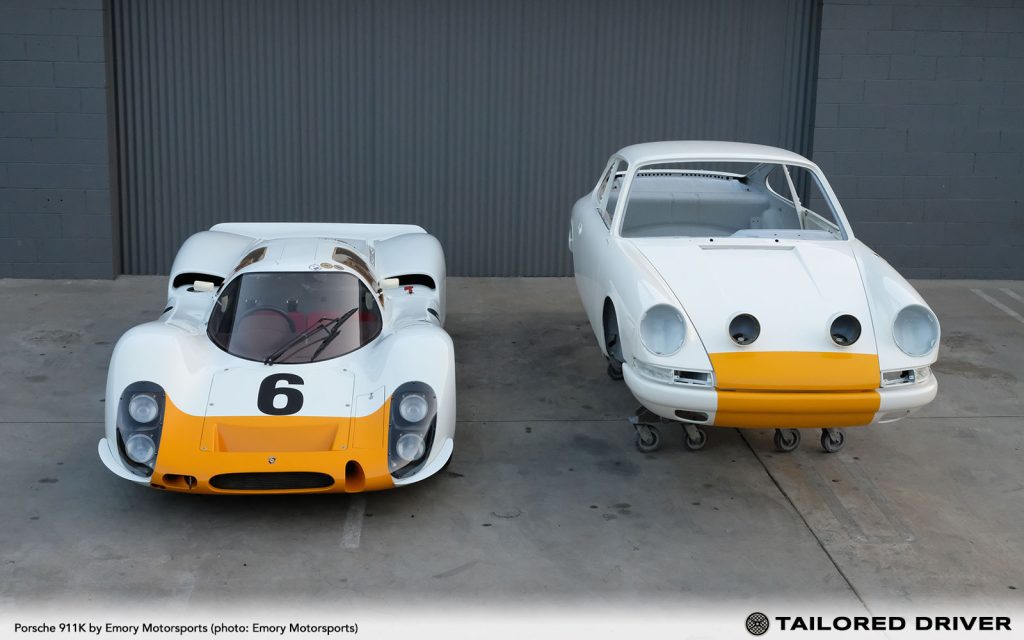
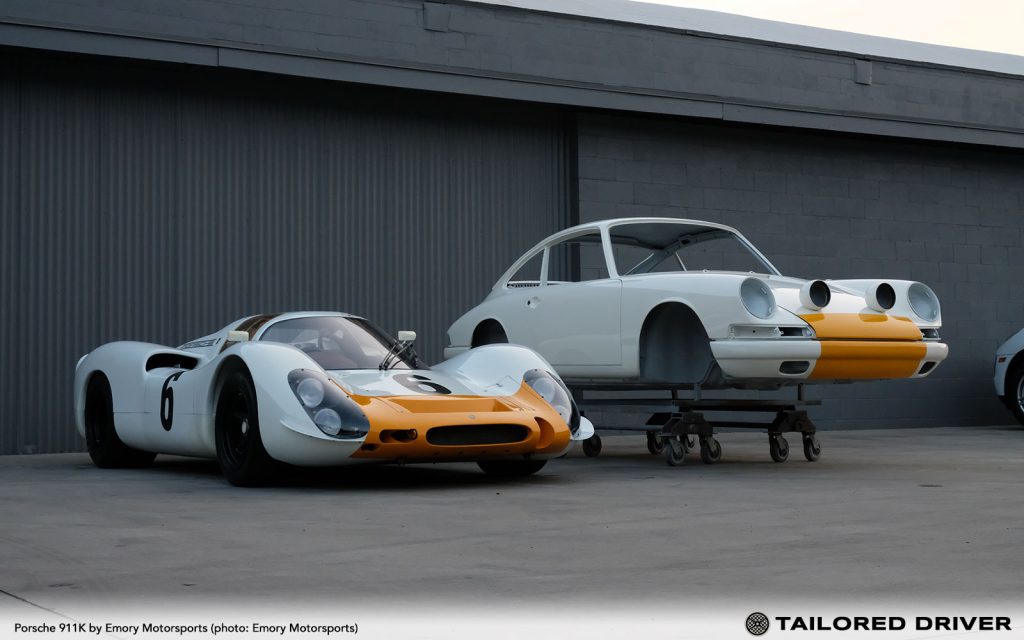
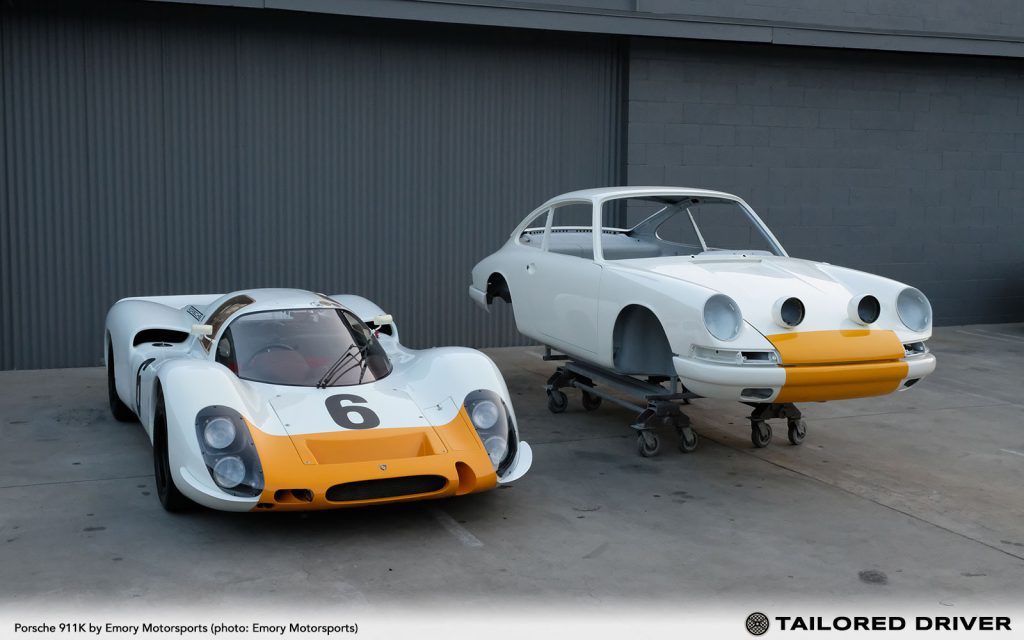
“This slab-sided Emory Outlaw 911K is unique,” Rod Emory says. “We specialize in 356s, and we did this 1968 911 SWB as a one-time commission for a special client. The inspiration for this car comes from Porsche 908-010, a K-bodied sports prototype once piloted by Vic Elford. The design cues and livery from that car lend themselves beautifully to this build.”
This 1968 908 was one of the first closed-cockpit works prototype cars. It is also believed to be one of only five that still exist, and was also one of the five that initially received the short-tail (“Kurzheck”) bodywork. Porsche collector Cameron Healey occasionally campaigned the car in vintage races from 2006-2016, entrusting its care to Emory Motorsports. When the opportunity came for Rod Emory to restyle another 911, he used it as inspiration for the “911K,” which has many understated and purpose-driven details for Porsche aficionados who think they’ve seen everything.
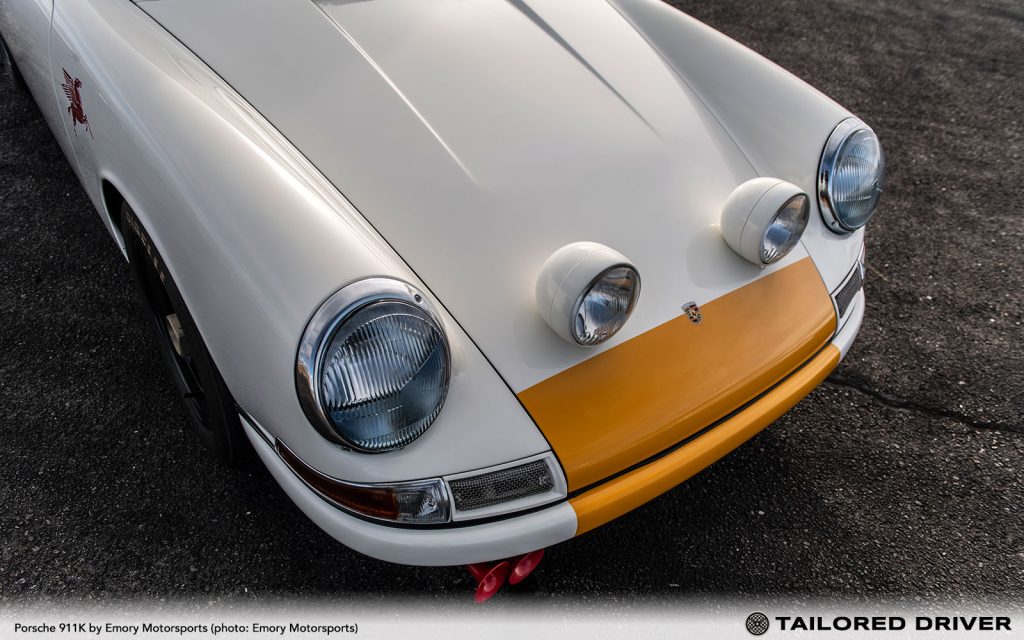
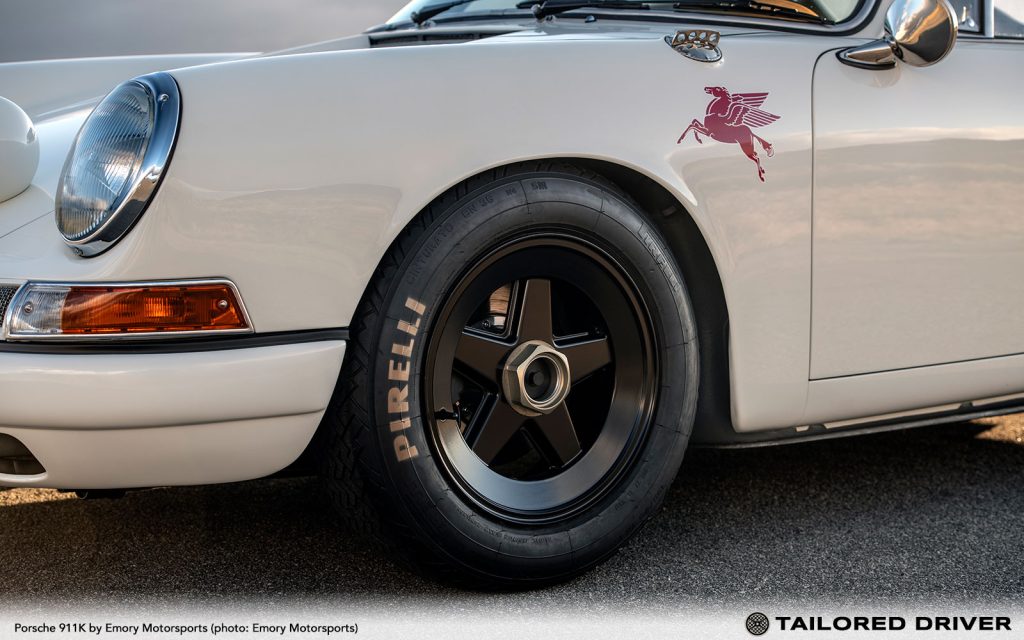
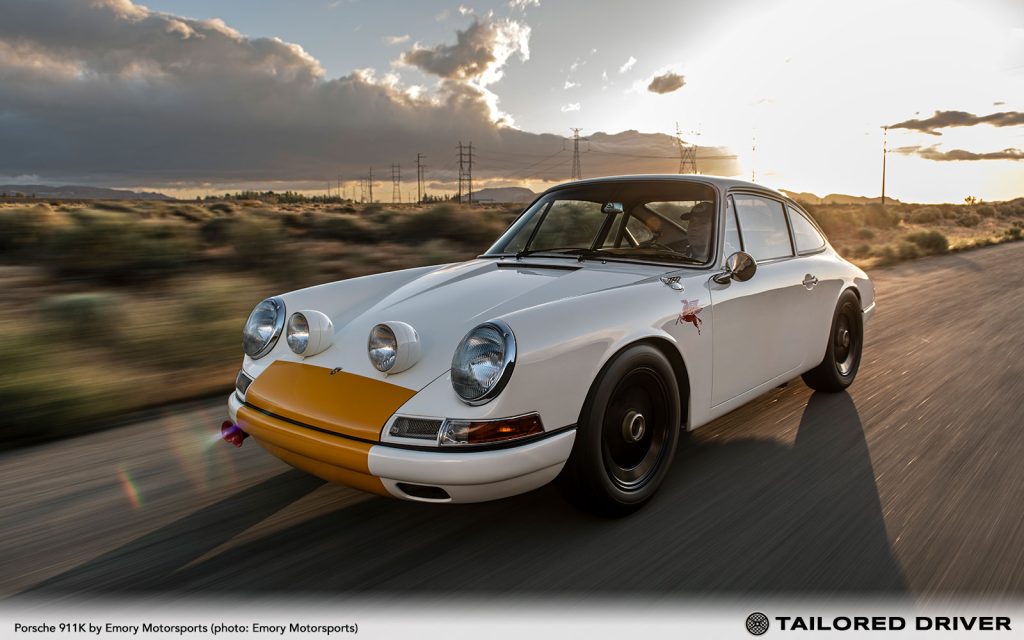
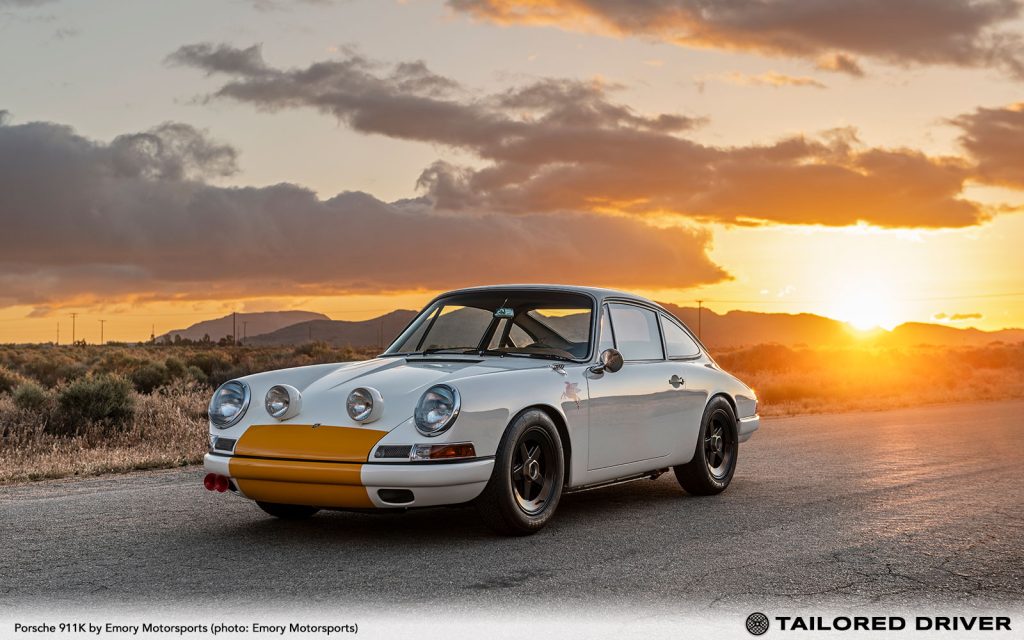
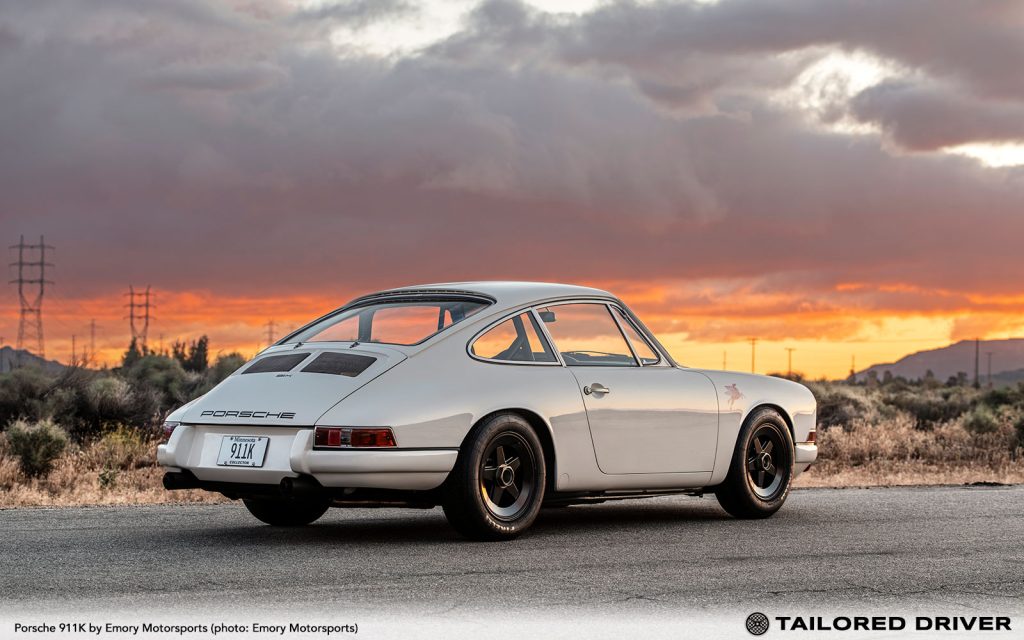
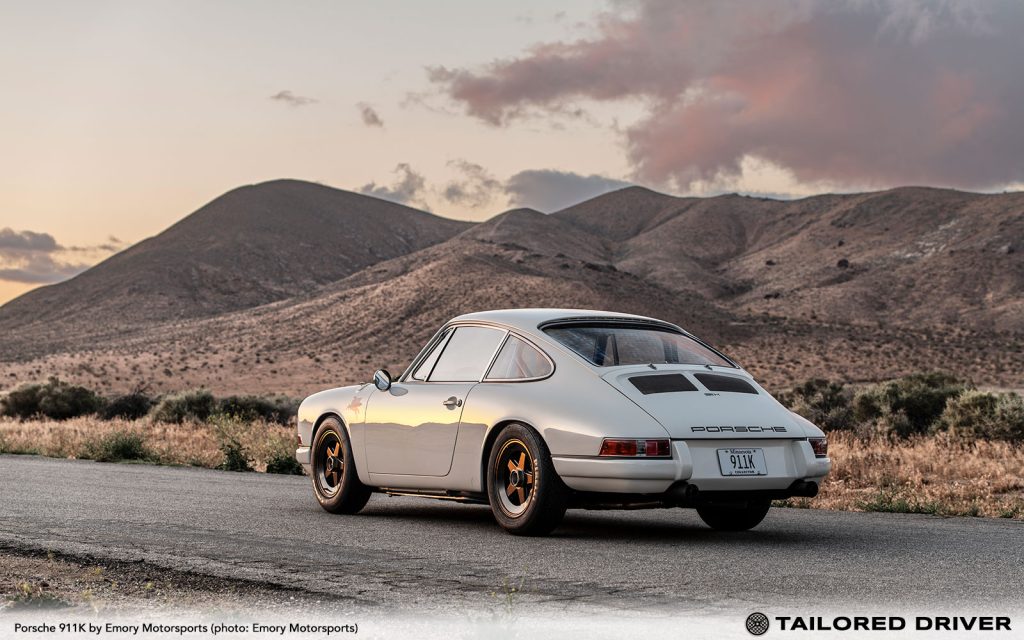
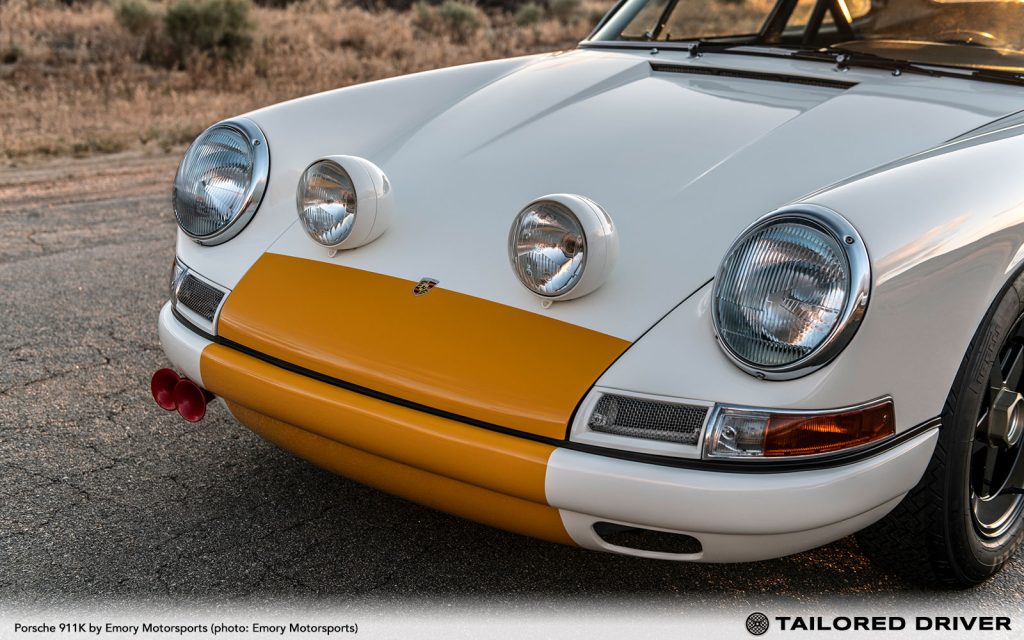
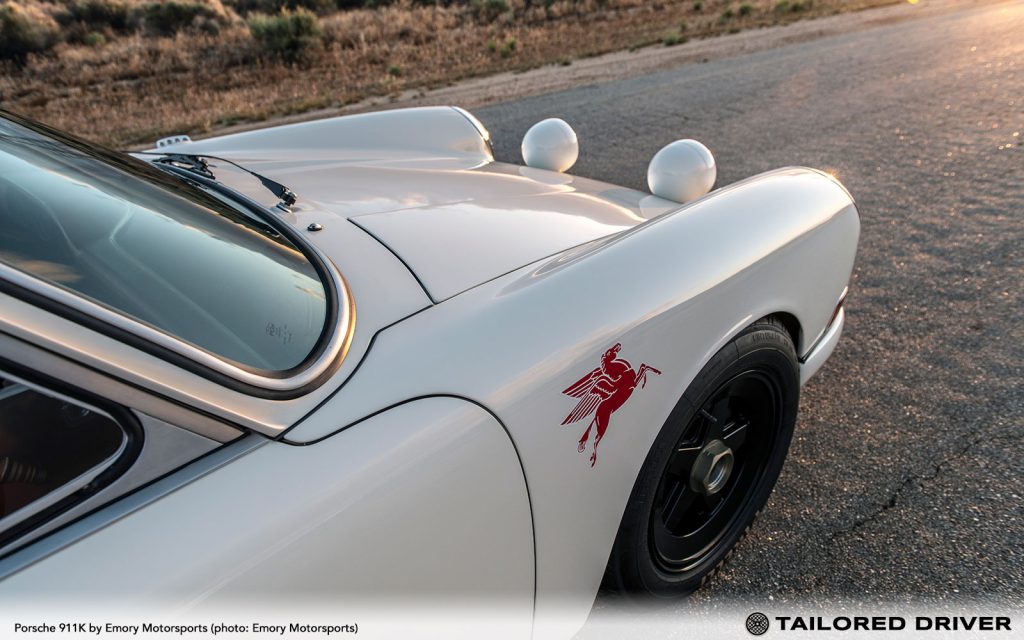
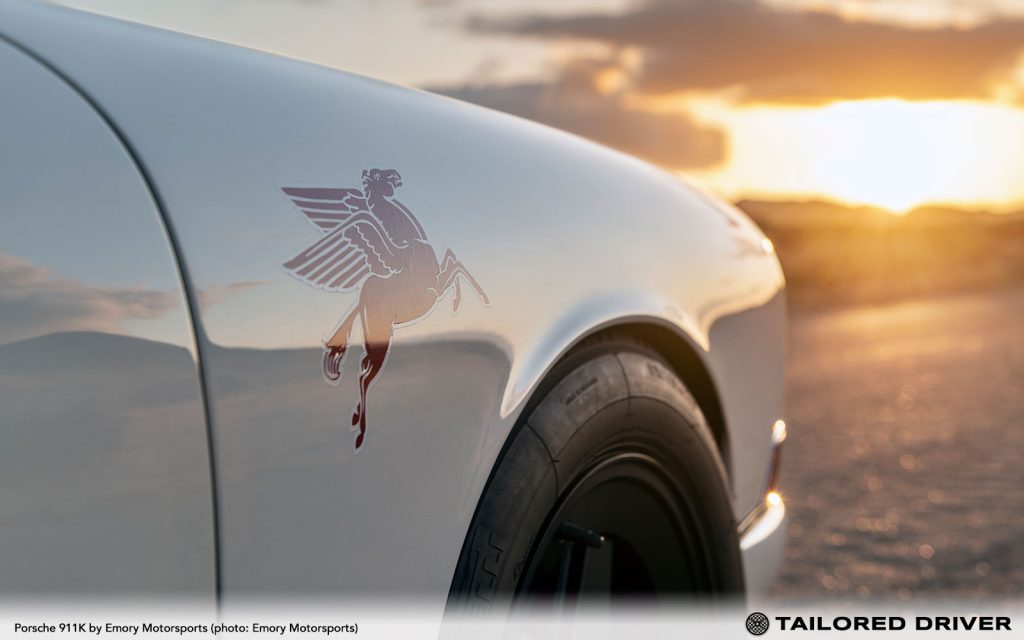
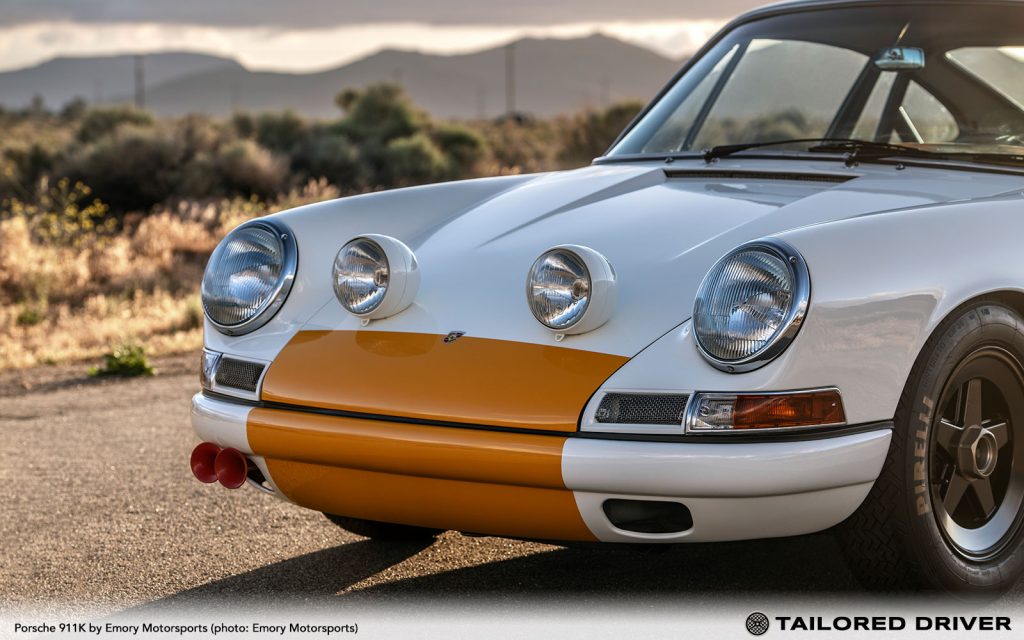
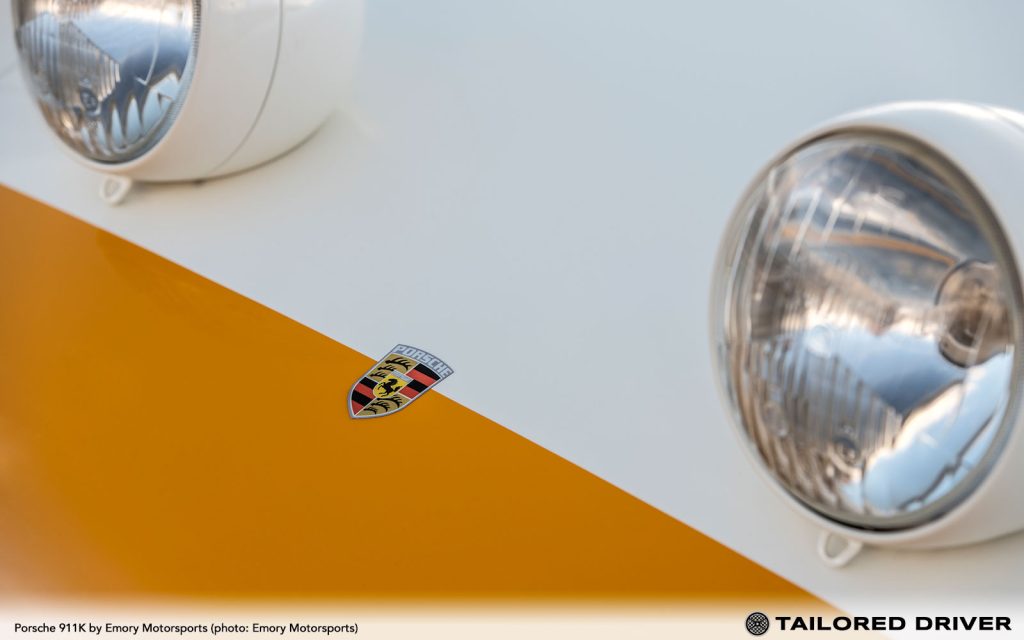
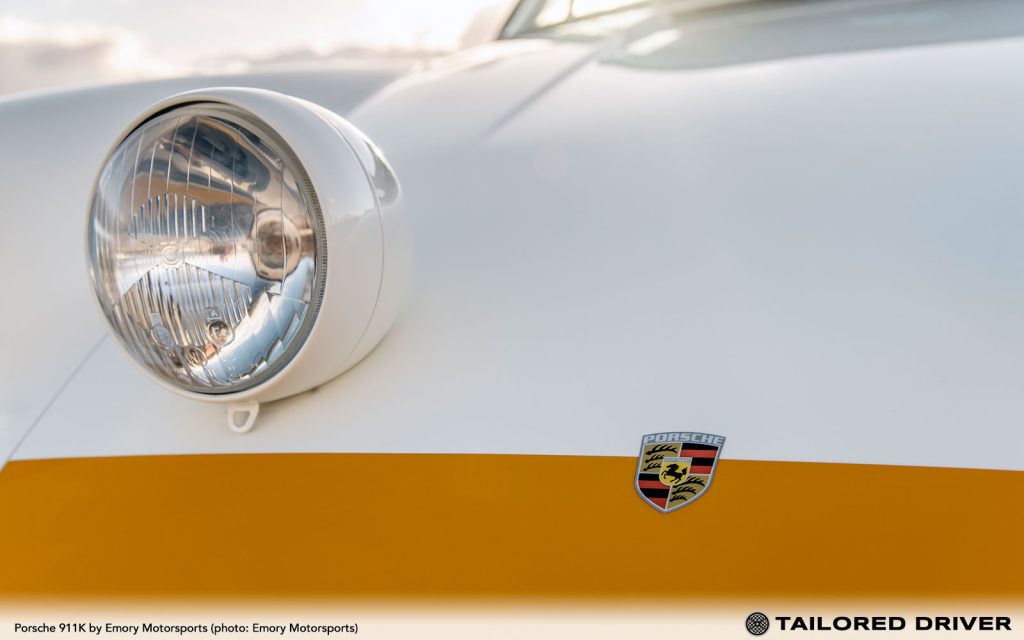
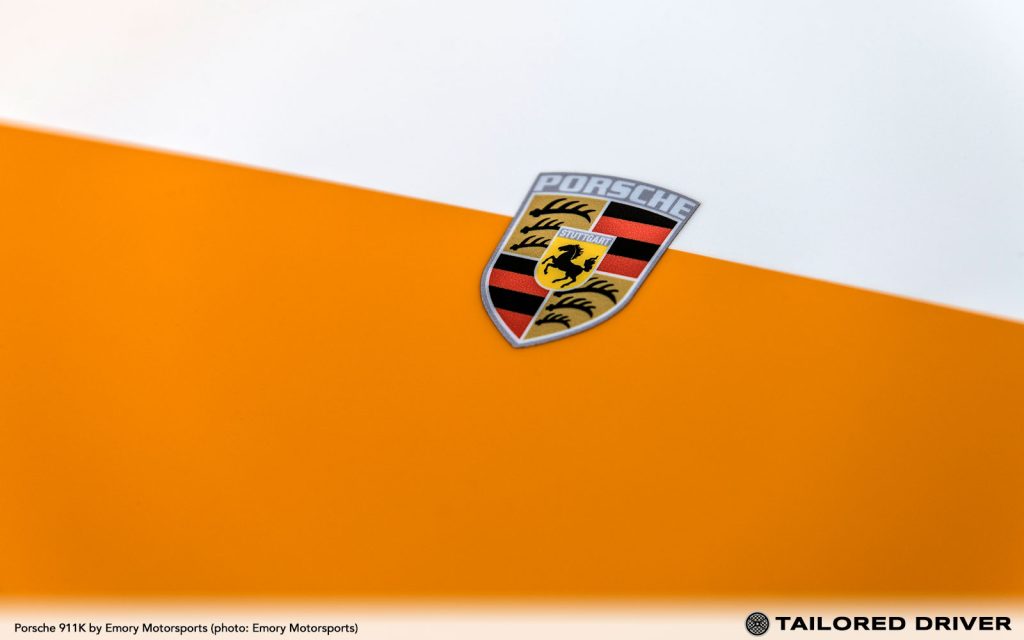
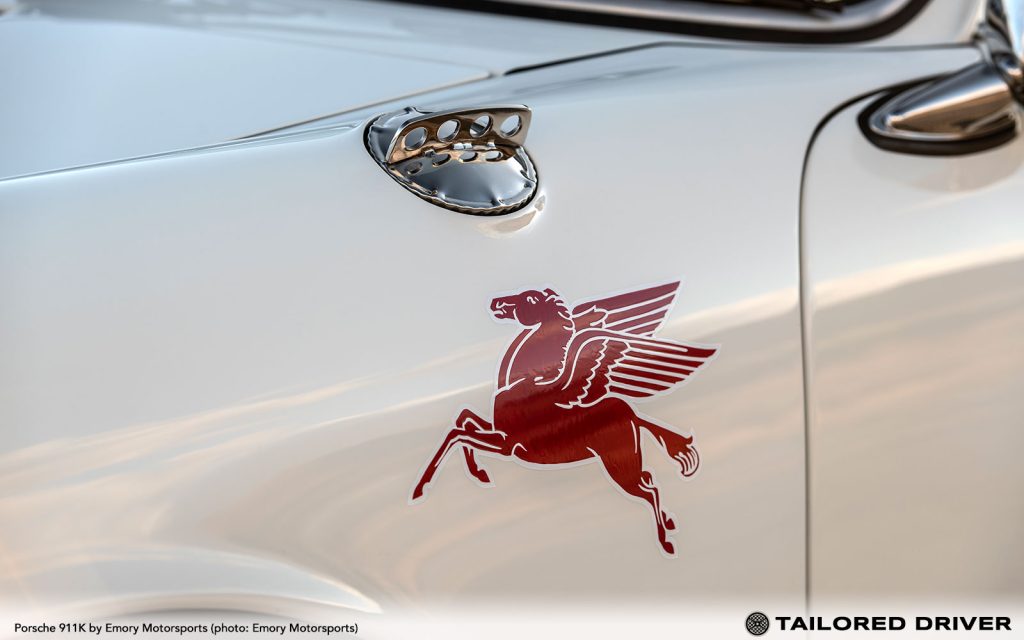
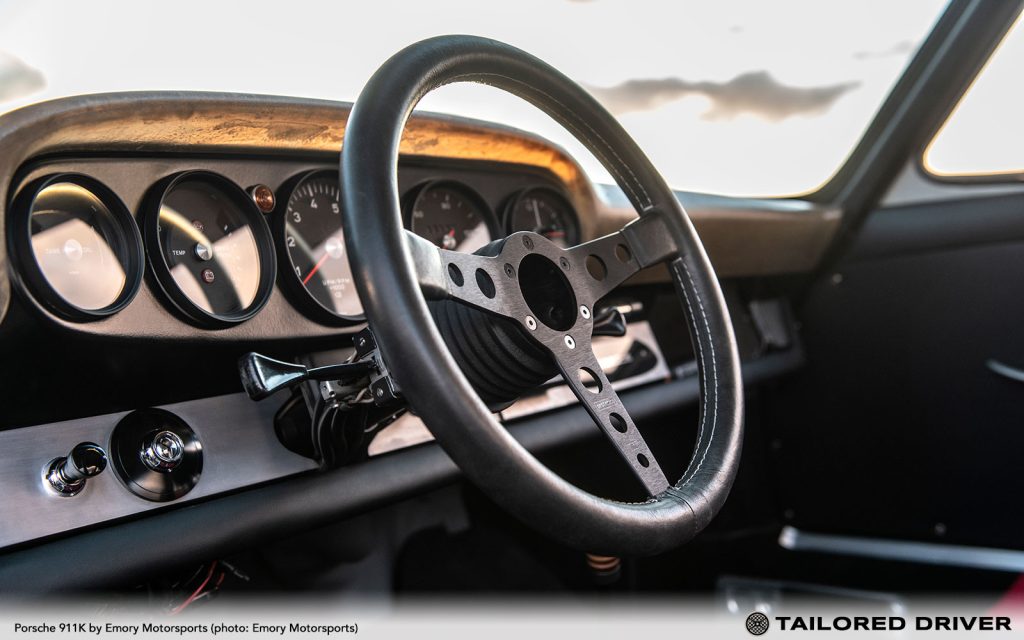
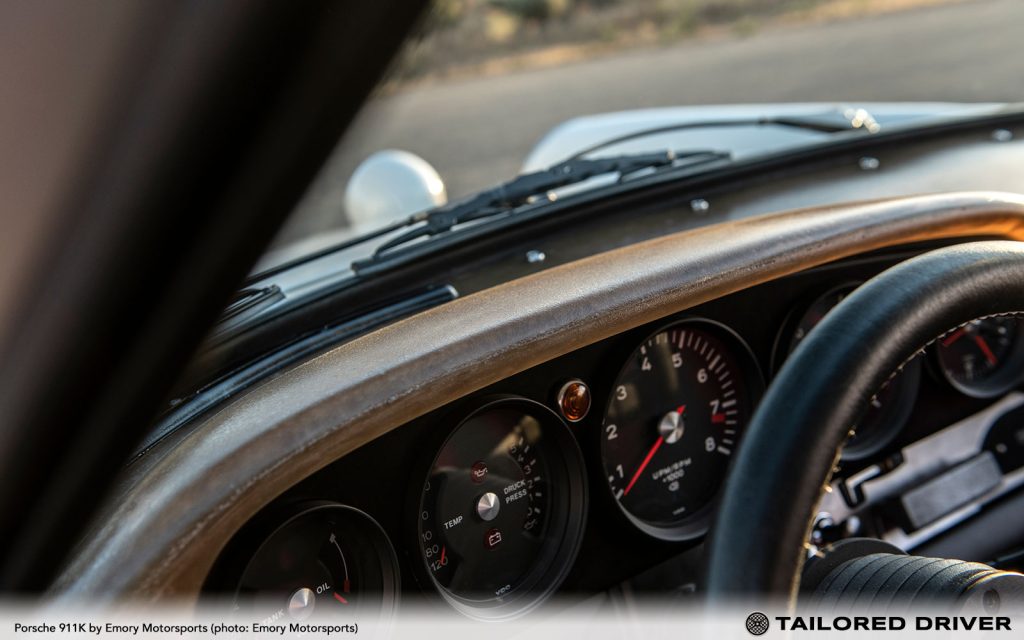
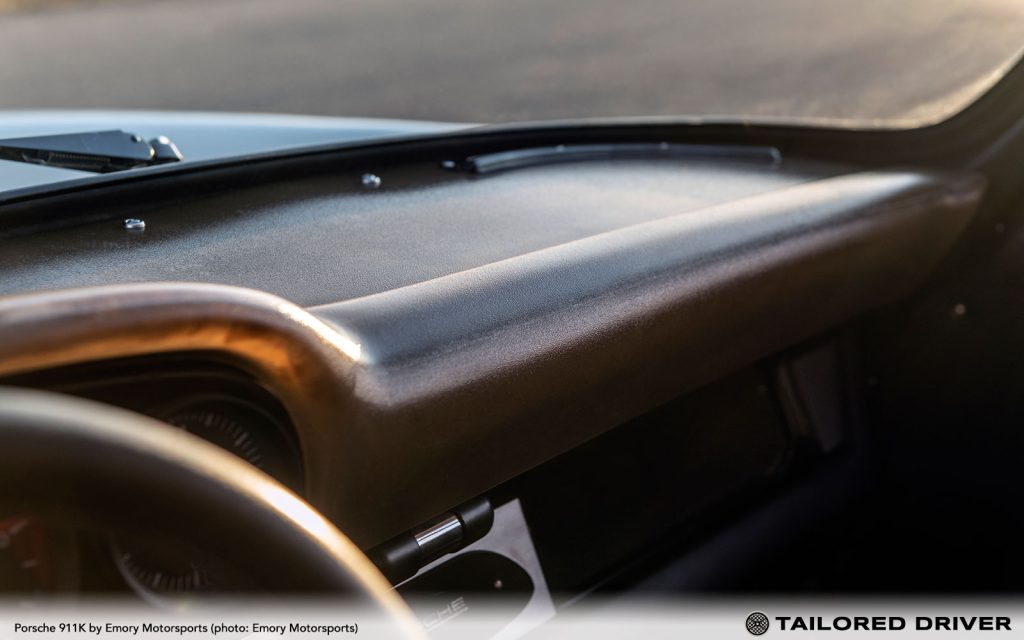
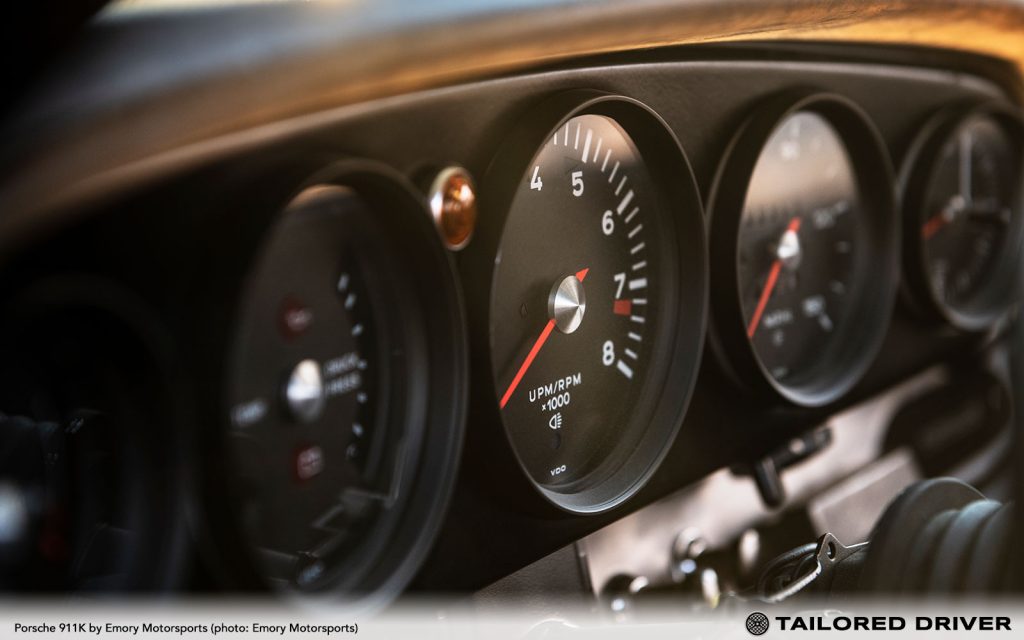
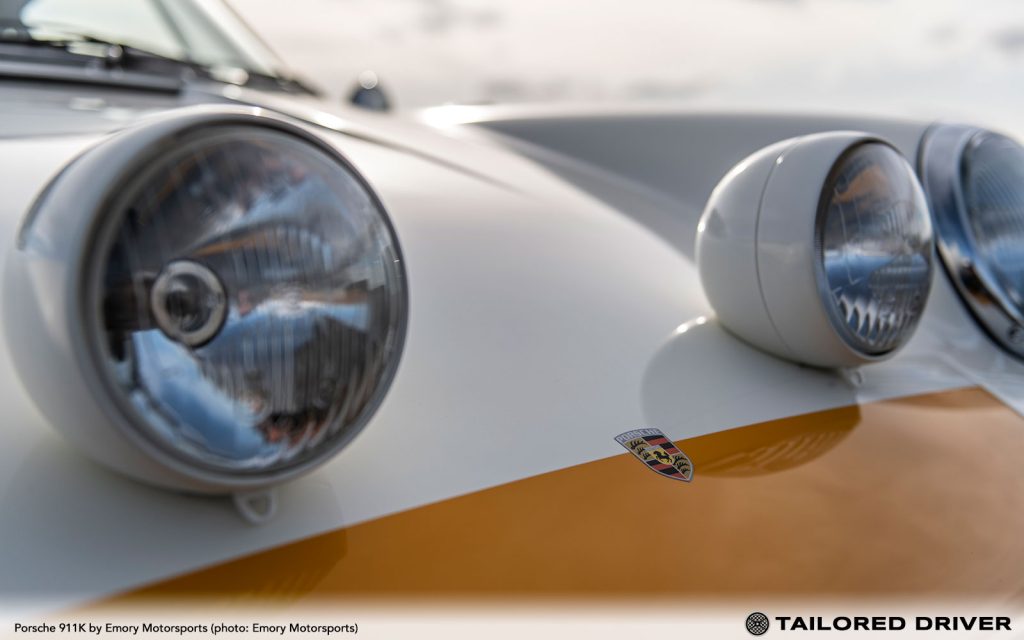
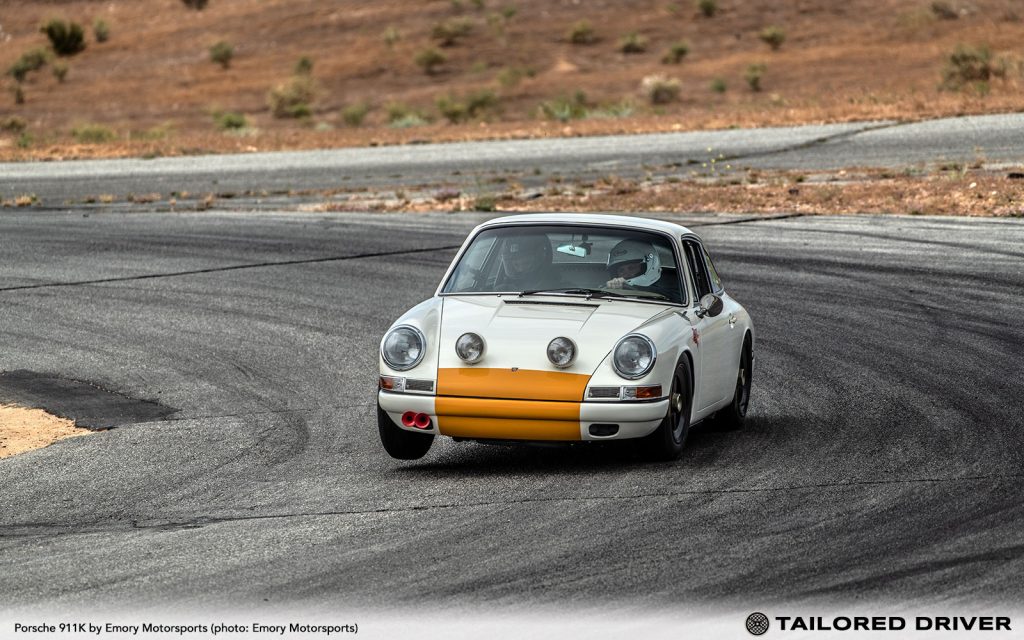
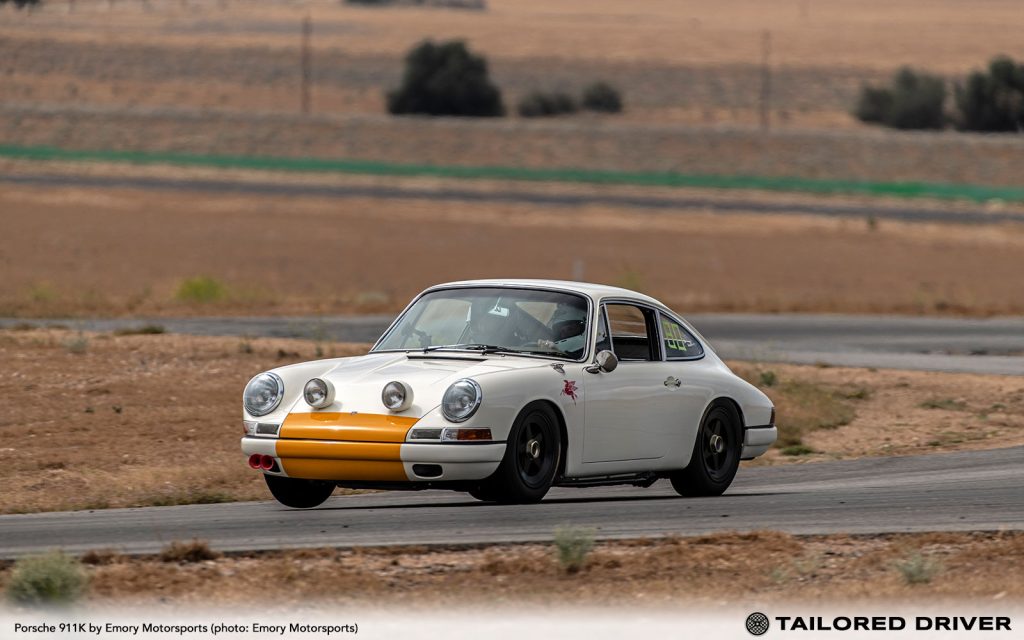
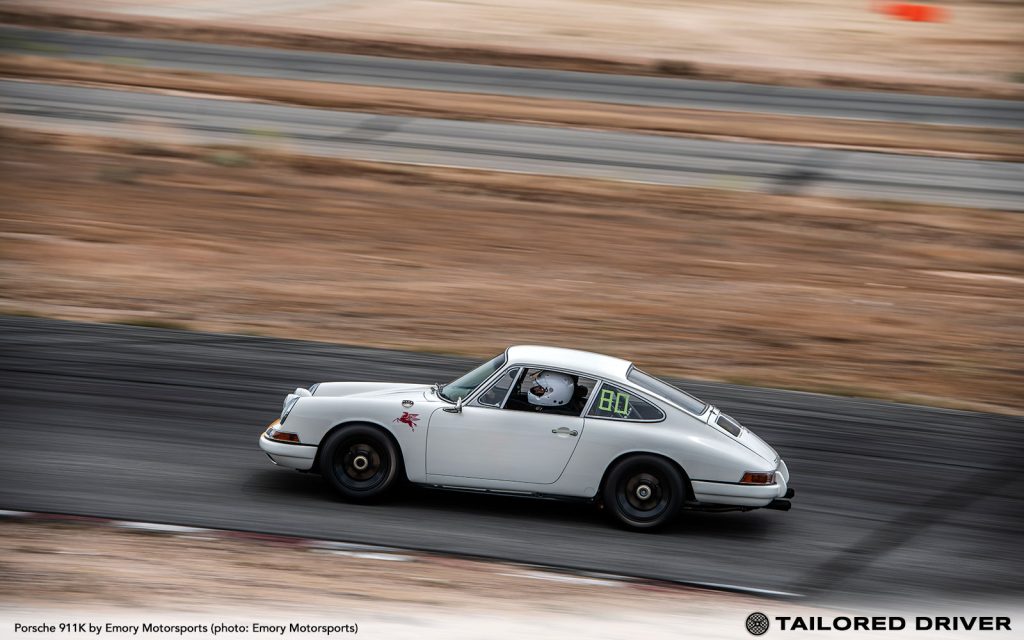
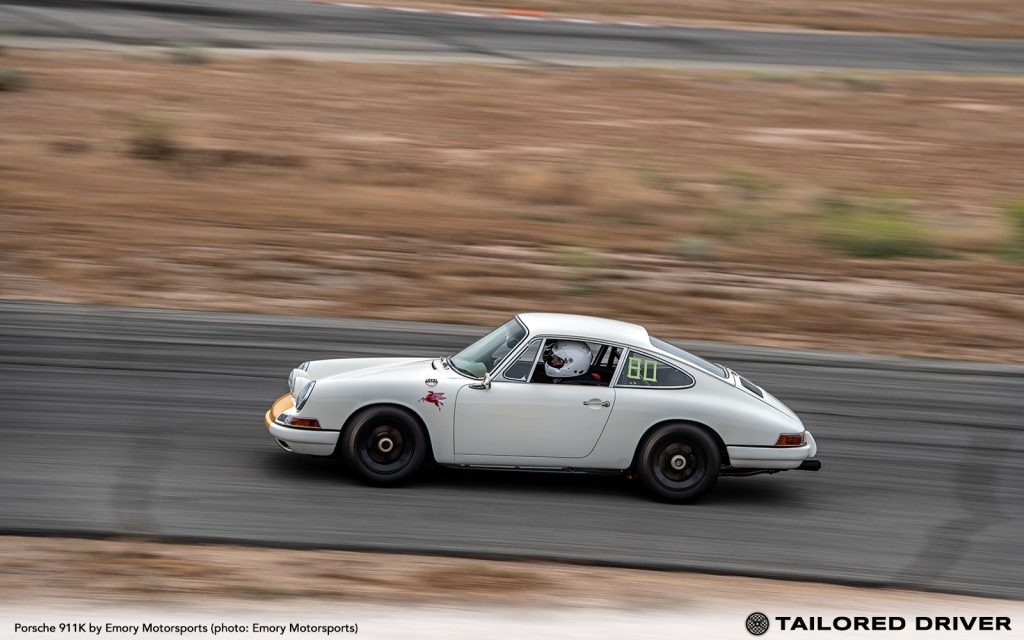
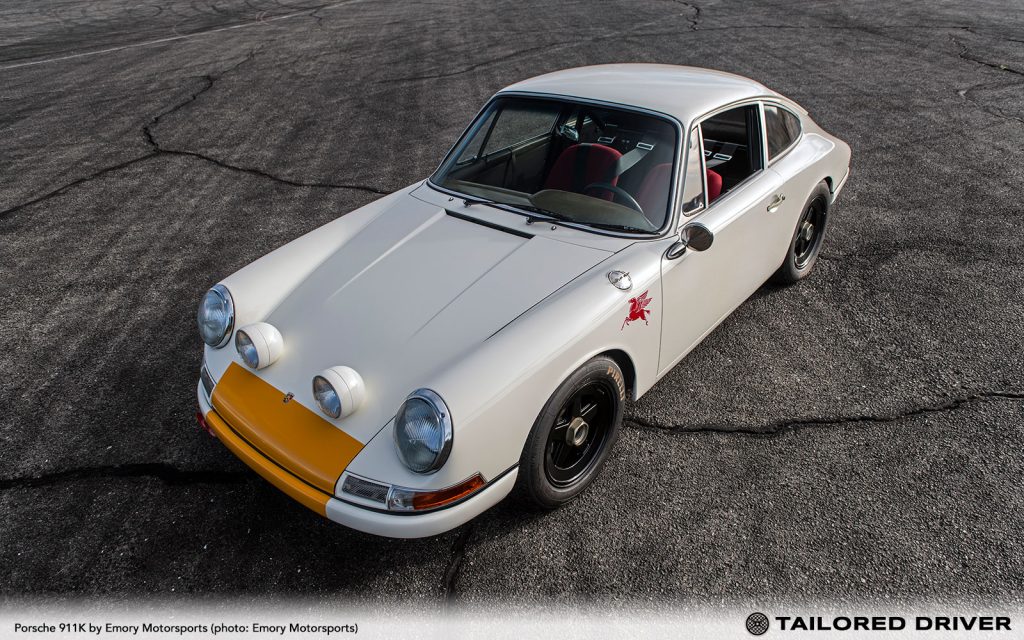
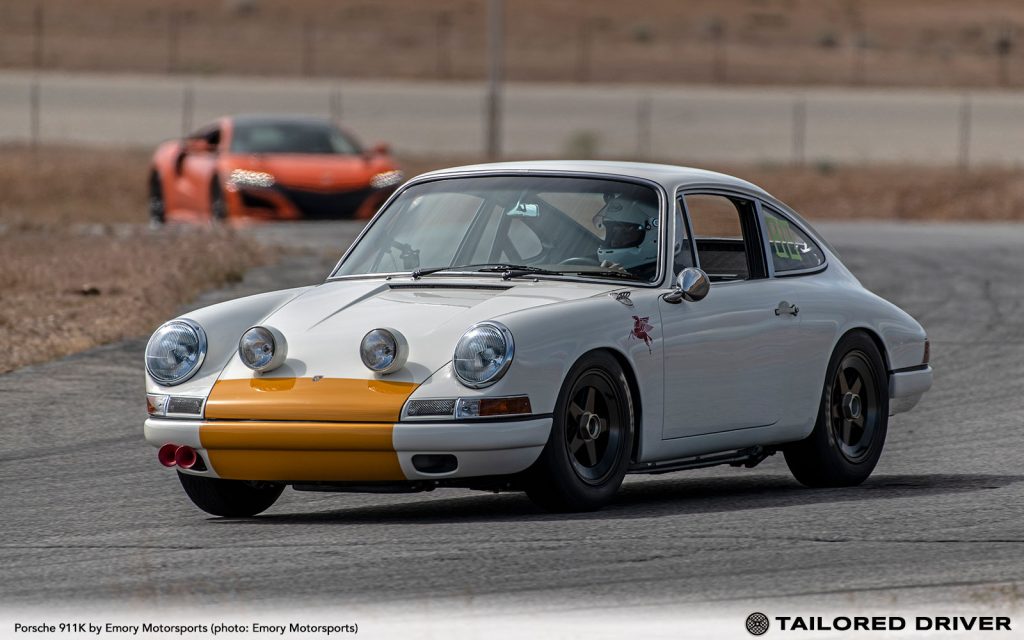
The 911K acknowledges its motorsports brethren with distinct cues such as the amber fiberglass dashcap, Porsche Light Ivory (hellelfenbein; non-metallic; 6404 / 6604 / 6804 / 131 / 1111 / L80E; Porsche) paint with signal-yellow (signalgelb; non-metallic; R1007 / 6823 / 114 / 7272; Porsche) accent and hand-painted Mobil Pegasus for that authentic touch.
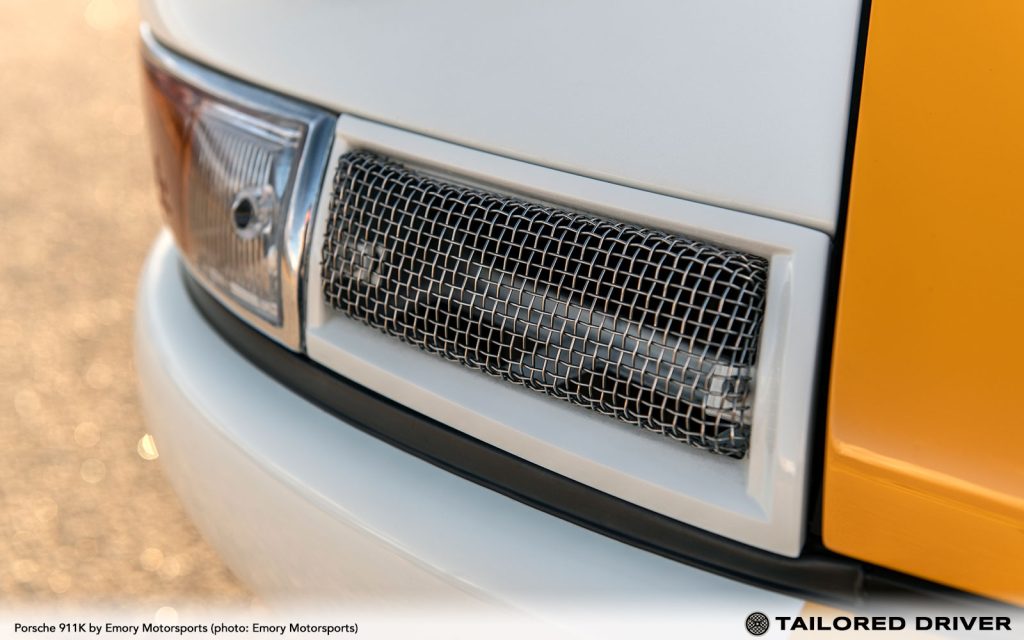
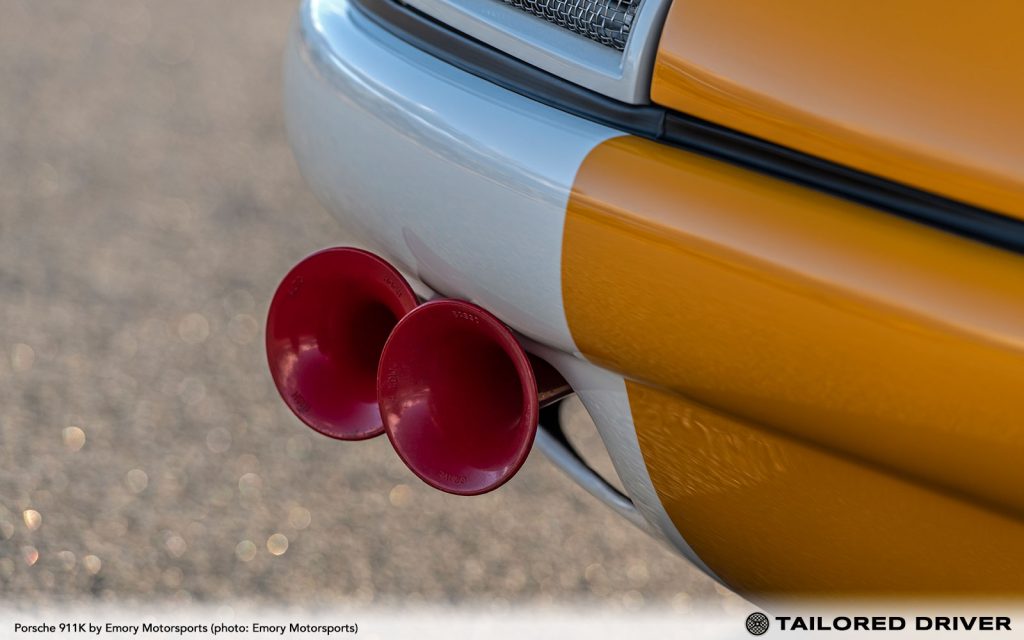
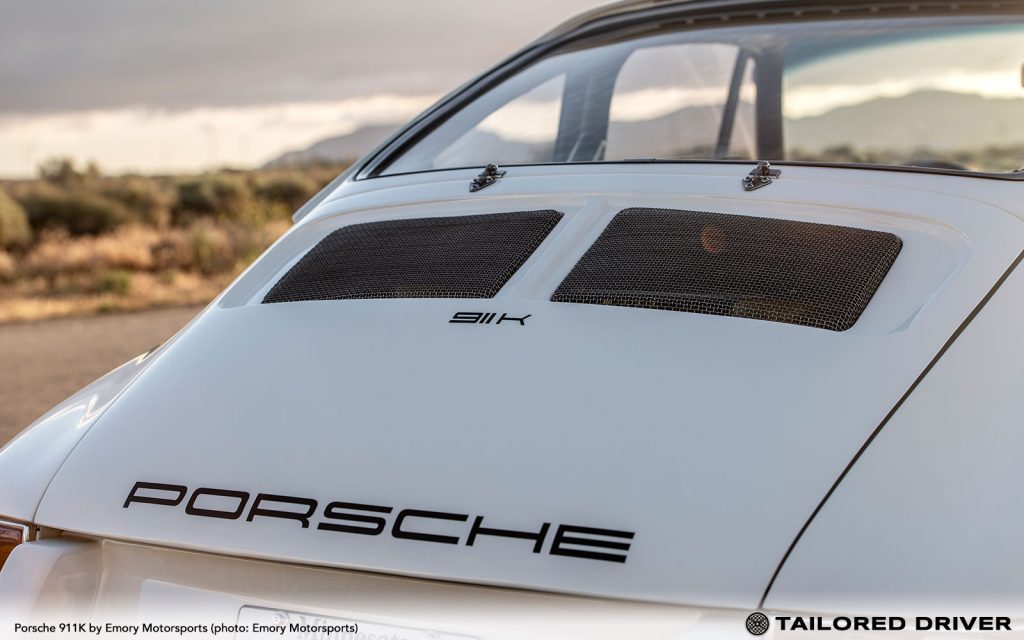
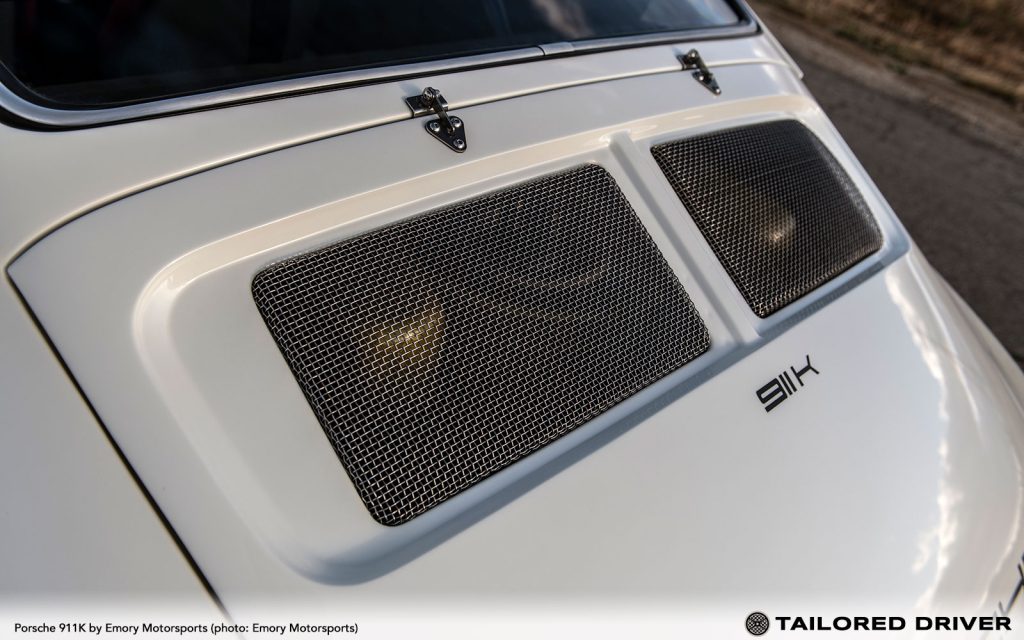
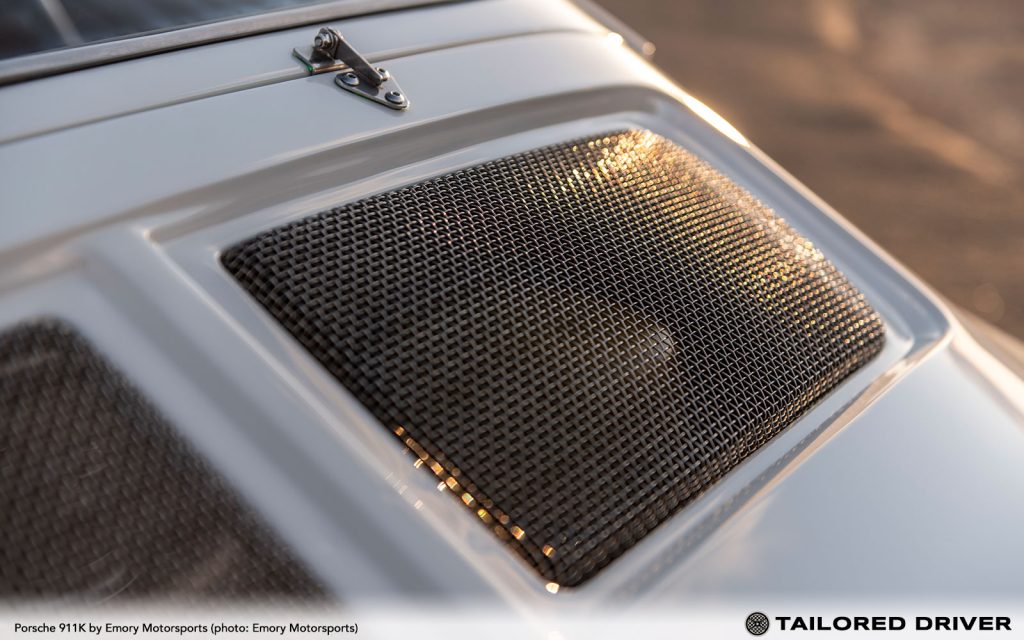
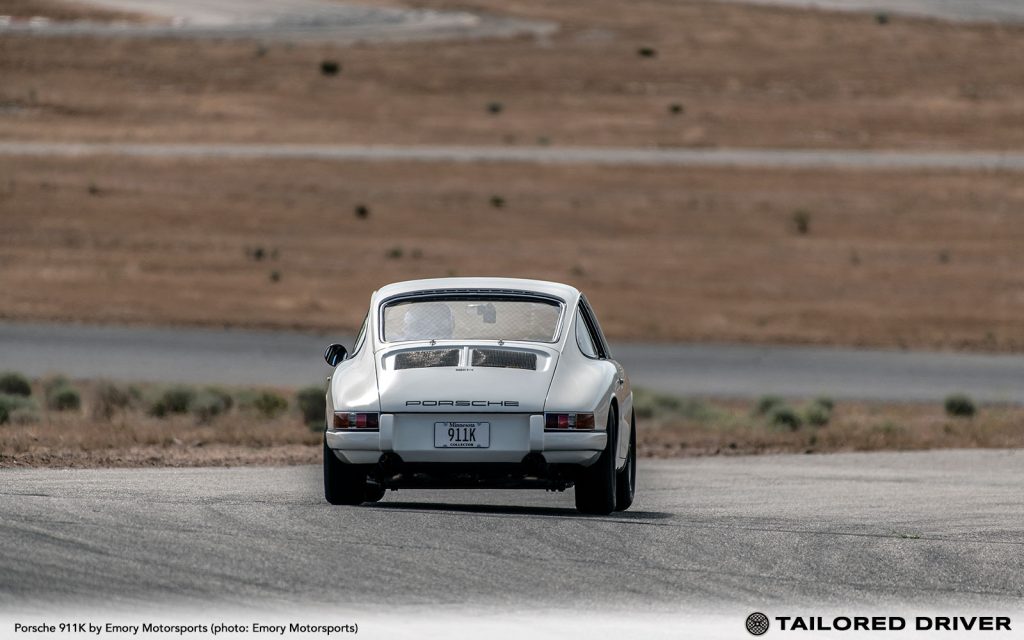
Air horns and auxiliary lights define the car’s rally stance from the front. Other body modifications include mesh intake guards, a twin-grille decklid, R-style deck lid hinges and R-style bumpers.
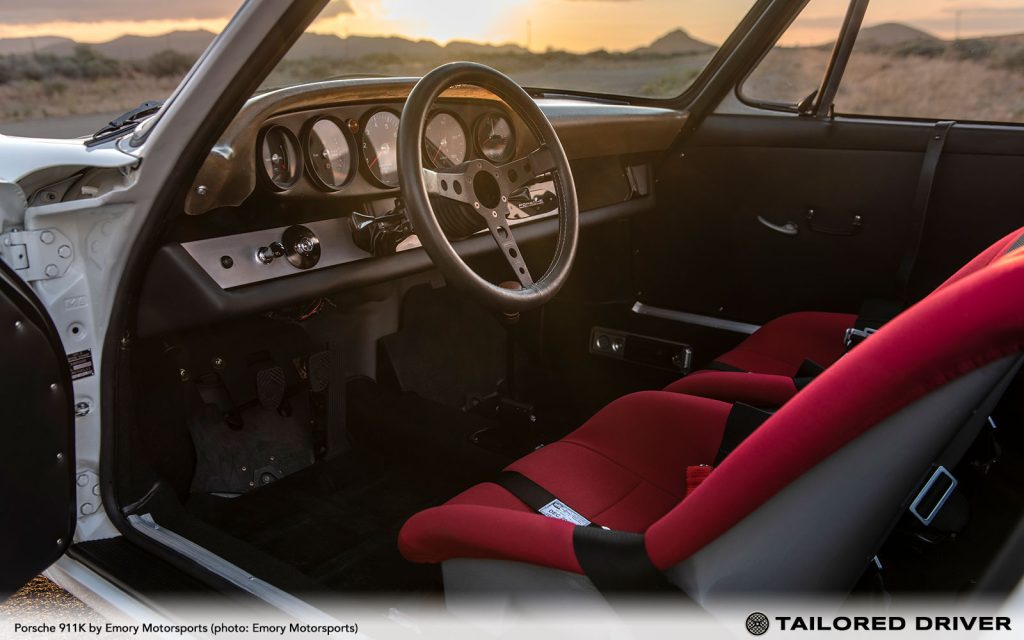
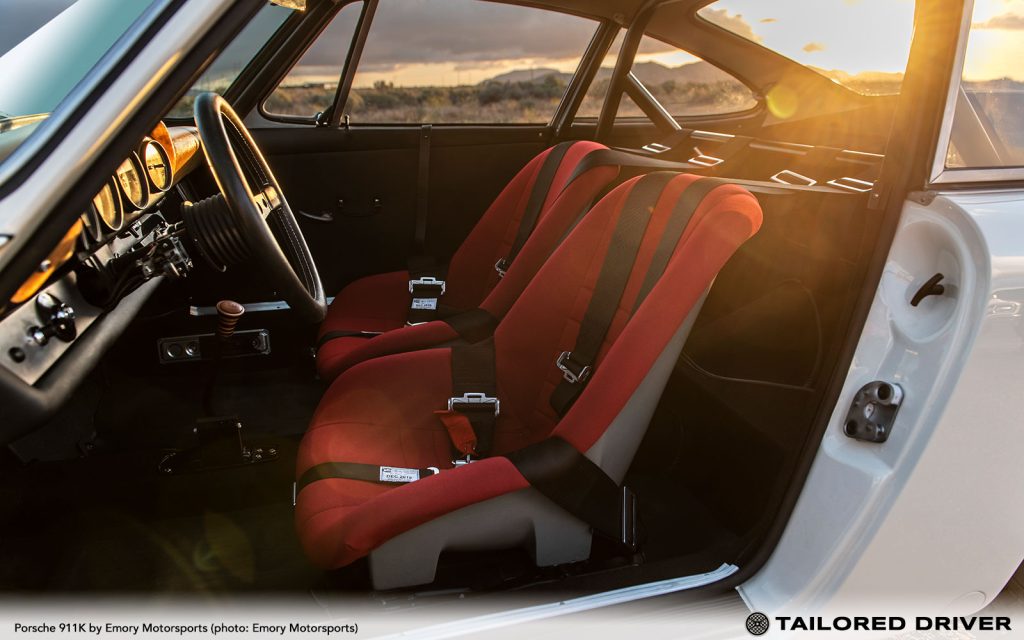
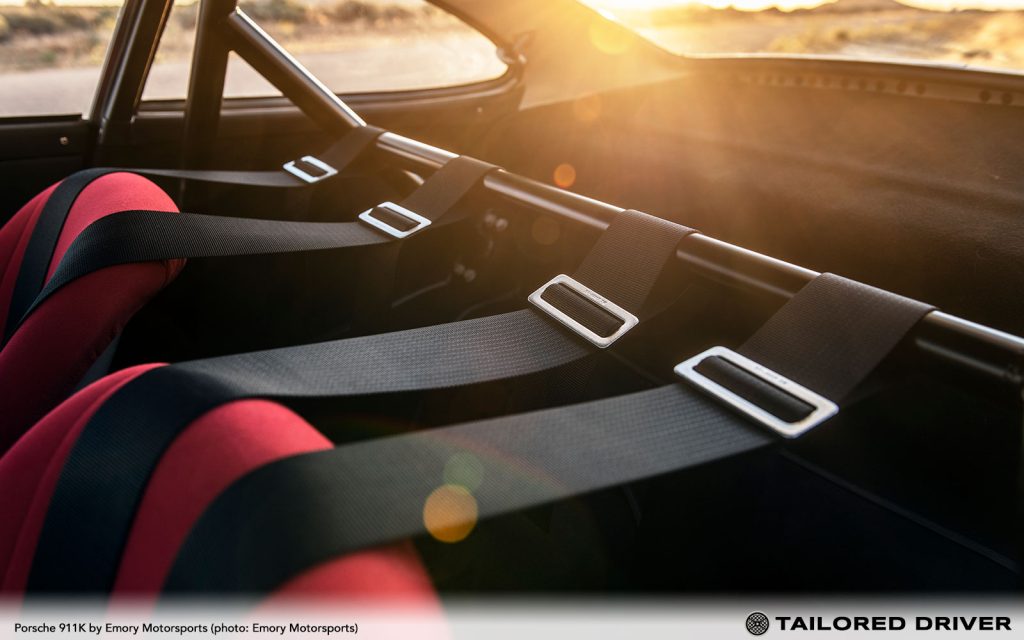
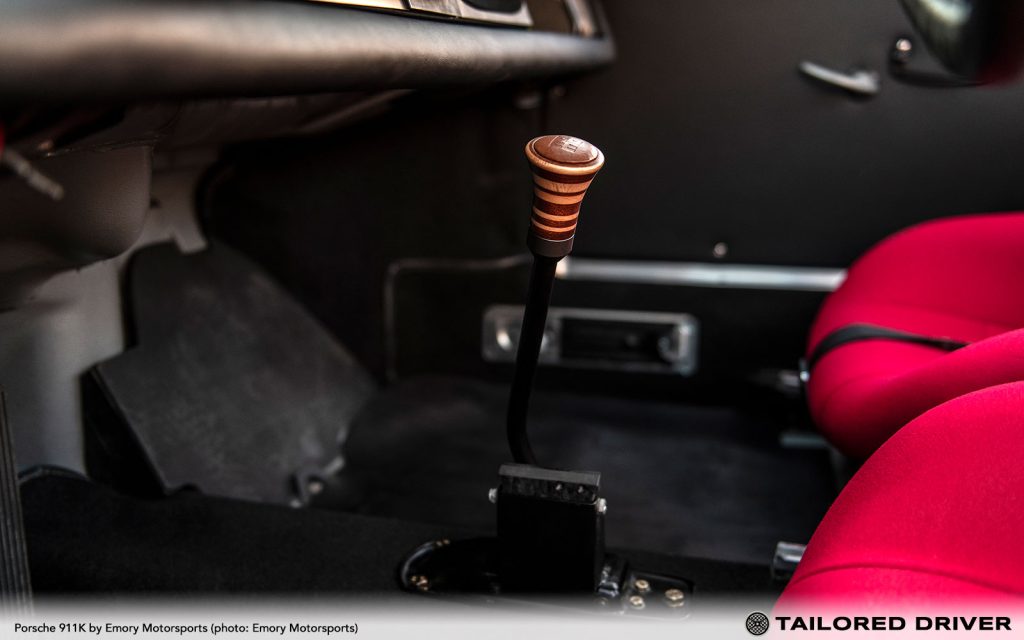
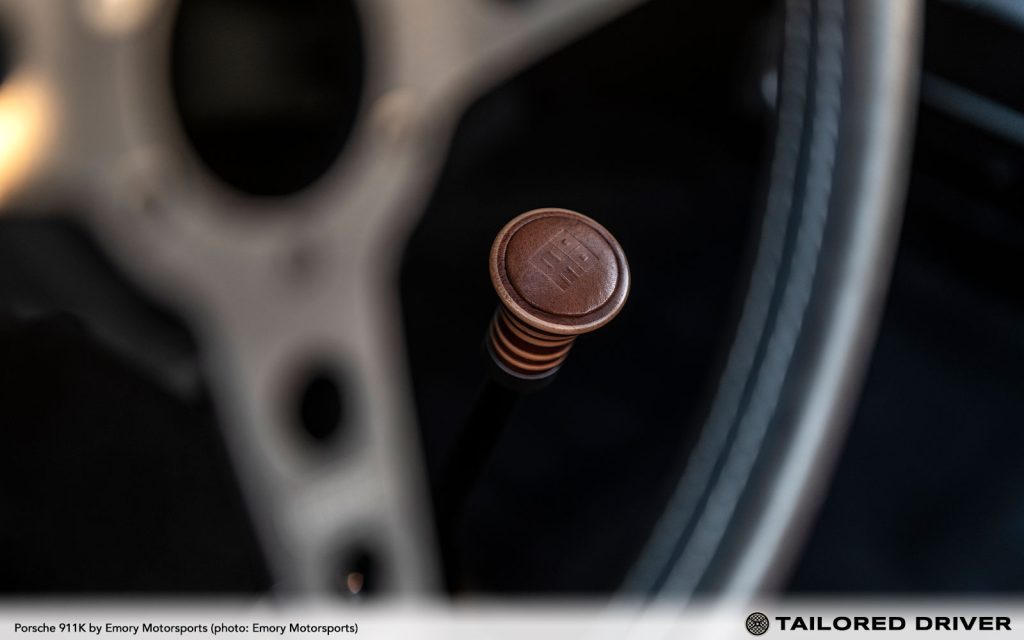
The 911K’s interior includes 908-inspired front seats with fire-retardant Spanish Red Veltex covers and MOMO 5-point competition harnesses. The MOMO influence continues to the Prototipo steering wheel and shift knob for the 901 five-speed transmission. Other custom additions include the removable rollbar, lightweight door panels & pulls and leather window straps.
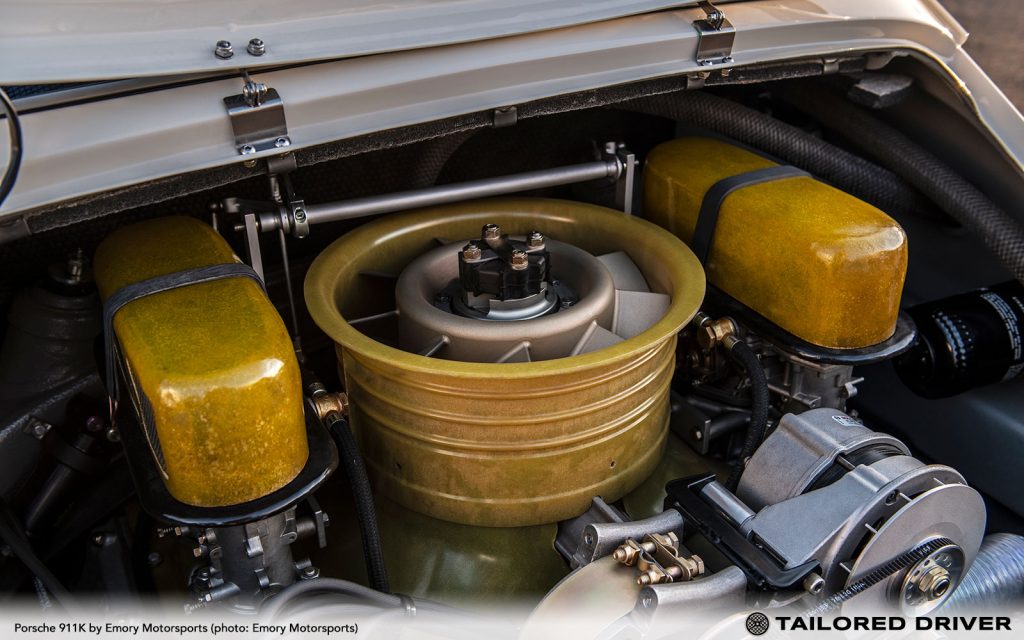
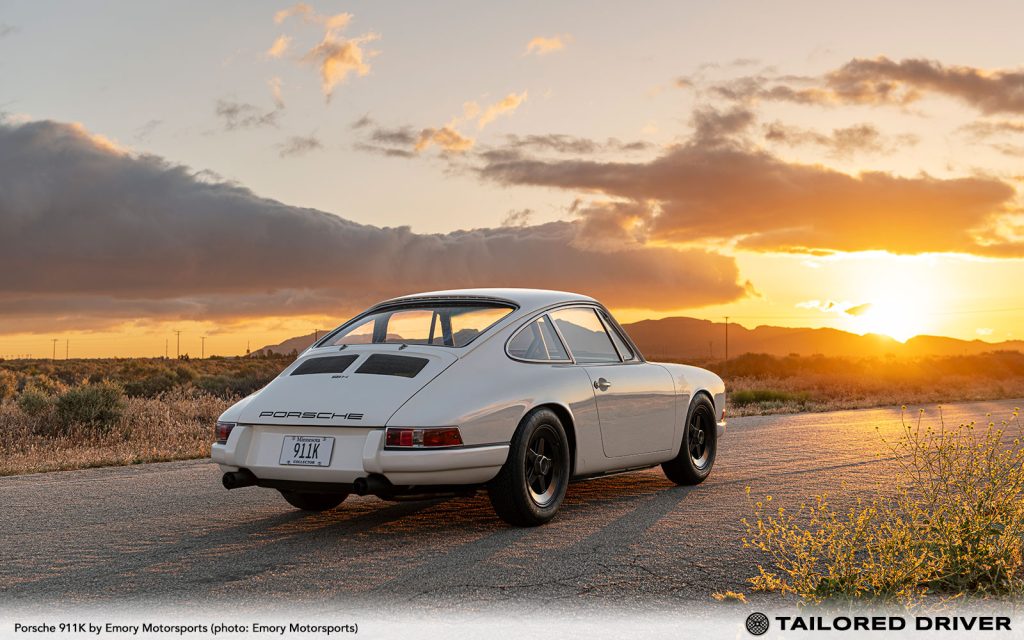
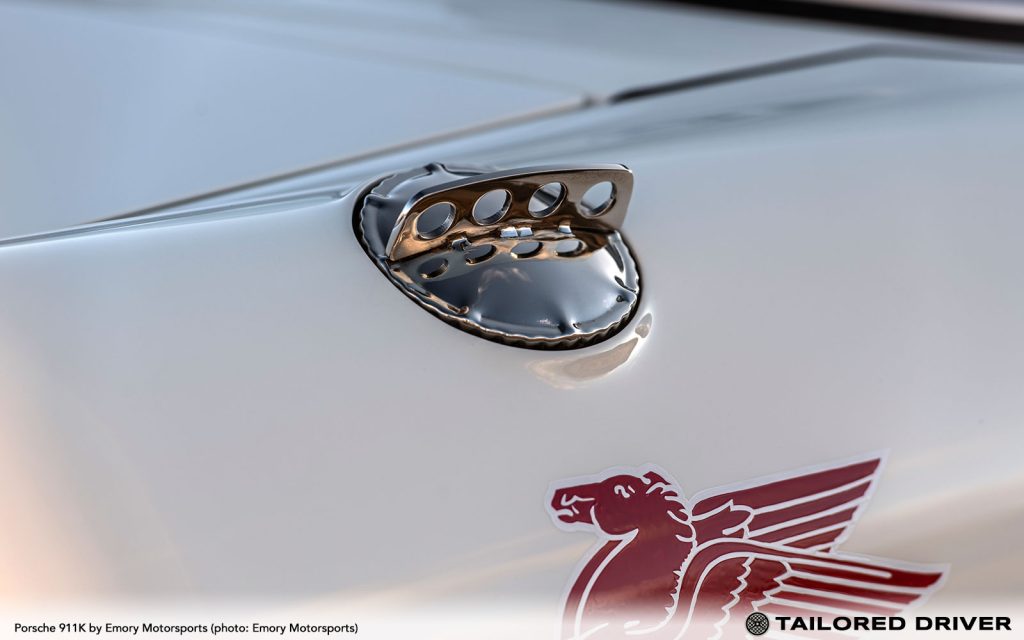
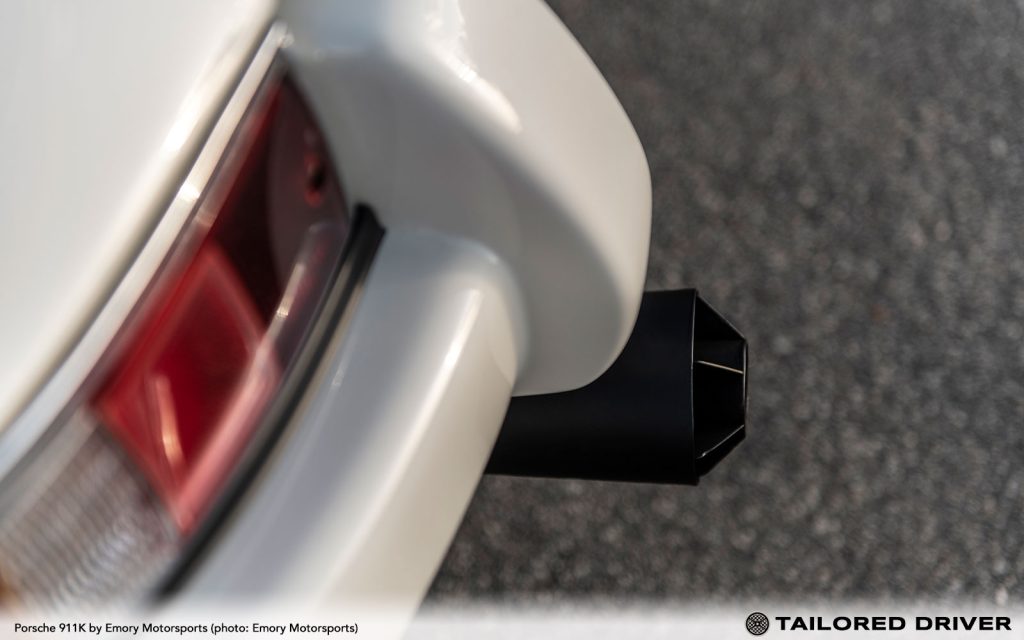
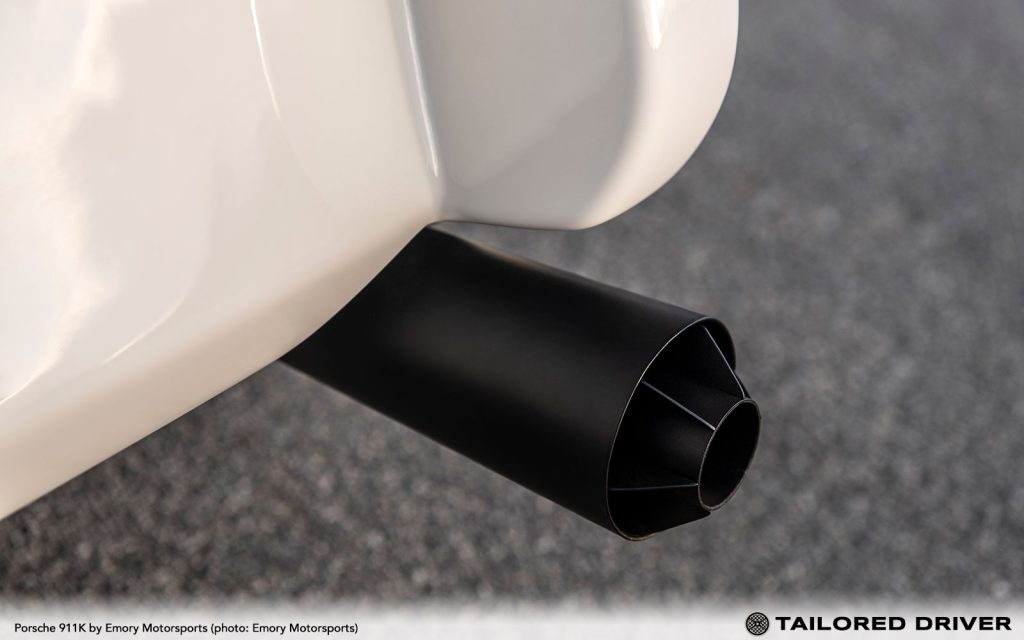
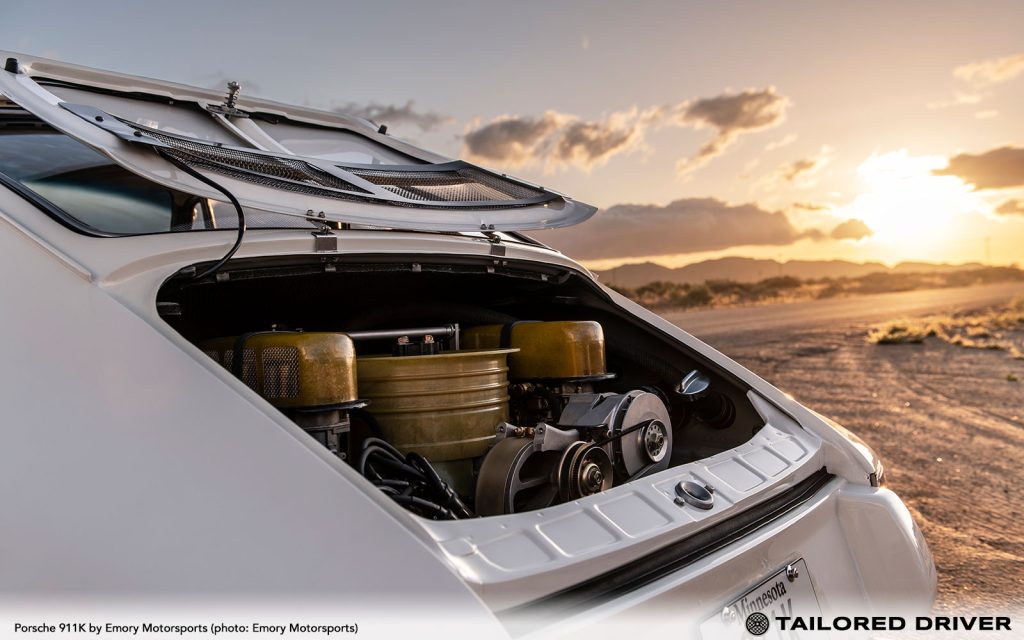
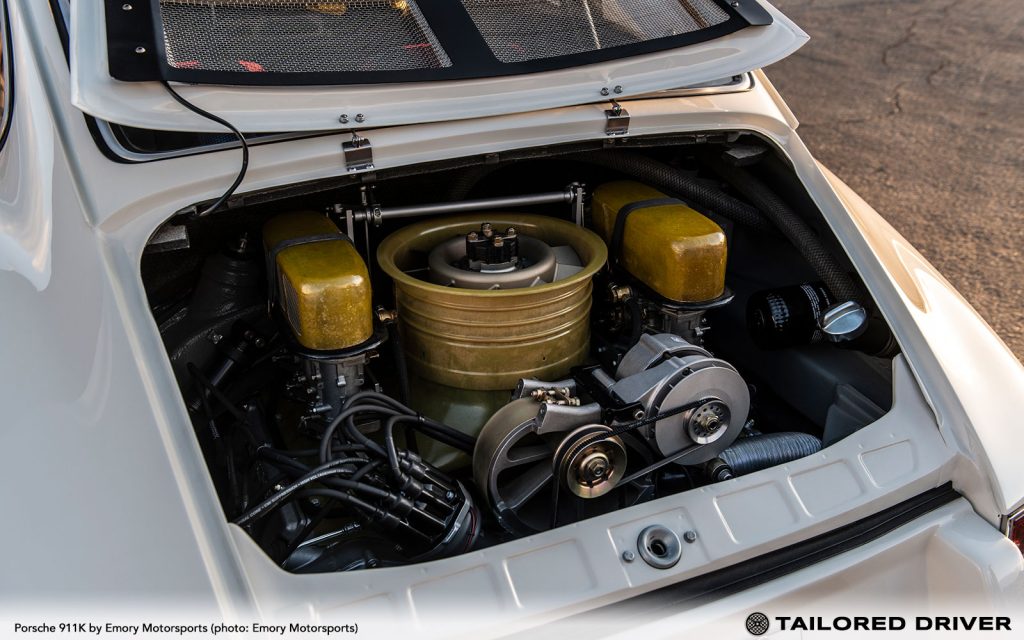
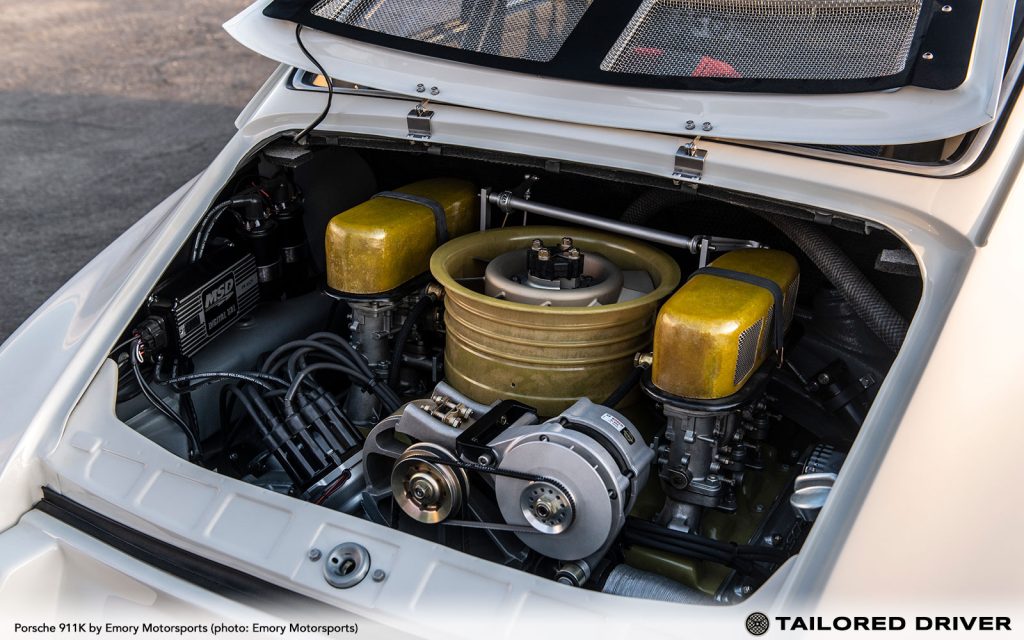
Power for the 911K comes from a later 2.5-liter twin-plug 911 engine. The hot-rodded six-cylinder powerplant produces 190 horsepower with the help of an MSD brain, Weber 40 IDA 3C carburetors, and 908-style cookie-cutter megaphones. Other details include a 935 “flat” cooling fan and shroud, hand-laid amber fiberglass airboxes, and a full-flow oil system with remote filter and cooler. A Fuel Safe fuel cell with through-fender competition filler feeds the engine.
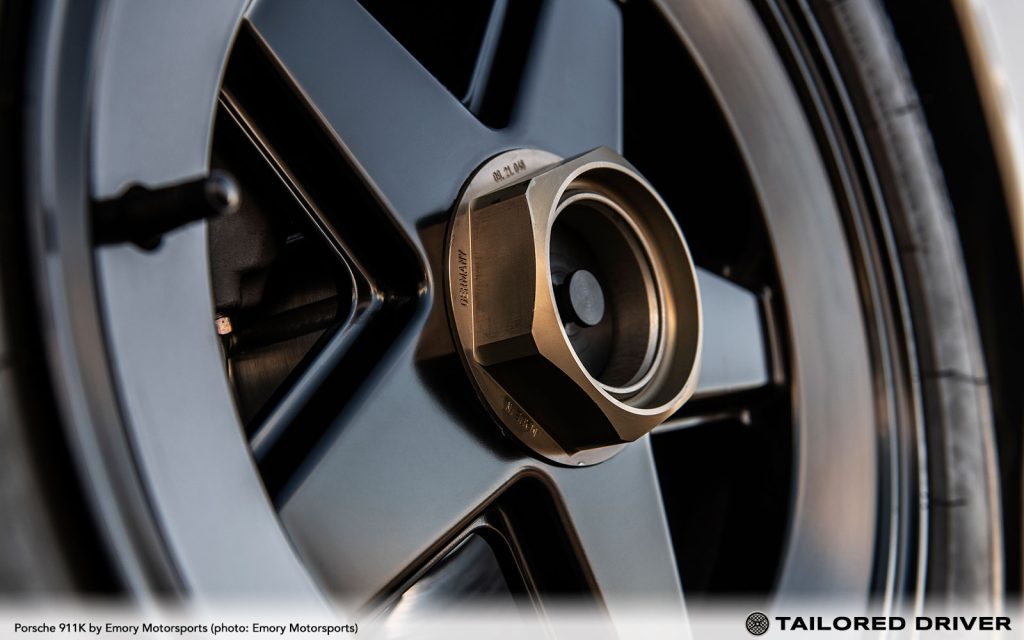
To counter the impressive engine, Emory Motorsports upgraded the brakes with 911 S alloy calipers with custom rotors and hats. Grip is courtesy of the Pirelli CN36 tires on custom 15×7 908-inspired 5-spoke wheels by 1552 rotating on Porsche 935 Carrera centerlock hubs. The suspension was chosen with track days in mind: 3-way fully adjustable KW coil-over gas shocks that provide great drivability in a variety of conditions.
In all, Rod Emory pulled inspiration and design influences from key Porsche models to create the 911K, but the overall effect is restrained and tasteful. Attention to detail and fabrication mastery define all Emory builds, whether they be 356 or 911. This Emory ‘Outlaw’ is exceptional on many levels and was named ‘Favorite 911’ of Luftgekühlt 6 by many attendees.
For more information on Emory Motorsports, please call 971.241.7017 or visit EmoryMotorsports.com or @rodemory on Instagram.
EMORY MOTORSPORTS EMORY OUTLAW 1968 PORSCHE 911K
Vehicle: 1968 Porsche 911K SWB
Engine: 2.5-liter twin-plug 911
Power (est.): 190 HP
Suspension: 3-way fully adjustable KW coil-over gas shocks all around
Wheels: 15 x 7″ dished 5-spoke custom 908-inspired center-lock wheels by 1552
Tires: Pirelli CN36
Body: 1968 911 SWB
Paint: Porsche Light Ivory with signal yellow nose accent
Accessories: Momo Shift knob, Momo Prototipo steering wheel, Amber fiberglass dashcap, removable roll bar, R-style door panels with lightweight pulls, leather window pulls, 5-point competition harnesses
Founded in 1996 by Amy and Rod Emory, Emory Motorsports initially provided turnkey prep, repairs, and logistics for vintage racers. When Rod Emory began doing custom builds, the company eventually evolved into one of the world’s leading resources for Porsche 356 customization and restoration.
Rod Emory’s automotive roots date to 1948, when his grandfather Neil Emory founded Valley Custom Shop. An innovator in body chopping and channeling, Neil Emory created the bodywork for the infamous land-speed record-holding SoCal Streamliner. Rod’s dad, Gary, created the first Baja Bug while working as parts manager at Chick Iverson Porsche in the 1960s. He later founded Porsche Parts Obsolete and became the go-to source for hard-to-find replacement parts.
Rod applied his grandfather’s sheet-metal fabrication skills and dad’s Porsche obsession and design sensibility to the 356 models. Porsche purists labeled the Emorys as ‘Outlaws’ when they dared attempt to enter shows in the 1990s with subtly modified cars that combined OE parts from different models. The Emorys happily became champions of the Porsche Outlaw movement. Since then, Emory Motorsports has stunningly rejuvenated more than 180 Porsche 356s and a few early 911s. The company also meticulously restored what is now regarded as the most historically significant Porsche ever, a 356 SL Gmund that took a class victory at the 1951 24 Hours of Le Mans–Porsche’s first international race win.